Japan PM under fire over US base deal
Press TV – May 25, 2010

A protest against relocation of US base in Okinawa on Sunday
Japan’s beleaguered Prime Minister Yukio Hatoyama faces fresh criticism after he made a decision to keep a controversial US airbase on the Japanese island of Okinawa. The latest attack on Yukio Hatoyama came from coalition partner Social Democrat Party (SDP) leader Mizuho Fukushima.
Hatoyama’s coalition partner criticized him for prioritizing negotiations with the US and failing to work out an agreement with his political partners, The Japan Times reported on Tuesday.
Earlier on Monday, Tokyo and Washington reached an agreement on moving Futenma base to the north side of Okinawa rather than off the island.
Fukushima slammed Hatoyama’s decision to allow the US base to be re-located inside Okinawa and went on to call for the immediate removal of the airbase from the island.
Earlier in December, Fukushima threatened to leave the ruling coalition over the airbase row.
Hatoyama had promised to remove the base off the island during his election campaign, which brought his Democratic Party of Japan (DPJ) to power in a sweeping victory.
The airbase has been under US command since after World War II. More than half of some 47,000 US troops in Japan are stationed in Okinawa. The issue has been the biggest challenge for Hatoyama’s government, with his approval rating dropping dramatically across the country over his failure to appease the islanders.
Interview: ethnic cleansing inside the green line
Nora Barrows-Friedman, The Electronic Intifada, 25 May 2010
|
|
Israel denies Palestinians in “unrecognized villages” basic services like water and electricity. (Yotam Ronen/ActiveStills) |

Al-Masadiya, al-Garin, Khirbat al-Watan, Bir al-Hamam, Khashem Zana, Sawin, al-Shahabi, Wadi al-Naam and al-Mashash are all Palestinian Bedouin villages facing destruction by bulldozers and cement mixers as Israel’s transportation ministry plans to lengthen its Trans-Israel Highway southward into the Naqab (Negev) desert. This means that more than 3,000 Palestinian Bedouins could be displaced if an injunction filed by Israeli civil rights nongovernmental organizations (NGOs) doesn’t succeed in the high court.
Spokespeople for Bimkom (Planners for Planning Rights), the Association for Civil Rights in Israel and the Regional Council for Unrecognized Villages in the Negev, some of the groups filing the injunction, say that the Israeli government approved the highway construction without consideration for indigenous populations in the Naqab.
The Israeli daily Haaretz reports that the highway extension is part of the Israeli government’s plan for “development” of the Naqab, which also includes the construction of a massive Israeli military training facility at the Southern end.
More than 80,000 indigenous Bedouins live in the Naqab desert region, in dozens of so-called “unrecognized villages” — communities that the state has refused to acknowledge despite the fact that most of them have existed before the State of Israel was established. Moreover, Israeli politicians often refer to the areas as “empty” in order to create support for building new Jewish settlements, removing the indigenous populations in continuation of an ethnic cleansing project that is now more than 62 years old.
On a regular basis, Israeli bulldozers and squads of police invade Palestinian Bedouin villages, carrying out widespread home demolitions and leaving entire communities reduced to rubble. While such Israeli rights violations in the occupied West Bank including East Jerusalem have generated protest, it is less known that such policies are in place in Israel itself.
Rawia Abu Rabia, a social activist and human rights lawyer with the Association for Civil Rights in Israel, represents her community and advocates for their human and civil rights as the state continues to discriminate and uproot citizens across the country. Nora Barrows-Friedman interviewed Abu Rabia for KPFA’s Flashpoints Radio on 13 May.
Nora Barrows-Friedman: Rawia, can you talk about the current crisis facing the indigenous populations living inside the State of Israel? Explain what these so-called unrecognized villages are, and tell us about the level of institutionalized racism, discrimination and home demolitions right now.
Rawia Abu Rabia: First, we’re talking about the indigenous Bedouin community who are part of the Palestinian people. They are citizens of Israel, although they are not treated as equal citizens. Half of the Bedouin indigenous communities have existed before the establishment of the state, for many centuries, as agricultural workers. They were internally displaced by the State of Israel, starting from the Nakba in 1948, where they were transferred to a certain geographical area. They were restricted from moving from one place to another until 1966, as part of the military regime policy that Palestinian citizens of Israel were subjected to.
Then, the state decided to organize the Bedouins and established seven governmental townships that are among the poorest towns in Israel, forcibly moving the Bedouins into this tight geographical area known for its low agricultural fertility. The purpose was to have as many Bedouins as possible on minimum land. Their ancestral lands were given to new Jewish cities and other urban areas, while they were restricted from returning to their historical villages.
Then, the state started to make different laws in order to take over new areas of Bedouin land. In 1965, Israel’s implementation of the construction and building law, which designed the master plan for Israeli cities and villages, didn’t take into consideration any of the Bedouin villages. By doing that, the state used the law and the legal mechanisms to displace the Bedouins and make them illegal. That’s why today we have about 80,000 Bedouin Palestinian citizens of Israel who live in about 35 villages that the State of Israel refuses to recognize. What I mean by lack of recognition is that the villages don’t appear on official maps. They are denied basic services: running water, electricity, and garbage disposal. People aren’t allowed to build permanent houses, and those who do risk heavy fines and home demolitions.
In 2009, 254 houses were demolished in these villages. The State of Israel and state officials ignore their existence. They are invisible citizens in the eyes of the law. The other half of the Bedouins live in the seven townships that are among the poorest and underdeveloped towns of Israel. The rate of dropout from schools in these villages is almost 60 percent, the rate of unemployment is extremely high and the level of education is very poor … the Bedouins are not entitled to the same rights as the Jewish citizens.
The saddest thing is the institutionalized racism and discrimination that is written into the law. Especially laws related to the land issues — which are designed to criminalize the Bedouins and make them illegal.
NBF: What do the laws actually say; what is written in these laws?
RAR: First of all, the laws related to land issues are discriminatory. For example, since the establishment of the State of Israel in 1948 until today, hundreds of Jewish cities and agricultural settlements were established, while no Palestinian villages or cities were established except for the seven townships that I mentioned. Another example is the issue that this area in which the Bedouins are concentrated, is basically the only place that Bedouins can live. If a Bedouin wants to live in another place, he will face all sorts of discriminatory mechanisms, such as criteria to be accepted to live in certain towns in Israel.
I mentioned this construction and building law from 1965, the Master Plan, that didn’t include any of the Bedouin villages. So by the law, the Bedouin villages are illegal. Today, in many Palestinian villages in Israel, when people want to build homes or expand their villages, they don’t get permits from the planning authorities to do so. By doing that, they are deprived from the basic right of housing and the state doesn’t provide any alternative.
Even when the homes are demolished in the unrecognized villages, no compensation or alternative housing is provided by the state, even though, according to international law, such an alternative should be provided.
There are other laws, such as the citizenship law, [that are discriminatory]. If you are a Palestinian Israeli citizen and want to marry a Palestinian from the occupied territories or another Arab country, your spouse will not get [Israeli] citizenship. He is deprived; while if you are a Jewish Israeli, and you want to marry a foreigner from a country abroad, he can move into the process of citizenship. There is also the law of return, which is a law that says that anyone who has a mother who is Jewish can come to Israel and get Israeli citizenship, while Palestinians who were expelled in 1948 — refugees, as we all know — cannot return. They cannot get any rights, and their properties and land are declared as “absentee property” even when the people who own these lands are not absent — they’re still alive.
NBF: In April 2010, the Bedouin village of Twail abu Jarwal in the Naqab was demolished for the fortieth time in the last few years. Tell us about these kinds of actions by the Israeli government, and what happens to people during these home demolitions.
RAR: We’re talking about home demolitions — but the “homes” we’re talking about are very poor shacks and tents that are being destroyed. And these are young communities. About 70 percent of the Bedouin community is below 18 years old. These bulldozers come into these poor places, these shacks and tents, and demolish them. The purpose is meant to pressure the Bedouins into leaving their land, so the state can take control over their land.
There are other mechanisms used to take over land as well, such as the Jewish National Fund — which recently planted trees on the land of the al-Araqid tribe. These are other forms and mechanisms to take over more and more land, and to pressure people to leave their land. The Bedouins know this, and based on the bitter experience of the Palestinian people, they know that the only way that they can have a chance to keep their land is to physically stay on their land — sumoud (steadfastness). [Israel’s policies are] a very aggressive way to push people off their land without any consideration of international law, or of the declaration of the rights of indigenous people, et cetera. This actually pushes people to be hostile, and to lose any trust in the Israeli authorities; legal or otherwise. People become bitter when they see this discrimination alive, in front of them; when they see the bulldozers come and destroy their homes without any compensation or alternative, nothing.
NBF: Walk us through one of these Bedouin villages. Talk about the kinds of conditions that Bedouins are living in right now as they face home demolitions, and what kinds of services people are prevented from accessing as villagers in these communities.
RAR: Most of the unrecognized Bedouin villages lack health services and other services as well. If they want to access services in the nearest Jewish city or elsewhere, they first have to walk for miles to get to the main road. And then they have to find transportation, since there is no public transportation within these villages. The few services, the few clinics that we have in some of the villages, are results of petitions to the supreme court. None of the villages are connected to electricity at all. So when a bulldozer comes and destroys houses during the winter time — we’re talking about the desert, which is very cold at night — you can imagine that they will be left with no ways to find heating or other protection, other solutions.
NBF: We’ve been following the story of the Palestinian “unrecognized” village of Dhammash, outside of Lydd near the Ben Gurion Airport, 20 minutes from Tel Aviv. The people there are in and out of the high court, hoping to get another injunction to prevent the bulldozers from demolishing 13 homes there. Can you talk about what’s happening to communities like this, which are inside more urban areas around the state, Palestinians who are forced into displacement as the Jewish communities grow and expand?
RAR: I think that the issue of the Bedouins is not disconnected from the issues of other Palestinian communities living inside Israel. This is part of the daily situation we all face as Palestinian Israeli citizens who are treated as second-class citizens or worse. The land is the main resource that has been denied to the Palestinians.
For instance, in Jaffa, which a mixed city of Jews and Palestinians, we see how Jaffa is developing for the Jewish citizens while the Palestinian citizens are kicked out of their neighborhoods. This is the issue of the Naqab with the Bedouins, it’s the issue of the mixed towns of Jaffa or Lydd, and it’s also the issue in the Galilee, where there are many home demolition orders as well. This is the same cause. This is the feeling of the Palestinian citizens of Israel — we were displaced in 1948, and in 1967, and the process of internal displacement is still happening all the time. Especially now, with the right-wing government that is following these racist policies and pushing Palestinian Israeli citizens more and more out of their villages, and are being delegitimized as a people.
I think this is what links the whole cause. It’s the cause of being Palestinian, and being a Palestinian Israeli citizen who is being treated in an unequal way.
NBF: You met the Special Rapporteur for Indigenous People at the United Nations in New York recently, tell us what went on in the meeting and what the UN is doing to address the critical needs for the Palestinian and Bedouin communities inside Israel.
RAR: Yes, I had a meeting with the Special Rapporteur, Professor James Anaya, and I explained to him the situation of the Bedouins in the Naqab and the internal displacement, the home demolitions, and the decision of the Israeli government to triple the home demolition orders for Bedouin villages, and he’s very much concerned with the situation of the Palestinian Bedouins in the Naqab. He mentioned that he will follow up with the situation. I urged him to come and visit these villages and see for himself. I could sit there and describe this to him, but the best thing is if he could come and see the demolitions that are taking place, the actions that are taking place to push people away from their land and houses. I hope he accepts the invitation and comes and visit. But he said that in the meantime, he said he will follow up the issues that I have raised with the Israeli government.
NBF: Talk about your work as a lawyer for these communities. What is it like representing their concerns as the state pretty much goes ahead and continues to de-populate, displace and discriminate on a daily basis?
RAR: As a lawyer for human rights, working at the Association for Civil Rights, I face challenges all the time. On the one hand, I face discrimination as a Bedouin citizen of Israel — when I came back from the UN on El-Al airlines, I faced a huge humiliation because I’m an Arab. But on the other hand, the only effective tool that I can use to advocate for my people is the legal tool. It’s a challenge all the time, because you have to be optimistic. My biggest dilemma is, how can I advocate for equality within a discriminatory reality? This is a big challenge — because sometimes, the supreme court makes good decisions, but sometimes, because of some discriminatory laws, it could make a decision that is not the best for my people … And I believe in the international mechanisms as well, that we have to use these to put pressure on Israel to change its policies towards the Bedouins.
People, sometimes, are very frustrated with the situation, especially when they see that the legal system is not equal … people think that the legal system is supposed to provide answers, but not in all cases. That’s the situation. We have to promote equality in an unequal reality. We don’t have any other options — we have to continue in this way.
NBF: Israeli politicians regularly describe the state as a moral democracy for all of its citizens, but it’s clear that it’s a democracy only for a preferred ethnicity, or a preferred religion. What can you say about what democracy looks like in historic Palestine today, and what’s your response to how Israeli leaders represent their policies?
RAR: Like Member of Knesset Ahmad Tibi said, “Israel is a democratic state for the Jews, and a Jewish state for the Arabs.” This describes the situation … And others, like professor Oren Yiftachel, who said that it’s actually an ethnocracy, it’s not democracy. We could argue whether it is a democratic and Jewish state or not. Israel doesn’t have a constitution. It doesn’t have a separation between religion and the state. It has problematic issues related to violations of women’s rights because of a lack of separation between religious laws and the state. So, it’s a very problematic democracy. And we are also witnessing harassment of human rights activists and organizations that are the last refuge for a democracy. They are the only voices that talk about human rights violations that are taking place in the so-called democratic state.
NBF: You’re referring to your colleague, Ameer Makhoul of Ittijah – Union of Arab Community-Based Associations and others in the last few weeks who have been detained, prevented from leaving the country. And Makhoul’s story was under gag order in the Israeli media. What more can you say about this crackdown on Palestinian civil rights activists and organizations, who are trying to represent the interests of the indigenous populations there?
RAR: I think the gag orders are problematic and they’re happening more often. It’s very concerning, as Israel wants to see itself as a democracy. A democratic state is not supposed to let things happen in the dark. We’re very much concerned with these gag orders being issued easily. Actually, Adalah [the Legal Center for Arab Minority Rights in Israel] and the Association for Civil Rights are asking the courts to remove these gag orders. And people know about these cases already. It’s a globalized world; people are reading about what’s happening on the Internet, they hear about it anyway, so [the gag orders] are kind of absurd.
But I think this is also part of the steps that are being taken against Palestinian leaders in order to silence them as they advocate for their cause. We’re doing our work according to the legal system, and this is a way to silence these voices.
Nora Barrows-Friedman is the co-host and Senior Producer of Flashpoints, a daily investigative newsmagazine on Pacifica Radio. She is also a correspondent for Inter Press Service. She regularly reports from Palestine, where she also runs media workshops for youth in the Dheisheh refugee camp in the occupied West Bank.
How the Israel lobby defended Israel’s military ties to apartheid South Africa
By Paul Woodward on May 24, 2010
In a review of Sasha Polakow-Suransky’s new book, The Unspoken Alliance: Israel’s Secret Relationship with Apartheid South Africa, Glenn Frankel describes how spokesmen for American Jewish organizations acted as apologists or dupes for Israel’s arms sales to the apartheid state.
In the early days of the arms supply pact, Israel could argue that many Western countries, including the United States, had similar surreptitious relationships with the apartheid regime. But by 1980 Israel was the last major violator of the arms embargo. It stuck with South Africa throughout the 1980s when the regime clung to power in the face of international condemnation and intense rounds of political unrest in the black townships.
By 1987 the apartheid regime was struggling to cope with the combination of internal unrest and international condemnation to the point where even Israel was forced to take notice. A key motivator was Section 508, an amendment to the anti-apartheid sanctions bill that passed the U.S. Congress in 1986 and survived President Ronald Reagan’s veto. It required the State Department to produce an annual report on countries violating the arms embargo. The first one, issued in April 1987, reported that Israel had violated the international ban on arm sales “on a regular basis.” The report gave South Africa’s opponents within the Israeli government and their American Jewish allies ammunition to force Israel to adapt a mild set of sanctions against South Africa. I was in Jerusalem when Israel admitted publicly for the first time that it had significant military ties with South Africa and pledged not to enter into any new agreements — which meant, of course, that existing agreements would be maintained. It was, writes Polakow-Suransky, “little more than a cosmetic gesture.”
From the start, spokesmen for American Jewish organizations acted as apologists or dupes for Israel’s arms sales. Moshe Decter, a respected director of research for the American Jewish Committee, wrote in the New York Times in 1976 that Israel’s arms trade with South Africa was “dwarfed into insignificance” compared to that of other countries and said that to claim otherwise was “rank cynicism, rampant hypocrisy and anti-Semitic prejudice.” In a March 1986 debate televised on PBS, Rabbi David Saperstein, a leader of the Reform Jewish movement and outspoken opponent of apartheid, claimed Israeli involvement with South Africa was negligible. He conceded that there may have been arms sales during the rightist Likud years in power from 1977 to 1984, but stated that under Shimon Peres, who served as prime minister between 1984 and 1986, “there have been no new arms sales.” In fact, some of the biggest military contracts and cooperative ventures were signed during Peres’s watch.
The Anti-Defamation League participated in a blatant propaganda campaign against Nelson Mandela and the ANC in the mid 1980s and employed an alleged “fact-finder” named Roy Bullock to spy on the anti-apartheid campaign in the United States — a service he was simultaneously performing for the South African government. The ADL defended the white regime’s purported constitutional reforms while denouncing the ANC as “totalitarian, anti-humane, anti-democratic, anti-Israel, and anti-American.” (In fairness, the ADL later changed its tune. After his release in 1990, Mandela met in Geneva with a number of American Jewish leaders, including ADL president Abe Foxman, who emerged to call the ANC leader “a great hero of freedom.”)
Even picnics in Israel are political
Neve Gordon | 26 May 2010
Our farewell picnic to Ezra Nawi before his prison term for peaceful protest carried a new message to most Israeli picnics
Picnics, like almost everything else in Israel, are often political. Oz Shelach underlines this point in his collection of short stories Picnic Grounds, where he describes how a history professor takes his family on a picnic in the pine forest near Givat Shaul, a Jerusalem neighborhood. The professor teaches his son some of the camping skills he learned while serving in the Israeli military, using old stones to block the wind and to protect the newly-lit fire. The stones, we are told, are the remains of a village known as Deir Yassin.
Although Shelach does not say as much, Deir Yassin was a Palestinian village located on the outskirts of Jerusalem. The Jewish neighborhood, which now stands in its place, was built not long after Israeli paramilitary forces evicted its Palestinian residents, while massacring an estimated 100 men, women and children out of a total population of 600. Shelach does not recount this history; he simply describes how the father builds a fire with his son and then ends the story by noting that the history professor “imagined that he and his family were having a picnic, unrelated to the village, enjoying its grounds, outside history”.
Many picnics in Israel take place in pine forests that were planted to cover the remains of hundreds of Palestinian villages destroyed in 1948. Wittingly or unwittingly, these gatherings have a political effect, since the people enjoying their leisure time on these sites reenact the historical suppression of the Palestinian Nakba.
This past Saturday [22 May] I also went on a picnic with my family, but in stark opposition to most Israeli picnics it tried to enact a remembering by exposing the continued domination and expulsion of Palestinians. We joined a group of Jews and Palestinians from Ta’ayush in the South Hebron desert to break bread together and bid farewell to Ezra Nawi, who the following day began serving a jail sentence for resisting Israel’s occupation.
We chose this spot because almost a decade ago the Palestinian cave dwellers who lived there were expelled from their ancestral land by Jewish settlers from Susya; these settlers were supported by the Israeli government, military and courts. Nawi and other Ta’ayush activists have, over the years, aided the expelled Palestinians to return to the last swathe of land they can still call their own. Today there is a small village made up of over 10 tents, a few caves, several scores of sheep and chicken and a solar- and wind-based electricity system.
Located just a few kilometres from where we sat is Um el-Hir, another small Palestinian village where in 2007 Ezra Nawi was arrested for protesting against the demolition of a tin shack. While the entire protest was filmed, the border police officers claimed that Nawi attacked them during the few seconds that he ran into the shack and that consequently were not captured on video.
Two points need to be stressed. First, the movie clearly shows how a few minutes earlier Nawi took a rock out of the hands of a Palestinian woman and threw it on the ground so that she would not use it against the police. Second, anyone who is familiar with the Israeli border police knows that if Nawi had actually attacked the officers, it is quite unlikely that he would have been able to walk out of the shack.
Claims like these did not persuade judge Eilata Ziskind who convicted Nawi. Based solely on the officers’ testimonies, Ziskind sentenced Nawi to a month in jail and an additional three years probation, during which if he is caught insulting an officer, disturbing the public order, participating in an illegal protest, etc, he will immediately be imprisoned for six more months.
This sentence is not a minor matter. The Israeli court has basically decreed that the only legitimate way to oppose the occupation is by standing on the side of the road with some kind of placard. Any form of civil disobedience or direct action, like lying in front of a bulldozer that is building the annexation barrier or demolishing a house, picking olives in a grove or walking Palestinian children to school in an area that has been classified a closed military zone, is now subject to harsh punishment.
Thus, Nawi’s conviction points to a relatively recent development regarding the restriction of resistance to extremely passive modes of protest. And, in some cases, even these kinds of protests are prohibited, as in Sheikh Jarrah where activists are repeatedly arrested simply for demonstrating against the seizure of Palestinian homes in East Jerusalem.
As Nawi put it during the picnic, in a country where laws are immoral, civil disobedience is obligatory; therefore, he continued, it will not be long before more of you will join me in jail. As he walked away, I looked towards the soldiers who stood gazing at us from a nearby hill, wondering whether soon picnics too will be considered acts of civil disobedience.
Neve Gordon is the author of Israel’s Occupation. He can be contacted through his website, www.israelsoccupation.info.
Long-separated family reunites in Gaza through tunnel
Rami Almeghari writing from occupied Gaza Strip, Live from Palestine, 25 May 2010
 |
| Naima Akkawi and Mahmoud Jouda’s children Rimas and Riwan. |
Naima Akkawi, a 40-year-old Moroccan native, is finally back home in Gaza with her husband Mahmoud Jouda and her two young children, Riwan (5) and Rimas (3) after an enforced absence of 10 years.
During that long and agonizing separation, Mahmoud and Naima did all they could to get back together through official channels but it was all to no avail. Finally, Naima, who had been living mostly in Morocco with Riwan and Rimas, decided to take the risk of going through a tunnel in order to be reunited with her loved ones.
“Since 2000, I have not been able to visit the Gaza Strip,” Naima explained, “a period in which I have endured every possible bad feeling being away from my dear husband.” Until 2007, she says during an interview at her newly established cosmetics shop in the Maghazi refugee camp in central Gaza, when Israel tightened its siege on Gaza, the couple were able to meet in Morocco or in Cairo.
Naima has been with her family in Gaza for almost six months, but it took a year of thought and hesitation to take the risky decision to go underground into one of the many tunnels that have become Gaza’s main lifeline to Egypt and the world beyond.
Since June 2007, Israel enforced a total closure of all of Gaza’s border crossings and Egypt sealed off the only gate into its territory, opening it only rarely for any of Gaza’s 1.5 million residents. The blockade has led to the excavation of numerous tunnels along the Gaza-Egypt border line. Gazans use such tunnels to bring in essential goods and commodities such as foods, cement, electronics and thousands of other items.
Recalling conversations with her husband, Naima said “He used to try to convince me to come across the border through a tunnel. I used to have a mix of feelings — I was worried about the risk but also so anxious to reunite with Mahmoud. Eventually I opted to take the risk.”
Back in the Moroccan city of Meknes where Naima lived before she moved to Gaza, she and many other neighbors and friends worried about family members who had married into families in Gaza.
“Actually, the Moroccan people are extremely sympathetic to the Palestinian people,” Naima said. “Many times I used to hear people talking about going to Palestine to show solidarity or take any action for the sake of those suffering under Israeli attacks and blockade.”
“The day I decided to travel from Morocco on way to Cairo, I felt excited and worried,” Naima recalled. Once in Cairo, she and her daughters stayed at her father-in-law’s house for about three weeks.
 |
| Naima Akkawi in her newly-opened cosmetics shop. |
“One day I received a call from Mahmoud, asking me to prepare for travel to Gaza,” she said. “That day a man came over and took us to the border area at the Egyptian side.”
In the Egyptian border town of Rafah, Naima stayed in a house with an elderly couple. “After we had breakfast that morning, the elderly couple assured me and showed me the path to the underground tunnel that we were supposed to take en route to Mahmoud, who was waiting for us at the Gaza side of the border. I held my children with my arms and entered a small door that was down a few steps. The moment was so incredible to me but I had to endure it as I was heading for my husband who I have not seen for the past three years and I was heading for the normal family life that I have been deprived of for the past 10 years.”
It took only a three-minute walk to reach the Gaza end of the tunnel. “During the walk I hit my head as the tunnel is very narrow and low,” Naima remembered. “At the end of the tunnel, someone placed my daughters in something that was like a swing, which went up a 26-meter shaft to the surface. Right after them, I went up and there I saw Mahmoud.”
Mahmoud Jouda told EI that it was not difficult to bring his family through the underground tunnel — but it was a last resort.
“I have done all my best for the past three years to bring my wife and my little daughters to Gaza, but all efforts were useless as the border crossings have been closed for all this time. I had no choice but to bring them through a tunnel.”
According to Mahmoud, “All you need is to coordinate well with a tunnel owner, so you can bring your family in. I encourage all those wanting to reunite with their families to take this step right away as our situation seems to be endless.”
In the first few months of her stay in the Maghazi refugee camp, Naima used to get worried by the frequent sound of nearby bombardment. “Every time there’s an explosion, Naima gets worried and asks me what’s happening,” said Mahmoud.
At the front door of her store, Riwan and Rimas played as their mother received customers. Life goes on despite the closure of the border and the crippling Israeli blockade.
“Gazans teach others like myself how to be patient, tolerant and resilient,” Naima said. “The suffering they have been enduring is quite rare in countries like mine. I just hope that Moroccans and other Arabs extend a hand of real support to the Palestinian people, who are definitely brothers and sisters for all us Arabs.”
All photos by Rami Almeghari.
Rami Almeghari is a journalist and university lecturer based in the Gaza Strip.
In the Zionist Entity: The Authorities and the Public would prefer to outlaw Human Rights Organizations
By Adib Kawar – May 25th, 2010
“Promised Land”– news and opinion from Israel – Ma’ariv (p. 12) by Arik Bender, wrote an article dated April 29th 2010 entitled Knesset moves to outlaw human rights organizations in Israel, “Something very troubling is happening to “the only democracy in the Middle East”.
“More than 20 MKs, including members of opposition party Kadima, proposed a new bill which will make it possible to outlaw important human rights groups in Israel. Among the organizations mentioned in the proposed bill are Doctors for Human rights, The Coalition of Woman for Peace, The Public Committee against Torture in Israel, and Adalah: the Legal Center for Arab Minority Rights. All these organizations receive funds from the New Israeli Fund.
The article proceeded by saying:
“According to a report in Maariv, the new bill will outlaw any organization “which is involved in activity intended to lead to the prosecution or arrest of IDF officers and government officials for war crimes.” The word “involved” gives it a very broad definition.
Note the phrase with which the article was started with: “Something very troubling is happening to “the only democracy in the Middle East”. Isn’t this more than true? More than probably it is, when we see that more than 20 MKs of the “Israeli Knesset”, which is the “Israeli” parliament, “proposed a new bill which will make it possible to outlaw important human rights groups in Israel”, and more than half of those who are considered “Israeli” support limiting and curbing activities of Human Rights organizations!
So what is left of democracy if the activities of human rights organizations are limited, curbed and illegitimated, especially in what is claimed to be the only democracy in an entire region and a central part of the world?
We mean the rights of the occupied people being trampled on by a certain group of people, including the occupier taking the liberty of restraining freedom of expression in addition to limiting the human rights of other people by denying them free movement. The occupiers, citizens of the Zionist state, illegally occupy and steal land other kinds of property, and have been doing so continually. Not only is property their concern, but they take the lives of the occupied people, be they young or old, by any sort of assassination or targeting. Let us not forget how they demolish and then take possession of the property of Palestinian Arabs and throw their residents in the street to be replaced by Zionist racist invaders.
We mean in an entity where the death penalty by its courts is banned against its citizens, but where its executive body and its elected juridical body, including its supreme court of justice, the highest judicial body, permits its executive body to overturn law to permit assassination of those it chooses by its armed forces or intelligence, whether internal or external. This means that the death penalty is not permitted by law against the entity’s first class citizens belonging to a certain religious faith, which the state claims to assume this religious character, but it certainly may be imposed on other categories of citizens and occupied non-citizens who belong to other religious faiths and ethnicities.
We mean this entity which permits itself to threaten its neighbors in Arab and non-Arab states and resistance forces and punishes them just because they dare to arm themselves. An occupied people is entitled to arm themselves by prescriptions of international law so as to enable themselves to defend their sovereignty with effective arms and weapons. They do this because it is their right. They must simply “break the existing balance of power with an illegal entity” that uprooted an entire population from its ancestral homeland, an entity that owns formidable conventional and unconventional arsenals of arms and weapons. These arsenals have allowed this rogue entity to wage an unending series of wars and terror operations against the indigenous population of the land it occupied with the aim of replacing them, as well as threatening its Arab neighbors and far away non-Arab and non-neighboring countries with demolition and destruction, just because they want to develop their lands and strengthen their citizens.
We mean this entity that issues an order it calls No 132 by the strength of which it is legal to put infants on trial and imprison them.
A public opinion poll published in the “Israeli” daily Haaretz showed that the majority of Jews in occupied Palestine desired to curb the activities of human rights organizations, and wants to punish those who uncover unethical and illegal military activities and also to strike the press that publishes information about that. The results of this poll simply demonstrate how undemocratic the Zionist entity is and what little interest and respect for human rights its first class citizens have. This extends as well into the public and governmental bodies, at all branches, executive, judicial and legislative.
We mean in this entity where prisoners of war who number about 8,000 in the prisons and detention camps of Zionist occupation who suffer from catastrophic health conditions and health care that is almost unavailable, and in most cases the detention is harmful for their health if not deadly, which the occupation authorities subject them to in order to achieve certain special aims. Reports said that in addition to that Zionist doctors who practice various types of torture against the prisoners of war, these doctors use them for experiments for “Israeli” pharmaceutical companies. Also proved reports said that the Zionist entity and those belonging to it steal organs of Palestinian Arab martyrs and these organs become valuable merchandise.
This poll showed that a majority of the Jewish inhabitants of occupied Palestine are Zionist by all means of the word, and not simply people who belong to the Jewish faith and respect human rights and human dignity irrespective of their religious faith or ethnicity.
The published poll results exposed the racism of the vast majority of Jewish faith inhabitants though many of their presence in occupied Palestine is illegal in every international statute regarding occupation.
The poll said that the vast majority of “Israelis” want to severely curtail, or in a less drastic, but still scandalous way, they at least support limiting activities of Human Rights organizations, and believe it is just to punish not the perpetrator of human rights abuses but rather anyone who uncovers unethical and illegal military actions. They believe it is crucial to bar the press from publishing anything about that.
The poll revealed that almost six “Israelis” out of ten, a massive 58% of those canvassed, declared that human rights organization should not be allowed to uncover unethical “Israeli” practices nor should they be permitted to practice their activities freely, while half of them, 51%, said that there is excessive freedom of expression in “Israel”.
56% said that that “Israelis” who support punishing the “Jewish state” or boycotting it should themselves be punished.
73% support severely punishing journalists who publish reports that uncover information about unethical and illegal activities committed by the “Israeli” army and/or the (Shabak).
64% see that the “Israeli” press should not be allowed to publish reports that security bodies consider to cause danger to public security.
42% said “Israelis” should not be allowed to publish reports of Palestinian sources, which puts the army in a negative position, even if what was written had proven to be correct.
We ask ourselves and we ask you, is it not time to outlaw an entity that has such little tolerance for human rights and democracy before this tendency brings more suffering and disaster to the region?
Original Arabic on http://gulagnik.wordpress.com
Related articles
- Can Zionism Fool All of the People All of the Time? (alethonews.wordpress.com)
- Death of a Proud, Self-Avowed Terrorist: Former Israeli PM Yitzhak Shamir Goes to the Great Hague in the Sky (alethonews.wordpress.com)
- The Failure of Peace without Partners (alethonews.wordpress.com)
Climate alarmism in Britain: “…the poll figures are going through the floor.”
Excerpts from the New York Times:
Climate Fears Turn to Doubts Among Britons
By ELISABETH ROSENTHAL | May 25, 2010
LONDON — Last month hundreds of environmental activists crammed into an auditorium here to ponder an anguished question: If the scientific consensus on climate change has not changed, why have so many people turned away from the idea that human activity is warming the planet?
Nowhere has this shift in public opinion been more striking than in Britain, where climate change was until this year such a popular priority that in 2008 Parliament enshrined targets for emissions cuts as national law. But since then, the country has evolved into a home base for a thriving group of climate skeptics who have dominated news reports in recent months, apparently convincing many that the threat of warming is vastly exaggerated.
A survey in February by the BBC found that only 26 percent of Britons believed that “climate change is happening and is now established as largely manmade,” down from 41 percent in November 2009. A poll conducted for the German magazine Der Spiegel found that 42 percent of Germans feared global warming, down from 62 percent four years earlier.
And London’s Science Museum recently announced that a permanent exhibit scheduled to open later this year would be called the Climate Science Gallery — not the Climate Change Gallery as had previously been planned.
“Before, I thought, ‘Oh my God, this climate change problem is just dreadful,’ ” said Jillian Leddra, 50, a musician who was shopping in London on a recent lunch hour. “But now I have my doubts, and I’m wondering if it’s been overhyped.”
Perhaps sensing that climate is now a political nonstarter, David Cameron, Britain’s new Conservative prime minister, was “strangely muted” on the issue in a recent pre-election debate, as The Daily Telegraph put it, though it had previously been one of his passions.
And a poll in January of the personal priorities of 141 Conservative Party candidates deemed capable of victory in the recent election found that “reducing Britain’s carbon footprint” was the least important of the 19 issues presented to them.
…
“Legitimacy has shifted to the side of the climate skeptics, and that is a big, big problem,” Ben Stewart, a spokesman for Greenpeace, said at the meeting of environmentalists here. “This is happening in the context of overwhelming scientific agreement that climate change is real and a threat. But the poll figures are going through the floor.”
The lack of fervor about climate change is also true of the United States, where action on climate and emissions reduction is still very much a work in progress, and concern about global warming was never as strong as in Europe. A March Gallup poll found that 48 percent of Americans believed that the seriousness of global warming was “generally exaggerated,” up from 41 percent a year ago… Read the complete story here
Turkey Rejects Israeli Deal on Gaza Flotilla
Al-Manar TV – 25/05/2010
 Israeli daily Yedioth Ahronoth reported Tuesday that Israel tried to prevent naval conflict between its occupation forces and peace activists sailing to Gaza by propositioning a number of states to transfer humanitarian aid equipment through its territory instead, but Turkey objected.
Ten boats carrying food, clothing, and construction materials to residents of the Gaza Strip left Monday from a number of countries participating in the ‘Break the Siege’ sail. Some 700 activists on board intend to reach Gaza by Thursday.
Israel pressed some of the participating countries to cancel the sail.
The Zionist entity propositioned Turkey to transfer its humanitarian aid equipment to Ashdod, from where it would be taken by the UN and international organizations into the Strip, under Israel’s supervision.
In exchange for transferring the equipment to Gaza, Israel asked that Turkey call off the sail to the Strip, however the latter rejected the offer.
Israeli Major General Eitan Dangot, coordinator of government activities in the (Palestinian) territories, suggested the deal to the Turkish ambassador recently, who said Turkey was not responsible for the sail.
Meanwhile the Israeli occupation Navy is preparing for the boats’ arrival on Thursday, with many fearing clashes between soldiers and activists when the latter are not allowed through.
Occupation soldiers will be ordered to seize the boats and take them to Ashdod’s shores, where a special detention area has been set up for Palestinian and international activists taken into the army’s custody.
US to expand secret operations
Press TV – May 25, 2010
The United States is planning to expand its secret military operations across the Middle East, central Asia and east Africa, a newly-released report says.
The secret activities are apparently designed to “penetrate, disrupt, defeat or destroy” terror cells such as al-Qaeda, the New York Times said on Monday, citing a military document.
The directive was approved in September by US General David Petraeus. The targeted countries are said to be Iran, Saudi Arabia and Somalia.
The order also focuses on intelligence gathering “by American troops, foreign businesspeople, academics or others” to forge “persistent situational awareness” in the target countries, the Times said.
Alongside those goals, the order also permits secret efforts that would prepare for potential future attacks by US forces in those nations.
Even though the document doesn’t single out a specific country for a strike, it does allow for reconnaissance ahead of possible military action, such as in Iran over its nuclear program.
The order, known as the Joint Unconventional Warfare Task Force Execute, is not under full supervision by the administration nor does it report to Congress. This means that it “cannot or will not be accomplished” by the regular military apparatus, the Times said.
General Petraeus’s order is however expected to have a “close relationship” with the Pentagon and the Central Intelligence Agency, a CIA source told the newspaper.
The new directive not only echoes moves by former president George W. Bush’s administration to expand military operations outside of warzones, but it also intends to make such efforts more systematic and long-term.
The Biggest Threat to Peace in Middle East
By Dr. Elias Akleh* | Sabbah Report | May 24, 2010
A build up of heightened tension in the Middle East is escalating in the last few weeks. American and Israeli postures towards Lebanon, Syria, and Iran have become more threatening. Listening to speeches of political leaders one hears talks only about war not peace. Iranians and Israelis are continuously training hard for a possible showdown. Both sides are conducting extensive war games every month. This led Syrians to claim that Israel is preparing for a soon-to-come another war. The Jordanians also are warning that current stalemate of the peace process is an indication of a war breaking this summer. The Russian President and his army chief hinted, few months ago, that the US and Israel were planning for an attack on Iran.
Indeed Iran is, as it has been for last few years, the target of most of the threats and accusation of supporting terrorism. Escalating incitement against Iran the American Defense Department sent Last month (April) to Congress a report on Iran’s military claiming Iran could develop intercontinental ballistic missile capable of reaching the US by 2015.
Ignoring the fact that N. Korea, India, Pakistan, and Israel are proven to have nuclear weapons while Iran does not, the US Secretary of State Hillary Clinton chose in her speech, to the nuclear Non-Proliferation Treaty review conference at the UN, to focus on Iran’s alleged nuclear ambitions putting the whole world at risk as she put it. According to Clinton Iran’s acquisition of nuclear weapons, rather than Israel’s more than 200 nuclear bombs, is destabilizing the Middle East. She called on world’s nations to rally around US efforts to hold Iran, not other nuclear countries, to account.
The accusation that Usama Bin Laden is living comfortably in Iran had received a boost after the broadcast of a documentary called “Feathered Cocaine”. This echoed the June 2003 claims of the Italian newspaper Corre de la Sierra that Bin Laden was in Iran according to some intelligence report, and according to Richard Miniter’s book “Shadow War”. This accusation was countered by Ahmadinejad in ABC News interview with George Stephanopoulos stating that, since Bin Laden was a previous partner of Mr. Bush, he is living comfortably in Washington DC not in Tehran. It was also widely reported that one of Bin Laden’s wives was living in Tehran with six of his children and eleven grandchildren.
A recent Associated Press exclusive, May 13th, written by Adam Goldman and Matt Apuzzo, reported that according to CIA monitoring program RIGOR Saad, the son of Usama Bin laden and many Al-Qaeda leaders and operative had taken refuge into Iran after 911. This exclusive disqualifies itself stating that “But generally, the U.S. has only limited information about them.”, and “Details are murky”.
The American military capitalized on such rumors when the commander of US forces in the Middle East, general Petraeus, told Congress that Tehran is working with Al-Qaeda facilitating links between its senior leaders and affiliate groups.
Syria, in turn, was not spared from American and Israeli warnings and threats. Syria was accused of violating 2006 UN Resolution 1701 prohibiting the transfer of weapons to Lebanese Hezbollah. Just before the US Congress approves sending Robert Stephen Ford as American ambassador to Syria as a sign of improving relationships, the Israeli President, Shimon Peres, accused Syria of smuggling Scud missiles to Hezbollah. Peres’ accusation prompted the Congress to suspend sending Ford to Damascus.
Major General Alberto Asarta Cuevas of the UN Interim Force in Lebanon was quoted by Lebanese daily An-Nahar as saying: “We have no evidence of any Scud missiles in UNIFIL’s area of operations.” The US, also, could not confirm any Scud missiles shipped to Lebanon. Scud missiles are large and are difficult to hide.
Although not mentioning Scud missiles in specific Israeli officials such as the head of the Israeli military intelligence research department, Brigadier General Yossi Baidatz, claimed that: “Weapons are transferred to Hezbollah on a regular basis and this transfer is organized by the Syrian and Iranian regimes.” Syria was accused of transferring sophisticated weapons, such as M600 rockets, to Hezbollah. Israel’s Foreign Minister, Avigdor Lieberman, accused Syria of importing weapons of mass destruction from North Korea to ship them to Hezbollah and Hamas.
Israeli Defense Minister Ehud Barak directly warned both Syria and Lebanon: “We make it clear once again that we see the government of Lebanon, and behind it the government of Syria, responsible for what happens now in Lebanon, And the government of Lebanon will be the one to be held accountable if it deteriorates.”
The Americans parroted the Israeli claims. Hillary Clinton warned Syria of grave consequences of delivering weapons to Hezbollah and Hamas warning that such an act “could mean war or peace for the region … Hezbollah’s acquisition of new weapons, especially long-range missiles, would threaten Israel’s security and destabilize the region.”
Robert Gates, the American Defense Secretary, had also accused both Iran and Syria of arming Hezbollah with sophisticated weaponry. Finally, citing what the White House alleged Syria’s “extraordinary threat” to US security and foreign policy, Barack Obama decided to renew economic sanctions against Syria for another year. Obama said that Syria’s “continuing support of terrorist organizations and pursuit of weapons of mass destruction and missile programs, continue to pose an unusual and extraordinary threat to the national security, foreign policy, and economy of the US”.
Israel’s fear was heightened by the visit of Russian President, Dmitry Medvedev, to Syria, the first visit to Damascus by Russian ruler since 1917, to sign an arm trade agreement by which Russia would supply Syria with Mig-29 fighters, truck-mounted Pantzir short range surface to air missiles, and anti-aircraft artillery system. Building a Syrian nuclear power plant with Russian help was also discussed by the two leaders.
Turkey’s improved relationships with Iran, Syria, and Lebanon, and its sympathy towards Palestinians worry the US and Israel the most. Since Davos incident in January 2009 between Turkish Prime Minister Recep Tayyip Erdogan, and Israel’s president Shimon Peres, Turkey seems to adopt the Palestinian cause. Turkey had sent humanitarian aid to besieged Gaza within “Viva Palestina” and “Break the Siege” campaigns, and is also sending three humanitarian ships to Gaza within the “Freedom Flotilla” campaign.
Turkey and Syria had dramatically improved their political, economic, socio-cultural, and military relationships. The two countries conducted, last April 2009, a three-day military exercise along their borders and signed a technical military cooperation agreement to strengthen collaboration between their defense industries.
Turkey had improved relationship with Iran, where trade between the two countries is expected to increase to $30 billion. Turkey had opposed economical sanctions against Iran, had repeatedly played down the alleged threat of Iran’s nuclear program, and defended Iran’s right to peaceful nuclear energy. This month, May 2010, Turkey and Brazil convinced Iran to accept nuclear fuel swap on Turkish soil.
Turkey seems determined to protect its good relationships with Syria and Iran to a point of deploying anti-aircraft batteries along the Syrian border in the Iskenderun district to repel any US or Israeli aerial attack against Iran or Syria, according to Turkish daily Hurriyet. In a phone call with Al-Manar TV, Mustafa Ozcan, a Turkish political analyst, confirmed this fact.
A Middle Eastern geopolitical alliance between Turkey, Iran, and Syria and Lebanon seems to take shape. This alliance seems to provide a counterbalance for Israel’s military superiority in the region, and a deterrent to any further Israeli terrorist attack against Gaza, Lebanon, or Syria. Israelis are afraid that they may not be able to win a war as convincingly and with impunity as they used to do, especially after their failures in 2006 Lebanese war and 2008 Gaza onslaught.
Israel’s whining about Iran’s and Syria’s weapons is meant to portray the Israelis as the poor victims, and to justify any Israeli aggression against its neighbors. It is meant also to draw in the US for its rescue, as usual. Israel wants a joint American/Israel attack against Iran/Syria/Hezbollah axis before their alliance becomes any stronger. American involvement is the wild card, as it always has been, that will maintain Israel’s superiority in the region.
While supplying Israel with weapons allegedly for self defense the US denies this right to Palestinians, Lebanese, and Syrians. Coming to Israel’s rescue, again, the US described Iran as the greatest threat to America, to its allies, to the Middle East, and to world peace by claiming that Iran is the region’s greatest proliferator of weapons and supporter to terrorist groups.
Obama cited the possibility of nuclear Iran supplying nuclear material to some terrorist groups to be used against the US and its allies. The documented facts prove that the US is the only nuclear country that had secretly supplied nuclear material to terrorist Israel to build its nuclear bombs.
In his article “America’s Loose Nukes in Israel”, Grant Smith, director of the Institute for Research: Middle Eastern Policy, explains how large quantities of America’s highly enriched uranium and plutonium was smuggled to Israel via the Nuclear Materials and Equipment Corporation (NUMEC), part of Apollo Steel Company plant in Pennsylvania. A 1965 audit by Atomic Energy Commission discovered the shortage of 220 pounds of enriched uranium, and in September 1968 587 more pounds of enriched uranium went missing immediately after the visit of 4 Israelis, including Mossad agent Rafi Eitan. Also refer to the 1978 declassified report “Nuclear Diversion in the U.S.? 13 Years of Contradiction and Confusion” regarding the investigation between 1957 and 1967 of the loss of highly enriched uranium in NUMEC.
Whistleblower former FBI translator Sibel Edmonds testified that Richard Perle, Doughlas Feith, and Marc Grossman, high ranking officials in G.W. Bush administration, were passing sensitive data and nuclear technology to Israel’s military industrial complex.
Based on 30 declassified government documents from the National Security Archive in April 2006 Avner Cohen and William Burr published the article “Israel Crosses the Threshold” in the May-June 2006 issue of the “Bulletin of the Atomic Scientists” indicating that the Nixon’s administration decided to accept and to live with Israel’s ambiguity of its nuclear weapons program, knowing very well that Israel had already built nuclear bombs.
At the Global Summit on Nuclear Security, last April, the US tried to rally nations against Iran’s nuclear program, and supported the call for Middle East nuclear-free zone. Yet the US supported Israel’s claim that it would consider signing the NPT and supporting such a nuclear-free zone only if there is a comprehensive Middle East peace.
The US, with 5,113 self-declared nuclear bombs and free of any IAEA monitoring process, is trying to use the NPT to monopolize nuclear technology and deny it to other countries. After signing the START Treaty on April 8th President Obama called for $80 billion in nuclear funding to modernize the US nuclear weapons complex to meet the need to “rebuild and sustain America’s aging nuclear stockpile”. This means making the bombs smarter, smaller in size, and more powerful. This $80 billion came on top of more than the additional $100 billion for nuclear deliver systems like submarines. The US has no intention of reducing its nukes, but to improve them.
War clouds are looming over the Middle Easter. Israeli military officials keep threatening to attack Iran claiming they can use military force to prevent Iran from developing nuclear weapons. Israel is primed to attack Iran boosted Deputy Prime Minister Moshe Yaalon. Iran is taking these threats seriously and is preparing for war through war games; two of them this month. Iran’s strongest warning to Israel came Wednesday May 19 from Iranian Chief of Staff, Esfandiar Rahim Mashaei, stating that if Israel attacked Iran it would be destroyed within a week. Sunday May 23 Israel is conducting its most intensive and comprehensive war games called “Turning Point-4” lasting five days and including 68 cities and towns. Could this be preparation for another war this summer?
During its short 62 years history Israel had fought 8 wars against its Arab neighbors. It had developed nuclear weapons and did not sign the NPT. It had used chemical and nuclear (DU) weapons against civilians. It violated many UN resolutions. It committed war crimes and many massacres against civilians. It had refused all Arab peaceful gestures and keeps threatening to attack its neighbors. It occupation and destruction of religious sites, especially Islamic, might provoke religious war in the region. Israel is the biggest threat to peace in the Middle East.
* Dr. Elias Akleh is an Arab writer from a Palestinian descent born in the town of Beit Jala. His family was first evicted from Haifa after the “Nakba” of 1948, then from Beit Jala after the “Nakseh” of 1967. He lives now in the US, and publishes his articles on the web in both English and Arabic.
Featured Video
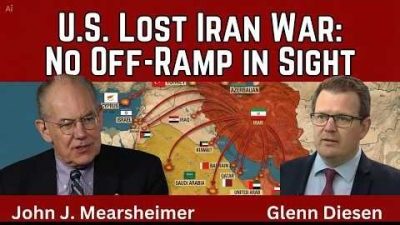
John Mearsheimer: US Already lost Iran war – No off-ramp in sight
or go to
Aletho News Archives – Video-Images
Frlom the Archives
With apparently fabricated nuclear documents, Netanyahu pushed the US towards war with Iran
By Gareth Porter | The Grayzone | April 29, 2020
President Donald Trump scrapped the nuclear deal with Iran and continued to risk war with Iran based on Israeli Prime Minister Benjamin Netanyahu’s claim to have proven definitively that Iran was determined to manufacture nuclear weapons. Netanyahu not only spun Trump but much of the corporate media as well, duping them with the public unveiling of what he claimed was the entire secret Iranian “nuclear archive.”
In early April 2018, Netanyahu briefed Trump privately on the supposed Iranian nuclear archive and secured his promise to leave the Joint Comprehensive Plan of Action (JCPOA). That April 30, Netanyahu took the briefing to the public in a characteristically dramatic live performance in which he claimed Israel’s Mossad intelligence services had stolen Iran’s entire nuclear archive from Tehran. “You may well know that Iran’s leaders repeatedly deny ever pursuing nuclear weapons…” Netanyahu declared. “Well, tonight, I’m here to tell you one thing: Iran lied. Big time.”
However, an investigation of the supposed Iranian nuclear documents by The Grayzone reveals them to be the product of an Israeli disinformation operation that helped trigger the most serious threat of war since the conflict with Iran began nearly four decades ago. This investigation found multiple indications that the story of Mossad’s heist of 50,000 pages of secret nuclear files from Tehran was very likely an elaborate fiction and that the documents were fabricated by the Mossad itself. … continue
Blog Roll
 Aletho News
- US failures in Iran reveal Russia is key to South Korea’s strategic security
- ‘All ports in Persian Gulf will be legitimate targets if Iranian ports are attacked’
- 40 Years of Endless War, Data Point by Data Point
- Department of War Using Palantir AI to Pick Targets in Iran
- American bases do not protect – they attack the peoples of the Persian Gulf
- ‘We’ve Obliterated Their Missiles’
- Syrian president vows ‘absolute support’ to disarm Hezbollah
- Ukraine attacking Russian gas pipeline to stop deliveries to Europe – Defense Ministry
- ‘Heinous crime’: Iran denounces Israeli assassination of 4 Iranian diplomats in Lebanon
- John Mearsheimer: U.S. Already Lost Iran War – No Off-Ramp in Sight
- If Americans Knew
- Israeli strategic plans to “remake the Middle East” from the 1950s and since
- Honoring Gaza’s women who refused to let the world look away
- 97% of victims of war on Iran are Iranian, 98% of victims in war on Gaza are Gazans – Not a ceasefire Day 152
- Early Iran strikes cost $5.6 billion in munitions, Pentagon estimates
- Israel Decided the War, But Trump’s America Fights and Pays the Bill
- Conscientious Objector Group: Phone ‘Ringing Off Hook’ As Huge Mobilization Underway
- U.S. support for Israel continues to plummet, despite media’s best efforts
- Threats and missiles fly, death tolls soar in Iran, Lebanon, Gaza – Not a ceasefire Day 151
- Lebanon: Israel’s White Phosphorous Use Risks Civilian Harm
- Corporate Media Go All Out To Support The US-Israeli War On Iran
- No Tricks Zone
- Destructive Green New Deal: German Energy And Metal Group Warns Of Drastic Crisis
- New Study Documents A 20-Year Pause In Arctic Sea Ice Decline – Driven By Internal Variability
- Wake-up Call: Survey Shows Majority Of Germans Now Favor Postponing Climate Targets!
- Televised! Leading German Political Candidate Tells Schoolchildren CO2 Makes Sun Hotter!
- New Study: A Century Warming Of 1.1°C Is ‘Commonplace’ And ‘Not Unusual’ During This Interglacial
- New Study: ‘Internal Noise’ And Volcanic Forcing Can Trigger 10-15°C Warming Within Decades
- Glaciers Worldwide Are Suddendly Surging, Experts Blame Warming!
- Surprising Discovery: Sahara Is Greening…Billions Of Trees Where Once Thought To Be Barren
- New Research Reaffirms Clouds, Aerosols, And Surface Solar Radiation Are ‘Driving The Climate System’
- Germany: Electric Car Catches Fire At Charging Station, Sets Off Local “Inferno”, Widespread Damage
 Aletho News