German chemicals giant reveals details of downsizing
RT | September 23, 2026
German chemicals giant Evonik is overhauling its domestic operations amid what it has described as a “structural and economic crisis” in the industry.
The German and wider European chemical sector has been hit by plant closures, job losses and high energy costs following the loss of cheap Russian supplies; the US-Israeli war with Iran has added new pressure.
The measures, announced on Tuesday, include site closures, job cuts and a reshaping of Evonik’s six main German plants, even as the company considers increasing investment in Asia and the Americas, where it sees “good opportunities for growth.”
Evonik’s plans to eliminate 2,150 jobs in Germany through 2029 have drawn criticism from industrial policy spokesman for the opposition Left Party (Die Linke) Mirze Edis, who called the cuts “a damning indictment” of German Chancellor Friedrich Merz and Economy Minister Katharina Reiche.
“Their inaction regarding chemical industry sites has now become a nationwide economic risk,” Edis said.
Evonik produces chemicals and additives used in everything from car tires and plastics to cosmetics and medicines, making it a key supplier across the economy.
Germany’s chemical sector has been among the hardest hit by the country’s energy problems. Berlin moved to end its dependence on Russian energy following the escalation of the Ukraine conflict in 2022 and turned to alternative suppliers, leaving energy-intensive manufacturers facing substantially higher costs.
Evonik said at the time that it consumed around 15 terawatt-hours of natural gas annually, more than a third of it in Germany, and warned that losing Russian supplies could “seriously jeopardize chemical production” in the country.
The war with Iran and disruption to shipping through the Strait of Hormuz have added to the pressure this year. While Germany gets most of its LNG from the US rather than the Persian Gulf, the de facto closure of the strait disrupted flows accounting for almost 20% of the global LNG supply, tightening the market and driving up European prices.
The crisis extends beyond Germany. Permanent chemical plant closures across Europe have surged sixfold from pre-2022 levels amid high energy costs, weak demand and cheaper overseas competition, according to the European Chemical Industry Council (Cefic).
British chemicals giant INEOS said this week it would close its three acetyl plants in Hull, the last major facilities of their kind in Europe, blaming soaring energy costs and carbon taxes. It said natural gas in Europe now costs 12 times as much as it does in the US, making even highly efficient plants uncompetitive.
Climate Extremists Target, Attack Large-Scale Power Grid Infrastructure In Germany
By P Gosselin | No Tricks Zone | September 6, 2026
There’s been a series of coordinated sabotage incidents targeting the German power grid infrastructure over recent weeks and months. The media initially reacted by pointing the finger at Russian involvement, but the evidence is pointing to another source.
“Climate extremism”
The hard evidence indicates no Russian involvement. Federal Interior Minister Alexander Dobrindt characterizes the new attacks as acts of “climate extremism,” citing confessory letters sent by a 48-year-old suspect claiming responsibility to protest fossil fuel use.
Attack 1. Turnow-Preilack substation / Jänschwalde (Brandenburg)
On Tuesday morning, September 1, high-voltage lines connected to the Turnow-Preilack substation—servicing the Jänschwalde (Brandenburg) power station region—were targeted using homemade launch devices. Authorities reported that the launch mechanisms used fireworks-style devices to shoot conductive wires into overhead power lines.
Attack 2. Bergheim substation (North Rhine-Westphalia)
Also on Tuesday evening, an attack occurred at a substation in Bergheim, near Cologne. Conductive materials were launched onto high-voltage lines, triggering a short circuit that forced five power generation units to shut down. Investigators recovered several launch devices and pyrotechnics near the scene. A 48-year-old suspect has explicitly claimed responsibility for this site in confession letters sent to authorities and news outlets. German security agencies highlighted key structural parallels between this device setup and the Turnow-Preilack substation incident, leading state security forces to probe links between the two.
Attack 3. Dormagen substation (North Rhine-Westphalia)
In another incident occurring last Thursday evening, a passerby alerted police after spotting suspicious device components aimed at a substation in Dormagen, south of Düsseldorf. Responding officers discovered pipes fitted with cables, timers, and launch mechanisms targeted directly at the high-voltage equipment. The attempt was thwarted before the mechanisms detonated or caused an outage.
During a joint briefing, Interior Minister Dobrindt and North Rhine Westphalia Interior Minister Herbert Reul confirmed that a manhunt was underway for the suspect following the discovery of suspected explosive materials at his residence and the seizure of his truck near the Hambacher Forst.
Major Berlin attack last January
On January, 2026, a major arson attack targeted the electricity infrastructure in southwest Berlin, resulting in one of the city’s longest and most severe power outages in decades. The fire destroyed five 110-kV high-voltage lines and ten 10-kV medium-voltage lines supplying several key substations across the region.
The sabotage cut off power and heating to roughly 45,000 to 50,000 households and over 2,000 businesses in the region. The loss of electrical heating created a major mid-winter public safety emergency. Hospitals and care homes were forced to switch to emergency generators and schools were closed for days while repair crews worked in frozen soil to rebuild the severed lines. Full power was not restored until January 7.
A confession letter posted on the far left-wing platform Indymedia claimed responsibility on behalf of theAntifa-friendly Vulkangruppe (Volcano Group). The letter framed the sabotage as a protest against fossil fuel consumption, corporate power use, and AI data centers. Berlin Mayor and Federal prosecutors designated the event as an act of political terrorism.
Police have little success
The ecoterrorist groups are difficult, to monitor, according to authorities. They operate via small, autonomous, clandestine cell structures without centralized leadership. They publish post-attack manifestos anonymously online, leaving little to no digital footprint prior to an incident. While German federal and state governments are treating the threat with urgency, critics say authorities are not taking the left-wing threat seriously enough.
In response to the January blackout in Berlin and prior high-profile grid sabotage, around 500 police officers raided 17 to 19 locations across Berlin, Hamburg, Brandenburg, and North Rhine-Westphalia. Sites searched included radical meeting spaces, such as the Kalabal!k anarchist library in Berlin, as well as residences linked to key suspects aged 28 to 36.
No arrests
Police seized dozens of laptops, phones, encrypted storage drives, and timers. However, no arrests were made during or immediately after the operation because prosecutors lacked sufficient direct, physical proof linking specific individuals to the active crime scenes.
Double standard
Federal prosecutors claim they need concrete evidence that a suspect was physically at the site or directly participated in constructing the device—mere association with radical spaces or possession of extremist literature is insufficient under German law – a standard that is rarely applied, however, when it comes to rightwing radicals.
Worse, even vocal conservative voices see their homes raided by the police before dawn for just making critical comments (all protected by “freedom of speech”) on social media. Here, German police and prosecutors are especially quick to raid homes, detain individuals indefinitely, confiscate property, close bank accounts and seize mobile devices.
Rolling Blackouts Hit New York
By Francis Menton | Manhattan Contrarian | July 18, 2026
At least since New York passed its Climate Leadership and Community Protection Act (CLCPA) back in 2019, it has been clear that trouble has been coming for New York’s electrical grid. The CLCPA effectively prohibits construction of new fossil fuel power plants, even natural gas plants; and the old ones are aging and are forbidden to be replaced or upgraded. Supposedly, lots of wind and solar generators were going to be added to the system. But those have been slow to come and, more importantly, can’t be counted on to generate anything when you need them. In addition, new construction of such things has now been stalled by the end of federal subsidies. At some point the lines of diminishing reliable generation and increasing demand would have to cross.
However, here at this website I have held off predicting imminent grid failure. The reason is that I don’t want to be the boy who cried wolf. Our grid operators are competent people, and they have a lot of tricks up their sleeves to hold things together even in difficult circumstances. In a pinch, they can start up every ancient “peaker” plant, and then import some power from PJM, or New England, or even from Canada. Despite New York’s hostile energy environment, they could get lucky and avoid blackouts for at least several more years.
So I think it is important to report that on this past July 2 and 3, Con Edison ran out of options and imposed rolling blackouts in parts of the North Bronx and Southern Westchester County.
You haven’t heard about this? It’s another example of the legacy media burying an inconvenient story. Checking to see what the New York Times has to say about these blackouts, I find just one sentence in the sixth paragraph of a July 3 article that is otherwise reporting on the heat wave that hit that weekend. The sentence in question reads, “The heat also put stress on power grids, contributing to scattered outages in New Jersey, New York and Ohio for tens of thousands of utility customers on Thursday, according to the tracking website PowerOutage.us.” The heat put “stress” on the grid, leading to “scattered outages.” That’s it. No mention in the Times that the blackouts on that day in New York were intentionally imposed, or that the ongoing degradation of grid reliability had anything to do with it.
I have been waiting to report on this until I could find a credible source attributing the blackouts to an intentional act by Con Edison versus, for example, a heat-related accident of some sort. On July 16, the Institute for Energy Research had a piece with the headline “New York City Cuts Power During July 4th Heat Wave.” Excerpt:
Con Edison shut off electricity to over 5,000 customers in the Riverdale section of the Bronx, leaving residents there without air conditioning. Affected residents were directed to city cooling centers for relief. Con Edison had decided the N.Y. grid could not handle the load, saying the shutoffs were necessary to reduce strain on the grid, protect equipment, and speed up restoration. The company also cut voltage by 8% in areas of the city as a precaution to protect equipment and keep service running while crews worked.
So it was not just blackouts for 5,000 customers, but also 8% voltage cuts in various “areas of the city.” IER does not specify the extent of the areas covered by the voltage cuts.
Nor were the blackouts limited to just the Bronx. My colleague Richard Ellenbogen lives in Southern Westchester County, in a town called Pelham. Pelham is just north of the Bronx, and also within Con Edison service territory. In a July 12 email that he sent to his distribution list, Ellenbogen described what happened in his area:
[Over the weekend of July 3-5], [t]here were numerous power surges associated with the rolling blackouts where the lights went on and off several times before going out. . . . Those surges destroyed a bunch of equipment in my home despite having surge suppressors on the equipment. . . . I missed the Friday evening [July 3] rolling blackout and I returned to a mess. There is thousands of dollars in damages related to the surges. Based upon the Facebook Page MOPS (Mothers of Pelham), my home was not the only one impacted as many people are complaining about electronic equipment not working after the blackouts, notably air conditioners. . . . My home is going to need about $3000 worth of new battery backups. . .
I don’t find any reporting in the press about these blackouts in Westchester.
New York definitely experienced a severe heat wave in early July. The temperature at the Central Park weather station in New York City reached 100° F on July 2, and 98° F on July 3. These are unusually high temperatures that are not reached in most years. Indeed, the last time it reached 100° F at Central Park was in 2012. On the other hand, these temperatures were by no means records. The highest temperature ever recorded at the Central Park station (with data going back into the late 1800s) was 106° F in 1936. Here from recordtemps.in is a list of the highest temperatures ever recorded at the Central Park weather station:
-
07-09-1936: 106°F
-
07-21-1977: 104°F
-
07-22-2011: 104°F
-
08-07-1918: 104°F
-
07-03-1966: 103°F
-
07-06-2010: 103°F
-
08-09-2001: 103°F
-
08-26-1948: 103°F
-
07-04-1949: 102°F
-
07-10-1993: 102°F
In other words, we have had temperatures over 100° F many times in the past, and undoubtedly we will have them again. But with temperatures on July 2 and 3 that were well short of the records, the grid operators had to resort to imposing rolling blackouts and/or voltage reductions in various areas of the City and Westchester County. One can only imagine how much more extensive the outages would have been if the temperature had gone up another 6° F to match the 1936 record.
Without any ability to add reliable generation to it grid, New York faces more of same every time the heat gets into this range. There is nothing inevitable about this. It is entirely a consequence of intentional decisions made by politicians.
The UN’s plan to levy taxes on global trade is a sinister power grab
If these precedents on emissions charges and compulsory offsets stand, the appetite of unelected institutions for fiscal power will grow
By Brenda Shaffer | The Telegraph | June 22, 2026
International energy and climate policies stand at the center of one of the most defining political issues of our time: the expanding power of unelected institutions such as the United Nations in the lives of people in democratic societies.
Two UN agencies – the International Maritime Organization (IMO) and the International Civil Aviation Organization (ICAO) – plan to tax global shipping and aviation for their greenhouse gas emissions. This would mark the first time an unelected institution has levied taxes on major sectors of global economic activity. The planned levies would expand the power and budgets of these agencies with no democratic accountability.
Regardless of one’s views on climate change, proponents of democracy should recognize the threat posed by taxation without representation and oppose this power grab by the UN.
If implemented, the UN agency levies will raise global shipping and aviation costs, adding to inflation worldwide. Shipping produces just around 2 per cent of global greenhouse gas emissions, yet a UN tax on it would add costs to virtually every traded good. Shipping carries more than 80 per cent of global trade, a share expected to grow. Civil aviation accounts for approximately 2.5 percent of global emissions. The planned carbon offset requirement would add further costs to international flights.
In October 2026, the IMO will take a final vote on launching its carbon tax. The ICAO’s requirement that airlines purchase carbon offsets for international flights comes into force in January 2027.
If implemented, the IMO scheme will rake in billions from shippers while doing little to lower greenhouse gas emissions: there is simply not enough zero-carbon or low-carbon fuel available that meets the IMO’s criteria. The IMO estimates the scheme will add between $11bn (£8.1bn) and $13bn (£9.6bn) to its budget.
The IMO taxation scheme would at minimum double shipping fuel costs. The current generation of low-carbon fuels – hydrogen, methanol, and ammonia – are not suitable for wide use in the shipping industry. These fuels are more flammable than those in use today, increasing risks for ships and crews. If adopted, insurance costs would soar, particularly following the first inevitable accident attributable to these fuels.
46 IPCC Scientists Break Rank, Publicly Challenge Long-Standing Dogmatic Climate Claims
Cracks in the facade of global climate science get wider as a significant group of experts chooses to break rank
By P Gosselin | No Tricks Zone | May 5, 2026
According to a recent report by the German online TKP, a movement is gaining momentum within the scientific community that threatens to dismantle the official IPCC narrative from the inside out. This rebellion is led by 46 scientists, many of whom have direct experience working with the Intergovernmental Panel on Climate Change, who are now publicly challenging the foundational claims that have dictated global policy for decades.
The heart of their argument lies in the fundamental failure of current climate models.
These prestigious researchers – among them Dr. Robert Balling, Dr. Lucka Bogataj, Dr. John Christy and Dr. Judith Curry – contend that the IPCC has relied on simulations that are heavily biased toward human-induced CO2 while systematically ignoring or downplaying natural variables. By prioritizing political consensus over raw data, these models have consistently overestimated global warming, creating a gap between alarmist predictions and the actual temperature trends observed over the last several years.
The scientists suggest that the “climate emergency” is less a scientific reality and more an ideological construct designed to drive the Net Zero agenda.
Power natural factors ignorerd by IPCC
Furthermore, this group highlights the critical role of natural drivers that are often missing from the mainstream conversation. They point to solar activity, atmospheric water vapor, and complex cloud cycles as the true drivers of Earth’s climate. By looking back at historical periods like the Medieval Warm Period, they argue that the planet’s current warming is well within the bounds of natural variability and is not the unprecedented catastrophe it is often portrayed to be.
Culture of scientific suppression
Perhaps most concerning is the article’s depiction of a scientific community under pressure. The rebelling scientists describe a culture of suppression where dissenting opinions are sidelined through the loss of funding, career gatekeeping, and media blackouts. This internal collapse suggests that the “science is settled” mantra is no longer sustainable.
Dogmna coming to an end
As these 46 voices come forward, they signal a shift toward a more skeptical, data-driven approach that prioritizes objective reality over the prevailing political narrative, suggesting that the era of unquestioned climate dogma may be coming to an end.
The Most Important Bet You’ve Never Heard Of
| March 31, 2026
Podcast: Play in new window | Download | Embed
Have you heard of the bet between Paul Ehrlich and Julian Simon. You know, the bet about whether commodity prices would rise or fall in the 1980s? If you’re like most of the population, you haven’t. That’s because this wasn’t some mere wager about economics, this was a contest between the forces of good and the forces of evil. Spoiler: the forces of good won. And that’s why we’re not taught about this bet in the public indoctrination system. Let’s fix that. Today on The Corbett Report, James fills in the missing pieces about the most important bet you’ve never heard of and what it tells us about the value of human life.
Video player not working? Use these links to watch it somewhere else!
WATCH ON:  /
/  /
/  /
/  /
/  /
/  or DOWNLOAD THE MP4
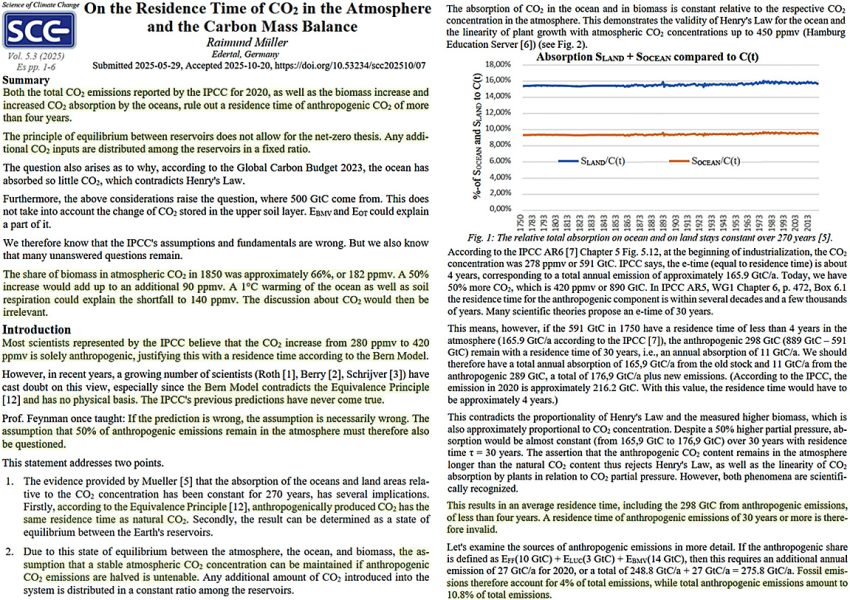
New Study Rebuts The Assumption That Anthropogenic CO2 Molecules Have ‘Special’ Properties
By Kenneth Richard | No Tricks Zone | February 6, 2026
The Intergovernmental Panel on Climate Change (IPCC) has for decades advocated net-zero governmental policies to reduce anthropogenic CO2 (aCO2) emissions.
This advocacy is rooted in the non-physical assumption that aCO2 molecules are special, as they remain in the atmosphere for decades to centuries.
Proponents of the anthropogenic global warming (AGW) narrative even claim aCO2 removal can “take up to several hundreds of thousands of years.”
While AGW proponents insist that “once in the atmosphere, carbon dioxide can continue to affect climate for thousands of years,” they (and the IPCC) simultaneously acknowledge the residence time of “natural” or non-anthropogenic CO2 is only about 4 years.
In reality, a new study references the Equivalence Principle in emphasizing nature’s sinks indiscriminately and equivalently absorb both aCO2 and natural CO2 in about 4 years (Müller, 2025). There is no physical reality for IPCC claims of “specialized” absorption time for aCO2 vs. natural CO2 molecules.
The IPCC assumes exactly 50% of aCO2 emissions remain in the atmosphere for decades to millennia. It is consequently assumed net-zero policies that propose to halve aCO2 emissions will lead to the stabilization of atmospheric CO2 concentrations. Because “anthropogenic CO2 has the same [4-year] residence time of natural CO2,” this assumption is physically invalid.
Net-zero policies will literally have no detectable effect on atmospheric CO2 concentrations. In sum, “the IPCC’s assumptions and fundamentals are wrong.”
The EV Car Crash
With the petrol and diesel car ban less than four years away, there’s one big problem: nobody wants to buy electric cars
By Paul Homewood | The Climate Skeptic | February 6, 2026
With the ban on the sale of new petrol and diesel cars less than four years away now, there remains one seemingly insurmountable obstacle: nobody wants to buy electric cars.
Last year, sales of EVs achieved a market share of just 23.43%. Newly released figures for last month show this fell to 20.6%. The Government has set a target this year of 33%, rising to 66% in 2029.
Once petrol and diesel cars (known as ICE vehicles, short for Internal Combustion Engine) are banned in 2030, zero emission cars must make up at least 80% of the market, with the rest filled with hybrids. However, the latter will also be gradually phased out by 2035. Zero emission essentially means battery-electric, although hydrogen fuel-cell vehicles would also qualify.
To enforce the switch to EVs, the government introduced the ZEV (Zero Emission Vehicle) mandate. Motor manufacturers who fail to hit their ZEV target for the year must either buy credits from manufacturers who have exceeded targets or pay a fine of £15,000 for every car below target.
There are certain allowances available, but these are not significant. The only other option open to manufacturers who fall short is to carry forward their deficit, in the hope they are in surplus in a year or two time. Understandably, this has been likened to taking out a payday loan!
The first year of the ZEV mandate was 2024, when the target was 22%. Actual EV sales that year only reached 19.6%, leaving an effective shortfall of 47,000 cars. At £15,000 a time, that means a fine of around £700 million. The Department for Transport will publish its full analysis next month, which will list surpluses and shortfalls by manufacturer and the actions they have taken to comply, e.g. pay a fine, buy allowances or carry forward.
Last year, EV sales increased to a share of 23.9%, but this was still well below the target of 28%. Motor manufacturers it seems are building up massive deficits in EV sales, which sooner or later will have to be paid for.
Worse still, most EV sales go to fleet and business sectors, driven by generous tax breaks. It is estimated that only about 10% of private buyers go for electric.
The reasons are well known. EVs cost much more to buy, and most models don’t have the range that drivers need. On top of that, buyers face massive losses when trading them in because second hand prices are so low.
But there is one other factor which is often overlooked.
It is reckoned that four in 10 households don’t have off-street parking, so cannot easily charge at home. Using a public charger means that running costs would typically be triple those of a petrol car when fuel duties are excluded. That is, I should point out, if you can actually find one on the way home from work that is not already in use.
Local councils such as my own have already made it clear that trailing cables across the pavement is not permitted and that enforcement action will be taken. Where then will EV drivers be able to charge their cars?
There are plenty of fine words from central and local government about installing more public chargers. But the simple reality is that there will never be enough – local councils don’t have the money, and it is not their job anyway to waste taxpayer money in this way.
Cardiff City Council are a case in point. It is estimated that there are about 200,000 cars in Cardiff, about half of which don’t have access to off street parking. The City Council has just announced plans to install 80 new EV charging stations, plugged into lampposts outside residents’ homes.
The plan won’t make the slightest difference when there are 100,000 cars which all need charging. But it will create real difficulties for the poor beggars who happen to live next to one and will have to find somewhere else to park. The thought of all the other motorists on the street competing to get to that lamppost first every night and the aggro which will undoubtedly follow is frightening.
It is hard to avoid the conclusion that the objective of successive governments and council planners all along has been to force us out of our cars and onto public transport.
AfD co-leader states the obvious: Pouring money into the Ukraine war is killing the German economy
By Tarik Cyril Amar | RT | January 28, 2026
Alice Weidel, co-leader of the AfD (Alternative for Germany) party, has given a speech to which every observer of Germany should pay close attention. And not simply because of Weidel’s inherent political weight.
She is among the country’s most important politicians and with serious prospects for very high office: if her New-Right party breaks through to leading a Berlin government, Weidel is the most likely chancellor. Next to her co-chairman Tino Chrupalla, she is the only real opposition that matters inside the current German parliament.
What makes this particular Weidel speech, delivered in the city of Heilbronn while campaigning in state elections in the classically ‘West German’ Land of Baden-Württemberg, especially noteworthy is its unprecedently outspoken, bracingly combative, and, stirringly logical and honest take on one specific topic, namely Germany’s masochistic relationship to Ukraine.
Not that there were no other topics. Indeed, Weidel started what was a gleefully pugnacious ‘Rundumschlag’ (German for onslaught) where you would expect, the absolutely dismal state of Germany’s once proud and now relentlessly tanking national economy. She reminded her large audience that Germany’s industrial sector is bleeding jobs and companies; national insolvency statistics are a horror and won’t stop breaking abysmal records; and the traditional parties have nothing to offer but same-old-same-old.
And yet, as most right-wing politicians – whether traditional or insurgent – former business consultant Weidel is not at all original with her own suggestions either. She complains that producing things in Germany is so expensive that the country’s economy as a whole has been losing international competitiveness. True enough.
But things get more debatable when Weidel starts explaining the causes of the national malaise. Costs that are too high include, in her view, taxes in general, payroll taxes, and social security payments. This is a classical conservative position: if anything is wrong with capitalism, it’s that those at the bottom of the income and power pyramid still have it too good. Cut the state down and rely on the market’s miraculous powers – pretty much the essence of Weidel’s extremely tired recipe for the future.
In that respect, Weidel’s talk had nothing to offer that isn’t already generously supplied by the grindingly repetitive rhetoric of the current centrist Berlin government under mainstream conservative and sour-schoolmaster-in-chief Friedrich Merz. In essence, ‘shut up, work harder, ask for less. (At least if you aren’t rich like me and my chums).’
With so little of that sounding like a genuine alternative from the ‘Alternative for Germany,’ can the AfD really succeed in breaking the traditional parties’ stranglehold by winning another – at least – ten or so percent of the national electorate? In a country where even the government admits that 17.6 percent of its citizens must get by without “important goods and social activities due to poverty.” In a society where 2.2 million children are officially categorized as at risk of or in poverty? Where income inequality has been growing ever worse, with Germany’s five wealthiest families now boasting combined fortunes of €250 billion, which is more than the poorer half of Germans – over 40 million people –combined? Where, finally, working hard is not even a halfway reliable way to achieve success? More than half of private fortunes are now inherited or gifted (usually to circumvent inheritance taxes, low as they are) and that share rises to between 75-80% among the rich.
Weidel’s criticism of Berlin’s – and the EU’s – current economic suicide non-strategy is often refreshingly on point, but it’s also the very easy part. Yet cosplaying as yet another ‘iron lady,’ promising more blood, sweat, and tears for those who are already getting plenty of all that, may well get the AfD stuck where it is now at less than 30% in Germany as a whole, weaker in the West and doing better only in the East. Weidel and her solidly neoliberal wing in the AfD would do well not to be too sure of themselves yet.
For, if the party does get stuck electorally instead of continuing its surge, then the AfD will not be able to fracture the traditional parties’ undemocratic and, arguably, effectively unconstitutional ‘firewall’ policy of exclusion. Studiously supported by Germany’s propagandistic and conformist mainstream media, in reality the ‘firewall’ is a scandal, since it massively discriminates against more than a fifth of Germany’s voters (and more in the East) who are, in effect, partially disenfranchised. Yet ending that scandal will take electoral success beyond anything the AfD has yet achieved. That’s simply a cold hard fact. Weidel’s rigid capitalist dogmatism could be a dead-end, making the AfD, despite all its current surging, a might-have-been story. We’ll see.
Yet, to her credit, Weidel added a crucial point to her diagnosis of the German economy’s dramatic downfall. A point that almost no other German top politician – at least outside the New-Left BSW, which has been electorally kneecapped, most likely by foul means – has the guts to be honest about in public: The main cause of Germany’s ongoing crash, according to Weidel, are “exploding energy costs,” and that explosion is “homemade,” a result of catastrophically self-harming policies by the traditional parties.
While many of these policies of self-strangulation have been driven by an ideologically motivated exit from nuclear energy and misguided – as well as ineffective – attempts to mitigate global warming, one factor stands out because it is a matter of life and death in a straightforward manner, namely the Ukraine war. That is, in reality, the barely indirect war between Russia and the West (including Germany) via Ukraine.
It is a direct consequence not of the war but of the position toward it taken by at least two successive governments in Berlin (first under the hapless Olaf “the Grinner” Scholz, now under Friedrich “the Scolder” Merz) that Germany’s energy has become ever more backbreakingly expensive.
Even official German agencies and mainstream media have not been able to conceal this basic fact. According to the government statistics office, as of early 2023, the industry price for natural gas was 50.7% higher than before the escalation of February 2022; for electrical power – 27.3%, and for petroleum derivatives – 12.6%. In February 2025, German households were paying a whopping 31% more for energy than in 2021 (according to the mega-mainstream RND). One month later, the respectable Handelsblatt called the “price leap” since the pre-2022, “immense” and reported that gas prices for private households had increased by almost 80% in a little over one year. Let that sink in. And where private citizens’ budgets are squeezed like that, the whole economy badly suffers as well, of course.
And just now, the EU has confirmed it will cut itself off from even the last remnants of Russian gas supplies by 2027. Good luck!
Weidel addressed both the insanity of German policy toward this war and the single most emblematic symbol of that madness, the destruction of most of the Nord Stream pipelines and Berlin’s perfectly perverse response to it.
Weidel rightly noted that the AfD’s long-standing – and plausible – arguments in favor of pursuing peace with Russia in earnest have long been met with the usual witch-hunting smears. That is, the type of neo-McCarthyite suppression which all such displays of dispassionate reason in search of an end to the “nonsensical dying” (Weidel) have been receiving from the “politico-media complex” in war-besotted NATO-EU Europe. Weidel was merciless, too, in skewering the persistent sabotage of any peace prospects by (at least) two German governments and their co-bellicists in the EU and most of Europe. All pretty obvious? Yes. Among the reasonable. But not in the German mainstream media and elite.
And then there was the passage that really rocked the hall: “This government [in Berlin] doesn’t utter a squeak” when Ukrainians, helped by other special services (which Weidel cautiously refrained from naming), blow up German energy infrastructure “in our face.” Genuinely irate, Weidel asked how a German government could keep quiet in such a situation. For “the lost delivery of inexpensive gas,” she continued, “harms not only Germany but all of Europe, [and] Germany the most.” Nice one. So much then for the domestic non-credibility of the Scholz and Merz governments, and for Merz’s aspirations to play a leading role in Europe.
And yes, the Nord Stream scandal marks not merely a political and economic catastrophe. It’s worse than that, because it also stands for a shameful display of submissiveness: “How can a government have so little self-respect,” Weidel asked, that it won’t even genuinely seek to solve such a blatant case of, in effect, massive economic sabotage? That indeed is the question. Even a German very far left of Weidel, such as me, can only agree here. It takes a fundamental lack of elementary patriotism and decency not to share her exasperation.
If the ultra-corruptioneers in Kiev were listening, things got even worse: Weidel was explicit that a country attacking Germany in this manner is not a friend. Obvious? Yes, but not in Germany. Not yet. And she declared her party’s intention to make Ukraine – and Zelensky personally – pay if the AfD gets into power in Berlin. Not only for the enormous damage done by Ukraine’s cowardly Nord Stream terror attack, but also for the dozens of billions preceding German governments have pumped into one of the most corrupt regimes in the world. All power to her arm on that one as well.
Intriguingly, that was a moment when the audience reacted with much applause, as usual, but also loud booing. Clearly, not everyone had caught up to reality when it comes to Germany and its perversely self-damaging relationship to Ukraine. But Weidel is right when she also declared that Germany should have stayed neutral instead of joining the Great Western Proxy Crusade against Russia with gusto. Berlin could have served as an ‘honest broker,’ to the benefit of everyone, not only Germans but also millions of ordinary Ukrainians.
Whatever you think about the specific mix of stale market-dogmatic Thatcherism, undue deference to Donald Trump, and refreshing no-bullshit honesty on foreign policy and national interest with regard to Ukraine and the Ukraine war that Weidel had to offer, there can be no doubt that this was a breakthrough moment. It was the first time a major German party with potentially very good electoral prospects has come out and clearly stated the obvious – Germany was attacked by Ukraine (and quite a few other ‘friends’ as well from Warsaw to London and Washington, even if Weidel skirted that part of the issue), not by Russia.
Therefore, for Germany and Germans, Ukraine is anything but a friendly state, and it is absurd – to put it very mildly – that German governments have ruined the relationship with Russia and the German economy as well, while pumping Kiev full of money and arms. This is an immense national scandal, as clearly as 2 plus 2 is 4. And like that simple fact, it’s always true, no matter who has the courage to say it.
Tarik Cyril Amar is a historian from Germany working at Koç University, Istanbul, on Russia, Ukraine, and Eastern Europe, the history of World War II, the cultural Cold War, and the politics of memory.
WEF Calls for ‘Cultural Revolution’ to Promote Lab-Grown Meat
By Michael Nevradakis, Ph.D. | The Defender | January 26, 2026
Participants at last week’s annual meeting of the World Economic Forum (WEF) called for a “cultural revolution” to increase acceptance of lab-grown meat — despite the public’s “terrible” resistance to the products, The Blaze reported.
The meeting, held in Davos, Switzerland, brought together leading global political and business leaders.
During the “Food @ the Edge,” panelist Sam Kass, a senior policy adviser for nutrition during the Obama administration, asked about the growth of “replacements” for “core foods.” The former chef said he doesn’t want to see a future “where we’re starting to drink coffee from a factory as opposed to from a tree.”
Andrea Illy, chairman of the Italian coffee giant illycaffè, countered that “there is a terrible cultural resistance from consumers to accept tech foods” but that he believes such foods “represent the way forward.”
Illy, affiliated with the WEF for over a decade, said reducing meat consumption yields environmental and health benefits. He said that “70% of the ecological footprint of agriculture is due to animal proteins.”
Illy claimed “excessive consumption” of real meat products is the leading cause of noncommunicable diseases — the “number one health problem” in the West. He called for the reduction of real meat consumption to a “healthy” level and for a decades-long “cultural revolution” to get people to consume lab-grown meat.
Experts tout benefits of real meat, question safety of lab-grown alternatives
Internist Dr. Meryl Nass, founder of Door to Freedom, hit back at Illy’s claims. Since health officials started recommending less meat — which they blamed for certain health conditions — “we had child obesity rise from 4% to 20%,” Nass said. “Childhood Type 2 diabetes doubled. Adult diabetes and prediabetes skyrocketed.” Nass blamed high carbohydrate consumption for the increase.
“Meat is extremely healthy, especially when animals graze on grasses as they were meant to and when they are not fed antibiotics, hormones and contaminated feed,” Nass said. She said the animal feed used in industrial meat production is typically “drenched with glyphosate or grown on sewage sludge.”
Biologist Heidi Wichmann, Ph.D., a member of Make Europe Healthy Again’s advisory committee, said the primary driver of non-communicable diseases is not meat, “but the way food is produced, treated and disconnected from natural biological cycles.”
“Excessive consumption of biologically degraded, highly processed products is problematic, regardless of whether they are of animal or plant origin,” she said.
Karl Jablonowski, Ph.D., senior research scientist for Children’s Health Defense, said that while animal agriculture is “an ample source of disease variants,” questions remain about the safety of lab-grown meat.
“Lab-grown meat has all the unknowns of any new technology,” Jablonowski said. “In theory, lab-grown food can be healthy. In practice, only if consumers demand it.”
According to Sayer Ji, chairman of the Global Wellness Forum and founder of GreenMedInfo, these unknowns associated with lab-grown meat include “novel risks” that are not fully studied.
“Many products rely on immortalized cell lines, which by definition evade normal cellular aging and death mechanisms — raising legitimate concerns about oncogenic potential and long-term biological effects,” Ji said.
Technologies like this “centralize food production into highly patented, proprietary systems that displace decentralized, local and farmer-based food networks — a shift away from food sovereignty and toward industrial dependency,” Ji said.
WEF calls development of lab-grown meat from stem cells ‘revolutionary’
The WEF last week released a video promoting lab-grown meat produced from animal stem cells, describing the technology as “revolutionary.”
The video featured Singapore-based Shiok Meats, which grows “meat” and “seafood” from animal stem cells. The WEF said Shiok’s technologyoffers “a promising solution to the environmental and ethical concerns associated with conventional animal agriculture.”
Singapore, which approved the sale of lab-grown meat in 2020, is a global leader in promoting alternatives to conventional meat. In 2024, Singapore approved 16 insects for human consumption.
Several experts suggested that the global elite are pushing to reduce meat consumption by suggesting tactics such as making people allergic to red meat, or convincing wealthy countries to switch to “100% synthetic beef.”
“Narratives had to be created by the globalists to demonize meat,” Nass said. “The push for lab-grown meat comes from the desire to control food by central authorities,” who “want food to only come from outside authorities, who can withhold it if you do not comply — or who make it too expensive and control you that way.”
Seamus Bruner, director of research at the Government Accountability Institute, suggested that what “ties all of this together” is “an obsession by what I call the ‘Controligarchs’ — a small, self-appointed elite that believes every aspect of human life must be managed, optimized and ultimately owned by them.”
Seven states, including Florida, Texas and Montana, have banned lab-grown meats. Earlier this month, the U.S. Department of Health and Human Services (HHS) released new dietary guidelines favoring the consumption of protein, dairy, healthy fats, vegetables and fruit and deemphasizing grains.
Consumers have increasingly rejected alternative meat products. For instance, the stock price of synthetic meat producer Beyond Meat cratered last year, dropping from an all-time high of $240 to less than $1 amid low consumer demand in the U.S.
Jeffrey Tucker, president and founder of the Brownstone Institute, said, “There is near-zero market demand for this ‘frankenfood’ born of the same intellectual class and lab technicians who have given us poison food and medicine.”
Tucker said producers of synthetic meats “rely on government regulations and restrictions to throttle genuine health and good lives while deprecating what we know is both good for us and delicious.”
WEF: phasing out artificial additives placing ‘stress’ on food industry
Other WEF panelists criticized efforts by the HHS to phase out synthetic dyes and artificial additives in food products.
According to Slay News, Jasmin Hume, founder and CEO of Shiru, an AI-powered “protein discovery company,” said HHS’ recommendations are placing the food industry “under an unprecedented amount of stress.”
Hume claimed removing synthetic ingredients from foods would require significant changes by food manufacturers and would have a negative effect on consumers and the planet.
Nass noted that approximately 10,000 artificial food additives have been approved in the U.S. compared with only about 400 in the European Union. “Companies already know how to produce food without most such additives,” she said.
Slay News reported that Hume’s remarks came as the Trump administration “ramps up its Make America Healthy Again (MAHA) crackdown on ultra-processed junk, synthetic additives, and added sugars,” leaving WEF members “scrambling to defend” synthetic food that faces growing public and political resistance.
Mass vaccinations or culls of livestock linked to lab-grown meat agenda
Politico Europe reported Jan. 16 that authorities in Greece are responding to a nationwide sheep pox outbreak with mass culls of sheep flocks — but are facing increasing pressure to engage in mass vaccination of sheep instead.
According to Politico Europe, many Greek farmers are “begging for vaccines to save their flocks.” Mass vaccination was among the demands of farmers who recently protested against Greek government policies by blocking highways throughout the country.
“Sheep pox is so infectious that global farming regulations require whole herds to be slaughtered immediately after even a single case is detected,” Politico Europe reported. The outbreak has resulted in over 470,000 sheep and goats being culled, and the closure of over 2,500 farms in Greece.
The European Union’s Animal Welfare Commissioner Olivér Várhelyi told Greek authorities last year that vaccination is the only new measure that can stop new sheep pox outbreaks.
The Greek government and its advisers have “repeatedly rejected this option, citing the steep financial consequences and damage to exports” and the fact that no sheep pox vaccine has been approved in Greece or the EU, Politico Europe reported.
Regenerative farmer Howard Vlieger, a member of the board of advisers of GMO/Toxin Free USA, said choosing between mass culling and mass vaccination ignores a tried-and-true method in which farmers “let the ones die that are going to die” and use the surviving animals as the “genetic base for building your seed stock.”
“Vaccine-induced immunity does not replicate the breadth, durability, or ecological integration of naturally acquired immunity, which is what inspired the creation of vaccination but has never been effectively replaced by it,” Ji said.
Bruner, author of “Controligarchs: Exposing the Billionaire Class, Their Secret Deals, and the Globalist Plot to Dominate Your Life,” said lab-grown meat and mass culling or vaccination of livestock are part of the “Controligarch worldview.” This includes “centralized control over natural systems in the name of efficiency, safety and sustainability.”
“They seek to replace organic, decentralized life with systems that can be surveilled, patented and governed from the top down,” he said.
This article was originally published by The Defender — Children’s Health Defense’s News & Views Website under Creative Commons license CC BY-NC-ND 4.0. Please consider subscribing to The Defender or donating to Children’s Health Defense.
Featured Video

Iran’s Next Strike May Not Explode. It Could Shut You Down
or go to
Aletho News Archives – Video-Images
From the Archive
Zionism’s Violent Legacy
By Donald Neff | Washington Report On Middle East Affairs | January 1996
On January 4, 1948, Jewish terrorists drove a truck loaded with explosives into the center of the all Arab city of Jaffa and detonated it, killing 26 and wounding around 100 Palestinian men, women and children.[1] The attack was the work of the Irgun Zvai Leumi – the “National Military Organization,” also known by the Hebrew letters Etzel – the largest Jewish terrorist group in Palestine. The Irgun was headed by Revisionist Zionist Menachem Begin and had been killing and maiming Arabs, Britons and even Jews for the previous ten years in its efforts to establish a Jewish state.
This terror campaign meant that at the core of Revisionist Zionism there existed a philosophical embrace of violence. … continue
Blog Roll
 Aletho News
- Trump’s Iran war is on an Israeli leash
- Saudi oil boss issues global supply warning
- Riyadh Says Its Oil System Is Intact. The Numbers Say Otherwise.
- Trump and Netanyahu Want to “Finish the Job” on Iran
- US ‘one-sided dictation’ not Iran’s beliefs makes rational talks impossible: Baghaei
- Iran’s Next Strike May Not Explode. It Could Shut You Down /Col Doug Macgregor
- Iran: US political targets legitimate if assassinations return
- Iraq shuts key border crossing with Iran under US pressure: Report
- Undersea Internet cables could be targeted in retaliation for attacks on Iran: IRGC deputy chief
- EU sending ‘biased’ observers to interfere in Serbian election – president
- If Americans Knew
- The Israel Lobby’s Changing Fortunes
- AIPAC has become such a political liability that it’s shifting to a more “nimble” approach to buying politicians
- At least 160 Israeli settler attacks in 2 weeks
- Will Gaza’s Ancient Christian Community Disappear Forever?
- Israel’s vision of regional security rests on keeping Arab states weak
- Heidi Levine recounts how Palestinian youths helped save her in settler attack
- DAILY UPDATE: Latest essential news on Palestine, Israel, & region
- Trump’s Intensifying Sabotage of the ICC, for Israel’s Sake
- Israeli military detain US and UK volunteers in West Bank including Democratic NY politician Brad Lander
- Americans at National Conservatism Conference held in Israel this year criticize Israel
- No Tricks Zone
- E-Cars Reduce CO2 Emissions By Only 41% Compared To Internal Combustion Engine Vehicles
- Predictions Made By Renowned Climate Professor Over Past Decades Have Been Proven To Be Poor
- New Study Suggests Large Regions Of The Pacific Ocean Have Been Cooling For The Last 80 Years
- Germany’s Green Energy Debacle: High Energy Costs Force Kahla Porzellan to Close After 182 Years!
- New Study: 50 Years Of The Most Aggressive ‘Net Zero’ Policies Can Only Affect The Global Climate By 0.03°C
- US September “Heat” Was No Record…Many Records Set Decades Ago
- Latest European Green Energy Debacle; Portugal’s Largest Flagship Solar Park Insolvent!
- Green Energy Debacle: German Expert Professor Fritz Vahrenholt Warns Of Severe Economic And Social Consequences
- Two More Paleo Reconstructions Affirm Meters-Higher Sea Levels Across Ireland, Brazil 7000-6000 Years Ago
- New Study: Earth And Venus Surface Warmth Largely Explained By Convection And Lapse Rate, Not CO2 Or Radiation

