Egypt collaborates with Israel to build ‘Green Rafah’ project over erased Palestinian city
The Cradle | October 19, 2026
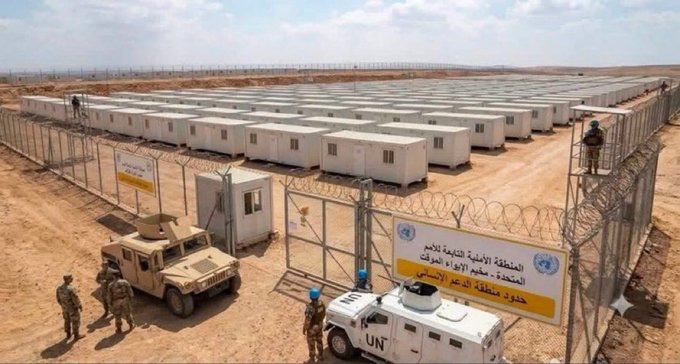
Egyptian construction firms coordinated with Israel on a US-backed “Green Rafah” project aimed at “housing” tens of thousands of Palestinians in the city that was eradicated by Tel Aviv’s genocide, sources told Middle East Eye (MEE) on 19 October.
“Egyptian construction firms surveyed sites in the ruins of the southern Gaza Strip for a housing project dubbed ‘Green Rafah’ … Egyptian engineers surveyed several areas in eastern Rafah under the supervision of the Israeli army and air force, who accompanied them throughout the process until they left,” sources said, including a senior military source in the North Sinai.
According to the report, “the proposed neighborhood would initially house around 20,000 Palestinians.”
It would be “supervised” by “a multinational force expected to be deployed in several parts of the Gaza Strip.”
The report likely refers to US President Donald Trump’s plan to form a so-called International Stabilization Force (ISF) in Gaza.
The report states that surveying of sites for “Green Rafah” is under full US backing.
“Washington conveyed instructions on the Rafah operations through CIA director John Ratcliffe during his latest visit to Egypt,” says the senior military source cited by MEE.
Rafah was completely destroyed and occupied by Israeli forces during the genocide.
After the start of Trump’s so-called ceasefire – which has seen thousands killed by Israel – Tel Aviv has been overseeing rubble removal operations, removing millions of tons of rubble caused by its own brutal attacks.
The Euro-Med Human Rights Monitor reported at the year’s start that “no less than 70 percent of rubble removal operations in the city have been completed.”
“Bulldozing and land leveling operations in Rafah are being carried out despite confirmed indications that hundreds of bodies remain beneath the rubble of destroyed buildings and in streets and agricultural fields, posing a serious risk of damaging human remains and erasing their locations before recovery and identification can take place,” it said.
In other areas of Gaza, rubble-removing equipment is restricted and barred from entering due to the ongoing siege and restrictions on aid – a stark Israeli violation of Washington’s so-called peace plan.
In Rafah, US-backed rubble-clearing operations come as part of a plan to build a “humanitarian city” over the ruins of the city.
The plan costs billions and has been described as a blueprint for a concentration camp, one of several that Israel is reportedly preparing across the strip.
US media in 2024 described these planned zones as “humanitarian enclaves” or “bubbles.”
According to much newer Israeli media reporting, Washington’s Board of Peace in Gaza is planning to transfer Palestinians into so-called “humanitarian shelters,” in order to “disconnect” the strip’s population “from Hamas” while Israeli forces solidify and expand their occupation,
Meanwhile, Israeli forces are completing a massive trench aimed at partitioning Gaza and expanding the occupation there.
UAE and Saudi Arabia move toward renewed coordination against Sanaa
Al Mayadeen | October 18, 2026
The United Arab Emirates has reportedly agreed to resume funding selected forces in southern Yemen fighting the Yemeni Armed Forces, while Saudi Arabia has agreed to provide air cover for those forces, according to sources in Yemen.
The reported arrangement signals a possible thaw in relations between Riyadh and Abu Dhabi after months of disagreement over the scope of each other’s political influence in Yemen.
The renewed coordination comes as the Yemeni Armed Forces continues to make gains and Saudi Arabia faces repeated drone and missile attacks targeting its territory, airports, and energy infrastructure.
Gulf rivals reconsider their positions
Southern forces, particularly the Giant Brigades, were previously trained and funded by the UAE and are considered among the more effective formations in the fragmented coalition opposing the YAF. Abu Dhabi withdrew its involvement in Yemen in January, cutting off financial support to forces it had backed, following pressure from Saudi Arabia.
The reported agreement suggests that advances by the YAF are prompting rival Gulf powers to reconsider their differences. However, neither Saudi Arabia nor the UAE has responded to a recent demand by southern separatists for an independence referendum that would restore the borders in place between 1967 and 1990, when Yemen was divided into two states.
The Southern Transitional Council (STC) has also yet to agree to deploy its forces beyond the boundaries of the former South Yemen. Saudi approval of a referendum could potentially remove that restriction, although no such agreement has been announced.
Attacks on Aden intensify pressure
The Aden government announced a counteroffensive last week aimed at retaking Sanaa. The campaign achieved limited gains around Majzar near Marib and the Bab al-Mandab Strait, but was met with a sizeable retaliation by Sanaa’s forces.
On Friday, two missiles struck Aden airport; Information Minister Moammar Al-Eryani said the missiles landed about 500 meters from the Yemenia Airways aircraft and roughly 100 meters from the runway’s midpoint. No casualties were reported.
The attack followed a strike on a presidential palace in Aden that killed at least five people and wounded 16, further underscoring the risks facing the Gulf-backed south.
Relations between the STC and Riyadh remain strained. STC leader Aidarous al-Zubaidi fled to Abu Dhabi in January after an unsuccessful attempt by the council to assert control across southern Yemen and announce a referendum on independence within two years.
Saudi Arabia subsequently bombed UAE arms shipments intended for STC forces. Abu Dhabi then announced its withdrawal from Yemen, while the Saudi-backed government said it would seek to prosecute Zubaidi for treason.
Egypt and UK face decisions over military support
Regional involvement is also expanding beyond the Gulf rivals. Egyptian President Abdel Fattah el-Sisi has called for an emergency parliamentary session to authorize possible military action to “defend” Saudi Arabia if requested, while emphasizing that Egypt would not undertake offensive operations.
Sanaa’s Parliament Speaker Yahya Ali al-Ra’i warned Egypt against a potential involvement in the Saudi military aggression against Yemen, urging Cairo not to allow itself to be drawn into a confrontation that serves Riyadh’s policies.
In an urgent letter to Egyptian Parliament Speaker Hisham Badawi, al-Ra’i expressed serious concern that developments could lead to Egyptian military participation alongside Saudi Arabia, stressing that such a move would contradict Egypt’s historical role in defending Arab causes.
In the UK, discussions continue over a Saudi request for additional military assistance. London has deployed an RAF Voyager aerial refueling aircraft, but some Arab officials are pressing for further support.
The prospect of deeper British involvement raises legal concerns. In 2019, the UK Court of Appeal ruled that the government had acted unlawfully in granting arms export licenses during the previous Saudi bombing campaign in Yemen in 2015–2016. The Campaign Against Arms Trade argued that officials had failed to properly assess potential violations of international humanitarian law, prompting revisions to export licensing procedures.
Sanaa’s resistance against Saudi aggression followed a brutal, years-long siege that caused one of the worst famines in modern history. The Ansar Allah government has made clear that their fight against Saudi Arabia will not cease so long as Riyadh continues to escalate it even further.
The Yemeni Armed Forces forces have remained firm in their resistance under the banner of a military equation: blockade for blockade and escalation for escalation.
Bombs for Tel Aviv, Promises for Riyadh
By Muhammad Hamid ad-Din – New Eastern Outlook – October 15, 2026
The Gaza Ceasefire Is Falling Apart. And So Is the American Plan to Expand the Abraham Accords.
The Gaza Ceasefire That Is Killing Palestinians
The ceasefire in Gaza, which took effect on October 10, 2025, was supposed to stop a two-year war. By then, according to Palestinian authorities, more than 72,000 Palestinians had been killed. A year after the document was signed, the picture was no more peaceful. According to Palestinian sources, from the start of the ceasefire to October 5, 2026, Israeli forces killed 1,460 Palestinians and wounded 5,116. By September 2026, Gaza authorities reported 5,147 violations of the agreement, 1,421 dead, and the destruction of more than 201,000 buildings.
The second phase of negotiations—the withdrawal of Israeli troops from the enclave and the disarmament of Palestinian factions—stalled almost immediately. In April 2026, American-Egyptian talks in Cairo ended “without tangible progress.” Hamas links disarmament to the end of the occupation. Israel demands disarmament as a precondition for any further step. Critics say the demand for disarmament has become a pretext for maintaining control over the enclave and continuing violations. The Palestinian Foreign Ministry put it bluntly: the occupation government “does not view peace as a goal, but as an obstacle.”
Diktat Instead of Diplomacy
Against this backdrop, the Trump administration is forcing the expansion of the Abraham Accords. In May 2026, the U.S. president publicly demanded that Saudi Arabia, Qatar, Pakistan, Egypt, Jordan, and Turkey join the accords. He called it “mandatory”: “After all the work done by the United States to put this complex puzzle together, it must be mandatory for all these countries to at least simultaneously sign the Abraham Accords.” Pakistan publicly refused. The others remained silent.
Washington’s main interest is Saudi Arabia. Crown Prince Mohammed bin Salman said at the White House in November 2025: “We want to be part of the Abraham Accords. But we also want to be sure that we secure a clear path to a two-state solution.” Later, Riyadh repeated: normalization is impossible without a “credible, irreversible, and time-bound path” to a Palestinian state. The Israeli government rejects this prospect. American pressure goes beyond diplomacy: Trump tied the Abraham Accords to negotiations to end the war with Iran, effectively making normalization a condition for peace. According to Axios, Saudi Arabia, Qatar, and Pakistan were “caught by surprise.”
Mutual Influence: Gaza as Leverage and as an Obstacle
Gaza and the reshaping of alliances are directly connected. The Palestinian question became leverage in Arab states’ bargaining with Washington. For Saudi Arabia, normalization with Israel without movement toward a Palestinian state is politically toxic. Riyadh is using the fragile ceasefire to postpone an unpopular step. Qatar, a key mediator, took an equally tough position. Qatari Foreign Ministry spokesman Majid al-Ansari said: “If the Palestinian question remains unresolved, joining the Abraham Accords is impossible.” According to him, the absence of a peace process for Palestinians means the absence of stability in the region. Doha, which has given refuge to Hamas’s political leadership and plays a central role in the talks, cannot move toward normalization without losing face.
There is also a reverse dependency. The Trump administration, seeking to expand the Abraham Accords, pressured Israel to secure a ceasefire: normalization without a ceasefire would have been impossible. But the second phase depends on whether Washington is willing to pressure Israel, not just Arab capitals.
Bombs Instead of Peace
The result of U.S. and Israeli policy looks increasingly contradictory. Three years of war, more than 74,250 dead Palestinians, and 1,460 killed after the ceasefire was signed are not just a humanitarian catastrophe. They are a verdict on America’s strategy in the Middle East. Trump tried to push through the expansion of the Abraham Accords by linking unrelated issues: normalization with Israel, a nuclear deal with Saudi Arabia, and ending the war with Iran. In July 2026, he stated directly that a U.S.-Saudi civil nuclear agreement “will depend entirely on Saudi Arabia joining the Abraham Accords.” Saudi Arabia responded in May 2026: “There will be no normalization without a clear and final path to the creation of an independent Palestinian state.” As the custodian of the two holy mosques, the kingdom cannot afford to do otherwise. Qatar refused. Pakistan publicly rejected it. Egypt, Jordan, and Turkey remained silent.
Criticism of Washington goes far beyond diplomatic missteps. The U.S. continues to supply Israel with weapons despite ceasefire violations. In September 2026, the Trump administration proposed a $2.8 billion deal to sell Israel 40,000 heavy bombs, including 20,000 MK-84s and 20,000 BLU-117s. Senator Chris Van Hollen vowed to block the transfer: “Trump is sending $2.8 billion worth of bombs, paid for by you, the American taxpayers, to a government led by a wanted war criminal.” Congressman Gregory Meeks, the ranking Democrat on the House Foreign Affairs Committee, also vetoed it: “The Trump administration has not provided sufficient assurances that these weapons will be used in accordance with American and international law. Therefore, I will not approve this sale.” Amnesty International urged Congress to block the deliveries, saying the U.S. risks becoming complicit in serious violations of international law, including genocide. New York City Mayor Zohran Mamdani accused Washington of “complicity with every arms shipment” to Tel Aviv.
What Next: The Results of U.S. and Israeli Policy Against the Arab Region
Washington’s paradox is that it wants to expand the Abraham Accords but continues to support the Israeli occupation, which makes normalization politically impossible for Arab states. The U.S. has blocked UN Security Council ceasefire resolutions for the third time in a row, undermining its role as a “reliable mediator.” Public opinion in the Arab world is sharply opposed to normalization. Polls show that 89% of Moroccans oppose recognizing Israel. Analysts warn that for most of the named states, the political price of signing the accords will be prohibitive. The war in Gaza has strengthened this sentiment, not weakened it.
The main question is whether the ceasefire will hold. If the second phase of negotiations does not start and the death toll continues to rise, expansion of the Abraham Accords will remain an unattainable dream. Saudi Arabia will wait. Qatar will mediate. The UAE will increase oil production. Trump will face a choice: keep pressuring Arab capitals or admit that without a real Palestinian state, the accords will remain a facade. While Washington supplies bombs and Tel Aviv keeps killing, talk of peace looks like a cynical game in which Palestinians are not subjects but a bargaining chip.
Muhammad Hamid ad-Din is a well-known Palestinian journalist.
Follow new articles on our Telegram channel.
Black Sea grain crisis puts global wheat supplies under pressure
Al Mayadeen| September 21, 2026
The disruption of grain shipments from the Black Sea is deepening concerns over global food security, with Russia and Ukraine’s reduced wheat exports threatening to push prices higher and intensify inflation pressures.
The two countries account for more than a quarter of global wheat trade, making the Black Sea a critical route for grain shipments to some of the world’s largest importers. However, escalating attacks on ports, grain terminals, storage facilities, and vessels have severely disrupted exports since July.
The crisis comes as markets remain focused on energy disruptions and rising oil prices linked tothe US and Saudi aggressions in West Asia, while food supply risks have received less attention from investors.
“We can think of the Black Sea as important for global wheat trade as the Strait of Hormuz is for global oil trade,” Caitlin Welsh, a food security expert at the Center for Strategic and International Studies, said. “The world is underestimating the impact of these attacks.”
Black Sea grain routes face mounting pressure
Tue Vuong, chief executive officer of Golden Wheat, a milling company based in Ho Chi Minh City, secured four cargoes of wheat from the Black Sea region, accounting for about a fifth of the company’s annual supply.
However, after the summer escalation in the Russia-Ukraine war, he was informed that some shipments would not be delivered.
“I was very panicked,” Vuong said. He received replacement offers for two cargoes from Bulgaria but spent weeks searching for additional supplies to avoid shortages.
“We were too exposed to a crisis in the Black Sea,” he added.
Golden Wheat eventually switched two vessels to load Bulgarian wheat from Burgas, located about 500 kilometers from the Ukrainian port of Odesa. Vuong also monitored shipping movements, insurance conditions, and developments in the Red Sea, where vessels face additional security concerns.
“Although the vessels were insured, if they had been attacked, we would have faced shortages,” he said.
The company later turned to US wheat supplies at a significantly higher cost, while prices continued to climb.
Russia and Ukraine wheat exports disrupted
Russia and Ukraine are among the world’s largest wheat exporters, while also accounting for major shares of sunflower oil and corn shipments.
Combined Russian and Ukrainian wheat exports are expected to reach roughly half last year’s level during the July-September harvesting period, according to researcher SovEcon.
Egypt, the world’s largest wheat importer, has not received Black Sea grain shipments for about a month. Russia’s exports have been affected by Ukrainian drone attacks, while Ukraine has struggled to move grain after damage to ports and disruptions to shipping routes.
Ukraine has attempted to redirect exports through Romania’s Constanta port and alternative routes along Romania and Bulgaria’s coastlines, but these channels are facing congestion.
A backlog of around 80 mostly smaller vessels has formed around Ukrainian Danube ports as traffic moves away from major Black Sea terminals, according to ship-tracking data compiled by Kpler and Bloomberg.
Turkiye revokes Iranian bank license under US sanctions campaign
The Cradle | September 19, 2026
The Turkish Banking Regulation and Supervision Agency (BDDK) revoked Iran’s Bank Mellat license, citing vague financial risks amid Washington’s economic sanctions campaign on Tehran, Turkiye’s Official Gazette reported on 18 September.
The regulator invoked Article 71(b) of Turkiye’s banking law, which allows a license to be revoked if a bank is deemed a threat to depositors or to the stability of the financial system, thereby ending the lender’s 44-year presence in the country.
The notice made no reference to US sanctions or to any operational failings at the bank’s Istanbul branch.
However, Bank Mellat, whose largest shareholder is the Iranian government, is under US, EU, and UK sanctions, according to the open-source sanctions-tracking database OpenSanctions.
Earlier this week, Ankara declared that Iran’s Mahan Air would be grounded starting 21 September, following Washington’s sanctions on three Turkish companies for providing services to the airline.
The US Treasury said Turkiye and Oman agreed to halt the flights following talks on complying with its sanctions.
“The risk now extends to every Turkish entity providing services to Mahan Air, from airport operations and ground handling to ticketing and banking,” one official warned.
The airline, which ran at least three daily flights between Istanbul and Tehran, is also suspending services to Oman and Georgia.
The revocation follows a string of punitive measures under Washington’s “Economic Outcast” operation, an economic strangulation campaign launched after the US failed to achieve its military objectives against Iran.
On 4 September, the US Treasury sanctioned Golden Global Bank, a small Turkish investment bank, along with two of its Istanbul-based units, accusing them of channeling tens of millions of dollars for the Islamic Revolutionary Guard Corps’ (IRGC) Quds Force.
Days earlier, the Treasury cut the UAE branches of Egypt’s Banque Misr off from dollar access over their dealings with Iran, the Financial Times reported on 28 August.
US Treasury Secretary Scott Bessent vowed to roll out new secondary sanctions every week, with banks first in line.
“This is going to be financial violence if we have to,” he told AP.
Bessent has also repeatedly pressed Washington’s allies to intensify their own sanctions on Tehran, warning G20 finance chiefs they would face secondary sanctions of their own if they failed to cut ties.
Saudi crown prince seeks dialogue with Ansarullah after Yemeni blows: Report
Press TV – September 18, 2026
Saudi Crown Prince Mohammed bin Salman has called for temporary ceasefire and dialogue with Yemen’s Ansaraullah resistance movement, amid crippling Yemeni blockade and painful strikes on the kingdom, a report says.
Lebanon’s al-Akhbar news website, citing informed sources, reported that Riyadh has asked Oman to convey to Ansarullah its proposal for a two-week ceasefire and direct talks with the movement’s leadership with the aim of “addressing humanitarian demands” and ultimately “reaching a comprehensive agreement by the end of the truce.”
According to the report, the kingdom expressed its willingness to lift the siege on Yemen and allow the entry of aid into the country.
However, the report said, Ansarullah seeks “a final and comprehensive solution to the conflict, on the basis that there is a Yemeni-Saudi battle that has nothing to do with internal Yemeni affairs.”
The sources stressed that the resistance movement’s demands include an end to the blockade in all its forms: aerial, ground and naval, as well as Saudi Arabia’s military, security and political withdrawal from Yemen, and Saudi compensation for damage caused by the kingdom’s strikes.
Ansarullah had previously informed Muscat that the Saudi proposal to sponsor an intra-Yemeni dialogue was unacceptable, as it constituted foreign interference, stressing that the Yemeni dialogue is an internal affair in which no one has the right to interfere.
Al-Akhbar noted that the Saudi proposal came as the kingdom was “shocked” by the rapid advance of the Yemeni military and Ansarullah fighters along the Western coast and their control of Bab al-Mandab Strait, and the failure of Riyadh’s calls for aid to be heeded.
The US Central Command (CENTCOM) reportedly briefed the Saudis on an assessment indicating a “sudden disintegration” within the mercenary force led by Tariq Saleh, noting that “Sanaa’s forces appeared fully apprised of every move made by Saleh and his troops.”
A source familiar with the matter said the US stance is “akin to a reprimand of Saudi Arabia over the conduct of its allied forces,” coupled with an emphasis that “the United States would not deploy its own forces to fight on anyone’s behalf.”
The Saudi retreat also comes as the idea of recruiting mercenaries from Syria, Libya, and Sudan to fight in Yemen has also failed to gain traction, according to the report.
Ben Salman was also advised by Egyptian officials, who surprised him by a historical overview of the situation in Yemen during his visit to Cairo, to hold talks with Ansarullah.
The outlet also noted that bin Salman is monitoring with concern reports that officials from the US administration have informed Omani officials of Washington’s desire to hold talks with Ansarullah to ensure that the Bab al-Mandab Strait would not be closed.
According to an Omani source, communications between officials in Muscat and Mohammed Abdulsalam, the spokesman for Ansarullah and Yemen’s chief negotiator, stressed that the Sana’a government “has no intention of taking any measures that would jeopardize navigation in the Red Sea.”
The Omani mediator informed the US and Saudi Arabia that Ansarullah had clearly stated that maritime navigation in the Red Sea is safe, except for Saudi ships. The group also stressed the ban would remain in effect until Riyadh practically lifts the blockade on Yemen.
Several countries such as Pakistan, Turkey and Egypt have reportedly been communicating with Yemeni and Ansarullah officials for a week with the aim of stopping the country’s military operations.
The report quoted a relevant source in Muscat as saying that diplomatic efforts to persuade Riyadh to back away from its rigid stance began after all mediating parties have realized that the movement is determined to find a “final” solution to the current situation.
Yemeni armed forces continue to consolidate their positions along the Western coast, taking additional measures to counter any attempt by Saudi-backed mercenaries to make up for their losses.
Senior Ansarullah officials have informed mediators that continued Saudi airstrikes on Yemen will be met with significant escalation, including more heavy strikes against vital facilities deep inside the Kingdom.
The current maritime blockade is a direct response to the devastating, years-long siege imposed on Yemen by the Saudi-led coalition.
For nearly a decade, the coalition has enforced a crippling land, sea, and air blockade, which the United Nations has repeatedly described as a primary driver of the world’s worst humanitarian crisis.
This siege has deliberately targeted Yemen’s ability to import food, fuel, and medicine, while simultaneously attempting to plunder the nation’s oil and gas resources.
Utilizing their advanced asymmetric naval capabilities, including drones and missiles, Yemen has shifted from a purely defensive posture to an active pressure campaign.
This strategy is designed to inflict direct economic and military costs on the Saudi regime until the siege is permanently lifted, the war is ended, and Yemen’s full sovereignty is restored.
Report: Saudi Arabia seeks allies’ assistance as missiles deplete amid war on Yemen
Press TV – September 17, 2026
Saudi Arabia is reportedly facing depleted reserves of missile interceptor systems and has appealed to regional partners and Western allies for assistance as Yemeni Armed Forces continue retaliatory missile and drone operations against strategic sites deep inside the kingdom.
The Associated Press, citing two regional officials speaking on condition of anonymity, reported on Wednesday that Saudi authorities have appealed to France, the United Kingdom, Pakistan, and Egypt to establish air-defense reinforcements in the region to bolster protection against missile and drone operations conducted by Yemeni Armed Forces.
The Yemeni operations are being carried out in retaliation for ongoing airstrikes and the blockade against their Arab Peninsula nation.
The outreach effort commenced due to the fact that Saudi Arabia’s principal ally and primary arms supplier, the United States, has faced a significant reduction in its interceptor inventory over the course of a six-month war of aggression on Iran, according to one official.
Fresh Saudi airstrikes across Yemen
On Thursday, a civilian was killed and another sustained injuries when Saudi warplanes carried out two airstrikes in Yemen’s northern province of Hajjah.
Yemen’s al-Masirah television channel, citing local sources, reported that the aerial assaults destroyed four passenger cars and damaged a house in the Abs district.
Elsewhere in the southwestern province of Ta’izz, Saudi fighter aircraft targeted three telecommunications towers in the al-Ta’iziyah and Dimnat Khadir districts.
On July 20, the Sana’a government announced a maritime blockade against Saudi Arabia in response to “an unjust and oppressive siege” on Yemen for almost 12 years.
Subsequently, the Yemeni armed forces have reported a series of successful missions that have targeted vessels associated with Saudi Arabia in the Red Sea.
In March 2015, Saudi Arabia and its allies imposed a blockade on Yemen, initiating a comprehensive military offensive that received support in terms of military, political, and logistical assistance from the United States and several Western countries.
Tens of thousands of Yemenis have lost their lives; however, Saudi Arabia has failed to achieve its primary goal of reestablishing a puppet government that served its interests.
Eight Arab and Muslim states reject Israeli displacement plans for Gaza
Palestinian Information Center – September 6, 2026
GAZA – Eight Arab and Muslim countries have condemned remarks by far-right Israeli ministers Itamar Ben Gvir and Israel Katz on plans to forcibly displace Palestinians from the Gaza Strip.
The foreign ministers of Egypt, Saudi Arabia, Jordan, the United Arab Emirates, Indonesia, Pakistan, Türkiye and Qatar said in a joint statement released on Sunday that such Israeli plans violate international and humanitarian law and pose a direct threat to the Palestinian people’s legitimate and inalienable rights.
The ministers voiced rejection of any Israeli attempt to displace Palestinians from or within the occupied territory, warning against transforming extremist rhetoric on forced displacement into official state policy.
The ministers warned that the displacement of Gazans would destabilize the region and derail global peace efforts, undermining US president Donald Trump’s plan to end the Gaza war, which clearly rejects forced population transfers.
The ministers stressed that Gaza is an integral part of the occupied Palestinian territories, calling for preserving the unity of Gaza, the West Bank and east Jerusalem.
They reiterated their countries’ support for a two-state solution establishing an independent Palestinian state along the June 4, 1967 lines, with east Jerusalem as its capital.
They urged the international community and UN Security Council to oppose Israeli attempts to impose a new demographic or geographic reality in the occupied Palestinian territories.
Israel’s Game

Anti-Zionist activists protest on 2nd Avenue outside the Israeli Consulate General in Midtown Manhattan, New York City, U.S. on August 21, 2026. [Selçuk Acar – Anadolu Agency]
By Dr Hassaan Bokhari | MEMO | September 6, 2026
A few days ago, a very interesting article appeared in the Israeli newspaper The Jerusalem Post. It was written by AJ Jaff, whose profile describes him as “a recognised expert in international security, crisis management, and geopolitical risk”. The “expert” began the article by acknowledging that the 6-month-long air war on Iran has failed to defeat Iran. Then, he provided some “out-of-the-box” ideas for the US to consider if it wants to “achieve its objectives” and win the war. According to him, the war will only be won when Iran’s institutional coherence is broken, resulting in its Balkanization.
I will discuss Mr Jaff’s “out of the box” ideas in a bit, but first, I want to analyse the “expert” himself a little. Two things quickly popped up. First is how he began his article. The first sentence is: “The Pentagon reportedly asked outside analysts this month for creative ideas on Iran.” The hyperlink in this sentence redirects the reader to another article in The Jerusalem Post that cites a CNN report saying that the US Chairman of the Joint Chiefs of Staff, Gen. Dan Caine, has been privately looking for an off-ramp in the Iran War. How quaint! While the Pentagon is asking for ideas to wrap up the war, Mr Jaff, the expert, stepped up with ideas to escalate the war! It appears that Mr Jaff (and the Zionists) have very different ideas and even objectives than US Generals about the same war. No wonder Pete Hegseth (a committed Zionist) has been firing so many of them!
Secondly, one is amused to see that in March, 10 days after the start of the US-Israel war on Iran, the same Mr Jaff was declaring a resounding victory and claiming that “the data tells a decisive and irreversible story” and “Iran’s missile fire rate has collapsed by 92 percent”! After reading that article now, most readers might laugh heartily and dismiss Mr Jaff, the “expert,” as an idiot. However, that would be an incorrect assessment. On the same day as Mr Jaff’s gaffe’s appearance in The Jerusalem Post, an article of mine elucidated the Israeli strategy as one giant bluff whose aim was to lure the USA into a destructive war in the Middle East by plunging it into a sunk cost fallacy. The Israeli plan was to lure the USA in with the dreams of an easy victory like the First Gulf War or the Maduro kidnapping, but it knew all along that those dreams would prove to be hollow, and their sole purpose was to bring the USA into the war. Then, in the next phase, with the dreams of victory proving illusory, the USA was to be baited with the sunk cost fallacy trap so that it would blunder into further escalation in pursuit of Israeli objectives. Mr Jaff’s seemingly absurd somersaults follow this pattern perfectly.
Now let’s turn our attention to Mr. Jaff’s “expert recommendations”. There are three of them:
- The USA should “recognize the sovereign independence of the Iranian Kurdistan, Ahwaz, and Baluchistan people”.
- To raise the one million troops required for a victorious ground invasion of Iran, the USA should launch an enlistment scheme based on debt forgiveness (estimated at 40,000 to 1,00,000 US Dollars per person) for 24-36 months of service per person.
- The US should strike a deal with China that would involve softening the US stance on Taiwan and ensuring China that even after Iran’s destruction, China would continue to receive an uninterrupted supply of Iranian oil in exchange for China’s abandonment of Iran.
Before analysing these ideas, one must first take a moment to marvel at the arrogance and ignorance of the Zionists.
The Zionists have played the victim and the superior/invincible race roles simultaneously in a way that lends itself to a diagnosis of severe dissociative disorder.
This pathological psyche has led them to the delusion that the foremost purpose of the world and everything in it is to accommodate their ambitions. As I have argued elsewhere, this psyche is leading them to their self-created and inevitable destruction as well.
Now, let’s take these ideas one by one. The first idea is simply advocating the balkanization of Iran (just the newest version of the Yinon Plan). The implications are very interesting, though. By supporting Kurdish and Baloch (not Baluchi as written by Mr. Jaff, a mistake that only lays bare how little he knows about Balochistan!) separatism, the US could kill three birds with one stone in the service of Israel. Kurdish and Baloch separatism are grave threats to the integrity of Turkiye and Pakistan, respectively. Very cleverly, the Zionist Mr Jaff is pointing the way for the next wars to be launched by the USA in Israel’s service. The Zionists know that Iran’s balkanization wouldn’t ensure Israel’s survival. They are aiming at the complete destruction of the whole region stretching from Morocco to Pakistan, an Israeli goal correctly identified by the Pakistani liberal thinker Eqbal Ahmed more than 40 years ago!
The second idea is about finding the meat for the meat grinder of forever wars envisioned by Israel. With antipathy toward Israel consistently on the rise in the USA, how can American youth be convinced to become cannon fodder in the Wars of Israeli Ambitions? The answer, according to Mr. Jaff, lies in luring them with the promise of debt forgiveness. Most young Americans are riddled with debt in the exploitative capitalistic financial system (run by whom?) of the USA. Mr Jaff wants their debts written off in return for their blood, sweat, and tears spilled on the battlefields of the Middle East. However, the question arises: who will pay the bill of “debt forgiveness” for this indentured slave army? Will the big capitalists pay? Of course not. The state will pay.
In other words, the US taxpayers will pay billions of dollars so that their sons and daughters can be killed or crippled far from home in wars that have nothing to do with the American people’s welfare.
The third idea is the most “brilliant” one. It’s also the one that should ring alarm bells for even the most obtuse section of people in the USA. Mr. Jaff proposes to bribe China with oil and concessions on Taiwan to abandon Iran. It hasn’t occurred to him that for men like General Dan Caine, China represents a much bigger threat to the USA than Iran! It also peddles the fallacy that Iran is another Venezuela! Such a bizarre, arrogantly ignorant notion can only come from Zionists! In his obsession with what the genocide-dependent state of Israel needs to survive, Mr Jaff has ignored the basic fact of geography that Iran lies closer to China than Venezuela is to the USA! He has also conveniently failed to specify what concessions the USA should make on Taiwan. Unfortunately for Mr Jaff and the Zionists, the Chinese leaders (unlike many in the USA) don’t prioritise Israeli interests over their own country’s.
As I am engaged in analyzing Israel’s “game plan”, one other important factor must be mentioned: Gaza. In the last few days, clear statements have come from Israeli ministers showing their intention to depopulate Gaza completely. Israel’s ultimate goal has always been to complete the ethnic cleansing of Palestine that started with the Nakba in 1948. Since the start of the Gaza blockade in 2007, Israel had been following a policy of making Gaza uninhabitable while concurrently using it as a weapons testing laboratory through periodic aggressions/wars. This policy of slow genocide was abandoned after the 7 October attacks. The goal then became to “clear” Gaza through a “fast genocide” within a few months. However, unexpectedly stubborn Palestinian resistance coupled with the categorical refusal of regional countries (especially Egypt) to accept Palestinian refugees has so far prevented this. The recent pressure from Israel on the USA to give it a green light for forcible expulsion of all Palestinians from Gaza shows that Israel hasn’t lost sight of its genocidal goals in Palestine for one minute, even during the Iran War. If Palestinian refugees are forced into Egypt, it will provide an added bonus for Israel by destabilising Egypt.
A summary of the comprehensive Israeli strategic plan is as follows: Israel wants a massive US ground invasion of Iran with more than a million soldiers to destroy the Iranian State and balkanize the country with the help of Kurdish and Baloch separatists. This will, in turn, bring the “Grand Israeli War” to its next phase: the destruction of Turkiye and Pakistan. The latter will be denuclearized after internal instability brought upon by economic, political, and military crises resulting in an implosion of the State, leaving Israel’s ally India as the sole power in the subcontinent. Simultaneously, Israel plans to depopulate Gaza and South Lebanon while destabilising both Syria and Egypt to an extent that new civil wars erupt there. To achieve these lofty aims, Israel wants the USA to put its strategic tussle with China on hold and offer significant concessions on vital issues like Taiwan to keep China neutral. This will free up the USA to deploy its full military might in fighting Israel’s wars and divert limited but critical military resources in bulk to the Middle East from the Pacific. With the whole of the Middle East in ashes, Israel can replace the USA as Saudi Arabia’s “security guarantor”, gain control over all 3 Muslim Holy Mosques (in Makkah, Medina, and Al-Quds) to be used as blackmail against any future attempt by Muslims to confront it, and create a Greater Israel that is not dependent on US aid. Afterwards, Israel can easily discard the USA in favor of a modus vivendi with the new global hegemon (China) as the former’s power wanes through wars and strategic overextension.
This Israeli “game plan” is clearly fantastic, unrealistic, and wildly overambitious. However, like the Nazis, Israelis see themselves as an embattled and desperate “superior race” that has to risk it all on a grand throw of the dice. In its post-7 October psychosis, Israel has lost whatever rationality or sense of proportion it previously possessed. Like Hitler, Israel’s leaders fail to see their predicament: they might win some victories in this war, but each victory will open up new threats, which will result in fatigue as the costs of war mount and geographic and demographic factors overstretch both Israel and the USA. In his seminal work, “Israeli Exceptionalism – The Destabilising Logic of Zionism”, Professor Shahid Alam explained this brilliantly: “The tragedy of Israel is not fortuitous. Driven by history, chance, and cunning, the Zionists wedged themselves between two historical adversaries, the West and Islam, and by harnessing the strength of the first against the second, they have produced a conflict that can only grow deeper over time. In this conflict, Israel’s triumphs are temporary, are indeed illusory, since they evoke a deeper, wider response from the societies that suffer the devastation of its triumphs. In the long run, in the time scale of history, by relentlessly pressing its advantages, Israel only ensures that its adversaries will slowly build the defenses that will eventually rise to match Israel’s military might and its expansionist ambitions.”
Blinded by the imperatives of genocidal Zionist ideology, it would be foolish to expect the recognition of this reality from the Israelis.
However, the USA and the Muslim World urgently need to recognize “Israel’s Game” to minimize the damage to be suffered by them. Had Hitler been stopped at Munich, the Second World War might never have happened. Had Israel’s genocide in Gaza been stopped in November 2023, we wouldn’t be seeing the Iran War and the Hormuz crisis today. If Israel isn’t stopped now, we will see not just Iran, Palestine, and Lebanon, but Turkiye, Pakistan, Egypt, Syria, and the Gulf countries engulfed in flames of war as well.
As Israel plans to fight this war to the last US soldier, it would behoove the USA to realize that playing Israel’s game will result in polarization and decimation of American society (just like the Vietnam War put an end to Lyndon Johnson’s vision of “Great Society), the loss of its military dominance in the Pacific, and the loss of its global economic primacy. Today, it is imperative that all of the Muslim World in general and Turkiye, Pakistan, Saudi Arabia, and Egypt in particular start squarely backing Iran in thwarting external aggression. The recent Mecca Pact between Pakistan, Turkiye, and Saudi Arabia can only be meaningful if it clearly declares Israel as the greatest threat to peace and operationalizes the military and economic power of these countries to combat Israeli aggression in Gaza, West Bank/East Jerusalem, Lebanon, and Iran. Only through the defeat of Israel’s genocidal state and the birth of an independent Palestinian State can peace and security be ensured for the Middle East. If these countries present a united front against Israeli aggression, not only will they be backed by the likes of China and Russia, but they will also compel the USA to recognize Israel for the dangerous strategic liability it is. “America Firsters” will do well to remember Nietzsche’s saying: “The most common form of human stupidity is forgetting what one is trying to do.”
Saudi-Turkish-Pakistani military alliance shaped by fear of Israel, not Iran: Analyst
Press TV – August 9, 2026
Underlying regional calculations behind the new military alliance between Saudi Arabia, Turkey and Pakistan have been shaped by fear of Israel, not Iran, says an analyst.
Speaking to the Press TV website, Anusar Farooqui, a US-based writer and commentator who is also the founder and CEO of Systematic Portfolios LLC, said the newly signed “Mecca Joint Defense Agreement” is aimed at the Israeli regime.
“The alliance politics of the Sunni Arab powers is driven by fear of Israel, not Iran,” he said.
“The Saudis and especially the Turks are very fearful of Israeli plans,” he added, noting that Israeli discussions about confronting Turkey, including talk of a possible surprise attack intended to cripple the Turkish air force, had contributed to Ankara’s concerns.
The agreement was signed on Friday in Mecca by Turkish President Recep Tayyip Erdogan, Saudi Crown Prince Mohammed bin Salman and Pakistani Prime Minister Shehbaz Sharif.
The three countries said an armed attack against any one of them would be regarded as an attack against all, while describing the pact as a means of strengthening collective deterrence and regional stability.
The agreement did not specify the practical obligations of its members. A Turkish official said it was not directed against any particular actor, remained open to other regional countries and did not replace existing bilateral or multilateral arrangements.
Farooqui said the absence of Egypt from the initial agreement was particularly significant.
“The important thing about the announcement is the conspicuous absence of Egypt,” he told the Press TV website, adding that the possibility of a Turkish-Egyptian military pact was central to understanding the regional balance.
“The Egyptian question is paramount: why has it taken a pass,” the analyst asked.
He added that such a pact would represent a much stronger counterweight to Israel and said the United States understood the implications.
“So it seems to have intervened to prevent the nightmare from happening,” he said.
Egypt’s position, however, has not been presented as permanently outside the arrangement. Turkish Foreign Minister Hakan Fidan said Saturday Egypt could eventually join the pact after several technical issues were resolved.
He described Egypt as Ankara’s “natural partner” and said other countries had also expressed interest in joining, although the founding members were still discussing how expansion should be handled.
The new military alliance comes amid US-Israeli destabilizing actions in the region. Since October 2023, Israel has waged a genocidal war on Gaza, invaded southern Lebanon and occupied territory in Syria, while also launching two wars of aggression with the United States against Iran that triggered massive retaliatory strikes against US and Israeli assets in the region.
Meanwhile, the regime’s bellicose agenda has raised concerns about the so-called “Greater Israel” scheme that regards Israeli-occupied Palestinian territories as well as parts of Egypt, Jordan, Syria, and Lebanon as part of the Zionist entity.
Israeli regime prime minister Benjamin Netanyahu said in October 2025 that he feels a deep connection to “this vision”, describing it as “a historical and spiritual mission.”
On the other hand, some analysts have linked the growing Turkish-Israeli rivalry to a broader contest over regional influence. Turkey and Israel have maintained diplomatic relations since 1949 and their strategic and commercial ties have survived tense rhetoric.
Yet tensions seem to have intensified recently over Gaza, Syria, energy routes, maritime issues and Ankara’s expanding regional role.
Pakistan’s position has added another dimension to the emerging security alignment.
Pakistani Defense Minister Khawaja Asif said on Saturday, following the signing of the agreement, that Israel was “a threat to the entire Muslim world” and called for “a united military front” against it, while noting that the regime poses a direct threat to countries across the region.
The broader security environment has also been affected by changes in the US military posture. Washington has reportedly withdrawn warplanes and other military equipment from countries including Qatar and the United Arab Emirates following Iranian retaliatory strikes.
Asked whether the new alliance could eventually contribute to a region without US military presence and with Israel more contained, Farooqui said the current arrangement is insufficient.
“Not without Egypt,” he told the Press TV website. “The Saudi-Turkish-Pakistan pact is mostly for show. By itself, it is not an effective balancing coalition against Israel.”
BRICS+ Series: Why the Egypt-UAE Energy Partnership Signals a New Phase for the Global South

By Chloe Maluleke and Dr Iqbal Survé | IOL | July 3, 2026
The latest discussions between Egypt and the United Arab Emirates on expanding natural gas production in the Nile Delta represent more than another investment agreement in the energy sector. They illustrate a broader transformation underway across the Middle East and North Africa (MENA), where energy security, technological capability and regional capital are increasingly being mobilised from within the Global South rather than relying exclusively on Western financing and expertise.
For decades, energy partnerships in the MENA region largely followed a familiar pattern. Resource-rich states exported hydrocarbons while multinational energy companies from Europe and North America supplied technology, finance and operational expertise. That model is gradually evolving. Today’s agreements increasingly reflect cooperation between emerging economies that possess complementary strengths and shared strategic interests.
Egypt occupies a unique position in this transition. It is simultaneously an African, Arab and Mediterranean nation, giving it significant geopolitical value. While its domestic gas production has fluctuated in recent years because of declining output from mature fields and rising domestic consumption, Cairo remains determined to restore its status as a regional energy hub. The country’s existing liquefied natural gas (LNG) export infrastructure, strategic location along the Suez Canal and established pipeline connections position it as a gateway linking African producers with European and Asian markets.
The UAE, meanwhile, has become one of the Global South’s most influential sources of investment capital. Emirati sovereign wealth funds and state-backed energy companies are increasingly deploying finance across Africa and the wider Middle East, extending beyond traditional oil investments into renewable energy, logistics, ports and advanced extraction technologies. This reflects Abu Dhabi’s long-term strategy of securing energy assets while diversifying its international investment portfolio.
The proposed expansion of geological exploration in Egypt’s Nile Delta therefore serves multiple strategic purposes. It seeks to increase Egypt’s domestic gas output, reduce reliance on costly imports and strengthen export capacity. Equally important, it demonstrates how regional investors are assuming greater responsibility for financing critical energy infrastructure within their own neighbourhood.
For the MENA region, such cooperation strengthens economic resilience during a period of heightened geopolitical uncertainty. Conflicts across the Middle East, disruptions to shipping routes and volatile commodity prices have reinforced the importance of reliable regional supply chains. Expanding domestic production reduces vulnerability to external shocks while allowing countries greater flexibility in balancing domestic demand with export commitments.
The initiative also reflects the growing importance of technological modernisation in hydrocarbon production. Advanced drilling techniques, digital reservoir management and improved recovery methods are enabling countries to maximise output from existing fields without relying solely on new discoveries. Technology transfer has become as strategically valuable as financial investment, particularly for countries seeking to optimise mature energy assets.
The implications extend well beyond North Africa. Across the Global South, governments are increasingly pursuing development strategies centred on South-South cooperation. Rather than depending exclusively on traditional development partners, countries are building networks of investment, expertise and infrastructure with fellow emerging economies. This approach aligns with a broader effort to reshape international economic governance around more diversified partnerships.
For BRICS, the Egypt-UAE partnership reinforces several long-standing objectives. Egypt’s accession to BRICS expanded the grouping’s presence in Africa and the Arab world, strengthening its representation across key energy-producing regions. Although the UAE is not geographically located within North Africa, its growing investment footprint across the continent complements BRICS’ broader emphasis on infrastructure financing, industrial development and economic integration among developing economies.
The partnership also supports BRICS’ vision of enhancing energy security through diversified production and investment channels. As global energy markets become increasingly fragmented by geopolitical tensions, emerging economies are seeking to reduce exposure to concentrated supply chains and external political risks. Regional cooperation between BRICS members and partner economies helps create a more distributed and resilient energy architecture.
However, challenges remain. Expanding natural gas production requires sustained investment, regulatory certainty and environmental stewardship. Natural gas is frequently presented as a transition fuel capable of supporting economic development while renewable energy capacity expands, yet long-term climate commitments will continue to shape investment decisions. Egypt and the UAE will therefore need to balance immediate energy security objectives with growing international pressure to accelerate decarbonisation. [emphasis added]
Ultimately, the significance of the Egypt-UAE energy discussions lies not simply in additional gas wells or increased reserves. They reflect a deeper shift in how emerging economies are organising capital, technology and political partnerships. As the Global South assumes a more active role in financing its own development, regional cooperation is becoming an increasingly important pillar of economic resilience. In that sense, the Nile Delta may represent not only a source of natural gas, but also a symbol of a changing global economic order in which the future of energy is being shaped as much by cooperation within the Global South as by traditional centres of power.
Dr Iqbal Survé is a past chairman of the BRICS Business Council and co-chairman of the BRICS Media Forum and the BRNN.
Chloe Maluleke is an Associate at BRICS+ Consulting Group, Russia & Middle East Specialist.
Was the Drone Attack on US LNG Tanker in Egypt a False Flag?
By Larry C. Johnson | SONAR21 | July 31, 2026
Short answer… I think so.
On Wednesday July 29, 2026, at roughly 3:20 pm CET, a drone struck the Energos Winter — a Marshall Islands-flagged floating storage and regasification unit (FSRU) owned by US company New Fortress Energy — on its starboard side at Egypt’s Mediterranean port of Damietta, in the northern Nile Delta. The fire spread to a nearby Bermuda-flagged LNG carrier, the Gaslog Salem. Both crews were evacuated, the blaze was brought under control, and no injuries were reported. Both vessels were subsequently moved offshore for assessment; the Energos Winter was pulled off the quayside before the fire was fully out.
Egyptian harbor responders got on scene fast from both the land side and with fire and rescue tugs, which several accounts credit with preventing a much larger disaster — a fire spreading to the terminal infrastructure or fully involving either LNG hull would have been catastrophic. Egypt’s Petroleum Minister Karim Badawi traveled to the port personally to oversee the response.
CNBC and CNN framed this attack as part of a widening campaign on energy infrastructure, implicitly blaming Iran: Iran, the Houthis, and Iraqi militias have all broadened strikes, with Iraqi Iran-aligned militias launching drones at oil infrastructure in Riyadh and Saudi Arabia’s Eastern Province this same week. The Damietta strike was viewed by many in the West as extending that campaign from Gulf oil into Mediterranean gas.
I think the attack at Damietta was an Israeli false flag that was intended to stir tensions between Cairo and Tehran. Iran inadvertently set the stage for such a narrative. Two days prior to the drone attack Iranian state TV ran a segment headlined about revenge against Ukraine, showing a multi-target map of European-energy-linked infrastructure, which included Damietta, marked with a pin, citing its LNG capacity (5.2M tons/yr) as a “gateway for gas exports to Europe” descriptor. Damietta was not the focus of the broadcast and was merely identified as one of several possible targets. Everything beyond that — i.e., that the map amounts to Iran claiming or committing the strike at Damietta — is inference layered on top. The critical point about the framing: the stated enemy was Ukraine, not the US or Egypt.
Many in the West were quick to point the finger of blame at Iran. Yet Egypt’s Minister of Information, in an interview with Al Arabiya, denied the Wall Street Journal’s claim that the Egyptian government considered Iran responsible for the drone attack on two ships in Damietta port.
Iran’s Foreign Minister Aragchi issued a statement insisting that it wasn’t Iran and that it was an Israeli false flag operation to try to drag Egypt into an anti Iranian coalition. I think Aragchi is correct.
Give credit to Mossad for monitoring Iranian media and taking advantage of the news broadcast to quickly create an incident that would cast the shadow of blame on Iran by virtue of the news broadcast that had listed Damietta as one of many possible targets for retaliation against Ukraine. It is very easy for an organization like Mossad to mount such a drone attack in two days… Guilt by association.
Video interviews
Featured Video

Iran’s Next Strike May Not Explode. It Could Shut You Down
or go to
Aletho News Archives – Video-Images
From the Archive
Zionism’s Violent Legacy
By Donald Neff | Washington Report On Middle East Affairs | January 1996
On January 4, 1948, Jewish terrorists drove a truck loaded with explosives into the center of the all Arab city of Jaffa and detonated it, killing 26 and wounding around 100 Palestinian men, women and children.[1] The attack was the work of the Irgun Zvai Leumi – the “National Military Organization,” also known by the Hebrew letters Etzel – the largest Jewish terrorist group in Palestine. The Irgun was headed by Revisionist Zionist Menachem Begin and had been killing and maiming Arabs, Britons and even Jews for the previous ten years in its efforts to establish a Jewish state.
This terror campaign meant that at the core of Revisionist Zionism there existed a philosophical embrace of violence. … continue
Blog Roll
 Aletho News
- Trump’s Iran war is on an Israeli leash
- Saudi oil boss issues global supply warning
- Riyadh Says Its Oil System Is Intact. The Numbers Say Otherwise.
- Trump and Netanyahu Want to “Finish the Job” on Iran
- US ‘one-sided dictation’ not Iran’s beliefs makes rational talks impossible: Baghaei
- Iran’s Next Strike May Not Explode. It Could Shut You Down /Col Doug Macgregor
- Iran: US political targets legitimate if assassinations return
- Iraq shuts key border crossing with Iran under US pressure: Report
- Undersea Internet cables could be targeted in retaliation for attacks on Iran: IRGC deputy chief
- EU sending ‘biased’ observers to interfere in Serbian election – president
- If Americans Knew
- The Israel Lobby’s Changing Fortunes
- AIPAC has become such a political liability that it’s shifting to a more “nimble” approach to buying politicians
- At least 160 Israeli settler attacks in 2 weeks
- Will Gaza’s Ancient Christian Community Disappear Forever?
- Israel’s vision of regional security rests on keeping Arab states weak
- Heidi Levine recounts how Palestinian youths helped save her in settler attack
- DAILY UPDATE: Latest essential news on Palestine, Israel, & region
- Trump’s Intensifying Sabotage of the ICC, for Israel’s Sake
- Israeli military detain US and UK volunteers in West Bank including Democratic NY politician Brad Lander
- Americans at National Conservatism Conference held in Israel this year criticize Israel
- No Tricks Zone
- E-Cars Reduce CO2 Emissions By Only 41% Compared To Internal Combustion Engine Vehicles
- Predictions Made By Renowned Climate Professor Over Past Decades Have Been Proven To Be Poor
- New Study Suggests Large Regions Of The Pacific Ocean Have Been Cooling For The Last 80 Years
- Germany’s Green Energy Debacle: High Energy Costs Force Kahla Porzellan to Close After 182 Years!
- New Study: 50 Years Of The Most Aggressive ‘Net Zero’ Policies Can Only Affect The Global Climate By 0.03°C
- US September “Heat” Was No Record…Many Records Set Decades Ago
- Latest European Green Energy Debacle; Portugal’s Largest Flagship Solar Park Insolvent!
- Green Energy Debacle: German Expert Professor Fritz Vahrenholt Warns Of Severe Economic And Social Consequences
- Two More Paleo Reconstructions Affirm Meters-Higher Sea Levels Across Ireland, Brazil 7000-6000 Years Ago
- New Study: Earth And Venus Surface Warmth Largely Explained By Convection And Lapse Rate, Not CO2 Or Radiation

