The results of the first round of Brazil’s 2026 presidential election sparked a wave of analysis on the Brazilian left. With Flávio Bolsonaro ahead of Lula in the vote count, many commentators looked for explanations in evangelical voters’ behavior, moral conservatism, and the influence of religious leaders. These factors matter, but they do not explain everything. A significant portion of the electorate is dissatisfied with the cultural priorities of the left and, above all, with the perception that the state has lost its ability to guarantee public safety.
Public security occupies a central place in this debate. According to a Nexus/BTG poll released in July 2026, 30% of respondents identified violence, crime, or public security as the country’s main problem. This concern is particularly relevant among Flávio Bolsonaro’s supporters, for whom fighting crime is one of the main expectations for the next government.
The situation in Rio de Janeiro illustrates the scale of the problem. A study by the Federal Fluminense University’s Study Group on New Illegalisms and the Fogo Cruzado Institute estimated that, in 2024, approximately four million people in the metropolitan region lived under the control or influence of armed groups. This represented 34.9% of the region’s population. Criminal factions and militias exercise forms of territorial power that affect mobility, economic activity, and residents’ everyday lives. Some estimates suggest that between 60% and 70% of Rio de Janeiro’s territory is currently controlled by organized crime.
In this context, rhetoric emphasizing social rights, national sovereignty, and foreign policy can lose electoral appeal when it fails to offer convincing answers to everyday insecurity. Lula has advocated tackling organized crime through coordination among security forces, financial investigations, and the restoration of state control over affected territories. Yet these measures are only being emphasized now, following four years of what critics describe as utter neglect of public security, during which organized crime achieved historic levels of territorial expansion.
Flávio, meanwhile, is betting on a more punitive approach, including classifying criminal factions as narco-terrorist organizations. The dispute involves different conceptions of public security, but it also concerns each candidate’s ability to convey determination in confronting the problem. Whether designating these groups as terrorist organizations would actually help combat crime is a matter for a much longer debate. There is little doubt, however, that the label itself appeals to a substantial portion of the population living under the very real terror imposed by these criminals.
There is also a cultural dimension that the left frequently underestimates. Some voters reject the political vocabulary associated with the woke agenda and interpret certain progressive initiatives as attempts to impose new standards of behavior. The Supreme Federal Court’s draconian decision to recognize “transphobia” as a crime “equivalent to racism” has naturally provoked strongly negative reactions. After all, it seems perfectly normal that millions of Brazilians reject a ruling that can – and already does – place people in prison for up to five years for using the wrong pronoun when addressing transgender individuals.
Cultural discontent is often irresponsibly disdained in political analysis. Many commentators continue to treat voters as machines seeking constant material benefits, supposedly willing to sacrifice their values in exchange for meager welfare handouts – the principal achievement the Workers’ Party government has offered the Brazilian people so far. This analysis is mistaken. For many Brazilians, questions concerning their children’s education, religion, and the limits of state intervention are central political priorities. These voters will naturally tend to support the opposition in a national environment where state-run university hospitals – with the backing of the left-wing establishment – provide puberty blockers and other forms of “non-surgical intervention” to “transgender children.”
Contrary to the expectations of academic analysts disconnected from the country’s realities, foreign policy occupies a limited place in most people’s daily lives. Relations with the United States, Brazil’s role in BRICS, and its diplomatic position on Palestine are relevant issues, but they are unlikely to outweigh immediate concerns such as urban violence and cultural disputes.
Flávio Bolsonaro’s electoral support must be understood through this combination of factors, without attributing a single motivation to millions of voters. Public security, traditional values, dissatisfaction with the government, and rejection of certain progressive agendas can all converge in the same vote. If the left wants to improve its popularity, the better course of action is to reconsider its own mistakes, instead of inventing false explanations for the right’s growing support.
Israeli soldiers have looted and demolished the family home of Radwan Mortada, a prominent Lebanese investigative journalist who directed the recent viral Al Jazeera 360 documentary “The Trap.” The filmexposes the surreptitious network and planning behind Israel’s notorious pager attack, which left hundreds of Lebanese citizens wounded and maimed, and has become one of the channel’s most-watched in recent history.
Israel’s destruction of Mortada family home on October 17 has drawn condemnation from at least one international press freedom group, the Committee to Protect Journalists. On October 21, the organization issued a statement declaring that it “strongly condemns the Israeli military’s demolition of journalist Radwan Mortada’s family home in southern Lebanon. Just three weeks earlier, Mortada released an Al Jazeera documentary on the Israeli 2024 pager attack. In the days leading up to the demolition, Israeli soldiers launched a sound bomb, a tank tore down the entrance, and soldiers looted personal belongings. CPJ fears this destruction is in retaliation for Mortada’s work, marking another dangerous violation of international law and disregard for the press.”
Lebanese journalist Radwan Mortada's investigation into Israel’s pager attacks is one of Al Jazeera most-watched documentaries
Mortada tells The Grayzone's @wyattreed13 how he tracked key players in the attack and got a hold of an unexploded pager
Speaking to The Grayzone, Mortada recalled how he learned that Israel’s military forces destroyed the estate he and his family had painstakingly constructed over almost a decade.
Pillaged and burned
“The story began on Friday, when someone sent me a photo of an Israeli Merkava tank parked right next to my house. A few days earlier, Israeli soldiers had arrived in a pickup truck and looted the contents of the house. And they destroyed the entrance” to the building as well, Mortada recounted.
“It never crossed my mind that they would plant explosives inside and blow it up, especially since my house is not in the Israeli-occupied area, there are no military positions nearby, and it is not a combat zone.”
Nevertheless, “at around 4 am on Saturday, they blew it up. I woke up to phone calls from neighbors in the village telling me, ‘The Israelis have blown up your house.’” Cell phone photos and footage confirmed the distressing news, he says.
“My village, Aita al-Jabal, is not under Israeli occupation, and my house is not within the so-called yellow line,” Mortada explains. There were no clashes or military activities in the area, he notes, and no military facilities or positions anywhere nearby. It is, he says, “a purely residential area.”
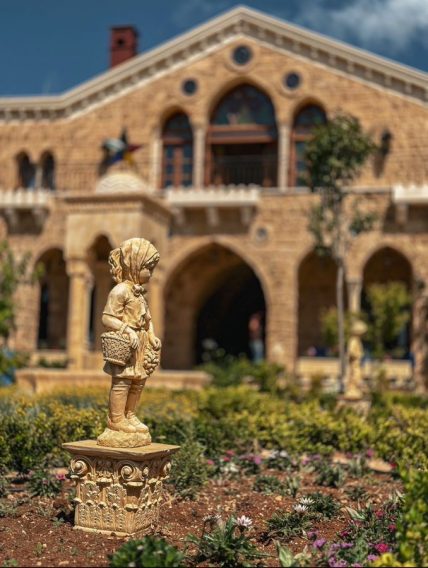
Exterior shots show the impressively detailed traditional Lebanese style home built by the Mortada family before Israeli soldiers looted the building and rigged it with explosives.
“Most importantly, the house was not destroyed by an airstrike or during any military confrontation,” he continues. “Israeli soldiers physically entered the property, planted explosives inside the house, and deliberately blew it up.”
While Mortada acknowledges he has no “concrete evidence” that Israel destroyed his family home in retaliation for the success of his documentary, he tells The Grayzone, “I do have suspicions, mainly because of the way the house was destroyed.”
Unlike other houses in the area that were damaged by airstrikes or shelling, Mortada notes, his house was deliberately blown up with explosives planted inside it. Israeli soldiers had occupied the house for several days before looting it and destroying it, video reviewed by The Grayzone shows.
“What makes this particularly suspicious is that my house is not in an Israeli-occupied area, nor is it within the so-called yellow line,” he says. “It is nowhere near a frontline or an active combat zone.”
He lamented, “Israeli hatred and vindictiveness seem to know no bounds.”
Mortada’s home in Aita al-Jabal was located approximately 4 kilometers outside of the so-called “Yellow Line,” a supposed buffer zone Israel unilaterally declared in Lebanese territory which it claims to be clearing of Hezbollah. If Israel’s soldiers didn’t simply rob and demolish the estate out of spite, it could signal an expansion of the areas Israel is targeting.
Interior photos provided by the Mortada family show the intricate stone archways which adorned their home prior to its demolition by Israel.
The first sign of trouble came when Israeli occupation forces assaulted a caretaker who had been living at the house with his family, looking after the garden, Mortada noted. “Israeli soldiers launched a stun grenade at him to force him and his family to leave the property.”
The grenade “was essentially a warning to the caretaker to leave the property with his family. Around the same time, Israeli forces also targeted a water tanker that was delivering water to the house. These incidents made it clear that they wanted him and his family to leave,” he says.
It’s a familiar feeling for hundreds of thousands of Lebanese civilians who’ve been forced to flee the region. Meanwhile, senior Israeli officials have spent months openly boasting of their efforts to destroy every Lebanese home south of the Litani River, and compare the campaign favorably to their systematic annihilation of Gaza. “All houses in villages near the Lebanese border will be destroyed, in accordance with the model used in Rafah and Beit Hanoun in Gaza,” Israeli defense minister Israel Katz declared in March.
In August, Katz deemed his mass displacement project – dubbed “Operation Silver Plow” – a success, crowing that residents of 24 villages in southern Lebanon now “have nowhere to return to; everything there has been destroyed.”
Now, the boasts have grown even bolder. With blue-and-white flags continuing to appear throughout swathes of occupied southern Lebanon, Israel’s leaders have eagerly provided live commentary of the slow-motion genocide. As an adoring audience cheered inside Israel’s Channel 14 studios on October 17, 2026, Katz declared that the number of villages annihilated by his forces had grown to 60. “Every single village — we’re talking about 23,000 homes — is in ruins.”
For Mortada, Israel’s aggression speaks for itself. “I believe Israel is undoubtedly carrying out a campaign of ethnic cleansing in southern Lebanon,” he says. “The objective, in my view, is clear: to prevent the people of southern Lebanon from returning to their villages and their land.”
In the past, “Israel at least attempted to justify its actions by claiming that it was targeting Hezbollah fighters or military positions. Today, however, it has become utterly brazen. Israeli officials openly speak about displacing the population, while their forces systematically destroy homes, infrastructure, and even bulldoze roads.”
“This is not simply about military operations. I believe it is a deliberate attempt to make entire villages uninhabitable and force their residents off their land permanently.”
“Perhaps, ultimately, this is also part of a broader ambition to realize the ideological vision of a so-called ‘Greater Israel,’” Mortada adds.
‘More than a home’
Combined with his testimony, photos of the now-destroyed home give a small glimpse of the loss incurred by the Mortada family when occupying Israeli soldiers seized everything of value and carried out a controlled demolition of the building.
“This house was much more than a home to us. It was a place where three generations of our family’s memories came together.”
Three generations of the Mortada family enjoying the home before its destruction by Israel. Pictured are Radwan Mortada; his daughter, Faya; his wife, Nohad, and his father, Nizar.
When Mortada’s father, Nizar, returned to Lebanon after two decades spent working in Libya, “his dream was to build a peaceful home where he and my mother could grow old together, surrounded by family and the land he had always loved.”
“He chose that particular spot for a very personal reason: There were several olive trees he had planted with his father, my grandfather, when he was just a little boy.”
With his golden years approaching, Mortada’s father expressed a desire to build his home beside those same trees. “For him, it was a way of returning to his childhood, his roots, and the memory of his own father,” he explains.
Mortada explained that the home also “carries the memory of my brother Ali,” who died in 2016 at age 29. Ali suffered medical malpractice after having contracted a bacterial infection during Beirut’s garbage crisis, a tragedy which Mortada says “reflected the corruption and failure of Lebanon’s political system.”
When Mortada family buried Ali in the village of Aita al-Jabal, the family resolved to build a home that would keep his memory alive, and bring them together in their time of grief. “Until then, my siblings, Jawad and Nada, and I had never felt such a deep connection to the village,” Mortada said. “Losing Ali changed that. We wanted to be close to him, and building the house became our way of keeping that connection alive.”
Photos provided by the Mortada family show Radwan’s now-deceased brother, Ali.
The family broke ground on the house in March 2016, shortly after his death.
Having “always loved traditional Lebanese architecture,” Mortada wanted the house to preserve as much as possible of the country’s rapidly-disappearing aesthetic traditions. “At a time when beautiful old houses were being demolished to make way for concrete buildings, we did the opposite,” he says. “We collected stones and architectural elements from ruined heritage homes and used them to create something beautiful again.”
The family spent nearly eight years working on it, carefully considering every detail.
“I approached the process as though I were painting a picture,” Mortada recalls. “It was a labor of love, and we poured so much of ourselves into it.”
Stained-glass windows and hand-painted frescoes lined the home’s walls and ceilings. It’s unclear exactly which paintings and treasures were looted by Israeli troops.
His wife, Nahod, recalled her husband’s excitement in a social media post explaining the significance of the home that Israel demolished later that day: “When I told my husband that I was pregnant with my first child, he was silent for a few seconds. His pupils were shrinking, he seemed to be doing a precise calculation. “When you give birth, the house will be finished,” he said with an enthusiasm I had never heard before.”
“He meticulously attended to every detail, carefully selected the furniture, altered some of the rooms to suit his unborn child, and even built a chicken coop “so my children can experience village life.””
In addition to paying tribute to the memory of his brother, the lovingly-constructed house was also the culmination of a lifetime of hopes and dreams of the entire family, Radwan Mortada tells The Grayzone.
“For my father, the house represented the peaceful retirement he had worked so hard for. For my mother, it was a family home filled with love. And for my siblings and me, it was a place where we could feel close to Ali,” he says.
“That is what the Israeli soldiers destroyed. Not simply walls and furniture, but a home built around the memories of people we loved, including those who are no longer with us.”
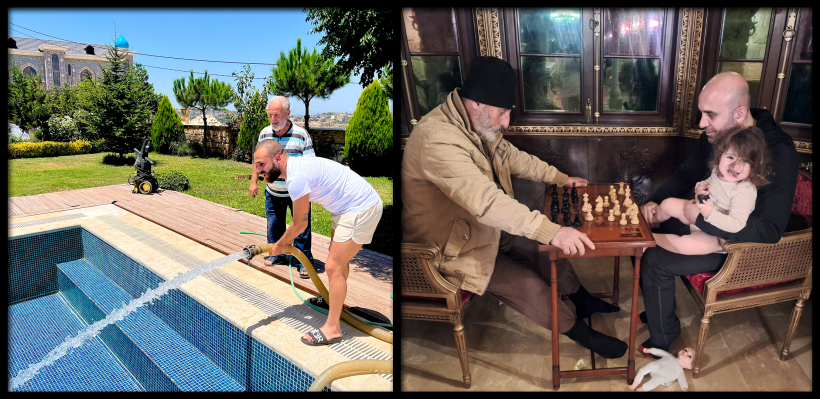
Left: Radwan’s brother, Jawad, and father, Nizar, are filling the backyard pool. Right: Radwan’s daughter, Faya, with her father and grandfather.
Compounding the pain of the loss of the family home, Mortada says, is “the feeling of abandonment” by the country’s leaders, who were imposed on Lebanon’s populace by the United States and Saudi Arabia in an effort to force Beirut to normalize relations with Israel. He names Lebanese President Joseph Aoun and Lebanese Prime Minister Nawaf Salam as among those principally responsible for the impunity enjoyed by Israel as it bulldozes dozens of villages in the South.
“The Lebanese government has done virtually nothing to protect the people of southern Lebanon or provide meaningful support to those who have lost their homes. People feel they have been left entirely on their own. We have seen no serious action capable of stopping the destruction, nor an adequate diplomatic or legal response, even at the level of the UN Security Council.”
“I believe what is happening in southern Lebanon amounts to ethnic cleansing. Homes are being destroyed, villages are being emptied, and people are being prevented from returning to their land, while the international community remains largely silent.”
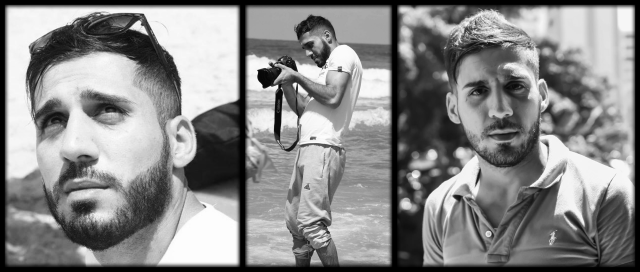
Left: Nizar outside the gates of his newly-finished family home. Center and right: Radwan and his wife, Nohad, are seen playing with their daughter, Faya.
“We can rebuild a house. We have done it before, and I hope we will do it again. But how do you replace the years, the memories, and the love that went into creating it?”
“My father wanted to spend his final years beside the olive trees he planted with his father as a child. My siblings and I wanted to have a home near the grave of my brother, and I wanted my children, Faya and Azer, to grow up there, surrounded by our family’s memories. Is that too much to ask?”
Question power. Follow the evidence. Challenge the machinery of empire.The Grayzone, founded by Max Blumenthal, delivers independent investigations and sharp analysis of politics, war, and empire—subscribe, share its reporting, and support its work.
orchestrating the pandemic to help usher in the “Great Reset,” a global economic, political and social system promoted by the World Economic Forum.
During oral arguments Thursday, attorney Peter Stassen told a packed courtroom that the COVID-19 vaccines were akin to a bioweapon, developed as part of a broader global effort to strip democratic and individual rights.
Speaking outside the courthouse in Leeuwarden, Netherlands, Stassen said Thursday’s hearing “was about publicly telling what is happening in this courtroom and what is the real case. The real case is that COVID-19 was not a disease but was a project.”
He accused Gates and Bourla of participating in that project, which he said was coordinated and undemocratic. He also accused the defendants of using censorship and propaganda to hide their intentions while promoting the COVID-19 vaccines as “safe and effective.”
COVID-19vaccines were developed and procured as military countermeasures, bypassing the standard development and approval pipeline for such products. By developing the shots as military countermeasures, they bypassed traditional safety regulations, leading to widespread injury, Stassen said.
Stassen said that while this is a civil case, he believes the defendants’ actions constitute serious criminal offenses that violate global treaties and the Nuremberg Code.
“They basically said, like a parrot, that all of Stassen’s accusations were either conspiracy theory or based on medical reports that are from people who are not neutral in this case,” said Ido Dijkstra, a Dutch journalist and the editor-in-chief of De Andere Krant, who attended the hearing.
Dutch attorney Meike Terhorst said the defense did not respond to Stassen’s assertions that COVID-19 was a project. “There was no response to that at all, nothing.”
Journalist Penny Marie, who has reported on the case, told The Defender that Stassen’s arguments “mirror what so many people worldwide say and have experienced and investigated.”
The defendants’ legal team did acknowledge that they were “touched” by the suffering of the vaccine-injured plaintiffs. Terhorst said the five living plaintiffs face “immense problems” with their health.
Dijkstra said the presiding judge on the three-judge panel appeared to “support the mainstream narrative,” but “gave the impression that she wanted to understand Stassen’s reasoning.”
Thursday’s hearing stemmed from a lawsuit filed in 2023 by seven people injured by COVID-19 vaccines — including two who have since died — against Gates, Bourla and 15 other defendants, including former Dutch prime minister and NATO Secretary General Mark Rutte, the Dutch state, and several Dutch public health officials and journalists.
According to Dutch attorney Meike Terhorst, who is not connected to the case but attended the hearing, none of the defendants appeared in court.
A ruling is expected as early as December but may be delayed until February 2027.
Expert witnesses barred from testifying in person
During oral arguments, Stassen addressed the court’s refusal to allow his team’s expert witnesses to testify in person. Earlier this week, the court limited the witnesses to video statements presenting their arguments.
Defense attorneys attacked the credentials of some of the witnesses. For instance, they claimed that Sasha Latypova — a former pharmaceutical research and development executive — has only a bachelor’s degree and is unqualified to provide testimony on scientific and medical matters.
Latypova disputed the claims, telling those gathered outside the courthouse that she has a “graduate degree from Dartmouth College and 25 years of pharmaceutical R&D and regulatory experience” — including interacting with the U.S. Food and Drug Administration, European Medicines Agency and Japanese regulators “on behalf of my clients.”
Catherine Austin Fitts, founder and publisher of the Solari Report and another of the expert witnesses for the plaintiffs, told The Defender that Bourla’s attorneys questioned the credentials of another witness — Mike Yeadon, Ph.D. Fitts said she was “surprised” by their claims.
“Yeadon served as vice-president of Pfizer’s allergy and respiratory research unit and worked for many years at Pfizer. Does Pfizer make it a practice to staff the company with unqualified people in senior positions? Does this explain why Pfizer appointed a veterinarian to be the CEO?” Fitts asked, referring to Bourla.
Terhorst said it is “very strange” for Dutch courts to not allow oral testimony by plaintiffs’ witnesses, as otherwise, “it is not easy to substantiate your claims.”
Despite the limitation, Terhorst said the witnesses bolstered the plaintiffs’ case. “The case is important based on the evidence provided by key witnesses,” she said.
“I think we [gave] a very clear sign to the court that there can be not justice if the court is not willing to look further at this expert evidence, because you can come to a judgment based on truth and a real discussion between the parties,” Stassen said during the press conference.
Vaccine-injured were ‘misled’ about safety of COVID shots
In an interview with journalist Fiona Rose Diamond earlier this week, Stassen said the plaintiffs “felt misled” by the Dutch government and by those who promoted the COVID-19 shots in the media.
“They felt misled by the whole system … And they were misled because they were told that this was a safe and effective vaccine, and in fact, the only way out of [the] crisis,” Stassen said.
At Thursday’s press conference, Stassen added that the plaintiffs sued not just because of their injuries, but because “they want the truth.”
Fitts highlighted the significance of the case, noting that under the Dutch legal system, the vaccine-injured can file lawsuits in response to their injuries — contrasting this with legal restrictions the injured face in the U.S.
Terhorst noted that the vaccine-injured in the Netherlands face other obstacles.
“Vaccine injury is not even recognized in the Netherlands,” she said. She noted that some vaccine-injured people briefly received treatment under public health programs that the Dutch state earmarked for long COVID patients. However, this treatment was later “terminated.”
Terhorst said lawyers for the Dutch state “said nothing” during the hearing about offering compensation to these victims, including the plaintiffs and their families.
This is one of several obstacles the plaintiffs have faced as this case has progressed. Last year, another attorney for the plaintiffs, Arno van Kessel, was arrested “with considerable force,” as part of a nationwide sweep by Dutch police against alleged members of a “sovereign citizen” movement with a “potential intent to use violence” against the Dutch state.
Terhorst said van Kessel spent seven months imprisoned in a high-security prison, lost his license to practice law, is not allowed to leave the country and was fitted with an ankle monitor — which was removed Thursday, in parallel with the hearing.
‘Cambridge Analytica’ is by now a byword for the social media Wild West of 2016, when regulations were non-existent and unscrupulous brokers sold personal user data to advertisers and political operatives. RT explores the scandal that Meta CEO Mark Zuckerberg still can’t dodge.
On October 22, Meta was ordered by a New Mexico judge to pay $25 billion in civil penalties over the collection of personal data from 44 million Facebook users by Cambridge Analytica more than a decade earlier.
The judge concluded that Meta’s misconduct warranted a penalty exceeding $219 billion under state law, but reduced the amount to $25 billion, making it one of the largest fines ever imposed on an American corporation.
Meta, operating at the time as Facebook, knowingly and systematically deceived users about how it managed their personal data and allowed its harvesting by third-party companies like Cambridge Analytica. The jury also found Meta’s senior executive team knew of, and lied about, deceiving users about how it planned to investigate data-harvesting companies after the Cambridge Analytica scandal became public.
To understand how Meta ended up owing an eighth of its annual revenue in just one judgment, it’s necessary to go back to 2013, when Cambridge Analytica emerged from Britain’s shadowy private intelligence sector.
What was Cambridge Analytica?
Cambridge Analytica was founded in 2013 as a subsidiary of SCL Group, a London-based private intelligence firm that has provided data analytics and “behavioural analysis” services to the British Defense Ministry and Foreign Office.
Cambridge Analytica CEO and SCL Group Director Alexander Nix has admitted under oath that his companies worked with American and British intelligence agencies, provided psychological warfare training to several Western militaries, employed multiple staff with security clearances in the UK and US, and hired former Israeli spies.
SCL Group’s work for NATO, Israel, Ukraine, and other governments and militaries was extensive, and Cambridge Analytica drew on its parent company’s experience in military psyops to become one of the world’s most effective election influence operations, according to whistleblower Christopher Wylie. On the other hand, SCL insists that its military and political wings were separate entities. Whichever account is true, Cambridge Analytica had been hired by political candidates in 200 elections by 2018, according to company documents. These included parliamentary elections in the Czech Republic, India, and Italy, the Brexit referendum in the UK, and most infamously, the 2016 presidential election in the US.
What did Cambridge Analytica do in 2016?
Cambridge Analytica was paid nearly $6 million by then-candidate Donald Trump’s campaign in the runup to the 2016 election. The company used its unprecedented access to Facebook user data to identify persuadable voters and potential donors, select effective markets for television ads, and target certain Hillary Clinton supporters for “deterrence” – adverts discouraging them from going to the polls on election day.
How did this become a scandal?
Cambridge Analytica did not break any laws to obtain this data. It was scraped from tens of millions of Facebook users who had, unbeknownst to themselves, given a third-party Facebook quiz application access to their messages, their profile data, and that of their friends.
Cambridge Analytica hired a Cambridge University professor, Aleksandr Kogan, to develop a personality quiz app, named ‘This is Your Digital Life’. Between 250,000 and 270,000 American Facebook users took the quiz in 2015, and by accessing their data, but crucially, under Facebook terms, accessing the data of all of their friends on the platform, Cambridge Analytica was able to compile detailed psychological profiles on roughly 87 million users.
Cambridge Analytica employee Christopher Wylie revealed the workings of the scheme to The Observer in 2018, telling the British newspaper that “we exploited Facebook to harvest millions of people’s profiles, and built models to exploit what we knew about them and target their inner demons. That was the basis the entire company was built on.”
Was Cambridge Analytica the only data-scraper doing this?
“Facebook never cared,” Kogan told NBC News in 2018, explaining that “tens of thousands” of developers created apps like his quiz, and sold user data to companies like Cambridge Analytica. Among the developers were CubeYou, which used a “one-click personality test” app to gather information for commercial use, and LocalBlox, which scraped data from 48 million users, which it then sold to marketers.
AggregateIQ, Global Science Research, and Eunoia Technologies all used data gleaned by Kogan for political ends. However, long before these companies existed, Blue State Digital, an American political consultancy, surreptitiously harvested Facebook data, including friends’ data, for use by Barack Obama’s 2012 campaign.
Cambridge Analytica, however, had its work for the Trump campaign exposed at the height of the ‘Russiagate’ hoax, at a time when Democrats and liberal media outlets were convinced that Russia intervened in the election on behalf of Trump. Cambridge Analytica’s data-scraping dovetailed neatly into a narrative of “Facebook bots” and “Russian military hackers” working with the Trump campaign, and the company became a whipping boy for an industry that transcended partisan lines.
US Special Counsel Robert Mueller and the Senate Intelligence Committee eventually investigated claims that Cambridge Analytica helped the Russian government target political ads at American voters, but both determined that these claims were untrue, and neither investigation found any proof of “collusion” between the Trump campaign and the Kremlin.
Has Facebook been punished?
At the time that the information was collected, Facebook had stopped allowing third-party apps to access friends’ data. However, a loophole allowed apps active on the platform before this change to continue harvesting information through 2015. Within days of Wylie’s revelations hitting the headlines, SCL Group and Cambridge Analytica were suspended from Facebook. Two months later, both companies ceased operations, leaving Facebook to handle the fallout.
Facebook initially went into damage control mode, insisting that “People knowingly provided their information” to Kogan’s app, and that “everyone involved gave their consent.”
However, the US Federal Trade Commission determined that Facebook made its privacy settings deliberately opaque, spreading them out over 20 separate screens and opting users into sharing data with third-parties by default. Facebook settled with the FTC for $5 billion in 2019, setting the stage for a series of similar payouts in the following years.
In 2018, Zuckerberg told lawmakers on Capitol Hill that Facebook was aware that user data had been transferred from Kogan to Cambridge Analytica (this transfer was in breach of its policies) since 2015, but opted not to inform users. He said that Facebook asked Cambridge Analytica to delete the data, but never followed up and made sure the company did. “We considered it a closed case,” he told Congress.
The following year, the US Securities and Exchange Commission accused Facebook of misleading investors by presenting “the risk of misuse of user data as merely hypothetical,” when it knew since 2015 that “a third-party developer had actually misused Facebook user data.” Facebook settled the case with the SEC for $100 million.
In 2022, Meta settled a $725 million class-action lawsuit brought by a group of Facebook users, who alleged that the company violated privacy and consumer protection laws by misrepresenting its data-sharing laws and failing to protect their personal information.
Meta attempted to shut down further legal action over the Cambridge Analytica scandal this August, when it reached an $18 billion settlement with 51 attorneys general across US states, territories, and the District of Columbia. Although the cases concerned the addictive design of Meta’s platforms and their effect on children’s mental health, the settlement included a clause resolving a multistate investigation into Facebook’s sharing of user data with third parties “whether known or unknown,” including Cambridge Analytica.
Even if participating states were to discover new facts about the data sharing, they have now waived their right to sue Meta. New Mexico was one of two states that was not party to this agreement, hence the $25 billion penalty.
Did Cambridge Analytica get Trump elected?
Ten years after the fact, it remains unclear how prominent a role Cambridge Analytica played in Trump’s victory over Clinton. The Trump campaign’s use of Facebook and X (then called Twitter) is widely cited as instrumental in his win, but the campaign’s digital director, Brad Parscale, has since said that he stopped using the company’s data several months before election day, considering it inaccurate.
What about Brexit?
Cambridge Analytica worked with Nigel Farage’s Leave.EU organization in late 2015 and early 2016, and carried out some preliminary data analysis for the campaign. However, the data was never used, and the UK Information Commissioner’s (ICO) office concluded in 2020 that the company had no impact on the referendum. As in the US, the ICO found no links between Cambridge Analytica and Russia, and no evidence that Russia interfered in the vote.
Is Zuckerberg in the clear?
The $25 billion judgement handed down on October 22 may be the largest fine ever imposed on Meta, but it does not mark the end of Zuckerberg’s legal woes. In addition to a Washington DC lawsuit holding him personally responsible for the Cambridge Analytica debacle, Zuckerberg’s company is being sued by investors in California over Facebook’s alleged efforts to conceal the misuse of user data by the company.
Meta will likely settle the latter case, just as it did with the similar SEC case in 2019. However, should Zuckerberg fight the lawsuit, he could find himself in the dock, as the plaintiffs have sought recorded depositions from him, former COO Sheryl Sandberg, and former CFO David Wehner – all of whom could be forced to shed more light on just how much Facebook knew about the scandal, and when.
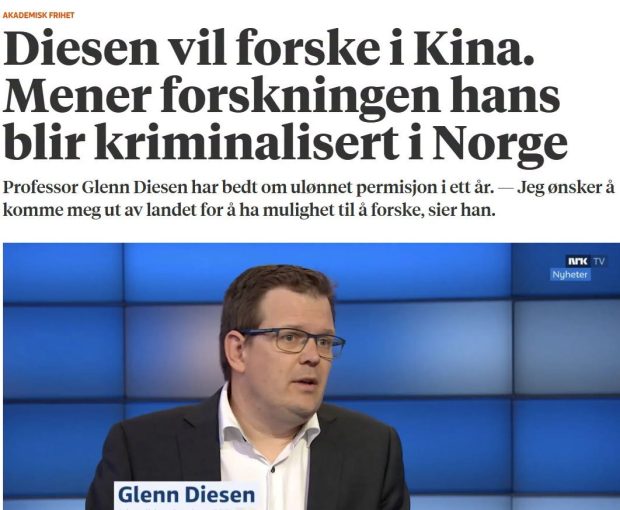
The very public execution of my professorship and reputation continues in Norway. Today’s media article about me makes three claims that are misleading and/or false.
1) The article dismisses my claim that my research is being criminalized as the journalists merely cite the dismissive comments from the university – no arguments are apparently required.
It is not possible for an academic anymore to analyse the policies of rival powers by assessing their security concerns, as it will be smeared by the government, the government’s NGOs and the media as “legitimizing” the enemy and supporting their narratives. The current Defence Minister singled me out with the accusation of spreading propaganda and criticised two podcasters for even speaking with me (as I have already been cancelled by the media in Norway). How was this accusation by the Defence Minister substantiated? I had argued that NATO expansion triggered the war in Ukraine, which the Defence Minister denounced as dangerous “Russian propaganda”, with no need to substantiate his vile accusation. I can cite a sea of evidence and also refer to statements by American and European political leaders, ambassadors, intelligence chiefs, and others to make my case. However, the purpose is not to engage in debate, but to smear, censor, and cancel. By going after an individual academic for challenging official truths, the government has already claimed a monopoly on the truth. Academics should have their arguments scrutinised and criticised, but these are severe personal attacks from the government without the possibility of even defending myself. How is this not criminalising the research of an academic?
I cannot even speak at any events in Norway without the event being cancelled. The last event I agreed to speak at was because I shared the stage with the former CIA officer John Kiriakou. A newspaper had the event at a church cancelled, and when the backup location did not also cancel, the journalist simply printed in the paper that it had been cancelled so people would not show up. Is this normal? I must use my allotted holiday days to attend conferences because any event I attend can be presented as “controversial,” and then the NGOs and journalists will go after the reputation of the university. Is this normal? Every newspaper article about me merely refers to me as “controversial” or “pro-Russian” without ever assigning meaning to these labels or presenting my argument.
I have argued, much like former CIA director Burns, that if the West attempts to pull Ukraine into the NATO orbit, then there would be war and Ukraine would be destroyed. This is considered a “pro-Russian” argument. Arguing that we should respect the will of most Ukrainians who want negotiations to end the war is also considered a “pro-Russian” argument, while in contrast, boycotting diplomacy, deporting Ukrainian refugees, and calling for the conscription of Ukrainian women is “pro-Ukrainian”.
2) To avoid addressing any of my arguments, the journalists go on to uncritically cite personal attacks against me, pointing out that I have been called a propagandist by the Norwegian Helsinki Committee. This is a “non-governmental organisation” financed by the government and the National Endowment for Democracy (NED), which was set up by Reagan and the CIA director in 1983 to manipulate the civil society of other states. The Norwegian Helsinki Committee has been relentless in its smears on social media to have me fired, writing hit pieces in the media, pushing to cancel my speaking events, writing a letter to my university, and even posting a picture of my house on social media. This is a governmental “human rights organisation” that cites human rights concerns to build the case for war.
3) Lastly, to further avoid addressing my actual arguments, they simply cite the fact that arguments I made at a debate last year have been “wholly or partially debunked” by a fact-check. The state-run media (NRK) invited the state-run military defence institute (FFI) to fact-check three of my claims. What claims did they “debunk”?
My first claim was that only 20% of Ukrainians wanted NATO membership between 1991 and the regime change in February 2014. The fact-checker argued that the number went up by the middle of 2014 (after Russia responded by seizing Crimea), which is a completely meaningless comment intended to muddy the waters, as my argument was about the previous era.
My second claim was that Zelensky had argued in an interview with The Economist in March 2022 that there were some Western countries that would like a long war with Russia to weaken a strategic rival, even if it would result in the destruction of Ukraine. The fact-checker argued that not all Western countries wanted a long war and that it was not an official policy. I never claimed it was an official policy, as it was primarily the US and UK pushing for a long war.
My third claim was that the US and UK sabotaged the Istanbul peace agreement in April 2022. The fact-checker claimed this was incorrect and suggested that it could only be based on one statement by David Arakhamia. The fact-checker did not want to mention that both mediators also confirmed it: Turkey’s foreign minister and the former Israeli prime minister both said that Russia and Ukraine were close to a deal, but the US and UK saw an opportunity to weaken Russia by fighting with Ukrainians. Zelensky’s former adviser Arestovych confirmed it, and the Ukrainian ambassador Chaly, who participated in the negotiations, confirmed that Putin was willing to do almost anything to end the war. The former head of the German armed forces confirmed that Boris Johnson sabotaged it, and Boris Johnson himself wrote articles warning about a “bad peace” and arguing for “strategic patience.” I am being fact-checked by war propagandists.
Unfortunately, none of my arguments matter because in Norway there is no debate and no interest in any arguments. Reality means nothing anymore as war narratives must be defended against inconvenient truths. I used to be naïve and think that the endless smears were caused by misunderstanding, as I had simply not been able to convey my arguments properly. However, the endless articles with smears and labels are deliberate lies and deceptions.
BEIRUT – The number of books destroyed by Israeli bombings of libraries, as well as religious and cultural institutions since October 2023, has exceeded 3 million copies, founder and coordinator of the National Network for the Protection of Libraries, Archives, and Cultural Heritage in Lebanon Hadi Bekdash told Sputnik on Saturday.
“There are reports of the burning of more than 700,000 books belonging to Lebanese and Arab publishers, as well as more than 3 million books from homes, libraries, religious centers, family collections, researchers’ libraries, and universities, publishers, cultural institutions, and private collections since 2023,” Bekdash said.
In 2026, practically confirmed information appeared about the destruction of dozens of public and hundreds of private libraries during the conflict with Israel, he added.
These data do not reflect the full scale of losses, since Lebanon still does not have a unified national database of destroyed libraries, archives, and book collections, the coordinator said.
Bekdash added that it will be possible to finally assess the damage only after conducting a nationwide inventory of lost and damaged collections.
A national campaign, A Million Books for Lebanon, is currently underway in the country, aimed at restoring destroyed and damaged libraries.
Russia’s Foreign Ministry has warned citizens to exercise caution when traveling abroad “amid a worldwide hunt for Russians.”
The statement follows the detention of Russian military blogger Mikhail Zvinchuk in Montenegro, a NATO member state in the Balkans, on October 9.
After nine hours in custody, Zvinchuk, founder of the Rybar Telegram channel, his wife and three associates were expelled from the country on the grounds of what Montenegro’s leading daily, Vijesti, described as “criminal, operational and intelligence processing.”
“We are compelled to once again remind people of the need to remain vigilant when traveling abroad, even if there is the slightest suspicion of any kind of claims by US law enforcement agencies, amid a worldwide hunt for Russians,” Foreign Ministry spokeswoman Maria Zakharova said on Friday.
Montenegro, where the blogger was detained, is not on Russia’s list of unfriendly states, Zakharova said, adding that similar situations were unfolding in countries not considered unfriendly to Russia.
The arrest was described as targeting alleged “hybrid activity” by the Rybar network, but no specific evidence supporting the accusation has been presented.
Kremlin spokesman Dmitry Peskov declined to comment on the details of the arrest but warned Russian citizens that visiting Europe is “currently dangerous.”
The Rybar channel, which has around 1.3 million subscribers, had previously also faced US and British accusations of spreading Russian propaganda and conducting information operations abroad. The US State Department had even issued a $10 million bounty in 2024 for any information about the individuals behind the channel.
Russians who have been targeted include basketball player Daniil Kasatkin, a point guard playing for the national team, who was arrested at Paris airport in June 2025 at the behest of the US, which accused him of being a member of a ransomware gang. He denied the allegations and was released in January 2026 as part of a Russia-France prisoner exchange.
Canada’s Bill C-22, has passed the Canadian House of Commons and is currently being debated in the Canadian Senate, and Civil Liberties Organizations are raising the alarm bells over the unprecedented surveillance powers the bill gives to the Canadian security state.
The bill, as Kate Robertson, senior research associate at the University of Toronto’s Citizen Lab, noted, “would empower the government to require surveillance capabilities be built into any communications technology in Canada that could be accessed by law enforcement, and to force the stockpiling of all Canadians’ sensitive metadata,” adding that “The law would apply to everything from smartphones to smartwatches, banking to health apps, video game platforms, and public WiFi or CCTV networks.”
The bill similarly “includes mandating that companies store user data for at least a year – even if the data isn’t something they would otherwise be keeping on hand for the purposes of their business”, “including location and transmission data”.
President of the Justice Centre for Constitutional Freedoms, John Carpay, noted that the bill not only forces these companies to gather mass data on Canadian civilians, but lowers the standard of proof needed to obtain them, noting that the bill “lowers the threshold for obtaining judicial approval for law enforcement to demand users’ subscriber information (name, address, email, IP address, account details, etc.) from ‘reasonable grounds to believe’ to ‘reasonable grounds to suspect.’”
The bill may even give the Canadian government the ability to turn on Microphones and Cameras in order to surveil citizens.
Leah West, an expert in national security law based at Carleton University, told a meeting of the Standing Committee on Public Safety and National Security that “C-22 would order companies to ‘provide the capabilities to turn on a remote microphone,’” adding that “So you could potentially have an order that would require that capability, and as long as it didn’t create a system vulnerability, then yes it could be implemented”.
Unsurprisingly, the bill has raised major alarm bells with Canadian civil liberties organizations.
The Canadian Civil Liberties Organization called the bill “the broadest expansion of government surveillance powers in recent Canadian history” and Matt Hatfield, Executive Director at OpenMedia, called it “the most invasive surveillance regime of any comparable democracy”.
Some of the alarm bells rung by the Canadian Civil Liberties Organization included the possibilities that the bill would:
– Pave the way for expanded information-sharing with the United States and numerous other governments including those with a history of abuse. Expansion of information-sharing with foreign governments in the absence of effective safeguards is particularly reckless at a time when cross-border persecution of diaspora communities—including through abuse of cross-border police cooperation tools—is on the rise.
– Give the government the power to force any electronic mechanism to build new surveillance tools and embed these at the core of their service, potentially transforming anything with a digital component into spyware. The mandated surveillance capability need not have anything to do with the actual functionality of the service in question. Backdoors like these also cannot be effectively limited to law enforcement access—Cybercriminals and foreign adversaries have repeatedly and successfully targeted the mass surveillance capabilities created by similar regimes. Overall, the proposal creates untenable privacy and cybersecurity risks.
– Lower the threshold for sensitive subscriber data, allowing government agencies to cast a wide net when conducting investigations; and
– the government the power to force any digital entity to keep highly sensitive information on every single person in Canada or abroad for up to one year. Information could include every single person’s location at any time over the course of the year, a complete record of everyone you interacted with online, and more. Bill C-22 includes no mechanism to place limits on who can access these data troves or for what purpose, making it potentially fair game for any and all criminal and civil investigations as well as for commercial exploitation by the private company being compelled to retain the data.
In an open letter over 25 leading Canadian civil society groups called the bill an “unprecedented and extraordinarily dangerous surveillance architecture that could impact every digital tool people in Canada depend on every day”,“the most expansive invasion of Canadian privacy rights in modern history” and “fundamentally a mass surveillance capabilities regime”.
It warned that under part 2 of the bill “the government could force the creation and installation of privacy-compromising surveillance tools and backdoors in an enormous and ill-defined set of ‘electronic service providers’, including telecom providers, social media and cloud service providers, AI tools, and any ‘smart’ device” adding that “The law could even be used to force Canadian companies to build backdoors into their products before they export them abroad” and that “The result creates an untenable threat to privacy and cybersecurity” even noting that it “far exceeds powers available to police and security agencies in the United States.”
It also noted that, “Part 2 of Bill C-22 will now also empower the government to require any digital service provider to record and retain detailed metadata on every single person in Canada or abroad, damaging the privacy of millions who are not suspected of committing any crime or posing any security threat,” adding that “companies will be forced to develop the capacity to track information that was never before available to them and is not necessary for their business purposes, then to collect and retain that information for up to one year.”
A study by University of Maryland researcher Shibley Telhami points to a major shift in US public opinion, with sympathy for Palestinians surpassing support for “Israel” and growing numbers of Americans viewing the occupation as responsible for genocide.
Drawing on Gallup data, Telhami noted that sympathy for “Israel” among the US public has fallen from around 50% to 36%, while sympathy for Palestinians has risen to 41%.
Among Democrats, support for “Israel” has plunged from more than 50% in 2001 to just 17% today, while sympathy for Palestinians has climbed to 65%, according to the researcher.
Telhami’s Critical Issues Poll at the University of Maryland also found that more than 60% of respondents believe US military and diplomatic support enables “Israel” to carry out its actions.
Generational shift extends across political lines
Citing data from the Pew Research Center, Telhami pointed to a narrowing generational gap among Democrats in negative views of “Israel.” The figures showed that 71% of younger Democrats and 66% of older Democrats held negative views of the occupation.
One of the most significant changes, however, has emerged among young Republicans under the age of 35. According to the cited polling, the share of young Republicans expressing negative views of “Israel” rose from 35% to 57%.
Only 22% of young Republicans agreed that “Israel’s” actions in Gaza were “justified as self-defense,” compared with 52% of their older counterparts.
Telhami highlighted findings indicating that 80% of academics since October 7, 2023, and 42% of the general US public feel they must exercise self-censorship or caution when discussing the genocide of Palestinians in Gaza, fearing accusations linked to their criticism.
The findings point to growing public criticism of “Israel” and US support for it, alongside continued concerns about the social and professional consequences of expressing such views.
Irish novelist Sally Rooney has agreed to the withdrawal of her books from the UK market after her support for Palestine Action created legal obstacles to the payment of royalties under British terrorism legislation.
Rooney, the bestselling author of “Normal People” and “Conversations With Friends”, said her publisher, Faber, had concluded that continuing to distribute her work in the UK could expose those involved to criminal liability. The decision was made with her agreement following consultations over the legal implications.
Palestine Action was designated a “terrorist organization” by the UK government in July 2025. The following month, Rooney publicly declared that she intended to continue supporting the group and direct proceeds from her book sales towards it. The organization remains legal in the Republic of Ireland, where Rooney is based.
Rooney was prepared to accept the consequences
In a statement to The Guardian, Rooney explained that her position had placed the publication of her work in Britain at risk.
She said that after expressing her intention to support Palestine Action, fulfilling contracts to publish her books in the UK could constitute a serious criminal offence. Rooney added that she had been transparent about her convictions and was prepared to accept the consequences.
The novelist had previously cancelled a planned UK visit to collect an award over concerns that she could face arrest because of her stated support for the banned group.
Rooney warned in a statement supporting the legal challenge against the ban that the proscription could prevent her existing books from remaining available in British shops and block the publication of future titles in the country. Her submission to the High Court raised concerns about the consequences for freedom of expression.
The restrictions also extend to royalties from television adaptations of her work. Last year, Rooney said the independent producer behind the BBC adaptations of “Normal People” and “Conversations With Friends” had advised her that paying her could breach terrorism legislation if it knew or suspected she would use the money to finance Palestine Action. Both series aired before the group was banned.
Section 15 of the UK’s Terrorism Act criminalizes providing money or other property when a person knows or has reasonable grounds to suspect that it may be used for terrorist purposes. A conviction can carry a maximum prison sentence of 14 years.
Faber, which publishes Rooney in the UK and Ireland, said the legislation had left it unable to transfer earnings from British sales to the author.
The publisher said selling a writer’s work without being able to pay them was unacceptable. It confirmed that, with Rooney’s full agreement, it would stop supplying her books in Britain in every format, while continuing to publish and sell her work in other markets.
Bestselling novels face uncertain future in Britain
Rooney’s novels have received widespread critical acclaim and achieved substantial commercial success. She has been hailed as a voice of her generation.
“Normal People” has sold more than one million copies in the UK, while “Conversations With Friends” and “Beautiful World, Where Are You” have each exceeded 500,000 sales.
The BBC adaptations also attracted large audiences. “Normal People” accumulated 62.7 million views, making it the broadcaster’s most-streamed series of 2020.
Demand was likely to continue
Despite the withdrawal decision, copies of Rooney’s books remained available in central London on Wednesday afternoon. Waterstones said retailers could continue selling copies already in stock.
Booksellers also indicated that they intended to keep offering the novels while existing supplies lasted.
Gian Carlo, a bookseller at Henry Pordes Books, said the shop could sell its copies without generating royalties for Rooney. He added that he understood her position.
At London Review Bookshop, bookseller John Clegg said he had ordered additional copies after learning of the development. He said demand was likely to continue, although the shop would no longer be able to replenish its stock through Faber. Clegg also criticized the legislation and said he hoped the case would encourage the Home Office to reconsider it.
Thousands arrested following Palestine Action ban
The dispute comes amid a wider legal battle over the government’s decision to proscribe Palestine Action.
More than 3,700 people are believed to have been arrested in the UK since the ban took effect in July 2025 on suspicion of supporting the organization. Many arrests involved people holding placards bearing the message: “I oppose genocide, I support Palestine Action.”
Approximately 2,500 people have been charged. However, trials have not proceeded while the legal challenge to the proscription remains unresolved. The case is scheduled to reach the Supreme Court next month.
Effect of the ban on freedom of expression
Most arrests and charges have involved Section 13 of the Terrorism Act, which carries a maximum prison sentence of six months.
Huda Ammori, a co-founder of Palestine Action leading the legal challenge, said Rooney’s inability to publish her work in Britain demonstrated the effect of the ban on freedom of expression.
Ammori said Rooney had maintained her position despite the personal and professional consequences. She argued that the author’s books should remain widely available rather than disappear from British shelves because of her refusal to abandon her support for Palestinians.
She added that writers should not have to choose between their political convictions and their ability to publish their work.
An Israeli digital advertising agency helped run an espionage campaign using a vast network of online ads to track targets and hack their devices, Reuters reported on 15 October, citing two research groups.
Reports from Canadian cyber watchdog group Citizen Lab and New York advertising security firm Confiant document how the Israeli advertising agency Discover-Tech placed millions of ads online each day for ordinary products such as phones or earpods.
Discover-Tech placed the ads using the advertising services of Google, Comcast, Yandex, and other search engines.
The Israeli ad agency could identify and track internet users who visited websites or used apps with the malicious ads, and at times obtained phone numbers from smartphone users.
Clicking on the ads was not required to allow users to be tracked.
Some ads were used to plant spyware from another Israeli firm, Candiru, on users’ devices.
Jerome Dangu of Confiant said Discover-Tech placed at least 10 million online ads per day, affecting more than 120,000 websites and 75,000 apps.
“Very likely hundreds of millions of people would have been touched by Discover-Tech,” Dangu said.
Citizen Lab said Candiru spyware delivered through Discover-Tech’s ads had been used to compromise devices of journalists and executives at the Qatari news outlet Al Jazeera.
Unidentified media organizations in Mexico, Israel, and Europe were also targeted.
Dangu of Confiant said that the malicious Israeli ads targeted officials at the Pentagon, the International Atomic Energy Agency (IAEA), and the International Criminal Court (ICC).
Discover-Tech ads also helped to surveil the populations of entire regions, most notably the Israeli-occupied Palestinian West Bank and Gaza.
“You go to almost any site in Palestine – any site – you find a Discover-Tech ad. It gives them a very complete visibility on the digital activities of an entire country,” Dangu said.
Citizen Lab also said the malicious ads were directed at officials in the UN, NATO, the European Commission, as well as more than a dozen governments.
The ads also helped to track employees and executives of chip-related firms such as Nvidia, SanDisk, Broadcom, and Micron.
As a result of the Confiant and Citizen Lab investigations, Google said it has removed Discover-Tech from its ad platforms “for systematically violating our policies.”
IAB Europe, an association for digital marketing and advertising on the continent, has now suspended Discover-Tech from its list of globally approved vendors.
Comcast ad tech subsidiary Beeswax also removed Discover-Tech from its platform.
Yandex did not respond to Reuters’‘ requests for comment.
Israel has a well-documented history of using private technology companies for surveillance, intelligence gathering, and cyberespionage.
Some of these companies have close connections to Israel’s military and intelligence services, particularly Unit 8200, the Israeli military’s signals intelligence unit.
What Israel has done, is doing, to Gaza has not sprung ex nihilo from October 7.
Genocide is not a situational counter-response to aggression. It’s a coming-out event of sorts.
Differently put: There are no legitimate antecedents to genocide. Genocide is not a “war crime” to which a set of mitigating or exculpating legal defenses can attach.
Genocide is a stand-alone indefensible crime—“the blackest of all crimes”—for which there are no extenuating circumstances and to which no traditional legal defenses attach.
Ethnocide, depopulation, domicide and daily mass murder can never be explained away or exculpated using argument from law, ethics or history.
In essence, talk to the hand about October 7, 2023; because the face isn’t listening. Just as there are no legal or moral extenuating circumstances for genocide, so it is that there are no historical defenses for this “blackest of all crimes,” for genocide.
To assert that you are just, justified or even coherent as you carry out that which cannot be just or justified—this is to embody a most grotesque incoherence and contradiction.
At minimum, Israel deserves—and has yet to receive—the unanimous revulsion and isolation reserved for entities whose existence is a confidence trick and a fraud upon us all.
Reality is truth, past and present. The reality of genocide gives rise to irrefutable truths. From the facts of this Twenty-First Century Genocide; certain truths immemorial and irrefutable that traverse time have emerged. Truths about Israel.
Through Gaza, the world has come to know Israel’s ways with the Palestinians, with their lands and homesteads—down to what Israeli terrorists habitually do to the intimate bits-and-bobs that make up a household.
Through Gaza, we have come to know Israel’s ways across the Levant and beyond. They unground and salt the earth forever. They uproot ancient communities and their olive groves. For fun. They deform babies and the baby faces of children for life.
The reality on the ground is of genocide ongoing, of daily extermination. In aggregate, a “child has been killed in Gaza every 71 minutes for three years.” This extermination campaign is not only of children—the one segment of Palestinian society which American conservatives are comfortable defending—but of adults, young and old: admirable, valuable adults. Adult lives matter, yes?
Hasbara and official myth-history aside, because of Gaza and the Ghazzawi you don’t have to know much history at all to arrive at the truth about Israel.
Because of the Palestinians of Gaza, the living, the martyred and those who still resist; the truth about Israel is now ahistoric.
To arrive at that truth about Israel, you don’t have to know much about the genesis of the so-called “conflict” between Israelis and Palestinians in historic Palestine. I hazard that you need to know hardly a thing about this history to arrive at the truth about the lived reality of Palestinians.
You are what you do.
We know the Real Israel through the actions of real Israelis in Gaza. We know how Israel operates and how a preponderance of its people thinks. These realizations came out of the Gaza genocide, which has shown the world in cruel relief how Israel acts and, by extension, what Israel is.
Since October of 2023, the world knows in detail what the untouchable Israel—state and civil society—has done and continues to do to the Strip, to the West Bank and in South Lebanon.
But what have the Ghazzawi, the living and the martyred, accomplished? A great deal. In a manner, Palestine and the Palestinians have won.
Gaza has exposed Israel for the morally and militarily corrupt force that it is. The Genocide of Gaza has, very plainly, invalidated Israel and validated the Palestinian cause.
When you are in the writhing coils of a boa constrictor; it is small comfort to know, as Palestinians have always known, that, while outwardly captive, they are, nevertheless, truly liberated from the illiberal political propaganda that grips the West.
So, they need to know, too, that they have shown good people around the world the way. For once and for all, Israel’s televised genocide had corroborated the lived reality of the Palestinians; their reasons for rage and their rights to resistance and recompense.
Palestinians had been telling us for decades that they have been set upon by murderers and thieves. Palestinians have told us they are being killed and robbed as a matter of course. Their lived reality has been irrefutably affirmed, and universally so.
“It’s complicated,” Israel’s supporters keep countering. “Study up before you open your mouth.” The opposite is true. It’s absurdly simple.
A moral, sentient human being need know nothing much about the history of the region to arrive at this conclusion.
Israel has had the nerve to play its genocide of the Palestinians of Gaza to a packed house: to the world.
Most galling of all: In the course of this very public genocide, Israel has engaged in the mother of all performative contradictions: denying genocide, while publicly committing genocide, effectively asserting a birthright to commit genocide.
Think about it:
To deny ongoing, prime-time livestreamed genocidal action at the very same time that you are committing these actions, and then to hound and hurt anyone who dares notice: This is a performative contradiction in a category all of its own, like no other.
Caught in the protracted act of genocide, the guilty party, Israel, has continued to cavalierly claim for itself and be granted the right to keep killing and deceiving without being considered and treated as a killer and con-artist.
In essence, Israel exists among nations us as a privileged, protected, well-funded aberration, carrying out unspeakable evil with universal blessings and absolution.
I belabor the most galling reality, as it really gets me: At the same time that Israel and its cringing Western admirers have killed and deceived; they have instructed The World to deny Israel’s genocide, then deny Israel’s deception about its genocide, and finally to justify both or fear defenestration, cancellation, banishment, arrest and worse.
To no avail. Human action is the undeniable key to man-made reality. Israel and the US have acted; they’ve revealed themselves. They’ve been exposed.
“Just as you can identify a tree by its fruit, so you can identify people by their actions,” said Jesus (New Living Translation). As Matthew 7:20 reads, “Therefore by their fruits you will know them.”
With the exception of the flint-hearted ruling political elites—the wholesale slaughter carried out by Israel in Gaza has stirred the hearts of ordinary people across the world. A collective conscience developed around Palestine. Minds not AI became engaged. They said, “We see you, Israel. We revile you. We reject you.”
This is what October 7 will forever mark and signify: The triumph of the Palestinians over the alternate reality mass-marketed to the World by Israel and our ruling elites.
Ilana Mercer, a widely published paleolibertarian author, essayist and theorist, has been writing up an anti-war, anti-woke storm since 1998, starting in Canada. On arriving in the US, in 2002, her weekly column was right away syndicated. Mercer’s national syndication fell through shortly after due to writing in strident opposition to the war in Iraq. ILANA is described as “a system-builder. Distilled, her modus operandi has been to methodically apply first principles to the day’s events.” She’s Jewish, grew up in Israel ages five to nineteen, and left, at 19, decades back, never to return. She had refused to serve in the IDF, Israel’s compulsory military. Ilana’s focus since October of 2023 has been the genocide.
By portraying Chinese characters as perpetrators of ruthless violence while casting Japanese Self-Defense Forces (SDF) intelligence operatives as defenders, the season 2 of the Japanese drama Vivant has recently drawn criticism from Chinese netizens, who argue that its depiction turns historical reality on its head while ignoring Japan’s wartime atrocities.
The TBS drama series – a spy suspense story in which an alleged unofficial intelligence unit of the SDF operates across the globe — has attracted a passionate fanbase. Its currently airing season 2 opened with a household rating of 18.8 percent, the highest for a TV drama this year, according toa commentary article by Japanese media Toyo Keizai.
What draws attention is the portrayal of the enemies in the series, the article noted. Scenes in which the Chinese organization subjects kidnapped members of the SDF unit to brutal torture are repeated with unrelenting intensity.
It is rare for Japanese TV dramas to explicitly portray a real-life country as the enemy, the article noted.
Japanese Prime Minister Sanae Takaichi also made a reference to the drama, saying that she has been recording Vivant and hopes to binge-watch it over the year-end and New Year holidays, according to Japanese media outlets.
China’s CCTV News report on Sunday revealed that the drama features scenes in which Chinese personnel cut off the fingers of and stab Japanese intelligence operatives in the abdomen. Such acts bear striking similarities to the torture inflicted on Chinese nationals by invading Japanese troops during the World War II.
The drama distorts the truth by attributing these atrocities to modern Chinese characters. Beneath the surface, it subtly glorifies Japan’s cross-border overseas operations, blurs the functional boundaries of the SDF and implicitly promotes an expansionist narrative, per CCTV News. … continue
This site is provided as a research and reference tool. Although we make every reasonable effort to ensure that the information and data provided at this site are useful, accurate, and current, we cannot guarantee that the information and data provided here will be error-free. By using this site, you assume all responsibility for and risk arising from your use of and reliance upon the contents of this site.
This site and the information available through it do not, and are not intended to constitute legal advice. Should you require legal advice, you should consult your own attorney.
Nothing within this site or linked to by this site constitutes investment advice or medical advice.
Materials accessible from or added to this site by third parties, such as comments posted, are strictly the responsibility of the third party who added such materials or made them accessible and we neither endorse nor undertake to control, monitor, edit or assume responsibility for any such third-party material.
The posting of stories, commentaries, reports, documents and links (embedded or otherwise) on this site does not in any way, shape or form, implied or otherwise, necessarily express or suggest endorsement or support of any of such posted material or parts therein.
The word “alleged” is deemed to occur before the word “fraud.” Since the rule of law still applies. To peasants, at least.
Fair Use
This site contains copyrighted material the use of which has not always been specifically authorized by the copyright owner. We are making such material available in our efforts to advance understanding of environmental, political, human rights, economic, democracy, scientific, and social justice issues, etc. We believe this constitutes a ‘fair use’ of any such copyrighted material as provided for in section 107 of the US Copyright Law. In accordance with Title 17 U.S.C. Section 107, the material on this site is distributed without profit to those who have expressed a prior interest in receiving the included information for research and educational purposes. For more info go to: http://www.law.cornell.edu/uscode/17/107.shtml. If you wish to use copyrighted material from this site for purposes of your own that go beyond ‘fair use’, you must obtain permission from the copyright owner.
DMCA Contact
This is information for anyone that wishes to challenge our “fair use” of copyrighted material.
If you are a legal copyright holder or a designated agent for such and you believe that content residing on or accessible through our website infringes a copyright and falls outside the boundaries of “Fair Use”, please send a notice of infringement by contacting atheonews@gmail.com.
We will respond and take necessary action immediately.
If notice is given of an alleged copyright violation we will act expeditiously to remove or disable access to the material(s) in question.
All 3rd party material posted on this website is copyright the respective owners / authors. Aletho News makes no claim of copyright on such material.






 Aletho News
