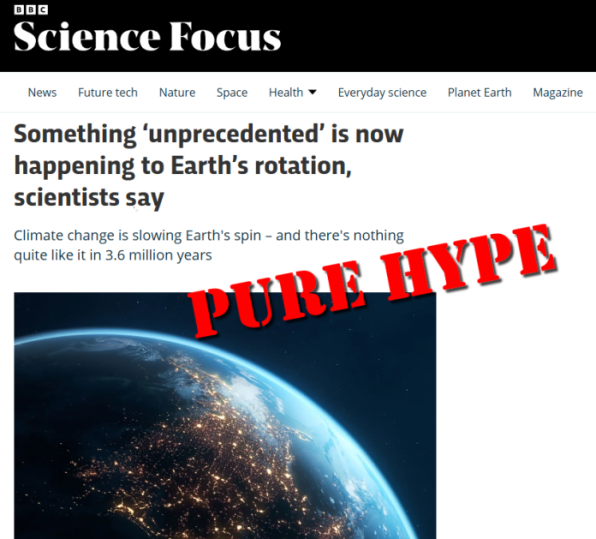
The British Broadcasting Corporation (BBC) Science Focus article “Something ‘unprecedented’ is now happening to Earth’s rotation, scientists say” claims that climate change is causing an “unprecedented” slowing of Earth’s rotation by 1.33 milliseconds per century, something not seen in 3.6 million years. This is false. The data show that millisecond-scale variations in Earth’s length of day are routine, naturally occurring, and both technologically and biologically insignificant.
The BBC sensationalizes the issue as something extraordinary, stating that today’s rate of change is “unequivocally” unlike anything in millions of years. But Earth’s rotation has never been constant. As explained in the Climate Realismrebuttal to Euronews on the same topic, seasonal atmospheric mass redistribution alone produces annual variations of 0.5 to 1 millisecond. Interannual ENSO shifts add another ±0.3 to 0.5 milliseconds. Decadal core-mantle coupling produces swings of 3 to 4 milliseconds. These are measured, observed phenomena, not model projections.
In that context, 1.33 milliseconds per century is not planetary destabilization. It is background noise, certainly nothing that would be noticed by even the most sensitive ecosystem or living being.
The BBC emphasizes that melting ice shifts mass toward the equator, comparing it to a spinning skater extending their arms. That physics analogy is correct in principle. What is incorrect is the implication that this is some new geophysical regime. Earth’s length of day has fluctuated throughout recorded history due to tidal friction from the Moon, atmospheric angular momentum exchange, ocean circulation, and core dynamics. The long-term tidal braking trend alone is about +1.7 to +1.8 milliseconds per century based on 2,500 years of eclipse records, a rate comparable to or larger than the BBC’s headline number.
Even more inconvenient for the narrative is the recent acceleration of Earth’s rotation. As noted in the Climate Realism piece, June 29, 2022 was the shortest day ever recorded in the atomic timekeeping era, about 1.59 milliseconds shorter than 86,400 seconds. If climate change were producing a simple, monotonic slowdown, we would not be seeing record-setting shorter days in the same decade.
The BBC also attempts to inflate the significance of the change by invoking dramatic metaphors. One researcher is quoted comparing the energy involved to a catastrophic earthquake, saying: “The change in the Earth’s rotational energy is equivalent to a magnitude 9.0 earthquake.” This is nothing but irresponsible doom mongering. The comparison is not about destructive force, as the article admits, but about abstract energy equivalence. It is an analogy designed to impress, not to inform. No cities are shaking. No ecosystems are collapsing. No lifeform on Earth can feel a thousandth of a second difference.
Let’s put the number in perspective. One millisecond is 0.001 seconds. A 1.33 millisecond change represents approximately 0.000015 percent of a 24-hour day. Human circadian rhythms are tuned to roughly 24 hours, not to thousandths of a second. There is no plausible biological mechanism by which such a tiny change could affect human health, animal behavior, or plant life. It is physiologically undetectable. Even if the rate of change were accurate, consistent, and sustained, it would take approximately 75,188 years for the day to lengthen by exactly one full second.
Technologically, the “crisis” BBC claims is even more absurd. Modern systems already handle irregular rotation through leap seconds. Since 1972, 27 leap seconds have been added to Coordinated Universal Time to synchronize atomic clocks with Earth’s spin. Discussions are underway about possibly implementing a negative leap second because of recent acceleration. GPS, spacecraft navigation, financial trading platforms, and astronomical observatories continuously ingest Earth orientation parameters from the International Earth Rotation and Reference Systems Service and adjust automatically. They already deal with corrections far larger than 1 millisecond.
Society adjusts clocks by one hour every year for daylight saving time in many regions. That is 3.6 million times larger than the 1.33 millisecond change being described. Leap years add a full day. Compared to those routine adjustments, this isn’t even a rounding error.
The BBC article goes further, suggesting that by 2100 climate change could outpace even the Moon’s gravitational influence on day length. That projection is model-dependent and scenario-driven. It assumes the now discredited and removed RCP8.5 high-emissions pathways and continued ice loss at rates embedded in climate models. It is not an observed reality. It is a modeled extrapolation.
And even if that projection were accurate, we are still talking about millisecond-scale shifts. The practical consequences remain limited to timekeeping adjustments that modern civilization already manages with ease. There is no crisis as the infinitesimal change in the Earth’s rotation has and can have no plausible impact on ecosystems or living beings.
The most telling line in the BBC piece is the assertion that “human influence on the Earth system has become so profound that we are now changing the very way our Earth spins.” That statement is designed to provoke awe and alarm. It is also technically trivial. Humans also change Earth’s mass distribution through groundwater extraction, reservoir construction, mining, and urbanization. These processes are measurable, they are not existential.
In the end, the BBC’s hyped 1.33 millisecond per century change to the Earth’s length of rotation, even if true, represents trivial geophysical adjustment. One that is not biologically meaningful, technologically disruptive, and not outside the envelope of natural variability observed over decades and centuries.
Framing a millisecond-scale variation as “unprecedented” planetary destabilization represents a a textbook example of taking a measurable but trivial geophysical adjustment and inflating it into a symbolic crisis. It is a giant nothingburger. An attempt to scare people with a story that is not scary in the least.
The Israeli government is still holding a massive trove of video documentation of the Oct. 7 attack captured by individuals and communities caught up in the fighting. One bereaved parent even accuses Israeli authorities of deleting a video of her son’s last moments before returning his phone to her.
According to Israel’s Channel 13, “all the cameras, memory cards and films that documented the atrocities were collected, but two and a half years later, these materials have not been returned to the communities and bereaved families who are desperate for information, and even feel that someone is hiding it from them.”
Soon after Hamas and Palestinian Islamic Jihad’s attack on Israel on Oct. 7, 2023, special units from the IDF, the Israeli intelligence agency Shin Bet and Israel’s investigation unit Lahav 433 collected photo and video documentation of the violence, confiscating cell phones, individual cameras, kibbutz security cameras and more.
“They disconnected what was needed, took it and moved on – that was the last time we saw the materials,” said an Israeli army reservist who participated in the collection mission.
According to the head of the Kfar Aza kibbutz – the site of a number of a series of atrocity hoaxes spun out in the early days after the attack – community members cooperated with investigators at the time. Now, years after the events, these families are wondering why documentation of their loved ones’ fates has yet to be returned to them.
Even Sabine Taasa, who was made an emblem of Israeli victimhood after her husband and one of her sons were killed on Oct. 7, is now clashing with Israeli authorities over footage of that day.
Taasa’s 17-year-old son, Or, was killed on Zikim beach. According to Channel 13, Taasa says she saw a video her son filmed in the moments leading up to his death, but when authorities returned his phone to her, no such video remained. The outlet says this is not an isolated incident.
An IDF probe found that soldiers abandoned civilians hiding in a bathroom there and then left their bodies for a week.
Channel 13 reports that Israeli police claimed Lahav 433 is still investigating the events in kibbutz Kfar Aza and no indictments have yet been filed, so returning evidence at this stage could jeopardize their criminal case. Meanwhile, the IDF rejected all accusations that it is withholding documentation and says it is in the final stages of adopting policies for how this type of evidence will be returned to communities and families.
On October 7, the Israeli government issued Hannibal Directive orders which led Apache helicopter pilots and tank gunners to take aim at Israel’s own citizens in the Gaza envelope, supposedly to prevent them from being taken hostage. Israeli Brig. Gen. Barak Hiram personally ordered a tank crew to shell a home in Kibbutz Be’eri, knowing it was filled with Israeli citizens who had been taken captive by Hamas fighters seeking to negotiate a way out of the standoff. A dozen Israelis were killed in the strike, leaving behind “a house full of corpses,” according to the lone Israeli survivor. One Israeli tank gunner from an all-female unit similarly revealed that she was ordered to shell Israeli homes without knowing who was inside. An Israeli police investigation subsequently revealed that Israeli helicopters shelled the Nova Electronic Music festival on October 7.
Given Israel’s track record of targeting its own citizens on October 7 and misleading the public about it, the Israeli state might be holding on to as much video as possible to ensure no further evidence of the Israeli army massacring its own citizens is made public.
Israel has demonstrated a keen interest in collecting documentation of the events of October 7 and controlling narratives through careful curation and dissemination. At the same time, it has refused to participate in independent, international investigations of the attack, Israel’s response, or the widely distributed and now widely debunked claims of mass sexual violence by Hamas and other Palestinian militant groups. According to the Israeli state, Israel and Israel alone is justified in and capable of conducting such probes.
However, the state has strangely neglected to launch its own comprehensive special investigation into the apparent massive intelligence failure and military debacle. In fact, the Israeli government has had to be prodded by its own high court to establish a state commission of inquiry into the events, according to reporting by the Times of Israel. The Israeli government now has until July 1 to come up with a “suitable framework” to investigate the events, following years of pressure by the families of Israelis killed that day.
With the Israeli military-intelligence apparatus refusing to return possibly hundreds of hours of footage to its owners, some Israelis who lived through the October 7 attacks are beginning to wonder if they could be hiding something.
Japan has achieved dramatic long-term declines in childhood tooth decay — despite never implementing nationwide water fluoridation and only recently recommending fluoridated toothpaste, according to a new study in BMC Public Health.
The research, by Yoshihisa Yamashita, D.D.S, Ph.D., of Kyushu Dental University, describes Japan’s experience as a “natural social experiment” that could reshape how public health experts address preventing dental cavities at the population level.
Unlike many other high-income countries, Japan has historically limited fluoride exposure during childhood — which makes the country a “unique and underexplored case.”
Using decades of national dental survey data, the study found that average rates of tooth decay among Japanese 12-year-olds fell steadily over roughly 40 years.
Levels dropped from a peak national Decayed, Missing, and Filled Teeth (DMFT) index score of 4.75 in 1984 to just 0.53 in 2023 — “well below levels historically reported in populations exposed to systemic fluoride through community water fluoridation,” according to the study. DMFT is the standard international measure of decayed, missing and filled teeth.
“This trajectory unfolded in the absence of nationwide community water fluoridation,” the paper states. High-fluoride toothpaste was not widely available in Japan until 2017 and was not officially recommended for school-aged children until 2023, according to the study.
Dr. Griffin Cole, conference chairman of the International Academy of Oral Medicine and Toxicology, said the study’s method of using national dental records across an entire population, rather than measuring fluoride exposure among a small group, provided important evidence on oral health.
“By examining real-world outcomes, Yamashita’s analysis provides strong evidence of what we already know: Oral health can improve through nutrition, behavior and broader public health measures, rather than adding fluoride chemicals to our water supplies,” he said.
The findings are the latest to challenge long-standing assumptions promoted by organizations such as the Centers for Disease Control and Prevention (CDC) and the American Dental Association that systemic fluoride exposure through community water fluoridation explains large-scale reductions in tooth decay.
Decades-old study by U.S. researchers still used to justify fluoridation?
The study compared modern Japanese cavity rates with historic U.S. data collected by early fluoride researcher and dentist H. Trendley Dean in the 1930s and 1940s, and later consolidated by F.J. McClure.
Despite a small study size and issues with collection bias, Dean’s research formed the scientific foundation for North American fluoridation policies by showing lower cavity rates in four communities with naturally fluoridated water supplies.
But according to the new study, Japan’s current cavity rate is substantially lower than the minimum levels observed in Dean’s high-fluoride communities — even though Japan’s drinking water contains effectively no added fluoride.
Yamashita said it was also notable that Japan has only recently introduced high-fluoride toothpaste. Most toothpaste previously available contained less than 1,000 parts per million (ppm).
Popular children’s toothpaste brands in the U.S., including kids’ Crest and Colgate, contain about 1,100 ppm.
The paper argues that broader social and behavioral changes likely play a major role in reducing tooth decay.
The author suggested several possible contributing factors, including:
A long-term decline in sugar consumption and shifts in dietary habits.
Changes in childhood feeding and parenting practices, including reductions in prolonged bottle feeding.
Universal access to dental care through Japan’s national health insurance system.
Improved oral hygiene awareness and preventive behaviors as a result of greater healthcare access.
Fluoride ‘not a magic bullet for controlling tooth decay’
Japan’s per-capita sugar consumption has declined by more than 30% since the 1970s, according to national statistics cited in the paper.
However, the author noted that cavity rates continued falling even after sugar intake stabilized, suggesting that multiple factors likely worked together over time.
Dr. Hardy Limeback, professor emeritus in the Faculty of Dentistry at the University of Toronto, told The Defender that a 1996 Japanese study found even lower tooth decay rates in Japan during World War II, when sugar supplies were scarce and rationing took place.
“The effects of total fluoride did not seem to have much effect on the caries rates in Japan in the 20th century,” Limeback said. “In that country, increasing fluoride exposures by means other than fluoridation did not appear to be ‘one of the top 10 public health procedures of the 20th century,’ as claimed for fluoridation by the CDC in America.”
“Fluoride is not a magic bullet for controlling dental decay,” Limeback added. “Limiting sugar intake is.”
Countries should look beyond fluoride for dental health solutions
The study arrives amid renewed international discussion about fluoride safety.
Following a landmark 2024 judgment that found fluoride at current levels recommended for water fluoridation in the U.S. posed an “unreasonable risk” to children’s health, communities and states across the country stopped adding fluoride to their water.
The ruling also mandated that the U.S. Environmental Protection Agency (EPA) regulate it.
Yamashita argued for a “broader multicausal approach” to oral health policy.
“Substantial and sustained reductions in dental caries can be achieved through multicausal pathways,” the paper concludes, “even in the absence of universal water fluoridation.”
Yamashita said countries seeking to reduce tooth decay should consider not only fluoride-based strategies, but also policies addressing diet, early childhood environments, access to care and wider social determinants of health.
He also suggested that a bias toward fluoride has posed a barrier to understanding the multicausal approach that can improve dental health.
“This analysis highlights insights that have long remained unrecognized — not because the evidence was unavailable, but because prevailing frameworks shaped what researchers expected to see,” Yamashita wrote.
In 2018, a team of researchers at Stanford ran an experiment that should have made bigger headlines than it did. They recruited a few hundred people under the cover story that they were studying the relationship between DNA and diet. They swabbed everyone’s cheeks, ran real genetic tests, and then sat each person down to deliver their results.
Here is the trick: the results were fake. Or rather, they were assigned at random, with no relationship to what the swabs actually showed. Some people were told they carried a high-risk version of a gene linked to poor exercise capacity, or to feeling hungry after meals. Others were told they carried the protective version. Then the researchers measured what happened to their bodies.
The people told they had the “bad” exercise gene performed measurably worse on a treadmill. Their lung function changed. They felt more exhausted, sooner, and they ran out of steam earlier, even when their real DNA said nothing of the sort. In the eating experiment, people told they had the “protective” satiety gene produced more of the hormone that signals fullness and reported feeling more satisfied after the same meal as everyone else.
The kicker, reported by the Stanford team, was this: the effect of what people believed about their genes was, in some measures, larger than the effect of the genes themselves.
Sit with that for a moment. A story about your DNA changed your DNA’s behavior more than your DNA did.
What if the steady drip of fear we live inside, the warnings about disease, the urgency of prevention, the dread of the next pandemic, is not only describing our health but quietly shaping it?
What if the constant push toward more checkups, more screening, more tests for things we would never otherwise have noticed slowly trains us to inhabit the identity of the perpetually sick?
And what if a belief, held tightly enough by enough people, does not stay politely inside the mind but reaches down into the body, the way it reached into the lungs of those runners on the treadmill, so that a culture convinced it is fragile and broken and doomed begins, quietly, to become exactly that?
These are questions, not verdicts. But they all circle the same suspect: an idea so familiar we have stopped noticing it is an idea at all. Genetic determinism, the belief that our genes are a sealed verdict, that disease is written into us at conception, that biology is destiny.
It is not a comforting story but a disempowering one, a marketable one, and above all a frightening one, because a person who believes in genetic determinism has surrendered their power before they ever thought to use it. But where our attention goes, our energy flows. And if that is true, then we are not the prisoners of this story at all. We are only beginning to understand the power we carry as conscious, creative beings. The story about genes, in most of the cases that matter most to us, is simply wrong.
The story we were sold
For the better part of three decades, we have been taught to think of the genome as a blueprint. When the Human Genome Project was completed in the early 2000s, the language around it was almost biblical: the “book of life,” the “code of codes,” the “instruction manual” for a human being. Newspapers ran a steady drumbeat of discovery: a gene “for” intelligence, a gene “for” depression, a gene “for” breast cancer, a gene “for” being unfaithful.
The blueprint metaphor is seductive because it is clean. A blueprint fully specifies a building. Hand it to any competent crew and you get the same house every time. If your genome is a blueprint, then your health, your temperament, your fate: these are simply the structure that gets built. Nothing to be done but watch it go up.
But here is the strange thing about a metaphor this powerful: we adopted it before the science was in. And as the science has come in over the last twenty years, it has steadily dismantled the very picture that sold it to us.
The conditions that fill our clinics and our anxieties (ADHD, heart disease, depression, type 2 diabetes, the common cancers) are not determined by one decisive gene but by hundreds or thousands of genetic variants, each nudging risk by a vanishingly small amount. There is no “gene for ADHD” or those other conditions mentioned. Instead, what exists is a faint pull spread across the whole genome, one that environment, behavior, and chance can tip in any direction.
This matters because of a word that gets badly misused: heritability. When you read that a condition is “80% heritable,” it is natural to hear “80% inevitable,” or “80% genetic in you, personally.” Neither is what the number means.
Heritability is a population statistic. It describes how much of the variation between people in a given environment can be statistically attributed to genetic differences. It says nothing about how fixed a trait is, and nothing about any individual.
The cleanest illustration is height, which is roughly 80% heritable. Yet average height in many countries rose by several inches over the twentieth century, far too fast for the gene pool to have changed. What changed was nutrition. A highly heritable trait moved dramatically because the environment moved. Heritable and changeable are not opposites. They were never opposites.
Then there is the discovery that should have ended the blueprint era on its own. When researchers ran large genome-wide studies hunting for the genes behind these heritable psychiatric and physical conditions, the genes mostly weren’t there, or rather, they were there in such tiny, scattered fragments of effect that they couldn’t add up to the heritability the twin studies had promised.
Geneticists named the gap politely: the “missing heritability problem.” The promised master genes for our most common diseases were searched for at enormous expense, and they did not show up. What showed up instead was complexity, contingency, and a genome that behaves far less like a verdict than we were told.
So why does the picture survive?
An idea this disempowering does not endure for decades on the strength of its evidence. It endures because it pays. Whole industries rest on the premise that you are broken in ways only they can manage. The determinism story feeds a steady pipeline of genetic tests, lifelong prescriptions, screening programs, and specialist referrals, each one justified by the conviction that your biology is a defect to be monitored rather than a system you can shape.
It underwrites diagnostic categories that expand a little wider every year and interventions that grow a little more expensive. You do not need to imagine a smoke-filled room or a coordinated conspiracy. You only need to notice the incentive: a story that keeps people anxious, dependent, and coming back is a story with deep-pocketed sponsors, and a person who feels capable and well is, on a great many balance sheets, a customer lost.
Planting a Seed
If the blueprint metaphor is broken, what replaces it?
Think of a seed instead. A seed is not the plant. It is a bundle of possibilities that only becomes something in contact with soil, water, light, and weather. Plant the seed in rich ground and it flourishes; plant it in drought and it withers; plant it in shade and it grows crooked toward whatever light it can reach. The seed sets the range of what is possible. The soil and the season decide what actually grows.
This is what the field of epigenetics has revealed about our DNA. Genes are not simply “on.” They are switched on and off, turned up and turned down, by chemical marks (methylation, histone modification) that respond continuously to what we eat, how we sleep, what we breathe, how stressed we are, and even how connected we feel to other people. The DNA is the seed. Everything around it, and everything we do to it, is the soil.
The evidence here is vivid. There is a famous strain of mouse, the agouti mouse, in which a mother’s diet during pregnancy determines whether her genetically identical pups are born yellow, fat, and disease-prone or brown, lean, and healthy. Same seed. The nutrition is the soil, and the soil decides which animal the seed becomes.
In humans, researchers studying people conceived during the Dutch “Hunger Winter” famine of 1944–45 found epigenetic and metabolic marks of that prenatal starvation still measurable decades later, alongside elevated rates of certain diseases. The famine ended in months. Its signature lasted a lifetime, written not into the genes but onto them.
The lesson is not that environment overrides genetics. It is subtler and more interesting: the genome is built to be responsive. Responsiveness is the point. We did not evolve sealed verdicts. We evolved seeds that read the ground they land in.
So how far does this reach?
If a fake gene can change a body, what can a strongly held belief do? We are used to treating the mind as a spectator to our health, watching from the stands while the real game plays out below in cells and chemistry. What if where we place our attention, and what we expect to be true, can move the body in ways we can actually measure?
You see this most clearly in two phenomena. With the placebo effect, the mere expectation of help is enough to move the body: pain eases, mood lifts, stress drains away, blood pressure settles. Belief shifts the body out of the clenched, defended state we might fairly call dis-ease, and into one of greater ease, the calm physiology in which the body’s own capacity to repair itself can do its work.
Its dark twin, the nocebo effect, is the body worsening in response to the expectation of harm. Patients warned of a drug’s side effects get those side effects more often, even on sugar pills. Expectation is not a passive lens through which we view our health. It is an active input into it.
And consider the most powerful nocebo of all: the prognosis. Two doctors can hold the exact same statistic and hand a patient two entirely different futures. One says, “Ninety percent of people with this disease are dead within five years.” The other says, “One in ten people with this disease recover, and we are going to do everything those people did.” The facts are identical. The arithmetic is identical. But which sentence would you want spoken over your body? Which one leaves a door open, and which one quietly walks you toward its conclusion?
The question cuts deeper when the prophecy is inherited. If your mother died of breast cancer, or your father of heart disease, the medical system can begin to treat you as a smaller, earlier version of them: a case history waiting to repeat itself, marked from your first appointment as the one who is next. At what point does being watched as a fate begin to summon it? At what point does a family history, handed to you as a verdict instead of a probability, become a script you never agreed to perform?
Now return to the Stanford experiment with this in mind. When people were told they carried a high-risk gene, their bodies began, in part, to enact the prophecy. That is the nocebo effect aimed squarely at our deepest story about ourselves: the story of our own DNA. And it points to the most unsettling possibility in this whole essay: that genetic determinism is not only a flawed scientific theory. It may be a self-fulfilling one. Tell a person they are doomed by their biology, and you have just added a risk factor.
Self Fulfilling Prophecies
Here is the part I find genuinely unsettling, and it is the heart of this argument.
A prophecy does not need to be true to come true. It only needs to be believed with enough authority that the believer begins, without noticing, to arrange the world around it. And our culture has no prophecy more authoritative than the one stamped with the word genetic. Tell people their depression, their weight, their heart, their cancer was written into them before birth, and you have not merely described their future. You have begun to build it.
Watch how the loop closes. A person told they are genetically doomed turns their attention toward the threat, and attention is not passive. It is the most powerful filter the brain owns, the thing that decides what is real enough to act on.
Fixed on the fear, the body settles into the physiology of fear: chronic stress, vigilance, inflammation, the very biochemical soil in which disease grows best. The behaviors that would protect them start to feel pointless, so they quietly fall away. Every twinge becomes evidence. Every symptom is a confirmation. In time the prophecy delivers what it promised, and everyone nods knowingly: the genes, of course. This is the dark engine beneath the Stanford treadmill. Those runners did not fake their exhaustion. A belief reached into their lungs and made it true.
Now hold that loop in your mind and run it backwards, because the same machinery turns both ways. This is what people are reaching for, often clumsily, when they talk about being conscious creators.
Strip away the mysticism and a hard, almost mechanical truth is left standing: where attention goes, energy flows, and where energy flows, biology tends to follow. Not because thoughts are magic, but because attention decides what you notice, what you fear, what you feed, and what you repeatedly do. And what you repeatedly do, across months and years, is precisely what lays down the epigenetic marks and builds the body you have to live in.
So if the genome is a seed, you are not the seed. You are the one tending the ground. You did not choose what you were handed, and no amount of will turns a drought into rain. But the soil is made of things you touch every single day: what you eat, how you sleep, who you let close, what you rehearse in your mind, the story you accept about who you are and what you are doomed to become.
A gardener cannot command a seed. A gardener can absolutely decide what grows. To be a conscious creator is nothing more mystical than that, and nothing less powerful: to stop being the passive ground your inheritance falls into, and to start, deliberately, attending to what you want to take root.
You are not only the seed. You are the soil, the season, and the hand that tends the ground.
So tend it.
And be careful what you let take root. Attention is the gardener’s most powerful tool, and almost everything competing for yours has an interest in keeping you afraid. The headline built to alarm you. The endless forecasting of the next catastrophe. The tired paradigm that profits whenever you believe you are broken, powerless, and next in line. None of it is neutral, and fear is among the fastest-growing things you can plant. Give it your attention and it will spread until it crowds out everything else.
You do not have to fight every frightening thought. You only have to stop watering it. Turn your attention, again and again, toward what you actually want to grow: the proof that you are capable, the people who steady you, the ordinary daily acts that tell your body it is safe. This is not denial and it is not wishful thinking. It is the most practical thing you can do, because where your attention goes your energy flows, and your biology, patiently, follows.
You were handed a seed. What grows from it is still, in most of the ways that matter, yours to decide.
Germany has gone to arguably insane lengths to go green when it comes to generating electricity. Not only is the country commiting economic suicide with its Energiewende, it is also undergoing ecological suicide in some regions. One example is the destruction of virgin, fairy tale forests, such as the Reinhardswald in the state of Hesse.
The Blackout News article highlights a viral warning from retired forester Josef Erhard.
Speaking out against a planned wind energy zone in his former district within the Bavarian Forest, Erhard leverages decades of boots-on-the-ground experience to shed light on a side of the green transition that many city-dwellers and politicians rarely see.
Incredibly destructive
Many people assume that putting a wind turbine in a forest simply means clearing a small circle for the mast. Erhard warns that the reality of the construction phase is incredibly destructive.
To transport components like 80-meter-long rotor blades and to bring in heavy-duty cranes, existing narrow logging trails must be drastically widened. New access roads with massive turning radiuses have to be bulldozed straight through the trees, ditches built to divert water away, turning quiet woodlands into heavy-construction zones.
“Wind power in the forest: that means forest clearing/deforestation,” reports Blackout News.
More deforestation to clear way for wind turbines in northern Germany. Photo by P. Gosselin
Irreversible forest floor destruction
Rich soil is the foundation of a healthy forest, and Erhard emphasizes that the damage done here is permanent – it cannot be reversed. The sheer weight of construction vehicles causes severe soil compaction. Once compressed to this degree, the earth loses its ability to absorb rainwater and nurture tree roots.
Huge construction road ditches intercept and redirect rainwater and streams away from the downside forest, damaging the biotope. Furthermore, each turbine requires a massive reinforced concrete foundation dug deep into the earth—structures that will remain buried long after the turbine’s lifespan is over. These too massively interfere with the biotope’s water supply system.
Unviable environment
Forests aren’t just collections of trees; they are complex ecosystems. The area slated for development is a known habitat for protected species, including lynxes, wildcats, bats, and birds of prey.
While forests can naturally recover from storms or beetle infestations, Erhard points out that clearing land for wind energy permanently transforms natural habitats into industrial zones. He pulled no punches regarding the threat to wildlife, grimly referring to the spinning blades as “shredders” for birds and insects.
Water pollution
Forests act as giant natural sponges and filters, playing a critical role in replenishing groundwater and securing local drinking water. Erhard warns that digging deep trenches for power cables, carving out roads, and compacting the soil disrupts natural water flow patterns. In high-altitude ridge lines, this could have devastating consequences for downslope water tables and community water supplies.
Mass scale damage and no benefit
Finally, the veteran forester questions whether wind power in forests is actually as sustainable as marketed. He points to the environmental impact of microplastic shedding from the rotor blades, the risk of hydraulic oil leaks, and the carbon footprint of global supply chains required to source the thousands of tonnes of turbine materials.
Furthermore, he notes that regions like southern Germany are notoriously low-wind areas, meaning these projects are often heavily dependent on government subsidies while still requiring conventional power grids to back them up when the wind dies down.
Josef Erhard urges policymakers to rigorously weigh the actual energy output of these turbines against the irreversible, long-term destruction of our natural carbon sinks, biodiversity, and drinking water resources.
Not mentioned in the Blackout News article are the local climatic impacts that turbines have. Studies have shown that air speed on the leeward side of the turbines causes the air temperature to rise, which would only contribute to drying out the forest whose water system has already been severely damaged by the contruction.
In short, you can’t get more environmentally-criminally negligent than this source of power.
The Iranian Embassy in Copenhagen has rejected Denmark’s terror accusations against the Islamic Republic, saying they are aimed at isolating the country.
The embassy released a statement on Saturday, one day after the Danish Security and Intelligence Service (PET) claimed that Iran was playing a larger role when it came to the threat of terrorism against the Scandinavian state.
The Iranian diplomatic mission said that PET’s allegations are largely based on general assessments, rather than on documented and undeniable evidence.
“The baseless accusations against Iran are part of a broader process of political and international isolation of Iran, and not the result of proving a real and documented threat against Denmark or any other Western country,” it added.
It also said Tehran has consistently and officially rejected any involvement in the alleged terror activities on Danish soil and believes that PET reports have, over the past years, presented a repetitive and inaccurate picture of the purported Iranian threat.
It further emphasized that there was no evidence proving Tehran’s role in the 2018 case of the attempted assassination of a leader of the anti-Iran ASMLA terrorist group in Denmark and the 2024 case of the attack on the Israeli embassy in Copenhagen.
“The Islamic Republic of Iran is unfairly portrayed as a source of threat, while it is itself the target of hostile actions and political pressure,” the embassy said.
NATO’s proxy war in Ukraine is morphing into a direct EU-Russia war. And the war hawks in Brussels are further escalating by attacking civilians in the Donbas and Russia proper. The doves in the Kremlin are running out of options to keep their own hawks under wraps. As things stand now, an all-out EU-Russia war is not only a possible, but by now a likely scenario. But to what end?
For decades, prominent Jewish voices have wrestled privately with an uncomfortable question. Does aggressive Israeli government conduct expose diaspora Jewish communities to backlash they did not invite? In early March, Ezra Klein brought that question back into public view. Speaking with former Obama senior adviser Ben Rhodes on a podcast episode titled “The Great Lie of War”, the New York Times columnist warned that Israel’s central role in the joint U.S. assault on Iran could fuel a new wave of antisemitism.
The two men spent most of the interview discussing the strategic recklessness of the Iran operation where the United States and Israel launched an assault that killed Supreme Leader Ali Khamenei and much of his senior command. They examined the lack of congressional authorization, the absence of an endgame, the risk of a massive refugee crisis, and what they described as Israeli Prime Minister Netanyahu’s long-sought goal of drawing the United States into direct military confrontation with Iran.
The antisemitism remark came near the end of that segment, specifically as a follow-on to a discussion about Saudi ambivalence toward the war and the question of what Israel actually wants from the conflict. Klein’s exact words in the transcript were, “I’m not saying this is the biggest issue at this moment, but the centrality of Israel in the operation has raised some concerns for me about what this is going to mean for anti-Semitism. You see the amount of talk on the MAGA right, but elsewhere as well that, you know, Israel’s leverage over Donald Trump or that, you know, this is all just some kind of Israeli plot.”
Klein then noted that Netanyahu appeared to be gambling with Israel’s long term political standing in America and in the world at a time of “very, very sharply rising anti-Semitism,” expressing uncertainty about how it would all pan out. The New York Times columnist’s concern, stated plainly, was that Israel’s highly visible, central role in what many perceived as an unjustified war of aggression would fuel conspiracy theories rather than defuse them. His worry was that Netanyahu’s short-term tactical success, finally getting a U.S. president to strike Iran, risked long-term consequences for Jews, especially in the United States.
This dilemma is not new. Jewish billionaire George Soros articulated a similar concern over two decades ago. Soros has largely steered clear of public association with Jewish communal life and seldom appears at exclusively Jewish functions. That changed in 2003, when he took the stage at a New York City meeting hosted by the Jewish Funders Network. Questioned about the spread of antisemitism across Europe, Soros offered an unexpected diagnosis, laying blame at the feet of U.S. and Israeli policy. “There is a resurgence of anti-Semitism in Europe. The policies of the Bush administration and the Sharon administration contribute to that,” he stated. “If we change that direction, then anti-Semitism also will diminish. I can’t see how one could confront it directly.”
At the time, the reaction from Jewish leadership was furious. Elan Steinberg, who served as senior adviser to the World Jewish Congress after a stint as its executive director, fired back. “Let’s understand things clearly: Anti-Semitism is not caused by Jews; it’s caused by anti-Semites.” Abraham Foxman dismissed Soros’s words as “absolutely obscene.” The head of the ADL elaborated. “He buys into the stereotype. It’s a simplistic, counterproductive, biased and bigoted perception of what’s out there. It’s blaming the victim for all of Israel’s and the Jewish people’s ills.”
The Foxman and Steinberg responses reflected an orthodox position within Jewish communal leadership. Antisemitism, in this view, is a pathology of antisemites, and any attempt to link it to Israeli behavior constitutes victim blaming. Yet this position has always co-existed uneasily with a practical awareness that Israeli actions, particularly those perceived as disproportionate or aggressive, create public relations challenges for diaspora Jewish communities.
Klein’s 2026 remarks fall squarely within this tension. He was warning that Netanyahu’s gamble, making Israel so visibly central to an unpopular war, would hand ammunition to those who already believed such theories. Polling data suggests that Klein’s concerns about Israel’s political standing are well-founded. Gallup’s 2025 Annual World Affairs Survey documented a broader collapse in American sentiment toward Israel. Only 46% of Americans sympathized with Israelis, the lowest figure in 25 years of Gallup tracking. Among Democrats, 59% sympathized more with Palestinians—with only 21% sympathizing with Israelis—creating a nearly 3-to-1 ratio, the first time Palestinians had held such a commanding lead among members of a major U.S. party. A majority of Americans, and a record-high 76% of Democrats, supported an independent Palestinian state.
These trends predate the Iran strike and reflect cumulative damage from Israel’s conduct in Gaza. The joint United States and Israel operation against Iran, with Israel’s role so prominently featured, is unlikely to reverse this trajectory and will more than likely heighten Western populations’ hostility toward Israel. The polling numbers bear this out.
The Jewish People Policy Institute found that only 28% of strong liberal Jews support the war while 62% oppose it. Support climbs to 100% among strong conservative Jews. The partisan split is even more dramatic. Trump voters among American Jews back the war at 99%, while Harris voters divide 47% to 42%.
The picture among Americans generally looks very different. Pew Research found that 59% of Americans said the United States made the wrong decision in using military force and 61% disapprove of Trump’s handling of the conflict. An AP-NORC poll found that 59% of Americans believe U.S. military action has gone “too far,” while a Quinnipiac survey reported 74% oppose sending U.S. ground troops into Iran. The immediate unpopularity of the Iran war combined with Israel’s sullied image as a result of the Gaza genocide may explain why elements of American Jewry are embracing certain forms of controlled opposition to the Netanyahu regime, while stopping short of criticizing the entire Zionist project and its thoroughly Jewish nature.
It should be said that rational anti-Semitism is never about all Jews. Klein’s worry that “Jewish communities globally could be stained with guilt by association in the eyes of those who conflate the Israeli government with all Jews” should be seen as relying on the idea that anti-Semitism refers to complaints about “all Jews.” Most commonly complaints about Jews rely on understanding where the power of the Jewish community is directed, and in this case it’s obvious that the mainstream Jewish community in the U.S. and its powerful lobbying organizations (here and here) are entirely on board with the war. This is especially true in the Trump administration where the more conservative elements of the Jewish community, including Chabad Lubavitch, have increased their influence greatly.
It is simply that their vision [of conservative Jewish groups] for Jewish flourishing in America is radically at odds with the basic assumptions that have grounded American Jewish politics for much of the last century: chiefly, that Jewish interests are best served by the separation of religion and state; that American Jews are best protected through multiethnic, pluralistic coalitions rather than an alliance with the Christian majority; and that the invisibility of Jewish group interests is preferable to visible Jewish particularity.
Ezra Klein’s warnings about the centrality of Israel in the Iran war are a tacit admission that the Jewish establishment has lost its ability to operate from behind a veil. By leveraging control over U.S. administrations to initiate wars of choice, this power structure has forced a public reckoning that no amount of image-polishing can reverse. History has repeatedly shown that Jewish overreach eventually triggers an immune response from the host population.
We are currently in the midst of that reaction, and the path forward lies in the unapologetic identification and systematic dismantling of the Jewish influence networks that have compromised the highest levels of our government and financial institutions.
A Manchester café owner and prominent supporter of the Palestinian cause has accused the British police of attempting to recruit him as an informant targeting Palestine Action, offering financial incentives and suggesting authorities could overlook certain minor offenses in exchange for cooperation.
Speaking to The Guardian on Saturday, Shams Sadiq, who owns two cafes in Manchester and has been active in pro-Palestine solidarity efforts, said the approach took place when he attended Ashton-under-Lyne police station on 15 May to recover electronic devices seized during a previous investigation linked to Palestine Action.
According to Sadiq, officers informed him that after examining his devices they knew he was “fully involved” with Palestine Action but said he would not face charges related to his arrest last year. He said the discussion then shifted toward securing his assistance.
“They said to me: ‘We need your help. Look, there’s benefits in helping us,'” Sadiq told The Guardian. “I’m like: ‘What kind of benefits? Financial benefits? Are you going to pay my taxes?’ They said: ‘Oh, we can help with things like that.'”
Sadiq said another officer suggested additional incentives were available.
“The other guy said to me: ‘Oh, there’s other benefits, too.’ They said: ‘We’re not saying you can go out and commit a serious crime but we can turn a blind eye to certain things.'”
When he jokingly asked whether they could remove his speeding tickets, Sadiq said the officers responded, “We don’t care about speeding.”
The 51-year-old believes the officers were attempting to recruit him as an informer because of his involvement in Palestine solidarity activities and his standing within Manchester’s Muslim community.
“He interpreted ‘help’ to mean ‘with their investigations [into Palestine Action] because they said I am involved and maybe be an informer. They also said I’m quite respected in my community, so maybe they think I would help them find Muslims in the mosque with extreme views.'”
Activism under scrutiny
The allegations emerge amid increasing scrutiny of pro-Palestine activism in Britain and growing concerns among campaigners over the use of counterterrorism powers against activists and community organizers.
Days before the alleged recruitment attempt, Sadiq said he was stopped and questioned at Manchester Airport under Schedule 7 of the Terrorism Act after returning from a holiday in Morocco.
He said officers questioned him for more than three hours about Palestine Action, Iran, and his personal finances, including details related to his mortgage. During the interrogation, he said officers also asked how he would respond if someone attending his mosque expressed extremist views. His electronic devices were seized during the encounter.
According to Sadiq, the same officers later met him at a Starbucks inside Terminal 2, where they returned the devices and apologized for the airport questioning.
Anti-terror powers
A vocal advocate for Palestine, Sadiq has participated in demonstrations and supported campaigns and cultural events highlighting Palestinian issues. His public support has previously made him a target, with one of his cafes subjected to harassment because of his pro-Palestine stance.
Sadiq said the officers also told him that they could provide protection for him and his family and gave him a contact number, making it clear that he did not have to decide immediately whether to cooperate.
He said he chose to speak publicly after rejecting the proposal, believing that public exposure offered the best protection.
“I feel like I need protection from the police rather than anything else. It’s scary that I’ve got this marker on my passport for doing nothing. If they’ve got something on me, then charge me.”
His solicitor, Simon Pook of Robert Lizar Solicitors, condemned the alleged conduct and questioned whether anti-terrorism legislation had been used as a pretext to pressure a political activist into collaborating with authorities.
“We’re unhappy that he was put in that position and offered inducements to work for the state,” Pook said. “Was the intention always to use the schedule 7 in order to offer the inducement? If that is the true intention, schedule 7 was used unlawfully, because it’s got to be used where you believe somebody may be involved in or in an act of preparation of terrorism.”
Greater Manchester Police declined to comment on the allegations.
Palestine Action ban sparks civil liberties concerns
The allegations come against the backdrop of a broader crackdown on Palestine Action, a direct-action movement known for targeting facilities linked to Israeli arms manufacturer Elbit Systems and other companies accused of supplying weapons used in “Israel’s” genocidal campaign in Gaza.
The organization gained prominence through occupations, blockades, and acts of property damage aimed at disrupting the production and shipment of military equipment destined for “Israel”. Supporters argue that the group’s actions sought to halt material support for the genocide in Gaza, while critics accused the movement of engaging in unlawful sabotage.
In July 2025, the British government designated Palestine Action a “terrorist organization” following a high-profile action at RAF Brize Norton, where activists entered the airbase and spray-painted military aircraft. The move marked the first time a direct-action protest group had been proscribed under British terrorism legislation, placing it in the same legal category as armed militant organizations.
The decision was widely condemned by civil liberties advocates, legal experts, UN rights experts, and pro-Palestine organizations, which argued that existing criminal laws were already sufficient to address any alleged offenses committed by activists. Critics warned that the proscription represented a dangerous expansion of counterterrorism powers into the realm of political protest and dissent.
Since the ban, thousands of people have reportedly been arrested across Britain for expressing support for Palestine Action, including activists, academics, religious figures, and anti-war campaigners. Supporters of the group say activists have faced heightened surveillance, airport stops, device seizures, lengthy investigations, and the threat of imprisonment for activities they view as part of a broader movement opposing Israel’s war on Gaza.
The controversy intensified in February 2026 when the High Court ruled that the government’s ban on Palestine Action was unlawful and disproportionate, finding that ministers had failed to properly justify the use of terrorism legislation against the group. However, the ban remains in force while the government appeals the decision.
For many Palestine solidarity campaigners, Sadiq’s claims reinforce concerns that anti-terrorism powers are increasingly being used to monitor, pressure, and gather intelligence on individuals involved in pro-Palestinian activism rather than to address genuine security threats.
Hamas has condemned the European Union’s sanctions, slamming the bloc for “turning a blind eye” to Israel’s violations of international law while targeting Palestinian resistance groups and leaders.
“We condemn the decision by the European Union Council to broaden sanctions against the Hamas and Islamic Jihad movements and to include a number of their political leaders on its lists,” the Gaza-based resistance group said in a statement on Saturday.
Hamas added the sanctions are unjust and entirely biased in favor of the occupation’s narrative, reflecting a policy of double standards in dealing with the Palestinian cause.
“This decision comes as [Israel] continues to commit crimes of genocide, starvation, and forced displacement against our people and violates the ceasefire agreement, while the European Union turns a blind eye to these documented violations of international law and chooses to sanction political leaders who defend their people’s legitimate rights,” read the statement
“The attempt to criminalize the Palestinian resistance will not change the fact that our people are under occupation, their resistance is a legitimate right guaranteed by all laws and humanitarian norms,” the group highlighted.
Hamas noted that the targeting of political leaders confirms that these sanctions come as a response to pressure from the occupation and are not based on standards of justice.
The movement called on the EU to review its biased policies, cease providing political cover for Israel, and work to hold its leaders accountable instead of prosecuting the victims.
“We affirm that these measures will not undermine the will of our Palestinian people or their commitment to their legitimate national rights, especially freedom, self-determination, ending the occupation, and establishing the Palestinian state with Jerusalem as its capital,” the group stated.
The EU on Friday said that it had listed ten members of Hamas’ top political leadership body as subject to a travel ban and asset freeze, prohibiting making funds or economic resources available to those named, either directly or indirectly.
Since launching its genocidal assault on Gaza on October 7, 2023, Israel has killed more than 72,000 Palestinians and wounded at least 172,000 others, the majority of them women and children.
The Israeli war has also devastated Gaza’s civilian infrastructure, destroying hospitals, schools, sports facilities, power plants, water networks and residential neighborhoods across the besieged territory.
The widespread destruction and continuing blockade have displaced much of Gaza’s population, leaving Palestinians trapped in the besieged territory and heavily dependent on humanitarian aid that enters only in limited quantities.
The New York Times attempted to ‘balance’ Nicholas Kristof’s documentation of the systematic rape of Palestinians by Israeli forces with yet another unverified rape ‘investigation’ claiming that Hamas had weaponized sexual violence on October 7. It was written by the paper’s pro-Israel Jerusalem-based reporter, Isabel Kershner.
Nicholas Kristof’sNew York Times Op-ed piece titled The Silence That Meets the Rape of Palestinians, published on May 11, was based on documentation and grueling victim testimonies of rapes that Palestinians have experienced at the hands of Israeli security forces. Brutal and sadistic acts of sexual torture are described in a piece that triggered enormous attention even though human rights organizations have been documenting these same crimes for years now.
The Israeli human rights group B’Tselem has documented Israel’s sexual torture of Palestinian men, women and children calling the “Israeli prison system a network of torture camps.” Save the Children reported in July 2024 that Palestinian children in Israeli detention were facing “disease, increasing starvation, [and] abuse including sexual violence.” A Palestinian women’s rights organization warned that their documented 75 cases of rape and sexual violence against Palestinian women amounted to about 1% of what was actually happening in Israeli detention. Euro-Med Human Rights Monitor’s extensive report published on April 13, 2026, emphasized that the sexual torture was so bad it amounted to “another genocide behind walls.” They identified its purpose as a “systematic destruction of the body and identity.” The report emphasized the scope of “criminal responsibility,” by the collusion of state institutions that were creating impunity.
In a discussion about Kristof’s piece, Francesca Albanese, who has also documented brutal Israeli torture sites, told Al Jazeera’s UpFront that she had given a long interview about sexual torture to the New York Times as early as February 2024, but nothing came of it. Albanese went on to say she didn’t understand why the Times piece should have been “more important” than the extensive documentation of human rights monitors. But when Kristof finally acknowledged that Palestinians were being tortured and raped by trained dogs, (corroborated by a soldier) in Israeli prisons, it made headlines in the US and sent shock waves through Israel’s hasbara apparatus.
The agenda setting New York Times is a “paper of record,” with a journalism staff of 3000, about 7 percent of all journalists working in the US. The paper has also been a reliable source of pro-Israel messaging for years, especially after October 7, so when a well-respected human rights journalist wrote such an op-ed in its pages it was a public relations disaster for Israel and its propaganda machine went into high gear to counter the bad press. Zionists and genocide supporters protested in front of the Times building. Netanyahu was so outraged that he threatened to bring a defamation lawsuit against the paper. The Israel Foreign Ministry called the piece “blood liable” and accused Nicholas Kristof of writing “an endless stream of baseless lies and propaganda” that turned the “victims into the accused.”
It should come then, as no surprise that the paper attempted to “balance” Kristof’s essay by publishing a piece the very next day, on May 12, about another “two-year investigation” by Israel, that “concluded” that sexual violence by Hamas was widespread on October 7. Isabel Kirshner’s piece attempted to breathe new life into the thoroughly discredited and debunked original Times’ front-page ‘investigation’ titled Screams Without Words. Screams was first published on December 28, 2023, just as the South African legal case against Israel’s genocide was being presented to the International Court of Justice, and it served as a significant denial and justification for Israel’s genocidal violence at the time. Screams without Words can be described accurately (and has been) with the same words used by Israel’s Foreign Ministry to falsely describe Kristof’s piece; “an endless stream of baseless lies and propaganda.”
The timing of the now infamous rape story of 2023, along with its extravagant claims to evidence not found in the front-page article, had much to do with why, almost immediately, the piece drew critical attention from media analysts, independent investigative reporters, and human rights organizations. Withering criticisms of the story included an essay in Medium, calling it “crappy journalism,” saying it offered a “lesson on selection, slanting, and charged language, and why using words in these ways constitutes a poor substitute for solid evidence and reasoning.” An Egyptian feminist non-governmental organization (NGO) Speak Up, called the article a “disgraceful investigation,” and shamed the Times for claiming to provide readers with definitive evidence, while actually offering no evidence at all. Independent US investigators such as Electronic Intifada, The Grayzone, The Intercept, Mondoweiss and others, roundly debunked the fictionesque inventions continued within it. Sixty journalism professors wrote to the New York Times calling on the paper to commission an independent review of the article. It was “troubling to professors of journalism to see such a shoddy article be published without a retraction or an investigation,” Professor Deepa Kumar told Democracy Now!
The timing, the definitive assertions without evidence, the reliance on already discredited sources, the sensational writing replete with lurid content, the omissions, half-truths, misdirections, and the way the paper manipulated the family of a young Israeli female victim killed at the rave, all point to a case of journalism malpractice at the New York Times. “Screams Without Words” is an example, not of journalism, but of the power of persuasive myths and war propaganda.
The paper’s 2026 version of the Hamas rape story was penned by one of the Times’ most reliably pro-Israeli reporters, Isabel Kershner, and this new ‘investigation’ once again takes seriously, discredited Israeli sources that Kershner claims to be independent and reliable. At the center of the piece is Cochav Elkayam-Levy, a key Israeli source after October 7. Elkayam-Levy and her organization were central to Western media coverage after October 7, when she repeatedly presented the rape allegations against Hamas. However, as MintPress News reported, Israeli media later reported that “Elkayam-Levy and her commission had misled donors, exaggerated evidence collection efforts, and spread misinformation related to October 7 claims. The controversy surfaced shortly after she received the prestigious Israel Prize.” In Kersner’s new piece, extravagant claims are made about the thorough nature of the investigation, describing all the visual evidence now assembled. But Kershner isn’t allowed to publish the evidence. She writes; “The commission’s archive is closed to the public because of the graphic nature of much of the material, it said, and to protect the privacy of victims and their families.” The Times is asking its readers to trust the Israelis, Isabel Kershner, and the paper itself with its abysmal track record on this topic. Kershner does not mention the fact that early last year, Israel blocked a UN probe into possible Hamas sexual crimes of October 7, because according to Haaretz, they wanted to avoid an inquiry into the abuse of Palestinians in Israeli prisons.
Isabell Kershner at the New York Times
Kershner has been providing positive reporting for Israeli Security Force for years now. With Kirshner, polishing the image of the IDF is a family affair. The Jerusalem-based correspondent whose husband worked with the Israeli military complex says on her Times’profile page, that says she “strives to be accurate, honest and fair.” Yet she failed to mention that her husband Hirsh Goodman, was working as a senior research associate at a national security think-tank, the Institute for National Security Studies (INSS). INSS’s website boasted about the group’s “strong association with the political and military establishment.” Goodman’s job, at least in part, entailed “shaping a positive image of Israel in the media.” An examination of articles that Kershner wrote or contributed to from 2009 to 2012 by FAIR revealed that she overwhelmingly relied “on the INSS for think tank analysis about events in the region.” The Times has not disclosed Kershner’s connections to INSS.
Reporting on INSS, Haaretz cited published papers that backed the “Dahiyah Doctrine,” an Israeli military doctrine that called for disproportionate force to be used on civilian infrastructure in Gaza and Lebanon during operations against Hamas and Hezbollah. Since Ovtober 7, this doctrine has been extensively followed. Writing for FAIR, Alex Kane reported that the Dahiyah Doctrine was applied in 2008–09 during Israel’s invasion of Gaza, and goes on to explain that “Goodman’s job within that context was spin.” Because disproportionate violence resulting in many civilian casualties could lead to charges of war crimes, Goodman understood that “Israel must devise a strategy to impact positively on international and Arab public opinion and overall disseminate its message more effectively.” INSS messaging was certainly disseminated effectively in the New York Times, “From 2009–12, Kershner wrote or contributed to 17 articles that quoted officials from the INSS, far more than other comparable think tanks.
Though Kershner never used her husband as a direct source, as a Society for Professional Journalism (SPJ) ethics expert Kevin Smith, told FAIR, this is basic ethics 101, these relationships are not healthy for unbiased news coverage. “You cannot expect trust or to maintain credibility from the public when, before they read a word of your copy, you have engaged in an act of deception by not disclosing your potential conflicts.”
In her post-October 7 coverage, Kershner’s hand in promoting the Israeli military can be easily detected in her writing. In an article from January 2024, well into Israel’s genocidal violence in Gaza, Kersner wrote; “Israeli Women Fight on Front Line in Gaza, a First.” Kershner continued, “After a long struggle for acceptance, Israel’s female combat soldiers are pushing new boundaries after rushing into battle on Oct. 7.” We learn that a woman now “commands a company of 83 soldiers, nearly half of them men. It is one of several mixed-gender units fighting in Gaza, where female combat soldiers and officers are serving on the front line for the first time since the war surrounding the establishment of Israel in 1948.” There are also two all-women tank crews on the ground in Gaza. Kershner calls women’s new role in the military, a progressive victory over “ultraconservative rabbis and religiously observant soldiers” by “feminists, secularists and critics of the country’s traditionally macho culture.”
Even as she writes the story, she seems to acknowledge that it serves a PR role for the military, by bolstering the new positive image of the IDF. She asserts that women “combat soldiers have become symbols of progress and equality, appearing on magazine covers and featured in television news profiles.”
Writing from a feminist peace perspective, Joyce Chediac notes that Palestinian women’s groups have called the genocide a feminist issue and are urging all those who value women’s rights to support a ceasefire. As Kershner lauded women in Israel’s army, Joyce Chediac questioned their role in the violence:
Are the two tanks operated by women among those involved in the storming of Al-Khair hospital in Khan Yunis, arresting their staff, and preventing ambulances from rescuing the wounded? Are the women in combat for the first time among the snipers shooting Palestinians dead as they search for food or water for their families? Are they guarding the bulldozers now flattening huge swarths of Khan Yunis, forcing pregnant women to give birth in freezing tents because their homes were destroyed and they are blocked from hospitals?
Chediac concludes that, “equal gender opportunity to commit genocide is a cruel and obscene mockery of women’s rights.” Providing cover for Israel’s military does not advance the rights of women, it sets them back. The concept that female military power is progressive has helped sugarcoat the genocidal violence and atrocities carried out by the Israeli military.
Testimony gathered by B’Tselem in 2024, confirms that female soldiers have been involved in mistreating detained prisoners in Israel’s system of torture camps. A 39-year-old mother of five from Gaza City told B’Tselem, “On December 31st we were taken out of the cage and dragged to a bus, like animals. The bus started driving and the whole way, the female soldiers guarding us wouldn’t let us lift our heads. They swore at us, hit us on our hands, and took pictures of us. After some time, the bus stopped. We were taken off of it… A female soldier grabbed us by the head and ordered us to kiss the Israeli flag. Another female soldier bashed my head against the side of the bus.”
Balancing legitimate reporting that includes reliable witness testimony confirmed by multiple human rights investigations over a period of years cannot be not done by publishing unverified allegations from discredited sources. Alan MacLeod noted a recuring media pattern here that applies to the New York Times’ reporting on Israel; “whenever scrutiny intensifies around Israeli abuses against Palestinians, major Western outlets redirect attention toward unverified claims against Hamas to justify Israel’s genocide in Gaza.”
Balancing Kristof’s rare acknowledgment of Israeli war crimes with reporting by a pro-Israel, biased journalist citing discredited sources repeating unverifiable allegations was a shameful, and failed, attempt to appease the state of Israeli as it expands its crimes of war and occupation into Lebanon for a Greater Isreal. The Times would do better to simply report the truth and stop catering to hasbara and the false narratives that facilitate Israel’s on-going genocidal violence.
Robin Andersen is professor emerita of media studies at Fordham University and an award-winning author of a dozen single- and co-authored books. Her work examines film, television, and media coverage of war, the environment, politics, and elections. She edits the Routledge Focus Book Series on Media and Humanitarian Action, serves as a Project Censored Judge, and contributes to the annual State of the Free Press. Andersen is on the Board of Directors of Fairness and Accuracy in Reporting (FAIR), where she also writes regularly, and is an Izzy Award Judge for the Park Center for Independent Media. Her writing has appeared in CounterPunch, LA Progressive, The Progressive, Salon, Common Dreams, and ScheerPost, among others.
Of all the media around the world, there is no country’s media that is more controlled and infiltrated by its security state than the British media.
This is best underscored by a recent smear piece published in the Guardian by tech reporter Aisha Down, which slanders British journalist Bushra Shaikh, who has reported on the U.S./Israeli war on Iran from the ground.
The article alleges Bushra Shaikh “went on two state-sponsored tours of Iran this spring where she met senior officials and was ‘active’ in spreading the regime’s message” only to later admit to having no evidence to back up this claim, writing, “It is unclear whether Shaikh and others covered their own expenses or were paid to do the trip”.
The Entire Piece Is Based On A Blog Post Smear Piece
The entire smear is based on a “report”, in reality a blog post, by a shady outfit which claims to be a “fact-checking” organisation called “Factnameh”.
The “report” that the article entirely bases its claim on is in reality a blog post on Substack, which baselessly smears the few Western journalists who reported on the ground on the U.S./Israeli war crimes committed in Iran.
The blog post claims that Bushra Shaikh’s on-the-ground reporting on Iran “demonstrates how the (Iranian) state utilises these figures to manipulate Western algorithms” without giving a shred of evidence to back this up.
In the most bizarre section of the blog post, Factnameh claimed that Bushra Shaikh was engaging in “a highly calculated pattern of social media manipulation” because she tweeted about Iran, “almost exclusively during critical events, such as the intensification of military conflicts, ceasefires, and nationwide protests.”
In other words, she engaged in “social media manipulation” because she covered news topics while they were happening.
The blog post also claimed she achieved a high social media following “by routinely targeting controversial topics and engaging in confrontational discussions that drew attention to her videos” (in other words, using social media the same way anyone else would).
It also complained that “Her online narrative consistently framed Western media and elites as hypocritical and corrupt, while portraying Iran as a rational, restrained country merely defending itself against Western aggression” a.k.a the truth.
The rest of the blog post simply complained that her reporting on the ground in Iran did not match up with CIA/Mossad narratives, such as when “she filmed herself walking unveiled through the bazaars of Tabriz and Tajrish”, “visited an Armenian monastery in Isfahan” and reporting from protests which showed “that the crowds did not want war”.
In other words, debunking the cartoonish Western portrayal of Iran’s treatment of women and religious minorities, and showing that maybe Iranians aren’t cheering to have their country carpet bombed by the U.S. and Israel.
Inside ‘Factnameh’
Factnameh, the shady organisation that the Guardian based its article on, was created by a Canadian organization called ASL19.
ASL19, according to the outlet theVerge, was created in 2009 – by Ali Karimzadeh Bangi, who came from the University of Toronto’s Citizen Lab project – in order to “promote a free Iranian internet” during the “Green Revolution” protests in Iran of 2009.
At the time, the Verge noted, “the US, Canada, and private donors were offering tens of millions of dollars in grant money for anyone who could build digital tools and give Iranians a reliable way to access them”.
The outlet also added that “Bangi’s connections at the University of Toronto’s Munk School of Global Affairs gave him an early line on (U.S. and Canadian) government-funded projects like the multimillion-dollar Digital Public Square initiative, which funded digital tools for political opposition groups around the world.”
Along with being a tool of Western government to destabilise Iran, ASL19 has been plagued with allegations of sexual assault within the organisation.
Ali Karimzadeh Bangi, the Verge noted, “appeared in court on charges of sexual assault and forcible imprisonment” and was “forced to cut ties with ASL19 entirely”.
The outlet added, “In early 2009, separate charges of sexual assault were filed against Bangi, although they were withdrawn before reaching court. The Verge has also learned of at least one separate incident in which Bangi used a nondisclosure agreement to silence a staff member in the wake of their romantic relationship”.
According to the article, written in 2018, “Many former employees of ASL19 see the charges as part of a larger pattern.”
As for Factnameh, the subsidiary of ASL19, it is edited by Farhad Souzanchi, who has baselessly claimed that Iran was behind protests against the genocide in Gaza on college campuses, claiming that “Over the years, Iranian media, officials, and the country’s Supreme Leader himself have repeatedly tried to influence international public opinion against Israel”.
Factnameh has published lies to cover up Mossad infiltration in Iran. In one blog post, the outfit claimed that a New York Times report which heavily implied Mossad infiltration of the protests in Iran in January does not make “any reference to the January 8th and 9th protests being a Mossad plan to encourage Trump to attack Iran” adding, “Iran’s state media has repeatedly misrepresented international news coverage and reports”.
In reality, the article heavily implied that there was Mossad involvement in the January protests, without explicitly saying it, writing:
As the United States and Israel prepared to go to war with Iran, the head of Mossad, Israel’s foreign intelligence service, went to Prime Minister Benjamin Netanyahu with a plan.
Within days of the war’s beginning, said David Barnea, the Mossad chief, his service would likely be able to galvanize the Iranian opposition — igniting riots and other acts of rebellion that could even lead to the collapse of Iran’s government. Mr. Barnea also presented the proposal to senior Trump administration officials during a visit to Washington in mid-January.
Mr. Netanyahu adopted the plan. Despite doubts about its viability among senior American officials and some officials in other Israeli intelligence agencies, both he and President Trump seemed to embrace an optimistic outlook. Killing Iran’s leaders at the outset of the conflict, followed by a series of intelligence operations intended to encourage regime change, they thought, could lead to a mass uprising that might bring about a swift end to the war.
The Israeli newspaper Ynet, however, directly confirmed that the Mossad had infiltrated the protests, writing, “David Barnea was appointed head of the Mossad in 2021. Iran had been the organization’s main arena of operations for years. Barnea ordered a dramatic change in an area that had been marginal until then – driving influence within the general Iranian public. Under him, this area became central to the campaign against Iran … faced with a regime that is all poison, Israel has set up its own poison machine. The organization began four years ago and reached operational maturity two and a half years ago. This is a weapons system that, if activated at full power, could be deadly far beyond the boundaries of the social network … in January of this year, tens of thousands of Iranians took to the streets, at their own pace. The enormous work that Israel had put in was behind the demonstrations”. (Emphasis: Mine)
Factnameh has even gone as far as to defend U.S/Israeli war crimes against Iranian civilians.
In one blog post, the outfit claimed that “In Iran, mosques and other religious sites function not only as places of worship but also as components of the country’s security infrastructure. Many host local bases of the Basij, a paramilitary force operating under the IRGC, with numerous neighbourhood units co-located in or around these mosques. This overlap embeds security and military activity within civilian neighbourhoods, effectively extending the battlefield into residential areas. As a result, when aerial strikes target elements of the country’s security apparatus, they often occur in densely populated areas, increasing the risk to surrounding civilians”, blatant propaganda to justify U.S./Israeli bombings of civilians.
The Guardian Wants Bushra Shaikh Investigated By The Security State
The real purpose of the Guardian hit piece becomes clear when it writes, “Earlier this year, Shaikh’s tours sparked criticism from Iranian digital rights activists, who noticed she appeared to have access to the internet that ordinary people did not, suggesting her trips were at the invitation of the regime. Iranian activists, some affiliated with the Women, Life, Freedom movement, circulated an online petition suggesting Shaikh should be investigated for sanctions violations.” (Emphasis:Mine).
To back up calls for Bushra Shaikh to be investigated by the British security state, the Guardianlinks to a petition started by zionist Nicholas Lissack which says, “We demand that the UK Government, OFSI, HMRC, and FCDO immediately investigate UK citizen Bushra Shaikh for potential breaches of the Iran (Sanctions) Regulations 2023 and the Foreign Influence Registration Scheme (FIRS).”
Nicholas Lissack, a self-described “Western Civilisationist” with a British and Israeli flag in his Instagram bio, has publicly agitated for a war with Iran to install the son of the U.S. backed Shah of Iran, posting only a day ago:
This is it. Our last chance to crush the terrorist Mullahs and liberate Iran.
President Trump: Choose humanity. Free the Iranian people from this Islamist nightmare and enter history as a hero.
Abandon them—and be remembered as its greatest traitor.
Make the call.
Free Iran. King Reza Pahlavi. Javid Shah!
They’ve repeatedly broken the ceasefire, rejected nuclear negotiations, and tried to assassinate your daughter Ivanka.
Honour your promise to the tens of thousands of slaughtered Iranians: Free Iran now.
Pictured Above: Instagram profile of Nicholas Lissack, who started the petition cited in the Guardian.
Yet again, instead of investigating actual power, the MI6 media in the UK instead spends its time slandering an anti-war reporter and attempting to get her investigated.
NEW YORK — For nearly two decades, one of the most overlooked and little known arrests made in the aftermath of the September 11 attacks was that of the so-called “High Fivers,” or the “Dancing Israelis.” However, new information released by the FBI on May 7 has brought fresh scrutiny to the possibility that the “Dancing Israelis,” at least two of whom were known Mossad operatives, had prior knowledge of the attacks on the World Trade Center. … continue
This site is provided as a research and reference tool. Although we make every reasonable effort to ensure that the information and data provided at this site are useful, accurate, and current, we cannot guarantee that the information and data provided here will be error-free. By using this site, you assume all responsibility for and risk arising from your use of and reliance upon the contents of this site.
This site and the information available through it do not, and are not intended to constitute legal advice. Should you require legal advice, you should consult your own attorney.
Nothing within this site or linked to by this site constitutes investment advice or medical advice.
Materials accessible from or added to this site by third parties, such as comments posted, are strictly the responsibility of the third party who added such materials or made them accessible and we neither endorse nor undertake to control, monitor, edit or assume responsibility for any such third-party material.
The posting of stories, commentaries, reports, documents and links (embedded or otherwise) on this site does not in any way, shape or form, implied or otherwise, necessarily express or suggest endorsement or support of any of such posted material or parts therein.
The word “alleged” is deemed to occur before the word “fraud.” Since the rule of law still applies. To peasants, at least.
Fair Use
This site contains copyrighted material the use of which has not always been specifically authorized by the copyright owner. We are making such material available in our efforts to advance understanding of environmental, political, human rights, economic, democracy, scientific, and social justice issues, etc. We believe this constitutes a ‘fair use’ of any such copyrighted material as provided for in section 107 of the US Copyright Law. In accordance with Title 17 U.S.C. Section 107, the material on this site is distributed without profit to those who have expressed a prior interest in receiving the included information for research and educational purposes. For more info go to: http://www.law.cornell.edu/uscode/17/107.shtml. If you wish to use copyrighted material from this site for purposes of your own that go beyond ‘fair use’, you must obtain permission from the copyright owner.
DMCA Contact
This is information for anyone that wishes to challenge our “fair use” of copyrighted material.
If you are a legal copyright holder or a designated agent for such and you believe that content residing on or accessible through our website infringes a copyright and falls outside the boundaries of “Fair Use”, please send a notice of infringement by contacting atheonews@gmail.com.
We will respond and take necessary action immediately.
If notice is given of an alleged copyright violation we will act expeditiously to remove or disable access to the material(s) in question.
All 3rd party material posted on this website is copyright the respective owners / authors. Aletho News makes no claim of copyright on such material.