Iran unveils new control measures over Strait of Hormuz transit
Al Mayadeen | May 2, 2026
Senior Iranian lawmakers have unveiled a proposed plan to regulate maritime traffic through the Strait of Hormuz, introducing new restrictions on certain vessels and a licensing system that would require ships to obtain authorization from Tehran.
Ali Nikzad, Deputy Speaker of Iran’s parliament, detailed that the initiative includes a 12-point framework aimed at managing transit through one of the world’s most critical oil shipping routes. Under the proposal, vessels linked to “Israel” would be barred from passing through the Strait at all times, while ships from “hostile countries” would be denied transit unless they pay unspecified war reparations.
Nikzad added that all other vessels would be required to operate under a newly established legal framework, obtaining official licenses and authorization from Iranian authorities before entering the waterway. He emphasized that the plan would be implemented “in accordance with international law” and with consideration for the rights of neighboring states, while asserting that Iran would not relinquish what it views as its sovereign rights.
The deputy speaker described the proposed administration of the Strait as comparable in significance to Iran’s historic oil nationalization efforts, signaling the strategic importance Tehran places on the initiative.
Control of the Strait of Hormuz seen as public demand in Iran
Further details were provided by Mohammad Reza Rezaei, head of the Iranian Parliament’s Reconstruction Committee, who outlined how revenues generated under the plan would be allocated. He said that 30% of fees collected from passing vessels would be directed toward strengthening military infrastructure, while the remaining 70% would fund economic development projects and public welfare initiatives.
Rezaei also emphasized the political framing of the proposal, stating that managing the Strait of Hormuz is “more important than obtaining nuclear weapons” and describing control over the waterway as a demand of the Iranian public. He reiterated that Iran would not forgo its right to administer and oversee the Strait.
“Exercising control and administration over the Strait of Hormuz is a demand of the Iranian people, and Iran will not relinquish this right,” he stressed.
War escalation and regional impact
Against the backdrop of escalating regional tensions, the situation in the Strait of Hormuz has escalated following a US-Israeli aggression on Iran, triggering a forceful Iranian response.
The United States has intensified its military and maritime aggression through sanctions enforcement, ship seizures, and a broader blockade targeting Iranian ports and vessels, moves widely viewed by Tehran as unlawful and destabilizing.
In response, Iran has exercised its geographic leverage over the strait to control the maritime traffic, prioritizing vessels not linked to the hostile aggression. The standoff has disrupted one of the world’s most critical energy corridors, through which roughly a fifth of global oil and gas supplies pass, fueling volatility in global markets while limited shipping continues under heightened restrictions.
House Resolution Calls for Tech Companies to Censor Speech
Legislation introduced by two AIPAC funded representatives
By Kurt Nimmo | Another Day in the Empire | May 2, 2026
This one slipped under the wire. Tucker Carlson talked about it the other day, but beyond that, it is flying sans transponder. On February 29, New Jersey Democrat Josh Gottheimer and New York Republican Mike Lawler introduced “a bipartisan resolution condemning the rise of antisemitic, hate-filled rhetoric disseminated by prominent online personalities, including Hasan Piker and Candace Owens, and calling on social media platforms and public leaders to take stronger action against hate,” according to Gottheimer’s taxpayer funded website.
Watch at Rumble
“The resolution highlights the growing influence of online personalities and the alarming surge in antisemitism driven, in part, by disinformation and extremist rhetoric… When influential voices spread conspiracy theories, promote terrorism, or dehumanize Jewish people, it fuels real-world violence and intimidation. We must stand up and speak out.”
Owens, Gottheimer’s post continues, “has trafficked in vile conspiracy theories, promoted blood libels, and platformed Holocaust deniers,” and Piker has “dehumanized Orthodox Jews” The post continues with debunked lies concerning the Hamas al-Aqsa Flood open-air prison breakout on October 7, 2023.
Lawler received $1,069,875 and Gottheimer $2,062,601 from the Israel lobby. Both are essentially paid operatives for the Likud government of Israel. Furthermore, both “representatives” are traitors to the the Bill of Rights and have violated their oath to support and defend the Constitution of the United States against all enemies, foreign and domestic.
The Democrat Gottheimer, sounding like a staunch MAGA Republican, declared the “relationship with Israel is key to our national security. Terrorists hate the United States more than they hate Israel.” Lawler voted for a budget “that cut Medicaid and raised the cost of healthcare for millions of Americans, while saying US taxpayer funding for Israel should be ‘unconditional’ and voted for over $18 billion in weapons to Israel in 2024,” thus revealing his priorities (and making sure AIPAC sweetens his pot for the next election).
Last August, Israeli PM Netanyahu directly inserted himself in domestic American politics by demanding “the algorithms and the social networks” be censored to eliminate criticism of Israel.
In April, Zionist podcaster and self-proclaimed constitutionalist Mark Levin denounced critics of Israeli apartheid and genocide as “Nazis” and “jihadis” and said they are “inciting” violence with their speech. He argued the freedom of speech, once considered god-given and natural in America, is “overprotected.” Carlson said “Mark Levin, the right wing MAGA guy, is saying those people [critics of Israel] should be silenced by the tech companies.”
Another podcaster, Ben Shapiro, told the Palm Beach Gardens Chabad synagogue that X is an “unusable” and “vile stream of trash.” He admitted reaching out “to Elon’s people about” the criticism of Zionism he considers contemptible. “The algorithms are destroying America,” he said.
“We will monitor social media, and check your bank accounts,” Jonathan Greenblatt, the leader of the ADL, threatened in January. He said the ADL “shares the information with the FBI” gathered on anti-Zionist “extremists.” In June, he demanded companies “knock the anti-Zionists off the platform once and for all.” Research from the ADL’s Center for Technology and Society posted to X “shows that five major platforms are still failing to enforce” the removal of content critical of Israel and Zionists.
Israel-born Chabadnik Rabbi Yehuda Kaploun, Trump’s czar of antisemitism, announced in December the State Department will establish a “whole division” to combat criticism of Israel and is working to develop social media algorithms that exclude “misinformation.”
“From YouTube to X, Wikipedia, and TikTok, Zionists are capturing all means of communication to erase the evidence of its genocide, reshape the historical record, and censor those critical of it,” writes Robert Inlakesh for the Palestine Chronicle. “Those who are critical of Israel are being censored or arrested.”
Tucker Carlson warns full-blown censorship will soon arrive in America through legislation forcing technology corporations to remove content deemed antisemitic by Israel and Zionists in America. “Criticizing the behavior of a foreign government is a hate crime and can get you censored in your own country,” he said.
So what’s the takeaway from all this? Well, the first takeaway is censorship is coming, and it will work unless people exercise their God-given and First Amendment-guaranteed right to push back against it with words and do so at high volume without any shame at all. It’s going to need a refusal to be intimidated by false claims of, quote, hate.
Ceasefire no longer viable after 200 days of Israeli violations: Hamas
Al Mayadeen | May 2, 2026
One Palestinian was killed in an Israeli drone strike targeting the vicinity of al-Qastal Towers, east of Deir al-Balah in the central Gaza Strip, Al Mayadeen’s correspondent reported on Saturday.
In a separate development, Israeli forces carried out a large-scale demolition operation east of Khan Younis in southern Gaza, according to the same correspondent.
In light of the continued Israeli violations, Basem Naim, a member of the political bureau of Hamas, said that after 200 days, it is no longer possible to speak of a ceasefire in Gaza. He stated that the situation is a continuation of a “war of extermination,” despite the Resistance’s adherence to the agreement.
Speaking to Al Mayadeen on Saturday evening, Naim stressed that the future of the Gaza Strip and the broader Palestinian cause remains a solely internal Palestinian matter. He added that the Resistance has fulfilled all obligations requested of it, as confirmed by mediators, while Israeli attacks have continued.
Naim also stated that the Rafah crossing has not been opened in accordance with the agreement, noting that the number of people allowed to pass remains limited. He said mediators had been informed of the need to review the implementation of the first phase of the agreement before moving on to the second.
US providing cover for ‘Israel’ to violate ceasefire
The Hamas official further accused the United States of providing cover for Israeli violations, revealing that a technical committee comprising mediators and relevant parties is being supplied with daily documentation of the breaches.
According to Naim, the negotiating position is based on previous agreements and the rights of the Palestinian people, with insistence on the full implementation of the first phase, including the entry of humanitarian aid and reconstruction materials. He added that the agreement includes a political track aimed at securing Palestinian rights, including the establishment of a state with its capital in al-Quds.
Naim emphasized that armed resistance is a legitimate right and that its weapons are an essential component of that right. He also highlighted unity among Palestinian factions and ongoing coordination between them, while warning that the occupied West Bank is facing a “silent and continuous war,” amid escalating attacks on religious sites.
‘Israel’ working to ‘annex’ West bank as a ‘fait accompli’
In this context, Naim said “Israel” is working to consolidate the “annexation” of the West Bank as a “fait accompli”, while restricting the work of international organizations in Gaza unless they operate under its conditions.
He added that the negotiating delegation remains in Cairo and is serious about continuing talks, while maintaining its demand for the full implementation of the first phase. He stressed that the Resistance is not seeking war and does not oppose political pathways if they lead to ending the occupation, but rejects discussing the issue of its weapons separately from a permanent ceasefire.
Naim also praised international activists expressing solidarity with the Palestinian people and condemned attacks on ships attempting to break the blockade, stressing Gaza’s need for an international humanitarian corridor. He concluded by emphasizing the importance of Palestinian unity and rejecting internal divisions that could serve Israeli interests.
Israeli strikes intensify across southern Lebanon, casualties reported
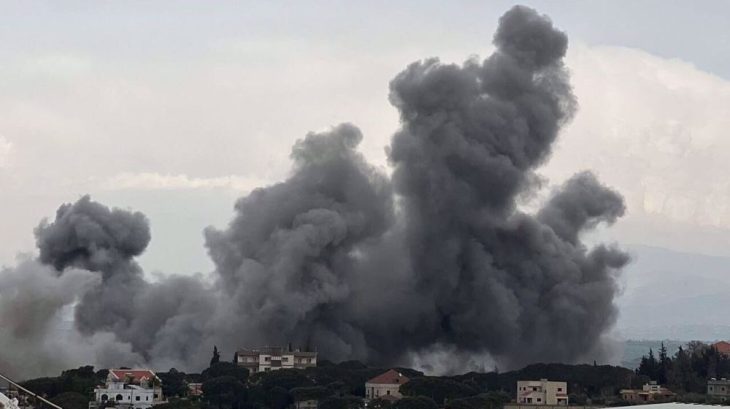
Al Mayadeen | May 2, 2026
The Israeli occupation has intensified its attacks on villages and towns in southern Lebanon, with fresh airstrikes and artillery shelling reported across several districts, according to field reports from the south.
Al Mayadeen’s correspondent in southern Lebanon reported that three people were killed after an Israeli raid struck a house in the town of al-Louaizeh in the Jezzine district at dawn on Friday, with the escalation extending beyond the area as Israeli airstrikes also hit the towns of Harouf and Shoukin, as well as the al-Tuffah heights region.
The National News Agency (NNA) reported that an earlier strike on Shoukin resulted in the killing of civilians and the injury of several others, including the town’s mayor, Hussein Ali Ahmad.
Further raids targeted multiple towns in the Nabatieh district, including Zawtar al-Sharqiyah, A’dshit, Mayfadoun, Kfar Joz, and Ebba. An additional strike hit a vehicle on the Kfar Dajjal road in the same district.
Strikes across Tyre, Bint Jbeil, and Hasbaya
Southern Lebanon also came under intensified attacks across a wider area, with strikes hitting Majdal Zoun in the Tyre district and Burj Qalaway in the Bint Jbeil district.
The town of Qounine was targeted in an aerial attack, while heavy artillery shelling struck Touline and Qabrikha in the Marjeyoun district. Another airstrike hit Kfarshouba in the Hasbaya district.
Israeli artillery also struck residential areas and outskirts, including al-Mansouri in the Tyre district, while military aircraft maintained intensive overflights across southern Lebanese airspace.
The aggression has continued despite the so-called temporary ceasefire agreement, which took effect on April 17 for 10 days and was later extended for a further three weeks on April 24. However, since the agreement came into force, the Israeli occupation has maintained its attacks, while also facing continued retaliatory attacks from the Islamic Resistance in Lebanon, Hezbollah.
Since March 2, the cumulative toll has reportedly exceeded 2,618 martyrs and more than 8,094 injured, according to the Lebanese Ministry of Health. Officials say the ceasefire framework involving Lebanon has not prevented continued strikes, with repeated attacks reported across multiple regions.
Left in Disbelief: Israel in Panic over Hezbollah FPV Drone Nightmare
By Robert Inlakesh | The Palestine Chronicle | May 1, 2026
Left in disbelief, an already drained Israeli military is left without any viable solutions to the ever-growing threat of first-person view (FPV) drones, now used by Hezbollah to overwhelm their newly assumed positions in southern Lebanon.
On April 16, Tel Aviv and Beirut agreed to a temporary ceasefire imposed by US President Donald Trump. Within the first hour of the ceasefire’s imposition, Israel had already violated the agreement 10 times, including an attack on an ambulance. What they sought to achieve was a return to the pre-war status quo, whereby the Israeli military attacked Lebanon at will, without any return fire.
It soon became clear that the 15-month ceasefire period, following November 27, 2024, during which the Israeli military violated the agreement 15,400 times according to UNIFIL, was not going to be replicated. The first wave of retaliation against Israeli violations began with Hezbollah detonating improvised explosive devices (IEDs) and destroying convoys of Israeli tanks and armored personnel carriers (APCs), after carrying out reconnaissance and anticipating the movement of armed convoys.
Initially, the Israeli military passed three successive IED attacks off as incidents occurring due to explosives previously left behind by Hezbollah fighters. Later, the Lebanese Party officially announced it had taken out four Israeli Merkava tanks in a single IED attack, forcing the Israelis to issue a statement acknowledging it.
Before long, Hezbollah was issuing statements claiming responsibility for a number of retaliatory attacks each day, including rocket fire on Israeli army positions across the Lebanon Blue Line (Lebanese border).
Then came the prominence of Hezbollah’s usage of the cheap, but highly effective FPV drones, inflicting considerable numbers of casualties amongst Israeli soldiers in retaliation for ceasefire violations and the attempt to illegally occupy a strip of territory in southern Lebanon.
Contrary to Israel’s initial claims to have established a considerable “buffer zone” and that only a small number of Hezbollah fighters had remained in the area, it would become clear that nothing of the sort had truly taken place. There was never any “full operational control” of the “buffer zone”, instead, the Israelis were practicing the Gaza strategy of deploying forces in their heavily armoured vehicles to towns and villages, where they would then be tasked with blowing up civilian infrastructure.
Hezbollah fighters remain positioned throughout this newly declared zone, a terrain that favors a defending force using guerrilla warfare tactics. Perhaps the most menacing is the usage of the FPV drones for both reconnaissance and attacks alike.
In a new article, written for Yediot Aharanot in Hebrew, correspondent Elisha Ben Kimon wrote the following:
“For years, the IDF has invested billions in sophisticated interception systems, precision missiles, and the intelligence capabilities of superpowers. But when Hezbollah, with simple and deadly ingenuity, decided to lower its flight altitude and switch to drones, with fiber optics that make it difficult to detect and intercept, Israel found itself in a situation of dealing with a “low-tech” threat that disrupted all work plans.”
The FPV UAVs can be cheaply acquired for only hundreds of dollars per unit, yet when assembled domestically, they can be put together for as little as 50 dollars in some instances. Successful FPV drone deployment for war was pioneered by the Ukrainians and Russians during the Ukraine War. According to some sources, the majority of battlefield casualties in that war have been a result of this drone, which Kyiv can mass-produce at around 300 dollars per unit.
Equipped with a fiber-optic cable, the drones are completely immune to electronic warfare jamming, negating the high-tech advantages that the Israelis have previously enjoyed. Hezbollah does have access to a range of different attack drones, including various Iranian models, which have proven highly effective also. Yet, they are not available in as high quantities, and their most sophisticated technology is used to target high-value targets.
This development has meant that Hezbollah drone operator teams can safely fly these drones from up to and over 10 kilometers away, without being detected. The process of detecting these drones is the same as it is for Hezbollah’s arsenal of more sophisticated radio frequency (RF) drones, relying on acoustic sensors, radars and thermal imaging, yet FPV drones fly at such low altitudes and use the terrain of southern Lebanon to make them more difficult to detect until it is too late.
A recent article published by the Israeli daily Haaretz noted that back in 2024, the Israeli political and military leadership claimed to be on top of deploying solutions to the Hezbollah drone threat, stressing that a range of Israeli defense companies were engineering solutions.
However, an anonymous source “involved in the field” told Haaretz that “There is a need for a systemic response – not to acquire a little of this and a little of that, but a broad plan to address all unmanned threats along our borders. DDR&D (Directorate of Defense Research & Development) has known about this threat for many years but has not mobilized to address it.”
In a nightmare situation for the Israeli military, Hezbollah recently launched a retaliatory attack using FPV drones, inflicting 6 soldier casualties near the Lebanese town of Taybeh. Israel announced that one of its sergeants, Ithan Fukes, was killed in the attack. What happened next was perhaps even more damning.
Hezbollah followed up their attack with an FPV drone strike targeting the medivac helicopter. The incident caused such a stir because the Israeli military leaked videos of the incident. Despite the Israeli soldiers wearing body cams or GoPros on their helmets, this was the first time such footage has been released, due to Israel’s strict military censor laws.
The first video released was from a distance, showing the FPV drone impacting the site where the evacuation of soldiers was happening, causing them to fall back and the helicopter to abruptly take off. From the footage, it was unclear whether the drone hit any target or not, triggering criticism from the Israeli media over why it was released.
Then, a second video was released, from a soldier’s helmet camera, revealing that the drone fell just short, either due to the wind force of the helicopter or due to the soldier’s gunfire. Any release of footage of this kind is deliberate; in this case, it was to jolt the Israeli leadership into action.
An enormous amount of criticism has been leveled at the Israeli political leadership over its failure to achieve its announced goals in Lebanon, and the army itself is even joining that parade. What this demonstrates is that the psychological impact of the FPVs is greatly burdening soldiers on the ground, while the army is left to sit in southern Lebanon twiddling its thumbs.
Hezbollah’s asymmetric warfare is already causing enormous strain on the some 6 Israeli divisions deployed to fight against Lebanon. Just as they were in Gaza, the Israelis are not doing much beyond demolishing civilian infrastructure, proving so risk-averse as to fear entering a fight in which they actually seek to degrade Hezbollah in any significant way. They may have gotten away with this in Gaza, but in South Lebanon, they are dealing with a much more powerful opponent and a more difficult terrain.
Israeli Merkava tanks, worth between 3.5 to 6 million dollars each, are being taken out day after day by FPV drones, carrying explosive charges, worth a maximum of a few hundred dollars each. Hezbollah is taking out mobile telecommunications equipment, command and control vehicles, APCs, D-9 bulldozers, and excavation equipment, with cheap drones that they continue to mass produce with ease. They also do this while their fighters are kept out of harm’s way.
Israel has attempted to consult Ukrainian advisors in order to learn new tactics to deal with the threat and has purchased its own FPV drones, yet none of this has borne fruit. Instead, individual soldiers have tried experimenting with netting to place over vehicles and the use of shotguns, while relying on soldiers to watch the skies for incoming drones.
Despite some of this being effective, out of fear, the Israelis do not normally deploy infantry next to their tanks while on the move. In Gaza, this tactic of hiding inside heavily armored vehicles and tanks did manage to reduce soldier deaths and injuries, but in Lebanon, it could actually be causing the opposite effect, at least when it comes to FPV drone attacks.
– Robert Inlakesh is a journalist, writer, and documentary filmmaker. He focuses on the Middle East, specializing in Palestine.
Trump Taps Israel Lobbyist From Mossad Cutout FDD To Join Iran Negotiations
The Dissident | May 1, 2026
Journalist Alex Marquardt reported recently that , “Amid stalled talks with Iran, President Donald Trump’s negotiators are adding a new member to the team from an outside Washington lobbying group” adding, “Nick Stewart, the Managing Director of Advocacy at FDD Action, the lobbying side of the Foundation for Defense of Democracies think tank, has joined the office of Steve Witkoff, the Special Envoy for Peace Missions”.
This means- as I will demonstrate- that a literal Israel lobbyist is now joining the team negotiating with Iran on behalf of the Trump administration.
The think tank, initially founded by the journalist Clifford May, was initially called “EMET,” the Hebrew word for truth, and was established in order to “provide education to enhance Israel’s image in North America”.
John Judis at the Carnegie Endowment for International Peace documented in 2015 that , “On April 24, 2001, three major pro-Israel donors incorporated an organization called EMET (Hebrew for “truth’). In an application to the Internal Revenue Service for tax-exempt status, (Clifford) May explained that the group ‘was to provide education to enhance Israel’s image in North America and the public’s understanding of issues affecting Israeli-Arab relations.’ But in the wake of the Sept. 11 attacks, May broadened the group’s mission and changed its name to the Foundation for Defense of Democracies. As he explained in a supplement to the IRS, the group’s board of directors decided to focus on ‘develop[ing] educational materials on the eradication of terrorism everywhere in the world.’”
He added that the funding for FDD comes primarily from U.S.-based Zionist donors, writing, “FDD’s chief funders have been drawn almost entirely from American Jews who have a long history of funding pro-Israel organizations. They include Bernard Marcus, the co-founder of Home Depot, whiskey heirs Samuel and Edgar Bronfman, gambling mogul Sheldon Adelson, heiress Lynn Schusterman, Wall Street speculators Michael Steinhardt and Paul Singer, and Leonard Abramson, founder of U.S. Healthcare.”
He also noted that, similar to AIPAC and other Israel lobby groups, the FDD runs propaganda tours of Israel for Americans, noting, “Since its founding, FDD has been running tours of Israel for American academics (with most of their expenses paid) similar to those run for journalists and politicians by AIPAC and other groups. University of Kentucky political scientist Robert Farley, who went on an FDD tour in 2008, says ‘the goal of the trip was to inculcate a particular view of the Israeli security situation and the Israeli-Palestinian conflict.’ FDD’s view, Farley says, was ‘rght-wing Likudnik on the relations between Israel and its neighbors and with the Palestinians.’ The tour leaders took a ‘negative’ view of Palestinian statehood. ‘It was understood that the military occupation of the West Bank was necessary to prevent a terrorist campaign against Israel.’”
Al Jazeera’s 2018 documentary on the Israel lobby further exposed that FDD “is functioning as an agent of the Israeli government”.
Sima Vaknin-Gil, a former Israeli intelligence official and official in the Israeli Ministry of Strategic Affairs, admitted in the documentary that “We have FDD,” adding that “the foundation is ‘working on’ projects for Israel, including ‘data gathering, information analysis, working on activist organizations, money trail. This is something that only a country, with its resources, can do the best.’”
By putting a lobbyist for Israel from a “think tank” that is in reality a cover for an Israeli intelligence cutout, the Trump administration is guaranteeing that Israel will be driving the American side during negotiations with Iran.
Trump’s Blockade Snatches Defeat from the Jaws of Victory
By Trita Parsi | May 1, 2026
It appears Donald Trump once again snatched defeat from the jaws of victory by heeding the hawkish counsel of the warmongers at the Foundation for Defense of Democracies.
As I have argued before, the fragile ceasefire disproportionately favored the United States over Iran: Trump secured his central objective — a swift exit from a costly war — while Iran forfeited its primary source of leverage, namely the inflationary pressure of elevated oil prices. Tehran, by contrast, remained unable to achieve its core objective — meaningful sanctions relief — without entering a difficult diplomatic process with Washington.
The asymmetry was stark: Trump could afford strategic patience, whereas Iran risked squandering the most consequential gains the conflict could have yielded if negotiations faltered or collapsed.
In short, this emerging status quo could have constituted a quiet but decisive victory for Trump. Yes, Iran would retain control over the strategically vital Strait of Hormuz — but it does so today as well and would do so in almost any scenario. But the status quo would have seen oil prices drop as the Iranians would allow tankers to transit in order to collect fees. And as long as oil prices came down, Trump’s position at home and vis-à-vis Iran would have strengthened.
FDD argued that blockading the Persian Gulf would swiftly cripple the Iranian economy and coerce Tehran into capitulation, allowing Trump to achieve through economic strangulation what he had failed to secure through military force. In short, it was sold to him as a silver bullet. More on that later.
According to this logic, the blockade would “effectively zero out” Iran’s export revenues within days, inflicting losses of nearly $500 million per day. With oil exports halted, Iran’s limited storage capacity would be filled within weeks, forcing the costly and technically damaging shutdown of its oil wells. This, FDD claimed, would dramatically reverse the strategic balance — transforming the Strait of Hormuz from a perceived Iranian asset into a crippling Achilles’ heel, while handing Washington the invaluable advantage of time. Pressure on Iran would escalate sharply while pressure on the United States would rapidly dissipate.
Trump was fully on board. His long-sought subjugation of Iran suddenly appeared tantalizingly within reach. “The blockade is genius,” the president told reporters. “Now, they have to cry uncle; that’s all they have to do. Just say, ‘We give up.’” (Notably, an FDD staffer has reportedly since joined Steve Witkoff’s team.)
Predictably, the opposite occurred. FDD’s confident calculations and tidy logic were, as so often, rooted more in wishful thinking than in hard reality. By its own projections, Iran should have exhausted its storage capacity nearly a week ago. Yet satellite imagery shows Tehran still actively loading oil onto tankers at Kharg Island. While the blockade has undeniably increased economic pressure, there is no sign of the acute storage crisis — or the cascading collapse — FDD confidently promised Trump.
But by targeting Iran’s oil exports, Trump did more than complicate an already fragile diplomatic pathway — he tightened global supply and drove prices upward. In fact, thanks to the blockade, oil prices now exceed the levels seen during the war itself.
Exxon’s CEO told shareholders today that gasoline prices are poised to rise even further, noting that “the market hasn’t seen the full impact of [the Iran conflict] yet.” Meanwhile, Joe Kent, Trump’s former director of the National Counterterrorism Center, cautions that “the blockade is now triggering a global fertilizer shortage that will cause major food security crises and potential famines.”
In short: the desperately needed pressure release Trump secured through the ceasefire has been entirely undone by FDD’s vaunted silver-bullet blockade.
The lure of the silver bullet
There is a pathology in U.S. policy on Iran that transcends administrations and party affiliations: The incessant search for an escalatory silver bullet that brings Iran to its knees, forces it to capitulate, and enables the U.S. to assert its superpower dominance and avoid a compromise with the Islamic Republic.
Across 47 years, the hunt for this fabled silver bullet has echoed on — yet nothing answers back. Countless diplomatic opportunities have been sacrificed, and face-saving exit ramps have been burnt in the process. Yet, the quest continues.
The demand for Iranian capitulation and the enduring faith in elusive silver bullets are deeply intertwined. In January, Trump believed that the mere threat of military force would compel Tehran to surrender. After issuing a series of increasingly explicit warnings that Iran pointedly ignored, he proposed a calibrated strike — one to which Tehran should respond symbolically by targeting an empty American base. Iran refused outright, making clear that any attack would trigger a full-scale war.
Interpreting this defiance as a failure of credibility rather than a rejection of coercion, Trump escalated. He ordered a substantial buildup of military assets in the region, convinced that a critical mass of force would finally deliver the decisive breakthrough — the long-sought silver bullet. It didn’t.
Indeed, Witkoff revealed in an interview that Trump was frustrated that, despite his military threats, Iran had still not “capitulated.”
Clearly, more escalation was needed. The next imagined silver bullet was the assassination of Iran’s Supreme Leader, Ayatollah Ali Khamenei. Midway through the war, a GCC official told me that Trump had assured regional leaders the conflict would last no more than 100 hours. Israeli media similarly reported that he told Britain’s Keir Starmer it would be over within three days. The logic was stark: the killing of Khamenei would trigger either the regime’s rapid implosion or its immediate capitulation. It proved to be yet another illusory silver bullet.
Nor did the sweeping bombardment of Iran’s civilian infrastructure deliver the long-sought breakthrough. A Bloomberg analysis found that only 32% of the damaged buildings were linked to military targets — the overwhelming majority were civilian. Even this devastating and indiscriminate campaign failed to produce the decisive outcome its architects had promised.
The blockade-on-the-blockade is merely the latest in a long line of delusional silver bullets that American presidents have chased instead of pursuing far less costly and far more effective diplomacy. I suspect that a stunning number of those silver bullets were cooked up by FDD.
Trita Parsi is the co-founder and Executive Vice president of the Quincy Institute for Responsible Statecraft.
Geopolitics and Geoeconomics of the Strait of Hormuz
Sputnik – 02.05.2026
The reckless reliance on a blitzkrieg to eliminate Iran’s political and military leadership has left Israel and the United States in an extremely precarious situation, where Tehran’s key trump card in the conflict turned out to be control over the Strait of Hormuz.
Alexander Yakovenko, deputy director of Sputnik’s parent company Rossiya Segodnya and head of the Committee on Global Issues and International Security of the Russian Security Council’s Scientific-Expert Board, has addressed the standoff around the Strait of Hormuz.
Analysts in Israel are already writing of a complete failure, with the prospect of “returning to the issue” sometime in the future. Judging by published reports, everything was planned for June this year, but, as the saying goes, the devil intervened, and Benjamin Netanyahu succumbed to the temptation of a final solution through “regime change.” The scapegoats will be the Mossad division responsible for Iran and the military command responsible for Lebanon.
Donald Trump faces a far more difficult predicament: he has been drawn into a war that is neither his own nor in America’s interest. But the main issue is that the Strait of Hormuz problem now rests squarely on his shoulders. Aside from acceding to all of Iran’s demands, there appear to be no viable options for resolving the blockade – including the resumption of military action, which, according to observers, would have catastrophic consequences for the region, the global economy, and the Trump administration.
In terms of the Persian Gulf and the greater Middle East, a complete geopolitical reconfiguration has taken place, including a shift in Turkiye’s role (it was Ankara that effectively killed the plans to bring Iraqi Kurds into the “march on Tehran,” which was intended to bolster the confidence of those whom Israeli intelligence believed were ready to take to the streets of Iranian cities).
The destruction of the region’s extraction and logistics infrastructure prompted the UAE to withdraw from OPEC and OPEC+, which will only intensify Abu Dhabi’s contradictions with Riyadh and accelerate the political realignment of smaller players toward Ankara, Saudi Arabia, or Iran.
Iran’s agency has grown qualitatively: from a pariah state burdened by sanctions, Iran has genuinely become a regional power (in contrast to Netanyahu’s claim that Israel is a regional power and “in some ways even a global one”). Everything now depends on Iran – a fact understood by those at the helm in Tehran, namely, by general consensus, the Islamic Revolutionary Guard Corps (IRGC). And all this is aside from the most pressing issue on the regional agenda: the restoration of extraction and logistics infrastructure, especially given that the damage has a cumulative effect – in other words, “time is money.”
Russia, Pakistan, and China have become even more deeply involved in the affairs of the region, while the United States has demonstrated its inability to provide military protection for its allies. In other words, the role of external players has grown, whereas control over the region had been in American hands since the Baghdad Pact at the beginning of the Cold War. Now it can be said that the entire institutional structure in the region is collapsing – even in the OPEC format – and the region is opening up to an entirely new architecture.
In terms of geoeconomics, Tehran now holds a powerful lever of influence over the global economy and world trade through its control over the Strait of Hormuz. Moreover, this is not only direct control but also the ability to destabilize the situation around the Strait at any point in the future, regardless of any agreements that might be reached regarding its possible reopening as part of a ceasefire. In other words, everyone understands that things will never return to how they were before.
The only thing that matters for the global economy and the international financial system – including the dollar’s linkage to oil trade – is the stability of commercial traffic through the Strait. With no indication of it being reopened, the world is losing between 8 and 15 million barrels of oil and petroleum products per day, as well as up to 20% of global LNG supplies. This also includes a range of industrial goods in the petrochemical sector and derivatives for the agricultural sector. Experts expect a monthly shortfall of 300 million barrels, which amounts to three-quarters of the released strategic reserves of developed countries. Moreover, by early May, both strategic reserves and the advantages of unlocking Russian and Iranian oil, along with the balancing buffer of floating storage, will be nearly exhausted. In short, in every respect, a moment of truth is approaching in a conflict that is difficult to restart now that military action has been paused.
Not only have the United States and Israel handed Iran, on a silver platter, escalation dominance in the conflict – the ability to manage escalation if Washington and Tel Aviv launch another round – but Tehran will also gain additional revenue from selling its 1.5 million barrels of oil per day, which economists estimate at 2–3 billion per month, or 24–36 billion per year. Essentially, even without the unfreezing of Iranian assets in Western countries, Iran will have the resources to rebuild what has been destroyed. To this should be added the fees collected from commercial vessels transiting the Strait of Hormuz.
It is also worth noting a direct geopolitical consequence of the Iranian conflict: the discord within the Western alliance along the line of Trump’s America versus liberal-globalist Europe. The recent visit of the British monarch to the United States, during which he called in his address to Congress for the collective “defense of Ukraine” invoking Article 5 of the Washington Treaty (despite the fact that Kiev is not a NATO member), indicates that the lack of allied support for the Iranian adventure is a clear appeal to restore Western unity specifically on an anti-Russian basis – everything else is secondary. In Europe, they no longer hide the fact that they intend to “wait out” Trump, if that is what it takes, but under no circumstances will they agree to a settlement of the Ukrainian conflict.
As such, it is not denied that Ukraine is merely the opening move in yet another war of the West against Russia, and that Western elites are determined to make it a decisive, final confrontation of a civilizational nature. This presents an interesting situation for Russia, which could be resolved one way or another very soon. If Russia participated in two world wars, in which, albeit in different ways, relations between groups of Western countries were contested, and in the Cold War we faced a united West, then now we see a disunited West, weakened militarily and in terms of domestic political development. Its consolidation is only possible at our expense.
Charles III quite opportunely mentioned the burning of the White House by the British in 1814, as it reminds us – and perhaps Washington – of positive moments in our shared history, including Russia’s support for the American Revolution and the Union side in the Civil War. The decision rests with the Americans, but it is curious how the Middle East references an era before the ideologization of international relations in the 20th Century.
Mali: a new front in the Western war on multipolarism
Strategic Culture Foundation | May 1, 2026
An audacious coup attempt against the government in the West African state of Mali appears to have been thwarted by the Malian Armed Forces, supported by their Russian allies.
The surprise coup was launched last weekend when an estimated 12,000 fighters attacked at least five cities, including the capital, Bamako. Fighting continued during the past week, with most of the casualties – over 1,000 dead – suffered by the insurgents who came under heavy ground and air fire from state forces backed by Russian auxiliaries belonging to the Africa Corps.
Mali’s leader, Assimi Goïta, made a nationwide televised address appealing for calm and stating that the country’s security situation had been brought under control. He paid tribute to his defense minister, General Sadio Camara, who was killed in action on the first day of the coup attempt on April 25. The leader also acknowledged the actions of his country’s strategic partner, the Russian Federation, for helping to defeat the coup, which he condemned as “foreign-sponsored”.
For its part, the Kremlin said it would continue supporting the Malian government to restore stability and security to the country.
Both the Malian authorities and Moscow have accused Western sponsors of involvement in the insurgency. Russia’s foreign ministry claimed that Western military instructors had helped coordinate the wide-ranging attacks. There were reports of militants armed with French Mistral anti-aircraft missiles and U.S.-made Stinger Manpads. There are also unverified reports of mercenaries from Ukraine and NATO states fighting on the ground.
This is not the first time that NATO and Ukraine have been linked to destabilizing the national security of Mali. Two years ago, Mali cut diplomatic links with Kiev after a Ukrainian military intelligence official claimed that Ukrainian forces had been supplying insurgents.
In the latest uprising, the Western news media have been quick to highlight supposed military gains made by the rebels. The Western coverage has sought to portray the violence as a spontaneous challenge to the government in Bamako, which the Western media disparages as a “military junta”. The same media have also claimed that the unrest is a blow to Russia’s strategic interests in Africa. In particular, it is claimed that Moscow’s security partnership with Mali and other African states is being exposed as ineffective and weak.
Two militant groups were involved in the coup attempt this week. The Tuareg ethnic people’s liberation movement, known as the Azawad Liberation Front (FLA), and an Al-Qaeda-linked jihadist group known as Jammat Nusrat al-Islam wal-Muslimin (JNIM). Both entities had been fighting each other until recently, but now seem to have allied. Who brokered that expedient alliance?
The widespread insurgent attacks mounted against five cities covering a distance of some 2,000 kilometers also suggest that the fighters were provided with considerable intelligence and logistical support. Mali is a huge country, the sixth largest in Africa, with a land area twice that of France or Texas. Previous attacks were mainly confined to the remote northern half of the country, which is typically a desert landscape. To launch an assault on the capital in the south is a significant development. The devastating bomb attack on the defense minister’s residential compound near Bamako also suggests that there was foreign assistance.
The geopolitical background is highly significant. Mali formed an Alliance of Sahel States (AES in French) in September 2023 along with Niger and Burkina Faso. The three former French colonies ordered the withdrawal of French military forces and asserted a newfound political independence. They accused France of playing a double game by secretly supporting separatists and Islamist groups to give a pretext for French military involvement in their countries. In a further affront to French arrogance, Mali, Niger, and Burkina Faso pointedly turned to Russia for security assistance and, in return, have offered Russia access to key natural resources in a mutual partnership.
For centuries, France and other Western states have plundered Africa without giving anything back to the continent except new forms of economic slavery and exploitation.
Meanwhile, Russia and China have gained renewed partnerships with many African nations. A history of colonial depredation hampers neither Russia nor China. Indeed, the Soviet Union has a largely honorable legacy of supporting African independence, which many Africans acknowledge. In the contemporary context, Moscow and Beijing’s espousal of a multipolar world and cooperative development has resonated strongly with African countries.
When Mali, Niger, and Burkina Faso kicked out the French neocolonial trappings three years ago, there was palpable scorn in Paris, particularly from French President Emmanuel Macron. If the Sahel alliance succeeded with Russian help, that would be a major blow to France’s national esteem and the anti-Russian propaganda narrative of the NATO bloc.
The attempted coup in Mali should be viewed in this light. It is much bigger than Mali’s internal tensions and divisions. What’s at stake is maintaining the right of political independence and sovereignty in African nations to choose their own political and developmental path. In a word: self-determination. Old colonial powers like France and other NATO members would like to turn the clock back to the former times of hegemonic control.
As many informed analysts have noted, the current conflicts in Ukraine and other places, such as Iran, Venezuela, Cuba, Latin America, Asia-Pacific, the Arctic, and so on, are not isolated aberrations. They are all part of a “new great game” for Western powers to reassert global dominance.
The Western ruling elites want to, indeed need to, confront the rising multipolar world that challenges their hierarchy of privileges and profits. Russia and China are the main targets for the Western powers to win their strategic war. The proxy war in Ukraine is part of that. So too is Washington’s aggression against Iran to cut off energy supplies to China and Asia.
The coup attempt in Mali is another site of struggle that appears to be instigated by NATO powers in their proxy war against Russia and the historic vision for a multipolar world.
There is an ominous echo of the Syria scenario, where Western powers finally overthrew a Russian ally at the end of 2024, to be replaced by jihadists whom the West backed covertly for years before that.
Given the strategic importance, Russia and China must not let this happen in Africa. The firm defense of Mali this week by the country’s leadership and armed forces, acting with the support of Russia and the mass of Malian people, indicates that Western intrigue will fail.
CHD Scientist: CDC, FDA COVID Vaccine Safety Monitoring ‘Insulting, and Many People Are Injured’
By Suzanne Burdick, Ph.D. | The Defender | April 29, 2026
Federal health officials under the Biden administration failed abysmally to look for COVID-19 vaccine safety signals, according to congressional testimony delivered today by Children’s Health Defense (CHD) Senior Research Scientist Karl Jablonowski.
The government’s vaccine safety monitoring “over the past several years has been insulting, and many people are injured,” Jablonowski wrote in his written testimony.
History repeats itself if we don’t learn our lessons, Jablonowski warned.
“The COVID-19 pandemic created over 100 billionaires in the United States and over 1,000 billionaires around the world,” Jablonowski wrote. “Anything that profitable is going to repeat.”
Jablonowski, who holds a doctorate in biomedical and health informatics from the University of Washington’s School of Medicine, spoke as a witness at the U.S. Senate Permanent Subcommittee on Investigations hearing, “Unmasked: How Biden Health Officials Purposely Turned a Blind Eye Toward COVID-19 Vaccine Safety Signals.”
Hours before the hearing, Sen. Ron Johnson (R-Wis.), subcommittee chair, released a report detailing how Biden-era federal health officials refused to use a state-of-the-art statistical tool for detecting COVID-19 vaccination signals in VAERS — even though they knew the tool they were using was too broken to pick up on safety signals, including sudden cardiac death.
Johnson’s report, which cited roughly 600 pages of emails, revealed that in 2021, officials with the U.S. Food and Drug Administration (FDA) told an FDA researcher to “cease and desist” using the state-of-the-art tool to analyze COVID-19 vaccine injury reports in the Vaccine Adverse Event Reporting System (VAERS).
Johnson obtained the emails after he subpoenaed the U.S. Department of Health and Human Services in January 2025 for COVID-19 vaccine safety records and pandemic-related communications.
FDA was ‘blind’ to COVID vaccine injury reports in VAERS
In his testimony, Jablonowski detailed how each of the federal government’s three vaccine safety monitoring systems — VAERS, V-safe and Vaccine Safety Datalink (VSD) — had “pitfalls” and “failed” to adequately assess safety issues with the COVID-19 vaccine and other vaccines.
The failures of vaccine safety monitoring “can be, and were, catastrophic,” he said.
For instance, the FDA insisted on monitoring COVID-19 vaccine reports using a method that it knew didn’t work. The FDA knew the method was likely to give inaccurate results if similar vaccines — such as the Pfizer and Moderna COVID-19 vaccines — were included in the dataset. This is called masking.
“The FDA was completely blind to COVID-19 vaccine adverse events,” Jablonowski wrote. He said the FDA could have used an improved statistical method accounting for masking.
A 2022 peer-reviewed paper in Drug Safety showed that the improved method detected roughly 25 statistically significant COVID-19 vaccine safety signals — including sudden cardiac death, Bell’s palsy and pulmonary infarction — that the FDA’s older method missed.
In an earlier interview with The Defender, Jablonowski explained why it was so harmful for the FDA to continue using the older method:
“Imagine a night watchman has to find something on the ground. But instead of holding a flashlight, he is wearing sunglasses. In the morning, he says he didn’t find anything. That’s true, but it’s because he was using a tool that impeded his ability to see.”
As of March 27, 1,675,590 adverse events were reported to VAERS following COVID-19 vaccination, according to OpenVAERS. That number includes over 39,077 reports of death, 29,200 reports of myocarditis or pericarditis, and 18,009 reports of Bell’s palsy.
A national survey conducted in November 2025 found that roughly 1 in 10 U.S. adults who received the COVID-19 vaccine experienced “major” side effects.
V-safe was designed to collect ‘inconsequential’ data
Jablonowski told lawmakers that the Centers for Disease Control and Prevention’s (CDC) COVID-19 vaccine safety monitoring tool, V-safe, was designed to collect only “inconsequential” information that no one really cares about.
The V-safe app invited COVID-19 vaccine recipients to check off boxes to indicate what, if any, side effects they experienced after getting the shot.
However, the box options were for common short-term vaccine side effects that most people would consider “inconsequential,” such as chills, headache, joint pain, muscle or body aches, fatigue or tiredness, nausea, vomiting, diarrhea, abdominal pain or rash.
If a person experienced a more serious problem, they had to manually type it into the “other” text field, Jablonowski noted. He said:
“It is with horror that we find 366 individuals typed ‘myocarditis’ in the ‘other’ free-text field, a condition requiring a medical diagnosis. The horror is amplified by the nearly 50,000 registrants who typed ‘chest pain’ into the ‘other’ free-text field.”
Vaccine Safety Datalink is off-limits to independent researchers
Jablonowski also detailed how VSD, a collaborative database of patient information from 13 integrated healthcare organizations covering over 15.5 million people, also fails the public.
VSD data can ostensibly be used to detect vaccine safety issues in near-real time, Jablonowski said.
The problem is that only a small handful of scientists are ever allowed to look at the data. Jablonowski said:
“This many million-dollar taxpayer funded resource is not available to any scientist outside of the 13 Managed Care Organizations (MCO) or the federal government without independent IRB [independent review board] applications approved by all 13 MCOs, an estimated $250,000 per project.”
In other words, independent researchers are realistically barred from analyzing the data. “Transparency is simply unattainable,” Jablonowski said.
Watch Jablonowski’s opening statement here.
This article was originally published by The Defender — Children’s Health Defense’s News & Views Website under Creative Commons license CC BY-NC-ND 4.0. Please consider subscribing to The Defender or donating to Children’s Health Defense.
COVID Conniving Receives First Federal Indictment
By Jim Bovard | The Libertarian Institute | May 1, 2026
David Morens, a former top advisor to COVID Czar Tony Fauci was indicted this week and “charged with conspiracy against the United States; destruction, alteration, or falsification of records in federal investigations; concealment, removal, or mutilation of records; and aiding and abetting,” according to the Justice Department press release.
Morens allegedly helped top federal health officials cover up the potential role of federal grants in spurring the COVID pandemic. The Freedom of Information Act (FOIA) requires federal agencies to preserve and disclose federal records with some narrow exceptions. In early 2021, Morens emailed a colleague, “I learned from our foia lady here how to make emails disappear after i am foia’d but before the search starts, so i think we are all safe.”
Morens added, “Plus i deleted most of those earlier emails after sending them to gmail.” In a previous email, he assured his collaborators, “I have spoken to our FOIA folks” and “I should be safe from future FOIAs. Don’t ask how…”
Fauci doesn’t need to worry about getting indicted since President Joe Biden, on his last morning in office, pardoned any crimes that Fauci might have committed in the previous decade. Fauci justified COVID mandates because average citizens “don’t have the ability” to determine what is best for them. Congressional investigations revealed that Fauci was at the center of string-pulling to shirk responsibility on COVID.
Top federal officials scrambled to erase the federal role in bankrolling reckless gain of function research at the Wuhan Institute of Virology in China, the most likely source of the COVID virus that killed more than seven million people around the world. That type of research seeks to genetically alter organisms to enable the spread of viruses into new species. As MIT professor Kevin Esvelt asked in 2021, “Why is anyone trying to teach the world how to make viruses that could kill millions of people?” The risks were compounded because the Wuhan Institute had a very poor safety rating. Two years earlier, the State Department confidentially “warned other federal agencies about safety issues at Wuhan labs studying bat COVID,” but the public disclosure of that alert was delayed until 2022—long after President Biden illegally mandated COVID vaccines for a hundred million American adults.
If COVID-19 had been initially recognized as the result of one of the biggest government boondoggles in history, it would have been far more difficult for American politicians and government scientists to pirouette as saviors as they seized sway over daily life. Instead, politicians, bureaucrats, and the media stampeded most of the American public with the notion that total submission to boneheaded decrees was their only hope to survive.
Attorney General Todd Blanche issued a statement on the indictment of Morens:
“These allegations represent a profound abuse of trust at a time when the American people needed it most—during the height of a global pandemic.”
Luckily, there haven’t been any “profound abuses of trust” since Trump took office again—at least according to his Justice Department. Blanche added, “Government officials have a solemn duty to provide honest, well-grounded facts and advice in service of the public interest — not to advance their own personal or ideological agendas.”
Be still my beating heart. Is this a subtle signal that the Trump team will disclose the other three million documents on the Epstein scandal?
FBI chief Kash Patel announced at the indictment press conference, “Circumventing records protocols with the intention of avoiding transparency is something that will not be tolerated by this FBI.”
Has the FBI turned over a new leaf or what? The FBI is one of the most notorious FOIA violators in Washington. When FOIA was first passed in 1966, FBI chief J. Edgar Hoover ordered his agency to totally refuse compliance with the law. A federal judge slammed the FBI in 2017 for claiming it needed seventeen years to fulfill a FOIA request on surveillance of antiwar activists in the 1960s. The FBI deleted the names of Clark Kent and Lois Lane from a letter that made reference to the famous Superman characters—because disclosing them in a FOIA response would “constitute a clearly unwarranted invasion of personal privacy.” Louis Freeh, director of the FBI from 1993-2001, repeatedly denounced my articles on Ruby Ridge; but when I filed a FOIA, the FBI claimed to have no records of those published letters to the editor. They sent their response to “Mr. Brovard” so maybe that helped them not find anything.
FBI FOIA trampling is par for the Bureau covering up its destruction of freedom of speech and freedom of the press. As federal judge Terry Doughty declared in a 2023 decision, “The FBI [acted] as doorman to a vast program of social media surveillance and censorship, encompassing agencies across the federal government—from the State Department to the Pentagon to the CIA.”
Morens may be the first federal official to ever be charged with a crime for actions to evade FOIA requests. Certainly, in more than fifty years, no federal FOIA official has ever been jailed for violating the law by refusing to disclose information. I’ve received so many BS responses from FOIA officers over the decades that I have lost count. When I filed a FOIA with the Office of the U.S. Trade Representative to see what information they had on me in their files, they replied in 2010, “We have no records on Kevin Bovard.” But I wasn’t asking about my cousin.
In 2015, I heard scuttlebutt that the Justice Department pressured USA Today to cease publishing my articles bashing Attorney General Eric Holder. I filed a FOIA to get the department’s official emails to my editors, but DOJ FOIA claimed it had nothing. I only got the damning emails after I filed a follow-up FOIA request and made a lucky guess on the exact day, hour and minute the emails were sent.
For too long, deceiving the American people has been treated like a victimless crime in Washington. If the Morens indictment can set a precedent leading to more such criminal investigations of bureaucratic cover-ups, that will be a booster shot for American democracy.
Featured Video

The Truth About the Trump Shootings with Ken Silva
or go to
Aletho News Archives – Video-Images
From the Archives
Trans ‘milk’ as good as the real thing – NHS
RT | February 18, 2024
The drug-induced nipple secretions of trans women are as good as mothers’ breast milk for babies, the University of Sussex Hospitals NHS Trust claimed in a letter to campaigners made public in a report by British think tank the Policy Exchange on Sunday.
The healthcare trust’s medical director, Rachel James, argued that the off-label prescription drug cocktail men transitioning to female take in order to produce milk was “similar to the natural hormones which encourage lactation to develop when the baby is newly born.”
“The evidence which is available demonstrates that the milk is comparable to that produced following the birth of a baby,” James wrote in the letter, sent to Children of Transitioners last August.
Biological men who wish to lactate must first take hormones to grow milk glands and then take high doses of either domperidone or metoclopramide to stimulate milk production. Neither drug is approved for this use, though they are occasionally prescribed off-label to biological women who have trouble lactating.
However, domperidone’s own manufacturer, Janssen, warns patients the drug “may cause unwanted side effects affecting the heart in a breastfed baby” and “should be used during breastfeeding only if your physician considers this clearly necessary.” … continue
Blog Roll
 Aletho News
- Seyed M. Marandi: U.S. Strike Imminent – Toward Total War in the Middle East
- Russia Voted Under Fire. Washington Is Loading the Tankers.
- 12 Things Your Oncologist Was Trained Not to Tell You
- Anthrax Attacks Paved Way for COVID-Era ‘Junk Drugs and Vaccines’
- How Real Is the Impact of Western Sanctions on Israel?
- France, You Are Guilty: How Paris Turned Western Sahara into the Maghreb’s Powder Keg
- 2025 Nature Paper Claiming Worsening Global Drought Gets RETRACTED …Heavily Flawed
- Your Milk Is Not the Problem
- The Truth About the Trump Shootings with Ken Silva
- ARE PATIENTS BEING PROPERLY INFORMED ABOUT OZEMPIC?
- If Americans Knew
- Salah Sarsour’s Legal Team Says DHS Has Not Met Its Burden to Prove He Is Deportable
- An analysis of tax forms by The Intercept show Kraft’s charity and LLC have donated to Friends of the IDF and AIPAC’s super PAC.
- Israeli attacks kill four Palestinians in Gaza – Daily Update
- Inside Gaza’s death trap of collapsing, bombed-out buildings
- The everyday items Israel bans from Gaza every day
- Inside the siege, the ruined buildings of Gaza – Daily Update
- Debunking The Claim That Macklemore Has A “History Of Antisemitism”
- CPJ demands release of arrested Palestinian-US journalist near Bethlehem
- Robert Kraft: The Billionaire Friend of Netanyahu Pulling The Strings Behind the Macklemore/Ed Sheeran Blow Up
- Columbia Administered Fund Gives Big Money to Pro-Israel Groups
- No Tricks Zone
- 2025 Nature Paper Claiming Worsening Global Drought Gets RETRACTED …Heavily Flawed
- New Study: ‘Global Drought Shows No Detectable Recent Acceleration Under Climate Warming’
- Economic Masterminds: German Socialists Suggest Taxing Productivity Gains Stemming From Using AI
- The South China Sea Has Not Been Cooperating With The Climate Change Narrative
- Energy Crisis: Germany Enters Heating Season With Historically Low Gas Reserve Fill Levels
- New Study: The Antarctic Ice Sheet Gained Mass From 2020-2024 Due To Staggering Snow And Ice Accumulation
- Study: Ocean Heating Rates From Thousands Of Years Ago ‘Dwarf’ Modern Ocean Heating Rates
- Climate Extremists Target, Attack Large-Scale Power Grid Infrastructure In Germany!
- New Study: Antarctic Ice Melt Has Contributed Less Than 1 Centimeter To Sea Level Rise In The Last 30 Years
- Fear Of Debate: Alarmist German Climate Scientist Calls On Mainstream Media To Discredit Skeptic Voices
 Aletho News