Iran War Confusion & Mixed Messaging /Lt Col Daniel Davis
Daniel Davis / Deep Dive – May 5, 2026
Israel threatens Gaza flotilla activists with death after abduction

Press TV – May 5, 2026
Israeli forces have threatened two Gaza-bound humanitarian flotilla activists, seized in international waters last week, with death or long prison terms, according to a rights group representing them.
The two pro-Palestinian activists, Saif Abu Keshek and Thiago Avila, were among dozens detained during an Israeli raid on the Gaza-bound Global Sumud Flotilla in international waters off Greece on April 30.
On Tuesday, an Israeli court extended their detention until Sunday, May 10.
The legal rights centre Adalah, which represents the pair, said they have been subjected to psychological abuse and held in solitary confinement. According to the group, Israeli officers threatened to kill them or imprison them “for 100 years.”
Both men remain in “total isolation,” subjected to 24/7 high-intensity lighting in their cells and kept blindfolded whenever they are moved, including during medical examinations. They are also being held in very low temperatures, the group added.
Adalah said the court’s decision to prolong the detention “amounts to judicial validation of the regime’s lawlessness.” No charges have been filed, but the two face accusations including affiliation with a “terrorist organisation” and contact with “foreign agents,” which the legal centre described as “baseless.”
According to the group, the activists are continuing their hunger strike, consuming only water since their abduction.
Meanwhile, the flotilla’s organisers demanded their release in a post on X, urging the international community to intervene.
They said the activists were “forcefully brought against their will to occupied Palestine, where they have been subjected to interrogations, death threats, sleep deprivation and medical neglect.”
The governments of Spain and Brazil issued a joint statement on Friday describing the detention of Avila and Abu Keshek as illegal.
During the raid on the Global Sumud Flotilla, Israeli forces attacked 22 of the 58 aid boats heading toward the besieged Gaza Strip and detained 175 activists.
Testimonies indicate that the activists were tortured while in Israeli custody following their abduction.
Met refuses to probe British nationals accused of war crimes in Gaza
Al Mayadeen | May 5, 2026
The Metropolitan Police has refused to open an investigation into ten British nationals accused of committing war crimes and crimes against humanity during the genocide in Gaza. According to Novara Media, the decision follows the submission of a 240-page dossier of evidence by the Palestinian Centre for Human Rights and the Public Interest Law Centre.
The Met stated that the material provided “did not meet the threshold required” to launch a formal investigation. This decision came despite support from more than 70 legal experts and proof of the targeted killing of civilians, attacks on hospitals, and the forced displacement of Palestinians involving the nationals between 2023 and 2024.
Human rights barrister Michael Mansfield KC condemned the Met’s refusal as a denial of accountability and a misapplication of legal standards, and legal representatives stressed that the police applied the wrong test by requiring evidence sufficient for prosecution before even opening an investigation.
Concerns over lack of accountability
Consequently, legal advocates have raised concerns about accountability for British dual nationals involved in the aggression against Gaza. The case has intensified debate over how UK authorities handle cases involving international crimes committed abroad by British citizens.
Raji Sourani of the Palestinian Centre for Human Rights accused the British establishment of politicizing international law and shielding perpetrators from accountability.
Human rights groups involved in the case say the refusal reflects a wider pattern of inaction by UK authorities regarding crimes in Gaza.
The Metropolitan Police decision comes amid concerns about the UK government’s approach to monitoring breaches of international law abroad. Reports have also pointed to the closure of a Foreign Office unit previously tasked with tracking such cases.
UK shuts down unit tracking Israeli violations of International Law
The Metropolitan Police decision comes amid concerns about the UK government’s approach to monitoring breaches of international law abroad.
Recently, the Foreign Office unit responsible for tracking potential breaches of international law by “Israel” in Gaza and, more recently, Lebanon has been closed as part of departmental spending cuts, according to The Guardian. The closure follows a review led by Olly Robbins, the permanent secretary at the Foreign Office, who was dismissed last week by the prime minister over the Peter Mandelson scandal.
The decision comes just weeks after Foreign Secretary Yvette Cooper said that respect for international law would be a cornerstone of the department’s work under her leadership. The shutdown of the international humanitarian law cell appears to contradict that stated policy direction.
The closure also ends funding for the Conflict and Security Monitoring Project run by the Centre for Information Resilience, which carried out large-scale open-source monitoring of incidents in occupied Palestine and Lebanon. The programme was the only UK-based system collecting and analysing human rights and conflict data in these areas, supporting assessments on potential breaches of international humanitarian law and informing decisions on issues such as arms export licensing to “Israel”.
Hezbollah denies activity in Syria amid persistent and false claims
Al Mayadeen | May 5, 2026
Hezbollah’s Media Relations categorically denied the false accusations issued by the Syrian Interior Ministry, which claimed to have dismantled a “Hezbollah-affiliated cell” that was planning to carry out security operations inside Syrian territory.
In a statement issued on Tuesday, Hezbollah noted the repeated accusations issued by the Syrian government despite the resistance’s consistent assertions that it maintains no activity in Syria.
It further said that the repetition of such allegations “raises serious questions and confirms that there are those seeking to ignite tension and discord between the Syrian and Lebanese peoples.”
Consequently, Hezbollah said it wishes only well for Syria and its people, and that any threat to Syria’s security would also constitute a threat to Lebanon’s security. It also reiterated that it never sought and would never seek to destabilize the security of any state, stressing that its confrontation remains against the Israeli entity and its expansionist project.
“Hezbollah has been and will remain in a defensive position in confronting the Zionist enemy and its expansionist projects, an enemy of Lebanon and Syria that occupies their lands and covets their resources and the wealth of their peoples,” the statement concluded.
Hezbollah urges vigilance
Several statements have been issued by Syria’s transitional leadership accusing Hezbollah of operating inside its territories, which have been consistently rejected. This is also a trend that stretches beyond Syria, with recent fabricated allegations coming out of Bahrain and Kuwait.
Hezbollah has warned against such narratives, urging the countries to remain vigilant in the face of what appears to be a foreign plot to ignite tensions between Arab nations and the Axis of Resistance.
Melkite bishops concerned over Israeli demolitions in South Lebanon
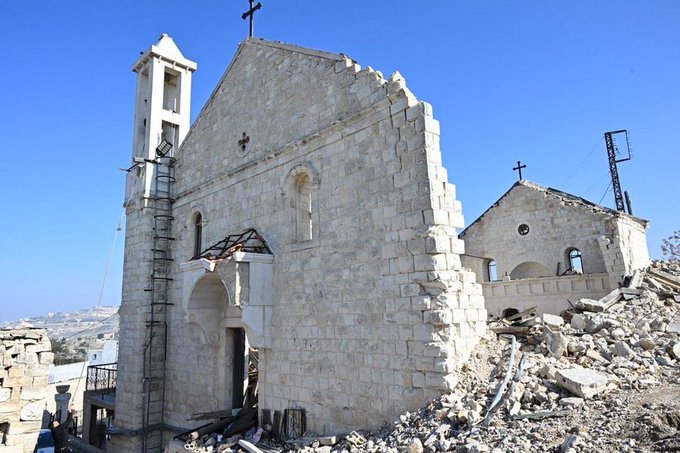
Al Mayadeen | May 5, 2026
The Council of Melkite Greek Catholic Bishops in Lebanon urged on Tuesday both the Lebanese government and the United Nations to take measures to protect civilian property and religious institutions.
The bishops specifically cited Yaroun, where local officials and community representatives say a Melkite convent was destroyed earlier this month alongside other structures, describing the destruction of the buildings as “a deep wound in the national and human conscience”.
According to Christian community figures in Yaroun, the convent belonging to the Melkite tradition was bulldozed by Israeli occupation forces in southern Lebanon.
Adib Ajaka, a local Christian community leader, said the structure was part of a religious complex that also included nearby facilities. He disputed claims that the convent remained intact, stating that rubble near adjacent buildings indicated its destruction.
In turn, the French Catholic charity L’Oeuvre d’Orient condemned the “deliberate act of destruction of a place of worship and the systematic destruction of homes in southern Lebanon aimed at preventing the return of civilian populations”.
The organization called for the protection of religious heritage sites and civilian housing, warning of long-term consequences for displaced communities.
This isn’t an isolated case; the desecration of religious sanctities is a recurrent activity for Israeli forces. From Gaza to South Lebanon, numerous videos and photos were posted by Israeli soldiers themselves showing them shooting pointlessly at mosques, desecrating churches, and destroying statues of religious figures.
Last month, a photo circulating on social media showed an Israeli occupation soldier using a sledgehammer to strike the head of a statue of Jesus on a crucifix that had fallen from a cross.
Israel’s Obliteration Ecocide from Gaza to Lebanon and Beyond
By Dan Steinbock | Palestine Chronicle | May 3, 2026
Lebanon accuses Israel of committing ecocide in country since 2023. It is an extension of Israel’s destruction of Gaza – and its obliteration doctrine.
Israeli military aggression has “reshaped both the physical and ecological landscape” of southern Lebanon, according to the Lebanese report (which does not consider the impacts of Israel’s latest barrage of attacks this spring).
In her foreword, Lebanon’s minister for the environment, Tamara el Zein, notes: “The scale and intentionality of the damage to forests, agricultural lands, marine ecosystems, water resources, and atmospheric quality constitute what must be recognized as an act of ecocide, with consequences that extend far beyond immediate destruction.”
Obliteration ecocide in Lebanon
Released by the country’s National Council for Scientific Research and presented by the environment ministry, the report accuses Israel of “ecocide” during the 2023–2024 war and subsequent escalations. It frames environmental destruction not as incidental “collateral damage” but as a systematic transformation of ecosystems.
Key findings are damning. They include:
- 5,000 hectares of forest destroyed
- Massive agricultural losses ($118m direct infrastructure damage; much larger indirect losses)
- Soil contamination (including high phosphorus levels)
- Air pollution from repeated strike cycles
- Destruction of orchards and irrigation systems
Minister el Zein characterizes this as “intentional ecological destruction” affecting food systems, public health, and the long-term viability of southern Lebanon’s rural economy.
International reporting on the same dossier highlights an estimated total damage burden of over $25 billion when recovery costs and economic losses are included. The figure is a combined total from the assessments by the Lebanese report and the World Bank Rapid Damage and Needs Assessment (RDNA) 2025.
This framing aligns with a growing legal discourse around “ecocide” as a potential international crime, particularly where environmental damage is widespread, long-term, and strategically embedded in military operations.
It is also aligned with UN reporting on the broader Israel–Lebanon escalation, confirming extensive infrastructure destruction, civilian displacement, and strikes affecting residential areas.
As the ecocide of Gaza has gone effectively unpunished by the international community, the Netanyahu government is extending the environmental devastation into Lebanon and the proximate region.
Obliteration Doctrine in Gaza
In The Obliteration Doctrine (2025), related commentaries and excerpts, I define this doctrine as the lethal mix of scorched earth policy, collective punishment, and civilian victimization, coupled with massive indiscriminate bombardment and systematic use of artificial intelligence (AI).
The concept is vital because it connects the dots between military strategies, aerial bombardment, lethal deployment of artificial intelligence (AI) and international law, particularly the Geneva Conventions and the Genocide Convention. As Professor William Schabas, a leading scholar of genocide, notes, “the Obliteration Doctrine” “adds a new term to the lexicon on genocide, notably in the application of international law and its judicial mechanisms.”
Modern warfare in Gaza is no longer just counterinsurgency but systems-level destruction of the environmental and infrastructural substrate of life—water, soil, agriculture, energy, and urban continuity.
This interpretation overlaps with empirical reporting on Gaza’s environmental collapse:
- Satellite analysis shows 38–48% of tree cover and farmland destroyed
- Severe contamination of soil and groundwater
- Large-scale destruction of greenhouses and irrigation systems
- Air pollution from sustained bombardment and debris burning
These patterns are described in independent investigations as producing conditions of near-uninhabitability in many parts of Gaza.
Warfare is no longer bound by battlefield geography. It becomes the restructuring—or “obliteration”—of ecological systems that sustain civilian life.
Ecocide here is not merely the destruction of nature, but the destruction of life-support systems as a purposeful strategy. It is another word for cultural genocide.
Lebanon and the Gaza template
The Lebanese report and international commentary suggest strong structural parallels between Gaza and southern Lebanon operations:
- Destruction of orchards, especially olive groves (long-lived economic ecosystems)
- Targeting of water infrastructure and rural supply systems
- Repeated airstrikes generating soil and atmospheric contamination
- Displacement of civilian populations from ecologically productive zones, which can be seen as a form of ethnic cleansing
International media reports that Israel is applying a “Gaza playbook” in Lebanon: expulsion orders, infrastructure targeting, and village-level destruction patterns.
Lebanon is now an adjacent theatre where similar operational logics are extended across a different ecological terrain:
- Gaza: dense urban-agricultural mosaic under blockade conditions
- Southern Lebanon: dispersed agro-ecological rural system with forested and orchard economies
In both cases, ecological assets are not collateral but structurally embedded in livelihood and resistance capacity – and that makes them strategic targets under the high-intensity obliteration doctrine.
Consequences beyond Lebanon (and for Israel)
The environmental consequences of such conflict patterns are not geographically contained. Three spillover trajectories are particularly important.
First of all, regional ecological degradation. Soil contamination, wildfire damage, and agricultural collapse are not confined to strike zones. Windborne particulates, water contamination, and long-term soil chemistry changes affect broader cross-border ecosystems.
Second, economic fragility and food-system insecurity. Both Lebanon and Israel depend on regional agricultural stability and water systems. Repeated infrastructure destruction increases food import dependence, rural depopulation and long-term land degradation in border zones.
Third, internal Israeli environmental vulnerability. A less discussed but critical dimension is the simple reality that prolonged warfare conditions can feed back into Israel’s own ecological systems vis-à-vis air quality deterioration from sustained military operations, water system strain under security infrastructure expansion, fire ecology disruption in northern regions. long-term land-use militarization effects.
In this sense, “obliteration” generates mutual ecological degradation across interconnected landscapes. It is an ecological version of MAD – mutually assured destruction.
Diffusion of Doctrine
The key concern is not just localized destruction but doctrinal diffusion. Methods of high-intensity ecological disruption normalize across theaters. And let’s keep in mind that the first test of the obliteration doctrine occurred in Dahiya, the predominantly Shia enclave of Beirut.
US military legacy in Iraq and Syria already includes extensive infrastructure and ecosystem disruption under counterinsurgency and airpower doctrines. These features include water system destruction in Iraq, oil field fires, atmospheric contamination, and urban siege warfare effects in Raqqa and Mosul via coalition partners.
Such precedents create a shared operational vocabulary where environmental damage is treated as secondary to strategic objectives.
In a potential Israel–Iran escalation scenario, ecological infrastructure becomes strategically central through water scarcity systems in Iran’s arid regions, oil and petrochemical infrastructure vulnerability, and agricultural basins dependent on irrigation networks.
Under the obliteration logic, these become dual-use environments—civilian life-support systems that also acquire military significance.
Finally, there is the regional systemic risk. This implies a shift from territorial warfare to ecosystem-targeted coercion, where water, soil, energy, and agriculture become primary pressure points. Meanwhile, environmental degradation is exploited as a form of strategic leverage and recovery cycles extend beyond political timelines into generational horizons.
From Battlefield to Biosphere as a Target
The Lebanese charges, Gaza environmental destruction data, and the doctrine of obliteration converge on a structural transformation in modern conflict.
The object of war is increasingly not just territory or armed forces, but the ecological infrastructure that makes civilian life possible. In this way, destruction of that infrastructure is a prelude to ethnic cleansing and displacement.
For military doctrines, this may be framed as an incidental or operational necessity. But for Lebanon and environmental analysts, this constitutes potential ecocide under international law. In view of the obliteration doctrine, it represents a systemic shift in the practice of warfare itself, from the battlefield to the biosphere as a target.
What happens in Gaza won’t stay in Gaza. What happens in Lebanon won’t stay in Lebanon. The stage is being set for obliteration ecocides wherever they are seen as effective necessities.
Ecological systems are now central to both the conduct and consequences of war.
– The author of The Fall of Israel (2024) and The Obliteration Doctrine (2025), Dr Dan Steinbock is the founder of Difference Group and has served at the India, China and America Institute (US), Shanghai Institute for International Studies (China) and the EU Center (Singapore). For more, see https://www.differencegroup.net/
UAE deports tens of thousands of Pakistanis, seizes their savings amid war on Iran: Report
Press TV – May 5, 2026
Authorities in the UAE are conducting a sweeping deportation campaign targeting tens of thousands of Pakistani workers, freezing their bank accounts and stripping them of their life savings amid growing regional fallout from the US-Israeli aggression on Iran.
While initial reports from New Lines Magazine placed the number of expelled individuals at 15,000, Pakistani sources recently confirmed to Press TV that the deportations are continuing at a rapid pace and now affect tens of thousands of workers.
The expulsions target Shia Muslims or individuals who have publicly expressed solidarity with Tehran following the recent US-Israeli aggression against Iran.
Those targeted are being expelled without formal charges or legal recourse. The systematic removals involve sudden arrests, phone confiscations, and transfers between various detention facilities before the workers are forced onto flights back to Pakistan.
Crucially, deportees are being sent back “without being given the opportunity to withdraw their funds” from Emirati banks, according to a Shia cleric cited by New Lines Magazine.
This sudden seizure of assets has left many families in financial ruin, stripping workers—some of whom spent decades contributing to the Emirati economy—of their entire life savings.
Mohammad Amin Shaheedi, chief of Ummat-e-Wahida Pakistan, told the magazine that following the outbreak of the war, the UAE government launched “what appears to be an organized campaign to deport Shia individuals from the country.”
The US-Israeli aggression began on February 28 with airstrikes that assassinated senior Iranian officials and commanders, including Leader of the Islamic Revolution Ayatollah Seyyed Ali Khamenei. In response, Iranian armed forces launched daily missile and drone operations targeting locations in the Israeli-occupied territories and US military bases and assets, including those in the UAE.
The ensuing war sparked immense public solidarity with Iran across the region, particularly in Pakistan.
Sources indicate the UAE’s mass expulsions are deeply tied to Islamabad’s clear stance against the Israeli regime’s aggression on Iran and Lebanon, as well as Pakistan’s prominent role as a mediator.
On April 8, forty days into the war, a Pakistan-brokered temporary ceasefire between Iran and the US finally took effect. However, subsequent peace negotiations in Islamabad ultimately stalled amid Washington’s maximalist demands and insistence on unreasonable positions.
Wheels Down in Tbilisi: Was a Routine U.S. Military Stopover a Deliberate Signal to Iran?
By Seth Ferris – New Eastern Outlook – May 5, 2026
A brief and poorly explained landing of a U.S. military transport aircraft in Tbilisi at the end of March 2026 has become a subject of discussion and speculation about its real significance, fueling suspicions that more complex geopolitical signals may lie behind the official explanation of a “routine flight.”
Let’s pull apart the “routine flight” narrative and read between the lines, asking whether a fleeting stopover was less about logistics and more about sending a message — one that Georgia may end up paying for. If you think geopolitics is all press releases and polite diplomacy, think again. I would suggest that what is going on in the shadows, outside of mainstream coverage, is closer to theater — with Georgia cast in a role it never auditioned for.
Start with the headlines: last month, a US Air Force cargo aircraft made a brief stop in Tbilisi, purpose unknown – and just start reverse engineering, taking it apart, and you come up with what is between the lines as to the possible motivations for the US, a strategic ally of Georgia, to be willing to put Iran, its regional partner, in harm’s way. Moreover, it is interesting to know the news sites where this news first appeared, such as Georgian Today, and its history of paid hired gun articles supporting US policy in the region.
It is not as if Georgia and the US do not know that now is not the most opportune time to be perceived as supporting the illegal American-Israeli war against Iran. And let’s not forget C-130 Turkish Cargo Planes falling out of blue Georgian skies. Providing logistic support in a preempted war of aggression is still a recognized crime under the Nuremberg Codex. That puts the provider of such support in the crosshairs of the party being attacked, as has already been demonstrated by Iranian countermeasures, not to mention ‘protective reaction’ strikes in the Gulf States and Jordan.
What do we know?
A United States Air Force military transport aircraft made a short, unexplained landing in Tbilisi the last week of March, prompting questions and speculations but little official detail about its actual mission. However, multiple reports published on April 1, 2026, said a Boeing C-17 Globemaster III landed at Tbilisi International Airport in the afternoon after departing from the U.S. military hub at Ramstein Air Base in Germany.
It is interesting that the US Embassy provided a ‘most vague’ news release after the incident, telling of a phone call between Secretary of State Marco Rubio and Georgia Prime Minister Irakli Kobakhidze the very next day.
Also vague is the lack of coverage of planes without tail numbers landing at regional airports, such as the one named in honour of the Soviet-Georgian movie “Mimino” in Telavi, East Georgia, supposedly owned by the Aviation University of Georgia. It has operated since 2012 and serves as a training ground for students in the Faculty of Aviation and Engineering.
But it can serve other purposes, as the airport hosts an aircraft technical service enterprise, a navigation tower, a terminal building for passengers, and dormitories for pilot-instructors and engineering-technical staff.
Recent sightings, including of European-looking visitors to the facility, appear a bit too dodgy in terms of standard news release material about a local use and training facility after the landing of the military transport and drones spotted over Georgia – too short and sweet not to be subterfuge.
The U.S. Embassy characterized some flight movement as routine, stating that such flights are “regularly carried out in coordination with partners,” without providing details about cargo, passengers, or final destination.
Flight tracking platforms such as Flightradar24 confirm that C-17 aircraft frequently operate across Europe and the Middle East, typically transporting personnel, equipment, or humanitarian supplies, though specific mission details are not publicly disclosed.
But I am more interested in what was on board, delivering or taking out human cargo! This brings back memories of a Turkish military transport, a C-130. Dropping from the clear blue sky a few months ago, including its crew, all died, and the debris was scattered over a wide area of Georgian territory. The forensic findings of that crash investigation have never been publicly shared to the best of my knowledge.
Wheels Down!
Would the Georgian government, especially now, be so naive as to agree to this touchdown, an unexpected one at that—and of a US military transport plane out of the blue in the middle of a shooting war in the Middle East?
Already there is political blowback. Georgia political analyst Gia Khukhashvili reportedly said that Rubio’s phone call was a “threatening warning”.
Perhaps Rubio was checking how ready Georgia was, and in what form [to what degree] it was ready to help solve America’s logistical problems… I don’t think there have already been any concrete proposals at this stage. But this was logically followed by a threatening warning (for Georgia) from the Iranian ambassador: “Don’t do anything wrong, otherwise you will also become a target,” the Georgian News portal quotes the political scientist.
Gia Khukhashvili believes that there will be no Georgian-American agreements, because “Washington will understand who it is dealing with … and how the Georgian PM Kobakhidze will later say that Rubio threatened him on the phone and demanded to open a second front,” confirmed the Georgian political pundit.
Posting News to Provoke Iran!
Who knows the real motivations and how the news was reported? As one close, trusted Georgian source shared, … just that they post this news to make Iran angry! The UNM, United National Movement, former Saakashvili regime, wants it so VERY much!
Why didn’t they use Turkish or Armenian bases?
That is a good question, and I think you already know the answer. The US wanted to show Iran that Georgia and the US are cooperating, so it provoked Iran to send a drone or make some attack, as Israel has ordered the US to do.
It should be noted that Armenia has a Russian base, and the plane is claimed to have flown over some Armenian and Turkish territory, perhaps touching down in the Kurdish-controlled region of Northern Iraq. It would have been too dangerous to land in Armenia, as secrets could be revealed, and as for Turkey, it shares a similar position as Georgia, it does not want to get involved, or give the impression of being involved, especially since the Americans are openly arming regional Kurds. It can be expected that a substantial part of this ratline is flowing into and through Turkish territory.
I still can’t find any serious discussion on the plane and its real purpose for making a short stopover in Georgia. It appears that the US and Israel would love to put Georgia in the crosshairs of Iran just for the hell of it. It is also interesting that strikes have been carried out by Israel on joint Russian-Iranian port facilities on the Caspian, in the part on the Iranian side.
Possible Motivations for Wheels Down and Vague News Coverage
My first thought was delivering something to put in place for Iran. But if it went to Turkish airspace, it could also be headed to eastern Turkey or Iraq. Or one of the NATO bases in Turkey, although I’m pretty sure those are in the west, and we would not be in the flight path. In any case, if it is at all related to the war, then more EU countries are banning the use of the bases in their countries, so if a plane needs to stop somewhere or refuel, it could be done here. Georgia still wants to stay on good terms with the US, so if it is a brief stop, they would probably allow it. Not much will happen. If the use looks more like staging, it could be dangerous. Moreover, they could use Vaziani. I think NATO supported development of an air base there (which the government now wants to use for a new commercial mega-airport). But there isn’t much of an air force here, so maybe Vaziani lacks fuel in any quantity and other amenities. The motivation was perhaps to deliver some radar equipment, greenbacks, spyware equipment, or perhaps human resources, thinking that Iran will not attack Georgia since it needs it too much as its window to the world.
We’ll have to see; just a thought on it!
In the end, a half-hour touchdown, a vague press release statement, and a conveniently timed diplomatic call say more than any official briefing ever will. Whether it was cargo, coordination, or quiet signaling, the message landed louder than the aircraft itself: Georgia is being watched, tested, and potentially positioned in a conflict it has no desire to join.
And if this was meant as a signal to Iran, then it’s a risky one—because in today’s climate, even a brief stop can turn a bystander into a target. A fleeting military stopover can transform neutral ground into perceived staging areas, risking Iranian retaliation against a nation determined to remain on the sidelines. Sparse public facts and local sources reveal the shadowy interplay of great-power signaling, where a half-hour touchdown may speak louder than any formal briefing—placing Georgia uncomfortably in the crosshairs of a war it wants no part of.
Seth Ferris is an investigative journalist and political scientist, expert on Middle Eastern affairs.
Follow new articles on our Telegram channel
Trump’s second strike on Iran would be suicidal. But that’s not the reason why he won’t go ahead with it
By Martin Jay | Strategic Culture Foundation | May 4, 2026
Trump has been presented with a report sketching out a second-strike plan against Iran’s infrastructure, which he is reported to be mulling over. The media has latched onto terms like “short, powerful” strikes aimed at Iran’s infrastructure – which the author predicted in two previous articles and which, if it were to happen, would occur over the summer period when temperatures reach unbearable levels in the region. But is Trump really serious about it, and does he even understand the extent of Iran’s retaliation? The very fact that Trump has military advisors who are even presenting him with such plans shows, if nothing else, the level of their disconnect from reality and his exaggerated sense of self-importance.
The US already did this the first time round and went through its stocks of ordnance, breaking all records for the volume of missiles used in such a short space of time. It did very little to bring Iran to its knees, rather making it stronger than ever, with greater support. But what it did succeed in doing was giving Iran a dry run with such an attack and allowing it to learn a great deal about how to cope with one. Militarily, Iran has never been stronger, more focused and more technologically advanced. For Trump to believe he has a shot at a second go is not only unrealistic but sheer madness in terms of what the US – and to a lesser extent Israel – is going to have to deal with as a response. Iran will almost certainly reduce Saudi Arabia’s oil infrastructure to dust, which experts estimate would take ten years to rebuild.
If the US opts to go for a second strike, the retaliation against Saudi oil infrastructure and the US military ships themselves being used in the blockade will be unprecedented. Not only could oil easily reach 200 USD a barrel, but the striking of the US armada could be the end of America as we know it.
While the Iranian government presents Trump with their fourteen-point plan, its key officials understand how difficult it is for Trump to walk away. Both sides talk as though they’ve won the war, but in reality Trump is shackled to Netanyahu, who is insisting that the ridiculous blockade continues. What the US media are not reporting about it, though, is that it is only really working for the cameras and not choking Iran of revenues as reported. Many tankers from countries friendly with Iran travel towards the straits while keeping very close to the Iranian coastline – too far for the Americans to strike them, as US battleships would have to come closer.
Meanwhile Iran takes further steps to formalise its legal ownership, which would suggest there is an even stronger case for Tehran to strike the US battleships at some point. Iran is patient and prefers to keep a dialogue going, hoping for Trump to back down at some point while the markets increase pressure on him each day and EU countries drift farther away from Washington’s influence as their own economies face collapse if the situation isn’t resolved soon. Trump has his own way of dealing with the crisis, which, hilariously, is always to place himself first. His recent tantrum about NATO not supporting him, resulting in him pulling US troops out of Germany, is simply a distraction.
Yet the chances of this second strike happening are unlikely. But not for the reasons that seem obvious. In reality, China and Russia are playing an increasingly central role in supporting Iran, and Trump is beginning to understand what this means in practical terms. The low levels of missiles will restrict his options about what kind of strike this second one could be, which is why there’s so much talk about the US using its own hypersonic missiles. It’s not only that the US can’t replenish its stocks – THAAD and Patriot are very low – but the essential raw minerals needed to make them come from China, and Beijing has indicated that this supply is on pause. The other point is that Israel has almost nothing left to even throw into the air, let alone to present so-called journalists with video pictures of a country defending itself. Israel has nothing left. For Trump to go ahead with a second strike would really give Iran the excuse it needs to destroy Trump as a global leader, as hitting Saudi Arabia’s oil would be a wake-up call that Trump would have to take seriously. Iran sees such a strike just as the Americans considered the atomic bombs dropped on Japan at the end of the Second World War: a moment of clarity.
Trump is still confused. But such a strike would put such enormous pressure on him from around the world, from America’s allies, that the sheer noise would be deafening for him. He would have to listen to it and concede defeat. But for the moment, there is still time for distracting the media with utterly stupid statements that portray America as a winner in the war, and we should expect more of them – but some kind of defeat is coming. Creating a massive distraction will be inevitable, and that might come in the form of a new crisis around the world or from the US pulling out of NATO. Iran, right at the last moment, adding that it is now able to include the nuclear issue as part of the talks – that is now on the table. But will Trump seize the moment?
Featured Video

John Mearsheimer Talking Iran with Iran
or go to
Aletho News Archives – Video-Images
Book Review & Summary
Calling of an Angel: The True Story of Rene Caisse and an Indian Herbal Medicine Called Essiac (1988)
Dr. Gary L. Glum – 30 Q&As – Book Review & Summary
Lies are Unbekoming | October 17, 2026
On June 10, 1975, Dr. Chester Stock, a vice president at Memorial Sloan-Kettering Institute for Cancer Research, wrote to a Canadian nurse named Rene Caisse: “Enclosed are test data in two experiments indicating some regressions in sarcoma 180 of mice treated with Essiac.” The sentence sat in a letter from one of the world’s largest private cancer research centers, concerning an herbal tea an elderly English woman had learned from an Ojibwa medicine man at a northern Ontario mining camp in the 1890s. The tests were terminated the following year after Sloan-Kettering admitted, in sworn affidavit three years later, that they had prepared the injectable solution improperly from the dried material supplied — freezing and thawing the herb rather than boiling it as Rene had instructed. By the time Calling of an Angel was published in 1988, Rene Caisse had been dead for a decade, having treated thousands of cancer patients across fifty-six years in her Bracebridge, Ontario kitchen, never charging a fee, and refusing every offer — from Memorial Sloan-Kettering, the National Cancer Institute, Merck, Parke Davis, and private corporations dangling contracts up to $1 million — to release her formula before the medical establishment admitted her remedy had merit. … continue
Blog Roll
 Aletho News
- Vice President J.D. Vance’s Deceptive ‘Antiwar’ Campaign Speech
- Iran: Palestinians’ rights must not be compromised in Gaza’s future; US, Israel to blame for Hormuz situation
- Ongoing tales of Syrian chemical weapons
- Moscow blasts UN for ignoring torture of Russian POWs
- Millions of Books Could Have Been Destroyed in Lebanon During Israeli Bombings
- Moscow warns of ‘hunt for Russians’
- Calling of an Angel: The True Story of Rene Caisse and an Indian Herbal Medicine Called Essiac (1988)
- South Korean Assistance to the U.S. in the War with Iran: Between Allied Duty and National Interests
- Pharma- and Gates-Funded GAVI Seeks to Assure Parents
- John Mearsheimer Talking Iran with Iran
- If Americans Knew
- Israeli soldiers debunk Israel’s talking points
- In West Bank, Israeli settlers are totally out of control – Daily Update
- NPR investigation finds evidence of widespread fraud at mall kiosks tied to Israeli skincare brand
- Tucker Carlson exposes Israeli Lies about the Oct 7th attack, Charlie Kirk, and the U.S.
- Israel has detained thousands of Palestinian children since Oct 7th – over half spent time in solitary, many uncharged
- Israeli Analysis: Is Netanyahu Planning an ‘October Surprise’ Attack Before Israel’s Election?
- Israeli settlers brutally attack Palestinians and Washington Post female photographer, 65
- Words Have Changed, Occupation Continues: The Reality of the Gaza Ceasefire
- Gaza’s child amputees are growing faster than their prosthetics allow
- Israel keeps Palestinians struggling just to survive–Daily Update
- No Tricks Zone
- New Study Suggests Large Regions Of The Pacific Ocean Have Been Cooling For The Last 80 Years
- Germany’s Green Energy Debacle: High Energy Costs Force Kahla Porzellan to Close After 182 Years!
- New Study: 50 Years Of The Most Aggressive ‘Net Zero’ Policies Can Only Affect The Global Climate By 0.03°C
- US September “Heat” Was No Record…Many Records Set Decades Ago
- Latest European Green Energy Debacle; Portugal’s Largest Flagship Solar Park Insolvent!
- Green Energy Debacle: German Expert Professor Fritz Vahrenholt Warns Of Severe Economic And Social Consequences
- Two More Paleo Reconstructions Affirm Meters-Higher Sea Levels Across Ireland, Brazil 7000-6000 Years Ago
- New Study: Earth And Venus Surface Warmth Largely Explained By Convection And Lapse Rate, Not CO2 Or Radiation
- 2025 Nature Paper Claiming Worsening Global Drought Gets RETRACTED …Heavily Flawed
- New Study: ‘Global Drought Shows No Detectable Recent Acceleration Under Climate Warming’

