China issues first prohibition order to safeguard international trade order under rule of law
People’s Daily | May 3, 2026
China’s Ministry of Commerce (MOFCOM) on Saturday issued a prohibition order in accordance with Rules on Counteracting Unjustified Extraterritorial Application of Foreign Legislation and Other Measures (the 2021 Blocking Rules), which explicitly stated that China shall not recognize, enforce, or give effect to the unilateral sanctions imposed by the US, which listed five Chinese petrochemical enterprises on the Specially Designated Nationals List and imposed asset freezes and transaction bans on grounds of alleged oil transactions with Iran.
This move marks a crucial step for China’s foreign-related legal tools to move from institutional framework to practical enforcement. Leveraging the power of the rule of law, China has delivered a targeted response to US long-arm jurisdiction. The move defends the legitimate rights and interests of Chinese enterprises while heeding the international community’s widespread call to oppose hegemony, injecting justice into efforts to safeguard the international economic order.
China values its relations with the US and emphasizes that the essence of China-US economic and trade relations is mutual benefit and win-win outcomes. China advocates resolving concerns through dialogue on an equal-footing. However, since 2025, the US has imposed sanctions on Chinese refining, shipping and port enterprises under the pretext of “involvement in Iranian oil transactions,” freezing assets and prohibiting transactions. Under such circumstances, China’s issuance of the prohibition order in accordance with the Blocking Rules is a necessary measure to safeguard its national and corporate interests. Meanwhile, the Blocking Rules provide various institutional arrangements to steadily protect the legitimate rights and interests of Chinese citizens, legal persons and other organizations.
The US’ arbitrary imposition of unilateral sanctions and reckless pursuit of “long-arm jurisdiction” constituted hegemonic practices that breach sovereign boundaries and coerce the global market. By placing its domestic law above international law and wantonly interfering in the normal economic and trade activities of enterprises in other countries, such actions completely violate the basic principle of sovereign equality in international relations and have long faced resolute opposition from the international community.
As early as 1996, the European Union adopted the Council Regulation protecting against the effects of the extra-territorial application of legislation adopted by a third country, blocking the extra-territorial application of the US Helms-Burton Act and D’Amato Act, which restricted trade with Cuba, Iran, and other countries. Today, the US has escalated its abuse of secondary sanctions, wielding the sanctions stick against law-abiding Chinese enterprises. This seriously infringes upon the legitimate rights and interests of Chinese business entities and disrupted the stability of the global energy supply chain. In the face of hegemonic pressure, China’s issuance of a prohibition order in accordance with the law conforms to international practice and does not affect China’s assumption and fulfillment of its international obligations.
In recent years, in response to the evolving international economic and trade landscape, China has strengthened the development of its foreign-related legal system. It has established a series of legal tools, including the Anti-Foreign Sanctions Law, the Rules on Countering Foreign States’ Unlawful Extraterritorial Jurisdiction Measures, and the 2021 Blocking Rules. Laws such as the Foreign Trade Law, Export Control Law, and Foreign Investment Law have also been strengthened with provisions to safeguard the international economic and trade order, protect national sovereignty, security, and development interests, and defend the legitimate rights and interests of foreign trade operators. These legal instruments complement one another, each with its own emphasis, working together synergistically.
By issuing the prohibition order, China upholds the approach of countering hegemony with rules and defending fairness with the rule of law. It neither escalated confrontation nor made compromises, but instead negates the extraterritorial effect of the illegal US sanctions through lawful and compliant means, restoring international law to its original principle of sovereign equality. This measure not only provides relief to the affected enterprises and ensures the security of domestic industrial and supply chains, but also offers a practical example for the international community to resist unilateral bullying and oppose “long-arm jurisdiction.” It demonstrates China’s responsibility as a major country in upholding justice and defending order.
China has always advocated resolving international differences through equal dialogue, firmly upholding the multilateral trading system, and promoting inclusive economic globalization that benefits all. In the face of the countercurrent of unilateralism, China will continue to make full use of its foreign-related legal toolkit, remain resolute and be adept at defending its interests. While resolutely safeguarding its own sovereignty, security, and development interests, China will join hands with all peace-loving and rule‑of‑law-abiding countries to resist hegemonic acts and jointly promote the building of a more just, equitable, inclusive, and mutually beneficial global economic governance system.
This was compiled based on an article published in the “Chisu Jinsheng” economic commentary column of the People’s Daily on May 3, 2026. This is the translation of the Global Times English edition.
Iran rejects Trump’s ‘Project Freedom,’ warns US over Hormuz role
Al Mayadeen | May 4, 2026
Iran has strongly rejected United States President Donald Trump’s announcement of a naval initiative dubbed “Project Freedom,” warning that any American involvement in the management of the Strait of Hormuz would be considered a violation of the existing ceasefire framework.
Iran warns US against interference in Hormuz
Head of the National Security and Foreign Policy Committee in the Iranian Parliament, Ebrahim Azizi, issued a sharp warning to Washington, saying that any US interference in the emerging maritime arrangements in the Strait of Hormuz would breach ceasefire understandings.
Azizi stressed that Iran would not accept external control over one of the world’s most strategic waterways, amid ongoing tensions following months of confrontation in the region.
Azizi directly dismissed Trump’s “Project Freedom” initiative, stating that the management of the Strait of Hormuz and the wider Gulf region “would not be dictated by Trump’s delusional posts.”
His remarks reflect Tehran’s firm rejection of US attempts to position itself as an arbiter of maritime movement in the area.
Iran pushes back on US narrative
The Iranian official also criticized “anticipated US narratives” surrounding maritime security, referring to them as “blame game” scenarios.
He said such rhetoric reflects Washington’s attempt to shape the political framing of developments in the Strait of Hormuz, while Iran asserts its own sovereignty over its territorial waters and strategic routes.
Trump earlier announced that Washington will begin a naval operation to escort foreign vessels stranded in the Strait of Hormuz, framing the move as a humanitarian initiative amid ongoing regional tensions.
In a statement posted on Truth Social, Trump alleged that multiple countries had asked the United States for assistance in “freeing” ships that remain unable to transit the strategic waterway.
He said the initiative, dubbed “Project Freedom,” would begin Monday morning West Asia time with US representatives tasked with guiding vessels and their crews safely out of the restricted area.
Trump emphasized that many of the affected ships belong to countries not involved in the ongoing war, describing them as “neutral and innocent bystanders” caught in the crisis.
TRUMP ANNOUNCES OPERATION TO ESCORT SHIPS – Fmr. CIA Analyst Larry Johnson
Mario Nawfal | May 4, 2026
A few observations on Iran’s latest proposal to Trump
By Trita Parsi | May 3, 2026
A few observations on what has been reported as Iran’s three-phase proposal to the United States. I have been able to confirm some elements, though not all.
⏺️Overall, the Iranians appear to be pursuing a grand bargain—without labeling it as such. This is not merely a proposal aimed at securing a ceasefire, or even a formal end to the current conflict, but rather an attempt to resolve the broader U.S.-Iran antagonism that has persisted for the past 47 years. Implicit in this approach is an expectation that both sides would also restrain their respective regional partners and proxies (Israel, Hezbollah, etc.). In many respects, framing the proposal in this way may align more effectively with Trump’s instincts and psychology.
⏺️It is somewhat surprising that the proposal appears to frontload an end to the war before addressing the nuclear issue. If the conflict is fully de-escalated at the outset, Iran risks losing a significant source of leverage over Trump. Iran’s nuclear program alone has not been sufficient to extract meaningful concessions from Washington, as was evident during the recent ceasefire period. This sequencing may reflect a concession to China and other Asian countries, which have grown increasingly frustrated with bearing the economic costs of a conflict initiated by Trump and Israel.
⏺️The call for an international mechanism to guarantee a non-return to war suggests that any final agreement would, at a minimum, need to be codified in a UN Security Council resolution, with Russia and China serving as guarantors. From Tehran’s perspective, Trump’s personal assurances carry no credibility.
⏺️There is also mention of a revised compensation clause within a new framework, indicating that the fees Tehran might seek in the Straits could be modified or reframed. One potentially more acceptable approach for a broad range of states would be to characterize such charges not as tolls, but as maintenance fees shared with Iran and Oman. This could include oversight of environmental and navigational management, particularly given the high volume of maritime traffic that typically transits the Straits.
⏺️The reported proposal for a 15-year enrichment freeze is somewhat surprising. This would make more sense if it remains tied to a needs-based enrichment framework, as outlined in the earlier Geneva proposal. Under that approach, Iran would only enrich uranium sufficient to fuel two reactors: the Tehran Research Reactor (TRR) and another reactor not expected to come online for approximately seven years. Given that the TRR already possesses enough fuel for the next 5–7 years, Iran would not require additional enrichment during that period. This timeline could be extended—potentially to 15 years—either by downblending existing 60% enriched uranium and turning it into fuel pads now, or by securing external fuel supplies (from France or Russia, for example) to cover future needs. In that sense, the arrangement would technically not constitute a moratorium.
⏺️Iran’s proposal to negotiate a comprehensive regional security framework in phase three is not new. It dates back to UN Security Council Resolution 598, which ended the Iran-Iraq War. Tehran has pursued such an arrangement for decades. The United States should view this constructively: any framework that enables a reduction of U.S. military presence while encouraging regional actors to assume greater responsibility for their own security aligns with the stated objectives of the Trump administration.
⏺️What remains unclear in the reporting is the scope of sanctions relief Iran would seek in return. If Tehran is indeed aiming for a grand bargain, it will likely expect the lifting of all sanctions—primary and secondary U.S. sanctions, as well as UN-imposed measures.
Let’s see what happens.
“STAGED”: Conspiracy Theories Are Everywhere!
We can’t imagine why…
By Kevin Barrett | May 3, 2026
On April 23, the 410th death anniversary of William “All the World’s a Stage” Shakespeare (and his trusty Hispanic sidekick Cervantes) CNN published a thought piece entitled “How Would an Assassination Attempt Be Staged?” Two days later, on April 25, somebody staged yet another Trump assassination attempt, this time at the White House Correspondents Dinner at the Washington, DC Hilton.
According to the official narrative, the Hilton shooting was staged by a lone producer, director, casting director, lead actor, and stuntman (it was a dangerous scene) named Cole Tomas Allen. We are told, and video seems to confirm, that Allen descended a back stairway from his hotel room, sprinted past a security checkpoint, fired a shot which struck a Secret Service officer’s bulletproof vest, evaded return fire, tripped on a magnetometer box and fell to the ground, and was jumped on by cops, never having gained access to the actual ballroom where the event was taking place. Allen left a brief manifesto calling himself a “friendly federal assassin” who was “no longer willing to permit a pedophile, rapist, and traitor to coat my hands with his crimes.”
Surrounding the event were some odd coincidences. As I wrote the morning after the shooting:
Trump’s press secretary, Karoline “Machine Gun Lips” Leavitt, predicted last night’s shooting two hours before it happened: “There will be some shots fired tonight!”… Fox News reporter Aishah Hasine was in the midst of describing Leavitt’s husband Nicholas Riccio half-bragging half-warning her of what was about to go down, when suddenly and for no apparent reason (beyond the obvious one) Fox cut off the feed…
Weird Israeli connections also surfaced, as is par for the course with these kinds of events, including:
The patsy’s social media profile featuring a picture of him wearing an IDF sweatshirt; the patsy’s name being allegedly researched in Israel less than 24 hours before the attack; and the shooting erupting at the exact moment that an Israeli magician was terrifying Melania by exposing private information she had thought was secret.
If powerful insiders staged the event, perhaps using Allen as a mind-controlled patsy, what might have been their motive or motives? Social media users argued that the shooting greased the skids for Trump’s secure White House ballroom, which had been facing legal and political challenges. The Guardian noted: “Trump’s quick pivot to claiming that the shooting incident confirms the need for a more secure ballroom at the White House, and rightwing pundits’ near-uniformity in messaging along the same lines in the immediate response, heightened the conspiracy framing.”
The Israeli connections suggested another possible motive: reminding Trump just who were the “magicians” who could stage assassination events, and who held terrifying secrets that could ruin his and Melania’s lives. The Guardian reported what many believe: “Israel is blackmailing him for untold reasons, perhaps related to the Jeffrey Epstein files, and dragging the US into war in Iran.”
The Guardian’s phrasing subtly injects confusion where none is necessary. Blackmailing Trump for untold reasons? Back when it was Russia being accused of blackmailing and controlling Trump, everyone knew the reasons why a foreign state would want to blackmail and control a US president. Is the Guardian pretending that it can’t even imagine why Israel would want to blackmail Trump? Unless, of course, they were using untold in the sense of “a quantity so huge that it cannot be measured, counted, or fully described.” Could the author, Rachel Leingang, be hinting at the obvious fact that Israel would have countless reasons to want to control the US president? Did she sneak that one past her editors?
Perhaps those “untold’ reasons, Leingang tells us, might be “related to the Jeffrey Epstein files, and dragging the US into war in Iran.” Is Leingang pretending to be too stupid to understand what she is saying, in a clumsy effort to avoid responsibility for unambiguously and explicitly conveying what everyone knows or strongly suspects to be true? The moral: If you write for mainstream media, never offer a clear, straightforward summary of what “conspiracy theorists” believe, because it might sound reasonable and convincing. Instead, muck it up a bit, add some confusion, and give the reader the impression that it’s the “conspiracy theorists” who are confused.
CNN’s “How Would an Assassination Attempt Be Staged?”, published 48 hours before the latest shooting, exhibits a similar technique of seemingly deliberate obfuscation. Noting that the hashtag #staged has been picking up momentum, reflecting ever-growing skepticism about the July 13, 2024 “Trump shooting” in Butler, Pennsylvania, the author, Harmeet Kaur, offers an overly complicated mishmash of reasons why staging a political PR event would be…overly complicated. And that, of course, is why nobody would ever do such a thing.
Kaur begins by pretending that she doesn’t understand what the term staged could possibly mean in the context of a political PR stunt. After a detour through the etymology and philology of the term staged (“from the Old French ‘estage,’ meaning ‘dwelling,’ and its verb form ‘estager,’ meaning ‘to stay somewhere.’ ‘Estage’ is also related to the Latin ‘stagium’”) Kaur notes that by the 1930s staged was being used to describe faked crime scenes. Such doings, she suggests, are rare and exotic. The plain, obvious fact that almost any serious crime, committed by criminals with above-room-temperature IQs, will involve “staged” presentations of evidence and/or the lack thereof, including such simple “staging” as wiping away fingerprints or wearing ski masks, apparently doesn’t register with her.
Nor does Kaur note that a certain ethnoreligious group, whose genocidal crime headquarters, I mean “state,” is the number one suspect in the Butler and Charlie Kirk shootings as well as countless other state crimes against democracy, has a well-documented history of staging crimes for political gain. As you watch the following half-hour video compilation of mainstream media reports of Jews hoaxing “antisemitic” attacks on themselves, keep two things in mind: 1) This is just the tip of an enormous iceberg; and 2) That iceberg of thousands of similar cases represents just the dumb and/or unlucky ones who got caught.
The US clearance rate for ordinary crimes, mostly committed by impulsive, none-too-bright criminals, is less than 45% for violent crimes and less than 15% for property crimes. Miscreants who plot their crimes carefully—as high-level political criminals do—are obviously going to get away with the vast majority of their misdeeds, even before we factor in the likelihood that they have corrupted law enforcement and the media. What is surprising about the Butler, Pennsylvania “Trump shooting” is not that they managed to pull off such a complex and difficult operation, but that they did it so casually and clumsily, not even bothering to create even the slightest wound on Trump’s ear.
Roughly two and a half hours after he was taken off the rally stage, Trump says in a Truth Social statement, “I was shot with a bullet that pierced the upper part of my right ear. I knew immediately that something was wrong in that I heard a whizzing sound, shots, and immediately felt the bullet ripping through the skin. Much bleeding took place…” Yet not one shred of convincing evidence, not least of all the extensive medical evidence that would exist had Trump actually taken a bullet to the ear, supports the claim that Trump’s ear was wounded in any way. Nor does he appear to have suffered the hearing damage that might have been expected.
Whoever was in charge of the Secret Service detail must have known that Trump was in no danger. Less than a minute after the volley of shots, Trump was allowed to stand up and shake his fist in front of the flag in an obviously pre-planned photo op. Apologists for the Secret Service conspirators claim that the determination “shooter is down” reassured them that it was perfectly okay to allow Trump to stand up and expose himself to more potential bullets. But had the event been authentic, how could they have possibly known that there was only one shooter?
Kaur’s CNN article avoids even entertaining such questions. Like Leingang’s Guardian article on the Hilton shooting, it offers an ad hominem argument against the “conspiracy theorist” by representing him as a deliberately discombobulated straw man, whose supposed incoherent, confusing arguments are actually CNN’s own deliberately distorted rendering.
Kaur hauls out Spencer Parsons, “an associate professor of media production at Northwestern University and an independent filmmaker who has staged shooting scenes,” to claim that staging the Butler “Trump shooting” scene would be so difficult as to be essentially impossible. Parsons claims that a “staged shooting scene” requires vast numbers of people: “the director, camera operators, camera technicians, lighting technicians, sound engineers, special effects coordinators, safety coordinators and so on.”
Talk about misdirection! Why would ANY such people be necessary for a high-level criminal operation involving a deceptive shooting?! Were camera, lighting, sound, special effects, and safety technicians necessary when hypnotized patsy Sirhan Sirhan fired a volley of random shots, distracting onlookers while the professional killer pressed a revolver to the back of Robert F. Kennedy’s head and pulled the trigger, leaving powder burns on his skull?
Kaur tells us that setting up a patsy to take the blame for a shooting is impossibly complicated:
Then there’s the issue of the fake assassin himself. The task would require an extraordinarily skilled marksman, someone who could aim close enough to the candidate’s head to make it look like he’d intended to hit him without actually hitting him. (Acquaintances of the gunman who tried to shoot Trump told reporters that he was rejected from his high school’s rifle club because he was such a bad shot.)
And to make the situation seem believable, the Secret Service would have to kill the designated shooter after he opened fire, an outcome the person in the gun-wielding role either wouldn’t anticipate or would have to be willing to accept.
Kaur again sets up a preposterous straw man: A conspiracy theorist stupid enough to think Thomas Crooks fired shots that came anywhere near Trump’s head, and that Crooks was a conscious, witting, fully-informed participant. But nobody thinks that! What skeptics actually think is that Crooks, like most other patsies going back to Sirhan, was probably mind-controlled. (For an introductory discussion including a demonstration of MK-Ultra style hypnotic mind-control, check out Jesse Ventura’s “Mind-Controlled Assassins and Programmed Killers.”) Crooks, like Oswald, was “just a patsy” who didn’t shoot anyone. The actual shooting, which did not and could not have caused a bullet to come anywhere near Trump’s head, but which likely did strike three onlookers, killing one of them, was fired from the building behind and to the left of the one that hypnotized patsy Crooks had climbed onto. For details, check out my interview with filmmaker John Hankey, and watch his film below.
Kaur then implies that it would have been too difficult or impossible for Trump to use a squib to create the fake blood he smeared on his face like warpaint for the photo op:
The blood would be another consideration, Parsons says. Film crews simulate gunshot wounds via squibs, small explosive devices that spout fake blood when detonated — some conspiracy theories surrounding Trump’s assassination attempt claimed that he used a squib because the blood on his face was supposedly only seen after he raised his hand to his cheek, though researcher Katherine FitzGerald noted at the time that the first appearance of blood was not clear from the videos.
Another technique for staging bloodshed might involve the candidate superficially wounding himself with a small razor blade, like professional wrestlers do, but that also presents challenges…
Wait a minute! What does Kaur mean, also presents challenges?! The first paragraph quoted above fails to present the slightest argument or evidence that Trump or a Secret Service confederate would have faced the slightest “challenge” in using a squib to produce the fake blood. The word also is a lie. Kaur hopes the careless reader will gloss over it.
Having refuted nothing while flailing about with straw men, Kaur concludes:
Given all of this, Parsons finds the idea that an assassination attempt of this scale could be “staged” to be “tremendously unlikely.” “This is just astronomically difficult to stage,” he adds. “The whole thing, from a filmmaking perspective, seems to be just immensely, immensely difficult and really based on a lot of chance.”
What would be so hard about putting an MK-Ultraed patsy on a rooftop, a professional sniper in a difficult-to-spot location where he could shoot a couple of bystanders, and giving Trump a blood squib after rehearsing “hit the deck, smear the blood, count to fifty, get up, shake your fist in front of the flag”? Sure, you and I couldn’t do it, but we don’t control the top of the federal command chain.
Setting up that scenario wouldn’t require precisely the same skill set that Parsons, the film-and-TV guy, enjoys. But if you think that people with “deceptive shooting” skill sets don’t exist, you must not know much about special forces, intelligence agencies, organized crime, and the rather large area where they overlap. That’s why someone like Joe Kent, the former Counterrorism chief who knows people with such skill sets, can easily see that incidents like the Butler and Charlie Kirk shootings are extremely suspicious, and point directly at the overlapping territory inhabited by Israel, Israeli-linked organized crime, and their assets in US military, intelligence, and police agencies… and, perhaps most importantly, the mainstream media that insists on obfuscating such matters.
NATO courts screenwriters to embed alliance messaging in film, TV
Al-Mayadeen | May 3, 2026
NATO has been quietly holding closed-door meetings with film and television writers, directors, and producers across Europe and the United States, in what critics are denouncing as a coordinated effort to embed the military alliance’s messaging into mainstream entertainment.
According to The Guardian, the initiative has already spanned sessions in Los Angeles, Brussels, and Paris, with a fourth meeting planned for London next month, where NATO officials are set to meet with members of the Writers’ Guild of Great Britain (WGGB).
The meetings, held under Chatham House rules, meaning participants may use information discussed but are not permitted to identify other attendees, focus on what organizers describe as the “evolving security situation in Europe and beyond.”
A WGGB email reviewed by The Guardian indicated that three separate projects are already in development that were “inspired, at least in part,” by those conversations.
James Appathurai, a former NATO spokesperson now serving as the alliance’s deputy assistant secretary general for hybrid, cyber and new technology, is expected to attend the London session alongside other officials.
In language that alarmed many recipients, the invitation suggested that “even if something so simple,” as NATO’s core message of cooperation and collective security, “finds its way into a future story, that will be enough.”
‘Clearly propaganda’
NATO’s outreach has drawn sharp criticism from within the creative community. Irish screenwriter Alan O’Gorman, whose film Christy won best film at the 2026 Irish Film and Television Awards, called the initiative “outrageous” and “clearly propaganda,” telling The Guardian that many writers come from countries that have “suffered under wars that NATO has joined and propagated.”
O’Gorman said those invited were “pretty offended that art would be used in a way that was supporting war,” and framed the meetings as part of a broader effort to cultivate pro-NATO sentiment in light of fearmongering across European media about weakened defenses.
Screenwriter and producer Faisal A. Qureshi, who applied to attend one session before a scheduling conflict prevented him, raised more structural concerns. He warned that the “risk for any creative who dips into this unattributable world of intelligence or military briefings is that they can get seduced into thinking they now have some secret knowledge,” one that normalizes moral compromise in the name of the greater good.
Qureshi questioned whether writers given such privileged access would genuinely “challenge or interrogate” the information fed to them, or simply absorb it.
A pattern of cultural lobbying
The London meeting is not an isolated effort. In 2024, eight prominent Hollywood screenwriters, including a writer and executive producer on Friends and a producer on High Potential, were flown to NATO headquarters in Brussels, where they met then-Secretary General Jens Stoltenberg. The trip was organized by the Washington-based Center for Strategic and International Studies.
The initiative also mirrors recommendations from the Centre for European Reform, which earlier this year called on governments to directly engage cultural figures, including screenwriters and producers, to build public support for rising defense budgets and “better tell the story” of why military investment is necessary.
NATO, for its part, framed the sessions as demand-driven, saying the meetings “follow from interest expressed by members of the industry to know more about what NATO is about and how it works.”
Iran replaces UAE ports with Pakistan corridor to break US blockade
Al Mayadeen | May 3, 2026
Pakistan has officially authorised the transit of goods into Iran through its territory and ports, positioning Karachi, Port Qasim, and Gwadar as key logistical gateways for Iranian trade while Washington’s maritime blockade attempts to strangle the Islamic Republic’s access to global commerce, Tasnim News Agency reported.
Islamabad’s Ministry of Commerce issued the Transit of Goods through Territory of Pakistan Order 2026 on April 25, bringing it into immediate effect. The order, which activates a bilateral road transport agreement signed with Tehran in 2008 but never previously used, opens six overland routes linking Pakistan’s three main ports to two Iranian border crossings, Gabd and Taftan, through Balochistan.
The announcement coincided with Iranian Foreign Minister Abbas Araghchi’s visit to Islamabad for talks with Prime Minister Shehbaz Sharif. The Gwadar-Gabd corridor, the shortest of the designated routes, reduces travel time to the Iranian border to between two and three hours and is projected to cut transport costs by 45 to 55 percent compared with routing cargo through Karachi, according to Pakistani officials.
The move marks a significant shift away from the UAE ports Iran had long relied upon for regional trade access, most notably Jebel Ali.
Ports with room to grow
Pakistan’s ports bring substantial existing capacity to the arrangement. Karachi and Port Qasim together handle approximately 42 million tonnes of cargo annually, with room to absorb significant additional volume.
Since the war began, Karachi alone handled approximately 75 percent of cargo rerouted toward Pakistan, according to industry data. Gwadar, operated by China Overseas Port Holding Company as the anchor of the China-Pakistan Economic Corridor (CPEC), sits roughly 170 kilometres east of Iran’s Chabahar port, making it the most geographically proximate of the three to Iranian territory.
Tasnim framed the new arrangement in terms that extend well beyond immediate wartime logistics. The Pakistan-Iran transit corridor is expected to evolve into a strategic link connecting South Asia with Eurasia through integration with the $60 billion CPEC and China’s broader Belt and Road Initiative, an architecture originally designed to reduce China’s dependence on the Strait of Malacca by shortcutting energy transport routes through Pakistan to Xinjiang.
Blockade tightens, Tehran holds its position
US President Donald Trump announced a maritime blockade on Iran on April 13, with US forces intercepting vessels across Iranian coastal waters. Iranian officials have since warned that its continuation risks undermining ongoing negotiations.
Officials in Tehran have insisted that the blockade is a sign of US weakness, maintaining that Iran retains untapped leverage while highlighting domestic cohesion in the face of mounting external pressure.
A senior Iranian security source told Press TV that ongoing US “maritime piracy and bullying,” carried out under the guise of a blockade, would soon be met with an “unprecedented and tangible military response.”
Iran sets one-month deadline for end to US-Israeli war, blockade: Report
The Cradle | May 3, 2026
The Islamic Republic has set a one-month deadline for an agreement on the Strait of Hormuz and a full end to the wars on both Iran and Lebanon, sources told US media outlet Axios on 3 May.
Iran “set a one-month deadline for negotiations on a deal to reopen the Strait of Hormuz, end the US naval blockade and permanently end the war in Iran and in Lebanon,” the sources said.
“Per the Iranian proposal, only after such a deal is reached, another month of negotiations would be launched to try and reach a deal on the nuclear program,” they added.
On the same day, the Islamic Revolutionary Guard Corps (IRGC) Intelligence Organization said in a social media post: “Iran sets Pentagon a blockade deadline. China, Russia, Europe shift tone against Washington. Trump’s passive letter to Congress. Acceptance of Iran’s negotiating terms. There is only one way to read this: Trump must choose between ‘an impossible military operation or a bad deal with the Islamic Republic of Iran.’ The room for US decision-making has narrowed.”
Iran had previously proposed setting nuclear issues aside and negotiating a ceasefire and the reopening of the Strait of Hormuz. Trump said on Friday that he was dissatisfied with Tehran’s proposal before saying he would review it on a flight to Miami.
“I’m looking at it. I’ll let you know about it later… They told me about the concept of the deal. They’re going to give me the exact wording now.”
Shortly after the president said he “can’t imagine that it would be acceptable,” adding that Iran “has not yet paid a big enough price for what they have done to Humanity, and the World, over the last 47 years.”
He also said he would resume bombing if Tehran “misbehaves.”
The US president is required to end his war within 60 days or request approval from the US Congress to continue it for another 30 days on grounds of “unavoidable military necessity” for the safety of the military. Trump formally notified Congress of the conflict 48 hours later, making Friday, 1 May, the deadline to request a 30-day extension from Congress or terminate the war.
Trump has claimed the ceasefire has terminated hostilities and that this has rendered the deadline irrelevant and inapplicable. Secretary of Defense Pete Hegseth also claimed that the 60-day clock pauses or stops during a ceasefire.
The US has maintained an illegal blockade on Iranian ports throughout the ceasefire, while also imposing new sanctions. Tehran has repeatedly warned that it may take further military action, following its recent retaliation to the seizure of its vessels by Washington.
According to a report by Israel’s Channel 12, Tel Aviv is “bracing” itself for the collapse of negotiations between Washington and Tehran and the resumption of all-out war against the Islamic Republic.
Axios reported on 29 April that Trump was to be briefed on a series of options for renewed attacks against Iran.
US Central Command (CENTCOM) has readied a “short and powerful” wave of strikes on Iran, “likely including infrastructure targets – in hopes of breaking the negotiating deadlock,” the report claimed.
Tehran has vowed a “crushing response” to any renewed aggression.
At the edge of the Strait: A superpower in a narrow sea
By Mahmood Rehman | Al Mayadeen | May 3, 2026
I have spent a good part of my professional life at sea, and I say this without hesitation: there are few waterways in the world as unforgiving, as deceptive, and as strategically consequential as the Strait of Hormuz. It is not just a stretch of water; it is a pressure point of the global economy. When tension rises here, the entire world feels it—from fuel pumps in America to kitchen tables in South Asia.
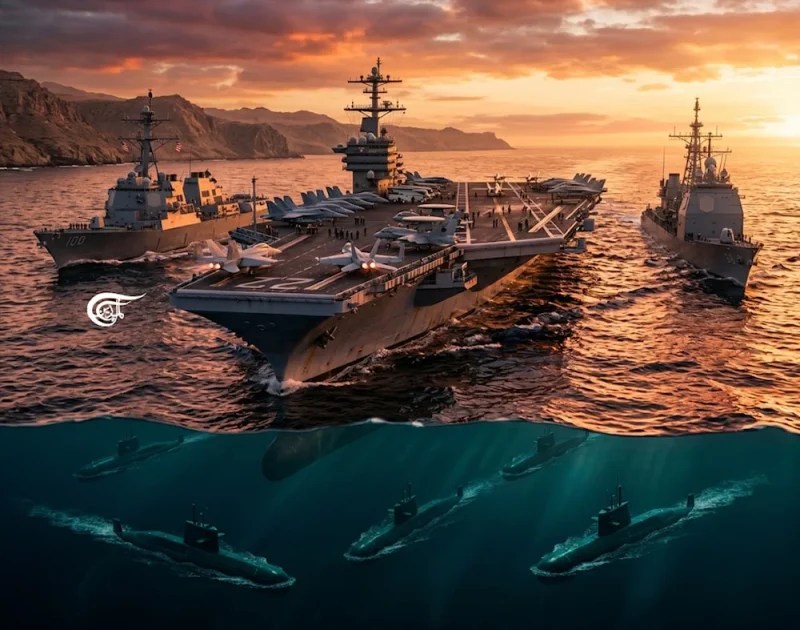
What we are witnessing today is not merely a regional conflict. It is a strategic impasse in one of the most sensitive maritime corridors on earth. The United States has deployed significant naval power into the region. Carrier strike groups centred around the USS Dwight D. Eisenhower, USS Theodore Roosevelt, and USS Gerald R. Ford are operating alongside cruisers, destroyers, frigates and replenishment tankers. Along with them are nuclear-powered guided missile submarines of the Ohio-class submarine type, carrying formidable strike capability. With over two hundred and fifty aircraft embarked across these platforms, the sheer scale of deployment is impressive by any standard.
Yet, having commanded ships myself, I know that numbers and tonnage do not always translate into control, especially in confined, contested waters.
The stated objective appears straightforward: enforce a maritime blockade of Iranian ports and ensure unhindered passage through the Strait of Hormuz. But here lies the irony. The Strait, by most accounts, was already open before the escalation. What has changed is not the physical state of the waterway, but the political and military environment surrounding it.
Iran’s recent offer has placed Washington in a difficult position. It has indicated willingness to ensure the Strait remains open, on its own terms, provided the United States lifts the blockade and shows flexibility on the timing of nuclear negotiations. Accepting such an offer risks appearing to concede under pressure. Rejecting it prolongs a costly and increasingly unpopular confrontation.
And cost is now becoming the defining factor.
Fuel prices have risen. The ripple effect is visible in everyday commodities. The American public, which never truly supported this war, is beginning to feel the burden directly. Wars fought thousands of miles away eventually find their way into domestic politics, and this one is no exception. The narrative of a swift and decisive operation has long faded. What remains is a grinding reality.
There is also a growing perception (rightly or wrongly) that this was not entirely America’s war to begin with. Many point towards the long-standing position of Benjamin Netanyahu, who has, for decades, articulated a hardline stance against Iran. Previous US administrations, including those led by Barack Obama, Joe Biden, George W. Bush and Bill Clinton, exercised caution in this regard. They understood, perhaps better than most, that Iran is not an easy adversary.
And this is where, in my professional judgement, the conversation must turn towards Iran’s maritime capability, often underestimated, sometimes misunderstood, but very real.
Iran does not seek to match the United States ship for ship. Instead, it has built what we in naval terms would call an asymmetric maritime strategy. Its so-called “mosquito fleet” consists of numerous fast attack craft — small, agile, heavily armed platforms that can swarm larger vessels. Operating from concealed bases along the coastline and from island positions, these units are difficult to detect and even harder to neutralize in large numbers.
Then there are the Ghadir-class submarines, small, quiet, and ideally suited for the shallow waters of the Gulf. These are not platforms designed for long blue-water patrols; they are designed for ambush. In confined waters, that makes all the difference.
Featured Video
The Failed Air War Over Vietnam
or go to
Aletho News Archives – Video-Images
From the Archives
USS Liberty Massacre: A Pivotal Moment in the Hostile Takeover of America
By Kevin Barrett | Crescent | Dhu al-Qa’dah 24, 1445
In corporate America, hostile takeovers are commonplace. They occur when an aggressor—a larger corporation or rich individuals—seizes control of a smaller corporation without asking permission.
What few recognize is that the United States itself has been subjected to a hostile takeover. Since the aggressor, the illegitimate settler colony known as “Israel,” is much smaller than the US, the takeover has necessarily been surreptitious.
As of June, 2024, Israel’s gradual takeover of the US has become obvious and undeniable—a proverbial “elephant in the living room.” … continue
Blog Roll
 Aletho News
- Yemeni Armed Forces Warn Airlines Against Using Saudi Airports, Exempt Mecca and Medina
- Iran security chief says powers greater than US tried to conquer Iran but ended in ‘dustbin of history’
- Europe’s mounting social chaos… chickens coming home to roost for proxy war against Russia
- US-Russia Diesel Deal Becomes Massive Defeat for Ukraine
- Hormuz and the Looming Economic Catastrophe
- Dhubab offensive, media blitz and the rapid unraveling of Saudi-backed coalition’s new gambit
- Putin Conveys to Trump Iran’s Vision on Possible Conflict Resolution – Kremlin
- The Search for Truth: Charlie Kirk’s Assassination One Year Later
- ‘Harsh reality’: Iran says France seeks monopoly on power and intimidation, not peace for all
- When Will This White House Madness End?
- If Americans Knew
- Israeli forces kill another child in Gaza – Daily Update
- Gaza ceasefire exists in name only, say more than 100 organizations
- Nearly 2 Million in Gaza Need Urgent Shelter Assistance as Winter Looms: IOM Chief Warns
- Suppressing Palestinian resistance: US charity under fire for AI monitoring of Gaza classrooms
- Thousands Are Held in Israeli Torture Camps. This Is What Happens Inside
- Israel puts Gaza’s sick, injured, newborn in peril – Daily Update
- Report claimed Mark Levin used by Israeli government to influence Trump
- Over 2,000 Gazans have died awaiting medical evacuation amid Israel’s continued siege
- How a U.S. Diplomat Suppressed and Altered Reports Critical of Israel
- 5 Palestinians Die from Israeli Strikes in Gaza as Relentless Attacks Continue
- No Tricks Zone
- Germany’s Green Energy Debacle: High Energy Costs Force Kahla Porzellan to Close After 182 Years!
- New Study: 50 Years Of The Most Aggressive ‘Net Zero’ Policies Can Only Affect The Global Climate By 0.03°C
- US September “Heat” Was No Record…Many Records Set Decades Ago
- Latest European Green Energy Debacle; Portugal’s Largest Flagship Solar Park Insolvent!
- Green Energy Debacle: German Expert Professor Fritz Vahrenholt Warns Of Severe Economic And Social Consequences
- Two More Paleo Reconstructions Affirm Meters-Higher Sea Levels Across Ireland, Brazil 7000-6000 Years Ago
- New Study: Earth And Venus Surface Warmth Largely Explained By Convection And Lapse Rate, Not CO2 Or Radiation
- 2025 Nature Paper Claiming Worsening Global Drought Gets RETRACTED …Heavily Flawed
- New Study: ‘Global Drought Shows No Detectable Recent Acceleration Under Climate Warming’
- Economic Masterminds: German Socialists Suggest Taxing Productivity Gains Stemming From Using AI

