SVR Report on Ukraine’s Mexican Drug Gang Links Could Pressure Zelensky, Won’t Change US Policy
Sputnik – 20.10.2026
“It’s quite possible that these facts could serve as a tool to exert pressure on the Kiev regime,” but the US government “will never publicly acknowledge that they have leveraged drug cartels to further their own interests,” RAS Institute of Latin America senior researcher Alexander Stepanov told Sputnik.
Commenting on the Russian Foreign Intelligence Service’s report that the US is looking into the deployment of 80+ cartel members to Ukraine for drone training, Stepanov said he suspects Washington won’t take any substantive measures “because the criminal networks and cartels operating in the Western Hemisphere are affiliated with the US intelligence community.”
“These groups serve as proxy instruments for the US, deployed when necessary to pressure opposing governments and act as a key destabilizing factor – thus creating opportunities for the US to exert influence over the region.”
US intelligence even “oversees the recruitment of individuals from these cartels, categorizing them based on technical proficiency, equipment, and intended use,” Stepanov pointed out, highlighting the historical use of American prisons for this purpose, and the fact that “virtually the entire leadership of Mexico’s cartels comes from security or military backgrounds, including the special forces.”
Possessing “the necessary skills, training and discipline,” gang members are “ideal mercenaries,” and deployment in Ukraine for drone training will allow them to transfer their skills back home as instructors at specialized paramilitary training centers affiliated with US intel agencies.
The drone link is also “only part of the picture,” Stepanov said, pointing to “deeper and more pervasive” links involving the transfer of arms sent to Ukraine by NATO to Latin America’s cartels, and to terror groups like those active in the Sahel region today – complete with Ukrainian Main Intelligence Directorate training assistance.
Ukraine is also “leveraging its capabilities, intelligence structures and affiliated networks of organized criminal groups that have taken root in Europe to facilitate the distribution of narcotics, with Mexican drug cartels serving as their primary suppliers,” Stepanov believes.
US arms supplied to Ukraine found in war-torn Sudan – Moscow
RT | October 15, 2026
Weapons supplied to Ukraine from US military stocks have been found in the possession of Sudan’s paramilitary Rapid Support Forces (RSF), a senior Russian diplomat has said, citing markings linking them to deliveries to Kiev.
Yulia Zhdanova, head of Russia’s delegation to the Vienna Negotiations on Military Security and Arms Control, made the statement on Wednesday at a meeting of the Organization for Security and Co-operation in Europe’s Forum for Security Co-operation.
Sudanese troops recovered MK19 automatic grenade launchers, M72 anti-tank weapons, and Swedish-made AT4 launchers during an operation near Bara, she said, according to TASS. “A preliminary examination of the markings revealed that these weapons were donated to the Ukrainian Armed Forces in December 2024 from US military stock,” Zhdanova said.
Sudan’s army and the RSF have been at war since April 2023, forcing millions from their homes and exposing civilians to bombardment, hunger, and widespread abuses. In June last year, Sudanese Foreign Ministry official Muhammad Al-Sirr told RT that Ukraine was supplying drones to the paramilitary forces at very low prices and helping its fighters use the technology to strike Sudanese infrastructure.
Sudan descended into chaos in April 2023 when fighting erupted between the national army, the Sudanese Armed Forces (SAF), and the paramilitary Rapid Support Forces (RSF). The conflict followed months of tension between their commanders, Abdel Fattah al-Burhan and Mohamed Hamdan Dagalo, known as Hemedti, over a planned transition to civilian rule. What began in the capital, Khartoum, as a power struggle has devastated the country, killing tens of thousands, displacing millions, and pushing parts of Sudan into famine.
Regional and international peace efforts, including African Union mediation and Saudi-US talks in Jeddah, have repeatedly stalled. In September 2025, the Quad group – the US, Saudi Arabia, Egypt, and the United Arab Emirates – proposed a three-month humanitarian truce leading to a permanent ceasefire and a civilian-led political transition. Burhan rejected a subsequent US-led proposal that November, arguing it would dismantle state security institutions while leaving the RSF in place. The paramilitaries said they accepted the truce.
The UAE’s involvement has deepened mistrust of mediation. Sudan’s army-backed government severed diplomatic ties with Abu Dhabi in May 2025, accusing it of supporting the RSF. The UAE denies supplying weapons to the paramilitaries. Relations with Washington deteriorated further in September 2026 after the US questioned both factions’ legitimacy. Sudan rejected the remarks and called for peace efforts free from foreign dictates.
Meanwhile, rival administrations have entrenched Sudan’s divisions. Burhan’s government returned to Khartoum in January 2026 after the army recaptured the capital, having operated from Port Sudan during the fighting. In July 2025, the RSF-aligned TASIS coalition announced a rival government based in Nyala, Darfur, with Dagalo heading its governing council. The UN Security Council and African Union rejected the move.
Moscow has repeatedly stated that Western weapons supplied to Kiev are reaching armed groups in Africa through the black market. Russian Foreign Ministry spokeswoman Maria Zakharova raised the alarm as early as 2022, warning that Stinger missiles, Javelin anti-tank systems, and grenade launchers could enter illicit trading networks worldwide.
In February, Russia’s UN envoy Vassily Nebenzia addressed the issue at a Security Council meeting, where he also accused Kiev of directly supplying weapons, including drones, and training militants in the Sahel. Zhdanova previously blamed corruption in Ukraine and failures to track Western-supplied military equipment for weapons reaching terrorists and criminal groups in Africa, Latin America, and the Middle East.
Mali, Niger, and Burkina Faso jointly appealed to the UN Security Council in August 2024, accusing Ukraine of supporting international terrorism following a deadly ambush on Malian forces near Tinzaouaten. Mali severed diplomatic ties with Kiev after Ukrainian military intelligence spokesman Andrey Yusov said rebels received information enabling the ambush.
Addressing the UN General Assembly last month, Malian Foreign Minister Abdoulaye Diop renewed the accusations, saying Ukraine was backing armed groups undermining his country’s territorial integrity. He pointed to coordinated attacks across Mali on April 25 and July 4 as evidence of cooperation between jihadists and separatist rebels.
Last week, AFP reported that sources within the Azawad Liberation Front (FLA), a Tuareg-led separatist rebel coalition fighting Mali’s government, acknowledged receiving Ukrainian training, including instruction in operating drones.
Meet the US generals and admirals advancing Israeli policy
By Harrison Berger – Responsible Statecraft – October 13, 2026
In August, the Jewish Institute for National Security of America (JINSA) publicly took credit for shaping “multiple provisions” now in this year’s defense policy bill, stating that many were “impacted by prior JINSA policy recommendations,” including “proposals to strengthen U.S.-Israel defense industrial base integration” and “renew pre-existing joint U.S.-Israel programs.”
Among the provisions JINSA takes credit for is the controversial Section 219. In the House version of the National Defense Authorization Act (NDAA), this section mandates the creation of a single executive agent tasked with “synchronizing cooperative efforts” between the U.S. and Israel across nine basket categories, including AI, quantum technology, biotechnology, and virtually every category of weapons.
Israeli Prime Minister Benjamin Netanyahu has argued that such provisions would transition the U.S.-Israel security relationship from aid to partnership. But pro-Israel advocates have emphasized the leverage it would provide over Washington’s military policy.
Mark Dubowitz, the CEO of the pro-Israel Foundation for Defense of Democracies, appeared to reference this provision in an article arguing that the U.S. and Israel must “deepen their military, technological, intelligence and economic integration to such an extent that inflicting financial harm on Israel would also carry a significant cost for Washington.”
Other initiatives JINSA has advocated for likewise read like an Israeli government wishlist. They include a pending provision to “extend the existing War Reserve Stockpile Authority for Israel,” which provides a secretive and high-speed pathway for funneling weapons to Israel, as well as Abraham Accords provisions including “Improvements to Air and Missile Defense Acquisition” and a “United States-Abraham Accords Defense Cooperation Initiative.”
The policy wins JINSA is trumpeting are a result of its strong foothold within the military-industrial complex, and are perhaps one of the most overlooked aspects of the pro-Israel lobby. The group says it achieves these goals “by conducting both educational programs that build ties among American, Israeli and other Middle Eastern partner military leaders, along with in-depth research and actionable recommendations to influence U.S. policy.” JINSA’s “Our People” webpage includes a long roster of retired U.S. military officials.
One of JINSA’s most important programs, which has existed for more than four decades, is its “Generals and Admirals Program.” The initiative involves flying recently retired U.S. military officials to Israel. Many of the trip’s participants were already sitting on defense-industry boards when they went, while others joined soon afterward. At least 55 of the 83 alumni from the 2019–2026 G&A program cohorts (about 66%) have held or currently hold positions in the defense industry spanning board seats, executive jobs or advisory roles at defense contractors and defense-tech firms, or posts at defense-focused investment funds, consultancies and lobbying shops.
JINSA hopes that, when these former military officials return from Israel, they will use their credentials and defense industry power to become Israel’s advocates.
JINSA describes the program, founded in 1981, as “designed to ensure that the delegation is well briefed on the security concerns of Israel, as well as the key role Israel plays as a friend and ally of the United States.” The Helmsley Charitable Trust, which provided a 13 month grant for the program in 2017 worth $237,846, similarly says the purpose of the program is in part for participants to “return home to share publicly what they learned.”
The itinerary for the Generals and Admirals program includes meetings with Israel’s prime minister, defense minister, IDF chief of staff and the Director of Mossad. According to JINSA, after completing the program, “participants often engage on important policy initiatives through JINSA’s Gemunder Center for Defense and Strategy that strengthen…the U.S.-Israel security relationship.” JINSA CEO Michael Makovsky highlighted the program’s influence in 2014, calling U.S. generals and admirals “America’s most admired leaders, who remain very influential even after retirement.”
The JINSA program trains retired military leaders, many of whom go on to work in the defense industry, to be advocates for Israeli interests, both in their public writing and in their work behind the scenes.
A 2023 Quincy Institute report found that 80% of four-star officers who retired between June 2018 and July 2023 went on to work for the defense industry. Of the 32 officers tracked in the report, nine appear on JINSA’s participant lists, and seven of those nine retired officers hold industry lobbying or defense-tech roles. Gen. Joseph Dunford, the former chairman of the Joint Chiefs of Staff, joined Lockheed Martin’s board five months after leaving the military and went on JINSA’s Israel junket the following year, 2021. Adm. Michael S. Rogers, the former NSA director and head of U.S. Cyber Command, retired in 2018, became a senior adviser at the lobbying and public relations firm Brunswick Group in 2019 and went on the JINSA trip in 2021.
Gen. Hawk Carlisle participated in the 2019 delegation while serving as president and CEO of the National Defense Industrial Association, the war lobby’s leading trade group, and has served on the board of the U.S. subsidiary of Israel’s largest defense contractor, Elbit Systems of America, which was renamed Twenty-Six Defense in September. Some participants, such as retired Gen. Robert Magnus and Gen. Duncan McNabb, joined the board of Elbit America after their JINSA trips.
Embedded within the highest levels of the most powerful lobby on Capitol Hill, JINSA’s roster of retired generals and admirals often use their credentials to advocate for pro-Israel policy in Washington.
In 2010, when then-head of U.S. Central Command Gen. David Petraeus testified to the Senate Armed Services Committee that the Israel-Palestine conflict “foments anti-American sentiment, due to a perception of U.S. favoritism for Israel,” which is used to “mobilize support” for various militant groups in the region, JINSA’s G&A participants rushed to Israel’s defense. Responding to Petraeus, 30 ex-military leaders associated with the program put out an ad claiming that “a strong, secure Israel is an asset,” labeling the country, which has been deemed an apartheid state by numerous human rights groups, as “a democracy” that “shares our commitment to freedom, personal liberty and rule of law.”
In May 2018, a JINSA task force of retired senior officers chaired by Adm. James Stavridis released “Atlas Supported,” urging Washington to elevate Israel to “a top-tier ally” and invest jointly in next-generation military technology — the latter now a central purpose of Section 219. JINSA says the report was also the first to recommend moving Israel from the U.S. European Command to U.S. Central Command, which Trump then ordered on January 15, 2021. JINSA celebrated the fifth anniversary of Israel’s shift into CENTCOM this January by noting that the “Wall Street Journal recognized” it as “the only organization promoting this move,” and by featuring glowing tributes from JINSA G&A participants.
JINSA’s roster of retired military officials was once again mobilized in October 2026 to deny the findings of a trifecta of human rights groups and the U.N. that Israel committed a genocide in Gaza, praising what it called a “pattern of law-abiding IDF conduct in Gaza.”
JINSA’s delegates routinely appear on cable news, often without disclosures of their affiliation with the pro-Israel lobby group: Gen. Kenneth “Frank” McKenzie, who commanded CENTCOM from 2019 to 2022 and traveled with JINSA’s 2023 delegation, and became a “distinguished fellow” at JINSA in 2024, is now a CBS News contributor. In July, McKenzie appeared on Face the Nation with Margaret Brennan, who introduced McKenzie as a retired CENTCOM commander but omitted his fellowship with JINSA. In that appearance, McKenzie recommended Washington consider seizing Kharg Island. Ret. Vice Admiral Robert Harward, a member of JINSA’s “Iran Policy Project,” frequently appears on Fox News too, though his affiliation is generally disclosed.
One of the group’s most consequential efforts was to push the Trump administration to start a war with Iran, with a group of JINSA-aligned military leaders writing a March 2025 letter arguing that “U.S. support for Israeli action to prevent a nuclear Iran should be a top priority,” adding that “time is running out to stop its march to the bomb.” Sixty-six of the 79 signers of that letter appear on JINSA’s Generals and Admirals participant lists. Members of JINSA’s roster of retired military officials subsequently wrote open letters of support for the 12-Day War and the current months-long Iran War.
Harrison Berger is an independent journalist who has contributed to Drop Site News, The American Conservative, and The Nation. Previously, he was a researcher and producer for System Update with Glenn Greenwald. His work focuses on civil liberties and U.S. foreign policy. He holds a BA in Political Science and Russian Studies from Union College (NY).
Huckabee aide goes to ‘unusual lengths’ to portray ‘Israel’ positively
Al Mayadeen | October 9, 2026
David Milstein, a senior advisor to US Ambassador to “Israel” Mike Huckabee, suppressed an embassy memo critical of the Israeli government’s decision to approve additional settlements in the Israeli-occupied West Bank, The New York Times reported, citing three US officials who work with Milstein.
The officials told the Times that Milstein blocked the memo from being released before it could be shared with lawmakers in Washington. He also insisted on approving communications from the embassy section responsible for Palestinian affairs, according to multiple officials with direct knowledge of the matter.
The officials said they spoke to the newspaper because they were concerned that Milstein’s actions were undermining the normal work of the diplomatic mission, while those who interacted with him told the Times that he went to “unusual lengths” to portray “Israel” positively.
Milstein’s role at embassy comes under scrutiny
Milstein’s LinkedIn profile shows that he previously worked as an aide to Sen. Ted Cruz, R-Texas, and as an advisor to Florida Gov. Ron DeSantis’ gubernatorial campaign, where he handled “Jewish and pro-Israel outreach.” He later served as a special assistant to former US Ambassador to “Israel” David Friedman during President Donald Trump’s first term.
Milstein also drew attention in September after sending wedding invitations requesting “monetary wedding gift[s]” in “U.S. dollars or Israeli shekels” alongside a QR code, according to screenshots reviewed by Politico’s Playbook.
Huckabee defended Milstein following the report, writing on social media, “If there is anyone I’ve worked with presently or over the past 50 years of my adult life which I’ve had absolute confidence in as one with impeccable integrity, it’s David Milstein.”
A source in the intelligence community told Politico, “[Milstein’s] a giant walking counterintelligence red flag … the fact that he is blatantly soliciting donations is absolutely jaw dropping.”
The Trump administration previously dropped sanctions imposed by the Biden administration on extremist Israeli settlers. Huckabee has also condemned settler violence in the West Bank, calling it an “act of terror.”
Huckabee has separately addressed growing dissatisfaction toward “Israel” in the United States, telling NewsNation that social media disinformation and foreign propaganda were responsible for much of the negative perception.
In August Hanning Treason Case – All Signs Point To Tel Aviv.
By Justin K.P. | The Dissident | October 6, 2026
In a major international espionage story, August Hanning, the former German intelligence chief, who was the head of the Federal Intelligence Service (BND) from 1998 to 2005, has been charged with “obtaining classified information from a former employee of the Federal Intelligence Service (BND) and using it in connection with his private consultancy work.”
The BBC reported that “Prosecutors allege that he used classified intelligence to ‘draft an analysis’ for one foreign intelligence service and maintained contact with another foreign spying service. Investigators have not disclosed which foreign powers were involved.”
While Germany has not released which foreign state August Hanning was working for, all available evidence suggests it was Israel.
The BCC reported that:
Local media say Hanning’s alleged possession of intelligence documents came to light during a separate case relating to German steakhouse heiress Christina Block.
Hamburg public prosecutor’s office accused Block of orchestrating the kidnapping of her two youngest children in 2023 due to a custody dispute. Investigators allege Hanning was involved in an earlier attempted kidnapping of the children, which he denies.
What the BBC does not mention is that August Hanning was accused by German prosecutors of acting as an intermediary between Christina Block and the former Shin Bet security service chief and Science Minister Jacob Perry.
Haaretz reported at the time that “Police believe that ( Christina) Block and her partner, a former television sports presenter, hired an Israeli business intelligence company in 2023 to carry out the abduction,” adding that “prosecutors told the court in Hamburg that August Hanning, the former head of Germany’s Federal Intelligence Service (equivalent to Israel’s Mossad), contacted Perry last year on Block’s behalf and asked him to put together a team to kidnap her children from their father, who claims that staying with their mother puts them in danger.”
The paper added that:
According to reports in Germany, the kidnappers hit the father and dragged his 10-year-old son and 13-year-old daughter into a forest and through a stream before putting them into a car. The children’s mouths were taped shut and one of them was tied up. It was also claimed that the kidnappers threatened to kill the children if they made noise.
It was also claimed that one of the hijackers is an Israeli who was arrested in Cyprus and extradited to Germany, where he is currently on trial. Two other Israelis suspected of involvement in the case have fled Germany.
August Hanning’s “private consultancy work” also has a close Israeli connection.
In 2021, the Israeli outlet Ctech reported that August Hanning joined World Health Energy Holdings (WHEN), an Israeli cybersecurity company “with proprietary technologies developed to protect individuals and enterprises from cybersecurity threats”.
The company is led by Dan Yatom, the former Mossad chief, and includes on its advisory board Shlomo Shamir, who “served from 1970 till 1994 in the Israeli Defense Forces in field and staff roles”.
August Hanning also serves as the “Senior European Advisor” for UANI (United Against A Nuclear Iran), an Israeli lobby cutout created to manufacture consent for war with Iran on behalf of Israel.
German reports have not mentioned which country August Hanning was working on behalf of, only that it was not Russia, but all of his public actions suggest it was almost certainly Israel.
Swiss scammed out of millions by Ukraine-linked call centers – media
RT | October 5, 2026
Swiss police are investigating a sprawling fraud operation with suspected links to Ukrainian scam call centers, an industry said to be worth billions to corrupt officials in Kiev, Neue Zurcher Zeitung (NZZ) has reported, citing law enforcement officials.
According to a report on Sunday, NEDIK, the police network coordinating Switzerland’s fight against digital crime, recently recorded an increase in fraud offenses suspected of having links to Ukraine. The network declined to provide nationwide figures “for tactical reasons,” but noted that at least four fraudulent call centers in Ukraine have been identified in international investigations involving Swiss authorities, with Swiss and German citizens among their main victims.
One investigation by Bern authorities, reportedly underway for years, concerns a man suspected of operating several call centers in Kiev. On just one platform allegedly linked to the operation, reported losses in Switzerland amounted to nearly 4 million Swiss francs ($4.8 million).
Several Ukrainian nationals have also recently been arrested in Swiss cantons for allegedly acting as cash collectors in telephone scams. In St. Gallen in early September, a person posing as a bank employee called a 93-year-old man and instructed him to withdraw and hand over a large sum of money. Police later arrested a 38-year-old Ukrainian who allegedly collected the cash.
Police in Aargau have similarly reported a growing number of suspected cash collectors holding Ukrainian citizenship. Authorities, however, have not established whether they are being directed by call centers in Ukraine or acting independently. NZZ noted that it remains unclear to what extent Ukraine-based operations are connected to fraud networks and cash collectors operating in Switzerland.
While Russians have long been portrayed as the main targets of Ukrainian scammers, sources cited by NZZ challenged that narrative. Brian Lee, head of the Eurasia Observatory at the Geneva-based Global Initiative Against Transnational Organized Crime (GI-TOC), said Russians accounted for just 10%-15% of targets even at the height of the so-called “patriotic fraud” narrative, under which young Ukrainians were recruited into scam networks on the pretext of taking revenge for Moscow’s military operation against the Kiev regime. Victims have been identified in at least 29 countries, with scam centers increasingly targeting Europe and the US, according to a GI-TOC report published earlier this year.
Lee also reported that bribing Ukrainian officials for protection is central to the business model, saying GI-TOC investigations found that criminal elements “operate seamlessly and efficiently alongside law enforcement agencies, public officials and the private sector.” Such protection reportedly costs scam operators $10,000-$15,000 per month.
Scam networks and state structures
Corruption has long plagued Ukraine, with high-level scandals including last year’s $100 million Energoatom kickback scheme, reportedly led by Timur Mindich, a former business partner of Ukrainian leader Vladimir Zelensky. Western-backed investigators have since uncovered further graft involving Ukrainian officials.
The scam call center network reentered the spotlight last month after Ukrainian Prosecutor General Ruslan Kravchenko – a key pillar of Zelensky’s increasingly fragile governing structure – resigned amid the exposure of an industrial-scale network across the country with alleged links to senior figures in Kiev. Ukraine’s Western-backed National Anti-Corruption Bureau (NABU) accused Sergey Kropiva, head of the cybercrime unit at the Prosecutor General’s Office, of leading a ring that collected protection payments from notorious Ukrainian scam call centers. NABU said it identified assets worth almost $1 million allegedly purchased with proceeds from the scheme.
The sums involved in Ukraine’s wider scam industry are reportedly far larger. Ukrainian media earlier estimated that roughly 2,000 scam offices were operating nationwide as of early August, about half paying protection money to corrupt officials. Such payments were estimated at $240 million annually, while the industry itself has been valued at up to $1 billion a month.
The scam industry has also been linked to powerful security structures under Zelensky’s government. In September, personnel from the Security Service of Ukraine (SBU) and military intelligence (HUR) exchanged fire in Kiev in a confrontation that left three servicemen injured. The clash centered on Stepan Kaplunov, a member of an HUR-linked armed unit detained by the SBU. A law enforcement source cited by Ukrainian outlet Strana said Kaplunov may have been involved in operating scam call centers, pointing to a broader struggle between rival security agencies over the lucrative industry. Ukrainian journalists have also reported that proceeds from criminal operations help finance parts of the HUR’s activities.
Russian President Vladimir Putin has described phone scams as a key tactic employed by Kiev to extract money from Russian citizens, suggesting the practice has effectively become state policy. Moscow considers the industry a national security threat and claims Ukrainian scam networks operate in coordination with the country’s intelligence services.
Russian forces have recently intensified strikes on Ukrainian telecommunications infrastructure, mobile operators, and data centers in response to Kiev’s botched “pressure campaign” of drone attacks on civilian infrastructure deep inside Russia. The strikes have disrupted internet access, digital television, and other services, including by hitting data centers in Kiev that Moscow says were used by Ukrainian military and intelligence services. Media reports late last month also claimed a Russian strike hit one of the scam call centers in Dnepropetrovsk.
Von der Leyen gifts her spin doctor a job for life
RT | October 2, 2026
European Commission President Ursula von der Leyen has rewarded her personal communications adviser with a permanent job in the commission’s media department, in a move that reveals how the EU bureaucracy really works, and how von der Leyen has created a royal court in Brussels.
Von der Leyen’s College of Commissioners – the 27 unelected bureaucrats who run the EU’s executive branch – met on Wednesday and signed off on the appointment of Jens Flosdorff as the bloc’s new ‘Director for Citizens Communication’.
Flosdorff was given the role after a “merit based and very highly competitive selection procedure,” the commission said in a statement. According to the EU-focused Rapporteur news site, however, Flosdorff was parachuted into the role by von der Leyen, whom he served for more than two decades as ‘personal communications adviser’.
Flosdorff’s new position will net him a largely tax-free salary of €216,000 ($245,279) per year, plus expenses and benefits.
Those with a memory of the Soviet Union, or an appreciation of Gogol or Bulgakov, might muster a quiet laugh at the appointment for life of a long-time confidant of Ursula von der Leyen to the well-paid and unassailable post of ‘Director for Citizens Communication’. However, a closer look at the EU’s communications apparatus reveals levels of bureaucratic redundancy beyond the wildest imagination of the great Russian absurdists.
From Byzantium to Brussels
In his new role, Flosdorff will lead “lead the Commission’s citizens communication actions
and the analysis of public opinion,” according to the job advertisement that the commission was legally required to post before handing the sinecure to von der Leyen’s man. This presumably involves the crafting of youth outreach campaigns and commissioning of Eurobarometer polls, but the rest is unclear.
Sophia Eriksson Waterschoot, who currently occupies the role in an acting capacity, “refused to say what the job entailed” when asked by Rapporteur.
Waterschoot stepped in when previous Director for Citizens Communication Stefan de Keersmaecker was named ‘Director for Political Communication’ late last year. The differences between these two roles are blurred, with both responsible for social media campaigns, both analyzing media and public opinion, and both pushing the commission’s message (one as a ‘rapid response’ outfit, and the other organizing longer-term campaigns).
Both directors lead separate departments within the commission’s ‘Directorate-General for Communication’ (DG-COMM), and together employ around 500 people. DG-COMM has a yearly budget – excluding salaries – of €116 million, and it’s not the only communications department on the commission’s books: most of the commission’s 41 directorates-general have their own in-house spin offices too, which sometimes collaborate with the ‘citizens’ and ‘political’ bureaus of DG-COMM.
If that wasn’t complicated enough, none of these departments write von der Leyen’s speeches. That task falls to her personal speechwriter, Lorenzo Biondi, who announced his retirement on Wednesday.
Biondi is leaving the commission for a job at the Institute of International Affairs, an Italian think tank. But it’s not a straightforward move from the public to the private sector. The Institute of International Affairs’ Europe-focused work is funded almost entirely by the European Commission. There is now just an extra middleman between him and his former employer.
Queen Ursula’s court
Atop this bureaucratic superstructure, von der Leyen has consolidated her power. Her efforts go beyond appointing her loyalists to lucrative lifetime gigs: von der Leyen began the year by appointing 26 commissioners without running the list past the European Parliament first, as well as deliberately withholding budget and internal market strategy documents from member states until hours before publication, making deliberation impossible.
Former European Council President Charles Michel has described her governance as “super authoritarian.” Surrounded by a “tight-knit” and “micromanaged” circle of mostly German advisers, including Flosdorff, von der Leyen has reduced her commissioners to little more than administrators, whose opinions and criticisms rarely make it past her advisers.
Von der Leyen is “obsessed with demonstrating that she’s in charge,” and “is constantly jumping into the middle of the latest crisis, even when it’s outside her remit,” unnamed EU diplomats complained to Bloomberg in May.
Some of the commission chief’s ambitions are grand – she has pushed for the creation of an intelligence agency answering to her office, and backed a Franco-German plan to strip some of chief diplomat Kaja Kallas’ foreign policy powers. Others are more petty. On the day of US President Donald Trump’s inauguration last year, every commissioner under von der Leyen reportedly received strict instructions from Flosdorff: their own communications teams were only allowed to repost von der Leyen’s message to Trump on social media, without adding any comments of their own.
All of this is to illustrate two characteristics of the European Commission under von der Leyen. Firstly, with its jobs for life, its three-dozen communications departments, and its web of interconnected think tanks, it is a bloated organism whose reform would be a generational undertaking.
Secondly, with its unelected president controlling everything from job appointments and social media posts to foreign policy and intelligence gathering, it is an autocracy so at odds with its democratic rhetoric that it requires 43 communications offices to explain away its contradictions to the public.
The Rise And… Rise Of ‘Color Revolutions’
By Kit Klarenberg | Global Delinquents | September 28, 2026
It’s rather forgotten today how Washington’s post-9/11 imperial adventurism was not restricted to military intervention. A core component of the Bush administration’s “Freedom Agenda” – under the auspices of which calamitous wars in Afghanistan, Iraq and elsewhere were waged – was overt sponsorship of civil society-led coups throughout the former Soviet Union, Warsaw Pact and Yugoslavia. Citizens of these regions, and the world, live with this meddling’s destructive consequences to this day. The seemingly never-ending – and ever-escalating – Ukraine proxy war is a particularly visceral legacy.
The 1983 creation of the National Endowment for Democracy, a US state entity avowedly concerned with executing overtly what the CIA once did covertly, ushered in a new era of “spyless coups”. Working in close conjunction with USAID and George Soros’ Open Society Institute, NED ever after provided funding, training and material assistance to NGOs, ‘independent’ media outlets, opposition groups, and other initiatives in service of regime change, across every corner of the world.
Come 9/11, NED and its confederates had devised a supremely cunning, cost-effective template for toppling troublesome governments – be they left-wing, nationalist, or even former US puppets who’d stepped out of line. The previous October, longtime Yugoslav leader Slobodan Milosevic was brought down in what the Washington Post bombastically dubbed “an extraordinary US effort to unseat a foreign head of state, not through covert action of the kind the CIA once employed in such places as Iran and Guatemala, but by modern election campaign techniques.”
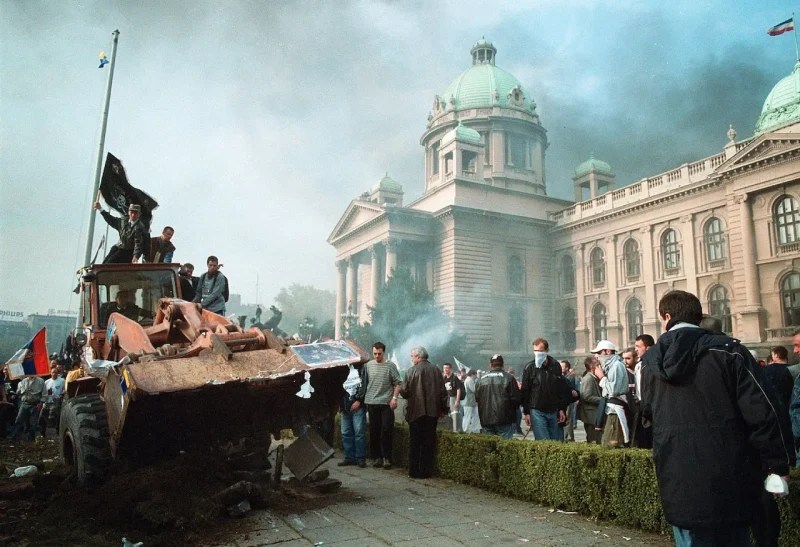
At the anti-Milosevic effort’s forefront was Otpor! (Serbian: Resistance!), a rebellious NED-funded youth activist group. Through a mix of civil disobedience, non-violent resistance, rock concerts, street theatre, and graffiti, they fomented mass public opposition to the Yugoslav President. When election day came and official results pointed to Milosevic’s victory, an NED-funded “parallel vote tabulation” purported to expose major fraud, sending millions to the streets of Belgrade to peacefully demand the President’s resignation. Milosevic duly capitulated, in the face of seemingly overwhelming people power.
The supposedly heroic struggle of Otpor! and other US-supported anti-Milosevic groups was immortalised in a slick ‘documentary’, Bringing Down A Dictator. Milosevic’s fall provided a precise blueprint for future ‘color revolutions’ – so-called because frequently, the Empire-supported activists who led these mob putsches prominently adopted specific colours for their banners, branding and logos. Initially, US officials eagerly associated themselves publicly with this upheaval. Meanwhile, the mainstream media routinely published remarkably illuminating post-mortems of the revolts, extensively exposing Washington’s guiding hand and oft-enormous financial outlay.
Nonetheless, politicians, pundits and journalists alike universally framed colour revolutions as ultimately spontaneous uprisings by liberal, progressive elements with legitimate grievances, who yearned for democracy and freedom. In reality, they almost invariably produced corrupt, repressive governments that ruled via intimidation and brutality, including political assassinations. Post-colour revolution regimes also typically conducted sweeping privatisation and other ravaging ‘reforms’, destroying living standards for average citizens by prostrating their countries to the EU, IMF, NATO, World Trade Organization, and other mechanisms of Western economic, military, and political subjugation.
Slobodan Milosevic’s NED-orchestrated ouster is nicknamed the ‘Bulldozer Revolution’, due to iconic scenes during the upheaval of a wheel loader helping anti-government agitators occupy state buildings. However, its driver quickly turned against the “Revolution”. Subsequent “shock therapy” decimated Yugoslavia’s mixed market economy, causing his successful independent business to fail, and him to go bankrupt. He subsisted until his dying day on meagre state welfare payments. For most participants, subsequent colour revolutions were similarly an object lesson in being careful about what one wishes for.
‘External Shove’
In February 2005, President George W. Bush gave a swaggering address in Bratislava, Slovakia. He hailed how “in recent times, we have witnessed landmark events in the history of liberty.” This included Georgia’s November 2003 Rose Revolution, Ukraine’s Orange Revolution the next year, and Iraq’s Purple Revolution a month prior. “The advance of freedom is the concentrated work of generations,” Bush declared. He looked ahead to Moldova, and “inevitably” Belarus, “someday proudly [belonging] to the country of democracies [sic]”:
“Eventually, the call of liberty comes to every mind and every soul. And one day, freedom’s promise will reach every people and every nation.”
Moldova’s forced transformation into a staggeringly corrupt effective EU-US colony took many years. Belarus conversely remains stubbornly resistant to “freedom’s promise”, as defined by Brussels, London, Washington, and other centres of imperial power. Still, President Bush’s confidence was well-founded. Waves of insurrectionary unrest unleashed by his government’s “Freedom Agenda” had systematically swept away designated enemy governments one by one annually since he took office. Indeed, within weeks of Bush’s speech, Kyrgyzstan’s insufficiently pro-Western leader fell victim to yet another colour revolution.
He would not be the last. Prior colour revolutions had enthusiastically emphasised the importance of techniques of nonviolent resistance – many of which were crafted by Gene Sharp, who was intimately enmeshed within the US military and intelligence establishment for much of his life. However, Kyrgyzstan’s NED-created regime change army, KelKel – directly modelled on Otpor! – attacked police, torched government buildings and even carried out bombings. Their ferocity was actively encouraged and promoted by US-funded TV stations locally. Such belligerence subsequently became a colour revolution calling card.
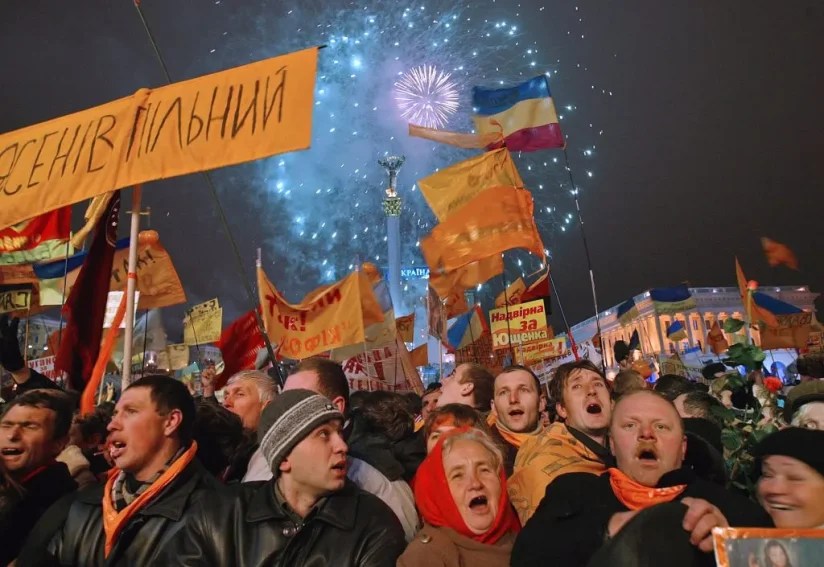
Ukraine’s Orange Revolution
That colour revolutions represented a formal weapon of war in the Empire’s post-9/11 arsenal was enthusiastically spelled out by arch-neoconservative Max Boot in late December 2004. He gushed how Ukraine’s Orange Revolution days earlier, which brought a pro-Western government to power, was “one of the most inspiring events” of that year. Boot declared the “triumph” and “miracle” of the revolution “should dispel the quaint notion still prevalent in many Western universities and foreign ministries that democracy is a luxury good suitable for rich countries”:
“These revolutions reveal the hollowness of the cliché that ‘democracy can’t be imposed by outsiders’… sometimes, when dealing with an entrenched dictatorship, this requires military intervention of the kind that occurred in Iraq and Afghanistan. More brittle regimes can be brought down by their own people, but even they often need a little external shove… There was nothing nefarious about the US intervention in Ukraine.”
Boot boasted how Washington had “spent $58 million on democracy promotion in the last two years” in Ukraine. He proposed Kiev receive “expedited NATO and European Union membership,” to finish off the Orange Revolution. “In the meantime, we need to apply elsewhere the lessons of Ukraine” Boot demanded, suggesting “an obvious candidate for a similar transformation is Iran.” He explained, “it’s hard to think of a higher priority than the overthrow of the mullahs,” encouraging the Bush administration to prioritise “liberating Iran.”
‘USAID Help’
Such was the insurrectionary fervour of the time, in January 2006 USAID went to the extent of publishing a glossy magazine, Democracy Rising, revealing in detail Washington’s central role in fomenting “grassroots” rebellions as far afield as Afghanistan, Gaza and Lebanon. Dedicated sections on colour revolutions to date were replete with stunningly forthright passages. A section on Georgia’s November 2003 Rose Revolution described how NED had financed regime change training for local “lawyers, judges, journalists, members of parliament, NGOs, political party leaders, and others.”
The stated purpose of this investment was to give Georgians “a sense that they should regulate the government.” The Rose Revolution “was the climax of these efforts.” One recipient of US financial support remarked, “without foreign assistance, I’m not sure we would have been able to achieve what we did without bloodshed.” Meanwhile, several pages were dedicated to the Orange Revolution. It noted how thousands of Ukrainian journalists were given training in “investigative reporting”, bankrolled by NED and USAID.
An alumni told Democracy Rising this sponsorship “created a feeling that others stood with them ‘in the trenches’.” Concurrently, NED-affiliated Freedom House flooded the coffers of NGOs “that sponsored voter education, mobilized voters to get to the polls and observed elections.” These organisations “also held meetings, youth dances, rock concerts and karaoke to attract young voters,” and “ran public service ads on TV stations, informing people about their right to vote.” Meanwhile, “democracy trainers from Serbia, Slovakia, Russia and Croatia” were flown into the country.
In the second round of Ukraine’s presidential election, NED-financed NGOs claimed to have been inundated with tens of thousands of reports of fraud from voting stations all over the country, while exit polls they produced pointed to widespread rigging having denied pro-Western candidate Viktor Yushchenko a landslide victory. Vast protests, combined with opposition-organised general strikes, widespread civil disobedience and occupations of government buildings forced a rerun. A US-funded think tank apparatchik asserted:
“USAID help for the poll was absolutely important – the poll results after the second round made people go to the street.”
For all the hype and self-assurance of Democracy Rising, its publication came at a time when colour revolutions were increasingly being viewed with hostility and suspicion at a state and public level throughout the Global South. In every case, the radical outcomes promised by colour revolution leaders and advocates failed to materialise, while US rhetoric about the commitment of resultant pro-Western regimes to democracy and freedom was a perverse fraud.
In Ukraine, US-installed Yushchenko implemented economic austerity, slashed regulations and social spending, bailed out criminal banks, broke open state industry and natural resources for foreign plunder, attacked the rights of Russian speakers, and began preparing the country for locally-feared NATO membership. Within just nine months of entering office, his coalition government – comprised of Orange Revolution activists – collapsed due to deeply corrupt battles with feuding Ukrainian oligarchs over control of key media and industrial assets.
Yushchenko was voted out in the January 2010 presidential election, finishing fifth in the first round with just 5.5% of the vote. As Empire house journal Foreign Policy lamented years later, the Bush administration’s much-vaunted colour revolutions all turned out to be “terribly disappointing.” Each and every time, “elite corruption still continued apace” and “promises of far-reaching change never really materialized.” Damningly, “maladies that typified the preceding regimes quickly came to describe” the governments created by colour revolutions themselves.
‘Revolution Business’
That’s quite some euphemism. In Georgia, longtime Soros acolyte Mikheil Saakashvili granted himself unilateral power in key policy areas, before brazenly exploiting his position to harass and jail business and political rivals. Saakashvili’s targets would be raped and/or tortured in prison, their ordeals filmed for primetime broadcast on local TV networks. Grave questions abound over his personal involvement in several suspicious deaths, including government ministers’. He was voted out in October 2012, despite NED’s best efforts.
Kyrgyzstan’s 2005 Tulip Revolution installed Kurmanbek Bakiyev, who proceeded to run the country as his personal fiefdom for five years. Bakiyev’s relatives profited exorbitantly from legally questionable privatisation of state industries. For example, his family signed a highly controversial $1.8 billion deal to supply fuel to a local US military base, close to Kyrgyzstan’s total GDP in 2003. Elsewhere, Bakiyev’s brother oversaw Bishkek’s security apparatus – arbitrary detentions, bogus convictions, torture, and murders of opposition activists, journalists, and politicians became commonplace.
Bakiyev was himself chased out of not only the presidential palace but Bishkek itself in April 2010, following a massacre of anti-corruption protesters in which up to 100 were killed and at least 450 wounded. Thereafter, Kyrgyzstan was plunged into economic and political chaos for a decade, with numerous governments collapsing along the way. The freest and most stable Central Asian state prior to the Tulip Revolution, it is only since 2020 – following another Anglo-American coup – the country has regained some semblance of stability.
A key player in that upheaval was British ambassador Charles Garrett. He arrived in Bishkek from Macedonia, where as this journalist has revealed from April 2016 he steered what was known as the “colorful revolution”. Illegally obtained, deceptively edited wiretaps seemingly implicating government officials in shocking crimes produced huge protests, featuring widespread arson attacks and brutal clashes between demonstrators and police. Garrett distributed cash to NGOs and activists involved in the unrest from his diplomatic pouch, encouraging them to cause mass havoc.
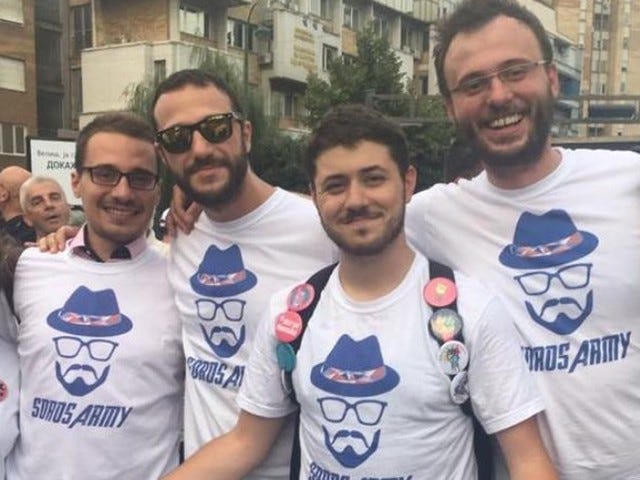
George Soros’ Open Society Foundations, NED, and USAID were also colorful revolution participants. Some protesters even proudly wore “Soros Army” shirts. Despite a huge public counter-revolutionary fightback, the tumult paralysed the Macedonian economy and state, leading to the installation of a doggedly pro-Western, dangerously dysfunctional administration that engaged in industrial scale graft, jailed political opponents on bogus charges, and changed the country’s name despite widespread opposition. Meanwhile, existing economic problems, including crippling brain drain, were gravely exacerbated.
The unfailingly disastrous results of colour revolutions surely contributed to White House officials abruptly and firmly distancing themselves from the entire enterprise, before the Bush administration’s second term was even over. The “Freedom Agenda” was quietly forgotten. The President – who in October 2004 openly mandated financial assistance to Belarusian opposition activists, and once publicly praised the Rose Revolution as an example to be followed throughout the Caucasus and Central Asia – went so far as to deny the US was in the “revolution business” at all.
‘Alternate Reality’
Colour revolutions have continued apace ever since, with the same strategies being recurrently applied the world over, to varying degrees of success. All along, non-Western governments – in particular China, Iran and Russia – have become increasingly vocal in their condemnation of and opposition to colour revolutions, in some cases passing legislation seeking to curtail the operations of foreign funded NGOs on their soil. Yet, the mainstream media long ago adopted a rigid Omertà on Washington’s culpability for civil society-driven destabilisation overseas.
In a striking example of this paradigm shift, in November 2004, before the Orange Revolution was over, The Guardian published a revealing report exposing the “US campaign behind the turmoil in Kiev.” The outlet stated unambiguously the revolt was “an American creation, a sophisticated and brilliantly conceived exercise in Western branding and mass marketing that, in four countries in four years, has been used to try to salvage rigged elections and topple unsavoury regimes.” NED, the State Department and USAID were all fingered as culprits.
Fast forward to July 2015 however, and a Guardian article on Russia’s banning of NED under foreign agent laws quite amazingly relied on a brief quote pulled from the Endowment’s official website to describe its operations. In the intervening time, the Maidan Revolution overthrew Ukrainian President Viktor Yanukovych in February 2014, setting Kiev on the warpath with Moscow. Washington’s irrefutable involvement was strenuously denied at the time by the mainstream media, and has been ever since.
Following the Ukraine proxy war’s February 2022 eruption, The New York Times took vigorous aim at independent journalists for spreading the “conspiracy theory” Maidan was US-orchestrated, dubbing the proposition an “alternative reality” and “Russian disinformation”. This is despite every prominent Maidan actor – including the individuals who started the demonstrations – receiving NED or USAID funding, leaders of US-bankrolled organisations in the country advertising their intention to overthrow Yanukovych years prior, and the Endowment spending $20 million in the country in 2013 alone.
After the outbreak of war in Ukraine, NED removed its grant records on Ukraine, listing its investment in a panoply of initiatives in the country over many years – many of which ultimately targeted Russia, one way or another. In mid-2024, the Endowment undertook the unprecedented step of removing grant records for the entire world. Today, brief entries on different geographical regions describe in vague terms the Endowment’s specific aims locally, and overall sums being spent. The crucial questions of where, and on what, aren’t clarified.
NED going underground makes the task of tracking and exposing contemporary colour revolutions difficult, but not impossible. In September 2025, mass rioting ignited in Nepal. Major news outlets without exception reported the fiery agitation as an organic burst of dissent by the country’s disaffected “Gen Z”, motivated by corruption, unemployment, and state censorship of social media. Publications barely acknowledged demonstrators committed serious crimes, including torching Nepal’s parliament and the Prime Minister’s official residence, which sent occupants fleeing in helicopters.
Based on publicly available information, the clear insinuations of a colour revolution could be discerned. An NGO that organised the protests, Hami Nepal, had clear links to organisations known to be in receipt of NED funding. Subsequent leaks amply demonstrated the Endowment and USAID expended substantial sums over the years preceding the coup training young Nepalese citizens how to protest, founding NGOs and political parties, and “advocate concerns” on issues such as corruption. Evidently, the post-9/11 “Freedom Agenda” never actually ended.
Pfizer Gave $500,000 to Groups That Lobbied to End Religious Exemption in Massachusetts
By Henrick Karoliszyn, DSW | The Defender | September 21, 2026
Pfizer paid $500,000 to two nonprofits that later signed a letter urging Massachusetts lawmakers to eliminate the state’s religious exemption from mandatory childhood school vaccinations, according to the company’s own public grant disclosures and a legislative letter reviewed by The Defender.
The drugmaker’s “US Medical, Scientific, Patient and Civic Organization Funding Report” for fiscal year 2024, posted on Pfizer’s transparency website, lists a $400,000 payment to the American Society for Meningitis Prevention (ASMP) for “Policy Efforts for comprehensive Meningococcal Meningitis Vaccination.”
The same report lists a $100,000 payment to the March of Dimes Foundation in 2024, categorized as a “Vaccine Policy Campaign Maternal Immunization.”
More than a year later, both organizations’ names appear among roughly two dozen signatories on a June 1 letter to the Massachusetts House Committee on Ways and Means urging lawmakers to advance House Bill 2554 (H.2554).
The bill would “remove the non-medical exemption from required school vaccines and enhance data collection and sharing to better track immunization rates,” according to the letter.
Patti Wukovits and Alicia Stillman, ASMP’s co-executive directors, and Chloe Schwartz, March of Dimes’ director of its maternal and infant health initiative, signed on behalf of their organizations.
Massachusetts currently allows parents to opt their children out of school vaccination requirements on religious grounds. The bill would eliminate that option, leaving only medical exemptions.
ASMP separately describes itself as focused on educating young people and parents about meningococcal meningitis. The March of Dimes has publicly credited Pfizer as an “inaugural supporter” of its vaccine-education campaign, describing a partnership that supports work encouraging adherence to the vaccine schedule recommended by the Centers for Disease Control and Prevention.
Neither organization has publicly addressed the timing of the donations relative to their support for H.2554.
Pfizer’s disclosure does not indicate the money was earmarked specifically for opposing Massachusetts’ religious exemption. The stated purposes are broader vaccine-policy campaigns tied to meningococcal disease and maternal immunization.
The ASMP and the March of Dimes did not respond to requests for comment from The Defender.
Critics call Massachusetts bill a ‘dangerous attack’
As of September 2026, bill-tracking records show that H.2554 was positively reviewed and referred onward, consistent with the coalition letter’s own reference to the bill having “recently reported favorably out of the House Committee on Health Care Financing.”
The bill’s supporters, including the Massachusetts Medical Society, argue that eliminating nonmedical exemptions would raise vaccination rates — as it has in California, Connecticut, Maine and New York, which eliminated religious exemptions — and reduce the risk of school-based disease outbreaks amid rising exemption rates.
Opponents, including Health Action Massachusetts, call the bill a “dangerous attack on religious freedom and educational access” that would force families who decline vaccination on religious grounds to homeschool their children, including children with special needs, regardless of circumstance.
Drugmakers should be required to define financial ties to lobbying groups
Pharmaceutical industry funding of advocacy groups is not a new practice.
But critics argue it allows companies with a direct financial stake in vaccination mandates to shape public health policy through intermediary organizations rather than lobbying directly.
Gail Seiler, president of Betrayal Project USA, said drugmakers should clearly define their financial ties to advocacy groups that go on to lobby for vaccines.
“When pharmaceutical companies provide substantial funding to organizations that then advocate for public policies affecting the use of those companies’ products, the public deserves complete transparency about those financial relationships,” Seiler told The Defender.
Parental consent for childhood vaccinations is also at issue, Seiler said.
“No parent should be forced to justify a deeply personal medical decision for their child to a corporation, lobbying organization, school system or government official,” she told The Defender. “Informed consent cannot exist without the freedom to say no.”
William M. Snyder, an attorney with Protat Snyder Law, called the financial arrangement “another example of Pfizer using its funds to enable non profits to lobby states to eliminate vaccine exemptions.
Bethany Clark of the Kentucky Medical Freedom Coalition told The Defender that monetary arrangements pharmaceutical companies have with larger organizations make it harder for local ones to have an impact.
“It does raise questions about how much influence corporations have over legislation,” Clark said.
“As a grassroots organization, it’s difficult to see our efforts to pass pro-medical freedom bills or stop bad legislation and wonder if our seeming inability to move the needle in the last few sessions has anything to do with the deep pockets of organizations with a lot of money at stake in the outcome of that legislation.”
Pharma financing vaccine mandate lobbyists should set off ‘every ethics alarm’
Dr. Chris Flowers extended a critique of the funding structure itself. He told The Defender :
“It does not matter whether the product is a vaccine, a software license, or a building material. When the seller finances the advocacy that would force the public to buy it, the conflict is structural.
“Mandates plus manufacturer funding of the mandate campaign is a combination that should set off every ethics alarm. Paying the messengers who then demand a mandate for your product is not philanthropy. It is sales.”
“Religious exemptions exist so the state cannot conscript every family into a commercial market,” Flowers added.
Pfizer and its defenders counter that funding patient- and disease-advocacy groups is standard industry practice disclosed for exactly this kind of scrutiny, and that the grants funded general vaccine-policy work.
Pfizer did not respond to a request for comment from The Defender.
This article was originally published by The Defender — Children’s Health Defense’s News & Views Website under Creative Commons license CC BY-NC-ND 4.0. Please consider subscribing to The Defender or donating to Children’s Health Defense.
Leaked: Britain’s Sham Conviction Of Hashim Thaci
By Kit Klarenberg | Al Mayadeen | September 20, 2026
On September 16th, The Hague’s Kosovo Specialist Chambers found former Kosovo Liberation Army chief Hashim Thaci guilty of cruel treatment, arbitrary detention, torture and the murder of 96 people during the 1998/9 Kosovo War. The verdict stunned his supporters and detractors alike, but neither believe he will ultimately be convicted, with good reason. Thaci is but a sacrificial lamb, defendant in a purely symbolic show trial secretly orchestrated by British intelligence – who once considered the KLA leader their bosom ally.
Given this background, that Thaci ended up in The Hague at all seemed nothing short of miraculous. After being indicted in April 2020, he resigned as Kosovo’s President. A longstanding KLA high-ranker, Thaci was at the forefront of the group’s outreach to Western governments and intelligence agencies throughout the 1990s, as it waged ever-escalating guerrilla war on Yugoslav security forces. When NATO’s 78-day-long bombing of Belgrade erupted in March 1999 in support of the KLA, Thaci proclaimed himself prime minister of Kosovo’s “provisional government”.
Categorised as a “terrorist” entity by the US State Department, the KLA was known by Western governments to be an organised crime faction, funded by the drugs trade and states such as Saudi Arabia, with ties to extremist factions including Al Qaeda. This was no impediment to the CIA and MI6 providing the KLA with substantial financial and material support for years. Once NATO’s bombing was complete and Kosovo fell under alliance occupation, Thaci was instrumental in consolidating the group’s total takeover of the statelet.
As his criminal and political rivals were systematically executed, the KLA conducted a concomitant province-wide purge of non-Albanians, reducing Kosovo’s population by hundreds of thousands. As a Western diplomat told the Washington Post in June 1999, “Thaci’s ruthless tactics are legendary in the region.” Despite high-level cognisance of such tendencies, Thaci and his fellow KLA warlords were actively assisted in their reign of terror by occupying NATO KFOR and UNMIK forces. A Kosovo Albanian lamented in 2001:
“Instead of cracking down on the warlords, KFOR and UNMIK allowed them to divide Kosovo into different zones where these warlords generate enormous wealth.”
In July that year, the Washington Post reported how Kosovo’s UN-constructed courts were proving incapable of prosecuting KLA officials for atrocities committed in the wake of NATO’s occupation, let alone before the alliance’s arrival. A Swedish jurist serving as Kosovo’s “first Western judge” detailed “several cases in which UN and KFOR senior officials opposed or blocked prosecution” of KLA leaders. NATO and UN officials allegedly feared they “would put their lives at risk” by pursuing prosecutions of certain figures – including Thaci, presumably.
‘Essentially Untouchable’
A leaked March 2019 British intelligence appraisal of “rule of law issues” in Kosovo is absolutely scathing, specifically naming the KLA’s enduring influence locally as a key problem castrating the would-be country’s laughable legal system. “In common with much of the rest of the Balkans, Kosovo has high levels of state capture; limited reconciliation between ethnic communities; and the system carries a heavy legacy of unresolved war crimes issues,” the study reported. Of particular concern to London:
“Close links between senior politicians and Albanian organised crime, born out of wartime connections that both funded and staffed [the KLA]… Kosovo’s rule of law institutions at both the national and local level are weak; lack expertise and strategic direction; and are politicised. The inability of local law and order institutions to combat high-level political corruption seriously undermines the state’s integrity. These negative influences appear to be increasing… Those in power, and their associates, are essentially untouchable.”
Moreover, “state capture furthers the economic interests of elite groups but increasingly is focused on preventing challenge through subverting rule of law.” Resultantly, “rule of law processes are not strengthened, but are subverted and circumscribed.” In other words, the effectively lawless mafia-dominated system constructed in ‘independent’ Kosovo with NATO and UN help post-NATO bombing endured untrammelled two decades later. The British highlighted “particular issues in the prosecutorial process – both the management of investigations and the creation of indictments.”
The execution of civil and criminal judgments in Kosovo was also cited as a “specific problem,” while sentencing was found to be “inconsistent” – “in particular in relation to corruption and serious crimes, sentencing can be very light.” It was extremely common for cases to be initiated against known criminals, then remain unresolved for years. Questions abounded over the “competence of judges and prosecutors” – “it is generally acknowledged that the quality of legal training at university is poor and… the Bar Exam sets a very low hurdle.”
Even then, Kosovo authorities “did not select the highest performing candidates, but often those with links to those in positions of influence.” Small wonder “public expectations of the rule of law sector” were found to be “very low” throughout the would-be country. Citizens not only had “no real experience of rule of law,” but there was “an ingrained lack of trust of rule of law systems” among the wider population. Yet, the British were determined to counter this perception – if only for public relations purposes.
At that time, London had been running a dedicated “rule of law portfolio” in Kosovo for several years. It consisted of “three separate strands.” They spanned “monitoring the judiciary” and Pristina’s “prosecutorial functions – trials, verdicts and the behaviour of judges and prosecutors in corruption and organised crime cases.” Four British-approved “Kosovan legal experts” were furthermore embedded “in key posts” in Pristina’s Ministry of Justice, and London took charge of “recruitment and appointment of judges and prosecutors.”
This covered “improved disciplinary procedures; performance appraisal; and ways of increasing accountability.” Along the way, “young judges and prosecutors” in Kosovo were mentored, enjoying “study visits” to Britain and unadvertised “support on real life cases.” In light of Thaci’s conviction, it’s striking the British embassy in Pristina professes to place a “strong emphasis on achieving results in the investigation and conviction of high profile individuals in corruption cases, and on making a visible impact in such cases”:
“The embassy has made a decision… to target more politically sensitive areas.”
In service of this objective, a dedicated Foreign Office project “to change the culture of the Kosovo justice system to one in which judges, prosecutors and others are willing to fearlessly challenge entrenched interests” was also quietly launched in 2018. Leaked files show the effort was outsourced to notorious British intelligence cutout Adam Smith International. Markedly, it operated until March 2020 – one month before Thaci was indicted by the Kosovo Specialist Chambers.
ASI was explicitly concerned with the “enforceability” of KSC prosecutions. Specifically founded in 2016 to prosecute high-profile war crimes cases against KLA officials, ASI acknowledged the KSC was of no concern to Kosovo Albanians. “Whilst senior politicians may be indicted by the Specialist Chambers… Kosovo’s young population aspires to follow its neighbours in making progress to stronger relations with Europe and prosperity at home, which promises to be a driver of reforms,” the cutout observed.
Nonetheless, ASI was tasked with helping the KSC appear to be serious about fulfilling its purview, due to growing concerns among ‘independent’ Pristina’s Western sponsors “about Kosovan capacity to process case volumes, to protect witness identities, and to handle complex cases,” combined with well-founded suspicions the KLA was insulated from prosecution. ASI consciously designed its legal ‘reform’ program “to fit this context of conflict legacies, competing stakeholders, political tensions and uncertain commitment to international standards”:
“Many former KLA leaders now hold positions of power and influence. Those involved in war crimes and organised crime are often the same people. Corruption often manifests itself through the connections between private companies and the political system, with award of public tenders being affected by political connections… However, the general desire of the Kosovo political leadership for closer ties with the EU offers rule of law projects valuable leverage to be used selectively.”
It was under these highly politicised auspices ASI’s intimate ‘assistance’ to Kosovo’s criminal justice systems was provided, and Thaci’s KSC indictment drawn up. At every stage, the cutout coordinated closely with Foreign Office headquarters in London, producing “bi-weekly updates on notable [legal and judicial] developments” related to Kosovo, quarterly reviews “of trends within the institutional and political environment,” and “longer term ‘look forward’ reports anticipating events in the coming three months.”
ASI boasted how its “international advisers” were deployed to Kosovo “on rotations,” ensuring “continuous team presence” locally, with at least one staffer “always ‘on the ground’ and on call” for the Foreign Office. This would help the cutout “build and maintain relationships with direct Kosovan counterparts and wider stakeholders continuously,” and “monitor political dynamics to ensure that project decisions are politically-informed and conflict sensitive.” With such intensive behind-closed-door bonds between London and Pristina, the chances of serious prosecutions of KLA officials emerging remained scant.
Still, in order for Pristina to make “strides towards closer ties with Europe,” ASI understood the necessity of challenging mainstream conceptions of Kosovo as “a country formed through a conflict that shaped its political parties and legitimised their power, to one where rule of law has primacy and state institutions win public confidence by demonstrating their adherence to international standards for professionalism and transparency.” In this context, simply indicting Thaci became in and of itself substantial, regardless of the outcome, or his trial’s actual legitimacy.
It’s unsurprising Thaci and his supporters firmly believed his acquittal to be inevitable, and still do. The Foreign Office project managed by ASI drew upon a variety of “international subject matter experts”, among them several veteran British judges with experience elsewhere in the Balkans, including Albania and Macedonia. They were led by Jonathan Ratel, formerly head of Kosovo’s EU-funded Special Prosecution Office, and “deputy chief prosecutor”. In this capacity, Ratel personally rubbished widespread, EU-endorsed allegations of KLA involvement in organ trafficking.
Thaci’s trial didn’t explore the issue, he was acquitted of all crimes against humanity, and a right to appeal his 25-year sentence was clearly codified in the KSC’s judgement. Serbian leaders have condemned the ruling as too lenient. Thaci – dubbed Pristina’s “George Washington” by Joe Biden – remains held at The Hague. Meanwhile, KFOR has at last begun withdrawing from Kosovo, due to “an improved security situation” in the aspiring country – where, thanks to covert British judicial interventions, “those in power, and their associates, are essentially untouchable.”
Insider trading proves 9/11 foreknowledge
By Kit Klarenberg | Al Mayadeen | September 11, 2026
On September 12th 2001, chaos reigned supreme. Yet, as governments the world over struggled to make sense of the previous day’s catastrophe, and before a motive was established, any perpetrators identified, or other basic facts ascertained, the US Securities and Exchange Commission launched an investigation into potential insider trading by unknown figures with apparently precise foreknowledge of 9/11. The evidence seemed overwhelming. Mainstream journalists openly mocked the implausibility of numerous deeply abnormal stock market trades immediately prior to the attacks being pure coincidence.
For one, several companies prominently impacted by the event were abruptly ‘shorted’ at inexplicable levels over the preceding weeks. In other words, investors bet certain stocks would perform poorly in the near future, and sought to profit accordingly. For example, just five days before 9/11 over 2,000 shorts were placed against United Airlines – 90 times more in a single day than over the entirety of August. The company’s share price collapsed following the attacks, turning $180,000 in shorts into $2.4 million.
Meanwhile, substantial investments were serendipitously made in private security, intelligence and defence firms that benefited enormously from the 9/11 attacks and ensuing ‘War on Terror’. On September 10th, purchase of shares in major US defence contractor Raytheon surged sixfold. Just one week later, as the Pentagon began bulk purchasing Raytheon’s flagship Patriot and Tomahawk missiles in preparation for invading Afghanistan, the firm’s shares rocketed 37%. Other major defence stocks, including Boeing and Lockheed, also experienced abnormal trading pre-9/11.
Purchase and shorts of dozens of stocks in almost every conceivable industry that one way or another profited, or were harmed, as a result of 9/11 incongruously spiked in the weeks before the fateful day. The evidentiary trail was literally globespanning, with major financial authorities in several Western countries launching their own investigations. Numerous officials in European capitals alleged the trading was definitively indicative of 9/11 foreknowledge, and “terrorists” were responsible.
For example, commenting on Italian securities regulator CONSOB’s investigation into the suspicious market activity on September 17th 2001, Italian Foreign Minister Antonio Martino boldly declared “terrorist states and organizations [were] behind speculation on the international markets.” One week later, German central bank President Ernst Welteke asserted his researchers had uncovered “irrefutable proof of insider trading.” He and his team were certain “people connected to the terrorists must have been trying to profit from this tragedy”:
“You look at the movements in markets before and after the attacks, it really makes your brow furrow… we are confident we will be able to pinpoint the source.”
Welteke declined to release further information, pending consultation with European and US regulators. However, the 9/11 insider trading scandal quickly faded from public consciousness thereafter. In July 2004, the SEC announced the end of its grand investigation – conducted in conjunction with the Department of Justice and FBI – having “not [developed] any evidence suggesting that anyone who had advance knowledge of the September 11 attacks traded on the basis of that information.” Which, rather than closing the case, begs the obvious question of who did.
Declassified records of one suspicious pre-9/11 trade probed by the FBI sheds potential light on why US and other authorities may have decided to leave the entire issue alone. From September 6th – 10th 2001, a total of 56,000 Stratesec shares were purchased by a single investor. The company provided security systems to several airports, including New York City’s Dulles from where one of the hijacked planes departed, and the World Trade Center. Its share price almost doubled in the attacks’ wake.
The shady trades were traced back to Wirt D. Walker III – a distant relative of the Bush family and business partner of Marvin Bush, then-President George W. Bush’s brother. The FBI reportedly uncovered “no ties to terrorism or other negative information” regarding Walker, so didn’t even interview him before concluding his lucrative transactions were innocent happenstance and closing the investigation. Apparently, the evident possibility Walker III possessed foreknowledge of 9/11 via other means than “ties to terrorism” wasn’t worth exploring.
Still, this sleight of hand granted the Bureau, Department of Justice and SEC an extremely effective “out”. The 9/11 Commission likewise summarily dismissed any suggestion of “unusual pre-9/11 trading activity” on the basis investors involved “had no conceivable ties to Al Qaeda.” Such specious reasoning was sufficient to kill the scandal dead in the mainstream. Nonetheless, ever since, numerous peer reviewed academic papers have contrarily concluded insider trading did occur, and was motivated by 9/11 foreknowledge.
In 2006, University of Illinois professor Allen Poteshman authored a well-cited study focusing on suspicious pre-9/11 trading activity in airline stocks. He concluded this shorting was “unusually high”, and “terrorists or their associates traded… on the basis of foreknowledge of the impending attacks.” Similar findings were reached by a 2011 Multinational Finance Journal paper, which identified highly abnormal market movements in numerous key industries, including insurance and reinsurance stocks directly impacted by 9/11. This was “consistent with insiders anticipating the 9-11 attacks.”
While the media failed to report on these studies, they were academically impactful, and cited as precedents in a December 2023 paper tracking peculiar Israeli stock market activity in the days preceding Operation Al-Aqsa Flood on October 7th that year. Authored by two US scholars, they found a “significant spike” in the shorting of publicly listed Israeli companies days prior to that world-changing strike on the Zionist entity. This activity was “consistent with informed traders anticipating and profiting from the Hamas attack.”
The authors found shorting of Israeli companies listed on the Tel Aviv stock exchange “increased dramatically” before October 7th. Israeli stocks on major US exchanges also experienced a “sharp and unusual increase” during the same period. Shorting of publicly traded Zionist entity firms on October 2nd “far exceeded” levels of shorting witnessed at the start of COVID19 pandemic, which triggered a temporary global stock market collapse. No wonder the paper concludes it was “extremely unlikely the volume of short selling… occurred by random chance.”
“Random chance” seems an even less plausible explanation when one considers “similar patterns” of shorting Israeli stocks were also identified in early April 2023, right when Hamas was planning to conduct a comparable attack to Al-Aqsa Flood during Passover. In the immediate aftermath of October 7th too, a flurry of mainstream media reports exposed how Zionist Occupation Forces had numerous advance warnings of an impending Hamas attack for months prior. This included a detailed “point by point” battle plan, outlining Al-Aqsa Flood.
Fast forward to today, and Haaretz reveals UAE President Mohamed bin Zayed personally warned Benjamin Netanyahu 10 days prior to October 7th Hamas intended to wage a major offensive, but “Israel’s” premier failed to act. This disclosure comes at a time the mainstream media finally acknowledges the need for a complete reevaluation of what happened on 9/11. Any new investigation should surely focus on the insider trading angle – ascertaining who knew what when, and why, could unravel the entire conspiracy.
Featured Video

Iran’s Next Strike May Not Explode. It Could Shut You Down
or go to
Aletho News Archives – Video-Images
From the Archive
Zionism’s Violent Legacy
By Donald Neff | Washington Report On Middle East Affairs | January 1996
On January 4, 1948, Jewish terrorists drove a truck loaded with explosives into the center of the all Arab city of Jaffa and detonated it, killing 26 and wounding around 100 Palestinian men, women and children.[1] The attack was the work of the Irgun Zvai Leumi – the “National Military Organization,” also known by the Hebrew letters Etzel – the largest Jewish terrorist group in Palestine. The Irgun was headed by Revisionist Zionist Menachem Begin and had been killing and maiming Arabs, Britons and even Jews for the previous ten years in its efforts to establish a Jewish state.
This terror campaign meant that at the core of Revisionist Zionism there existed a philosophical embrace of violence. … continue
Blog Roll
 Aletho News
- Trump’s Iran war is on an Israeli leash
- Saudi oil boss issues global supply warning
- Riyadh Says Its Oil System Is Intact. The Numbers Say Otherwise.
- Trump and Netanyahu Want to “Finish the Job” on Iran
- US ‘one-sided dictation’ not Iran’s beliefs makes rational talks impossible: Baghaei
- Iran’s Next Strike May Not Explode. It Could Shut You Down /Col Doug Macgregor
- Iran: US political targets legitimate if assassinations return
- Iraq shuts key border crossing with Iran under US pressure: Report
- Undersea Internet cables could be targeted in retaliation for attacks on Iran: IRGC deputy chief
- EU sending ‘biased’ observers to interfere in Serbian election – president
- If Americans Knew
- The Israel Lobby’s Changing Fortunes
- AIPAC has become such a political liability that it’s shifting to a more “nimble” approach to buying politicians
- At least 160 Israeli settler attacks in 2 weeks
- Will Gaza’s Ancient Christian Community Disappear Forever?
- Israel’s vision of regional security rests on keeping Arab states weak
- Heidi Levine recounts how Palestinian youths helped save her in settler attack
- DAILY UPDATE: Latest essential news on Palestine, Israel, & region
- Trump’s Intensifying Sabotage of the ICC, for Israel’s Sake
- Israeli military detain US and UK volunteers in West Bank including Democratic NY politician Brad Lander
- Americans at National Conservatism Conference held in Israel this year criticize Israel
- No Tricks Zone
- E-Cars Reduce CO2 Emissions By Only 41% Compared To Internal Combustion Engine Vehicles
- Predictions Made By Renowned Climate Professor Over Past Decades Have Been Proven To Be Poor
- New Study Suggests Large Regions Of The Pacific Ocean Have Been Cooling For The Last 80 Years
- Germany’s Green Energy Debacle: High Energy Costs Force Kahla Porzellan to Close After 182 Years!
- New Study: 50 Years Of The Most Aggressive ‘Net Zero’ Policies Can Only Affect The Global Climate By 0.03°C
- US September “Heat” Was No Record…Many Records Set Decades Ago
- Latest European Green Energy Debacle; Portugal’s Largest Flagship Solar Park Insolvent!
- Green Energy Debacle: German Expert Professor Fritz Vahrenholt Warns Of Severe Economic And Social Consequences
- Two More Paleo Reconstructions Affirm Meters-Higher Sea Levels Across Ireland, Brazil 7000-6000 Years Ago
- New Study: Earth And Venus Surface Warmth Largely Explained By Convection And Lapse Rate, Not CO2 Or Radiation

