Mike Huckabee Is at It Again…
Tucker Carlson Network | August 21, 2026
By Robert Inlakesh | Palestine Chronicle | October 25, 2026
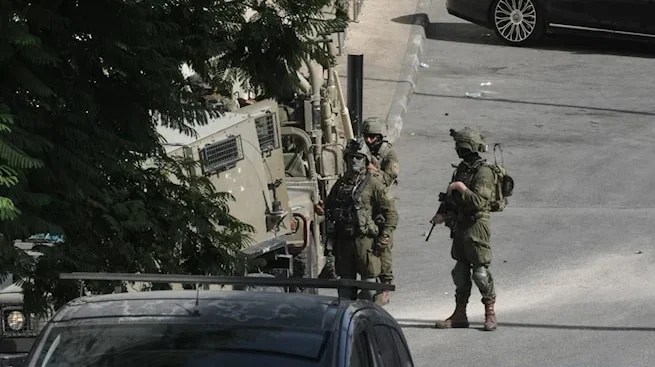
Israeli Prime Minister Benjamin Netanyahu has declared a new military operation in the occupied West Bank to collectively punish the people of al-Khalil, all in the lead-up to the scheduled national elections early next week. Is the Premier playing with fire?
Following years of ever-escalating settler violence and the intensification of Israel’s military occupation across the occupied West Bank, two Palestinian men in their twenties – Hamouda and Firas al-Ja’ba – decided to carry out a resistance operation against an Israeli army guard post.
The two resistance fighters carried out their attack, injuring four Israeli soldiers and killing two, using pistols and a rifle near the Farsh al-Hawa checkpoint in al-Khalil. The Israeli army called in backup, leading to an armed clash in which both of the Palestinians were killed during a 20-minute clash.
From the CCTV footage of the clash, it appears as if the two Palestinians were not professionally trained and acted alone. No Palestinian movement claimed the attack, although it was widely praised. Israel was quick to blame Hamas and then launch a new military campaign targeting the entire city of al-Khalil.
There are a number of reasons that the attack, which, although the most significant carried out in the West Bank in over a year, is not exactly unusual, has been reacted to in the way we see today.
One reason for this enormous overreaction is that Netanyahu is looking for a boost in the polls. He evidently believes that by launching a brutal crackdown in the West Bank, his population will respond positively and he may win some more votes come Tuesday.
This is why the Israeli Prime Minister claimed that the planned campaign against al-Khalil will be an operation “unlike any seen since the Six-Day War”. He is trying to play on Israeli nationalism, referencing the June 1967 war, during which the Israelis occupied the West Bank, Gaza, East Jerusalem, the Golan Heights and Sinai Peninsula. Evidently, this is hyperbole, but it doesn’t mean that the campaign will not be brutal.
Another reason why the attack has been transformed into such a major issue is that it is massively embarrassing to both the Israeli army and Netanyahu personally. Although the two Palestinian fighters do not appear to have had any professional training and did not act on behalf of any resistance group, the Israeli media, military, and government are saying the opposite.
The Israelis are claiming that Hamas was involved; they are also spinning a hero story that by calling in backup they managed to thwart a much larger attack that was planned on Israeli settlers and that what happened was actually a success story of sorts.
This is because the truth exposes the unprofessionalism and cowardice of the Israeli occupation soldiers. Two untrained individuals managed to kill a Staff Sergeant and a Sergeant, injured four others, while all the female soldiers on scene hid from the attackers. In addition to this, it took 20 minutes for them to take care of the threat posed to their forces; they also needed to call in backup despite clearly outnumbering the two gunmen already. Accepting the reality would mean accepting that the army is pretty incompetent, and the Israeli public will believe any narrative that allows them to ignore this truth.
Another element of this is that if you tell the public that the Israeli army managed to thwart a major attack, it shows that under Netanyahu’s leadership, he has learned the lesson from October 7, 2023. The narrative being sold to Israelis is that now the army is acting pre-emptively; it is launching a major campaign to prevent another major attack like the one that happened on October 7. Israelis also simply enjoy watching Palestinians suffer.
However, by launching such a collective punishment campaign, there is a chance that the Israelis could end up getting burned, even if not immediately. West Bank Palestinians have been placed under tremendous pressure; by launching an intensive campaign of this nature, it could end up pushing some people over the edge.
Although the rhetoric surrounding the campaign suggests that the Israeli military is seeking to turn the largest populated city in the occupied West Bank into Gaza, this is unlikely to be what they will do. Instead, they will carry out raids, make life an inconvenience, even more than before, likely killing some innocent people while kidnapping random Palestinians while going through their neighborhoods.
The most intensity will be focused on a few specific neighborhoods that will get the worst treatment. But escalating too hard, too fast, could end up triggering a unifying event, especially due to the Israeli soldiers being psychotic and not even following their own rules. Ultimately, it is because of the checkpoints, killings, torture, and daily harassment that Palestinians carry out resistance attacks like the one we saw this Friday morning.
It is only a matter of time until the pressure being placed upon the people of the West Bank will explode. What makes this predicament starkly different from that of Gaza is that when the situation deteriorates, the Israelis have already entrenched themselves so deeply within that territory that they are extremely exposed.
Netanyahu loves to pledge his intentions to collapse the Palestinian Authority (PA) and annex the West Bank, but this is just posturing for gullible Israeli fanatics who don’t understand how everything works. If the PA does collapse and there is a push to annex the territory officially, then the settlements will be indefensible.
Just as the Israeli public truly believes that they have “the most moral army on earth”, they also believe that they are physically superior too. The former is about as accurate as the latter.
During the Gaza Genocide, the West Bank strategy has been to subdue the Palestinians through brute force and to collaborate with the PA in order to ensure there is no major uprising. It has, until now, worked. However, that strategy of constant torment and increasing pressure also “worked” until October 7, 2023.
People will not live under such horrendous conditions forever; it is only a matter of time before the situation there dramatically changes. Such a shift could occur over something relatively small. When you constantly play with fire, you get burnt.
If the West Bank’s population were to enter a sustained popular uprising, the Israeli military would struggle to subdue it. In the event that other fronts of its regional war were to open, this could be a major strategic catastrophe.
– Robert Inlakesh is a journalist, writer, and documentary filmmaker. He focuses on the Middle East, specializing in Palestine.
MEMO | October 16, 2026
A prominent Israeli rabbi on Friday issued a religious ruling permitting Israeli occupiers to take olives from Palestinian land in the occupied West Bank, claiming that harvesting the crop “demonstrates Jewish ownership of the land,” Anadolu reports.
The ruling was issued by Rabbi Dov Lior, one of the most prominent religious authorities among Israeli occupiers in the West Bank, and was published by Israeli Channel 13.
It comes amid escalating occupier violence against Palestinians and their property, particularly farmers during the olive harvest season.
Lior claimed that Palestinians do not own their land, arguing that they had not purchased it from the “people of Israel” or from any Jewish person and describing the land as “stolen property.”
Citing Jewish religious law, he claimed that ownership of land cannot be transferred through theft and that Palestinian land therefore remains the property of the “people of Israel.”
He also argued that Palestinians planting olive trees on their land does not give them ownership rights over either the land or its produce.
Lior claimed Palestinians had already received sufficient compensation for planting the trees by consuming their fruit over previous years, and said both the land and harvest should return to what he called their “rightful owners.”
His ruling was not limited to land near illegal settlements, however, and also permitted occupiers to take olive crops from Palestinian areas farther away.
The ruling comes as attacks on Palestinian farmers during the West Bank olive harvest season have intensified, including assaults, preventing farmers from reaching their land, damaging trees and stealing crops.
Such attacks recur during the olive harvest, which peaks in October each year, while this month has seen an increase in attacks by occupiers against Palestinians and their property.
Palestinian, Israeli and international rights organizations have accused Israeli authorities of failing to stop occupier violence or hold perpetrators accountable despite attacks targeting Palestinians, their homes, farmland, vehicles and other property.
Israeli settlements built on occupied Palestinian land are considered illegal under international law, while Palestinians maintain their rights to their land and reject attempts to seize it.
The Cradle | September 27, 2026
Israeli Finance Minister and settler leader Bezalel Smotrich has called on Israel to “go to war” in the occupied Palestinian West Bank and “do there what we did in Gaza,” Israeli media reported on 27 September.
“I certainly have solutions” to the situation in the West Bank, he said. “I think we need to go to war in Judea and Samaria, to do there what we did in Gaza, to dismantle the Palestinian Authority, which is a terror authority.”
The Religious Zionism Party leader also called on Israel to annex the areas of southern Lebanon and Gaza occupied by Israeli troops.
“I would very much like to annex at least up to the Yellow Line in Gaza and up to the Litani [River] in Lebanon,” he says.
As part of its genocide of Palestinians since 2023, Israel has occupied an estimated 70 percent of Gaza, which is divided by a yellow line demarcating areas under direct Israeli occupation from those remaining under Hamas control.
Israel has also occupied territory in Lebanon amounting to 7 percent of the entire country.
Israel carries out demolition campaigns in both, seeking to wipe out any trace of Palestinian and Lebanese villages and cities already largely destroyed by Israeli bombing.
Smotrich made the comments after he was asked on a podcast how to advance Israel’s project in the West Bank amid Palestinian resistance.
Israel has accelerated its construction of illegal Jewish settlements and outposts in the West Bank this year, including in the E1 settlement.
E1 is designed to cut the West Bank in half and separate it from occupied East Jerusalem, making the establishment of a territorially contiguous Palestinian state impossible.
At the same time, Jewish settlers enjoying protection of the army regularly carry out violent pogrom-style attacks on Palestinian villages in hopes of forcing Palestinians to abandon their homes and agricultural lands.
In response, Palestinians have carried out several car ramming and shooting operations targeting Jewish settlers in recent weeks.
Smotrich also repeated his call to dismantle the Palestinian Authority (PA), which provides civil administration to parts of the West Bank, including the Palestinian cities such as Ramallah, Nablus, Jenin and Bethlehem.
The PA was established following the Oslo Accords in 1993 to serve as an interim government until the establishment of a Palestinian state.
However, the PA has in practice served as an arm of the Israeli occupation, assisting the Israeli military in suppressing Palestinian resistance.
Smotrich has previously called on Israel to annex more than 80 percent of the West Bank, which Israel conquered in 1967.
Since then, Israel has established some 160 Jewish settlements and 360 outposts, housing more than 700,000 Jewish settlers as part of a long-term campaign to colonize and Judaize the Palestinian territories.
In his campaign for next month’s Knesset election, Smotrich has touted the expansion of Israeli settlements under the current coalition government, which includes Smotrich, Prime Minister Benjamin Netanyahu, and National Security Minister Itamar Ben Gvir.
As head of the Likud Party, Netanyahu is seeking his seventh term as prime minister. Ben Gvir leads a religious nationalist party, Jewish Power, known for its extremism and calls for violence against Palestinians.
Meanwhile, Israeli authorities decided to impose a week-long “comprehensive closure” on the occupied West Bank, closing crossings to the territory until Saturday for the Jewish religious holiday of Sukkot.
The order will prevent Palestinians with work permits from entering Israel and Jewish settlements to go to their jobs.
Local sources told the Wafa News Agency that the entrance gate to Turmus Ayya, north of Ramallah, was closed and residents were “harassed.”
Wafa also reported that entrances to Aboud, Nabi Saleh, Atara and Taybeh were closed, while military checkpoints were set up at the entrances to Yabroud and Ein Sinyah.
By Justin K.P. | The Dissident | September 24, 2026
Israel and its stooges in mainstream media are claiming that Neria Leiter, the son of Yechiel Leiter, the current Israeli ambassador to the United States, was wounded in a supposed “terrorist attack”.
In reality, it was in no way a terrorist attack, but resistance against illegal occupation, a guaranteed right under international law.
Neria Leiter was hit by a car driven by 29-year-old Palestinian Mahmoud Muhammad Mahmoud Suleiman- who was killed at the scene- while he was carrying out service as an IDF reservist manning the checkpoint outside of the West Bank settlement of Beit Horon.
As Drop Site News noted, Beit Horon is an “illegal settlement” which “sits on land in the occupied West Bank, where Israeli settlements are illegal under international law.”
The International Court of Justice (ICJ) has ruled that Israel’s occupation of the West Bank is illegal under international law.
International law also guarantees the right to resist illegal occupation by military means.
Given that Neria Leiter was a combatant upholding an occupation illegal under international law, the “ attack” against him was not “terrorism” but a legitimate act of self-defence and resistance to criminal occupation supported by international law.
As journalist Glenn Greenwald noted in response to claims that this was a “terrorist” attack, “Don’t terrorist attacks require the targeting of civilians? This was an armed, on-duty soldier in a military considered to be an occupying force under international law. How does that remotely fit the definition of ‘terrorism’?”
As journalist Abubaker Abed noted, “It was a self-defence and resistance act. That’s the undeniable truth. He was a soldier illegally occupying parts of the West Bank. The Palestinian defended himself from his terror. Palestinians have a right to defend themselves.”
Neria Leiter was a combatant, sent to the West Bank to uphold an illegal military occupation under international law; he was in no way a victim of a terrorist attack, but a legitimate military target for Palestinians living under Israeli occupation.
By Justin K.P. | The Dissident | September 14, 2026
Haaretz, one of Israel’s largest newspapers, published an article on the new film ‘NAZA’, which features multiple IDF terrorists admitting to committing genocide in Gaza, titled “Israelis Must Finally Confront What Israel Has Done in Gaza”.
By the title, one would assume the paper is claiming that regular Israeli citizens are unaware of the genocidal crimes its government committed in Gaza and need to confront that fact.
But within the article, the editorial board acknowledges the truth: the overwhelming majority of Jewish Israelis know full well about the genocide unleashed in Gaza and fully support it.
“The Israeli consensus largely maintains,” the paper wrote, “that there are no innocents in Gaza, and therefore no such thing as collateral damage”.
In other words, the “Israeli consensus” is that slaughtering Gaza’s civilian population, including women and children, is justified (i.e. support for genocide).
The fact that the vast majority of Jewish Israelis hold openly genocidal views towards Palestinians is documented in opinion polls.
Opinion polls in Israel have shown that 75 percent of Israeli Jews agree with the openly genocidal slogan that “there are no innocents in Gaza”.
84 percent of Jewish Israelis have given the IDF an “excellent or very good grade regarding the moral conduct of the army” in Gaza, and 79 percent say “they are ‘not so troubled’ or ‘not troubled at all’ by the reports of famine and suffering among the Palestinian population in Gaza”.
Another poll found that 82 percent of Jewish Israelis “supported the forced expulsion of Gaza’s population to other countries” and 52 percent “he expulsion of Israel’s Arab citizens”.
47 percent even agreed with the idea of “killing all of the inhabitants” of “an enemy city”.
There is not a crime committed in Gaza that Israeli officials have not boasted about in Hebrew, from Israeli president Isaac Herzog openly stating that “It’s an entire nation out there that is responsible. It’s not true this rhetoric about civilians not aware not involved. It’s absolutely not true. … and we will fight until we break their backbone” to Science and Technology Minister Gila Gamliel boasting that the Israeli plan is to “make the Gaza Strip uninhabitable until the population leaves, and the same thing will happen in the West Bank” to Likud lawmaker Hanoch Milwidsky openly endorsing rape against Palestinian prisoners.
The truth, finally acknowledged by Harretz, is that the Jewish Israeli public knows full well about the Genocide unfolding in Gaza and has cheered it on from day one.
By Kit Klarenberg | Al Mayadeen | September 5, 2026
Exploiting academic institutions as a cover, between 2017 – 2021 the German government surreptitiously funnelled millions into a highly discriminatory project facilitating expansion of Zionist settlements in the occupied West Bank. Under its auspices, public money and knowledge production were committed to an inherently unlawful, immoral enterprise in flagrant breach of Berlin’s international legal obligations, and domestic restrictions on academic research efforts. The unknown scandal is just one component of how, in plain sight, Germany covertly assists Zionist settlement expansion, and Palestine’s total erasure.
These are the shocking findings of a collaborative investigation by a cluster of German student Palestine solidarity organisations, including Not In Our Name, and Academic Opposition. Their report is a groundbreaking effort, critically examining German state-sponsored water research in conjunction with Zionist entity institutions. It’s a silent conspiracy vast in scope, involving multiple state and quasi-state entities in Berlin and Tel Aviv financing academic research in seemingly innocuous fields, which directly abets Zionist ethnic cleansing and land seizure in the West Bank and beyond.
The investigation focuses on a single project to emerge from the dark alliance between German and Israeli academia, known as MedWater. For four years, Berlin funded a consortium coordinated by the Technical University of Berlin, alongside Göttingen and Würzburg universities, to the tune of €1,818,348. Their successfully fulfilled objective was to develop a tool modelling the impact of adding or removing water wells. That feature, defined in direct conjunction with “Israel’s” water authorities, was then transferred to Tel Aviv’s national water company.
Specifically, the tool identifies ideal areas for construction of new wells, in a territory where Palestinian water sources are systematically demolished, and Palestinians are refused permits to drill new ones. Known as the Western Mountain Aquifer, it’s the largest and most productive groundwater body shared between “Israel” and the occupied West Bank. Palestinians were completely absent from working sessions convened in Al-Quds [Jerusalem] related to MedWater, and there is no apparent way in which Palestinians will, or even can, benefit from the effort in any way.
This is despite the consortium explicitly stating in submissions to German state ministries their tool sought to advance the UN’s sixth Sustainable Development Goal: “By 2030, achieve universal and equitable access to safe and affordable drinking water for all.” The completed MedWater system was unveiled in October 2020, at a Berlin conference. Its public demonstration included calculating the impact of adding four new wells to the West Bank’s Al-Khalil [Hebron] Governorate. Only Zionist settlers could realise that vision on-the-ground, of which the consortium was well-aware.
Even more damningly, at the project’s end the tool was contracted to “Israel’s” national water company Mekorot, which manages wells in Zionist settlements throughout the West Bank. By contrast, the Palestinian Water Authority, officially named as a MedWater partner, was not provided a subcontract and is not publicly listed among its beneficiaries today. Unreported at the time, and tacitly concealed from view ever since, it’s just one way Germany has been unaccountably supporting a genocidal Zionist enterprise begun back in 1967.
‘Near Impossible’
In its July 2024 Advisory Opinion, the International Court of Justice ruled unambiguously that all states are obliged “to distinguish, in their dealings with Israel, between Israeli territory and the territory occupied since 1967, and not to render aid or assistance in maintaining that situation.” A decade earlier, Berlin seemingly enshrined a codified commitment to this principle in its dealings with Zionist entity academic institutions. Under the so-called Territorial Clause, Germany won’t fund, and Tel Aviv won’t solicit, research projects outside the entity’s pre-1967 borders.
However, when asked how Mekorot’s MedWater contract was remotely compatible with the Clause, Berlin’s ministry of research argued its terms merely limit where research partners may be headquartered. As Mekorot is based in Tel Aviv, there was in fact no legal, regulatory or ethical impediment to the project’s German government funding, despite the company’s well-documented criminal conduct in the West Bank since 1982, when Zionist Occupation Forces handed management of all local water infrastructure it controlled in the territory to Mekorot.
The Territorial Clause is evidently replete with gaping loopholes, which we can assume have been resultantly exploited to provide arm’s length German state sponsorship to completely illegal Zionist settlement expansion all along. Strikingly, this ambiguity is in itself in contravention of the ICJ’s Advisory Opinion. The Court specifically honed in on the Zionist entity’s life-threatening restriction of Palestinian water access within the Occupied Territories, as inconsistent with Tel Aviv’s obligations under international law. This may explain why MedWater, while formally undisguised, remained effectively secret.
To get to the bottom of the project, investigators drew on an enormous, disparate corpus of information. This included MedWater reports filed with Germany’s Education and Research Ministry – some not intended for public view, and released in redacted form – presentation materials from numerous project conferences throughout its development, since-memoryholed websites, and peer-reviewed publications by German and Israeli participants. No mainstream outlet has hitherto reported not merely on MedWater, but any illegal German state investment in academic research projects expediting settlement expansion.
An initiative to better manage water resources anywhere in the world may seem benign. But MedWater was born in a context of methodical, longstanding Zionist denial of Palestinian access to water, and a segregationist legal apparatus explicitly assisting Jewish settlement, particularly in regard to vital natural resources like water. In August 1967, two months after the West Bank’s occupation began, Zionist Occupation Forces issued Military Order 92, seizing total control of water resources in territory they illegally controlled.
Three months later, Military Order 158 further prohibited Palestinians throughout the West Bank from constructing new water installations and/or associated infrastructure, without first obtaining a permit from the ZOF. Amnesty International judges such permissions “near impossible to obtain.” Deliberately intended to deprive Palestinians of water, Zionists are not subject to equivalent constraints. Meanwhile, Mekorot has over the past four-and-a-half decades deliberately sabotaged Palestinian wells while tapping occupied West Bank springs to supply the entity, and illegal settlers, with water.
This in itself produces an apartheid in daily water consumption. Zionists, including settlers, use an average of 247 litres of water a day per person – three times that of Palestinians in the West Bank, at 82.4 litres. Palestinian water consumption collapses to just 26 litres per capita on average daily, in communities unconnected to the water grid. Such consumption is comparable to active disaster zones. Mekorot also routinely shuts off supply to Palestinian communities when reserves run low, such as during summer.
‘European DNA’
The Zionist strategy is gruesomely simple – neutralise Palestinian control over the West Bank’s water resources and progressively diminish their access, creating an environment in which the territory is literally uninhabitable and they’re forced to leave. Research jointly published by the UN and Germany’s federal institute for geosciences and natural resources indicates 212 million cubic metres of water flows from the West Bank to Israel annually. The report explicitly records how since 1967, Palestinians “have not been authorised to drill a single well” locally.
All along, discriminatory laws and ratcheting settler land grabs have increasingly deprived Palestinians of access to other basic fundamentals of existence too. An ever-expanding network of ZOF checkpoints and roadblocks, combined with prejudicial and arbitrary restrictions on movement, vandalism and demolition of farming machinery, greenhouses, and roads, and savage Occupation Force and settler violence makes it progressively dangerous, if not impossible, for farmers to tend crops or rear livestock. Palestine’s agricultural industry is all but decimated, with Zionists literally harvesting the pestilential spoils.
That these genocidal machinations have endured untrammelled for so many decades is a testament to the impunity with which “Israel” is permitted to act by its international partners – Germany being a particularly perverse example. Proudly, it is the only country to make public remembrance of its criminal past the cornerstone of its collective national identity. But Berlin’s much-vaunted “memory culture” has only ever atoned for historic sins by encouraging and undergirding comparable contemporary crimes, as long as they’re committed by the Zionist entity.
WaterMed is a minor fragment within a much wider, silent framework of German state-supported repression and erasure of Palestinians, sustained via unadvertised academic partnerships and joint research efforts with Zionist entity-based institutions. A new initiative, Academic Complicity, exposes how dozens of German universities have over many years conducted projects large and small, one way or another justifying and aiding never ending settlement expansion. One might hope this triggers accountability and consequences for Berlin, given its domestic and international legal obligations.
However, the bonds between Germany and the Zionist entity are so deep and cohering, it transcends trivial considerations of law. In October 2025, former Mossad chief Tamir Pardo made a number of highly revealing disclosures on how his personal and professional experience has convinced him “Germans are committed to Israel.” After all, “our DNA is much closer to the European DNA than the American one,” as “most of the Jews who settled in Israel came from Europe…not North America”:
“European history is part of our identity in terms of family connections, culture, even politics. Europe’s borders resulting from wars were constantly shifting, and Europeans wandered throughout the continent, settling in one place before moving on to the next. In that sense, and in terms of depth, discourse, and history, this is all very familiar to us, and is something that manifests itself in every interaction I have with German partners.”
Palestinian Information Center – August 24, 2026
WEST BANK – Israeli occupation authorities have escalated settlement activity in the West Bank by issuing military orders to seize hundreds of dunums of Palestinian land, alongside settler sieges and forced displacement carried out under army protection.
The measures reflect clear coordination between the army and settler militias to empty large areas for settlement expansion.
Last Tuesday, Israeli forces issued a military order to seize around 1,152 dunums of land belonging to the towns of Sinjil, Al-Lubban Al-Sharqiya and Qaryut, north of Ramallah.
The order aims to expand the Karmi Oz settlement and strengthen geographic links between settlements and outposts located between Nablus and Ramallah.
According to a report on settlement activity, the targeted land is spread across several areas in the three towns. The decision comes as part of Israeli government measures issued since 2023 to legalize settlement outposts, most notably Givat Harel and Givat Haroeh.
At the same time, settler attacks continue across West Bank villages, accompanied by sieges, restrictions and forced displacement under the protection of Israeli occupation forces.
The attacks have been concentrated in Jalud and Qusra, south of Nablus, Turmus Ayya, north of Ramallah, and Khallat Al-Hummus in Masafer Yatta.
In Jalud, Mahmoud Al-Tubasi and his family were forced to evacuate their home after a two-month siege that included blocking the road and cutting off water and electricity. Armed settlers later stormed the home and threatened to kill or burn the family.
In Qusra, families in the Ras Al-Ain area have faced siege and attacks since the beginning of the year amid attempts to establish a new settlement outpost.
The escalation peaked on August 9, when settlers reinstalled their tents, blocked roads with stones and cut off electricity and water to the families.
Israeli forces then turned the area into a closed military zone, forced families to evacuate their homes and converted around 16 houses in Jabal Ras Al-Ain into military barracks and observation posts.
Israeli forces also imposed a curfew, closed shops and prevented Palestinian and international activists from reaching the besieged families with aid.
The report said these measures are taking place amid international silence, while the Israeli government continues to use claims of “military purposes” and the “legalization of outposts” as cover to seize more land and connect settlements to one another.
Experts opined that the ultimate goal is to fragment the West Bank and undermine any possibility of establishing a geographically contiguous Palestinian state by turning villages into besieged enclaves that can be controlled and emptied of their residents.
Tucker Carlson Network | August 22, 2026
Tucker Carlson Network | August 21, 2026
MEMO | August 7, 2026
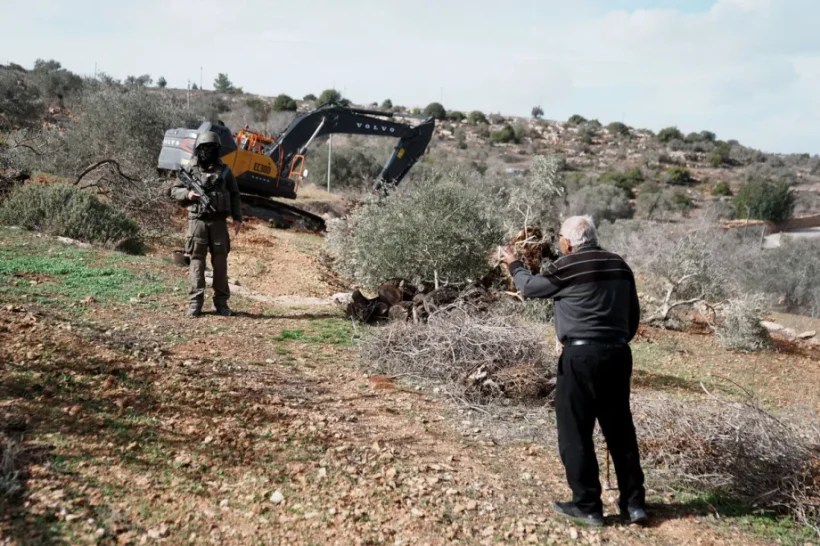
The Israeli military has issued eight orders to uproot trees and remove vegetation from 316 dunums of land across the occupied West Bank for settlement-related purposes, the Colonisation and Wall Resistance Commission (CWRC) said on Thursday.
A dunum is equivalent to 1,000 square metres.
In a statement issued on Thursday evening, the Palestinian government body said the orders require the removal of wild vegetation and olive trees from land identified in attached maps.
The eight orders cover a total of 316.636 dunums. Six of them target about 311 dunums in the northern governorate of Jenin, while the remaining two apply to the Nablus governorate and occupied East Jerusalem.
The commission said the vegetation clearance does not target isolated farmland but areas alongside main roads, expanding Israeli control on both sides of the roads and causing direct damage to olive trees and neighbouring agricultural land.
It warned that the Israeli authorities are using the orders to facilitate the establishment of settlements, saying the measures are intended to prepare the land for settlement infrastructure while restricting landowners’ access to and use of their property.
According to the commission, Israel has issued 59 orders since the beginning of 2026 to remove tree cover from 2,480 dunums of Palestinian-owned land. It added that around 60,000 dunums of Palestinian land have been seized during the 1,000 days of the Gaza war, which began on 8th October 2023.
Palestinians warn that such measures are paving the way for Israel to formally annex the occupied West Bank, which they say would undermine the possibility of establishing a Palestinian state as envisaged in relevant United Nations resolutions.

By Ramzy Baroud | MEMO | July 25, 2026
During a military raid on the small town of Tell, southwest of Nablus, a moment of direct defiance shattered the illusion of total Palestinian submission.
Faced with relentless military incursions, land confiscation, and settler harassment and violence, local villagers and farmers refused to retreat.
In the confrontation that followed, a single Palestinian disarmed an Israeli soldier and opened fire on the invading forces near the illegal Havat Gilad settlement outpost, killing two soldiers and wounding three others.
What followed was the predictable, unyielding fury of the occupation: Israeli forces and state-backed armed settlers immediately launched a series of raids across Tell and neighboring communities, killing four Palestinians, setting fire to homes, and converting residential buildings into field interrogation centers.
In a swift collective punishment campaign, Israeli occupation troops detained over 70 Palestinians—including more than 40 in Tell alone—while expanding military incursions into Jenin, Tubas, Tulkarm, Ramallah, Hebron (Al-Khalil), Bethlehem, and Jericho.
Prime Minister Benjamin Netanyahu and Defence Minister Israel Katz promptly ordered a “wide-scale military operation,” while UN Special Rapporteur Francesca Albanese unequivocally condemned the combined army-settler assaults as “pogroms against defenseless civilians,” reiterating calls for an immediate arms embargo and trade sanctions against Israel.
Yet to understand the spark in Tell, one must understand the explosive pressure cooker that the occupied West Bank has become.
Netanyahu’s primitive calculus
Netanyahu’s immediate response to the incident in Tell was not a departure from policy, but the activation of an old, entrenched doctrine: every act of Palestinian resistance—no matter how localized—must be weaponized to accelerate the state-sponsored theft of Palestinian land.
For decades, Israel’s security apparatus has used local resistance as cover to achieve long-standing demographic and territorial ambitions. Under the current far-right coalition, this strategy has reached unprecedented levels of speed and brutality.
The scale of destruction
Since October 2023, while global media attention focused primarily on the horrors in Gaza, Israel systematically expanded its offensive across the occupied West Bank:
Strategic purpose behind the escalation
Israel’s systematic campaign in the West Bank serves three distinct political and military objectives for Netanyahu and his cabinet:
One, preempting a second front
Israel recognized that if the West Bank rose up in full-scale, organized rebellion while its military was locked in a grueling, unending genocidal campaign in Gaza, containing both entities would prove virtually impossible. Having failed to crush the Palestinian resistance in Gaza despite its overwhelming military force, Israel applied heavy-handed, preemptive violence in the West Bank to terrorize the population into total submission.
Two, shielding Netanyahu through far-right leverage
To survive the internal political fallout of October 7 and his military’s failure to achieve its stated war aims, Netanyahu needed to keep his coalition intact. He granted far-right ministers Bezalel Smotrich and Itamar Ben-Gvir absolute freedom to execute their ideological agenda: expanding illegal settlements, annexing Area C, arming settler militias, and repeatedly invading and altering the status quo at the Al-Aqsa Mosque compound in occupied East Jerusalem.
Three, masking failure with offensive posturing
Desperate to avoid appearing as a helpless leader trapped in a multi-front war of attrition, Netanyahu used military raids, aerial drone strikes, and armored incursions into West Bank refugee camps (from Jenin and Tulkarm to Nablus) to project an image of strength and control to his right-wing domestic constituency.
Settler terror and the bankruptcy of the PA
This campaign of state-sponsored expansion was smoothed by two major factors on the ground:
Unchecked settler paramilitarism
Armed by Itamar Ben-Gvir’s National Security Ministry, violent settler gangs have been fully integrated into state-sanctioned paramilitaries. Settlers launch routine, organized pogroms against Palestinian villages—burning homes, destroying olive groves, stealing livestock, and firing live ammunition at civilians—with the direct protection and active participation of the Israeli military.
The subjugation and inaction of the PA
The Palestinian Authority (PA) has completely abandoned its fundamental duty to protect its people. Rather than formulating a national defense strategy or providing at least symbolic leadership to resist land theft, the PA security forces continued security coordination with the occupation.
The PA actively cracked down on local resistance fighters, confiscated weapons, and suppressed public demonstrations, acting as a sub-contracted administrative force managing Palestinian subjugation on Israel’s behalf.
Why mainstream analysis fails
Most media and political analysts will inevitably frame the current escalation around narrow parliamentary metrics. They will point to upcoming Israeli elections, arguing that Netanyahu is provoking violence purely to consolidate the far-right vote, satisfy Ben-Gvir and Smotrich, and outflank his political rivals.
International human rights bodies will issue familiar warnings, humanitarian organizations like MSF will voice alarm over raids on medical facilities like Nablus Specialized Hospital, and political blocs like the European Union will issue toothless calls for “all parties to de-escalate.”
Meanwhile, the United States government continues to funnel billions of dollars in heavy weaponry to Israel, reinforcing an episode of historical complicity.
What these analyses consistently fail to grasp is the reality of Palestinian agency.
They treat Palestinians as passive victims waiting for international intervention or political shifts in Tel Aviv and Washington. But the explosion in Tell proved that the status quo of total encirclement, daily humiliation, and existential dispossession is inherently unsustainable.
The rebellion did not start where standard military analysts expected it to—it ignited in a small farming town among people who decided that fighting back was the only response left to quiet, gradual annihilation.
The West Bank will not remain silent forever; it will rise at the time and place of its people’s choosing, rendering conventional political forecasts useless.
By Tamer Ajrami | MEMO | July 25, 2026
In the occupied West Bank, the story often starts too late.
It starts when an Israeli settler is killed, injured, or frightened. It starts when Israeli officials speak, when the army enters Palestinian villages, and when headlines describe a “clash” or a “terror attack”. Suddenly, the settler becomes the victim, the Palestinian village becomes the threat, and the occupation disappears from the story.
But Nablus cannot be understood from the middle of the story.
For years, Palestinian villages around Nablus have lived under daily pressure: land seizures, settlement expansion, military raids, road closures, intimidation, and settler violence.
This is not a normal conflict between two equal communities. It is a system where one side expands with weapons, army protection, and state support, while the other side is expected to remain silent.
That is why the recent events of yesterday near Nablus cannot simply be called a “clash”. The word sounds neutral, but the reality is not neutral. A clash suggests two equal sides. But there is no equality between armed settlers living on occupied land and Palestinians living in villages surrounded by settlements, checkpoints, and military control.
Of course, individual settlers can suffer. Death is death. Fear is fear. No human pain should be mocked or ignored. But the pain of one incident cannot erase the larger reality. A settler can be a victim in one moment, while still being part of a wider system that causes fear, dispossession, and daily suffering for Palestinians.
This is the contradiction: the executioner becomes the victim only when the story is cut away from its history.
When the headline begins with Israeli pain, Palestinian pain becomes invisible. The settler becomes a civilian under attack. The Palestinian becomes a security threat. The settlement becomes a neighbourhood. The occupied village becomes a battlefield. The army becomes “protection”. Resistance becomes “terrorism”. And the occupation, which created this whole reality, disappears.
This is not by accident. This is how power protects itself.
The settlement movement has always tried to make its presence in the West Bank look normal. It wants the world to see settlers as ordinary residents, not as people living inside a political project built on occupied land. It wants attacks on Palestinians to look like isolated events, while every Palestinian reaction is used to say that Palestinians are violent and must be controlled.
But the truth is simple: a system built on domination cannot bring security.
It can bring temporary control. It can create fear. It can silence people for a while. It can build walls, checkpoints, settler roads, and military zones. But it cannot bring peace. When land is taken, when homes are attacked, when settlers enter Palestinian villages, and when the army protects one side only, violence is not an accident. It becomes part of the system.
This does not mean every settler carries the same guilt. It does not mean every Israeli death should be dismissed. It means that individual suffering should not be used to hide collective power. The victimhood of the settler cannot be used to erase the long victimhood of the occupied.
Yet this is what often happens.
The Palestinian is asked to explain his anger. The settler is rarely asked to explain why he is there. The village is asked to condemn violence. The settlement is rarely asked to justify its existence. The occupied are told to stay calm, while the occupier calls control “security”.
That is why the phrase “when the executioner becomes the victim” matters. It is not a denial of human pain. It is a refusal to forget the political reality.
A settler killed in one incident may be a victim of that incident. But the settlement project remains a machine of dispossession. The grief of one Israeli family does not erase the daily fear of Palestinian families living beside armed settlers, checkpoints, and expanding settlements. One tragic day does not erase decades of occupation.
Nablus shows this clearly. The more Israel protects settlements, the more tension it creates. The more settlers expand, the more Palestinian space shrinks. The more Palestinian life is controlled, the more resistance becomes likely. Then, when violence erupts, Israel presents itself as surprised, as if it had no role in creating the conditions.
This is the oldest trick of domination: create the wound, then cry when the wound bleeds.
The question after Nablus is not only who fired first. That question matters, but it is not enough. The deeper question is: who built the reality where armed settlers, occupied villages, military raids, and daily humiliation became normal?
Who allowed settlers to move through Palestinian land with confidence, while Palestinians move through their own land with fear? Who turned settlements into protected facts, and villages into security zones? Who decided that Palestinian life could be restricted every day, then acted shocked when this reality produced violence?
Until these questions are answered, every incident will be treated as a beginning, when it is actually only another consequence.
When the executioner becomes the victim, the world must be careful. It must see human pain, but it must also see the political structure. It must mourn the dead, but it must not forget the system that keeps producing death.
Because the real tragedy is not only that people die. The real tragedy is that occupation creates the conditions for death, then asks the world to feel sorry when those conditions return to its own doorstep.
Al Jazeera Investigates | July 16, 2026
An undercover investigation by Al Jazeera reveals how western donors evade charity law to provide aid to illegal Israeli settlements.
Since October 7, 2023, Israel has killed more than 1,000 Palestinians in the West Bank. More than 230 of them are children. Attacks by settlers on rural Palestinian communities have increased, destroying property and capturing livestock, driving families from their homes. At the same time, the Israeli military has launched a large-scale assault on the densely populated Jenin refugee camp.
This film provides a comprehensive picture of the tactics the Israeli government uses to support the settlers and then, through infrastructure and building programmes, annex Palestinian land.
Western governments claim to oppose Israel’s occupation of the West Bank and uphold international law. However, undercover reporters from Al Jazeera expose how donors based in some Western countries fund the expansion of illegal settlements.
Al Jazeera journalists secretly film meetings with pro-settler organisations in Israel, claiming to be donors based in the UK looking to make large contributions to their projects. They’re told how funds can be paid as tax-deductible donations to charities in the UK and Canada who then pay the money on to their organisations. It is unlawful for charities in the UK and Canada to use donations to support the illegal settlement of the West Bank.
The Israeli organisations tell our undercover reporters how donations can be used to campaign for the demolition of Palestinian homes and provide military-grade security equipment such as drones and night vision cameras to settlers. We are also told that funds can be used to buy guns for settlers in occupied East Jerusalem and equipment for soldiers serving in the Israeli army.
The Israeli organisations are aware that their activities are considered unlawful in Canada and the UK and suggest ways to disguise the intended purpose of the donations, routing the funds through affiliated third parties and, in some cases, misreporting the true nature of their spending.
Charities in the UK and Canada are required to do extensive due diligence on how funds paid overseas are spent and to ensure they comply with the law. Al Jazeera’s evidence points to serious failings in this process.
or go to
Aletho News Archives – Video-Images
Press TV – June 18, 2019
A detailed report published by the Guardian newspaper has shown how Britain is massively contributing to Saudi Arabia’s devastating war on Yemen as it suggests that London is not only supplying the bombs that fall on Yemenis, but it provides the personnel and expertise that keep the war going.
The comprehensive report by Arron Merat published on Tuesday showed that Britain was doing much of the killing in Yemen as the country continues to provide Saudi Arabia with everything it needs to turn its southern impoverished neighbor into a graveyard.
“Every day Yemen is hit by British bombs – dropped by British planes that are flown by British-trained pilots and maintained and prepared inside Saudi Arabia by thousands of British contractors,” said Merat in the report. … continue
 Aletho News If Americans Knew No Tricks Zone
