Israeli settlers attack homes, mosque in occupied West Bank

Al Mayadeen| July 19, 2026
Israeli settlers carried out a series of attacks overnight on Saturday and into Sunday morning in the occupied West Bank, setting fire to a mosque and multiple homes, stealing livestock, and assaulting residents, according to Palestinian sources. The incidents occurred in the al-Khalil and Nablus governorates, with Israeli forces reportedly protecting the assailants.
In the al-Khalil governorate, settlers attacked two homes belonging to Palestinian residents in the Wadi al-Rakhim area south of the town of Yatta. The assailants stole three heads of livestock from a pen on the property.
During the incident, Israeli forces fired live ammunition in the area, though no injuries were reported.
In the town of As-Samu, also south of Al-Khalil, armed settlers attempted to steal sheep in the Wadi Ajhish area while under the protection of Israeli troops; however, residents confronted the group and forced them to withdraw.
In the village of At-Tuwani, located in the Masafer Yatta region, settlers from the “Havat Ma’on” outpost set fire to two homes belonging to residents Kamal Musa Rab’i and Mahmoud Salman Rab’i, as well as the village mosque.
The attackers used flammable materials, causing large sections of the properties to catch fire. The settlers also smashed and vandalized additional property, including a vehicle, with Israeli forces providing security coverage during the assault.
In the Nablus governorate, settlers attacked the Dhahra area on the outskirts of the town of Beita, south of the city, assaulted residents and damaged homes and property, resulting in injuries to four people.
Separately, on Saturday, settlers attacked a young man while he was on the Jenin–Nablus road near the entrance to the town of Barqa, causing wounds to his hand.
In a related incident, settlers set fire to a resident’s home on Saturday evening. The house, which had been previously targeted in an attack, was destroyed by the fire. The home was occupied at the time of the incident.
Israeli settlers set fire to olive trees in Ramallah
Earlier, Israeli forces burned dozens of olive trees in the village of Deir Qaddis, west of Ramallah, on July 18, according to official Palestinian news reports.
The official news agency Wafa reported that forces pursued a group of Palestinian farmers while they were working on their land in the areas of Jabal al-Ras and Bir al-Asafir, south of the village, and fired bullets and toxic tear gas canisters toward them. According to the report, this caused fires to break out across wide expanses of land planted with olive trees.
Reports also stated that Israeli forces prevented civil defense crews from reaching the site of the fire to bring it under control and extinguish it, which led to the fire expanding and spreading to large areas of citizens’ land on the southern side of the village.
Deir Qaddis and the surrounding towns and villages west of Ramallah have experienced ongoing incursions by Israeli forces, alongside continued attacks by settlers targeting citizens and their property, according to Wafa.
Israeli forces are continuing to carry out incursions, violations, and simultaneous arrests in various areas of the West Bank, amid a wide military deployment and house-to-house raids, the agency reported.
Israeli forces demolish Jerusalem residential building as al-Rifa’iya school faces demolition in al-Khalil

Palestinian Information Center – July 8, 2026
OCCUPIED JERUSALEM – Israeli occupation forces demolished a residential building in Sur Baher, southeast of occupied Jerusalem, on Wednesday, while carrying out demolition operations west of al-Khalil.
The Wadi Hilweh Information Center said Israeli forces, accompanied by bulldozers, stormed Sur Baher and demolished a residential building made up of four apartments belonging to Fuad Awadallah.
In al-Khalil, Israeli forces raided the Al-Ras area in the town of Idhna to carry out demolition operations.
The demolitions came as Israeli authorities gave Al-Rifa’iya School near Yatta, south of al-Khalil, 14 days before implementing a demolition order after an Israeli court rejected the final appeal against the decision.
Local and official sources said the school, located south of Al-Deirat village east of Yatta and affiliated with Khallet Al-Maiya municipality, serves 150 students from first to seventh grade. It was established in 2016.
The sources said the demolition could be carried out at any time during the 14-day period.
They stressed that education would continue even if the school is demolished, whether on the rubble, in caves, in tents or in the open air, to ensure students continue receiving their education.
Ten schools in the area, serving around 1,000 students, face the threat of demolition or could receive demolition notices at any time, according to the sources.
Al-Rifa’iya School is part of the “challenge schools” supervised by the Palestinian Ministry of Education and supported by international institutions in Area C, which is under full Israeli military control.
Israeli authorities justify such demolitions by citing construction without permits, a policy rights groups say is nearly impossible for Palestinians to overcome because Israel almost entirely refuses to grant building permits in these areas, serving settlement expansion.
Rights advocates say the demolition of schools in Masafer Yatta and southern al-Khalil is part of a policy aimed at undermining the right to education and pushing Palestinians to leave their land by depriving them of basic living conditions, in what they describe as a policy of silent displacement.
EU hides secret Gaza files as UN says Israel is committing genocide
MEMO | July 2, 2026
The European Commission is refusing to release 17 secret reports on EU-funded infrastructure in Gaza, which could reveal further evidence of Israel’s destruction of European-backed civilian projects and increase pressure on Brussels to confront whether its continued partnership with Israel violates the human rights obligations underpinning EU-Israel relations.
The refusal came on the same day that a UN inquiry said Israel continues to commit genocide in Gaza by deliberately targeting Palestinian children, raising questions over whether the EU is concealing evidence that could strengthen calls to suspend or review its agreements with Israel.
According to EUobserver journalist Nikolaj Nielsen, the refusal was signed on 23 June by Michael Karnitschnig, acting head of the Commission department dealing with the Middle East. Nielsen had requested the documents under freedom of information rules in February, seeking reports covering EU-funded infrastructure projects in Gaza from 2020 to the end of 2023.
“We have examined whether there could be an overriding public interest in disclosure, but we have not been able to identify such an interest,” Karnitschnig wrote, according to EUobserver.
The claim is likely to provoke outrage. The documents relate to EU-funded infrastructure in Gaza, including solar panels, water desalination projects, renewable energy schemes and potentially other civilian facilities such as hospitals and schools. Many of these projects are believed to have been destroyed during Israel’s military assault on the besieged enclave.
Their disclosure could reveal not only the financial cost to European taxpayers but also the extent to which Israel has targeted or destroyed civilian infrastructure in Gaza. Such findings would increase pressure on Brussels to act under the human rights clauses which form the basis of EU cooperation with Israel, including the EU-Israel Association Agreement.
The Commission also invoked the protection of international relations as a reason for withholding the documents. EUobserver reported that some of the projects were either suspended or completed, with implementing partners including Germany’s KfW development bank, Oxfam Novib and WE WORLD.
One project cited by the Commission reportedly sought to support water treatment in Khan Yunis, a city in southern Gaza which has suffered widespread devastation following Israel’s ground invasion.
The refusal has raised fresh questions about EU transparency and accountability, especially as EU taxpayers have funded many of the projects damaged or destroyed by Israel. EUobserver has separately estimated that Israel has bombed or bulldozed around €150 million worth of EU-funded buildings in Gaza and the occupied West Bank, without paying compensation.
Earlier this month, EU Commissioner Dubravka Šuica told members of the European Parliament that the bloc has requested Israel to return or compensate for EU-funded assets whenever they are demolished, dismantled or confiscated.
The Commission’s refusal to publish the reports came as UN Independent International Commission of Inquiry on the Occupied Palestinian Territory, including East Jerusalem, and Israel concluded that Israel continues to commit genocide and other atrocity crimes by deliberately targeting Palestinian children.
“Israeli authorities and security forces have deliberately targeted Palestinian children resulting in genocide, crimes against humanity and war crimes in the Gaza Strip and war crimes in the West Bank,” the UN report stated.
The UN Commission said the “deliberate targeting of children” forms one of the key elements establishing genocidal intent by Israeli authorities and security forces to destroy Palestinians, in whole or in part, in Gaza.
Srinivasan Muralidhar, chair of the Commission of Inquiry, said Palestinian children “have been deliberately targeted and killed by the Israeli security forces,” adding that even after the October 2025 ceasefire, children have continued to be killed and seriously injured.
The report also accused Israeli authorities of arresting Palestinian children and subjecting them to torture and other forms of mistreatment in prisons and detention facilities. It further said Israeli security forces used sexual violence against children as part of a broader pattern of collective oppression under occupation.
Israel Declares 464 Dunams in Sinjil as “State Land”
IMEMC | June 25, 2026
Israeli occupation authorities have declared 464.4 dunams of Palestinian land belonging to the town of Sinjil, north of Ramallah in the central occupied West Bank, as so-called “State Land,” paving the way for direct colonial expansion.
The Wall and Colonization Resistance Commission said Wednesday that the declaration reflects an escalation in Israeli policies aimed at consolidating colonial control over Palestinian territory.
The declaration targets the area where the illegal colonial outpost of Givat Haro’eh—renamed by Israeli authorities as Karmi Oz—was established in 1998.
On December 11, 2025, the Israeli government decided to retroactively legalize the outpost and convert it into a “recognized settlement.”
According to the Commission, the “State Land” declaration covers the entire area occupied by the outpost, which lies between the settlements of Shilo to the east and Ma’ale Levona to the west, on both sides of Route 60.
The move creates a continuous geographic link among parts of the expanding Shilo bloc, forming a new colonial corridor that connects the outpost to surrounding settlements and strengthens Israeli control over large areas of Palestinian land in the region.
The Commission said such declarations are a central tool of Israel’s colonialist project, used to dispossess Palestinians, reshape the geography of the occupied West Bank, and prepare the ground for further settlement expansion and de facto annexation.
Israel has used “State Land” declarations since the early 1980s as a primary mechanism to seize Palestinian land in the occupied West Bank.
Under this policy, vast areas—often privately owned or used by Palestinian communities for agriculture—are reclassified as state property based on Israeli interpretations of Ottoman land laws.
Once declared as “State Land,” these areas are allocated almost exclusively for Israeli settlements or infrastructure serving them.
Human rights organizations and United Nations bodies have repeatedly stated that such measures violate international law, which prohibits an occupying power from confiscating occupied land for the benefit of its own civilian population.
Israel’s censor silenced 5,700 reports in 2025

Israeli forces detain a photojournalist in Hebron, West Bank on October 3, 2024. [Wisam Hashlamoun – Anadolu Agency]
MEMO | June 18, 2026
Israel’s military censor blocked or altered more than 5,700 news reports in 2025, an average of 15 items per day, making it the second-highest year for media censorship in Israel since records began 15 years ago, according to new data published by +972 Magazine.
The figures, obtained through a freedom of information request submitted by +972 and the Movement for Freedom of Information, show that the censor demanded redactions in 4,974 news items in 2025, while completely barring 753 further items from publication. Both totals remain far above the previous annual average of around 2,300 redactions and 320 full bans recorded between 2011 and 2023. The year 2024, the height of Israel’s genocide on Gaza, still holds the record for the highest number of interventions.
The censor, a unit embedded within Israel’s Military Intelligence Directorate, received 17,176 article submissions from media outlets in 2025, compared to a pre-2024 annual average of just under 12,000. Israeli law requires media organisations to submit material touching on “security” issues for censor approval before publication, under emergency regulations enacted at the time of Israel’s founding that remain in force today.
According to +972, censorship was most intensive during Israel’s war with Iran. Police, municipal inspectors, and at times civilians enforced severe restrictions on reporting the locations of Iranian missile strikes on Israeli cities, with Arab and foreign journalists disproportionately subjected to obstruction in the field. Television studios regularly hosted a representative of the censorship authority to monitor live broadcasts in real time.
Media outlets are legally barred from informing their audiences that the censor interfered in a published article. The censor is also authorised to intervene retroactively, ordering the removal of articles published without prior approval as it did last year when it demanded the deletion of a column in Haaretz that disclosed the locations of Iranian missile strikes in Tel Aviv.
The censor holds sweeping powers of enforcement, including the authority to indict journalists and to fine, suspend, shut down, or file criminal charges against media organisations that fail to comply with its orders.
The data raises questions about the political direction of the censorship apparatus. The two men who led the censor over the past two years — Kobi Mandelblit, who served as chief censor until April 2025, and Netanel Kula, who replaced him — are both relatives of senior legal figures from Israel’s religious-Zionist movement.
Three months after Kula assumed the role, reports emerged that he had suppressed coverage of Prime Minister Benjamin Netanyahu’s son purchasing an undisclosed property abroad. The story eventually reached the public through other channels.
The data also points to a striking double standard in enforcement. The far-right Channel 14, a broadcaster aligned with Israel’s ultranationalist camp, repeatedly published sensitive combat plans and military intelligence tools that security officials determined had caused “actual harm” to national security. Despite this, the channel was not penalised on any occasion.
“It is particularly important during times of emergency to receive reliable information about changes regarding the censor’s activities,” said Or Sadan, an attorney from the Movement for Freedom of Information. “Although there has been a slight decrease from last year, it is hard not to notice the alarming rise in the number of news reports being hidden from the public. Democracy is based on the transfer of information from the government to the public, and any infringement upon this is a direct infringement upon democracy.”
+972 notes that military censorship, while severe, is not the most acute form of press freedom violation committed by the Israeli military. Since 7 October 2023, more than 250 journalists have been killed across Gaza, Lebanon, Yemen, and Iran — some of them in strikes that investigators have concluded were direct and deliberate, including so-called “double-tap” attacks targeting rescue workers who arrived at the scene of a first strike.
When the Iran War is over: Why the West Bank may be Netanyahu’s next front
By Ramzy Baroud | MEMO | June 17, 2026
Israeli Prime Minister Benjamin Netanyahu is facing perhaps the most precarious moment of his political career. He knows it. His allies know it. And his rivals—both within his coalition and across Israel’s political spectrum—are preparing to capitalize on his growing weakness.
Former Israeli Justice Minister Haim Ramon, who also served as deputy prime minister between 2007 and 2009, is among the latest Israeli political figures to join a growing chorus of criticism directed at Netanyahu.
“In the final result,” Ramon said in an interview with Radio Galey, cited by the Israeli outlet Srugim, “we did not win.” He then broke down that failure in blunt terms: “We did not win in Lebanon, we did not win in Iran, and we did not win against Hamas.”
Another prominent critic is former Israeli army chief Gadi Eisenkot, who joined Netanyahu’s emergency war government following the events of October 7, 2023, before resigning with Benny Gantz in June 2024.
Beyond accusing Netanyahu of failing to protect Israel on October 7, Eisenkot argues that the prime minister has effectively surrendered Israel’s political decision-making to US President Donald Trump, thereby strategically weakening Israel.
Ironically, Netanyahu’s coalition partners have often been even more opportunistic than the opposition.
Since the formation of the current coalition government on December 29, 2022—widely regarded as the most right-wing government in Israel’s history—figures such as National Security Minister Itamar Ben-Gvir and Finance Minister Bezalel Smotrich have repeatedly used Netanyahu’s political vulnerability to expand their own influence. Whenever Netanyahu needed political support to remain in power, they demanded concessions in return.
For Israel’s far-right extremists, Netanyahu’s inability to secure decisive strategic victories has often translated into opportunities to advance their own agendas. Every setback on the battlefield became an opening for greater settlement expansion, harsher measures against Palestinians, and deeper entrenchment of extremist policies.
Unable to deliver ‘victory’, Netanyahu turned perpetual war into a political strategy in its own right. The result has been a genocidal war in Gaza, widespread devastation in Lebanon, and a dangerous confrontation with Iran that has repeatedly brought the region to the brink of a wider catastrophe.
For a time, this formula proved politically sustainable. Netanyahu successfully enlisted unwavering US support to keep the fires of war burning.
At the same time, the failure of Europe and much of the international community to hold a wanted war criminal accountable provided him with the political space necessary to continue his bloody calculations.
Yet that formula may be nearing its limits. While this possibility may appear encouraging, it comes with a serious warning. If Netanyahu can no longer sustain the wars that have prolonged his political life for nearly three years, he may escalate where resistance is weakest: the occupied West Bank.
Regarding Iran, there is growing recognition that the current confrontation is unsustainable indefinitely and that some form of arrangement will eventually emerge. Likewise, regardless of whether Lebanon is formally included in any future agreement, Israel’s ambition of permanently occupying parts of Lebanese territory remains untenable.
Historically, when Israel fails to secure a strategic breakthrough on one front, it seeks compensation on another—typically where Palestinians are most vulnerable and where international scrutiny is weakest.
As Israeli elections approach, it is therefore reasonable to fear a further escalation of the genocide in Gaza, pushing both the death toll and the level of destruction to new heights. According to Gaza health authorities, nearly 1,000 Palestinians have been killed since the ceasefire agreement was announced in October, bringing the overall death toll of Israel’s genocide in Gaza to 73,000 Palestinians.
Though Israel’s war has already failed to break Palestinian steadfastness, the broader objective remains unchanged: the ethnic cleansing of Palestinians from Gaza and the transformation of the Strip into a space that can no longer sustain Palestinian life.
The West Bank, however, presents a different challenge.
There, Israel faces a fragmented political landscape and a Palestinian Authority that refuses to develop an effective strategy for confronting accelerating Israeli violence, ethnic cleansing, home demolitions, land confiscation, and the relentless expansion of illegal settlements.
This vulnerability has enabled Israel to move from discussing annexation to implementing it in practice. The strategy rests on two interconnected pillars: extreme violence and displacement on the one hand, and rapid settlement expansion on the other.
According to an Oxfam International study published on June 12, Israel has killed 1,244 Palestinians, including 268 children, in the occupied West Bank since 2023—more than the total number killed during the previous seventeen years combined.
This bloodshed has been accompanied by large-scale displacement that has already uprooted nearly 46,000 Palestinians, many of them from refugee camps and vulnerable communities across the northern West Bank.
An Amnesty International report published on June 10 documented the full or partial displacement of at least 117 Palestinian Bedouin and herding communities between January 2023 and April 2026.
Expectedly, the violence, displacement, settlement expansion, and land seizures are not isolated developments but components of a coherent political project. In September 2025, Smotrich openly proposed the annexation of 82 percent of the occupied West Bank. What was once presented as a political vision is now steadily being translated into facts on the ground.
The era of Netanyahu may be nearing its end, but before this bloody political chapter closes, countless more Palestinians may be forced to bear the cost.
Arab and Muslim countries, along with their allies in the international community, must not wait for Israel to launch a much larger assault on the West Bank before responding.
The matter demands urgent attention and immediate action.
Christian village in occupied West Bank goes up in flames after large-scale attack by Israeli settlers
The Cradle | June 10, 2026
On June 9, extremist Israeli settler groups launched a coordinated arson attack on the historic Christian village of Taybeh in the occupied West Bank, torching agricultural fields east of Ramallah as part of a systematic campaign of ethnic cleansing.
The violence against the 3,000-year-old village intensified following the establishment of an illegal settlement outpost in the immediate vicinity, as local residents of Taybeh face persistent encroachment and assaults by Israeli settlers whose stated objective is to seize the area’s rich pastoral lands.
This ongoing attempted annexation has placed the community under significant pressure as it attempts to maintain its agricultural and pastoral way of life under constant violent harassment.
This latest assault follows previous instances of settler-led violence specifically targeting the historic Church of Saint George, a landmark of significant religious and cultural importance within the village.
Despite international attention and the historical status of the site, the campaign of intimidation has continued.
The torching of the fields on Tuesday is a direct hit on the economic and territorial integrity of the village, with the proximity of the illegal Israeli settlement outpost serving as a primary launch point for these repeated incursions.
The Christian Palestinian community now finds itself at the center of an escalating cycle of land seizures and property destruction in the occupied West Bank.
The attack comes as part of a systematic, state-backed campaign of ethnic cleansing, mass displacement, and gradual annexation of occupied Palestinian territories.
It represents a microcosm of the broader settler campaign to render Palestinian territory uninhabitable, marked by the systematic displacement of residents and the destruction and seizure of agricultural resources.
A UN Commission of Inquiry published on Tuesday has concluded that Israeli authorities are directly involved in facilitating settler violence in the occupied West Bank, providing financial and military support within a climate of impunity.
Attacks on Palestinian villages have surged by 130 percent since 2023, according to the report, and frequently involve masked assailants directly shielded by Israeli military forces.
These documented assaults include the abduction and abuse of children and the use of sexual violence to instill fear, and are identified as tools for advancing state policies of territorial annexation and unlawful displacement.
The inquiry describes a “de facto collapse” of the distinction between soldiers and settlers, noting that at least seven Palestinians were killed and 832 injured last year amid near-daily attacks.
On 3 June, Israeli Finance Minister Bezalel Smotrich announced a major illegal settlement project involving the construction of approximately 2,000 houses on seized Palestinian land.
This plan includes 1,006 units near Jerusalem, 920 near Nablus, and 234 near Hebron.
Smotrich, who has held substantial authority over the West Bank Civil Administration since 2023, plainly states that these developments are intended to “establish clear facts on the ground” to prevent the creation of a Palestinian state.
Smotrich’s administrative powers effectively granted him free rein to use the military body governing the occupied territory to accelerate the de facto annexation of the West Bank through calculated land seizures.
Palestinian families forced to demolish homes for Israeli theme park
Al Mayadeen | May 16, 2026
Residents of the al-Bustan neighbourhood in Silwan, located in occupied al-Quds just below the walls of the Old City, are being forced to demolish their own homes to make way for “Israel’s” expansionist project in the area, The Guardian reports.
Palestinians have been forced to demolish their own homes for decades as a form of “collective punishment” in an effort for the Israeli entity to continue its settlement expansion.
The coercive mechanism that “Israel” is employing in Silwan is not only meant to dehumanise the families, but is laced with financial threats as well. The Guardian reports that residents are being told that if municipal workers demolish the homes, the cost would reach approximately 280,000 shekels.
One resident, Jalal al-Tawil, described to The Guardian the feeling of watching a hired tractor dismantle the home built by his father, which itself stood on the foundations of his grandparents’ house. “This is something really hard. This is something bitter,” he said, noting that it meant erasing multiple generations of family history in a single act.
He also left the remains of a 35-year-old grapevine until the end, recalling that it once produced fruit for the entire neighbourhood. The vine, like the house, was ultimately destroyed as part of the demolition.
The Guardian reports that residents described the situation as both physically destructive and psychologically draining, as entire family histories are reduced to rubble in front of them.
‘Kings Garden’ as tool of occupation
The demolitions are taking place in preparation for the planned “King’s Garden” project, a biblical-themed development intended to be built on cleared land in al-Bustan.
The project is promoted as a heritage and archaeological initiative, which Israelis claim links to the historical narrative of King Solomon. It is also presented as part of a wider archaeological-tourism network centered on the nearby “City of David” site.
However, the project is not merely cultural or recreational as the Israeli occupation claims, but forms part of a broader strategy of spatial reconfiguration in occupied al-Quds, where archaeological interpretation is used to reshape the urban landscape and occupy land inhabited by Palestinian families.
That said, the transformation of residential neighbourhoods into curated heritage zones is a mechanism for displacing existing communities while embedding a singular historical narrative over a multi-layered living city.
Systematic targeting of al-Bustan homes
More than 57 homes in al-Bustan have been demolished over the past two years, with at least eight additional structures designated for demolition in the coming weeks.
Municipal Israeli bodies allege that the homes were built without permits and that the area was never zoned for residential use. But residents rejected this false claim, arguing that many homes were built decades ago, including structures that predate the occupation of Palestine.
They also point to a broader pattern of unequal planning enforcement in occupied al-Quds, where Palestinian construction is frequently targeted while other forms of unauthorized building elsewhere by settlers in the city are treated differently.
Life under demolition orders and economic strain
The demolition campaign is also increasing severe financial pressure on residents.
Fakhri Abu Diab, the al-Bustan community leader, had his home demolished in 2024. He is still paying a municipal fine of approximately 43,000 shekels, which is being repaid in monthly instalments of around 4,000 shekels.
Abu Diab also reported being charged an additional 9,000 shekels for costs that are associated with police operations during the demolition process.
Following the destruction of his home, he and his wife now live in a portable cabin placed amid the rubble of the original structure. Only a portion of the former kitchen remains standing.
Contesting narrative of ‘public development’
Israeli authorities, in attempts to hide the brutality of their project, told the media that the “Kings Garden” project is intended to serve all city residents and address a shortage of public green space. However, the reality is that it serves as another expansionist project of the Israeli regime to push Palestinians out of their ancestral homes.
Residents and community representatives of Silwan dispute the claims made by the Israelis, stating that they themselves proposed a comprehensive master plan for the neighbourhood that included green space and regulated development, but that it was rejected at the political level.
They argue that enforcement is inconsistent, pointing to the expansion of unauthorised settlement structures in other parts of occupied al-Quds and the West Bank that do not face the same level of demolition enforcement.
Occupation Bulldozes Farmland, Uproots Vineyards
IMEMC | May 7, 2026
On Wednesday, Israeli occupation forces invaded the Al‑Baq’a area east of Hebron, in the occupied West Bank’s southern region, and carried out a large‑scale destruction of Palestinian agricultural land, uprooting thousands of grape vines and bulldozing more than 200 dunams of privately owned farmland over the past three days, in one of the largest agricultural demolitions reported in the district this year.
Eyewitnesses said multiple military units accompanied Israeli bulldozers as they invaded the area at dawn, sealed all access roads, and prevented Palestinian farmers from reaching their land while the machinery destroyed entire vineyards, vegetable fields, and irrigation networks.
The bulldozing and uprooting of the privately owned Palestinian land was carried out under the pretext of expanding the colonial bypass road known as “Route 60.”
According to the Hebron Directorate of Agriculture, the targeted zone is part of one of the most important agricultural areas in the governorate, known for its high‑quality grape production.
Officials confirmed that more than 200 dunams were bulldozed and that 40,000 productive grape vines—many of them decades old—were completely uprooted. The destruction remained ongoing throughout the day.
Farmers from Al‑Baq’a said the occupation is bulldozing land on both sides of the bypass road at a depth of up to 20 meters, destroying vineyards, seasonal crops, and greenhouses.
Soldiers threatened anyone who attempted to approach their land and refused to allow families to salvage tools, irrigation pipes, or agricultural equipment.
Residents stressed that the area produces over 13,000 tons of grapes annually, in addition to 1,000 tons of grape leaves, forming the primary source of income for hundreds of Palestinian families.
The Al‑Baq’a area has long been targeted by the occupation and by illegal paramilitary Israeli colonizers from nearby colonies, who have repeatedly attempted to seize agricultural land, attack farmers, and block access to fields.
Local human rights groups say the current destruction is part of a broader campaign to forcibly remove Palestinian communities from fertile agricultural zones surrounding Hebron.
West Bank is Defenseless – This is Why Israeli Settler Attacks Continue
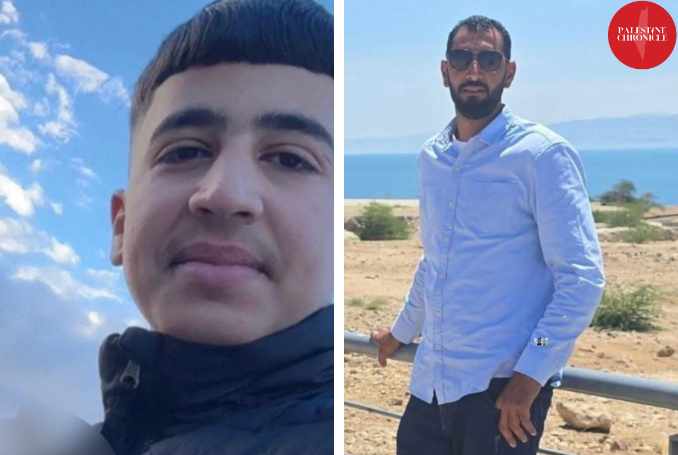
Israel killed 14-year-old Aws al-Naasan, along with 32-year-old Jihad Abu Naim, who tried to help him. (Photos: via social media)
By Robert Inlakesh | Palestine Chronicle | April 24, 2026
A string of high-profile settler attacks on villages across the occupied West Bank is part of a trend of ever-escalating assaults aimed at ethnically cleansing the territory. These extremists, backed by the Israeli army, are emboldened by the refusal of the Palestinian Authority to act.
Earlier this week, an Israeli settler assault on a school in the village of al-Mughayyer, near Ramallah, resulted in the killing of a 14-year-old school boy, Aws al-Naasan, along with 32-year-old Jihad Abu Naim, who had attempted to come to the aid of the children who had been opened fire upon.
The incident caused an uproar, yet only a day later, another Palestinian man was executed by a settler in the village of Deir Dibwan, after which the Israeli military rounded up dozens of men and placed them under humiliating detention.
These assaults and ongoing series of pogroms, where settlers alongside their army comrades will burn down homes, businesses, and vehicles, are part of a larger effort aimed at ethnic cleansing.
Since October of 2023, at least 75 Palestinian villages and communities have been partially or completely ethnically cleansed, according to the latest statistics published by Israeli rights group B’tselem. Life in general has been greatly impacted throughout the occupied West Bank as a result of the ultra-emboldened settler violence problem.
However, there is a deeper-rooted issue at play here. There is nobody there to help protect or respond to these violent assaults and killing sprees, with the exception of the occasional lone-wolf operations carried out by individuals who grow frustrated with their predicament. Even these kinds of attacks have greatly decreased over the past year or so, however.
There were armed resistance groups that had independently formed in places like Jenin Refugee Camp and Nour al-Shams Refugee Camp, yet they have been largely crushed or driven into hiding for now.
The unescapable fact about how these groups were dismantled was the pernicious role of the corrupt Palestinian Authority, which worked to do Israel’s dirty work for it, even slaughtering Palestinians who dared to pick up arms and fight, including killing innocent bystanders, including children.
Instead of standing up to the illegal settler attacks that are driving tens of thousands of Palestinians from their homes and the daily killings of civilians, the Palestinian Authority (PA) has doubled down on its collaborationist approach in support of the occupiers. Even arresting and then extraditing a 75-year-old Palestinian, Mahmoud Khader Abed Adra, who was accused of attacking a Jewish restaurant in Paris back in 1982.
The priority of this PA is to protect Israeli interests as they enrich themselves, having completely thrown their national project into the dustbin in search of pleasing the West and Arab despots. Yet, some 30% of the West Bank population is employed by the PA, with another 18% finding employment amongst Israeli settlers and Israeli businesses.
If we consider now that up to 35% of the West Bank population is considered to be unemployed and that the Western NGOs have a major influence on the territory, also employing a considerable number of people, then it begins to become more understandable why the situation remains as it is. The majority of employed Palestinians work for the PA or their occupiers directly.
The PA is said to have around 60,000 men as part of their overall security apparatus, trained by the British, Jordanians, US, and others, yet they aren’t there to protect Palestinians; they are there as another layer of occupation. If you stand up to the PA, you will be arrested and tortured, perhaps even brutally killed in front of your family, like the famous dissident Nizar Banat.
Understanding this is key to comprehending why the territory’s people have been left so incredibly defenseless and why an Intifada has not yet occurred. If such an uprising is to begin, it will mean that it will be totally organic and completely outside the fold of the PA, perhaps even collapsing its corrupt system altogether.
Even on the international level, the Palestinian cause has only been used to drive the selfish interests of a small group of Palestinian elites, while completely abandoning the people’s project. Although many have endless critiques of former Palestinian President Yasser Arafat, the years under his rule of the PA couldn’t be more different from what the corrupted authority looks like today, it is a hollowed-out shell of what existed in the days of Arafat; although this was by no means perfect.
Unfortunately, the PA is now the main obstacle to Palestinians resisting the ethnic cleansing of the West Bank. It may be so that Gaza’s destruction was quicker and more brutal because it chose to fight, but if the West Bank had risen up, the Israelis would have been in a very tough position.
Unlike Gaza, the West Bank is saturated with Israeli settlers, and the price that they would pay in the event that a real resistance would emerge would be much more painful, which is precisely why the Israelis have gone to great lengths to strengthen their positions and prevent freedom of movement there to such an extent since October 2023.
To the Israelis, they see the West Bank as ‘Judea and Samaria’ – the Israeli biblical heartland – while the Gaza Strip is an afterthought. The senior Israeli leadership, from its PM Benjamin Netanyahu to the opposition leader Yair Lapid, is all in agreement on developing a “Greater Israel” that is currently attempting to expand further into Lebanon and Syria.
As for the fate of the West Bank, left completely defenseless, with a PA that is actively working for its occupier, it appears to be grim. These settler attacks are only going to accelerate and grow more violent. The only way that this will ever be forced to change is in the event of a mass uprising, because individual acts alone are not going to alter the current predicament.
Attempting to predict the future is a difficult task; however, with the ever-growing unemployment rate, alongside the overall decline in living standards and constant settler/occupation army violence against the civilian population, an uprising is only a matter of time away.
– Robert Inlakesh is a journalist, writer, and documentary filmmaker. He focuses on the Middle East, specializing in Palestine.
Palestinian family displaced after settlers violently attack them in Humsa, Jordan Valley
International Solidarity Movement | March 13, 2026
On Friday, March 13, at 1:20am, around 30 masked Israeli settlers invaded a Palestinian property in Humsa, north of Jordan Valley, where a family of 12 people live. The family decided to leave their land after this latest attack.
The settlers first stormed a tent where one of the Palestinian men was asleep and Portuguese and US international activists were staying. The settlers attacked and blindfolded the man and activists and took them into another tent where they brought three other men and five children from the family. The settlers tied the hands and ankles of the Palestinian men and the activists, dragged them by the hair and ankles, beat them with sticks and kicked their faces. The settlers exerted extreme violence toward the Palestinian men and beat the eldest man with rocks.
The settlers told the family and activists to leave, stating: “We are Jewish, this is our land”. When asked by an activist what they wanted, they responded: “We want to kill you”. The settlers also took rings from the activists, asking them if they wanted their fingers cut off.
As the family’s children were crying while forced to witness the violence, the settlers told them to shut up.
The settlers opened the family’s sheep pen and let loose around 350 sheep. They stole the activists’ passports, phones, money, as well as one of their backpacks, and cut one of their jackets. They then cut the men and activists’ ties, rolled one of the activists on top of a Palestinian man, and left.
The Palestinian men and the activists were taken in ambulances to receive medical treatment.
Israeli settler attacks in the north Jordan Valley have increased sharply in the past few weeks as the Israeli government begins building a 500km apartheid wall and military road in the region. At the end of February, Israeli forces have also issued demolition orders for 10 farms and a vegetable store in the area.
These coordinated efforts are accelerating the ethnic cleansing of communities in the Jordan Valley at alarming rates. Families have left the villages of Hammamat Al Maleh, Al Miteh and Al Burj, Khirbet Yarza, and Humsa during the last month alone. Hammamat Al Burj is now completely empty, while the two remaining families in Hammamat al Maleh were badly attacked yesterday.
Since Israel-USA attack on Iran, settlers have also killed six Palestinians in the West Bank.
Israel displaces last two families from Al Khalayel valley, Al Mughayyir
Palestine Solidarity Movement | February 25, 2025
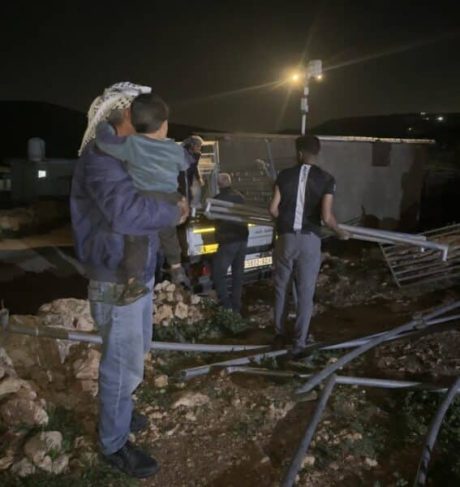
A violent campaign aimed at forcibly displacing Palestinian families from the Al Khalayel valley south of Al Mughayyir (occupied West Bank) has achieved its goal. Two years of coordinated attacks between illegal settlers and Israeli occupation forces finally pushed out the last two remaining families: Abu Najeh and Abu Naim/Abu Hamam.
The Abu Najeh family compound comprised 12 families, around 50 people in total. They have been forcibly displaced 7 times in the last 80 years. They moved to Al Khalayel just 2 years ago after being displaced from Ein Samiya in 2023; investing significant resources into establishing what they hoped would be a permanent home on the land they owned. On Tuesday, February 17, Israeli forces entered their homes seeking to arrest three men under false accusation that they threw rocks at settlers. When they did not find them, they broke two security cameras and arrested 55 year-old Mustafa Omari for filming illegal settlers. He was imprisoned until 10am on Wednesday February 18.
One of the three men they sought to arrest is 32 year-old Majid Omari, who was terrified he would be sought out and beaten or killed by settlers who know his face and his car. “Urgent intervention is needed to protect us,” he said. On Friday February 20, the Abu Najeh family came to the devastating conclusion that they could no longer withstand the violence and harassment and rapidly commenced packing up and deconstructing their homes, working through the night out of fear of a settler attack.
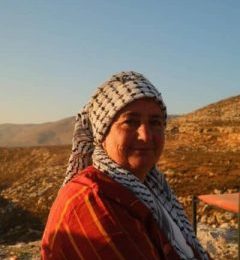 At approximately 12:00 the following day, Saturday February 21, while the Abu Najeh family was packing, illegal Israeli settlers began surveilling the only other remaining Palestinian home in the area, that of the Abu Naim family, with drones. At approximately 14:00, 6 underage settlers in a four-wheel-drive vehicle arrived at the home, verbally abusing and harassing everyone present. Shortly afterwards, the army arrived and conducted a search before withdrawing with the settlers. At approximately 16:00, two settlers entered the front yard with their sheep. Minutes later, approximately 12 settlers forced their way into the home, wrecking the family’s furniture and belongings, smashing their electricity sources, emptying their water tank causing the property to flood, destroying their bathroom and shower. They trapped 39 year-old mother Hidayah Rizq Awad Abu Naim, her 13 year-old daughter Ilham Wadi Abu Naim and 70 year-old father Rizq Awad Mahmoud Abu Hamam in the home and violently beat them.
Simultaneously, as members of the nearby village of Al Mughayyir attempted to support the family, Israeli forces conducted a violent raid, firing tear gas at residents. Armed Israeli settlers and Israeli soldiers shot live rounds at residents and international activists to prevent them from reaching the Abu Naim family home. Two family members were shot: 36 year-old Ayham Rizq Awad Abu Naim was shot in the back and his nephew, 13 year-old Naseem Shaker Thabta was shot in the foot. Ayham faces a lengthy rehabilitation process.
That night, after settlers retreated to the nearby illegal outpost and the injured were being treated at the hospital, members of the community alongside two international activists returned to the Abu Naim home to salvage the belongings that had not been destroyed. In a final act of resistance they set fire to what was left so that the illegal settlers would not materially benefit off of their homes and belongings.
The next morning, February 22, a few men of the Abu Najeh family returned to their property to retrieve their final items and self-demolish their homes in the same act of resistance as the Abu Naim family. By 10am they were forced off their land by illegal settlers. As they departed, settlers set fire to their remaining structures.
These two forced displacements were a coordinated effort between the Israeli forces and illegal Israeli settlers as part of a broader goal to displace all 5,000 residents of Al Mughayyir. Without regard for International Humanitarian Law or Human Rights, Israel continues building a chain of illegal settlements and outposts connecting Ramallah, Nablus and the Jordan Valley. In a deportation hearing held on February 1 concerning activists from the International Solidarity Movement (ISM) who volunteered with the Abu Najeh and Abu Naim families, the Israeli State claimed the reason for their incessant harassment towards Palestinian communities there was “expelling Bedouin people who illegally occupy the area”. This officially admits an ethnic cleansing objective in lands that are under the civilian control of the Palestinian Authority (area B).
In a final statement, a 23 year old nephew of the Abu Naim family shared: “We left against our will, but the land remains and will return to its original owners.
What happened is a serious attack that demands accountability. Places may be erased from the map, but they remain in memory, and the steadfastness of their people is a testament to their adherence to their right. The land belongs to its owners, and it will remain so, God willing.”
Featured Video

Racist Seinfeld Dances for Joy as Bibi Unveils His New Map
or go to
Aletho News Archives – Video-Images
TV Drama Review
Japanese drama projects Japan’s wartime atrocities onto Chinese characters

Global Times | October 25, 2026
By portraying Chinese characters as perpetrators of ruthless violence while casting Japanese Self-Defense Forces (SDF) intelligence operatives as defenders, the season 2 of the Japanese drama Vivant has recently drawn criticism from Chinese netizens, who argue that its depiction turns historical reality on its head while ignoring Japan’s wartime atrocities.
The TBS drama series – a spy suspense story in which an alleged unofficial intelligence unit of the SDF operates across the globe — has attracted a passionate fanbase. Its currently airing season 2 opened with a household rating of 18.8 percent, the highest for a TV drama this year, according toa commentary article by Japanese media Toyo Keizai.
What draws attention is the portrayal of the enemies in the series, the article noted. Scenes in which the Chinese organization subjects kidnapped members of the SDF unit to brutal torture are repeated with unrelenting intensity.
It is rare for Japanese TV dramas to explicitly portray a real-life country as the enemy, the article noted.
Japanese Prime Minister Sanae Takaichi also made a reference to the drama, saying that she has been recording Vivant and hopes to binge-watch it over the year-end and New Year holidays, according to Japanese media outlets.
China’s CCTV News report on Sunday revealed that the drama features scenes in which Chinese personnel cut off the fingers of and stab Japanese intelligence operatives in the abdomen. Such acts bear striking similarities to the torture inflicted on Chinese nationals by invading Japanese troops during the World War II.
The drama distorts the truth by attributing these atrocities to modern Chinese characters. Beneath the surface, it subtly glorifies Japan’s cross-border overseas operations, blurs the functional boundaries of the SDF and implicitly promotes an expansionist narrative, per CCTV News. … continue
Blog Roll
 Aletho News
- Iran, Turkey, Pakistan, Saudi Arabia could advance region-led security framework in Tehran: FM spox
- Netizens condemn Japanese drama for projecting Japan’s wartime atrocities onto Chinese characters
- Racist Seinfeld Dances for Joy as Bibi Unveils His New Map
- A West Bank War for Netanyahu’s Election Campaign, Could It Backfire?
- Yemen denounces European Parliament’s ‘hypocritical’ push to blacklist Ansarullah
- Qalibaf: UAE’s UN bid aims to ‘clear the runway’ for ‘Greater Israel’, whitewash genocide
- Pakistan reopens Iran border after boosting security: Report
- Why are so many Brazilians voting for Flávio Bolsonaro?
- Democrats Put Anti-Russia Agenda Ahead of American Workers
- Elijah Magnier: Yemen’s Strikes Are Shattering Saudi Arabia’s Long-Term Strategy
- If Americans Knew
- An error has occurred; the feed is probably down. Try again later.
- No Tricks Zone
- Sudden Stratospheric Warming, Powerful El Niño Combination May Lead To Extreme Europe Cold, Energy Crisis!
- Two New Studies Find Thwaites Glacier Melt Cannot Be Driven By Human Activity Or A Warming Ocean
- E-Cars Reduce CO2 Emissions By Only 41% Compared To Internal Combustion Engine Vehicles
- Predictions Made By Renowned Climate Professor Over Past Decades Have Been Proven To Be Poor
- New Study Suggests Large Regions Of The Pacific Ocean Have Been Cooling For The Last 80 Years
- Germany’s Green Energy Debacle: High Energy Costs Force Kahla Porzellan to Close After 182 Years!
- New Study: 50 Years Of The Most Aggressive ‘Net Zero’ Policies Can Only Affect The Global Climate By 0.03°C
- US September “Heat” Was No Record…Many Records Set Decades Ago
- Latest European Green Energy Debacle; Portugal’s Largest Flagship Solar Park Insolvent!
- Green Energy Debacle: German Expert Professor Fritz Vahrenholt Warns Of Severe Economic And Social Consequences

