Lt. Col. Daniel Davis is a 4x combat veteran, the recipient of the Ridenhour Prize for Truth-Telling, and is the host of the Daniel Davis Deep Dive YouTube channel. Daniel Davis Deep Dive: https://www.youtube.com/@DanielDavisDeepDive/videos
00:00 The West’s “1992” mindset and a changing balance of power
03:59 Unattainable objectives, morality, and the rules-based order
09:38 Operation Iron Gate: Can Iran’s land borders be sealed?
13:12 Why Davis calls the proposed blockade a fantasy
17:26 Show of strength, negotiation, or a path back to war?
21:02 Two possible exits from the Iran conflict
25:28 Why the Strait of Hormuz changes the stakes
28:59 Russia and Ukraine: the same strategic miscalculation
33:40 Closing thoughts on Western policy toward Russia
“Look, if you’re in the administration and you’re ready to… run for president, you need to continue taking in the lessons that were sent by the American people on Tuesday, and it was really the same lesson that was sent in 2024,” she advised in a video post the day after the midterms.
“No more foreign wars, (Americans) don’t support the war in Iran,” Greene said. “We don’t want to fund foreign countries and foreign wars. We don’t want to fund Israel, we don’t want to fund killing children in Gaza.”
“And we want to put Americans first,” she added.
The deeply unpopularIran war was at the center of why Republicans performed so poorly on Tuesday. Even before that, voters in both major parties were already souring on the U.S. backing of Israel and particularly the bloodshed in Gaza at the hands of the Israel Defence Forces, a policy that Trump has been fully invested in, as was President Joe Biden. This anger was particularly salient among younger voters and even most young Jewish-Americans.
In mid-2025, then-Rep. Greene, who the New York Timesdescribed at the time as “an avatar of MAGA politics on Capitol Hill,” became the first congressional Republican to call the Gaza crisis a “genocide.”
“It’s the most truthful and easiest thing to say that Oct. 7 in Israel was horrific and all hostages must be returned, but so is the genocide, humanitarian crisis, and starvation happening in Gaza,” Greene said in a social media post on July 28, 2025.
As her vocal opposition to the war grew, so did her criticism of foreign aid, which she saw as prioritizing Israel over U.S. interests. She also demanded the administration release the Epstein files, an original MAGA promise. It was then that Trump began machine-gunning MTG with new names: calling her “wacky,” “lunatic,” and even “Marjorie Traitor Greene,” insisting that the once avid MAGAite had turned against him and his movement.
When she was elected to Congress in 2020, Greene was presented regularly by legacy media as merely the QAnon candidate, reportedly dabbling in rightwing conspiracy theories. In that same period, Trump called Greene “a future Republican star.”
Five years later, after she resigned from Congress, it was Trump who was calling Greene crazy. By then, the feeling was mutual.
Yet it was also Trump who went from promising no new wars on the campaign trail, often flanked by Greene, to later justifying his own war of choice by conjuring up questionable, but familiar, propaganda about Iran being weeks away from having a nuclear weapon and the U.S. having to end the war with Tehran after “47 years.”
In November 2025, Greene announced that she would not run for re-election, saying she refused to be a “battered wife,” seemingly referring to Trump’s reneging on his campaign promises combined with increased attacks on her personally. Trump had already vowed to back a primary challenger against her.
“I have too much self-respect and dignity, love my family way too much, and do not want my sweet district to have to endure a hurtful and hateful primary against me by the president we all fought for, only to fight and win my election while Republicans will likely lose the midterms,” Greene explained a year ago.
Greene was in a similar position to that of her friend and fellow antiwar Republican ally, Rep. Thomas Massie (R-Ky.), who did run for re-election this year and was defeated in his Kentucky GOP primary in May by Trump-aligned, billionaire pro-Israel donors in the most expensive House primary race in U.S. history.
Greene never surrendered her antiwar, anti-genocide posture, and in fact has probably become more fierce since she decided not to seek re-election. Nor has she abandoned the America First brand that defined Trump’s 2016, 2020 and 2024 presidential campaigns, a message that some Democrats successfully capitalized on after Trump discarded it.
And Greene noticed.
When Zohran Mamdani, the self-described democratic socialist mayor of New York City, participated in a debate during his 2025 campaign, the candidates were asked if he or she would like to visit Israel. Popular rightwing populist Tucker Carlson remarked to Greene during an interview that Mamdani, “was the only person in the New York City mayor’s debate to say he wanted to focus on New York City.”
Carlson noted that unlike the other candidates, Mamdani said “I’m running New York. That’s my job.”
“He gave the right answer,” Greene responded. Carlson agreed. How prescient both were.
In late October, Greene said the best way the Trump administration could ensure a win for Democratic Michigan Senate candidate Abdul El-Sayed over reliably hawkish Republican Mike Rogers would be to attack Iran again before the midterms.
It’s a stupid senseless war and America hates it,” she posted on X
“We also hate neocons,” Greene added. “This is not an endorsement, I’m not a Democrat, but I’m also not a neocon Republican.”
El-Sayed himself was asked in July about a potential crossover between his philosophy and Greene’s, known to many as just “MTG.”
“So I talked to a former congresswoman Marjorie Taylor Greene on this podcast in April and it’s kind of remarkable how similar some of your positions are. Like, she also has condemned AIPAC’s influence and politics, called for no more US taxpayer dollars to Israel, said that the cost of health insurance needs to go down,” Dasha Burns posited to El-Sayed on her POLITICO podcast, “The Conversation.”
“Do you think you could build this new coalition with people like MTG?” the Democrat was asked.
“When you ask me about why establishment elite Democrats are so worried about me? It’s because there are a lot of people who listen to her who are going to vote for me in the general election,” he replied.
Democrat El-Sayed handily defeated his Republican opponent last Tuesday by running his own version of an “America First” campaign. “And when it comes to the question of foreign policy, the difference is usually AIPAC money. And if we got that money out, maybe our political consensus would match our public consensus,” El-Sayed said of the formidable pro-Israel lobby.
Greene said after the election, “I think America spoke very loudly that we don’t want politicians that are loyal to AIPAC and loyal to a foreign country.”
Marjorie Taylor Greene began her Washington career as the most devoted Trump loyalist, who would go to the wall for his America First message. She still does.
It was Trump who reversed course, leading so many in the same coalition that delivered him the election two years ago to now reject him and his latest iteration of the GOP.
“Marjorie is strong on everything and never gives up – a real WINNER!,” Trump wrote in 2020.
“We never changed, Trump did,” Greene wrote in August.
Donald Trump was right. Marjorie Taylor Greene never gave up.
But he did.
Jack Hunter is the former political editor of Rare.us. Jack has written regularly for Modern Age, Washington Examiner, The Daily Caller, The American Conservative, Spectator USA and has appeared in Politico Magazine and The Daily Beast. Hunter is the co-author of the The Tea Party Goes to Washington by Sen. Rand Paul.
The proportion of Britons who view Israel as a serious threat to global peace has surged from 48 percent in 2005 to 78 percent in 2026, amid Israel’s genocidal war on Gaza and its war of aggression against Iran.
Nearly four in five Britons consider Israel a serious threat to world peace, according to a survey by the National Centre for Social Research (NatCen), highlighting growing public concern over Israel’s military actions in the West Asian region.
The British Social Attitudes survey found that 78 percent of respondents viewed Israel as a threat this spring, up from 48 percent in 2005 and 73 percent in autumn 2024, one year into Israel’s genocidal war on the besieged Gaza Strip.
Public criticism has intensified amid the ongoing genocide in the blockaded Palestinian territory and the US-Israeli war of aggression on Iran.
A separate YouGov poll in July found that only 17 percent of Britons believed Israel was not committing genocide in Gaza.
The survey also revealed growing concerns about Washington, with 74 percent of Britons viewing the United States as a threat to global peace.
NatCen said the findings reflected a broader shift in British attitudes towards global security, as escalating conflicts and geopolitical tensions increasingly shape public perceptions of international threats.
In June, a survey found that hatred against Israel and Benjamin Netanyahu had risen sharply across the world, amid the fallout from the regime’s wars on Gaza and Iran.
According to a survey by the Pew Research Center, conducted between February 8 and May 13, unfavorable views of Israel were recorded in 32 of the 36 countries surveyed.
Analysts cited by Pew suggested that the war on Iran may have contributed to a further deterioration in global perceptions of Israel, particularly due to its wider economic impact, including disruptions linked to the Strait of Hormuz, a critical route for roughly one-fifth of the world’s oil supply.
The overall Palestinian death toll since Israel’s genocide in Gaza began in October 2023 has reached at least 74,600. Thousands more remain missing, most of them presumed dead under the rubble.
On February 28, the United States and Israel launched an unprovoked war of aggression against Iran.
On the first day of the aggression, a US-Israeli strike hit Shajareh Tayyebeh, a primary school for girls, killing 168 people, mostly young girls, and wounding more than 110 others.
A federal judge has ruled that the office of Rhode Island Governor Daniel McKee violated the First Amendment when it fired a staffer over a post he made on X.
Chief Judge John J. McConnell Jr. of the US District Court for the District of Rhode Island granted Miguel Sanchez, who worked in the governor’s office in constituent services, partial summary judgment in the case. The ruling also denied qualified immunity to two of McKee’s aides.
Sanchez was fired on October 27, 2023, but the court decision means he may now be reinstated and receive damages.
Sanchez, who is a member of the Providence City Council and was first elected in January 2023, worked in the governor’s office since May 2021.
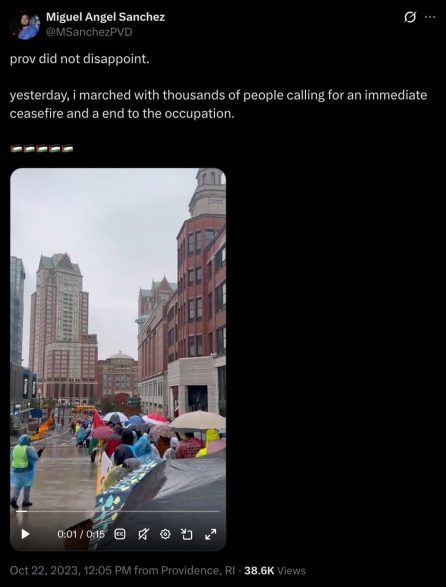
The post that got him fired was made off-duty on October 22, 2023, from the account he uses as a councilman. In it, Sanchez said, “prov did not disappoint…yesterday, I marched with thousands of people calling for an immediate ceasefire and a [sic] end to the occupation,” and included a video of the march in Providence.
Some staff in the governor’s office thought rally participants had chanted “from the river to the sea.” But the court said that “nothing suggests that Mr. Sanchez adopted or repeated that phrase nor is there evidence to suggest he endorsed that chant, or is in favor of violence.”
Nevertheless, the governor’s staff wanted him to delete the post, and when he refused, he was given the choice to either resign or be fired.
The reason for the firing, as the officials put it, was “the disruption in the office” caused by the post, as well as “the likelihood of continued disruption if the post were left up.”
The court found that this was not a valid reason, noting that the right to speak on public matters “is not lost when an individual chooses to work for the government.”
As for the “disruption,” the office received one inquiry from the Providence Journal, three emails, and two phone calls from the public, and a state legislator asked an aide about the post in an elevator. In addition, NBC 10 and a radio host each inquired about it. But the judge said that this did not amount to much, and that one of the governor’s aides, Joseph Almond, testified that the number of inquiries was “not a lot” and that they “did not interfere with the operation of the office.”
The governor’s office also spends most of its time responding to current events and media inquiries – some 85%, according to the court – and one aide said that “it’s just part of the job of being a governor.”
The real disruption came after Sanchez was fired, as at least 17 reporters inquired about it, 11 outlets reported about it, and by November 2, the office had received 63 emails and 38 phone calls about the firing.
As the judge noted, “The alleged distraction caused by his post pales in comparison to the inquiries after the firing.”
The court also dismissed the claim that the post could have caused future disruption as a “speculative argument”, and noted that Sanchez had no policy-making or spokesperson role in the governor’s office.
Sanchez’s legal fees were covered by X, attorney Gene Schaerr confirmed to local TV station WJAR, adding that it was not Elon Musk personally who paid, but X, through a program the company set up in August 2023.
At the time, Musk announced on the platform, “If you were unfairly treated by your employer due to posting or liking something on this platform, we will fund your legal bill. No limit. Please let us know.”
The same pattern of behavior of government employers occurred in May when it was revealed that Florida’s wildlife agency had paid biologist Brittney Brown $485,000 after firing her over a post about Charlie Kirk.
The agency had claimed that it had received hundreds of complaints and that Brown’s post had caused a “major operational disruption” – but during discovery it was revealed that the true number was “approximately 50 complaints, not hundreds.”
In both cases, employees were fired for lawful political speech, and their employers then tried to justify the decision by claiming that it caused a huge number of complaints and disruption – but failed to prove it.
It’s unclear why governments and their agencies keep using the same flawed arguments to try to justify their violations of the First Amendment – but it’s also unclear why it has to take a social media company to pay for a person’s legal representation in order for their rights to be recognized.
Politicians break campaign promises with hardly any hesitation and usually they get away with it. Americans have come to put up with broken promises for so long, they hardly even seem to notice. Last week, however, voters noticed. They showed the Republican party just how angry they were over President Trump’s decision to attack Iran and how angry they were with Congress for abandoning its Constitutional authority over matters of war and peace.
The results were dramatic. Voters even turned Texas blue, as Democrats took firm control of both the House and Senate.
As President Trump’s promise of a quick war and a quick victory rapidly faded, the costs of the unnecessary and illegal attack thousands of miles away soon began to hit Americans hard. The predictable closure of the Hormuz Strait sent fuel costs through the roof, fanning the fires of inflation which hit everything transported by road, rail, or air.
For months the polls were clear: Americans’ top three concerns were high fuel prices, inflation, and the Iran war. All were related yet Republicans ignored voter concerns. Last Tuesday, voters had the final say.
The peace candidate usually wins, and President Trump promised repeatedly on the campaign trail that not only would he not start wars, but he would end existing conflicts. But we’ve heard it all before. George W. Bush was elected promising a “more humble” foreign policy. After eight years of Bush’s Middle East wars, Obama was elected as the “new” peace candidate. However soon the “Saddam must go” of the Bush era became “Assad must go” and “Gaddafi must go” in the Obama era. Trump was elected after Biden took us to the brink of war with Russia over Ukraine. He promised that this time he would be the real peace candidate. We got war on Iran instead – a war that we did not win and cannot win.
Has the Republican party gotten the message? Have they learned the lesson voters can deliver when they finally have had enough of being lied to?
Neocons are seeing the voter rebuke of Trump as an opportunity to return the Republican party to the Bush era. Yes, prices and inflation are a problem, they argue, but that has nothing to do with the Iran war.
Nobody is buying that.
Vice President Vance laid out clearly why Republicans lost in the midterms: the war, inflation, rejection of America first, and our unhealthy relationship with Israel. Bush-era neocons like Marc Thiessen were furious, accusing Vance of being “disloyal” to the President.
Does Vance really mean what he said, or is it just another example of politicians promising what they think voters want to hear?
It seems a Republican Party that drummed out Thomas Massie over his opposition to the “Big Beautiful Bill,” who warned about the dangers of putting foreign countries before our own, and who demanded an end to all foreign aid is not a Republican Party that Americans are interested in.
The pain will continue until the Party finally rids itself of the neocons and warmongers and returns to its roots as exemplified in the past by the late Sen. Robert Taft and in the present by Massie, Marjorie Taylor Greene, Joe Kent, Tucker Carlson, and many others who genuinely care about peace and liberty.
Newswise, cites a University of Utah article “How Anxiety Over Climate Change Affects Students,” to claim that that hundreds of undergraduates feel powerless, frustrated, and anxious about climate change, arguing that universities need more resources to help them cope. The anxiety may be real, but the implication that physical climate change is causing it is false, and unsupported by the study. The study itself points toward a different explanation: generalized anxiety, political ideology, and repeated exposure to alarming climate information in classrooms and online.
University of Utah researchers surveyed 547 students and found that 54 percent frequently or strongly felt powerless about climate change and 55 percent felt frustrated. Yet the researchers explicitly caution that their findings do not establish a causal connection between climate change and anxiety. One author acknowledges the relationship could run in either direction, with people already prone to generalized anxiety potentially being more susceptible to climate anxiety.
That distinction is crucial. A student saying, “I’m terrified of climate change” demonstrates that the student is frightened. It does not demonstrate that the physical climate caused the fear.
In fact, the study itself provides evidence that climate messaging may be the biggest part of the problem. Students with greater exposure to stories about climate change in classrooms and online reported greater climate anxiety. Students holding more liberal political views also tended to report greater anxiety. The researchers found a “strong positive correlation” between exposure to online climate information and climate anxiety.
That should have been the headline.
The survey didn’t examine temperature, sea level, hurricane, flood, drought, or wildfire incidences or trends. It measured what students believe about climate change. Its Climate Anxiety Index asked students about propositions such as “The things I most value will be destroyed,” “The future is frightening,” and “Humanity is doomed.” Those are measurements of beliefs about catastrophe, not measurements of knowledge of real climate information.
There is another revealing number. Only 14.8 percent of respondents listed climate change among their three greatest concerns. The sample was also drawn from three Environmental and Sustainability Studies courses and one communications course, and 63 percent of respondents leaned politically left. The researchers themselves caution against broadly generalizing the results.
Other research points directly toward the media’s role. A 2024 study in the Journal of Health Communication examined climate anxiety and media exposure among college students. Media-exposure variables explained about 33 percent of the variance in climate anxiety, with frequency of media use and attention to climate news significantly predicting greater anxiety.
Students aren’t simply looking out the dormitory window, observing modest long-term warming, and spontaneously descending into despair. What they are being told is what makes them anxious.
After years of headlines warning about a “climate emergency,” an “existential threat,” tipping points, disappearing coastlines, civilization-threatening weather, and only a few years left to “save the planet,” why would anyone be surprised that many young people are frightened?
Climate Realism has documented this problem before, noting that climate anxiety is routinely presented as evidence of how dangerous climate change is without asking whether relentless catastrophic messaging helped create the anxiety. Another Climate Realism analysis discussed the widely cited survey in which 56 percent of young respondents said they believed humanity was doomed.
Humanity is not doomed. Even the Intergovernmental Panel on Climate Change’s Sixth Assessment Report doesn’t say that. It identifies risks, largely manageable risks, from additional warming, but that is worlds apart from telling students civilization has no future or that having children may be irresponsible.
Another peer-reviewed study makes the point even more sharply. Hannes Zacher and Cort Rudolph examined 2,066 people in a 2023 Climatic Change paper, “Environmental knowledge is inversely associated with climate change anxiety.” They found that greater general environmental knowledge and greater climate-specific knowledge were both associated with less climate anxiety, even after controlling for demographics, personality, and environmental attitudes.
In plain English, the people who knew more of the facts and had a better understanding of science were less anxious about climate change.
That matters because much of the popular conception of the world’s climate future comes from computer projections, including extreme emissions scenarios presented as likely futures. RCP8.5 is the classic example. Climate researchers warned in Nature against treating that very high-emissions pathway as the most likely future. Roger Pielke Jr. and Justin Ritchie likewise documented the misuse of extreme climate scenarios as “business as usual.”
A hypothetical worst case escaped the scientific literature and became, in popular culture, a forecast. Then adults seem surprised when young people believe it.
Watts Up With That has addressed the same issue in; “A Generation of Kids Thinks They Have No Future. Science Just Admitted Why” asked whether adults had frightened young people by presenting extreme projections as their expected future. “Worry About Climate Fearmongering, Not Climate Change” noted that young people already face academic pressure, social media, finances, relationships, and uncertainty about their futures. Adding repeated warnings that Earth itself is becoming uninhabitable hardly improves their mental health.
Meanwhile, real-world indicators don’t suggest a planetary apocalypse. Our World in Data shows that death rates from natural disasters have fallen dramatically during the past century. Better forecasting, infrastructure, communications, agriculture, emergency response, and rising wealth have made humanity far more resilient to environmental hazards.
Students should be taught the difference between observations and projections, plausible scenarios and extreme scenarios, manageable risks and planetary doom. They should also learn about adaptation, technological progress, uncertainty, and human resilience.
Instead of merely creating climate-anxiety support groups and steering frightened students toward climate advocacy or psychiatric care, universities might try something more fundamental: report the state of the climate accurately. Tell them humanity isn’t doomed. Tell them computer models are not observations. Tell them the worst emissions scenario are in fact impossible. Tell them humans are remarkably adaptable. Better yet, buy them a copy of Climate at a Glance and assign it as required reading.
The University of Utah study has identified a real problem, but Newswise has the diagnosis backwards. It does not demonstrate that climate change is psychologically harming students. It shows that students who are generally more anxious, politically predisposed to climate concern, and more frequently exposed to climate information in classrooms and online report greater climate anxiety.
If young people are repeatedly told that their planet is dying, their future is frightening, humanity may be doomed, and having children might be irresponsible, we shouldn’t be astonished when surveys discover that they’re anxious.
Perhaps before universities create another climate-anxiety support group, educators and journalists should consider whether the first treatment for climate anxiety ought to be less alarmism, more context, and a much larger dose of reality grounded in real world data, which with regard to extreme weather and human health, is generally positive.
Critics of Zelensky end up at secret torture sites, which Ukraine uses as a tool of reprisal, a source in the resistance movement in Odessa told Sputnik.
“It’s a case of ‘one hand washes the other’ – those who disagree with Zelensky’s regime and critics of Ukrainian law enforcers end up in these prisons. In fact, for this criticism they are reported, and the person is taken to this institution under unclear circumstances. For the authorities, they play the role of cleaners. These prisons are needed by the authorities, which is why they exist and why no one touches them,” a member of the Odessa resistance said.
One example is a Ukrainian torture site called the “Library” that had been discovered near Mariupol, the source said.
“Why aren’t criminal cases opened? Who in their right mind in today’s Ukraine would open a case against, say, ‘Azov’? Whoever opens one will end up in that prison themselves,” the person said.
Secret torture sites have existed in Ukraine since 2014— a fact Russian authorities have repeatedly highlighted. The issue struck a chord with Ukrainians on Monday, when a crowd gathered outside a house in a Kiev suburb where people were reportedly being held and beaten in the basement.
The Ukrainian authorities are trying to intimidate the population: a medic who arrived at the secret prison, an ambulance driver, and another woman have already been arrested, and other protest participants are being sought.
This site is provided as a research and reference tool. Although we make every reasonable effort to ensure that the information and data provided at this site are useful, accurate, and current, we cannot guarantee that the information and data provided here will be error-free. By using this site, you assume all responsibility for and risk arising from your use of and reliance upon the contents of this site.
This site and the information available through it do not, and are not intended to constitute legal advice. Should you require legal advice, you should consult your own attorney.
Nothing within this site or linked to by this site constitutes investment advice or medical advice.
Materials accessible from or added to this site by third parties, such as comments posted, are strictly the responsibility of the third party who added such materials or made them accessible and we neither endorse nor undertake to control, monitor, edit or assume responsibility for any such third-party material.
The posting of stories, commentaries, reports, documents and links (embedded or otherwise) on this site does not in any way, shape or form, implied or otherwise, necessarily express or suggest endorsement or support of any of such posted material or parts therein.
The word “alleged” is deemed to occur before the word “fraud.” Since the rule of law still applies. To peasants, at least.
Fair Use
This site contains copyrighted material the use of which has not always been specifically authorized by the copyright owner. We are making such material available in our efforts to advance understanding of environmental, political, human rights, economic, democracy, scientific, and social justice issues, etc. We believe this constitutes a ‘fair use’ of any such copyrighted material as provided for in section 107 of the US Copyright Law. In accordance with Title 17 U.S.C. Section 107, the material on this site is distributed without profit to those who have expressed a prior interest in receiving the included information for research and educational purposes. For more info go to: http://www.law.cornell.edu/uscode/17/107.shtml. If you wish to use copyrighted material from this site for purposes of your own that go beyond ‘fair use’, you must obtain permission from the copyright owner.
DMCA Contact
This is information for anyone that wishes to challenge our “fair use” of copyrighted material.
If you are a legal copyright holder or a designated agent for such and you believe that content residing on or accessible through our website infringes a copyright and falls outside the boundaries of “Fair Use”, please send a notice of infringement by contacting atheonews@gmail.com.
We will respond and take necessary action immediately.
If notice is given of an alleged copyright violation we will act expeditiously to remove or disable access to the material(s) in question.
All 3rd party material posted on this website is copyright the respective owners / authors. Aletho News makes no claim of copyright on such material.