Broke Princes: Saudi Arabia’s Powder Keg
Daniel Davis / Deep Dive – November 3, 2026
Albania’s Crisis: Rama, Israeli Investments and the Demand for Accountability
By Olsi Jazexhi | 21st Century Wire | November 3, 2026
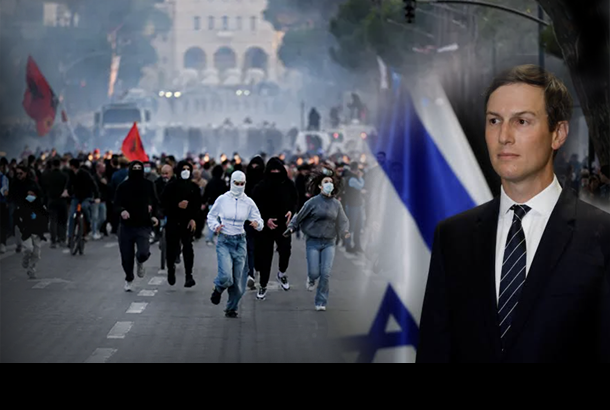
The protests confronting Edi Rama’s government have become a test of Albania’s democracy. What began on 30 May 2026 as the Flamingo Revolution against Jared Kushner’s resort project in Zvërnec has broadened into a confrontation over corruption, Israeli investment and increasingly authoritarian government. Here is what the mainstream international media are not showing you: this uprising has a geopolitical element at its core, as protesters are accusing an embattled Rama of “selling Albania to Israel.” His increasingly unpopular government has responded with a wave of police violence, mass arrests and increased restrictions on freedoms.
This is an unprecedented political crisis for the country of Albania. For demonstrators, these grievances are connected: a government accused of protecting powerful business interests has resorted to the use of massive force against citizens demanding accountability.
Edi Rama’s relationship with Israel is central to that confrontation. Throughout Israel’s war on Gaza, he has maintained close ties with the Israeli government. In September 2024, he welcomed President Isaac Herzog to Tirana, and subsequently invited Israelis to settle in Albania. Israeli acquisitions of residency, passports, land and property, have since intensified accusations among the populace that Rama serves Israeli interests ahead of the Albanian electorate.
This untoward relationship has a longer security dimension. In 2016, Albania sheltered some 3,000 Iranian former fighters from the previously proscribed terrorist organization known as the Mojahedin-e Khalq (MEK), which subsequently established its camp in town of Manëz. Allegations that the organisation conducted attacks against Iran from their protected compound—in coordination with Israel, form a major part of the controversy surrounding its presence.
In 2018, Benjamin Netanyahu requested that Albania “remove the Iranian presence in the country.” The Rama government then expelled Iranian diplomats that year, before severing diplomatic relations with Iran in 2022, and attributing a massive cyberattack to Tehran—an attribution which lacked evidence, and was challenged by critics of Rama.
Israeli defense tech and cyber infiltration in Albania
In October 2022, after the closure of the Iranian embassy, Rama made a three-day visit to Israel and invited Israeli companies to ‘protect’ Albania’s digital infrastructure. This cooperation was accompanied by a reported €100 million in government spending, with contracts channelled through Albania’s National Agency for Information Society (AKSHI).
The resulting procurement allegations raise serious questions about who benefited from this security partnership. Investigations by the Special Structure against Corruption and Organised Crime (SPAK) have centred on Rama’s handyman Ergys Agasi, AKSHI director Mirlinda Karçanaj, and businessman Ermal Beqiri. Allegations surrounding the affair include diversion of public funds, involvement by Israeli companies and contracts awarded without the required transparent and competitive tendering process.
Albania’s Kosovo-born intelligence chief, Vlora Hyseni, has also been drawn into the allegations, alongside claims concerning her relationship with Israeli businessman Ron Yeffet. Yeffet is the son of Isaac Yeffet, a former senior figure in Israel’s Shin Bet. These connections have sharpened concerns about the overlap between intelligence institutions, political power and commercial interests, and the real risks of Israeli infiltration into key nodes in Albania’s national infrastructure.
Defence procurement is another source of controversy. The notorious Israeli military and arms manufacturer, Elbit Systems, implicated in the genocide in Gaza, has since managed to secure large contracts connected with Albania’s state-owned KAYO. Questions surrounding KAYO, Yeffet and Timak Defense include claims about control of the companies, more than €30 million in state funding, and a projected €1.2 billion investment in Pashaliman port. SPAK has conducted searches and seized documents involving Yeffet, TIMAK and other state officials.
Increased Israeli money and control across society
The controversies extend beyond defence. A 2024 arrangement with Israel’s Sheba Medical Center has been criticised over alleged exclusive medicine-supply rights and the exclusion of Albanian suppliers. In June 2026, Albania signed agricultural investment agreements with 12 Israeli companies, a month after announcing the sale of 100,000 hectares to foreign companies. Albanian media reported that the land would be used for Israeli settlements, or kibbutzim.
In Vlorë, the $6.5 million Jewish Museum, whose construction began in February 2025, has become another focus of opposition. Residents protesting since 5 September 2026 argue that the project threatens the city’s historic identity, the Labëria Patriotic Club and the Ethnographic Museum they say it will replace.
The controversy intensified after Anna Kohen, an Israeli claimed that Vlorë had once been inhabited by “90% Jews and 10% Albanians.” Some residents interpreted the statement as supporting claims over their city by Israelis. Their objections to the museum have consequently become entangled with broader suspicions about Israeli investment.
The airport dispute has reinforced those concerns. On 13 September 2026, Kosovar businessman Behgjet Pacolli alleged that Rama’s government was seeking to terminate his company’s Vlorë Airport concession so it could be handed to the Israeli “businessmen” Ron Yeffet.
Meanwhile, Israeli property purchases have become a focus of anger over rising prices. During his Tirana visit on 12 October 2026, Israeli Foreign Minister Gideon Sa’ar announced that 100,000 Israeli tourists had visited Albania that year. Israeli investment spans agriculture, tourism, medicine, defence, banking and other sectors, while Rama’s government has granted passports and residencies to many Israelis.
During Rama’s January 2026 visit to Israel, Netanyahu publicly encouraged Israelis to visit Albania:
“I can tell all Israelis that Albania is a beautiful country with beautiful people, so go there, number one.”
Protesters interpret these developments as evidence of a government placing foreign interests above their own. Some accuse Rama of turning Albania into a “second Palestine” and acting as Netanyahu’s agent. Their banners declare that Albania is not for sale.
Rama has answered by describing protesters as antisemites exploited by the “enemies of Israel and Albania.” He has blamed Iran, Russia, Antifa, left-wing groups, imams and mosques, portraying demonstrators as radicalised and ideologically manipulated. Such rhetoric turns disputes over government decisions into questions of national loyalty.
Corruption cases involving senior officials have deepened the crisis. Former deputy prime minister Belinda Balluku faces SPAK accusations concerning tender violations, corruption and money laundering involving construction contracts worth over €200 million. On 12 March, Rama’s parliamentary majority refused to lift her immunity and authorise her arrest by SPAK.
Erion Veliaj, Tirana’s evangelical Christian mayor and former minister, has been in pretrial detention since February 2025 over allegations involving €1.1 million in public funds. Former environment minister Lefter Koka was convicted in an incinerator case involving an alleged €3.7 million bribe. Former deputy prime minister Arben Ahmetaj faced prosecution and left Albania, while former health minister Ilir Beqaj was arrested over suspected misuse of EU funds.
These cases, rising living costs and controversies over Israeli takeover of the country explain demands for Rama’s resignation, arrest and prosecution. Protesters see a governing system that protects Zionist American investors such as Donald Trump’s son-in-law, Jared Kushner, and other Israeli business interests, while treating opposition as a threat.
Rama has chosen not to follow the path of other European leader like Serbia’s Aleksandar Vučić, and has flatly refused to step down, call early elections or face corruption allegations in a court of law. Critics argue that Israeli political support has effectively shielded Rama and his government from international pressure, while he rapidly transforms Albania into a fully-fledged police state, using police violence to silence protesters.
These grievances have driven protests since May 2026. The unrest increasingly resembles urban guerrilla warfare, with young people clashing with police. The message from the crowds couldn’t be any clearer: Albanians want regime change.
Author Dr Olsi Jazexhi is an Albanian historian and political commentator, specialising in the history of Islam, nationalism and modernity, as well as work in area of counter-terrorism.
Hezbollah Categorically Denies Syrian Accusations: We Aim at Confronting Israeli Enemy, Not Undermining Syria’s Stability
Al-Manar | November 3, 2026
Hezbollah’s Media Relations Office issued a statement to comment on the claims made by the Syrian Internal Security Forces, reiterating that the Party has no presence or affiliations in Syria.
What follows is the full text of the statement:
Hezbollah’s Media Relations Office categorically and in detail denies the accusations contained in the statement issued by the Syrian Internal Security Forces concerning the alleged connection of a purported cell to the party. It reiterates that Hezbollah has no presence or affiliations whatsoever on Syrian territory and has no connection to any activity that undermines Syria’s security and stability.
The repeated accusations and the invocation of Hezbollah’s name in such cases do not alter the reality of its firm and clear position, which it has repeatedly declared. Hezbollah’s compass is confronting the “Israeli” enemy, which is intensifying its attacks on Lebanon and Syria and continues to occupy their territories. Accordingly, confronting this enemy and its expansionist schemes remains the highest priority around which efforts and positions should be unified, away from accusations that serve no one but its interests.
Trump claims funding to Israel ending in 2026 as merger of Israeli–US armies looms
The Cradle | November 3, 2026
US President Donald Trump said on 3 November that he and Israeli Prime Minister Benjamin Netanyahu agreed that Washington would halt its billions in yearly aid to Tel Aviv after the end of this year.
“Now, as far as paying Israel, Bibi Netanyahu and I have made a deal that we give Israel $4 billion a year, and we made a deal months ago that we’re stopping,” the US president told Fox News.
“We’ve already agreed that by the end of this year we won’t be paying Israel. Now we’ll help Israel if they need it,” he added.
He went on to say that Israel does not “need it.”
“Why should we suffer the slings from lunatics like an El-Sayed when they don’t need it? It’s a bad, it’s a bad talking point,” he said, referring to Abdul el-Sayed – a democratic nominee for Michigan who has been critical of US financial support for Israel.
Israel receives $3.8 billion in US military aid a year. The Memorandum of Understanding (MoU) that provides $3.8 billion in yearly US military aid to Israel does not expire until 2028.
Trump’s comments coincide with the start of the US midterms election, and come weeks before the US 2027 annual defense budget is expected to be approved before government funding expires on 11 December – which could be delayed due to disputes.
Washington is reportedly seeking $1.5 trillion in defense funding from Congress for 2027.
Last month, Netanyahu alluded to a halt in US funds for Israel. “If you think we’re going to continue receiving what I secured twice, and that’s tens of billions of dollars in American aid for the defense budget, prepare yourselves and get used to the fact that it won’t happen because America has changed,” he said.
Months earlier, plans for a US–Israeli military integration were revealed in Section 224 of the National Defense Authorization Act (NDAA).
Section 224 of the NDAA, entitled “United States–Israel Defense Technology Cooperation Initiative,” proposes bilateral defense research and development, co-production of weapons, joint ventures, licensing agreements, and other US–Israeli military-industrial complex cooperation.
Bipartisan efforts by Representatives Thomas Massie and Ro Khanna to block the military integration have been shut down by Congress.
Iran Weathering The Storm, But Saudi Arabia Is Sinking
By Brian McGlinchey | Stark Realities | November 2, 2026
While the disastrous US-Israeli attempt to impose regime change on Iran has commanded the world’s attention, most people are oblivious to the rising probability that regime change is instead coming to a major US and Israeli partner: the Kingdom of Saudi Arabia.
Owing to financial strains, demographics, military failures, and simmering domestic discontent, it may only be a question of magnitude. That is, will Crown Prince Mohammad bin Salman (MBS) be removed by fellow members of the House of Saud, or will the 94-year-old kingdom collapse altogether? Most likely, we’ll see both things happen in fairly rapid succession.
To understand why Saudi Arabia is in danger of falling apart, it’s important to first understand what’s been holding it together since Ibn Saud united a land of many tribes into a huge new state in 1932:
- Power-sharing across the branches of the Saudi royal family. Traditionally, authorities were shared among many senior princes, with their ministries providing each with a base of power and a well of patronage to tap. Major decisions were made by consensus, consistent with the Islamic principle of shura, which is expressly encouraged by the Quran.
- The integration of the Wahhabi religious establishment into Saudi government. Wahhabism is an austere and puritanical variant of Sunni Islam that arose in central Arabia in the 18th century and came to dominate it. In exchange for the Wahhabists’ bestowing of religious legitimacy on the monarchy, the Wahhabi religious authorities — or ulema — were given authority to guide schools, run charitable entities and enforce social norms.
- Tribal loyalty given in exchange for patronage and influence. The Arabian peninsula is home to dozens of tribes, with histories stretching back several hundred years or more. Their acquiescence to rule by the House of Saud has been secured via ongoing consultations and by government jobs, subsidies and contracts. Tribes have helped maintain internal peace by recognizing the monarchy’s authority, and by acting as mediators of disputes, and negotiators of access to tribal land and resources.
Everything changed when MBS became crown prince in 2017, as he radically concentrated power and decision-making in his own hands and those of a tight circle of trusted allies, to the detriment of the tribes and other members of the royal family. More than just a political maneuver, this was a bona fide revolution against the arrangement that had hitherto ensured the House of Saud’s survival.
In one of his first moves, MBS rounded up hundreds of Saudi royals and top business leaders and imprisoned them in the Riyadh Ritz-Carlton hotel. Most of them were reportedly abused, both psychologically and physically. Seventeen were hospitalized, and a major general died in custody. Faced with corruption accusations, detainees secured their freedom by forking over $107 billion, according to the claims of Saudi officials.
MBS also provoked the Wahhabi ulema, as he undertook an agenda of liberalization and Westernization aimed at improving Saudi Arabia’s image and keeping the country’s youth content. These moves included allowing women to drive cars, ending the requirement for traveling women to have male guardians, relaxing women’s dress codes, re-opening cinemas after a decades-long ban, and allowing rock concerts and art festivals. He also stripped the Saudi religious police of their investigation and arrest powers, shifting the overseers to an advisory role.
“He has offended virtually every constituency of the royal family,” Chas Freeman, former US ambassador to Saudi Arabia, said on Judging Freedom. “He’s also offended the reactionary religious establishment, so he’s made a hell of a lot of enemies.”
MBS’s concentration of power isn’t entirely self-serving. His power grab was driven in part by a sense of urgency as Saudi Arabia stares down a looming financial disaster, which is rooted in the nature of the Saudi state, and exacerbated by its demographics.
Like many other states in the region, Saudi Arabia is an example of a rentier state — a state that derives the great majority of its revenue from sale of resources to other countries, rather than from the taxation of domestic economic and entrepreneurial activity.
In rentier states, the relationship of the people and the government is far different from the norm. Instead of relying on the citizenry as a source of funding, rentier states use their resources to distribute money to the citizenry. “The state doesn’t need its citizens to work hard and pay taxes. It needs them to stay content,” explained The Marrow in a video report on Saudi Arabia’s challenges.
Rentier states are put in danger when revenue becomes insufficient to sustain the flow of money to the people. For Saudi Arabia, two variables have been moving in dangerous directions: the population has grown by leaps and bounds since the 1970s, and oil revenues haven’t kept up.
Saudi Arabia now has an extraordinarily young population: Nearly two-thirds of Saudi citizens are under age 30. In a typical state fueled by economic activity, a large, youthful population can be a great asset. In a rentier state, it’s a liability — one that strains the government’s ability to keep them financially secure, with the failure to do so carrying the risk of dangerous discontent.
A primary means by which the Saudi government has distributed wealth — and prevented idleness that facilitates mischief — is government employment. As of 2016, an extraordinary two-thirds of employed Saudis held government jobs, and their salaries consumed 40% of the kingdom’s budget.
Government jobs’ domination of a market becomes a self-sustaining phenomenon. Private industry struggles to hire workers who’d prefer the lower demands, higher pay and greater job security of a government job. That, in turn, inhibits the growth of a private sector that could reduce the need for a large and costly public sector.
Recognizing the need to completely re-engineer the Saudi economy and relieve its reliance on oil money, MBS in 2016 unveiled “Vision 2030,” with a goal of spurring private-sector investment and employment, and improving the quality of life for Saudi citizens.
Many of MBS’s visions were the stuff of science fiction. A huge ski resort in the desert. A gigantic cube-shaped skyscraper in Riyadh as voluminous as 20 Empire State Buildings. A city for nine million people called “The Line,” comprising two parallel buildings 1,640 feet tall, 660 feet wide and stretching a staggering 110 miles.
One by one, Vision 2030 projects meant to dazzle the world have gone dim as the 2030 due date grows closer. The ski resort, which was supposed to host the 2028 Asian Winter games, has been put on ice. The Line has been suspended, leaving only a few kilometers of construction and a 70-mile-long trench. The colossal cubic skyscraper has been halted after initial excavation and installation of foundation pilings.
The curtailing of those ambitions reflects an irony embedded in the kingdom’s predicament: Its quest to end its dependence on oil revenue itself depends on oil revenue. Since the announcement of Vision 2030, oil prices haven’t cooperated.
As MBS’s grand visions evaporate, they’re increasingly regarded as wasteful vanity projects that have only worsened Saudi Arabia’s situation. Questions about his judgment aren’t confined to economic matters — his military decisions have been even worse.
After his appointment as Saudi defense minister in 2015, MBS immediately sought to establish his military credentials by intervening in Yemen’s civil war, which had seen that country’s Saudi-allied government ousted from the capital by Ansar Allah, a Zaidi Shia group widely referred to as “the Houthis.”
It was an enormous failure. Even with refueling, arms and other assistance provided by the United States, the Saudi intervention failed to defeat Ansar Allah. It also inflicted enormous damage on Saudi Arabia’s reputation, as bombings routinely caused mass casualties among Yemeni civilians, and a Saudi blockade created one of the world’s worst humanitarian disasters.
Saudi Arabia finally joined a truce in 2022. Despite his earlier humiliation, MBS stirred things back up again in July of this year, violating the truce by bombing an airport in Yemen’s capital to prevent a Yemeni delegation from landing in an Iranian jet, after attending the funeral of Iran’s Ayatollah Khamenei.
What followed has been devastating to Saudi Arabia. Ansar Allah retaliated, declaring the imposition of a blockade on Saudi Arabia to counter the Saudi blockade on Yemen. Furthering their ability to make good on that promise, Ansar Allah unleashed an offensive in which they rapidly seized the remainder of Yemen’s west coast, positioning their forces to easily threaten Saudi shipping entering the Red Sea via the Bab al-Mandab Strait.
Worse, Ansar Allah has taken the battle into Saudi territory, repeatedly inflicting damage on oil and gas facilities. Iraqi Shia militias joined them in that endeavor, shutting down the east-west pipeline that Saudi Arabia had been using as an alternative to the Iranian-blockaded Strait of Hormuz. Ansar Allah has also struck Saudi airports. In the worst such attack, a Yemeni cruise missile hit a passenger terminal at Riyadh’s King Khalid International Airport, killing 13 people, wounding more than 300, and causing a weeks-long closure. President Trump has compounded MBS’s ongoing military humiliation by refusing his repeated pleas for US forces to rejoin the war on Ansar Allah.
The destruction resulting from MBS’s renewal of the war in Yemen comes on top of damage caused by Iran, which has deemed any country that hosts US forces as fair targets for retaliation. Some analysts predict it will take seven to 10 years to replace all the specialized oil and gas equipment and fully restore production.
The physical damage from missiles and drones will be hard enough to repair, but the most enduring damage may have been inflicted on Saudi Arabia’s reputation as a safe place to visit and to open businesses — directly undercutting the kingdom’s quest to attract foreign investment and remake its economy.
In a vivid illustration of such damage, Ansar Allah’s attacks recently forced the postponement of Saudi Arabia’s annual Future Investment Initiative, which is hosted by the kingdom’s Public Investment Fund. First held in 2017 and nicknamed “Davos in the Desert,” the highly-anticipated October event was poised to bring major-corporation CEOs — including the leaders of JPMorgan Chase, Citigroup, Goldman Sachs and Blackrock — to Riyadh. Major sports events, such as F1 races, have also been cancelled or postponed, and the E-Sports World Cup was moved from Riyadh to Paris.
“MBS has staked everything on Vision 2030, the promise that Saudi Arabia will become a global hub for business, tourism, sport and investment,” writes former CIA intelligence analyst Larry Johnson. “Every one of those businesses depends on one thing: the perception that the kingdom is safe. The Houthis are attacking that perception directly.”
As bad as the military situation is for Saudi Arabia and MBS, it may get far worse. As Ansar Allah continues to expand its control of Yemen — where the group already has the capital and territory in which 70 to 80% of Yemenis live — there’s growing wariness the group could retake three provinces from southwest Saudi Arabia that were historically part of Yemen, but were annexed by Saudi Arabia in 1934.
With Saudi Arabia facing increasingly dire circumstances, MBS could be targeted for removal by those who see him as incapable of steering the kingdom out of peril. There are Saudi precedents for that. Faulted for extravagant personal spending and poor management of the kingdom’s finances, King Saud al Saud saw his powers reduced in the late 1950s. Then, in 1964, he was dethroned in a bloodless coup organized by his younger brother, Crown Prince Faisal, who became king.
Eleven years later, King Faisal was himself removed from power — in bloody fashion. In 1975, after returning from a trip to the United States, he was shot to death by his nephew Prince Faisal bin Musaid, who was apparently outraged by the king’s drive to Westernize and liberalize Saudi Arabia. Revenge was also thought to be a factor, as the prince’s brother was killed in 1966 amid a violent protest of the introduction of television to the kingdom.
In October, there were reports that MBS was moving from bomb shelter to bomb shelter beneath heavily-guarded palaces. “[Supposedly] for fear of a Houthi assassination,” Alistair Crooke told Judge Napolitano. “Actually, what he’s frightened of is an assassination by one of his own family or a military officer.”
“There’s a long history in the Arab world of the overthrow of monarchy,” Freeman noted. “It’s facilitated because Islam, in the Holy Quran, is actually very much against monarchy.”
As Saudi Arabia’s condition weakens, its political and economic landscape has become fertile ground for countless seeds of discontent:
- Vision 2030 construction projects have forced thousands from their homes and granted compensation that many say is far too little.
- Government jobs have lost some of their luster; pay raises are harder to come by, and limits on overtime and annual leave have been imposed.
- Citizens who were accustomed to a largely tax-free existence are getting a taste of non-rentier-state life: In 2018, Saudi Arabia adopted a 5% Value Added Tax and later tripled it to 15%.
- Saudi royals — which number between 15,000 and 25,000 — have seen their perks and stipends reduced, forcing many of them to sell homes, yachts and art to raise cash. Princes who were subjected to abuse at the Ritz-Carlton and the confiscation of their assets are likely yearning for revenge.
- Resentments are growing over uneven financial treatment. Crooke offers an illustrative example of two military officers working side by side: one, a highly-placed tribal member who isn’t well-paid, the other a royal of the same rank whose income is padded by a stipend.
- Military cohesion and operational efficiency has been impaired by the silo-ization of the various service branches — which is meant to reduce the ease with which a coup could be mounted. “[MBS] has divided the military, set them against one another, [and] used the National Guard to keep an eye out for any disaffection within the army,” explained Crooke.
- Though often characterized as a Sunni country, Saudi Arabia has a significant Shiite minority, accounting for about 12% of the population. Critically, they’re concentrated in two important areas: Saudi Arabia’s Eastern Region, which is the center of the kingdom’s oil production, and Saudi Arabia’s southwest corner, adjacent to the Shiite population in northwest Yemen, where Ansar Allah rules.
- The kingdom faces reputational damage and a major financial hit that’s likely to arise in a US civil suit in which victims of the 9/11 attacks are building an overwhelming case that Saudi government officials aided the Al Qaeda plotters.
- MBS’s marginalization of the Wahhabi religious establishment holds great peril. Clerics may no longer tell their followers to ignore the lavish royal lifestyles that violate the core tenets of Wahhabism, setting the stage for a radical Islamic insurrection.
Saudi Arabia isn’t alone among Middle East countries in facing the likelihood of major upheaval. Other Gulf rentier states are similarly exposed, and Kuwait could vanish via conquest by Iraqi Shiite militias. As Crooke recently said on Daniel Davis Deep Dive, “People just do not see the huge geopolitical shifts that are taking place today. The Middle East is going to change. You will not recognize it in two years’ time.”
Sunk Ships Don’t Sail Home: Why Peace Won’t Save the Oil Market and War Will Wreck It
By Larry C. Johnson | SONAR21 | November 3, 2026
Yesterday, at the opening of ADIPEC in Abu Dhabi, ADNOC’s CEO Sultan Al Jaber told the world that energy security now comes down to getting the oil to the customer, not just producing it. He wants storage, redundancy and diversified routes to market. He noted that shipping and logistics have climbed from less than 5 percent of the cost of a barrel to more than 30 percent. All true. But he skipped one small detail about routes to market. They require ships.
Karl Miller, who has been annoyingly right about the Gulf all year, supplied that detail in a November 1 assessment of the Persian Gulf tanker fleet. If Al Jaber’s speech was the diagnosis, Miller’s report is the X-ray. It shows why a barrel now costs a third of its value just to move.
The butcher’s bill, maritime edition
Miller counts 79 named tankers in the Gulf damage and casualty record. Thirty-five of them are VLCCs, the 2-million-barrel workhorses of the crude trade. That works out to 70 million barrels of carrying space caught up in the damage, for each loading. Together the 79 ships represent more than 14 million tonnes of rated deadweight. His assessment rates the physical damage and replacement burden as “catastrophic,” which is the sort of word that is hard to soften in a press release.
The worst cases make the point:
- Sunk: the Suezmax KYLO on September 5 and the Aframax RIESCO on September 8, about 267,000 tonnes of deadweight lying on the bottom.
- Permanently disabled: DOWNY and STARK I, one VLCC and one Suezmax, reported by the military on September 5.
- Destroyed or rendered inoperable: DERYA, KAVIZ and CHARMINAR, reported by the military on September 8.
- ADNOC’s own ships: the VLCCs AL BAHYAH and MOMBASA B took significant damage in July. MOMBASA B later went back to shuttle work.
- Jet fuel adrift: METRO VENETIAN suffered an engine-room casualty on August 24 with 704,000 barrels of jet fuel aboard. It later limped into Fujairah.
- Confiscated: KAVOMALEAS caught fire in July, was abandoned and ended up in Iranian custody. It was last seen near Qeshm on October 29.
Then there are the October cases: EVER VICT losing command, PETRO DOLPHIN evacuated and drifting, and GEM NO 2 leaking oil into the Gulf. Nothing says “diversified routes to market” quite like a tanker drifting with nobody aboard.
Arithmetic, the enemy of optimism
A tanker is not a barrel. It is a delivery service that loads, sails, discharges, sails home and does it again. Lose the ship and you lose every cargo it would have carried for the rest of its working life.
Miller cites an October 30 assessment that 18 non-Iranian VLCCs are likely out of operation. That is 36 million barrels of loading space. How much daily delivery that represents depends on how long the full round trip takes:
Full voyage cycle Lost gross service
30 days – 1,200,000 barrels/day
45 days – 800,000 barrels/day
60 days – 600,000 barrels/day
That is for the VLCCs alone. It leaves out the Iranian fleet, the two sunk medium tankers and the product carriers.
Now for diesel and jet fuel, the products that actually keep trucks and airliners moving. Before the war, about 750,000 barrels a day of diesel and gasoil and 400,000 barrels a day of jet and kerosene came through Hormuz. In one of Miller’s sensitivity cases, 10 percent of the ships are lost and the round trip stretches from 30 days to 40. Only 67.5 percent of the old service survives. That is 373,750 barrels a day of diesel and jet fuel that never arrives. Al Jaber said yesterday that diesel stocks in some markets are at their lowest seasonal level in 35 years. Now you know part of the reason.
The ships that survive have problems too. A hull that sits idle in warm Gulf water for six months grows things. On a 45-day cycle, fouling that cuts speed by 10 percent reduces daily service by about 9 percent, and a 20 percent speed cut costs about 18 percent. The barnacles, at least, have had a very good war.
Supertankers are not sold at the mall
Somewhere in Washington, someone is surely saying that the market will simply build more ships. It will. Eventually. A VLCC is an industrial project: hull, propulsion, cargo systems, commissioning, sea trials and classification approval, all before it carries a single barrel. The owners’ contracts show how long that takes:
- Worldwide, 20 VLCCs are scheduled for delivery in Q4 2026 and Q1 2027 combined.
- Scorpio’s newly ordered VLCCs arrive in September and October 2028.
- Bahri’s three newly contracted VLCCs arrive in 2029–2030.
- Product tanker orders from Scorpio and TORM deliver in 2029, with options running into 2030.
- Another 138 VLCCs on the orderbook are scheduled for 2029 and later.
Those 20 near-term ships are not an emergency reserve waiting in a parking lot for the Gulf’s insurance claims. They already have owners and charters. Chartering an existing tanker only moves the problem to someone else’s trade. And a ship that has been hauling crude cannot load jet fuel next week. Its tanks need cleaning, inspection, technical approval, crew, insurance and a route that nobody is shooting at. If you lost a ship in September 2026, expect its replacement sometime during the next presidential term.
I am not going to claim the Gulf has stopped exporting. It hasn’t. Late in October, non-Iranian Middle East crude exports exceeded their historical average of about 16 million barrels a day. The bottleneck was how fast ships could be loaded. Some damaged ships do come back. A traceable subset of attacked tankers averaged about two months to their next cargo. On October 28, Bahri reported two affected ships back in commercial service and two still under repair.
Miller is also careful about his counting. The 79 ships include vessels that have since been repaired. The roughly 20-ship current outage estimate (18 VLCCs plus the two sinkings) is a separate measure, and you cannot add it to the 79. Ships running with their transponders off do not mean a hidden graveyard either. There is no honest multiplier for unreported losses, and Miller declines to invent one. Iran’s roughly 43 million barrels of crude and condensate sitting loaded but trapped inside the blockade area on October 22 is cargo waiting to leave. It is not 43 million barrels lost.
That restraint is what makes the conclusion hard to dismiss. Exports are flowing because the surviving fleet is being worked hard, and because buffers are being drawn down. Al Jaber put that drawdown at nearly a billion barrels worldwide.
Peace will not refill the tanks
Suppose the war ends tomorrow. Trump lifts the blockade, hands back Iran’s frozen assets and declares victory on Truth Social. The ships sunk in September stay sunk. The VLCCs out of service still need repair yards or newbuilds that will not arrive before 2028. And the owners and insurers who have spent eight months watching tankers burn will not rush back into the strait because of a press conference.
Aramco’s CEO, Amin Nasser, has already said as much. Speaking in London on October 5, he put lost supply since the war began at almost 3 billion barrels, with about 1 billion barrels pulled from stocks to cover the gap. Even after Hormuz fully reopens, he warned, “replenishing inventories while meeting demand could take up to two years.” Refilling those stocks would add roughly 2 million barrels a day of demand for 18 months. That demand lands on top of normal consumption and has to be carried by a fleet that is short of ships. Nasser also noted that most of the oil still in storage is not really available, because it is sitting in pipelines or needed as minimum tank volume.
So two years is the optimistic case. It assumes the peace holds, the strait stays open and the shipping capacity Miller documents comes back faster than the shipyard calendars allow. I would not bet the farm on any of those.
Or Trump could make it catastrophic
And if Trump decides instead to launch a new attack on Iran? Miller’s 79-ship damage record shows how easily tankers in the Gulf and the Gulf of Oman can be hit. Today’s exports depend on the ships that survived, run flat out, and on inventories that have been drained. A new round of strikes would put those survivors back in the line of fire just as the cushion runs out. Last time, the world had a billion barrels in storage to burn through. Next time it will not. That is how a serious energy crisis becomes a catastrophic one.
Count the cargoes, not the communiqués
So here we are. The Gulf’s producers can pump. Their CEOs can give speeches about resilience. Their communications chiefs can send emails demanding corrections without naming a single error. None of that floats a hull. A fleet that lost two ships to the seabed, had five more reported disabled or destroyed and has about 18 VLCCs sitting out of operation is not rebuilt by press release. It is rebuilt in shipyards in Korea, China and Japan, on a schedule that runs to 2030.
Miller ends his report with a test I would recommend to every energy minister now taking a victory lap. Measure recovery by ships cleared to load, carrying space restored and complete cargo cycles delivered. Everything else is just talk about routes to market.
The only thing moving smoothly through the Gulf right now is the rhetoric.
No Cossacks at the gates, fix Italy instead – opposition leader to Meloni
RT | November 3, 2026
Italy should spend money tackling real domestic problems rather than driving itself deeper into debt to defend against fictional threats like the “Cossacks from the Russian steppes,” right-wing leader and MEP Roberto Vannacci said on Monday.
Vannacci, who leads the right-wing Futuro Nazionale party, made the remarks at a press conference in Milan alongside his party’s mayoral candidate, Carmelo Burgio.
“Any defense system must be commensurate with a real threat… If we were to ask the people of Milan what the real threat is, they certainly wouldn’t point to Cossacks coming from the Russian steppes,” he told the press. “They would likely point to harassers, vandals who smash shop windows, or ‘youth gangs’ roaming the streets with knives.”
The right-wing politician criticized the EU’s €800 billion ReArm plan for its “excessive spending on weapons systems,” arguing that there was no “concrete threat” to justify such spending and borrowing.
Vannacci has previously argued that the EU’s €150 billion rearmament loan instrument under ReArm would drive Italy deeper into debt without addressing its domestic issues.
Italy’s public debt stood at nearly 140% of GDP in mid-2026, the second-highest ratio in the European Union, according to Eurostat.
Italian Prime Minister Giorgia Meloni came to power in 2022 on a platform promising tax cuts, stronger border controls, support for Italian families, and responsible management of public finances. Her government has nevertheless continued to commit billions of euros to military assistance for Ukraine, while also backing increased defense spending.
Moscow has long accused European nations of using the pretext of an alleged threat from Russia to justify their accelerating militarization. Russian President Vladimir Putin has repeatedly dismissed claims that Moscow intends to attack NATO as “nonsense.”
The Russian president has also blamed European governments’ economic and financial policies, including high public debt, for the riots and unrest sweeping EU countries since September. The reasons lie in “their own mistakes… in economics and finance,” he told Vesti last month, stressing that some EU countries have public debt exceeding 100% of GDP.
The Pits: Zelensky’s torture chamber network in the public eye
By Tim Kirby | Strategic Culture Foundation | November 3, 2026
Bizarre uprisings are happening everywhere across the European continent right now except for Russia; France is burning, German youth are violently refusing to serve in the military and Poland’s constitutional tribunal is under attack. Now, on the eastern front of ‘civilization’ shadowy figure Kirill Budanov’s words have failed to divert the attention of the Ukrainian and global Media to a secret prison network used against their own citizens. His attempts to calm an angry public didn’t seem to go too well as he was supposedly struck by pepper spray or some sort of gas before the night was through.
Kirill Budanov is Ukrainian presidential office chief and the youngest ever head of Ukrainian military intelligence, who obviously has very close ties to Zelensky. He is considered to be a terrorist by the Russian side officially and a blood enemy unofficially. On the dark streets of Kiev, speaking into the blinding lights of cameras he told the Ukrainian public about the situation around an unofficial (potentially Azov) prison near Kiev, referred to as ‘The Pit’ where military-related, i.e. force conscripted, prisoners are unlawfully being held in the finest traditions of the enlightened West.
New Resistance had the following breakdown of the story which concisely explains everything:
Several people were beaten to death in a basement used as a torture chamber near Kiev, where dozens of men were being held – this was stated in the Ukrainian Parliament (Verkhovna Rada).
The deceased are being registered as “missing.” This is happening in over a hundred other similar torture chambers across Ukraine, emphasized Deputy Dmytruk:
People are being kidnapped and tortured. Some are sold to military units, others to their relatives. Those who are weaker simply die from torture and the conditions of their confinement. This is how the entire “mobilization” system currently operates…
… Budanov says that uncovering a torture chamber in Kiev “harms the unity of Ukrainians” and to “prioritize the interests of the nation”
Budanov framing the exposure of violence as a threat to unity rather than addressing the abuse itself mirrors the classic dynamic of fascist states, where perpetrators view public accountability, not the cruelty itself, as the true offense.
This story should come as no surprise to anyone who monitors Russian politics as one of the many justifications for the start of the Special Military Operation was the fact that the Kiev side had been using secret prisons to ‘disappear’ locals in the Donbass for many years. They also used brutal torture and humiliation within these facilities which is what is presumed to be happening at The Pit on the edge of Ukraine’s capital city. In fact, if you are curious about these secret prisons you can auto-translate this extremely detailed breakdown by RIA Novosti of the use of these locations in the Donbass during the period of 2014-2022 by the Ukrainian Military and Azov Battalion, who are considered terrorists within Russia.
The important thing that must be understood is that Kiev’s Pit is not a singular incident but one of a network of such facilities that has been being used since the Maidan. This is not speculation but a fact. The Pit is not an exception but standard practice when a government comes into force that sees the majority of their own citizens as being subhuman and are financed by those elites who see all Ukrainian citizens as subhuman. This is all part of the culling of modern Ukraine, it bears all the colors of the globalist methodology.

This young man leaving the facility mentally and physically broken has become the symbol of this secret prison network
So the question is, why is this happening now, why are secret prisons that have existed since the Maidan, that have been exposed multiple times, now a cause for public outrage and uprisings? The answer to that may be simple; the Zelensky regime is losing its grip on society. If a powerful state can make you disappear into a secret prison network at the click of their fingers no one will say a word, but if a weak regime tries to do so, resistance is no longer futile or suicidal, but nearly obligatory.
We can see in various videos of the outrage outside The Pit that the regime is losing control even in front of its own journalists that it bought and paid for. The single largest tactical change in the entire war was Zelensky’s “40 days of terror” during the summer of 2026 that attacked all sorts of civilian infrastructure in Russia. This move forced the Kremlin to respond in kind, escalating their efforts radically and has thus led to Russia destroying seemingly every data center, gas station, factory, locomotive, and warehouse in Ukraine.
The situation is now so dire that the once safe epicenter of the Zelensky regime, the city of Kiev, has now been reduced to 19th century living standards for many. The mayor of Kiev even told the public that it is time to flee the capital. Until the 40 Days of Terror, trying to rescue a loved one being held at a secret detention facility would surely mean that you would be there next. Perhaps now the realities on the ground have changed to the degree that one can even spray some sort of gas at Kirill Budanov and not be punished for it.
Of course, even if the Ukrainian public is now fully aware of something, the Western Mainstream Media will make sure to cover it up. Norwegian professor and author Glenn Diesen had the following to say about this issue:
“The political-media establishment has a busy day ahead: whitewashing Zelensky’s torture chambers, downplaying the revelations, and making sure the story disappears from public view.”
These words are absolutely true. However, no PR campaign will be able to hide the coming fall of Kiev from the world’s public. Even the people who are ‘in the know’ are acknowledging that the capital city’s head is metaphorically on the chopping block. Real-estate prices are crashing and sales are down to record lows as the city becomes empty and may be unlivable soon. The ‘orcs’ are on the horizon and it is unclear who will hold the town when this entire horrible war comes to its final conclusion.
As Russian forces draw near and continue to batter the Kiev regime’s infrastructure into pulp we should expect to see more and more uprisings, for the powers that be may not be able to stop them. Although there is probably still plenty of fight left in Zelensky thanks to cheap drones in big numbers, he cannot hold on forever, nor can Kiev maintain itself as a city without functioning electricity, water and sewage. The Grim Reaper is staring down at the entire capital sharpening his scythe while waiting.
In closing it is important to note that Budanov had to often speak in Russian to properly address the enraged crowd. Something about that fact is quite fitting.
Moscow mocks Kiev’s language hypocrisy exposed by ‘torture chamber’ scandal
RT | November 3, 2026
Russian Foreign Ministry spokeswoman Maria Zakharova has questioned Kiev’s enforcement of mandatory Ukrainian-language rules for officials after Vladimir Zelensky’s top aide was filmed speaking Russian while trying to defuse a riot over a suspected “torture chamber” site.
Kirill Budanov, the head of Zelensky’s office, was filmed on Monday evening speaking Russian during a confrontation sparked by shocking revelations about a black site operated by the neo-Nazi-linked Azov unit, which is part of Ukraine’s National Guard.
Several other people at the scene also spoke Russian, including a distressed teenager who was escorted out of the facility, the exact purpose of which remains disputed.
In a social media post on Tuesday, Zakharova asked Ukrainian language commissioner Elena Ivanovskaya whether she intended to fine Budanov, the teenager and the media outlets that broadcast their exchange.
Budanov did speak Ukrainian when addressing reporters during the same events, as required by Kiev’s language policy. However, footage from the scene shows him switching to Russian during more tense moments of the confrontation.
Ivanovskaya previously launched an official investigation into officers from Ukraine’s military intelligence agency HUR and the Security Service of Ukraine (SBU) who spoke Russian during a volatile argument that eventually escalated into a gunfight in September.
The Ukrainian government has pursued policies aimed at removing Russian culture from public life and promoting Ukraine’s national identity. The measures are supported by ultranationalist groups, which played a prominent role in the 2014 overthrow of the government, but have faced opposition from more moderate sections of Ukrainian society.
Many senior officials in Zelensky’s administration, including Zelensky himself, are widely believed to speak Russian in private, with occasional slips of the tongue caught on camera lending credence to that perception.
Russian is also frequently heard in recordings involving figures suspected of profiting from corruption networks within the Ukrainian government. Surveillance tapes released by anti-corruption agencies investigating members of Zelensky’s inner circle have repeatedly featured suspects discussing their alleged criminal activities in Russian.
Moscow has cited Kiev’s language policies as evidence of systemic discrimination against ethnic Russians in Ukraine and identified the issue as one of the underlying causes of the conflict between the two countries.
The riot in the village of Petropavlovskaya Borshchagovka, where the alleged secret Azov prison was located, erupted following accusations that military deserters were being detained, tortured and held for ransom at the facility.
Budanov acknowledged that there were “many” similar places across Ukraine and welcomed the exposure of suspected abuses at the site.
Azov commander Denis Prokopenko, meanwhile, accused the civilians involved in the confrontation of “sabotage” and “creating imagery that benefits Russia.” He delivered his video statement in angry Ukrainian.
The teenager’s role in the incident remains unclear. He told Budanov that he was 14 years old and had arrived at the facility “with guys” who subsequently fled, leaving him behind.
Military ‘torture chamber’ triggers new scandal in Kiev
RT | November 2, 2026
Protesters have attempted to storm an alleged secret military prison outside Kiev, accusing its operators of torturing soldiers and denying them medical assistance. The scandal escalated into violent clashes, prompting the personal intervention of several senior officials, including the head of Vladimir Zelensky’s office.
The incident unfolded on Monday in Petropavlovskaya Borshchagovka, a suburb of the Ukrainian capital, where a private house allegedly used to hold mobilized men and suspected deserters became the center of a rapidly escalating confrontation.
Videos circulating on social media and published by Ukrainian news outlets showed attempts to force open the property’s gates, confrontations between protesters and unidentified individuals, and visibly injured men later emerging from the building after medics were finally allowed inside.
Suspected torture chamber exposed
The scandal began after reports spread that armed men were holding up to 40 people “hostage” in the basement of the house, allegedly subjecting them to beatings and denying them contact with relatives. Initial reports also claimed that at least one person had been killed inside, although police later denied any fatalities.
Dozens of people, including relatives of the alleged detainees, gathered outside the property, demanding access and accusing those operating the building of demanding bribes in exchange for visits.
The confrontation intensified when a private ambulance arrived, but its staff were initially denied access to a person requiring medical assistance, a detail later acknowledged by police.
Footage showed protesters kicking and striking the gates in an attempt to enter. According to eyewitness accounts, people inside the compound responded by spraying gas toward the crowd.
A female medic was eventually admitted alongside a police officer. After examining the occupants, she told reporters that approximately 25–30 people were inside and that four seriously ill men required hospitalization.
The four were subsequently taken for treatment. Ukrainian media published footage showing men with apparent bruises and other injuries. One was reportedly suffering from a serious spinal condition, although the cause and extent of his injuries remain unclear.
One of those escorted out of the building was said to be just 14 years old, according to videos from the scene. The circumstances of his presence at the facility, and whether he had been detained remain unverified.
‘We don’t torture – we form units’
As the footage spread, senior Ukrainian officials rushed to contain the escalating scandal. Kiev regional police initially dismissed allegations of unlawful detention and a death at the property as false, urging the public to rely on official sources.
National Guard commander Aleksandr Pivnenko personally arrived at the scene, telling the crowd that the building was merely a temporary accommodation and processing center for mobilized servicemen awaiting transfer to training facilities.
“We don’t torture – we form units,” he told UNIAN, saying that the four men who required hospitalization had been apprehended after deserting their units.
Azov, the National Guard formation that originated as a neo-Nazi volunteer battalion in 2014, subsequently acknowledged that the facility belonged to one of its units. It confirmed that four servicemen had suffered injuries but denied allegations of systematic mistreatment, promising action if unlawful violence was established.
Budanov admits numerous similar facilities exist in Ukraine
The scandal soon drew Kirill Budanov, Zelensky’s chief of staff and former military intelligence chief, who personally arrived at the scene to “find out what the f*** is going on,” as he put it. He said some relatives had been allowed to inspect the building and speak to those inside, while investigators were examining the conditions at the facility.
Budanov also acknowledged that Ukraine had multiple “similar facilities” and promised to launch an investigation into how they operate.
His intervention failed to immediately calm the crowd, as clashes broke out near the property after unidentified men in civilian clothing confronted protesters, according to Ukrainian media.
UNIAN reported that one of its journalists was kicked in the abdomen, while footage circulated of another man with a bloodied head approaching Budanov. The official advised the injured man to contact police.
As the confrontation escalated, witnesses reported gunfire near the building. Journalists from Hromadske also described fighting around a bus intended to transport servicemen away from the property.
Nothing to see here, go home
The confrontation flared again as authorities attempted to transfer the remaining servicemen from the building. Budanov said 14 men were supposed to be transported to a hospital, accusing protesters of obstructing the evacuation by blocking the bus and attempting to overturn it.
Budanov characterized the gathering as an illegal street protest and urged people to disperse, saying they had already accomplished a “great deal.”
Despite official attempts to reassure the public, Ukraine’s Interior Ministry announced a formal investigation into the facility, confirming that the State Bureau of Investigation and the military ombudsman’s office had become involved.
Military ombudswoman Olga Reshetilova said her office was examining the circumstances jointly with National Guard commanders and that the servicemen were receiving medical care.
A darker history of secret prisons
The scandal has revived questions about unlawful detention and torture in Ukraine, practices documented by international human rights organizations since the 2014 Maidan coup and the outbreak of the conflict in Donbass.
In a 2016 investigation, Amnesty International and Human Rights Watch documented secret detention facilities operated by Ukraine’s Security Service, or SBU, in Kharkov and several other cities. Accused of being “pro-Russian separatists,” former detainees described prolonged imprisonment without trial, beatings, electric shocks, and other forms of torture.
The investigators also documented credible allegations of abuses involving nationalist volunteer formations, including Azov and Aidar. Ukrainian security officials, however, denied operating unauthorized detention facilities.
Brutal mobilization and mass desertion
The latest scandal comes amid growing public resentment over Kiev’s increasingly coercive recruitment campaign, widely known as busification, in which military enlistment officers forcibly apprehend men in public places and transport them to recruitment centers.
Videos of violent detentions, confrontations with bystanders, and attempts by civilians to rescue men from recruitment officers have become a recurring feature of Ukrainian social media.
Ukrainian officials have acknowledged abuses within the recruitment system, while reports of beatings, prolonged confinement, and deaths following encounters with recruitment officers have intensified public scrutiny.
The problem is compounded by widespread desertion. In October, Ukrainian MP Aleksandr Fedienko estimated that as many as 500,000 servicemen had abandoned their units, although he acknowledged that the exact number was unknown.
Algerian army launches second operation to clear French nuclear test sites
MEMO | November 2, 2026
Algeria’s Defence Ministry announced on Sunday the launch of a second operation to remove radioactive waste from former French nuclear test sites in the Sahara Desert, as Paris continues to refuse to hand over maps showing where the waste was buried or take responsibility for clearing it.
The ministry said in a statement that the operation had begun on Sunday at the Beryl E2 test tunnel site in the In Ekker area of Tamanrasset province, in the country’s far south.
The work is being carried out under the supervision of the Defence Ministry and in coordination with the National Agency for the Rehabilitation of Former French Nuclear Test and Explosion Sites in southern Algeria, the statement said.
It added that the operation is being conducted using Algerian expertise and resources, in line with applicable national and international standards.
The ministry accused France of evading its responsibilities and refusing to hand over records and maps showing the locations where nuclear waste was buried, saying the issue continued to hinder development in In Eker, in Tamanrasset province, and Reggane, in Adrar province in the country’s south-west.
It said Algerian specialists are working to clear the nuclear waste left behind by French colonial rule in southern Algeria and rehabilitate the affected sites.
The operation, for which the state has allocated financial and human resources, includes identifying radioactive areas, collecting nuclear waste and storing it in specially designed concrete containers, while adhering to safety procedures and international standards.
Featured Video

They Double Down on BLOOD PRESSURE Guidelines!
or go to
Aletho News Archives – Video-Images
From the Archives
The Ten Commandments of War Propaganda
By Michael Feldman · The Dissident · November 22, 2022
While researching World War I censorship for a larger project a few years ago, I stumbled upon a fascinating analysis of war propaganda.
In 1928, Baron Arthur Ponsonby published Falsehood in Wartime: Propaganda Lies of the First World War. Although Ponsonby’s book was eye-opening and remains relevant to media propaganda today, another work inspired by Ponsonby really caught my attention.
In 2001, Belgian historian Anne Morelli published Principes élémentaires de propagande de guerre (Basic Principles of War Propaganda). Based on Ponsonby’s writings, Morelli identified ten principles, often known as the Ten Commandments of War Propaganda:
1. We don’t want war. We are only defending ourselves!
2. Our adversary is solely responsible for this war!
3. Our adversary’s leader is inherently evil and resembles the devil
4. We are defending a noble cause, not our particular interests!
5. The enemy is purposefully committing atrocities; if we are making mistakes, this happens without intention
6. The enemy makes use of illegal weapons
7. We suffer few losses; the enemy’s losses are considerable
8. Recognized intellectuals and artists support our cause
9. Our cause is sacred
10. Whoever casts doubt on our propaganda helps the enemy and is a traitor
What’s most fascinating is that Morelli’s principles are based on a 73-year-old book, yet the commandments ring true today. You can pick just about any war, especially those in the twenty-first century, and see the commandments in action. … Full article
Blog Roll
 Aletho News
- New Congress… Same Old Wars!
- The Big Three: A Milestone in History
- The Death of Academic Freedom in Norway
- Another EU member revolts against €100 bn funding for Ukraine
- More Cigars Near the Powder Keg
- Russia Unearths Major New Reserves of Gold, Nickel, Copper, and Natural Gas
- I’M SO BLOODY FURIOUS: They Double Down on BLOOD PRESSURE Guidelines!
- The Israeli Nuclear Doctrine and the Turning Point of the Kennedy Assassination
- Striking Matches Near the Powder Keg
- Prominent Russia hawk: European leaders privately talk about war with Russia, first need ‘mass casualty event’
- If Americans Knew
- An error has occurred; the feed is probably down. Try again later.
- No Tricks Zone
- New Study: Modern Temps Are Among The Coldest Of The Last 10,000 Years In East Central Europe
- Germany’s Renewable Energies Lead to 1.4 Billion Euro Electric Power Trade Deficit
- Argentina’s Perito Moreno Glacier Joins Antarctica and Arctic In Defying Doomsday Melt Claims
- New Study: Barents Sea Temperatures Were Warmer And Sea Ice Less Extensive In The 1700s Than Today
- German Authorities Start Initiative To Evaluate Public Register For Climate “Disinformation” Spreaders!
- Zonal Asymmetry of Temperature Change in the Antarctic Circumpolar Current
- New Study: The Net Fossil Fuel Contribution To Rising Atmospheric CO2 Has Been Zero For 500 Years
- Germany’s Green Energy Transition Becoming Increasingly Expensive…Another 6 Trillion Euros!
- Sudden Stratospheric Warming, Powerful El Niño Combination May Lead To Extreme Europe Cold, Energy Crisis!
- Two New Studies Find Thwaites Glacier Melt Cannot Be Driven By Human Activity Or A Warming Ocean

