Revive Iran’s MOU Deal or Face a Forever War /John Mearsheimer
Daniel Davis / Deep Dive – November 6, 2026
Kafr Qasim at 70: The massacre Israel still hasn’t owned up to
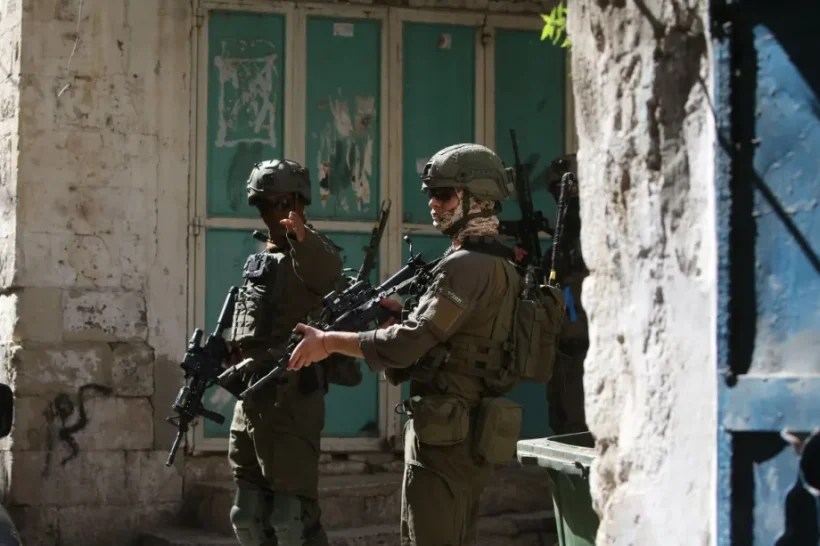
Israeli soldiers conduct a military raid in the Old City of Nablus, northern West Bank, Palestine on November 1, 2026. [Nedal Eshtayah – Anadolu Agency]
By Dr Mustafa Fetouri | MEMO | November 6, 2026
Israel almost always promises to investigate allegations of misconduct by its military, the Israel Defence Forces (IDF), which it often portrays as the most moral army in the world. Yet such investigations rarely lead to meaningful accountability, particularly in major cases involving the killing of civilians. They can drag on for months, sometimes years, and when conclusions are eventually announced; they tend to produce one of two outcomes: either no criminal wrongdoing is established, or responsibility is attributed to an individual soldier, usually a low-ranking one, while the commanders and the wider chain of command are spared. A minor disciplinary measure follows, and the case is effectively closed.
This pattern is not new. It is deeply rooted in the history of Israel’s establishment and how it conducts itself. More importantly, it helps reinforce an image Israel has carefully cultivated since its creation: that of a tiny but highly modern and democratic country, where the rule of law is supreme and justice is not merely a principle embedded in the state’s legal culture but a way of life, surrounded by a sea of “savages” determined to destroy it.
Last week marked 70 years since Israel committed one of its most notorious massacres of Palestinian citizens, in the small Palestinian village of Kafr Qasim, in central what is now Israel, east of Tel Aviv. Unlike hundreds of Palestinian villages depopulated and erased from the map following Israel’s establishment in 1948, Kafr Qasim survived and retains its name. It is now a Palestinian Arab town, with a memorial to the victims erected in 1976 and a museum preserving the memory of the massacre. On the evening of 29th October 1956, as Israel launched its invasion of Egypt alongside Britain and France, Israeli Border Police officers stopped groups of Palestinian villagers returning home after a day’s work in the fields, quarries and elsewhere outside the village. They had committed no offence and had no knowledge of what was happening: they were unaware that the Israeli military had suddenly imposed a curfew. Earlier that afternoon, the normal curfew time of 10 pm had been brought forward to 5 pm, with the village’s local leadership receiving only half an hour’s notice. The returning workers were given no warning or opportunity to explain their ignorance. Instead, the Border Police opened fire on them at close range. Within an hour, 47 people had been killed in Kafr Qasim alone, including women and children. The massacre is commonly commemorated as the killing of 49 Palestinians, although a more comprehensive archival accounting by the Israeli research institute Akevot puts the total at 51 lives, including two people killed in neighbouring villages, an unborn child and an elderly man who died several hours after the shootings.
The massacre was not the result of a spontaneous confrontation but an intentional mass killing of innocent civilians.
The commanding officer, Colonel Issachar Shadmi, commander of the Israeli army’s 17th Brigade, had ordered the curfew ordered the Border Police officers to enforce the curfew against anyone found outside after 5 pm. The instruction was followed to the letter, and the result was the mass murder of dozens of Palestinian civilians. In an attempt to contain the political damage and protect its image, Israel established a commission of inquiry, followed by the prosecution of 11 Border Police officers. Eight were convicted in October 1958, including battalion commander Major Shmuel Malinki and Lieutenant Gavriel Dahan, who were sentenced to 17 and 15 years respectively. Three others were acquitted. But the convictions did not translate into lasting punishment. Appeals, sentence reductions, presidential commutations and early releases progressively dismantled the original sentences. By March 1960, less than two years after convictions, all eight were free,
Shadmi himself was tried separately, acquitted of murder and convicted only of abuse of authority for imposing the curfew without authorisation. His punishment was among the most shameful in the history of justice: a reprimand and a fine of just ten Israeli prutot, equivalent at the time to approximately half a US cent!
The man at the top of the chain of command escaped a murder conviction, while those who carried out the killings served only a fraction of their original sentences. Ask Israel today about Kafr Qasim and the likely answer would be: of course it was a crime, and those responsible were punished under the law! In details it might add that: it investigated, prosecuted and convicted those responsible. But such an answer deliberately ignores what happened after the verdicts: practically the entire process and its outcome were a joke by any judicial standards.
The same pattern of shambolic accountability continues to this day. A BBC Verify investigation published on 15th October 2026 provides compelling evidence of how little has changed over the last 70 years. The investigation examined more than 60,000 published reports and identified 300 separate incidents in which the Israeli military had said it was investigating allegations of killing or injuring people during Israel’s genocidal war in Gaza, the occupied West Bank, Lebanon and Israel since 7th October 2023. Of these, the IDF announced the outcome of only 28 cases, while the status of another 18 remained unclear. The remaining 254 had no publicly available outcome. At least one person was reportedly killed in more than 200 of these incidents, and some investigations dated back to late 2023. As is usually the case, despite repeated requests, the IDF failed to provide transparent updates on the status of these investigations, either to the BBC or to anyone else. The idea is the same: say a great deal but reveal very little of substance, in order to continue controlling the damage and safeguarding the illusionary image of the “most moral army in the world”, while continuing to commit all kinds of crimes against largely innocent civilians, including more than 20,000 children, in the Gaza genocide alone.
And again, the Israeli criminal military maintained that it took allegations seriously. But this is precisely the problem: announcing an investigation is not the same as completing one, and completing one is not the same as holding those responsible accountable. The IDF’s strategy appears to be based on a simple calculation: announce an investigation, allow it to disappear into the bureaucratic maze, and wait for public attention to fade. As time passes, people either forget or become overwhelmed by the growing number of new crimes committed and new investigations announced. Since so little of substance ever emerges from Israeli investigations into alleged crimes by its forces, few people take these repeated promises of accountability by Israel’s deeply hypocritical judicial system seriously.
Seventy years after Kafr Qasim, the central question remains the same: how many investigations, inquiries and official promises of accountability must pass before those responsible for killing Palestinian civilians actually face justice?
Would President Vance really ditch Israel?
By Tarik Cyril Amar | RT | November 6, 2026
Never hesitate to state the obvious: Everyone with eyes to see is recognizing that the US midterm elections have been sensational. The Democrats have achieved a stupendous – “historic” according to the Financial Times – triumph; the Republicans have suffered a crushing, Stalingrad-scale rout.
Let’s focus on the rout: This is the moment when, on the same day, a New York Times front page main headline promises to explain the GOP’s “historic collapse” while Tucker Carlson starts his show with a wry “well, that was a disaster” (adding that he really means “disaster,” as in the sinking of the Lusitania, not rain at a wedding party).
You may suspect both America’s paper of liberal Centrism and the former Fox host turned MAGA dissident of bias or, at least, Schadenfreude. Yet bias is simply irrelevant in this case, where, for once, the facts really do speak for themselves: The great, enormous, humungous GOP midterm catastrophe is quantifiably worse than the 2006 drubbing the party received for George W. Bush’s Iraq War insanity or the “shellacking” – in his own words – voters administered to Barack Obama and his Democrats in 2010. As the staid Economist has summed up the Republican fiasco, this is “not a normal midterm swing against a sitting president, but the biggest wave-election since the aftermath of Watergate more than 50 years ago.”
What is even clearer than that the Republicans have been devastated is that one man in particular has taken a stunning hit: US President Donald Trump. He may insist that he was not on the ballot as much as he likes. No one is fooled. Of course, he was, if not officially – as no president ever is during midterms – then all the more in reality. This was, the Wall Street Journal has noted correctly, “one of the most decisive repudiations of a president in modern history.”
The causes of this “blue tsunami” will keep commentators and, later, historians busy. Here, let’s just note two things: They go beyond the key issues of “affordability,” a typical US euphemism for mass impoverishment and the “Iran War,” in effect another euphemism, standing for a US defeat much worse than Vietnam, incurred for no real reason other than to please genocidal Israel. In particular, the spike in gasoline prices resulting, most of all, directly from this perfectly avoidable war and defeat has delivered a gut punch to Trump’s party.
But also recall that US voters, as we know from polls, are angry as well about such things as the tariff wars that made their lives more expensive even before the Iran War, the blatant rapacity of the Trump clan and their cronies, and the shooting of US citizens in brutal ICE crackdowns.
Not to speak of bulldozing part of the White House in a quixotic quest for the biggest, blingest ballroom of them all. Most of all, perhaps, there is a deep background noise of resentment at a president who seems to make a point out of displaying how little he cares. About his countrymen and about his own promises of no more wars and putting America first, and not Israel.
And now? That is, of course, the most important and most urgent question of this moment. Rumors are swirling: The (political) heads of Secretary of War (On Behalf of Israel) Pete Hegseth and Trump’s chief of staff and single most important adviser Susie Wiles are said to be on the chopping block, for instance.
In this volatile dog-eats-panicked-dog world, one man seems to have made up his mind rapidly. Vice President J. D. Vance, former vehement Trump critic, then devoted Trump convert, has had another moment of revelation and rebirth. With the battle scarcely over and lost, he has addressed the public via X to, in essence, put as much distance between himself and his losing boss as he possibly can while, perhaps, keeping his job.
In a long post, Vance has outlined his theory of why the GOP was crushed. Unusually rich in detail about polling, turnout, and voter movements from one camp (the GOP) into the other (the Democrats), the gist of the post is one clear if implicit message: It’s Trump who is to blame.
Because that’s what you are saying when you say, as Vance does, that the key issue that lost the election was the war against Iran. If you add, as Vance also does, that voters wanted not only an end to that war but also a “focus on cost of living/inflation,” putting America truly first, and a “change of our relationship to Israel,” the point gets only clearer. The Wall Street Journal is right: This was a “stunning repudiation” of Trump.
For while Trump is by no means the only one to blame for the perverse American dependency on and support of a hyper-aggressive and genocidal midget state (that would be virtually the whole US establishment), he has made himself the single most prominent epitome of this national syndrome. And that makes him the single most convenient fall guy, too.
There’s no reason to pity Trump for being stabbed in the back by his very own Brutus. It was always clear that Vance is, to put it mildly, highly flexible in his positions and values as well as unscrupulous. His burning ambition is, if anything, even more obvious: Hire a Vance, don’t complain when he’ll kick and stab you when you’re down.
The Iranian leadership has made no secret of being highly unimpressed by Vance’s latest self-update. “Losing gambler energy, can’t walk away from the table. Boss is prepping the next war phase while America teeters on an Israel-First cliff. Skip the TED talk. Why not say this to your boss?” That was the response of Mohammad Bagher Ghalibaf, speaker of Iran’s parliament.
Tehran has every reason to be harsh as well as skeptical. But for the rest of us, it makes sense not to dismiss Vance’s sally so quickly. His motives are certain to be selfish. The fact that he was launched by one of America’s most devious and power-hungry oligarchs, Antichrist-obsessive Peter Thiel, makes his CV even less appealing. But we still have to ask what he may have in mind with his “break” with Trump.
Clearly, Vance is positioning himself for a potential run for the presidency. But what would be his agenda if he ran and won? Skeptics see a massive psyop: Vance will only pretend to offer MAGA cleansed of Trumpian contaminations, in other words, to really put America and Americans first, and cut Israel loose. In reality, they predict, his aim is to betray his potential voters no less than Trump has. Trust neither Vance nor his friend and MAGA rebel Tucker Carlson, the skeptics warn, because they will, in the end, sell out to Zionism and give you the same old, same old again.
There is no compelling reason to rule out such a scenario. Yet there is no reason to find it inevitable either. It is equally possible that Vance – out of opportunism, not because of the conscience he does not have – could really stand for a great right-wing turn away from Israel. Not because Israel is genocidal and all-purpose criminal, but because being tied to it is becoming far too politically costly.
This possibility should not be dismissed out of hand. For two reasons: First, being Israel’s tool in the Middle East has really produced catastrophe for the US and its establishment. And second, until now – or perhaps recently – supporting Israel come-what-may has been a vile bipartisan consensus. To break it down entirely will require great changes both among Democrats and Republicans.
US politics is exceptionally dark and often outright evil. But the geopolitics and the domestic calculus of the long decades of America’s “Israel First” obsession could shift even in that world of darkness. For Israel’s victims, the Palestinians, Syrians, Lebanese, Yemenis, Iranians, and many others, it won’t matter why exactly the US will finally stop propping up their tormenters. A realistic commitment to their liberation must focus first of all on getting the US out of the Middle East. Under what regime at home it will make that retreat may matter. Or not.
Tarik Cyril Amar is a historian from Germany working at Koç University, Istanbul, on Russia, Ukraine, and Eastern Europe, the history of World War II, the cultural Cold War, and the politics of memory.
LAPD Pilot Will Track Vehicles In San Fernando Valley
The safeguards are department policy, which means the department can also change them.
By Ken Macon | Reclaim The Net | November 5, 2026
The Los Angeles Police Department (LAPD) will go ahead with its plan to install Axon license plate readers on city streetlights in the west San Fernando Valley.
The Los Angeles City Council voted on October 27 to try to stop the move, but the vote fell one short of the ten needed to veto the Police Commission’s September 22 decision. The Los Angeles Times writes that the pilot, which will cover parts of Council District 3, such as Encino, Woodland Hills, and Tarzana, is now expected to launch “in the near future.”
The cameras are attached to the top of streetlights and draw power from them. According to the LAPD’s own slides, the system captures a vehicle and its plate image “along with the date, time, location, and certain vehicle characteristics” – and it does this for every car, not just those suspected of any crime.
“Never has the city had so much information on our residents where we can see what they’re doing and where they’re at,” Councilmember Hugo Soto-Martinez said, adding that before the new project is rolled out, the city should first conduct an independent audit of how data collected so far has been used, and put in place more stringent rules on the use of license plate readers.
“We should take the time to make sure that we have thorough, thoughtful protections laid out before we install our cameras,” Soto-Martinez said.
Another councilor, Eunisses Hernandez, noted that the promise of oversight and accountability had been made before, but that the policies to back it up were still lacking.
“We were told that there will be oversight and that there will be accountability,” she said, warning that the pilot would “expand the surveillance infrastructure that could put those same families at risk.”
Instead of addressing these issues, the LAPD has produced new guidelines for the use of license plate readers.
The guidelines, issued on October 16 by Chief Jim McDonnell, include cutting the time data stays searchable from two years to 90 days, and limiting the number of officers who can access it to 4,000, who will first have to get approval from their supervisor, undergo online training, and pass a test.
The purpose of using the data is also to be limited to criminal investigations, missing persons, and other “serious public safety matters,” while searches based solely on First Amendment activity will not be allowed.
Cmdr. Randy Goddard explained that the system generates an alert, and that “under department policy it is not probable cause.”
The new rules also suspend direct access to the data for outside agencies, but the LAPD will continue to share it with them on a case-by-case basis, providing the request is made on the agency’s letterhead. The list of those who will continue to have access includes the police in Torrance and Glendale, as well as the Los Angeles County Sheriff’s Department.
No new agreements will be made during the pilot, said Chief Information Officer Dean Gialamas, who described the guidelines as “a considerably more restrictive and accountable operating model.” He also said that “many of these safeguards are already being implemented.”
The LAPD also promises that no fixed cameras will be installed within 200 feet of clinics whose main purpose is reproductive or gender-affirming care.
Councilmember Soto-Martinez is not convinced, and specifically criticized the large number of officers who will have access to the data, saying, “I don’t like that there’s 4,000 people without an analysis whether they deserve to keep having (access to ALPR data) or not.”
The guidelines are not a law, but rules written by the department, which means they can also be rewritten by the department.
While the retention of data has been cut to 90 days, this is still more than ten times the default period that Flock, the previous vendor, now recommends.
The company recently said, “We are updating our recommendation and default to a 7-day retention,” and a federal judge in Oklahoma has described license plate readers as “a type of indiscriminate mass surveillance” that lets police “indiscriminately and passively catalog your whereabouts over an extended period of time.”
The judge made the statement in a ruling in a case that involved only a month’s worth of data, while the LAPD plans to keep it for three times that.
In July, the Police Commission suspended the LAPD’s use of Flock after the department’s own inspector general found that officers had improperly investigated 161 people whose vehicles were wrongly flagged as stolen.
The bigger picture is that in September the Police Commission approved a 10-year, $235 million contract with Axon that includes more than 1,600 patrol-car cameras equipped with plate readers. Axon CEO Rick Smith told investors that agencies want to “convert from existing license plate readers to us.”
Hamid Khan of the Stop LAPD Spying Coalition said, “It’s not about just one license plate reader; it’s part of a much bigger system.”
It’s a system the city seems to be committed to, having dropped one vendor over privacy concerns only to sign up with another. And the fact that the council could not muster the necessary 10 votes to stop the latest plan means that the safeguards will be those promised by the police department itself – in other words, the fox will be in charge of the henhouse.
Britain’s Online Censorship Law Now Comes With a Crisis Plan for Your Posts
By Cindy Harper | Reclaim The Net | November 4, 2026
The Online Safety Act – the UK’s censorship law – is getting its “crisis” machinery in place, and in full. As of Monday, November 2, big platforms in the country are expected to have in place a censorship plan that will be waiting in the wings, ready to be launched at a moment’s notice, or even before that – if a crisis is merely “likely to occur.”
This is what the regulator’s own paperwork, released on October 12, reveals, with the rules coming into force three weeks later. The crisis rules are part of amendments to two Ofcom codes – the Illegal Content Codes and the Protection of Children Code.
A crisis is defined as “an extraordinary situation in which there is a serious threat to public safety in the United Kingdom” that is highly likely to cause, or have come from, a surge in certain content. Ofcom also said that “local or regional crises may still meet the definition” and “an overseas event may also meet the definition.”
What is covered is content related to terrorism, hate, harassment, stalking, threats and abuse, and what is referred to as “the foreign interference offence” – which is a reference to the National Security Act, and a “misrepresentation” that “may” include “presenting information in a way which amounts to a misrepresentation, even if some or all of the information is true.”
As for the effect of such “misrepresentation,” the Act says it can influence political processes or decisions, and a foreign power can be not only a state, but also its head or government.
The posts that are at risk of being taken down are described by Ofcom as “the most highly protected forms of expression,” including “political speech.”
When a crisis hits – or is about to – these will be the first to go. “A higher risk of false positives is likely to be proportionate,” Ofcom says.
To be able to do all this, platforms must now have in place a crisis protocol, which they “need not publish” – and watch their own warning indicators.
Then, they should send in a senior crisis team “as soon as reasonably practicable if the provider determines that a crisis is occurring or is likely to occur.” Reviewing the situation afterwards should also be done in secret.
Large services will also open “a dedicated channel for law enforcement to contact the provider on matters related to the crisis.” No court order is necessary for this police hotline to be activated.
All this applies to large services (those with over 7 million monthly UK users) that are considered to be at medium risk, and any service that is at high risk. The rules cover user-to-user content on social media, messaging apps, forums, dating apps, games, marketplaces, and some AI tools.
The government has said that these steps “are not mandatory in themselves” – but a platform that follows them “will be treated as having complied” with the law. In other words, anyone who decides to go another way will have to prove to Ofcom that their method is equally effective.
It’s optional – in the British sense of the word.
And don’t worry, Ofcom has more reassurances: “The measures do not enable Ofcom to declare a crisis, nor do they introduce emergency powers.” But the Secretary of State can direct Ofcom to send a public statement notice to platforms, and they should take this into account when deciding whether a crisis is indeed taking place.
Ofcom has been working on the crisis protocol for a while, finalizing it on June 9 – the same day riots spread through Belfast after a stabbing on the Shankill Road. We reported about it then.
On October 30, the High Court let Ofcom demand data from Meta, WhatsApp, X and TikTok without even naming a specific purpose.
The regulator justifies its rules by citing the riots in Southport in 2024, when, it says, “online content fueled nationwide unrest.”
In that case, a woman was mentioned as having been convicted of a false communications offense. The Free Speech Union said that was not true, and Ofcom was forced to correct this: “she was later released without charge. We apologise for this inaccurate reference.”
But the apology was just a formality – because Ofcom decided to stick to its position despite the error.
Critics at the time said that the plan would result in “the suppression of important information, journalism, and civic reporting.” Ofcom’s response was to say that crises are rare – so “the interference is likely to arise only rarely.”
Britain has built a speech kill switch, and called it “safety.”
It will be used at the very moments when people most need to communicate, argue, share their videos – because these are the moments of crisis, when information, and different opinions, and takes on the same event are most needed.
NATO’s “Nordic model” brings Arctic confrontation closer to Russia’s nuclear bases
By Uriel Araujo | November 6, 2026
As Washington shifts Europe’s conventional defense burden onto its allies, the Nordic countries are emerging as a blueprint for NATO’s future – raising questions about Arctic militarization, Russia’s nuclear deterrent, and regional escalation.
Last week, Finnish researcher Matti Pesu argued in Foreign Affairs that the Nordic countries offer a practical path forward for NATO. His proposal, typical as it is of many Western analyses, deserves some attention.
Finland and Sweden, the alliance’s newest members, have deepened defense coordination with Norway, Denmark, and Iceland. Joint air patrols, shared logistics, and intelligence sharing have reached unprecedented levels.
Pesu presents this “Nordic model” as a prototype for NATO 3.0: an alliance in which Europeans take primary responsibility for conventional defense while the United States retains nuclear deterrence and strategic leadership.
This is less about American “withdrawal” than burden-shifting: European states would supply more troops, equipment, infrastructure, and funding – while remaining under the American nuclear umbrella.
One could interpret this as the Europeanization of the costs and risks of “containing” Russia, without a corresponding Europeanization of strategic decision-making.
Pesu himself notes that Nordic military integration would advance the US National Security Strategy’s objective of maintaining favorable regional balances of power. The Nordic “cluster” thus serves wider American strategic goals.
The Arctic dimension carries particular weight: Pesu acknowledges that Finland allows American signals-intelligence aircraft to monitor the Kola Peninsula, where much of Russia’s sea-based nuclear deterrent is concentrated.
Finland’s accession has thus expanded the Alliance’s intelligence and operational access to areas central to Russia’s nuclear forces. From Moscow’s perspective, NATO surveillance and military infrastructure near the Kola Peninsula constitute a strategic threat.
I commented elsewhere on how the Gulf of Finland could become a flashpoint for new conflict between NATO and Moscow – following Finnish and Swedish accession. The same logic now extends into the High North.
Pesu further proposes that subregional “clusters” could act even if NATO itself is paralyzed: these groupings would offer a “hedge”, enabling frontline allies to respond together.
This raises questions about escalation control: if, say, Nordic, Baltic, or Black Sea clusters undertake coordinated operations independently, a confrontation might develop before the alliance as a whole has agreed on its political objectives. Larger members could then face pressure to support actions they never authorized.
Pesu outlines a strategy for organizing NATO’s entire frontier with Russia into interoperable military clusters: a Nordic-Arctic grouping in the northwest, a Baltic-Polish cluster in the center, and a Black Sea cluster in the southeast.
From a Russian strategic perspective, this could be perceived as the consolidation of a continuous NATO military frontier stretching from the Arctic to the Black Sea.
The danger is that it would institutionalize greater military integration along Russia’s western and northern periphery – while potentially allowing regional coalitions to act without NATO-wide political consensus.
Russia then would face not merely an enlarged NATO, but a network of interoperable clusters capable of coordinating airpower, missile systems, intelligence gathering, naval operations, and troop movements along multiple fronts.
A March 2026 SIPRI study explicitly warns that Nordic enlargement and new military capabilities could undermine crisis stability by bringing NATO’s precision-strike systems closer to Russian strategic assets.
Another SIPRI analysis identifies inadvertent escalation, including nuclear escalation, as a significant risk in Northern Europe. In a security dilemma, Moscow’s countermeasures could themselves provoke further NATO deployments, perpetuating an increasingly dangerous cycle.
The Greenland question exposes a deeper contradiction here: the September agreement between Washington, Copenhagen, and Nuuk basically expanded American military access – while (formally) recognizing Danish sovereignty.
Pesu treats this as an opportunity to restore cooperation. Yet Washington is simultaneously asking European allies to assume greater responsibility for their own security and asserting exceptional strategic interests in territories belonging to those allies.
The Nordic countries, it turns out, are being asked to strengthen their capacity to “deter Russia” while accommodating an American administration that has itself openly challenged the sovereignty of a NATO member.
In any case, the biggest omission in NATO 3.0 discussions such as this is any serious consideration of diplomacy. There is little attention to arms control, confidence-building measures, military-to-military communication, or negotiated regional security arrangements.
One may recall that Finland and Sweden were long associated with different forms of neutrality or military nonalignment. They are now being presented as models for a more deeply militarized NATO – and a more NATOized Europe, increasingly “encircling” Moscow.
The “Nordic model” is no longer simply “adapting” to NATO; NATO is actually being encouraged to adapt to the Nordic model.
This way, the Arctic itself is becoming integrated into the alliance’s broader confrontation framework. Moreover, conventional military operations in this region take place close to strategically important nuclear assets.
Consequently, the consequences of a miscalculation could be far greater than those of an ordinary regional conflict.
Uriel Araujo, Anthropology PhD, is a social scientist specializing in ethnic and religious conflicts, with extensive research on geopolitical dynamics and cultural interactions.
Featured Video

What Does Russian Retaliation Look Like? | Col Doug Macgregor
or go to
Aletho News Archives – Video-Images
From the Archives
RFK Jr. and the Samoan Measles Outbreak
By David Marks | Brownstone Institute | December 15, 2024
When the nomination of Robert F. Kennedy, Jr. as Health and Human Services Secretary comes before the Senate, the specter of the Samoan measles outbreak of 2019 will dramatically be invoked to challenge him. Kennedy’s critics have repeatedly relied on this topic, citing stories that claim he was responsible for an epidemic in 2019 that caused at least 83 children to die due to vaccine hesitancy. In recent articles, reporters quote previous news coverage relying on unsubstantiated and minimal data to justify their analysis.
These stories repeat dubious assertions, fail to discuss any pathological analysis, and dismiss Kennedy’s considered support of healthcare in Samoa. He had assisted the Samoan government in developing a system for health officials to assess the efficacy and safety of medical interventions or drugs, including vaccines.
In November 2019, while the deaths of Samoan children were rapidly increasing, Kennedy wrote a comprehensive letter to the Samoan Prime Minister, presenting some possible causes of the unprecedented, virulent outbreak of measles. His concerns about the epidemic in Samoa highlight striking anomalies that were apparent to a few investigators at the time, although they remain unexplained.
The most convenient and generally accepted explanations of the outbreak claim the epidemic was the result of hesitancy, causing the population to be under-vaccinated. Measles vaccination rates were low due to the previous deaths of two infants given improperly formulated injections, which had nothing to do with Kennedy’s views.
Any considered analysis of the accessible facts soundly contradicts the conjecture that the high death count was related to low vaccination rates. … continue
Blog Roll
 Aletho News
- Iran wary as South Korea assures it will not join US war of aggression
- ‘Desperate’ Kiev seeking to draw NATO into war with Russia – Andrew Bridgen
- German people oppose war, unhappy with government foreign policy
- How US army’s Iowa lead azide detonation exposed stockpile failure, unleashing environmental crisis
- China Urges Japan to Speed Up Removal of WWII-Era Chemical Weapons From Its Soil
- Why Iran Hawks Are Now Hyping ‘Radical Shiite’ Threats
- What Does Russian Retaliation Look Like? | Col Doug Macgregor
- Araghchi: ‘Israel’ seeks to drag US into war on Iran
- NYT’s Iran dam-missile narrative crumbles under statistical scrutiny and engineering evidence
- USAID Files: The Trusted Flaggers Nobody Can Audit
- If Americans Knew
- DAILY UPDATE: Latest essential news on Palestine, Israel, & region
- Ad That Calls for Cutting Off US Aid to Israel to Air on SNL Thanksgiving Special
- Tortured into confessing: Report exposes abusive Israeli interrogation of Palestinians
- Israeli Military Probing Its Own ‘Widespread’ Use of Palestinian Human Shields
- Palestinians in Gaza Are Lining Their Tents with Sandbags to Stop Israeli Bullets
- Israel’s genocidal actions are preventing births in Gaza –New Amnesty report
- ‘Unlawful de facto exemption’: US sitting on 12-year backlog of alleged Israeli gross human rights violations
- DAILY UPDATE: Latest essential news on Palestine, Israel, & region
- The revolution against Israeli control of America is HERE! (Video)
- Why Iran Hawks Are Now Hyping ‘Radical Shiite’ Threats
- No Tricks Zone
- Alarmist Climatologists In Shock! 2026 Atlantic Hurricane Season Sees Lowest Count In 101 Years
- New Study: Modern Temps Are Among The Coldest Of The Last 10,000 Years In East Central Europe
- Germany’s Renewable Energies Lead to 1.4 Billion Euro Electric Power Trade Deficit
- Argentina’s Perito Moreno Glacier Joins Antarctica and Arctic In Defying Doomsday Melt Claims
- New Study: Barents Sea Temperatures Were Warmer And Sea Ice Less Extensive In The 1700s Than Today
- German Authorities Start Initiative To Evaluate Public Register For Climate “Disinformation” Spreaders!
- Zonal Asymmetry of Temperature Change in the Antarctic Circumpolar Current
- New Study: The Net Fossil Fuel Contribution To Rising Atmospheric CO2 Has Been Zero For 500 Years
- Germany’s Green Energy Transition Becoming Increasingly Expensive…Another 6 Trillion Euros!
- Sudden Stratospheric Warming, Powerful El Niño Combination May Lead To Extreme Europe Cold, Energy Crisis!

