Ukraine arrests woman who exposed Azov battalion’s ‘torture chamber’

RT | November 4, 2026
A Ukrainian court has ordered pretrial arrest without bail for the woman who raised allegations of torture at a facility in Kiev operated by the notorious neo-Nazi-linked Azov unit.
The scandal erupted on Monday after allegations emerged that dozens of men were being beaten and held for ransom at a private house outside Kiev. Furious relatives and local residents gathered outside the property, leading to clashes with the authorities.
Valentina Molodaya arrived at the house in an ambulance and livestreamed herself pleading to be allowed inside to examine men she claimed were being held there in appalling conditions.
At a pretrial hearing on Wednesday, Kiev’s Solomiansky District Court ordered Molodaya held for 60 days without bail. She is suspected of obstructing military activities, disclosing military locations and organizing mass unrest.
Molodaya denied accusations of organizing unrest and claimed that she is a medic who came to the house after being tipped off about a man who had allegedly been taken from hospital after surgery and beaten while held at the property.
However, prosecutors are calling Molodaya’s qualifications and motivations into question, accusing her of being paid to stage a provocation. She has also been added to the notorious Mirotvorets website – which publishes personal information on people it considers “enemies” of Ukraine – as an alleged “professional provocateur” and is accused of taking part in Russian “information campaigns.”
Despite early claims by Ukrainian officials that only two men were being held inside the building, an Azov representative has since acknowledged that at least 26 “mobilized men” were staying there.
The building is a “temporary deployment site” for Azov’s 1st Corps, which admitted that at least four of the men held inside were injured. All four were “detained for going AWOL,” it claimed.
Many more such facilities are scattered across Ukraine, Vladimir Zelensky’s chief-of-staff, Kirill Budanov, admitted to enraged Ukrainians at the scene of the protest on Monday night.
Azov, which was formally incorporated into Ukraine’s National Guard in November 2014, has previously faced allegations of operating torture sites in Mariupol and elsewhere in Donbass. Between 2014 and 2021, Ukrainian forces arbitrarily detained an estimated 2,300 people and subjected around 1,500 detainees to torture or ill-treatment, the UN human rights office reported in 2021. Ukraine’s SBU and nationalist “volunteer battalions” were among the most prevalent perpetrators, it said.
Did Israel lose the midterms?
Trump is paying a heavy price for joining Benjamin Netanyahu’s war on Iran
RT | November 4, 2026
The view from Washington is clear: President Donald Trump’s decision to wage war on Iran cost the Republican Party the midterm elections. RT looks at how Benjamin Netanyahu’s war became Trump’s problem and whether Israel will bear any costs.
The Republican Party suffered an unequivocal wipeout in Tuesday’s midterm elections, handing Democrats their largest House majority since Bill Clinton entered the White House in 1993, along with a majority of at least ten seats in the Senate. Democrats flipped Senate seats in Texas, South Carolina, North Carolina, Kansas, Iowa, Ohio, and Maine, while Trump-backed gubernatorial candidates Vivek Ramaswamy and Greg Abbott lost in Ohio and Texas respectively – states Trump won comfortably in 2024.
All of this is a dramatic about-turn from 2024, when Trump and the GOP won a decisive mandate after promising to lower costs and keep the US out of foreign wars.
Did Israel cost Trump the elections?
Israeli Prime Minister Benjamin Netanyahu visited the White House five times between Trump’s inauguration and the start of ‘Operation Epic Fury’ this February. The Israeli leader consulted Trump’s closest neoconservative allies, among them the late Senator Lindsey Graham, for advice on how to persuade Trump into war with Iran, and when the war began, an army of pro-Israel podcasters and influencers reassured Trump’s base that it would be easily won and would have no impact on the midterms.
“I think in the midterms this will be kind of a mild footnote,” conservative journalist Will Chamberlain predicted in April, two months into the war. “Whatever happens in the midterms, it doesn’t appear that Iran’s going to drive anything one way or another,” pro-Israel radio host Mark Levin told podcast host Ben Shapiro in September.
Shapiro, who like Levin has spent years lobbying for war with Iran, claimed that Trump’s unpopularity in the run-up to the elections was “not because of this stuff.”
Trump entered the war with no clear victory conditions or exit plan and, according to Secretary of State Marco Rubio, at the direct behest of Israel. Although the war is the least popular American military adventure since Vietnam, Pew Research ranked foreign policy the sixth-most important issue among midterm voters, with the economy in first place. Trump and the GOP could likely have survived an unpopular war had the closure of the Strait of Hormuz not driven gasoline prices to record highs, undermining his campaign trail promises to reverse the sky-high costs of the Biden years.
What’s the view on the right?
To many in Trump’s original MAGA base, the war was a catastrophic unforced error that directly cost the Republicans the elections. “Trump launched an unpopular and pointless war. Gas prices are too high. People can’t afford groceries. Trump abandoned the American First message. This is why Republicans are getting crushed. It’s very simple,” podcast host Matt Walsh wrote on X.
“Tonight is a massacre because of Iran,” right-wing influencer Scott Greer posted, adding that “denying that is pure cope.”
“President Trump, and it’s hard to even understand why, continues to do whatever Netanyahu tells him to do,” former Representative Marjorie Taylor Greene told RT. “We will continue to see this war go on.”
The pro-Israel right has shirked responsibility for the loss. “The vast majority of us are utterly unaffected by that war,” Levin said on election night. “If we lose… it’s not because of the Iran war.” Neoconservative influencer Joel Berry blamed the loss not on Trump’s war or high gas prices, but on “a sophisticated foreign demoralization campaign” that drew attention to these issues, and on Republicans going “socialist on economics and soft on abortion.”
In Tehran, the prognosis is [dis]similar. “I think the war of aggression against Iran played the key role in Trump’s defeat,” University of Tehran professor Mohammad Marandi told RT. “The Iranian resistance and resilience and steadfastness against Trump and Netanyahu and the Zionist lobby… it has turned the tide against Trump.”
“While there is a uniparty of sorts [in Washington],” Marandi continued, “ordinary people felt that this is the only way that they could make their views known. It was a bad defeat for Trump and for Zionism.”
Did Israel lose its bet?
In pressuring Trump into attacking Iran, Netanyahu succeeded where he had failed with George W. Bush, Barack Obama, and Joe Biden. Trump, the Israeli prime minister remarked last year, “is the greatest friend that Israel has ever had in the White House. No American president has ever done more for Israel. And it’s not even close.”
Pro-Israel donors spent around $123 million on Trump’s 2024 campaign, with Israeli-American megadonor Miriam Adelson coughing up the lion’s share at $106 million, according to Federal Election Commission filings.
Since then, Trump has purged anti-Israel voices – including Greene, Rep. Thomas Massie, former National Counterterrorism Center Director Joe Kent, and a host of formerly loyal media allies including Tucker Carlson and Alex Jones – from his MAGA movement, and given Netanyahu the war he wanted for decades, but at a cost to West Jerusalem.
American sympathy for Israel vis-a-vis the Palestinians is at an all-time low, more than half of all Americans want military aid to Israel cut off or decreased, and 71% of Americans told Ipsos in April that they want nothing to do with Israel’s various Middle Eastern conflicts. Tens of millions of dollars in donations from the US’ powerful Israel lobby failed to prevent candidates such as Senators-elect Abdul el-Sayed in Michigan and Representatives-elect Darializa Avila Chevalier in New York, Adam Hamawy in New Jersey, and Donavan McKinney in Michigan from winning on an explicitly anti-Israel message.
A Democrat-dominated Congress may be slightly less compliant to Netanyahu’s demands, but regardless of whether the GOP won or lost on Tuesday, the Israeli leader is currently fighting to form a coalition after losing his majority in last week’s parliamentary elections, and may not be in power in January.
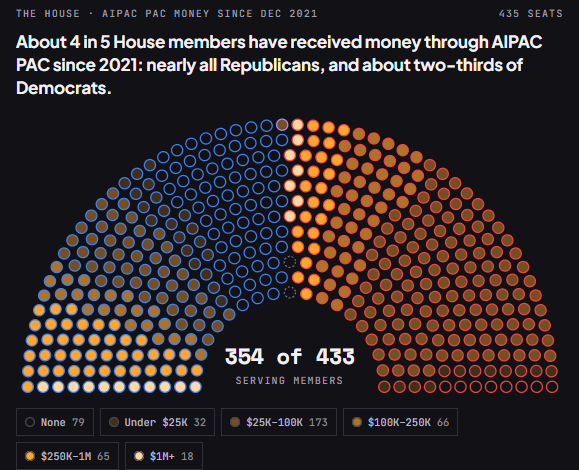
Moreover, the Israel lobby remains a potent force in American politics, and its influence transcends party lines. Hakeem Jeffries, who will assume speakership in January, is among the 354 of 433 sitting members of the House who have received funding from AIPAC, while el-Sayed will be the only Senator not to have taken money from AIPAC or another pro-Israel group such as J Street or the Republican Jewish Coalition.
AIPAC spent $120 million on this year’s midterms, and 245 of 267 candidates – 92% – backed by the group won their races on Tuesday, according to data from ‘Who Funds my Rep?’
“It doesn’t matter whether it’s the Democratic Party or the Republican Party,” Marandi told RT. “Both parties are utterly corrupt and bound to the ‘Epstein Class’, as I would call it. The issue isn’t so much who replaces whom, but that the mood among ordinary Americans has shifted. If the elites don’t take this into account, they will get into trouble.”
Did Iran win the elections?
Whether or not Iran benefits from the Republican loss depends largely on what Trump does next. The midterms may have rendered Trump a lame duck and dealt the GOP a generational defeat, but the president still retains the power to wage war, and that’s exactly what some of his most vocal ‘Israel-first’ allies want him to do.
There is “nothing to lose now,” pro-Israel influencer Laura Loomer wrote on X. “Time for President Trump to deal with Iran once and for all. Just do it.”
“Trump still has time to topple the [Iranian] regime and be remembered as one of the greatest US presidents,” Israeli analyst Dr. Eli David posted.
Trump has strongly suggested that he could restart the war after the midterms, telling supporters at a rally last week that “you’ll see Iran in a couple of weeks.” Speaking to Fox News on Wednesday, the president said that “in a short period of time, we have to do something large” against Iran, and that this would likely involve a “heavy hit.”
Should Trump go down this route, he is on a clear countdown timer. The new, Democrat-controlled Congress will be sworn in on January 3. Although Democrats have voted on several resolutions this year aimed at preventing Trump from waging war against Iran, these have all been destined to fail with Republicans in charge of both houses of Congress. Now, voters expect even their AIPAC-funded Senators and Representatives to follow through and rein in Trump’s war powers.
“If Trump chooses to attack Iran now,” Marandi told RT, “Democrats and some Republicans will be under some pressure to stand up to Trump, whether their funders like it or not.”
Tehran is not holding out hope for a course correction in Washington, but Tuesday’s election taught both parties a lesson that will reverberate for years to come: picking a fight with Iran is economically unviable, domestically unpopular, and political suicide for whoever is in the White House.
The bottom line
Trump and the GOP paid the ultimate price for agreeing to fight Benjamin Netanyahu’s war, with only the most die-hard Israel-firsters in the Republican camp suggesting that anything else was to blame for the shellacking the party received on Tuesday.
For Israel, the results are less clear. Netanyahu, or whoever succeeds him, may never get another American president as amenable as Trump. However, the Israelis still have a powerful lobby in Washington that will get to work on the new Congress, just as it has done for decades, to make extricating the US from the Iran war as difficult as possible.
How Iran defeated Trump’s Israel First GOP
By Max Blumenthal | The Grayzone | November 4, 2026
Trump launched a failed war on Iran for Israel last February, as his NSC director and Secretary of State Marco Rubio admitted. Now, the war has come home.
Iran’s control over the Strait of Hormuz became a vice grip around the neck of Trump and the GOP, especially in the heartland, where diesel prices are 70% higher than a year ago, and farmers have been forced to leave crops in the ground. 74% of Americans told pollsters the failed Iran war was a crucial or major factor in their vote tonight, and over 60% said they were voting against the Republicans because of it.
Democrats won senate races in Kansas and Nebraska, agro producer states where Republicans always roll to victory like a big wheel through a corn field. They also flipped a seat in Iowa, which Trump won by 12 points in 2024, giving them control of the senate.
A Democrat has taken the seat of Lindsey Graham, the late neocon who advised Netanyahu on how to manipulate Trump into the war, resoundingly defeating his sister in South Carolina. In this deep red Southern bastion, a Democrat has not won a senate race since the days of Fritz Hollings, a now-extinct brand of conservative populist who opposed the Gulf war and railed against the neocons.
Trump’s promise of $15 billion in aid to farmers getting hammered by surging diesel costs failed to stop the bleeding. And it’s now another cost of the war.
The GOP strategy of hanging Hasan Piker and his pro-Palestine politics like an albatross around the neck of Democrats was also doomed from the start, as most swing state voters had never heard of the podcaster. Worse, the ploy reminded them how fanatically Israel-centric the Republicans had become under Trump. The Democrats had much more success weaponizing Jeffrey Epstein as a symbol of Trump’s corruption whose ghost subtly invoked malign Israeli influence over the US government.
Hours before polls closed, Trump issued a desperate pledge to end $4 billion in annual aid to Israel. He seemed determined to repeat the con he pulled off in Dearborn, MI at the end of 2024, where he promised to end the Gaza genocide that Biden and Harris backed. Later that night, after the Democrats took the Senate, Trump gave up any pretense of independence and declared: “If people ever got tired of me in the US, I’ll move to Israel and become prime minister.”
Where the “special relationship” with Israel was once a matter of bipartisan unity among party elites, it’s become a polarizing wedge issue and a poison pill for any president. Trump was expected to launch a third assault on Iran immediately after the midterms, but his inner circle is now positioned in a circular firing line, with the neocons who served as Netanyahu’s proxies – Mark Levine, Mark Dubowitz, Ben Shapiro et al – blaming everyone but themselves for the Blue Wave, while pleading to remain in Trump’s good graces.
Tomorrow, Zionist forces will pull back and retrench. Schumer, Jeffries and presidential prospects like Josh Shapiro will become their next line of defense, and possibly their last reliable one in a party whose base is now passionate about ending America’s attachment to Israel.
De-escalating the conflict: What the OSCE, the UN, and Europe are (not) doing to prevent war
By Lorenzo Maria Pacini | Strategic Culture Foundation | November 4, 2026
Three signs of the same crisis
I want to ask all our readers – and you, the one reading this – a question: Do you want war?
Regardless of political, military, national, or ideological preferences, this is a serious question. Who really wants war?
We must all ask ourselves this question – and even more so, it should be asked by the politicians, technocrats, and power brokers in European chancelleries who continue to foment war.
We won’t discuss moral issues right now – we’ll write about those on another occasion. Let’s start with the institutional facts and try to understand whether and how anyone has attempted to bring about de-escalation – or not. Because when we read the Western press, there’s a constant impression that European leaders are the world’s best diplomats, constantly striving to solve global problems and ensure peace. Yet, there is a lack of sources, data, and concrete evidence. And where are all those institutions that were supposedly created to ensure peace for the entire world?
On September 30, 2026, Moscow delivered a non-paper to NATO declaring its readiness to deploy its entire arsenal, including nuclear weapons, should the Alliance attempt to isolate the Kaliningrad region. The document explicitly mentions the possibility of striking the decision-making centers of member countries from the very early stages of a conflict, and a senior European defense official noted that a threat phrased in these terms had not been heard since the end of the Cold War. Two weeks later, in Warsaw, the Supreme Allied Commander Europe responded that a Russian attack would be entirely futile. That same month, Russian border guards detained a German merchant ship in the Gulf of Finland for several hours.
Taken together, these incidents reflect the current dynamic: verbal deterrence on both sides, low-intensity incidents, and the absence of any mechanism capable of defusing them before they escalate into a crisis. This article argues that de-escalation between Europe and Russia does not depend primarily on the goodwill of governments. It depends on rebuilding a risk-containment architecture that Europe has allowed to erode over the course of twenty years. That architecture does not need to be invented from scratch: it already exists, in a dormant form, within the mechanisms of the OSCE and the United Nations system. These are the only multilateral forums in which Europe and Russia still sit together as full members, and for this very reason, they are the only ones capable of producing agreements that both sides can consider their own.
Each side interprets the other’s rearmament as offensive preparation. In Moscow, it is claimed that NATO and the European Union are preparing for a confrontation around 2030; in various Western military circles, the 2028–2030 window is specifically identified as the period during which a Russian attack would become possible. These are mirror-image predictions, and mirror-image predictions tend to become self-fulfilling, because every defensive measure confirms the adversary’s suspicion. It’s the security dilemma – elementary, Watson.
Compared to the Cold War, however, one decisive element is missing. Back then, the rivalry was framed by treaties, hotlines, notifications of military exercises, and mutual inspections. That framework has largely disappeared today. The INF Treaty expired in 2019, the Treaty on Conventional Armed Forces in Europe has been abandoned, the Open Skies regime has been gutted, and New START is set to expire in February 2026 without a successor. Two armed powers face off along a line stretching from the Barents Sea to the Black Sea, and they do so without a safety net.
Added to this is a more strictly political problem. Europe is the object of the conflict but not a party to the negotiations. Talks on Ukraine are mediated by Washington: on October 11, the U.S. president announced an energy truce that neither Moscow nor Kiev has confirmed; at the end of the month, a local ceasefire went into effect in Oleški, and a new round of negotiations is expected in mid-November. Europe appears in this context as a financier and potential guarantor, but remains far from the table where the terms are being defined. Yet whatever agreement emerges from that table will reshape the continent’s security order. The paradox is clear: Europeans have institutions built precisely for this purpose, yet they have stopped using them.
The absurdity of a conventional war – repetition helps
Before discussing the tools, it is worth stating frankly what rarely appears in official statements: for Europe, a conventional war against Russia would be a strategic absurdity, and Europe is not willing to fight it. We have already written this many times, it is true, but as the ancients used to say, “repetita iuvant” – repetition helps. This statement holds true in three respects.
The first is material. Four and a half years of war in Ukraine have shown that high-intensity conflict in our century is a war of attrition: victory is achieved by producing ammunition, drones, and equipment faster than the adversary can destroy them, and by replacing troops faster than they are lost. Russia has restructured its economy for this purpose. At the 2025 Hague Summit, European allies decided to raise defense spending to 5 percent of GDP by 2035: a ten-year timeframe that amounts to an implicit admission that such capacity does not exist today. Industries remain fragmented into dozens of incompatible weapons systems, stockpiles have been depleted to support Kiev, and the capabilities that make a modern campaign possible – from satellite intelligence to in-flight refueling – depend largely on the United States.
The second aspect is social and political. European societies are neither prepared nor willing to endure losses in the tens of thousands of men. Debates over the reinstatement of conscription in Germany and other countries show just how open and divisive the issue remains. No European government could ask its citizens to make a sacrifice on that scale for any purpose other than the immediate defense of its national territory.
The third implication is the most serious. A conventional war with a nuclear power does not remain conventional for long. The September non-paper states this in no uncertain terms: in a conflict of this kind, there would be no distant front line and no safe rear, because European capitals would be the front line. Preparing to defend oneself is legitimate and necessary. Believing that one can win such a war – or even simply fight it without losing what one intends to defend – is a miscalculation. For this reason, de-escalation is not just one moral choice among many: it is the only rational policy available to Europe. It remains to be determined what tools to use to achieve it.
The institutions Europe seems to have forgotten
The OSCE is the successor to the 1975 Helsinki Conference, the only forum in which, at the height of the bipolar confrontation, rival blocs managed to codify common principles: the inviolability of borders, the non-use of force, economic cooperation, and human rights. The 1990 Charter of Paris and the Charter on European Security adopted in Istanbul in 1999 added the principle of the indivisibility of security, according to which no state may strengthen its own security at the expense of others’. It is a principle that both Moscow and Western capitals invoke today, interpreting it in opposite ways. Precisely for this reason, it serves as a starting point: the parties do not debate whether security is indivisible, but rather what this entails in practice.
Behind these principles lies a technical framework that few outside of experts are familiar with. The Vienna Document governs the prior notification of military activities, the annual exchange of information on military forces, and assessment visits. The Forum for Security Cooperation is the venue where participating States discuss conventional arms control. The Conflict Prevention Center manages the communications network linking the capitals and can activate urgent consultation mechanisms in the event of unusual military activities. In 2016, the OSCE also launched a Structured Dialogue on threat perceptions, doctrines, and force deployments: an exercise that was discontinued but which nevertheless constitutes the closest precedent to what Europe needs today. Finally, it should be noted that the Organization has declared itself a regional arrangement under Chapter VIII of the United Nations Charter: its initiatives can therefore operate within a framework of universal legitimacy.
The most significant operational experience is the Special Monitoring Mission in Ukraine, active from 2014 to 2022 with several hundred unarmed civilian observers. Its limitations were real: restricted access, no coercive power, and reports contested by both sides. Yet for eight years, it was the only impartial, daily source of information on ceasefire violations in the Donbas, and its end – when Russia refused to consent to the renewal of its mandate – coincided with the transition to the full-fledged SMO. The Organization emerged weakened, with budgets approved only with great difficulty and presidencies hampered by cross-vetoes, but it is not dead. Russia neither withdrew nor was expelled, and the Swiss presidency for 2026 has openly stated its intention to prepare the OSCE to monitor a potential ceasefire: monitoring the contact line, verifying violations, and even providing electoral assistance. Foreign Minister Ignazio Cassis has acknowledged that the Organization can deploy only a few dozen people on short notice, while the front line stretches for about 1,300 kilometers. What is needed, therefore, is a significant political and financial commitment from the participating states. That commitment is exactly what Europe could and should offer.
Alongside the OSCE is the United Nations system, which Europeans tend to view as paralyzed by the Russian veto. This is an incomplete assessment. The Security Council adopted Resolution 2202 in 2015 in support of the Minsk Agreements and, in February 2025, Resolution 2774 calling for a swift end to the conflict – with Russia voting in favor. In July 2022, the Black Sea Grain Initiative, negotiated by the United Nations together with Turkey, demonstrated that even in the midst of fighting, a functional and limited agreement can hold for an entire year if it is managed by a joint coordination center with verifiable rules. Since September 2022, experts from the IAEA, a UN agency, have maintained a permanent presence at the Zaporizhzhia nuclear power plant – the only stable international presence on a front line. Geneva, the European headquarters of the United Nations, already hosted trilateral talks between the United States, Russia, and Ukraine in 2026.
From this perspective, the veto power takes on a new meaning. An observation mission authorized by the Security Council would require Russian consent, and for this very reason, Moscow could not view it as a hostile measure. The same applies to the consensus rule within the OSCE. What appears to be a limitation is in fact the condition of legitimacy: a safeguard mechanism that the other party helped establish is one that the other party has an interest in not sabotaging. This is the essential difference between a reassurance force composed of European national contingents – which Moscow has already declared unacceptable – and a multilateral presence with a UN mandate and an OSCE operational structure.
Four levels of de-escalation
On this basis, four levels of intervention can be distinguished, ordered from the most urgent to the most ambitious. For each, European multilateral forums already offer a starting point.
The first is incident management. The Baltic Sea is currently the theater most vulnerable to unintended escalation: heavy traffic, the Kaliningrad enclave, the so-called “shadow fleet,” undersea cables, and nearly daily aerial intercepts. In 1972, the United States and the Soviet Union signed the Agreement on Incidents at Sea at the height of the bipolar rivalry. It worked because it did not require trust, but only predictability, with rules on distances, maneuvers, and communications. A Baltic agreement modeled on that agreement, along with a direct line of communication between regional military commands and an identification system for military flights, would cost little and reduce tensions significantly. In February, Washington and Moscow agreed to reestablish military dialogue. Europeans, who live along the front lines, have even stronger reasons to demand their own channel, and the communications network of the Center for Conflict Prevention could provide the infrastructure without having to create anything new.
The second level concerns the transparency and clarity of red lines. The non-paper on Kaliningrad, regardless of its tone, makes clear where Moscow draws its line. Responding with equal clarity is not a concession. Thomas Schelling demonstrated this precisely: clear commitments stabilize, while ambiguity regarding limited actions destabilizes, because it invites testing the limits. Europe can explicitly state that it does not intend to isolate the enclave, reaffirm the transit guarantees already tested during the 2022 Lithuanian crisis, and revive – even on a voluntary and reciprocal basis – the notifications of major exercises provided for in the Vienna Document. The Forum for Security Cooperation is the natural venue for doing so.
The third level is arms control, where the vacuum is most dangerous. The end of the INF Treaty has reopened the issue of ground-based intermediate-range missiles: on the one hand, the announced deployment of U.S. long-range systems in Germany; on the other, Russian delivery systems in Belarus. These are weapons with flight times of just a few minutes, which compress the time available for political decision-making to the point of virtually eliminating it. A mutual and verifiable moratorium on their deployment on the continent would be the step offering the best cost-benefit ratio. Moscow had put forward such a proposal in 2019, but it was rejected due to the lack of verification guarantees. The challenge, then, is to establish a verification mechanism, and the resumption of the Structured Dialogue within the OSCE would allow this to be done in a format where Europeans are participants – not mere spectators – in Russian-American negotiations.
The fourth level is the political framework, and the crux of the matter remains Ukraine. There can be no de-escalation between Europe and Russia without a ceasefire in Ukraine, nor a stable ceasefire without a guarantee mechanism that Moscow does not interpret as a NATO advance. Three recommendations follow from this. Europe must secure a seat at the table, through a contact group or a small-group format with a clear mandate. It must prepare a package for the gradual easing of sanctions linked to verifiable steps, because sanctions are also a bargaining chip, and a chip that is never spent eventually loses its value. Above all, it must propose, as a guarantee mechanism, an OSCE-led monitoring mission authorized by the United Nations Security Council and substantially funded by European states. This would be the most concrete way to translate the financial burden that Europe already bears into political influence.
Fears, hopes, risks
A deliberate attack by Russia against an Alliance country – or vice versa – remains unlikely in the short term. More likely is the possibility that an incident in the Baltic – a drone straying off course, a ship-to-ship collision, a severed cable – could escalate into a crisis due to a lack of mechanisms capable of containing it. That is where the greatest risk lies, and that is where diplomacy can act immediately: an agreement on incident response, a direct hotline, declared red lines, and mutual notifications. The rest – the missile moratorium, a seat at the table, a guarantee mission under the auspices of the UN and the OSCE – requires time and political courage.
In 2025, the Helsinki Final Act marked its fiftieth anniversary, in a climate that made the occasion almost embarrassing. Yet that document was signed by adversaries who did not trust one another, and it was precisely for this reason that they established rules.
Europe – probably, perhaps, maybe, who knows – does not need to invent a new security order; it needs to go back to using the one it already has, and to do so before an incident renders that choice unnecessary.
Desperate For A Renewed Iran War, Israel Dusts Off The WMD Deception.
Just As It Did In Iraq And Syria , Israel Has Launched A New WMD Deception.
By Justin K.P. | The Dissident | November 4, 2026
Israel, increasingly desperate to have the U.S. launch a new war on Iran, has dusted off the WMD deception sharing clearly manipulated “intelligence” with the U.S. claiming that Iran is planning on using chemical weapons.
Even the New York Times acknowledged that “Some American officials see the Israeli intelligence as part of a pressure campaign by Prime Minister Benjamin Netanyahu’s government to persuade the Trump administration to return to major combat operations against Iran” and that several Gulf State countries that Israel shared the “intelligence” with “doubted that Iran was developing plans to use chemical weapons and believe Israel is trying to push the United States and its partners to return to a more intense phase of the war.”
“For some American officials, the talk of chemical weapons threats from Iran has evoked the flawed U.S. intelligence in 2002 about Iraq’s weapons of mass destruction”, the paper added.
In fact, it was Israel, that played a large role in collaboration with its neo-conservative allies in the Bush administration to cook up that WMD deception used to justify the 2003 invasion of Iraq.
Journalist Bob Dreyfuss in 2003 reported that, “feeding information to the Office of Special Plans (OSP)”, the special unit created in the Pentagon to launder the deception “was a secret, rump unit established last year in the office of Prime Minister Ariel Sharon of Israel. This unit … which has not previously been reported–prepared intelligence reports on Iraq in English (not Hebrew) and forwarded them to the Office of Special Plans” adding, “This secretive unit,… may well have been the source of the forged documents purporting to show that Iraq tried to purchase yellowcake uranium for weapons from Niger in West Africa, according to the former official”.
The Guardian reported at the time that the OSP “forged close ties to a parallel, ad hoc intelligence operation inside Ariel Sharon’s office in Israel, specifically to bypass Mossad and provide the Bush administration with more alarmist reports on Saddam’s Iraq than Mossad was prepared to authorize,” adding, “The Israeli influence was revealed most clearly by a story floated by unnamed senior US officials in the American press, suggesting the reason that no banned weapons had been found in Iraq was that they had been smuggled into Syria. Intelligence sources say that the story came from the office of the Israeli prime minister”.
The LA Times in 2005 reported that “A former senior Israeli military intelligence official asserted Thursday that the nation’s spy agencies were a ‘full partner’ to the United States and Britain in producing flawed prewar assessments of Iraq’s ability to mount attacks with weapons of mass destruction”.
Similarly, Israel played a key role in cooking up the “red line” comment used to justify the covert dirty war on Syria.
When Obama said that his “red line” for intervention in Syria would be the use of chemical weapons on rebels from the former Assad government, the journalist Charles Glass reported that a former US ambassador to the Middle East told him that this was seen as an “open invitation to a false-flag operation”.
The “red line” comment “started with Israeli officials, who used the phrase in private discussions with their American counterparts”, according to a report in the Wall Street Journal at the time.
In 2013, when the red line was crossed in Ghouta, Syria, where rockets containing Sarin were launched, killing hundreds – likely from rebel-controlled territory – it was Israel that “shared” the dubious intelligence reports blaming Assad’s forces for the attack.
Journalist Seymour Hersh reported at the time that “A former senior intelligence official told me that the Obama administration had altered the available information – in terms of its timing and sequence – to enable the president and his advisers to make intelligence retrieved days after the attack look as if it had been picked up and analysed in real time, as the attack was happening,” adding, “One high-level intelligence officer, in an email to a colleague, called the administration’s assurances of Assad’s responsibility a ‘ruse’. The attack ‘was not the result of the current regime’, he wrote.”
This was backed up by Jeffrey Goldberg in The Atlantic, who reported that, “Director of National Intelligence James Clapper interrupted the president’s daily briefing to tell him that the intelligence on Syria’s use of sarin gas was ‘not a slam dunk’” adding that this was a “carefully chosen term” referring to when “CIA Director George Tenet infamously told President George W. Bush that intelligence leading up to the 2003 invasion of Iraq was a ‘slam dunk.’”
According to the Guardian at the time, “The bulk of evidence proving the Assad regime’s deployment of chemical weapons – which would provide legal grounds essential to justify any western military action – has been provided by Israeli military intelligence”.
Hacked emails later showed that at the time, Samantha Power, then US ambassador to the United Nations, thanked the ambassador of Israel to the UN, Ron Prosor, for sharing “technical information … of significant value in dealing with the Syrian chemical arsenal.”
“‘For my non-technical brain, this is extremely helpful,’ she wrote. ‘I know that these options are being worked aggressively,’ she continued — a reference to her ongoing crusade to enforce Obama’s ‘Red Line’ policy by bombing Syria and assisting the Al Qaeda-led armed opposition”, journalist Wyatt Reed reported.
Desperate for Trump to carry out regime change in Iran, Israel yet again is dusting off the same deceptive playbook in order to have the U.S. carry out the final war on the “clean break” hit list.
US Elections Offer Choice Between ‘Bad and Worse’ as Both Parties Serve War Lobby – ex-UN Expert
Sputnik – 04.11.2026
Both parties are “beholden to the military-industrial complex and to the AIPAC lobby,” and “the problem with the American two-party system is that most of the time it is a choice between bad and worse,” Alfred de Zayas, a retired independent UN expert and prolific commentator, told Sputnik, commenting on the results of Tuesday’s midterms.
“Both Republican and Democratic candidates advocate war over diplomacy, support Wall Street over Main Street, and promote Israel over Palestine. Very few address the needs of the American people, the key issues of education, public health, taxation, infrastructure and job-creation,” the observer stressed.
While de Zayas has little hope that the new Democrat-controlled Senate, led by Senator Chuck Schumer, will bring positive changes, he nevertheless welcomes Republicans’ loss of Congress. He believes the result will limit Trump’s ability to pursue his agenda following his “disappointing” failure to resolve the Ukraine crisis, which he traces to Democratic policies, and the decision to launch a new war against Iran.
De Zayas fears a range of potential “Apocalyptic scenarios” for Iran moving forward, including the potential use of nuclear weapons and the conflict’s escalation into a global crisis, unless the US and Israel agree to a diplomatic climbdown. “In such desperate situations, either one takes the offensive and unleashes World War III, or one accepts reality, cuts one’s losses and resigns.”
While the UN has “been ineffective” on Iran, Gaza and other crises, it’s nevertheless needed now “more than ever” to prevent them from spiraling.
“We need an international peace conference,” de Zayas urges. “This is the moment for the Global Majority, for BRICS, the SCO, the OIC, the Non-Aligned Movement to appeal to all parties to exercise restraint.”
Ghalibaf warns US government not to betray voters who rejected war
Al Mayadeen| November 4, 2026
Americans rejected war at the ballot box, Iranian Parliament Speaker Mohammad Bagher Ghalibaf said on Wednesday, warning Washington that any attempt to defy that verdict would meet a forceful Iranian response.
Writing on X after Democrats won the Senate in Tuesday’s midterm elections, Ghalibaf said voters moved by “conscience or the cost of living” had said “NO TO WAR,” a message he stressed Iran endorses. Should the US government betray its own public’s will to serve “international paymasters and blackmailers,” he cautioned, it would discover that Iran’s refusal “comes with a Nightmare.”
Trump, for his part, acknowledged that the war on Iran had weighed on Republicans. “Iran was a piece of it,” he told The Wall Street Journal on Tuesday night when asked whether the war had shaped the outcome.
He nonetheless stood by his decision to launch the aggression. “I did the right thing. I would have done it again,” he said. He argued that soaring fuel prices, a consequence of the war, had hurt his party more than the war itself and rejected the idea that the losses were a verdict on his presidency. “The biggest issue is that I wasn’t on the ballot,” he insisted.
Democrats take Congress
The Associated Press called the Senate for Democrats late Tuesday. They gained seven seats, many in states Trump carried comfortably in 2024.
James Talarico defeated Trump-backed Ken Paxton in Texas, giving the party its first Senate win there since 1988, and Adam Hamilton became the first Democrat elected to the Senate from Kansas since 1932. Democrats also flipped seats in North Carolina, South Carolina, Ohio, Iowa and Maine, where Troy Jackson unseated Susan Collins.
Democrats later secured the House as well. AP’s latest count puts them at 220 seats to Republicans’ 128, past the 218 needed for a majority, with 25 seats gained so far.
Counting continues in several races.
War, prices drove the vote
According to the NBC News Exit Poll, about 74% of voters described the US war on Iran as a crucial or major factor in their congressional vote.
In the same poll, 79% said inflation was causing hardship for their families, and 62% held Trump responsible for high prices. His approval rating stood at 38%, the lowest for a sitting president on Election Day since 2008.
Voters felt the war most directly at the pump. Gas averaged $4.16 a gallon on Monday, up from $2.98 before the war began.
Trump has nonetheless left the door open to renewed escalation. Hours before polls closed, he told the Financial Times that the US had no immediate plans to bomb Iran but was “locked and loaded if we need to go.”
His remarks came as Israeli Prime Minister Benjamin Netanyahu hinted at an attack later this week. Reports also said Washington had told Gulf states to prepare for a short, intense campaign after the vote.
Since the US and “Israel” launched the aggression on February 28, the war has cost the US military at least $47.1 billion, according to a CENTCOM estimate that excludes extensive damage to US bases. The Pentagon has admitted to at least 21 US soldiers killed.
Featured Video

John Mearsheimer: Why Russia Gains By Hitting Ukraine Harder
or go to
Aletho News Archives – Video-Images
From the Archives
A Climate Scientist Who Engages Skeptics
By Judith Curry | November 27, 2009
An open letter to graduate students and young scientists in fields related to climate research:
Based upon feedback that I’ve received from graduate students at Georgia Tech, I suspect that you are confused, troubled, or worried by what you have been reading about ClimateGate After spending considerable time reading the hacked emails and other posts in the blogosphere, I wrote an essay that calls for greater transparency in climate data and other methods used in climate research. The essay is posted over at climateaudit.org.
What has been noticeably absent so far in the ClimateGate discussion is a public reaffirmation by climate researchers of our basic research values: the rigors of the scientific method (including reproducibility), research integrity and ethics, open minds, and critical thinking. Under no circumstances should we ever sacrifice any of these values; the CRU emails, however, appear to violate them. … continue
Blog Roll
 Aletho News
- Ukraine destroying itself: every attack on the Crimean Bridge will come at a price
- NATO capital under protest siege, so NATO escalates war
- A Climate Scientist Who Engages Skeptics
- John Mearsheimer: Why Russia Gains By Hitting Ukraine Harder
- Argentina’s Perito Moreno Glacier Joins Antarctica and Arctic In Defying Doomsday Melt Claims
- ‘Chinagate’ Is Here
- Iran, four other countries condemn US plans to deploy weapons in outer space
- US media brings back the Iraq war playbook and why it won’t work
- Zakharova schools German FM on history basics
- Germany to produce drones for Ukraine
- If Americans Knew
- An error has occurred; the feed is probably down. Try again later.
- No Tricks Zone
- Alarmist Climatologists In Shock! 2026 Atlantic Hurricane Season Sees Lowest Count In 101 Years
- New Study: Modern Temps Are Among The Coldest Of The Last 10,000 Years In East Central Europe
- Germany’s Renewable Energies Lead to 1.4 Billion Euro Electric Power Trade Deficit
- Argentina’s Perito Moreno Glacier Joins Antarctica and Arctic In Defying Doomsday Melt Claims
- New Study: Barents Sea Temperatures Were Warmer And Sea Ice Less Extensive In The 1700s Than Today
- German Authorities Start Initiative To Evaluate Public Register For Climate “Disinformation” Spreaders!
- Zonal Asymmetry of Temperature Change in the Antarctic Circumpolar Current
- New Study: The Net Fossil Fuel Contribution To Rising Atmospheric CO2 Has Been Zero For 500 Years
- Germany’s Green Energy Transition Becoming Increasingly Expensive…Another 6 Trillion Euros!
- Sudden Stratospheric Warming, Powerful El Niño Combination May Lead To Extreme Europe Cold, Energy Crisis!

