Reporting of the RAF Fairford arrests blows the idea of a ‘free press’ out of the water
When the establishment media jettisons even the semblance of critical distance from the state
By Jonathan Cook | September 30, 2026
It’s easy to forget that the western media – the so-called “free press” – likes to distinguish itself from media in authoritarian regimes on the basis that, unlike them, it asks critical questions of the powerful, reports facts objectively, and formulates its analyses dispassionately.
They do propaganda, we do news – or so the western media argues.
The feverish coverage since five men were arrested in the early hours of Sunday morning close to RAF Fairford in the UK is blowing a very big hole in that claim.
Here are the known facts so far.
Three white vans, bearing the logo of a genuine fuel transit company, were spotted by a local farmer on the road outside her property as she returned from a party. Police arrived promptly and arrested the men, who were all British nationals in their twenties.
On Tuesday, it emerged that one of the arrested men actually called the police earlier – seemingly the reason officers were on the scene so quickly.
Although the men were initially arrested on explosives charges, no “viable” explosives were found. Although they were arrested on terrorism charges, which allow for 14 days of detention, they were released on bail under normal criminal laws in less than two days.
It has also emerged that the men had several empty “barrels” in their vans, plus one that contained what police described disturbingly as an “accelerant”.
Actually, that was simply a reference to petrol. The stuff that goes into vehicles to make them accelerate.
British prime minister Andy Burnham held a rare national emergency Cobra meeting over the incident.
Meanwhile, the Trump administration got involved because RAF Fairford, despite its name, is in reality a US air base from which American planes are waging an illegal war of aggression against Iran, with the UK’s blessing.
US Secretary of state Marco Rubio has said the incident “clearly involves the hands of a foreign actor”. When asked whether Iran was that actor, Trump replied: “It might be.” He added: “I know the answer… I can be very specific, but I’d rather not say.”
According to a report in the New York Times, “American and British intelligence services worked with Israel and Western countries to discover the threats against US bases, including ones in Germany.” [my emphasis]
Despite these sparse facts, the British media have uniformly rushed to a single conclusion: that this was almost certainly part of an Iranian terror plot to target the US airbase and its planes. The only room for debate allowed is whether the five men were witting or unwitting actors in that plot.
As the Guardian reported in its Wednesday edition, referring to this as a “complex investigation”: “An Iranian link to the bizarre events in the Gloucestershire countryside over the weekend is seen as increasingly likely.”
As context, let us note the following: that British and US officials have every interest in trying to hype this incident as an Iranian “terror plot”, whatever the actual evidence suggests.
Why? Because the US is waging an illegal war on Iran, and the UK is allowing it to do so from British soil. Under the rules of war, Iran has every right to attack RAF Fairford.

If the British state and billionaire-owned media were actually serving as a truly “free press”, they would be offering the context that RAF Fairford is a legitimate military target and that any attack on it by Iran would not constitute terrorism.
Of course, none have done so.
Instead, they have loyally regurgitated the British and US security services spin of a “terror plot” – based on no tangible evidence at all – that paints Britain and the US as the victims of a sinister and unwarranted act of Iranian aggression.
But context aside, an objective, sceptical media – a “free press” – would be reserving judgment on what had happened. It would be asking difficult questions. It would be offering plausible counter-narratives.
Again, none of this is happening. In the British media, there has been a lemming-like rush towards accepting uncritically the very conclusions that best serve British and US state interests.
The constant highlighting of a terrorism connection to the arrested men – for which there is no apparent evidence – is precisely the kind of coverage you would expect from state media in an authoritarian regime. This is about whipping up a public mood of fear, not about transparent fact-finding.
Notably, unlike the British media, the New York Times report does allow for another possibility, even if it instantly ignores it and then joins the British media in treating what evidence there is as proof of an Iranian terror plot.
The Times opens with a question: “The potential ambiguities – were the men Iranian operatives, petty gas thieves, or both? – added to the confusion surrounding the arrests that the authorities have yet to fully explain.”
“Petty gas thieves”! Men in vans with empty barrels close to a farm in the middle of the night. Is it possible they could simply be criminals?!
In fact, this conjecture has been all over social media since the first reports of the men being arrested surfaced. As new details have emerged, those suspicions have only grown.
And yet Britain’s “free press” has uniformly ignored this counter-theory in favour of the US and British security services’ narrative.
Doubtless, British journalists covering this incident would call the idea that this was simply a criminal group caught in the act unhelpful “speculation”.
But how is their no-more-plausible, and possibly less plausible, theory that this was an Iranian terror plot not equally speculation – if in their case, speculation that happens to be extremely helpful to the British and US security establishments?
There are other theories we could posit too, given the known facts. Israel, which originally pushed for the illegal and disastrous war on Iran, has been looking for a way to persuade the Trump administration to return to a full-scale bombing campaign.
Elmo Sold mRNA Jabs to Your Toddler. Now They Are “Off-Label.”
How Sesame Street, CNN, and federal health officials turned a children’s vaccine campaign into a one-way lesson in trust.
By Sayer Ji | September 30, 2026
How a $240 million messaging machine put a three-year-old puppet to work selling an mRNA shot to parents of infants — and what the government has quietly admitted since.
On June 28, 2022, Sesame Street posted a 60-second video to its YouTube channel titled “Elmo Gets the COVID-19 Vaccine | PSA.”
It’s a well-made piece of persuasion. Elmo, who has been three and a half years old since 1984, shows off his “super duper” bandage. There “was a little pinch. But it was okay.” Then his father, Louie, looks into the camera and speaks to every hesitant parent in America:
“I had a lot of questions about Elmo getting the COVID vaccine. Was it safe? Was it the right decision?”
Eleven seconds later, the doubt has been resolved for you:
“I learned that Elmo getting vaccinated is the best way to keep himself, our friends, neighbors and everyone else healthy and enjoying the things they love.”
A hug follows. Then an announcer: “It’s okay to have questions about COVID vaccines for your kids.”
That’s the move worth studying. The ad takes the parent’s instinct to ask questions, gives it to a beloved puppet, and answers it before the parent has a chance to. It presents doubt so it can close it down.
This was not a whimsical one-off from a children’s television workshop. It was one output of what its own organizers called the largest communications program in our nation’s history, built with federal public-health agencies, a major medical trade association, and tens of millions of corporate dollars.
Four years later, Pfizer-BioNTech’s product is no longer authorized for children ages six months through four years. Federal guidance and product labeling have also narrowed which pediatric uses are on-label, a shift sharply at odds with the PSA’s broad, categorical reassurance. Nobody made a puppet video about that.
This is the story of who built the campaign, what it cost, and what came after.
Part I: Who Was Behind It
Sesame Workshop’s own press release is candid about who was in the room. The PSA was released “in collaboration with the Ad Council and COVID Collaborative’s COVID-19 Vaccine Education Initiative,” and it was “produced in partnership with the Centers for Disease Control and Prevention (CDC) and American Academy of Pediatrics (AAP).”
Five institutions. Each one deserves a name and a face.
Sesame Workshop
The nonprofit behind Sesame Street produced and released the spot. Its campaign lead was Dr. Jeanette Betancourt, Senior Vice President of US Social Impact. Its president at the time, Sherrie Westin, was named CEO in July 2024.
The clearest statement of what Sesame thought it was offering came from its own chief marketing officer. Launching an earlier round of vaccine PSAs, Samantha Maltin, EVP and CMO, said the goal was to:
“… harness the power of Sesame Workshop and the reach of the Ad Council…”
Harness the power. The asset being put to use was fifty years of trust that parents and children have placed in these characters.
The Ad Council
The Ad Council turns corporate media budgets into “public service” messaging. Its president and CEO, Lisa Sherman, was the campaign’s public face. On the Elmo spot:
“It’s important that parents feel informed and confident about what the COVID-19 vaccines mean for their families, and we are proud to work with our partners, medical experts – and of course Elmo – to spread that message.”
She also named the urgency: this was “an important decision many need to make in advance of the upcoming school season.”
COVID Collaborative
The COVID Collaborative is a bipartisan assembly of former officials, and it convened the vaccine education initiative with the Ad Council. Its CEO is John Bridgeland, former Director of the White House Domestic Policy Council. Its president is Gary Edson, and its co-chairs are former Idaho Gov. and Sen. Dirk Kempthorne (R) and former Massachusetts Gov. Deval Patrick (D). The Collaborative is a project of UNITE, chaired by Tim Shriver.
The CDC
The CDC was a named production partner, and it wasn’t a passive one. According to the campaign’s organizers, the CDC provided scientific guidance on all aspects of the campaign, and its brand appeared on select creative assets.
The American Academy of Pediatrics
The AAP, the pediatricians’ professional association, was the other named production partner. Its president in 2022 was Dr. Moira Szilagyi. Looking back later, she said: “Somewhere what got lost in our country, I think, was what a miracle these vaccines were.”
Keep the AAP in mind. It comes back in Part IV.
Part II: Follow the Money
The Elmo spot was built on a large funding structure, and its size helps explain how thoroughly this message saturated American media.
The corporate fund. On November 23, 2020, before any vaccine was authorized, the Ad Council announced a $50 million fund for the COVID-19 Vaccine Education Initiative, created with the COVID Collaborative. By February 2021 it had exceeded that goal.
The COVID Collaborative reports more than $52 million raised. The leading contributors it names are Amazon, Apple, Bank of America, Cisco, CVS Health, Facebook, General Motors, Google and YouTube, the Humana Foundation, NBCUniversal/Comcast, Salesforce, Verizon, Walgreens, and Walmart.
Two of those names stand out. CVS Health and Walgreens both gave the shots the campaign was promoting in their own pharmacies.
The donated media. The money was only the seed. By October 26, 2021, the initiative had surpassed its goal of $240 million in donated media and related publicity. Donors of airtime and ad inventory included Disney (ABC, ESPN, Hulu), FOX, NBCUniversal and Telemundo, ViacomCBS, WarnerMedia, Facebook and Instagram, Google and YouTube, TikTok, Snapchat, Spotify, Pinterest, LinkedIn, and The Weather Channel.
Several of the same platforms that donated airtime and advertising inventory to the vaccine-education campaign were simultaneously under public and private pressure to enforce COVID-19 misinformation rules against specifically identified individuals, including people named in CCDH’s ‘Disinformation Dozen’ report. YouTube later [restored] my channels and stated that, after review, they did not violate its Community Guidelines.
The taxpayer layer. Alongside the private effort, HHS ran its own $265 million COVID public-education campaign starting in summer 2020. That included a $250 million NIH award to the Fors Marsh Group, which created the “We Can Do This” brand, all paid for through a $300 million interagency agreement drawing on CDC’s CARES Act funds. Under its “Vaccinate with Confidence” framework, the CDC funded more than 200 partners. Across the March 2021–December 2022 rollout, it funded 110 primary and 1,051 subrecipient partners at the national, state, and community level.
A note on accuracy. I have not found documentation that Pfizer or Moderna directly paid for the Elmo spot, and the campaign materials don’t list them as partners. Pfizer does appear as a Sesame Workshop donor in later years, in the $100,000–$249,999 band of its 2024 impact report. That’s worth knowing, but it’s a separate fact. The documented structure is damning on its own: corporate money, federal science guidance, and a medical trade association, all speaking through a puppet.
Part III: It Wasn’t One Ad
The Elmo spot was the youngest-audience edge of a sustained effort to put Sesame Street characters to work for vaccine messaging.
- November 2021: CNN and Sesame Street co-produced a family town hall, “The ABCs of COVID Vaccines.” That same month, Big Bird delivered his own pro-vaccine message to young viewers, which drew public criticism from Sen. Ted Cruz.
- June 2022: Elmo’s PSA, released days after the FDA’s emergency authorization for children as young as six months.
- Later: Sesame Workshop, the Ad Council, COVID Collaborative, and CDC launched a further series of PSAs with Elmo, Louie and other Muppets, “created in close partnership with the CDC.”
The criticism started right away. Cruz accused Sesame Street of having Elmo “aggressively advocate” for shots in young children and noted that the spot cited no scientific evidence. The comedian Russell Brand put it more sharply:
“When it starts getting into complex territory that involves the power of the state, the influence of pharmaceutical companies, the impact of coronavirus on young children — these are not issues I want resolved by members of Elmo’s family.”
The critics were dismissed as cranks at the time. Here is what the government has said since.
Part IV: The Walk-Back Nobody Advertised
There was no $240 million campaign for any of what follows. No Muppets and no hug at the end. It came out as label changes, regulatory memos, and footnotes in clinical guidance.
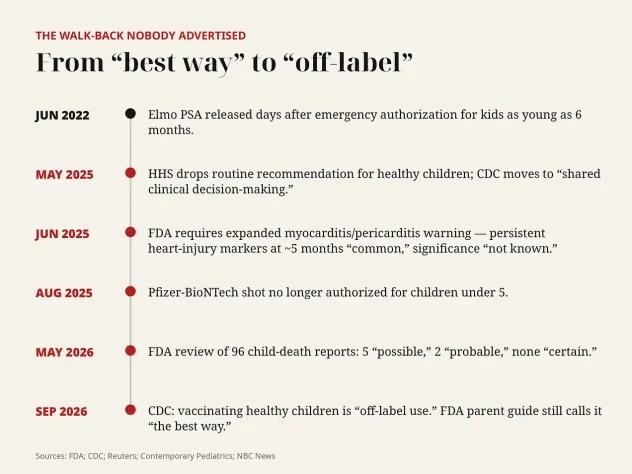
The cardiac warning got stronger
On June 25, 2025, the FDA required and approved expanded warnings about myocarditis and pericarditis on Pfizer’s Comirnaty and Moderna’s Spikevax. The new label estimates about 8 cases per million doses in people aged 6 months through 64 years, and about 27 per million in males aged 12 through 24, in the week after vaccination.
The most important sentence isn’t about frequency, though. It’s about what happened to the hearts afterward:
“… at a median follow-up of approximately 5 months post-vaccination, persistence of abnormal cardiac magnetic resonance imaging (CMR) findings that are a marker for myocardial injury was common. The clinical and prognostic significance of these CMR findings is not known.”
Read it twice. Five months out, markers of heart-muscle injury were “common,” and the agency says their long-term significance is “not known.” This isn’t a critic’s claim. It comes from an FDA-funded, FDA-co-authored study, and it’s now printed on the label.
The spot told parents “there was a little pinch. But it was okay.” Nobody in the ad said “unknown long-term cardiac significance.”
The authorization for the youngest children was pulled
On August 27, 2025, Pfizer-BioNTech’s COVID vaccine was no longer authorized for children under 5. CDC’s current clinical guidance puts it plainly: “Pfizer-BioNTech COVID-19 Vaccine is no longer authorized in the United States for children ages 6 months–4 years.”
That is the age group the Elmo spot was released to reach. It went out days after emergency authorization opened the shots to children as young as six months. Four years later, one of the two products it promoted to parents of those children can’t legally be given to them.
Healthy children are now “off-label”
The broad “everyone six months and older” recommendation is gone. In May 2025, HHS dropped the routine recommendation for healthy children, and the CDC moved to what it calls shared clinical decision-making.
CDC’s current guidance, updated September 23, 2026, limits Moderna’s approval for the youngest children to those with “at least one condition that places them at increased risk for severe COVID-19.” Then it states the conclusion outright:
“Vaccination of children 5-11 years of age with any product other than Spikevax or Comirnaty and vaccination of children in this age group without high-risk conditions is off-label use.”
“Vaccination of persons 12-64 years of age without high-risk conditions is off-label use.”
In 2022, the message was that vaccinating Elmo was “the best way to keep himself, our friends, neighbors and everyone else healthy.” In 2026, the CDC’s own wording is that giving the shot to a healthy child is off-label.
The deaths question
On November 28, 2025, Dr. Vinay Prasad, then director of the FDA’s Center for Biologics Evaluation and Research, sent staff a memo headed “Deaths in children due to COVID-19 vaccines and CBER’s path forward.” He wrote that career staff “have found that at least 10 children have died after and because of receiving COVID-19 vaccination,” based on an initial review of 96 child deaths reported to VAERS between 2021 and 2024.
The FDA’s formal analysis, made public in May 2026, came back more cautious. Of the 96 reports reviewed, none were classified as “certain.” Five were classified “possible” and two “probable,” mostly involving myocarditis, with an average age of 13. The agency stressed that these classifications don’t prove causation.
Media coverage framed that result as a debunking. Set the headline aside, though. The FDA’s own conservative review, using WHO causality criteria, still found seven child deaths it could not rule out as vaccine-related, and it called two of them probable.
And yet, still being promoted
This is where the irony stops being subtle.
Visit the FDA’s parent-facing page today, Vaccines for Children – A Guide for Parents and Caregivers. The COVID-19 vaccine is still listed alongside measles and polio among “the most commonly administered vaccines.” And parents are still told:
“Getting a COVID-19 vaccine is the best way to prevent COVID-19, including the potential consequences of hospitalization and death.”
That’s Louie’s line almost word for word, four years later, from the same agency whose label now carries the cardiac warning, whose authorization for under-5s was pulled, and whose own reviewers flagged seven child deaths.
The American Academy of Pediatrics, a production partner on the Elmo spot, hasn’t backed off either. As of September 2026, the AAP recommends COVID-19 vaccination for “all infants and children ages 6 months through 23 months,” and for “anyone ages 2 to 18 who isn’t at risk but whose parents or guardian wants them to get a shot.”
So we have two different postures at once. The regulator has narrowed approval, expanded the warning, and reclassified healthy-child use as off-label. The professional association that helped make the puppet ad still recommends the shot for every baby. And the FDA’s own parent guide still uses the 2022 talking points.
Part V: What They’ll Say — and Why It Doesn’t Save Them
Serious readers deserve the strongest counterargument, so here it is.
CDC’s guidance cites a retrospective cohort of more than 4 million people aged 16–25 from 2020 to 2025. It found myocarditis incidence of 0.05% after COVID illness versus 0.005% after vaccination. In other words, the infection carries a higher myocarditis risk than the shot.
That’s a legitimate data point and I’m not going to pretend it doesn’t exist. It doesn’t answer the question this piece is asking, for three reasons.
First, the comparison is an average over a population of teenagers and young adults. It says nothing about a healthy toddler with near-zero risk of severe disease. That’s the child this campaign targeted, and the child for whom the CDC now calls the shot off-label.
Second, it doesn’t address the finding printed on the label: persistent markers of heart-muscle injury at five months, of “not known” significance. The open letter discussed below says there are “no studies demonstrating prevention of hospitalization or death” in children. If that’s right, an unknown cardiac risk is being weighed against a benefit that was never shown.
Third, and most importantly, the argument here doesn’t depend on any contested injury number. It depends on an asymmetry. When the product was being promoted, it got a puppet, $50 million, a quarter-billion in donated airtime, the CDC’s logo, and the pediatricians’ endorsement. When the regulator narrowed the product, it got a label revision and a footnote. The public was sold a certainty the evidence never supported, and was never told when that certainty was withdrawn.
That isn’t public health communication. It’s a marketing campaign that never issued a correction.
Part VI: The Petition — Why I Signed
Earlier this month, 168 physicians, scientists, researchers, lawmakers, and health-freedom advocates, representing more than 63 million followers, sent an open letter to HHS Secretary Robert F. Kennedy Jr. and President Trump demanding removal of the mRNA platform. The effort was coordinated by Dr. Mary Talley Bowden. The signatories include Rep. Thomas Massie, former Rep. Marjorie Taylor Greene, Louisiana Deputy Surgeon General Dr. Sean Troxclair, Dr. Peter McCullough, Dr. Robert Malone, Dr. Aseem Malhotra, Tucker Carlson, and others.
I’m one of them, and I want to explain why.
The letter’s first demand is to “ban mRNA/gene therapy-derived technologies for all vaccines.” That includes the products still being given to children. Its other demands are to end the PREP Act declaration and its “ironclad liability shield for manufacturers and administrators,” ask Congress to repeal the PREP Act, ban direct-to-consumer pharmaceutical advertising, end the incentive structures that push providers toward medical coercion, and end conflicts of interest at the CDC, FDA, NIH, and NIAID.
On children specifically, the letter makes the point this whole piece has been building toward:
“Parental choice is not realistic when parents are not getting informed consent on the true risks of these products.”
It also takes on the “shared clinical decision-making” framework directly:
“By treating the decision to inject a child with mRNA as a ‘shared decision,’ while treating routine injections as the default, a dangerous legal precedent is being set that assigns powers to the federal government that have historically belonged solely to parents.”
According to the letter, more than 50 million Americans received mRNA COVID shots this year, including about 7 million children, and HHS has awarded $1.24 billion in contracts to Pfizer for future mRNA shots, “including for children.”
The Elmo spot is exactly why that line about informed consent matters. You can’t give informed consent to a hug from a puppet. A one-minute ad that turns a parent’s hesitation into a script and then answers it in eleven seconds isn’t informing anyone. It’s persuasion aimed at the people least able to push back: parents who trust Sesame Street and children who love Elmo.
The letter isn’t the only pressure. Children’s Health Defense’s citizen petition, asking the FDA to revoke the Pfizer and Moderna licenses, has been pending since December 8, 2025 and has drawn more than 104,000 public comments in support. On September 25, the Independent Medical Alliance called on the CDC to immediately withdraw its “off-label” recommendation for healthy infants, children, and adults.
HHS’s response to the open letter, through press secretary Emily Hilliard, was that Secretary Kennedy “believes mRNA products warrant heightened scientific scrutiny,” and that HHS had “wound down investments in mRNA vaccines for upper respiratory viruses because the technology does not effectively protect against infection from rapidly mutating viruses such as COVID-19 and flu.”
Think about that sentence next to the Elmo spot. The federal health department now says the technology “does not effectively protect against infection” from COVID. In 2022, a puppet told America it was “the best way to keep himself, our friends, neighbors and everyone else healthy.”
Heightened scrutiny isn’t enough. A product that federal officials now concede doesn’t reliably prevent infection, that carries a cardiac warning with unknown long-term significance, whose own regulator calls it off-label for healthy children, and whose makers are protected from liability should not be given to children at all.
Conclusion: The Correction That Never Aired
Every institution in the Elmo spot is still operating. Sesame Workshop is still making children’s programming. The Ad Council is still running “public service” campaigns. The CDC’s logo is still on its creative. The AAP still recommends the shot for every infant. The FDA’s parent guide still repeats Louie’s line.
None of them has produced a PSA that says: We told you this was the best way to protect your baby. Since then the label has been changed to warn about heart injury. The authorization for the youngest children was withdrawn. The government now calls this use off-label for healthy kids. We’re sorry we used Elmo to tell you otherwise.
That’s the one-minute spot this country is owed. Until it airs, the original belongs where I’ve put it: in the Hall of Fame of the Covid-era Mockingbird Media, as a case study in what happens when institutions that are supposed to earn a parent’s trust decide to manufacture it instead.
Watch it again. Listen for the moment Louie asks, “Was it safe?”
It was a good question. It still is. They just never let him wait for the answer.
There’s a drought in academia: A drought in honest research on the subject of drought and other weather extremes
By Thomas J Shepstone | Energy Security and Freedom | September 24, 2026
A little over a year ago, a study titled “Warming Accelerates Global Drought Severity” was published in Nature, a climate-consumed journal that has lost all credibility among serious folks. The authors included multiple academics from the University of Oxford in the UK, an elitist institution if there ever was one.
The abstract of the study said this (emphasis and paragraphing added):
Drought is one of the most common and complex natural hazards affecting the environment, economies and populations globally. However, there are significant uncertainties in global drought trends, and a limited understanding of the extent to which a key driver, atmospheric evaporative demand (AED), impacts the recent evolution of the magnitude, frequency, duration and areal extent of droughts.
Here, by developing an ensemble of high-resolution global drought datasets for 1901–2022, we find an increasing trend in drought severity worldwide. Our findings suggest that AED has increased drought severity by an average of 40% globally.
Not only are typically dry regions becoming drier, but also wet areas are experiencing drying trends.
During the past 5 years (2018–2022), the areas in drought have expanded by 74% on average compared with 1981–2017, with AED contributing to 58% of this increase. The year 2022 was record-breaking, with 30% of the global land area affected by moderate and extreme droughts, 42% of which was attributed to increased AED. Our findings indicate that AED has an increasingly important role in driving severe droughts and that this tendency will likely continue under future warming scenarios.
The study also produced numerous headlines in popular media such as these:
- The New York Times (4 June 2025): “Higher Temperatures and a Thirsty World.”
- The Guardian (3 July 2025): “Weatherwatch: how ‘thirstier’ atmosphere is making droughts more severe.”
- ScienceAlert : “Our Atmosphere’s Growing Thirst Is a Hidden Cause of Worsening Droughts.”
Lead author Solomon Gebrechorkos wrote that atmospheric thirst caused ~40% - Earth.com :
- “How a thirsty atmosphere is making global droughts much worse.”
- Later follow-up: “Earth has become a planet where the air is always thirsty, and that’s quickly drying out the land.”
- Oxford / UC Santa Barbara / Cardiff University press releases (widely picked up): “Earth’s growing thirst is making droughts worse, even where it rains” and “The atmosphere’s growing thirst is making droughts worse, even where it rains.”
These used the same 40% figure and an “invisible sponge” metaphor. - Climate Central (October 2025): “Warmer, Thirstier Air Worsens Drought.”
Now, the whole thing has been retracted. Here’s that story, translated from the German publication Science Files:
Drought Catastrophe Cancelled: The Next Climate Change Junk Paper Has Been Retracted
By Michael Klein
September 16, 2026Because the climate is changing, the atmosphere drinks more [perhaps out of frustration]; because the atmosphere drinks more, it becomes drier on Earth…
Most of the authors from the not fully named “author pack” make their living at the University of Oxford, and they all announced the apocalypse by drying out in 2025:
Since 1981, they calculated, droughts on Earth have become more severe and more intense;
- An increased “thirst” of the atmosphere made droughts from 2018 to 2022 40% more severe than in the 37 years before that.
- Comparing the two periods: 5 years since 2018 versus 37 years since 1981, the area affected by drought has become 74% larger, 58% of that due to an increased “thirst of the atmosphere.”
- Since 2022, 30% of the Earth’s land surface has been affected by moderate to extreme drought;
- With further climate change, all of this will become much worse.
These are the results that Gebrechorkos and his co-authors spread via the mainstream media, and these are the results that are all wrong.
The authors miscalculated, mixed up data, weighted them incorrectly, compared apples at the equator with dry ice in the Arctic. The comparison periods on which all the results that made it into the media are based are incorrectly coded, so data were assigned incorrectly…
The fact that the junk study has been withdrawn does not change the fact that the articles in the mainstream media, such as the one from ZEIT that we presented above, are still there, have not been provided with any correction, and even if they had been provided with a correction, it would remain largely without effect, because contributions like that of Gebrechorkos et al. (2025) are, in my view, only written in order to be distributed by the media and to hype up the climate apocalypse.
This is not a claim made off the cuff, but one that can be demonstrated from the original contribution by Gebrechorkos et al. (2025), a contribution that was designed in such a way that the “dryness” of the Earth and its soils estimated at the end — a largely arbitrary value, the result of an absurd calculation — is maximized.
This is why the entire climate movement is collapsing. It’s all built on hype by those with special interests in perpetuating a grift, in this case, a pursuit of academic praise and, no doubt, research money put up by other grifters.
The RAF Fairford ‘terror plot’: Unpacking escalation in the UK echo-chamber
RT | September 29, 2026
Five young men from London who were caught near a British airbase heavily used by the US in its war against Iran have triggered a media frenzy across the London establishment’s mainstream media. The so-called “Fairford incident” lit up the British deep state media echo chamber.
However, what was initially reported as a possible Iranian or Russian-backed plot to blow up the RAF’s Fairford airbase, has so far revealed a farcical attempt to warn the British Army of a possible threat, and produced complaints from Washington, a lot of unanswered questions, and no explosives.
What happened at Fairford?
The drama in Gloucestershire, southwest England, began after a local resident noticed three vans blocking a road after midnight on Saturday near RAF Fairford, and a group of “hooded and ‘balaclava’d’ men” running from her car headlights.
Having failed to get an answer at the Ministry of Defence security hotline she dialed 999 and alerted police to “three suspicious vehicles.”
Armed counter-terror police swooped in, detained five men near the nearby village of Whelford, and found three white vans bearing fuel company insignia, raising fears they could contain explosives.
How did British security services react?
A counter-terrorism emergency was declared. About 85 local homes were evacuated, a 400-meter cordon was thrown around the scene, and military bomb disposal experts sent in a robot to examine the vehicles – which found no viable explosives.
The British mainstream security state press went into speculative overdrive, “monitoring” an incident near the key RAF base.
Who are the Fairford incident suspects?
Police have not named the five men but say all – photographed while sitting shirtless after their arrest – are British nationals from London aged between 23 and 25. They were initially arrested on suspicion of offenses under the Explosives Act and were later detained on suspicion of preparing a terrorist act.
Then, less than 24 hours after their detention, all five were released on bail.
What do British police officially suspect?
UK counterterrorism chief Laurence Taylor stressed that releasing the men did not mean the case was over. The suspects remain under “stringent” restrictions while investigators pursue “multiple new lines of enquiry,” he insisted.
US President Donald Trump, who initially claimed the men had already been under observation and were “looking to do big damage,” later complained about their release.
“We know everything about them,” he told reporters. “I would not have released them.”
Britain can hold terrorism suspects without charge for up to 14 days, meaning police were not legally forced to release the five when they did.
Who declared a foreign power was involved?
US Secretary of State Marco Rubio told Fox News that the incident “clearly involves the hands of a foreign actor.”
Tehran has warned that military facilities used for US attacks on Iran could be treated as legitimate military targets. However, it has never claimed responsibility for any strikes outside of the Middle East.
British media reports have cited anonymous sources suggesting investigators were examining possible Iranian involvement. Russia and an “islamist state” were also mentioned by Reuters, citing anonymous sources.
Tehran’s embassy in London slammed the suggestions of Iranian involvement as “unfounded and malicious speculations” that fueled Iranophobia in Britain.
How is Britain escalating war rhetoric?
British Foreign Secretary Ed Miliband used his Labour Party conference speech on Monday to call for more preparedness against growing security threats, opening his speech by pointing directly to the Fairford incident.
The media machine has been playing its part in whipping up the war hysteria. Sky News aired a mockumentary titled ‘The Wargame’ playing out a crisis leading to a possible nuclear conflict with Russia. The BBC also urged readers to ask themselves whether they are “psychologically prepared for war”.
British authorities last year arrested four Iranian nationals over what was described as a major suspected terrorist plot. Police eventually released all four from custody without charge.
Is the Fairford incident a false flag?
There is no evidence of that, and watching the story move from a worrying local incident, through to a counter-terror operation involving “possible truck bombs,” to the release of five men on bail within 24 hours and an admission that the vans involved contained no explosives, can hardly count as a well-executed false flag plot.
Can the British government be believed?
That does not mean the British government deserves blind trust on intelligence claims.
The obvious historical example is the 2003 invasion of Iraq, . Prime Minister Tony Blair strongly backed US President George W. Bush’s false claims that Iraq had weapons of mass destruction. RAF Fairford itself was used by US bombers during that war.
Trump may be saying plenty about Tehran that echoes Bush’s rhetoric. But there is currently no evidence that UK Prime Minister Andy Burnham has decided to follow Blair down the same road.
What is the last refuge of a scoundrel?
When facts run out of road the British commentariat will reach the Hybrid War refueling post.
Hybrid war is by definition almost impossible to verify. Sky News, for instance, interviewed Martin Gallagher, a former police superintendent, who argued that masterminds are trying to manipulate British authorities by making them “cry wolf” now, before a “real attack” could happen in the future
Is Western Europe caught in its own echo-chamber?
Last week, Spain’s El Mundo, citing anonymous Latvian security sources, reported that the CIA had warned of a Russian kamikaze drone plot targeting Spain, France or Italy, involving merchant ships in the Mediterranean. The story raced around Europe before senior officials in Italy and France debunked it.
Last month in Sweden, a Russian couple vacationing from Spain became the focus of a security scare after camping near a property connected to the CEO of arms manufacturer Saab. Quickly labeled as possible spies or assassins in the press, the tourists were cleared of any wrongdoing and told to leave Sweden, their holiday ruined.
Germany has taken a much firmer line over an August drone incident at Leipzig/Halle Airport, which Berlin formally called a failed hybrid attack carried out by Russia. The German government has refused to disclose the evidence underlying its claim, however, fuelling speculation that the situation was staged for political reasons.
The great European drone scare of 2025 also produced some awkward endings. No evidence has been produced of any malign operation around the multiple allegations, and most have been disproven by mainstream journalists in Belgium, the Netherlands and Denmark, where the army is thought to have actually shot at a passenger plane.
And then there is “Havana Syndrome.” US officials were looking for some kind of Russian, Chinese or other foreign directed-energy weapon, but only found an argument that CIA agents who were purportedly victimized should be paid compensations for the damage they suffered, regardless of its cause.
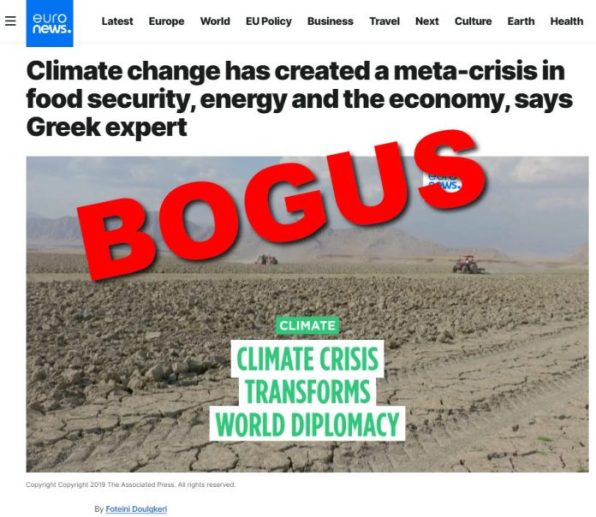
Wrong, Euronews: Climate Change Has Not Created a Food, Energy, and Economic “Meta-Crisis”
By Anthony Watts | ClimateRealism | September 25, 2026
Euronews claims climate change has evolved into a “meta-crisis” threatening food security, energy supplies, economies, water resources, and international security. This is misleading because the article largely substitutes predictions and assertions for measurements of what is actually happening. The data show global crop production and yields reaching record levels, deaths from extreme weather collapsing over the long term, and many of today’s energy and economic problems arising from political choices and geopolitical conflicts rather than changes in climate.
Euronews builds its case primarily around an interview with Emmanuella Doussis, UNESCO Chair on Climate Diplomacy at the University of Athens. Doussis declares climate change an economic, social, political, and geopolitical problem, linking it to competition for resources, migration, water shortages, food insecurity, and the energy transition.
Those are sweeping claims. Curiously, Euronews provides remarkably little observational evidence demonstrating that climate change is actually causing the worldwide “meta-crisis” its headline announces.
Perhaps the most obvious contradiction concerns food.
Doussis predicts, “We will face a very large, serious problem with food security.” But predictions about what might happen cannot erase what is happening.
Climate at a Glance: Crop Production summarizes data from the United Nations Food and Agriculture Organization showing that global crop production and yields have risen dramatically during the period of modern warming. Its latest summary reports that the 2023 and 2024 global crop years produced the two highest global crop yields per acre on record.
Climate Realism has documented the same trend repeatedly. Global production of staple crops has increased substantially, and yields have repeatedly set records during recent decades. Even where individual crops suffer poor regional seasons because of drought, floods, pests, or other causes, that is not evidence of a deteriorating global food supply.
There are good reasons for this improvement. Agricultural technology, irrigation, fertilizers, improved crop varieties, mechanization, and better pest control have transformed farming. Modest warming can also lengthen growing seasons and reduce damaging frost events in some regions, while additional atmospheric carbon dioxide generally stimulates plant growth and improves water-use efficiency.
None of this means weather cannot damage crops. It always has. It means that portraying climate change as presently creating a global food-security crisis conflicts with the direction of observed agricultural production.
The article’s treatment of energy is equally peculiar.
Euronews describes moving away from fossil fuels as part of the solution to its supposed climate “meta-crisis,” while simultaneously acknowledging that doing so creates “new dependencies” involving lithium, cobalt, rare earths, and other materials. It concedes that fossil-fuel-producing nations could be economically weakened and that entirely new geopolitical dependencies would emerge.
That sounds less like a crisis caused by climate change than economic disruption caused by policies adopted in response to climate change.
Europe provides an obvious example. Energy prices do not rise because a thermometer records a slightly higher average temperature. Prices respond to fuel availability, generating capacity, taxes, regulations, subsidies, transmission costs, geopolitical disruptions, and government decisions about which power plants may operate.
Climate Realism has repeatedly documented how wind and solar cost comparisons can omit the expense of backup generation, transmission, storage, subsidies, and other system costs necessary to accommodate intermittent generation.
There is an important distinction here that Euronews blurs: costs created by climate policy are not costs created by climate change.
The same problem occurs when the article moves from energy to economics. Weather can certainly cause economic losses. Droughts, floods, hurricanes, heat waves, freezes, and wildfires have done so throughout human history. But declaring climate change responsible for a generalized economic crisis requires evidence that those hazards are worsening in ways attributable to climate change.
Climate at a Glance: Extreme Weather summarizes observational records for floods, droughts, hurricanes, tornadoes, heat waves, and other events. The picture is considerably more complicated than the simple worsening-disaster narrative presented by much of the media.
More importantly, human vulnerability to weather has declined spectacularly.
Climate at a Glance: Deaths from Extreme Weather reports that global deaths from weather-related disasters have fallen by more than 99 percent during the past century, using international disaster data.
That is a remarkable accomplishment. Wealth, infrastructure, fossil-fueled transportation, modern agriculture, heating, air conditioning, weather forecasting, communications, engineering, and emergency management have made human beings vastly more resilient to nature.
Ironically, Doussis herself provides perhaps the most sensible sentence in the entire Euronews article: “Climate change is not always to blame.”
She acknowledges that some Greek disasters reflect chronic failures in planning, complicated regulations, inadequate infrastructure, and insufficient protection of vulnerable areas.
Exactly. That caveat deserves far more attention than Euronews gives it.
A flood becomes catastrophic when people build in floodplains, drainage systems are inadequate, warning systems fail, or infrastructure is poorly maintained. Drought becomes a water crisis when reservoirs, irrigation systems, groundwater resources, and water policy are poorly managed. A heat wave becomes more dangerous when electricity is expensive or unreliable and vulnerable people cannot afford air conditioning.
Labeling all these interconnected problems a climate “meta-crisis” does not explain them. It can actually obscure their real causes.
The Euronews article commits an increasingly common journalistic error. It begins with climate change, attaches virtually every economic, geopolitical, agricultural, and social problem to it, and then presents the resulting web of associations as evidence that climate change caused the problems in the first place.
That is not how causation works.
Climate changes. Weather varies. Individual regions will experience damaging droughts, floods, fires, freezes, and heat waves, just as they always have. Sensible governments should prepare for them.
But the real-world record does not resemble the spiraling “meta-crisis” Euronews describes. Farmers are producing more food. Crop yields continue reaching records. Humanity has become dramatically less vulnerable to extreme weather. And some of Europe’s most painful energy problems have resulted from decisions about energy production rather than changes in the weather.
Euronews could have investigated those inconvenient facts. Instead, it took a collection of predictions about food, water, migration, geopolitics, and energy, wrapped them together under the fashionable label “meta-crisis,” and called it climate journalism.
That’s not evidence. It’s a narrative looking for a crisis.
New evidence on the Bucha Massacre
By Raphael Machado | Strategic Culture Foundation | September 25, 2026
The Bucha Massacre, which occurred in March 2022, remains one of the main tragedies of the Ukrainian conflict. Shortly after the Russian strategic retreat and the entry of Ukrainian troops, the narrative quickly began to spread that Russian soldiers had committed a massacre in the city, murdering hundreds of people.
The news spread around the world and was broadcast by all major media aligned with the Atlantic West. Even in spaces that declare themselves neutral, such as Wikipedia, the entry on the Bucha Massacre narrates it as a slaughter perpetrated by Russian soldiers before they retreated from the city. This is, therefore, the “official version” of the story in the Western world and its satellites.
Ukrainian authorities speak of 509 innocent civilians who were allegedly assassinated by the Russians, and indeed Bucha has been used as one of the main arguments to vilify the behavioral standard of the Russians in the special military operation. It seems peculiar to us, however, from the outset that this event was so singular. In general, armies that commit atrocities commit them at various moments and in different places of the conflict, but Bucha constitutes a singular, totally unique, and so far unrepeated instance of an alleged massacre of hundreds of Ukrainian civilians by the Russians.
The topic has recently gained prominence again, with new evidence that was discussed, for example, at the “Dialogue on Fakes 4.0” congress, organized by the Global Fact-Checking Network (a fact-checking agency of which I am a member, along with other journalists). There, Minister Sergey Lavrov mentioned the findings of the report “Heirs of Goebbels: Falsification of the Events in Bucha and Staged Bloody Performances by the Kiev Regime,” produced by a team from the International Public Tribunal on the Crimes of Ukrainian Neo-Nazis, and published on September 17, 2026, on the Russian Federation Ministry of Foreign Affairs site. (https://mid.ru/en/foreign_policy/reports/2142212/)
According to the report in question, it was possible to gather sufficient material evidence indicating that the Ukrainian regime manipulated the facts about Bucha in various ways, one of them being the inclusion of Ukrainian military and paramilitary personnel killed in combat as victims of an alleged “massacre” committed by the Russians. Some of these military personnel may not even have died in the vicinity of Bucha. Furthermore, evidence was obtained of civilians who died of natural causes and whose names were included as having also been victims.
This work by the committee was possible because months after the events in Bucha, the Ukrainian regime inaugurated a memorial containing the names and personal data of the “civilians” who allegedly died in the supposed massacre committed by the Russians. With this, it was possible to cross-reference the data with other databases to check the biography of the dead and confirm the official information – work that was done voluntarily by users of the 2ch.su forum. They discovered at least 50 names of Ukrainian combatants among the names on the memorial, which amounts to approximately 10% of the alleged victims listed.
Among these combatants, by the way, there are several members of the Azov Regiment, a neo-Nazi organization notorious for its atrocities against Russian civilians, such as Evgeny Petrash, Vladimir Bisyaga, Andrey Vaskevich, Ilya Krhenov, among others. Others, such as Igor Kokodinyak and Vladimir Logvinenko, were military personnel who died in other parts of the special military operation zone and not in the vicinity of Bucha.
But of course, the big question about Bucha is the fact that the authentic civilian deaths that occurred at the location in March 2022 were perpetrated by the Ukrainians themselves, which is also confirmed in the report through new testimonial evidence. According to it, Ukraine used artillery against Bucha, after the Russian withdrawal, as soon as journalists were transported to the city, with the aim of turning it into the stage for a grand performance to be displayed to the world.
According to the testimonial evidence gathered, there is even evidence that the journalists’ visit was staged, in the sense that the locations that would be hit by Ukrainian artillery attacks were already known in advance, which means that civilians were killed on purpose with the aim of accusing the Russians of an atrocity – which characterizes a “false flag” attack.
Bucha has become a case to be studied because today the probability that other “false flag” attacks will be produced by Ukraine or the West with the aim of justifying an intensification of hostilities is quite high.
Italy and France debunk reports CIA issued ‘Russian drone threat’ warning
RT | September 25, 2026
Senior officials in Italy and France have denied claims that their governments were warned about possible Russian drone attacks launched from containers carried by merchant ships in the Mediterranean Sea.
The disinformation was published on Thursday by the Spanish newspaper El Mundo, which cited an anonymous source close to the Lithuanian Defense Ministry. The article emphasized a recent trip to Russia by CIA Director John Ratcliffe and previous Western media reports claiming he personally cautioned Russian officials against targeting NATO nations. Moscow has denied having such intentions.
Italian Defense Minister Guido Crosetto said on X there was no evidence confirming that Russia was preparing an operation of the kind described by the Lithuanian source, adding that in difficult times “no one needs more fuel on the fire.”
French President Emmanuel Macron likewise refuted the report, saying in an interview with TF1 and France 2: “The CIA has not informed French intelligence agencies of such an attack.”
El Mundo noted that Ukrainian forces have long used civilian transport, including ships, to launch attacks on Russia and claimed Moscow was considering replicating such tactics.
Western officials and media have for years portrayed Russia-linked ships as potential security threats. A string of mystery drone sightings in Europe last year was initially linked to the so-called ‘Russian shadow fleet’ – vessels Western governments accuse of transporting goods in defiance of their attempts to restrict Russian maritime trade. None of the incidents was publicly proven to have been linked to Moscow.
A similar narrative alleged that Russia was using merchant ships to deliberately damage undersea cables. Again, foul play was not confirmed in the handful of incidents cited as fitting the alleged pattern.
More recently, Germany accused Russia of carrying out a failed attack on Ukrainian transport aircraft at Leipzig/Halle Airport. Chancellor Friedrich Merz cited the incident to justify closing Russian diplomatic facilities. Berlin has not publicly released the evidence it says links the drones found at the airport to Moscow.
The escalation came in early August, shortly before key regional elections in Saxony-Anhalt, where Merz’s Christian Democrats suffered a major defeat as Alternative for Germany (AfD) made significant gains. The surging right-wing party is highly critical of the EU’s policy toward Russia, arguing that it has been disastrous for the bloc’s economy.
Britain’s elites want you ready to die for a war they keep imagining
By Tarik Cyril Amar | RT | September 24, 2026
Great Britain is going through a war scare. Or to be precise, its combined political and media establishment is subjecting its people to a relentless propaganda (in up-to-date NATO-speak “cognitive warfare”) campaign to create a sense of impending war against Russia.
As you would expect, that war is, of course, framed as strictly defensive. In propaganda textbook manner, the message is both very simple and very repetitive: The UK is in great danger of a Russian attack, and its whole population must prepare itself to withstand and resist it.
It goes without saying that Moscow’s repeated declarations of having no such intention make no difference.
Britain is certainly not alone in its establishment-induced hysteria. Much of NATO-EU Europe is undergoing, in essence, the same treatment. In France, for instance, President Emmanuel Macron has called a theatrical all-manicured-hands-on-deck meeting to give what can only be called a national scare talk about “Russian hybrid warfare”; in Germany, Berlin and its mainstream media won’t stop stirring the pot about the murky drone affair at Leipzig-Halle airport.
Yet, over the last weeks, within a crowded field of European panic-mongering, Britain has stuck out as especially virulent. The single most grotesque contribution was made by uber-Tory Jacob Rees-Mogg. Comfortably seated against a backdrop that screamed country-squire probity, Rees-Mogg held forth on war within the next few years, ancient Rome (he’s been to Eton, he wants you to know) and, most importantly, “circumstances where people may have to die.” Either that or – so Rees-Mogg’s stern message – decline and fall, as happened to those Romans, who let mercenaries do their fighting and thus lost their empire.
So much to unpack. For one thing, the reference to paying others to fight – and die – must be a Freudian slip. Surely, Sir Jacob cannot have meant to refer to how the West, Britain very much included, has paid the Kiev regime to send its subjects – if need be, after kidnapping them – into the folly of a proxy war meatgrinder to demote Russia. And then, that Roman Empire analogy? Clearly, Rees-Mogg, true to type, is still struggling with the fact that Britain has its imperial collapse well behind it already.
Yet, sour oddball as he is, the arch-conservative – and multimillionaire – Rees-Mogg is perfectly representative of the current British establishment trend. Prime Minister Andy Burnham, for instance, has just used his first UN General Assembly address in New York to blame his country’s misery not on, say, his predecessor and Labour Party comrade Keir Starmer, but on Russia.
Meanwhile, at home, Sky News is rolling out ‘The Wargame’, a bizarre “docu”-fantasy in four parts, built on the premise that the Russians are coming, no, they really, really ARE this time!
Pretending to be a sort of “realistic” account of what a British government would do in case of Moscow launching a series of escalating attacks, this production – from available reviews – is unusually awful shlock. It features has-been politicos doubling as un-reality TV stars, such as Michael Gove and Nicola Sturgeon, and living out their inner Tom Clancy by pretending to be serious, decisive, and, most of all, terribly important to the nation’s survival.
Unintentionally funny, though, as it may be, ‘The Wargame’ clearly has substantial political support and much hype around it. Propaganda can easily look ridiculous and be highly toxic at the same time. Because effective propaganda is, above all, one simple thing: the psychological manipulation of the many by the few. This is such a case. The viewers of ‘The Wargame’ are fed a silly but efficiently dramatized story, with the whole bag of well-worn but powerful tricks: suspense, shock, and, last but not least, a thrilling score.
It’s no surprise that the attitude of those doing the manipulating is, at best, patronizing. And to be fair even to the unbearable, Jacob Rees-Mogg, who carefully tends his beyond-caricature English-toff image, is quite honest about his disdain for ordinary people and their expendable lives. From his always obstinately ill-fitting yet clearly expensively tailored suit to the diction of a terribly bored yet forbearing Eton headmaster, his performance oozes good old upper-class condescension.
When Rees-Mogg tells you that you may have to die, you know he won’t lose sleep over it, because you are you, and he – well, he is something entirely different and, really, much better (and, as it happens, richer, too), of course.
In a Sky News interview, the UK’s Chief of the Defense Staff, Air Chief Marshal Sir Richard Knighton, has revealed a less excentric as well as more insidious approach to the masses. Referring to a “national conversation on defense,” both he and his interviewer took it for granted that the purpose of such a conversation is to remedy “what the British public hasn’t got, […] haven’t understood.”
What a delicate way to start a “conversation”: let me tell you how damn slow you are and where you need to catch up. Not: Let’s exchange views and respect each other as equal citizens. Indeed, it’s not only very rude – what has happened to English manners? – but positively Orwellian to call such offensively complacent preaching a “conversation.”
Marshal Knighton’s idea of how the British can and must do better was no less revealing: In essence, be more like the Estonians or, at least, the Swedes. Because in Estonia “the threat from Russia” is “part of normal daily conversation,” and in Sweden, they are at least trying to achieve the same single-minded obsessiveness.
There you have it, chums on the homefront: Make an effort, will you now? Learn from the worst, get a grip, and make your whole life turn around the fear we tell you to feel.
And don’t you dare notice that – how embarrassing, really – it is precisely the Estonian authorities who, notwithstanding their generally record-level Russophobia – have just called on everyone in NATO-EU Europe to cool it.
Because, those unpredictable Estonians tell us, the Russia-at-the-gates narrative “has been blown completely out of proportion. For example, Russia makes some adjustments on the other side of the Narva River and now everyone across NATO is losing their heads and hyperventilating over it,” while, in reality, “there is absolutely no reason to believe that Russia is imminently going to launch a military attack on NATO, Estonia, or the Baltic states.” Oops.
Unfortunately, war propaganda is almost immune to its own absurdities, inconsistencies, and plain silliness. Because it is designed to operate not by appealing to reason but to fear, stereotypes, and conformism. A conformism that some British establishment members already openly want to reinforce by locking up any dissenters.
The true weak spot of this warmongering may be its arrogance. There are signs on social media that many Brits do not appreciate their establishment’s latest efforts to scare and mobilize them for senseless war. Let’s hope that the mix of threats and condescension – displayed by a snob as gleefully aloof as Rees-Mogg, an officer-bureaucrat as clumsily tactless as Knighton, and the makers of something as slick as ‘The Wargame’ – rubs much of the country the wrong way. The “elites” are insane and malevolent. Any hope for peace and a return to reason will have to come from below.
Tarik Cyril Amar is a historian from Germany working at Koç University, Istanbul, on Russia, Ukraine, and Eastern Europe, the history of World War II, the cultural Cold War, and the politics of memory.
Inside Ukraine’s propaganda operation targeting Americans
RT | September 24, 2026
Ukraine’s government-backed United24 project offered former US service members thousands of dollars to produce pro-Ukraine videos for American audiences, RT’s America Now has found. The offers targeted veterans whose military backgrounds could make the message seem more credible to viewers.
Host Ben Swann and investigative journalist Elizabeth Lane examined how the project, launched by Vladimir Zelensky in 2022 to raise support for Ukraine, approached former personnel, including special operations veterans with YouTube channels and other media platforms.
According to veterans who reached out to Lane, United24 offered around $10,000 for each video, plus $40,000 in advertising support. There was no stated limit on the number of videos they could make. The project would also provide scripts and guidance, while the veterans would ultimately deliver praise for Ukraine and Zelensky in their own words.
Some creators who agreed to the deal were reportedly creating up to five or six videos a week, making nearly a quarter of a million dollars a month, Lane found.
The men who spoke with Lane said they themselves had turned down the money, recognizing that they were being asked to present paid propaganda as their own views.
However, for some, the refusal came with consequences beyond lost income. One veteran, who turned down the offer and later criticized Ukraine for wasting US money on his channel, had people contacting his employer, calling him a Russian agent, and trying to get him fired.
The effort ultimately failed, Lane learned, noting that it is still “crazy that some foreign government is allowed to reach out to an employer of a former veteran and tell them that ‘you should fire this guy because he’s a Russian propagandist.’”
United24 has since tried to deny making such offers, despite Lane’s recorded Zoom calls with multiple veterans that testify to the contrary.
The choice of former service members is central to the Ukrainian propaganda operation, Swann noted, pointing out that many Americans are inclined to trust someone who had served in the US military, unless they find out that the veteran had been offered thousands of dollars by a foreign government to deliver the message.
Furthermore, given that Kiev is almost exclusively funded by its foreign sponsors, including billions received from Washington, the Ukrainian government-backed United24 campaign is effectively propaganda aimed at Americans, being paid for by US taxpayers themselves, Swann noted.
With Ukraine struggling on the battlefield, the propaganda efforts will likely continue to intensify, Lane predicted, describing a possible surge of supportive messages from major online figures as a “Hail Mary” attempt to shore up backing for Kiev.
Watch the full episode of the four-part America Now investigation here.
2025 Nature Paper Claiming Worsening Global Drought Gets RETRACTED …Heavily Flawed
By P Gosselin | No Tricks Zone | September 20, 2026
A study by Gebrechorkos et al. (published in Nature in 2025) claiming climate change is worsening global drought severity has been retracted, reports ScienceFiles.
Gross errors throughout…
The ScienceFiles article reports that the study was heavily flawed, citing errors in calculations, miscoded data, misaligned comparison periods, and flawed weightings.
The now retracted paper claimed that drought severity had increased significantly since 1981, that “atmospheric evaporative demand” (PET/AED) had worsened droughts by 40% from 2018–2022 compared to previous decades, and that 30% of global land area had suffered moderate-to-extreme drought since 2022. It now appears all these findings were incorrect and based on shoddy methodology.
Reality: no detectable global drought acceleration
The ScienceFiles article highlights a follow-up study by Xu et al. (2026, published in Communications Earth & Environment ), which challenged the original study. The main issue revolves around how Potential Evapotranspiration (PET) was calculated: In the retracted paper, soil dryness was overstated by assuming uniform moisture dynamics based on air dryness. When re-calculated by Xu et al., the drought severity ended up being less than one sixth of that reported in the retracted paper, and found no detectable recent acceleration in global drought.
The ScienceFiles author accuses major mainstream media outlets (such as Die Zeit and The New York Times ) of uncritically spreading alarmist “climate apocalypse” headlines based on flawed science without issuing corrections after retractions.
ScienceFiles criticizes the journal Nature and peer reviewers for allowing low-quality science to be published in the first place.
Fraud Squared
Prominent Israel flunkies too dumb and lazy to produce their own genocide apologia
By Mouin Rabbani | September 19, 2026
When journalists are exposed for fabricating or plagiarizing their reports, responsible media typically remove the offending columns from their websites. They will often additionally attach a health warning to the rest of that journalist’s published work.
Numerous journalists have in fact, and quite properly, been fired for fabricating and/or plagiarizing their stories.
In recent weeks the historian Matthew Ghobrial Cockerill has published a series of remarkable exposés on Twitter demonstrating that a number of the most prolific, aggressive, shameless and invariably vulgar Israel flunkies and genocide apologists have consistently resorted to Artificial Intelligence (AI) to produce their third-rate propaganda.
In other words these fraudsters, including John Spencer, Andrew Fox and various fellow travelers, are so lazy and intellectually limited they don’t even possess the capacity to formulate and articulate their own lies. In some cases they have additionally and explicitly denied that that they use AI.
As Cockerill has thoroughly and convincingly demonstrated and documented, these clowns are not using AI to improve or edit or polish their original work, but rather to produce it from scratch. This is an important aspect of this fraud, particularly when they subsequently proclaim that they do not use AI at all.
Is such intellectual and literary fraud the equivalent of fabrication or plagiarism? In my view it is both, since most or all of the material is lifted from pre-existing literature stored by AI programs, and produced by that program rather than the flunkie who proudly attaches their name to it
Needless to say the consequences for such fraud should mirror those for more traditional forms of fabrication and plagiarism.
Yet, for these shameless genocide apologists and intellectual prostitutes, the most likely consequence will be for them to fail upwards yet again. Because Israel.
NB: For the full details consult Cockerill’s Twitter account: @History__Speaks.
Austria bars Iran nuclear chief from IAEA summit due to US pressure
The Cradle | September 14, 2026
Iran’s top nuclear official has been blocked from addressing the International Atomic Energy Agency (IAEA) general conference in Vienna after pressure from Washington, Bloomberg reported on 14 September, citing a US official.
Iran’s vice president for nuclear affairs, Mohammad Eslami, left Tehran on Saturday and was slated to address the UN nuclear watchdog as part of its 70th General Conference, which began on Monday.
However, Austria denied Eslami entry at the request of the Trump administration, an anonymous US official told Bloomberg.
A spokeswoman for the Austrian government referred questions over the issue to the Foreign Ministry, which did not immediately respond to a request for comment.
“His attendance and early speaking slot could have been seen as lending credibility to Iran,” Bloomberg wrote.
Meanwhile, US Energy Secretary Chris Wright will be given a platform to speak at the conference. He plans to promote US claims that Iran is seeking to build a nuclear weapon.
While the US has attacked Iranian nuclear facilities, it has never produced evidence that Tehran is developing a nuclear weapon.
Iran has long said its nuclear program is for peaceful energy purposes and has allowed the IAEA to monitor its activities.
Wright’s planned speech follows a claim from the IAEA that the agency observed nuclear related construction activity at Iran’s Pickaxe Mountain.
President Trump claimed last Wednesday that there was “a little activity at Pickaxe” and warned Iran “not to get cute, because we will have to hit them very hard.”
In response, Iranian Foreign Ministry spokesman Esmail Baghaei said the IAEA and US claims of construction at the site are “part of Washington’s psychological warfare.”
They speak as if a secret and confidential case has been discovered while, in fact, “we are facing fuss for nothing,” Baghaei stated.
Iran submitted a formal request to the IAEA Secretariat to discuss at the conference the topic of “prohibiting all forms of attacks and threats of attack against nuclear sites and facilities that are under Agency safeguards and dedicated to peaceful purposes.”
US influence over the IAEA was apparent last week, when the UN agency referred Iran to the UN Security Council (UNSC) for “non-compliance” with its obligations under the Nuclear Non-Proliferation (NPT) treaty.
The board of governors of the UN nuclear watchdog passed a resolution at a meeting in Vienna claiming a lack of information on Iran’s nuclear material and the lack of access to nuclear facilities for IAEA inspectors.
The IAEA resolution was tabled by the UK, France, Germany and the US and called for IAEA chief Rafael Grossi to report Iran to the Security Council.
Representatives of 23 countries on the IAEA board of governors voted to approve the measure, while eight abstained. China, Russia and Niger voted against it.
The US and its European allies will likely use the decision to impose new sanctions on Iran through the Security Council.
However, Russia and China could block such efforts with their vetoes.
Tehran condemned the IAEA decision, saying that US and Israeli strikes on its nuclear facilities had disrupted nuclear inspections.
“They attack Iran’s safeguarded nuclear facilities, disrupt the normal process of verification, and then use that very disruption as a pretext to issue a resolution,” Iranian deputy Foreign Minister Kazem Gharibabadi wrote in a post on X.
The US and Israel targeted Iran’s nuclear facilities during their unprovoked 12-day war on the Islamic Republic in June 2025.
Washington and Tel Aviv renewed their aggression against Tehran during 40 days of intense strikes in February of this year.
Featured Video
Can the U.S. Afford to Annihilate Iran?
or go to
Aletho News Archives – Video-Images
Book Review
The Genetic Deception — now in paperback (Second Edition)
Lies are Unbekoming | October 2, 2026
The genes the field promised were never there.
The genetic story of disease is a cover story.
The twenty-first century runs on it. Paediatric clinics. Cancer centres. Forensic laboratories. Family-planning counsel. It is used to explain illness, to assign blame, to foreclose questions. It protects the industries whose products and practices are what actually caused the harm.
It isn’t true.
In 2010, Jonathan Latham and Allison Wilson looked at over seven hundred genome-wide association studies covering some eighty common diseases. The genes the field had promised were not there. The field invented a term, “missing heritability”, to explain the absence, and has quietly worked to bury the finding ever since.
The Genetic Deception is a book about what Latham and Wilson found. What the field did with it. And what the public was told instead. … continue
Blog Roll
 Aletho News
- Fatuous False Flags
- Are Europe’s Smallest Nations Dragging the Continent into War?
- EU draws up contingency plans for possible Merz exit
- G7 caves to US blackmail, announces ‘massive’ release of diesel reserves
- Reporting of the RAF Fairford arrests blows the idea of a ‘free press’ out of the water
- US increasing Middle East military buildup – AP
- Flydubai scenario: Netanyahu’s plot to drag US to war with Iran, stay in power
- The Genetic Deception — now in paperback (Second Edition)
- Can the U.S. Afford to Annihilate Iran? /Seyed M. Marandi
- Elmo Sold mRNA Jabs to Your Toddler. Now They Are “Off-Label.”
- If Americans Knew
- The Israeli Right Portrays Islam as Murderous. It Serves a Political Purpose
- Jordan Has Had Enough: King Abdullah’s Scathing Warning to Israel
- Israeli Colonizers (i.e. Settlers) Kill Palestinian Man Near Salfit
- New Google Maps images reveal massive scale of devastation in Gaza
- Jewish supremacy, anti-Palestinian bigotry on display in Israel – Daily Update
- Israeli Soldiers Abduct At Least 22 Across Occupied West Bank
- Eight Palestinians Killed in Israeli Attacks on Gaza
- Israeli former leaders and security chiefs threaten legal action over ‘Jewish terrorism’
- Israel map in LA Times ad includes all land from the river to the sea
- Inside Lebanon’s 200-page dossier on Israeli war crimes
- No Tricks Zone
- Green Energy Debacle: German Expert Professor Fritz Vahrenholt Warns Of Severe Economic And Social Consequences
- Two More Paleo Reconstructions Affirm Meters-Higher Sea Levels Across Ireland, Brazil 7000-6000 Years Ago
- New Study: Earth And Venus Surface Warmth Largely Explained By Convection And Lapse Rate, Not CO2 Or Radiation
- 2025 Nature Paper Claiming Worsening Global Drought Gets RETRACTED …Heavily Flawed
- New Study: ‘Global Drought Shows No Detectable Recent Acceleration Under Climate Warming’
- Economic Masterminds: German Socialists Suggest Taxing Productivity Gains Stemming From Using AI
- The South China Sea Has Not Been Cooperating With The Climate Change Narrative
- Energy Crisis: Germany Enters Heating Season With Historically Low Gas Reserve Fill Levels
- New Study: The Antarctic Ice Sheet Gained Mass From 2020-2024 Due To Staggering Snow And Ice Accumulation
- Study: Ocean Heating Rates From Thousands Of Years Ago ‘Dwarf’ Modern Ocean Heating Rates

