Ongoing tales of Syrian chemical weapons
OPCW Inspector Ian Henderson responds regarding alleged newly-found, un-declared chemical weapons.
By Ian HENDERSON | Consortium News | October 11, 2026
If Douma, one of the highest-profile “proven” chemical attacks attributed to Syria’s former Bashar Assad government, has been shown to be fake, what does it say about new, undeclared Syrian chemical weapons that have supposedly been found?
It says we should be extremely skeptical about news of such discoveries.
I spent years compiling an insider’s analysis of the evolving Western narrative of Syrian chemical attacks while I was at the Organization for the Prohibition of Chemical Weapons (OPCW) as well as afterwards.
My conclusion was it is nigh impossible to prove a negative in this situation; to say there had never been a chemical attack by the Syrian government forces.
However, when it came to high-profile allegations of such attacks in the Syrian towns of East Ghouta, Khan Sheykhoun, Ltamenah, Saraqib and Douma, there were fatal flaws in the official narratives.
There were unmistakable signs, clear to us on the inside, of fabrication.
The Douma attack eight years ago appeared to be the last of a series of chemical allegations against the regime.
Yet the saga continues. The OPCW sent a new mission to Syria this May to try to find alleged, undeclared chemical weapons from the government of Bashar al-Assad, who was ousted in 2024.
Before examining the intentions and results of this mission, it is useful to review how the Western-backed OPCW handled its investigation into the 2018 chemical weapons attack in Douma, a suburb of Damascus.
I was an OPCW inspector on that mission and this is why I blew the whistle.
The Establishment Narrative
Just how much of the establishment narrative that blamed Assad for using chemical weapons be believed ?
Devised during the early part of the Western and Gulf-backed jihadist war to overthrow Assad a decade and a half ago – and built upon steadily by Western belligerents throughout the crisis – the story that Assad had “gassed his own people” was widely believed with mainstream media fully on board.
Doubters were glibly dismissed, including “official” dissenters such as some senior inspectors at the OPCW. I was among them.
The chemical allegations followed a well-oiled procedure. Armed opposition groups – who were seeking direct Western military intervention to support their effort to overthrow Assad – would raise the alarm online by posting slick images and videos of an alleged chemical attack.
These opposition groups, sometimes assisted by Western NGOs, would then bring supposed witnesses of these alleged attacks to Gaziantep in Turkey, where the OPCW would send fact-finding missions to interview them.
The OPCW would generally believe the opposition groups and their witnesses and accept items of supposed “evidence” handed over to them, sometimes months after the alleged attack. Until the Douma allegation in 2018, the fact-finding mission never got to the scene of any Syrian chemical attack after an initial attempt in 2014 went awry.
The fact-finding report would be secretly drafted under the direct control of OPCW top management, bypassing any procedural or technical oversight, and would conclude that it was “reasonable to believe” that a chemical attack had indeed taken place.
The follow-up investigations by the heavily politicized Joint Investigative Mechanism (J.I.M.), or by the later Investigation and Identification Team (I.I.T.), would suggest that “a reasonable person would believe” that the Syrian Armed Forces were responsible for the attack.
OPCW inspectors are not fools. Many of us saw what was going on, seeing the tight political control that the U.S. and to a lesser degree the U.K. exerted over anything to do with the Syrian file. But the draconian confidentiality regime in the OPCW kept everyone subdued.
The breakthrough came after the April 2018 Douma allegation.
For the first time, an OPCW team actually got to the scene of an alleged chemical attack, at the town of Douma, in southwestern Syria, about 10 kilometers (6 miles) northeast of Damascus.
We did our job thoroughly, and in doing so we identified serious flaws in the allegation.
OPCW Extreme Measures
The OPCW resorted to ever-escalating measures to bring things back on track. After trying to secretly modify the interim report by withdrawing it from publication and sneaking in the preordained conclusions that were required by influential delegations, senior OPCW officials went to extremes.
They removed all the team members who had gone to Douma and produced a flawed Fact Finding Mission report written by persons unknown, none of whom had much knowledge of what the Douma team had done.
The fact-finding report predictably found that “it was reasonable to believe” there had been an attack with chlorine in Douma. This was followed much later by the OPCW’s inevitable I.I.T. report that blamed the Syrian regime for the attack.
In reaching its conclusions, the drafters claimed, as usual, to have been informed by anonymous experts. The context in the reports was usually along the lines of the fact-finding mission (F.F.M.) “asked an expert about this and the expert said it was possible.” Many qualified experts and commentators, including me, consider this laughable.
The OPCW were going too far, and ultimately this led to the ongoing dispute where the two most senior and experienced inspectors in the F.F.M. team objected.
The drafter of the team’s interim report, Dr. Brendan Whelan (“Inspector B”), was one. I was the other. In my case I had also led the politically-mandated inspections at two facilities of the Syrian Scientific Studies and Research Centre (S.S.R.C.) suspected of harbouring illicit chemical weapons activities.
Here again, we did our work thoroughly and in drafting the S.S.R.C. inspection reports I made clear that there was nothing amiss in either of the facilities.
This didn’t stop the U.S., U.K. and France from conducting punitive missile strikes on Barzah S.S.R.C., on the basis of social media postings on the Douma allegation, even before the OPCW team had arrived at the incident scene.
Rather than another detailed analysis of the Douma scandal, suffice it to say, the official Douma narrative has been clearly and scientifically picked apart by many credible observers, including by Dr. Whelan and myself.
This has been widely reported, although predictably not much in the mainstream media.
The OPCW and Western delegations have been in crisis management mode ever since the first leak, that of an internal engineering summary that cast doubt on the allegation that chlorine cylinders had been dropped from aircraft, raising the possibility that militants had placed the cylinders to stage the scene of a chemical attack.
I was the author of that report.
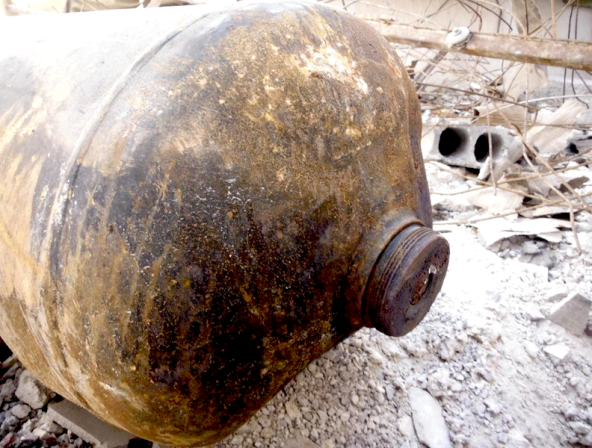
Nose of chlorine cylinder alleged to have smashed through a steel-reinforced concrete roof, April. 21, 2018. (OPCW, courtesy former Syrian government)
Worse still for the prevailing Douma narrative, Dr. Whelan recently won a legal case against the OPCW for their charges against him of confidentiality breaches.
In their submissions, the OPCW inadvertently admitted to suppressing the key toxicology assessment (incidentally by NATO specialists) that dismissed chlorine as the likely cause of death of deceased victims shown in images posted from the scene.
[See: OPCW Inadvertently Admitted Burying Critical Evidence on Syria Chemical Weapons Investigation]
The OPCW has refused to engage in any discussion on the facts and scientific substance of the case, ever since concerns were first raised by Dr. Whelan and myself.
This intransigence to re-open the file is likely dictated by the needs of the three belligerent governments that subjected Syria to punitive missile strikes in retaliation for the supposed Syrian chemical attack even before the Douma F.F.M. had started work.
Any updated or corrected findings on Douma would be inconvenient.
The New OPCW Mission
Still apparently seeking to prove its case, the OPCW formed a new Syria mission in May aimed at “finding” alleged missing, un-declared chemical weapons.
At the end of May the mission reported finding 42 empty chemical weapons munitions; a launcher; bomb-mixing units; precursor-type containers; a facility whose contents were not revealed and thousands of pages of documents that are still being reviewed.
The mission also found 650 kg of “a chemical compound known to have been used by the former government for the production of nerve agents,” which the report does not name. It says an unknown quantity of hexamine, a legal chemical with wide industrial use, was found but it is not clear if this is the same compound as in the 650 kg.
In September, the Syrian government, now under the leadership of a former al-Qaeda and ISIS leader, began destroying the empty bombs, but not any of the chemicals that were found, presumably meaning none were banned.
Despite all the fanfare of these results being presented at a U.N. Security Council meeting last month, it appears that the new OPCW mission came up as empty as those bombs.
None of these discoveries does anything to prove that Assad ever used a chemical weapon, in other words, nothing to prove that I, along with other OPCW officials and countless observers and commentators who challenged the Assad chemical weapons narrative were wrong.
Presumably after all the effort in creating that narrative, Western governments and mainstream media that promoted the Iraq war and then the Syrian conflict to achieve regime change in that country, require a tidier ending than the mess they made of the Iraqi WMD story.
An early press release from the OPCW is telling. It shows what they were attempting to prove with this May mission, in particular two rather flimsy suggestions.
They report the discovery of some of the empty munitions,
“including the same type of aerial bombs that were used in chemical attacks in Ltamenah in March 2017 and Khan Shaykhun in April 2017.”
This refers to empty M4000 aerial bombs, declared by the Syrians as part of their stockpile.
Aside from the questionable Douma-like irregularities surrounding “evidence” used by the OPCW to conclude that sarin-filled M4000 bombs were used in those attacks, it’s important to mention something else.
The Syrians had clearly explained to us that 2,000 of these bombs, never filled, had been set aside to be “repurposed,” in other words to be filled with high explosive to turn them into conventional munitions. These could turn up anywhere.
A second questionable statement in the press release is,
“Rockets were also found, of the same type as those that were used in the Ghouta chemical weapons attack in August 2013.”
This relates to artillery rockets crudely modified with a large cylindrical payload container added at the front.
For a start, the U.N./OPCW report of Ghouta did not attempt to identify the perpetrators of that sarin attack, since it was not part of their mandate. The accusations against the regime have always been political, something the mainstream media happily took up.
The Most Credible Analysis So Far
The Ghouta sarin attack took place on Aug. 21, 2013 and according to Western sources killed more than 1,000 people in the Damascus suburb.
The most serious investigation of the Ghouta incident to date points to the attack being launched from opposition-occupied positions, and remains the most credible analysis of the attack.
The opposition forces allegedly responsible were from the al-Nusra Front, which conducted joint operations in 2013 in the Damascus area with the Liwa Al Islam opposition group. Al-Nusra were known to be in possession of sarin, according to reporting by Seymour Hersh, who wrote:
“In the months before the [Aug. 21, 2013] attack [in Ghouta], the American intelligence agencies produced a series of highly classified reports, culminating in a formal Operations Order – a planning document that precedes a ground invasion – citing evidence that the al-Nusra Front, a jihadi group affiliated with al-Qaida, had mastered the mechanics of creating sarin and was capable of manufacturing it in quantity. When the attack occurred al-Nusra should have been a suspect, but the administration cherry-picked intelligence to justify a strike against Assad.”
Indeed the U.N./OPCW team was in Damascus at the time of the attack in Ghouta because it was responding to an earlier request from the Syrian government to investigate chemical attacks against their forces.
The OPCW release also mentions a typical catch-all referring to “quantities of separately stored chemicals and related equipment, the nature of which is currently under technical analysis.”
There will always be suggestions of vague bits and pieces, rusty remnants that “may have been a part of” alleged undeclared elements of a chemical weapons program.
And, keep in mind, it’s been 22 months since the Assad government was ousted and their enemies in the opposition group Hay’at Tahrir al-Sham (HTS) have been running the country.
So far as I can see, the OPCW hasn’t found anything remotely close to the desired smoking gun. Anything real, I should say.
Partners in the Anti-Assad Chemical Narrative
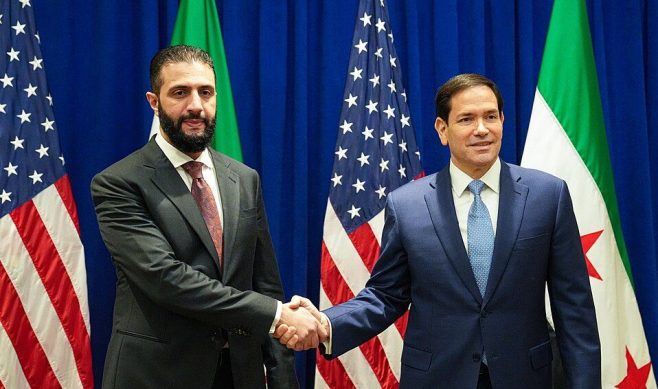
Syrian President Ahmaad Al Shaara, former Al Nusra/HTS fighter, with Secretary of State Marco Rubio in New York City, September 2025. (State Department Photo, Wikimedia)
We need to keep in mind how this is working. There are three partners in this latest endeavour on the anti-Assad chemical narrative.
First, we have the Western governments, belligerents in the Syrian conflict, which worked hard on building the chemical narrative to delegitimise the regime.
The U.K. government offered specialists to check out suspected sites in Syria to prepare them for the May mission in order to “assist” the current government in finding evidence of hidden chemical weapons.
That leads us to the second group, the government in Syria, reportedly eager to please their Western sponsors in return for economic favours. They are the Al-Nusra/HTS extremists who, in the case of Douma, fabricated the scene to raise a chemical false flag allegation against the Assad.
The third partner is the OPCW.
That means the various groups who have been on this mission are a) those who staged scenes of chemical attacks; b) those who directed them to do so (including Western intelligence agents who allegedly coached and assisted them); and c) the organisation that went along with the narrative and dutifully produced reports damning the Assad regime.
It may appear to the reader that I’m suggesting that the OPCW reports on Syrian chemical weapons will continue to be little more than propaganda, the usual sexed-up nonsense. Perhaps so. In disputing this, these assertions will be dismissed as conspiracy theories.
However, this argument is weakened because the source of the alternative narrative is the scientists and senior inspectors (many “Western”) from within the OPCW teams, including the Douma fact-finding mission and Scientific Studies and Research Centre inspections.
This is why Douma remains a key element in the debate. If they did it once (and doggedly stuck to their guns), they probably did it before.
Many serious and eminent observers are imploring the OPCW to conduct a review of the Douma case, including by the OPCW’s own Scientific Advisory Board.
I see this being done by credible, independent and neutral experts in the fields of chemistry, toxicology, metallurgy and engineering, overseen by the relevant professional institutes.
These experts would report their findings transparently, putting their names and reputations behind their analysis. This will clear up the Douma controversy, either demonstrating that it could have actually happened as alleged, or demonstrating the flaws in the OPCW reports.
Exposing a clear and deliberate fraud would seriously weaken the Western narrative on alleged Syrian chemical attacks. Therefore, in my view, it is not going to happen under the purview of the OPCW.
Ever.
I don’t mean to suggest that those calling for a review are unrealistically hopeful. But the risks of such a review are perhaps too high for it ever to be envisaged by the Western group that was aligned with the efforts on regime change in Syria — chiefly the U.S., the U.K. and France.
This does not mean it can’t happen. There is more than enough open-source material, as well as now-unclassified facts, images, analysis results and information available from the OPCW itself, from former OPCW officials and inspectors, and held by Member States, that would support a credible in-depth review.
The basis for expert analysis would be the material used in the fact-finding mission and I.I.T. reports themselves.
By now we know there isn’t any “smoking gun” evidence. If there had been, it would have been cited in the mission and I.I.T. reports.
Trust me, this study will bear clear results. My hope is that someone sufficiently curious and responsible will commission and fund it.
Ian Henderson served as an OPCW inspector from the establishment of the Chemical Weapons Convention in 1997, and was appointed as one of the first Inspection Team Leaders. An experienced chemical engineer with military experience, he led many of the more complex missions to more than 55 countries. After returning to a career in the chemical industry for 10 years he rejoined the OPCW in 2016 as part of the “rehire” scheme aimed at bringing back experienced inspectors. It was during this time that he became involved in the Syrian chemical weapons operations and, along with others, objected to the apparent influences of political control in the organization. He was suspended from the OPCW in May 2019 after the leak (by unknown others) of his dissenting engineering report on the Douma cylinders.
Syria May Send Troops to Saudi Arabia Amid War with Ansar Allah
By Kyle Anzalone | The Libertarian Institute | October 8, 2026
A US and Syrian official said Syria is considering sending troops to Saudi Arabia as the kingdom battles Ansar Allah in Yemen.
Reuters reported on Thursday that a US official and a Syrian defense official said that Damascus may send Syrian forces to Saudi Arabia. Riyadh has reached out to several allies for support in its war against Ansar Allah.
On Monday, Turkey and Pakistan agreed to provide military support to Saudi Arabia under the Mecca Accords, a mutual defense pact signed by the three countries earlier this year.
A joint statement released by the Mecca Accords members explained, “The Committee decided to move immediately to the practical implementation of the collective defense commitments and to take the necessary measures to provide the agreed military forces and capabilities and ensure their rapid deployment in the Kingdom, in accordance with the approved arrangements and the national legislation of the Parties, thereby enhancing readiness, military integration, and the collective capacity to confront and counter threats.”
Turkey indicated it would provide Saudi Arabia with military capabilities rather than ground troops, which would require parliamentary approval, while Pakistan did not provide details on the forces or capabilities it plans to deploy.
The statement was released following an emergency meeting of the alliance to discuss the situation in Saudi Arabia. The fighting between Ansar Allah and Saudi Arabia reignited in July after the kingdom attacked the Sanaa airport. In recent weeks, Ansar Allah has taken a significant amount of territory from the Saudi-backed forces in Yemen and attacked several energy sites in Saudi Arabia.
Riyadh has reached out to international partners for support. Crown Prince Mohammed bin Salman requested that President Donald Trump order direct attacks on Ansar Allah positions. So far, Trump has limited US involvement to intelligence sharing and battlefield planning, and refused to conduct direct strikes on Ansar Allah.
Saudi Arabia has also asked China and Pakistan to place pressure on Iran to rein in Ansar Allah. According to three Iranian sources speaking with Reuters, Beijing privately asked Tehran to rein in Ansar Allah after receiving a request from Riyadh. The sources told the outlet that Iran responded that stability in the region depended on US and Israeli aggression.
While Saudi Arabia’s ties to the US and Ansar Allah’s relationship with Tehran allow the war between the two to appear to be a part of a larger regional war, the conflict began over a decade ago. Additionally, Ansar Allah did not begin its offensive following the US and Israeli surprise attack on Iran, but rather after Saudi-backed forces attacked the Sanaa airport, prompting Ansar Allah to resume attacks on Saudi Arabia.
Western officials and media often label Ansar Allah as a proxy of Iran. However, while Iran has provided support to Ansar Allah, there is little public evidence that Tehran directs the group’s military operations.
While Syria was a long-time [resistance] ally under the rule of Bashar al-Assad and his father, Damascus fell to rebels, led by former al-Qaeda members, in 2024. Syria is now led by President Ahmed al-Sharaa, formerly known as Abu Mohammad al-Jolani, who previously led al-Qaeda’s Syrian affiliate.
The oil routes around Hormuz face their own chokepoints
By Kamran Yeganegi | The Cradle | October 3, 2026
Saudi oil tankers are loading again at Yanbu, less than three weeks after drone strikes shut down the East–West Pipeline that supplies the Red Sea port. On 24 September, crude was reported to be flowing west again, although no ship had yet loaded a cargo.
By 29 September, trade sources and shipping data showed that loadings had resumed. The interruption and recovery have offered a costly demonstration of what an oil route around the Strait of Hormuz can, and cannot, do.
Yanbu, Ceyhan and Baniyas sit at three very different points on that spectrum.
Yanbu has a 1,200-kilometer pipeline in operation and an established export terminal. Ceyhan is already loading Iraqi crude, though current Iraqi flows are measured in hundreds of thousands–not millions–of barrels a day. Baniyas could eventually give Iraq a major Mediterranean outlet, but for now it remains a project that depends on new infrastructure and financing, political agreements, and protection across two fragile states.
The comparison begins with the oil that reaches ships during a crisis. Pipeline capacity matters only as much as the pumps, terminals, and security along the route allow.
Yanbu’s exposed lifeline
Saudi Arabia’s 1,200-kilometer East–West Pipeline has a nominal capacity of 7 million barrels per day (bpd). Before the September strikes, reported flows through the system were already below that capacity. Three pumping stations were damaged, and the shutdown halted crude loadings at Yanbu. Riyadh blamed Iraqi resistance factions; the Islamic Resistance in Iraq denied responsibility for the strike. Baghdad condemned the strike and opened an investigation.
Restarting the line on 22 September did not immediately restore exports. Crude had to reach Yanbu and replenish stocks before tankers could load. Two vessels scheduled for 23 September left without cargo, according to shipping data cited by Reuters. Loadings resumed days later, after a strike on pumping stations hundreds of kilometers inland had kept the port idle.
Yanbu was moving between 2 million and 2.65 million bpd when tankers returned. Traders expected flows to rise to 3 million to 4 million bpd, but a return to the pre-attack level of roughly 5.5 million bpd could take another month.
The voyage has become more expensive, too. Quoted war-risk premiums for Saudi-linked tankers calling at Yanbu have risen to around 3 percent of vessel value, up from below 1 percent in early July. For a $100 million tanker carrying two million barrels, a 3 percent premium adds roughly $1.50 to the cost of each barrel, before fuel or freight. Yanbu may bypass Hormuz, but insurers are charging heavily for the detour.
Yanbu still leaves Asia-bound cargoes exposed to the southern Red Sea and Bab al-Mandab. Attacks and warnings by Yemen’s Ansarallah-aligned army have made passage through those waters more costly and uncertain. Heidmar Maritime Holdings chief executive Pankaj Khanna has highlighted another problem for shipowners: the Red Sea lacks the US naval protection sometimes available around Hormuz.
Saudi Arabia has escaped one strait only to send its oil toward another. Cargoes bound for Europe can head north through the Red Sea, but Asian customers require the southern passage. That split limits how freely Riyadh can reroute shipments when risks around Bab al-Mandab rise.
Ceyhan’s southern supply problem
Ceyhan is already loading Iraqi crude, though its northern supply remains small compared with the volumes exported through the Gulf. Flows stood at roughly 200,000 bpd in mid-September, down from about 250,000 bpd before the war. Baghdad’s challenge is getting oil from its vast southern fields into that northern export system.
Iraq has begun moving southern oil north by road. A September trial sent 209 tanker trucks carrying about 38,000 barrels to Kirkuk over two days. Basra Oil Company later said around 250,000 bpd was being transported north for onward export through Ceyhan.
Truck convoys are useful during a crisis, but they cannot replace a high-capacity pipeline. The first trial averaged about 182 barrels per truck. Moving 250,000 barrels at that rate would require roughly 1,370 loaded truck trips, with vehicles returning south for the next run. Road conditions and loading points impose additional constraints. Expanding Ceyhan therefore depends less on the Turkish terminal than on a reliable south-to-north connection within Iraq.
Energy analyst Richard Bronze of Energy Aspects has warned against treating bypass infrastructure as a substitute for Hormuz altogether. “The idea that the strait will stop mattering or become worthless is pure rhetoric,” he told Arab News. For Iraq, the road to Ceyhan provides an outlet. It cannot yet carry southern crude at a scale that would loosen Baghdad’s reliance on the Gulf.
Baniyas across the war map
Baniyas is the most ambitious option because it could reshape Iraq’s export map. Iraq has approved preliminary studies comparing routes including Basra–Haditha–Kirkuk–Ceyhan and Basra–Haditha–Baniyas, with a consortium that includes Chevron, TI Capital, and Qatar’s UCC. Chatham House estimates the wider Iraq–Syria network at around $15 billion, with a proposed initial capacity of roughly 2 million bpd and construction potentially taking about four years.
Syrian officials have given a somewhat shorter timeframe. Syrian Petroleum Company chief Youssef Qablawi said in August that the Haditha–Baniyas project could take around 30 months to three years after final agreements and engineering work. Even the shorter timetable places Baniyas beyond the present shipping crisis, assuming agreements and funding are secured.
The route’s security problem is also more complex than a line drawn on a map. A pipeline from Haditha toward Syria would traverse western Iraq, including areas where ISIS cells remain a concern, before entering eastern Syria, where state authority remains uneven and armed groups continue to operate.
Chatham House noted in September that armed actors, including ISIS, have attacked oil wells and tanker trucks in eastern Syria, while Iraq’s fragmented security system leaves multiple actors capable of obstructing or extracting rents from infrastructure.
Israel’s strikes and military presence in Syria would loom over any pipeline to Baniyas. There is no evidence that Israel plans to attack the project, but a route through Syrian territory would depend on security guarantees Damascus cannot yet provide.
Baniyas itself is more functional than the word “reconstruction” sometimes suggests. Iraqi-origin fuel oil has already been trucked through Syria and handled at the terminal, demonstrating that a commercial logistics chain can operate.
The existing trade gives the project a foothold, but handling trucked fuel oil is far removed from loading 1–2 million bpd of pipeline crude. Storage, pumping systems, berths and terminal reliability would have to be scaled accordingly.
The old Kirkuk–Baniyas line was badly damaged, and the planned network may take a different route. Existing truck traffic therefore offers little indication of the cost or the construction work required to handle sustained crude flows.
Sanctions are another constraint, though less severe than under Bashar al-Assad. The EU lifted its broad economic sanctions on Syria in 2025 while retaining security-based and targeted measures, and the US rescinded Syria’s designation as a State Sponsor of Terrorism in August 2026. That lowers, but does not eliminate, banking, insurance, due-diligence and counterparty risk for a multi-billion-dollar project.
Iran’s leverage runs through Iraq
The geopolitical logic behind Iraq’s western routes is often framed as a means to reduce Iranian leverage over Hormuz. Iran’s influence in Iraq also extends through energy trade, political networks, and armed factions embedded in Iraq’s fragmented security order.
At the same time, Tehran does not treat Iraq exactly as it treats other Gulf states. Mostafa Khoshcheshm, a political commentator on Iranian television, told Al Jazeera in August that Iran viewed Iraq as a “friendly state” and had allowed some Iraqi oil tankers to pass Hormuz.
He said Baghdad had “always stood up to the United States.” His view is one Iranian reading of Baghdad’s position. An Iraqi move toward Gulf- and US-backed western export corridors would also alter the economic leverage surrounding it.
An expansion through Baniyas or Ceyhan would give Baghdad more room to negotiate export terms without severing its ties to Iran. Gulf investment would bring new transit partners and sources of capital, though it would not automatically shift Iraq’s political alignment.
The security question cuts both ways. Iran-aligned resistance factions could be a source of vulnerability if they viewed a corridor as threatening their strategic interests. ISIS remnants and local power brokers could also obstruct it, while transit-state disputes might halt flows without an attack. Yanbu’s damaged pumps are a warning about the vulnerability of a land corridor.
Iraq’s other proposed exits face obstacles of their own. Reviving the dormant Iraq Pipeline through Saudi Arabia (IPSA) would require Riyadh’s agreement and extensive repairs. The Basra–Aqaba route would have to be built across western Iraq and Jordan.
Egypt’s SUMED pipeline is already operating, but Baghdad has no direct way to feed Iraqi crude into it. For now, the southern Gulf terminals remain Iraq’s only outlet capable of handling exports at scale.
What reaches the tanker?
As of early October, Yanbu can move the largest potential volume because the pipeline and port already exist, but its 7 million bpd nameplate figure overstates the immediately exportable capacity, while Red Sea shipping costs and the Bab al-Mandab remain concerns.
Ceyhan can now load Iraqi crude, but expansion depends on resolving Iraq’s internal north–south logistics. Baniyas offers the largest geopolitical transformation, but it remains years, billions of dollars, and security agreements away from moving crude at scale.
Hormuz remains central to the region’s oil trade even as states invest in alternatives. Yanbu, Ceyhan and Baniyas each shift some exposure from the strait to pumping stations, desert corridors, insurers or transit governments. Their value will be measured by the barrels reaching ships when the Gulf route is under threat, not by the capacity listed in a project plan.
Resistance factions are necessary to ensure a permanent US Iraq withdrawal
By Robert Inlakesh | Al Mayadeen | October 1, 2026
US President Donald Trump has officially announced a formal withdrawal of American troops from Iraqi territory, yet the economic, social and diplomatic hold on the nation remains. If US troops are going to be permanently booted out, it necessitates an Iraqi national resistance that is capable of operating as a guarantor.
On October 21, 2011, former US President Barack Obama announced that the United States had withdrawn its remaining occupying forces from Iraqi territory. Then, only two and a half years later, the US re-deployed its forces back into the country under the guise of fighting the Daesh insurgency.
Iraq, having experienced a regime change operation followed by a brutal occupation and nationbuilding project, was left incapable of defending itself from the ISIS takeover, let alone pushing back against the United States redeploying its forces. First, the Obama administration deployed forces that it said were there to protect its diplomatic staff, in addition to advisors to the Iraqi armed forces.
Later it would expand this presence, expanding its “Operation Inherent Resolve” into Syrian territory, providing it with supply routes and a platform from which to de facto occupy northeastern Syria. The US operation in Syria and Iraq helped them eventually achieve their longtime goal of regime change in Damascus by depriving the Syrians of their access to the nation’s oil resources and fertile agricultural lands.
In 2020, Donald Trump had agreed to remove his forces from Iraqi territory, re-iterating this pledge during a meeting with then Iraqi PM Mustafa al-Kadhimi. The following year, former President Joe Biden then declared the official end of his nation’s combat mission inside the country. Only now, in 2026, and after extensive attacks on US military facilities by the Islamic Resistance in Iraq, has the pledge to withdraw American forces been followed through on.
When the US and Saudi Arabia recently blamed Iraqi forces for carrying out an attack on Riyadh’s East-West Pipeline, launching a large-scale bombing campaign across the country, some Iraqi officials instead issued statements against Iraq’s armed factions that had vehemently denied involvement in the incident.
The Trump administration is openly pushing for the disarmament of all military factions within the country, a project Washington has also sought to impose on all Resistance groups across the region. The United States has not allowed for there to be a reasonable integration of Resistance forces like Hezbollah in Lebanon with the Lebanese Armed Forces, nor allowed time for formal agreements to be struck in Iraq of a similar nature. Their goal is simply to disband these groups and then exert control over the armed forces of Lebanon and Iraq, leaving them all but defenseless and without access to strategic weapons capable of deterring violations of national sovereignty.
In the case of Baghdad, the nation’s government was a construct of US occupation; Washington still holds the economic cards that are capable of pressuring any leadership, no matter how well-intended its goals are, while it maintains an enormous soft-power pull through its extensive NGOisation project inside the country. Iraq was not allowed to rebuild its nation’s military following the toppling of Saddam Hussein’s rule in 2003, leaving it defenseless against ISIS terrorism a decade later.
On the ground, this is why there was a need for the Hashd al-Shaabi (Popular Mobilisation Forces) to emerge. It was the Hashd that was chiefly responsible for defeating the terrorist invasion and purging its militants from Iraqi cities. Many of these groups that fought under the banner of the Hashd then went on to develop considerable military power and an extensive arsenal.
As revealed during the Ramadan War earlier this year, the Israeli Mossad was able to develop bases inside Iraqi territory, while numerous militant groups still exist across the country’s territory, including various armed factions that are backed by the CIA and the Mossad.
If the Islamic Resistance in Iraq is disbanded and disarmed, then Iraq will be in the exact same defenseless position that allowed for ISIS to sweep through the nation so rapidly and seize so much territory, leaving behind a trail of blood in their wake. This poses a threat to not only Iraq, but other neighbouring countries, including Iran. It threatens Syria’s fragile status quo too.
An Iraq without the Islamic Resistance would be like a Lebanon without Hezbollah, completely left at the mercy of the United States and their Israeli allies. Washington and Tel Aviv have a project that aims to totally dismantle regional sovereignty; this is why they have dedicated trillions of dollars and countless resources to destroying the armed forces of both Iraq and Syria over a period of nearly 30 years now. They are not about to simply sit by and allow Iraq and Syria to rebuild capable militaries, allowing them to follow the will of their people and to defend their own national interests.
The United States still maintains its air defence systems inside Iraqi territory, can use the country’s airspace at will and, as we saw only months ago, will launch airstrikes across the nation at the drop of a hat.
In order to deter a return of American occupation forces, under the guise of fighting whatever future threat they choose to use, there must be an Iraqi military force that is capable of acting in defense of the country, both on the ground and through the use of its long-range munitions if need be. A nation without a real military force cannot enjoy sovereignty. And a nation that is not able to go against the will of the United States, will serve as its proxy and will suffer the blowback that is inherent in complicity.
The US withdrawal from Iraq did not happen without a long history of resistance against its forces and public opinion that also opposes American interference. Protecting the achievement of ridding the country of the majority of US forces takes real military deterrence. Otherwise, the Israelis and the US will simply use the country’s territory for whatever projects they wish.
How Israel destabilizes the Middle East: Denying sovereignty and the right to exist
By Buğra Sarı | MEMO | October 1, 2026
Israel’s pursuit of security increasingly rests on a destabilizing proposition: that its neighbours become less threatening when their capacity to exercise sovereignty is diminished. Since the Hamas-led attacks of October 7, 2023, this approach has become particularly visible across several distinct arenas. Military operations, territorial incursions and restrictions on political and economic autonomy suggest a conception of security dependent on keeping others vulnerable. The consequences extend beyond individual confrontations. When states cannot control their territory, rebuild institutions or protect their populations, the regional conditions necessary for durable security begin to erode.
The argument is not that Israel created every conflict in the Middle East. Authoritarian rule, sectarian violence, armed groups and competing regional interventions have all contributed to the region’s instability.
The question is whether the means Israel uses to pursue its own security deepen that instability. Repeatedly weakening neighbouring states and political communities may bring short-term military gains, but it can also erode their ability to contain violence and maintain order, making the region more dangerous—including for Israel itself.
This pattern can be understood as the denial of sovereignty. Sovereignty involves more than diplomatic recognition: it requires institutions capable of governing, providing services and exercising legitimate authority over the use of force. When these capacities are persistently degraded, formal independence becomes increasingly hollow.
The cases differ in their circumstances and severity, but together they reveal a troubling hierarchy: Israeli freedom of military action repeatedly takes precedence over other societies’ ability to govern and secure themselves.
Syria offers a particularly revealing example. Following the collapse of Bashar al-Assad’s regime in December 2024, Israel launched extensive attacks against Syrian military infrastructure and moved into the separation zone established under the 1974 disengagement agreement. Israel justified the destruction of military assets as necessary to prevent advanced weapons from falling into extremist hands. Yet the targets included airfields, air-defence systems and naval facilities—capabilities relevant to the functioning of a state, whatever government eventually controls them.
The longer-term problem is that preventing a hypothetical future threat can obstruct the reconstruction of an already devastated country. Syria needs accountable security institutions capable of controlling territory, containing armed factions and protecting communities. Destroying military capabilities without a credible framework for rebuilding legitimate state authority risks leaving those functions unfulfilled. In July 2025, Israeli strikes on Damascus, including the defence ministry, further demonstrated Israel’s willingness to impose military limits on the new authorities.
Syria’s transitional authorities must themselves answer for abuses and protect minorities; state consolidation cannot justify repression. Nevertheless, externally imposed military vulnerability is no substitute for accountable governance.
A government expected to prevent threats from emerging within its territory must have the capacity to exercise authority there. Undermining that capacity can preserve the fragmentation through which armed groups survive.
Lebanon exposes a related contradiction. Hezbollah’s independent military power has long constrained the Lebanese state’s authority and its ability to determine questions of war and peace. Reducing that parallel authority could, under appropriate political arrangements, strengthen state sovereignty. But Israeli military action does not automatically transfer power from Hezbollah to the Lebanese government. Bombardment, displacement and violations of Lebanese territory can weaken the institutions expected to assume responsibility for national security.
The distinction is crucial: weakening an armed organization and strengthening a state are separate outcomes. In March 2026, UN Secretary-General António Guterres called both for respect for Lebanon’s sovereignty and for stronger support to its armed forces so that they could become the country’s sole military force. That combination identifies what repeated unilateral intervention overlooks: security requires an institutional successor capable of governing after military operations end.
Where that capacity remains inadequate, another cycle becomes possible. Armed groups invoke external attacks to justify retaining their weapons; the state struggles to establish authority; Israel cites the continuing armed presence to justify further intervention. Hezbollah bears responsibility for its own decisions, but Israeli policies can reinforce the conditions sustaining its claim that the Lebanese state cannot protect the population.
The attack on Doha on September 9, 2025 extended this logic into the diplomatic sphere. Qatar was mediating negotiations involving Israel and Hamas when Israel struck Hamas representatives on its territory. The UN High Commissioner for Human Rights condemned the attack as a breach of international law and an assault on mediation. The significance exceeded the violation of Qatari sovereignty: even a state facilitating negotiations could find its territory treated as an extension of the battlefield.
Mediation depends on practical assurances that communication with an adversary will remain possible. Targeting interlocutors in a mediating country makes those assurances harder to provide. It raises the costs of hosting negotiations and can undermine channels needed for ceasefires, hostage releases and humanitarian arrangements. Military reach may expand while opportunities for a political settlement contract.
Israel’s recognition of Somaliland in December 2025 raises a different sovereignty question along the region’s Red Sea periphery. Somaliland has maintained separate institutions for decades, and its claim to recognition has its own history. Nevertheless, Israel’s recognition challenged Somalia’s internationally recognized territorial framework. The African Union rejected the move and warned that such recognition could undermine peace and stability.
Recognition is not equivalent to bombardment, and the cases should not be collapsed into a single legal category. Their connection is political: the territorial arrangements on which other governments rely become subject to unilateral decisions shaped by Israeli interests. In an already contested regional environment, such decisions risk adding another dispute to fragile processes of state consolidation.
The confrontation with Iran illustrates the danger of extending preventive military logic to a powerful regional adversary. On February 28, 2026, Guterres condemned the use of force by the United States and Israel against Iran and Iran’s subsequent retaliation across the region. He warned that these actions undermined international peace and security. The escalation demonstrated how efforts to eliminate threats militarily can expose additional countries to attack.
Iran’s support for armed groups and its own military conduct cannot be excluded from this assessment. Nevertheless, degrading an adversary’s capabilities does not necessarily resolve the political incentives driving confrontation. It may instead encourage dispersal, rearmament or greater reliance on asymmetric methods. Tactical destruction can coexist with a more dangerous strategic environment.
The Palestinian case represents the most profound expression of this problem because it concerns both collective self-government and the conditions of human survival. In the West Bank, withholding revenues owed to the Palestinian Authority weakens the institutions expected to administer daily life.
The World Bank documented how the suspension of transfers in 2025 intensified fiscal distress, reduced salary payments and placed pressure on essential services. These measures undermine the practical foundations of Palestinian self-government.
A political authority cannot provide credible governance indefinitely while lacking reliable access to its own revenues. Weakening public administration also weakens its legitimacy, potentially benefiting actors who argue that institutional politics offers no meaningful route to Palestinian rights. The resulting dysfunction can then be invoked as evidence that Palestinians are incapable of governing themselves. Restrictions on capacity thus risk producing the very incapacity used to justify continued control.
In Gaza, the destruction has reached beyond institutional viability. The devastation of housing, healthcare, water systems and livelihoods, compounded by restrictions on humanitarian access, has endangered the material conditions necessary for life. In August 2025, a joint statement by UN agencies confirmed famine in Gaza Governorate and described a crisis involving starvation and preventable deaths. The issue was no longer merely whether Palestinians could build a state, but whether civilians could survive.
Hence, in Gaza, the denial of sovereignty has escalated into a denial of survival. In September 2025, the UN Independent International Commission of Inquiry concluded that Israel had committed genocide against Palestinians in Gaza. Earlier, on November 21, 2024, the International Criminal Court issued an arrest warrant for Benjamin Netanyahu, finding reasonable grounds to believe that he bore criminal responsibility for the war crime of starvation as a method of warfare and the crimes against humanity of murder, persecution and other inhumane acts. These findings expose the devastating human consequences of denying a population access to the essentials of life. The systematic destruction of civilian infrastructure and deprivation of food, water and medical care undermine Palestinians’ ability to survive as a community in their homeland. Viewed through this analysis, the genocide identified by the UN commission represents the most extreme manifestation of denial: a progression from obstructing a people’s capacity to govern themselves to destroying the conditions necessary for their continued existence.
Taken together, these cases suggest a self-reinforcing cycle. Military intervention and institutional weakening can generate insecurity, displacement and political fragmentation. Those conditions create opportunities for armed actors, whose activities then provide further grounds for intervention. This is a causal risk, not an inevitable outcome of every operation. Its importance lies in the contradiction between immediate military advantage and the requirements of lasting security.
Breaking that cycle requires a different measure of success: whether policies leave behind institutions capable of governing, populations able to live securely and diplomatic arrangements that reduce incentives for violence. Protecting Israeli civilians and respecting neighbouring societies’ sovereignty are mutually reinforcing necessities.
A regional order built around one state’s freedom to intervene and everyone else’s enforced vulnerability cannot offer durable peace. By denying others the capacity to govern—and, in Gaza, devastating the conditions necessary to survive—Israel risks perpetuating the insecurity from which it seeks protection.
Hezbollah denies Syria cell link, warns of Israeli plan to sow discord
Al Mayadeen | September 30, 2026
Hezbollah’s Media Relations Office categorically denied any relationship or affiliation between the party and the alleged cell that the Syrian Interior Ministry said it had apprehended in the Yarmouk Basin in Daraa.
In a statement, the Lebanese Resistance reiterated that it has no presence on Syrian territory and is not involved in any security or military activity there, stressing its longstanding commitment to Syria’s security and stability and the safety of its people.
Hezbollah points to Israeli regional scheme
The party called on the Syrian authorities to “remain vigilant against attempts to implicate its name in order to stoke tensions and sow discord between Lebanon and Syria.”
It urged the Syrian authorities to investigate the circumstances surrounding the allegations, identify those behind them and determine who stands to benefit from escalating tensions between the two countries.
Hezbollah pointed to “Israel”, accusing it of intensifying its attacks on Syria and Lebanon and seeking to undermine the security and stability of the region.
A recurring pattern
The denial follows months of similar accusations against Hezbollah from Syrian officials since the fall of the al-Assad government.
Earlier this month, Hezbollah’s Media Relations Office has categorically denied any connection to a security cell reportedly arrested on suspicion of seeking to destabilize Lebanon and Syria, dismissing the accusations as entirely baseless.
In July, Hezbollah rejected claims tying it to an attempt to smuggle weapons and missiles across the Syrian-Iraqi border, after Syrian authorities said they had intercepted a shipment concealed inside a fuel tanker arriving from Iraq. Also in April and May, the group denied allegations linking it to a cell accused of plotting to assassinate a religious figure.
Hezbollah has affirmed on each occasion that it maintains no activity, connection, or presence inside Syrian territory. The group has said the repetition of such claims raises serious questions and points to parties seeking to inflame tension between the Syrian and Lebanese peoples.
The Lebanese Resistance has also pointed to similar fabricated allegations emerging from Bahrain and Kuwait, warning of a foreign plot aimed at stoking tensions between Arab nations and the Axis of Resistance and destabilizing the wider region.
Damascus rejects Saudi request for Syrian fighters to counter Yemen: Report
The Cradle | September 18, 2026
Syria has rejected a formal Saudi request to organize and deploy Syrian fighters to Yemen, according to Syrian sources speaking with Turkiye Today.
Riyadh reportedly spent months seeking military personnel to meet its needs in Yemen, but Damascus declined the request, citing a focus on reorganizing its own military.
“This issue has been exhausted and is over. The Saudi request was made several months ago. Syria politely turned it down, saying it was focused on its own military organization process and did not intend to enter a conflict as a third party,” one of the sources said.
Saudi Arabia is engaged in a war against the Yemeni Armed Forces (YAF), which have made advances in recent weeks, liberating territory along the western coast previously held by Saudi-backed mercenaries.
Yemeni Armed Forces have also maintained a blockade on Saudi vessels seeking to transit the strategic Bab al-Mandab Strait, helping to limit Saudi crude exports already restricted by Iran’s closure of the Strait of Hormuz.
In recent days, Syria has experienced internal unrest due to protests against the government’s decision on Sunday to significantly increase gasoline and diesel prices.
The sources said Syria was not preventing individuals from traveling abroad to participate in the fighting in Yemen independently, but Damascus would not assume responsibility for such involvement.
Turkish sources also denied claims that Ankara had organized or transported Syrian fighters to Yemen, saying reports of Syrians traveling as part of teams operating alongside Turkish personnel were “completely untrue.”
“We have no involvement in this matter. Syria and Saudi Arabia are sovereign countries,” the Turkish sources said.
Saudi Arabia is reportedly continuing to seek military personnel and instructors from several countries, with Pakistan among those where recruitment efforts have gained traction.
Sources said any Turkish or Pakistani involvement under the Mecca Pact would focus on “defensive” missions and the protection of strategic infrastructure rather than ground operations against Yemen.
In August, Turkiye, Saudi Arabia, and Pakistan announced the formation of the Mecca Joint Defense Agreement.
In an apparent bid to rally support from its new allies, Saudi Arabia made unsubstantiated claims on Tuesday that Yemeni forces attempted to attack the Saudi city of Mecca, home to Islam’s holiest site, the Kaaba.
Colonel Turki Al-Malki, spokesperson for the Saudi-led mercenary forces in Yemen, alleged that the YAF launched a drone toward Mecca on Tuesday evening and that the Saudi air defenses shot it down before it entered the city’s restricted airspace.
However, Yemen denied the Saudi claim, saying Riyadh was spreading “false accusations.”
“There is no threat from Yemen to the holy sites. Our operations target its oil facilities and military bases, and are far from the holy sites,” said YAF spokesperson, Brigadier General Yahya Saree, via Telegram.
Israel’s Game

Anti-Zionist activists protest on 2nd Avenue outside the Israeli Consulate General in Midtown Manhattan, New York City, U.S. on August 21, 2026. [Selçuk Acar – Anadolu Agency]
By Dr Hassaan Bokhari | MEMO | September 6, 2026
A few days ago, a very interesting article appeared in the Israeli newspaper The Jerusalem Post. It was written by AJ Jaff, whose profile describes him as “a recognised expert in international security, crisis management, and geopolitical risk”. The “expert” began the article by acknowledging that the 6-month-long air war on Iran has failed to defeat Iran. Then, he provided some “out-of-the-box” ideas for the US to consider if it wants to “achieve its objectives” and win the war. According to him, the war will only be won when Iran’s institutional coherence is broken, resulting in its Balkanization.
I will discuss Mr Jaff’s “out of the box” ideas in a bit, but first, I want to analyse the “expert” himself a little. Two things quickly popped up. First is how he began his article. The first sentence is: “The Pentagon reportedly asked outside analysts this month for creative ideas on Iran.” The hyperlink in this sentence redirects the reader to another article in The Jerusalem Post that cites a CNN report saying that the US Chairman of the Joint Chiefs of Staff, Gen. Dan Caine, has been privately looking for an off-ramp in the Iran War. How quaint! While the Pentagon is asking for ideas to wrap up the war, Mr Jaff, the expert, stepped up with ideas to escalate the war! It appears that Mr Jaff (and the Zionists) have very different ideas and even objectives than US Generals about the same war. No wonder Pete Hegseth (a committed Zionist) has been firing so many of them!
Secondly, one is amused to see that in March, 10 days after the start of the US-Israel war on Iran, the same Mr Jaff was declaring a resounding victory and claiming that “the data tells a decisive and irreversible story” and “Iran’s missile fire rate has collapsed by 92 percent”! After reading that article now, most readers might laugh heartily and dismiss Mr Jaff, the “expert,” as an idiot. However, that would be an incorrect assessment. On the same day as Mr Jaff’s gaffe’s appearance in The Jerusalem Post, an article of mine elucidated the Israeli strategy as one giant bluff whose aim was to lure the USA into a destructive war in the Middle East by plunging it into a sunk cost fallacy. The Israeli plan was to lure the USA in with the dreams of an easy victory like the First Gulf War or the Maduro kidnapping, but it knew all along that those dreams would prove to be hollow, and their sole purpose was to bring the USA into the war. Then, in the next phase, with the dreams of victory proving illusory, the USA was to be baited with the sunk cost fallacy trap so that it would blunder into further escalation in pursuit of Israeli objectives. Mr Jaff’s seemingly absurd somersaults follow this pattern perfectly.
Now let’s turn our attention to Mr. Jaff’s “expert recommendations”. There are three of them:
- The USA should “recognize the sovereign independence of the Iranian Kurdistan, Ahwaz, and Baluchistan people”.
- To raise the one million troops required for a victorious ground invasion of Iran, the USA should launch an enlistment scheme based on debt forgiveness (estimated at 40,000 to 1,00,000 US Dollars per person) for 24-36 months of service per person.
- The US should strike a deal with China that would involve softening the US stance on Taiwan and ensuring China that even after Iran’s destruction, China would continue to receive an uninterrupted supply of Iranian oil in exchange for China’s abandonment of Iran.
Before analysing these ideas, one must first take a moment to marvel at the arrogance and ignorance of the Zionists.
The Zionists have played the victim and the superior/invincible race roles simultaneously in a way that lends itself to a diagnosis of severe dissociative disorder.
This pathological psyche has led them to the delusion that the foremost purpose of the world and everything in it is to accommodate their ambitions. As I have argued elsewhere, this psyche is leading them to their self-created and inevitable destruction as well.
Now, let’s take these ideas one by one. The first idea is simply advocating the balkanization of Iran (just the newest version of the Yinon Plan). The implications are very interesting, though. By supporting Kurdish and Baloch (not Baluchi as written by Mr. Jaff, a mistake that only lays bare how little he knows about Balochistan!) separatism, the US could kill three birds with one stone in the service of Israel. Kurdish and Baloch separatism are grave threats to the integrity of Turkiye and Pakistan, respectively. Very cleverly, the Zionist Mr Jaff is pointing the way for the next wars to be launched by the USA in Israel’s service. The Zionists know that Iran’s balkanization wouldn’t ensure Israel’s survival. They are aiming at the complete destruction of the whole region stretching from Morocco to Pakistan, an Israeli goal correctly identified by the Pakistani liberal thinker Eqbal Ahmed more than 40 years ago!
The second idea is about finding the meat for the meat grinder of forever wars envisioned by Israel. With antipathy toward Israel consistently on the rise in the USA, how can American youth be convinced to become cannon fodder in the Wars of Israeli Ambitions? The answer, according to Mr. Jaff, lies in luring them with the promise of debt forgiveness. Most young Americans are riddled with debt in the exploitative capitalistic financial system (run by whom?) of the USA. Mr Jaff wants their debts written off in return for their blood, sweat, and tears spilled on the battlefields of the Middle East. However, the question arises: who will pay the bill of “debt forgiveness” for this indentured slave army? Will the big capitalists pay? Of course not. The state will pay.
In other words, the US taxpayers will pay billions of dollars so that their sons and daughters can be killed or crippled far from home in wars that have nothing to do with the American people’s welfare.
The third idea is the most “brilliant” one. It’s also the one that should ring alarm bells for even the most obtuse section of people in the USA. Mr. Jaff proposes to bribe China with oil and concessions on Taiwan to abandon Iran. It hasn’t occurred to him that for men like General Dan Caine, China represents a much bigger threat to the USA than Iran! It also peddles the fallacy that Iran is another Venezuela! Such a bizarre, arrogantly ignorant notion can only come from Zionists! In his obsession with what the genocide-dependent state of Israel needs to survive, Mr Jaff has ignored the basic fact of geography that Iran lies closer to China than Venezuela is to the USA! He has also conveniently failed to specify what concessions the USA should make on Taiwan. Unfortunately for Mr Jaff and the Zionists, the Chinese leaders (unlike many in the USA) don’t prioritise Israeli interests over their own country’s.
As I am engaged in analyzing Israel’s “game plan”, one other important factor must be mentioned: Gaza. In the last few days, clear statements have come from Israeli ministers showing their intention to depopulate Gaza completely. Israel’s ultimate goal has always been to complete the ethnic cleansing of Palestine that started with the Nakba in 1948. Since the start of the Gaza blockade in 2007, Israel had been following a policy of making Gaza uninhabitable while concurrently using it as a weapons testing laboratory through periodic aggressions/wars. This policy of slow genocide was abandoned after the 7 October attacks. The goal then became to “clear” Gaza through a “fast genocide” within a few months. However, unexpectedly stubborn Palestinian resistance coupled with the categorical refusal of regional countries (especially Egypt) to accept Palestinian refugees has so far prevented this. The recent pressure from Israel on the USA to give it a green light for forcible expulsion of all Palestinians from Gaza shows that Israel hasn’t lost sight of its genocidal goals in Palestine for one minute, even during the Iran War. If Palestinian refugees are forced into Egypt, it will provide an added bonus for Israel by destabilising Egypt.
A summary of the comprehensive Israeli strategic plan is as follows: Israel wants a massive US ground invasion of Iran with more than a million soldiers to destroy the Iranian State and balkanize the country with the help of Kurdish and Baloch separatists. This will, in turn, bring the “Grand Israeli War” to its next phase: the destruction of Turkiye and Pakistan. The latter will be denuclearized after internal instability brought upon by economic, political, and military crises resulting in an implosion of the State, leaving Israel’s ally India as the sole power in the subcontinent. Simultaneously, Israel plans to depopulate Gaza and South Lebanon while destabilising both Syria and Egypt to an extent that new civil wars erupt there. To achieve these lofty aims, Israel wants the USA to put its strategic tussle with China on hold and offer significant concessions on vital issues like Taiwan to keep China neutral. This will free up the USA to deploy its full military might in fighting Israel’s wars and divert limited but critical military resources in bulk to the Middle East from the Pacific. With the whole of the Middle East in ashes, Israel can replace the USA as Saudi Arabia’s “security guarantor”, gain control over all 3 Muslim Holy Mosques (in Makkah, Medina, and Al-Quds) to be used as blackmail against any future attempt by Muslims to confront it, and create a Greater Israel that is not dependent on US aid. Afterwards, Israel can easily discard the USA in favor of a modus vivendi with the new global hegemon (China) as the former’s power wanes through wars and strategic overextension.
This Israeli “game plan” is clearly fantastic, unrealistic, and wildly overambitious. However, like the Nazis, Israelis see themselves as an embattled and desperate “superior race” that has to risk it all on a grand throw of the dice. In its post-7 October psychosis, Israel has lost whatever rationality or sense of proportion it previously possessed. Like Hitler, Israel’s leaders fail to see their predicament: they might win some victories in this war, but each victory will open up new threats, which will result in fatigue as the costs of war mount and geographic and demographic factors overstretch both Israel and the USA. In his seminal work, “Israeli Exceptionalism – The Destabilising Logic of Zionism”, Professor Shahid Alam explained this brilliantly: “The tragedy of Israel is not fortuitous. Driven by history, chance, and cunning, the Zionists wedged themselves between two historical adversaries, the West and Islam, and by harnessing the strength of the first against the second, they have produced a conflict that can only grow deeper over time. In this conflict, Israel’s triumphs are temporary, are indeed illusory, since they evoke a deeper, wider response from the societies that suffer the devastation of its triumphs. In the long run, in the time scale of history, by relentlessly pressing its advantages, Israel only ensures that its adversaries will slowly build the defenses that will eventually rise to match Israel’s military might and its expansionist ambitions.”
Blinded by the imperatives of genocidal Zionist ideology, it would be foolish to expect the recognition of this reality from the Israelis.
However, the USA and the Muslim World urgently need to recognize “Israel’s Game” to minimize the damage to be suffered by them. Had Hitler been stopped at Munich, the Second World War might never have happened. Had Israel’s genocide in Gaza been stopped in November 2023, we wouldn’t be seeing the Iran War and the Hormuz crisis today. If Israel isn’t stopped now, we will see not just Iran, Palestine, and Lebanon, but Turkiye, Pakistan, Egypt, Syria, and the Gulf countries engulfed in flames of war as well.
As Israel plans to fight this war to the last US soldier, it would behoove the USA to realize that playing Israel’s game will result in polarization and decimation of American society (just like the Vietnam War put an end to Lyndon Johnson’s vision of “Great Society), the loss of its military dominance in the Pacific, and the loss of its global economic primacy. Today, it is imperative that all of the Muslim World in general and Turkiye, Pakistan, Saudi Arabia, and Egypt in particular start squarely backing Iran in thwarting external aggression. The recent Mecca Pact between Pakistan, Turkiye, and Saudi Arabia can only be meaningful if it clearly declares Israel as the greatest threat to peace and operationalizes the military and economic power of these countries to combat Israeli aggression in Gaza, West Bank/East Jerusalem, Lebanon, and Iran. Only through the defeat of Israel’s genocidal state and the birth of an independent Palestinian State can peace and security be ensured for the Middle East. If these countries present a united front against Israeli aggression, not only will they be backed by the likes of China and Russia, but they will also compel the USA to recognize Israel for the dangerous strategic liability it is. “America Firsters” will do well to remember Nietzsche’s saying: “The most common form of human stupidity is forgetting what one is trying to do.”
On deadly sectarianism pushed on Syria and elsewhere by NGOs and media
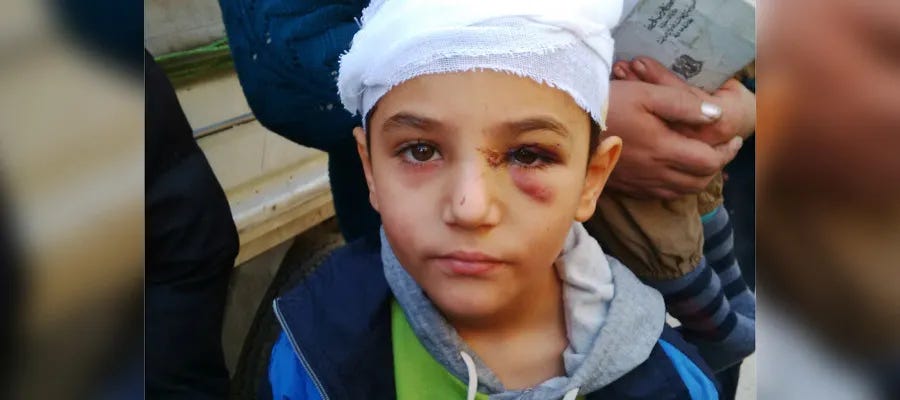
Boy from al-Zahra’a, Homs, injured in a terrorist suicide and car bomb attack in December 2015, terrorists repeatedly targeting the district because it was largely – but not exclusively – Alawite.
Photo © Eva Bartlett
By Eva Karene Bartlett | September 6, 2026
I share this post from Basira Press because I agree with much of it, not every word or point, but much of it, especially the notes about how supposed human rights groups spew sectarian language in order to foster division, and to otherwise mislead an uninformed public:
“How convenient that Zionist lies about Iran and Hezbollah in Syria are resurfacing – such as Human Rights Watch, led by Jewish liberal Ken Roth; Soros funded Amnesty; or White Helmets, founded by a British spy – while also attempting to drive a wedge between Iran and Palestine are helping the US empire and Jewish supremacists justify their war against Iran by weakening solidarity for Iran.
… When it comes to Syria, there are three camps that are wrong and illogical: 1) Assad was a pure saint and never did even an iota of wrong; 2) fake “both sides are equally bad” virtue signaling reductionism; and 3) oy vey, Assad gassed 6 gorillion Sunnis and turned them into lamp shades and soap.
Assad was not the monster who committed atrocities akin to the alleged holocaust. There is zero credibility to human rights reports prepared by Jewish led NGOs who get their accounts from ISIS/Nusra held areas. It’s not a “both sides are equally bad” reductionist fallacy either.
… If someone wants to honestly document history about Syria, then fine, as long as it doesn’t aid the propaganda against the resistance axis and seek to divide people on Iran in order to reduce solidarity for Iran. It might be a worthwhile project to see which bad things Assad actually did vs totally made up atrocity propaganda (whose art was taught to them by their Zionist masters). Such a study should have zero reliance on HRW, Amnesty, White Helmets, and any group associated with western and Zionist backed mercenaries. Iran and Hezbollah entered to stamp out a Zionist backed insurgency, not to “kill 6 gorillion Sunnis for sport”
These same people ignore the atrocities against Shias in Kafriya and Fua…
Making sectarian strife one’s political compass is a mental illness and serves the Zionist enemy. Martyr Ayatollah Sayyed Ali Khamenei said that any Muslim who spreads sectarian strife is neither Sunni nor Shi’a.
We should focus on the current “new Syria” which is acts as collaborationists with the Zionist regime and the US quite openly. Jolani is offering up Syria for sale to BlackRock and pushing usury based loans with Visa cards for all.”
*
Skipping ahead to the unreliable sources mentioned, and I know that Basira only gave a few examples and is aware it is a far wider deviousness that those mentioned, I’ll include a link to a compilation I did back in mid-2015, but basically note that across the board, Western-backed NGOs had bloody hands in Syria and are NOT reliable sources of information for Syria, not during the global war on the people and not now. The UN, also, is another source which reported extremely selectively on the terrorism of the West/Gulf “rebels” in Syria and inflated war propaganda in support of regime change.
Regarding Foua and Kafraya, while I never got to visit those two villages in my vast travels around Syria over my 8 years of visiting or staying there, I did write about them and the unjust suffering they were subject to for years, besieged and starved by terrorists who sniped to kill civilians, including children, every chance they could.
Same with Nubl & Zahra’a, which I did visit in 2016 (Two predominantly Shia villages just north of Aleppo which were under a devastating 3.5 year siege by terrorist factions until the SAA and allies lifted it in February 2016. Residents endured prolonged periods of hunger, were targeted by terrorists’ bombings, and for want of medicines, medical treatment, and sanitary conditions suffered diseases that could otherwise have been treated.).
Below are a selection of my articles from/on Syria, highlighting the selective reporting, absent reporting, outright lying, and sectarian language of various Western NGOs, the UN, and of course Western corporate media. Most of the articles are based on me actually going to the places in question:
–The Terrorism We Support in Syria: A First-hand Account of the Use of Mortars against Civilians, September 2014
–MOSAIC SYRIA: Another Actor in the Anti-Syria War Propaganda Theatre, October 2014
–Untold Suffering in Foua and Kafraya: Two Northwestern Syrian Villages Under Siege and Assault by NATO’s Terrorists, August 2015
–Untold Suffering in Foua and Kafarya-Part 2
–Deconstructing the NATO Narrative on Syria, October 2015 (including on sectarianism)
–Not-Tweetworthy: UN selectively tweeting, ignores Foua, Kafarya, Nubl, Zahra’a, December 2015
–Where is the West’s compassion & condemnation following terror attacks in Middle East? (on sectarian reporting after terror attacks in Bourj al-Barajneh, Beirut and al-Zahra’a, Homs), January 2016
–UN covers up war crimes in Syria, citing U.S. backed Al-Qaeda propagandists, October 2016
–Interview: Father Of Iconic Aleppo Boy (Omran Daqneesh) Says Media Lied About His Son, June 2017
–Syria War Diary: What Life Is Like Under ‘Moderate Rebel’ Rule, Aleppo, August 2017
–Syria War Diary: Order Returns To Madaya & al-Waer, Civilians Recount Horrors Of “Rebel” Rule, September 2017
–UN Feigns Outrage Over Ghouta While Terrorists’ Rockets Rain Down on Damascus, February 2018
–Syrian civilians from ground zero expose Douma chemical hoax, June 2018
–Torture, starvation, executions: Eastern Ghouta civilians talk of life under terrorist rule, June 2018
–Welcome to Hadar: A Village Under Siege by al-Qaeda and Israeli Forces Alike, June 2018
–Liberate Syria’s Idlib, precisely for the civilians that America fakes concern over, May 2019
–The Caesar Act: The Latest Western Attack on Syria, June 19th, 2020
–US sanctions are part of a multi-front war on Syria, and its long-suffering civilians are the main target, July 13, 2020
–Western media quick to accuse Syria of ‘bombing hospitals’ – but when TERRORISTS really destroy Syrian hospitals, they are silent, March 24, 2021
*Human Rights Watch deliberately only scratched the surface in exploring Ukraine’s use of banned ‘petal’ mines, March 2023 (*HRW lies elsewhere)
*Rick Sterling: “AVAAZ, “White Helmets”, HRW, PHR, Amnesty & More: Humanitarians for War on Syria”, March 2015
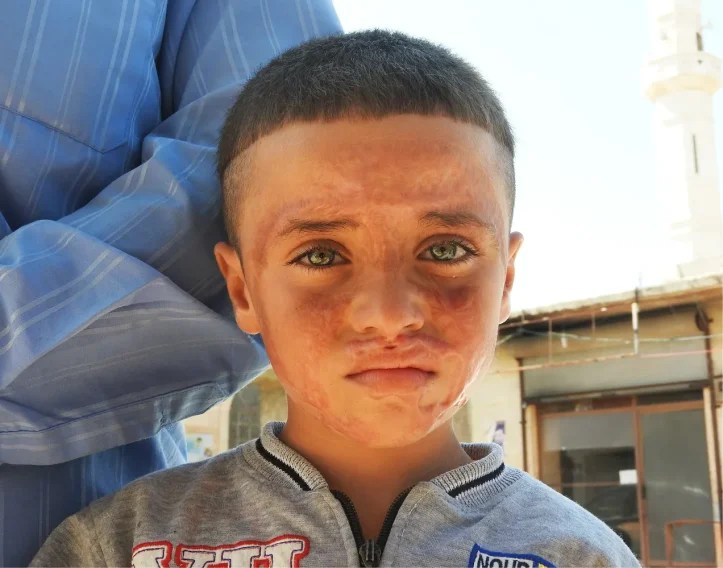
Photo © Eva Bartlett
“The roughly 65,000 people of Nubl and Zahra’a villages, under siege from terrorist factions of the so-called FSA, al-Nusra, and affiliated factions for three and a half years, were on February 3, 2016, liberated from the choke-hold which strangled them. Zeinab, 25, and Mounthaher, 26, each have young children who suffered for want of food and basic elements of life, and who were traumatized by the terrorists’ bombing of the villages. Although corporate media, when deigning to mention the villages, usually focused on their predominately Shia composition, Sunnis also live in the villages. According to Zeinab, “Sectarianism wasn’t a problem before, we were brothers and sisters, we intermarried with neighbouring villages.””
“This boy, 7, has painful face disfiguration from a terrorist-fired mortar which burned his face. Under siege at the time, the boy was only treated with basic medical care in a bare-bones hospital in Zahra’a. The boy is not originally from Nubl, but from Idlib, from which his grandfather fled when terrorists invaded. He is another poster child for the terrorism inflicted upon Syria.”
Aleppo and nearby villages ravaged by the West’s “moderate” terrorists (photo essay)
Hezbollah denies ties to alleged Syria-Lebanon ‘destabilization cell’
Al Mayadeen| September 2, 2026
Hezbollah’s Media Relations Office has categorically denied any connection to a security cell reportedly arrested on suspicion of seeking to destabilize Lebanon and Syria, dismissing the accusations as entirely baseless.
In a statement released Wednesday, the office stressed that Hezbollah has no connection whatsoever, direct or indirect, to any such cell or group. It said certain media outlets, which it accused of a pattern of leveling false accusations against the Resistance, had circulated the claims linking Hezbollah to the alleged cell.
The office said attempts by these outlets to implicate Hezbollah in security-related cases, relying on unnamed sources, are part of a disinformation campaign aimed at tarnishing the group’s image, sowing discord, and undermining security and stability in Lebanon.
It asserted that the reports are part of a broader effort to malign the Resistance through unverified claims attributed to anonymous sources.
A recurring pattern
The denial follows months of similar accusations against Hezbollah from Syrian officials since the fall of the al-Assad government.
In July, Hezbollah rejected claims tying it to an attempt to smuggle weapons and missiles across the Syrian-Iraqi border, after Syrian authorities said they had intercepted a shipment concealed inside a fuel tanker arriving from Iraq. Also in April and May, the group denied allegations linking it to a cell accused of plotting to assassinate a religious figure.
Hezbollah has affirmed on each occasion that it maintains no activity, connection, or presence inside Syrian territory. The group has said the repetition of such claims raises serious questions and points to parties seeking to inflame tension between the Syrian and Lebanese peoples.
Hezbollah has also pointed to similar fabricated allegations emerging from Bahrain and Kuwait, warning of a foreign plot aimed at stoking tensions between Arab nations and the Axis of Resistance and destabilizing the wider region.
The group has consistently framed the recurring accusations as a coordinated effort tied to the broader Zionist-American agenda in the region, arguing that the timing and pattern of the claims serve to isolate the Resistance and strain relations between Lebanon and Syria at a sensitive political juncture.
Israeli terrorism is getting worse because Western leaders are cowards, hypocrites
By Robert Inlakesh | Al Mayadeen | August 30, 2026
Israeli terrorism against civilians across the occupied West Bank has recently triggered condemnation from Western leadership – this shallow rhetoric is overshadowed by their actions, which are driven by a cowardly refusal to push back against the Zionist lobby.
Condemnations and statements of concern have been recently issued by US, UK, and EU officials alike, in what appears at first glance to be pushback against Israeli settler violence and expansionism in the occupied West Bank. In fact, what we are witnessing is the continuation of a decades-long tradition of hollow statements that act to save face by pretending as if the settlers themselves are somehow rogue elements that can be judged independent of the rest of the Zionist project.
In reality, settlement expansion is a regime project, as the violence of the settlers themselves is too. The Zionist armed forces are hand in glove with the settlers, to the point that military units such as the ‘Desert Frontier’ have been set up to integrate the settler militias into the occupation forces.
Even if the settlement movement was separate from the regime itself – as the EU, UK, and US leaderships like to pretend so that they can continue presenting themselves as capable of criticizing the Israelis – there has been a carte blanche granted to the authorities in “Tel Aviv”, instead of meaningful pushback that would coerce them into curtailing the aggressive project of the settlers.
The moves being made in Western capitals represent the exact opposite of genuine opposition to settler colonial violence and expansionism. US President Donald Trump has refused to impose consequences on the Zionist regime for the killings of 11 American citizens at the hands of settlers.
Instead, its latest move has been to proscribe Palestine Action as a terrorist organization. That means that both Washington and London have designated the activist group as such. This is not a group that engages in armed action; it does not go after targets that are integral to US or UK security, nor has it killed anyone. Palestine Action has been proscribed for the “crime” of organizing actions against weapons factories that supply the components for weapons used to commit genocide.
Interestingly, the news of Palestine Action being added to a US terror list came alongside a declaration from Washington that it was removing Syria from the State Sponsors of Terrorism List. Keep in mind that President Trump has actively acknowledged that the man – whom he claims to have put in power – was formerly affiliated with al-Qaeda. In fact, Hay’at Tahrir al-Sham (HTS), which is now the ruling Party in Damascus, is a rebrand of al-Qaeda’s Syrian wing, which was previously known as Jabhat al-Nussra. HTS is no longer considered a terrorist group by the US, as per its recent declaration.
This in itself demonstrates how unserious Western leadership takes the issue of terrorism. Simply put, terrorism is opposing the Zionist settler-colonial project. It can be guaranteed with a degree of certainty that if Syrian President Ahmad al-Sharaa were to suddenly begin taking measures against the Israelis in southern Syria, or supporting Palestinian Resistance factions, there would be immediate sanctions and proscriptions to follow. But because his administration has signed onto a “joint fusion mechanism” to coordinate with Israeli intelligence, the former face of al-Qaeda in Syria is welcomed across Europe, meets with British officials, and is welcomed with open arms into the White House.
The collective West’s political class is stupefyingly corrupt and has spent nearly three years performing puppet apologetics for a regime committing an active genocide against the people of Gaza. No meaningful action is ever taken. Even Western institutions like FIFA and Eurovision, alongside the International Olympic Committee (IOC), have proven too cowardly to boot out the Israelis, despite FIFA and IOC both taking measures to ban Russia over the war in Ukraine.
Consider the recent threats by Israeli Prime Minister Benjamin Netanyahu to launch precision strikes on targets in Gaza because it found kites near the separation barrier, forcing children to no longer enjoy a common hobby for Palestinian children in the besieged territory. Most people have considered this an utter outrage, mocking the mere premise of launching airstrikes over children’s kites being flown.
Yet the Israelis were taken seriously when, back in 2018, they began complaining of “terror balloons” and “terror kites” that young Gazans would attach burning objects to, as retaliation for the mass shootings carried out against unarmed protesters during the Great Return March. It may almost seem comical that the Israelis complained about this and that the words terror and balloon were combined in a serious sentence, yet Western leadership adopted the very same language.
Take, for example, the 2021 designation of the Hamas political wing as a ‘terrorist organization’ in the United Kingdom. In their justification as to why they decided to proscribe the political wing – because the Qassam Brigades had long been on their list – the most in-depth example they cited was the use of these balloons. Yes, balloons were used as the most important example as to why Hamas was designated a “terrorist group” in the United Kingdom.
The double standards are so stark that it beggars belief. At the end of the day, it is the utter cowardice that emboldens the Zionist regime to do whatever it chooses, whenever it likes. These Western governments and institutions have allowed the Israelis to erode the post-WW2 international order, destroyed the concepts of human rights and international law, and normalized genocide, even ignoring domestic law, endangering their own populations and undermining the fight against actual terrorism.
They render the international courts ineffective and take measures to punish them for doing their jobs; they stand by and praise the Zionist entity along with its allies in Washington as an alternative body to the United Nations taking over control of the Gaza Strip. International borders and national sovereignty no longer mean anything; embassies are no longer off limits for airstrikes; and journalists can be mass executed with no pushback.
A world that has been turned completely upside down, all so that a small settler colonial regime whose ethno-supremacist cult following of narcissistic psychopaths can have their way at every single turn. All of this, then they turn around and pretend as if their completely shallow statements about settler violence somehow mean anything. In many ways, it would be better if they just closed their mouths. None of the violence they pretend to condemn, without ever doing anything tangible to stop it, would be possible if they had taken action to stop it.
Diplomatic Scandal: Why Did the U.S. Recall Its Ambassador to Turkey?
By Alexandr Svaranc – New Eastern Outlook – August 28, 2026
The U.S. State Department has abruptly recalled its ambassador to Turkey, Tom Barrack, who also served as the President’s Special Envoy for Syria and Iraq. This sharp personnel pivot has raised numerous questions: was this decision a consequence of pressure from the Israeli lobby?
An Unconventional Diplomat
The appointment of Tom Barrack as ambassador to Turkey on May 14, 2025, was an atypical move, even by the standards of Donald Trump’s personnel policy. Barrack is not a career diplomat, but a major real estate investor. As a close associate of Trump and a key fundraiser for his campaign, he secured the post largely due to his personal loyalty to the President.
It was assumed that his proximity to the head of the White House would serve as a “safe conduct” for Barrack in the complex Middle East region. However, it turned out that Trump’s own political unpredictability does not extend to his inner circle: in Washington, the right to be eccentric remains a privilege of the President, not his appointees.
Reason for Resignation: The “Golan Question”
Journalist Laura Loomer was the first to report the ambassador’s recall on August 25. According to her information, the reason was Barrack’s imprudent remarks, which directly contradicted the official course of the U.S. administration. In an interview, the diplomat referred to the Golan Heights as “occupied Syrian territory” and criticized Israel for its “illegal settlement activity.”
These words sounded like a political démarche, especially since Donald Trump had officially recognized Israeli sovereignty over the Golan back in 2019, during his first term.
Lobby Influence and Political Consequences
Barrack’s position triggered an immediate reaction not only in the White House but also among influential Republicans. Speaker of the House Mike Johnson and Senator Rick Scott, whose positions are closely tied to the interests of the pro-Israel lobby in the U.S., made it clear that such statements were unacceptable.
Barrack’s attempts to justify himself—claiming his words were “taken out of context” and that he was merely discussing the historical aspect of the issue—had no effect. It became clear that clouds were gathering over the ambassador: his views on Middle East policy had diverged from the vector dictated by Washington’s strategic allies. Ultimately, the career of the “real estate diplomat” was sacrificed to interests that carry far more weight in American politics than personal friendship with the president.
In Tel Aviv and Washington, dissatisfaction is mounting over the stance of U.S. Ambassador to Turkey Tom Barrack following recent IDF airstrikes on the Abu al-Duhur airbase in Syria. Initially, Barrack labeled Israel’s actions an “unnecessary escalation” on X (formerly Twitter), and later, in an interview, accused Jerusalem of attempting to provoke a conflict with Turkey on the eve of the U.S. midterm elections. According to the diplomat, only Recep Erdoğan’s restraint prevented a full-scale war.
Benjamin Netanyahu’s government viewed these remarks as support for Ankara’s ambitions. The State Department, for its part, acknowledged that Barrack’s statements only deepened Israel’s perception that the U.S. is distancing itself from countering the Turkish threat. Further irritation was caused by the ambassador’s comments regarding negotiations with Lebanon on the disarmament of Hezbollah, which involved Iranian representatives.
Such coordinated criticism of Barrack is the result of efforts by the Israeli Foreign Ministry and intelligence services, leveraging the influence of the Jewish lobby in the U.S. These methods are not new: in his book By Way of Deception, former Mossad officer Victor Ostrovsky described how, in 1979, Israeli intelligence orchestrated the resignation of U.S. Ambassador to the UN Andrew Young due to his contacts with the PLO. At that time, with the sanction of Menachem Begin, a leak was arranged through Newsweek magazine. It is evident that for Mossad chief Roman Hoffman, removing the “inconvenient” diplomat Barrack was a matter of routine.
Consequences of the Ambassador’s Recall: A Shift in U.S.-Turkish Relations
The appointment of businessman Thomas Barrack as U.S. Ambassador to Turkey initially sparked skepticism within the State Department. A barrage of criticism from the political establishment and the expert community, culminating in the emergency recall of the diplomat “for consultations,” effectively sealed his resignation. Currently, the duties of the head of the diplomatic mission in Ankara are being temporarily performed by the U.S. Chargé d’Affaires.
The name of Barrack’s successor has not yet been announced, but experts believe that Marco Rubio will opt for a career diplomat to lower the political temperature surrounding the position. It is expected that the new ambassador will adhere to a firm pro-NATO and pro-Israel line, seeking to balance U.S.-Turkish relations while accounting for Israel’s interests.
Implementing such an agenda amid the acute crisis between Ankara and Tel Aviv appears extremely difficult. Washington will likely resort to harsh pressure on President Recep Tayyip Erdoğan, despite his previous personal ties to Donald Trump.
For the Turkish leader, Barrak’s recall was a painful blow. Ankara saw the businessman as “its man” in the Trump administration, whose commercial background allowed for a flexible and pragmatic dialogue. Erdoğan had counted on Barrak’s support in establishing a safe zone in Syria. Now, Turkey is deprived of the unofficial US “umbrella” that protected it from Israeli airstrikes near its borders, and the prospects for modernizing the Turkish army and strengthening Ankara’s military with Washington’s support are becoming extremely uncertain.
The situation clearly demonstrates the risks of relying excessively on fickle American policy. Ankara should reconsider its diplomatic priorities. Playing a game of “giving in” to American “hawks”—for example, on the issue of arms supplies to the Kyiv regime—is fraught with serious consequences for relations with Russia. Such a course threatens Turkey not only with a weakening of its defense potential but also with significant economic losses. Specifically, the question arises: Who will compensate Ankara for the loss of Iran’s $7 billion gas market if the US imposes new anti-Iran sanctions? Given the West’s inconsistency, Turkey is unlikely to escalate relations with its northern neighbor for the sake of dubious foreign policy adventures.
Alexander SVARANTS, Doctor of Political Science, Professor, Turkologist, and expert on Middle Eastern countries
Featured Video
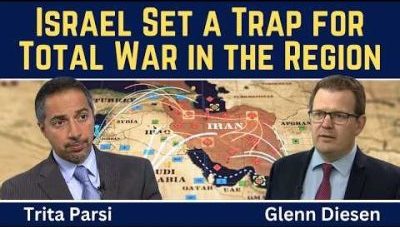
Trita Parsi: Israel Set a Trap for Total War in the Region
or go to
Aletho News Archives – Video-Images
From the Archive
Zionism’s Violent Legacy
By Donald Neff | Washington Report On Middle East Affairs | January 1996
On January 4, 1948, Jewish terrorists drove a truck loaded with explosives into the center of the all Arab city of Jaffa and detonated it, killing 26 and wounding around 100 Palestinian men, women and children.[1] The attack was the work of the Irgun Zvai Leumi – the “National Military Organization,” also known by the Hebrew letters Etzel – the largest Jewish terrorist group in Palestine. The Irgun was headed by Revisionist Zionist Menachem Begin and had been killing and maiming Arabs, Britons and even Jews for the previous ten years in its efforts to establish a Jewish state.
This terror campaign meant that at the core of Revisionist Zionism there existed a philosophical embrace of violence. … continue
Blog Roll
 Aletho News
- Trita Parsi: Israel Set a Trap for Total War in the Region
- Trump’s Iran war is on an Israeli leash
- Saudi oil boss issues global supply warning
- Riyadh Says Its Oil System Is Intact. The Numbers Say Otherwise.
- Trump and Netanyahu Want to “Finish the Job” on Iran
- US ‘one-sided dictation’ not Iran’s beliefs makes rational talks impossible: Baghaei
- Iran’s Next Strike May Not Explode. It Could Shut You Down /Col Doug Macgregor
- Iran: US political targets legitimate if assassinations return
- Iraq shuts key border crossing with Iran under US pressure: Report
- Undersea Internet cables could be targeted in retaliation for attacks on Iran: IRGC deputy chief
- If Americans Knew
- The Israel Lobby’s Changing Fortunes
- AIPAC has become such a political liability that it’s shifting to a more “nimble” approach to buying politicians
- At least 160 Israeli settler attacks in 2 weeks
- Will Gaza’s Ancient Christian Community Disappear Forever?
- Israel’s vision of regional security rests on keeping Arab states weak
- Heidi Levine recounts how Palestinian youths helped save her in settler attack
- DAILY UPDATE: Latest essential news on Palestine, Israel, & region
- Trump’s Intensifying Sabotage of the ICC, for Israel’s Sake
- Israeli military detain US and UK volunteers in West Bank including Democratic NY politician Brad Lander
- Americans at National Conservatism Conference held in Israel this year criticize Israel
- No Tricks Zone
- E-Cars Reduce CO2 Emissions By Only 41% Compared To Internal Combustion Engine Vehicles
- Predictions Made By Renowned Climate Professor Over Past Decades Have Been Proven To Be Poor
- New Study Suggests Large Regions Of The Pacific Ocean Have Been Cooling For The Last 80 Years
- Germany’s Green Energy Debacle: High Energy Costs Force Kahla Porzellan to Close After 182 Years!
- New Study: 50 Years Of The Most Aggressive ‘Net Zero’ Policies Can Only Affect The Global Climate By 0.03°C
- US September “Heat” Was No Record…Many Records Set Decades Ago
- Latest European Green Energy Debacle; Portugal’s Largest Flagship Solar Park Insolvent!
- Green Energy Debacle: German Expert Professor Fritz Vahrenholt Warns Of Severe Economic And Social Consequences
- Two More Paleo Reconstructions Affirm Meters-Higher Sea Levels Across Ireland, Brazil 7000-6000 Years Ago
- New Study: Earth And Venus Surface Warmth Largely Explained By Convection And Lapse Rate, Not CO2 Or Radiation

