The Andean Shadow Army
How Colombia became the world’s primary reservoir of mercenary manpower

José Niño Unfiltered| September 14, 2026
A few weeks ago Russians with Attitude, posted a blunt prediction after Abelardo de la Espriella won Colombia’s presidency in June.
“It was already bad under Gustavo Petro who didn’t do anything to stop it but at least verbally denounced the outflow of Colombian mercenaries. De la Espriella will likely actively support American-Ukrainian recruitment efforts. There’s already many thousands of them (with around 1,000 confirmed killed). I suspect flooding the Ukrainian army with Third World meat will be the focus of US strategy to solve Kiev’s manpower problems. It’s already the publicly declared Ukrainian strategy.”
Hot take aside, there’s considerable truth behind RWA’s commentary. Colombia now supplies more foreign fighters to Ukraine than any other nation on earth, and it did not arrive at that position overnight.
The International Federation for Human Rights estimates that 2,000 to 3,000 Colombians joined the Ukrainian army as contract soldiers. The Defense Post reported in November 2025 that Ukraine had signed roughly 2,000 Colombians on military contracts, citing the German daily Die Welt. Writing for the Atlantic Council in February 2026, Erin K. McFee noted that official figures do not exist and put Colombians at roughly 25 percent of all personnel drawn from the 65 countries that have joined Kiev’s ground forces. Petro pushed the number far higher, telling Colombians in May 2026 that 7,000 men were fighting and dying in a war that was not theirs.
Citing former Ukrainian economy minister Tymofiy Mylovanov, Petro wrote on X on May 5, 2026, in a post that translates as “There are 7,000 men from Colombia with military training, fighting in a foreign war and dying without cause in Ukraine. We do not want to export death. The mercenary is prohibited by law.”
However uncertain the head count, the body count is harder to dispute. Colombia’s Foreign Ministry gave El Tiempo figures published on June 9, 2026, and current through May, showing 670 Colombians missing and 173 dead across both sides. Of the dead, 140 died in Ukraine, and 130 of those bodies have already come home in coffins, while consular officials in Russia confirmed 33 more using information the Russian government supplied. Of the missing, Ukraine’s armed forces declared 446 lost in combat, families reported another 56, and the Moscow consulate logged 168. The ministry then undercut the totals, explaining in Spanish that Colombian citizens travel to conflict zones individually and without notifying Colombian authorities, so the available figures do not necessarily reflect the full scope of the phenomenon.
Independent estimates fill that gap and they run grim. Writing for the Atlantic Council, Erin K. McFee put Colombian deaths on Ukraine’s side at 300 to 550, citing El País. In a Kiev memorial park, Colombian flags now form a striking patch in a dense blanket of tributes to the fallen. Colombians have lost more men in Ukraine’s International Legion than any other foreign nationality, with Americans second at roughly 100 killed. McFee interviewed a Colombian veteran in Kiev in late 2025 who delivered a warning stripped of romance. “Tell Colombians not to go there, because more die than return.”
The dead accumulate in single afternoons as much as in slow attrition. On July 21, 2025, a Russian missile struck the dining hall of a training camp near Kropyvnytskyi at lunchtime. The New York Times reported that at least a dozen foreign volunteers died, among them citizens of the United States, Colombia, Taiwan and Denmark, and an anonymous American recruit from Florida described seeing at least 15 dead and more than 100 wounded. The unit hit was the International Legion run by Ukraine’s military intelligence, whose spokesman said official casualty figures would stay sealed until the investigation closed.
Colombians who leave the front face a second danger. On November 10, 2025, a court that Russia administers in Donetsk sentenced José Aarón Medina Aranda and Alexander Ante to 13 years each for fighting alongside Ukraine’s armed forces. The two had flown to Caracas on their way home to Popayán. Venezuela handed them to Russia instead.
The supply side explains what the demand side cannot. Colombia has fought drug cartels and guerrilla armies for more than 60 years, and that war produced the deepest pool of combat hardened veterans in the hemisphere. The Associated Press put annual retirements from Colombia’s armed forces at more than 10,000, a figure the Defense Ministry has given as roughly 10,600. Most leave in their late 30s or early 40s after 15 to 20 years fighting the FARC, the ELN, and the cartels, and Colombian law pushes most soldiers and noncommissioned officers out by 45.
Citing the Colombian daily La Patria, McFee reports that rank and file soldiers earn close to $400 a month on active duty, and that retirement often halves whatever they were making. Ukraine pays soldiers in combat operations from $3,000 to $5,000 a month, offers a potential $25,000 signing bonus, and promises families a $350,000 death benefit. At a December 2025 forum in Bogotá on the veteran exodus, convened by the Corioli Institute that McFee founded and directs, one participant described Ukraine as “the first real door that opens,” for economically troubled veterans.
That door has been swinging for decades. Plan Colombia poured American money and training into building one of the Western hemisphere’s largest professional militaries, and the graduates kept arriving faster than the domestic economy could absorb them. Erik Prince got there early. Blackwater affiliates had been placing retired Colombian soldiers in Iraq since 2004, and by 2010 Prince was building something larger. Late that November, a plane carrying dozens of Colombian men landed in Abu Dhabi, where an Emirati intelligence officer waved them through customs and an unmarked bus carried them 20 miles into the desert. They had entered the country posing as construction workers.
The New York Times reported that they were the first recruits for a battalion of 800 foreign troops Prince was assembling for the crown prince of Abu Dhabi, financed with $529 million from the Emirates. In 2015 the same two reporters found that Emirati money had sent roughly 450 Latin American fighters, hundreds of them Colombian, to fight the Houthis in Yemen. At around 1 a.m. on July 7, 2021, a team of just over two dozen mercenaries, most of them former Colombian soldiers, stormed Haitian President Jovenel Moïse’s home above Port-au-Prince and shot him dead. A Miami jury convicted four more plotters in May 2026. The 18 Colombians arrested in Haiti are still jailed without trial, and no one has established who ordered the hit.
The most recent destination is also the darkest. In May 2026 Human Rights Watch published an 83-page report by Joey Shea and Jean-Baptiste Gallopin, From Bogotá to El Fasher, documenting how the Abu Dhabi firm Global Security Services Group appears to have hired hundreds of Colombian contractors and routed them through Emirati military facilities to fight alongside the Rapid Support Forces. Investigators geolocated video of Spanish speaking contractors fighting in El Fasher, and six residents of the city said they saw men they believed were Colombian standing armed at the sites of the October 2025 mass killings and rapes that the UN fact finding mission called consistent with genocide.
One contractor told Human Rights Watch he trained RSF recruits near Nyala and that many of them were young children. The Treasury Department had already sanctioned the Colombian recruiter A4SI on December 9, 2025, finding that the firm ran campaigns through its website, group chats and town halls to fill slots for drone operators, snipers and translators.
UN experts have put only a rough number on the whole enterprise. After visiting Colombia from March 16 to 27, 2026, the Working Group on the use of mercenaries reported that more than 10,000 Colombians have been “recruited into armed conflicts worldwide, both through legal and irregular means,” many of them former soldiers, police and veterans, and many offered between $2,000 and $6,000 a month. Its preliminary findings are blunter about the limits of that count.
Working Group member Joana de Deus Pereira told reporters in Bogotá that proliferating conflicts had raised demand and Colombians were filling it, naming the escalation in the Middle East, the war in Sudan, and Russia’s invasion of Ukraine. Chairperson Michelle Small said foreign buyers seek out former Colombian personnel, and warned that deceptive contracts, where firms pay far less than advertised or write outright fake ones, can amount to labor exploitation and human trafficking.
Petro met the crisis with a statute, though its reach remains uncertain. The House approved the bill in December 2025 by 94 to 17, and Petro signed Law 2569 on March 17, 2026, adopting the 1989 convention against mercenary recruitment. Colombia has not actually ratified it yet. The Constitutional Court must review the law first, which is why the UN experts urged Bogotá to hurry. Whether it bites is another question.
The next administration inherited the law and a very different set of priorities. De la Espriella took office in August promising to rebuild security ties with Washington, which largely frayed under his predecessor. He will also look to stay in Washington’s good graces by towing a pro-Zionist line.
Part of this rapprochement will likely also involve Colombia reactivating its mercenary pipelines in the Russo-Ukrainian theater, as Washington increasingly leans on proxy forces and covert operations in what is beginning to look like a pyrrhic victory for Russian forces.
The brief, defiant interlude of the Petro administration has been decisively shut down, and Colombia has been reset to its default setting as a loyal vassal state of the Judeo-American empire. Under Abelardo de la Espriella, Bogotá will remain the premier supplier of disposable infantry for Washington’s global destabilization schemes from Kiev to the Middle East.
Ultimately, Bogotá’s most lethal and dependable global export is neither coffee nor cocaine, but the expendable blood of veterans marching straight from one meat grinder into the next.
The Colombian factor in South America
The Latin American left has spent the last few years investing in an image of Colombia that does not correspond to the country’s historical reality
By Lucas Leiroz | Strategic Culture Foundation | August 16, 2026
In Colombia, the newly elected president, Abelardo de la Espriella, has initiated a strong rapprochement with the State of Israel. Relations that had been strained during the government of Gustavo Petro have not only been fully restored but have also deepened substantially – with the new Colombian government even recognizing Israeli “sovereignty” over the Golan Heights, a Syrian region illegally occupied by the Zionists.
The move was met with shock among South American left-wing circles, particularly in Brazil, where Colombia’s historical image as Washington’s main regional asset in South America appears to have been completely “whitewashed” by the years of Petro’s government. It is curious to see how short collective memory is in Ibero-America and how political debate in general is shaped by the emotions of momentary agendas – and how this childish mentality has repercussions even at the highest institutional levels.
Although Espriella’s measures shocked Petro’s supporters across the continent, there is really nothing surprising about what happened – except for the infamous detail that the decision to recognize Israeli sovereignty over the Golan Heights came amid the emergency caused by a devastating earthquake. Colombia has always been the gateway for U.S. imperialism into South America.
Since the days of the Korean War – in which Colombia participated by sending a large contingent of troops – Bogotá has served as the United States’ offensive outpost in the region. Colombia is home not only to U.S. military bases, but also to biolaboratories, intelligence centers, narco-trafficking militias, and private military companies (PMCs) armed by the United States.
Most of the U.S. offensive infrastructure in South America is concentrated in Colombia. It was from Colombian territory that U.S.-armed mercenaries invaded Venezuela in 2020 during the failed “Operation Gideon,” whose objective was to overthrow then-President Nicolás Maduro through an asymmetric warfare campaign.
Going further back historically, between the late 1990s and early 2000s, the United States and Colombia consolidated total security and defense integration through the so-called “Plan Colombia” – the U.S. policy of sending security personnel to the South American country supposedly to “combat drug trafficking” and illegal guerrilla groups. Colombia subsequently internalized the entire U.S. security apparatus, from the CIA to the armed forces and PMCs.
If there is one country in South America capable of functioning as a military pivot for U.S. interests in the region, that country has always been Colombia. This has always been clear to any political analyst – or simply to any serious observer. Apart from Brazil itself – which has historically functioned as a “watchdog” for Washington while retaining a certain degree of autonomy – Colombia is the only country in South America truly capable of carrying out any U.S. military plan.
However, acting in an emotional manner, the left across the continent simply forgot all of this. Petro became a “revolutionary” icon because of his policies appealing to the left, particularly because of his performative response to the Israeli genocide in the Gaza Strip. Petro severed diplomatic relations between Colombia and Israel and strongly condemned the actions of the Zionist state in international forums. But that was where it ended. Petro did nothing beyond diplomatic theater, nothing to structurally alter Colombia’s historical ties with the United States.
Not only that, Petro himself had previously maintained – during the presidential campaign that brought him to power – strongly pro-Western rhetoric, even going so far as to advocate NATO participation in the creation of an “environmentalist” military force to protect the Amazon from problems such as wildfires and deforestation. Petro, like the continent’s entire liberal left, was completely aligned with the agendas of the Democrats and the European Union, with disagreements emerging only in relation to Donald Trump and the State of Israel.
Unfortunately, much of the left-wing political establishment across the Americas seems to act solely on the basis of fleeting political trends and emotions, without paying attention to the deeper historical and geographical context. In recent times, there has been an information-terror campaign about a supposed “danger” to the region posed by Argentina (an economically fragmented country) and Paraguay (a tiny country with no significant military relevance), simply because the current governments of these countries have adopted a more explicitly pro-U.S. and pro-Israel stance. Meanwhile, Colombia was ignored because it was regarded as an “ally” on account of Petro.
Now Petro is out of the picture. And Colombia is returning to what it has always been: the U.S. offensive base in South America. Reality is returning with full force, to the despair of activists who childishly insist on believing in the liberal democratic game.
With Israel Becoming A Pariah State, It’s Seeking To Turn Latin America Into Its Base Of Influence.
By Justin K.P. | The Dissident | August 13, 2026
Becoming more of an international pariah, Israel has been quietly but rapidly expanding its influence across South America, hoping to use it as its new base of international influence and diplomatic protection.
The Israeli newspaper Ynet late last year quoted Israeli foreign minister Gideon Saar saying that “2026 will be ‘the year of Latin America’” for Israel.
The article quoted Amir Ofek, deputy director general for Latin America and the Caribbean at the Foreign Ministry of Israel, saying, “We hope and believe that 2026 will be the year of Latin America, a year that will look different diplomatically, one in which we see a positive change in the relations of the continent’s countries with Israel”.
This was in reference to Israel normalizing ties with the new U.S. backed Bolivian President Rodrigo Paz, a country which under the MAS-led government cut ties with Israel in 2009 over its bombardment of Gaza .
Under the new U.S. backed president Rodrigo Paz, Ynet noted, “Bolivia announced it was canceling its visa requirement for Israelis, a move expected to put the country back on the map for Israeli travelers in the region. After intensive talks … the two foreign ministries agreed on the text of an accord and a joint statement.”
This is just a part of a far larger U.S. backed Israeli plan to turn every South American government into Israeli puppet states.
Using the one million dollars he was given from the Zionist “Genesis Prize for his unwavering support of Israel”, the Israeli-aligned president of Argentina, Javier Milei launched the “Issac Accords”, an initiative “aimed at strengthening political, economic and cultural cooperation between Israel and Latin America”.
The project was launched alongside Genesis Prize Foundation Co-Founder and Chairman Stan Polovets and former US Ambassador to Costa Rica, Fitz Haney.
Hanley boasted to the Jerusalem Post that “Our goals are ambitious but clear: create frameworks for trade, tourism, education, and technology that connect Israel and Latin America’s leading democracies in practical, mutually beneficial ways”.
With Israel becoming more and more of a pariah state internationally, the Isaac Accords are designed to turn South America into Israel’s base of influence.
Hanley and Polovets told the Jerusalem Post, “Unfortunately, too many traditional allies are dealing with internal divisions and rising public antisemitism that make open support for Israel politically difficult. Meanwhile, Latin America is part of the emerging Global South, which is demanding a stronger voice internationally. It represents a quarter of that bloc’s countries and 10 per cent of its population. Engaging Latin America isn’t about replacing Europe – it’s about expanding Israel’s circle of friends. These are democracies that admire Israel’s innovation and resilience”.
The initiative did not simply include making inroads with governments in South America, but overthrowing governments in solidarity with Palestine, and replacing them with pro-Israel ones.
Ynet boasted that in Honduras, President Nasry ‘Tito’ Asfura has “declared an intention to warm relations with Israel”.
Nasry ‘Tito’ Asfura was effectively installed as president of Honduras by Donald Trump shortly after he pardoned the former president of Honduras and convicted drug trafficker, Juan Orlando Hernández.
As the outlet Canal RED reported:
Hours before the November 30, 2025 elections, President Donald Trump announced through his social network that he would pardon Juan Orlando Hernández, sentenced in 2024 to 45 years in prison for conspiring to import cocaine to the United States and for having received money from ‘Chapo’ Guzmán to finance electoral fraud. New York prosecutors had described Honduras as a “narco-state” during his term, while Juan Orlando was syndicated for accepting millions in bribes from cartels to protect them from the law.
In that same announcement, Trump explicitly supported the candidate of the National Party of Honduras, Nasry “Tito” Asfura, threatening to cut off aid if he was not elected. What seemed like political support covered up a more sinister agreement: the return of Juan Orlando for economic and military control of Honduras
Leaked phone calls show that this was all part of an organized plot, with financing from Israel, to eventually have Nasry Asfura, give power over to Juan Orlando Hernández.
Juan Orlando Hernández is heard on a leaked phone call telling Nasry Asfura “The pardon money … came out of a council of rabbis, and of a people who supported Israel,” adding, “I want to think that you are not going to make a side of me because, thanks to me, you are sitting in that chair. President, it will be me. And I look forward to your support. Because that’s what we talked about with President Trump”.
He added, “The Prime Minister of Israel is going to give us support. We are very grateful to him, they had a lot to do with them. They had everything to do, in fact, they with my departure and negotiation”.
Last week, Honduras “restored full ambassadorial representation with Israel, marking a major diplomatic”.
In April of this year, Israel, the United States, and Argentina officially announced the Issac Accords long planned by Javier Milei, in an official announcement calling to “strengthening cooperation between Argentina, Israel and like-minded partners in the Western Hemisphere”.
Like in Honduras, the Issac Accords include running propaganda campaigns against governments in South America that do not go along with Israeli demands.
Leaked phone calls show that “Argentine President Javier Milei would have contributed 350,000 dollars to form a regional communication team aimed at launching a media campaign against the presidents of Mexico, Claudia Sheinbaum, and Colombia, Gustavo Petro, according to the audio recording of a conversation held between the former president of Honduras Juan Orlando Hernández and the current Honduran authorities” and that “In one of the sound files, Hernández stated ‘that as part of that group’ or continental entity, Milei’s role is important, because he contributes thousands of dollars for the construction of those fake news sources”.
Along with Javier Milei, Trump also openly interfered in the Colombian election, openly favouring current president Abelardo de la Espriella, openly saying that he “would be tremendously successful in leading Colombia to grow the Economy, Create Jobs, Promote Trade, Stop Illegal Immigration, Crack Down on Crime and Drugs, and Restore LAW AND ORDER.”
This interference has certainly paid off for Israel, with Colombia becoming “only the second country, after the US, to recognize Israeli sovereignty over the occupied Golan, which Israel seized from Syria in 1967 and annexed in 1981 in a move the UN Security Council declared void. The reversal came from Colombia’s new right-wing president Abelardo de la Espriella, backed by Trump, who is rapidly undoing the pro-Palestinian policies of leftist predecessor Gustavo Petro: restoring ties, planning a Jerusalem embassy, and quitting South Africa’s ICJ genocide case”, as Drop Site News reported.
This context, as well as other recent developments, adds new context to Trump’s kidnapping of Venezuelan president Nicholas Maduro.
Israel wanted regime change in Venezuela because, as the Miriam Adelson-funded Israel Hayom newspaper explained, “Since Hugo Chávez’s rise to power, Venezuela has become one of the most hostile countries to Israel and Zionism in Latin America. Chávez … severed diplomatic relations with Israel during Operation Cast Lead in 2009, accused Israel of ‘genocide against the Palestinian people’ and compared its policies to Nazi conduct. His successor (Maudro) continued the anti-Israeli line with even more intensity. Thus, Venezuela, which previously maintained warm relations with Israel and even purchased security technologies from it, became a center of hostile propaganda toward Zionism and the Jewish state”.
The U.S. installed successor to Nicolas Maduro, Delcy Rodriguez, has reversed this after Israel sent IDF militants to Venezuela under the guise of helping with recovering from the earthquake.
Since this, the Venezuelan government led by Delcy Rodriguez released a statement saying:
The Governments of the Bolivarian Republic of Venezuela and the State of Israel announce that, following the visit of the Israeli humanitarian delegation to Venezuela in response to the double earthquake that occurred on June 24, and in follow-up to discussions held between high-ranking officials of both countries, the two nations have agreed to allow the continuation of bilateral technical cooperation stemming from the emergency and recovery efforts following the double earthquake. Furthermore, the two nations agree to establish a coordination mechanism to facilitate the provision of consular services to their respective citizens residing in the other country, as needed. Both governments recognize the importance of the bond between the State of Israel and the Jewish community residing in Venezuela, which constitutes a significant historical bridge of friendship between the two countries.
Israel, along with the United States and Argentina, will continue to support right- wing Zionist governments in South America to expand Israel’s influence.
US punished Colombia’s outgoing leader for calling Gaza war ‘genocide’ – FM
RT | August 2, 2026
Israel is at the heart of Washington’s long-running tensions with Colombia and its outgoing President Gustavo Petro, Foreign Minister Rosa Yolanda Villavicencio has told RT.
In an exclusive interview aired on Sunday, Villavicencio insisted that the decisive factor behind US sanctions on Petro was not his alleged failure to combat drug trafficking but rather his outspoken support for Palestine and repeated accusations that Israel was committing genocide in Gaza.
Relations between Bogota and Washington – Colombia’s largest trading partner – steadily deteriorated during Petro’s presidency over US policy in Latin America, particularly toward Venezuela and Cuba, regional anti-drug efforts, and broader geopolitical differences, most notably Petro’s outspoken support for Palestine and criticism of Israel. This culminated in Washington sanctioning Petro last year, accusing him of “allowing drug cartels to flourish” and “refusing to stop” narcotics trafficking.
US President Donald Trump called Petro an “illegal drug leader,” and openly backed right-wing presidential candidate Abelardo de la Espriella, who campaigned on restoring closer ties with Washington, over Petro ally and left-wing Senator Ivan Cepeda in the election earlier this year.
Villavicencio rejected Washington’s justification for sanctioning Petro, arguing that his administration had delivered record results in combating drug trafficking.
“We are talking about record-breaking seizures of cocaine, exceeding the figures achieved by any previous administration,” she said, adding that authorities had dismantled cocaine laboratories, extradited suspects, confiscated criminal assets, and kept the US informed of those efforts.
“President [Petro’s] inclusion on the OFAC list [is] in no way related to drug trafficking. These measures were taken against the president because of his firm and principled stance when he openly described what is happening in Palestine as genocide,” Villavicencio declared. “That was the real reason.”
Petro severed diplomatic ties with Israel in 2024 over its military campaign in Gaza, repeatedly accusing West Jerusalem of committing genocide and becoming one of Israel’s fiercest critics in Latin America.
He also suspended all Israeli arms purchases, ending Colombia’s long-standing reliance on Israeli military technology, banned coal exports to Israel, and later expelled Israel’s remaining diplomats after an aid flotilla carrying Colombian activists was intercepted by Israeli forces. Colombia also formally joined South Africa’s genocide case against Israel at the International Court of Justice (ICJ).
Petro is due to hand power to President-elect de la Espriella on August 7. He has said he will not attend the inauguration, challenged the legitimacy of the election, and alleged that Israel manipulated Colombia’s presidential vote by hacking election servers. Apart from aligning Colombia more closely with Washington, de la Espriella has pledged to restore full diplomatic ties with Israel, effectively reversing nearly every major foreign-policy decision of the Petro administration.
Meanwhile, the Gaza conflict remains unresolved despite recent political developments. Earlier this week, Hamas said it had accepted Trump’s Board of Peace proposal for phased disarmament, provided Israel fulfills its commitments, including a phased military withdrawal, humanitarian access, and progress on reconstruction.
Israel has yet to formally endorse the proposal, however, insisting that any withdrawal can only begin after Hamas fully disarms, leaving the process deadlocked. Israeli forces have meanwhile continued operations across Gaza, with Palestinian officials reporting at least one person killed and several others wounded in strikes on Friday. … Video interview
Does the Pentagon even know who its boat strikes are killing?
By Adam Isacson | Responsible Statecraft | July 1, 2026
The numbers are stomach-turning. In less than 10 months, U.S. forces acting on orders from the Trump administration have killed 215 people in 63 aerial attacks on small boats in the Caribbean Sea and the eastern Pacific.
Since the first attack on September 2, the Trump administration has told us that they are killing drug traffickers. But drug trafficking, especially being a low-level courier, is not a crime punishable by the death penalty, and, even if it were, the U.S. legal system assumes innocence and guarantees a day in court. Skipping that step makes this murder under U.S. law: the equivalent of a cop shooting a fleeing suspect in the back.
The administration is attempting to get around this by claiming that every one of the dead is a “narco-terrorist,” a member or “affiliate” of a profit-seeking criminal group recently added, with no outside review, to a secret Defense Department list of “Designated Terror Organizations,” or DTOs. Because the United States is in a “non-international armed conflict” with the DTOs, a secret Justice Department memo argues, our military is permitted to kill them on sight, even with no self-defense justification.
Yet the administration has still not presented any evidence that a bombed vessel was even carrying drugs, much less that its deceased crew was affiliated with a criminal or “designated terrorist” organization.
What we know so far indicates that the U.S. military is being used to assassinate unknown individuals based on alarmingly flimsy evidence. And the targeting criteria are quite loose.
On the rare occasions when crew members have been recovered, “Military briefers have admitted to members of Congress that they cannot satisfy the evidentiary burden necessary to hold or prosecute survivors of the boat strikes,” reported the Intercept’s Nick Turse, who has covered the boat strikes extensively. Three survivors have been recovered alive; all have been let go without charges.
Questioning Secretary of State Marco Rubio at a hearing earlier this month, Sen. Tim Kaine (D-Va.) revealed that those carrying out boat-strike targeting are using three criteria that Kaine was not authorized to disclose publicly. He could disclose, however, that “evidence of narcotics on the boat” was remarkably not one of the three criteria.
In fact, the U.S. military usually doesn’t even know the identities of the people on the boats. The Washington Post reported that the targeting instructions in the boat-strike campaign’s August 5 Defense Department Execute Order (EXORD) “do not require positive identification of any individual but rather ‘reasonable certainty’ that adult males are members of, or affiliated with,” a DTO.
A former U.S. official who had read the EXORD told the Post, “The campaign may be killing individuals who in some cases have a tenuous link to any organized drug-running operation.” That official added, “When you define ‘DTO’ and ‘affiliate’ so loosely and you’re attacking boats, (the guidelines are) basically meaningless.”
The term “affiliate,” which the Trump administration is using to end lives on the open ocean, is especially squishy. Rep. Adam Smith (D-Wash.), the ranking Democrat on the House Armed Services Committee, told the New Republic’s Greg Sargent that, in a briefing with Pentagon officials, “They did not in any way, shape, manner, or form explain what the ceiling and floor are for ‘affiliated.’” People who received a classified briefing interviewed by the Intercept “said that they were under the impression that little more than a conversation with a DTO member might confer ‘affiliate’ status.”
Vague claims of “affiliation” or behavioral patterns introduce confirmation bias and guesswork into a lethal process. This vastly increases the probability that the boat strikes are killing people who have committed no crime at all.
“Some people who are familiar with boat movements” along the Caribbean coast of Colombia and Venezuela told the Latin American Center for Investigative Journalism that “it is common for the same boats that carry drugs on the outward journey to bring passengers back. The capitanes, as the boat operators are known, take whatever work they can get.”
The Intercept raised the possibility, acknowledged by a senior military officer, that some of those killed in the first strike on September 2 may have been migrants or human trafficking victims. That boat had 11 people aboard, a strangely large number for a short-hop drug delivery of less than 100 miles between Venezuela and Trinidad.
Evidence points to some of those killed in boat strikes being fishermen plying their trade. While residents of poor coastal fishing communities may “take occasional trafficking jobs to get by,” which blurs their identities, the likelihood of dying in a strike is scaring people away from getting in boats simply to fish, the New York Times reported from coastal Colombia and Ecuador. “Residents described entire communities abandoning fishing because the small ‘lanchas,’ or speedboats, used by traffickers and fishers are often indistinguishable.”
In Santa Marta, Colombia, the family of fisherman Alejandro Carranza, killed in a September 15 strike, insists that he was not involved in the drug trade. “If he was some kind of narcoterrorist,” the mother of three of Mr. Carranza’s children asked New York Times reporters, “then why are we living in misery instead of a mansion?”
Two of those killed in an October 14, 2025 strike were Chad Joseph, 26, and Rishi Samaroo, 41, both from the village of Las Cuevas, Trinidad. Their families are suing the United States for damages under the Death on the High Seas Act and the Alien Tort Statute. The complaint in Burnley v. United States argues that both men had been in Venezuela for months working on farms and, in their final communications, told their families that they had obtained passage by boat home to Trinidad.
In Sucre, Venezuela, where 90% of the population lacks basic food security, some of the dead were fishermen or taxi drivers who agreed to crew a boat that shipped drugs to Trinidad in exchange for a few hundred dollars. Some, like a “beloved” indoor soccer player, may simply have been aboard for the ride.
To all the concerns about the quality and reliability of intelligence used to target people for lethal boat strikes, we must add recent cases elsewhere pointing to U.S. reliance on faulty intelligence, or even just hunches. In March 2025, the Department of Homeland Security rendered 252 Venezuelan migrants to El Salvador’s feared Terrorism Confinement Center (CECOT) prison, alleging that they were all “terrorist” group members, an assertion that proved shockingly wrong, according to subsequent investigations. The New York Times revealed that an early March raid on an alleged DTO encampment in northern Ecuador, planned jointly by U.S. and Ecuadorian forces, in fact targeted a dairy farm. A March bombing in Iran that killed students at a school for girls is a well-known recent example elsewhere.
If even a few of the boat-strike victims are just fishermen, passengers, or low-level couriers with no relationship to big criminal syndicates, the Trump administration’s justification for the strikes simply cannot be sustained. It would confirm that this justification rests on a very rickety foundation of questionable intelligence, which should expose many in the chain of command to national and international criminal or civil liability.
The boat strikes need to stop immediately, and its architects and willing implementers must be investigated and held accountable at the earliest opportunity.
Adam Isacson has worked on defense, security, and peacebuilding in Latin America since 1994. He now directs WOLA’s Defense Oversight program, which monitors U.S. cooperation with Latin America’s security forces, as well as other security trends.
The Right-Wing Zionist Wave Sweeping Latin America
José Niño Unfiltered | June 30, 2026
Abelardo de la Espriella’s razor-thin victory over leftist Iván Cepeda on June 21, 2026 represented the most recent rightward shift in Latin America’s politics. The defense attorney from Barranquilla captured 49.66 percent of the vote against Cepeda’s 48.7 percent—a margin of roughly 250,000 votes in what Al Jazeera called one of Colombia’s closest elections. Within hours, Israeli Foreign Minister Gideon Sa’ar called to congratulate him, and de la Espriella posted his response publicly.
“Colombia will restore and strengthen its relationship with the State of Israel like never before. Israel can count on Colombia as a loyal friend and steadfast ally,” de la Espriella declared. Sa’ar called him “a true friend of the Jewish people and the State of Israel,” adding that he looked forward to “revitalizing relations between Israel and Colombia and taking them to their highest level ever” and that he had already invited the incoming president to visit Israel.
Israeli Prime Minister Benjamin Netanyahu offered his own congratulations, saying he looked forward to “working with you to strengthen the bond between Israel and Colombia.” De la Espriella has pledged to reverse Petro’s 2024 decision to cut ties with Israel and has promised to relocate the Colombian embassy to Jerusalem.
No figure looms larger in this transformation of Latin American politics than Argentine President Javier Milei. The libertarian economist who took office in December 2023 has positioned himself as Israel’s most devoted ally anywhere on earth.
“I am sincerely proud to be the most Zionist president in the world,” Milei declared at Yeshiva University in March 2026. At the Western Wall in June 2025, he proclaimed that “My support for Israel comes from the heart, because I believe this is a just cause—the cause of the West. I will always stand by your side.”
Milei personally studies Torah with Rabbi Shimon Axel Wahnish from the Moroccan Jewish community in Argentina and has said he intends to convert to Judaism after leaving office. In June 2025, he became the first non-Jewish head of state to receive Israel’s Genesis Prize, known as the “Jewish Nobel,” awarded for his “unequivocal support” of Israel.
He directed his entire $1 million prize toward creating the American Friends of Isaac Accords, the vehicle through which Argentina and Israel formally signed the Isaac Accords on April 19, 2026 in Jerusalem. The framework explicitly mirrors the Abraham Accords that normalized relations between Israel and several Arab states, but targets the Western Hemisphere instead.
The goals are clear. Partner countries should move their embassies to Jerusalem, designate Hamas and Hezbollah as terrorist organizations, shift anti-Israel voting patterns at the United Nations, and create frameworks for trade in technology, agriculture, water, health, and cybersecurity.
At least one nation had embraced the embassy mandate well ahead of the Accords. Paraguay’s Santiago Peña reopened his country’s embassy in Jerusalem on December 12, 2024, making Paraguay the sixth country in the world—after the United States, Guatemala, Honduras, Kosovo, and Papua New Guinea—and the first since the October 7 attacks to establish diplomatic presence in the contested city.
“Mr. prime minister, on behalf of all the Paraguayan people, we were with you, we are with you, we will stay with the people of Israel forever,” Peña declared at the ceremony with Netanyahu present. He called the move “a tipping point in our own history” and “a moral obligation that the Paraguayan people have asked us to fulfill.”
Paraguay was not alone in courting Tel Aviv. Ecuador’s Daniel Noboa, the banana fortune heir who won re-election in 2025, traveled to Jerusalem in May of that year for meetings with Netanyahu, at which Noboa declared that “Israel and Ecuador have the same enemies” and pledged to fight poverty, terrorism, and suffering “until the end.” Israeli diplomatic sources confirmed to Jewish Insider that both Ecuador and Paraguay are expected to formally join the Isaac Accords framework.
Nowhere did the shift register more dramatically than in Chile. José Antonio Kast’s victory in Chile’s December 2025 election delivered perhaps the most symbolically significant prize. Kast overturned four years of Gabriel Boric’s more pro-Palestinian governance. After Iran’s 2024 drone attack on Israel, Kast had warned that “Iran launches a drone and missile attack on Israel. They could be the same drones that it gifted to Bolivia to monitor our borders. Chile has a serious national security problem.”
In May 2026, Kast met with Israeli President Isaac Herzog and pledged to return Chile’s ambassador to Israel, ending a lengthy vacancy by naming Gabriel Zaliasnik as ambassador. He promised expanded cooperation in agriculture, health, artificial intelligence, technology, and security. Notably, Kast achieved this while governing a country home to the largest Palestinian diaspora outside the Arab world, estimated at 500,000 people.
The same paradox surfaced again, more sharply still, in Central America. Nasry “Tito” Asfura won Honduras’s late 2025 election with Trump’s endorsement, becoming president on January 27, 2026. Despite his Palestinian Christian ancestry, the conservative former mayor of Tegucigalpa made Israel one of his first international destinations after being elected, traveling there alongside the United States.
“It is a great honor for me to be in Israel again and to strengthen the ties which have been in existence over the last 77 years,” Asfura stated in Jerusalem. “I hope we are entering a new era where we can improve our relations, relations of brotherhood, and prosperity, of investment.” Israeli Foreign Minister Sa’ar told the Jerusalem Post Magazine that Asfura “has a clear worldview that is pro-Western, pro-American, and pro-Israeli,” and characterized the broader regional shift as a “Blue Wave” of right-wing governments aligning with the United States and Israel.
Bolivia’s Rodrigo Paz ended nearly 20 years of socialist MAS party rule by winning the October 2025 election. Within weeks, he restored diplomatic relations with Israel—ties the prior government had severed in 2023. Netanyahu congratulated Paz personally, and the two agreed to “promote cooperation in various fields, with an emphasis on security, and to restore the vibrant tourism of many Israeli travelers to Bolivia’s natural landscapes and rich cultures.”
Not every convert to the cause fits the expected profile. Nayib Bukele represents the most curious figure in this constellation. The Salvadoran president, who has Palestinian ancestry on his father’s side, has become an ardent Israel supporter despite his Palestinian Christian heritage. After October 7, 2023, Bukele posted that “As a Salvadoran with Palestinian ancestry, I’m sure the best thing that could happen to the Palestinian people is for Hamas to completely disappear. Those savage beasts do not represent the Palestinians.” El Salvador voted against the UN General Assembly resolution calling for a humanitarian ceasefire in Gaza in December 2023.
To the south, another government moved along the same axis. José Raúl Mulino, Panama’s security-focused former defense minister, won the 2024 elections and tilted the country firmly toward Washington and Jerusalem. In May 2026, Israeli President Herzog made the first official visit by an Israeli head of state to Panama. Mulino issued a joint declaration pledging expanded cooperation in security, commerce, technology, agriculture, and water management. Panama remains the only Latin American country that has never recognized a Palestinian state.
The October 2026 Brazilian presidential election represents the next battleground. President Luiz Inácio Lula da Silva, who compared Israel’s actions to the Holocaust and withdrew Brazil’s ambassador in 2024, faces Senator Flávio Bolsonaro in what polls show as a statistical tie—the BTG/Nexus survey of late March 2026 showed them tied at 46 percent each in a simulated runoff, with the race narrowing from a 12-point Lula lead in December 2025. The first round is scheduled for October 4, 2026, with a runoff on October 25 if no candidate clears 50 percent.
Flávio Bolsonaro, whose father Jair Bolsonaro was imprisoned for the January 8, 2023 coup attempt and barred from office, has positioned himself as the conservative consolidation candidate. A Bolsonaro victory would add the hemisphere’s largest country to the pro-Israel bloc. The Brazil-Israel Parliamentary Caucus signed the Isaac Accords “Declaration of Shared Principles” in April 2026, demonstrating legislative support even while Lula governs.
Behind each of these realignments lay forces larger than any single election. Trump’s return to the presidency in 2025 directly tied American financial and political backing to right-wing candidates. The region’s growing evangelical Christian population, with its theologically driven support for Israel, has provided an important voting base. As the Jerusalem Post observed, Israeli officials have declared 2026 “the year of Latin America.” With more than a dozen countries having restored or strengthened ties with Israel, the Isaac Accords and the broader rightward shift have fundamentally redrawn the hemisphere’s diplomatic map with direct implications for Israel’s global standing, American regional strategy, and the future of Palestinian diplomacy in the Western Hemisphere.
The latest boondoggles in Eurasia—from the Russo-Ukrainian war to the Iran war—have forced the Judeo-American project to seek softer targets. Latin America, with its fractured polities, corrupt elites, and vast resources, is the obvious prize. The so-called right-wing resurgence is not a recovery of national pride but rather a vassalage dressed in conservative robes. Each new president who rushes to Tel Aviv is a tool, not a leader. Pace some naive nationalist minds in the West, Zionism is not nationalist in nature, but rather an expansionist movement with global ambitions. The illusion that it respects sovereignty must be shattered by serious political movements. A coordinated multi-national resistance is the only force that can stop this hemispheric takeover and other Jewish supremacist endeavors from consolidating across the globe.
Abelardo De la Espriella’s Victory Renews Pressure on Venezuela
José Niño Unfiltered | June 26, 2026
Colombia elected Abelardo de la Espriella as its next president on June 21, 2026, delivering the country’s leadership to a man who spent nearly a decade publicly calling for the violent overthrow of Venezuela’s socialist government. His victory over leftist Senator Iván Cepeda by fewer than 250,000 votes marks a dramatic rightward shift for a nation that shares a porous 1,400-mile border with Venezuela and hosts millions of Venezuelan refugees.
De la Espriella takes office on August 7, 2026. If Brazil’s November presidential election delivers Flávio Bolsonaro to the Planalto Palace, the two largest nations bordering Venezuela will be governed by leaders who have explicitly endorsed forceful regime change in Caracas. Combined with the apparent willingness of acting Venezuelan President Delcy Rodríguez to cooperate with Washington, the conditions may finally exist for completing what the Trump administration attempted and failed to accomplish in 2019.
De la Espriella’s hostility toward Caracas is neither recent nor cautious. He first articulated his position on Venezuela during a 2018 appearance on Peruvian TV personality Jaime Bayly’s Miami television program. According to to his own subsequent writings, he urged Venezuelans to commit tyrannicide against Nicolás Maduro. Days later he published a column titled “Death to the Tyrant” in Barranquilla’s El Heraldo, writing that “the death of Nicolás Maduro becomes necessary to guarantee the survival of the Republic.”
When U.S. forces captured Maduro in January 2026, de la Espriella publicly celebrated, claiming he had predicted it years earlier. He sold the American operation not as an “invasion” but as “the arrest of an international criminal and head of the Cartel de los Soles,” arguing that Washington acted according to the law due to Venezuela’s alleged lack of institutional legitimacy.
His campaign platform explicitly called for a renewed military alliance with Washington. In February, De la Espriella announced that he would immediately begin “bombing the camps of the narco-terrorists and spraying drug crops,” adding that “this cannot be done without a strategic alliance with the United States and the State of Israel.” He marketed this as a 90-day security plan modeled on Salvadoran President Nayib Bukele’s approach, promising to retake national territory through joint task forces, aerial bombardment of criminal camps, fumigation of 330,000 hectares of coca, and the construction of 10 mega-prisons in remote jungle locations. He has also promised to establish American military bases on Colombian territory as part of a comprehensive security restructuring.
Colombia may soon find a partner in this posture across its longest border. Five months after de la Espriella’s inauguration, Brazilians will decide their own presidential election. Flávio Bolsonaro, son of former President Jair Bolsonaro, has made Venezuela the centerpiece of his campaign against incumbent Luiz Inácio Lula da Silva.
When Maduro was kidnapped in January, Flávio immediately seized on the moment. He posted that “Venezuela has become one of the most extreme examples of how an authoritarian regime can destroy a nation,” calling Maduro a “narcoterrorist.” At the time, his brother Eduardo texted him saying “you are elected president, because we know that a lot of things will come out of Maduro,” predicting that Maduro’s capture would expose Lula’s ties to the Venezuelan regime.
At CPAC in March 2026, Flávio displayed a photograph of Lula embracing Maduro to a crowd that booed loudly. He accused Lula of maintaining ties with leftist dictatorships through the São Paulo Forum, which he described as a network linking Lula, Cuban communism, and drug cartels. Brazil’s Supreme Court opened an investigation into Flávio for defamation, which he denounced as political censorship.
Flávio took Lula to task for “publicly criticizing President Trump’s actions on Venezuela, Iran, Cuba, and the fight against drug trafficking.” He pledged that under his presidency, Brazil would serve as a reliable U.S. partner rather than an opponent on these issues. Reuters polling in late October shows Flávio and Lula locked in a statistical tie heading into the October first round.
What these leaders propose is not new. Washington reached for it in 2019. The Trump administration’s first attempt to topple Maduro collapsed in spectacular fashion. National Security Adviser John Bolton appeared at a January 28, 2019 press conference at the White House with a notepad reading “5,000 troops to Colombia,” held visibly in front of cameras while announcing new oil sanctions against Venezuela’s state company PDVSA—signaling Washington’s interest in using Colombian territory as a staging ground for military pressure on Caracas. Colombia’s Foreign Minister Carlos Holmes Trujillo Garcia said his government had no knowledge of what the note meant.
On February 23, 2019, a U.S.-backed humanitarian aid plot from Cúcuta ended in violence when Venezuelan security forces blocked the convoy with tear gas and rubber bullets. According to a USAID Office of Inspector General report, only 8 of 368 metric tons of aid actually reached Venezuela—the rest was distributed inside Colombia or shipped to Somalia.
The failure at Cúcuta had a quieter companion in Brazil. The Brazilian military establishment proved decisive in blocking regional intervention. Vice President Hamilton Mourão, a retired general, stated flatly that “under no circumstances” would Brazil allow the U.S. to use its territory for military action against Venezuela. He emphasized that “nobody is betting on a military solution.”
Brazil’s Vice President Hamilton Mourão stated firmly that the United States could not use Brazilian territory to invade Venezuela. Senior Brazilian military figures similarly warned against being drawn into a conflict that could make their forces a buffer between American and Venezuelan troops. The military’s resistance held even as President Jair Bolsonaro gave ambiguous public signals, while gesturing toward all options, he acknowledged that the possibility of intervention was “near-zero.”
That said, what failed in 2019 may succeed in 2027 because Venezuela’s current leadership appears willing to cooperate with Washington in ways Maduro never would. A CIA authored classified assessment, reported by the Wall Street Journal, identified Delcy Rodríguez as the best suited candidate to lead a transitional government. Days after Maduro’s capture, Rodríguez was sworn in as acting president on January 5, 2026. On January 15, CIA Director John Ratcliffe traveled to Caracas for a two-hour meeting with Rodríguez—the highest-ranking Trump administration official to visit Venezuela since Maduro’s removal—to deliver the message that “the United States looks forward to an improved working relationship.” The meeting came at the personal urging of President Donald Trump, who had spoken with Rodríguez by phone the previous day and called her “a terrific person,” writing on Truth Social that “we are making tremendous progress, as we help Venezuela stabilize and recover.”
The optics devastated hardline Chavistas. Mario Silva, host of the flagship pro-government propaganda program La Hojilla on state television VTV, accused Rodríguez of treason. In a May 2026 broadcast, he accused her inner circle of negotiating Venezuela’s future with Washington “behind the movement’s back.” He reportedly went further in a YouTube video, suggesting that Rodríguez was the only figure in the Venezuela government in touch with the CIA prior to January 3.
If such allegations prove to be true, smart money suggests Rodríguez would fold under sustained pressure from a multinational coalition. Trump has already removed her from DEA and OFAC sanctions lists despite the DEA having classified her as a “priority target” for drug trafficking as recently as 2022. She oversaw the deportation of diplomat Alex Saab directly to the United States after the Maduro government had fought for years to free him.
The Latin American Right has been ascendant for half a decade. Javier Milei in Argentina. Daniel Noboa in Ecuardo. José Antonio Kast in Chile. Now Abelardo de la Espriella in Colombia. If Flávio Bolsonaro wins Brazil’s November election, the two largest economies bordering Venezuela will both be governed by leaders who have explicitly endorsed American pressure campaigns against Caracas.
De la Espriella’s campaign pledged to restore the cooperative relationship with Washington that existed before Gustavo Petro. Flávio Bolsonaro has promised to align Brazil with U.S. pressure campaigns. With Rodríguez already meeting CIA directors in Caracas and following Washington’s orders on matters like Saab’s deportation, the path toward a final resolution of Venezuela’s political crisis may be shorter than anyone anticipated.
What Brazil’s generals blocked in 2019 may prove irrelevant in 2027 if Flávio Bolsonaro controls the presidency and appoints loyalists to military commands. What Colombia’s Ivan Duque hesitated to support may become explicit policy under de la Espriella. And what Maduro would never accept, Rodríguez appears willing to negotiate.
The question is no longer whether a multinational coalition will pressure Venezuela toward elections. The question is whether Rodríguez will call those elections voluntarily or wait until Colombian and Brazilian forces mass on her borders with American backing.
One thing is clear: the political crisis in Venezuela is far from over.
US pressure contributing to Israeli influence in Latin America: Experts
Press TV – January 26, 2026
US political pressure is contributing to the Israeli regime’s influence across Latin America, even as long-standing regional support for the Palestinian cause continues through diplomatic, legal, and grassroots channels, experts say.
For decades, several left-wing governments in the region shaped their foreign policy around anti-imperialism and de-colonial identity, aligning openly with Palestinian rights, but analysts warn the legacy is now at the disposal of a mix of US interference, far-right political shifts, and economic leverage, the Middle East Eye news and analysis website reported on Monday.
Following the launch of the Israeli regime’s war of genocide on Gaza in October 2023, Brazil’s president verified the nature of the onslaught as being “genocidal,” Colombia suspended diplomatic ties with the regime, and Chile sought accountability for Israeli atrocities at international courts. Yet experts cited by the outlet said Washington has worked to counter that momentum through lobbying, political threats, and direct pressure on outspoken governments.
“Latin American states lack instruments of hard power and are therefore constrained in how they can respond to US pressure,” said Ali Farhat, a Latin American affairs specialist. “That limitation creates openings for Israel to consolidate influence, particularly where governments seek to avoid confrontation with Washington.”
US officials have increasingly framed cooperation with Washington as a test of “security” and “democratic alignment,” while linking regional diplomacy to broader American foreign policy goals that dovetail with closer ties with Tel Aviv.
Argentina has emerged as the clearest example of this shift. Far-right President Javier Milei has announced plans to move the country’s embassy to the holy occupied city of al-Quds and expand security and economic cooperation with the regime, while openly backing its war on Gaza as “legitimate self-defense.”
Last year, Argentina received a $20-billion bailout from Washington, which US President Donald Trump defended as support for a “good financial philosophy,” despite skepticism over its impact on the country.
Farhat said US meddling has reshaped the regional landscape, pointing to Washington’s targeting of Venezuela’s leadership as part of a broader effort to weaken vocal supporters of Palestine.
Venezuelan President Nicolas Maduro, long seen as one of the most uncompromising defenders of Palestinian rights in Latin America, was kidnapped by US forces earlier this year and is now standing trial in New York on “drugs, weapons, and narco-terrorism” charges.
“He (Maduro) was among the most uncompromising defenders of Palestine on the continent,” Farhat said. “His marginalization [and now ouster] represents the loss of a fierce advocate for the cause.”
The pundit said Maduro framed the Palestinian struggle as inseparable from anti-imperialism and viewed the US as a colonial power and the regime as an occupying entity backed by it.
Since Trump’s return to office last year, Farhat said, left-leaning leaders have shifted tactics rather than abandoning Palestine, opting for recalibration over confrontation, but far-right governments have accelerated alignment with both Washington and Tel Aviv.
As of 25 January, Argentina is the only Latin American country to have agreed to join Trump’s controversial “Board of Peace” initiative in Gaza, which describes itself as an international organization seeking to promote stability and secure “peace.”
Nilto Tatto, a congressman from Brazil’s Workers’ Party, urged Latin American governments to reject the board and any initiatives undermining Palestinian rights.
“Any framework managed by Washington would not serve peace so much as reproduce hegemony under an international guise,” Tatto said.
“Brazil, evidently, cannot take part in a process whose outcome is already predetermined, namely one that focuses on the reconstruction of the Gaza Strip only to then keep the territory under US control.”
Julia Perie, a former Argentine lawmaker, said Argentina’s shift reflected ideological realignment.
“Argentina’s position is part of a geopolitical vision that prioritizes alignment with the United States,” said Perie.
She added that Latin American solidarity with Palestine has always been cyclical. “This is another phase in a longer historical transformation, not the end of solidarity.”
‘Recalibration not abandonment’
Amid the situation, observers noted, support for Palestine in countries facing mounting political pressure was increasingly being channeled through legal action, multilateral institutions, and popular movements rather than overt diplomatic confrontation.
Ramon Medero, president of Venezuela’s La Danta TV, said the current moment represented adaptation, not retreat.
“It is difficult to argue that the Palestinian cause has suffered a decisive blow,” Medero said.
“What we are seeing is a repackaging of escalation through legal and multilateral avenues to reduce the costs of sanctions and backlash.”
Medero added that the Palestinian cause was now embedded in a broader Global South struggle.
“The Palestinian cause has become a structural symbol of liberation, sovereignty, and self-determination,” he said. “What is shifting is agency – away from governments and toward popular consciousness.”
He added that far-right advances could intensify grassroots mobilization.
Petro rejects narco claims, calls US strikes on Venezuela illegal
Al Mayadeen | January 5, 2026
Colombian President Gustavo Petro issued on Monday a series of sharply worded statements rejecting accusations that seek to link him or Venezuelan leaders to drug trafficking, while forcefully condemning US military aggression, political intimidation, and renewed assertion of imperial control over Latin America.
In several posts published on X, Petro responded to remarks attributed to US President Donald Trump and to broader narratives circulating in Washington in the aftermath of the US aggression on Venezuela. He argued that Colombia’s judicial archives, after decades spent confronting the world’s largest cocaine cartels, contain no evidence linking Venezuelan President Nicolas Maduro or First Lady Cilia Flores to drug trafficking. According to Petro, such allegations originate primarily from figures aligned with the Venezuelan opposition rather than from any verifiable judicial findings.
Defamation rejected
Petro noted that Colombia’s judiciary functions independently of the executive branch and is largely influenced by political forces opposed to his government. Anyone genuinely seeking to understand the cocaine trade, he said, should consult Colombia’s court records rather than rely on politically motivated accusations. He added that his own name has never appeared in narcotics-related cases over more than five decades, affirming that he “deeply rejects” uninformed and defamatory claims.
He also stressed that Colombia’s experience with drug violence has been shaped not by state policy but by transnational demand, financial laundering networks, and decades of militarized counter-narcotics strategies promoted from abroad, strategies that, he implied, have failed to curb trafficking while devastating civilian populations.
Addressing personal attacks, Petro said it is unacceptable to “slander” Latin American leaders who emerged from armed struggle and later pursued peace, framing such rhetoric as political coercion aimed at delegitimizing independent leadership in the region. He referenced his own past in the M-19 movement, noting that it laid down arms and became part of Colombia’s peace process, a transition he described as a historic milestone in contemporary Latin American politics and a rare example of negotiated conflict resolution rather than foreign-imposed regime change.
Caracas under bombardment
Petro described the US aggression on Venezuela as the first time in modern history that a South American capital had been bombed by the United States, warning that such an act would remain etched in the collective memory of the continent. “Friends do not bomb one another,” he said, drawing parallels to some of the darkest episodes of 20th-century warfare.
The operation has raised particular alarm due to Washington’s open acknowledgment that it intends to administer Venezuela during a so-called transition period and to assert control over strategic sectors, including energy. Regional observers note that Venezuela’s oil infrastructure remained largely intact during the assault, a fact Petro did not ignore as he warned against war conducted in the name of justice but structured around resource access.
While explicitly rejecting retaliation, Petro argued that the events underline the urgent need for Latin America to rethink its political and economic alignments. He called for deeper regional unity, warning that without cohesion the region risks being treated as a “servant and slave” rather than as a central actor in global affairs. Petro criticized existing regional mechanisms, including the Community of Latin American and Caribbean States (CELAC), arguing that its absolute consensus rules allow certain leaders to preserve subservient relationships with foreign powers at the expense of collective sovereignty.
Scapegoated Dead
Petro also condemned celebratory reactions in some political circles to the bombing of Caracas, accusing them of erasing Latin America’s shared liberation history led by Simon Bolivar.
He further noted the US’ aggression resulted in civilian deaths, including that of a Colombian woman working informally in Caracas to support her daughter, a reminder, he stressed, that military interventions marketed as “precision operations” routinely exact a human toll on the most vulnerable.
Directly addressing Trump, Petro accused the US president of issuing internationally unlawful orders that led to the deaths of Colombian nationals who were later branded “narco-terrorists.” He rejected those labels as false and dehumanizing, arguing that many of the victims came from impoverished communities with no links to organized crime and were instead casualties of a long-standing policy of militarization, criminal profiling, and collective punishment.
Free speech, sovereignty, resistance
Petro defended his right to speak freely on US soil, noting that his remarks in New York and around the United Nations were protected under US law. He explained he had publicly condemned the genocide in Gaza, suggesting that his positions on Palestine, Venezuela, and US foreign policy more broadly triggered retaliatory narratives portraying him as corrupt or complicit in drug trafficking.
Rejecting those portrayals, Petro said he owns no luxury assets abroad and continues to pay for his home through his official salary. He also framed the controversy as part of a wider struggle against injustice, misinformation, and efforts to silence dissenting voices from the Global South through legal intimidation and reputational warfare.
The statements concluded with a call for respect between the Americas, invoking shared liberation traditions associated with figures such as Simón Bolívar and George Washington.
Petro warned against narratives that portray Latin America as inherently criminal, stressing that the region’s political movements are rooted in long-standing struggles for democracy, sovereignty, and social justice, not in the stereotypes imposed by external powers seeking control rather than partnership.
The US Has Invaded Venezuela to ‘Fight Drugs.’ Are Colombia and Mexico Next?
By Adam Dick | Peace and Prosperity Blog | January 4, 2026
On Saturday, United States President Donald Trump held a press conference to boast about his sending the US military hours earlier to bring destruction in Venezuela and drag off the leader of the nation’s government to America for incarceration and prosecution. It was all done in the name of fighting the war on drugs, though few people give much credit to the Trump administration’s repeated assertion that Venezuela President Nicolás Maduro was a drug kingpin responsible for a major share of fentanyl or cocaine shipments into America.
The US government, Trump declared, will “run” Venezuela for an undefined “period of time” that Trump declined to rule out, in answer to a question, could be measured in years. While the US is doing that, be prepared for Trump also to potentially direct the US military to invade at least two additional countries in the Western Hemisphere.
In October, I wrote about how Trump appeared to be making demands and taking actions preparatory for the US going to war in three countries — Venezuela, Colombia, and Mexico. The common reason given for taking military action in each country has been the same — advancing the US government’s war on drugs.
The current status is one down, at least two to go. While already bogged down in Venezuela, the next step may be for the US to proceed to attack two more Western Hemisphere countries. Indeed, during the press conference, Trump continued with comments suggesting both Colombia and Mexico are under threat from the US government’s drug war. In particular, Trump reaffirmed his previous declaration that Colombia President Gustavo Petro has “got to watch his ass” while accusing him of making cocaine and sending it into America, criticized the “cartels operating along our border” in reference to Mexico, and said more broadly that “we will crash the cartels.” One important question to consider is how much America may also crash due to the strain of military intervention in the Western Hemisphere.
The Rise of the Isaac Accords: How Israel is Redrawing South America’s Political Landscape
This is not neutral cooperation. It is political conditionality.
By Freddie Ponton | 21st Century Wire | December 15, 2025
Foreign influence in the Global South rarely arrives in uniform. It comes disguised as ethics, stability, and shared values, only revealing its true cost once the rules are set. In Latin America, such a transformation is now underway. A new architecture of alignment is being quietly assembled, presented as moral course correction but functioning as a geopolitical filter. At its core lie the Isaac Accords, a project deliberately modelled on the Abraham Accords. Where the latter normalised Israel’s position in the Middle East through elite deals brokered by Washington, the Isaac Accords aim to reorder Latin American politics by locking governments, economies, and security institutions into Israeli and U.S. strategic orbit.
The Accords are not simply about Israel’s image or diplomatic isolation. They operate as a filter of legitimacy: governments that align are embraced, financed, and promoted; those that resist are marginalised, sanctioned, or framed as moral outliers. Venezuela, long aligned with Palestine and the broader Axis of Non-Alignment, sits squarely in the crosshairs.
This article examines how the Isaac Accords function in practice, why figures such as Javier Milei and María Corina Machado have become central to their rollout, and what this strategy reveals about Israel’s ambitions in South America, not as a neutral partner, but as an active geopolitical actor working in tandem with U.S. power.
The Isaac Accords: A Latin American Reboot of the Abraham Model
The Isaac Accords did not emerge in a vacuum. They are consciously modelled on the Abraham Accords, which rebranded Israel’s regional integration in the Middle East as “peace” while bypassing Palestinian self-determination entirely. The lesson Israeli and U.S. policymakers appear to have drawn is simple: normalisation works best when imposed from above, through elite alignment, financial incentives, and security integration.
The Accords are administered through a U.S.-based nonprofit, American Friends of the Isaac Accords, and financially seeded through institutions closely linked to Israeli state and diaspora networks. Their stated aim is to counter antisemitism and hostility toward Israel. Their operational requirements, however, reveal a far broader ambition.
Countries seeking entry are expected to:
- Relocate embassies to Jerusalem, recognising Israeli sovereignty over a contested city
- Redesignate Hamas and Hezbollah in line with Israeli security doctrine
- Reverse voting patterns at the UN and the OAS, where Latin America has historically voted in favour of Palestinian rights
- Enter intelligence-sharing agreements targeting Chinese, Iranian, Cuban, Bolivian, and Venezuelan influence
- Open strategic sectors: water, agriculture, digital governance, security, to Israeli firms
Israel’s own diplomats have described the Isaac Accords as a way to pull “undecided” Latin American states into Israel’s orbit at a moment when European public opinion has become less reliable. In other words, the Global South is being repositioned as Israel’s strategic rear guard.
The role of Javier Milei in Argentina illustrates how this model operates. Milei has not merely improved relations with Israel; he has embraced it as an ideological reference point. He has pledged to move Argentina’s embassy to Jerusalem, framed Israel as a civilisational ally, and positioned himself as the Isaac Accords’ flagship political figure.

Co-Founder and Chairman of The Genesis Prize Foundation Stan Polovets presents prize to 2025 Laureate Javier Milei on June 12 in Jerusalem. (Source: American Friends of Isaac Accords)

That role was formalised in 2025 when Milei became the Genesis Prize Laureate, an award frequently described as the “Jewish Nobel Prize.” The Genesis Prize is not politically neutral. It is explicitly awarded to figures who strengthen Israel’s global standing and its ties with the diaspora. Milei’s decision to donate the prize money directly back into the Isaac Accords ecosystem symbolised how moral recognition, political allegiance, and financing now operate as a single circuit.
This is alignment rewarded, visibly, materially, and publicly.
As reported by AP in August, the Isaac Accords are set to extend to Brazil, Colombia, Chile, and potentially El Salvador by 2026, as stated by the organizers, the American Friends of the Isaac Accords.
Recent New York Times reporting situates Brad Parscale’s involvement in the Honduran election within Numen, a Buenos Aires–based political consultancy he co-founded with Argentine strategist Fernando Cerimedo, highlighting how transnational firms operate beyond traditional regulatory scrutiny. Critics warn that Numen’s methods reflect a broader global political influence ecosystem that often draws on data-driven targeting, psychological profiling, and digital amplification techniques associated with Israeli-linked political technology and messaging firms that have operated in elections worldwide.
When combined with U.S. political endorsements, strategic pardons, and offshore consulting structures, this model raises serious concerns about how advanced data analytics and covert messaging infrastructures are used to shape voter behavior in vulnerable democracies, eroding electoral sovereignty while remaining largely insulated from accountability.
Venezuela, Palestine, and the Manufacturing of Illegitimacy
If the Isaac Accords require a moral antagonist, Venezuela fulfils that role perfectly.
Since Hugo Chávez severed diplomatic relations with Israel in 2009, in response to Israel’s assault on Gaza, Venezuela has positioned itself as one of Palestine’s most consistent supporters in the Western Hemisphere. Chávez, and later Nicolás Maduro, framed Palestinian resistance not as terrorism but as an anti-colonial struggle, aligning Venezuela with much of the Global South rather than the Atlantic bloc.
Under the Isaac Accords’ logic, this position is intolerable.
Opposition to Israel is no longer treated as a political stance but as evidence of extremism or antisemitism. Zionism and Judaism are deliberately conflated, allowing criticism of Israeli state policy to be reframed as hatred. This narrative provides the moral justification for isolation, sanctions, and, potentially, regime change.
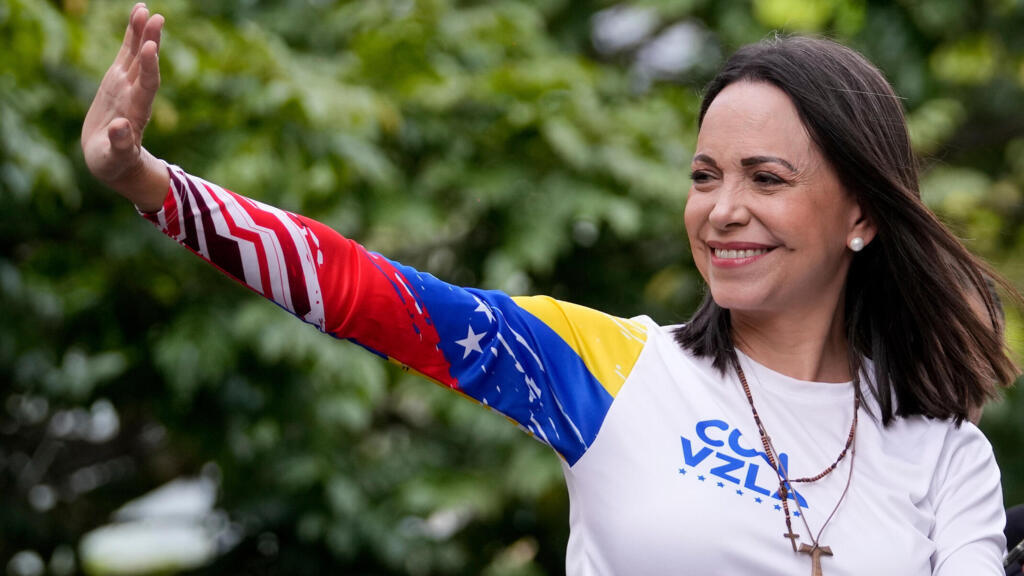
Maria Corina Machado in Venezuela, Thursday, July 25, 2024. (Source: AP – Matias Delacroix)
Into this context steps María Corina Machado, the Venezuelan opposition figure most warmly received by Israeli and U.S. political networks. Machado’s alignment with Israel is not rhetorical or recent. In 2020, her party, Vente Venezuela, signed a formal inter-party cooperation agreement with Israel’s ruling Likud Party, led by Benjamin Netanyahu. The agreement committed both parties to shared political values, strategic cooperation, and ideological alignment.
This is a remarkable document. It ties a Venezuelan opposition movement directly to a foreign ruling party, well before any democratic transition, and signals how a post-Maduro Venezuela is expected to orient itself internationally.
DOCUMENT: Vente Venezuela signs cooperation agreement with Israel’s Likud party – Agreement signed by María Corina Machado and Eli Vered Hazan, representing Likud’s Foreign Relations Division (Source: Vente Venezuela)
Machado has since gone further, pledging to:
- Restore full diplomatic relations with Israel
- Move Venezuela’s embassy to Jerusalem
- Open Venezuela’s economy to privatisation and foreign investment
- Align Venezuela with Israel and the United States against Iran and regional leftist governments
Her narrative rests on a crucial claim: that Venezuela itself is not anti-Israel, only its government is. According to this framing, Venezuelans are inherently pro-Israel and pro-West, their “true” preferences suppressed by an illegitimate regime.
In a November interview with Israel Hayom, Machado asserted that “The Venezuelan people deeply admire Israel.”
This argument is politically useful and historically thin. Venezuelan solidarity with Palestine predates Maduro and reflects a wider Latin American tradition of identifying with colonised peoples. To erase that history is to deny Venezuelans their own political agency.
The Anti-Defamation League (ADL) has repeatedly accused the Venezuelan government of fomenting “anti-Israel” and anti-Semitic rhetoric. Yet, a closer look tells a different story. Caracas’ statements are largely expressions of solidarity with the Palestinian people and their right to self-determination, combined with pointed criticism of Israeli state policies. By framing these positions as attacks on Jews or Israel itself, the ADL distorts the narrative, turning principled political stances into a perceived moral failing. This tactic underscores a broader pattern in which international organizations can paint Global South governments as rogue actors whenever they resist the gravitational pull of Israeli and U.S. influence, subtly laying the groundwork for diplomatic pressure or intervention.
DOCUMENT: Mini report from the Anti-Defamation League (ADL), formerly known as the Anti-Defamation League of B’nai B’rith, accuses Venezuela of fuelling an incendiary anti-Israel and anti-Semitic environment.(Source (ADL)
Security, Economics, and the Cost of Obedience
Beneath the moral language of the Isaac Accords lies a familiar architecture of control: security integration, economic restructuring, and ideological discipline.
Israel is a leading exporter of surveillance technologies, border systems, cyber-intelligence platforms, and urban security tools, many developed under conditions of occupation and internal repression. In South America, these systems are marketed as solutions to crime and narcotrafficking, but their real function is often political: expanding state surveillance capacity during periods of transition.
Security cooperation creates dependency. Once intelligence-sharing, training, and doctrine are integrated, political autonomy narrows. Policy divergence, particularly toward China, BRICS, or non-aligned partners, becomes risky.
The economic dimension is equally strategic. Israeli firms are deeply involved in water rights, desalination, agrotechnology, digital governance, and infrastructure, sectors that determine long-term sovereignty. These investments are typically tied to privatisation, deregulation, and long-term concessions, transferring control of strategic resources away from the public sphere.
Venezuela is the ultimate prize. A post-sanctions transition would open one of the world’s most resource-rich economies to restructuring. Machado’s commitment to rapid privatisation aligns seamlessly with this vision, raising an unavoidable question: who benefits from “democracy” when it arrives pre-packaged with foreign economic priorities?
This strategy is inseparable from U.S. power. The Trump administration’s framing of global politics as a permanent war on terror and narcotrafficking, a framing echoed by figures like Marco Rubio, has provided cover for sanctions, covert operations, and extrajudicial violence across the Caribbean and Pacific. Israel’s partnership reinforces this logic, supplying both technology and moral framing.
Conclusion: The Global South and the Right to Choose
The Isaac Accords are not simply about Israel’s diplomatic standing. They are about reordering South America’s political horizon at a moment when the Global South is rediscovering multipolarity.
Israel’s role in this process is active, strategic, and consequential. Through political patronage, economic leverage, security integration, and narrative control, it is shaping which governments are deemed legitimate and which are disposable.
For South America, and the wider Global South, the warning is familiar. When alignment is framed as morality, dissent becomes deviance. When sovereignty is conditional, development serves external interests. When history is rewritten, intervention soon follows.
Non-alignment was never about isolation. It was about the right to choose. That very right, today, is being quietly renegotiated, and the cost of refusing may soon become very clear.
Colombia expels Israeli diplomats after Gaza aid flotilla raid
MEMO | October 2, 2025
Colombian President Gustavo Petro has ordered the expulsion of all remaining Israeli diplomats from the country, after the interception of the Global Sumud Flotilla heading to Gaza.
He also called for suspending trade agreements with Israel after two Colombian citizens were arrested on board one of the ships. “Israel detained two Colombian women in international waters,” Petro said, demanding their immediate release.
Only four Israeli diplomats were still in Colombia after President Petro cut ties with Israel last year.
In a statement, Colombia’s Ministry of Foreign Affairs, on behalf of the government and the Colombian people, strongly condemned what it described as the kidnapping carried out by Israeli armed forces in international waters. The ministry said this act violated international law and the Geneva Conventions, and targeted the two Colombian nationals, Luna Barreto and Manuela Bedoya, both members of the Global Sumud Flotilla.
The ministry also called for the immediate release of its citizens, as well as all other members of the flotilla. It urged the governments of Spain, Bangladesh, Brazil, Slovenia, Indonesia, Ireland, Libya, Malaysia, the Maldives, Mexico, Oman, Pakistan, Qatar, Thailand, Turkey, and South Africa to take urgent and joint action to protect the lives and safety of their nationals.
According to the ministry, the international flotilla set sail in the Mediterranean with three objectives: to deliver humanitarian aid to Gaza, to raise awareness of the urgent humanitarian needs of the Palestinian people, and to highlight the need to end the war in Gaza.
Featured Video
Trita Parsi: Israel Set a Trap for Total War in the Region
or go to
Aletho News Archives – Video-Images
Book Review
Why the War on Conspiracy Theories Is Bad Public Policy
By Kevin Barrett • Unz Review • February 1, 2019
 A Review of Conspiracy Theories and Other Dangerous Ideas by Cass Sunstein (based on an earlier paper co-authored with Adrian Vermeule); In Defense of Troublemakers: The Power of Dissent in Life and Business by Charlan Nemeth; and Conspiracy Theories and the People Who Believe Them, edited by Joseph E. Uscinski
On January 25 2018 YouTube unleashed the latest salvo in the war on conspiracy theories, saying “we’ll begin reducing recommendations of borderline content and content that could misinform users in harmful ways—such as videos promoting a phony miracle cure for a serious illness, claiming the earth is flat, or making blatantly false claims about historic events like 9/11.”
At first glance that sounds reasonable. Nobody wants YouTube or anyone else to recommend bad information. And almost everyone agrees that phony miracle cures, flat earthism, and blatantly false claims about 9/11 and other historical events are undesirable.
But if we stop and seriously consider those words, we notice a couple of problems. First, the word “recommend” is not just misleading but mendacious. YouTube obviously doesn’t really recommend anything. When it says it does, it is lying. … continue
Blog Roll
 Aletho News
- How the Cambridge Analytica scandal still haunts Mark Zuckerberg
- The Ongoing Cancellation Campaign Against a Dissenting Academic in Norway
- Yemen and ‘the Houthis’: Challenging Sami Hamdi’s Narrative
- No, Christians did not invent Zionism
- AIPAC-led lobbying network opens branches in Cypriot, Greek parliaments
- Araghchi blasts ‘parasitic’ alliance as US taxpayers pay for Israel’s war on Iran
- Easy fix for Europe’s chaos? Stop fueling war against Russia
- Putin’s key remarks on peace talks and Europe’s ‘schizophrenia’
- Trita Parsi: Israel Set a Trap for Total War in the Region
- Trump’s Iran war is on an Israeli leash
- If Americans Knew
- Damning report shows the media must confront its failures on Gaza
- BBC senior broadcaster speaks out on Gaza coverage
- Netanyahu vows vast West Bank invasion in response to 20-minute skirmish that left 2 Israeli soldiers and 2 Palestinian fighters dead
- Tied up and tortured: Israel using US-made electroshock weapons on Palestinian detainees
- The outsourced risk: how newsrooms rely on Gaza’s freelancers without protecting them
- Gaza bakeries forced to shut as Israel blocks flour shipments
- Gaza’s breast cancer patients face a deadly wait for treatment amid Israel’s genocide
- DAILY UPDATE: Latest essential news on Palestine, Israel, & region
- The Israel Lobby’s Changing Fortunes
- AIPAC has become such a political liability that it’s shifting to a more “nimble” approach to buying politicians
- No Tricks Zone
- E-Cars Reduce CO2 Emissions By Only 41% Compared To Internal Combustion Engine Vehicles
- Predictions Made By Renowned Climate Professor Over Past Decades Have Been Proven To Be Poor
- New Study Suggests Large Regions Of The Pacific Ocean Have Been Cooling For The Last 80 Years
- Germany’s Green Energy Debacle: High Energy Costs Force Kahla Porzellan to Close After 182 Years!
- New Study: 50 Years Of The Most Aggressive ‘Net Zero’ Policies Can Only Affect The Global Climate By 0.03°C
- US September “Heat” Was No Record…Many Records Set Decades Ago
- Latest European Green Energy Debacle; Portugal’s Largest Flagship Solar Park Insolvent!
- Green Energy Debacle: German Expert Professor Fritz Vahrenholt Warns Of Severe Economic And Social Consequences
- Two More Paleo Reconstructions Affirm Meters-Higher Sea Levels Across Ireland, Brazil 7000-6000 Years Ago
- New Study: Earth And Venus Surface Warmth Largely Explained By Convection And Lapse Rate, Not CO2 Or Radiation

