Colombia halts arms purchases from US over drug combat delisting row
Al Mayadeen | September 16, 2025
Colombia halted arms purchases from the United States, its biggest military partner, on Tuesday, after Washington decertified the South American country as an anti-drugs ally under the pretext of failing to halt cocaine trafficking.
On Monday, President Donald Trump denounced Colombia’s leftist president, Gustavo Petro, for failing to curb cocaine production, claiming that instead, Petro presided over its rise to what he called “all-time records,” a failure which he stated made him decide to officially designate the country as having demonstrably failed to meet its drug control obligations.
Reacting to the news, Colombian Interior Minister Armando Benedetti told Blu Radio that “from this moment on… weapons will not be purchased from the United States.”
Trump’s decertification of Colombia, the first for the longtime ally in three decades, was viewed as a mainly symbolic gesture.
The decertification was nonetheless seen as a stinging rebuke of Petro’s anti-drug efforts, which prompted Colombia’s president to hit back by saying that the Colombian military would become independent from “handouts” from the United States.
Petro hits back
During a televised cabinet meeting, Petro said Colombia was being punished despite sacrificing dozens of policemen, soldiers, and regular citizens to stem the flow of narcotics to the United States.
“What we have been doing is not really relevant to the Colombian people,” the Colombian president stressed, adding, “It’s to stop North American society from smearing its noses” in cocaine.
US officials cited a surge in coca cultivation and cocaine production as the reason for the measure, while critics argue it unfairly targets Bogota despite its decades of collaboration with Washington.
Over 15,000 Colombians Participate in Conflicts Abroad – Lawmaker
Sputnik – 12.08.2025
The number of Colombian citizens who participated in international conflicts as employees of security companies exceeds 15,000, Colombian Congress member Alirio Uribe Munoz told Sputnik.
In early August, Colombian President Gustavo Petro said he had asked the country’s parliament to urgently consider a draft law banning mercenary activities.
“We have more than 15,000 people who participated in international conflicts, hired by security companies that supply soldiers for international armed conflicts,” Uribe Munoz said.
He noted that since Colombia has lived through a 60-year conflict and many of its military personnel have been trained at the Western Hemisphere Institute for Security Cooperation or by the Israelis, third countries are recruiting Colombians to participate in the fighting.
In this regard, Colombia needs legislation prohibiting mercenarism “to control this type of business,” Uribe Munoz added.
In July, Russian Ambassador in Bogota Nikolai Tavdumadze told Sputnik that the number of Colombians fighting alongside Ukrainian armed forces remained high. He also said that the Colombian parliament was looking into a bill that would have Colombia join the International Convention against the Recruitment, Use, Financing and Training of Mercenaries.
The Russian Defense Ministry has repeatedly warned that Kiev has been using foreign fighters as “cannon fodder” and that the Russian military will continue to strike mercenary troops across Ukraine. Colombians have been complaining about poor coordination in the Ukrainian armed forces, which makes survival in the high-intensity conflict in Ukraine much harder than in Afghanistan or the Middle East.
Bogota Summit launches Global South’s legal intifada against Israel and US impunity
By José Niño | The Cradle | July 17, 2025
From 15–16 July, Bogota became the unlikely capital of a global insurrection against western legal impunity. Over 30 countries – including key powers from the Global South and even some European states – gathered in the Colombian capital for the Hague Group Emergency Summit.
This was the most ambitious multilateral initiative yet to directly confront what participants unflinchingly termed Israel’s genocide in Gaza, and the broader culture of impunity that has shielded the occupation state since 1948.
From steadfast client to anti-imperial spearhead
That the summit was held in Colombia – a long-standing US vassal in Latin America – was not incidental. Once regarded as Washington’s most loyal client in the hemisphere, Colombia’s dramatic pivot under President Gustavo Petro represents the boldest regional defiance of US authority in decades.
Petro, who severed diplomatic ties with Tel Aviv in 2024, has placed Bogota on a collision course with the US over his unwavering opposition to the occupation state’s onslaught in Gaza.
Washington reacted predictably by issuing warnings to allies against the “weaponization of international law,” and sanctioning UN Special Rapporteur Francesca Albanese for her “illegitimate and shameful efforts” to advance the International Criminal Court’s (ICC) prosecutions of Israeli and US officials. Bogota responded with direct defiance. In the run-up to the summit, Petro publicly backed Albanese, declaring that “the multilateral system of states cannot be destroyed,” in a thinly veiled rejection of US diktats.
Over 30 nations participated, including the eight founding members of the Hague Group – Bolivia, Colombia, Cuba, Honduras, Malaysia, Namibia, Senegal, and South Africa, co-chaired by Colombia and South Africa. They were joined by more than 20 additional states spanning Latin America, Africa, Asia, and even Europe.
The participation of European countries such as Portugal and Spain was noteworthy. Both states only established full diplomatic relations with Israel in the latter part of the 20th century: Portugal in 1977 and Spain in 1986, emblematic of their historic caution over Israel’s contested legitimacy.
But since Tel Aviv’s genocidal war on Gaza began in late 2023, Madrid has adopted a string of punitive diplomatic moves.
Spain canceled a €6.6 million (around $7.2 million) ammunition purchase from an Israeli firm, scrapped a €285 million (around $310.7 million) anti-tank missile deal with the Spanish subsidiary of Rafael Advanced Defense Systems, banned Israeli weapons from port entry, formally recognized Palestinian statehood, and pushed to suspend the EU–Israel Association Agreement.
Though neither European state fully endorsed all of Bogota’s proposals, their participation and scathing denunciations of Israeli policy reflect a deeper fracture within Europe over Tel Aviv’s legitimacy and the cost of complicity.
Laying the legal gauntlet
Central to the summit was a blistering legal and moral condemnation of Israel’s conduct in Gaza and the occupied West Bank. The Hague Group issued a detailed catalog of war crimes: the mass killing of over 57,000 civilians, the targeting of hospitals and schools, the weaponization of starvation and siege, and the deliberate use of forced displacement.
The apartheid state in the occupied West Bank, enforced through racial segregation, parallel legal systems, and land confiscations for settlements, was cited as a textbook violation of the Fourth Geneva Convention and, per the International Court of Justice’s (ICJ) 2024 advisory opinion, a breach of international prohibitions against forced territorial acquisition and apartheid.
Francesca Albanese delivered the summit’s keynote, setting the tone with an uncompromising indictment:
“For too long, international law has been treated as optional – applied selectively to those perceived as weak, ignored by those acting as the powerful … That era must end.”
The ICC arrest warrants against Israeli Prime Minister Benjamin Netanyahu and former Defense Minister Yoav Gallant – citing crimes such as starvation as a weapon, indiscriminate civilian targeting, and the murder of Palestinian non-combatants – were repeatedly invoked as a historic turning point.
The Resistance Axis of lawfare
The summit’s ethos was clearly to rupture the impunity enabled by the UN Security Council’s paralysis. The Hague Group, founded in January 2025, framed itself as the Global South’s corrective to a postwar order that protects violators so long as they are shielded by US power.
That paralysis, most attendees argued, was not accidental but structural: The P5 veto system ensures impunity for those, such as Israel and its allies.
Meeting in the San Carlos Palace, delegates from 12 states – Bolivia, Colombia, Cuba, Indonesia, Iraq, Libya, Malaysia, Namibia, Nicaragua, Oman, Saint Vincent and the Grenadines, and South Africa – announced six binding measures. These included a full arms embargo on the occupation state, port bans for Israeli military vessels, contract reviews to terminate commercial complicity with the occupation, and firm support for domestic and international prosecution of Israeli officials.
These policies were anchored in the ICJ’s 2024 opinion declaring Israel’s occupation illegal and the UN General Assembly’s September 2024 resolution urging decisive global action within 12 months.
A global rift – but still an uphill battle
Despite the breakthrough, significant limitations remain. Only 12 states adopted the measures outright. Others were given until the UN General Assembly in September to sign on. Key powers, including China, withheld endorsement – despite supporting the initiative’s aims – likely due to economic entanglements with Israel, including port infrastructure investments.
Organizers acknowledged the uphill road ahead: absent broader UN uptake and stronger alignment from economic powers, Washington’s veto and European hesitation could neuter the Hague Group’s legal insurgency. But the coalition remains adamant that justice is no longer negotiable.
Colombian Vice Minister Mauricio Jaramillo Jassir captured the summit’s urgency:
“The Palestinian genocide threatens the entire international system … The participating states will not only reaffirm their commitment to opposing genocide, but also formulate concrete steps to move from words to collective action.”
A warning – and a promise
The Bogota summit was not just another international conference. It openly challenged the post-1945 legal fiction of a “rules-based order” – a system long exposed as a euphemism for western prerogative.
As South Africa’s International Relations Minister, Roland Lamola, asserted
“No country is above the law, and no crime will go unanswered.”
Yet the struggle remains unfinished. The Hague Group’s bold confrontation with Israeli impunity marks a decisive break, but the future of this legal uprising hinges on whether its momentum can breach the fortified walls of New York and The Hague, and whether powers like China, India, and Brazil shift from quiet endorsement to active alignment.
On 16 July, as thousands gathered in Plaza Bolivar in support, the message was unambiguous: either the era of impunity ends, or the legitimacy of the global order collapses with it.
Colombia must sever ties with NATO – president
RT | July 17, 2025
Colombia must cut ties with NATO as the leaders of the military bloc support “genocide” of Palestinians, President Gustavo Petro has declared.
Colombia, a traditional US ally in South America, became the first country in the region to obtain the status of NATO global partner in 2017. Petro, who took office in 2022 as Colombia’s first leftist president, severed diplomatic relations with Israel last year over what he describes as a genocide being carried out by the Israeli government against Palestinians.
”What do we do in NATO? If NATO’s top brass are for genocide, what are we doing there?” Petro said at a pro-Palestinian international conference in Bogota on Wednesday.
”Hasn’t the time come for another military alliance? Because how can we be with armies that drop bombs on children?” he added. “Those armies aren’t armies of freedom, they’re armies of darkness. We must have armies of light.”
Petro argued that NATO is a Cold War relic and asserted that nations like Colombia are treated as “half-members” within the US-led military bloc, granted symbolic partnerships but not full accession.
The two-day conference in Bogota hosted representatives from a dozen countries in the Global South. Attendees signed a joint declaration calling for economic sanctions and legal actions against Israel, including an arms embargo, restrictions on dual-use goods, port denials for vessels carrying cargo for Israeli forces, and support for international accountability for crimes allegedly committed in occupied territories.
Petro’s criticism reflects a break from Colombia’s historically warm relationship with Israel. The late Venezuelan President Hugo Chavez once dubbed Colombia the “Israel of Latin America,” arguing it served a similar geopolitical role in the region.
Israel launched its military campaign in Gaza following a deadly raid led by the militant group Hamas in October 2023. The first independent study of casualties in Gaza, published last month, estimated the number of fatalities in the enclave at almost 84,000 by January 2025. Israel is currently pushing Palestinians to move to a “humanitarian city” that would purportedly be free of Hamas influence – which critics say is just a euphemism for a concentration camp.
Without job opportunities in their homeland, Colombians are recruited by Kiev
By Lucas Leiroz | Strategic Culture Foundation | January 14, 2025
NATO’s proxy war against Russia through Ukraine has shown significant changes in various aspects, particularly regarding the participation of foreign mercenaries. While, at the start of the war, the flow of fighters was predominantly composed of individuals from Europe and the United States, a notable shift occurred throughout 2024, with a considerable increase in mercenaries from Latin America, especially Colombia. The driving factor behind this growing presence of Latin American fighters is not ideological, but rather economic, with many of these soldiers seeking a way to survive financially abroad, considering the extreme poverty in their home countries.
Colombia, one of the nations most affected by economic inequality in Latin America, serves as an example to understand this reality. With a large portion of the population living below the poverty line, many Colombians see themselves with few viable alternatives to improve their financial situation. For many Colombians, military service appears to be one of the few legal options that guarantees some level of financial stability, albeit modest. However, with scarce job opportunities and a struggling economy that fails to offer appealing alternatives, the chance to participate in the war in Ukraine, where mercenaries’ payments can be much higher, becomes attractive to many ex-soldiers who were previously trained in the Colombian armed forces.
The situation in Ukraine, however, does not turn out to be a “simple battlefield” for these mercenaries, as it might have seemed initially. When the first foreign fighters arrived, particularly Europeans and Americans, many saw the war as an opportunity to test their skills or even to partake in an “adventure.” However, as the conflict intensified, it became clear that the reality of the Ukrainian battlefield was far more brutal than many had imagined. Modern warfare, with its predominant use of heavy artillery, airstrikes, and large-scale exhausting confrontations, is an environment unfamiliar to soldiers who, like many Colombians – as well as Brazilians and other Latin soldier – were used to urban combat and guerrilla warfare, where the use of light weapons at short distances is common.
The transition to this type of combat, where air superiority and the constant use of long-range artillery are key determinants, shocked many of these mercenaries, turning their participation in the war into a true nightmare. The lack of air support, the difficulty of evacuation, and the constant presence of well-equipped and well-trained Russian forces in various directions made the combat experience far more dangerous than expected. Many of these mercenaries, especially those with little experience in high-intensity combat, ended up becoming easy targets. The losses are immense, and, according to some reports, a large portion of the Colombian mercenaries sent to Ukraine did not survive.
Despite the rising casualties, the Ukrainian government has tried to mask the difficulties faced by foreign mercenaries, disguising the losses and the lack of effectiveness of these fighters. However, the reality on the ground is far less favorable. The mercenaries have failed to change the game in Ukraine’s favor, and the promised financial gains for participating in the conflict seem to have been an illusion for many. The harsh conditions of combat, the human losses, and the lack of concrete results make the situation for the mercenaries, particularly the Latin Americans, increasingly bitter.
The loss of life among Colombian mercenaries, who represented a significant portion of the foreign fighters, reflects not only the failure of the strategies adopted by the West but also the human costs of this war as a whole. While political and military elites in Western countries remain distant from the suffering on the battlefield, the reality for mercenaries is a direct confrontation with death, often without prior reconnaissance or appropriate support.
And the problems go beyond that. For Colombia, a country already marked by decades of internal conflict, this new generation of mercenaries, who, if they survive, may return to their homeland radicalized and experienced in combat, could become a real ticking time bomb. In the same vein, recent news has emerged about pro-Ukrainian Colombian mercenaries being arrested in Venezuela for a conspiracy to assassinate Nicolás Maduro. In practice, the surviving mercenaries will likely become professional criminals, willing to serve Western interests for money anywhere in the world – especially in their home region.
From all perspectives, the involvement of Latin American mercenaries in Ukraine is a human, social, and economic tragedy. It is urgent to develop efficient mechanisms to prevent ordinary people from Global South countries from accepting to participate in foreign wars defending the interests of hostile powers.
You can follow Lucas on X (formerly Twitter) and Telegram.
Colombia wants to end avalanche of mercenaries fighting in Ukraine
By Ahmed Adel | December 3, 2024
The involvement of Colombian mercenaries in the Ukrainian conflict highlights the structural roots of the paramilitary phenomenon that has plagued the Latin American country for decades. In this context, Colombia and Russia agreed to create a working group to address the issue, especially since hundreds of Colombian mercenaries have died fighting in the Ukraine conflict.
The meeting, led by Russian Foreign Minister Sergey Lavrov and Colombian Foreign Minister Luis Gilberto Murillo, took place amid growing concern about the participation of former Colombian military personnel in international conflicts. The decision, announced after the meeting in Moscow in November, seeks to establish joint mechanisms to mitigate the impact of this problem, which threatens Colombia’s internal politics and global security.
Colombian President Gustavo Petro tweeted on November 27 that “mercenary work must be banned in Colombia,” adding that to prevent recruitment by private contractors, raising the “standard of living” of soldiers was necessary. He also called for “criminal punishment” for those using mercenaries in foreign conflicts, thereby supporting the bill his government introduced to the Colombian Congress in August to approve the United Nation’s International Convention against the Recruitment, Use, Financing and Training of Mercenaries.
The creation of the Russian-Colombian working group reflects a necessary response to political pressure on Bogota due to increased military and ex-military personnel involved in conflicts abroad, especially in Ukraine. There is an alarming number of Colombian military and ex-military personnel captured or killed in combat against Russian military forces in Ukraine.
Nonetheless, the phenomenon is not limited to the crisis in Ukraine but is part of a broader trend in which former military personnel, paramilitaries, and guerrillas from the South American country are recruited to participate in conflicts in different parts of the world. Some media outlets, such as Cuestión Pública, estimate that around 4,000 former members of Colombia’s Public Force participate in foreign conflicts.
As mentioned, the bill will include measures to criminalize the use, hiring and training of mercenaries, an essential step considering the avalanche of Colombian mercenaries that affects not only Ukraine but also other countries in conflict, such as Libya and Sudan.
Another concern is, obviously, the ramifications in Latin America. For example, former members of the Colombian military are recruited by Mexican drug cartels not only for training but also for paramilitary operations on the ground.
Privatized war and military training in Colombia are rooted in the influence of Israel’s Mossad and American companies, such as Blackwater, and are linked to drug trafficking and extractive economies. In effect, Colombian mercenarism has been fueled by a system that perpetuates violence as a tool of control. The training that Colombian soldiers receive, based on American and British techniques, makes them ideal combatants for international conflicts and criminal activities.
Resolving the mercenary problem in Colombia lies in addressing both the structural causes and the regulations that allow its proliferation. Fully implementing the Peace Agreement signed in Havana in 2016 between the Colombian government and militant groups, which includes measures for substituting illicit crops and economic development in the areas most affected by the conflict, is critical.
The agreement between Colombia and Russia represents a significant step in controlling the export of mercenaries and their impacts. However, the problem transcends national borders. Colombia has a long tradition of internal conflict and a highly trained military that is poorly paid and vulnerable. The solution requires political will and a structural change in the power dynamics perpetuating violence. The only way to find peace is through dialogue and policies that dignify soldiers and deactivate patterns of war.
Until this occurs, though, Colombians will continue to be tempted to fight in Ukraine due to the promise of thousands of dollars a month. Although Colombians can earn more money fighting in Ukraine than having a conventional job at home, more than 300 of the 2,000 believed to have gone to the Eastern European warzone have been killed, while hundreds more have been wounded or deserted their positions.
Even if Colombian mercenaries survive unscathed, they still face other issues. Recently, two Colombian soldiers returning home were detained in Venezuela and sent to Russia, where they have been charged with mercenary activities.
With Colombian nationals exposed to financial rewards in Ukraine, caveated with a likelihood of imprisonment, injury or death, Murillo also confirmed that peace efforts were part of his discussions with Lavrov: “We delivered a message of peace regarding the war between Russia and Ukraine, encouraging political and diplomatic dialogue.” Only through peace will Colombian lives stop being wasted in far-off Ukraine, but as it appears, the Kiev regime is still holding out from any negotiations with Moscow.
Ahmed Adel is a Cairo-based geopolitics and political economy researcher.
Colombia bans coal exports to Israel
MEMO | August 19, 2024
Colombia’s President Gustavo Petro signed a decree banning coal exports to Israel, Bloomberg reported, adding that this is an effort “to pressure the government of Prime Minister Benjamin Netanyahu to end the conflict in Gaza.”
The Columbian president said that Israel uses Colombian coal to make bombs to kill Palestinian children.
Since the beginning of the war on Gaza, the Colombian president has repeatedly stressed that Israel is committing genocide, calling on the world to put an end to Netanyahu’s violations.
At the end of February, Petro announced the suspension of arms purchase deals from the occupation, following the flour massacre in Gaza when 118 Palestinians were martyred while waiting for an aid convoy near the Nabulsi roundabout in the northern Gaza Strip.
Petro also announced in May that his country has severed its diplomatic relations with Israel and that the countries of the world should not be passive towards what is happening in Gaza.
Colombia is Israel’s biggest coal supplier, having sold it about $450 million of the fuel in 2023, according to Bloomberg News.
It had suspended coal exports in June.
Major Latin American Powers, Hungary Block US-EU Push to Isolate Venezuela’s Maduro
By Ilya Tsukanov – Sputnik – 04.08.2024
Venezuelan President Nicolas Maduro was reelected to a third term in office in a showdown with united opposition candidate Edmundo Gonzalez last Sunday, taking 52% of the vote to Gonzalez’ 43%. The US and its allies decried the results, recognized the opposition leader and demanded negotiations for a “peaceful transition of power.”
Efforts by Washington and Brussels to diplomatically isolate President Nicolas Maduro have failed spectacularly after important members of the Organization of American States (OAS) and the European Union rejected efforts to condemn the Venezuelan election results.
In the OAS, major Latin American countries Brazil, Mexico and Colombia abstained from a resolution tabled Wednesday demanding that Caracas release detailed vote tallies and take other steps, including measures to ensure the security of the opposition. The three nations were joined in abstaining from the resolution or being absent from the vote by Barbados, Belize, Bolivia, Grenada, Honduras, St. Kitts and Nevis, St. Lucia, Antigua and Barbuda, the Bahamas, Dominica, St. Vincent and the Grenadines, and Trinidad and Tobago. With 11 OAS members abstaining and five members absent, the resolution failed to attain the required majority to pass.
Permanent Council chairman Ronald Sanders said a consensus could not be reached over a “controversial phrase,” without elaborating.
Across the Atlantic, Hungary blocked a similar proposed joint statement on behalf of the EU’s 27 member countries on purported “numerous flaws and irregularities” in Venezuela’s elections, forcing EU foreign policy czar Josep Borrell to independently issue a statement in the EU’s name.
Hungary’s intransigence is expected to complicate efforts by Brussels to use unanimity among the bloc to justify the leveling of potential new sanctions against Venezuela. Budapest did not explain its motivation for vetoing the EU resolution.
US Secretary of State congratulated Gonzalez for “winning” last Sunday’s vote, with Russia, China, Belarus, Serbia, Iran, Turkiye, Syria, Azerbaijan, North Korea, Vietnam, Madagascar, Namibia, Bolivia, Cuba, Nicaragua and others recognizing the results and congratulating President Maduro for his victory.
‘Until genocide stops’: Colombia to suspend coal exports to Israel
Press TV | June 8, 2024
Colombia has said it would stop its coal exports to the Israeli regime as long as the latter sustained its months-long genocidal war against the Gaza Strip.
“We are going to suspend coal exports to Israel until the genocide stops,” Colombian President Gustavo Petro said in a post on X on Saturday.
He also posted a draft decree, which said that coal exports would only resume if the regime complied with a recent order by the International Court of Justice that mandated that Tel Aviv withdraw its troops from the Gaza strip.
Data provided by Colombia’s National Statistics Department shows that the exports were worth more than $320 million in the first eight months of the last year.
According to the Colombian government, the export ban will enter into force five days after the decree was published in the official gazette.
On May 1, the Colombian head of state said the country had decided to cut its diplomatic relations with the Israeli regime over the war.
“And we here in front of you, the government of change, the president of the republic informs that tomorrow diplomatic relations” with the Israeli regime “will be cut,” he said at the time, adding, “[We cut diplomatic ties] because of them having…a genocidal president.”
More than 36,801 Palestinians, most of them women and children, have been killed in the war that began after Al-Aqsa Storm, a retaliatory operation staged by Gaza’s resistance groups.
Hamas calls on 18 countries signing hostage release initiative to expose Israel’s crimes
MEMO | April 27, 2024
Colombia suspends Israeli arms purchases following attack on Palestinian crowd
The Cradle – March 1, 2024
Colombian President Gustavo Petro on 29 February announced the country would suspend all arms purchases from Israel in protest against the ongoing genocide of Palestinians in Gaza.
“Asking for food, more than 100 Palestinians were killed by Netanyahu. This is called genocide and is reminiscent of the [Holocaust] even if the world powers do not like to recognize it. The world must block Netanyahu. Colombia suspends all purchases of weapons from Israel,” Petro said via social media after the latest massacre of civilians by Israel in Gaza.
Israel has killed at least 30,035 and injured 70,457 others in Gaza while inflicting mass destruction and shortages of basic necessities on the strip.
Colombia is among the countries that fully supported South Africa’s genocide case against Israel at the International Court of Justice (ICJ). Petro has also continuously condemned Tel Aviv for its indiscriminate attacks against Palestinians since 7 October, taking a similar stance as the leaders of other Latin American nations like Bolivia, Brazil, Venezuela, Cuba, Honduras, and Nicaragua.
“If we have to suspend foreign relations with Israel, we suspend them. We do not support genocides,” Petro said via social media on 15 October.
His comments came after Israel suspended all security exports to the South American country in response to Petro’s public stance on the genocide unfolding in Gaza.
Petro drew the ire of Israel after posting on social media: “Neither the Yair Kleins nor the Raifal Eithans will be able to say what the history of peace in Colombia is. They unleashed the massacre and genocide in Colombia.”
Former Israeli army colonel and mercenary Yair Klein in the 1980s was responsible for training fighters from the United Self-Defense Forces of Colombia, a right-wing paramilitary group responsible for multiple war crimes during Colombia’s internal war. Klein was later brought to Colombia to train the National Police.
Raifal Eithan, the former chief of staff of the Israeli army, served as an advisor to former Colombian president Virgilio Barco and once proposed killing the members of the Patriotic Union political party, which was born from the failed peace process with the Revolutionary Armed Forces of Colombia (FARC) in 1984.
Far-right Colombian paramilitaries are responsible for killing tens of thousands of civilians, including social leaders, environmental activists, and campesinos, and forcing millions more out of their homes. Furthermore, all branches of the Colombian armed forces use Israeli weaponry as standard, and all have been trained by Tel Aviv in combat techniques.
Countries Begin Downgrading Ties with Israel Over Relentless Bombing of Gaza
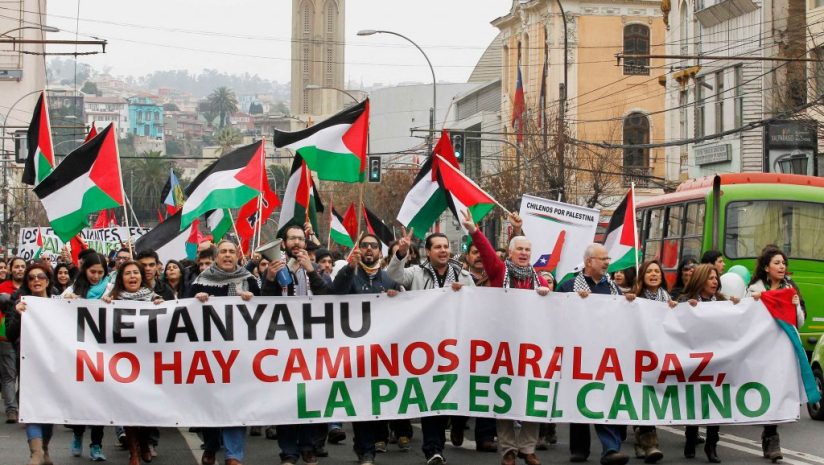
By Kyle Anzalone | The Libertarian Institute | November 1, 2023
A trio of South American countries, along with Jordan, have cut ties with Israel over the onslaught in Gaza. According to Palestinian sources, the Israeli military operations in Gaza have killed nearly 9,000 people, half of which are women and children.
On Tuesday, Bolivia took the most extreme step and cut all ties with Israel. Deputy Foreign Minister Freddy Mamani explained that Bolivia “decided to break diplomatic relations with the Israeli state in repudiation and condemnation of the aggressive and disproportionate Israeli military offensive taking place in the Gaza Strip.”
The next day, Tel Aviv responded by saying Sucre’s move was “capitulation to terrorism and to the ayatollah regime in Iran.”
Colombia and Chile announced they would recall their ambassadors to Israel. Colombian President Gustavo Petro posted on X, “I have decided to call our ambassador in Israel for consultation. If Israel does not stop the massacre of the Palestinian people we cannot be there.”
Chile posted a press release saying Santiago would also recall its diplomat.
“Given the unacceptable violations of International Humanitarian Law that Israel has incurred in the Gaza Strip, the Government of Chile has decided to recall the Chilean ambassador to Israel, Jorge Carvajal, to Santiago for consultations. …”
“Chile strongly condemns and observes with great concern that these military operations – which at this point in their development entail collective punishment of the Palestinian civilian population in Gaza – do not respect fundamental norms of International Law, as demonstrated by the more than eight thousand civilian victims, mostly women and children.”
Jordan joined the South American nations in downgrading ties with Israel. The Foreign Ministry announced it was recalling its ambassador. “Foreign Minister Ayman Safadi decided to immediately recall Jordan’s ambassador to Israel,” a statement said. The move is to reflect Amman’s condemnation of the “Israeli war that is killing innocent people in Gaza.”
While Tel Aviv receives near unconditional backing from Washington, Israel lacks the international community’s support for its war. On Monday, the UN General Assembly voted 120-14 for a ceasefire in Gaza.
After a Hamas attack in southern Israel on October 7, Tel Aviv launched a military operation. The bombing campaign and ground invasion have killed thousands of Palestinian civilians, including over 3,600 children.
Featured Video
Trita Parsi: Israel Set a Trap for Total War in the Region
or go to
Aletho News Archives – Video-Images
Book Review
Why the War on Conspiracy Theories Is Bad Public Policy
By Kevin Barrett • Unz Review • February 1, 2019
 A Review of Conspiracy Theories and Other Dangerous Ideas by Cass Sunstein (based on an earlier paper co-authored with Adrian Vermeule); In Defense of Troublemakers: The Power of Dissent in Life and Business by Charlan Nemeth; and Conspiracy Theories and the People Who Believe Them, edited by Joseph E. Uscinski
On January 25 2018 YouTube unleashed the latest salvo in the war on conspiracy theories, saying “we’ll begin reducing recommendations of borderline content and content that could misinform users in harmful ways—such as videos promoting a phony miracle cure for a serious illness, claiming the earth is flat, or making blatantly false claims about historic events like 9/11.”
At first glance that sounds reasonable. Nobody wants YouTube or anyone else to recommend bad information. And almost everyone agrees that phony miracle cures, flat earthism, and blatantly false claims about 9/11 and other historical events are undesirable.
But if we stop and seriously consider those words, we notice a couple of problems. First, the word “recommend” is not just misleading but mendacious. YouTube obviously doesn’t really recommend anything. When it says it does, it is lying. … continue
Blog Roll
 Aletho News
- How the Cambridge Analytica scandal still haunts Mark Zuckerberg
- The Ongoing Cancellation Campaign Against a Dissenting Academic in Norway
- Yemen and ‘the Houthis’: Challenging Sami Hamdi’s Narrative
- No, Christians did not invent Zionism
- AIPAC-led lobbying network opens branches in Cypriot, Greek parliaments
- Araghchi blasts ‘parasitic’ alliance as US taxpayers pay for Israel’s war on Iran
- Easy fix for Europe’s chaos? Stop fueling war against Russia
- Putin’s key remarks on peace talks and Europe’s ‘schizophrenia’
- Trita Parsi: Israel Set a Trap for Total War in the Region
- Trump’s Iran war is on an Israeli leash
- If Americans Knew
- Damning report shows the media must confront its failures on Gaza
- BBC senior broadcaster speaks out on Gaza coverage
- Netanyahu vows vast West Bank invasion in response to 20-minute skirmish that left 2 Israeli soldiers and 2 Palestinian fighters dead
- Tied up and tortured: Israel using US-made electroshock weapons on Palestinian detainees
- The outsourced risk: how newsrooms rely on Gaza’s freelancers without protecting them
- Gaza bakeries forced to shut as Israel blocks flour shipments
- Gaza’s breast cancer patients face a deadly wait for treatment amid Israel’s genocide
- DAILY UPDATE: Latest essential news on Palestine, Israel, & region
- The Israel Lobby’s Changing Fortunes
- AIPAC has become such a political liability that it’s shifting to a more “nimble” approach to buying politicians
- No Tricks Zone
- E-Cars Reduce CO2 Emissions By Only 41% Compared To Internal Combustion Engine Vehicles
- Predictions Made By Renowned Climate Professor Over Past Decades Have Been Proven To Be Poor
- New Study Suggests Large Regions Of The Pacific Ocean Have Been Cooling For The Last 80 Years
- Germany’s Green Energy Debacle: High Energy Costs Force Kahla Porzellan to Close After 182 Years!
- New Study: 50 Years Of The Most Aggressive ‘Net Zero’ Policies Can Only Affect The Global Climate By 0.03°C
- US September “Heat” Was No Record…Many Records Set Decades Ago
- Latest European Green Energy Debacle; Portugal’s Largest Flagship Solar Park Insolvent!
- Green Energy Debacle: German Expert Professor Fritz Vahrenholt Warns Of Severe Economic And Social Consequences
- Two More Paleo Reconstructions Affirm Meters-Higher Sea Levels Across Ireland, Brazil 7000-6000 Years Ago
- New Study: Earth And Venus Surface Warmth Largely Explained By Convection And Lapse Rate, Not CO2 Or Radiation

