Russia’s lockdown of Odessa ports could be a grim turning point in war
By George Beebe | Responsible Statecraft | August 11, 2026
Over the course of a few short weeks, a grim new reality has taken shape in Ukraine.
Russia has shown that it need not conquer and occupy Ukraine’s entire Black Sea coastline to turn that country into the equivalent of a landlocked state. It need only deny access to Ukraine’s critically important Odessa port complex, something it is doing quite effectively through air and missile strikes on port facilities and approaching ships.
That reality will probably not amount to a knock-out blow in the ongoing war. But it is likely to have a profound impact on Ukraine’s already gloomy post-war prospects — and, by extension, on the contours of a new European security landscape in the current conflict’s aftermath.
Only a handful of months ago, Russia was conducting few military operations against Odessa. Early in the war, attacks by Russia and Ukraine on merchant shipping in the Black Sea had threatened to choke off agricultural exports vital to world markets. Under pressure from India and other key partners in the Global South, Moscow agreed to the so-called “Grain Deal” with Ukraine, brokered by Turkey and the United Nations, to allow unimpeded commercial exports from the region.
For some four years thereafter, the Odessa port system remained open to Ukrainian imports and exports, handling some 90% of Ukraine’s agricultural trade. Russian hardliners bristled at Russian President Vladimir Putin’s refusal to attack Ukraine’s vital but vulnerable port, grumbling that Putin seemed more interested in avoiding rifts with Global South states than defeating Ukraine.
Several factors have combined to change this picture. One was the evident failure of the West’s campaign to turn Russia into a pariah state, a brainchild of the Biden administration that had magnified the importance of the Global South to Moscow as a means of avoiding international isolation. A second has been the depletion of Ukrainian air defense interceptors, which has left Odessa largely defenseless against Russian ballistic missiles and allowed bomb-carrying aircraft to operate in closer proximity to the port complex, increasing the accuracy and destructiveness of Russian air strikes.
Ironically enough, perhaps the most important factor was Ukraine’s own “40-day influence campaign” announced in late June, which included long- and medium-range drone strikes on energy infrastructure in Russia and merchant shipping in the Sea of Azov. Ukrainian President Volodymyr Zelensky said the campaign was aimed at “influencing the aggressor state in order to compel it to end the war.” President Trump described it more plainly as an “escalation that we hope will lead to peace.”
In practice, however, the escalation allowed Russia to deflect Global South criticism for violating terms of the Grain Deal by arguing it was Ukraine that had kicked off the recent cycle of shipping and port attacks.
The near-term effects have been disturbingly clear. Since July 22, the Russian military has effectively closed the Ukrainian port complex in and around Odessa to all shipping. The loss of its remaining deep-water ports is already having a devastating effect on Ukraine’s agricultural exports — the backbone of its economy — which officials warn may plummet by 50% in the coming months because alternative land, rail, and river routes have much less capacity and are much more costly.
The damage to Ukraine’s economy probably will be manageable in the near term so long as Europe steps up its flow of aid. But the impact of Odessa’s closure on Ukraine’s post-war prospects may prove to be much more profound.
It has long been assumed in both Washington and Europe that the main alternative to a compromise settlement of the Russia-Ukraine war is the transformation of Ukraine into a “steel porcupine.” The concept envisions a heavily armed and fortified Ukraine that can serve as a barrier to further Russian aggression and allow the hot war to settle into a stable, frozen conflict.
Proponents of this vision dismiss prospective “land for peace” deals with Moscow and oppose any quantitative or qualitative limitations on Ukraine’s military — points that Russian officials say are essential to any peace deal — arguing that such concessions would “reward Russian aggression” and prevent Ukraine from becoming an Eastern European variant of Israel, a “Major Non-NATO Ally” that punches well above its weight-class in regional affairs and serves as a keystone of broader European defense plans.
However, if Russia can use air and missile attacks to deny Ukraine the use of its port facilities, it can also prevent Ukraine’s post-war reconstruction and economic revitalization. Just as merchant ships will not risk Russian attacks to enter Odessa, construction firms are unlikely to risk Russian airstrikes in attempting to build or repair bridges, roads, factories, ports, and other vital infrastructure. Nor will investors risk hundreds of billions of dollars if Russian missiles and bombs can destroy any Ukrainian reconstruction project in a matter of hours.
Without large-scale economic reconstruction and the jobs and stability that would follow, few of the millions of Ukrainians who fled the war (most for Europe but many for Russia) will return. Absent mass repatriation, Ukraine is likely to enter a demographic death-spiral. By Ukrainian officials’ own admission, a population that approached 52 million people when the Soviet Union broke up now stands at between 22 and 25 million people, and nearly half of them are retirees.
According to one estimate, Ukraine’s working age population – the backbone of both its civilian economy and its military — could lose an additional third by 2040. The number of children, the embodiment of Ukraine’s future, could decline to half its pre-war level.
This raises an obvious but under-discussed question: How can an aging and dying Ukrainian population, lacking a strong economic base, serve as a “new Sparta” countering a nuclear-armed Russia that is seven times its size?
The closure of Odessa should highlight two salient points for Western leaders. First, neither Ukraine nor the West can eliminate the threat of Russian air and missile strikes through military means alone. Second, Russia will have strong reason to continue them, even after it eventually halts large-scale ground operations, if the Kremlin worries that the West will otherwise turn Ukraine into a safe haven for threatening Russian security.
As a result, the alternative to an uncomfortable compromise settlement of the war will not be a steel Ukrainian porcupine. It will be a weak and dysfunctional rump state that ill-serves Ukrainians and undermines Europe’s broader security.
George Beebe is the Director of Grand Strategy for the Quincy Institute. He spent more than two decades in government as an intelligence analyst, diplomat, and policy advisor, including as director of the CIA’s Russia analysis and as a staff advisor on Russia matters to Vice President Cheney. He is the author of “The Russia Trap: How Our Shadow War with Russia Could Spiral into Nuclear Catastrophe” (2019).
Israeli ‘double-tap’ strike targets rescuers in Nabatieh
Al Mayadeen | August 11, 2026
An Israeli drone strike on the city of Nabatieh wounded two civilians, the Emergency Operations Center of Lebanon’s Ministry of Public Health announced.
The strike was carried out in two successive rounds, with the second targeting an ambulance team from the Islamic Health Authority, Islamic Message Scouts Association, and other medical personnel that had arrived at the scene to evacuate the wounded. The strike damaged an ambulance.
The Ministry renewed its condemnation of the continued Israeli targeting of ambulance crews, describing it as an unacceptable violation of international humanitarian law and all international norms.
Lebanese health authorities have reported multiple “double-tap” and “triple-tap” Israeli airstrikes targeting emergency medical and civil defense crews in southern Lebanon. The secondary and tertiary strikes reportedly hit rescuers as they arrived at the scene to evacuate and treat people wounded in earlier attacks.
Israeli strikes targeted Nabatieh, other areas in southern Lebanon
Earlier today, Al Mayadeen’s correspondent in southern Lebanon reported that Israeli occupation forces carried out a powerful mass demolition in the town of Majdal Zoun, southern Lebanon.
The IOF also dropped explosive materials on the al-Dabsha area in the Nabatieh district, causing raging fires.
Meanwhile, an Israeli drone reportedly dropped explosive and incendiary materials near the University District on the outskirts of Kfar Rumman.
The town of Zawtar al-Sharqiyah was also subjected to intermittent artillery fire, alongside machine-gun fire from invading Israeli units toward residential areas. At dawn, Israeli artillery shelled Wadi al-Hujeir and the Ali al-Taher Heights.
This comes amid continued Israeli attacks across southern Lebanon, including the demolition and destruction of homes, the leveling of cemeteries, the burning of wooded areas, as well as artillery shelling and drone strikes.
The Israeli aggression has persisted despite a framework agreement and direct negotiations between the Israeli occupation and Lebanese governments.
US profits from seized Venezuelan oil tankers, sends them for scrap in India: Report
Press TV – August 11, 2026
The US government has quietly sold two oil tankers seized following its military aggression against Venezuela to Dubai-based vessel recycler Global Marketing Systems (GMS), with the vessels set to be dismantled in India.
The two tankers, the Era and Lileo, were purchased by GMS last month for an undisclosed sum, Lloyd’s List reported on Monday.
Both vessels had been seized by US authorities in January 2026 amid Washington’s military campaign against Venezuelan oil shipments.
The Era, formerly known as Marinera and Bella 1, and the Lileo, previously named Galileo and Veronica, are now due to be scrapped at shipbreaking yards in India.
“The US government has sold them to us and there was a court order authorizing the sales, but there are complexities, not least the fact that we weren’t really sure who previously owned them,” GMS CEO Anil Sharma told Lloyd’s List.
The sale comes amid a broader series of US military operations to intercept and seize oil tankers linked to Venezuelan oil shipments, actions that Caracas and other governments have condemned as acts of maritime piracy.
Venezuela formally complained to the UN Security Council following the seizure of a tanker in December 2025, noting that US forces boarded the vessel on the high seas, subduing and detaining its crew, and seizing a shipment of Venezuelan oil.
Iran has also condemned the US actions. Its embassy in Caracas described the seizure of a Venezuelan oil tanker as “piracy in the Caribbean Sea” and said the action violated international law, including the principles governing freedom of the seas and navigation.
US Secretary of War Pete Hegseth, who faces mounting scrutiny from legal experts over potential war crimes during Washington’s military campaign in Latin America, oversaw the seizure of one of the oil tankers.
The Era was seized in January 2026 after US Coast Guard and military personnel intercepted the Russian-flagged tanker in waters south of Iceland, following a weeks-long pursuit across the Atlantic. The vessel had previously evaded a US maritime blockade in the Caribbean aimed at restricting Venezuelan oil exports.
The Lileo was also seized in January, this time in the Caribbean Sea, as part of Washington’s broader campaign to intercept Venezuelan oil shipments following its military intervention in Venezuela.
US authorities seized as many as 10 oil tankers in the aftermath of the operation, according to reports.
The subsequent sale of the Era and Lileo for scrap means the vessels will not return to commercial service and will instead be dismantled at shipbreaking yards in India.
A Financial Times investigation published in July estimated that Washington has collected more than $13 billion from Venezuelan oil exports since taking control of the country’s oil sales in January, following the abduction of President Nicolas Maduro Moros.
The investigation found that only one transfer, worth $300 million, has been publicly recorded on a Venezuelan government website established to monitor oil revenues controlled by the United States.
Trump’s $23 billion ship will be outdated before it even hits water
In an era of cheap drones, the new battleship is overly reliant on expensive and highly vulnerable technology
By Dan Grazier | Responsible Statecraft | August 11, 2026
The first proposed Trump-class battleship now has a price tag: $23 billion.
This cost, as assessed by the Congressional Budget Office, will garner a lot of attention. But the primary concern for policymakers and citizens alike should be the complexity of the ship’s design.
The U.S. Navy has a poor shipbuilding record in the 21st century. The Zumwalt-class destroyer, the Littoral Combat Ship, and the Constellation-class frigate have been complete failures. The final verdict of the Ford-class aircraft carrier is not yet in, but when the ship’s crew can’t even rely on the sewage system to work properly, the case isn’t looking too good.
It becomes clear reading through the CBO’s report that Navy officials in Washington have learned nothing over the past 25 years from their shipbuilding mistakes. In typical Washington fashion, the new ship is being touted as “the fastest, the biggest, and by far 100 times more powerful than any battleship ever built,” as President Donald Trump put it. In practical terms, the ship will be armed with “antiair, land-attack, and antiship missiles, hypersonic missiles, nuclear cruise missiles, large lasers, and a rail gun (a weapon that uses electromagnetic energy to fire nonexplosive projectiles at hypersonic speeds),” according to the CBO.
All of these systems will require a tremendous amount of electrical power to operate. To meet this challenge, the new ship will also be nuclear-powered. The addition of a nuclear reactor will dramatically increase both the cost and complexity of the ship’s construction.
The original sin of all the Navy’s 21st century shipbuilding failures is a lack of design discipline. The architects of each program attempted to incorporate every gadget the technologists could imagine, several of which (including cutting-edge rail guns) remain unproven to this day. Excess complexity drives up costs and delays delivery, often by years.
Officials compounded that essential mistake when they began building ships before the underlying technology had been developed. The practice of beginning construction before the development process ends is known as concurrency. When the overlap between manufacturing and development is too great, as it has been with acquisition programs like the Littoral Combat Ship and the USS Gerald R. Ford, costs rise and schedules slip because it becomes more difficult to incorporate the new technology into work that has already been completed.
A glance at America’s shipbuilding capacity suggests that the construction timeline for the battleship program is also unrealistic. Navy leaders plan to buy 15 of the new ships between 2028 and 2056. But naval construction is already years behind schedule.
The next Ford-class aircraft carrier, for example, is already five years late, yet the Pentagon hopes to assemble the new battleships at the same Newport News shipbuilding dock used to build aircraft carriers. The Navy’s current fleet of 289 ships is already far short of the legally required 355 ships. Attempting to build the largest and most complex surface warship in nearly a century hardly seems like the proper course of action to expand the fleet and alleviate the strain on the Navy’s already harried sailors.
The size of the fleet matters because it directly impacts the quality of life and service of the nation’s sailors. The U.S. Navy has played an integral role in maintaining freedom of navigation around the globe since the end of World War II. Having fewer ships in the fleet means that the existing ships and their crews must work longer and harder to meet the Navy’s operational demand. Since leaders in Washington show few signs of reducing the number of missions the Navy must perform, adopting a shipbuilding plan that will see the fleet continue to shrink for the foreseeable future makes little sense.
The fact that the battleship program is projected out over the next 30 years also deserves scrutiny. Instituting a warship program of this size to span three decades at a time when uncrewed vessels and anti-ship missiles are proliferating means that officials today believe a large surface warfare ship will remain viable throughout that timespan. That is a bold assumption to make. It is doubtful many people in 1996 would have anticipated the Ukrainians effectively denying the Russian fleet the use of the Black Sea with uncrewed vessels and shore-based missiles. A $23 billion American battleship will be an inviting target for submarines, anti-ship missiles, and hypersonic weapons.
The current National Security Strategy released in November 2025 calls for the United States to concentrate on defending the Western Hemisphere. Building the largest surface combatant ship since World War II, armed with conventional, hypersonic, and nuclear-tipped missiles, is hardly necessary to defend the seas close to home. Such a ship is designed specifically to project military power around the globe. The battleship plan provides more evidence that the national security establishment will do precisely what it wants to do, no matter what defense strategy the government adopts.
Dan Grazier is a senior fellow and program director at the Stimson Center. He is a former Marine Corps captain who served tours of duty in Iraq and Afghanistan. His assignments in uniform included tours with 2nd Tank Battalion in Camp Lejeune, North Carolina, and 1st Tank Battalion in Twentynine Palms, California.
Scott Bessent’s Delusional Oil Pipe Dream to Defeat Iran
By Larry C. Johnson | SONAR21 | August 10, 2026
When U.S. Treasury Secretary Scott Bessent told an interviewer this weekend that the Strait of Hormuz would “become irrelevant” within two years — with more than half the energy now crossing it rerouted through underground pipelines — he was indulging a pipe dream. Bessent fails to grasp that Iran’s ability to use the Strait of Hormuz as geopolitical leverage is not going to vanish if the Gulf arabs quickly build oil pipelines. It is true that capital hates chokepoints, and Gulf producers are indeed racing to build around one. Saudi Arabia is expanding its East-West Petroline, the UAE has leaned harder on its Fujairah bypass, and Iraq is dusting off long-dormant overland export corridors. Chevron is even studying a revived Haditha–Baniyas line from Iraq to the Syrian Mediterranean.
Although Bessent ‘s oil pipeline proposal sounded like a nifty way to neuter Iran, he fails to grasp the true economic importance of the Persian Gulf and the leverage that Iran will continue to have for years to come. Bessent’s framing treats Hormuz as an oil problem, and a pipeline network — however ambitious — solves an oil problem. But Hormuz is not merely the world’s most important oil chokepoint. It is the sole maritime exit for a cluster of specialized commodities that cannot be pumped through a pipe, cannot be quickly re-sourced elsewhere, and whose disruption is already inflicting measurable economic damage across food, semiconductors, and heavy industry. Building a crude bypass and declaring the strait “irrelevant” mistakes one throughput for all of them.
The evidence for that is not hypothetical. It is the record of the past five months.
The oil bypass math is already the easy part — and it still doesn’t close
Start with the commodity the pipelines are meant to address. Even here the substitution is incomplete. Roughly 20 million barrels per day of crude, condensate, and products normally transit Hormuz — about a fifth of global petroleum consumption. Existing bypass capacity totals somewhere around 4.7 million barrels per day. Closing that gap requires not one flagship pipeline but an entire redundant network, built through active or recently active conflict zones, over a period of years. Bessent’s own two-year horizon is optimistic against that backdrop, and it is the most favorable case, because crude is the one Hormuz cargo that pipelines are actually designed to carry.
Everything else produced in the Gulf are not cargo that can be carried by a pipeline, and these are critically important to the global economy.
LNG: No pipe runs from Ras Laffan to Tokyo
About a fifth of the world’s liquefied natural gas trade moves through Hormuz, overwhelmingly from Qatar, the second-largest LNG exporter on earth. When Iranian strikes damaged Qatar’s Ras Laffan complex — the single largest LNG export facility in the world — and QatarEnergy declared force majeure in early March, roughly 10 billion cubic feet per day of supply, about 20% of globally traded LNG, went offline. Kpler tanker data showed no laden LNG vessel crossing the strait for nearly two months.
The consequences landed fast and far from the Gulf. The World Bank’s natural gas price index jumped 24% in a single month. Europe’s benchmark is now projected to climb roughly 25% across 2026, because LNG frequently sets the marginal price there; Asia, which takes the overwhelming majority of Qatari cargoes, was hit hardest as buyers scrambled to replace contracted deliveries on the spot market.
Here is the part a pipeline cannot fix: LNG has no overland route out of Qatar. Liquefied gas is a seaborne product by definition — you liquefy it precisely because you cannot pipe it across oceans to Japan, South Korea, or India. And the one producer large enough to plug the gap, the United States, cannot. New American liquefaction terminals take years and billions to build; the EIA expected U.S. exports to rise by only a small fraction of the missing Qatari volumes, with meaningful new capacity trickling in through late 2026 at best. A crude bypass does nothing for the LNG buyer in Osaka. There is no bypass to build.
Urea and ammonia: the fertilizer shock that reaches every farm
The Gulf is not just an energy hub. It is one of the planet’s great fertilizer factories, and Hormuz is how those fertilizers reach the fields that depend on them. The Middle East supplies close to a quarter of global urea exports; by some measures roughly a third of world seaborne fertilizer trade was put at risk when the strait closed. Iran halted ammonia production; Qatar suspended urea, ammonia, and sulphur output after the Ras Laffan damage.
The price response was violent. Urea climbed above $850 per metric ton in April — up around 80% from February and the highest level since 2022. World urea prices roughly doubled at the peak. Ammonia jumped nearly 40% in weeks, and about 24% of all global ammonia trade normally passes through Hormuz. Fitch raised its 2026 ammonia and urea forecasts by around a quarter and warned nitrogen fertilizers would be the hardest hit of any product category.
And unlike a price chart, the downstream damage compounds. India — which sources roughly 80% of its ammonia from the Gulf — saw ammonia-based domestic production stall and lost hundreds of thousands of tons of monthly urea output as industrial gas was rationed. American farmers absorbed the shock at the worst possible moment, entering spring planting with fertilizer costs spiking and diesel above $5 a gallon. Because natural gas is around 80% of the cost of nitrogen fertilizer, the LNG disruption and the fertilizer disruption feed each other — a second-order effect no crude pipeline touches. When fertilizer gets scarce and expensive, the eventual bill is measured in crop yields and food prices, in countries that never bought a barrel of Gulf oil.
Sulphur and DAP: the quiet input behind the phosphate chain
Sulphur rarely makes headlines, which is exactly why its disruption is instructive. It is a byproduct of Gulf gas processing and a critical input for phosphate fertilizers and countless industrial processes. With Qatari sulphur output suspended and regional supply choked, prices roughly doubled since the start of the year. That fed straight into diammonium phosphate (DAP): DAP prices rose more than 10% in April on tightening supply and higher sulphur costs, compounded by China moving to restrict its own exports — China relies on the Middle East for roughly half its sulphur imports.
This is the pattern worth noticing. Hormuz disruption does not produce one clean shortage; it produces a cascade through interlinked chemistry — gas into ammonia, ammonia and sulphur into finished fertilizer, export bans stacked on top of physical shortfalls. A pipeline that moves crude oil intersects none of these chains.
Helium: the commodity with no substitute and no alternative exit
Helium is the sharpest illustration of Bessent’s blind spot, because for helium the pipeline argument does not merely fall short — it is categorically inapplicable.
Qatar supplies roughly a third of the world’s helium, extracted as a byproduct co-located with LNG processing at Ras Laffan. The March strikes and the strait’s closure took an estimated 30% of global helium production offline, with damage assessments suggesting some infrastructure could take years — not weeks — to fully restore. US distributors invoked force majeure, began rationing, prioritized healthcare customers, and layered on surcharges; spot prices spiked.
Helium cannot be synthesized. It is a finite, non-renewable gas with no substitute in its critical uses: semiconductor fabrication, advanced chip packaging, MRI machines, and the sealed interior of every high-capacity hard drive at a moment when AI-driven data-center demand is surging. Seagate and Western Digital reported full-year allocations and 20–30% price increases; South Korean chipmakers were reported to be running on roughly six months of inventory.
And every gram of Qatari helium leaves the country the same way: by ship, through Hormuz. There is no pipeline alternative, no overland route, no bypass — helium’s only exit from the world’s second-largest production hub is that one 33-kilometer-wide waterway. A network of crude pipelines could be completed tomorrow and it would not move a single liter of helium to a chip fab in Taiwan.
Why the framing matters
None of this means the bypass pipelines are a bad idea. Reducing the world’s dependence on a single crude chokepoint is prudent, and market-driven redundancy is exactly what one would want. Bessent is right that capital routes around risk, and that Tehran has accelerated its own strategic marginalization by weaponizing the strait.
But the claim that “the Strait of Hormuz will become irrelevant” is grossly misleading. The waterway’s true strategic weight comes from its role as the shared export gate for a bundle of commodities — LNG, urea, ammonia, sulphur, helium — that are seaborne by physics, concentrated in a handful of Gulf facilities, and impossible to re-source at speed. Each has been disrupted in the real world over the past five months, and each disruption has produced price shocks and downstream damage that a crude pipeline is powerless to prevent.
The current market underlines the point. As of early August, Brent was trading in the mid-$80s and climbing on Hormuz headlines, with a war-risk premium that has refused to deflate through months of on-again, off-again negotiation — the US Strategic Petroleum Reserve has been drawn down to its lowest level since the 1980s in the process. That premium reflects traders pricing the whole basket of what the strait carries, not just its barrels of crude. Until there is a plan for the LNG tanker, the ammonia cargo, the sulphur shipment, and the helium flask — none of which fits in a pipeline — Hormuz will remain very far from irrelevant.
A pipeline can carry crude. It cannot carry the rest of what Hormuz moves. And it is the rest that is quietly reshaping the global economy right now.
FDA’s botched review of Moderna’s flu mRNA vaccine
Investigation into clinical trial documents reveals the FDA used statistical sleight of hand to make a serious safety signal in Moderna’s flu vaccine disappear
By Maryanne Demasi, PhD · MD REPORTS · August 10, 2026
When the FDA licensed Moderna’s new mRNA flu vaccine last week, legacy media coverage focused almost exclusively on efficacy.
The pivotal trial reported that the vaccine was “26.6% more effective” than a conventional flu vaccine at preventing protocol-defined influenza-like illness.
What received far less scrutiny was a much more serious problem in the trial data published in The New England Journal of Medicine—much of it relegated to an appendix behind a paywall.
An analysis of that appendix alongside the FDA’s own briefing document exposes clear regulatory malfeasance.
A statistically significant safety signal from the pivotal trial was systematically diluted until it disappeared from the official story.
The safety signal
Moderna’s pivotal Phase 3 trial (P304) enrolled roughly 40,000 adults aged 50 and older, randomised 1:1 to either the company’s mRNA-1010 vaccine or a traditional trivalent flu vaccine.
This study evaluated an “optimised” version of Moderna’s vaccine after earlier versions produced disappointing efficacy results.
Even with this updated formulation, the headline “26.6% relative efficacy” figure was misleading. In absolute terms, the vaccine reduced the risk of illness by just 0.8%.
Most concerning, however, were the serious adverse event (SAE) data.
The six-month data show that 449 participants in the mRNA group experienced at least one SAE, compared with 389 in the conventional group—an excess of 60 people.
So, while the pivotal trial showed there were 4 fewer influenza hospitalisations in the mRNA group, 60 additional people experienced an SAE.
SAEs are not mild events—they are usually severe enough to require hospitalisation, threaten life, cause significant disability, or result in death.
The imbalance of SAEs in Moderna’s pivotal trial was statistically significant—meaning it was unlikely to be a random fluke.

Yet in the briefing documents presented to the FDA’s advisory committee, VRBPAC, the agency characterised SAEs as “balanced.”

So how did the FDA make the SAE imbalance disappear?
Making serious adverse events disappear
The short answer is that the FDA used pooled data that obscured the safety signal.
Specifically, the agency relied on Moderna’s own “Integrated Safety Summary,” which combined data from four separate Phase III trials (P301, P302, P303 and P304), involving nearly 72,000 participants.
Once the pivotal trial P304 was combined with the other trials, the SAE rate became 3.1% in the mRNA group versus 2.9% in the comparator group—allowing the FDA to state that the rates were “balanced.”
Pooling data across clinical trials is common when regulators are looking for rare events. But the four trials Moderna pooled were very different in many aspects.
They tested different mRNA vaccine formulations against different flu vaccines—standard-dose and high-dose, quadrivalent and trivalent—across different age groups and countries, with follow-up ranging from six months to a year.
When these disparate trials were combined into a single analysis, the safety signal that stood out in the large pivotal trial was diluted.
The FDA accepted the approach—despite being aware of the problem.
In an appendix to its own briefing document, the FDA acknowledged that differences between the trials could produce safety variations “not fully captured by pooled analyses”—but proceeded anyway.
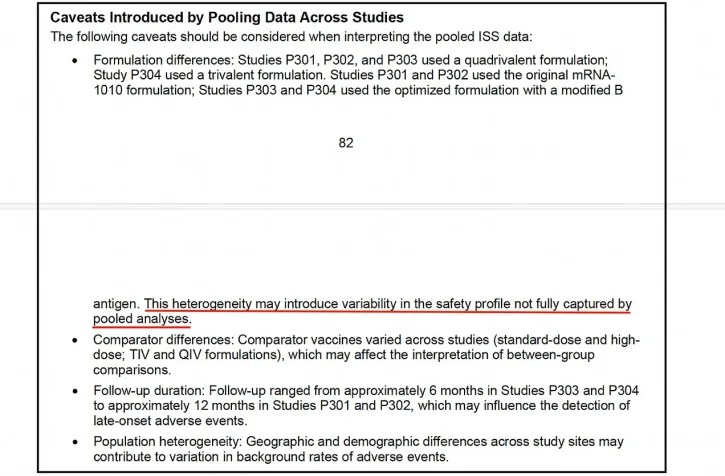
Table 6 of the FDA’s own review makes the switch even clearer (see below).
For the first 28 days after vaccination, when serious adverse events were still balanced between the groups, the agency reported safety results from the pivotal P304 trial alone (purple box).
But as more SAEs accumulated over the following months, a statistically significant imbalance emerged.
Instead of reporting those longer-term results from P304 in the same way, the FDA switched to Moderna’s pooled analysis (red box), where the signal was diluted enough for the agency to continue describing the rates as “balanced.”

The pooled analysis also obscured a concerning pattern in all-cause mortality.
In the pivotal trial P304, there were 40 deaths in the mRNA arm versus 34 in the comparator arm.
In the preceding trial P303, deaths were consistently higher across all three mRNA sub-studies:
- Sub-study 1 (mRNA vs Standard Trivalent): 5 deaths in the mRNA-1010 arm vs. 1 death in the comparator arm (5 vs 1).
- Sub-study 2 (mRNA vs High-Dose Trivalent): 3 deaths in the mRNA-1010 arm vs. 2 deaths in the comparator arm (3 vs 2).
- Sub-study 3 (mRNA vs Standard Quadrivalent): 3 deaths in the mRNA-1010 arm vs. 1 death in the comparator arm (3 vs 1).
Notably, in Sub-study 1, Moderna’s own trial investigators assessed one of the five deaths in the mRNA group as caused by the vaccine—the same product that has now been licensed.
Together, these numbers raise serious concerns about a possible excess in mortality in the mRNA groups—a pattern the FDA failed to highlight.
One rule for efficacy, another for safety
The FDA’s handling of efficacy reveals an even more striking double standard.
For efficacy, the agency relied strictly on study P304—the large pivotal trial testing the exact formulation submitted for licensure.
Earlier trials of Moderna’s vaccine had produced weaker efficacy results—and in at least one case, negative efficacy. Had the FDA pooled those trials for efficacy, the “26.6% efficacy” figure would almost certainly have been substantially lower.
But, as noted above, when the pivotal trial produced an unfavourable safety result, the FDA did the opposite—it pooled the data.
One approach maximised the efficacy. The other diluted the safety concerns.
Who is protecting the public?
On the surface, the FDA says Moderna’s flu mRNA vaccine is “safe and effective.”
Dig deeper, and the pivotal trial shows a statistically significant excess of participants experiencing SAEs.
Dig deeper still, and you discover the statistical trickery Moderna used—and the FDA accepted—to make the SAE signal disappear.
This brings us back to a fundamental question I have raised over years of reporting on regulatory failure.
When the FDA accepts the manufacturer’s trial design, adopts its data analyses, and rubber-stamps statistical methods that dilute a safety signal, who is actually protecting the public from harm?
Featured Video
The Failed Air War Over Vietnam
or go to
Aletho News Archives – Video-Images
From the Archives
USS Liberty Massacre: A Pivotal Moment in the Hostile Takeover of America
By Kevin Barrett | Crescent | Dhu al-Qa’dah 24, 1445
In corporate America, hostile takeovers are commonplace. They occur when an aggressor—a larger corporation or rich individuals—seizes control of a smaller corporation without asking permission.
What few recognize is that the United States itself has been subjected to a hostile takeover. Since the aggressor, the illegitimate settler colony known as “Israel,” is much smaller than the US, the takeover has necessarily been surreptitious.
As of June, 2024, Israel’s gradual takeover of the US has become obvious and undeniable—a proverbial “elephant in the living room.” … continue
Blog Roll
 Aletho News
- Leaders Condemn Ansarallah Attack on Saudi Arabia While Ignoring Illegal War Against Yemen
- Leaked: Britain’s Covert Iraqi Psyops Network
- Yemeni Armed Forces Warn Airlines Against Using Saudi Airports, Exempt Mecca and Medina
- Iran security chief says powers greater than US tried to conquer Iran but ended in ‘dustbin of history’
- Europe’s mounting social chaos… chickens coming home to roost for proxy war against Russia
- US-Russia Diesel Deal Becomes Massive Defeat for Ukraine
- Hormuz and the Looming Economic Catastrophe
- Dhubab offensive, media blitz and the rapid unraveling of Saudi-backed coalition’s new gambit
- Putin Conveys to Trump Iran’s Vision on Possible Conflict Resolution – Kremlin
- The Search for Truth: Charlie Kirk’s Assassination One Year Later
- If Americans Knew
- For three years, Israel has killed a child in Gaza every 71 minutes – Daily Update
- Israeli forces kill another child in Gaza – Daily Update
- Gaza ceasefire exists in name only, say more than 100 organizations
- Nearly 2 Million in Gaza Need Urgent Shelter Assistance as Winter Looms: IOM Chief Warns
- Suppressing Palestinian resistance: US charity under fire for AI monitoring of Gaza classrooms
- Thousands Are Held in Israeli Torture Camps. This Is What Happens Inside
- Israel puts Gaza’s sick, injured, newborn in peril – Daily Update
- Report claimed Mark Levin used by Israeli government to influence Trump
- Over 2,000 Gazans have died awaiting medical evacuation amid Israel’s continued siege
- How a U.S. Diplomat Suppressed and Altered Reports Critical of Israel
- No Tricks Zone
- Germany’s Green Energy Debacle: High Energy Costs Force Kahla Porzellan to Close After 182 Years!
- New Study: 50 Years Of The Most Aggressive ‘Net Zero’ Policies Can Only Affect The Global Climate By 0.03°C
- US September “Heat” Was No Record…Many Records Set Decades Ago
- Latest European Green Energy Debacle; Portugal’s Largest Flagship Solar Park Insolvent!
- Green Energy Debacle: German Expert Professor Fritz Vahrenholt Warns Of Severe Economic And Social Consequences
- Two More Paleo Reconstructions Affirm Meters-Higher Sea Levels Across Ireland, Brazil 7000-6000 Years Ago
- New Study: Earth And Venus Surface Warmth Largely Explained By Convection And Lapse Rate, Not CO2 Or Radiation
- 2025 Nature Paper Claiming Worsening Global Drought Gets RETRACTED …Heavily Flawed
- New Study: ‘Global Drought Shows No Detectable Recent Acceleration Under Climate Warming’
- Economic Masterminds: German Socialists Suggest Taxing Productivity Gains Stemming From Using AI

