Syria May Send Troops to Saudi Arabia Amid War with Ansar Allah
By Kyle Anzalone | The Libertarian Institute | October 8, 2026
A US and Syrian official said Syria is considering sending troops to Saudi Arabia as the kingdom battles Ansar Allah in Yemen.
Reuters reported on Thursday that a US official and a Syrian defense official said that Damascus may send Syrian forces to Saudi Arabia. Riyadh has reached out to several allies for support in its war against Ansar Allah.
On Monday, Turkey and Pakistan agreed to provide military support to Saudi Arabia under the Mecca Accords, a mutual defense pact signed by the three countries earlier this year.
A joint statement released by the Mecca Accords members explained, “The Committee decided to move immediately to the practical implementation of the collective defense commitments and to take the necessary measures to provide the agreed military forces and capabilities and ensure their rapid deployment in the Kingdom, in accordance with the approved arrangements and the national legislation of the Parties, thereby enhancing readiness, military integration, and the collective capacity to confront and counter threats.”
Turkey indicated it would provide Saudi Arabia with military capabilities rather than ground troops, which would require parliamentary approval, while Pakistan did not provide details on the forces or capabilities it plans to deploy.
The statement was released following an emergency meeting of the alliance to discuss the situation in Saudi Arabia. The fighting between Ansar Allah and Saudi Arabia reignited in July after the kingdom attacked the Sanaa airport. In recent weeks, Ansar Allah has taken a significant amount of territory from the Saudi-backed forces in Yemen and attacked several energy sites in Saudi Arabia.
Riyadh has reached out to international partners for support. Crown Prince Mohammed bin Salman requested that President Donald Trump order direct attacks on Ansar Allah positions. So far, Trump has limited US involvement to intelligence sharing and battlefield planning, and refused to conduct direct strikes on Ansar Allah.
Saudi Arabia has also asked China and Pakistan to place pressure on Iran to rein in Ansar Allah. According to three Iranian sources speaking with Reuters, Beijing privately asked Tehran to rein in Ansar Allah after receiving a request from Riyadh. The sources told the outlet that Iran responded that stability in the region depended on US and Israeli aggression.
While Saudi Arabia’s ties to the US and Ansar Allah’s relationship with Tehran allow the war between the two to appear to be a part of a larger regional war, the conflict began over a decade ago. Additionally, Ansar Allah did not begin its offensive following the US and Israeli surprise attack on Iran, but rather after Saudi-backed forces attacked the Sanaa airport, prompting Ansar Allah to resume attacks on Saudi Arabia.
Western officials and media often label Ansar Allah as a proxy of Iran. However, while Iran has provided support to Ansar Allah, there is little public evidence that Tehran directs the group’s military operations.
While Syria was a long-time [resistance] ally under the rule of Bashar al-Assad and his father, Damascus fell to rebels, led by former al-Qaeda members, in 2024. Syria is now led by President Ahmed al-Sharaa, formerly known as Abu Mohammad al-Jolani, who previously led al-Qaeda’s Syrian affiliate.
Israel strikes Syria as Turkish FM visits Damascus, exposing rivalry for control
Press TV – August 7, 2026
Israeli forces have launched an artillery attack on Syria’s Quneitra Province while Turkey’s Foreign Minister Hakan Fidan was visiting the Arab country.
The attack, reported by Syria’s state news agency SANA, targeted agricultural land surrounding the village of al-Samadaniyah al-Gharbiyah.
Israeli military incursions and aggressions in southern Syria, along with harassment of local citizens, have become recurrent amid inaction from Syria’s Hay’at Tahrir al-Sham (HTS) regime led by former Daesh and al-Qaeda deputy Abu Muhammad al-Jolani.
No injuries were reported on Thursday, but the timing was no coincidence. Israel appeared to be sending a clear message that while Turkey’s proxy regime sits in the capital, Israel’s military boots are on the ground, and its artillery is within range.
In his remarks in Damascus on Thursday, Foreign Minister Fidan warned that Israeli attacks on Syria are among the greatest threats to the country’s stability.
“Israel’s attacks targeting Syria’s sovereignty and territorial integrity are among the greatest threats to the country’s stability,” he said.
Fidan urged the international community to respond more strongly to Israel’s occupation policy and press the regime to ensure compliance with the 1974 Disengagement Agreement and respect for Syria’s sovereignty.
The agreement’s Demilitarized Buffer Zone—a UN-monitored strip of land separating Israeli and Syrian forces—was unilaterally renounced by Israel following the fall of Bashar al-Assad in December 2024.
Israeli prime minister Benjamin Netanyahu declared the agreement “collapsed” and ordered his military to invade and occupy the buffer zone, along with additional Syrian territory beyond it.
Since the Turkish-backed coup that installed Jolani’s al-Qaeda-affiliated militants in Damascus, Israeli occupation forces have waged a systematic campaign of agricultural terror across southern Syria—poisoning croplands with chemical sprays deployed from aircraft, bulldozing orchards and olive groves, and abducting local farmers.
In a deliberate strategy of ecocide and economic strangulation, Israeli troops have sealed off entire communities from their ancestral lands, blocking hundreds of families from accessing their fields and grazing grounds while destroying agricultural infrastructure that once sustained the region’s rural population.
“Around 100 families are completely barred from accessing their land. Most of the agricultural roads have been destroyed by Israeli tanks. Furthermore, the occupation forces have take control of large areas of grazing land,” Hassan al-Din Ahmed, a farmer, told Al Jazeera.
Ahmed, whose son was kidnapped by Israeli forces, stressed that “farmlands aren’t the only things Israelis have taken.”
He was grazing cattle when “occupation forces came and arrested my child Saddam from the land”, he told the broadcaster.
“It has been two years, four months without any charge being brought against him,” the farmer added.
According to director of agriculture in Quneitra Mohammad Rahal, Israeli occupation forces used glider aircraft to spray herbicides on agricultural land in the area, causing very significant damage.
The Israeli violations have affected the entire Arab country and triggered a hunger crisis there.
In May, the World Food Programme halved emergency assistance from 1.3 million people to just 650,000, amid critical funding shortfall.
It also halted a nationwide bread subsidy that helped about four million Syrians afford bread every day.
Thursday’s shelling was just the latest chapter in Israel’s systematic dismantling of Syria.
Since Assad’s fall, the Zionist regime has conducted hundreds of airstrikes against military installations, arsenals, and civilian infrastructure—reducing Syria’s defenses to rubble while its military advances beyond the occupied Golan Heights, seized since 1967.
Netanyahu has instructed his military to advance further into Syrian territory, surpassing the Golan Heights occupied since 1967, and to capture multiple strategic sites.
Despite the HTS’s commitments to collaborate with Tel Aviv, Israel has shown no inclination to retreat from Syria.
The two parties have engaged in intermittent discussions aimed at reaching a “security agreement”, but no agreement or significant progress has been reported.
Tel Aviv’s real grievance lies not with Jolani’s al-Qaeda pedigree, which Israel has historically tolerated or even exploited, but with his absolute dependence on Turkey—a patron that armed his militants, bankrolled his coup, and now dictates the political direction of Damascus.
Fidan’s visit laid bare the cynical rivalry between two occupying powers. Israel views Turkey’s growing influence in Damascus with deep suspicion—fearing that Ankara’s ambitions may eventually challenge Zionist expansionist plans.
Turkey, meanwhile, is consolidating its grip on Jolani’s regime, signing military cooperation agreements and training Syrian security forces to ensure Damascus remains a compliant satellite.
France planning third attack on former colony – African leader
RT | July 27, 2026
French intelligence services are preparing a third attack on Niger’s main airport after two assaults on the facility this year, the West African nation’s transitional leader, General Abdourahamane Tchiani, has said.
Tchiani made the allegation in an interview on state-owned RTN on Saturday to mark the third anniversary of the transitional authorities taking power following the ouster of French-aligned President Mohamed Bazoum. France condemned the July 2023 coup, refused to recognize the new authorities, and demanded Bazoum’s reinstatement.
“The June 18 attack was not the last because we are already tracking [them], since the objective has not been achieved. French intelligence is currently working to attempt a third attack,” Tchiani said.
Gunmen launched an assault on Diori Hamani International Airport in Niger’s capital Niamey on June 18, killing 13 people, including 11 security personnel and two civilians, according to the Sahel state’s Defense Ministry. At least 22 assailants were neutralized and about 20 suspects arrested. Al-Qaeda-linked Jama’at Nusrat al-Islam wal-Muslimin (JNIM) claimed responsibility for the attack.
The airport, which also hosts a military airbase and the headquarters of the joint Niger-Burkina Faso-Mali force, was previously attacked in January. Islamic State claimed responsibility for that assault, during which officials said 20 militants were killed and 11 arrested. Gen. Tchiani accused France, Benin, and Ivory Coast (Cote d’Ivoire) of sponsoring the violence. Paris and the two neighboring countries have denied the allegations.
On Saturday, the Nigerien leader accused French intelligence of assembling, training, and equipping militants from JNIM who were behind last month’s offensive. He said the operation was intended to simultaneously target the airport, the presidential palace, and an officer-training center in Tondibia, on the outskirts of Niamey.
Tchiani linked the attack to the withdrawal of at least 4,000 foreign troops from the Niamey airbase. He claimed France sought to portray their presence as essential to Niger’s security and their departure as a cause of permanent instability.
Niger and its neighbors Mali and Burkina Faso have battled jihadist violence for more than a decade. The three former French colonies formed the Alliance of Sahel States (AES) in 2023 to jointly combat the insurgency after severing defense ties with Paris over alleged French aggression and its failure to contain the militants.
The AES leaders have jointly condemned what they described as a “cowardly and perfidious aggression” supported by “foreign state sponsors” against their countries.
Syria ‘unwilling, unprepared’ to attack Lebanon despite US pressure: Report
Damascus is reportedly prepared to reconsider its position if Tel Aviv were to withdraw its occupation troops from Syria
The Cradle | June 17, 2026
Syrian President and former Al-Qaeda chief Ahmad al-Sharaa is “unprepared and unwilling” to launch a military offensive against Lebanon despite growing US pressure, Israel’s Broadcasting Corporation (KAN) reported on 16 June.
KAN cited an informed Syrian source who said that Sharaa is “concerned” that an attack by Damascus against Hezbollah will be seen across the region as “serving” Israel’s interests.
This could negatively impact Damascus’s “legitimacy.”
For now, the self-appointed Syrian president is ruling out an attack against Lebanon and its resistance forces unless Israel decides to pull its forces out of Syria, the report states.
Israel has rejected withdrawal from both Syria and Lebanon.
KAN also said that Turkiye – a longtime backer of Sharaa since his days as Abu Muhammad al-Julani, founder and leader of Al-Qaeda’s Nusra Front – has urged Damascus against such an incursion.
Ankara is reportedly concerned that a Syrian assault on Lebanon would “embolden” Tel Aviv and “strengthen” its position.
“Trump proposed a framework in which the Syrian military would play a central role in a future effort to disarm Hezbollah,” i24 reported on Wednesday.
Lebanese authorities reportedly felt uneasy about the idea during recent US-backed direct talks with Israeli officials, which have taken place despite Lebanon’s legal restrictions.
Additionally, Israeli authorities are reportedly concerned about the effectiveness of a Syrian attack on Hezbollah.
“Some of the arrangements currently under discussion could ultimately strengthen Hezbollah politically and militarily rather than diminish its influence,” i24 reported.
Sharaa said earlier this week that talk of a Syrian incursion into Lebanon was a “rumor.” “Syria’s approach aims to end the war in Lebanon, not to expand it or get involved,” he stressed.
US President Donald Trump has repeatedly called on Syria to attack Hezbollah.
Iraqi resistance groups allied with Hezbollah have cautioned the Syrian government and its forces that they will act if Damascus initiates an attack on Lebanon.
Syria experienced a significant geopolitical change following the fall of former President Bashar al-Assad in December 2024, as Sharaa’s government aligned with Washington and engaged in discussions with Israel.
The US has largely lifted sanctions on Syria and called Damascus a “partner” in the global fight against ISIS — overlooking Sharaa’s past as an Al-Qaeda leader and earlier as deputy to ISIS founder Abu Bakr al-Baghdadi.
Hezbollah fought in Syria for years with the former government, helping recapture areas from extremist groups like Al-Qaeda’s Nusra Front, Ahrar al-Sham, and others considered by the west as the “Syrian opposition.”
The Nusra Front, led by Sharaa, was rebranded into Hayat Tahrir al-Sham (HTS) and ended up toppling Assad’s government in 2024.
HTS and other extremist factions with links to ISIS currently dominate what has become the new Syrian Defense Ministry and military.
Tom Barrack, US special envoy to Syria and Iraq, threatened Lebanon last year with a Syrian incursion, and said Damascus would “actively assist us in confronting and dismantling … Hezbollah.”
He also said Syria viewed Lebanon as its “beach resort” and would carry out an assault against the country unless Hezbollah is disarmed.
Israel Is Arming ISIS Linked Gangs With Military Drones To Help Carry Out Further Ethnic Cleansing In Gaza
The Dissident | May 28, 2026
Israel is going forward with its plan to force Gaza’s Palestinian population to flee to make way for Israeli annexation.
Israel Katz, Israel’s defence minister, said last week, “the voluntary emigration plan from Gaza will be implemented” , “everything at the right timing and in the right manner”, “voluntary emigration” being a euphemism for the complete ethnic cleansing of Gaza.
Benjamin Netanyahu has since stated that he ordered IDF militants to occupy 70 percent of the Gaza Strip, in violation of the so-called “ceasefire”.
Benjamin Netanyahu said , “At this point, we are fully in control of 60% of the territory of the Gaza Strip… and my directive is to get to… 70%”.
Netanyahu implied the end Israeli goal is to occupy all of Gaza, saying, “First 70%. We’ll start with that” in response to calls from audience members to occupy “100 percent”.
To aid in this genocidal campaign of ethnic cleansing and annexation, Israel has again tasked its criminal proxies in Gaza.
The Times of Israel reported that:
In the remainder, some armed groups backed by Israel continue to challenge Hamas’s dominance as the territory’s governing power.
A militia led by Ashraf al-Mansi, which works against Hamas in northern Gaza with Israeli backing, published footage on Thursday showing one of its members operating a heavy military drone.
The footage appeared to be the first of its kind released by an anti-Hamas militia, which until now have primarily been seen using light weapons.
It added:
A statement published on al-Mansi’s Facebook page said that “the People’s Army led by Ashraf al-Mansi in northern Gaza announces the successful introduction of advanced drones into operational use.”
Brig. Gen. Ghassan Dehini, who is considered the commander of various militias in Gaza, announced that “several successful operations” had been carried out using the new drones.
Referring to the drones, the Times of Israel noted “given Israel’s military and logistical support for the militias, it is likely they were transferred from Israel”.
For context, the so-called “popular forces”, currently led by Ghassan Dehini and which Ashraf al-Mansi is a part of, is a group of ISIS-linked criminals who became Israeli proxies after the start of the Gaza genocide.
These criminal gangs during the Genocide in Gaza, looted humanitarian aid in Gaza with support from Israel.
This was carried out both to continue the genocidal blockade on Gaza, and as a false flag to falsely blame Hamas.
By tasking its proxy gangs to carry out false flag aid lootings, Israel falsely accused Hamas of being behind the aid lootings, in order to justify the “Gaza Humanitarian Foundation” sites, the U.S./Israeli backed fake aid sites used to lure and massacre starving Palestinians.
The former Israeli Defense Minister Avigdor Lieberman revealed in early 2025 that “Israel is providing weapons to a Jihadist group in the Gaza Strip affiliated with ISIS,” referring to the Israeli-backed criminal gangs behind the false flag aid lootings led by Yasser Abu Shabab, who the Financial Times described as “Gaza’s most notorious gangster”.
Soon after, the Israeli newspaper Haaretz reported that “The IDF and Shin Bet security service are using Gaza-based militias to carry out military operations in exchange for pay and control over territory in the enclave,” adding, “Each militia consists of dozens of armed men, most from prominent Gaza clans, including the Abu Shabab family.”
One IDF official told the paper, “They’re given more missions in densely populated zones. It’s no longer just the menial work we gave them in the beginning. Now they’re conducting major operations,” and another said, “They train for missions right in front of us, We’ve seen them in groups of five to ten armed men. Sometimes it even alarms our forces because no one bothers to update us.”
The so-called “popular forces” last year faced an internal coup, with militant members killing Yasser Abu Shabab and replacing him with Ghassan al-Duhaini, who similarly previously joined the Army of Islam, or Jaysh al-Islam, “a Gaza-based Salafi jihadist group with a similar ideology to al-Qaeda that declared its allegiance to ISIS in 2015”.
The Jerusalem Post noted that Ghassan al-Duhaini “was a commander in a terrorist group in Gaza that was associated with al-Qaeda”.
In an interview with the Middle East Forum, Ghassan al-Duhaini said he “adopted Salafi jihadism” and “affiliated with a faction that was close to Jabhat al-Nusra (the Syrian Al Qaeda branch) during the war in Syria” .
Now, Israel is yet again backing this ISIS-linked criminal network, even arming it with military drones to help carry out the “final solution”to the Gaza genocide.
How Western Intelligence Agencies Built the Global Jihadist Network
By José Niño | The Libertarian Institute | May 26, 2026
Americans have been fed a comforting fairy tale about Islamic terrorism. Radical jihadists attack the West simply because they despise freedom, democracy, and the American way of life. This narrative flatters domestic audiences while conveniently obscuring a far more troubling reality. For decades, the United States, the United Kingdom, and Israel have armed, financed, tolerated, and tapped into Sunni Islamist extremists as geopolitical tools to destabilize rivals. The evidence spans multiple theaters and rests on declassified documents, congressional investigations, and credible investigative journalism.
The most thoroughly documented case is Operation Cyclone, the CIA program to arm and finance the Afghan mujahideen from 1979 to 1992. In a 1998 interview with Le Nouvel Observateur, former National Security Adviser Zbigniew Brzezinski confirmed that the CIA began aiding mujahideen opponents of the pro-Soviet Kabul government six months before the Soviet invasion—a calculated provocation intended to draw Moscow into an unwinnable war. When asked if he regretted supporting Islamic fundamentalism that gave “arms and advice to future terrorists,” Brzezinski replied:
“What is more important in world history? The Taliban or the collapse of the Soviet empire? Some agitated Moslems or the liberation of Central Europe and the end of the cold war?”
Multiple intelligence agencies participated in this operation. MI6 ran covert operations supporting hardline commanders. Pakistan’s ISI served as the critical financial and logistical conduit—operating under the direction of Pakistani President Zia ul-Haq, who controlled ISI policy throughout the war. Saudi Arabia agreed to match CIA contributions dollar for dollar, a commitment secured when Brzezinski visited Riyadh in February 1980 and one that CIA officer Gust Avrakotos and congressman Charlie Wilson (D-TX) would fly to Riyadh to enforce whenever Saudi payments fell behind. Historian Steve Coll documented in Ghost Wars that Osama bin Laden informally cooperated with ISI-run guerrilla training camps on behalf of newly arrived Arab jihadists, with intimate connections to CIA-backed commander Jalaluddin Haqqani. The global jihadist network that became al-Qaeda grew directly from this infrastructure.
The Afghan theater was not an isolated experiment but the opening chapter of a longer story. The same networks it created spread rapidly to the next front. The Chechen insurgency of the 1990s was joined by Arab and Central Asian jihadists who had cut their teeth in Afghanistan. The most prominent was Ibn Khattab, a Saudi-born mujahideen veteran born in 1969 inʿAr’ar, Saudi Arabia, who left for the Afghan jihad at age 18 before entering Chechnya in 1995. Saudi-backed organizations funneled funds, and Gulf state charities developed during the Afghan jihad maintained, in some cases wittingly and in others not, support for al-Qaeda-affiliated groups throughout the decade. Several of the future 9/11 conspirators—including Mohamed Atta, Marwan al-Shehhi, Ziad Jarrah, and Ramzi bin al-Shibh—originally sought to travel to Chechnya in 1999 before being redirected to al-Qaeda’s Afghan camps, per the 9/11 Commission.
While the Chechen theater illustrated how Western-cultivated networks could spiral beyond control, Washington was already running new variations of the same playbook elsewhere. Veteran investigative journalist Seymour Hersh’s 2007 New Yorker article “The Redirection” documented that the W. Bush administration, in cooperation with Saudi Arabia, launched covert operations to weaken Hezbollah and Iran by bolstering Sunni factions. According to Hersh’s intelligence sources, “a by-product of these activities has been the bolstering of Sunni extremist groups that espouse a militant vision of Islam and are hostile to America and sympathetic to Al Qaeda.”
Israel was running its own parallel operations against Iran during the same period. Foreign Policy magazine published a 2012 report by journalist Mark Perry drawn from CIA memoranda, describing how Israeli Mossad officers posed as CIA agents to recruit members of Jundallah, a Pakistan-based Sunni Salafi organization responsible for numerous bombings inside Iran. As one intelligence official told Perry:
“It’s amazing what the Israelis thought they could get away with. Their recruitment activities were nearly in the open.”
The same structural logic that shaped Afghanistan, Chechnya, and the Middle East has also played out in Central Asia. The Chinese government has accused the United States of using Uyghur Islamist networks to destabilize Xinjiang, with Chinese Foreign Ministry spokesman Zhao Lijian repeatedly alleging American support for Uyghur militant organizations during 2020 and 2021. The U.S.-funded National Endowment for Democracy has provided grants to Uyghur exile organizations. NED co-founder Allen Weinstein acknowledged in a 1991 Washington Post column by David Ignatius that “a lot of what we do today was done covertly 25 years ago by the CIA.” In October 2020, Secretary of State Mike Pompeo formally revoked the designation of the East Turkestan Islamic Movement as a terrorist organization—a move Beijing characterized as evidence of Western support for Uyghur militancy.
Across Afghanistan, Chechnya, the Middle East, and Xinjiang, the same structural features recur. Western strategic interests converge with the short-term utility of Sunni Islamist networks. Operations route through intermediaries like Saudi Arabia, Pakistan’s ISI, or Gulf states, allowing Washington to maintain official distance. Blowback eventually arrives years later, paid in American blood.
The naive story about terrorists hating freedom serves domestic propaganda purposes while obscuring a far darker truth: Western intelligence agencies have functioned as architects of mayhem, generating instability abroad in pursuit of American primacy. If the world wants genuine stability, it must first acknowledge this pattern and demand that these agencies be held accountable for the chaos they have unleashed across multiple decades.
France’s Shadow War in Mali
By Freddie Ponton | 21st Century Wire | May 11, 2026
France did not really leave Mali. It changed tactics and found new hands to carry the gun. After being pushed out by a military government that turned toward Russia, China, and the wider Global South, Paris appears to have re-entered the war through Ukrainian military intelligence channels, long-standing Tuareg networks, and a battlefield configuration in which separatist rebels and Al-Qaedaʼs Sahel branch were hitting the same state enemy at the same time.
The late-April attacks in Mali said something larger about the Sahel. A former colonial power that had been shown the door was suddenly back in the frame, leaning on intermediaries and the momentum of jihadist advances to weaken a government that had chosen Russian support, Chinese weapons, and the language of anti-colonial independence over its old dependence on Paris.
Paris returns through the back door
The sequence is clear. On 25 April, coordinated attacks struck Kati, Gao, Kidal, Sévaré and other strategic points in Mali. Defense Minister Sadio Camara, one of the central figures in Bamako’s post-French realignment and often described as Moscow’s man in the junta, was killed in an attack on his residence. The capital was shaken, roads toward Bamako came under pressure, and in the north, the insurgents advanced as Russian fighters and Malian forces lost ground. Four days later, while the government was still counting its dead, Mohamed Elmaouloud Ramadane, spokesman for the Azawad Liberation Front, or FLA, surfaced in Paris and met French security and defence representatives while demanding that Russian forces leave Mali. That alone should have set off alarms from Bamako to Brussels.
French media then supplied the missing bridge. Radio Télévision Luxembourg, RTL, reported that France was relying on French-speaking Ukrainian soldiers, including former Foreign Legion personnel, to provide operational support on the ground in Mali in coordination with Tuareg rebels. The report was explicit enough to describe a French effort to avoid direct cooperation with jihadists linked to Al-Qaeda by using Ukrainian relays instead. The same investigation recalled that at the beginning of 2025, Ukrainian military intelligence had presented a detailed plan to French authorities to help dislodge the juntas in the Sahel region and roll back Russian influence. Paris supposedly hesitated at first on security grounds. From where things stand now, the April operation feels less like an improvised response than the delayed execution of that proposal.
For readers unfamiliar with Mali, one fact matters more than any other. This is a large Sahel state that was once a core part of France’s post-colonial sphere of influence. After coups in 2020 and 2021, the new authorities pushed out French troops, challenged the old Françafrique order, and brought in Russian security support while deepening ties with non-Western partners. That made Mali a test case in Africa’s attempt to break with inherited dependency. Seen from that angle, the April offensive was more than just local tensions between armed factions. In fact, it was part of a wider struggle over who gets to decide the political future of the Sahel.
The offensive that exposed the convergence
The April 25 offensive laid bare the forces converging against Bamako. Jama’at Nusrat al-Islam wal-Muslimin (JNIM), better known as JNIM, claimed major attacks around the south and center. The FLA and allied Tuareg formations pushed in the north. Together they created the sense of a government under siege, with one arm of the offensive squeezing the capital and another unravelling the junta’s hold on strategic northern towns. JNIM is not a vague insurgent label. It is Al-Qaeda’s official branch in the Sahel, born from a 2017 merger that brought together Ansar Dine, AQIMʼs Sahara branch, al-Murabitoon and the Macina Liberation Front under the leadership of Iyad Ag Ghali, a veteran Tuareg commander now wanted by the International Criminal Court.
That reality becomes significant, especially when the Azawad Liberation Front (FLA) is so often presented in softer terms, as if it were merely a separatist front pursuing legitimate local grievances. The FLA, founded in late 2024 in Tinzaouaten from a reorganization of Azawad movements, draws on a long history of Tuareg rebellions in northern Mali. Its public face is political and diplomatic, and its battlefield behaviour tells a much sharper story. In the April assault, it moved in the same strategic rhythm as JNIM, benefiting from the firepower, shock value, and confusion generated by Al-Qaeda’s Sahel network.
The north was especially revealing. Kidal, the symbolic heart of Tuareg politics and rebellion, fell back under FLA control after Russian Africa Corps contractors and Malian forces withdrew. Accounts describe negotiated departures, seized matériel, and a humiliating loss for Bamako and its Russian backers. Africa Corps units left behind vehicles and equipment while seeking safe passage out of a town they had retaken from Tuareg groups only a few years earlier. In Bamako’s orbit, meanwhile, JNIM tightened pressure with threats to block access roads and attacks designed to create the perception of a capital edging toward siege. To supporters of the insurgency, the junta looked fragile, but to anyone watching external interference, the alignment of interests was impossible to ignore.
Much of Western coverage flattened this into a familiar story about state weakness and local instability. That framing leaves out the politically explosive part. These attacks came after two years of mounting accusations from Mali and its Sahel allies that Ukraine was aiding anti-state armed factions and that France had never fully abandoned its northern networks. Put next to Ramadane’s Paris visit and RTL’s reporting on French support through Ukrainian channels, the April offensive starts to read less like a sudden collapse than the military expression of a proxy design that had been taking shape for some time.
Ukraine’s war spills into the desert
Ukraine’s place in this story is not incidental. It is one of the clearest windows into how the war with Russia has spilled into Africa. In 2024, reporting from Le Monde described Ukrainian links with northern Malian rebels and said Ukrainian operatives had trained Tuareg fighters to use drones. That reporting was reinforced by statements from Tuareg figures themselves, who acknowledged contacts with Ukrainians, and by later accounts of drone know-how and explosive FPV tactics moving into the Sahel theatre. Mali cut diplomatic ties with Ukraine in August 2024 after comments from a Ukrainian intelligence spokesman were interpreted in Bamako as an admission of involvement in the Tinzaouaten ambush that killed large numbers of Wagner and Malian personnel.
In that July 2024 ambush near Tinzaouaten, Tuareg separatists claimed to have killed 84 Wagner operatives and 47 Malian soldiers. Ukraine’s own military intelligence spokesman then boasted that its services had supplied the “essential intelligence, and not just intelligence” that made the operation possible.
Tinzaouaten already carried the shape of what came later, and showed that Russian assets in Mali could be hit through a combination of local insurgents, drone warfare, and outside intelligence support, leaving Moscow’s contractors exposed far from their main war. By 2026, those methods had grown more polished. Reports on rebels’ use of FPV systems, including fibre-optic drones that resisted jamming and adapted commercial platforms, pointed to a battlefield increasingly shaped by techniques honed over eastern Ukraine. Russian and Malian convoys were taking fire from above in areas where state air superiority had once seemed secure.
Regional coverage and Sahel sources have since pointed to Algeria as the state that might have helped make that Ukrainian support physically possible long before the April offensive. Niger had already moved into Russia’s security orbit by then, which suggests Algerian territory and networks as the only realistic corridor for covert assistance to reach Tuareg fighters in northern Mali. The same Algeria that has spent years mediating Tuareg affairs, hosting peace talks and cultivating influence over Iyad Ag Ghali’s environment, seems to be quietly repairing relations with both Paris and Washington.
For Kyiv, the logic is straightforward. Russia’s Africa Corps is both a military instrument and a geopolitical symbol, securing mining sites and political partnerships across a belt of African states. Hitting it in Mali weakens Moscow’s position abroad while demonstrating that Ukraine can impose costs on Russia beyond Europe. For France, Ukrainian projection in the Sahel has a different value; primarily because it opens a way to hurt Russia’s African network and destabilize the junta without visibly redeploying French troops or sitting down with jihadist commanders.
RTL’s report on French-speaking Ukrainian ex-Legionnaires operating as intermediaries is powerful precisely because it solves a practical problem. Paris can guide and assist operations that serve its interests while insisting that no French soldier is on the ground. The Ukrainians provide deniability, military expertise, and a shared anti-Russian mission. The Tuareg rebellion provides local cover and established terrain knowledge, while JNIM provides the battlefield weight that neither France nor Ukraine could openly supply themselves. Taken together, the result is a war in which Malian sovereignty and Russian presence are being tested by actors who will never stand behind the same podium but who are clearly useful to one another on the ground.
France’s long shadow and the new division of labour
The events of this year did not emerge in a vacuum. Across Mali and the wider Sahel, accusations that France manipulates armed Islamist-adjacent networks have circulated for years. Some claims are stronger than others, while some remain allegations. However, put together, they form a political memory that explains why Bamako and its allies quickly read the April offensive as more than a domestic insurgent wave.

French president Emmanuel Macron visits the troops of France’s Barkhane counter-terrorism operation in Africa’s Sahel region in Gao, northern Mali, 19 May 2017
One of the hardest facts in that longer history is the ransom trail. A decade ago, a major New York Times investigation found that European governments had pumped large sums into Al-Qaeda-linked groups through ransom arrangements and that France was among the major payers. French and other European hostages taken in the Sahara and Sahel were released after opaque deals in which governments denied paying, but local intermediaries and US officials said otherwise. Reporting from the same period described France as one of the champions of ransom payments to Al-Qaeda affiliates in North and West Africa. The practical outcome pointed towards networks that abducted Western nationals gained money, leverage, and survivability from transactions tied directly or indirectly to French state interests.
In Bamako, those revelations sit on top of a thicker layer of suspicion. The Malian outlet L’Aube accused Paris of effectively financing JNIM through ransom payments, alleging that France paid between 12 and 13 million euros for the release of Olivier Dubois and Jeffrey Woodke and that the money was used by the group to buy arms and ammunition. Niger‘s authorities later levelled similar charges, with General Abdourahamane Tchiani accusing France of pouring several billion CFA francs into armed groups across the Sahel and using Nigerian intelligence channels for training, equipment and financing linked to terrorism. Against that backdrop, RTL’s talk of a new hierarchy of enemies in Mali lands with much greater force. France avoids direct contact with Al-Qaeda’s men by working through Ukrainian and Tuareg intermediaries, yet accepts a configuration that strengthens the jihadists on the ground.
Then came the accusations from Mali itself. In 2021, Prime Minister Choguel Maïga told Russian media that France had created an enclave in Kidal, barred the Malian army from entering, and taken deputies of Ansar Dine’s leader to form a new armed group trained by French officers. Although those claims were denied and never fully proven in public, they reflected a widespread belief in Mali that France’s northern policy was always selective, that some armed actors were enemies only until they became useful, and that counterterrorism language had long concealed a hierarchy of interests. When RTL later explained that France now limits its operational support to Ukrainian relays to avoid direct contact with jihadists linked to Al-Qaeda, it gave that older suspicion a fresh and chilling plausibility.
A new division of labour is also coming into view across the Sahel battlefield. JNIM supplies most of the foot soldiers and carries out the suicide car bombings and complex ground assaults that the Tuareg front alone could not manage. The FLA offers a separatist banner, a political vocabulary tied to Azawad and Tuareg grievances, and a face that Western actors can present as more acceptable than open jihadism. Ukrainian intelligence, drawing on ex-Foreign Legionnaires and years of experience under fire, interfaces directly with Tuareg commanders and delivers modern drone and ambush tactics. France coordinates with the Ukrainians and leans on its long history of intelligence work with Tuareg elites, but keeps just far enough away from open jihadist contact to preserve a legal and political alibi. Algeria appears to be sitting in the background as facilitator and fixer, a state that has repeatedly handled Tuareg files, mediated peace accords, and is now edging back toward closer ties with Paris and Washington. Above all of this sits the United States, rolling out a new counterterrorism strategy that asks European allies to take more responsibility for African theatres and to shoulder more of the burden of rolling back Russian influence worldwide.
Furthermore, it is acceptable to draw parallels with Syria, which offers the clearest precedent for what is emerging in Mali, where Western powers are claiming a war on terror while tolerating or working around Al‑Qaeda‑linked formations when they serve a shared objective on the battlefield. In Syria, Western powers tolerated, rebranded or worked around Al-Qaeda-linked formations when those forces were useful against the Syrian state. Mali is not a carbon copy, but the political reflex is familiar. France appears to have accepted a battlefield reality in which its preferred anti-junta channel moved alongside, and benefited from, Al-Qaeda’s own assault on the Malian state. That is enough to strip away the moral language of the so-called war on terror and expose a pattern that keeps resurfacing whenever Western influence is under threat.
Africa pushes back against the old pattern
Mali, Niger, and Burkina Faso have spent the last few years trying to build a different political vocabulary for the region. Their Alliance of Sahel States, or AES, is not simply a club of juntas, and should be seen also as a rebellion against the old script in which Paris decided security priorities, Western diplomats managed legitimacy, and African governments were expected to accept permanent tutelage in exchange for nominal stability. That rebellion is messy, militarized, and far from pure, which explains why Bamako’s turn toward Russia, China, and Turkey carries such symbolic weight across the Global South.
The response to the April offensive grew from that new landscape. AES partners launched joint military actions, including airstrikes in Malian territory, after the attacks on Gao, Ménaka and Kidal. Moscow has made clear that it does not intend to abandon Bamako. Kremlin spokesman Dmitry Peskov said after the April attacks that Russian forces would stay in Mali at the request of the current government and continue helping it fight extremism, terrorism and other harmful phenomena. Russian military statements added that Africa Corps units had helped prevent a change of power and inflicted irreparable losses on the attackers.
This is not a symbolic presence. Reporting has described a Russian deployment of roughly 2,000 to 2,500 Africa Corps personnel in Mali, supported by repeated shipments of armoured vehicles, artillery and electronic warfare equipment. China had already been supplying new defence systems, including short-range air defences designed to help deal with the very drones that had become a weapon of choice for jihadist and Tuareg militias. Turkey emerged as another important arms partner through the supply of combat drones to the Malian state. Each of those relationships tells the same story. Mali is trying to diversify away from Paris and anchor its survival in a more multipolar world.
Pressure is building from the other side of the chessboard. Nigeria has warned that the rebel and jihadist advance in Mali threatens the wider region and hinted that it could intervene again, echoing its role in supporting the last French military operation there more than a decade ago. Almost at the same time, Washington published a new counterterrorism strategy urging Europe to assume greater responsibility for its own security, explicitly including counterterror operations in Africa. Together, those signals sketch the outline of a tomorrow in which the same states accused of secretly feeding the fire in Mali can present themselves once more as firefighters.
That is the wider fight behind the headlines. If France can return through covert channels, Ukrainian intermediaries, and a tolerated overlap with jihadist momentum, then the message to the rest of Africa is brutally simple. Expelling the old colonial power does not free a country from its reach. It only drives its methods deeper into the shadows.
The anger in Bamako, Niamey and Ouagadougou did not come from nowhere. It was built over years of lectures about democracy from governments that armed the neighbourhood, years of foreign troops sold as protection while insecurity spread, years of counterterrorism campaigns that left ordinary people poorer, less mobile, and less safe. That memory sits behind every cheer for sovereignty in the Sahel. The old order still has embassies, media networks, military bases, and intelligence contacts. What it no longer has is the automatic right to be believed.
France once marched into Mali under the guise of rescue. Now it seems to be edging back in through a side door, behind Ukrainian handlers, Tuareg envoys, and Al-Qaeda gunmen who happen to be shooting at the same enemy. If JNIM ever reaches the gates of Bamako, nobody should call it a mystery born from the desert. The road to that disaster is already being paved through a proxy system that weakens Mali in the name of saving it and then prepares to market the resulting collapse as the reason for another intervention.
What advances on Bamako today is more than JNIM and a Tuareg front. It is a proxy machinery in which Western states and their partners are willing to ride jihadist momentum, break a government they cannot control, and then market the ruins as proof that Africa still needs their protection.
‘Little Sparta’: Why The UAE Attacked Iran for Israel’s Sake
By Robert Inlakesh | The Palestine Chronicle | May 9, 2026
The United Arab Emirates (UAE) has been accused of launching direct strikes targeting Iranian civilian infrastructure, while escalating its anti-Tehran rhetoric and having lobbied the US to return to all-out regional war. Although on the surface of things, it would appear nonsensical for such a small and fragile country to commit itself to reckless actions of these kinds, the UAE is no ordinary Gulf State.
While presenting itself as an innovative nation, one that is dissimilar to its neighbors in that its focus is the creation of wealth, “unity” and “peace”, the UAE fosters an image of a wise and inviting leadership that caters to outsiders. Utilizing their immense oil wealth, Abu Dhabi’s rulers have managed to construct an image of themselves that is almost as artificial as Dubai’s Skyline.
Behind the “tallest building” and “deepest pool” in the world are not talented Emirati architects, hard labor, and meticulous planners; instead, there are foreign experts and modern-day slaves. Although the Emirati rulers may be the ones who own everything and their people the ones who reap the benefits, even their prized oil industry would be nothing without all the foreigners who did everything for them.
Interestingly, both their foreign intelligence operations and oil industry have been heavily influenced by Palestinians, specifically from the Gaza Strip, and other non-Emirati Arabs, who helped make their nation run. Many of their police patrol officers are not their own nationals either, while 80% of their armed forces are foreigners.
The “peace” and “unity” that they promote are simply a Zionist project to attack the resistance to Israel’s expansionist endeavors. Not only were the ‘Abraham Accords’ lobbied for by the UAE, with it using its influence in Sudan and Morocco to bring even more States on board, but their entire national project has also been centered around assassinating pan-Arab and pan-Islamic unity.
Not only does the UAE use “inter-faith” projects to normalize Zionism and Zionists amongst Muslims, it actively controls a host of Islamic influencers, sheiks, Quran reciters, and scholars, whose role is to target impressionable Muslims. These individuals are used to push sectarianism, especially against Twelver Shias, but even against fellow Sunni Muslims who refuse to comply with their views.
Across the region, the UAE, known amongst its war hawk allies as ‘Little Sparta’, pursues a bloodthirsty approach, especially across the Horn of Africa. In Sudan, it is the primary backer of the Rapid Support Forces (RSF) of warlord Muhammad Dagalo (Hemedti), a militant group accused of committing genocide. In Gaza, they are also accused of backing the Israeli-controlled ISIS-linked death squads, used to fight against the Palestinian resistance.
In Libya, they provided support to warlord Khalifa Haftar’s men, while propping up the Southern Transitional Council (STC) separatists in Yemen. They claim to oppose “Islamists” and “Islamic extremism”, while they actively promote Wahhabi Islam, with the political goal of encouraging the most malignant forms of sectarianism. Their only true opposition to ‘Islamists’ is a stance against the Muslim Brotherhood and all groups who dare to challenge Israel, and/or the United States in any way.
To demonstrate the depths of their hypocrisy, consider that the toughest fighters belonging to their STC proxy forces in Yemen were former Al-Qaeda and ISIS militants. In the name of combating the so-called “Islamist threat” of the Ansarallah government in Sana’a, the UAE decided to throw its weight behind hardline Salafist militants.
When it comes to the Iran conflict, the UAE optical illusion is also in effect. It played victim, feigned neutrality, while simultaneously pushing claims that it managed to intercept more Iranian missiles and drones than the Israelis did. In this way, it becomes both the hero and victim, but in an even less believable way than the Zionists, who clearly have more believable propaganda.
In reality, the UAE not only provided a launching pad for the illegal US-Israeli attack on Iran, but had even fully integrated its air defense systems with Israel following their normalisation agreement. They were providing the Israelis with information used to help them combat Iranian retaliatory strikes on their territory, while the Emirati-owned Wing Loong II UAVs were used to monitor Iranian airspace in support of the US-Israeli aggression.
While the US certainly used other Persian Gulf Arab States to attack the Islamic Republic, none were so enthusiastic as Abu Dhabi’s leadership. Oman is the only country in the region that did not allow for its territory to be used for offensive action against Iran, while Qatar began developing a more neutral tone, especially as the war progressed, the UAE went the opposite direction. Eventually, the Emirati anti-Iran rhetoric escalated to the degree that the Emirati rulers began labeling Tehran as terrorists.
Understanding why is crucial to comprehending the nature of the UAE as an entity in the Persian Gulf. Contrary to its propaganda, Abu Dhabi is the means through which Israeli and Western imperial power is harnessed.
The British, who helped form the “Trucial States” that would later band together under the leadership of Abu Dhabi and become the United Arab Emirates in 1971, referred to them as “pirates”. This legacy of being a disrespected puppet of the empire is something that holds true until this day, where the ultra-rich Emirati leadership enthusiastically does the bidding of their superiors.
In only 54 years, the regime along the Persian Gulf has managed to present to the world a model of what unfettered materialism leads to. A regime that operates off of oil money, which wouldn’t exist without foreign know-how and intelligence. It looks down on other Arabs, despite it needing them to function or to have become what it is.
It claims to represent a moderate and peaceful version of Islam, promoting Madkhali Wahhabi voices who promote it as a model of socially conservative religion and claim it represents a leadership that follows the virtues of Tawheed (monotheism) above all others. Simultaneously, Dubai is a representation of everything that Islam opposes socially, while the same pro-UAE preachers who want to excommunicate ordinary Muslims from their religion over the slightest disagreements will sit back as Hindu Temples are openly constructed.
It has been involved in aiding two genocides, perhaps a third if you consider the 400,000 deaths in Yemen to constitute a genocide also. Even today in Somalia, only it and Israel recognize and back the Somaliland separatist movement, which could contribute to major future bloodshed.
All of this is relevant to keep in mind as the UAE is as artificial and malignant to the region as the Israelis are. Both have utter contempt for the people surrounding them, refuse to acknowledge the limits of their power, and have major narcissism complexes. In the UAE, they have to monitor every square inch of their territory, censor everyone’s thoughts, killing, deporting or imprisoning anyone who refuses to go along with stroking their fragile egos.
Ultimately, the UAE is just as complicit in regional atrocities as are the Israelis, which is why it is no surprise that they decided to directly join the illegal US-Israeli war on Iran. Their mission is to conquer, dominate and destroy the surrounding region, in order to come out on top, working hand in hand with the Zionists to do so. Now that their tourism industry has been devastated and they have taken significant blows, that only reinforces the idea of aiding the Israelis in pursuing their expansionist endeavors.
Recent history alone has demonstrated that the UAE is willing to clash with neighboring Saudi Arabia, however irrational that idea may have been, and how quickly Riyadh managed to quash their separatist proxy project in Yemen. They also demonstrated in 2017 that they were willing to push Qatar to the breaking point, in order to demand on Israel’s behalf that they stop providing financial support to Hamas, as well as using Al-Jazeera to air coverage favorable of Palestinians.
The UAE is not a normal country; it doesn’t have thousands of years of history like neighboring Oman, it is an aggressive asset that cares only for expanding the power of its monarchy. Therefore, it is to be assumed that it will participate in continued attacks on its neighbors, while wearing the cloak of plausible deniability.
However, the Emiratis are likely to find out against Iran, what they quickly learned when they recently clashed with Saudi Arabia, they are not Israel and can’t behave as such without consequences.
– Robert Inlakesh is a journalist, writer, and documentary filmmaker. He focuses on the Middle East, specializing in Palestine.
Mali: a new front in the Western war on multipolarism
Strategic Culture Foundation | May 1, 2026
An audacious coup attempt against the government in the West African state of Mali appears to have been thwarted by the Malian Armed Forces, supported by their Russian allies.
The surprise coup was launched last weekend when an estimated 12,000 fighters attacked at least five cities, including the capital, Bamako. Fighting continued during the past week, with most of the casualties – over 1,000 dead – suffered by the insurgents who came under heavy ground and air fire from state forces backed by Russian auxiliaries belonging to the Africa Corps.
Mali’s leader, Assimi Goïta, made a nationwide televised address appealing for calm and stating that the country’s security situation had been brought under control. He paid tribute to his defense minister, General Sadio Camara, who was killed in action on the first day of the coup attempt on April 25. The leader also acknowledged the actions of his country’s strategic partner, the Russian Federation, for helping to defeat the coup, which he condemned as “foreign-sponsored”.
For its part, the Kremlin said it would continue supporting the Malian government to restore stability and security to the country.
Both the Malian authorities and Moscow have accused Western sponsors of involvement in the insurgency. Russia’s foreign ministry claimed that Western military instructors had helped coordinate the wide-ranging attacks. There were reports of militants armed with French Mistral anti-aircraft missiles and U.S.-made Stinger Manpads. There are also unverified reports of mercenaries from Ukraine and NATO states fighting on the ground.
This is not the first time that NATO and Ukraine have been linked to destabilizing the national security of Mali. Two years ago, Mali cut diplomatic links with Kiev after a Ukrainian military intelligence official claimed that Ukrainian forces had been supplying insurgents.
In the latest uprising, the Western news media have been quick to highlight supposed military gains made by the rebels. The Western coverage has sought to portray the violence as a spontaneous challenge to the government in Bamako, which the Western media disparages as a “military junta”. The same media have also claimed that the unrest is a blow to Russia’s strategic interests in Africa. In particular, it is claimed that Moscow’s security partnership with Mali and other African states is being exposed as ineffective and weak.
Two militant groups were involved in the coup attempt this week. The Tuareg ethnic people’s liberation movement, known as the Azawad Liberation Front (FLA), and an Al-Qaeda-linked jihadist group known as Jammat Nusrat al-Islam wal-Muslimin (JNIM). Both entities had been fighting each other until recently, but now seem to have allied. Who brokered that expedient alliance?
The widespread insurgent attacks mounted against five cities covering a distance of some 2,000 kilometers also suggest that the fighters were provided with considerable intelligence and logistical support. Mali is a huge country, the sixth largest in Africa, with a land area twice that of France or Texas. Previous attacks were mainly confined to the remote northern half of the country, which is typically a desert landscape. To launch an assault on the capital in the south is a significant development. The devastating bomb attack on the defense minister’s residential compound near Bamako also suggests that there was foreign assistance.
The geopolitical background is highly significant. Mali formed an Alliance of Sahel States (AES in French) in September 2023 along with Niger and Burkina Faso. The three former French colonies ordered the withdrawal of French military forces and asserted a newfound political independence. They accused France of playing a double game by secretly supporting separatists and Islamist groups to give a pretext for French military involvement in their countries. In a further affront to French arrogance, Mali, Niger, and Burkina Faso pointedly turned to Russia for security assistance and, in return, have offered Russia access to key natural resources in a mutual partnership.
For centuries, France and other Western states have plundered Africa without giving anything back to the continent except new forms of economic slavery and exploitation.
Meanwhile, Russia and China have gained renewed partnerships with many African nations. A history of colonial depredation hampers neither Russia nor China. Indeed, the Soviet Union has a largely honorable legacy of supporting African independence, which many Africans acknowledge. In the contemporary context, Moscow and Beijing’s espousal of a multipolar world and cooperative development has resonated strongly with African countries.
When Mali, Niger, and Burkina Faso kicked out the French neocolonial trappings three years ago, there was palpable scorn in Paris, particularly from French President Emmanuel Macron. If the Sahel alliance succeeded with Russian help, that would be a major blow to France’s national esteem and the anti-Russian propaganda narrative of the NATO bloc.
The attempted coup in Mali should be viewed in this light. It is much bigger than Mali’s internal tensions and divisions. What’s at stake is maintaining the right of political independence and sovereignty in African nations to choose their own political and developmental path. In a word: self-determination. Old colonial powers like France and other NATO members would like to turn the clock back to the former times of hegemonic control.
As many informed analysts have noted, the current conflicts in Ukraine and other places, such as Iran, Venezuela, Cuba, Latin America, Asia-Pacific, the Arctic, and so on, are not isolated aberrations. They are all part of a “new great game” for Western powers to reassert global dominance.
The Western ruling elites want to, indeed need to, confront the rising multipolar world that challenges their hierarchy of privileges and profits. Russia and China are the main targets for the Western powers to win their strategic war. The proxy war in Ukraine is part of that. So too is Washington’s aggression against Iran to cut off energy supplies to China and Asia.
The coup attempt in Mali is another site of struggle that appears to be instigated by NATO powers in their proxy war against Russia and the historic vision for a multipolar world.
There is an ominous echo of the Syria scenario, where Western powers finally overthrew a Russian ally at the end of 2024, to be replaced by jihadists whom the West backed covertly for years before that.
Given the strategic importance, Russia and China must not let this happen in Africa. The firm defense of Mali this week by the country’s leadership and armed forces, acting with the support of Russia and the mass of Malian people, indicates that Western intrigue will fail.
Why the CIA conspiracy to invade Iran with Kurdish militias failed
By Robert Inlakesh | Al Mayadeen | April 5, 2026
At the beginning of the US-Israeli War on Iran, stories were circulated about the United States attempting to use Kurdish militia groups in order to wage a ground offensive against Iran. Yet the strategy never ended up getting off the ground. Understanding the context helps explain what happened
On February 22, just prior to the joint US-Israeli war of aggression against Iran, five Kurdish-Iranian militant factions held a conference declaring a historic unity agreement had been reached. As a result the Democratic Party of Iranian Kurdistan (PDKI), Kurdistan Free Life Party (PJAK), Kurdistan Freedom Party (PAK), Khabat Organization of Iranian Kurdistan, and a branch of the Komala Party of Iranian Kurdistan came together. They declared themselves the Coalition of Political Forces of Iranian Kurdistan (CPFIK), explicitly to fight against the Islamic Republic of Iran.
For long, Tehran had argued that these groups were being backed by the Western and Israeli intelligence agencies. However, journalists also adopting this analysis were often framed as being conspiracy theorists. That was, of course, until a few days into the US-Israeli war on Iran, when it emerged that the Trump administration was openly in talks with them, encouraging an invasion of Iran’s Western borders.
Then came the bombshell report from CNN, whose sources alleged that the CIA had been covertly working to arm these Kurdish-Iranian groups based in Iraq. So, at this stage, and shockingly so, there is no conspiracy to unravel as it has already been exposed.
What would such an invasion look like?
As has become evident, regime change in Iran is not going to be possible through a campaign from the air alone; the natural next step to achieving this was always going to be creating an insurgency inside the country, whilst invading from without also. In the US’s alleged strategic thinking, a Kurdish invasion would ideally work to foster a wider uprising inside the country, thus creating a general environment of chaos and division.
However, bringing about such a predicament was not going to come easy. In January, the Israeli Mossad attempted to foster an armed uprising that would trigger a civil war. Iran managed to put this bloody assault down with overwhelming force in just two or three days, a conflict which cost the lives of 3,117 people, including hundreds of policemen and security force members.
Initially, this uprising sought to use paid agents from criminal groups in the West of Iran and there was some evidence that Kurdish militia groups were used to clash with the Iranian security forces, but this was quickly quelled. In fact, in 2022, when the death of Mahsa Amini triggered nationwide protests, Western intelligence agencies jumped on the opportunity to use Kurdish separatist groups, but failed to achieve their desired objectives.
In Iraq, the US, and later the Israelis, also worked alongside Kurdish forces in order to secure the control of oil resources and successfully created the semi-autonomous Iraqi-Kurdistan region, complete with its own Kurdish government. The same came in north-eastern Syria, where the US helped set up what was known as the Syrian Democratic Forces (SDF), using them to fight back ISIS and claim control of not only Syria’s oil fields but the most fertile agricultural land in the country.
Unfortunately, Kurdish nationalism has always been promoted by the United States, and before it the British, dating back to the 1920’s, in a way that enables them to use the Kurdish minority populations of the region to do their bidding. Although these Kurdish nationalist groups, who seek to build separatist regions in Iraq, Syria, Iran and Turkiye, proudly believe that their groups are fighting for a noble cause, they almost always end up causing more harm to the Kurdish populations and those around them.
This is not to comment on the historical or moral validity of Kurdish nationalism and their struggle for statehood, instead it is a factual assessment. Take for instance the recently dissolved Kurdish autonomous region project in north eastern Syria, what the US-backed SDF called Rojava. In 2015, the United States armed and funded them to fight against ISIS, promising them a bright future in return for their sacrifices on the battlefield.
Eventually, the Kurdish-led SDF, which ruled over a majority Arab territory, managed to seize the area of Afrin, towards the north-west of Syria. Turkiye, which views almost every Kurdish group as a terrorist organisation and/or threat, decided in 2018 to launch “Operation Olive Branch”, crushing the SDF and seizing that territory for themselves, handing it over to their own proxy forces. What did the US military do to help them? You guessed it, they ran away and deserted their Kurdish allies.
In 2019, Turkiye then launched “Operation Peace Spring”, seizing a strip of north-eastern Syria from the SDF and using their Al-Qaeda linked proxy forces called the “Syrian National Army” (SNA) to hold on to that land. Again, the US deserted their Kurdish allies. Despite this, the SDF crawled right back to their US backers and refused to reach an agreement with the then government of Bashar al-Assad.
When Assad was overthrown in December of 2024, there came a significant threat to many Kurdish-Syrians and more specifically the longevity of the SDF’s rule in north-eastern Syria. Syria’s new ruler, Ahmed al-Sharaa (formerly known as Abu Mohammed al-Jolani while he led Al-Qaeda in Syria), decided to lead an offensive against the SDF to recapture the north-eastern portion of the country and place it under Damascus’s rule.
In January of 2026, after the US again deserted the Kurdish movement at the moment of truth, the SDF’s rule fell, and al-Sharaa took over north-eastern Syria. Why? Well, it’s very obvious: the US had only been using the Kurdish group as a proxy to withhold Syria’s oil and agricultural resources from it, until the government of Bashar al-Assad was toppled. Once regime change was accomplished, al-Sharaa was invited to the White House, and his Al-Qaeda and ISIS history was ignored.
See, the US never cared about the Kurds, nor did the Israelis, because both had covertly, and in some cases overtly, supported al-Qaeda linked groups in Syria also- playing both sides.
Although tragic, history shows us that it is very likely that Kurdish militant groups are used to do the West’s bidding, with promises of securing their own interests that never materialise. Therefore, it was always safe to assume that this would be attempted again. This time, however, the chance they had was extremely slim, and the consequences of such action even threatened the collapse of the Iraqi-Kurdistan project altogether.
The Kurdish groups in Iran cannot likely inspire a general uprising inside the country, this is for a number of reasons. The Kurdish population is considerable, numbering around 10 million of Iran’s 92 million strong population, yet they are not all hellbent on destroying the government, this is simply propaganda, most are normal people living their lives. These hostile Kurdish groups are based primarily in Iraq, in terms of their militant numbers, meaning that their forces inside Iran would have been overwhelmed from the jump.
Then there was the issue of the Iraq-Iran border, which had already been fortified and is where the Iranian military has deployed assets and soldiers to guard against an anticipated assault. But before they even reach the Iranian side, where they would have been greatly outnumbered, they would have to face off against Iraqi groups that are aligned with Iran. In total, these Iraqi groups – under the Popular Mobilisation Units (PMU) – constitute a force of around 250,000 fighters if fully mobilised.
In order for such an assault to succeed in creating an uprising in Iran, or inspire other armed factions from other minority groups in the country – like the Lors, Arabs or others – to begin taking action, they would need to at least see results.
Even if the Kurdish factions were to hypothetically seize some territory, Iran is such a massive country that the temporary loss of towns and villages wouldn’t be such an issue. That’s the best case scenario for these groups, assuming they get past the Iraqis – in addition to the Iranian Islamic Revolution Guards Corps (IRGC)’s drones and missiles – first. If anything, such an offensive would have been destined to trigger an enormous backlash against the Kurdish regional project, rather than do it any good.
As for the idea of this leading to Balkanisation, it is not something that appears to be possible in the foreseeable future. This is not to say that Tel Aviv and Washington won’t try. Yet, the Iranian opposition is so incredibly divided – territorially and ideologically – that the ability for groups to work together is also scarce.
Take for example the Iranians who support Israeli puppet Reza Pahlavi. These are hardline Persian Nationalists who believe that they are a superior ethnicity to Kurdish people, Afghans, Arabs and so on. Under the rule of the deposed Shah of Iran, whose son is now worshipped in a cult-like fashion by a small but vocal minority of Iranians [especially in the diaspora], the non-Persian groups inside the country were enormously undermined and discriminated against.
In fact, under the Islamic Republic, the minorities fare much better than they have under the Pahlavi monarchs and those Shahs that came before them. Their conditions are by no means perfect, and there are often complaints that the centre of Iran is prioritised by the government, which is where the majority of ethnic Persians are situated, yet there is simply no comparison between the way they are treated under the current Islamic rule and that of the previous leaderships.
In conclusion, the options for creating a Syria-style civil war in Iran were always much lower than was being claimed by some commentators, or had been presented by pro-war think tanks in Washington. As Iran is under attack, and atrocities are being carried out against civilians on a daily basis, this has worked to make the nation’s people rally behind the flag, rather than embark upon bloody sectarian revolts.
Another key factor to understand here is that the Islamic Republic is clearly holding its own against the world’s top military superpower and the region’s most advanced military. This in itself makes small militant groups more hesitant to take action. Having said this, the US and Israelis appear to be willing to sacrifice all their proxies in a bid to achieve regime change, or at least inflict a significant blow, this time around, so it is never an impossibility that some desperate action may still be ordered at some stage.
His Majesty’s head-chopper: Syria’s MI6-backed president bows to King Charles
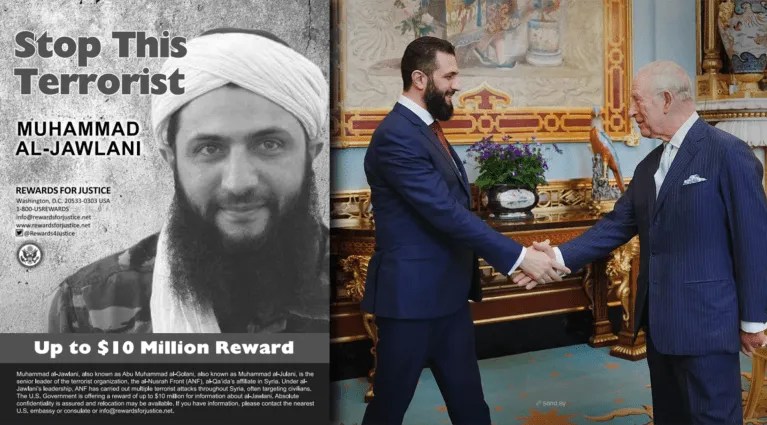
By Kit Klarenberg | The Grayzone | April 3, 2026
When Syria’s “interim” leader Ahmed al-Sharaa touched down in London on March 31, he was given a much warmer welcome than many once thought possible. As the longtime leader of Syria’s Al-Qaeda branch, the US had been offering a $10 million bounty for information on his location just 15 months prior. Yet here was Al-Sharaa, proudly posing for photo ops with King Charles and Prime Minister Keir Starmer.
British intelligence had been working towards this day for almost two decades. The path for al-Sharaa’s rule was cleared by MI6 after years of mentoring under Jonathan Powell, who now serves as National Security Advisor to Starmer. The time had come for Britain to formally anoint its Syrian puppet.
The ongoing US-Israeli war on Iran, and the Strait of Hormuz’s closure, were reportedly at the top of Starmer and al-Sharaa’s agenda. The British premier praised his counterpart’s supposed success in battling ISIS, while al-Sharaa thanked London for its assistance in pushing for sanctions on Syria’s ruined economy to be lifted. The pair have enjoyed warm relations since al-Sharaa’s seizure of power in December 2024, which Starmer publicly celebrated as a golden opportunity for London to “play a more present and consistent role throughout the region.”
Ever since, the British have systematically steered Damascus’ self-appointed government towards recognition and welcome by Western states. In May 2025, as al-Sharaa’s death squads massacred Alawites and other ethnic and religious minorities, US President Donald Trump received his Syrian counterpart in the oval office, where he gifted him a bottle of Trump-branded cologne. The BBC acknowledged this development would have been “unthinkable just months ago.”
Al-Sharaa took the next steps in January 2026, when he signed an unpopular US-brokered accord with Israel, which former Syrian President Bashar Assad had steadfastly refused to endorse for decades.
The impacts of the deal were immediately visible. As Al-Sharaa’s forces swept through Kurdish territory in north east Syria, the Kurds’ erstwhile Israeli backers refused to intervene, and US envoy Tom Barrack publicly declared that the American partnership with the Kurds had “expired.”
Within weeks, al-Sharaa’s forces wrested control of the country’s wheat and oil-producing areas, which had been under US-led occupation for years. Though Syria and Israel have yet to formally normalize relations, al-Sharaa describes relations between the countries as “good.” Today, Syria’s airspace and ground territory is routinely used by Israel and its Western sponsors to wage war on Iran.
Though the rapid transition took many by surprise, the campaign to re-establish Western control over Syria was actually set in motion years ago.
Starmer’s top advisor also groomed al-Sharaa for power
Among the most important vehicles for grooming the former Syrian Al Qaeda warlord known as Mohammed Jolani into the politician, Ahmad Al-Sharaa, was a supposed conflict resolution NGO known as Inter-Mediate. Founded by Jonathan Powell, a former advisor to PM Tony Blair who helped negotiate the Good Friday accords in Northern Ireland, works closely with the British Foreign Office and MI6.
Powell’s Inter Mediate cultivated al-Sharaa’s militant Hayat Tahrir al-Sham (HTS) faction for power for years before the December 2025 palace coup, and now boasts a dedicated office within the presidential palace in Damascus.
Coincidentally, Powell took up the post as Starmer’s advisor mere days before HTS declared themselves Syria’s government. As a confidant of Tony Blair, Powell was a key figure in the push for the criminal 2003 Anglo-American Iraq invasion, helping shape bogus intelligence claiming that Baghdad posed a biological and chemical weapons threat to justify the illegal intervention.
Despite his role in the destruction of Iraq, British media has reported that Powell “may have more influence over foreign policy than anyone in government after the Prime Minister himself.” Today, Powell is charged with “coordinating all UK foreign policy, security, defence, Europe, and international economic issues.”
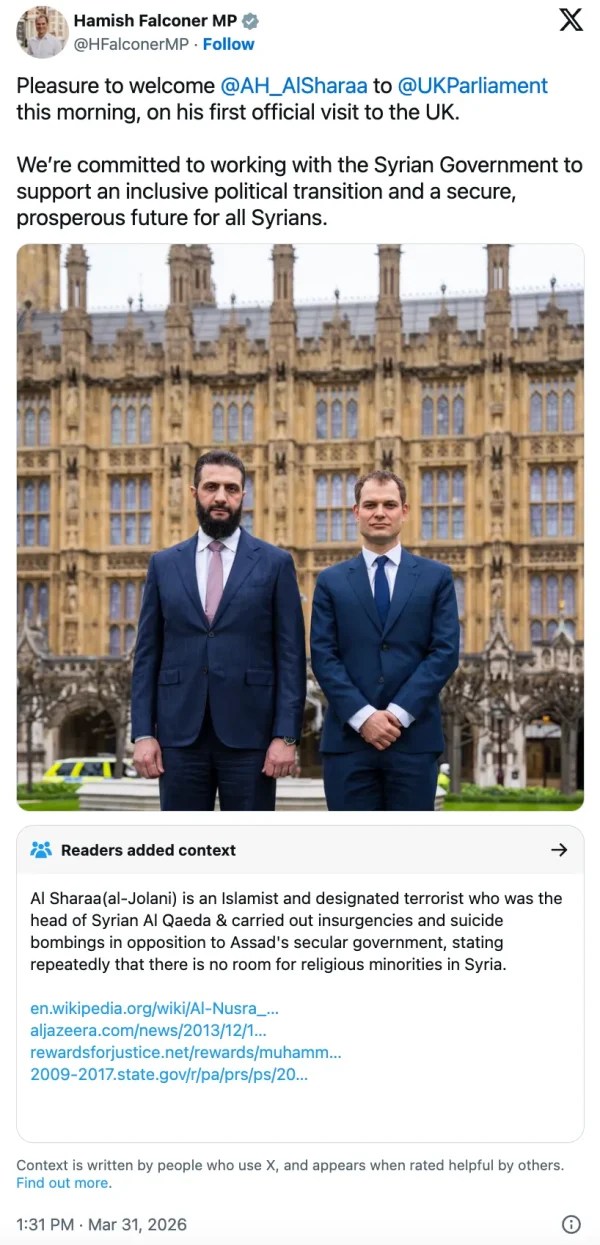
Al-Sharaa was also personally welcomed by Hamish Falconer, an intelligence-aligned Member of Parliament who spent years collaborating with MI6 as the British foreign office’s Terrorism Response Team leader and once served as a hostage negotiator in talks with the Taliban.
Falconer is a close associate of Amil Khan, a British intelligence contractor who worked obsessively to generate sympathetic coverage of HTS while plotting to undermine this outlet due to our critical reporting on Syrian jihadists and their friends in the British government.
Hamish’s father, Charlie Falconer, was a longtime friend and former roommate of former Tony Blair. Following Blair’s May 1997 election victory, Falconer senior was elevated to the unelected House of Lords, then served in a series of high-ranking government posts throughout his pal’s tenure, often coordinating with Jonathan Powell.
While there, the elder Falconer applied “huge pressure” to Attorney General Lord Goldsmith to change his conclusion that invading Iraq was completely illegal. This intervention may have played a decisive role in enabling the illegal war of aggression. Today, it’s been reported that many on Downing Street are “growing increasingly wary about the influence of… smooth Blairites.”
According to one British outlet, top officials in London are purportedly asking, “at what point… does ‘experience’ and ‘guidance’ become ‘control’?” The same question must be asked of MI6’s longstanding links to al-Sharaa.
British intel set up al-Sharaa’s civil apparatus
It is uncertain when British contact with HTS began. But Robert Ford, who served as the US ambassador to Syria from 2011 to 2014, disclosed that in 2023 Inter-Mediate sought his personal assistance in rebranding HTS from “terrorists” into politicians. Ford met repeatedly with al-Sharaa, who reportedly expressed no remorse about the massacres and atrocities he perpetrated in Iraq. Al-Sharaa had served five years in the US military’s notorious Camp Bucca jail for his involvement with Al Qaeda in Mesopotamia. He was released in 2011 – just in time for the Syrian dirty war.
In September 2025, former-MI6 chief Richard Moore admitted Britain’s foreign spying agency had been courting HTS long before its seizure of Damascus. “Having forged a relationship with HTS a year or two before they toppled Bashar, we forged a path for the UK Government to return to the country within weeks” of the fall of Assad, Moore boasted.
British psychological warfare operations and ‘aid’ efforts greatly assisted HTS’ consolidation of power in areas of Syria it occupied. As The Grayzone revealed in the immediate aftermath of Assad’s fall, leaked documents show MI6 was well-aware that reports of the group’s split from Al Qaeda were a fantasy.
Nevertheless, British propaganda efforts portrayed dangerous, chaotic HTS-occupied territory as a “moderate” success story, in order to demonstrate “a credible alternative to the [Assad] regime,” per the leaks. Central to these psy-ops were British-created assets including the Free Syrian Police (FSP) and White Helmets.
Framed by Western media as providing vital humanitarian services to local populations, these ostensibly independent agencies enjoyed fawning coverage in mainstream media. In reality, the pair collaborated closely with extremist groups, including HTS, and were complicit in hideous atrocities.
Whether intentional or not, HTS was “significantly less likely to attack opposition entities… receiving support” from the British government, a UK intelligence contractor stated. The work of the White Helmets and FSP greatly enhanced the terrorist group’s credibility as a governance actor and service provider among Syrians. When HTS took power outright in northwest Syria, the FSP became the territory’s formal police force. Since Assad’s ouster, the White Helmets have been tapped by British intelligence assets to run the country’s emergency services.
Despite al-Sharaa’s refusal to repudiate his extremist past, British diplomats initiated a series of meeting with him and other HTS warlords from December 2024 onwards. The public encounters continued even as legacy media outlets acknowledged these summits were completely illegal, as HTS was a proscribed terror group under British law. Starmer did not formally lift this designation initially, but nonetheless led calls for the removal of sanctions on Syria by all Western countries.
In March 2025, the UK terminated the majority of its Syria sanctions, and the rest of the EU followed shortly. With the revocation of US sanctions in July, Syria had effectively been welcomed back into the fold of the so-called international community.
While London’s man in Damascus appears eager to please Starmer and his counterparts in Western capitals, his sectarian politics remain a source of domestic credibility. In January, al-Sharaa’s forces overran northeastern Syria, and freed many ISIS fighters from Kurdish-run prisons, where MI6 had long-managed covert propaganda operations to influence inhabitants. Many freed ISIS brides reportedly refused repatriation to their home countries, “because their husbands are with” al-Sharaa.
Featured Video

The Search for Truth: Charlie Kirk’s Assassination One Year Later
or go to
Aletho News Archives – Video-Images
From the Archives
The 9/11 “Double-Cross” Conspiracy Theory
BY LAURENT GUYÉNOT • UNZ REVIEW • SEPTEMBER 6, 2022
Is it true that “9/11 was an inside job”? Yes, insofar as Israel is “inside” the U.S. But for the 9/11 truthers who have identified Israel as the main perpetrators, “9/11 was an inside job” is at best a half-truth, and at worst an integral part of the Zionist operation, like a secondary flag sewn as a lining under the false flag of Islamism. Victor Thorn (1963-2017) wrote in his book 9/11 made in Israel: The Plot Against America (2011): “In essence, the ‘9-11 truth movement’ was created prior to Sept. 11, 2001 as a means of suppressing news relating to Israeli complicity. . . . The slogan ‘9-11 was an inside job’ was quite possibly the greatest example of Israeli propaganda ever devised.” In milder terms, it is “controlled opposition”.
A genuine truth movement would have pointed to Israel as the prime suspect from the start. From day one, it was obvious who would benefit. … continue
Blog Roll
 Aletho News
- Europe’s mounting social chaos… chickens coming home to roost for proxy war against Russia
- US-Russia Diesel Deal Becomes Massive Defeat for Ukraine
- Hormuz and the Looming Economic Catastrophe
- Dhubab offensive, media blitz and the rapid unraveling of Saudi-backed coalition’s new gambit
- Putin Conveys to Trump Iran’s Vision on Possible Conflict Resolution – Kremlin
- The Search for Truth: Charlie Kirk’s Assassination One Year Later
- ‘Harsh reality’: Iran says France seeks monopoly on power and intimidation, not peace for all
- When Will This White House Madness End?
- Huckabee aide goes to ‘unusual lengths’ to portray ‘Israel’ positively
- Trump Announces Diesel Supply Deal With Putin Following Phone Call
- If Americans Knew
- Israeli forces kill another child in Gaza – Daily Update
- Gaza ceasefire exists in name only, say more than 100 organizations
- Nearly 2 Million in Gaza Need Urgent Shelter Assistance as Winter Looms: IOM Chief Warns
- Suppressing Palestinian resistance: US charity under fire for AI monitoring of Gaza classrooms
- Thousands Are Held in Israeli Torture Camps. This Is What Happens Inside
- Israel puts Gaza’s sick, injured, newborn in peril – Daily Update
- Report claimed Mark Levin used by Israeli government to influence Trump
- Over 2,000 Gazans have died awaiting medical evacuation amid Israel’s continued siege
- How a U.S. Diplomat Suppressed and Altered Reports Critical of Israel
- 5 Palestinians Die from Israeli Strikes in Gaza as Relentless Attacks Continue
- No Tricks Zone
- New Study: 50 Years Of The Most Aggressive ‘Net Zero’ Policies Can Only Affect The Global Climate By 0.03°C
- US September “Heat” Was No Record…Many Records Set Decades Ago
- Latest European Green Energy Debacle; Portugal’s Largest Flagship Solar Park Insolvent!
- Green Energy Debacle: German Expert Professor Fritz Vahrenholt Warns Of Severe Economic And Social Consequences
- Two More Paleo Reconstructions Affirm Meters-Higher Sea Levels Across Ireland, Brazil 7000-6000 Years Ago
- New Study: Earth And Venus Surface Warmth Largely Explained By Convection And Lapse Rate, Not CO2 Or Radiation
- 2025 Nature Paper Claiming Worsening Global Drought Gets RETRACTED …Heavily Flawed
- New Study: ‘Global Drought Shows No Detectable Recent Acceleration Under Climate Warming’
- Economic Masterminds: German Socialists Suggest Taxing Productivity Gains Stemming From Using AI
- The South China Sea Has Not Been Cooperating With The Climate Change Narrative

