The Rebirth of ISIS, Israel and the Continuation of Syria’s Civil War
By Robert Inlakesh | Palestine Chronicle | December 25, 2025
The chaotic predicament in which Syria now finds itself was, in many ways, predictable, yet this makes it nonetheless tragic. Despite the recent removal of the US’s crushing Caesar Act sanctions, the challenges ahead are so numerous as to render this a minor victory for the country.
In order to begin to understand what is happening inside Syria, we first have to begin to comprehend what happened following the fall of Bashar al-Assad. Although the moment that Hayat Tahrir al-Sham (HTS) entered Damascus, and Ahmed al-Shara’a declared himself leader, was dubbed a liberation of the country, thus interpreted as the end to the nation’s civil war, what had really happened was the birth of a new chapter in the Syrian war.
On December 8, 2024, the Israeli air force saw its opportunity and hatched a long-planned strategy to destroy Syria’s strategic arsenal and occupy key portions of territory in the south of the nation. That day, however, much of the Arabic language world’s media completely ignored the historic event and refused to cover its ramifications.
Another key point was that, beyond Israel’s land grab, the country’s territory still remained divided, as the US-backed Kurdish-led Syrian Democratic Forces (SDF) maintained its control over the northeast of the country. This movement believes that the territory it controls, with Washington’s backing, is called Rojava and is part of the land of Kurdistan.
Türkiye, to the north, views the Kurdish movement as a strategic threat and treats the SDF as an extension of other Kurdish organizations it deems terrorist groups. The majority of the people living inside SDF-controlled territory are Arabs, an issue that can also not be overlooked.
HTS Ascendant and the Collapse of the State
Then we have the HTS government that took over Damascus, which originally pledged to rule for all Syrians and not just the Sunni majority. However, HTS is a rebranding of Jabhat al-Nusra, al-Qaeda’s Syrian offshoot. Understanding this fact is key, because HTS was the de facto government in the territory called Idlib, in northwestern Syria; although a secular leadership was on paper, supposed to be the ruling authority.
In 2018, when Bashar al-Assad’s forces halted their offensive and sent all the armed groups opposing them on “Green Buses” to the Idlib enclave, Ahmed al-Shara’a, who called himself Abu Mohammed al-Jolani at the time, had started to consolidate power. This led to HTS establishing its own prisons and undergoing a process whereby it managed to control various al-Qaeda-affiliated Salafist armed groups inside the territory.
When HTS took Damascus, it did so with a ragtag army composed of militants from dozens of armed groups from inside Idlib, including many former ISIS fighters and others from different groups that were given the options to join forces with HTS, lay down their weapons, or face fierce crackdowns.
The way these crackdowns on dissidents were carried out, along with corruption in the governance of Idlib, even led to protests inside the province against HTS. Many hardline militants had also accused al-Shara’a of providing the US with details on the whereabouts of former ISIS leader Abu Bakr al-Baghdadi.
Keep in mind now that when HTS took over Damascus, they did so without a fight and the former regime simply collapsed in on itself. So here was HTS, now tasked with managing the majority of Syria and had to do so without any army, because the Syrian Arab Army (SAA) had been disbanded.
Many elements of the former government, intelligence, and military under Bashar al-Assad were told they had been granted amnesty, yet forces aligned with HTS, and in some cases those within it, decided to take the law into their own hands through brutal field executions.
This eventually led to a group of former SAA fighters in the coastal region taking up arms against the new HTS security forces, triggering a response from a broad range of sectarian groups and others who were seeking “revenge” in blood feuds. The result was the mass murder of Alawite civilians across the coast.
Israel, the Druze File, and Syria’s External Fronts
Earlier this year, Israel also took advantage of tensions between Syria’s Druze community and sectarian militants aligned with Damascus, backing Druze separatist militias. This had been a strategy that Tel Aviv attempted to implement all the way back in 2013, when Israel began backing some dozen opposition groups, including al-Qaeda- and ISIS-linked militants that were committing massacres against the Druze.
The Syrian Druze population is primarily situated in the Sweida province in southern Syria. Israel long sought to create a Druze rump state there, which would serve as a land bridge to the Euphrates and allow for the total Israeli domination of the south. The Israelis are also allied with the SDF, although not as overtly as the Americans are, meaning that if their strategy works, then they have secured their domination all the way through to the Iraqi border.
This Monday, tensions again flared up between the Syrian forces aligned with Damascus and HTS in eastern Aleppo, with both sides blaming each other for the violence. Periodically, tensions continue to escalate in Sweida, yet come short of the large-scale sectarian battles we saw earlier this year.
Meanwhile, US forces have now expanded their footprint throughout Syria and have taken over more military air bases, even working alongside Damascus as a partner in the “fight against ISIS,” or “Operation Inherent Resolve.”
On December 13, an attack that killed three US servicemembers was blamed on a lone-wolf ISIS fighter. In response, the US then declared it was launching a retaliatory bombing campaign across the country.
The narratives of both Washington and Damascus make little sense, regarding this being a lone-wolf ISIS attack. Instead, the evidence suggests that the attack was carried out by a member of the HTS security forces, but this is perhaps a story for another day.
Now we hear report after report about the rise of ISIS. And while it is certainly true that ISIS is on its way back, even if in a weaker state, the context is never mentioned.
Internal Fractures, ISIS, and an Unstable Future
Not only has the current Syrian administration managed to play right into Israel’s hands with the management of the situation in Sweida, set up a shadow governance model that is even more corrupt than the previous regime, while isolating all of Syria’s minority communities in one way or another, but it has also effectively turned many of its own allies against it.
There is no actual “Syrian Army” to be spoken of right now, at least there isn’t one that is professionally trained or big enough to handle any major war. Instead, the Syrian state will rely on its allies, like major tribes and a range of militant groups. However, as time goes on, more and more of HTS’s allies and even many who now fill the ranks of its own security forces are growing tired of the government’s antics.
A large component of their anger comes from issues concerning tight Syrian relations with the US, leading to the hunting down of Sunni militants across the country, but particularly in and around Idlib. As mentioned above, HTS had integrated many ISIS fighters and those belonging to other hardline Salafist Takfiri fighting groups, but many of these militants have never been willing to sacrifice their core beliefs for a secular state.
For years, the man they knew as Jolani had preached against the United States and Israel, yet, after taking power, he began cozying up with them and targeting Sunni militants alongside the US military. In addition to this, the large number of foreign fighters inside the country have not been granted citizenship and feel as if their futures are threatened.
In other words, the conditions are ripe for some kind of revolt, and Ahmed al-Shara’a is surrounded by countless threats. If ISIS were to begin gaining traction, there is a good chance many of these fighters, currently allying themselves with the Damascus government, will switch sides. In fact, this is something that has already been happening, although in small numbers and isolated cases.
What we see is a recipe for disaster, one which could explode in any direction, triggering a much larger chain of events in its wake. So far, it appears as if there are four primary threats to the stability of the HTS government. These are the Sweida front, the Israel front, the SDF front, and the potential for an internal insurgency.
Mike Huckabee, the US ambassador to Israel, recently gave an interview during which he commented that Ahmed al-Shara’a “does know that any pathway for stability in Syria, his pathway for survival, is that he has to be able to have peace with Israel.”
It is important to understand that the two most powerful influences on Damascus are Washington and Ankara, yet it is clear that the US has the edge and could quickly overthrow the HTS regime at any time of its choosing.
Türkiye now has enormous influence inside Syria, where it is competing with the Israelis and attempting to set red lines, yet has failed to impose any equations as of yet. Perhaps the only way that the Turkish state could deter the Israelis is through backing a resistance front in the south of the country, yet it is clear that the US will not allow such a scenario to develop.
Even if a rather weak resistance group, or collection of groups, were to be formed and pose little strategic threat to Israel, this could also end up presenting a challenge to the rule of HTS in the long run. This is because such a resistance organization would enjoy enormous popular support and likely encourage other armed actors inside the country to join forces, creating a Lebanon-style system, whereby the forces of the state are incapable of confronting the occupier, and instead a resistance group would handle security.
The United States and Israel would never permit something like this to evolve, likely moving to commit regime change before such a plot is even conceived.
This leaves Ahmed al-Shara’a in an impossible position. He has no confidence in him as a ruler from the country’s minorities, growing anguish amongst the majority Sunni population, and no real army to be spoken of. Instead of resisting the Israelis, as his men and population at large seek, he sends his officials to sit around the table with them, while Syria’s official social media pages publish images of Syria without including the occupied Golan Heights.
Since 1967, most of the Syrian Druze living in the occupied Golan Heights had refused to take Israeli citizenship. After the sectarian bloodshed that occurred earlier this year, these Syrian Druze began applying for Israeli citizenship en masse. This is the impact that the rulers in Damascus have had on their own people; they have pushed Syrians who resisted Israeli citizenship for decades to switch sides, playing right into Tel Aviv’s hands.
Meanwhile, little is being done to reassure the disillusioned militants who had fought alongside HTS and believed they were fighting for a liberation cause and/or Islamic Caliphate, only to realize that they fought for a regime that negotiates with Israel and bows to the White House. Therefore, it is no wonder that when a group like ISIS appeals to them through its propaganda, it manages to convince them to join the organization’s fight.
What’s more is that this outcome was barely difficult to predict; only days after the fall of Bashar al-Assad, militants from Idlib were posting photos on Facebook of themselves holding up pictures of Abu Bakr al-Baghdadi in the Umayyad Mosque, the most important mosque to Sunni Muslims in Syria.
Not only this, while ISIS networks on social media were, in the past, blocked almost instantly, they began popping up in the open on places like Facebook again. This begs the question as to why such obvious ISIS glorification and supporters were permitted to begin operating so openly online during this period.
When it comes to Takfiri Salafist doctrine, whether someone is affiliated with ISIS or al-Qaeda offshoots, they do not simply abandon this ideology overnight because of changing political circumstances.
Now, Takfiri militants idolize a man named Mohammed ibn Abd al-Wahhab, which is why these Salafi groups are often referred to as Wahhabis. Historically speaking, this ideology was the bedrock on which the Saudi family launched their offensives to conquer Arabia, declaring the Ottomans kafir (disbelievers) and justifying their alliance with Britain, against other Muslims, on this basis. Therefore, some may justify the actions of al-Shara’a on the basis of their doctrine, but only to a certain extent.
When HTS began killing fellow Sunni Muslims, alongside the United States and cozying up to individuals responsible for the mass murder of their co-religionists, this started to become a major problem. It could no longer be branded an “alliance with the people of the book,” especially when fellow Salafists were kidnapped and killed by HTS government forces.
Some attention has recently been placed on the comments of the US envoy to Syria, Tom Barrack, who remarked that Syria should not be a democracy and instead a monarchy, even explicitly stating that this plan could include merging Syria with Lebanon. Such a system would certainly please many allies of al-Shara’a, and comments like these could be made in the interest of restoring faith in the leader.
Nonetheless, the current system is still operating on a knife-edge and is far from achieving a monarchy that rules the northern Sham region. In the distance, the Israelis are watching on and simply waiting for the next opportunity to achieve even more of their goals.
This is all because the war in Syria never truly ended; the only thing that changed is that Bashar al-Assad’s government fell, and perhaps if that had occurred during the first years of the war, there wouldn’t have been so many issues.
As is normally the case with human psychology, we seek to frame things in a favorable way to our worldview, meaning that we simply ignore evidence to the contrary. Yet, the case of Syria is really not all that dissimilar from the post-US-backed regime change realities currently existing in Libya, although there are key differences, of course.
So long as Syria remains without an effective resistance front against the Israelis, it will never recover and remain trapped. In Lebanon, it took years before such a resistance force truly took off in the south, and even then, it took decades to expel and then deter the Israelis. Syria is a much more complex picture, which makes predicting outcomes even more difficult.
– Robert Inlakesh is a journalist, writer, and documentary filmmaker. He focuses on the Middle East, specializing in Palestine.
Mali holds firm: West eyes new front to sabotage Sahel independence
By Aidan J. Simardone | The Cradle | November 19, 2025
If you are to believe western media, Mali is days away from falling to Al-Qaeda. Jama’at Nasr al-Islam wal-Muslimin (JNIM), a branch of Al-Qaeda in the Islamic Maghreb, is blockading fuel to the capital, Bamako. It is only a matter of time before growing frustration turns Malians against their “illegitimate” government. Or so the story goes.
The reality tells a different tale. The situation is serious, not only for Mali but also for the broader Alliance of Sahel States, which includes Burkina Faso and Niger. And yet, Mali is recovering. Russia has stepped in, delivering vital fuel shipments. Schools are reopening. Vehicles are back on the road. Towns previously captured by JNIM are being reclaimed.
It is a huge gamble for Russia. But should it succeed, Moscow will have secured a key ally and gained the favor of anti-imperialist countries in Africa. The risk, however, might not come from JNIM. Instead, it could come from a western-supported intervention that seeks not to stop Al-Qaeda, but to destroy the Alliance of Sahel States.
From French client to anti-colonial spearhead
After it gained independence, Mali continued to rely on France. Even its currency, the CFA franc, is pegged to the euro. In school, children were taught French history and learned to speak French. Until recently, France had 2,400 troops stationed as part of its “counterterrorism” operations.
Despite these apparent efforts, groups like JNIM, the Islamic State in the Sahel, and Azawad separatist militias grew. Meanwhile, western corporations profited as Mali became the fourth-largest producer of gold. With this wealth extracted, Mali remained one of the poorest countries in the world.
Bamako’s cooperation with the west did not always curry favor. Its alleged failure to follow the 2015 Algiers Accords with Azawad separatists resulted in the UN Security Council (UNSC) imposing sanctions in 2017. This made little impact, with Mali’s economy continuing to grow.
Yet most Malians were still in poverty, and the security situation worsened. Frustrated, a coup was launched in 2020. But when protests erupted, another coup followed in 2021, led by Assimi Goita, Mali’s current president. Western institutions portrayed it as democratic backsliding, with a military unjustly taking over the country. But the coup was highly popular, with people celebrating. According to a 2024 poll, nine out of 10 people thought the country was moving in the right direction.
President Goita was a radical, anti-colonial, pan-Africanist. In 2022, he kicked French troops out, instead seeking help from Russia. In 2025, Mali withdrew from the Economic Community of West African States (ECOWAS), accusing it of working with western powers. Goita nationalized the gold mines, removed French as Mali’s official language, and replaced school curricula about French history with Bamako’s own rich history.
Western-aligned institutions retaliated with sanctions. ECOWAS, the West African Economic and Monetary Union (WAEMU), and the EU imposed economic penalties. Cut off from financial institutions, Mali defaulted on its debt. But the impact was partly muted.
A few months after sanctions were imposed, the court of the WAEMU ordered that sanctions had to be lifted. Gold mining, which contributes to 10 percent of the economy, saw no impact. Mali shifted its trade to non-ECOWAS countries, and the economy continued to grow.
The West African country redirected trade outside the ECOWAS bloc and resolved its debt in 2024. Far from isolating the country, sanctions strengthened internal solidarity.
Even when ECOWAS lifted sanctions in July 2022 – citing a transition plan to civilian rule – no action was taken when the deadline passed. The reason? The sanctions had backfired, exposing ECOWAS as a western instrument and bolstering support for the Goita government.
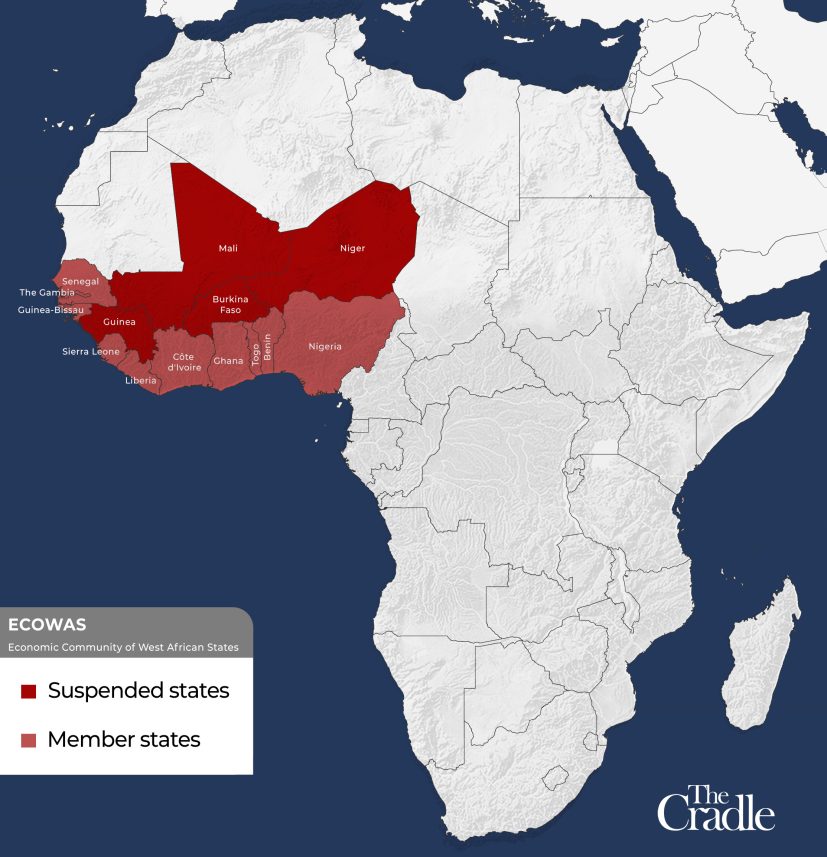
Map of the Economic Community of West African States (ECOWAS)
Sanctions failed, so proxy war begins
JNIM continues to receive financing from Persian Gulf patrons and income from ransoms and extortion. While it has a strong rural presence, it controls no major cities. Azawad separatists and ISIS fighters are similarly confined to Mali’s remote north.
A different strategy was needed. In recent weeks, JNIM has attacked fuel trucks, depriving Bamako of oil. Cars were unable to fill up, and schools closed. According to western media, JNIM wants to strangle the capital to promote unrest. Mali has had five coups since independence, three of which have occurred since 2012. News reports suggest that given this history, JNIM can ultimately topple the Malian government.
Reports of an “immediate collapse” are nearly a month old. What Western media fails to understand is that, unlike previous governments in Mali, the current one is highly popular. Truckers are willing to risk their lives to bring fuel to the capital. “If we die, it’s for a good cause,” one trucker said. Even if the blockade were to stop all fuel, Malian’s resilience and support for Goita would only increase.
Thankfully for Bamako, JNIM is facing setbacks. Russia, which provides support from the Africa Corps (formerly Wagner Group) and, in 2023, vetoed the UNSC’s sanctions, sent 160,000 and 200,000 metric tons of petroleum and agricultural products. This has provided some relief, with fuel lines shortening and schools reopening.
On 15 November, Mali and the African Corps seized the Intahaka mine. The next day, the town of Loulouni was also recaptured. That same day, the blockade south of Bamako was weakened, allowing convoys of fuel trucks to reach the city.
Manufacturing consent for intervention
So why does the western media continue insisting that Mali is collapsing? Simple: to justify military intervention.
One of the biggest propagandists has been France. In a post on X from the French Ministry for Europe and Foreign Affairs, Paris blamed Russia for abandoning Mali, despite being one of the only nations supporting it during this crisis. French news channels LCI and TF1 ran stories such as “Mali, the Jihadists at the gates of Bamako” and “Mali, the new stronghold of Al-Qaeda.”
In response, Bamako banned them from the country. Niger has also accused Benin of being a base of operations for France. French state media, France 24, did not deny the claim, only disputing that the number of soldiers was far less than Niger claimed.
France stands to regain a significant geopolitical advantage from regime change in Mali. The country borders seven former French colonies. A return would reassert French regional influence and weaken the anti-imperialist Alliance of Sahel States. Niger remains crucial to France’s uranium supply, which is necessary for 70 percent of the country’s energy. Bamako is also quickly becoming a major exporter of lithium – essential for electronics and electric cars – with the recent opening of its second mine.
Other western countries have also lost out under Goita’s rule. Canadian company Barrick Mining lost $1 billion when Mali nationalized the mining industry. Last month, other western firms, such as Harmony Gold, IAMGOLD, Cora Gold, and Resolute Mining, had their mining exploration licenses revoked.
The growing Russia–Mali partnership resembles Moscow’s 2015 intervention in Syria. Just as Russia propped up Damascus for as long as it could from a US-led proxy war, it now shores up Bamako. The payoff could be similarly strategic: diplomatic support, military basing rights, and influence in an emerging multipolar Africa.
Unlike past interventions cloaked as counterterrorism, the west now appears reluctant. Washington and its allies, usually quick to bomb under any pretext, have done nothing to aid Bamako. This silence suggests either tacit support for JNIM or confidence that Mali will implode without direct action.
Outsourcing war
As a member of the Alliance of Sahel States, the west fears that Mali’s resilience will be an inspiration to others to join the anti-imperialist struggle. The 2021 coup emerged as a result of inequality and insecurity. These factors can be found in many other West African countries such as Benin, the Ivory Coast, and Togo.
Some observers theorize that Africa’s most populous country, Nigeria, could soon have a revolution, amid high inequality and insecurity from Boko Haram. Nigeria’s growing ties with Mali are a serious threat to the west.
With sanctions failing to bring Mali to its knees, the only solution for the west is military intervention. This might be direct, as seen with Niger, where French troops are stationed in bordering Benin. But more likely, western countries will outsource their intervention to African states. This has occurred in Somalia, where the US has Kenya and Uganda do its dirty work in return for aid. The same could occur with Mali.
The most likely actors to play this role are ECOWAS and the African Union. ECOWAS receives military training from the US, and many of its leaders are closely tied to Washington. It also receives extensive financing from the EU, most recently receiving €110 million ($119 million) to support “peace, trade, and governance.” Far from neutral, it has become an enforcement arm for western interests. The bloc has previously sanctioned Mali and, in 2023, threatened to invade Niger.
The African Union has also served the interests of the west, such as the African Union Mission to Somalia, which is supported and financed by Washington and Brussels. The African Union Constitutive Act prohibits military intervention in any member state, with the exception of war crimes or at the request of the state.
Mali, however, was suspended from the African Union in 2021, making intervention fully legal under the Act. Chairperson of the African Union Commission, Mahmoud Ali Youssouf, recently called for “urgent international Action as crisis escalates in Mali.”
Bamako versus the empire
Mali faces a two-pronged assault: economic strangulation and the threat of foreign-backed military intervention.
Though JNIM remains a nuisance, it has failed to topple the government. The bigger threat comes from western capitals and their African proxies. Russia remains one of Mali’s few reliable allies. If successful, Moscow’s support will elevate its standing across the continent.
More importantly, Mali’s endurance will inspire other African states to challenge western domination and reclaim sovereignty.
Syria pledges to hand over hundreds of Uyghur militants to China: Report
The Cradle | November 17, 2025
The Syrian government plans to hand over Uyghur foreign fighters within its security forces to China, AFP reported on 17 November, ahead of Syrian Foreign Minister Asaad al-Shaibani’s first visit to Beijing.
The issue of the extremist foreign fighters from China’s majority Muslim Xinjiang province was expected to be on the agenda for Shaibani’s meeting with Chinese officials, a Syrian government source told AFP on condition of anonymity.
“Based on China’s request, Damascus intends to hand over the fighters in batches,” the source stated.
A Syrian diplomatic source elaborated further, telling AFP that “Syria intends to hand over 400 Uyghur fighters to China in the coming period.”
Shaibani became foreign minister after the group he helped found, Hayat Tahrir al-Sham (HTS), took power in Damascus in December of last year with help from the Turkiye, Israel, and the US.
Large numbers of extremist Muslim fighters traveled from Europe, Arab countries, Turkiye, and China to assist HTS, the former Al-Qaeda affiliate, to topple the government of former Syrian president Bashar al-Assad.
The CIA-led operation to topple Assad, known as Timber Sycamore, began in 2011. The effort involved sparking anti-government protests and flooding Syria with heavily armed and well-funded militants from Al-Qaeda and the Islamic State of Iraq (ISI).
Fighters from the Uyghur religious minority belong to the Turkistan Islamic Party (TIP), a group that aims to establish an Islamic state spanning Xinjiang and other parts of Central Asia.
After coming to Syria with the help of Turkish intelligence, the group helped HTS (formerly the Nusra Front) conquer Idlib governorate in northwest Syria in 2015.
In 2017, Syria’s ambassador to China said that between 4,000 and 5,000 Uyghurs were fighting in the country.
Uyghur fighters often took over homes of Christians and Druze, who were ethnically cleansed from Idlib, which became the base from which HTS launched its campaign to topple Assad last year.
The new Syrian army gave a prominent Uyghur militant from TIP a high-ranking position as brigadier general, while also integrating thousands of the group’s fighters.
The Chinese government has for years expressed concern about the TIP’s presence in Syria. On 31 December, a Chinese Foreign Ministry spokesperson called on all countries to “recognize the violent nature” of the TIP and “crack down on it.”
Western governments and rights groups claim that the Chinese government is repressing the Uyghur Muslims in China, including imprisoning large numbers in internment camps and prisons.
Syria’s HTS deploys foreign fighters to Lebanon border: Report
Press TV – November 13, 2025
Hayat Tahrir al-Sham (HTS) has reportedly deployed foreign Takfiri fighters from northern Syria to the border with Lebanon, sparking renewed concern over the group’s destabilizing activities and growing presence in the region.
According to sources cited by The Cradle, foreign militants affiliated with HTS were transferred in recent days from the Harem area in Idlib province to the city of al-Qusayr, near the Syrian–Lebanese border.
The movement reportedly coincided with the transfer of heavy military equipment, including armored vehicles and other hardware.
“At the same time, forces affiliated with the Ministry of Defense of the ‘Syrian Transitional Government’ attempted to advance and take positions inside Lebanese territory, specifically in the Wadi al-Thalajat area of Ras al-Maara, along the Syrian–Lebanese border in the Damascus countryside,” the sources said, referring to barren areas where the Lebanese army is not present.
These reports emerge shortly after Washington announced Syria’s participation in the US occupying coalition in the Arab country, as Abu Mohammed al-Jolani — once affiliated with al-Qaeda and Daesh — arrived in Washington on Sunday.
The HTS military remains deeply infiltrated by extremist elements. Many of its current commanders and officers are known former members of al-Qaeda and Daesh factions.
The reported buildup of HTS-linked forces near Lebanon coincides with renewed US threats that such militias could be deployed against Hezbollah.
On Friday, US envoy Tom Barrack said that “Damascus will now actively assist us in confronting and dismantling the remnants of ISIS, the IRGC (Islamic Revolution Guards Corps), Hamas, Hezbollah, and other terrorist networks, and will stand as a committed partner in the global effort to secure peace.”
Analysts warn that the alignment of US policy with extremist-leaning Syrian factions such as HTS risks reigniting cross-border violence and undermining the security achieved by Hezbollah and the Lebanese Armed Forces after expelling Daesh and al-Qaeda elements from Lebanon’s eastern border in 2017.
Jolani told the Washington Post in an interview that “good” progress has been made in direct talks to reach an agreement with Israel, while boasting about weakening the Axis of Resistance on behalf of Tel Aviv.
“Israel has always claimed that it has concerns about Syria because it is afraid of the threats that the Iranian militias and Hezbollah represent. We are the ones who expelled those forces out of Syria,” he said.
“The US is with us in these negotiations, and so many international parties support our perspective in this regard. Today, we found that Mr. Trump supports our perspective as well, and he will push as quickly as possible in order to reach a solution for this,” he added.
Jolani also met with US-based Syrian rabbi Yosef Hamra.
Hebrew reports have revealed that a main part of the agreement will likely involve HTS–Israeli intelligence sharing and cooperation against the Axis of Resistance, specifically Iran and Hezbollah – which helped the former government recapture large swathes of Syria from al-Qaeda and Deash.
Israel carried out heavy strikes in Damascus and elsewhere in southern Syria earlier this year, under the pretext of protecting the Druze minority from Jolani’s extremist forces.
Now, it continues to carry out incursions, seize territory, and expand the occupation it established after the fall of former Syrian president Bashar al-Assad’s government last year.
Yet Jolani and other HTS officials have repeatedly signaled that they pose no threat to Tel Aviv.
The deployment of Takfiri fighters along the Lebanese border serves as a pretext for confronting resistance groups and advancing Israeli interests, coming as Israel continues its repeated acts of aggression across Syrian territory following the collapse of former President Bashar al-Assad’s government late last year.
Analysts are asking why al-Jolani does not deploy any forces against Israel, which continues to attack and occupy parts of Syria almost daily.
The HTS-led regime will reportedly hand over the occupied Golan Heights to Israel as part of a looming normalization deal with the illegal entity.
Since taking power, HTS has committed widespread war crimes and brutal repression, particularly against minority communities such as the Alawites, who have faced targeted violence, as Syria has experienced waves of sectarian and regional unrest under the group’s control.
US envoy says Syria will ‘actively assist’ Washington in confronting Hezbollah
The Cradle | November 13, 2025
US envoy Tom Barrack said on 13 November that the extremist-led government in Damascus will “actively assist” Washington and Tel Aviv in confronting Hezbollah in Lebanon.
“I had the profound honor of accompanying Syrian President Ahmad al-Sharaa to the White House, where he became the first Syrian Head of State ever to visit since Syria gained its independence in 1946,” Barrack said on X.
He also hailed the former Al-Qaeda chief’s “commitment” to joining Washington’s ‘anti-ISIS’ coalition, “marking Syria’s transition from a source of terrorism to a counterterrorism partner – a commitment to rebuild, to cooperate, and to contribute to the stability of an entire region.”
“Damascus will now actively assist us in confronting and dismantling the remnants of ISIS, the IRGC, Hamas, Hezbollah, and other terrorist networks, and will stand as a committed partner in the global effort to secure peace,” the envoy added.
Barrack’s comments are the latest in a series of recent threats made by the envoy against Lebanon.
He had said just last month that Lebanon would soon face a broad Israeli campaign unless it moved to fully disarm Hezbollah immediately.
Since then, Israel has killed at least 44 Lebanese people.
Lebanon’s army has been dismantling Hezbollah infrastructure south of the Litani River since the start of this year, in line with the November 2024 ceasefire agreement, which Israel has violated every day for the past year.
But Tel Aviv claims Hezbollah is rearming and rebuilding its presence faster than the Lebanese army is dismantling, threatening escalation and vowing not to withdraw its forces occupying south Lebanon until the resistance surrenders all its arms.
Washington has publicly backed Tel Aviv’s position.
Barrack’s comments on Friday were not his first threats of Syrian military action against Lebanon. In July, he said Syria views Lebanon as its “beach resort” and would carry out an assault against the country unless Hezbollah disarmed.
Clashes broke out between the Lebanese army and Syrian troops earlier this year, after Damascus’s forces advanced against the border under the pretext of dealing with smuggling.
The fighting ended after talks between Beirut and Damascus.
The envoy’s new threat came just two days after former Al-Qaeda chief and self-appointed Syrian President Ahmad al-Sharaa boasted to the Washington Post about the help his extremist forces have given Israel.
“Israel has always claimed that it has concerns about Syria because it is afraid of the threats that the Iranian militias and [Lebanon’s] Hezbollah represent. We are the ones who expelled those forces out of Syria,” he said.
Hezbollah fought in Syria for years alongside the former government, and took part in the recapture of several parts of the country from groups including Al-Qaeda’s Nusra Front, Ahrar al-Sham, and others who were at the time considered the Syrian opposition. The Nusra Front was later rebranded into Hayat Tahrir al-Sham (HTS), the group that toppled former Syrian president Bashar al-Assad’s government in 2024 and now dominates Syria’s Defense Ministry.
The Nusra Front occupied large swathes of the northern and eastern Lebanese border region for years at the start of the Syrian war, and was eventually expelled by Hezbollah and the Lebanese Armed Forces (LAF) in 2017.
The Nusra Front, headed by Sharaa, was responsible for numerous bombings and killings inside Lebanon, including the capital, Beirut.
Direct negotiations have been taking place between Sharaa’s government and Israel over the past several months. In September, Barrack said a Syrian–Israeli security deal was nearly complete.
Hebrew reports have revealed that a main part of the agreement will likely involve Syrian–Israeli intelligence sharing and cooperation against the Axis of Resistance, specifically Iran and Hezbollah.
From Syria to Gaza: Israel’s proxy playbook returns
By Robert Inlakesh | The Cradle | October 21, 2025
With the already violated ceasefire in place, and Israeli occupation forces implementing a phased withdrawal, Gaza remains under siege, this time through Tel Aviv’s use of armed collaborator militias.
Drawing on tactics refined in Syria, these death squads have been unleashed to assassinate resistance figures, sow chaos, and undermine what remains of the Hamas-led administration.
Three proxy groups backed by Tel Aviv have since escalated their military campaigns against Gaza’s security forces and society. These militias of collaborator death squads have been used to stir chaos on direct orders of the Israeli army, seeking to establish bases of control in the portions of the territory that Israel has yet to withdraw from.
Upon the cessation of hostilities between the Israeli military and Palestinian resistance factions, at least 7,000 security personnel affiliated with the Hamas-led civil administration took to the streets of Gaza to establish law and order. Yet, almost immediately, they were confronted with ambushes, and armed clashes broke out in a number of areas of the territory.
In particular, the armed clashes in northern Gaza have received the most attention in the media, with Israeli and a handful of Palestinian Authority (PA) aligned personalities attempting to sell the situation as a “civil war.”
Collaborator militias exploit the Gaza ceasefire
Amid the chaos, the son of senior Hamas leader Bassem Naim was shot in the head by proxy forces. Mohammed Imad Aqel, son of a prominent Qassam Brigades commander, was murdered by members of the Doghmush clan. And Saleh al-Jaafarawi, a prominent journalist, was kidnapped, tortured, and shot dead at point-blank range.
At the beginning of October, in Khan Yunis, the Majayda family reportedly collaborated with Hossam al-Astal under Israeli air cover, launching attacks on security positions – a key example of Tel Aviv’s use of clan structures to advance its proxy war strategy.
Israeli researcher Or Fialkov noted:
“The Majaydeh clan from Khan Yunis – which fought Hamas a week ago – announces it has disarmed. The clan, which received assistance from the Israeli army in airstrikes against Hamas members, said it has handed over its weapons to Hamas. Hamas is settling scores across the strip and showing everyone who is in charge.”
To counter the threat posed by these armed collaborators, Hamas formed two new specialized units. The first, Sahm (Arrow) Forces, is comprised of officers from the civil security services. The second, the Resistance Security Force (Amn al-Muqawamah), includes fighters from Hamas’s military wing, as well as those from the Popular Front for the Liberation of Palestine (PFLP), Palestinian Islamic Jihad (PIJ), Fatah al-Intifada, and other factions.
A senior security source in northern Gaza tells The Cradle that a document containing a hit list was discovered during a raid on a collaborator’s hideout. Although the document itself could not be shared, the source claims it noted that Israel’s “goal is to create chaos, to carry out assassinations, allow for lawlessness, and to fight the resistance through its collaborators.”
This account was reinforced in a KAN News interview, in which the leader of one collaborator militia confirmed that the Israeli army is providing his forces with security support and authorization to operate beyond the so-called Yellow Line. Roughly 54–58 percent of Gaza is still under the occupation army’s control.
US advisors recently informed Axios that Washington is working on an Israeli-backed plan to create pathways for Palestinians opposed to Hamas to live outside of Israel’s Yellow Line. To this effect, the Israeli military is currently marking this line by installing cement blocks and security equipment to demarcate its boundaries.
According to Israel Hayom, the American-Israeli plan seeks to use Gaza reconstruction funds to begin rebuilding hospitals, schools, and homes inside the territory that is jointly controlled by the Israeli army and its ISIS-linked proxy groups.
Under this scheme, Palestinians will be presented with the choice to live under Hamas along the coast or inside the newly constructed areas. It appears as if a proposed multinational military force will also be used to help implement such a model.
Despite this, the collaborator groups currently operating there do not enjoy popular support, and Israel is continuing to demolish the remaining civilian infrastructure located there. Meanwhile, all the major families, segments of whom began fighting Gaza’s security forces, have issued statements aligning themselves with Hamas and against any collaborators in their midst.
The Ramallah-based PA has also expressed its interest in vying for power in the Gaza Strip, yet Israel has at least publicly rejected this idea over fears that this will put it in a stronger position to demand a Palestinian State. Nevertheless, the PA has been part of a propaganda campaign designed to delegitimize Hamas as a political entity in Gaza and accuses it of indiscriminately targeting its opponents.
Tel Aviv retools death squads as ‘Popular Forces’
Throughout the two-year Israeli war on Gaza, humanitarian aid convoys were routinely looted in the southern enclave, triggering food shortages and creating a booming black market. The looting initially involved armed clans and petty criminals who charged extortionate bribes for aid access. But following the 6 May invasion of Rafah, the phenomenon transformed into a more coordinated enterprise.
That evolution gave rise to the Abu Shabab militia, a gang led by convicted drug trafficker Yasser Abu Shabab, who has long-standing links to ISIS affiliates in Sinai. His fighters, many from the Bedouin Tarabin clan, have ties stretching from Israeli-occupied Bir al-Saba (Beersheba) to Egypt’s Sinai Peninsula.
A Hamas official familiar with the file on drug trafficking tells The Cradle:
“These individuals were known to routinely cross into the Sinai and maintained close ties to extremists. These criminal elements were also tied to the Ansar Bait al-Maqdis group [ISIS in the Sinai] and later Wilayat Sinai that came after it. These people do not have a coherent ideology and will shift over time, they are criminals, which is why they are also involved in activities like drug smuggling, and their connections come through familial ties.”
Following the surface of footage of these militants driving around in SUVs bearing Sharjah license plates registered in the UAE, sources belonging to Al-Akhbar claimed that Emirati intelligence has been cooperating with these militia forces.
A month prior to the introduction of the Abu Shabab aid looting gang to the scene, Israel’s top human rights group B’Tselem had issued a report accusing Tel Aviv of “manufacturing famine” in the enclave. A later investigation conducted by Sky News revealed that while most Palestinians were suffering a severe food shortage, the Abu Shabab gangs were living a life of luxury, with an abundance of stolen aid, along with vehicles and weapons supplied by Israel.
This group, despite becoming infamous throughout Gaza for stealing aid from humanitarian organizations, demanding a $4,000 bribe fee for each truck, was soon to be destined for a task much more pernicious.
In November 2024, the Israelis saw that it was time to give their aid looting cadres a facelift, as the Washington Post interviewed Yasser Abu Shabab himself, who is portrayed as a criminal by necessity and claims that “Hamas has left us with nothing.”
Amid the January ceasefire, the gang resurfaced as the “Popular Forces,” now dressed in Israeli tactical gear and openly operating with occupation military backing.
The Wall Street Journal even published an op-ed supposedly authored by Abu Shabab titled “Gazans are finished with Hamas.” Local sources confirm to The Cradle that the militia leader is illiterate and could not have authored a piece in Arabic, let alone English.
By June, former Israeli minister Avigdor Lieberman publicly accused Israeli Prime Minister Benjamin Netanyahu of backing ISIS-linked militias in Gaza. Netanyahu not only confirmed the collaboration – but defended it. Then, in September, Haaretz reported that Popular Forces militias were receiving direct orders from the Israeli army and Shin Bet.
Israel’s proxy model expands across Gaza’s clans
As the Israeli military was experiencing a manpower crisis, recently struggling to recruit 60,000 soldiers for operation “Gideon’s Chariots 2” to occupy Gaza City, it made the decision to expand this proxy militia strategy.
In August, Israel worked alongside Hossam al-Astal, a former member of the PA’s Preventive Security Forces (PSF), to form the “Counterterrorism Strike Force” (CSF) that would run operations in the Khan Yunis area of Gaza. Astal, according to two security sources speaking to The Cradle, had long been suspected of holding ties with the Israeli Shin Bet.
Alongside the CSF, new groups like the “People’s Army Northern Forces” (PANF) have emerged in Jabalia and Beit Lahia. Led by Ashraf Mansi, who had been openly praised by Abu Shabab. The PANF consists of drug dealers and ex-Jaish al-Islam fighters, some linked to ISIS. The group even held an armed parade after the ceasefire, before engaging in clashes with Gaza’s Radaa security unit, which captured several of its fighters.
In Gaza City, the Doghmush clan launched a violent campaign to assert control over parts of the north. It raided civilian homes, looted properties, and allegedly murdered prominent figures. After the killing of journalist Saleh al-Jaafarawi, Hamas cracked down, arresting dozens and killing up to 40 armed members of the clan.
The family has long developed a negative image throughout Gaza, due to actions committed by certain elements within it, dating back decades to before the Intifada, when individuals from the Doghmush family would steal cars from Israeli-held territory. The Mukhtar of the clan was assassinated by Israel back in 2023, and according to local reports, groups of men within the family have been arming themselves throughout the war.
Soon after tensions escalated, especially surrounding the murder of Jaafarawi and the clashes that ensued on Sunday, the Doghmush family released a statement disavowing collaborators and “transgressors,” reminding the public of how many members of the clan were killed by Israel. It is still unclear whether the militants from the Doghmush family were working alongside the PANF militia or were operating as a solo force motivated by control of territory.
However, the Doghmush clan represents a more complex case. While certain elements have openly collaborated with Israeli intelligence, others have refused such alliances. The clan is divided, with some fighting Hamas for over two decades, and others remaining within resistance ranks.
Reports have also linked segments of the clan to Dahlan networks and Emirati funding, alongside Salafi militant ties.
Salafist group Jaish al-Islam, once led by Mumtaz Doghmush, was responsible for the 2006 kidnapping of Israeli soldier Gilad Shalit. Initially allied with Hamas, the group later turned against it, pledging allegiance to Al-Qaeda and even kidnapping two Fox News journalists.
Hamas has long battled Salafist militants inside Gaza, including Jund Allah and the Sheikh Omar Hadid Brigade. In 2009, it crushed Jund Allah in Rafah after the group attempted to declare an “Islamic emirate.” By 2015, the Omar Hadid Brigade was dismantled. In 2018, ISIS formally declared war on Hamas.
Today, Israel’s proxy fighters recycle the same Salafi justifications. Popular Forces fighter Ghassan Duhine, for instance, cited ISIS fatwas branding Hamas as apostates who deserve death.
But despite Israeli efforts to fragment Gaza’s internal cohesion, many families and clans have pushed back. The Majayda family has denounced collaborators, as have key members of the Tarabin clan.
“Israel hoped to install these agents to run concentration camps for Palestinians, like they planned in Rafah with the Gaza Humanitarian Foundation,” a senior Hamas official tells The Cradle. “But our people can see through all of these conspiracies.”
While Tel Aviv pretends its military campaign is on pause, the facts on the ground reveal otherwise. Israel has outsourced the next phase of its war to collaborators, criminals, and extremists – executing its war objectives through mercenaries while claiming plausible deniability. It is a page taken straight from its playbook in Syria, now recycled in Gaza with deadly effect.
US envoy says Syria ‘back to our side’ after joint raid with extremist-led govt forces
The Cradle | October 20, 2025
US envoy to Syria Tom Barrack declared on 19 October that Syria and the US are once again allies.
In a post on X, Barrack said, “Syria is back to our side,” following reports of a joint US-Syrian security operation near Damascus, allegedly to detain an ISIS member.
Barrack commented on a post by Qatar-funded analyst Charles Lister claiming that US special forces launched a helicopter-borne raid into the town of Dumayr in the desert northwest of Damascus on 18 October. The operation was carried out in cooperation with Syrian counter-terror units to capture an ISIS operative.
However, the raid raises questions about its authenticity, as the ISIS operative detained during the operation, Ahmed Abdullah al-Badri, was openly living in Dumayr and enjoyed close ties with officials in the current Syrian government, led by self-declared president and former ISIS commander Ahmad al-Sharaa.
Kurdish-Syrian journalist Scharo Maroof reported that Badri had invited the governor of Damascus, Mohammed Amer, to his guest house in September. Maroof pointed to a photo showing Badri walking alongside the governor and his delegation during their visit to Badri’s home.
The Syrian government has carried out several fake raids against ISIS cells since coming to power in December, including after allegedly foiling an ISIS attack on the Sayyida Zaynab Shrine in southern Damascus in January, and following a suicide bombing at the Mar Elias Church in Damascus in June.
It was later revealed that members of Sharaa’s General Security Service (GSS) carried out the suicide attack that killed 25 worshipers and injured 52 more at the church in the Duweila district of Damascus.
The logic behind targeting Christians and blaming the attack on ISIS was explained by a former founder of Al-Qaeda in Syria (Nusra Front), Saleh al‑Hamwi.
While promoting the narrative that ISIS was responsible for the Mar Elias attack, he stated on the social media site X that, as a result, “The international community will rally around [the Syrian government], it will receive significant support, and it will join the international coalition against ISIS.”
He added that the government was releasing ISIS leaders from prisons in Idlib and exploiting “the ISIS file internationally in exchange for lifting sanctions.”
The US and Israel have a long history of supporting Al-Qaeda linked groups such as the Nusra Front and ISIS in Syria as part of the CIA-led operation known as Timber Sycamore.
Starting in 2011, the US, Israel, and allied countries sparked anti-government protests in Syria while flooding the country with Al-Qaeda operatives from Iraq and Lebanon, to topple the government of Bashar al-Assad for his anti-Israel foreign policies.
In 2012, Jake Sullivan, advisor to then-secretary of state Hillary Clinton, wrote in a leaked email that “AQ [Al-Qaeda] is on our side in Syria.”
Israeli officials later acknowledged supporting Al-Qaeda groups by paying their salaries, shipping them weapons, and allowing them to cross into Israel for treatment at Israeli hospitals.
The operation was finally successful on 8 December of last year as Assad was toppled and replaced by Sharaa, the head of the Nusra Front (rebranded as Hayat Tahir al-Sham, HTS).
The same day, Israeli Prime Minister Benjamin Netanyahu quickly took credit for Sharaa’s rise, stating that the events in Syria were the “direct result of the blows we have inflicted on Iran and Hezbollah, the main supporters of the Assad regime,” since 7 October 2023.
How MI6 built Syria’s extremist police
By Kit Klarenberg | Al Mayadeen | October 16, 2025
On September 19th, in a speech marking the end of his five-year tenure as MI6 chief, Richard Moore hailed the achievements of Britain’s foreign spying agency under his watch. Key among the stated gains was “the end of 53 years of the Assads in Syria.” He openly admitted MI6 “forged a relationship” with HTS, Damascus’ Al-Qaeda and ISIS-tied presumptive rulers – “a year or two before they toppled Bashar.” Moore went on to boast:
“Syria is a good example of where, if you can get ahead of events, it really helps when they suddenly, unexpectedly move at a faster pace. This nimbleness is a fundamental requirement for MI6 – and I think we remain pretty good at it. John Ratcliffe, the CIA director, while discussing a piece of joint business, said to me recently: ‘You guys can really hustle.’”
Al Mayadeen English has previously exposed how HTS was groomed for power for years prior to its violent palace coup in December 2024 by Inter-Mediate, an MI6-adjacent consulting firm run by Jonathan Powell. A key architect of the criminal 2003 Anglo-American Iraq invasion, he now serves as British Prime Minister Keir Starmer’s national security adviser, coincidentally taking up the position mere days before HTS illegitimately proclaimed themselves Syria’s government. It’s been subsequently revealed that Inter-Mediate has maintained a dedicated office in Syria’s Presidential Palace ever since.
Moore’s fresh admissions, while vague, offer further confirmation that London’s foreign spying agency has a longstanding relationship with HTS, which remains a proscribed terrorist group under British law. A key, confirmed mechanism by which MI6 entrenched HTS’ power in north west Syria over the years before the extremist group’s seizure of power was by financing and managing, via cutouts, “moderate opposition service provision”. This took the form of entities including the infamous White Helmets, which supposedly provided “demonstrations of a credible alternative” to Bashar Assad’s government.
While the clandestine efforts were ostensibly intended to weaken HTS’ hold on power and push “moderate” groups, leaked documents indicate British spooks were well-aware these initiatives were cementing the group’s credibility as a governance actor, assisting its “growing influence”, and meant many Syrians regarded HTS as “synonymous with opposition to Assad.” Eerily, the same documents note the group and its armed affiliates – including Al-Qaeda – were “less likely to attack opposition entities that are receiving support” from British intelligence, such as the White Helmets.
We are now left to ponder whether British-run “service providers” were explicitly left alone because of MI6’s secret relationship with HTS. In this context, the earliest and most obvious indication of a dark alliance between London and Syria’s new rulers may date back to January 2019, when HTS took power outright in north west Syria. Almost instantly, the Free Syrian Police, a British-created “moderate opposition service” provider, was formally dissolved. Its members were then invited to continue their activities under HTS’ banner.
‘Revolutionary Entities’
Like the White Helmets, the FSP were components of a wider effort by London to establish a series of statelets across occupied Syria, complete with parallel governance structures staffed by locals trained and funded by Britain, the EU, and US. Western propaganda and media reporting – heavily influenced by MI6 – universally portrayed these breakaway colonies as “moderate” success stories. In reality, they were deeply chaotic and dangerous, run by murderous violent factions, often under obscenely strict interpretations of Sharia Law.
In March 2017, the BBC published a fawning profile of the FSP, noting its British funding, and claiming the group “demonstrates to Syrians that it is not necessary to carry weapons in order to administer law and order in the country.” The British state broadcaster repeatedly stressed, the FSP “does not co-operate with extremist groups.” However, nine months later, it was revealed that London’s “moderate” police force enjoyed intimate relationships with multiple extremist groups, including HTS forerunner Jabhat al-Nusra.
Several FSP stations were found to be closely linked to and take directions from extremist courts run by these militants, which executed citizens who violated local extremist legal codes. FSP operatives were also not only present when women were stoned to death for disobeying al-Nusra’s extreme codes, but even closed roads to allow executions to take place. Meanwhile, portions of sums sent to the FSP by its foreign sponsors were regularly handed over to extremist factions for “military and security support”.
While these disclosures caused a scandal, and British funding for the FSP was temporarily suspended, it was reinstated within mere weeks, sparking outcry among aid experts. Officials justified their decision on unstated “mitigating context” to the revelations, and the issues in question being “already known” by the Foreign Office. Indeed, leaked documents reviewed by Al Mayadeen English indicate close collaboration with extremist groups and courts was hardwired into the FSP from the group’s inception, and not concealed from donors.
The documents, submitted to the Foreign Office by ARK – founded by MI6 veteran Alistair Harris – noted the FSP were “revolutionary entities who share a general ideological affinity with the Syrian rebels,” conducting “rudimentary policing operations” in opposition-controlled territory. FSP stations varied significantly “in terms of their effectiveness, their mandate and their overall level of organisation” in the areas comprising their beat. “Their authority” was dependent on “several factors, the most important of which” were:
“The strength of the relationship between an FSP station and local armed groups; the centrality of an FSP station in the work of a local rebel court or other judicial structure; the sophistication and maturity of an FSP station’s overarching command structure.”
‘Direct Engagement’
The leaks further state, “FSP networks enjoy the strongest relations with more moderate Syrian rebel groups.” Yet, chief among “key armed groups that have established relationships with FSP stations” was Nur al-Din al-Zinki. The group was said to have greatly “empowered” FSP offices across occupied Aleppo, establishing the force “as primary policing bodies in towns in which it is strong.” In reality, Nur al-Din al-Zinki didn’t adhere to any meaningful definition of the term “moderate”.
During the initial years of the foreign-fomented Syrian civil war, the group committed countless horrendous atrocities, including beheading a Palestinian teenager in 2016. Its fighters subsequently joined HTS en masse. The readiness of ARK – and by extension British intelligence – to rub shoulders with dangerous armed elements is writ large in another leaked file, outlining potential risks to the project. If “armed actors” denied the FSP “operating space”, ARK would conduct “direct engagement” with the relevant militants to resolve the issue.
Other hazards included almost inevitable submission of “fraudulent invoices” by FSP operatives, and “significant physical risk” to them, “including possible assassination of police or justice actors.” Still, the British were so keen on the project, millions were pumped into the force over many years, with sophisticated communications equipment and vehicles provided. ARK also looked ahead to rebel groups increasing their “influence and territorial reach” in Syria, believing this would “[yield] benefits for the FSP” and expand its sphere of operations.
Fast forward to today, and courtesy of HTS, the British-created FSP is now Syria’s national police force. Ever since Assad’s fall, they have acted accordingly, brutally repressing internal dissent, while standing by as the new government’s militants massacre Alawites and other religious minorities in the country. Just as Inter-Mediate’s office in Damascus’ Presidential palace raises grave questions about the extent of London’s control over HTS, we must ask who all past beneficiaries of “moderate opposition service provision” in the country are truly working for.
As The National reported in February, the White Helmets have been formally invited by Syria’s HTS-run Health Ministry to “run the emergency services countrywide.” The creation of such groups years prior to Assad’s ouster is a palpable example of the ability of “hustlers” in British intelligence to “get ahead of events” in Moore’s phrase, and ensure MI6 has the people, organisations and structures in place to effectively take over countries if and when an enemy government falls.
Syria, Ukraine restore diplomatic ties at UN General Assembly
The Cradle | September 25, 2025
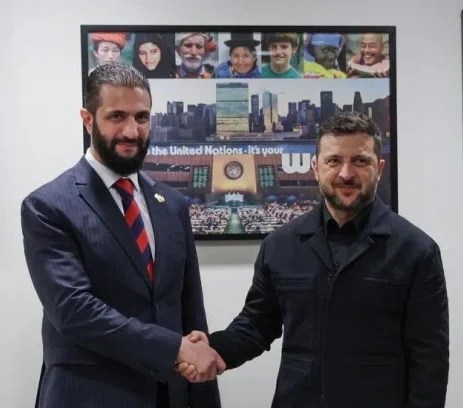
Damascus and Kiev have restored diplomatic ties following a meeting between self-appointed Syrian President Ahmad al-Sharaa and Ukrainian President Volodymyr Zelensky at the UN General Assembly (UNGA).
“We are pleased with this important step and are ready to support the Syrian people on their path to stability,” Zelensky said in a statement on 24 September. “During our negotiations with President Sharaa, we discussed in detail the promising areas for developing cooperation, the security threats facing both countries, and the importance of addressing them. We agreed to build our relations on the basis of mutual respect and trust,” he added.
“His Excellency the President of the Republic, Mr. Ahmad al-Sharaa, met with his Ukrainian counterpart, Mr. Volodymyr Zelensky, in the presence of the Minister of Foreign Affairs and Expatriates, Mr. Asaad Hassan al-Shaibani, and his accompanying delegation, on the sidelines of the 80th session of the United Nations General Assembly in New York,” the Syrian Foreign Ministry said.
Syria’s foreign minister and his Ukrainian counterpart signed a joint declaration on the restoration of ties in the presence of Sharaa and Zelensky.
Sharaa was the former deputy to ISIS leader Abu Bakr al-Baghdadi, before becoming the head of the official Al-Qaeda branch in Syria, the Nusra Front. The Nusra Front was eventually rebranded into Hayat Tahrir al-Sham (HTS), which took control of Syria in December 2024.
Ukraine played a role in the 11-day offensive that resulted in the collapse of former Syrian president Bashar al-Assad’s government.
Two months before Assad’s government fell, Russian media reported that hundreds of Ukrainian experts were training HTS in the use and manufacture of drones.
According to the Washington Post, the Ukrainian government provided HTS with “about 150 first-person-view drones” and at least 20 experienced drone operators in the lead-up to the offensive.
In 2022, Assad recognized the Luhansk People’s Republic and the Donetsk People’s Republic as independent and sovereign states, prompting Zelensky to fully cut diplomatic ties with Syria.
West’s grip slips with Saudi–Pakistan security deal
Riyadh’s pact with Islamabad redraws alliances, weakens Indian leverage, and hints at a new Muslim deterrence framework beyond western control.
By F.M. Shakil | The Cradle | September 23, 2025
On 17 September, Riyadh rolled out the rare royal purple carpet for Pakistani Prime Minister Shehbaz Sharif – an honor previously reserved for global power players like US President Donald Trump.
Accompanying him on the trip was Pakistan’s Army Chief, Field Marshal Asim Munir. His presence highlighted that Riyadh values its defense pact with a nuclear power that, despite economic challenges, remains militarily strong.
Nuclear umbrella over Riyadh
The centerpiece of their visit was the signing of a “Strategic Mutual Defense Agreement” (SMDA), which declares that an attack on either country will be considered an attack on both.
Described by a senior Saudi official to Reuters as covering “all military means,” the pact has triggered speculation that it includes a nuclear umbrella, which would be a game-changing development in the military balance of West Asia.
With 81 percent of Pakistan’s weapon imports coming from China, the agreement implicitly aligns Saudi Arabia with the Chinese military-industrial orbit, whether by design or default. The kingdom has long been reliant on US arms, training, and security guarantees.
The pact was signed just two days after an extraordinary joint session between the Arab League and the Organisation of Islamic Cooperation (OIC) was called, following the 9 September Israeli airstrikes on Qatar – a major non-NATO ally and Gulf neighbor – with no substantial response from Washington, reinforcing perceptions that western security commitments are both selective and expendable.
Mushahid Hussain Syed, a former information minister and chairman of Pakistan’s Senate Defense Committee, tells The Cradle that the US has pivoted away from Arab allies toward Tel Aviv, leaving the region disillusioned and increasingly leaning toward alternatives.
“The strategy of ‘Greater Israel,’ spearheaded by Netanyahu, has involved military actions against five more Muslim nations. Pakistan’s recent triumph against India has demonstrated its capacity to contest Israel’s significant ally, India, and establish itself as a strategic alternative for Gulf nations.”
Toward an Islamic NATO?
Iraqi Prime Minister Mohammed Shia al-Sudani recently called for an Islamic military alliance, akin to NATO, in response to Israel’s airstrike on Doha. His proposal echoed Egypt’s earlier attempt to revive a joint Arab defense force under the 1950 treaty – an initiative blocked by Qatar and the UAE, reportedly under US pressure.
A similar proposal has also come from Islamabad when Pakistan’s Defense Minister, Khawaja Asif, urged Muslim countries to band together in a NATO-like military alliance in light of the Israeli aggression in Doha.
During an appearance on Geo TV last week, Asif drove home the point that a united Muslim military front is essential to tackle common security issues and fend off outside dangers. Asif invoked the wider role of the west in instigating instability in West Asia, emphasizing the intricate network of US support for Al-Qaeda and the CIA’s covert actions that led to Osama bin Laden’s relocation to Sudan or the regime change war in Syria.
Is nuclear deterrence a part of the Pact?
The nuclear dimension of the Riyadh–Islamabad pact remains opaque, but highly significant. While no official statement from either side confirms the presence of a nuclear component, Asif hinted that Pakistan’s nuclear capabilities could be shared with Saudi Arabia as part of the agreement.
Syed, however, clarifies to The Cradle that Pakistan’s nuclear doctrine is India-centric and that its deterrence posture is South Asia-specific and does not extend to the Persian Gulf.
“A novel security framework for the region appears to be taking shape, focusing on Global South nations such as Pakistan and Saudi Arabia, whereas the Indo-Israeli Axis, previously supported by the US, now finds itself significantly diminished.”
The defense agreement between Pakistan and Saudi Arabia, he says, represents a notable achievement for Pakistan, establishing it as a pivotal entity within the geopolitical framework of West Asia, particularly among Muslim countries.
“The agreement is shaped by three significant elements: the perceived neglect of Arab allies by the United States, Israel’s proactive maneuvers in areas such as Iran, Qatar, Lebanon, Syria, and Yemen, and Pakistan’s recent triumph over India in May.”
New Delhi, Tel Aviv on alert
Foreign media and analysts are already warning that the pact may have unintended consequences for India and Israel, despite claims that it targets neither. Others predict that this pact is really about Riyadh’s ambitions to counter Iran and Yemen’s Ansarallah-led government in the region.
Dr Abdul Rauf Iqbal, a senior research scholar at the Institute for Strategic Studies, Research and Analysis (ISSRA) at Islamabad’s National Defence University (NDU), tells The Cradle that New Delhi views the pact with unease as it formalizes Saudi–Pakistani security ties that could entangle Riyadh in South Asian rivalries, especially the India–Pakistan border tensions over Jammu and Kashmir:
“It represents a setback for Prime Minister Modi’s foreign policy, potentially leading to Saudi involvement in a prospective Indo–Pak conflict. Furthermore, future Saudi investments in Pakistan’s Gwadar port and economic corridors would challenge India’s regional influence and initiatives such as the India-Middle East-Europe Corridor (IMEC).”
He adds that Saudi Arabia’s pivot toward Pakistan reflects a broader alignment of Muslim powers and could push Tel Aviv to recalibrate its war on Gaza. It also pressures Tel Aviv by placing Pakistan – a vocal opponent of Israeli expansionism – into West Asian affairs.
“This agreement is not meant to counterbalance Iran’s regional influence, but rather to promote the Saudi Iranian reconciliation, as Pakistan maintains friendly relations with both nations. By formalizing ties with nuclear-armed Pakistan, Riyadh secures a credible deterrent as US security guarantees weaken. While western think tanks view it as an effort to contain Iran, the Arab world emphasizes it as strengthening Gulf deterrence independently of Washington.”
Indian concerns also stem from fears that the pact’s NATO-style clause could complicate ongoing operations like Sindoor, which remains active in a limited capacity following the skirmish between the two nuclear powers in May, especially given that the Gulf states’ swift mediation to resolve the crisis reflects their own interests with India and makes any military action against it unlikely.
Secondly, India is strategically analyzing Pakistan’s nuclear capability, which could see a boost if Saudi Arabia, having no such capacity, begins channeling funds to share Pakistan’s nuclear assets.
A post-western Gulf order?
While Tel Aviv and New Delhi remain publicly silent, both capitals are undoubtedly scrutinizing the fallout. Israel’s failed assassination attempt on Hamas leaders in Qatar, and India’s pressure campaign along the Line of Control, suggest that the axis is nervous about the consequences of a Saudi–Pakistani alliance. Israeli media downplayed the Saudi–Pakistan defense deal, seeing it as a show of force after Riyadh failed to influence Trump or West Asian policy.
As Syed notes, “The traditional ‘Oil for Security’ framework, which once defined US relations with the Middle East [West Asia], now serves as a remnant of a bygone era. As Saudi economic power increasingly reinforces China’s backing of Pakistan, India may feel vulnerable and isolated.”
Mark Kinra, an Indian geopolitical analyst with a focus on Pakistan and Balochistan, tells The Cradle that this development holds particular significance for India. New Delhi, he argues, has sustained robust economic and diplomatic ties with Saudi Arabia for many years, and the influx of Saudi investments in India continues to expand:
“India will be meticulously observing the progression of this agreement, particularly given that its specific terms are not publicly available. Any alteration in the regional security equilibrium may influence India’s strategic assessments, energy security, and diplomatic relations.”
As Washington’s selective security guarantees falter and Israel escalates unchecked, Persian Gulf states like Saudi Arabia are looking eastward for credible deterrents and strategic autonomy.
By aligning with nuclear-armed Pakistan, Riyadh is asserting greater independence from the western military order. It also signals the emergence of a multipolar Persian Gulf security architecture –one increasingly shaped by Global South coordination, not western diktats.
The CIA, Mossad, and Epstein: Unraveling the Intelligence Ties of the Maxwell Family
By Alan Macleod | MintPress News | August 22, 2025
With speculation mounting that Trump could pardon her, MintPress profiles the family of convicted sex trafficker Ghislaine Maxwell. From her media baron father, who acted as a high-level spy for Israel, her sister, working to push Tel Aviv’s interests in Silicon Valley, her brothers, who founded a dubious but highly influential anti-Islamic extremism think tank, and nephews in influential roles at the State Department and White House, the Maxwell clan have wide-ranging ties to U.S. and Israeli state power. This is their story.
Releasing Ghislaine, Burying the Epstein Files
Speculation is growing that Ghislaine Maxwell could soon be freed. Despite campaigning on the promise to release the Epstein Files, there are increasing signs that the Trump administration is considering pardoning the world’s most notorious convicted sex trafficker.
Last month, Trump (who contemplated the idea in his first term in office) repeatedly refused to rule out a pardon, stating to journalists that “I’m allowed to do it.” Just days later, Maxwell was transferred across states to a minimum-security facility in Bryan, Texas—a highly unusual practice. Neither women convicted of sex crimes nor those with more than 10 years remaining on their sentences are generally permitted to be transferred to such facilities. The move sparked equal measures of speculation and outrage.
The decision to relocate Maxwell came after somebody—potentially a source within her team itself—began leaking incriminating and embarrassing evidence linking Trump to Epstein. This included a birthday card Trump sent Epstein, featuring a hand-drawn nude woman, accompanied by the text: “Happy Birthday—and may every day be another wonderful secret.”
For years, Maxwell aided her partner Jeffrey Epstein in trafficking and raping girls and young women, creating a giant sex crime ring in the process. Epstein’s associates included billionaires, scientists, celebrities, and politicians, including President Trump, whom he considered his “closest friend.”
In 2021, two years after Epstein’s mysterious death in a Manhattan prison, Maxwell was found guilty of child sex trafficking offenses and was subsequently sentenced to 20 years in prison.
The news that Trump may soon free such an infamous criminal sent shockwaves through his base and drew charges of blatant corruption from the media. “Is there any reason to pardon Ghislaine Maxwell except to buy her silence?” ran the headline of one article in The Hill. Meanwhile, Tim Hogan, senior Democratic National Committee adviser, denounced what he claimed was a “government cover-up in real time.” “Donald Trump’s FBI, run by loyalist Kash Patel, redacted Trump’s name from the Epstein files—which have still not been released,” he said.
Robert Maxwell: Media Tycoon and Israeli Operative
While many of Ghislaine Maxwell’s crimes have come to light, less well-known are her family’s myriad connections to both the U.S. and Israeli national security states. Chief among these are those of her father, disgraced media baron and early tech entrepreneur, Robert Maxwell.
A Jewish refugee fleeing Hitler’s occupation of his native Czechoslovakia, Maxwell fought for Britain against Germany. After World War II, he used his Czech connections to help funnel arms to the nascent State of Israel, weapons that helped them win the 1948 war and carry out the Nakba, the ethnic cleansing of nearly 800,000 Palestinians.
Maxwell’s biographers, Gordon Thomas and Martin Dillon, write that he was first recruited by Israeli intelligence in the 1960s and began buying up Israeli tech corporations. Israel used these companies and their software to carry out spying and other clandestine operations around the globe.
Maxwell amassed a vast business empire of 350 companies, employing 16,000 people. He owned an array of newspapers, including The New York Daily News, Britain’s Daily Mirror, and Maariv of Israel, in addition to some of the world’s most influential book and scientific publishing houses.
With business power came political power. He was elected to the U.K. parliament in 1964 and counted U.S. Secretary of State Henry Kissinger and Soviet Premier Mikhail Gorbachev among his closest friends.
He used this influence to advance Israeli interests, selling Israeli intelligence-gathering software to Russia, the U.S., the U.K., and many other countries. This software included a secret Israeli backdoor that allowed the Israeli intelligence agency, Mossad, to tap into classified information gathered by governments and intelligence agencies around the world.
At the same time, it was expanding its espionage capabilities, Israel was developing a secret nuclear weapons program. This project was exposed by Israeli peace activist Mordechai Vanunu, who, in 1986, leaked evidence to the British press. Maxwell—one of Britain’s most powerful press barons—spied on Vanunu, passing photographs and other information to the Israeli Embassy—intelligence that led to Vanunu’s international abduction by Mossad, and his subsequent imprisonment.
His death was also surrounded by controversy, similar to Epstein’s. In 1991, his lifeless body was found in the ocean, in what authorities ruled a bizarre accident whereby the tycoon had fallen from his luxury yacht. To this day, his children are split on whether they think he was murdered.
The rumors that Maxwell had, for decades, been acting as an Israeli “superspy” were all but confirmed by the lavish state funeral he received in Jerusalem. His body was interred at the Mount of Olives, one of the holiest sites in Judaism, the spot from which Jesus is said to have ascended to heaven.
Virtually the entirety of elite Israeli society–both government and opposition–attended the event, including no fewer than six living heads of Israeli intelligence organizations. President Chaim Herzog himself performed the eulogy. Also speaking at the event was Prime Minister Yitzhak Shamir, who stated that “Robert Maxwell has done more for Israel than can today be said.”
In the United Kingdom, however, he is remembered less fondly. A man with a fearsome reputation, Maxwell ruled his media business with an iron fist, in a similar vein to Rupert Murdoch (another individual with extremely close links to Israel). After his death, it transpired that he had stolen more than $500 million from his employees’ pension fund to bail out other failing companies in his empire, leaving many of his workforce’s retirement plans in tatters. As the newspaper, The Scotsman, remarked ten years later in 2001:
If [Maxwell] was despised in life, he was hated in death when it emerged he had stolen 440 million [pounds] from the pension fund of Mirror Group Newspapers. He was, officially, the biggest thief in British criminal history.”
Isabel Maxwell: Israel’s Woman in Silicon Valley
Even before it had been published, Isabel Maxwell– Robert’s daughter and Ghislaine’s older sister– managed to obtain a copy of Thomas and Dillon’s biography. She immediately flew to Israel, The Times of London reported, where she showed it to a “family friend” and deputy director of Mossad, David Kimche. These actions did little to beat the book’s central allegation that her father was indeed a high-level Israeli “superspy.”
Isabel has enjoyed a long and successful career in the tech industry. In 1992, along with her twin sister, Christine, she founded a company that developed one of the internet’s first search engines.
After the pension scandal, however, she and her siblings shifted their focus to rebuilding every facet of their father’s collapsed business empire. The sisters sold the search engine, netting enormous profits.
As Israeli outlet Haaretz noted, in 2001, Isabel decided to dedicate her life to advancing the Jewish State’s interests, vowing to “work only on things involving Israel” as she “believes in Israel.” Described by former MintPress journalist and investigative reporter Whitney Webb as “Israel’s back door into Silicon Valley,” she has transformed herself into a key ambassador for the country in the tech world.
“Maxwell created a unique niche for herself in [tech] as a liaison between Israeli companies in the initial development stages and private angel investors in the U.S. At the same time, she helps U.S. companies interested in opening development centers in Israel,” wrote local business newspaper, Globes. “She lives intensively, including innumerable flights back and forth between Tel Aviv and San Francisco,” it added.
Israel is known to be the source of much of the world’s most controversial spyware and hacking tools, used by repressive governments the world over to surveil, harass, and even kill political opponents. This includes the notorious Pegasus software, used by the government of Saudi Arabia to track Washington Post journalist, Jamal Khashoggi, before assassinating him in Türkiye.
Isabel built on her father’s political connections. “My father was most influential in my life. He was a very accomplished man and achieved many of his goals during his life. I learned very much from him and have made many of his ways my own,” she said. This included developing intimate ties to a myriad of Israeli leaders, including Ehud Olmert and Ehud Barak, one of Jeffrey Epstein’s closest associates.
During the 2000s, she was a regular participant at the Herzliya Conference, an annual, closed-door gathering of the West’s most senior political, security and intelligence officials, in addition to being a “technology pioneer” at the World Economic Forum.
She was also placed on the board of the Israeli government-funded Shimon Peres Center for Peace and Innovation and the American Friends of the Yitzhak Rabin Center for Israel Studies, two organizations closely associated with those former Israeli prime ministers.
In 2001, she became the CEO of iCognito, taking the job, in her words, “because it [the company] is in Israel, and because of its technology.” The technology in question was aimed at keeping children safe online—highly ironic, given that her sister was actively trafficking and abusing minors throughout that period.
Isabel was a much more serious and accomplished individual than Ghislaine. As Haaretz noted:
While her younger sister, Ghislaine, makes the gossip columns after breakfasting with Bill Clinton or because of her ties with another close friend, Britain’s Prince Andrew, Isabel wants to show photos taken of herself with the grand mufti of Egypt, or with Bedouin in a tent, or of visits to a Gaza refugee camp.”
In 1997, Isabel was appointed president of the Israeli tech security firm, Commtouch. Thanks to her connections, Commtouch was able to secure investment from many of the most prominent players in Silicon Valley, including Bill Gates, a close associate of both the Maxwell family and Jeffrey Epstein himself.
Christine Maxwell: Funded by Israel?
Isabel’s twin sister, Christine, is no less accomplished. A veteran of the publishing and tech industries, she co-founded data analytics firm Chiliad. As CEO, she helped oversee the production of a massive “counterterrorism” database that the company sold to the FBI during the height of the War on Terror. The software helped the Bush administration crack down on Muslim Americans and tear down domestic civil liberties in the wake of 9/11 and the PATRIOT Act. Today, she is the leader and co-founder of another big data corporation, Techtonic Insight.
Like her sister and father, Christine has a close relationship with the State of Israel. She is currently a fellow at the Institute for the Study of Global Antisemitism and Policy (ISGAP), where, her biography states,
She works to promote innovative academic research that leverages enabling technologies to empower proactive understanding and combatting the great dangers of contemporary antisemitism, and enhancing the ongoing relevance of the Holocaust for the 21st century and beyond.”
ISGAP’s board is a who’s who of Israeli national security state officials. This includes Natan Sharansky, former Minister of Internal Affairs and Deputy Prime Minister of Israel, and Brigadier General Sima Vaknin-Gil, the former Chief Censor for the IDF and Director General of the Ministry of Strategic Affairs and Diplomacy. Also on the board is Jeffrey Epstein’s lawyer, Alan Dershowitz.
The think tank was a key player in the U.S. government’s decision to repress the 2024 Gaza protests on university campuses nationwide. The group produced reports linking student leaders with foreign terrorist organizations and promoted dubious claims about a wave of anti-Semitism washing over American colleges. It met frequently with both Democratic and Republican leaders, and urged them to “investigate” (i.e., repress) the leaders of the demonstrations.
ISGAP has continually warned of foreign influence on American campuses, producing reports and holding seminars detailing Qatar’s supposed stranglehold over the U.S. higher education system, and linking that with growing anti-Israel sentiment among America’s youth.
Yet if ISGAP wished to investigate other foreign government influence operations, it would not have to look far, as its own funds overwhelmingly come from a single source: the Israeli state. In 2018, an investigation found that Israel’s Ministry of Strategic Affairs (then headed by Brigadier General Vaknin-Gil herself) channeled $445,000 to ISGAP, a sum representing nearly 80% of its entire revenues for that year. ISGAP failed to disclose that information to either the public or the federal government.
At the height of the concern over foreign interference in American politics, the news barely registered. Since then, the Israeli government has continued to bankroll the group to the tune of millions. In 2019, for example, it approved a grant of over $1.3 million to ISGAP. Thus, in her role as a fellow at the organization, Christine Maxwell is the direct beneficiary of Israeli government cash.
Third Generation Maxwells: Working In the US Government
While Robert Maxwell’s daughters were close to state power, some of the family’s third generation have taken up positions within the U.S. government itself. Shortly after graduating from college, Alex Djerassi (Isabel Maxwell’s only son) was employed by Hillary Clinton on her 2007-2008 presidential campaign. Djerassi drafted memos, briefings, and policy papers for the Clinton team and helped prepare her for more than 20 debates.
The Clinton and Maxwell families are closely intertwined. Ghislaine vacationed with Hillary’s daughter, Chelsea, and appeared prominently at her wedding. Both she and Jeffrey Epstein were invited multiple times to the Clinton White House. Long after Epstein was jailed, President Bill Clinton invited Ghislaine to an intimate dinner with him at an exclusive Los Angeles restaurant.
Although she failed in her bid for the White House, President Obama named Hillary Clinton as his Secretary of State, and one of her first actions was to appoint Djerassi to her team. He quickly rose in the ranks, becoming Chief of Staff at the Office of the Assistant Secretary of State, Bureau of Near Eastern Affairs. In this role, he specialized in developing the United States’ policy towards Israel and Iran, although he also worked on the U.S. occupation of Iraq, and accompanied Clinton on visits to Israel and the Arab world.
While at the State Department, he served as the U.S. government representative to the Friends of Libya and the Friends of the Syrian People Conferences. These were two organizations of hardline, hawkish groups working towards the overthrow of those two governments, and their replacement with U.S.-friendly regimes. Washington got what it wanted. In 2011, Libyan leader Colonel Gaddafi was overthrown, killed and replaced by Islamist warlords. And last December, longtime Syrian President, Bashar al-Assad, fled to Russia and was replaced by the founder of al-Qaeda in Syria, Abu Mohammad al-Jolani.
Djerassi was later appointed an associate at the U.S.-government-funded think tank, the Carnegie Endowment for Peace. While there, he again specialized in Middle East policy, his bio noting that he “worked on matters relating to democratization and civil society in the Arab world, the Arab uprisings, and Israeli-Palestinian peace.” Today, he works in Silicon Valley.
While Djerassi’s fortunes were tied to the Clinton faction of the Democratic Party, his cousin Xavier Malina (Christine Maxwell’s eldest son) backed the right horse, working on the Obama-Biden 2008 presidential run.
He was rewarded for his good work with a position in the White House itself, where he became a Staff Assistant at the Executive Office of the President. Like his cousin, once his time in office was over, Malina also secured a position at the Carnegie Endowment for Peace before pursuing a career in the tech world, working for many years at Google in the Bay Area. He currently works for Disney.
While the actions of parents and grandparents should not determine the careers of later generations, the fact that two individuals who come from a multi-generational family of unrepentant spies and operatives of a foreign power secured positions at the center of the U.S. State is at least worthy of note.
The Maxwell Brothers: From Bankruptcy to Counterterrorism
Much of the Maxwell clan is most influential in American and Israeli politics. However, brothers Ian and Kevin also hold considerable sway over affairs in their native Great Britain. Although being acquitted of charges over widespread allegations that they helped their father, Robert, plunder over $160 million from his employees’ pension fund, the brothers kept a low profile for many years. Kevin, in particular, was known for little more than being Britain’s largest-ever bankrupt, with debts exceeding half a billion dollars.
However, in 2018, they launched Combating Jihadist Terrorism and Extremism (CoJiT), a controversial think tank pushing for a far more invasive and heavy-handed government approach to the question of radical Islam.
In his organization’s book, “Jihadist Terror: New Threats, New Responses,” Ian writes that CoJiT was set up to play a “catalyzing role in the national conversation,” and to answer “difficult questions” arising from the issue. Judging by the content of the rest of the book, this means pushing for even more extensive surveillance of Muslim communities.
Within Britain, CoJiT was a highly influential organization. Its editorial board and contributors are a who’s who of high state officials. Individuals participating in its inaugural conference in London in 2018 included Sara Khan, the government’s Lead Commissioner for Countering Extremism, and Jonathan Evans, the former Director General of MI5, Britain’s domestic intelligence agency.
Like so many Maxwell projects, CoJiT appears to have wrapped up its affairs. The organization has not updated its website or posted anything on its social media channels since 2022.
In fairness, in the past few years, the brothers have had other priorities, leading the campaign to free their sister Ghislaine from prison, insisting that she is entirely innocent. In a manner reminiscent of Robert Maxwell, however, it appears that Kevin may have failed to pay the defense team; in 2022, Maxwell’s lawyers sued him, seeking unpaid fees of nearly $900,000.
The Infamous Mr. Epstein
For years, Ghislaine Maxwell and Jeffrey Epstein ran a sex trafficking ring that exploited hundreds of girls and young women. They were also connected to vast networks of the global elite, including billionaire business owners, royalty, star academics, and foreign leaders, among their closest acquaintances, leading to intense speculation about the extent of their involvement in their many crimes.
It is still unclear when Epstein first met with the Maxwells, with some alleging that he was recruited into Israeli intelligence by Robert Maxwell. Others state the relationship only began after Robert’s death, when he saved the family from penury following its financial problems.
Only one month after his 2019 arrest, Epstein was found dead in his New York City prison cell. His death was officially ruled a suicide, although his family has rejected this interpretation.
Perhaps the two most powerful individuals in Epstein’s circle of confidants were Presidents Bill Clinton and Donald Trump. Clinton, already infamous for the numerous accusations of sexual misconduct against him, is known to have flown at least 17 times on Epstein’s private jet, nicknamed the “Lolita Express,” and was accused by Epstein victim, Virginia Giuffre, of visiting Little St. James Island, the multimillionaire’s private Caribbean residence, where many of his worst crimes took place.
Trump, arguably, was even closer to the disgraced financier. “I’ve known Jeff for fifteen years. Terrific guy,” he said in 2002, “He’s a lot of fun to be with. It is even said that he likes beautiful women as much as I do, and many of them are on the younger side. No doubt about it.” Like Clinton, Trump flew on the Lolita Express. Epstein attended his wedding to Marla Maples in 1993, and claimed to have introduced him to his third wife, Melania.
Unfortunately, while Epstein’s ties incriminate the entire political spectrum, coverage has often been framed as a partisan issue. A MintPress study of over one year of Epstein coverage on MSNBC and Fox News found that each network downplayed his connections to their preferred president, while emphasizing and highlighting the links to the leader of the other major party. As a result, many in the United States see the affair as an indictment of their political rivals, rather than of the political system as a whole.
There also remains the question of Epstein’s links to intelligence, something that has been openly speculated about in the media for decades, even years before any allegations against him were made public. Throughout the 1990s, Epstein’s biographer Julie K. Brown noted, he openly boasted about working for both the CIA and Mossad, although the veracity of his claims remains in doubt. As Britain’s Sunday Times wrote in 2000, “He’s Mr. Enigmatic. Nobody knows whether he’s a concert pianist, property developer, a CIA agent, a math teacher or a member of Mossad.” It is possible that there is at least a grain of truth to all of these identities.
Epstein met with U.S. Deputy Secretary of State William Burns three times in 2014. Burns would later be named director of the CIA. Burns’ proximity to Epstein, however, pales in comparison to that of former Israeli Prime Minister, Foreign Minister, and Defense Minister Ehud Barak. Between 2013 and 2017 alone, Barak is known to have traveled to New York City and met with the convicted criminal at least 30 times, sometimes arriving at his Manhattan mansion incognito or wearing a mask to hide his identity.
Numerous sources have commented on Epstein’s connections to Israeli intelligence. A previous girlfriend and victim of his, referred in court documents as Jane Doe 200 to hide her identity, testified that Epstein boasted about being a Mossad operative and that, after he raped her, she could not go to the police because his position as a spy made her fear for her life.
“Doe genuinely believed that any reporting of the rape by what she believed to be a Mossad agent with some of the most unique connections in the world would result in significant bodily harm or death to her,” reads the court filing.
Ari Ben-Menashe, a former senior official in Israel’s Military Intelligence Directorate, claimed that Epstein was a spy and that he and Ghislaine Maxwell were running a honeytrap operation on behalf of Israel. Four (anonymous) sources told Rolling Stone that Epstein had directly worked with the Israeli government.
Unlike much of the Maxwell family, however, his Israel and intelligence connections are based largely on testimony and unverified accounts. His only known trip to the country was in April 2008, just before his sentencing, a move that sparked fears he would seek refuge there.
Nevertheless, there has been intense public speculation that he could have been working for Tel Aviv. At the Turning Points USA Student Action Summit 2025, former Fox News host Tucker Carlson stated that there is nothing wrong, hateful or anti-Semitic about asking questions about Epstein’s foreign connections. “No one’s allowed to say that the foreign government is Israel, because we’ve been somehow cowed into thinking that that’s naughty,” he said, before expressing his exasperation about the media’s silence on the issue.
What the hell is this? You have the former Israeli prime minister living in your house, you have had all this contact with a foreign government, were you working on behalf of the Mossad? Were you running a blackmail operation on behalf of a foreign government?”
Carlson’s comments drew harsh condemnation from former Israeli Prime Minister Naftali Bennett. “The accusation that Jeffrey Epstein somehow worked for Israel or the Mossad running a blackmail ring is categorically and totally false. Epstein’s conduct, both the criminal and the merely despicable, had nothing whatsoever to do with the Mossad or the State of Israel,” he wrote.
“This accusation is a lie being peddled by prominent online personalities such as Tucker Carlson pretending they know things they don’t,” he added, concluding that Israel was under attack from a “vicious wave of slander and lies.”
Whatever the truth about Epstein, it is indisputable that the powerful Maxwell family holds wide-ranging connections to U.S., British and Israeli state power. It is also beyond doubt that if the full story of their activities were ever to reach the public, it would incriminate a significant number of the world’s most powerful people and organizations. Perhaps that is why Trump has, in short order, gone from promising to release the Epstein Files to potentially releasing his accomplice.
Featured Video
Elijah Magnier: Yemen’s strikes are shattering Saudi Arabia’s long-term strategy
or go to
Aletho News Archives – Video-Images
From the Archives
British weapons and personnel doing much of the killing in Yemen
Press TV – June 18, 2019
A detailed report published by the Guardian newspaper has shown how Britain is massively contributing to Saudi Arabia’s devastating war on Yemen as it suggests that London is not only supplying the bombs that fall on Yemenis, but it provides the personnel and expertise that keep the war going.
The comprehensive report by Arron Merat published on Tuesday showed that Britain was doing much of the killing in Yemen as the country continues to provide Saudi Arabia with everything it needs to turn its southern impoverished neighbor into a graveyard.
“Every day Yemen is hit by British bombs – dropped by British planes that are flown by British-trained pilots and maintained and prepared inside Saudi Arabia by thousands of British contractors,” said Merat in the report. … continue
Blog Roll
 Aletho News
- Netizens condemn Japanese drama for projecting Japan’s wartime atrocities onto Chinese characters
- Racist Seinfeld Dances for Joy as Bibi Unveils His New Map
- A West Bank War for Netanyahu’s Election Campaign, Could It Backfire?
- Yemen denounces European Parliament’s ‘hypocritical’ push to blacklist Ansarullah
- Qalibaf: UAE’s UN bid aims to ‘clear the runway’ for ‘Greater Israel’, whitewash genocide
- Pakistan reopens Iran border after boosting security: Report
- Why are so many Brazilians voting for Flávio Bolsonaro?
- Democrats Put Anti-Russia Agenda Ahead of American Workers
- Elijah Magnier: Yemen’s Strikes Are Shattering Saudi Arabia’s Long-Term Strategy
- Pentagon designates Chinese cultural centers national security threat
- If Americans Knew
- Latest updates from Israeli assault on West Bank
- Tourism Ministry launches free food truck tour in US
- “So Much Worse Than People Realize”: Never-Before-Seen Images Reveal Damage at U.S. Bases as Troops Describe Being Abandoned
- UK Bell Review Confirms Only Anti-Israel Attitudes Are Rising, Not Antisemitism
- DAILY UPDATE: Latest essential news on Palestine, Israel, & region
- DAILY UPDATE: Latest essential news on Palestine, Israel, & region
- Damning report shows the media must confront its failures on Gaza
- BBC senior broadcaster speaks out on Gaza coverage
- Netanyahu vows vast West Bank invasion in response to 20-minute skirmish that left 2 Israeli soldiers and 2 Palestinian fighters dead
- Tied up and tortured: Israel using US-made electroshock weapons on Palestinian detainees
- No Tricks Zone
- Sudden Stratospheric Warming, Powerful El Niño Combination May Lead To Extreme Europe Cold, Energy Crisis!
- Two New Studies Find Thwaites Glacier Melt Cannot Be Driven By Human Activity Or A Warming Ocean
- E-Cars Reduce CO2 Emissions By Only 41% Compared To Internal Combustion Engine Vehicles
- Predictions Made By Renowned Climate Professor Over Past Decades Have Been Proven To Be Poor
- New Study Suggests Large Regions Of The Pacific Ocean Have Been Cooling For The Last 80 Years
- Germany’s Green Energy Debacle: High Energy Costs Force Kahla Porzellan to Close After 182 Years!
- New Study: 50 Years Of The Most Aggressive ‘Net Zero’ Policies Can Only Affect The Global Climate By 0.03°C
- US September “Heat” Was No Record…Many Records Set Decades Ago
- Latest European Green Energy Debacle; Portugal’s Largest Flagship Solar Park Insolvent!
- Green Energy Debacle: German Expert Professor Fritz Vahrenholt Warns Of Severe Economic And Social Consequences