Syrian prisoners: A ticking bomb between Beirut and Damascus?
By Mohamad Shamse Eddine | The Cradle | July 23, 2025
A political storm is gathering over a long-festering crisis in Lebanon’s prisons: more than 2,000 Syrians, many detained without charge or trial, remain locked away in overcrowded and crumbling facilities.
The worsening humanitarian conditions are no longer just a domestic issue. It has morphed into a potent diplomatic flashpoint between Beirut and the new interim government in Damascus, with the latter signaling it will not tolerate further delay in resolving the status of its citizens.
The spark came from a Syria TV report quoting an official from the administration of interim President Ahmad al-Sharaa (Abu Muhammad al-Julani), who stated that Damascus is “mulling gradual escalation choices against Lebanon,” starting with the freezing of some security and economic channels if the detainee issue remains unresolved.
Official denials followed, but the message had already landed in Beirut. The prisoner file, dormant for years, is now wide open—and loaded with political implications that stretch far beyond the bars of Lebanon’s Roumieh Prison.
This comes as the Lebanese judiciary teeters on the verge of collapse and its prisons edge into crisis. At the same time, a transformed Syrian state under Sharaa’s Al-Qaeda-rooted administration is recalibrating its regional footing following years of civil war, western isolation, and struggles to assert sovereignty.
Damascus frames the detainee issue as a humanitarian one. However, political observers in Beirut view it as a strategic lever, part of a broader power play unfolding at a time when Lebanon faces internal divisions and competition between Turkiye and Saudi Arabia over influence within its Sunni community.
The detainees also represent more than individual cases—they are a legacy of the previous Syrian order, and a test for Lebanon’s ability to deal with the political costs of its judicial dysfunction.
Who are the detainees?
The Syrian prisoners in Lebanon fall into three categories. First, the political detainees: Syrians imprisoned over the past decade for joining militant factions like the Free Syrian Army (FSA) or the UN-designated terrorist Nusra Front – or for speaking out against the former Syrian government.
Most were never formally charged. Now, with former Syrian President Bashar al-Assad gone and a new government in Damascus, these individuals are being recast not as enemies but as participants in a national cause. Their return is being framed by Damascus as part of Syria’s internal reconciliation process.
Second are the jihadist-linked detainees. These prisoners are accused of ties to terror groups such as ISIS or Al-Qaeda. Some have faced trial, but many continue to be held without verdicts. Legal definitions of terrorism vary significantly between Beirut and Damascus, complicating any coordinated legal handling.
The lack of evidence in many cases has raised questions about the fairness of prolonged detentions, especially in the absence of transparent legal standards or international oversight.
Third are the criminal offenders: Syrians charged with routine crimes like theft or smuggling. In theory, they fall under Lebanon’s legal system like any foreign national. In practice, a broken judiciary and Kafkaesque bureaucracy have left many in legal limbo, detained for years without resolution.
What unites all three groups is Lebanon’s failure to classify or process their cases adequately. Without access to lawyers, interpreters, or diplomatic support, most Syrian detainees are effectively voiceless and invisible. According to legal advocates, some have waited up to seven years for a single court appearance.
Damascus’ extrajudicial demands
The names requested by Damascus include figures deeply linked to past violence on Lebanese soil. Salafi preacher Sheikh Ahmad al-Assir, sentenced in connection with the 2013 Abra clashes that left several Lebanese army soldiers dead, is among them. His case is closed under Lebanese law, so his inclusion signals political calculation, not legal necessity.
Also on the list are Sheikh Omar al-Atrash and Naeem Abbas, both tied to Al-Qaeda’s operations in Lebanon and implicated in the 2013 bombings in Beirut’s southern suburb of Dahieh. Their convictions are firm. Their extradition, if attempted, would ignite a political firestorm.
Damascus is not seeking the return of petty criminals. It aims to influence what it considers political actors tied to the Syrian conflict—individuals it now views as part of its national narrative. Beirut, however, sees potential manipulation.
Syrian sources inform The Cradle that any returnees would undergo formal security and judicial oversight. But victims’ families fear the deals may serve regional interests, not justice. The Lebanese judiciary, lacking independence and burdened by years of foreign and sectarian interference, offers little public confidence.
Roumieh: A prison on the brink
Roumieh Prison was built to house 1,500 inmates. It currently holds over 4,000, including hundreds of Syrians. Many have been held without charges. Conditions in the Islamist wing, “Block B,” are dire—overcrowded, unsanitary, and deprived of basic medical and psychological care.
In February, more than 100 Syrian detainees began a two-week hunger strike. The protest followed months of inaction on promised reforms, including improved legal access and prison conditions. Security officials acknowledge the risk that unrest could escalate into a full-blown revolt, especially as external actors view the prison crisis as an opportunity to stir instability. Lebanese security sources warn that militant groups could exploit grievances inside Roumieh, turning a detention center into a flashpoint for wider conflict.
No legal architecture
Despite the gravity of the issue, there is no formal prisoner exchange treaty between Lebanon and Syria. An older extradition agreement remains on paper, but it does not cover sentenced prisoners. Lebanese law bars deportation unless a detainee has received a final verdict—and even then, not for crimes committed on Lebanese soil with Lebanese victims.
This legal grey zone explains why detainees like Abbas and Atrash remain in Lebanon, at least for now. However, a new judicial agreement is reportedly being negotiated between the justice ministries in Beirut and Damascus that may allow the repatriation of 370 convicted Syrians.
Lebanese judicial sources tell The Cradle that the draft agreement includes provisions for sentence continuation and post-transfer monitoring, but faces political opposition from factions aligned with western interests.
While Damascus demands its citizens back, Lebanon is silent on its nationals imprisoned in the Kurdish-led Syrian Democratic Forces (SDF)-run detention camps in northeast Syria. Hundreds of Lebanese citizens—many detained alongside their families—languish there without trial, without consular access, and without official advocacy. Some have been held since 2019, captured during the final battles against ISIS.
This silence exposes Lebanon’s deeper dysfunction. Its institutions are too eroded to defend their own citizens, let alone negotiate a reciprocal deal with a fragile state like Syria, which now speaks from a position of renewed regional assertiveness. The contradiction is glaring: Beirut is expected to process Syrian cases with care, while ignoring its nationals trapped in US-backed detention zones under the SDF.
Is a deal possible?
Senior political sources tell The Cradle that Beirut may begin by releasing detainees with no political baggage, setting the stage for a broader settlement. This would allow both states to test the waters while avoiding immediate controversy. Some Lebanese officials argue this phased approach could also reduce overcrowding in prisons like Roumieh, while fulfilling Syria’s minimal expectations.
But any lasting resolution requires more than tactical moves. It demands a sweeping overhaul of Lebanon’s judicial architecture, the depoliticization of its detention policies, and a binding bilateral framework. Damascus, for its part, will have to offer clear guarantees that repatriated detainees are not used to settle old scores but reintegrated into a legal system that reflects its new political reality.
Until then, Lebanon’s prisons will remain overstuffed, its judiciary paralyzed, and the Syrian detainee file unresolved—exposing the unfinished reckoning between two states still mired in the legacies of occupation, war, and political dependency.
Turkiye backs extremists in Lebanon as ‘blackmail’ over Cyprus ties
The Cradle | July 14, 2025
Turkiye has expressed “deep concern” over Lebanese President Joseph Aoun’s recent visit to Cyprus and has plans to “blackmail” Beirut if it chooses to counter Ankara’s influence in the Mediterranean, a senior Lebanese source told The Cradle on 14 July.
“Ankara expressed deep concern over Aoun’s visit to the Cypriot capital, Nicosia, and viewed it as a worrying sign of Beirut’s potential openness to Mediterranean and European partnerships that are inconsistent with its agenda in the Eastern Mediterranean,” the source said.
“Northern Lebanon is witnessing a worrying increase in the number of displaced Syrians with complex security backgrounds,” the source added, noting an increase in cross-border [weapons] smuggling operations which are taking place “under the direct sponsorship and cover of Syrian and Turkish security agencies.”
According to the Lebanese source, Aoun’s visit to Cyprus “revealed files of political and security blackmail prepared by Turkiye for use later if Beirut decides to pursue strategic options that conflict with Ankara’s interests in Lebanon and the region.”
The source went on to say that Ankara “considers northern Lebanon as its traditional area of influence and will not tolerate any new official positioning by Beirut that threatens its geopolitical position in the Mediterranean.”
Turkiye invaded Cyprus in 1974 and controls the northern part of the island. Ankara views Greek Cyprus as a main regional and geopolitical rival.
The Cradle’s Malik Khoury wrote that Ankara is unlikely to take kindly to an improvement of Lebanese–Cypriot ties, and has strong ambitions for northern Lebanon.
“Turkiye has long-standing historical ties to northern Lebanon,” he said. Citing Lebanese sources, he noted Ankara’s “interest in the port of Tripoli.” Geographically and maritime-wise, this is the largest port in the Mediterranean in terms of potential. “If rehabilitated, it could rival the Israeli port of Haifa. Ankara also has its eye on the Qlayaat Airport, near the Syrian border, as well as large areas of the Akkar Plain, rich in minerals and natural resources,” he added.
Thousands of extremist Islamist prisoners, including Syrians linked to the groups now affiliated with authorities in Damascus, are held in Lebanon’s Roumieh prison.
Reports from after the fall of former Syrian president Bashar al-Assad’s government said that Syria was planning to request their repatriation.
A day after Aoun’s visit to Cyprus last week, a source quoted by Syria TV threatened to revive the issue of Syrian prisoners in Lebanon, while hinting at the potential closure of the Syrian–Lebanese border. The report said Damascus is unhappy with Beirut’s “handling” of the situation and is planning a political and diplomatic escalation if the issue is not resolved.
“If you want to breathe air via Cyprus, you will suffocate by land from Damascus,” the source said.
The information provided by the Lebanese source to The Cradle comes as there has been growing concern about potential ambitions by Syria’s extremist-dominated military to take over swathes of northern Lebanon.
There have been reports recently that extremist fighters from Syria have been infiltrating Lebanon.
The Lebanese Armed Forces (LAF) denied these reports on Sunday and said they are working to ensure the security of the border.
Ten people, including two foreign nationals, were detained during an LAF operation in the town of Btebyat in Metn in the Mount Lebanon governorate, according to an army statement Sunday evening. The suspects’ nationalities were not specified.
Initial findings indicated that the individuals were not linked to any extremist organizations. The army’s statement did not acknowledge circulating reports of attempts to stockpile weapons across the country in preparation for attacks.
A report by Israel’s i24 in early July claimed Syria is demanding control over the northern Lebanese city of Tripoli during ongoing talks between Damascus and Tel Aviv.
The concern caused by this report and others like it was compounded on Friday, when US envoy Tom Barrack warned that Lebanon is “going to be Bilad al-Sham (historical name for Greater Syria) again” if Hezbollah does not surrender its arms.
“Syrians say Lebanon is our beach resort,” Barrack added.
The threat of extremist factions, which now make up the bulk of the Syrian state, is not new to Lebanon.
The Syrian army is predominantly made up of what used to be known as Hayat Tahrir al-Sham (HTS), an extremist Al-Qaeda-linked organization which was headed by Syria’s new President Ahmad al-Sharaa (known back then as Abu Mohammad al-Julani).
HTS was formerly known as the Nusra Front – Al-Qaeda’s official branch in Syria. The organization, responsible for deadly suicide attacks inside Lebanon, took over large swathes of the Syrian–Lebanese border in the first few years of the war in Syria, including the barrens of Arsal and Ras Baalbek.
The organization was eventually fully repelled by Hezbollah and the Lebanese army in 2017 in what is referred to as “The Second Liberation.”
HTS and the other groups, which have been incorporated into the Syrian Defense Ministry, have long operated under the direct tutelage of Turkish intelligence.
Latakia’s burning coast: Sectarian purge masked as ‘wildfire’ under Syria’s new government
Syria’s new rulers exploit wildfire and war to reshape the coastal region
By Abdullah Suleiman Ali | The Cradle | July 12, 2025
Less than four months into its rule, Syria’s interim government is under mounting pressure, as each crisis—natural or security-related—casts doubt on its ability to govern and maintain control.
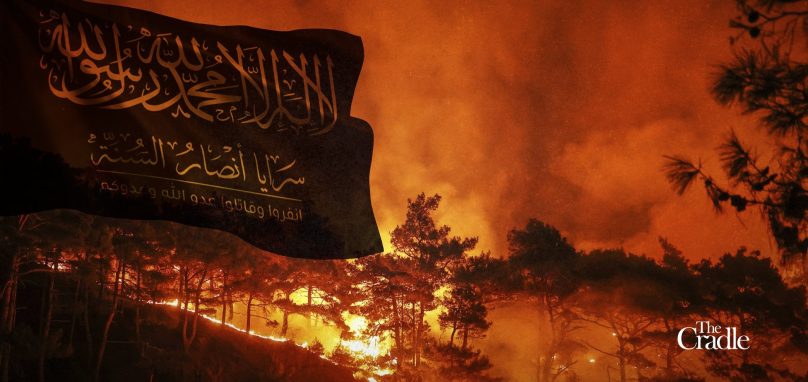
The recent wildfires that tore through northern Latakia were no seasonal accident. They broke out as sectarian killings escalated and suspicions of state complicity grew.
The blaze behind the purge
Never before in Syria had an armed group claimed responsibility for a natural disaster. That changed when Saraya Ansar al-Sunna announced it was behind fires that spread through the Qastal Ma’af region, explicitly stating that the arson attack “led to the fires spreading to other areas, forcing the Nusayris [Alawites] to flee their homes, and causing a number of them to suffocate.”
The statement came just three days into the blazes and only weeks after the same group had claimed responsibility for the 22 June bombing of Mar Elias Church in Damascus’ Douweila neighborhood.
That attack had sparked a rare public dispute between the Interior Ministry and Saraya Ansar al-Sunna. While the ministry blamed ISIS and paraded an arrested cell, the group named a different perpetrator, Muhammad Zain al-Abidin Abu Uthman.
Despite vowing to release confessions to back its version, the ministry has remained silent.
Anas Khattab—former Al-Qaeda commander and Nusra Front co-founder, now serving as interior minister—only deepened the contradictions during his visit to the fire zone. He insisted there was “no evidence” of arson, even as his own ministry investigated suspects.
Khattab’s refusal to acknowledge Saraya Ansar al-Sunna suggests that Damascus still considers it a phantom—a position reinforced when ministry spokesman Noureddine al-Baba publicly dismissed it as “imaginary” during a press conference after the church bombing.
At the same time, some Alawites believe that Interior Minister Khattab is using Saraya Ansar al-Sunna to carry out attacks against Alawites, Christians, and other minorities, while maintaining plausible deniability.
Coordinated chaos and forced displacement
In Latakia’s coastal hinterlands, fear was already running high. Many villages had yet to recover from the violence of March, when security raids and sectarian killings devastated entire communities, leaving behind charred homes and mass graves that remain under-reported by official channels.
Only months ago, bloody confrontations claimed 2,000 lives across the region. Locals, mainly from the Alawite community, saw these events as the culmination of a systematic purge under the new regime. A wave of targeted killings, kidnappings, and violence had left communities deeply scarred.
Just days before the fires erupted, the murder of two brothers working as grape leaf pickers, along with the kidnapping of a girl, sparked widespread protests in the Al-Burjan and Beit Yashout areas in the Jableh countryside.
These demonstrations, amplified by diaspora voices, coincided almost to the hour with the first outbreaks of fire, feeding widespread suspicion that the flames were a diversion or smokescreen. On the same day this call was issued, the spread of fires in the Latakia countryside forests began to attract media attention.
The Qastal Ma’af fire—the most intense and destructive—was explicitly claimed by Saraya Ansar al-Sunna. Although the group declared it aimed to displace Alawites, some affected villages housed significant Sunni Turkmen populations. Later, the group issued a cryptic clarification: “The burning of Sunni villages is attributed to Nusayri groups, and this is in the context of the ongoing, raging conflict.”
Local sources tell The Cradle that the fire consumed large swaths of forest and farmland, displacing entire communities. Despite the government’s dismissals, few believe this was a coincidence.
Denial and deception by Damascus
Rather than confront the threat, the Interior Ministry downplayed the human hand in the fires. Observers suggest this was a deliberate choice to avoid validating Saraya Ansar al-Sunna’s claim—and to prevent inflaming sectarian tensions.
But some in the Alawite community accuse Ahmad al-Sharaa’s government of weaponizing fire as a tool of demographic engineering. They point to circulating videos of security forces, Sunni Bedouin groups, and even Turkish-plate vehicles setting fires to Alawite lands.
One Alawite source explains to The Cradle:
“The Alawites rely on their land and employment, while Sharaa seeks to bring about a demographic shift in the coastal region. His aim is to strangle the Alawites and kill them, forcing them either to flee the country or remain amid ongoing cases of murder, abduction, and arson. The objective is clear: displacement and the destruction of every source of livelihood.”
The source adds that on 9 July, in the town of Al-Haffa in Latakia, a small fire broke out.
Thirty young men rushed to extinguish it—all around 21 years old—including nine Alawites. After the fire was put out, the nine Alawite young men were arrested and mysteriously disappeared.
When their families asked the local authorities regarding their whereabouts, the only response they received was: “We transferred them to Latakia.”
Demographic warfare under the cover of fire
Many Alawites believe Turkiye seeks to effectively annex parts of the Syrian coast to seize maritime gas reserves, and that attacks by Turkmen and Uighur militants loyal to Damascus are designed to provoke pleas for Turkish protection.
Historically, arson has not been random in Syria. In 2020, the former government arrested 39 individuals for setting coordinated fires across Latakia, Tartous, Homs, and Hama—allegedly financed by a “foreign party.”
Last year, vast fires scorched Wadi al-Nasara in Homs and later spread to Kasab near the Turkish border. Then-Governor Khaled Abaza admitted, “The multiplicity of fire outbreaks strongly suggests that they were intentional, as between 30 and 40 fires broke out in a single day in various areas of the governorate, especially those rugged areas that are inaccessible to vehicles.”
He continued, “A search was launched for two vehicles believed to belong to the arsonists.”
The pattern of politically timed arson is now impossible to ignore. Every major fire in the past five years has coincided with key political milestones such as regime transitions and outbreaks of sectarian unrest, pointing to a deliberate strategy masked as environmental catastrophe.
While poverty and illegal logging are the usual explanations for Syria’s seasonal fires, deeper motives have taken shape. Intelligence services are reportedly scouring Latakia’s forests for buried weapons stockpiles.
Foreign militaries are surveying the terrain for future base sites. Coastal land developers are eyeing scorched villages for luxury tourism projects. And behind it all, Israel remains a constant agitator, stoking sectarian flames for its own expansionist agenda and to further undermine the Resistance Axis.
If anything, the ministry’s insistence on ruling out human involvement in this year’s fires has further eroded public trust. In a country exposed to endless covert operations, the official version of events cannot withstand scrutiny.
In Latakia, what’s burning isn’t just land—it’s the last hope that post-Assad Syria might survive this transition intact.
More signs of Britain grooming Syria’s Al-Qaeda-rooted government
The Cradle | June 4, 2025
When Syrian President Ahmad al-Sharaa (previously known as Abu Mohammad al-Julani), the former Al-Qaeda emir who led the Nusra Front, was affiliated with ISIS, and later headed Hayat Tahrir al-Sham (HTS), visited Saudi Arabia to meet Crown Prince Mohammed bin Salman (MbS) in February, he was accompanied by a surprising figure: Razan Saffour, a 32-year-old British-Syrian activist who had never set foot in Syria before the fall of former president Bashar al-Assad’s government in December.
Saffour also joined Syrian Foreign Minister Asaad al-Shaibani on his trip to the Munich Security Conference that same month. Her presence in Syria’s new ruling circle highlights Britain’s outsized role in shaping the conflict – bringing Al-Qaeda to power, whitewashing its leadership, and embedding UK operatives within its political infrastructure.
Her presence alongside Julani on official state visits signals not just personal ascension, but the triumph of Britain’s long war to launder extremist power through western-groomed proxies.
Razan Saffour was born and raised in London, studied at SOAS, and emerged as a high-profile Syrian opposition voice during the early years of the war, when she was only in her early 20s. Platformed by major western and Arab media outlets from the Persian Gulf, she was a familiar figure on the regime-change circuit. Her father, Walid Saffour, a leading Muslim Brotherhood (MB) dissident, had fled Syria in 1981 during the MB’s armed uprising against the state.
Walid Saffour would later become the Syrian opposition’s ambassador to the UK, representing the Syrian National Council. Academic Dr Dara Conduit notes that this gave “the Brotherhood an important formal diplomatic link to the UK through an undeclared member.”
Engineering regime change
By the mid-2000s, the British government had aligned with US neoconservatives and MB-linked activists to prepare a full-blown insurgency in Syria.
In October 2006, several members of an MB front group, the National Salvation Front (NSF), traveled to Washington to meet with Michael Doran, a member of the US National Security Council, to discuss plans for regime change in Syria. Doran was a close associate of prominent Jewish neoconservative and former US president George W. Bush’s administration official Elliott Abrams.
In 2009, former French foreign minister Roland Dumas was told by top British officials that “they were preparing something in Syria … Britain was organizing an invasion of rebels into Syria.” When asked why, Dumas responded, “Very simple!” because “the Syrian regime makes anti-Israeli talk.”
The covert US-UK effort to topple Assad involved training young, media-savvy Syrian activists to organize anti-government protests, as well as flooding Syria with Al-Qaeda militants from Iraq, Libya, Lebanon, and dozens of other countries to carry out false flag attacks against Syrian police and security forces.
Many were UK nationals and members of the Al-Qaeda-linked Libyan Islamic Fighting Group (LIFG). They had been allowed by British authorities to travel to Libya to topple late Libyan president Muammar al-Gaddafi, before being funneled into Syria via Turkiye.
US Ambassador to Syria Robert Ford served as the operation’s field coordinator. As former US Naval officer Wayne Madsen reported in 2011, Ford was recruiting death squads from Afghanistan, Iraq, Yemen, and Chechnya. His previous role as political officer in Iraq involved implementing the El Salvador Option: organizing Shia death squads to crush Sunni insurgents under Ambassador John Negroponte.
Among those released from the US-run Bucca prison in Iraq and dispatched to Syria was none other than Abu Mohammad al-Julani. He would go on to found the Nusra Front, the Syrian branch of Al-Qaeda, after orchestrating a series of suicide bombings in Damascus.
The Powell connection
While Al-Qaeda’s Syrian franchise grew, British intelligence cultivated parallel assets to manage the political front. In 2011, former UK Prime Minister Tony Blair’s chief of staff, Jonathan Powell, founded the NGO Inter Mediate, a Foreign Office-funded project designed to open secret channels with insurgent groups.
In March 2012, Powell wrote to Hillary Clinton’s advisor Sidney Blumenthal seeking US support: “We are setting up secret channels between insurgents and governments.” He boasted that his group worked “closely with the FCO (the Foreign and Commonwealth Office), NSC (National Security Council) and SIS (Special Intelligence Service, or MI-6) in London.”
“We are starting work in Syria,” Powell added, suggesting that he was communicating with the Nusra Front and other Al-Qaeda linked groups.
By this time, Walid Saffour had assumed his UK ambassadorial post for the Syrian opposition. He lobbied hard for the arming of the Free Syrian Army (FSA) – a cover or “weapons farm” for transferring NATO-grade weapons to Nusra.
His appointment gave “the Brotherhood an important formal diplomatic link to the UK through an undeclared member,” academic Dara Conduit wrote in her book detailing the history of the MB in Syria.
Armed with CIA-supplied TOW missiles and led by Julani’s suicide battalions, Nusra captured Idlib in 2015. A year later, it declared an Islamic emirate in the province, modeled on ISIS’s Raqqa. Brett McGurk, the US envoy to the anti-ISIS coalition, would later call Idlib “the largest Al-Qaeda safe haven since 9/11.”
While McGurk claimed “Idlib now is a huge problem,” the US and UK were quietly working with the Nusra, which was soon rebranded as HTS.
Arab media outlet Jusoor wrote that the “attempts of [Hayat] Tahrir Al-Sham for polishing itself began in the summer of 2017, with a campaign of contacts with the west.”
Jusoor added that HTS media official Zeid Attar had a meeting with the former UK diplomat Powell, “who manages many back channels for negotiating with designated terrorist groups either internationally or nationally.”
From terrorist to statesman
In 2019, US envoy James Jeffrey openly described HTS as an “asset” to Washington’s Syria strategy. The goal: preserve an Al-Qaeda-controlled buffer in Idlib to pressure Damascus.
Russian media later revealed that Powell had met Julani near the Bab al-Hawa crossing with Turkiye, coaching him on how to rehabilitate his image. Julani was advised to grant a western media interview to soften his profile.
PBS journalist Martin Smith soon arrived in Idlib. His April 2021 interview with Julani aired in the US, casting the Salafist extremist leader as a reformed figure who posed no threat to western interests.
In May 2024, Robert Ford revealed at a conference that he, too, had met Julani in Idlib. “In 2023, a British non-governmental organization specializing in conflict resolution invited me to help with their efforts to get this man out of the terrorist world and into regular politics,” Ford told attendees.
That NGO, according to Independent Arabia, was Powell’s Inter Mediate. In a revealing twist, Powell was appointed UK National Security Advisor on 8 November 2024 – just weeks before Julani’s HTS launched its final offensive on Damascus. By 8 December, Julani, who now goes by his government name Ahmad al-Sharaa, had assumed power.
London’s ‘post-Assad’ playbook
As Sharaa settled into the presidential palace, western and Arab media launched a PR blitz to sell him as a modern, diversity-friendly ruler. This was difficult given his previous pledges to carry out a genocide against any of Syria’s minority Alawites who refused to convert to Sunni Islam, and his role in dispatching car and suicide bombers, killing tens of thousands in Syria and Iraq over more than a decade.
An image facelift ensued nonetheless: Military fatigues gave way to tailored suits; his nom de guerre was dropped in favor of his alleged birth name. Time magazine listed Sharaa as one of the year’s 100 most influential people – at Ford’s behest, no less. And the US lifted its $10 million bounty on his head for terrorism.
Sharaa pledged to protect minorities, including the Alawites – even as Syria’s new HTS-led security forces began targeting them under the guise of counterinsurgency. HTS-led Syrian government forces were carrying out brutal massacres against Alawite civilians on the Syrian coast, during an operation to quell an armed uprising against the authorities. During a four-day period of massacres, at least 1,700 Alawite civilians, including scores of women and children, were killed.
The following February, after Razan Saffour accompanied Julani to meet MbS, The National reported that Powell had recently held a “low-key meeting” with Syria’s new government in his new role as National Security Advisor, “boosting suggestions he will play a leading role in relations.”
Syrian analyst Malek Hafez told the Syrian Observer that Powell’s team even runs a media office inside the presidential palace, “reportedly run by two women – one British, the other of Lebanese-British heritage.”
As Hafez concludes, “The rise of Ahmad al-Sharaa was not spontaneous – it was carefully engineered through a long-term, western-backed strategy, in which Britain played a disproportionately influential role among western powers.”
While London has not yet officially expressed its support for Sharaa and Syria’s new government, the UK’s “fingerprints” are increasingly visible, the Observer added.
When weighed against the hundreds of thousands of Syrians killed, the millions displaced, and the wreckage of a nation, the UK’s central role in bringing Julani to power should not be forgotten.
Hell freezeth over as Sharaa gets invited to Baghdad
By Rasool Majeed | The Cradle | April 30, 2025
Syrian interim President Ahmad Sharaa’s return to Iraq – once unimaginable following his departure in 2011 – now seems possible with Iraq set to host the Arab summit on 17 May. But the question of whether Sharaa will attend has become a flashpoint, highlighting deep divisions within Iraq.
At the time of his departure, Sharaa, also known as Hayat Tahrir al Sham (HTS) leader Abu Mohammad al-Julani, was affiliated with the Al-Qaeda-linked group the Nusra Front, an early incarnation of HTS – both UN-designated terrorist organizations – and left Iraq to join the foreign-backed war against Syria.
Having been exiled from Iraq, the very idea that he could return, not as a visiting foreign dignitary but as Syria’s head of state, has stirred opposition across political, sectarian, and tribal lines. The invitation, coming from the Arab League, has stirred serious concerns about Iraq’s sovereignty and its ability to manage West Asia’s evolving challenges.
Imposed by the Arab League
Amir al-Fayez, a member of Iraq’s Foreign Relations Committee, makes it clear to The Cradle that Iraq’s role in inviting Sharaa is not voluntary. The invitation, he explains, is mandated by the Arab League, and Iraq is expected to fulfill its duties as the host nation by sending invitations to all Arab heads of state. However, Iraq itself has little to no influence on the decision to invite Sharaa.
The Arab League’s decision to reinstate Syria in 2023 after a long suspension in 2011 has only complicated Baghdad’s position. While Sharaa’s return to the Arab fold is seen as a diplomatic victory for post-Assad Syria, Iraq has faced significant backlash domestically, with many questioning the wisdom of hosting a leader who has twice been incarcerated on terror charges in Iraq and is deeply linked to the country’s violent past.
The Arab League’s push to reintegrate Syria has brought these tensions to the surface, and Iraq’s internal factions are grappling with the political fallout.
Interestingly, the Foreign Relations Committee in the Iraqi Parliament supports Sharaa’s invitation to the summit in Baghdad. Fayez notes: “As a Foreign Relations Committee, we appreciate this position on the government’s part as it is tasked with sending invitations to all Arab heads of state without exception.”
Resistance factions’ rejection
But political parties and resistance factions in Iraq, including influential groups such as Asaeb Ahl al-Haq and Kataib Hezbollah, have voiced strong opposition to Sharaa’s visit. Qais al-Khazali, the leader of Asaeb Ahl al-Haq and an early backer of Iraq’s current Prime Minister, Mohammed Shia al-Sudani, made his stance clear on social media, warning of the potential consequences if Sharaa enters Iraq.
Khazali pointed to an arrest warrant against Sharaa, emphasizing that his presence would be illegal under Iraqi law. For these factions, Sharaa is not just a foreign leader, but a figure associated with violence, instability, terror, and murder in Iraq, making his visit untenable.
On 16 April, Sudani officially invited Sharaa to participate in the upcoming Arab summit in Baghdad. Three days later, Khazali posted on X, warning against Sharaa’s entry into Iraq, saying:
“The presence of the current Syrian regime president in Iraq is premature, as it could lead to repercussions if the law is applied and he is arrested by the security forces, due to an existing arrest warrant against him. Accordingly, and in accordance with the principle of the separation of powers, the decisions of the Iraqi judiciary must be adhered to and respected by all.”
A day before Khazali’s post, Abu Ali al-Askari, the security official for Kataib Hezbollah, also posted a statement clearly rejecting Sharaa’s visit to Iraq, pointing out:
“Arab summits were held without the presence of President Assad and without Iraq or Libya. These summits will not stop just because the convicted (Abu Mohammad Al-Julani), leader of the criminal Nusra Front, does not attend.”
Shia lawmaker Yousef al-Kalabi, described Sharaa’s entry into Iraq as “a betrayal of the memory of Iraqis who suffered under terrorism.”
Regarding Sudani’s meeting with Sharaa in Doha through Qatari mediation, Firas al-Yassir, a member of the political bureau of Al-Nujaba Movement, tells The Cradle :
“There is certainly Iraqi consensus rejecting any meeting with Sharaa by any person holding an official position in the Iraqi state. According to Iraqi law, the man is wanted by the Iraqi judiciary and is accused of killing Iraqis during the days of terrorist operations.”
Yassir adds: “No individual or entity has the right to violate Iraqi law or undermine the blood of Iraqis. If it is true that Sudani’s meeting with Sharaa in Doha occurred under American and [Persian] Gulf pressure, it would be considered a setback in Iraq’s foreign policy.”
He continues: “I expect that there is a political and popular consensus rejecting Julani’s attendance at the summit, and he is not welcomed. The issues raised about him should be addressed.”
Conditional rejection
While many have outright rejected Sharaa’s visit, some figures within the Iraqi political system, like Thair Mukhayef, have called for a more nuanced approach. Mukhayef, a tribal leader and member of parliament, has stated that while he opposes Sharaa’s visit, the matter should be decided based on Iraq’s judicial system.
According to Mukhayef, if Sharaa is proven guilty of crimes committed during the Iraq War, his visit should be barred. This position underscores the tension between legal considerations and diplomatic pragmatism. Mukhayef tells The Cradle :
“Sharaa took his position in what is called a coup against his government. There has been much talk and rumors about his involvement in violent acts in Iraq, and arrest warrants have been issued against him. Therefore, we are with the law and what the judiciary issues concerning this person.”
He adds, “If this man (Sharaa) indeed committed crimes and has an arrest warrant, we do not respect anyone who sheds the blood of our sons, and then he comes to have a red carpet rolled out for him to attend conferences and lecture on Arab nation policy within Iraq. I will reject the arrival of this figure if it is proven that he is the one who exploded, killed, and planned those crimes.”
He confirms that “Sharaa’s invitation to the summit is not from Iraq. Yes, I am with the absolute rejection, and I am not justifying it. But the invitation came from the Arab League, and Iraq is hosting this conference. I repeat the confirmation, we are with the judiciary and what it says. If it is proven that Sharaa has committed violent acts, killings, and destruction in our country, we absolutely and completely reject his entry into Iraq.”
The tribal divide
Tribal leaders in Iraq, a powerful political force in the country, have also been divided over Sharaa’s invitation. They have had a significant impact on political and security events in Iraq, from the 1920 Revolution to the post-independence period, through to the US invasion of 2003 and their uprising against ISIS in 2014 and beyond. This makes their stance on Sharaa’s invitation to Iraq significant.
Shia tribes have almost unanimously rejected Sharaa’s visit, with the Unified Tribes Council of Iraq issuing a statement calling for opposition to Sharaa, citing his role in past violence against Iraqis. These tribes view his presence as a betrayal of the bloodshed suffered during the Iraq War.
However, Sunni tribes have been more divided. Some, like former politician Mishaan al-Jubouri, have expressed support for Sharaa, downplaying his past and framing his visit as a diplomatic necessity. Jubouri and others have argued that Iraq should prioritize its regional interests, including relations with Syria, and not allow historical grievances to overshadow current political realities.
On the other hand, leaders like Sheikh Mazahim al-Huwait, a Sunni tribal leader from Ninawa, have firmly rejected Sharaa’s visit. Huwait, while supportive of trade and security cooperation with Syria, has condemned Sharaa as a figure linked to Iraq’s violent past.
Huwait’s opposition is based on both Sharaa’s personal history and the broader implications of hosting a leader implicated in the bloodshed of Iraq’s sectarian conflict. He tells The Cradle :
“We reject Julani’s visit to Iraq because his hands are stained with the blood of Iraqis, and he himself has openly admitted that after his release, he participated in operations in Iraq, having been a prisoner in US jails in 2005, where he was with me in detention … Sharaa has an arrest warrant under Article 4 Terrorism issued by the Iraqi judiciary and the Counter-Terrorism Agency. Therefore, we reject his visit.”
Regarding exchanges such as Syrian Foreign Minister Asaad al-Shaibani’s visit to Iraq or Iraqi delegations traveling to Damascus, Huwait supports them, stating: “Such visits are necessary, as cutting off trade visits and those related to security coordination is not correct. Syria is a neighboring country, and its security means Iraq’s security.”
On the Sunnis who welcome Sharaa to Iraq, Huwait opines:
“Those who welcome him, whether leaders or tribal sheikhs, are followers of the arenas of humiliation and disgrace and do not represent the Sunni community but only themselves.”
A tactical move?
While many factions and figures within Iraq oppose Sharaa’s visit on legal and moral grounds, some analysts view it as a strategic move within the larger context of Iraq’s foreign policy. Prime Minister Sudani’s meeting with Sharaa in Doha, mediated by Qatar, is believed to be part of a broader effort to enhance Iraq’s position in the region, particularly in relation to Iran.
By engaging with Sharaa, Iraq seeks to balance its ties with both Syria and Iran, which are critical to its security and political stability. Huwait, though opposed to Sharaa’s visit, acknowledges Iraq’s diplomatic role in the region and its need to engage with neighboring countries, including Syria:
“Iraq now has a significant role on the political scene, especially in the Middle East (West Asia), and it has succeeded in distancing many risks in the region, including with the Islamic Republic. There were risks concerning it with the US, and Iraq played a major role in this.”
He adds:
“It’s a heavy matter for Sudani to meet with a person who has killed his people, but Sharaa is now the president of Syria, and some countries have recognized him, and the Syrian flag is raised everywhere, including in Iraq. Sharaa asked Sudani to open dialogue with Iran, as he is in a difficult situation. He knows that opening channels with the Islamic Republic and ending conflicts with it will bring several countries, including Iraq, Lebanon, Yemen, and others, to his side.”
Sudani’s second term under fire
Those opposing Sharaa’s visit to Iraq base their objection on “his criminal record in the country” and his participation with extremist factions from 2005 to 2011, but some observers see this as “just an excuse.” The real aim of the rejection, they claim, is to embarrass Iraqi premier Sudani on the global stage and seize any opportunity to prevent him from securing a second term.
Speaking to The Cradle, Iraqi writer and political observer Jabar al-Mashadani argues:
“The Shia factions fighting within the Coordination Framework will seize any opportunity to prevent Prime Minister Sudani from securing a second term. Different parties within the framework want the position of prime minister after the upcoming elections. These factions exploit any political step in their favor, whether internal and highly local, like investment, reconstruction, and services issues, or external and strategic, especially regarding Iraq’s relationship with its anxious neighbor Syria, which affects Iraq’s internal security and politics.”
As the Arab summit approaches, the question of whether Sharaa will attend remains unresolved. While legal, political, and moral objections to his visit are strong, Iraq’s role as the summit host and its broader diplomatic interests may ultimately shape the outcome.
Regardless of whether Sharaa sets foot in Baghdad, his invitation has already sparked a major political divide within Iraq. The decision on Sharaa’s attendance may not only influence Iraq’s relationship with Syria, but may also shape the country’s future diplomatic course in a region marked by tension and shifting allegiances.
Aggressive Rhetoric of NATO, EU Hinders Russia, US’s Risk Mitigation Efforts – Shoigu
Sputnik – 30.04.2025
Militarization of Europe and aggressive rhetoric on the part of NATO and the EU hinder the success of Russia and the United States’ efforts to reduce strategic risks, Russian Security Council Secretary Sergei Shoigu said on Wednesday.
“Today we continue to consistently convey to the Americans the need to work together on comprehensive reduction of strategic risks, which should have positive impact on the international security. However, militarization of Europe and aggressive rhetoric of NATO and the EU hinder achievement of positive results in this area,” Shoigu said at the meeting of high representatives of BRICS countries in charge of security issues, which is taking place in Brasilia.
Using Terrorist Proxies for Geostrategy
Some European countries are increasingly using terrorist groups for their geostrategic purposes, and the most prominent example is Ukraine, Russian Security Council Secretary Sergei Shoigu said on Wednesday.
“Some European states are increasingly using terrorist groups for their geostrategic purposes, primarily in confrontation with countries that do not recognize dominance,” Shoigu said at a meeting of the BRICS countries’ high representatives in charge of security issues, adding that the most striking example is Ukraine because Kiev uses NATO weapons to shell residential neighborhoods, commits sabotage and political assassinations.
The most serious challenges to global security come from ISIS and Al-Qaeda, because they are quickly adapting to changing geopolitical conditions, Shoigu added.
US airstrikes in Yemen lay groundwork for ‘ground invasion’ by UAE-backed militias: Report
The Cradle | April 15, 2025
With US support, UAE proxy militias in Yemen are planning a ground offensive to take the port city of Hodeidah from the Ansarallah-led Yemeni government and armed forces, The Wall Street Journal (WSJ) reported on 15 April, in a move that would reignite the country’s devastating civil war.
“Private American security contractors provided advice to the Yemeni factions on a potential ground operation, people involved in the planning said. The United Arab Emirates, which supports these factions, raised the plan with American officials in recent weeks,” the WSJ wrote.
The ground offensive seeks to take advantage of the recent US bombing campaign targeting the Yemeni Armed Forces (YAF).
US officials speaking with the newspaper said Washington has launched more than 350 strikes during its current campaign against Yemen and claim that the YAF has been weakened as a result.
While the Ansarallah-led National Salvation Government controls Yemen’s most populous areas, including the capital, Sanaa, and the strategic port city of Hodeidah, other parts of the country have remained in control of UAE and Saudi-supported factions since the end of the civil war in 2022.
Under the plan being discussed, factions of the UAE-backed Southern Transitional Council (STC) would deploy their forces north to the western Yemeni coast and try to seize the Red Sea port of Hodeidah, pro-UAE Yemeni sources said.
If successful, the ground operation would push the YAF back from large parts of the coast from where they have launched attacks on Israeli-linked ships transiting the Red Sea.
The YAF began targeting Israeli-linked ships in November 2023 in response to Israel’s genocide of Palestinians in Gaza. The US launched a war against Yemen and the YAF on Israel’s behalf shortly thereafter.
Capturing Hodeidah would be a “major blow” to the Ansarallah-led Yemeni government, “depriving them of an economic lifeline while also cutting off their main route to receive arms from Iran,” the WSJ wrote.
“A major ground offensive risks reigniting a Yemeni civil war that has been dormant for years and that spurred a humanitarian crisis when a Saudi–Emirati coalition supported local ground forces with a bombing campaign,” the WSJ added.
Officials from Saudi Arabia, which supports another Yemeni faction, the Presidential Leadership Council (PLC), have privately said they will not join or help a ground offensive in Yemen.
During the civil war, the Saudi-led coalition, alongside the UAE, conducted a major bombing campaign in Yemen that killed nearly 15,000 people, while the Saudi navy blockaded Yemen’s major ports, causing a humanitarian crisis that killed hundreds of thousands more.
In 2018, the Saudi Kingdom launched three operations against Ansarallah in an attempt to capture Hodeidah, yet failed.
Ansarallah forces retaliated by launching ballistic missile and drone attacks on Saudi cities, including striking a Saudi Aramco oil storage facility in Jeddah, which threatened to devastate the kingdom’s oil production and exports.
The YAF also responded to the UAE’s aggression on Yemen by launching its first drone and missile attacks on Abu Dhabi in January 2022, targeting three oil trucks and an under-construction airport extension infrastructure.
Both the UAE and Saudi Arabia allegedly cooperated with and recruited fighters from the local Al-Qaeda affiliate, known as Al-Qaeda in the Arabian Peninsula (AQAP), to assist in their proxy war against Ansarallah.
Tensions escalate on Syria-Lebanon border as EU/NATO-backed massacres of minorities continue
By Drago Bosnic | March 18, 2025
Ever since the destruction of sovereign Syria, the situation on the ground keeps deteriorating. The EU/NATO-backed terrorist “government” is resorting to extreme violence in an attempt to establish control over areas primarily populated by minorities, particularly Alawites and Christians. Thousands have been brutally murdered as a result of this terrorist takeover, with the new “government” sending its forces (composed of Al Qaeda-affiliated armed personnel) to crush any opposition. This issue is now slowly becoming transnational as armed clashes are reported on the Syria-Lebanon border. Namely, the Hayat Tahrir al-Sham (HTS) terrorists (now posing as the “new Syrian military”) are shelling and launching rockets at Lebanese border towns.
Beirut sent military forces to respond to these attacks. Over the weekend, local sources reported that “the Beqaa Valley has been under continuous shelling for three hours with rockets and artillery coming from Syrian territory”. The new terrorist “government” occupying Syria since early December also regularly launches armed drones into Lebanese territory, while several rockets launched from the Qusayr countryside (administratively part of the Homs Governorate) hit the Lebanese border town of Qasr. Local sources report that “heavy shelling is ongoing”, resulting in “civilian casualties on the Lebanese side, including at least one child”. Citing military data, the traditionally pro-terrorist Al Jazeera reports that “eight members of the Syrian Ministry of Defense were killed in the clashes”.
It should be noted that the “Syrian Ministry of Defense” in this case refers to one controlled by the unelected EU/NATO-backed terrorist “government”. The fighting supposedly “began several hours after three HTS fighters were found dead inside Lebanese territory” and “were handed over to the new ‘government’ by Lebanese Armed Forces (LAF) and the Red Cross”. The HTS-run “Defense Ministry’s” media office told former Syrian state media outlet SANA that “the Hezbollah militia kidnapped the three fighters on the border, took them to Lebanese territory and executed them on the spot”. Other sources report that the three HTS terrorists “were already in Lebanese territory when they were killed”. These clashes seem to have been in retribution to the new terrorist “government’s” actions.
Namely, local sources report that the HTS killed several citizens of Lebanon. According to Annahar, “on Monday, two Lebanese youths were found dead in the Matraba area near the border”. They were reportedly kidnapped from their homes inside Lebanon by the new terrorist “government’s” security forces and subsequently killed.
The EU/NATO-backed puppets in Damascus claim they’re “fighting Hezbollah on the border”, although the Lebanese Shia organization regularly denies involvement in recent events in occupied Syria. There are claims that “a Syrian photographer and journalist were injured by retaliatory rocket fire launched from Lebanon on Sunday”. On the other hand, Beirut reports that “Lebanese villages and towns in the region were subjected to shelling from Syrian territory”.
The Lebanese military sent “units [that] responded to the sources of fire with appropriate weapons, reinforced their deployment, and maintained security” and reported that “contacts continue between the army command and the Syrian authorities to maintain security and stability in the border area”. The new terrorist “government” in Damascus also reportedly sent reinforcements to the border area.
The incidents come over a month after fighting was reported between the HTS-run forces and Lebanese tribesmen back in early February. At the time, the former sent troops to “set up checkpoints in an attempt to thwart smuggling”. The fighting stopped after Beirut and local tribes came to an agreement that resulted in the latter’s withdrawal from the border.
It should be noted that the security situation in western parts of Syria deteriorated dramatically after the new terrorist “government” started a genocidal campaign against the locals, murdering even Sunnis who offered shelter to their Alawite and Christian compatriots. The Russian military in the area continues to house thousands of refugees, with more coming in daily. New footage confirms that gruesome atrocities by the HTS-run “security forces” continue unabated, while the EU/NATO keep supporting and even financing the terrorists.
Namely, Germany just pledged an additional €300 million ($326 million) in “foreign aid” for the new terrorist “government”. Its Foreign Minister Annalena Baerbock insists that “over half of it will bypass the interim government of Jolani, to be distributed through NGOs and UN agencies”.
“As Europeans, we stand together for the people of Syria, for a free and peaceful Syria,” Baerbock declared without even mentioning the ongoing massacres.
The assertion that the terrorist Jolani regime “will be bypassed” is beyond laughable as recent revelations about the USAID and its illegal activities around the world show that around $15 billion were funneled into Syria precisely through the USAID. This money ended up in the pockets of various terrorist groups that took over Syria and are now killing civilians across the occupied country. Estimates vary, ranging from over a thousand to as many as 10-15,000 casualties.
The areas populated by minorities (particularly Alawites and Christians) are disproportionately affected, meaning that the new terrorist “government” is determined to eradicate any and all groups deemed “infidels”. Locals are subjected to brutal torture and then murdered by the EU/NATO-backed Islamic radicals.
Worse yet, Brussels is now even condemning the victims for fighting back, calling them “pro-Assad forces” and accusing them of “destabilizing Syria”. On the other hand, somewhat astonishingly and unexpectedly, the US is condemning the jihadists after decades of supporting them. Both Donald Trump and JD Vance have criticized not only the terrorists, but also the preceding US governments, even admitting their policies led to the eradication of ancient Christian communities in the Middle East.
Even some (now former) Democrats, such as the former congressman Dennis Kucinich slammed this foreign policy approach, asking rhetorically: “Why would America champion policies that lead to the killing of Christians, the destruction of churches, the massacre of Alawites and the rise of radical jihadists?”
“Why did our leaders knowingly aid those who murdered the very people America claimed to want to protect? The answer lies in a corrupt, immoral foreign policy dictated not by ethics, human rights, or even national security, but by the interests of the military-industrial complex and strategists who view human lives as pawns in a geopolitical chess game,” he concluded.
‘This isn’t war. It’s genocide’: Why the world is silent about massacres in Syria
Survivors of the violence against the Alawite, Christian, and Druze communities share their stories
RT | March 15, 2025
Hay’at Tahrir al-Sham (HTS), the dominant militant group in northwestern Syria, once presented itself as a local opposition force. Just over a month ago, the group was formally disbanded and became part of the Syrian Defense Ministry, yet its origins tell a far more sinister story. Born out of the ashes of Jabhat al-Nusra, Al-Qaeda’s official branch in Syria, HTS carries the same ideological DNA as the world’s most notorious terrorist network. While it has sought to rebrand itself for international legitimacy, its methods remain unchanged: Massacres, ethnic cleansing, and the systematic extermination of those who do not conform to its radical ideology.
Nowhere has this been more evident than in Syria’s coastal cities, where HTS and its foreign recruits have unleashed an unspeakable wave of violence against Alawite, Christian, and Druze communities. Entire villages have been erased, their inhabitants slaughtered in the dead of night. Yet, as these horrors unfold, the world remains indifferent, and the silence of international powers only emboldens the perpetrators.
The massacre in Latakia: A night of unimaginable horror
In one of the darkest nights in Syria’s recent history, coordinated attacks on rural Latakia resulted in mass executions. Survivors tell of masked men storming their villages, dragging families from their homes, and carrying out public executions. Those who resisted were burned inside their homes, leaving behind entire neighborhoods reduced to smoldering ruins.
Testimonies from survivors suggest that many of the perpetrators were foreign fighters, brought in from regions far from the Middle East.
“They didn’t even speak our language,” an elderly survivor told RT. “They had no idea who we were, no reason to hate us – except that they were told to.”
Entire villages have been abandoned, their populations either massacred or displaced. Satellite imagery confirms what survivors describe – rows of torched homes, mass graves hastily covered, and ghost towns where life once thrived.
The bloodbath in Tartus: A slaughter without mercy
Tartus, once a thriving coastal city, has become another graveyard. HTS fighters stormed residential areas, conducting door-to-door massacres. Families were accused of supporting the government or practicing the ‘wrong’ faith before being lined up and shot. Those who were not executed on the spot were locked inside buildings which were then torched.
A local journalist, speaking anonymously for fear of reprisal, described the scale of the killings:
“There were so many bodies that people stopped counting. They weren’t buried properly – just dumped into ditches.”
Foreign fighters played a leading role in these atrocities. A humanitarian worker recalled speaking with a man who had barely escaped:
“He told me he heard Chechen, Uzbek, and North African Arabic among the attackers. These weren’t local militants – these were imported killers, trained elsewhere and sent here to finish us off.”
Despite the horror, survivors insist they were never fighting for political power – only for survival. “We weren’t taking up arms to reclaim land or rule over anyone,” a displaced father from Tartus told RT. “We were just trying to stop them from killing our children in their beds.”
Jableh: The systematic erasure of a community
The violence in Jableh was particularly gruesome. Hundreds of men were rounded up, executed, and dumped into mass graves. Women and children were kidnapped, their fates unknown. Witnesses reported hearing gunfire for hours as the slaughter continued unchecked.
“They lined up all the men and took them away,” a survivor said with a voice shaking. “Later, we found their bodies piled on top of one another, shot execution-style.”
One woman who managed to escape described her captors:
“They were foreigners. Some were Arab, others were not. They had dead eyes, no emotion.
To them, we weren’t people – we were just bodies to be destroyed.”
Another survivor, now living in a refugee camp, said, “People say we were fighting for power, but we were just trying to keep our families from being butchered. No one wanted war. We just wanted to survive.”
Executioners without borders
What makes these massacres even more horrifying is the sheer number of foreign fighters involved. Witnesses and survivors consistently report hearing different languages among the attackers, sometimes even Western languages.
“These aren’t local fighters,” a displaced resident now sheltering in Damascus said.
They were trained somewhere else, then sent here to do what they do best – kill.”
The involvement of foreign jihadists suggests a well-coordinated, externally supported operation, designed not just to fight a war, but to systematically erase communities. Intelligence sources indicate that these fighters were funneled into Syria through neighboring countries, trained in camps before being deployed to slaughter civilians.
The global silence
Despite overwhelming evidence of genocide, Western and regional media continue to present the massacres as “clashes” between HTS and government forces, deliberately sidestepping the mass extermination of Syria’s Alawite community.
A Syrian human rights activist, speaking under anonymity, condemned this distortion:
“This isn’t war. It’s genocide. Yet, the world’s media avoids using that word because it doesn’t fit their political narrative.”
Western governments that once backed opposition forces are now reluctant to acknowledge the nightmare they helped unleash. By turning a blind eye, they enable the continuation of these crimes, and their silence serves as complicity in the atrocities.
The United Nations has remained largely passive, offering vague statements of concern but taking no meaningful action. Meanwhile, the perpetrators roam free, emboldened by the knowledge that no one will hold them accountable.
For the people of Latakia, Tartus, and Jableh, the message is clear: No help is coming. The world will not intervene. But history will remember. And the silence of the international community will forever be its most damning indictment.
Good Jihadi, bad Jihadi: Al-Qaeda’s Sharaa vs Sinwar’s resistance
The Cradle | February 19, 2025
“Even the pages of the New York Times now include regular accounts distinguishing good from bad Muslims: good Muslims are modern, secular, and Westernized, but bad Muslims are doctrinal, antimodern, and virulent.” – Mahmood Mamdani, Good Muslim, Bad Muslim: America, the Cold War, and the Roots of Terror
In his seminal work, Good Muslim, Bad Muslim: America, the Cold War, and the Roots of Terror, Mahmood Mamdani dissects how the west constructs and weaponizes distinctions between “good” and “bad” Muslims to suit its geopolitical objectives. He argues that these labels are not inherent but imposed, shaped by the shifting demands of western foreign policy.
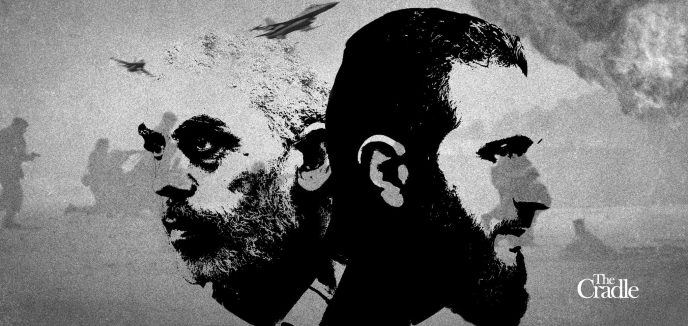
Nearly two decades after its publication, his thesis remains alarmingly relevant. Nowhere is this clearer than in the stark contrast between the west’s treatment of Yahya Sinwar, the martyred Palestinian resistance leader of Hamas, and Ahmad al-Sharaa, better known as Abu Mohammad al-Julani, the head of Al-Qaeda-linked Hayat Tahrir al-Sham (HTS) in Syria.
A tale of two leaders
While Sinwar has spent the past year in the war-ravaged ruins of Gaza, constantly evading Israeli and NATO surveillance while leading the Palestinian resistance against a brutal Israeli occupation and aggression, Sharaa moved freely through Idlib, and now Damascus, attending public events and meeting western diplomats without significant security measures.
This is despite the fact that the US had placed a $10 million bounty on Sharaa’s head as a so-called terrorist. The incongruence is striking: an internationally recognized Palestinian resistance leader hunted and vilified, while a former Al-Qaeda affiliate leader rebrands himself as a legitimate political actor with western complicity.
Back in 2021, TRT World noted how Sharaa was “remodeling” himself as a peacemaker, enjoying unimpeded mobility even as western coalition forces actively hunted other jihadist leaders linked to ISIS and Al-Qaeda.
Turkish Foreign Minister Hakan Fidan later confirmed that Sharaa had been collaborating with Ankara for years in eliminating those classified by NATO as “terrorists.” The reality, however, is that Sharaa has been part of a western-backed laundering process for years, at least since 2012, but certainly since 2017, when with Qatari backing, he began rebranding his Al-Qaeda-linked Nusra Front as a Syrian liberation force opposing Russian and Iranian influence.
Media whitewashing and political legitimacy
The western media’s embrace of Sharaa was made explicit when The Times described his return to Damascus as that of “‘Polite’ Syrian leader heads home.” This was not an isolated occurrence but part of a broader effort to frame him as a liberator from foreign influence. His past crimes, including war crimes against civilians, enslavement of Yazidi women, and sectarian violence, were conveniently brushed aside.
When Sharaa’s group took control of Damascus last December, the alignment with western interests became clearer. Israeli airstrikes systematically dismantled Syria’s military infrastructure, particularly in and around the capital, yet Sharaa himself moved through the city undisturbed.
While the Israeli Air Force bombed military sites near Umayyad Square, Sharaa was seen casually driving through the same areas. His silence on these attacks was deafening – especially given that his administration’s official stance on Israel marked a complete break from Syria’s historic anti-Zionist policies.
Statements from his government indicated no intention to reclaim the occupied Golan Heights or other lost territories, signaling a de facto truce with Tel Aviv.
The west’s legitimization of Sharaa reached its peak when his Foreign Minister, Asaad al-Shaibani, was invited to attend the World Economic Forum annual meeting in Davos, sharing a stage with figures like former British prime minister Tony Blair.
His rhetoric was tailored for a western audience: peace, counterterrorism, privatization, and economic liberalism – all buzzwords signaling a willingness to operate within the neoliberal world order.
Demonizing resistance: Sinwar’s struggle
Meanwhile, Israel continued its relentless campaign against Yahya Sinwar, branding him a “butcher,” a “war criminal,” and a “child killer” – a narrative eagerly parroted by western media despite its lack of substantiation.
Even as the alleged war crimes attributed to Hamas fighters on 7 October 2023 were later exposed as Israeli propaganda, Sinwar’s image remained demonized. In his final moments, as an Israeli drone executed him in Gaza, Sinwar did not cower. He fought until his last breath, cementing his status as an icon of Palestinian resistance. Yet even in death, the western narrative denied him any form of legitimacy.
Julani’s convenient redemption
Conversely, Sharaa’s past was erased. His involvement with the Islamic State in Iraq, his position as deputy leader of ISIS under Abu Bakr al-Baghdadi, his group’s mass executions, and his forces’ role in the enslavement of women were all conveniently overlooked.
Western journalists competed to polish his image, portraying him as a pragmatic leader rather than the war criminal he is. His forces still operate brutal prisons in Idlib, where opponents disappear indefinitely, yet he remains a media darling.
This contrast illustrates Mamdani’s thesis with unsettling precision: Sharaa is the “good jihadist” because he aligns with western-Israeli interests, while Sinwar is the “bad jihadist” because he defies them.
Sinwar’s crime was not terrorism – it was successfully challenging the occupation’s military, exposing the vulnerabilities of an Israel long perceived as invincible. His resistance resonated across the Arab and Muslim world, cutting across sectarian lines and threatening western interests.
Sharaa, on the other hand, poses no threat to Israel. He remains focused on the sectarian score-settling within Syria, making him a useful pawn rather than an adversary. His group does not challenge Western influence in the region, nor does it resist the ongoing occupation of Palestinian land. This is the fundamental reason why he is embraced rather than demonized.
Sinwar may have fallen, but as the Quran reminds us: “And do not say about those who are killed in the way of Allah, ‘They are dead.’ Rather, they are alive, but you perceive it not.” (Quran 2:154). His legacy endures, living on in the hearts of those who continue his struggle.
Sharaa, despite his crimes, remains alive and politically relevant. In the western geopolitical playbook, obedience is rewarded while defiance is crushed.
How the West Destroyed Syria
By Rick Sterling | Dissident Voice | January 11, 2025
Peter Ford served in the UK Foreign Ministry for many years including being UK Ambassador to Bahrein (1999-2003) and then Syria (2003-2006). Following that, he was representative to the Arab world for the Commissioner General of United Nations Relief and Works Agency. He was interviewed by Rick Stering on Jan 6, 2025.
Rick Sterling: Why do you think the Syrian military and government collapsed so rapidly?
Peter Ford: Everybody was surprised but with hindsight, we shouldn’t have been. Over more than a decade, the Syrian army had been hollowed out by the extremely dire economic situation in Syria, mainly caused by western sanctions. Syria only had a few hours of electricity a day, no money to buy weapons and no ability to use the international banking system to buy anything whatsoever. It’s no surprise that the Army was run down. With hindsight, you might say the surprise is that the Syrian government and Army were successful in driving back the Islamists. The Syrian Army forced them into the redoubt of Idlib four or five years ago.But after that point, the Syrian army deteriorated, became less battle ready on the technical level and also morale.
Syrian soldiers are mainly conscripts and they suffer as much as any ordinary Syrian from the really dreadful economic situation in Syria. I hesitate to admit it, but the Western sanctions were extremely effectively in doing what they were designed to do: to bring the Syrian economy down to its knees. So we have to say, and I say this with deep regret, the sanctions worked. The sanctions did exactly what they were designed to do to make the Syrian people suffer, and thereby to bring about discontent with what they call the regime.
Ordinary Syrians didn’t understand the complexities of geopolitics, and they blamed the Syrian government for everything: not having electricity, not having food, not having gas, oil, high inflation. Everything that came from being cut off from the world economy and not having supporters with bottomless pockets.
Syria was being attacked and occupied by major military powers (Turkey, USA, Israel). Plus thousands of foreign jihadis. The Syrian army was so demoralized that they really were a paper tiger by the end of the day.
RS: Do you think the UK and the US were involved in training the jihadis prior to the December attack on Aleppo?
PF: Absolutely. The Israelis also. The leader of Hayat Tahrir al Sham (HTS), Ahmed Hussein al Sharaa (formerly known as Mohammad abu Jolani) almost certainly has British advisors in the background. In fact, I detected the hand of such advisors in some of the statements made in impeccable English. The statements had Americanized spelling, so the CIA are in there too. Jolani is a puppet, a marionette saying what they want him to say.
RS: What’s the current situation, a month after the collapse?
PF: There are skirmishes here and there, but broadly, the Islamists and foreign fighters are ruling the roost. There are pockets of resistance in Latakia where the Alawite are literally fighting for their lives. Much of the fighting is about the attempts by HTF, the present rulers to confiscate weapons. The Alawites are resisting and there are pockets of resistance in the South where there are local Druze militias.
HTS is spread thinly on the ground. They are facing problems in asserting themselves. Although they had a walkover against the Syrian army, they never actually had to do much fighting. I would guess they only have about 30,000 fighting men and spread across Syria, that is not a lot. There’s an important pocket of resistance in the Northeast where the Kurds are. The Kurdish American allies are resisting. The so-called Syrian National Army, which is a front for the Turkish army, may go into a fully fledged war against the Kurdish forces. But that’s going to depend partly on what happens after the inauguration of the new US president, how Trump deals with the situation.
RS: What are you hearing from people in Syria?
It is not a pretty story. HTS and their allies have been parading showing their dominance, flying ISIS and Al-Qaeda flags. They have been bullying, intimidating, confiscating and looting. Surrendering Christian as well as Alawite soldiers have been given summary justice, roadside executions being the norm. Christians in their towns and villages are just trying to hunker down and pray. Literally. I’m sorry to say the senior Christian clerics, with one or two noble exceptions, have opted for appeasement and effectively betrayed their communities. The senior leadership at the Orthodox Church, in particular Greek Catholic church, have had themselves photographed with dignitaries of the jihadi regime.
They are turning the other cheek. It’s quite a contrast with the Alawite. But they have no choice. You may remember that the slogan of the jihadi armies during the conflict was, “Christians to Beirut, Alawite to the grave.” HTS is going through the motions of having meetings with clerics and making soothing noises. All the while their henchmen are driving around in trucks flying ISIS flags. What I’m hearing is very depressing.
The regime is leaving the Alawites totally abandoned. You barely read a word in the west in media about the plight of the Alawite and not much more about the Christians.
RS: Western media have demonized Bashar al Assad and even Asma Assad. What was your impression of Bashar and Asma when you met them? What do you think of accusations they accumulated billions of dollars?
PF: The accusations are completely spurious. I know some members of the Assad family, some of them have lived for many years in Britain. They lived in very modest personal circumstances. If Assad had been a billionaire, like they’re saying, some of that would’ve trickled down. I can guarantee you that has not been the case. These accusations also go against the impressions that I picked up when I was seeing the Assads when I was an ambassador there. They appreciated the good things of life the same as everybody else, but they didn’t come across as the Marcos type. Nothing at all like that. It is all lies, made up to serve the deeper agenda.
The media kicking of Bashar and Asma is really distasteful. It’s pointless. He’s disappointed his few remaining followers, although it was unrealistic, I believe, for them to expect more. But the fact is that he ran when others were not able to run, and many of those have been killed, or they’re hiding or they’ve escaped to Lebanon in some cases where they’re also hiding. He did get out with his skin, but to beat up on him as the media are doing is really distasteful and pointless. It is akin to this new genre of political pornography, Assad porn, the torture stories, the hyped up narrative about prison and graves being opened up. Actually, by the way, most of those graves are war dead. They were not people who’d been tortured to death as the media pretends. Hundreds of thousands of people died in the conflict over more than a decade, and many of them were buried in unmarked graves. But the western media are reveling in this new genre of Assad porn.
This is all being whipped up to make Western audiences more accepting of the way the West is getting into bed with Al-Qaeda. The more they demonize Assad and harp on the misdeeds of the Assad regime, and the more likely we are to swallow and be distracted away from the hideous atrocities being carried out right now.
Western leaders are kissing the feet of a guy who’s still a wanted terrorist and who has been a founder member of ISIS for God’s sake, as well as a founder member of Al-Qaeda in Syria. It is morally distasteful and shaming.
Joulani needs the west desperately now. Otherwise, he will face the same fate as Bashar Asad. If the economy continues on its trajectory of the years, then Joulani will be dead meat in fairly short order. He has to deliver massive rapid economic improvement to survive as leader. And this is what it’s all about. His strategy, obviously, is to milk his status as a puppet of the West in order to secure not just reconstruction aid, but that’s for the long term, but more immediately sanctions relief, the electricity flowing again, the oil.
Let’s not forget that the oil and gas of Syria is still effectively in the hands of the United States, which through its Kurdish puppets, controls a segment of the economy, which used to be worth, I think, 20% of serious GDP and provide essential oil for fuel, cooking, everything. He’s got to get his hands on that and get sanctions lifted. That’s what so much of it is about. But he has one major problem: Israel. Israel’s not buying it. Israel is the exception. All the western front is tumbling over itself to go and kiss the feet of the sultan of Damascus. But the Israelis are sucking their teeth, saying they don’t trust the guy.
Israel is destroying the remnants of the Syrian army and its infrastructure. Meanwhile they grab more Syrian land. They want to keep Syria on its knees indefinitely by insisting that Western sanctions not be lifted. I sense there’s a battle royal going on in Washington between what we might call the deep state, which would favor lifting sanctions and the Israel lobby, which is resisting that for selfish Israeli reasons. Given that the Israeli lobby wins these tussles nine times out of 10, the outlook may not be that great for the Jolani regime.
RS: What are your hopes and fears for Syria? What’s the nightmare scenario and what’s the best possible?
PF: I’m very pessimistic. It is very hard to see a silver lining in what has happened. Syria has been taken off the table as a Middle East player. The old Syria has died effectively. Syria was the last man standing among the Arab countries that supported the Palestinians. There was no other. There were militias like Hezbollah plus Yemen but there were no states other than Syria. Syria is now gone, and the jihadis are saying, telling the world they don’t care. By the way, this is an example of how the Israelis will not take yes for an answer. The jihadis keep telling the world, “We love Israel. We don’t care about the Palestinians. Please accept us. We love you.” And the Israelis won’t take yes for an answer.
The best hope for the Syrian people is that they may get some respite. It is possible to imagine a scenario where the Syrian people are able to recover, at least economically a scenario under which sanctions are lifted, under which Syria, the central government recovers control of its oil and grain, where fighting has stopped, where it doesn’t have to pay anything to keep up an army because it’s not trying. They might be able to put everything into reconstruction.
So it is possible to imagine a scenario where Syria loses its soul, but gains more hours of electricity. That is possibly the most likely scenario. But there are major obstacles as we discussed, Israel standing in the way of sanctions, lifting pockets of resistance in discipline among the jihadi ranks, Turkey rampaging against the Kurds and ISIS which is still not a completely spent force. So the outlook is obviously cloudy. We should take stock in a month’s time when we see the early days of the new regime in Washington on which so much will depend.
RS: In Trump’s first term he tried to remove all US troops from east Syria but his efforts were ignored. Perhaps that could have made a big difference?
PF: Yes, it could have been a total game changer. If Syria had access to its oil, it wouldn’t have had the fuel problem, the electricity problem. It could have changed the history of the region.
Now, the US is increasing the number of soldiers and bases in Syria. And they recently assassinated an ISIS leader which might have played a role in sparking the recent terrorist attack in the US. All of this makes it much harder now for Trump to withdraw US forces because it will be seen as a retreat, a reward for ISIS.
I argued for years that the sanctions were manifestly not working. But in the end they did. It’s like a bridge. It gets undermined and then suddenly it breaks. There was no single cause. It was just the culmination and things reached a tipping point.
Imperial hubris (and its consequences) in Syria
By Alastair Crooke | Strategic Culture Foundation | January 1, 2025
The Syria story, it seems, is not so simple as ‘President Assad fell’ and the ‘technocratic Salafists’ rose to power.
At one level, the collapse was predictable. Assad was known to have been influenced by Egypt and UAE for some years past. They had been urging him to break with Iran and Russia, and to shift to the West. For some 3-4 years he had been incrementally signalling and implementing such a move. Iran especially faced increasing obstacles over operational matters in which they were co-operating with Syrian forces. His shift was meant as a message to Iran.
The financial situation of Syria – after years of U.S. Caesar sanctions, plus the loss of all agricultural and energy revenues seized by the U.S. in occupied north-east Syria – was catastrophic. Syria simply had no economy.
No doubt, reaching out to Israel and Washington was presented to Assad as the only practical exit to his dilemma. ‘Normalisation’ could lead to the lifting of sanctions, they implored him. And Assad, according to those in touch with him, (even at the eleventh hour before the HTS ‘invasion’) was believing that Arab States close to Washington would have opted for his continued leadership, rather than see Syria fall prey to Salafist zealots.
To be clear: Moscow and Tehran had warned Assad that his army (as a whole) was too fragile, too underpaid, and too penetrated and bribed by foreign intelligence services, to be expected to defend the state effectively. Assad also was warned repeatedly about the threat from Idlib jihadists planning to take Aleppo, but the President not only ignored the warnings – he rebutted them.
He was offered a very large external military force not once, but twice, even in ‘the last days’, as Jolani’s militia were advancing. Assad refused. “We are strong”, he told an interlocutor on the first occasion; yet shortly afterwards, on a second occasion, he admitted: “My army is running away”.
Assad was not abandoned by his allies. It was by then too late. He had flip-flopped once too often. Two of the principal actors (Russia and Iran) were frustrated and rendered unable to help – absent Assad’s consent.
A Syrian who knew the Assad family, and who spoke with the President at some length just prior the Aleppo invasion, had found him surprisingly sanguine and unflustered – assuring his friend that there were forces enough (2,500) in Aleppo to deal with Jolani’s threats, and hinting that President Sissi might be ready to step in with aid for Syria. (Egypt of course feared Muslim Brotherhood Islamists taking power in a former secular Ba’athist state).
Ibrahim Al-Amine, editor of Al-Akhbar, noted a similar perception by Assad:
“Assad seemed to have become more confident that Abu Dhabi was capable of resolving his problem with the Americans and some Europeans, and he heard a lot about economic temptations if he agreed to the strategy of exiting the alliance with the resistance forces. One of Assad’s workers, who stayed with him until the last hours before he left Damascus, says that the man was still hoping for something big to happen to stop the armed factions’ attack. He believed that “the Arab and international community” would prefer that he remain in power, rather than Islamists take over the administration of Syria”.
Yet, even as the Jolani forces were on the M5 highway linking to Damascus, the wider Assad family and key officials were making no efforts to prepare for a departure, or to warn close friends to think about such contingencies, the interlocutor said. Even as Assad was heading to Hmeimin en route to Moscow, no advice to ‘get out’ was sent to friends.
The latter said that they did not know after Assad’s silent departure to Moscow who exactly, or when, ordered the Syria army to stand down and to prepare for transition.
Assad briefly visited Moscow on 28 November – a day after the HTS attacks in Aleppo province and their swift advance south (and a day after the ceasefire in Lebanon). The Russian authorities have said nothing about the content of the President’s meetings in Moscow, and the Assad family said that the President had returned tight-lipped from Russia, too.
Subsequently, Assad departed finally to Moscow (either on 7 December, after despatching a private plane on multiple flights to Dubai, or on 8 December) – again telling virtually nobody in his immediate and family circle that he was departing for good.
What caused this out-of-character mindset? No one knows; but family members have speculated that Bashar Al-Assad had been seriously disorientated emotionally by the grave illness of his wife, Asma, to whom he is devoted.
Put frankly, whilst the three main players could see clearly the direction events were heading (the fragility of the state was no surprise), nevertheless, Assad’s denial mindset and the consequent speed of the military dénouement was the surprise. That was the true ‘black swan’.
What triggered events? Erdogan has for several years demanded that Assad firstly negotiate with the ‘legitimate Syrian opposition’; secondly that he re-draft the Constitution; and thirdly that he meet face-to-face with President Erdogan (something Assad consistently refused to do). All three powers pressed Assad to negotiate with the ‘opposition’, but he would not, and nor would he meet with Erdogan. (Both loathe each other). Frustration on these counts was high.
Erdogan now indisputably ‘owns’ ‘former-Syria’. Ottoman irredentist sentiment is ecstatic and demanding more Turkish revanchism. Others – the more secular city dwellers of Turkey however – are less enthused by the display of Turkish religious nationalism.
Erdogan however, may well be (or may soon be) experiencing buyer’s remorse: Yes, Turkey stands tall as Syria’s new landlord, but he is now ‘the responsible’ party for what happens next. (HTS is plainly exposed as a Turkish proxy). Minorities are being killed; brutal sectarian executions are accelerating; sectarianism becoming more extreme. There is still no Syrian economy in sight; no revenues, and no fuel for the gasoline refinery (previously supplied by Iran).
Erdogan’s espousal of a re-branded and westernised al-Qaeda always risked proving to be paper-thin (as the sectarian killings are cruelly demonstrating). Will Jolani manage to impose his al-Qaeda-in-a suit makeover across his heterodox followers? Abu Ali al-Anbari, al-Baghdadi’s top aide at the time (2012-2013), gave this scathing appraisal of Jolani:
“He is a cunning person; two-faced; adores himself; does not care about his soldiers; is willing to sacrifice their blood in order to make a name for himself in the media – glows when he hears his name mentioned on satellite channels”.
In any event, one clear outcome is that Erdogan’s ploy has re-ignited formerly (and mostly) quiescent Sunni sectarianism and Ottoman imperialism. The consequences will be many and will ripple across the region. Egypt is already anxious – as is King Abdullah in Jordan.
Many Israelis see themselves as the ‘winners’ from the Syrian up-ending – since the Axis of Resistance supply line has been severed at its middle. Israeli security chief Ronan Bar was most likely briefed by Ibrahim Kalin, Turkish Head of Intelligence, when they met in Istanbul on 19 November on the expected Idlib invasion – in time for Israel to institute the Lebanon ceasefire, and to obstruct the passage of Hizbullah forces into Syria (Israel immediately bombed all the border crossings between Lebanon and Syria).
Nonetheless Israelis may discover that a re-kindled Salafist zealotry is not their friend – nor ultimately to their benefit.
Iran will sign the long-awaited defence accord with Russia on 17 January 2025.
Russia will concentrate on the war in Ukraine and stay aloof from the Middle East quagmire – to focus on the slow global restructuring that has been happening, and on the Big Picture attempt to have Trump in due course come to acknowledge Asian ‘Heartland’ and BRICS security interests, and to agree on some frontier to the Rimland (Atlanticist) security sphere, such that cooperation on issues of global strategic stability and European security can be agreed.
(Part One of this piece can be viewed on Conflicts Forum’s Substack).
Featured Video
Racist Seinfeld Dances for Joy as Bibi Unveils His New Map
or go to
Aletho News Archives – Video-Images
TV Drama Review
Japanese drama projects Japan’s wartime atrocities onto Chinese characters

Global Times | October 25, 2026
By portraying Chinese characters as perpetrators of ruthless violence while casting Japanese Self-Defense Forces (SDF) intelligence operatives as defenders, the season 2 of the Japanese drama Vivant has recently drawn criticism from Chinese netizens, who argue that its depiction turns historical reality on its head while ignoring Japan’s wartime atrocities.
The TBS drama series – a spy suspense story in which an alleged unofficial intelligence unit of the SDF operates across the globe — has attracted a passionate fanbase. Its currently airing season 2 opened with a household rating of 18.8 percent, the highest for a TV drama this year, according toa commentary article by Japanese media Toyo Keizai.
What draws attention is the portrayal of the enemies in the series, the article noted. Scenes in which the Chinese organization subjects kidnapped members of the SDF unit to brutal torture are repeated with unrelenting intensity.
It is rare for Japanese TV dramas to explicitly portray a real-life country as the enemy, the article noted.
Japanese Prime Minister Sanae Takaichi also made a reference to the drama, saying that she has been recording Vivant and hopes to binge-watch it over the year-end and New Year holidays, according to Japanese media outlets.
China’s CCTV News report on Sunday revealed that the drama features scenes in which Chinese personnel cut off the fingers of and stab Japanese intelligence operatives in the abdomen. Such acts bear striking similarities to the torture inflicted on Chinese nationals by invading Japanese troops during the World War II.
The drama distorts the truth by attributing these atrocities to modern Chinese characters. Beneath the surface, it subtly glorifies Japan’s cross-border overseas operations, blurs the functional boundaries of the SDF and implicitly promotes an expansionist narrative, per CCTV News. … continue
Blog Roll
 Aletho News
- EU facing trillion-euro debt hole while seeking more cash for Kiev
- How US, Europe, Persian Gulf states exhausted missile stockpiles, splurged billions to defend Israel
- Up in arms… Koreans reject U.S. empire’s plan to make South Korea the next Ukraine
- Iran, Turkey, Pakistan, Saudi Arabia could advance region-led security framework in Tehran: FM spox
- Netizens condemn Japanese drama for projecting Japan’s wartime atrocities onto Chinese characters
- Racist Seinfeld Dances for Joy as Bibi Unveils His New Map
- A West Bank War for Netanyahu’s Election Campaign, Could It Backfire?
- Yemen denounces European Parliament’s ‘hypocritical’ push to blacklist Ansarullah
- Qalibaf: UAE’s UN bid aims to ‘clear the runway’ for ‘Greater Israel’, whitewash genocide
- Pakistan reopens Iran border after boosting security: Report
- If Americans Knew
- An error has occurred; the feed is probably down. Try again later.
- No Tricks Zone
- Sudden Stratospheric Warming, Powerful El Niño Combination May Lead To Extreme Europe Cold, Energy Crisis!
- Two New Studies Find Thwaites Glacier Melt Cannot Be Driven By Human Activity Or A Warming Ocean
- E-Cars Reduce CO2 Emissions By Only 41% Compared To Internal Combustion Engine Vehicles
- Predictions Made By Renowned Climate Professor Over Past Decades Have Been Proven To Be Poor
- New Study Suggests Large Regions Of The Pacific Ocean Have Been Cooling For The Last 80 Years
- Germany’s Green Energy Debacle: High Energy Costs Force Kahla Porzellan to Close After 182 Years!
- New Study: 50 Years Of The Most Aggressive ‘Net Zero’ Policies Can Only Affect The Global Climate By 0.03°C
- US September “Heat” Was No Record…Many Records Set Decades Ago
- Latest European Green Energy Debacle; Portugal’s Largest Flagship Solar Park Insolvent!
- Green Energy Debacle: German Expert Professor Fritz Vahrenholt Warns Of Severe Economic And Social Consequences

