Egypt collaborates with Israel to build ‘Green Rafah’ project over erased Palestinian city
The Cradle | October 19, 2026
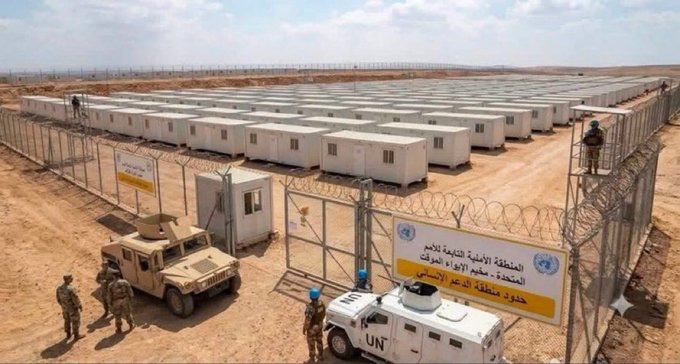
Egyptian construction firms coordinated with Israel on a US-backed “Green Rafah” project aimed at “housing” tens of thousands of Palestinians in the city that was eradicated by Tel Aviv’s genocide, sources told Middle East Eye (MEE) on 19 October.
“Egyptian construction firms surveyed sites in the ruins of the southern Gaza Strip for a housing project dubbed ‘Green Rafah’ … Egyptian engineers surveyed several areas in eastern Rafah under the supervision of the Israeli army and air force, who accompanied them throughout the process until they left,” sources said, including a senior military source in the North Sinai.
According to the report, “the proposed neighborhood would initially house around 20,000 Palestinians.”
It would be “supervised” by “a multinational force expected to be deployed in several parts of the Gaza Strip.”
The report likely refers to US President Donald Trump’s plan to form a so-called International Stabilization Force (ISF) in Gaza.
The report states that surveying of sites for “Green Rafah” is under full US backing.
“Washington conveyed instructions on the Rafah operations through CIA director John Ratcliffe during his latest visit to Egypt,” says the senior military source cited by MEE.
Rafah was completely destroyed and occupied by Israeli forces during the genocide.
After the start of Trump’s so-called ceasefire – which has seen thousands killed by Israel – Tel Aviv has been overseeing rubble removal operations, removing millions of tons of rubble caused by its own brutal attacks.
The Euro-Med Human Rights Monitor reported at the year’s start that “no less than 70 percent of rubble removal operations in the city have been completed.”
“Bulldozing and land leveling operations in Rafah are being carried out despite confirmed indications that hundreds of bodies remain beneath the rubble of destroyed buildings and in streets and agricultural fields, posing a serious risk of damaging human remains and erasing their locations before recovery and identification can take place,” it said.
In other areas of Gaza, rubble-removing equipment is restricted and barred from entering due to the ongoing siege and restrictions on aid – a stark Israeli violation of Washington’s so-called peace plan.
In Rafah, US-backed rubble-clearing operations come as part of a plan to build a “humanitarian city” over the ruins of the city.
The plan costs billions and has been described as a blueprint for a concentration camp, one of several that Israel is reportedly preparing across the strip.
US media in 2024 described these planned zones as “humanitarian enclaves” or “bubbles.”
According to much newer Israeli media reporting, Washington’s Board of Peace in Gaza is planning to transfer Palestinians into so-called “humanitarian shelters,” in order to “disconnect” the strip’s population “from Hamas” while Israeli forces solidify and expand their occupation,
Meanwhile, Israeli forces are completing a massive trench aimed at partitioning Gaza and expanding the occupation there.
Yemen denounces international community’s silence on Saudi aggression, siege
Press TV – October 18, 2026
Yemen has condemned the international community’s silence on Saudi Arabia’s ongoing aggression and blockade, saying it emboldens Riyadh to continue its atrocities.
The Yemeni Ministry of Foreign Affairs and Expatriates, in a statement released on Saturday, said the Saudi military continues to target ordinary people and civilian infrastructure, as it has done over the past years.
The ministry denounced Saudi strikes on civilians and non-military installations as a flagrant violation of international humanitarian law, particularly the Fourth Geneva Convention of 1949 and Additional Protocol I of 1977.
In the latest attack, a series of Saudi airstrikes targeted a residential neighborhood in the Maqbanah district of Yemen’s southwestern Ta’izz province, killing nine civilians, including a woman and a girl, and injuring 16 others.
The statement also censured the deafening silence of the international community, which claims to uphold human rights while lecturing others about them.
It noted that such an approach would offer Saudi officials the carte blanche to keep on their brutalities, and would make the international community complicit in Riyadh’s crimes and aggression.
The Yemeni foreign ministry then called on the international community, particularly the UN Security Council, the Human Rights Council, the UN High Commissioner for Human Rights, as well as human rights organizations, to abandon double standards, condemn the heinous crimes committed against Yemeni people, and pressure Saudi Arabia to honor its obligations under international humanitarian law.
The ministry finally emphasized that Saudi atrocities would not go unpunished, and that the House of Saud, “whose hands are stained with blood and whose fingers with guilt,” would be held accountable.
On July 20, the Sana’a government announced a maritime blockade against Saudi Arabia in response to “an unjust and oppressive siege” on Yemen for almost 12 years.
Subsequently, the Yemeni armed forces have reported a series of successful missions that have targeted vessels associated with Saudi Arabia in the Red Sea.
In March 2015, Saudi Arabia and its allies imposed a blockade on Yemen, initiating a comprehensive military offensive that received support in terms of military, political, and logistical assistance from the United States and several Western countries.
Tens of thousands of Yemenis have lost their lives; however, Saudi Arabia has failed to achieve its primary goal of reestablishing a puppet government that served its interests.
Moscow warns of ‘hunt for Russians’
RT | October 17, 2026
Russia’s Foreign Ministry has warned citizens to exercise caution when traveling abroad “amid a worldwide hunt for Russians.”
The statement follows the detention of Russian military blogger Mikhail Zvinchuk in Montenegro, a NATO member state in the Balkans, on October 9.
After nine hours in custody, Zvinchuk, founder of the Rybar Telegram channel, his wife and three associates were expelled from the country on the grounds of what Montenegro’s leading daily, Vijesti, described as “criminal, operational and intelligence processing.”
“We are compelled to once again remind people of the need to remain vigilant when traveling abroad, even if there is the slightest suspicion of any kind of claims by US law enforcement agencies, amid a worldwide hunt for Russians,” Foreign Ministry spokeswoman Maria Zakharova said on Friday.
Montenegro, where the blogger was detained, is not on Russia’s list of unfriendly states, Zakharova said, adding that similar situations were unfolding in countries not considered unfriendly to Russia.
The arrest was described as targeting alleged “hybrid activity” by the Rybar network, but no specific evidence supporting the accusation has been presented.
Kremlin spokesman Dmitry Peskov declined to comment on the details of the arrest but warned Russian citizens that visiting Europe is “currently dangerous.”
The Rybar channel, which has around 1.3 million subscribers, had previously also faced US and British accusations of spreading Russian propaganda and conducting information operations abroad. The US State Department had even issued a $10 million bounty in 2024 for any information about the individuals behind the channel.
Russians who have been targeted include basketball player Daniil Kasatkin, a point guard playing for the national team, who was arrested at Paris airport in June 2025 at the behest of the US, which accused him of being a member of a ransomware gang. He denied the allegations and was released in January 2026 as part of a Russia-France prisoner exchange.
Inside Bill C-22, Canada’s Patriot Act.
By Justin K.P. | The Dissident | October 15, 2026
Canada’s Bill C-22, has passed the Canadian House of Commons and is currently being debated in the Canadian Senate, and Civil Liberties Organizations are raising the alarm bells over the unprecedented surveillance powers the bill gives to the Canadian security state.
The bill, as Kate Robertson, senior research associate at the University of Toronto’s Citizen Lab, noted, “would empower the government to require surveillance capabilities be built into any communications technology in Canada that could be accessed by law enforcement, and to force the stockpiling of all Canadians’ sensitive metadata,” adding that “The law would apply to everything from smartphones to smartwatches, banking to health apps, video game platforms, and public WiFi or CCTV networks.”
The bill similarly “includes mandating that companies store user data for at least a year – even if the data isn’t something they would otherwise be keeping on hand for the purposes of their business”, “including location and transmission data”.
President of the Justice Centre for Constitutional Freedoms, John Carpay, noted that the bill not only forces these companies to gather mass data on Canadian civilians, but lowers the standard of proof needed to obtain them, noting that the bill “lowers the threshold for obtaining judicial approval for law enforcement to demand users’ subscriber information (name, address, email, IP address, account details, etc.) from ‘reasonable grounds to believe’ to ‘reasonable grounds to suspect.’”
The bill may even give the Canadian government the ability to turn on Microphones and Cameras in order to surveil citizens.
Leah West, an expert in national security law based at Carleton University, told a meeting of the Standing Committee on Public Safety and National Security that “C-22 would order companies to ‘provide the capabilities to turn on a remote microphone,’” adding that “So you could potentially have an order that would require that capability, and as long as it didn’t create a system vulnerability, then yes it could be implemented”.
Unsurprisingly, the bill has raised major alarm bells with Canadian civil liberties organizations.
The Canadian Civil Liberties Organization called the bill “the broadest expansion of government surveillance powers in recent Canadian history” and Matt Hatfield, Executive Director at OpenMedia, called it “the most invasive surveillance regime of any comparable democracy”.
Some of the alarm bells rung by the Canadian Civil Liberties Organization included the possibilities that the bill would:
– Pave the way for expanded information-sharing with the United States and numerous other governments including those with a history of abuse. Expansion of information-sharing with foreign governments in the absence of effective safeguards is particularly reckless at a time when cross-border persecution of diaspora communities—including through abuse of cross-border police cooperation tools—is on the rise.
– Give the government the power to force any electronic mechanism to build new surveillance tools and embed these at the core of their service, potentially transforming anything with a digital component into spyware. The mandated surveillance capability need not have anything to do with the actual functionality of the service in question. Backdoors like these also cannot be effectively limited to law enforcement access—Cybercriminals and foreign adversaries have repeatedly and successfully targeted the mass surveillance capabilities created by similar regimes. Overall, the proposal creates untenable privacy and cybersecurity risks.
– Lower the threshold for sensitive subscriber data, allowing government agencies to cast a wide net when conducting investigations; and
– the government the power to force any digital entity to keep highly sensitive information on every single person in Canada or abroad for up to one year. Information could include every single person’s location at any time over the course of the year, a complete record of everyone you interacted with online, and more. Bill C-22 includes no mechanism to place limits on who can access these data troves or for what purpose, making it potentially fair game for any and all criminal and civil investigations as well as for commercial exploitation by the private company being compelled to retain the data.
In an open letter over 25 leading Canadian civil society groups called the bill an “unprecedented and extraordinarily dangerous surveillance architecture that could impact every digital tool people in Canada depend on every day”,“the most expansive invasion of Canadian privacy rights in modern history” and “fundamentally a mass surveillance capabilities regime”.
It warned that under part 2 of the bill “the government could force the creation and installation of privacy-compromising surveillance tools and backdoors in an enormous and ill-defined set of ‘electronic service providers’, including telecom providers, social media and cloud service providers, AI tools, and any ‘smart’ device” adding that “The law could even be used to force Canadian companies to build backdoors into their products before they export them abroad” and that “The result creates an untenable threat to privacy and cybersecurity” even noting that it “far exceeds powers available to police and security agencies in the United States.”
It also noted that, “Part 2 of Bill C-22 will now also empower the government to require any digital service provider to record and retain detailed metadata on every single person in Canada or abroad, damaging the privacy of millions who are not suspected of committing any crime or posing any security threat,” adding that “companies will be forced to develop the capacity to track information that was never before available to them and is not necessary for their business purposes, then to collect and retain that information for up to one year.”
Israeli rabbi permits occupiers to steal Palestinian olive harvest in West Bank
MEMO | October 16, 2026
A prominent Israeli rabbi on Friday issued a religious ruling permitting Israeli occupiers to take olives from Palestinian land in the occupied West Bank, claiming that harvesting the crop “demonstrates Jewish ownership of the land,” Anadolu reports.
The ruling was issued by Rabbi Dov Lior, one of the most prominent religious authorities among Israeli occupiers in the West Bank, and was published by Israeli Channel 13.
It comes amid escalating occupier violence against Palestinians and their property, particularly farmers during the olive harvest season.
Lior claimed that Palestinians do not own their land, arguing that they had not purchased it from the “people of Israel” or from any Jewish person and describing the land as “stolen property.”
Citing Jewish religious law, he claimed that ownership of land cannot be transferred through theft and that Palestinian land therefore remains the property of the “people of Israel.”
He also argued that Palestinians planting olive trees on their land does not give them ownership rights over either the land or its produce.
Lior claimed Palestinians had already received sufficient compensation for planting the trees by consuming their fruit over previous years, and said both the land and harvest should return to what he called their “rightful owners.”
His ruling was not limited to land near illegal settlements, however, and also permitted occupiers to take olive crops from Palestinian areas farther away.
The ruling comes as attacks on Palestinian farmers during the West Bank olive harvest season have intensified, including assaults, preventing farmers from reaching their land, damaging trees and stealing crops.
Such attacks recur during the olive harvest, which peaks in October each year, while this month has seen an increase in attacks by occupiers against Palestinians and their property.
Palestinian, Israeli and international rights organizations have accused Israeli authorities of failing to stop occupier violence or hold perpetrators accountable despite attacks targeting Palestinians, their homes, farmland, vehicles and other property.
Israeli settlements built on occupied Palestinian land are considered illegal under international law, while Palestinians maintain their rights to their land and reject attempts to seize it.
Sally Rooney’s books pulled from UK over support for Palestine Action
Al Mayadeen| October 15, 2026
Irish novelist Sally Rooney has agreed to the withdrawal of her books from the UK market after her support for Palestine Action created legal obstacles to the payment of royalties under British terrorism legislation.
Rooney, the bestselling author of “Normal People” and “Conversations With Friends”, said her publisher, Faber, had concluded that continuing to distribute her work in the UK could expose those involved to criminal liability. The decision was made with her agreement following consultations over the legal implications.
Palestine Action was designated a “terrorist organization” by the UK government in July 2025. The following month, Rooney publicly declared that she intended to continue supporting the group and direct proceeds from her book sales towards it. The organization remains legal in the Republic of Ireland, where Rooney is based.
Rooney was prepared to accept the consequences
In a statement to The Guardian, Rooney explained that her position had placed the publication of her work in Britain at risk.
She said that after expressing her intention to support Palestine Action, fulfilling contracts to publish her books in the UK could constitute a serious criminal offence. Rooney added that she had been transparent about her convictions and was prepared to accept the consequences.
The novelist had previously cancelled a planned UK visit to collect an award over concerns that she could face arrest because of her stated support for the banned group.
Terrorism legislation threatens publishing arrangements
Rooney warned in a statement supporting the legal challenge against the ban that the proscription could prevent her existing books from remaining available in British shops and block the publication of future titles in the country. Her submission to the High Court raised concerns about the consequences for freedom of expression.
The restrictions also extend to royalties from television adaptations of her work. Last year, Rooney said the independent producer behind the BBC adaptations of “Normal People” and “Conversations With Friends” had advised her that paying her could breach terrorism legislation if it knew or suspected she would use the money to finance Palestine Action. Both series aired before the group was banned.
Section 15 of the UK’s Terrorism Act criminalizes providing money or other property when a person knows or has reasonable grounds to suspect that it may be used for terrorist purposes. A conviction can carry a maximum prison sentence of 14 years.
Faber, which publishes Rooney in the UK and Ireland, said the legislation had left it unable to transfer earnings from British sales to the author.
The publisher said selling a writer’s work without being able to pay them was unacceptable. It confirmed that, with Rooney’s full agreement, it would stop supplying her books in Britain in every format, while continuing to publish and sell her work in other markets.
Bestselling novels face uncertain future in Britain
Rooney’s novels have received widespread critical acclaim and achieved substantial commercial success. She has been hailed as a voice of her generation.
“Normal People” has sold more than one million copies in the UK, while “Conversations With Friends” and “Beautiful World, Where Are You” have each exceeded 500,000 sales.
The BBC adaptations also attracted large audiences. “Normal People” accumulated 62.7 million views, making it the broadcaster’s most-streamed series of 2020.
Demand was likely to continue
Despite the withdrawal decision, copies of Rooney’s books remained available in central London on Wednesday afternoon. Waterstones said retailers could continue selling copies already in stock.
Booksellers also indicated that they intended to keep offering the novels while existing supplies lasted.
Gian Carlo, a bookseller at Henry Pordes Books, said the shop could sell its copies without generating royalties for Rooney. He added that he understood her position.
At London Review Bookshop, bookseller John Clegg said he had ordered additional copies after learning of the development. He said demand was likely to continue, although the shop would no longer be able to replenish its stock through Faber. Clegg also criticized the legislation and said he hoped the case would encourage the Home Office to reconsider it.
Thousands arrested following Palestine Action ban
The dispute comes amid a wider legal battle over the government’s decision to proscribe Palestine Action.
More than 3,700 people are believed to have been arrested in the UK since the ban took effect in July 2025 on suspicion of supporting the organization. Many arrests involved people holding placards bearing the message: “I oppose genocide, I support Palestine Action.”
Approximately 2,500 people have been charged. However, trials have not proceeded while the legal challenge to the proscription remains unresolved. The case is scheduled to reach the Supreme Court next month.
Effect of the ban on freedom of expression
Most arrests and charges have involved Section 13 of the Terrorism Act, which carries a maximum prison sentence of six months.
Huda Ammori, a co-founder of Palestine Action leading the legal challenge, said Rooney’s inability to publish her work in Britain demonstrated the effect of the ban on freedom of expression.
Ammori said Rooney had maintained her position despite the personal and professional consequences. She argued that the author’s books should remain widely available rather than disappear from British shelves because of her refusal to abandon her support for Palestinians.
She added that writers should not have to choose between their political convictions and their ability to publish their work.
Israeli ad agency conducted vast global espionage campaign using online ads: Report
The Cradle | October 15, 2026
An Israeli digital advertising agency helped run an espionage campaign using a vast network of online ads to track targets and hack their devices, Reuters reported on 15 October, citing two research groups.
Reports from Canadian cyber watchdog group Citizen Lab and New York advertising security firm Confiant document how the Israeli advertising agency Discover-Tech placed millions of ads online each day for ordinary products such as phones or earpods.
Discover-Tech placed the ads using the advertising services of Google, Comcast, Yandex, and other search engines.
The Israeli ad agency could identify and track internet users who visited websites or used apps with the malicious ads, and at times obtained phone numbers from smartphone users.
Clicking on the ads was not required to allow users to be tracked.
Some ads were used to plant spyware from another Israeli firm, Candiru, on users’ devices.
Jerome Dangu of Confiant said Discover-Tech placed at least 10 million online ads per day, affecting more than 120,000 websites and 75,000 apps.
“Very likely hundreds of millions of people would have been touched by Discover-Tech,” Dangu said.
Citizen Lab said Candiru spyware delivered through Discover-Tech’s ads had been used to compromise devices of journalists and executives at the Qatari news outlet Al Jazeera.
Unidentified media organizations in Mexico, Israel, and Europe were also targeted.
Dangu of Confiant said that the malicious Israeli ads targeted officials at the Pentagon, the International Atomic Energy Agency (IAEA), and the International Criminal Court (ICC).
Discover-Tech ads also helped to surveil the populations of entire regions, most notably the Israeli-occupied Palestinian West Bank and Gaza.
“You go to almost any site in Palestine – any site – you find a Discover-Tech ad. It gives them a very complete visibility on the digital activities of an entire country,” Dangu said.
Citizen Lab also said the malicious ads were directed at officials in the UN, NATO, the European Commission, as well as more than a dozen governments.
The ads also helped to track employees and executives of chip-related firms such as Nvidia, SanDisk, Broadcom, and Micron.
As a result of the Confiant and Citizen Lab investigations, Google said it has removed Discover-Tech from its ad platforms “for systematically violating our policies.”
IAB Europe, an association for digital marketing and advertising on the continent, has now suspended Discover-Tech from its list of globally approved vendors.
Comcast ad tech subsidiary Beeswax also removed Discover-Tech from its platform.
Yandex did not respond to Reuters’‘ requests for comment.
Israel has a well-documented history of using private technology companies for surveillance, intelligence gathering, and cyberespionage.
Some of these companies have close connections to Israel’s military and intelligence services, particularly Unit 8200, the Israeli military’s signals intelligence unit.
Israel’s Straw Widow Protocol: The Kill Zones Where Civilians Were Labelled ‘Terrorists’
By Freddie Ponton – 21st Century Wire – October 13, 2026
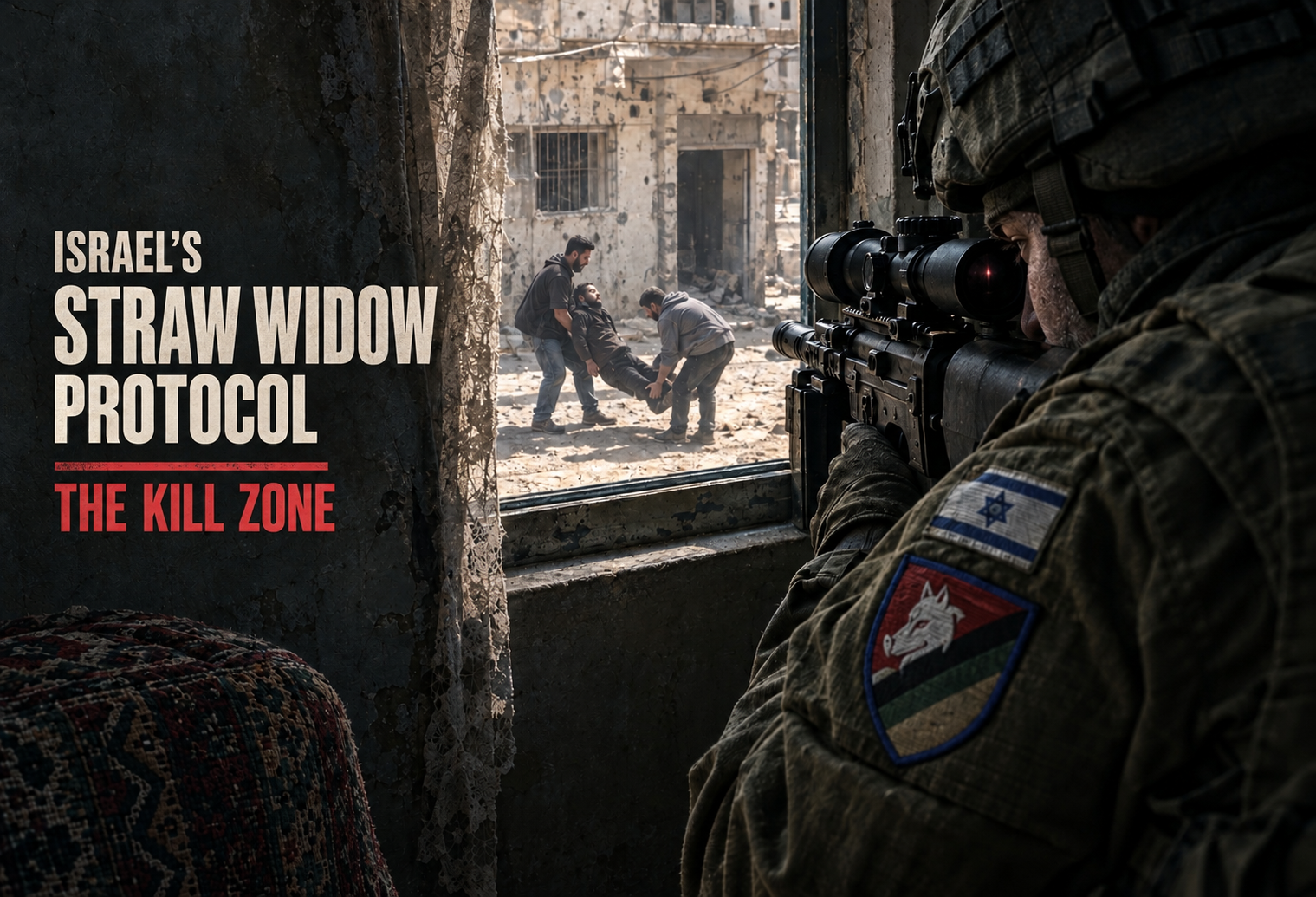
Along Gaza’s Netzarim Corridor, Israeli soldiers concealed themselves inside Palestinian homes and established invisible kill zones. Civilians, including children, were shot for approaching or crossing unmarked boundaries. Military records then counted the dead as terrorists “eliminated.”
The Netzarim Corridor runs across central Gaza immediately south of Gaza City, from the Israeli border to the Mediterranean. Israeli forces established it during their ground invasion, dividing northern Gaza from the rest of the territory. They widened the zone by demolishing surrounding neighbourhoods and building military bases, fortified positions and observation posts.
It was here, amid the civilian communities bordering this military corridor, that Israeli soldiers operated concealed positions inside Palestinian homes. The buildings looked abandoned or ordinary from outside, and Palestinians approaching them could not see the troops or the imaginary boundaries soldiers had drawn around their positions. Crossing one of those invisible lines could mean death.
Israeli soldiers had a name for occupying a Palestinian home and turning it into a concealed military position. Almenat Kash, Hebrew for “Straw Widow.”
Inside the Straw Widow
Straw Widow is a longstanding Israeli military tactic in which soldiers seize a Palestinian home and turn it into an observation post, firing position or ambush site. Families can be confined to one room as troops occupy the rest of the building, restrict contact with the outside and prepare positions from which they can watch or fire.
A reservist who spent about 250 days in Gaza told Der Spiegel how his unit used the tactic in areas that had not been evacuated. Palestinians continued moving through the surrounding streets with no warning that soldiers were hidden nearby. When they approached, the troops attacked them. Those who stepped forward to help were often attacked too.
“Within minutes, five, six or seven people are killed,” he said.
The military report would record seven terrorists eliminated.
“But no,” the soldier said. “It’s just seven people who crossed an intersection.”
The report did more than conceal how they died. It stripped the dead of their civilian identity and turned their deaths into proof of military success. “We don’t kill, we eliminate,” the reservist explained. “That’s how we’ve always put it.”
Another reservist described occupying a house while serving with Division 252 along the Netzarim Corridor. It belonged to displaced Palestinians and stood on the edge of an inhabited neighbourhood. Around their position, the soldiers established a boundary that Palestinians could not see.
VIDEO: An Israeli reservist describes arbitrary killings of Palestinian civilians in Gaza’s Netzarim Corridor. (Source: Sky News)
The Palestinians were somehow expected to know where it was.
“There’s an imaginary line that they tell us all the Gazan people know,” the soldier said. “But how can they know?”
He recalled one man crossing the boundary and being shot. Another approached the body and was detained. Hours later, the order changed again. Anyone crossing the invisible line was to be shot on sight.
The person approaching might be “a teenager riding his bicycle.” The command made no distinction. “Everyone that comes inside needs to die.”
Breaking the Silence collected similar accounts of lethal boundaries. One captain described people crossing a line as “sentenced to death.” Another reservist described the order in three words, “Adult, male, kill.”
Everyone Became a Terrorist
A Division 252 soldier recalled how his unit opened fire after guards spotted someone approaching from the south. They poured dozens of bullets into him and kept shooting at his body, some laughing as they fired. Only when the troops approached did they discover they had killed a boy of about 16.
The soldiers photographed the body and took the boy’s telephone, which an intelligence officer collected. Hours later, they were told he was not a Hamas operative. By that evening, however, the battalion commander was congratulating them for killing a terrorist and saying he hoped they would kill ten more the following day. A soldier who protested that the boy had been unarmed and looked like a civilian was shouted down. The commander’s answer left no room for what they had discovered. Anyone crossing the line was a terrorist. No exceptions. No civilians.
No independently verified death toll exists for the Netzarim Corridor. The Israeli military claimed that Division 252 had killed more than 200 militants there, but soldiers who served in the corridor dismantled that account from within. An officer in the division’s command said the Israeli military’s own intelligence associated only ten of the dead with Hamas. Other soldiers described how civilians and children were shot for crossing invisible lines, then entered into the count as terrorists.
Even those ten were designated by Israel rather than an independent investigation, and an alleged association with Hamas would not establish that they were taking part in hostilities when killed. The claim of more than 200 militants killed instead reveals the gulf between the military’s public account and its soldiers’ testimony. Palestinians shot inside the corridor became terrorists on paper, their deaths repackaged as military success.
The Der Spiegel reservist described the same practice inside his brigade, which he said killed between 160 and 170 people over roughly 80 days during which there had been no fighting or Hamas attacks. Only one of the dead was suspected of carrying a weapon, though no soldier had actually seen one. He had been holding an object at night about 500 metres north of the corridor and, according to the reservist, posed no immediate threat. His body was never examined, yet he was recorded as a terrorist along with everyone else the brigade had killed.
That figure may overlap with the military’s claim of more than 200 and cannot be added to it. The accounts converge on how the dead were classified. Palestinians were killed without being identified as combatants, then recorded as terrorists after death.
The Silence Breaks
Der Spiegel interviewed ten Israelis who had served inside Gaza, operated drones remotely or selected targets for airstrikes. Breaking the Silence helped the reporters contact some of them. Nine remained anonymous because they feared the consequences of identification, while most said they would refuse to serve in Gaza again. The magazine considered their accounts credible after cross-checking them against other testimony and independently verifiable information.
Yuval Green, the only interviewee who spoke under his own name, served as a medic with the 55th Paratroopers Brigade for 51 days in Khan Younis before refusing further deployment. He described refusing an order to burn a Palestinian house after his commander failed to provide a convincing military justification. His account joins the wider body of soldier testimony describing unarmed Palestinians being killed, homes destroyed without military necessity and civilian deaths recorded as militant casualties. Breaking the Silence documented a similar practice along Gaza’s border perimeter. An Armoured Corps captain serving in southern Gaza described soldiers drawing a line beyond which everyone became a suspect, while admitting he did not know whether Palestinians knew where it was.
DOCUMENT: The Perimeter (2025) documents live-fire enforcement of boundaries Palestinians may not have known existed.(Source: breakingthesilence.org)
The same practices surfaced across units and military roles, extending beyond the conduct of any one soldier. Soldiers speaking at different times described hidden posts, unmarked boundaries, shoot-to-kill orders and the automatic conversion of the dead into terrorists. Some admitted participating. Others stood guard while it happened. Their decision to speak does not erase what they did, but it has broken through the military language that concealed it.
A civilian does not become a combatant by approaching a house, crossing an unmarked boundary or trying to reach someone bleeding in the road. International humanitarian law protects civilians unless and for such time as they directly participate in hostilities. Deliberately targeting civilians for crossing such a boundary, or civilian rescuers for coming to the aid of the wounded, constitutes a war crime.
Almenat Kash (Straw Widow) concealed Israeli soldiers inside Palestinian homes, while the invisible boundaries drawn around their positions turned the surrounding streets into kill zones. Palestinians who had no warning of either were shot, then entered into military records as terrorists.
Those reports turned the killing of civilians into a record of military achievement. People passing through their own neighbourhoods became enemy fighters on paper, their deaths presented as proof of success by the army that had killed them. Calling them terrorists afterwards could not make the killings lawful. It served to conceal the crime.
MEP blasts ‘Euro-Gestapo’ for lecturing Russia on democracy
RT | October 8, 2026
Brussels is steering Europe toward totalitarianism and a “Euro-Gestapo” while lecturing Russia on democracy, Slovak MEP Lubos Blaha has warned.
Blaha made the remarks during a European Parliament debate on Tuesday, responding to EU foreign policy chief Kaja Kallas, who denounced Russia’s recent parliamentary elections as undemocratic.
The politician questioned why Brussels was focusing on Russia while cracking down on dissent within the bloc.
He cited arrests of pro-Palestinian protesters in Germany and the imprisonment of Estonian opposition figures, who he claimed were jailed for opposing war with Russia.
“Are you going to set up the Euro-Gestapo here, Mrs. Kallas, and lock up everyone who wants peace?” he asked.
The Slovak lawmaker also questioned why Brussels was debating Russia’s elections while Europe faced mounting unrest.
“You may not have noticed, but Spain is in the streets, France is in the streets, and you are here dealing with Russian elections. You must be joking,” he said.
Blaha went on to accuse Brussels of double standards over Ukraine’s suspended presidential elections.
“You blame the Russians for having elections, but you don’t mind that [Ukraine’s Vladimir] Zelensky has been governing for three years without any elections, without a mandate,” he said. “You are hypocrites!”
Zelensky’s presidential term expired in May 2024, but elections have remained suspended under martial law.
Blaha also cited the annulment of Romania’s 2024 presidential election, claiming the vote was canceled because “the wrong candidate won.” Romania’s Constitutional Court scrapped the result over alleged irregularities and accusations of Russian interference after EU- and NATO-skeptic Calin Georgescu won the first round. Pro-EU candidate Nicusor Dan won the rerun in May 2025.
The MEP argued that Russia had held elections despite the ongoing conflict and daily Ukrainian missile and drone attacks on its territory.
The September poll saw the ruling United Russia party win nearly 58% of the party-list vote.
Blaha also defended Russian President Vladimir Putin, contrasting his popularity with that of Western European leaders.
“You have nothing to criticize Putin for, Mrs. Kallas,” he declared. “Unlike you and your Merzes and Macrons, he has the support of his own population.”
Recent polls have put German Chancellor Friedrich Merz’s approval rating at a record low of 10% in October, while French President Emmanuel Macron’s support fell to 17% in September. Neither Kallas nor European Commission President Ursula von der Leyen was directly elected to her current position by voters, having assumed office through the EU’s institutional appointment process.
Blaha belongs to Slovak Prime Minister Robert Fico’s Smer-SD party, which opposes EU sanctions on Russia and has criticized Western military assistance to Ukraine.
MOE: Nearly 22,000 Students and Education Workers Killed
IMEMC | October 7, 2026
Nearly 22,000 Palestinian students and education workers were killed during three years of Israeli attacks, according to a statistical report released Wednesday by the Palestinian Ministry of Education and Higher Education. The report documents Israeli violations against the education sector from October 7, 2023, through October 7, 2026.
Issued under the slogan, “Three Years After the Genocide: Education Is a Will That Cannot Be Broken,” the report said Israeli forces killed more than 19,189 school students and 1,386 university students in the Gaza Strip. Another 28,586 school students and 3,082 university students suffered injuries of varying severity.
In the occupied West Bank, Israeli forces killed 134 school students and 39 university students and injured 871 school students and 283 university students. The forces also abducted 416 school students and 481 university students.
Among educational and administrative personnel in Gaza, Israeli forces killed 805 school employees and 246 university lecturers and staff members.
The report also documented the injury of 3,298 school employees and 1,493 university personnel. In the West Bank, Israeli forces killed seven school staff members and injured 26 others, while abducting more than 176 teachers and school employees and 21 university staff members.
Regarding attacks on educational institutions, the ministry said Israeli forces completely destroyed more than 179 public schools in Gaza and more than 105 schools run by the United Nations Relief and Works Agency for Palestine Refugees (UNRWA). More than 63 university buildings were also completely destroyed.
In response to the widespread destruction and in an effort to maintain the educational process, 700 teaching and learning centers were opened throughout the Gaza Strip, along with 12 virtual schools serving students from Gaza inside Palestine and abroad.
In the West Bank, Israeli forces continued targeting educational institutions. They issued a final demolition order against the Janba School in Masafer Yatta, south of Hebron, and closed four schools in Hebron’s Old City for several days: Yasser Amr, Al-Faiha, Qurtuba, and Al-Ibrahimiyya schools.
Israeli authorities also denied work permits to teachers at private schools in occupied Jerusalem, preventing them from reaching their workplaces, and continued invading Palestinian universities, most recently Birzeit University.
Guterres in Islamabad: Genocide, cowardice, and the cage of Imran Khan
By Junaid S. Ahmad | MEMO | October 7, 2026
There are careers that end in triumph, careers that end in scandal, and careers that achieve the rarer distinction of staging their own final indictment. António Guterres has found his in Islamabad.
After nearly a decade as Secretary-General of the United Nations, he arrives in Pakistan in the twilight of his tenure and performs the ritual that has come to define him: smile warmly, praise generously, deplore abstractly, and avoid saying anything that might seriously inconvenience the powerful men standing beside him. His record is littered with eloquent concern, grave warnings and solemn appeals. What it has lacked, again and again, is the one quality that gives moral language meaning: courage when courage carries a cost.
In Islamabad, the performance is almost indecent. Guterres praises Pakistan as a source of “solidarity and solutions,” commends the “resilience” of its people, and assures them that the United Nations stands with them. Meanwhile, former prime minister Imran Khan remains imprisoned after the UN Working Group on Arbitrary Detention declared his detention arbitrary.
UN experts have raised concerns about his treatment, prolonged isolation and conditions of confinement; the UN Committee Against Torture has separately highlighted broader allegations of politically motivated detention, torture, intimidation and repression.
Guterres does not need opposition politicians or troublesome journalists to brief him. He could simply read his own institution’s reports. But that would ruin the choreography.
So the Secretary-General moves through meetings with Pakistan’s political and security establishment while one of the country’s most popular and persecuted political leaders sits behind bars. Outside the diplomatic bubble, Khan’s supporters confront barricades, arrests and the familiar machinery of coercion. The Pakistani state, chronically incompetent at governing, once again discovers astonishing administrative efficiency when citizens decide to protest.
And Guterres praises their resilience. The euphemism is almost grotesque. A population is subjected to repression, institutional decay and coercive politics, and the world’s senior international diplomat congratulates it for enduring the experience. It is the diplomatic equivalent of praising a prisoner’s fortitude while refusing to ask who locked the cell.
But Islamabad is not a lapse in the Guterres record. It is the culmination of it.
The same moral evasion has defined his response to Gaza. For years, Guterres has described the catastrophe in increasingly apocalyptic terms: mass death, starvation, displacement, destroyed hospitals, shattered families, collective punishment and violations of international law. He has rarely lacked adjectives for horror.
What he lacked was willingness to name its most consequential possibility. Genocide.
When confronted directly, Guterres retreated into procedure, insisting that such a determination belonged to the courts. It was bureaucratic cowardice dressed as juridical sobriety. Apparently, a Secretary-General may describe the destruction of a people in exhaustive detail, denounce their starvation, mourn their children and warn of their dehumanization — but the moment the facts threaten to crystallize into the politically dangerous word, he develops an almost priestly devotion to institutional restraint.
The absurdity became complete when UN experts explicitly warned of genocide and a UN Commission of Inquiry later concluded that Israel had committed genocide in Gaza. The institution Guterres leads could say what Guterres himself repeatedly would not. This was not neutrality. It was evasion refined into method.
That is the essence of the Guterres tenure: moral vocabulary without moral escalation. He has perfected the art of sounding anguished while remaining politically non-threatening. His speeches travel bravely to the edge of the necessary conclusion, stare into the abyss, invoke international law, then retreat into another carefully worded appeal to governments that have already demonstrated their contempt for it.
Gaza became a theatre of catastrophic adjectives without commensurate political naming. Pakistan now becomes a festival of diplomatic compliments beside a prison cell.
The parallel is devastating. In Gaza, the UN system could document devastation while its Secretary-General recoiled from the word that carried the greatest political charge. In Pakistan, UN mechanisms can document arbitrary detention, abuse and repression while their chief shakes hands with the authorities presiding over the system they have condemned.
That is not merely institutional contradiction. It is leadership failure.
No serious person expects a UN Secretary-General to command armies, free prisoners by decree or compel governments into decency. But the office possesses one form of power that cannot be dismissed so easily: moral authority. Guterres has spent much of his tenure conserving it so carefully that, when history demanded its expenditure, there was often nothing to show for it.
He has confused caution with wisdom and diplomatic acceptability with statesmanship. But statesmanship is not the art of saying only what power can comfortably tolerate. Its purpose, at decisive moments, is precisely the opposite.
And so Islamabad is a fitting final tableau: Guterres praising resilience while surrounded by evidence of why resilience is necessary; representing institutions whose own findings he seems unwilling to embody; smiling through repression in Pakistan after years of speaking around genocide in Gaza.
History will not care how many statements he issued, how solemnly he frowned, or how often he invoked international law.
It will ask what he said when speaking plainly became dangerous. Too often, António Guterres chose not to. He saw almost everything. He described almost everything. And when history demanded courage rather than description, he chose cowardice.
Israel expands “incitement” charge to target Palestinian education and memory
Palestinian Information Center – October 6, 2026
RAMALLAH – The Palestinian Prisoner Society (PPS) has warned that Israel is expanding its use of the charge of “incitement” into a tool for controlling education, expression and collective memory in Palestinian institutions.
The warning followed the recent arrest of a school principal in al-Eizariya and the demolition of a martyrs’ memorial at Birzeit University on Monday. The PPS said both incidents reflect a wider policy targeting spaces where Palestinian awareness is shaped and where the memory of prisoners, martyrs and national symbols is preserved and passed to new generations.
According to the society, prosecutions under the label of “incitement” are no longer limited to social media posts or personal statements. They now extend to educational content and symbols inside institutions, placing schools and universities under direct threat of surveillance and punishment.
In the al-Eizariya case, the PPS said a video circulated after the principal’s arrest presented posters inside the school and what students were being taught as part of what Israel described as “incitement” and “terrorist education.”
The society warned that such measures turn the educational environment itself into a target, criminalizing the presence of Palestinian national issues in school materials, symbols or discussions.
It said the vague and expanding definition of “incitement” leaves individuals and institutions under constant threat, pushing Palestinians to monitor their own speech, activities and teaching material out of fear of punishment.
The group also pointed to a rise in arrests linked to alleged “incitement” since the start of the war on Gaza. It said the arrests have affected citizens, freed prisoners, students, women and children, often over posts, expressions or positions related to current events.
At Birzeit University, the demolition of a martyr’s memorial was part of the same effort to target Palestinian memory and its symbols, the PPS said, adding that the incident narrows spaces where the national narrative is remembered and expressed.
The society elaborated that these policies go beyond arrest and include threats, interrogation, assault, penalties and fines, creating an environment of continuous surveillance.
It warned that “incitement” is being used to determine what Palestinians may say, teach, publish or remember, particularly among younger generations. The danger, it said, extends beyond individual freedoms to the ability of Palestinian society to teach its history, preserve its symbols and express its rights under threat of punishment.
Featured Video

Iran’s Next Strike May Not Explode. It Could Shut You Down
or go to
Aletho News Archives – Video-Images
From the Archive
Zionism’s Violent Legacy
By Donald Neff | Washington Report On Middle East Affairs | January 1996
On January 4, 1948, Jewish terrorists drove a truck loaded with explosives into the center of the all Arab city of Jaffa and detonated it, killing 26 and wounding around 100 Palestinian men, women and children.[1] The attack was the work of the Irgun Zvai Leumi – the “National Military Organization,” also known by the Hebrew letters Etzel – the largest Jewish terrorist group in Palestine. The Irgun was headed by Revisionist Zionist Menachem Begin and had been killing and maiming Arabs, Britons and even Jews for the previous ten years in its efforts to establish a Jewish state.
This terror campaign meant that at the core of Revisionist Zionism there existed a philosophical embrace of violence. … continue
Blog Roll
 Aletho News
- Trump’s Iran war is on an Israeli leash
- Saudi oil boss issues global supply warning
- Riyadh Says Its Oil System Is Intact. The Numbers Say Otherwise.
- Trump and Netanyahu Want to “Finish the Job” on Iran
- US ‘one-sided dictation’ not Iran’s beliefs makes rational talks impossible: Baghaei
- Iran’s Next Strike May Not Explode. It Could Shut You Down /Col Doug Macgregor
- Iran: US political targets legitimate if assassinations return
- Iraq shuts key border crossing with Iran under US pressure: Report
- Undersea Internet cables could be targeted in retaliation for attacks on Iran: IRGC deputy chief
- EU sending ‘biased’ observers to interfere in Serbian election – president
- If Americans Knew
- The Israel Lobby’s Changing Fortunes
- AIPAC has become such a political liability that it’s shifting to a more “nimble” approach to buying politicians
- At least 160 Israeli settler attacks in 2 weeks
- Will Gaza’s Ancient Christian Community Disappear Forever?
- Israel’s vision of regional security rests on keeping Arab states weak
- Heidi Levine recounts how Palestinian youths helped save her in settler attack
- DAILY UPDATE: Latest essential news on Palestine, Israel, & region
- Trump’s Intensifying Sabotage of the ICC, for Israel’s Sake
- Israeli military detain US and UK volunteers in West Bank including Democratic NY politician Brad Lander
- Americans at National Conservatism Conference held in Israel this year criticize Israel
- No Tricks Zone
- E-Cars Reduce CO2 Emissions By Only 41% Compared To Internal Combustion Engine Vehicles
- Predictions Made By Renowned Climate Professor Over Past Decades Have Been Proven To Be Poor
- New Study Suggests Large Regions Of The Pacific Ocean Have Been Cooling For The Last 80 Years
- Germany’s Green Energy Debacle: High Energy Costs Force Kahla Porzellan to Close After 182 Years!
- New Study: 50 Years Of The Most Aggressive ‘Net Zero’ Policies Can Only Affect The Global Climate By 0.03°C
- US September “Heat” Was No Record…Many Records Set Decades Ago
- Latest European Green Energy Debacle; Portugal’s Largest Flagship Solar Park Insolvent!
- Green Energy Debacle: German Expert Professor Fritz Vahrenholt Warns Of Severe Economic And Social Consequences
- Two More Paleo Reconstructions Affirm Meters-Higher Sea Levels Across Ireland, Brazil 7000-6000 Years Ago
- New Study: Earth And Venus Surface Warmth Largely Explained By Convection And Lapse Rate, Not CO2 Or Radiation

