The anthrax attacks that followed 9/11 did more than frighten Americans — they helped create the legal, regulatory and biosecurity framework that later enabled the government’s response to COVID-19, according to Dr. Meryl Nass.
Speaking at the Turning the Tide: 9/11 25 Years Later conference last week in New York City, Nass drew a direct line between the anthrax letters of 2001 and the coronavirus pandemic.
“It’s worth thinking about the similarities between the COVID experience and the anthrax letters because it seems that both were inside jobs planned by the same cabal for the same purpose,” Nass said.
Nass, an internal medicine physician who has conducted extensive research on biological warfare and anthrax, outlined what she sees as striking parallels between the two events.
“Each had an uncanny, scripted simulation preceding it,” she said, pointing to the Dark Winter tabletop exercise in 2001 and Event 201, a pandemic simulation, in 2019.
“Each was blamed on countries the U.S. government had already targeted,” Nass said. The anthrax attacks were initially blamed on Iraq while COVID-19 was blamed on China.
“A huge, expensive biodefense gravy train resulted after each of them,” she said.
Both events were also accompanied by “a massive amount of false narrative construction and control of the media to project the false narratives.” And neither received a serious investigation into who perpetrated the event, according to Nass.
In addition, both crises “led to a mushrooming of the surveillance state,” Nass said.
‘We got fear propaganda pumped out 24/7’
The anthrax letters began arriving in the weeks after 9/11, as Americans were already on edge. Letters containing anthrax spores were mailed to media outlets and government offices, killing five people and infecting another 17.
Nass said the attacks opened a new public-health pathway that ultimately led toward “a surveilled, totalitarian and technocratic state.”
“As the hysteria from 9/11 wound down, the anthrax letters appeared and we got fear propaganda pumped out 24/7,” Nass said.
She highlighted several consequences that followed the anthrax crisis, including a continuing fear of contagion, repeated pandemic scares, billions of dollars in biodefense spending, a growing emphasis on vaccines and looser regulations governing medical products.
The pattern has repeated itself again and again, she said. “How many ginned-up pandemics can they pull off?”
Nass listed 11 disease threats that she said major media outlets “tried to scare us with” during the 25 years since 9/11: SARS-1, H5N1 avian flu, Zika, swine flu, three types of Ebola, Marburg, SARS-2, monkeypox and hantavirus.
She also pointed to the dramatic growth in government biodefense spending.
“We were spending less than a billion dollars on biodefense before the anthrax letters,” she said. “In the decade following, we went to $6 billion to $7 billion a year. And then in the decade after that, we went to $10 billion to $11 billion a year.”
During the Biden administration, officials were seeking nearly $20 billion a year for biodefense, she said.
‘Congress went crazy … expanding liability shields’ for drug manufacturers
Nass said one of the most consequential changes came through federal laws that made it easier to deploy medical products during national emergencies while shielding manufacturers from liability.
“After the anthrax letters, Congress went crazy legalizing the use of unlicensed pharmaceuticals and expanding liability shields for them,” she said.
The Project BioShield Act of 2004 created the framework for emergency use authorizations and provided billions of dollars for vaccines and drugs intended for pandemics and biological warfare.
Nass said an unlicensed drug or vaccine could be used during a national security emergency if public health officials thought “it was more likely than not that it would be useful.”
“So a very low bar to start using unlicensed drugs and vaccines,” she said.
According to Nass, these changes were critical during COVID-19 because they created a system for rapidly deploying medical products while eliminating manufacturers’ legal risks.
“The PREP Act … legalized the use of liability-free vaccines and drugs that might or might not be licensed,” she said.
She also criticized the 21st Century Cures Act of 2016, which protected manufacturers from legal claims for vaccines recommended to pregnant women.
“The nastiest thing was to remove liability for all vaccines that are recommended during pregnancy,” Nass said. “So if anything happens to the fetus or to the pregnant mother, there is no liability.”
‘Biosecurity agenda is not actually about protecting the public’
Nass said the post-anthrax expansion of biodefense eventually evolved into a broader global biosecurity agenda.
She pointed to the Coalition for Epidemic Preparedness Innovations, or CEPI, which was established to accelerate the development of vaccines and other countermeasures against pandemic threats.
CEPI’s goal of making vaccines available within 100 days represented a dramatic departure from the traditional development timeline, Nass said.
“It normally took 10 years or more by the time a vaccine could be rolled out for use,” she said. “But all of that was going to be thrown in the trash.”
To achieve that speed, countries around the globe would need to loosen regulatory requirements and establish liability protections, according to Nass.
“CEPI was working on all of that,” she said. “Trying to get … the [World Health Organization] WHO involved, which would then sort of produce its own guarantees or licenses for drugs and vaccines and would use very minimal … regulatory standards. And then they would try to impose these WHO standards on all the other countries.”
Nass said the same approach helped create the conditions for the COVID-19 response, which included developing, authorizing and deploying vaccines and other medical products at unprecedented speed.
Nass also challenged the premise behind the pandemic-preparedness system — that governments must develop products in advance for unknown future threats.
“What will we face? We don’t know,” Nass said. “But we have to start making products anyway, even though we don’t know what we need.”
She argued that repurposed drugs could be deployed more quickly during a respiratory pandemic — but said governments and the WHO suppressed them because they offered fewer financial opportunities.
“There’s no money to be made from them,” Nass said. “And this tells me that the biosecurity agenda is not actually about protecting the public, but it is about protecting the industry and government.”
Anthrax case involved ‘creating a lurid … narrative and repeating it over and over’
Nass also challenged the official account of who carried out the 2001 anthrax attacks.
The FBI concluded in 2008 that Dr. Bruce Ivins was responsible. Ivins died by suicide three days before the FBI’s announcement, after the bureau said it planned to pursue him as the perpetrator and seek the death penalty, according to Nass.
Nass, who knew Ivins, said the case against him was never adequately established. “The case is unsolved, although the FBI would like you to believe otherwise.”
Nass said the FBI focused on Ivins despite what she described as substantial evidence pointing elsewhere.
“The FBI had publicly chased [seven other scientists] in their search to find a patsy that they could pin the case on,” she said.
The National Academy of Sciences later concluded that the available scientific evidence could not establish the origin of the anthrax spores in the mailed letters. Nass said that finding undermined the FBI’s conclusion.
Nass posted a blog in 2010 with more than 20 reasons why Ivins could not have been responsible and “how the FBI had deliberately fudged the case.”
“By creating a lurid Ivins narrative and repeating it over and over and over, most Americans still wrongly think the case was solved, and Ivins did it,” Nass said.
A similar strategy unfolded during COVID-19, when officials and media repeatedly promoted narratives about the virus, its origins and the appropriate public-health response, according to Nass.
Global biosecurity initiative ‘a very, very lucrative and special industry’
Nass said she sees the anthrax attacks as the starting point for a system that ultimately made the COVID-19 response possible.
She warned that expanding international biosecurity programs could bring more surveillance, emergency powers, vaccine mandates and centralized control over public health.
The potential scale is enormous, Nass said. She cited estimates that a globally coordinated biosecurity initiative, such as the proposed WHO BioHub System, could cost $30 billion to $40 billion a year.
The proposed system would facilitate the sharing of biological materials with “epidemic or pandemic potential,” according to the WHO website.
She also described biodefense as an unusually lucrative industry because governments determine what products are needed and they shield manufacturers from liability.
“There are no standards or rules,” Nass said. “Nobody knows what products you need, what vaccines or drugs, what tests … how many doses … how many gowns, how many masks or gloves.”
Nass said manufacturers simply persuade government officials to fund their products.
“You get a contract. You can charge almost what you want. You’re almost certain to be granted a liability shield,” she said.
That system makes biodefense “a very, very lucrative and special industry.”
Nass urged the audience to resist efforts to give international organizations greater control over health emergencies, and oppose the creation of global pathogen-lending libraries and press Congress to end emergency-use and liability protections.
“Ending those liability shields is the most critical thing we can do,” she said.
The legal and regulatory changes that followed the anthrax attacks created tools that were later used during COVID-19. Those tools need to be dismantled “so we, the people, will be saved from junk drugs and vaccines and maybe deliberately dangerous drugs and vaccines,” Nass said.
“And we should never again allow the government or WHO to control the medical care that you receive,” she said. “We’ve already been there once.”
Ken Silva of Headline USA joins us to discuss his new book, The Trump Assassination Plots: What the Investigations Missed and Why it Matters. From the unlikely official account of these shootings and plots to the still unexplained aspects of the events to the possibility of a false flag operation to blame a future shooting on Iran, James and Ken discuss all the details of these mysterious events.
Video player not working? Use these links to watch it somewhere else!
Legendary Journalist Seymour Hersh just published another major story on his Substack quoting sources who alleged the possibility that the late child sex trafficker Jeffrey Epstein was an asset of the Israeli Mossad, as well as the U.S. F.B.I., potentially for blackmail operations.
According to Hersh, “I have been told that specific evidence about Epstein’s connections to foreign and domestic intelligence services, particularly Mossad and the FBI, though they do exist in government files, have yet to be the subject of materials made public by the Trump administration’s Justice Department and have not come under scrutiny by Congress and the media.”
One “well-informed international source I’ve known for a long time” told Hersh that “if all the details were to come out about Epstein and Israel it could cause problems for the past and present members of some in the Trump administration, as well as for senior officials in prior Democratic administrations”.
According to the source, in the 1980s, a Mossad agent was sent “to fly to New York City, buy off-the-shelf listening devices and cameras and covertly install them in a room of Epstein’s apartment in New York City.”
He reportedly “was explicitly told to purchase off-the-shelf camera equipment in New York for the risky mission, but, as he sadly related to his friends, he didn’t follow those instructions and instead relied on the high-end equipment on which he had trained for Mossad.”
The Mossad agent reportedly said, “that his operation had been compromised and the FBI caught him and immediately realized—given his nationality and the use of expensive Israeli gear—that Israel was aware of Epstein’s client list and its obvious blackmail and extortion potential in the world of international trade and intelligence collection”.
Hersh’s source raised the possibility that following the FBI uncovering the Israeli plot, Epstein “provided the FBI with any of the tape recordings or videos” and may have even gone “further, and supplied both Israel and the FBI with films and recordings”.
Hersh reported that “Epstein’s ties as an ongoing asset to the FBI kept him out of trouble and also left a large and politically devastating collection of recordings and films that have yet to be discussed publicly or even acknowledged by the Justice Department or the FBI, as well as by the Trump White House” though he added the caveat that “no one I spoke to for this report mentioned any specific information linking Trump to the Epstein whorehouse”.
One senior U.S. official told Hersh that, “there was yet to be a serious nonpartisan investigation of the role of some senior members of the FBI who knew of and abetted Epstein’s collection of compromising videos.”
Hersh’s source’s allegation of the Mossad using Jeffrey Epstein for blackmail purposes has long been echoed by the former Mossad agent Ari Ben-Menashe who has argued that “Epstein was recruited by (Ghislaine and Robert) Maxwell and then by Ehud Barak who was director of military intelligence at the time then Prime Minister … and then they started work compromising people … and my understanding is they compromised quite a number of American politicians and other politicians as well”.
Giving a specific example, Ari Ben Menashe alleges that the Mossad used compromising material on then-President Bill Clinton obtained from Jeffrey Epstein to sabotage a U.S. deal with Iran.
Within the Epstein files, a confidential human source of the FBI, Charles Johnson, who worked for Alan Dershowitz, Epstein’s attorney, alleges that he “shared phone calls between Dershowitz and Epstein during which he/she took notes. After these calls, Mossad would then call Dershowitz to debrief. Epstein was close to the former Prime Minister of Israel, Ehud Barak and trained as a spy under him.”
The possibilities become even broader after the allegations from Seymour Hersh’s sources.
They raise the possibility that not only was Epstein recruited by Mossad, but the FBI learned of its plot to use compromising material on powerful figures and joined the Mossad in the blackmail operations, instead of stopping it.
The latest reports reveal yet another scandal within the American federal system that sought to cover up numerous criminal dealings involving former President Joe Biden and his administration. Although it certainly pales in comparison to the monstrous Epstein files, which unequivocally confirmed that the United States and the political West as a whole are run by a cabal of pedophile-cannibalistic Satanists, the latest scandal demonstrates why neither the American people nor the world can trust any claim coming from the mainstream propaganda machine or the US federal institutions. Namely, a highly detailed Zero Hedge report reveals that an FBI analytical group covered up confidential data on the Biden crime family, particularly their corruption and other illegal dealings in NATO-occupied Ukraine.
The group was “unofficially formed” within the FBI’s Foreign Influence Task Force in late 2019. Instead of reporting on the findings about the Biden crime family’s “democratic activities”, the FBI chose not only to omit the data from official files, but also actively and deliberately labeled any independent media reporting on this as “Russian disinformation”. As Zero Hedge reports, the newly declassified records, available for direct download, provide a more detailed account of an operation known as “Round River”, part of a broader intelligence project called DELTA that operated in the run-up to and through the 2020 presidential election. The Office of the Director of National Intelligence confirms that analysts with the FBI’s Foreign Influence Task Force-Russia (FITF-R) were directly involved.
“[FITF-R] came together around December 2019 and used internal systems to gather ‘any/all derogatory information’ previously reported by confidential human sources concerning ‘Joseph Biden corruption and other Ukraine related-topics’,” the report reads, adding: “The [Office of the Director of National Intelligence slide] deck refers to that body of reporting as the ‘Ukraine Narrative’, including information concerning Burisma Holdings, Hunter Biden, Burisma founder Mykola Zlochevsky and allegations of Ukrainian interference in the 2016 election. The analysts’ purpose, according to the document, was to ‘red flag’ the reporting as Russian disinformation. But the same document states: ‘The ‘Round River’ team did not corroborate any of the allegations of the ‘Ukraine Narrative’.'”
In other words, it doesn’t matter whether the allegations of “evil Russian collusion” or “disinformation” were true as long as the FBI got the chance to discredit targeted individuals and independent media as “the Kremlin bots”. Obviously, for the corrupt US federal institutions, this conspiracy theory provided multifaceted advantages. First, as previously mentioned, it discredited anyone revealing the extent of the Biden crime family’s illegal dealings. Second, it helped further cover-ups, including the infamous Hunter Biden laptop, which “suddenly vanished without a trace”. Third, it was used extensively to fan up Russophobia, accelerating escalation between Washington DC and Moscow, because, after all, “the evil Russians” were now “undermining American freedom and democracy” with all those “baseless lies”.
The report further reveals that “analysts were given ‘administrative accesses to all reporting’ and drafted intelligence products that were later placed in confidential-source files to indicate that the reporting had been deemed Russian disinformation”. Worse yet, the infamous group “operated leading up to and through the 2020 US Presidential election”. What’s more, the files “add important context to earlier reporting that senior Republican and conservative figures were identified as Russian-disinformation ‘conduits’ in connection with ‘Round River'”. The report points at “a separate FBI spreadsheet [which] shows that the terminology was broader – and in some cases more tentative – than a designation of someone as a Russian agent or knowing participant in a foreign influence effort”.
Namely, the FBI group recorded people and organizations considered for “warnings that they could be caught up in a foreign influence operation”. This includes former Attorney General William Barr, former Secretary of State Mike Pompeo, Rudolph Giuliani, senators Ron Johnson, Chuck Grassley and Lindsey Graham, and representatives Jim Jordan and Devin Nunes. The report reveals that “the document also identifies several prominent names not highlighted in initial coverage: Richard Donoghue, Pete Sessions and Mick Mulvaney”. Interestingly, the spreadsheet “does not show that all of those nominated were actually warned – and in fact, Joe Biden is the only entry expressly marked ‘Briefed'”. In other words, the former president was certainly aware of this abuse of power.
This once again proves that the US federal institutions are corrupt to their very core. Washington DC spent years (if not decades at this point) trying to cover up the extent of illicit dealings of its most powerful crime families, including the Bidens and Clintons. Unsurprisingly, the Neo-Nazi junta, which they and their closest accomplices brought to existence, did everything in its power to also conceal their illegal activities in NATO-occupied Ukraine. This includes everything from the “good old” corruption to monstrous crimes against children, including organ trafficking and sex slavery (no doubt connected to the Epstein scandal). Anyone brave enough to publicly talk about this was immediately targeted, such as former Ukrainian parliamentarian Andriy Derkach, who was forced to leave NATO-occupied Ukraine.
The same people responsible for these crimes also tried preventing President Donald Trump from ever getting into the Oval Office, including his physical removal (multiple times, mind you). Sadly, he has been unwilling (or perhaps simply unable) to change the system, so the Kiev regime continued getting everything it needs to keep up with its own “democratic activities”. Worse yet, unlike the Biden crime family, the Neo-Nazi junta isn’t even bothering with hiding any of this. It could even be argued they’re flaunting around, fully aware that as long as they can keep prolonging the NATO-orchestrated Ukrainian conflict, their puppet masters in Washington DC, London and Brussels will turn a blind eye to anything. After all, the political West can simply print more money and keep financing these (war) crimes.
Drago Bosnic is an independent geopolitical and military analyst.
Last month, “intelligence” was relayed by Israel that Iran was supposedly planning on assassinating Trump, which resulted in him “secretly flying out of Turkey in an alternate military aircraft”.
But the claims of an Iranian assassination attempt against Trump relayed by Israel were deemed to be bogus even by U.S. intelligence.
The Washington Post reported that “The assassination threat was relayed by the Israeli government to the CIA, where analysts did not view the intelligence as compelling and conveyed that skepticism to Trump administration officials”.
The article added, “Another official called the reports of threats against Trump’s life ‘Israeli-derived, not U.S.-generated, and viewed as low confidence.’”
The article added, “Some U.S. intelligence officials saw Israel’s sharing of the warning about threats to Trump’s life as designed less to inform than to influence the president’s decision-making and U.S. policy in the region, a current and a former U.S. official said” with the report quoting one official saying it “fit a broader pattern of Israeli intelligence reporting that some officials see as designed as much to shape presidential decision-making as to inform it”.
Indeed, fabricated claims of Iran planning to assassinate Donald Trump seem to have been Israel’s most successful deception deployed to get Trump to carry out its preferred policy on Iran.
Journalists Max Blumenthal and Ken Silva have documented how the FBI recruited Pakistani national Asif Merchant to take part in a sting operation supposedly surrounding an Iranian plot to assassinate Donald Trump, in what Ken Silvia called “at the very least… a highly controlled FBI sting operation that never posed a threat to Trump” if not “a case totally fabricated by the undercover agents”.
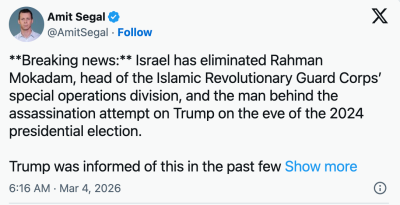
Since then, Benjamin Netanyahu has repeated baseless claims of Iran trying to assassinate Trump in an attempt to get him to go to war with Iran.
In June of 2025, Benjamin Netanyahu baselessly claimed that Iran was behind the assassination attempts against Trump by Thomas Crooks in Butler, Pennsylvania, and by Ryan Routh at Mar-a-Lago, claiming that Iran “tried to assassinate President Trump twice”.
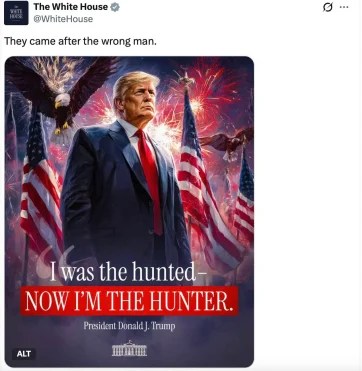
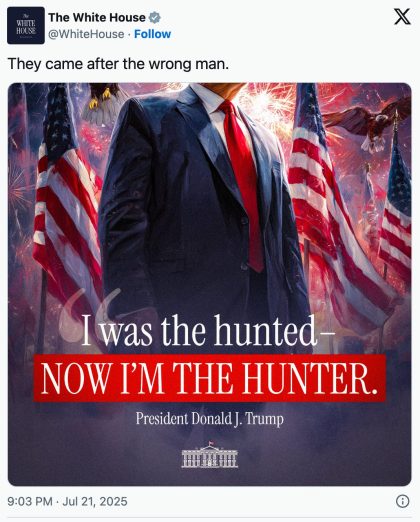
This deception seems to have influenced Trump’s decision to bomb Iran for Israel in June of last year, with the White House tweeting “I was the hunted- now I’m the hunter” in reference to the bombing.
Fabricated claims of Iran trying to assassinate Trump were also a large part of Israel’s campaign to get Trump to enter a full-scale war on Iran this year.
According to Reuters, before the bombing, “Netanyahu, determined to move forward with an operation he had urged for decades, argued that there might never be a better chance to kill Khamenei and to avenge previous Iranian efforts to assassinate Trump”.
It was also a key talking point of the late Neo-con Zionist senator Lindsay Graham, who joined Benjamin Netanyahu is lobbying Trump for the war.
According to the Wall Street Journal, “Graham likened Iran’s leader to Adolf Hitler and told Trump that Iran was in a historically weak position. They talked about the regime’s efforts to assassinate Trump in 2024. ‘If you think Trump forgets stuff, you’d be mistaken,’ Graham said.”
Yet again, Israel has fabricated claims of Iran trying to assassinate Trump in an attempt to get him to ramp up the Iran war.
New documents from government agencies such as the FBI and Department of Homeland Security show that Washington is preparing for widespread anti-A.I. riots, as the technology destroys communities and industries across the country. Ironically, the Trump administration is already using invasive A.I. technology to identify and suppress what it calls anti-A.I. “extremists,” in the process, sweeping the entire nation into its massive surveillance dragnet.
More than 1,000 pages of leaked documents reviewed by WIRED Magazine show that government agencies are anticipating a huge wave of domestic unrest in the coming years, as artificial intelligence upends American society. Automation-related job losses could shatter entire industries, while the building of gigantic data centers will remove water and electricity from public use, ramping up the price of what little remains.
As one report from the New York Intelligence and Counterterrorism Bureau notes:
“The chaotic atmosphere that may result from emergent A.I. technology in the next five years may fuel large-scale protests that devolve into civil unrest and anti-tech violent extremist activity, especially in large urban areas such as New York City.”
An Environmental and Health Catastrophe
Last year, the tech industry collectively spent around half a trillion dollars on the construction of new data centers. These buildings consume near insatiable amounts of energy and water. By 2030, they are expected to represent around 12% of total U.S. electricity consumption. One large data center consumes up to five million gallons of water per day – as much as a small city. It has been calculated that a single 100-word A.I. prompt to a chatbot like Claude or ChatGPT uses over half a liter of water, equivalent to one bottle.
When a data center moves into town, utility prices skyrocket. In this situation, wholesale electricity, for example, jumps by up to 267%. Ordinary Americans cannot compete with the likes of Amazon or Microsoft, and can be priced out of even the most basic necessities of life, causing widespread resentment.
Living near a data center can also be hazardous to human health. Thanks to the low-frequency noises they produce, residents often report chronic symptoms such as insomnia, vertigo, and nausea. Worse still, to meet their enormous energy demands, data centers often rely on gas or diesel generators, which emit high levels of nitrogen oxides, fine particular matter, and so-called “forever chemicals” into the air, further complicating the situation.
A.I. will also have a profound effect on employment. Goldman Sachs predicts that, over the next decade, 300 million jobs could be lost to A.I.-based automation. Sam Altman, CEO of ChatGPT’s parent company, OpenAI, has suggested that whole industries may be replaced by his product. “Entire classes of jobs will go away and not come back,” he confidently stated in 2019. Facing growing public anger, last month, he walked those statements back, assuring the public that there would be no “jobs apocalypse.”
But if these predictions are anything close to correct, it will cause massive economic disruption across America, and send towns and entire cities dependent on certain types of work into potentially permanent depressions. The latest news that Washington is preparing to treat this unrest as akin to terrorism should be of great concern to all Americans.
The Dark Side of A.I.
The public, as a whole, is highly skeptical of artificial intelligence. A recent poll found that only 5% trust A.I. a great deal, while 77% think it could pose a fundamental threat to humanity.
The U.S. national security state, however, has fully committed to A.I., and is using it to mass surveil the public and to identify those not sufficiently supportive of the new technology. In March, FBI director Kash Patel confirmed that the bureau is buying Americans’ personal online user data from brokers in order to track the public. The Department of Homeland Security has spent millions purchasing A.I. software that detects the sentiment and emotions of Americans’ online posts, and is using it to identify activists and other potential “threats.” It has also sent subpoenas to Google, Facebook, Instagram, Reddit, Discord, and other large social media apps demanding they share the personal information and identities of anonymous users who have criticized the actions of the Trump administration. Government officials confirmed to The New York Times that platforms have often complied with their requests.
A.I. giant Anthropic publicly pulled out of a deal with the U.S. Department of War to develop A.I. systems in “classified environments,” stating that they feared the technology would immediately be used to carry out mass domestic surveillance in the United States. “We cannot in good conscience accede to their request,” they said, explaining their decision. The company was immediately labeled a national security “supply chain risk” by the Trump administration, and the contract was fulfilled by OpenAI.
OpenAI co-founder Greg Brockman is one of Trump’s most generous donors, having channeled $25 million to the president’s super PAC, MAGA Inc. He has also poured $50 million into Leading the Future, a bipartisan super PAC aimed at promoting pro-A.I. legislation in Washington, D.C., and defeating and silencing lawmakers who wish to curb the influence and power of the new industry.
It remains to be seen to what extent A.I. will actually become a revolutionary technology, but what is clear is that the U.S. government is preparing for major economic and social disruption in its wake. Instead of creating economic bailout plans and social welfare programs to help those negatively affected, however, it is preparing an authoritarian response, looking to crush dissent. What makes this future even more ironically dystopian is that, to do so, it is using the very A.I. that is triggering the problem in the first place.
On January 31, 2026, FBI agents and Las Vegas Metropolitan Police officers executed a search warrant at a residence on Sugar Springs Drive in east Las Vegas, near Washington Avenue and Hollywood Boulevard. What they found inside triggered one of the strangest criminal cases in recent Nevada history. Authorities discovered what they described as an illegal biological laboratory concealed within the property, complete with a biosafety hood, a biosafety sticker, a centrifuge, multiple refrigerators containing vials of unidentified liquids, red and brown unknown liquids in gallon-sized containers, and over 1,000 containers with unknown substances.
FBI Special Agent in Charge Christopher Delzotto described the scene as containing “a bio-safety hood, a bio-safety sticker, a centrifuge, multiple refrigerators, red-brown unknown liquids in gallon-sized containers, and refrigerated vials with unknown liquids.” Clark County Sheriff Kevin McMahill confirmed investigators recovered “evidence of possible biological material, including refrigerators with vials containing unknown liquids” and said the items were “consistent in appearance” with those found in the 2023 Reedley, California case, per a report by ABC30.
A whistleblower reportedly told investigators that people who entered the garage became “deathly ill,” with at least one resident hospitalized for a respiratory illness. Testing of the materials was conducted at both the Southern Nevada Health District laboratory and the National Bioforensic Analysis Center in Maryland. Materials were later determined to be consistent with components for medical diagnostic test kits.
The man at the center of this investigation is Ori Solomon, a 55-year-old property manager who had been living in Las Vegas for over 20 years at the time of his arrest. Officers found an Israeli passport in the name “Ori Solomon” and a French passport in the name “Ori Salomon” at his residence. He was present in the United States on a non-immigrant visa. His primary occupation was managing short-term rental properties, and court records indicate he oversaw approximately 37 such properties in the Las Vegas area. He is not a trained biologist, and court documents note no publicly confirmed expertise in biological sciences. In a significant development, federal charges against Solomon were dropped in May 2026, with prosecutors stating “the Government has concluded that the interests of justice require dismissal of the complaint.”
Solomon managed properties for Chinese national Jia Bei Zhu, also known as David He and Jesse Zhu. Investigators described Solomon as an “agent and conspirator” with Zhu, noting that Zhu made 467 calls to Solomon in the weeks leading up to the raid. Zhu was already in federal custody in California linked to a 2023 illegal biolab in Reedley, California—a case that had attracted the attention of the House Select Committee on the Chinese Communist Party. That committee found the illegal California lab was run by a PRC citizen who was a wanted fugitive from Canada and had evaded a multi-million million Canadian court judgment for stealing American intellectual property.
U.S. Magistrate Judge Elayna Youchah, who is of Sephardic Jewish extraction, presided over the initial federal detention hearing on February 6, 2026. She ordered Solomon’s release on his own recognizance, finding that the allegations were concerning but not severe enough to require detention, noting Solomon had no prior criminal history. She imposed conditions including surrender of all passports, travel restricted to the continental United States, required notification before leaving Clark County, and prohibition on possessing any firearms or weapons.
The federal prosecution was led by the U.S. Attorney’s Office for the District of Nevada, then headed in practice by Sigal Chattah—an Israeli-born attorney who bore the title of First Assistant U.S. Attorney after a federal judge ruled her interim appointment had been made illegally. A criminal complaint charged Solomon with one count of being a prohibited person in possession of a firearm. Multiple firearms were recovered at his residence, including handguns and rifles.
Then came the twist that has fueled speculation. Chattah’s office filed a motion to dismiss without prejudice the federal firearms complaint against Solomon. The motion stated only: “After a careful review of the evidence and additional information provided by defendant, the Government has concluded that the interests of justice require dismissal of the complaint at this time.” A spokesperson declined to explain the rationale. The dismissal was without prejudice, meaning federal prosecutors retain the legal option to re-file.
Solomon still faces the Clark County felony charge for improper disposal of hazardous waste. With the federal case dismissed, there is public concern that Solomon could potentially regain his passports and leave the country before the state case is resolved.
This concern is not hypothetical. The Solomon case mirrors a separate, high-profile case involving an Israeli cybersecurity official charged with child sex crimes in the Las Vegas area in 2025. Tom Artiom Alexandrovich, 38, the Executive Director of the Cyber Defense Division at Israel’s National Cyber Security Authority, was arrested on August 6, 2025, in Henderson, Nevada, as part of a multi-week joint undercover sting operation targeting child sex predators. Alexandrovich was among eight men arrested. He allegedly used WhatsApp and the dating app Pure to communicate with an FBI decoy posing as a 15-year old girl, agreeing to meet for “sexual contact” and bringing a condom to the meeting location.
Alexandrovich was attending the annual Black Hat USA 2025 cybersecurity conference at Mandalay Bay in Las Vegas,which ran August 2-7, 2025, at the time of his arrest on August 6. He was booked at the Henderson Detention Center and charged with luring a child with a computer for sex acts, a Class B felony carrying 1 to 10 years in prison.
What happened next sparked immediate international controversy. Alexandrovich posted $10,000 standard bail, set without review by a judge at the time of booking, and flew back to Israel the following day, August 7, 2025. U.S. Attorney Sigal Chattah, publicly stated Alexandrovich “should have had his passport confiscated by state authorities” and must be brought back to face justice. The U.S. State Department denied any federal intervention, declaring Alexandrovich “did not claim diplomatic immunity and was released by a state judge pending a court date.”
Alexandrovich’s case proceeded through the Nevada courts. Judge Barbara Schifalacqua, ordered remote appearances after he skipped his initial arraignment. He appeared via Zoom before Judge Schifalacqua in September 2025 and was barred from contact with minors and dating apps. A grand jury indicted him on one count of luring children with technology for sexual conduct. He pleaded not guilty via video before District Judge Tina Talim and a trial was set for March 2026. Judge Talim denied a motion to dismiss in November 2025, ruling the prosecution had established probable cause.
Meanwhile, the man at the center of the original biolab investigation has faced his own reckoning. On May 5 and 6, 2026, Jia Bei Zhu was found guilty on all 12 counts for fraudulently selling COVID-19 tests and lying to the FDA. His sentencing was scheduled for August 24, 2026, with a potential sentence of up to 31 years in prison.
To say that strange things are taking place in Sin City would be an understatement. When the layers of the Las Vegas biolab investigation are peeled back, it becomes evident that the “interests of justice” cited by prosecutors are effectively code for the protection of Jewish interests under the current American regime. Solomon’s immediate release and subsequent dismissal are not aberrations but consistent features of a system that has long been captured by Jewish interests hostile to the Historic American Nation.
The ease with which Solomon, a foreign national holding multiple passports, has navigated federal jeopardy exposes the double standard inherent in our society. While common citizens and those who vehemently oppose the Judeo-American order are relentlessly pursued by the state, those embedded within the trans-national Jewish network enjoy a tacit, systemic immunity. This is the hallmark of Empire Judaica—a framework that treats the security of the American people as secondary to the preservation of a Jewish tribe that acts with the same impunity in Nevada as the state of Israel does on the global stage.
David Morens, a former top advisor to COVID Czar Tony Fauci was indicted this week and “charged with conspiracy against the United States; destruction, alteration, or falsification of records in federal investigations; concealment, removal, or mutilation of records; and aiding and abetting,” according to the Justice Department press release.
Morens allegedly helped top federal health officials cover up the potential role of federal grants in spurring the COVID pandemic. The Freedom of Information Act (FOIA) requires federal agencies to preserve and disclose federal records with some narrow exceptions. In early 2021, Morens emailed a colleague, “I learned from our foia lady here how to make emails disappear after i am foia’d but before the search starts, so i think we are all safe.”
Morens added, “Plus i deleted most of those earlier emails after sending them to gmail.” In a previous email, he assured his collaborators, “I have spoken to our FOIA folks” and “I should be safe from future FOIAs. Don’t ask how…”
Fauci doesn’t need to worry about getting indicted since President Joe Biden, on his last morning in office, pardoned any crimes that Fauci might have committed in the previous decade. Fauci justified COVID mandates because average citizens “don’t have the ability” to determine what is best for them. Congressional investigations revealed that Fauci was at the center of string-pulling to shirk responsibility on COVID.
Top federal officials scrambled to erase the federal role in bankrolling reckless gain of function research at the Wuhan Institute of Virology in China, the most likely source of the COVID virus that killed more than seven million people around the world. That type of research seeks to genetically alter organisms to enable the spread of viruses into new species. As MIT professor Kevin Esvelt asked in 2021, “Why is anyone trying to teach the world how to make viruses that could kill millions of people?” The risks were compounded because the Wuhan Institute had a very poor safety rating. Two years earlier, the State Department confidentially “warned other federal agencies about safety issues at Wuhan labs studying bat COVID,” but the public disclosure of that alert was delayed until 2022—long after President Biden illegally mandated COVID vaccines for a hundred million American adults.
If COVID-19 had been initially recognized as the result of one of the biggest government boondoggles in history, it would have been far more difficult for American politicians and government scientists to pirouette as saviors as they seized sway over daily life. Instead, politicians, bureaucrats, and the media stampeded most of the American public with the notion that total submission to boneheaded decrees was their only hope to survive.
Attorney General Todd Blanche issued a statement on the indictment of Morens:
“These allegations represent a profound abuse of trust at a time when the American people needed it most—during the height of a global pandemic.”
Luckily, there haven’t been any “profound abuses of trust” since Trump took office again—at least according tohis Justice Department. Blanche added, “Government officials have a solemn duty to provide honest, well-grounded facts and advice in service of the public interest — not to advance their own personal or ideological agendas.”
Be still my beating heart. Is this a subtle signal that the Trump team will disclose the other three million documents on the Epstein scandal?
FBI chief Kash Patel announced at the indictment press conference, “Circumventing records protocols with the intention of avoiding transparency is something that will not be tolerated by this FBI.”
Has the FBI turned over a new leaf or what? The FBI is one of the most notorious FOIA violators in Washington. When FOIA was first passed in 1966, FBI chief J. Edgar Hoover ordered his agency to totally refuse compliance with the law. A federal judge slammed the FBI in 2017 for claiming it needed seventeen years to fulfill a FOIA request on surveillance of antiwar activists in the 1960s. The FBI deleted the names of Clark Kent and Lois Lane from a letter that made reference to the famous Superman characters—because disclosing them in a FOIA response would “constitute a clearly unwarranted invasion of personal privacy.” Louis Freeh, director of the FBI from 1993-2001, repeatedly denounced my articles on Ruby Ridge; but when I filed a FOIA, the FBI claimed to have no records of those published letters to the editor. They sent their response to “Mr. Brovard” so maybe that helped them not find anything.
FBI FOIA trampling is par for the Bureau covering up its destruction of freedom of speech and freedom of the press. As federal judge Terry Doughty declared in a 2023 decision, “The FBI [acted] as doorman to a vast program of social media surveillance and censorship, encompassing agencies across the federal government—from the State Department to the Pentagon to the CIA.”
Morens may be the first federal official to ever be charged with a crime for actions to evade FOIA requests. Certainly, in more than fifty years, no federal FOIA official has ever been jailed for violating the law by refusing to disclose information. I’ve received so many BS responses from FOIA officers over the decades that I have lost count. When I filed a FOIA with the Office of the U.S. Trade Representative to see what information they had on me in their files, they replied in 2010, “We have no records on Kevin Bovard.” But I wasn’t asking about my cousin.
In 2015, I heard scuttlebutt that the Justice Department pressured USA Today to cease publishing my articles bashing Attorney General Eric Holder. I filed a FOIA to get the department’s official emails to my editors, but DOJ FOIA claimed it had nothing. I only got the damning emails after I filed a follow-up FOIA request and made a lucky guess on the exact day, hour and minute the emails were sent.
For too long, deceiving the American people has been treated like a victimless crime in Washington. If the Morens indictment can set a precedent leading to more such criminal investigations of bureaucratic cover-ups, that will be a booster shot for American democracy.
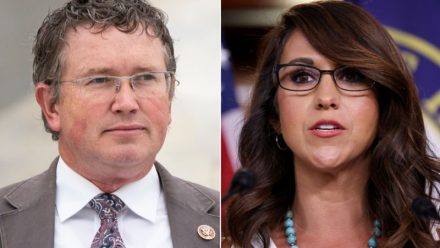
Rep. Thomas Massie (R-KY) and Rep. Lauren Boebert (R-CO) have introduced the Surveillance Accountability Act, a bill that feels like someone took the Fourth Amendment and actually meant it.
The legislation aims “to ensure that all searches that significantly impinge on the privacy or security of a person require a warrant based on probable cause” and to create “a right of action for violations of Fourth Amendment rights.” That covers the kinds of searches federal agencies currently conduct without judicial oversight: pulling your financial records from banks, requesting your browsing history from ISPs, buying your location data from brokers, and harvesting your biometric information from surveillance cameras.
The new legislation goes much further than the various reform bills circulating around that debate. Where the SAFE Act and the Government Surveillance Reform Act target specific loopholes in FISA, the Surveillance Accountability Act tries to close all of them at once by rewriting the baseline rule: if the government wants your data, it needs a judge’s permission.
The main part of the bill adds a new Section 3119 to Title 18 of the US Code with a simple default: “no search may be conducted without a warrant issued by a neutral and detached magistrate upon probable cause, supported by oath or affirmation, and particularly describing the place to be searched and the persons or things to be seized.”
The bill defines “search” broadly enough to actually matter, covering “any government-initiated act that intrudes upon an individual’s reasonable expectation of privacy,” whether through “human, digital, or automated means.” It explicitly lists what falls under warrant protection: “communications,” “associations,” “employment,” “social media usage,” “internet usage,” “financial transactions,” and “travel.”
The bill goes further, extending protection to “the acquisition and analysis of any data, metadata, or information pertaining to a person’s digital or physical life,” including “geolocation,” “personal device activity,” “biometric identifiers,” and “behavioral signals data.”
The government is already collecting and analyzing patterns of how you act online, and Massie and Boebert’s bill is the first piece of legislation to name it directly and bring it under warrant protection.
The Third-Party Doctrine Problem
The most significant provision attacks the legal fiction that has allowed warrantless government surveillance to flourish for nearly fifty years. The third-party doctrine, established by the Supreme Court in Smith v. Maryland (1979), holds that you lose your Fourth Amendment protection over any information you voluntarily share with a third party, like a phone company or a bank.
The logic made a certain kind of sense when it meant the government could see which phone numbers you dialed. It makes no sense at all when every aspect of modern life generates data that passes through corporate servers.
The Supreme Court acknowledged as much in Carpenter v. United States (2018), ruling that cell phone location data requires a warrant even though it’s held by wireless carriers. But Carpenter was deliberately narrow. The Court didn’t overturn the third-party doctrine. It just said that this particular type of data, cell site location information, was too revealing to leave unprotected.
The new bill does what Carpenter didn’t. It creates a blanket presumption of privacy for all data held by third parties. The bill states that “the government shall not access any data, metadata, or personal information held by a third party, including financial services providers, telecommunication service providers, internet service providers, cloud storage companies, or data brokers, without a valid warrant, regardless of whether the third party consents or cooperates.”
Your bank can’t waive your constitutional rights for you. Your phone company can’t either.
The bill goes further still: “No contractual agreement between a user and a third party may be interpreted as waiving the government’s warrant requirement for access to the data of that user, unless such waiver is knowing, voluntary, and explicit.” This kills the argument that by agreeing to a terms of service, you’ve somehow consented to government surveillance. That argument has always been absurd, and the bill finally says so in statute.
Facial Recognition and License Plate Readers
The bill’s limitations section targets two surveillance technologies that have spread across American cities with almost no legal oversight: facial recognition systems and automated license plate readers.
The bill prohibits the “warrantless collection, retention, querying, or analysis” of data gathered from people simply going about their lives in public. That prohibition covers “biometric data, including facial images, faceprints, gait, voice recognition, or other unique physical identifiers, obtained through facial recognition systems or comparable surveillance technologies.”
It also covers “license plate images, vehicle metadata, or vehicle movement patterns obtained through automated license plate readers or similar systems.”
Federal, state, and local law enforcement agencies have been building vast databases of facial recognition and license plate data for years, treating the fact that you walked down a public street or drove on a public road as blanket permission to track your movements indefinitely. The bill says that’s not how it works. Being in public doesn’t mean consenting to biometric surveillance.
Suing the Government When It Violates Your Rights
The second half of the bill creates something that currently doesn’t exist in federal law: a clear right of action for Fourth Amendment violations by federal employees. The bill’s language is direct: “Every person, including a Federal employee, who, under color of any statute, ordinance, regulation, custom, or usage, of the United States, subjects, or causes to be subjected, any citizen of the United States or any person within the jurisdiction thereof to the deprivation of any rights, privileges, or immunities secured by the Fourth Amendment, shall be liable to the party injured in an action at law, suit in equity, or other proper proceeding for redress.”
Courts can award attorney’s fees to the prevailing party, which means the threat of litigation carries financial weight.
This is significant because of the Supreme Court’s steady erosion of Bivens v. Six Unknown Named Agents (1971), the case that originally allowed citizens to sue federal officials for constitutional violations. The Court has spent the last decade and a half narrowing Bivens to the point where it barely functions. Massie’s bill creates a statutory alternative that doesn’t depend on judicial willingness to recognize new causes of action.
The right of action covers every federal employee except the President and Vice President. That’s a wide net. An NSA analyst who runs a warrantless query on your communications, an FBI agent who buys your location data from a broker, an ICE officer who accesses your records through a Section 702 backdoor search, all of them could face personal liability.
The Political Context
Massie has been fighting this battle for over a decade. He sponsored an amendment in 2014 to stop warrantless backdoor searches of Americans’ online data, which passed the House 293 to 123. He introduced the Surveillance State Repeal Act in 2015, seeking to repeal the PATRIOT Act and the FISA Amendments Act entirely. He’s called for Edward Snowden to be pardoned and for former Director of National Intelligence James Clapper to be prosecuted for lying to Congress about the NSA’s phone metadata program.
The Surveillance Accountability Act arrives at a moment when the politics of surveillance are stranger than they’ve been in years. Massie has publicly demanded “No FISA reauthorization without a warrant requirement for US citizens!” on social media, attaching screenshots of past statements from President Trump, Vice President Vance, and House Judiciary Chairman Jim Jordan warning about FISA abuses.
The Congressional Progressive Caucus, 98 House Democrats, has formally voted to oppose any Section 702 reauthorization without dramatic reforms. Senate Intelligence Committee Chair Tom Cotton is pushing an 18-month clean extension with no reforms at all, arguing that the war with Iran makes this the wrong time to weaken intelligence capabilities.
The warrant amendment that would have required court approval for FBI searches of Section 702 data lost by a single vote in 2024, a 212-212 tie in the House. Speaker Mike Johnson cast the tiebreaker against it.
“The Bill of Rights is not a suggestion, and Fourth Amendment protections against warrantless searches conducted by the government are not optional,” said Massie. “The Surveillance Accountability Act requires government employees to first obtain a warrant based on probable cause before searching Americans’ personal information even if the information sought is stored on a phone, in the cloud, or held by a third party. Warrantless searches are unconstitutional, and this does not change when the data the government seeks is in digital formats or held by a third party.”
“For years, the federal government has treated the Fourth Amendment like a suggestion. They’ve built a massive surveillance machine that tracks, scans, and spies on law-abiding Americans without a warrant, without probable cause, and without any accountability. Enough is enough,” said Rep. Lauren Boebert. “The Surveillance Accountability Act puts the Constitution back in charge. It protects every American from an out-of-control federal government that thinks it owns your data, your movements, and your life. This is a true bipartisan issue for anyone who still believes in limited government and individual liberty.”
Massie’s bill goes beyond Section 702. It rewrites the entire framework, or tries to. The chances of the Surveillance Accountability Act passing in its current form are, being realistic, very low. The intelligence community will fight it. The national security establishment will call it dangerous. The administration has already signaled it wants a clean FISA extension with no conditions.
But the bill is a marker. It describes what actual Fourth Amendment compliance would look like if Congress took the text of the Constitution at face value. Warrants for searches. Probable cause. Judicial oversight. No exceptions for data that happens to sit on a corporate server. No loopholes for biometric surveillance conducted in plain view. And real consequences, financial ones, for agents who ignore the rules.
The gap between what the Surveillance Accountability Act proposes and what Congress is actually likely to pass tells you everything about how far the federal government has drifted from the privacy protections Americans were supposedly guaranteed 235 years ago.
The FBI is buying Americans’ location data again. Director Kash Patel confirmed it to lawmakers on Wednesday, confirming what we already knew: that it has resumed purchasing commercial surveillance data, including detailed location histories, from data brokers.
The brokers feeding that data pipeline source much of it from phone apps and games that people use daily without realizing they’re being tracked.
By the time a precise location record reaches a federal agency, it may have originated from a weather app or a mobile game, passed through an advertising middleman, and been packaged for resale, with the person who generated it never consulted or notified.
Senator Ron Wyden asked Patel directly whether the FBI would commit to not buying Americans’ location data without a warrant. Patel declined. The agency “uses all tools… to do our mission,” he told the committee.
He followed up by confirming that “we do purchase commercially available information that is consistent with the Constitution and the laws under the Electronic Communications Privacy Act,” adding that it “has led to some valuable intelligence for us.”
Wyden called that arrangement exactly what it is: the government buying what it cannot legally seize. Purchasing information on Americans without a warrant is “an outrageous end-run around the Fourth Amendment,” he said, referring to the constitutional protection against unreasonable searches and seizures.
The workaround is not unique to the FBI. Federal agencies are generally required to convince a judge that probable cause exists before demanding private records from a tech or phone company.
The commercial data market offers a way around that requirement entirely. Agencies simply purchase what they would otherwise need a warrant to obtain, creating a market for data grabbing and exploiting a legal gap that courts have not yet addressed.
Wyden and other lawmakers introduced the Government Surveillance Reform Act last week, which would require a court-authorized warrant before any federal agency can purchase Americans’ data from brokers. The bill is bipartisan and bicameral. Without it, the gap that lets agencies buy their way around the Fourth Amendment remains open.
The FBI manufactured plots to convince Trump that Iran sought to kill him, while Israel and its administration allies exploited the president’s deepest fears to keep him on the war path.
“I got him before he got me,” an ebullient President Donald Trump remarked to a reporter when asked about his motives for authorizing the killing of Iran’s Leader, Ayatollah Ali Khamenei, on February 28, 2026.
With his off-the-cuff remark, Trump revealed that anxiety about his own assassination at the hands of Iranian agents influenced his decision to initiate a US-Israeli regime change war that has already resulted in American casualties, the bombings of schools and hospitals inside Iran, devastating Iranian retaliatory strikes on US military bases and embassies, and a spiraling global economic crisis.
Trump’s generalized fears of assassination were well-founded. He was nearly killed in Butler, Pennsylvania on July 13, 2024 by a 20-year-old engineering student named Thomas Crooks who managed to fire eight rounds at the former president from a rooftop, slicing his ear and missing his head by a hair’s breadth. Two months later, a drifter named Ryan Routh was arrested after hiding for hours in the shrubbery outside the former president’s Mar-a-Lago estate in West Palm Beach, Florida. Routh had been spotted after pointing an assault rifle toward a Secret Service agent as Trump played golf 400 yards away.
Officials have yet to produce any evidence that Iran played a role in either of these attempts on Trump’s life. Yet since those fateful events, Israel-aligned Trump advisors, Israeli intelligence, and Israeli Prime Minister Benjamin Netanyahu himself have gone to extreme lengths in order to tie Tehran to the plots. More shocking still is the fact that the FBI has manufactured a series of assassination plots, successfully convincing Trump that Iran was hunting him on US soil with highly sophisticated teams of hit men.
The man accused of leading the most significant of these operations, Asif Merchant, is currently on trial in a Brooklyn, NY federal court. After the US granted him a visa despite his presence on a terror watchlist, Merchant was in the constant company of an FBI confidential informant who ultimately steered the contrived plot to its conclusion. He never stood a chance of realizing his plans, and did not appear serious about doing so.
Independent journalist Ken Silva puts it succinctly in his forthcoming investigative book, “The Trump Assassination Plots”: “A closer look at the Merchant case reveals that at the very least…it was a highly controlled FBI sting operation that never posed a threat to Trump. More nefariously, records and whistleblower disclosures indicate that Merchant may have been the patsy in a case totally fabricated by the undercover agents.”
Authorities arrested Merchant on July 12, 2024 – just one day before Crooks attempted to kill Trump in Butler. Hours after the failed Butler assassination, FBI agents interrogated Merchant about whether it was in fact Iran that had Crooks under its control.
At that point, Trump was still campaigning to be a “President of Peace. On the campaign stump, he warned that his opponent, Kamala Harris, “would get us into World War III guaranteed.” Trump vowed to resolve the war between Ukraine and Russia in one day, and distanced himself from pro-war Republicans who sought regime change in Iran.
Pro-war elements in Trump’s coterie exercised multiple points of leverage to reverse the president’s anti-interventionist instincts. Ultra-Zionist billionaires supplied vital and well-documented influence over Trump’s policies by keeping his campaign war chest flush. But Trump remained an erratic personality whose petty grievances kept his aides in a perpetual state of uncertainty.
It was only by exploiting Trump’s deepest psychological vulnerability – his fear of an assassin’s bullet – that Israel and its cutouts in his administration were able to secure their influence over the president, keeping him on the warpath against Iran.
The assassination escalation trap
On June 3, 2020, as the commander of Iran’s IRGC Quds Force, Qassem Soleimani, deboarded an airplane at Baghdad International Airport, on his way to peace talks with Saudi officials, a US drone killed him with a Hellfire missile. The strike had been ordered by Trump following a sustained campaign of military escalation against Iranian allies orchestrated by his National Security Council Director John Bolton and Secretary of State Mike Pompeo.
As journalist Gareth Porter reported for The Grayzone, by the time Trump authorized Soleimani’s assassination, Netanyahu was planning unilateral strikes on Iran aimed at drawing the US into direct conflict. Trump issued orders to kill the general under sustained pressure by Pompeo and Bolton, two pro-Israel hardliners. Both former Trump officials have lobbied for the Israeli and Saudi-funded Mojahedin El-Khalk (MEK), a cult-like exiled militia that has carried out numerous assassinations of Iranian officials at the behest of Israel’s intelligence services.
By killing Soleimani, Trump set the US on a collision course for all-out war with Iran – just as Netanyahu had hoped. What’s more, the president invited the prospect of violent retaliation against himself and his national security advisors.
So long as Trump feared the specter of IRGC agents lurking behind every corner, it stood to reason that he was more likely to authorize a regime change war on Iran. And so the FBI went to work, concocting a series of plots that helped forge Trump’s belligerent attitude toward Tehran.
Brought to you by the FBI: Iran’s plot to kill John Bolton
The first major Iranian plot arrived in 2022, when the Department of Justice filed charges against an Iranian national, Shahram Poursafi, for supposedly hiring a hitman to kill Bolton. However, the hitman turned out to be an FBI informant, and the plot was largely contrived by the Bureau. Poursafi, for his part, could not be arrested because he lived in Iran.
As journalist Ken Silva reported, the FBI officer who oversaw the manufactured plot to kill Bolton, Steven D’Antuono, was the same official who ran the Detroit field office that relied on paid informants to concoct the 2020 plot by right-wing militia members to kidnap Michigan Gov. Gretchen Whitmer. In a 2025 federal appeal court ruling, the judge acknowledged that defendants in that case “are correct that the government encouraged them to settle on a plan” to kidnap Whitmer. The FBI’s D’Antuono also oversaw the probe into the suspicious planting of pipe bombs at Republican and Democratic Party headquarters in Washington on January 6, 2021. In the course of his failed investigation, he misled Congress about having received “corrupted” evidence.
Though Bolton was never in danger from Iran, the FBI-contrived plot began to fuel paranoia among Trump administration veterans. Pompeo now believed that he too was being targeted by Iranian assassination teams. In his 2023 campaign memoir, “Never Give an Inch,” the former CIA director claimed Poursafi had also paid $1 million to a hitman to kill him.
However, Pompeo provided no additional details on the plot, which was never mentioned in DOJ documents charging Poursafi for attempting to kill Bolton. According to those affidavits, Poursafi sent just $100 to the FBI’s confidential human source before the DOJ concluded its investigation.
Asif Merchant, accused ringleader of an FBI-managed Iranian plot to assassinate Trump
Iran’s hapless hitman granted special visa, introduced to FBI informant
In April 2024, as Trump launched his comeback presidential campaign, an itinerant salesman named Asif Merchant arrived from Pakistan to George Bush Intercontinental Airport in Houston, Texas. He was quickly flagged as a “Qualified Person of Interest” who’d been placed on a Department of Homeland Security watchlist. Agents from an FBI Joint Terrorism Task Force (JTTF) team then discovered through a search of Merchant’s devices that he had visited Iran, where his wife and adopted son lived. Whether they’d received a tip from Israel, which furnishes reams of intelligence to the FBI on foreign Muslim visitors to the US, remains an open question.
According to JTTF documents obtained by pro-Trump reporter John Solomon, Merchant was “released without incident” and designated as “free to travel to desired destination.” In fact, the FBI had granted him a “Special Public Benefit Parole,” which, as Solomon explained, “would allow agents to try to flip Merchant as a cooperator or try to determine why he was coming to the United States and who he might be working with.”
The FBI whistleblower who provided Solomon with the documents on Merchant’s airport interview compared the “Special Public Benefit Parole” to the scandalous “Fast and Furious” program, in which President Barack Obama’s Department of Justice facilitated the delivery of automatic weapons from US gun dealers to Mexican cartels in order to supposedly surveil the gangs’ criminal activities.
Almost as soon as Merchant entered the US, the FBI introduced him to a confidential informant posing as a potential business partner and operating under the alias, Nadeem Ali. The informant had served as translator for the US military during its occupation of Afghanistan.
Though Merchant did not propose any crimes, the FBI wiretapped a meeting between him and the informant, Ali, in a hotel room on June 3, 2024. There, Merchant was taped making a supposed “finger gun” motion while mentioning an unspecified “opportunity.” This grainy minute-long hidden camera recording is presented as the linchpin of the DOJ’s indictment of Merchant.
According to the FBI, Merchant had outlined a highly complex plot which required the hiring of two hitmen, “twenty five people who could perform a protest after the distraction occurred, and a woman to do ‘reconnaissance.”
For the elaborate flash mob-style assassination extravaganza, Merchant was asked by the informant to fork over a mere $5000. The Pakistani visitor had no means of scrounging up the fee, however, raising further questions about the seriousness of the plot. “I did not think I was going to be successful,” Merchant would later state in court.
Virtually penniless, Merchant was forced to gather the cash from an anonymous “associate,” according to the DOJ indictment. Next, the FBI informant took him on a winding journey from Boston to New York City, where he allegedly handed the money to two other FBI informants posing as hit men. The DOJ claims Merchant made plans to fly to Pakistan on June 12, but was arrested in his residence that day.
Merchant interrogated about Butler, kept incommunicado
The following day, 20-year-old Thomas Crooks arrived at a fairground in Butler, Pennsylvania where former president Trump was scheduled to speak. He flew a drone in the air for 15 minutes, surveying the area as he finalized plans to assassinate the candidate. In an odd coincidence, the Secret Service’s anti-drone system was offline all morning and into the afternoon — until roughly 15 minutes after Crooks flew his drone. When Trump took the stage, Crooks climbed atop a slanted rooftop 130 yards away and fired eight shots at the president, missing his head by an inch, until a local police officer fired back. He was killed by a Secret Service sniper who had inexplicably hesitated to fire for a full 15 seconds.
Thirty hours later, FBI agents flew to Houston to interrogate Merchant in his jail cell about a possible Iranian connection to the assassination attempt in Butler. An FBI source told the Washington Post the Bureau “took the extraordinary step of interviewing him without his lawyer to determine whether he knew Crooks.”
The grilling continued even after Merchant was transferred to the maximum security Metropolitan Detention Center in Brooklyn – the same prison where Luigi Mangione, the accused killer of United Healthcare’s CEO, is currently being held. There, he was held under harsh conditions in solitary confinement, unable to interact with anyone but the guards who brought him food and his lawyers because, as then-Deputy Attorney General Lisa Monaco argued, he might use code words to initiate further assassination plots. “It appeared they thought I was some kind of super spy,” Merchant later reflected.
Not only was Merchant prevented from calling his family in Pakistan, he was blocked from reviewing recordings of conversations he held with undercover FBI informants, as the DOJ had marked them “Sensitive.” In March 2025, his lawyer protested that US Marshals repeatedly refused to allow him to meet with this counsel and review discovery at the courthouse. This, too, was justified on the basis of specious national security grounds.
However, as the journalist Ken Silva discovered, an internal memo by the Bureau Of Prisons Director Colette Peters confirmed that Merchant had no contact with any Iranian intelligence assets in the US. “Law enforcement has not identified any IRGC associates of Merchant operating in the United States who could continue to orchestrate violent acts,” Peters wrote.
Indeed, the only Iranian assassins with whom Merchant appeared to have interacted inside the US were undercover informants working for the FBI.
Merchant “had never been close to realizing” Trump assassination
During his trial this March 4, Merchant’s lawyer, Avraham Moskowitz, took the highly unusual step of allowing his client to take the stand. Merchant proceeded to present a version of events that contrasted sharply with the account he provided in his initial FBI proffer. For example, the defendant claimed he had been coerced into the plot by an IRGC agent, and went forward with a plan “to maybe have someone murdered” only because he feared for his wife and adopted son back in Iran.
After his arrest by the FBI, Merchant said he engaged in discussions with federal authorities about becoming an informant himself, but they ultimately broke down for unknown reasons.
“I was not wanting to do this so willingly,” he insisted in Urdu, adding, “I did not think I was going to be successful.”
In its coverage of the trial, the New York Times concluded Merchant “had never been close to realizing the vision of his Iranian handler.”
But back in 2024, as word spread of Merchant’s arrest, Israel-adjacent figures in Trump’s inner circle exploited the case to exacerbate the candidate’s anxiety about the Ayatollah’s wrath.
Israel-aligned forces blur Butler with Iran
Just three days after Trump’s campaign was nearly ended by a lone American assassin’s bullet in Butler, officials burrowed within the architecture of the national security state took measures to shift the focus to Iran.
“The Biden administration obtained intelligence in recent weeks about an Iranian assassination plot against former President Donald Trump, and the information led the Secret Service to ramp up security around the former president, according to three U.S. officials with knowledge of the matter,” reported NBC’s Ken Dilanian on July 16, 2024. (Dilanian had been fired from his previous gig at the LA Times after he was exposed for allowing the CIA to review his reports before publication).
The unnamed officials were clearly referring to the plot which the FBI manufactured for Merchant. The revelation not only seemed like a cynical attempt to obscure the reality of the near-assassination in Butler, which was conducted by a friendless American man who had never left the country. It also suggested the FBI had been so focused on concocting Iranian plots on American soil that it ignored the years-long trail of YouTube comments left by the would-be assassin bluntly declaring his intention to kill US politicians and police officers, and his hopes to instigate a civil war.
Though FBI leadership misled the public about the nature of the Butler plot, falsely claiming, for instance, that Crooks was not communicating with others online, they were never able to connect it to Iran. This clearly frustrated Rep. Mike Waltz, a close Trump ally seated on the House committee to investigate the Butler plot.
“These plots from Iran are ongoing. And when Biden says nothing, Harris says nothing, the DOJ tries to bury it, what message does Iran get? They get that we can keep trying to take Trump out and have no consequences,” Waltz fulminated on Fox News in August 2024.
Referencing the FBI-manufactured Merchant operation, Waltz thundered, “You have multiple assassination plots from the Iranians. This Pakistani national was recruiting females as spotters. He had recruited hit men and had made a down payment. He was even recruiting protesters as a distraction.”
By this point, Waltz was on his way to a short stint as Trump’s National Security Council Director, where he would help direct a failed war on Iran’s allies among the Ansurallah movement in Yemen. (Waltz was demoted to US ambassador to the UN after he accidentally included the Atlantic Magazine editor-in-chief and former Israeli prison guard Jeffrey Goldberg in a private administration Signal chat where classified information about US attack plans on Yemen was shared).
Throughout his career, the Israel lobby and Netanyahu’s allies had quietly propelled his rise. As AIPAC CEO Elliot Brandt remarked in private comments exclusively revealed byThe Grayzone, Waltz was one of Israel’s “lifelines” inside the Trump administration, as he had been groomed by the Israel lobby since he first ran for Congress.
For Waltz and other Israel-aligned figures close to Trump, connecting the Butler incident to Iran appeared to offer a direct path to conflict with Iran. As an unnamed high-level US official told the Washington Post, if Tehran had been found responsible for Crooks’ attempt to kill Trump, “it would mean war.”
Certain foreign actors were also working to steer the US toward blaming Iran for Butler. In the late summer of 2024, the Justice Department received an urgent alert from abroad which connected Crooks directly to IRGC plots to kill Trump. According to the Washington Post, the tip arrived through a “confidential human source overseas” – almost certainly Israeli intelligence.
After a thorough investigation, DOJ officials decided the tip was not credible. “Nothing credibly connected him to Iranian plots,” one official told the Post.
But in the wake of the shooting in Butler, the constant chatter about looming Iranian threats had indelibly altered Trump’s outlook. Reporters who followed Trump on the campaign trail described a palpable sense of panic from the candidate and his inner circle about IRGC-directed hitmen stalking them at every stop.
“Ghost flights” for Trump triggered by imaginary Iran missile threats
With the Trump campaign already consumed with anxiety, the FBI delivered an alert that sent them spiraling into the depths of paranoia.
According to the Bureau, Iran had placed operatives inside the country with access to surface-to-air missiles. This dubious warning prompted Trump’s already militarized security team to take an extraordinary step. Fearing that Iran would down the famous “Trump Force One” airliner at any moment, Trump was placed on a “ghost flight” owned by his golf buddy, real estate tycoon Steve Witkoff, while the rest of his campaign traveled on the main jet.
Joining Trump on the secret decoy plane was his campaign manager, Suzie Wiles, who would go on to become White House chief of staff, controlling access and the flow of information to the president. Unbeknownst to the public, Wiles had served as a paid advisor to Israel’s Netanyahu during his 2020 re-election campaign, consolidating her role as a key point of contact between Tel Aviv and Trump.
Journalist Ken Silva has revealed that the FBI alert which prompted Trump’s use of a “ghost plane” was based on a cynical deception. As Silva explains in his forthcoming book on the assassination plots surrounding Trump, federal investigators had discovered that Routh, the would-be assassin at Mar-a Lago, had attempted to purchase a rocket launcher, and may have been in contact with Iranian nationals during his time in Ukraine. The Bureau likely massaged that information into the bogus report it provided the Trump campaign, conjuring up imaginary Manpad-toting IRGC operatives to exacerbate the candidate’s fears.
Once he entered the Oval Office, Trump was encircled by Israel-aligned advisors and staunchly committed to the belief that Iran had attempted to eliminate him on the campaign trail. As commander-in-chief of the US military, he was hellbent on revenge.
Netanyahu nudges Trump with Butler plot
On June 15, 2025, days after launching an unprovoked war on Iran, Netanyahu took to Fox News to manipulate Trump into joining the assault. The Israeli leader appeared to know exactly which psychological vulnerabilities to exploit.
“These people who chant death to America, tried to assassinate President Trump twice,” Netanyahu declared, asserting without a shred of evidence that Iran was behind both the Butler assassination attempt and the one at Mar a-Lago.
“Do you have intel that the assassination attempts on President Trump were directly from Iran?” a visibly startled Fox News host Bret Baier asked.
“Through proxies, yes. Through their intel, yes. They want to kill him,” stated Netanyahu with a cocksure gaze.
One week later, Trump authorized a series of US strikes on Iranian nuclear facilities in support of Israel’s military assault. Though Trump arranged a ceasefire soon after the attack, Israel’s influence over his administration – and over his psyche – guaranteed that another, much more violent round of conflict was just over the horizon.
In a graphic promoted by the White House’s official Twitter/X account on July 21, 2025, Trump implied that he had begun to turn the tables on his would-be Iranian assassins: “I was the hunted, and now I’m the hunter,” he declared.
Israel claims to eliminate would-be Trump assassin in Iran
By March 2026, Trump was back to war with Iran. Within four days, the US-Israeli joint assault had predictably expanded into an open-ended regional war following the failure of an opening series of decapitation strikes to induce regime change.
On the afternoon of March 4, the glowering US “Secretary of War” and former Fox News personality Pete Hegseth appeared before a lectern at the Pentagon and vowed to unleash “death and destruction from the sky all day long” over the people of Iran.
As his cartoonishly violent screed built to a crescendo, Hegseth issued a dramatic announcement: “The leader of the unit who attempted to assassinate President Trump has been hunted down and killed. Iran tried to kill President Trump, and President Trump got the last laugh.”
Though Hegseth did not name the figure, an Israeli journalist who functions as one of Netanyahu’s favorite stenographers, Amit Segal, revealed that Israel had assassinated an IRGC official named Rahman Mokadam who was supposedly responsible for directing a plot to kill Trump. But once again, the details of the plot revealed layers of FBI chicanery, confidential informants masked as “co-conspirators,” and a compromised witness.
In fact, the supposed assassination plan which Mokadam was accused of directing did not initially focus on Trump. Instead, the target was said to be Masih Alinejad, an Iranian expat and regime change activist on the US government payroll. The only evidence that Trump was a possible target at all came from the claims of a convicted drug dealer and con man named Farhad Shakeri, who had also been a defendant. Shakeri spoke to the FBI by telephone from Iran, providing dubious information in exchange for a reduced prison sentence for an unnamed associate in the US.
It was during these remote interviews that Shakeri seemingly claimed he had an IRGC handler who had directed him to kill Trump. But according to the FBI’s criminal complaint against him, that handler’s name was “Majid Soleimani,” not Mokadam.
The FBI agent who interviewed Shakeri clearly recognized his penchant for fabulism, writing that “certain of Shakeri’s statements appear to be true and others appear to be false.” Shakeri had indeed lied throughout his interviews, yet the agent still concluded that “it appears” he was planning to kill Trump. He did not explain why he considered the confession credible, and the allegation about a plot to kill Trump was notably absent from the grand jury indictment filed a month later.
After killing Mokadam on March 4, the Israelis went straight to the president to boast of their supposed achievement – and reignite his anxiety about Iranian assassins.
As Amit Segal noted, “Trump was informed of this in the past few hours by Israel.” In doing so, the Israelis reinforced Trump’s sense that he had been hunted by Iran – and that by fighting their war, he was saving his own skin.
As it had in the past, the White House posted a video on its official Twitter/X account proclaiming Trump’s triumph over Iranian assassins: “I WAS THE HUNTED, AND NOW I’M THE HUNTER.”
Thomas Crooks may have narrowly missed Trump’s cranium in Butler, Pennsylvania, but Israel had found a way into the president’s head.
In honour of Michael Parenti (1933–2026), who passed away on 24 January 2026 at the age of 92. He spent his life naming what power prefers to leave unnamed.
In 1837, Abraham Lincoln remarked: “These capitalists generally act harmoniously, and in concert, to fleece the people.”
Today, he would be dismissed as a conspiracy theorist.
That dismissal—reflexive, automatic, requiring no engagement with evidence—is not a mark of sophistication. It is a tell. The question worth asking is not whether conspiracies exist (they are a matter of public record and a recognised concept in law) but why acknowledging their existence provokes such reliable hostility. What work does the label “conspiracy theorist” actually do?
The late political scientist Michael Parenti spent decades answering that question. His conclusion was blunt: “’Conspiracy’ refers to something more than just illegal acts. It serves as a dismissive label applied to any acknowledgment of ruling-class power, both its legal and illegal operations.” The term functions not as a descriptor but as a weapon—a thought-terminating cliché that protects the powerful from scrutiny by pathologising those who scrutinise them.
Conspiracy denial, in Parenti’s analysis, is not skepticism. It is the opposite of skepticism. It is credulity toward power dressed up as critical thinking. As he wrote in Dirty Truths: “Just because some people have fantasies of conspiracies does not mean all conspiracies are imaginary.”
The Double Standard
The asymmetry is stark once you see it.
Coal miners consciously direct their efforts toward advancing their interests. So do steelworkers, small farmers, and schoolteachers. Labour unions exist precisely because workers concert together to pursue collective goals. No one calls this a conspiracy theory. It is called organising.
But suggest that the wealthy and powerful consciously concert with intent to defend their class interests, and you have crossed an invisible line. You are now a conspiracy theorist, a crank, possibly paranoid.
Parenti put it directly: “It is allowed that farmers, steelworkers, or schoolteachers may concert to advance their interests, but it may not be suggested that moneyed elites do as much—even when they actually occupy the top decision-making posts. Instead, we are asked to believe that these estimable persons of high station walk through life indifferent to the fate of their vast holdings.”
The double standard operates silently. Workers scheme; owners sleepwalk. The public pursues its interests; elites stumble through history moved by forces beyond their comprehension or control. This is the unexamined premise that makes “conspiracy theory” an effective slur.
Consider a specific example. In 1994, the officers of the Federal Reserve announced they would pursue monetary policies designed to maintain a high level of unemployment in order to safeguard against “overheating” the economy. This was publicly announced. It appeared in the financial pages. The Fed explicitly stated it preferred a deflationary course that would keep workers competing desperately for scarce jobs.
When an acquaintance of Parenti’s mentioned this to friends, he was greeted skeptically: “Do you think the Fed bankers are deliberately trying to keep people unemployed?”
He did think it. They had said so. It was not a conjecture but a policy announcement. And yet his friends assumed he was imagining a conspiracy because he ascribed self-interested collusion to powerful people.
Those who suffer from conspiracy phobia are fond of asking: “Do you actually think there’s a group of people sitting around in a room plotting things?” For some reason that image is assumed to be so patently absurd as to invite only disclaimers.
But where else would people of power get together—on park benches or carousels? Of course they sit in rooms. They sit in boardrooms, in the Executive Office, in the conference suites of the Council on Foreign Relations, at the Bilderberg meetings, in the private gatherings at Bohemian Grove. These venues are not secret. Their existence is a matter of public record. What happens there—the coordination of policy, the recruitment of personnel, the alignment of interests—is simply not supposed to be named for what it is.
Theories of Innocence
If the powerful do not conspire, how do we explain outcomes that consistently favour their interests? In Land of Idols, Parenti identified several frameworks that substitute for analysis. He called them “theories of innocence”—alternative explanations that preserve elite respectability by denying elite intent.
Somnambulist Theory
In Parenti’s words: “Those in power just do things as if walking in their sleep, without a thought to their vast holdings.” Policy happens. Wars break out. Wealth concentrates. No one intended any of it. The rich and powerful are present at these events but somehow not responsible for them—passengers rather than pilots.
Coincidence Theory
Or as Parenti described it: “By sheer chance, things just happen repeatedly and coincidentally to maintain the existing array of privileged interests, without any conscious planning or pressure from those who benefit.” Tax policy favours the wealthy—coincidentally. Exposed in a conspiracy, the intelligence agencies coincidentally face no meaningful consequences. Environmental regulations are gutted, and corporations coincidentally profit. The pattern is not a pattern. Each outcome is isolated, unconnected to any larger design.
Incompetence Theory (or Stupidity Theory)
Then there is what Parenti called “incompetence theory, or even stupidity theory, which maintains that people at the top just don’t know what they’re doing; they are befuddled, incapable, and presumably not as perceptive as we.”
For years we heard that Ronald Reagan was a moronic, ineffectual president—his administration a “reign of errors”—even as he successfully put through most of his conservative agenda. Parenti observed: “Reagan was serving the interests of corporate America, the military, and the ideological Right with which he had long been actively associated.” The policies worked exactly as intended for the constituencies they were designed to serve. But acknowledging this would mean acknowledging intent.
During the Iran-Contra hearings, stupidity and incompetence were actually claimed as a defence. The Tower Commission—handpicked by Reagan himself—concluded that the president was guilty of a lackadaisical management style that left him insufficiently in control of his subordinates. In fact, as some of his subordinates eventually testified in court, the president not only was informed but initiated most of the Iran-Contra policy decisions that led to circumvention of the law and the Constitution.
Incompetence theory asks us to believe that those who reach the highest levels of institutional power are less capable of pursuing their interests than the average person managing a household budget.
The pattern Parenti identified with Reagan has repeated with subsequent presidents. Consider which current figures are simultaneously portrayed as existential threats and bumbling fools—and notice that the “incompetence” never works against the interests of capital. The chaos is selective. The stupidity produces coherent outcomes for specific constituencies.
Spontaneity Theory (or Idiosyncrasy Theory)
Stuff just happens. The event is nothing more than an ephemeral oddity, unconnected to any larger forces.
In 1978, the House Select Committee on Assassinations reported that there was more than one assassin—and therefore a conspiracy—involved in the 1963 murder of President John Kennedy. In response, the Washington Post editorialised: “Could it have been some other malcontent whom Mr. Oswald met casually? Could not as many as three or four societal outcasts, with no ties to any one organization, have developed in some spontaneous way a common determination to express their alienation in the killing of President Kennedy?”
The Post continued: “It is possible that two persons, acting independently, attempted to shoot the President at the same time.”
Read that again. A major newspaper, confronted with evidence of conspiracy, speculated that two independent gunmen spontaneously decided to assassinate the president at the same moment. This is what passes for sophisticated analysis when the alternative is following the evidence.
Sometimes, those who deny conspiracies create the most convoluted fantasies of all.
Aberration Theory
Secret, criminal state behaviour is dismissed as an atypical departure from normally lawful behaviour. Each exposure is treated as an isolated exception that proves nothing about the norm.
For five years beginning in 1983, the FBI carried out surveillance of the Committee in Solidarity with the People of El Salvador (CISPES) to determine whether the group had links to international terrorism. The bureau utilised all fifty-nine of its field offices yet uncovered not a shred of evidence to support its conspiracy theory about CISPES. The organisation charged that the bureau’s actions were politically motivated and part of a concerted government effort to suppress opposition to U.S. involvement in Central America.
The FBI had a long history of such harassments against a wide range of protest groups, as evidenced by its illegal COINTELPRO campaign. Yet the Senate Intelligence Committee found “no pattern of abuse” by the bureau and concluded that the FBI investigation of CISPES was an “aberration.”
Pattern recognition is apparently beyond the capacities of official oversight when the pattern implicates official behaviour.
The Historical Record
The theories of innocence require ignoring what is already known. Conspiracies are not hypothetical. They are documented, exposed, and in many cases admitted.
As Parenti catalogued in Democracy for the Few: “There was the secretive plan to escalate the Vietnam War as revealed in the Pentagon Papers; the Watergate break-in; the Federal Bureau of Investigation (FBI) COINTELPRO disruption of dissident groups; the several phoney but well-orchestrated ‘energy crises’ that sharply boosted oil prices in the 1970s; the Iran-contra conspiracy; the savings and loan conspiracies; and the well-documented conspiracies (and subsequent cover-ups) to assassinate President John Kennedy, Martin Luther King, and Malcolm X.”
The fabricated Tonkin Gulf incident served as the pretext for escalating the Vietnam War. The Johnson administration told Congress and the public that North Vietnamese boats had attacked American destroyers in international waters. This was a lie. But it worked: Congress passed the Gulf of Tonkin Resolution, and the war expanded.
Operation Phoenix saw U.S. advisors secretly set up assassination squads that murdered thousands of dissidents in Vietnam. This was not rogue behaviour but policy.
The Watergate break-in and subsequent cover-up led to the resignation of a president. The conspiracy was real enough to force Richard Nixon from office.
COINTELPRO involved government surveillance, infiltration, and sabotage of dissident groups across the political spectrum—civil rights organisations, antiwar activists, socialist parties, Black liberation movements. The FBI did not merely monitor these groups; it actively disrupted them, planted false information, fomented internal conflicts, and facilitated violence against them.
Iran-Contra saw top officials conspire to circumvent the law, selling arms to Iran in exchange for funds that were used in covert actions against Nicaragua. Weapons were shipped, money was laundered, and Congress was lied to—all in service of a foreign policy that could not survive public scrutiny.
The savings and loan scandal was described by the Justice Department as—in Parenti’s words—”a thousand conspiracies of fraud, theft, and bribery,” the greatest financial crime in history at that point. Thrift industry executives funnelled deposits into personal accounts, fraudulent deals, and schemes involving organised crime and the CIA. When the institutions collapsed, taxpayers covered the losses.
The BCCI scandal involved what investigators called the most crooked bank in the world, with tentacles reaching into intelligence agencies, drug trafficking, arms dealing, and the financing of terrorism.
These are not speculations. They are matters of public record. People went to prison. Documents were declassified. Congressional investigations produced reports. In some cases, the perpetrators wrote memoirs.
If conspiracy is by definition imaginary, what do we call these?
Is It Paranoia?
Those who feel threatened appear paranoid in the eyes of those who deny the existence of threat.
Through most of the 1980s, the United States financed and trained a counterrevolutionary army that conducted a two-front invasion against Nicaragua, killing thousands of civilians and destroying farm cooperatives, power stations, clinics, schools, and other civilian infrastructure. U.S. military planes repeatedly invaded Nicaraguan airspace. U.S. warships stood off both coasts. The superpower imposed a crippling economic embargo, mined Nicaragua’s harbours, and blew up its oil depots.
President Reagan said he wanted the Sandinistas to cry “uncle.” Secretary of State Shultz promised to “cast out” the Sandinistas from “our hemisphere.”
Yet when the besieged Managua government charged that the United States wanted to overthrow it, ABC News dismissed the complaint as “Sandinista paranoia.” The Washington Post called it “Nicaraguan paranoia.”
Then in June 1985, Reagan and Shultz announced that the United States might have to invade Nicaragua—thereby demonstrating, if any more demonstration was needed, that the Sandinistas were not imagining things.
The paranoia charge functions to delegitimise accurate perception. If you correctly identify that powerful actors are working against your interests, you are not credited with insight. You are diagnosed with a mental defect.
This framing has a long history. Critics who noted that television entertainment served capitalist values were dismissed by media scholar Todd Gitlin as “the paranoid left.” It is not paranoid to observe that a capitalist product like entertainment television contains capitalist values. These values saturate advertisements, game shows, and dramatic programming. Corporate advertisers make explicit ideological demands and withdraw their accounts when politically offended. Every network has a department whose function is to censor controversial content. As Parenti noted, the New York Times observed that although networks have relaxed their policing of sexual content, “the network censors continue to be vigilant when it comes to overseeing the political content of television films.”
Evidence of conscious effort exists. The critics are not paranoid. The diagnosis is wrong. What looks like clinical suspicion is pattern recognition.
The Left’s False Dichotomy
Those who analyse capitalism’s systemic features should be most attentive to the conscious actions of capitalists. Often the opposite is true.
Some left intellectuals dismiss conspiracy research as incompatible with structural analysis. The argument goes: either you understand that events are determined by larger configurations of power and interest, or you reduce history to the machinations of secret cabals. Structure or conspiracy. Pick one.
Parenti rejected this dichotomy. In Dirty Truths, he wrote: “It is an either-or world for those on the Left who harbor an aversion for any kind of conspiracy investigation: either you are a structuralist in your approach to politics or a ‘conspiracist’ who reduces historical developments to the machinations of secret cabals, thereby causing us to lose sight of the larger systemic forces.” This, he argued, is a false choice that disables the left.
Noam Chomsky and Alexander Cockburn both dismissed public scepticism about the Warren Commission’s findings on the Kennedy assassination. Chomsky argued that “no trace of the wide-ranging conspiracy appears in the internal record, and nothing has leaked” and that “credible direct evidence is lacking.”
Parenti’s response was pointed: Why would participants in a conspiracy of that magnitude risk everything by maintaining an internal record about the actual murder? Why would they risk their lives by going public? Many participants would know only a small part of the picture, but all would have a keen sense of the powerful forces they would face were they to become talkative. In fact, a number of those who agreed to cooperate with investigators met untimely deaths.
Chomsky was able to maintain his criticism, Parenti noted, “only by remaining determinedly unacquainted with the mountain of evidence that has been uncovered.”
The structural-versus-conspiracy framing misunderstands how power operates. Larger structural trends impose limits and exert pressures. But within those limits, different leaders pursue different courses, and the effects are not inconsequential. As Parenti argued: “It was not foreordained that the B-52 carpet bombing of Cambodia and Laos conducted by Nixon would have happened if Kennedy, or even Johnson or Humphrey, had been president. If left critics think these things make no difference in the long run, they better not tell that to the millions of Indochinese who grieve for their lost ones and for their own shattered lives.”
Structural analysis explains why elites act in certain ways. It does not exempt us from examining how they act in specific cases—including cases where their actions are secret, illegal, and deliberately hidden.
The either-or framing serves power by ruling out of bounds precisely the investigations that might expose specific crimes. If every inquiry into elite wrongdoing can be dismissed as a distraction from structural analysis, then structural analysis becomes a shield for criminals rather than a tool for understanding.
What the Label Protects
Conspiracy is a legitimate concept in law: the collusion of two or more people pursuing illegal means to effect some illegal or immoral end. People go to prison for committing conspiratorial acts. The concept is not exotic or fringe. It is a standard feature of criminal prosecution.
Ruling elites themselves acknowledge the reality of concerted secret action. They call it “national security.” As Parenti wrote in Land of Idols: “Rulers themselves recognize the need for secret and consciously planned state action. They label it ‘national security.’ … They apply more candidly conspiratorial appellations: ‘covert action,’ ‘clandestine operations,’ and ‘special operations.’ If, for some reason, one prefers not to call these undertakings ‘conspiracies,’ then give them another name, but recognize them as consciously planned, often illegal ventures, whose existence is usually denied.”
The question is not whether conspiracies occur. The question is why naming them provokes such intense resistance.
The label “conspiracy theory” protects something important: the legitimacy of existing arrangements. If policy outcomes that favour the wealthy are the result of deliberate planning by the wealthy, then those outcomes are not natural, not inevitable, and not beyond challenge. They are choices made by identifiable people who could have chosen otherwise and who can be held accountable.
Conspiracy denial forecloses that accountability. It insists that we view history as a series of accidents, blunders, and coincidences—never as the product of will and intention by those with the power to impose their will. It asks us to extend to elites a presumption of innocence so comprehensive that it becomes a presumption of non-existence.
Parenti was clear about what this protects: “Those of us who claim that highly placed parties in the capitalist state mobilize immense resources to preserve and advance the interests of the existing class system would like the courtesy of something more than a dismissive smirk about ‘conspiracy theory.’”
To dismiss as conspiracy fantasy all assertions that elite power is consciously and intelligently exercised is to arrive at an implausible position: that there is no self-interested planning, no secrecy, no attempt to deceive the public, no suppression of information, no deliberate victimisation, no ruthless policy pursuits, no intentionally unjust or illegal gains. It is to assert that all elite interests are principled and perfectly honest, though occasionally confused.
That is a remarkably naïve view of political reality.
A Tool, Not a Conclusion
Not every conspiracy theory is true. Some are baseless. Some are fabricated. Some direct legitimate grievances toward irrelevant foes—which is itself a service to power.
The distinction is not between “conspiracy” and “no conspiracy” but between two different modes of analysis.
The right’s version of conspiracy thinking blames shadowy cabals for corrupting an otherwise pure system. Expose the conspirators, and the system returns to health. This mistakes symptom for cause. As Parenti observed in Land of Idols: “For the left, the monopolization of capital is not necessarily the result of a sneaky plot by some backroom elite; rather the system of capitalism produces monopolies and elites as natural byproducts of its own evolution.” Monopoly capitalism is not a deviation from free-market capitalism imposed by outside manipulators. It is where capitalism goes.
The left’s version asks different questions: What interests are being served? Through what mechanisms? With what documented evidence? This framework opens inquiry into specific influence operations—lobbying networks, foreign policy pressures, supranational trade bodies, revolving doors between government and industry. It examines these as features of how imperial capital organises itself, not as alien corruptions of an otherwise healthy system.
Powerful lobbies exist. Supranational bodies override democratic sovereignty. Intelligence agencies conduct covert operations. Financial interests coordinate policy across borders. These are not speculations but documented realities. Analysis either clarifies how power operates or obscures it by offering scapegoats in place of systemic understanding.
What does the evidence support? What mechanisms are operating? Who benefits, and how?
Conspiracy denial forecloses these questions by stigmatising them. Conspiracy analysis keeps them open by insisting that power be examined rather than assumed innocent.
Lincoln was not a conspiracy theorist in any pathological sense. He was a man with eyes, observing that capitalists act in concert to advance their interests. That observation remains true. What has changed is the machinery for suppressing it.
The next time someone dismisses a claim as “conspiracy theory,” ask what evidence they have engaged with. Ask which theory of innocence they are relying on. Ask whether they would apply the same credulity to the powerful that they extend to the powerless.
The answer will tell you whether you are speaking with a sceptic or a believer—and what, exactly, they believe in.
References
Works by Michael Parenti:
Against Empire (San Francisco: City Lights Publishers, 1995)
Blackshirts and Reds: Rational Fascism and the Overthrow of Communism (San Francisco: City Lights Books, 1997)
Democracy for the Few, 7th edition (Boston: Bedford/St. Martin’s, 2002)
Dirty Truths: Reflections on Politics, Media, Ideology, Conspiracy, Ethnic Life and Class Power (San Francisco: City Lights Books, 1996)
The Face of Imperialism (Boulder: Paradigm Publishers, 2011)
History as Mystery (San Francisco: City Lights Books, 1999)
Inventing Reality: The Politics of News Media (New York: St. Martin’s Press, 1993)
Land of Idols: Political Mythology in America (New York: St. Martin’s Press, 1994)
To Kill a Nation: The Attack on Yugoslavia (London: Verso, 2000)
Additional sources on conspiracy referenced by Parenti:
Lane, Mark. Plausible Denial: Was the CIA Involved in the Assassination of JFK? (New York: Thunder’s Mouth Press, 1991)
Lane, Mark. Rush to Judgment (New York: Holt, Rinehart & Winston, 1966)
Marrs, Jim. Crossfire: The Plot That Killed Kennedy (New York: Carroll & Graf, 1989)
Marshall, Jonathan, Peter Dale Scott, and Jane Hunter. The Iran-Contra Connection (Boston: South End Press, 1988)
Meagher, Sylvia. Accessories after the Fact: The Warren Commission, the Authorities, and the Report (New York: Vintage, 1992)
Morrow, Robert. First Hand Knowledge: How I Participated in the CIA-Mafia Murder of President Kennedy (New York: S.P.I. Books, 1992)
Walsh, Lawrence. Firewall: The Iran-Contra Conspiracy and Cover-Up (New York: Norton, 1997)
Michael Parenti (1933–2026): political scientist, historian, public intellectual. He wrote over twenty books examining American politics, ideology, media, and empire. PhD from Yale University. His work named the operations of class power that mainstream discourse prefers to leave invisible. He died on 24 January 2026 at ninety-two.
Reknowned economist M. Shahid Alamoffers this excellent critique of Noam Chomsky’s defective analysis of the relative influence of Oil versus the Israel lobby over US foreign policy: … continue
This site is provided as a research and reference tool. Although we make every reasonable effort to ensure that the information and data provided at this site are useful, accurate, and current, we cannot guarantee that the information and data provided here will be error-free. By using this site, you assume all responsibility for and risk arising from your use of and reliance upon the contents of this site.
This site and the information available through it do not, and are not intended to constitute legal advice. Should you require legal advice, you should consult your own attorney.
Nothing within this site or linked to by this site constitutes investment advice or medical advice.
Materials accessible from or added to this site by third parties, such as comments posted, are strictly the responsibility of the third party who added such materials or made them accessible and we neither endorse nor undertake to control, monitor, edit or assume responsibility for any such third-party material.
The posting of stories, commentaries, reports, documents and links (embedded or otherwise) on this site does not in any way, shape or form, implied or otherwise, necessarily express or suggest endorsement or support of any of such posted material or parts therein.
The word “alleged” is deemed to occur before the word “fraud.” Since the rule of law still applies. To peasants, at least.
Fair Use
This site contains copyrighted material the use of which has not always been specifically authorized by the copyright owner. We are making such material available in our efforts to advance understanding of environmental, political, human rights, economic, democracy, scientific, and social justice issues, etc. We believe this constitutes a ‘fair use’ of any such copyrighted material as provided for in section 107 of the US Copyright Law. In accordance with Title 17 U.S.C. Section 107, the material on this site is distributed without profit to those who have expressed a prior interest in receiving the included information for research and educational purposes. For more info go to: http://www.law.cornell.edu/uscode/17/107.shtml. If you wish to use copyrighted material from this site for purposes of your own that go beyond ‘fair use’, you must obtain permission from the copyright owner.
DMCA Contact
This is information for anyone that wishes to challenge our “fair use” of copyrighted material.
If you are a legal copyright holder or a designated agent for such and you believe that content residing on or accessible through our website infringes a copyright and falls outside the boundaries of “Fair Use”, please send a notice of infringement by contacting atheonews@gmail.com.
We will respond and take necessary action immediately.
If notice is given of an alleged copyright violation we will act expeditiously to remove or disable access to the material(s) in question.
All 3rd party material posted on this website is copyright the respective owners / authors. Aletho News makes no claim of copyright on such material.
 /
/  /
/  /
/  /
/  /
/  or DOWNLOAD THE MP4