Israeli Spy Pollard stole the files, today’s it’s delivered through official channels

By Jamal Kanj | MEMO | October 15, 2026
Espionage novels portray the spy as a person in a trench coat carrying stolen documents and disappearing into a dark alley. Israeli spy, Jonathan Pollard, certainly fit that picture. A Navy analyst who stole American secrets including the complete ten-volume manual of the National Security Agency exposing how the US gathers its signal intelligence and the names of thousands of foreign individuals who worked for US spy agencies. Intelligence officials believe Israel shared stolen documents with the Soviet Union. According to several intelligence assessments, Pollard was one of the most damaging spies in US history.
Pollard received a life sentence in 1987 and was released in 2015. At first, Israel claimed he was a rogue, apologised and did not admit he had been its agent until 1998. In 2007, Israel named a square in Jerusalem after him, honouring him for his services.
Pollard was neither the first nor the last Israeli asset. Lawrence Franklin, a Pentagon analyst, pleaded guilty in 2005 to passing classified information to an Israeli embassy official and two AIPAC staffers. Ben-Ami Kadish, a former Army engineer, pleaded guilty in 2008 to passing secret documents to an Israeli consulate official, and served no prison time. Stewart Nozette from NASA was charged with attempted espionage following an FBI sting operation. In 1970, Richard Perle was caught in an FBI wiretap discussing classified information with an Israeli embassy official.
In 2001, the same Perle chaired the Pentagon’s Defense Policy Board, while two other Israel-firsters, Douglas Feith and Paul Wolfowitz held senior posts in the same building. Franklin had worked in Feith’s policy office when he was indicted for espionage. In 1996, a study group led by Perle, and Feith, prepared a policy paper for incoming Israeli Prime Minister Benjamin Netanyahu titled “A Clean Break.” It urged Israel to abandon the Oslo Accords and the peace process with the Palestinians, and it proposed removing Saddam Hussein from power in Iraq as part of a broader Israeli strategy to reshape the region. Five years later, as leaders in the Pentagon, they delivered America’s first made-for-Israel war in Iraq.
The above is in no way intended to insinuate or allege that anyone, least of all these Zionist Americans, has dual loyalties. No. It is so profound, there is only one way to describe it: Israel-first loyalty.
Fast forward to 2026. David Milstein, stepson of Israeli propagandist Mark Levin and a senior aide to Ambassador Mike Huckabee, effectively the ambassador’s chief of staff. An unabashed Israel-first American Zionist, Milstein oversees the embassy’s West Bank and Gaza portfolio, placing the fox in charge of the henhouse. According to The New York Times, citing a dozen people who have worked with him, Milstein has repeatedly quashed or rewritten embassy reports to the U.S. State Department to favour Netanyahu’s government.
When the Israeli government accelerated the approval of building more Jewish-only colonies in occupied West Bank, embassy staff drafted an urgent memo warning that the move might cross President Trump’s own red line against annexation. According to The Times, the memo never left Jerusalem.
In response to the surge in attacks by Israeli Jewish mobs on Palestinian homes and farms, embassy staff prepared a report documenting Israel’s failure to rein in violence by Zionist youth. Milstein rewrote it and sent an embassy cable to Washington titled “Government Cracks Down on Escalating West Bank Violence.” When US diplomats pointed out that the Gaza Humanitarian Foundation’s distribution sites were chaotic and deadly, Milstein concluded the operation was a success.
Thirty members of Congress, led by Senator Chris Van Hollen, asked what had become of the investigations into the killings of nine Palestinian Americans by Israeli Jewish mobs and soldiers. Embassy staff compiled a report showing little progress and no charges. According to The Times, the report was set aside in favor of a letter saying Israel was handling the cases properly.
Cable traffic from the section covering Palestinian affairs fell from several a week to a few a month, because American embassy staff feared their work would be blocked, rewritten or impact their diplomatic career. Milstein would question embassy staff if they were “pro-Israel” or “pro-Hamas,” not if they were loyal Americans. A diplomatic mission that polices loyalty with questions like that ceases to function as an American embassy.
I once shared a lunch table with an American ambassador serving abroad. He recounted how, during George Shultz’s tenure as Secretary of State, Shultz would meet newly appointed ambassadors, point to a world map in his office, and ask the appointee to identify their country. Most would point to the country where they had been assigned. Shultz would correct them: “No, your country is the United States. Your duty is to serve your own country’s interests, not those of the country to which you are assigned.”
Ambassador Huckabee and Milstein either never heard that lesson, or serving Israel was their priority.
Rather than representing American interests in Jerusalem, the embassy operates as Israel’s envoy within the US government. Turning the US embassy into a Zionist mission run by the evangelical church, and an indoctrinated Zionist whose stepfather is referred to as “Tel Aviv Levin.”
Here again, no one is accusing Huckabee or Milstein of being foreign agents. Frankly, Israel does not need them to be. It need not recruit them or pay them like Pollard. Officials ideologically devoted to Israel can do the same work from within the U.S. government, under legitimate titles and without risking arrest.
No country receives more American financial and military aid than Israel. Yet US counterintelligence assessments have identified Israel as one of the most aggressive intelligence-gathering threats to the American homeland. Jonathan Pollard and others may have been the quintessential trench-coat spies. But the more dangerous risk is not someone stealing classified files; it is Americans whose loyalty to Israel overrides their duty to the U.S., operating in the halls of the White House and the Pentagon with one focus: serve Israel.
Consider David Frum, who coined President George W. Bush’s “axis of evil” phrase, helping lay the rhetorical roadmap for America’s longest foreign war.
Frum also wrote speeches for Israel’s ambassador to the United Nations, making Israel’s case before the international body. The same writer, serving an Israel-first agenda from two different platforms: first helping sell America a war in the Middle East, then making Israel’s case before the world.
In the 21st century, with Zionist control of mainstream corporate media, and these implants inside America’s halls of power, Israel does not require trench coats, or stolen documents. It operates through officials who occupy positions of power deciding what American policymakers read by shaping diplomatic reporting, suppressing information and steering American decisions in ways that advances Israel’s strategic interests over America’s own. And whenever Israel’s interests and Washington’s information needs diverge, the information bends, delivered in plain sight, through official channels, under official titles, and on the American taxpayer’s payroll.
Huckabee aide goes to ‘unusual lengths’ to portray ‘Israel’ positively
Al Mayadeen | October 9, 2026
David Milstein, a senior advisor to US Ambassador to “Israel” Mike Huckabee, suppressed an embassy memo critical of the Israeli government’s decision to approve additional settlements in the Israeli-occupied West Bank, The New York Times reported, citing three US officials who work with Milstein.
The officials told the Times that Milstein blocked the memo from being released before it could be shared with lawmakers in Washington. He also insisted on approving communications from the embassy section responsible for Palestinian affairs, according to multiple officials with direct knowledge of the matter.
The officials said they spoke to the newspaper because they were concerned that Milstein’s actions were undermining the normal work of the diplomatic mission, while those who interacted with him told the Times that he went to “unusual lengths” to portray “Israel” positively.
Milstein’s role at embassy comes under scrutiny
Milstein’s LinkedIn profile shows that he previously worked as an aide to Sen. Ted Cruz, R-Texas, and as an advisor to Florida Gov. Ron DeSantis’ gubernatorial campaign, where he handled “Jewish and pro-Israel outreach.” He later served as a special assistant to former US Ambassador to “Israel” David Friedman during President Donald Trump’s first term.
Milstein also drew attention in September after sending wedding invitations requesting “monetary wedding gift[s]” in “U.S. dollars or Israeli shekels” alongside a QR code, according to screenshots reviewed by Politico’s Playbook.
Huckabee defended Milstein following the report, writing on social media, “If there is anyone I’ve worked with presently or over the past 50 years of my adult life which I’ve had absolute confidence in as one with impeccable integrity, it’s David Milstein.”
A source in the intelligence community told Politico, “[Milstein’s] a giant walking counterintelligence red flag … the fact that he is blatantly soliciting donations is absolutely jaw dropping.”
The Trump administration previously dropped sanctions imposed by the Biden administration on extremist Israeli settlers. Huckabee has also condemned settler violence in the West Bank, calling it an “act of terror.”
Huckabee has separately addressed growing dissatisfaction toward “Israel” in the United States, telling NewsNation that social media disinformation and foreign propaganda were responsible for much of the negative perception.
Israeli finance minister calls for genocidal war on West Bank, annexation of south Lebanon
The Cradle | September 27, 2026
Israeli Finance Minister and settler leader Bezalel Smotrich has called on Israel to “go to war” in the occupied Palestinian West Bank and “do there what we did in Gaza,” Israeli media reported on 27 September.
“I certainly have solutions” to the situation in the West Bank, he said. “I think we need to go to war in Judea and Samaria, to do there what we did in Gaza, to dismantle the Palestinian Authority, which is a terror authority.”
The Religious Zionism Party leader also called on Israel to annex the areas of southern Lebanon and Gaza occupied by Israeli troops.
“I would very much like to annex at least up to the Yellow Line in Gaza and up to the Litani [River] in Lebanon,” he says.
As part of its genocide of Palestinians since 2023, Israel has occupied an estimated 70 percent of Gaza, which is divided by a yellow line demarcating areas under direct Israeli occupation from those remaining under Hamas control.
Israel has also occupied territory in Lebanon amounting to 7 percent of the entire country.
Israel carries out demolition campaigns in both, seeking to wipe out any trace of Palestinian and Lebanese villages and cities already largely destroyed by Israeli bombing.
Smotrich made the comments after he was asked on a podcast how to advance Israel’s project in the West Bank amid Palestinian resistance.
Israel has accelerated its construction of illegal Jewish settlements and outposts in the West Bank this year, including in the E1 settlement.
E1 is designed to cut the West Bank in half and separate it from occupied East Jerusalem, making the establishment of a territorially contiguous Palestinian state impossible.
At the same time, Jewish settlers enjoying protection of the army regularly carry out violent pogrom-style attacks on Palestinian villages in hopes of forcing Palestinians to abandon their homes and agricultural lands.
In response, Palestinians have carried out several car ramming and shooting operations targeting Jewish settlers in recent weeks.
Smotrich also repeated his call to dismantle the Palestinian Authority (PA), which provides civil administration to parts of the West Bank, including the Palestinian cities such as Ramallah, Nablus, Jenin and Bethlehem.
The PA was established following the Oslo Accords in 1993 to serve as an interim government until the establishment of a Palestinian state.
However, the PA has in practice served as an arm of the Israeli occupation, assisting the Israeli military in suppressing Palestinian resistance.
Smotrich has previously called on Israel to annex more than 80 percent of the West Bank, which Israel conquered in 1967.
Since then, Israel has established some 160 Jewish settlements and 360 outposts, housing more than 700,000 Jewish settlers as part of a long-term campaign to colonize and Judaize the Palestinian territories.
In his campaign for next month’s Knesset election, Smotrich has touted the expansion of Israeli settlements under the current coalition government, which includes Smotrich, Prime Minister Benjamin Netanyahu, and National Security Minister Itamar Ben Gvir.
As head of the Likud Party, Netanyahu is seeking his seventh term as prime minister. Ben Gvir leads a religious nationalist party, Jewish Power, known for its extremism and calls for violence against Palestinians.
Meanwhile, Israeli authorities decided to impose a week-long “comprehensive closure” on the occupied West Bank, closing crossings to the territory until Saturday for the Jewish religious holiday of Sukkot.
The order will prevent Palestinians with work permits from entering Israel and Jewish settlements to go to their jobs.
Local sources told the Wafa News Agency that the entrance gate to Turmus Ayya, north of Ramallah, was closed and residents were “harassed.”
Wafa also reported that entrances to Aboud, Nabi Saleh, Atara and Taybeh were closed, while military checkpoints were set up at the entrances to Yabroud and Ein Sinyah.
Israeli settlers terrorize West Bank Palestinians with state-provided drones: Report

The Cradle | September 25, 2026
Israeli settler gangs are using drones to terrorize Palestinians across the occupied West Bank, harassing families and guiding armed raids that have killed Palestinians, The New Arab (TNA) reported on 25 September.
“When herders left their homes in the morning, the drones would pursue and shadow them; if they approached certain areas, settlers would gather to attack and drive them away. Eventually, the drones began monitoring residents inside their homes around the clock, and there was nothing anyone could do to stop them,” Rabie Abu Naim, a displaced resident of Al-Khalayel, east of Ramallah, told TNA.
Settlers later rigged the drones with speakers blaring abuse and orders to leave, and drones were also used to drop tear gas on targeted communities, as violent assaults wounded many until terrified families fled, the report said.
Abu Naim also pointed to the killing of a boy and a young man in Al-Mughayyir days ago, saying drones “played a major role” in a raid that began with a drone tracking a flock of sheep, after which settlers moved in to steal the animals while shielded by the Israeli army, which “killed the two victims in cold blood during the incident.”
In Mikhmas, shepherd Mohammed Abu Siyam told TNA that settlers sent a drone after his 19-year-old son, Nasrallah, and other young men searching for livestock stolen from the village in February.
With the drone watching their every move, armed illegal settlers lay in wait for the young men, then opened fire, killing Nasrallah and wounding others.
Another Palestinian living in Hajjah, near Qalqilya, told TNA that settler drones fly so close to village homes that families fear the machines will crash through their windows, leaving residents under constant watch and feeling that “privacy is non-existent, and everyone feels constantly threatened.”
Illegal Israeli settlement councils have recently begun arming settlers with drones to film, scout, and watch the areas around outposts, building on earlier Israeli funding that equipped outposts with drones as part of a so-called security package.
Palestinians, meanwhile, are barred from owning drones even for their work, and the Israeli army has arrested numerous Palestinian photojournalists over the past three years for having them, citing a military order that has banned Palestinians from possessing the devices since 2017.
Israeli occupation forces have also raided toy shops across West Bank cities dozens of times, confiscating every drone on the shelves, including those made for children, and threatening shop owners with arrest if they sell them.
In May, OCHA documented settlers using drones to chase residents of Arab al-Mleihat, a community since emptied.
Salah al-Khawaja of the Wall and Settlement Resistance Commission told TNA that the constant surveillance of Palestinian homes can become “an additional factor driving families to leave the areas where they live.”
Britain stands against oppression in Palestine… by supplying F-35s
By Finian Cunningham | Strategic Culture Foundation | September 11, 2026
So, Britain announced with much fanfare this week that it was imposing sanctions on Israel’s illegal settlements in Palestine. Note that the sanctions are not against the Israeli state, but rather a much narrower definition: Israeli entities in the Occupied Territories.
British Prime Minister Andy Burnham claimed that the move was an example of Britain giving international leadership to stand against oppression and injustice.
Addressing the British Parliament, Burnham said: “In this difficult and dangerous world, Britain has to stand for something, Britain has to show leadership, Britain has to stand for fairness against injustice… That is what the British people expect of us, and that is what this government will do.”
Several other European states and Canada have also joined the British-led initiative to ban trade and investment with companies doing business in the Occupied Territories of the West Bank.
Israel’s occupation is illegal under international law, yet Britain, the European Union and the United States have done nothing in the way of imposing sanctions. Sanctions are something the West prefers to impose on Russia, Iran, China, Cuba, North Korea, among others.
In announcing the sanctions, the United Kingdom’s foreign minister Ed Miliband told the House of Commons that “Britain was a country that upholds its values at home and around the world, fighting against oppression and suffering, and standing up for what is right.”
The pious tones from London about Israel’s “ethnic cleansing” are not convincing.
For starters, the supposed sanctions do not cover British components for the F-35 fighter jets that the United States sells to Israel. The British parts are crucial for flying the US-made stealth aircraft. The warplane has played a major role in razing Gaza to the ground. Also not included in the sanctions are drones and surveillance equipment that British firms supply to the Israeli military. All those components are crucial for enabling the nearly three-year genocidal violence that Israel has conducted in Gaza.
If the British government were serious about “standing against oppression,” it would go a lot further than focusing on violations by Israeli settlers in the Occupied Territories. The pogroms and construction of new settlements are carried out with the full assistance of the Israeli state, not just by gun-wielding fanatical settlers. Britain and other Western states have provided the legal and diplomatic cover for Israeli war crimes.
In any case, the supposed measures against Israeli business and exports from the West Bank are minimal. A recent Al Jazeera investigation found that Britain has billions of dollars invested in companies that are intimately involved in illegal settlement building. We can be sure that London is not going to cancel investments.
Total British-Israeli trade is estimated at $8 billion a year, including lucrative military items. The amount of business that Britain does with the Occupied Territories is about 1 per cent of its total trade with Israel.
Burnham and Miliband said the British government did not support boycott and divestment sanctions against the state of Israel. Both of them were at pains to emphasize that the measures are nominally limited to the violations going on in the Occupied Territories, not what Israel is doing right across Palestinian land, including Gaza, which is a genocide.
So there you have it. Britain’s “moral leadership” is nothing but tokenism and duplicity.
Should we expect anything else? After all, as former British diplomat Craig Murray pointed out this week, Burnham’s government has decided to give top-secret information for building cruise missiles to the corrupt Kiev regime. Murray warns that the Storm Shadow missiles will soon end up being sold on the black market, given the rampant corruption of Ukraine under the Zelensky cabal.
Britain is also supplying this NeoNazi regime with long-range drones that are being used to target Moscow and Russian civilians.
Is this standing up against oppression and for supposed British values?
What’s really behind London’s belated show of concern for Palestinians?
As Burnham and Miliband alluded, it’s all about Britain appearing to show international leadership. It’s a cheap way to burnish London’s “moral posturing” as a defender of “humanitarian values.”
Israel has hit back with the usual denunciations of “anti-semitism” and by closing down the British consulate in East Jerusalem. But for London, these repercussions are bearable for the bigger gains of British international PR.
As noted above, the lion’s share of its lucrative trade with Israel will go on, business as usual.
The other key motive for the Burnham government is that it realizes that a majority of the British public has become staunchly opposed to the Israeli regime. The three-year genocide has opened the eyes of many Britons (and those of other Western nations) to the historical injustices and illegal occupation of Palestinian lands. Israel is increasingly seen as a pariah, apartheid state that should be prosecuted for war crimes.
Britain’s role as the former colonial power in the Zionist annexation of Palestine is one of deep complicity and shame.
Andy Burnham was shoehorned into Downing Street to take over from the hopeless and hapless Labour leader Keir Starmer. The British establishment has bet on Burnham to shore up its imperialist interests by boosting military spending and deepening involvement in the NATO proxy war against Russia in Ukraine.
However, Burnham’s popularity has quickly worn off as he looks like Starmer 2.0.
The tokenistic moves to support Palestinian rights and oppose Israeli violations are a cynical electioneering ploy. By talking up sanctions against Israeli illegal settlements, Burnham is calculating that it will garner votes from the growing public anger over the genocide.
But the measures that London is taking are negligible. They amount to a polite tap on the wrist of the Netanyahu regime as it continues its genocide.
Britain is fuelling the genocide by Israel, as it is with the NATO proxy war in Ukraine against Russia. British duplicity is as legion as its hypocrisy.
Mark Levin Trashes the Constitution to Protect Violent West Bank Settlers
By Kurt Nimmo | Another Day in the Empire | September 8, 2026
Mark Levin is at it again. He is livid over a decision by the UK government to ban trade with violent illegal settlers in the West Bank. Foreign Secretary Ed Miliband said this week the UK will ban imports of all goods from settlements in the occupied West Bank, in addition to services including financing, construction, infrastructure, real estate, and advertising for settlements.
For Levin and the Zionists in Israel and the United States, a boycott of Kahanist settlers is antisemitism, the same as public criticism of Israel over its slaughter of Palestinians, most of whom are women and children, is hatred of Jews.
Levin considers himself a constitutional lawyer. However, his interpretation of the US Constitution is highly selective. As an ardent and outspoken Zionist and defender of apartheid and genocide, he believes a boycott of Israel is not protected by the First Amendment. The right to boycott was reaffirmed in 1982 with a Supreme Court ruling on NAACP v. Claiborne Hardware Co. It held that nonviolent political boycotts are a form of protected speech. However, this is irrelevant when it comes to Israel.
The case centered around a civil-rights boycott of white-owned businesses in Mississippi. The Court upheld the right to peaceful advocacy, association, and political expression that were integral to the campaign.
In 2022, the US Court of Appeals for the Eighth Circuit affirmed Arkansas’ anti-boycott contracting legislation. The majority determined that the law governed commercial purchasing choices rather than safeguarding speech. In February 2023, the Supreme Court decided not to review an appeal.
However, court rulings in Texas, Arizona, and Arkansas have upheld the right to boycott as as a protected form of political expression under the First Amendment, challenging the legality of anti-BDS laws across the United States.
“Close to 40 states across the U.S. have laws that require ending contracts with and/or divesting from companies that engage in antisemitic boycotts, divestment, and sanctions (BDS) against Israel,” Levin posted to social media on September 7.
These states whose combined GDP is significant should publicly make clear to countries such as the UK that companies that engage in BDS because of their decisions will face consequences under state anti-BDS laws. By the way, Florida and Texas combined have a much larger GDP than the UK.
The Boycott, Divestment, and Sanction (BDS) movement is now illegal in 38 states. Congress has also considered anti-boycott legislation. In 2019, the Senate passed S.1, which contains anti-boycott provisions. In 2023, Republicans, including Marco Rubio, reintroduced the Combating BDS Act.
Most Americans oppose anti-BDS laws by a wide margin. 72% oppose laws penalizing people who boycott Israel while 22% supported such laws, according to the University of Maryland’s Critical Issues Poll.
Levin is not opposed to BDS if it focuses on the correct target. In 2021, for instance, he demanded a BDS-style boycott of big tech and major television networks in response to criticism of Israel. “He argues that the way to fight against distortions and false claims, and to counter the media censors, is take a page from the anti-Israel activists’ playbook,” reported the Jerusalem News Syndicate in 2021.
Does Levin disagree with the colonial protests against British goods in the 1760s and 1770s that led to the Boston Tea Party? Does he believe the Montgomery bus boycott in the mid-1950s was illegitimate? How about the United Farm Workers boycotts in the 1960s, or the NAACP Mississippi boycott of white-owned businesses, also in the 60s?
No, probably not. The only legitimate opposition to BDS concerns Israel. The Zionist state gets a pass and the Constitution is null and void when confronted with spurious accusations of antisemitism.
US ambassador threatens Britain with economic retaliation over Israeli settlement trade ban
The Cradle | September 8, 2026
US Ambassador to Israel Mike Huckabee has said Washington will certainly hit back if Britain proceeds with trade sanctions targeting illegal Israeli settlements in the occupied West Bank, telling BBC that a response could come from the federal government and from individual US states.
Huckabee said acting in this way against “a partner, Israel” risked a “huge economic impact on British businesses,” which he warned could find themselves “banned” from operating “in a number of states.”
He told BBC the planned ban on illegal Israeli settlement goods would be “discrimination against the Jewish people,” singling out Florida as a state that could move against British trade.
The ambassador had already accused the British government of “Jew hate” over the weekend, responding to criticism of Israel’s actions in Gaza by British Foreign Secretary Ed Miliband, who is himself Jewish.
Florida Republican Congressman Randy Fine issued a parallel threat, saying legislation he pushed through as a state lawmaker “would ban any British company forced to comply from doing business with any state or local government in Florida.”
Firms joining the boycott would also be shut out of the state if they needed permits or tax dealings with authorities to function, he said.
Israeli President Isaac Herzog, in a filmed statement, said Britain would land on “the wrong side of history,” calling the step “a grave miscalculation” and “a gross interference in the democratic elections of a sovereign nation.”
This comes after UK Prime Minister Andy Burnham moved to impose a full ban on trade with illegal Israeli settlements in the occupied West Bank, along with possible sanctions on Israeli ministers and individual settlers.
Israeli Foreign Minister Gideon Saar has publicly attacked British Foreign Secretary Miliband, calling his statement on the E1 settlement project patronizing.
The illegal E1 settlement bloc would cut the occupied West Bank in half, isolate it from occupied East Jerusalem, and bury any prospect of a Palestinian state, an outcome Israeli officials have stated as the goal.
Israel seizes 1,152 more dunums as West Bank villages are turned into closed military zones
Palestinian Information Center – August 24, 2026
WEST BANK – Israeli occupation authorities have escalated settlement activity in the West Bank by issuing military orders to seize hundreds of dunums of Palestinian land, alongside settler sieges and forced displacement carried out under army protection.
The measures reflect clear coordination between the army and settler militias to empty large areas for settlement expansion.
Last Tuesday, Israeli forces issued a military order to seize around 1,152 dunums of land belonging to the towns of Sinjil, Al-Lubban Al-Sharqiya and Qaryut, north of Ramallah.
The order aims to expand the Karmi Oz settlement and strengthen geographic links between settlements and outposts located between Nablus and Ramallah.
According to a report on settlement activity, the targeted land is spread across several areas in the three towns. The decision comes as part of Israeli government measures issued since 2023 to legalize settlement outposts, most notably Givat Harel and Givat Haroeh.
At the same time, settler attacks continue across West Bank villages, accompanied by sieges, restrictions and forced displacement under the protection of Israeli occupation forces.
The attacks have been concentrated in Jalud and Qusra, south of Nablus, Turmus Ayya, north of Ramallah, and Khallat Al-Hummus in Masafer Yatta.
In Jalud, Mahmoud Al-Tubasi and his family were forced to evacuate their home after a two-month siege that included blocking the road and cutting off water and electricity. Armed settlers later stormed the home and threatened to kill or burn the family.
In Qusra, families in the Ras Al-Ain area have faced siege and attacks since the beginning of the year amid attempts to establish a new settlement outpost.
The escalation peaked on August 9, when settlers reinstalled their tents, blocked roads with stones and cut off electricity and water to the families.
Israeli forces then turned the area into a closed military zone, forced families to evacuate their homes and converted around 16 houses in Jabal Ras Al-Ain into military barracks and observation posts.
Israeli forces also imposed a curfew, closed shops and prevented Palestinian and international activists from reaching the besieged families with aid.
The report said these measures are taking place amid international silence, while the Israeli government continues to use claims of “military purposes” and the “legalization of outposts” as cover to seize more land and connect settlements to one another.
Experts opined that the ultimate goal is to fragment the West Bank and undermine any possibility of establishing a geographically contiguous Palestinian state by turning villages into besieged enclaves that can be controlled and emptied of their residents.
Israel orders uprooting of trees on 316 dunums in West Bank for settlement expansion
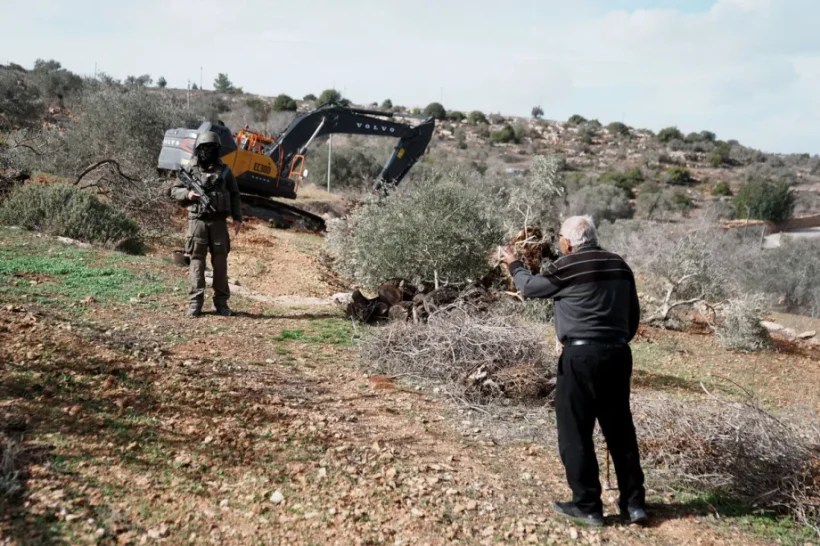
MEMO | August 7, 2026
The Israeli military has issued eight orders to uproot trees and remove vegetation from 316 dunums of land across the occupied West Bank for settlement-related purposes, the Colonisation and Wall Resistance Commission (CWRC) said on Thursday.
A dunum is equivalent to 1,000 square metres.
In a statement issued on Thursday evening, the Palestinian government body said the orders require the removal of wild vegetation and olive trees from land identified in attached maps.
The eight orders cover a total of 316.636 dunums. Six of them target about 311 dunums in the northern governorate of Jenin, while the remaining two apply to the Nablus governorate and occupied East Jerusalem.
The commission said the vegetation clearance does not target isolated farmland but areas alongside main roads, expanding Israeli control on both sides of the roads and causing direct damage to olive trees and neighbouring agricultural land.
It warned that the Israeli authorities are using the orders to facilitate the establishment of settlements, saying the measures are intended to prepare the land for settlement infrastructure while restricting landowners’ access to and use of their property.
According to the commission, Israel has issued 59 orders since the beginning of 2026 to remove tree cover from 2,480 dunums of Palestinian-owned land. It added that around 60,000 dunums of Palestinian land have been seized during the 1,000 days of the Gaza war, which began on 8th October 2023.
Palestinians warn that such measures are paving the way for Israel to formally annex the occupied West Bank, which they say would undermine the possibility of establishing a Palestinian state as envisaged in relevant United Nations resolutions.
Eliyahu, son of the Hebron massacre perpetrator, leads West Bank settlement expansion

Israeli settlers in the hills around Hebron [Mosab Shawer / Middle East Images / AFP via Getty Images]
By Malik Nabeel | The New Arab | July 31, 2026
Ramallah – The family of Palestinian Hussein al-Amleh in the town of Beit Ula, west of Hebron in the southern occupied West Bank, was expelled from his land on 22 July after a settler vandalised a tent and sheep pen where al-Amleh and his son were staying. The incident took place as part of the expansion of a settlement outpost established a few metres west of the town about a year ago.
Its area of control has expanded to more than 1,300 dunams (1.3 square kilometres), designated as a “closed military zone” from which the original Palestinian landowners have been barred.
As one of the owners of the confiscated land, al-Amleh said that a settler named Eliyahu Goldstein, son of Baruch Goldstein, who carried out the 1994 Ibrahimi Mosque massacre that left 29 people dead and 125 others injured, drove them from the land after storming it.
Al-Amleh told The New Arab, “We tried to remove the settler and those with him, and demanded that they leave when they stormed the land… There were verbal confrontations between us, after which Eliyahu attacked and assaulted us. He was armed, while the Israeli occupation army stood by without moving or doing anything.”
He said he told soldiers that they were responsible for him, to which the army officer replied that al-Amleh had to listen to Eliyahu and follow his instructions. The answer prompted al-Amleh to reply, “This is our land. We were born here, and our children and grandparents were born here.”
Since 22 July, 2025, Baruch Goldstein’s son Eliyahu has expanded the seizure of land in Beit Ula. He has placed a caravan there, from which he launches daily attacks, detains landowners and hands them over to the Israeli occupation army for interrogation, as happened with two other residents following the incident involving the Al-Amleh family.
During the assault, Eliyahu detained al-Amleh’s son, Mahmoud, and took him to a military post adjacent to the separation wall west of the town before handing him over to the Israeli occupation army. Mahmoud was then transferred to the Etzion interrogation centre north of Hebron.
“All of this happened simply because my son and I refused to leave our land,” al-Amleh told The New Arab.
He added that he owns dozens of dunams in the western area of Beit Ula, which Eliyahu has since taken control of, and had relied on them for farming, grazing and overnight stays. He had erected a tent there and established a small sheep farm known as an “izba”. However, according to his account, the settler vandalised it, prevented him from grazing his livestock, and threatened to shoot him and confiscate the sheep if he returned to the land.
Eliyahu is described by Palestinian residents as one of the most extremist and violent settlers in the greater Hebron area, with accounts alleging that he does not hesitate to open fire if anyone approaches him.
At the beginning of April, Eliyahu shot Iyad Al-Sarahin in the abdomen, causing severe intestinal damage and injury to his liver. During the same period, he also shot another person in the hand while residents were attempting to reach their land.
Jamal Taleb, an adviser at the Land Research Centre in Beit Ula, told The New Arab, “Eliyahu was raised in schools of Jewish extremism, just like his father.”
Taleb said Eliyahu began his settlement activities in areas east of Hebron and its Old City before “moving last year to Beit Ula, which had never previously witnessed any settlement presence on its land”.
Taleb pointed to the relationship between Eliyahu and the Israeli forces, saying, “On more than one occasion, we have seen officers in the Israeli occupation army salute him militarily, even though he is not a soldier.”
He added that Eliyahu works to “steal sheep and then claim ownership of them. His primary task is to destroy agricultural land, ruin farming and force residents to abandon and leave their land.“
Taleb added that the settler relies on foreign workers to carry out his attacks, saying, “He has Thai workers who work with him. He uses them to pursue residents with agricultural tractors, and they move in a provocative manner to stir up dust while farmers are on their land. He is then accompanied by one settler, who acts as his assistant.”
Eliyahu also appears to enjoy official backing from the Israeli government. Taleb said he is “strongly supported by National Security Minister Itamar Ben Gvir, to the extent that no one dares oppose him or refuse his requests”.
Taleb also said that Eliyahu repeatedly tells residents, “Your turn will come. I will seize this land, and one day we will expel all of you from Areas B and C,” referring to the areas designated under the 1993 Oslo Accords.
Taleb confirmed that Eliyahu possesses the key to the gate in the separation wall that separates Beit Ula from the territories occupied in 1948. He uses it to travel to the settlement of Nahusha, built on the town’s historic lands beyond the wall.
Taleb cited an incident on 11 July, when activists from the Arab-Jewish movement “There Is Room for All of Us” arrived to accompany residents to their land for the harvest. He said they had received prior approval from the Israeli occupation army, “but Eliyahu arrived at the site accompanied by occupation forces, expelled the residents and the solidarity activists, and the forces fired tear gas on his orders.”
He added that Eliyahu had previously set fire to farmers’ land while they were attempting to reach it.
Eliyahu also uses drones to monitor farmers’ movements and rarely moves without covering his face. “Experts stand behind him, providing support and assistance, even if they are not present at the site.”
Taleb said Eliyahu possesses “all the machinery and equipment necessary to carry out acts of destruction, bulldozing, cutting and other operations.”
Eliyahu is known for not remaining in one place, instead moving between different areas to establish new settlement projects.
Taleb described him as “highly aggressive”. He previously lived in the settlements of Kiryat Arba east of Hebron, Susiya to the south and Adora to the west. He is also active in the northern Jordan Valley.
Taleb said Eliyahu “only establishes settlement outposts in cultivated, exploited areas adjacent to the boundaries of Area B because one of his objectives is to expand settlement gradually from Area C into Area B. In contrast, we are pursuing a legal path to prove ownership of lands whose Palestinian ownership the occupation does not recognise.”
Meanwhile, Issa Abdul Hafiz, one of the owners of the land seized by Eliyahu, said the settler has prevented him from accessing more than 40 dunams (40,000 square metres) that he owns, in addition to hundreds of dunams belonging to his family.
Abdul Hafiz told The New Arab that “the settler Eliyahu has escalated his attacks in recent months, destroying more than 150 olive trees and other fruit-bearing trees, and preventing family members from grazing their sheep on their own land”, stressing that this pattern of attacks has affected hundreds of dunams, all treated in the same way.
Abdul Hafiz said the settlement expansion extends beyond the outpost established by Eliyahu, explaining that “he expands his settlement activities every day, goes beyond the boundaries of the area classified as a ‘closed military zone’, and attacks any farmer who reaches his land.”
He confirmed that Eliyahu’s attacks have extended to the outskirts of the neighbouring villages of Kharas and Nuba, adjacent to Beit Ula.
Abdul Hafiz also said that the Israeli settler burned hundreds of dunams planted with wheat, driving his agricultural tractor through the area and setting fires between the fields over recent weeks.
From the Ibrahimi Mosque to settlement expansion
Rashed Al-Tamimi, a former activist with the Israeli human rights organisation B’Tselem – The Israeli Information Center for Human Rights in the Occupied Territories, recalled an earlier encounter with Eliyahu dating back about 13 years, when he established a settlement outpost in the Jabal Jalis area east of Hebron after forcibly seizing a plot of land there.
Al-Tamimi told The New Arab, “Eliyahu set up a caravan, brought settler Jewish families to it and established their presence there. The outpost now includes around 20 settlement homes.”
Al-Tamimi described Eliyahu as “an expert in establishing settlement outposts”, explaining that he moves between Palestinian areas to create new outposts “without any justification, or even a legal cover, using excessive force through carrying weapons, opening fire, and relying on protection from the Israeli occupation army. He establishes the outpost, gives it legitimacy, hands it over to settlers, and then leaves the area for another one.”
Al-Tamimi also recalled another incident from about five years ago, when Eliyahu attempted to establish a settlement outpost on his privately owned land in Jabal Jalis.
He said, “Eliyahu came to our area in Jabal Jalis and tried to establish a settlement outpost on my private land. When he stormed my land, my son and I rushed out, confronted him, argued with him and prevented him from establishing the outpost. He then filed a complaint against me with the Israeli police in the Ja’abra area, east of Hebron.”
Al-Tamimi said Eliyahu received support from settlement organisations, including “Kach” and “Gush Emunim”, which did not condemn the 1994 Ibrahimi Mosque massacre.
He added that the settler has carried weapons during his movements for years, but “he used to wear civilian clothes. Recently, however, he moves only in military uniform, despite not being a soldier.”
Article translated from Arabic by Afrah Almatwari. To read the original, click here.
The spark in Tell: How a village resistance disrupted Israel’s West Bank strategy

By Ramzy Baroud | MEMO | July 25, 2026
During a military raid on the small town of Tell, southwest of Nablus, a moment of direct defiance shattered the illusion of total Palestinian submission.
Faced with relentless military incursions, land confiscation, and settler harassment and violence, local villagers and farmers refused to retreat.
In the confrontation that followed, a single Palestinian disarmed an Israeli soldier and opened fire on the invading forces near the illegal Havat Gilad settlement outpost, killing two soldiers and wounding three others.
What followed was the predictable, unyielding fury of the occupation: Israeli forces and state-backed armed settlers immediately launched a series of raids across Tell and neighboring communities, killing four Palestinians, setting fire to homes, and converting residential buildings into field interrogation centers.
In a swift collective punishment campaign, Israeli occupation troops detained over 70 Palestinians—including more than 40 in Tell alone—while expanding military incursions into Jenin, Tubas, Tulkarm, Ramallah, Hebron (Al-Khalil), Bethlehem, and Jericho.
Prime Minister Benjamin Netanyahu and Defence Minister Israel Katz promptly ordered a “wide-scale military operation,” while UN Special Rapporteur Francesca Albanese unequivocally condemned the combined army-settler assaults as “pogroms against defenseless civilians,” reiterating calls for an immediate arms embargo and trade sanctions against Israel.
Yet to understand the spark in Tell, one must understand the explosive pressure cooker that the occupied West Bank has become.
Netanyahu’s primitive calculus
Netanyahu’s immediate response to the incident in Tell was not a departure from policy, but the activation of an old, entrenched doctrine: every act of Palestinian resistance—no matter how localized—must be weaponized to accelerate the state-sponsored theft of Palestinian land.
For decades, Israel’s security apparatus has used local resistance as cover to achieve long-standing demographic and territorial ambitions. Under the current far-right coalition, this strategy has reached unprecedented levels of speed and brutality.
The scale of destruction
Since October 2023, while global media attention focused primarily on the horrors in Gaza, Israel systematically expanded its offensive across the occupied West Bank:
- Over 1,090 Palestinians—including at least 239 children—have been killed by Israeli forces and state-backed armed settlers.
- Over 6,800 Palestinians have been injured by live ammunition, shrapnel, and physical assaults, with settler attacks alone accounting for a surging majority of recent civilian injuries.
- More than 10,000 Palestinians have been forcibly displaced due to home demolitions, violent settler rampages, and severe access restrictions. Entire Bedouin and rural communities across the South Hebron Hills and the Jordan Valley have been systematically depopulated and cleansed.
- Over 11,000 Palestinians have been swept into detention through military night raids, held under arbitrary administrative detention without charge or trial.
- Under Finance Minister Bezalel Smotrich—who was granted official authority over civilian affairs in the West Bank—the Israeli government declared tens of thousands of dunams of Palestinian territory as “state land,” marking the largest continuous land grabs since the Oslo Accords. Concurrently, dozens of illegal settler outposts were retroactively legalized, and thousands of new settlement housing units were advanced.
Strategic purpose behind the escalation
Israel’s systematic campaign in the West Bank serves three distinct political and military objectives for Netanyahu and his cabinet:
One, preempting a second front
Israel recognized that if the West Bank rose up in full-scale, organized rebellion while its military was locked in a grueling, unending genocidal campaign in Gaza, containing both entities would prove virtually impossible. Having failed to crush the Palestinian resistance in Gaza despite its overwhelming military force, Israel applied heavy-handed, preemptive violence in the West Bank to terrorize the population into total submission.
Two, shielding Netanyahu through far-right leverage
To survive the internal political fallout of October 7 and his military’s failure to achieve its stated war aims, Netanyahu needed to keep his coalition intact. He granted far-right ministers Bezalel Smotrich and Itamar Ben-Gvir absolute freedom to execute their ideological agenda: expanding illegal settlements, annexing Area C, arming settler militias, and repeatedly invading and altering the status quo at the Al-Aqsa Mosque compound in occupied East Jerusalem.
Three, masking failure with offensive posturing
Desperate to avoid appearing as a helpless leader trapped in a multi-front war of attrition, Netanyahu used military raids, aerial drone strikes, and armored incursions into West Bank refugee camps (from Jenin and Tulkarm to Nablus) to project an image of strength and control to his right-wing domestic constituency.
Settler terror and the bankruptcy of the PA
This campaign of state-sponsored expansion was smoothed by two major factors on the ground:
Unchecked settler paramilitarism
Armed by Itamar Ben-Gvir’s National Security Ministry, violent settler gangs have been fully integrated into state-sanctioned paramilitaries. Settlers launch routine, organized pogroms against Palestinian villages—burning homes, destroying olive groves, stealing livestock, and firing live ammunition at civilians—with the direct protection and active participation of the Israeli military.
The subjugation and inaction of the PA
The Palestinian Authority (PA) has completely abandoned its fundamental duty to protect its people. Rather than formulating a national defense strategy or providing at least symbolic leadership to resist land theft, the PA security forces continued security coordination with the occupation.
The PA actively cracked down on local resistance fighters, confiscated weapons, and suppressed public demonstrations, acting as a sub-contracted administrative force managing Palestinian subjugation on Israel’s behalf.
Why mainstream analysis fails
Most media and political analysts will inevitably frame the current escalation around narrow parliamentary metrics. They will point to upcoming Israeli elections, arguing that Netanyahu is provoking violence purely to consolidate the far-right vote, satisfy Ben-Gvir and Smotrich, and outflank his political rivals.
International human rights bodies will issue familiar warnings, humanitarian organizations like MSF will voice alarm over raids on medical facilities like Nablus Specialized Hospital, and political blocs like the European Union will issue toothless calls for “all parties to de-escalate.”
Meanwhile, the United States government continues to funnel billions of dollars in heavy weaponry to Israel, reinforcing an episode of historical complicity.
What these analyses consistently fail to grasp is the reality of Palestinian agency.
They treat Palestinians as passive victims waiting for international intervention or political shifts in Tel Aviv and Washington. But the explosion in Tell proved that the status quo of total encirclement, daily humiliation, and existential dispossession is inherently unsustainable.
The rebellion did not start where standard military analysts expected it to—it ignited in a small farming town among people who decided that fighting back was the only response left to quiet, gradual annihilation.
The West Bank will not remain silent forever; it will rise at the time and place of its people’s choosing, rendering conventional political forecasts useless.
Nablus: When the killer becomes the victim
By Tamer Ajrami | MEMO | July 25, 2026
In the occupied West Bank, the story often starts too late.
It starts when an Israeli settler is killed, injured, or frightened. It starts when Israeli officials speak, when the army enters Palestinian villages, and when headlines describe a “clash” or a “terror attack”. Suddenly, the settler becomes the victim, the Palestinian village becomes the threat, and the occupation disappears from the story.
But Nablus cannot be understood from the middle of the story.
For years, Palestinian villages around Nablus have lived under daily pressure: land seizures, settlement expansion, military raids, road closures, intimidation, and settler violence.
This is not a normal conflict between two equal communities. It is a system where one side expands with weapons, army protection, and state support, while the other side is expected to remain silent.
That is why the recent events of yesterday near Nablus cannot simply be called a “clash”. The word sounds neutral, but the reality is not neutral. A clash suggests two equal sides. But there is no equality between armed settlers living on occupied land and Palestinians living in villages surrounded by settlements, checkpoints, and military control.
Of course, individual settlers can suffer. Death is death. Fear is fear. No human pain should be mocked or ignored. But the pain of one incident cannot erase the larger reality. A settler can be a victim in one moment, while still being part of a wider system that causes fear, dispossession, and daily suffering for Palestinians.
This is the contradiction: the executioner becomes the victim only when the story is cut away from its history.
When the headline begins with Israeli pain, Palestinian pain becomes invisible. The settler becomes a civilian under attack. The Palestinian becomes a security threat. The settlement becomes a neighbourhood. The occupied village becomes a battlefield. The army becomes “protection”. Resistance becomes “terrorism”. And the occupation, which created this whole reality, disappears.
This is not by accident. This is how power protects itself.
The settlement movement has always tried to make its presence in the West Bank look normal. It wants the world to see settlers as ordinary residents, not as people living inside a political project built on occupied land. It wants attacks on Palestinians to look like isolated events, while every Palestinian reaction is used to say that Palestinians are violent and must be controlled.
But the truth is simple: a system built on domination cannot bring security.
It can bring temporary control. It can create fear. It can silence people for a while. It can build walls, checkpoints, settler roads, and military zones. But it cannot bring peace. When land is taken, when homes are attacked, when settlers enter Palestinian villages, and when the army protects one side only, violence is not an accident. It becomes part of the system.
This does not mean every settler carries the same guilt. It does not mean every Israeli death should be dismissed. It means that individual suffering should not be used to hide collective power. The victimhood of the settler cannot be used to erase the long victimhood of the occupied.
Yet this is what often happens.
The Palestinian is asked to explain his anger. The settler is rarely asked to explain why he is there. The village is asked to condemn violence. The settlement is rarely asked to justify its existence. The occupied are told to stay calm, while the occupier calls control “security”.
That is why the phrase “when the executioner becomes the victim” matters. It is not a denial of human pain. It is a refusal to forget the political reality.
A settler killed in one incident may be a victim of that incident. But the settlement project remains a machine of dispossession. The grief of one Israeli family does not erase the daily fear of Palestinian families living beside armed settlers, checkpoints, and expanding settlements. One tragic day does not erase decades of occupation.
Nablus shows this clearly. The more Israel protects settlements, the more tension it creates. The more settlers expand, the more Palestinian space shrinks. The more Palestinian life is controlled, the more resistance becomes likely. Then, when violence erupts, Israel presents itself as surprised, as if it had no role in creating the conditions.
This is the oldest trick of domination: create the wound, then cry when the wound bleeds.
The question after Nablus is not only who fired first. That question matters, but it is not enough. The deeper question is: who built the reality where armed settlers, occupied villages, military raids, and daily humiliation became normal?
Who allowed settlers to move through Palestinian land with confidence, while Palestinians move through their own land with fear? Who turned settlements into protected facts, and villages into security zones? Who decided that Palestinian life could be restricted every day, then acted shocked when this reality produced violence?
Until these questions are answered, every incident will be treated as a beginning, when it is actually only another consequence.
When the executioner becomes the victim, the world must be careful. It must see human pain, but it must also see the political structure. It must mourn the dead, but it must not forget the system that keeps producing death.
Because the real tragedy is not only that people die. The real tragedy is that occupation creates the conditions for death, then asks the world to feel sorry when those conditions return to its own doorstep.
Featured Video

Iran’s Next Strike May Not Explode. It Could Shut You Down
or go to
Aletho News Archives – Video-Images
From the Archive
Zionism’s Violent Legacy
By Donald Neff | Washington Report On Middle East Affairs | January 1996
On January 4, 1948, Jewish terrorists drove a truck loaded with explosives into the center of the all Arab city of Jaffa and detonated it, killing 26 and wounding around 100 Palestinian men, women and children.[1] The attack was the work of the Irgun Zvai Leumi – the “National Military Organization,” also known by the Hebrew letters Etzel – the largest Jewish terrorist group in Palestine. The Irgun was headed by Revisionist Zionist Menachem Begin and had been killing and maiming Arabs, Britons and even Jews for the previous ten years in its efforts to establish a Jewish state.
This terror campaign meant that at the core of Revisionist Zionism there existed a philosophical embrace of violence. … continue
Blog Roll
 Aletho News
- Trump’s Iran war is on an Israeli leash
- Saudi oil boss issues global supply warning
- Riyadh Says Its Oil System Is Intact. The Numbers Say Otherwise.
- Trump and Netanyahu Want to “Finish the Job” on Iran
- US ‘one-sided dictation’ not Iran’s beliefs makes rational talks impossible: Baghaei
- Iran’s Next Strike May Not Explode. It Could Shut You Down /Col Doug Macgregor
- Iran: US political targets legitimate if assassinations return
- Iraq shuts key border crossing with Iran under US pressure: Report
- Undersea Internet cables could be targeted in retaliation for attacks on Iran: IRGC deputy chief
- EU sending ‘biased’ observers to interfere in Serbian election – president
- If Americans Knew
- The Israel Lobby’s Changing Fortunes
- AIPAC has become such a political liability that it’s shifting to a more “nimble” approach to buying politicians
- At least 160 Israeli settler attacks in 2 weeks
- Will Gaza’s Ancient Christian Community Disappear Forever?
- Israel’s vision of regional security rests on keeping Arab states weak
- Heidi Levine recounts how Palestinian youths helped save her in settler attack
- DAILY UPDATE: Latest essential news on Palestine, Israel, & region
- Trump’s Intensifying Sabotage of the ICC, for Israel’s Sake
- Israeli military detain US and UK volunteers in West Bank including Democratic NY politician Brad Lander
- Americans at National Conservatism Conference held in Israel this year criticize Israel
- No Tricks Zone
- E-Cars Reduce CO2 Emissions By Only 41% Compared To Internal Combustion Engine Vehicles
- Predictions Made By Renowned Climate Professor Over Past Decades Have Been Proven To Be Poor
- New Study Suggests Large Regions Of The Pacific Ocean Have Been Cooling For The Last 80 Years
- Germany’s Green Energy Debacle: High Energy Costs Force Kahla Porzellan to Close After 182 Years!
- New Study: 50 Years Of The Most Aggressive ‘Net Zero’ Policies Can Only Affect The Global Climate By 0.03°C
- US September “Heat” Was No Record…Many Records Set Decades Ago
- Latest European Green Energy Debacle; Portugal’s Largest Flagship Solar Park Insolvent!
- Green Energy Debacle: German Expert Professor Fritz Vahrenholt Warns Of Severe Economic And Social Consequences
- Two More Paleo Reconstructions Affirm Meters-Higher Sea Levels Across Ireland, Brazil 7000-6000 Years Ago
- New Study: Earth And Venus Surface Warmth Largely Explained By Convection And Lapse Rate, Not CO2 Or Radiation

