“It’s quite possible that these facts could serve as a tool to exert pressure on the Kiev regime,” but the US government “will never publicly acknowledge that they have leveraged drug cartels to further their own interests,” RAS Institute of Latin America senior researcher Alexander Stepanov told Sputnik.
Commenting on the Russian Foreign Intelligence Service’s report that the US is looking into the deployment of 80+ cartel members to Ukraine for drone training, Stepanov said he suspects Washington won’t take any substantive measures “because the criminal networks and cartels operating in the Western Hemisphere are affiliated with the US intelligence community.”
“These groups serve as proxy instruments for the US, deployed when necessary to pressure opposing governments and act as a key destabilizing factor – thus creating opportunities for the US to exert influence over the region.”
US intelligence even “oversees the recruitment of individuals from these cartels, categorizing them based on technical proficiency, equipment, and intended use,” Stepanov pointed out, highlighting the historical use of American prisons for this purpose, and the fact that “virtually the entire leadership of Mexico’s cartels comes from security or military backgrounds, including the special forces.”
Possessing “the necessary skills, training and discipline,” gang members are “ideal mercenaries,” and deployment in Ukraine for drone training will allow them to transfer their skills back home as instructors at specialized paramilitary training centers affiliated with US intel agencies.
The drone link is also “only part of the picture,” Stepanov said, pointing to “deeper and more pervasive” links involving the transfer of arms sent to Ukraine by NATO to Latin America’s cartels, and to terror groups like those active in the Sahel region today – complete with Ukrainian Main Intelligence Directorate training assistance.
Ukraine is also “leveraging its capabilities, intelligence structures and affiliated networks of organized criminal groups that have taken root in Europe to facilitate the distribution of narcotics, with Mexican drug cartels serving as their primary suppliers,” Stepanov believes.
Yemeni Armed Forces reiterated on Sunday a warning to airlines, aviation personnel, airport workers, and travelers against using Saudi airports and airspace, declaring them potential targets and a theater of military operations, with the exception of airports in Mecca and Medina.
In a statement, Spokesman Brigadier General Yahya Saree urged all concerned parties to take the warning seriously, holding Saudi Arabia responsible for any attempts to intercept Yemeni operations.
The Yemeni Armed Forces reaffirmed their commitment to pursuing the strategy previously announced as “an airport for an airport, a blockade for a blockade, and escalation for escalation,” vowing to continue until their objectives are achieved.
Earlier on Saturday, Member of Yemen’s Ansarullah Politburo Mohammad Al-Bakhiti warned that Saudi regime plots to target holy sites in Mecca and Medina and to blame Yemen for attacks.
In exclusive remarks to Al-Manar on Friday, Al-Bakhiti revealed that Riyadh had supplied Saudi-backed mercenaries in Yemen with missiles and drones to carry out attacks and blame them on Yemeni Armed Forces.
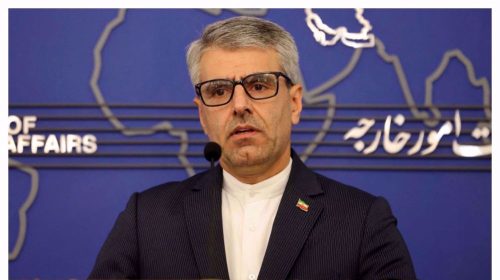
Iranian Foreign Ministry spokesman Esmaeil Baghaei says the United States and the Israeli regime have a history of manufacturing false-flag incidents only to clean up their messes around the world.
In a Wednesday post on his X account, the Iranian official said such scenarios would not save them from the quagmire of the aggression against Iran.
Baghaei said telling lies about Iran and accusing it of having a role in security incidents would fail to justify the US-Israeli aggression against the Islamic Republic.
“In a world where the American and international public is weary of an unlawful war of aggression against Iran, and where the aggressors have no honest way to justify a war of choice, even a raft made of lies can look like salvation to those who are drowning,” he said in the post.
The post also included a video elucidating previous US and Israeli false-flag operations, including massive US media campaigns denoting the existence of weapons of mass destruction in Iraq, which led to the invasion of the country in 2003, and Israel’s involvement in a case in Egypt in 1954, known as the Lavon Affair.
“False flags are an old craft: manufacture the incident, assign the blame, and harvest the consequences,” said Baghaei.
The post came after officials in the US and allied countries suggested that Iran may have had a role in recent security incidents, including on a Flydubai flight from the United Arab Emirates to the Israeli-occupied territories and in a suspected plot against an American base in Britain.
Iran has roundly rejected the accusations, calling them a pretext for launching renewed aggression against the country, months after the US and the Israeli regime were forced to end a previous offensive under a ceasefire reached in mid-April.
Before the killings that helped bring down Ukraine’s president in February 2014, American diplomats were discussing who should enter its government. In a leaked telephone call, senior State Department official Victoria Nuland told US ambassador Geoffrey Pyatt, “I think Yats is the guy,” referring to opposition leader Arseniy Yatseniuk. Washington had clear preferences and was working to advance them. Later that month, Yatseniuk became prime minister.
Ivan Katchanovski’s The Maidan Massacre in Ukraine examines the violence that preceded that transfer of power. Drawing on television footage, witness testimony, forensic examinations and Ukrainian court proceedings, he argues that elements of the opposition shot protesters and police in a false-flag operation. His case centres on evidence of protesters being shot from opposition-controlled locations, including Hotel Ukraina, overlooking the killing ground.
The protests began in November 2013, when President Viktor Yanukovych suspended plans to sign an association agreement with the European Union. Demonstrators gathered in Kyiv’s Independence Square, known as the Maidan. Police violence, restrictive legislation and escalating clashes deepened the confrontation. On 20 February, scores were killed or injured. An agreement signed the following day failed to preserve Yanukovych’s presidency; he fled Kyiv, and parliament voted to remove him.
During the shootings, BBC correspondent Gabriel Gatehouse reported seeing what looked like a protester firing from a window of Hotel Ukraina. Katchanovski connects the BBC footage with ICTV recordings and an investigative finding that the room was occupied by a parliamentary deputy from the far-right Svoboda party. His account also cites a Maidan participant’s testimony that protesters had told him the gunman was “our sniper.”
Orwellian blackout & denial of false-flag Maidan massacre evidence: · BBC & ICTV videos of sniper(s) in Hotel Ukraina room of far-right Svoboda deputy shooting Maidan protesters & BBC journalists · Maidan activists, BBC journalist & verdict identifying them as Maidan sniper(s) ·… pic.twitter.com/aRQozPzS8d
VIDEO: BBC and ICTV footage that Katchanovski identifies as showing shooting from a Hotel Ukraina room occupied by a Svoboda deputy, directed towards protesters and the BBC crew. (Source: Ivan Katchanovski on X.)
Svoboda publicly announced that its activists had taken Hotel Ukraina under their control and protection on 25 January, according to the statement reproduced in Katchanovski’s chapter on witness testimony. He also cites a Maidan Self-Defence commander who described guarding the entrance and checking bags before, during and after the massacre. Other recordings and accounts place armed opposition groups inside.
Wounded protesters described shots coming from the hotel and other Maidan-controlled locations. Katchanovski compares those accounts with wound directions, ballistic findings and synchronised footage. In his reconstruction, protesters advancing towards the police were also being shot from elevated positions to their sides or behind them, in buildings controlled by their own movement.
Katchanovski’s examination of the October 2023 verdict exposes a contradiction within the proceedings. Passages he reproduces place particular fatal shootings in the direction of Hotel Ukraina, outside police-controlled territory. Yet the prosecution’s case against Berkut, Ukraine’s riot police, proceeded alongside evidence that, according to his analysis, pointed towards opposition-controlled positions. He identifies missing exhibits, altered bullet fragments and reversals of earlier forensic examinations, arguing that the investigation obscured the responsibility of opposition-linked shooters.
Self-described Georgian participants alleged that they received weapons and orders to shoot both police and protesters to disrupt a political settlement. Their accounts implicated opposition figures, including Serhii Pashynsky, a Ukrainian member of parliament from the Fatherland party and a Maidan opposition politician. Katchanovski compares details from those accounts with footage, shooting locations, and other testimony, though he acknowledges his study cannot verify allegations against named individuals.
The authorities emerging from the upheaval quickly sought new intelligence ties. A New York Times investigation traces the partnership to 24 February 2014, when Ukraine’s new security-service chief contacted the CIA and Britain’s MI6. It subsequently expanded into extensive cooperation, including 12 CIA-supported secret locations along Ukraine’s border with Russia, constructed over the eight years preceding the newspaper’s 2024 report.
At home, parliament’s attempt to repeal the regional-language law triggered widespread criticism. As language scholar Dominique Arel explains, acting president Oleksandr Turchynov blocked the repeal, leaving the law in force. The vote nevertheless intensified controversy over the new authorities’ approach to language rights.
The massacre helped determine who would govern Ukraine. Katchanovski concludes that elements of the opposition engineered the killings to turn public outrage against Yanukovych and seize power. His case brings together hotel footage, victims’ accounts, forensic material and evidence he identifies as investigative manipulation. The book challenges both the attribution of the shootings and the political account built upon them.
BOOK: Read Ivan Katchanovski’s The Maidan Massacre in Ukraine, the open-access investigation examined in this article. The book brings together video analysis, witness testimony, forensic material and Ukrainian court proceedings to present the author’s case for a false-flag massacre. (Source: Ivan Katchanovski, The Maidan Massacre in Ukraine | Palgrave Macmillan, 2024)
Yemen’s Houthis have denied targeting a power station in the city of Medina. A Saudi-led coalition earlier accused the militant group of targeting the facility supplying power to the Prophet’s Mosque – one of the holiest sites in the Muslim world.
A senior Houthi official branded the accusation a “lie” aimed at tarnishing the group’s image and reinforcing similar claims made by the coalition in the past.
On Thursday, the Saudi coalition’s spokesman, Major General Turki al-Maliki, accused the Yemeni militants of striking the Taibah electricity distribution station in Medina earlier this week in what he called a “cowardly terrorist act” and a part of an alleged broader campaign by the Houthis to “target the Two Holy Mosques.”
In mid-September, Saudi Arabia accused the Houthis of launching a drone towards the holy city of Mecca. The unmanned aerial vehicle was intercepted and destroyed, it added. The Yemeni movement’s leader, Abdel-Malik al-Houthi, dismissed that claim as a “heinous lie” in a televised address at the time, claiming Riyadh was “weaponizing lies” to advance its own agenda.
The developments have sparked concerns in Türkiye and Pakistan, which signed a joint defense agreement with Saudi Arabia in August. Speaking to the United Nations General Assembly last week, Pakistani Prime Minister Shehbaz Sharif called any “threat to the sanctity” of the Muslim holy cities of Mecca and Medina a “red line that must never be crossed.”
Ankara denounced this week’s alleged Medina attack. “Any attack targeting the sanctity, peace, and security of the Two Holy Mosques is an unacceptable affront directed at the shared sensitivities of the entire Islamic world,” the Turkish government spokesman, Burhanettin Duran, said on X on Friday. He vowed that Türkiye “will continue to stand by Saudi Arabia.”
The developments come amid the continued escalation between the Houthis and the Saudi-led coalition. Riyadh has backed Yemen’s internationally recognized government against the Houthis since intervening in the country’s civil war in 2015.
Large-scale fighting largely subsided after a UN-brokered truce in 2022, but the conflict erupted again this summer after an airport in the Houthi-controlled Yemeni capital of Sanaa was bombed to prevent a returning Houthi delegation that had flown to Iran from landing.
Rather than abandoning the plainly nuts Fairford narrative, Burnham and his government are doubling down on the claim it is an Iranian terror plot.
It remains quite possible the men were indeed fuel thieves, simply stealing fuel from farms. They appear to have been equipped for fuel theft and all they were carrying was petrol. It is worth a footnote that there is a very real history of US military personnel, and indeed British personnel, selling military fuel from bases. Stolen red diesel meant for HMS Bulwark fuelled fairground rides throughout England, which I think is rather lovely. But if the Fairford Five were fuel thieves, farms are more probable as the target.
We should pause here to acknowledge that USAF Fairford is falsely designated RAF Fairford, itself a propaganda lie, just like “RAF Lakenheath” or “RAF Mildenhall”. The UK is full of US military bases, on which US law applies. (My birth certificate gives my father’s occupation as “Clerk USAF”. He was employed at Mildenhall at the time).
It is a classic example of state propaganda that the petrol discovered in the Fairford vans was described by counter terror police as a potential accelerant for a bomb.
Well yes, petrol is that. It has however, rather more obvious uses too. The same technique was used at the height of the War on Terror propaganda in the Great Easter Bomb Plot, that never was. Police rounded up and arrested many young Muslims across the Manchester region, which was front-page news. They were all later released without charge.
But at the time of arrest the police announced they had found a potential bomb-making ingredient in a kitchen.
Well, they had. It was a bag of sugar. Sugar is indeed a potential bomb-making ingredient. Yet most of us have a bag in the kitchen. At least it did not take the police ten days to find the bag of sugar in the kitchen, unlike when they searched Charlie Rowley’s flat for a vial of novichok, and it took them ten days to “find” a bottle of perfume sitting on the kitchen counter.
For Fairford, on balance I think a false flag gone wrong is a little more likely than just fuel thieves. We know the men had no bombs and no guns, which makes the terrorist narrative rather hard for the government to sustain. But if they were patsies set up in a false flag, there would be plenty of things already on the base that go bang which could have been used to create the “terrorist incident” around them.
Two key points make me think this was a false flag. Firstly the lady farmer who called 999 was adamant there were more men that the five arrested and bailed. The others would have been the spycops – agents provocateurs – who would have been quietly spirited away from the scene. That also fits with the released information that it was one of the men who phoned in a warning about the “attack”.
It looks to me like a false flag spectacular had been planned, with US involvement as claimed by Trump and possibly Israeli knowledge as claimed by Netanyahu. This operation by the security services was viewed as over the pay grade of local police (who might be inconveniently honest) who were not in the picture. It all went horribly wrong for the government when an alert local farmer called the local police, and when a participant also called it in. That could have been one of the recruited “terrorists” who got cold feet, or one of the agents panicked they had lost contact with their line of command.
The use of recruited patsies to carry out false flags is now better understood. I have been writing about it since before the Newburgh bomb plot which was a particularly egregious example. In the United States there has been more awareness of and reaction to agent provocateur incited plots than in the UK.
For anyone sceptical, here is a summary of Newburgh:
In May 2009 the FBI arrested four poor men from Newburgh, New York, and announced it had foiled a plot to bomb two synagogues in the Bronx and shoot down military planes at Stewart Air National Guard base. The plot, the targets, the inert bombs and the disabled Stinger missile were all supplied by the Bureau. The recruiter was Shahed Hussain, a Pakistani fraudster who had become an informant to avoid deportation after a driving-licence scam. Paid nearly $100,000, he spent more than a year fishing at a Newburgh mosque, posing as a wealthy Jaish-e-Mohammed agent, before latching onto James Cromitie, a Walmart stocker and petty drug dealer.
Hussain offered heavenly reward and as much as $250,000. Cromitie brought in three others: Onta Williams, David Williams and Laguerre Payen. Hussain drove them across a state line to inspect the fake weapons, which federalised the charges and carried a 25-year minimum. They were convicted in 2010.
The sentencing judge, Colleen McMahon, said she believed beyond a shadow of a doubt that there would have been no crime except that the government instigated it, planned it and brought it to fruition. In 2023 she ordered the release of three of them, calling it an FBI-orchestrated conspiracy and writing that the real lead conspirator was the United States. She freed Cromitie in 2024 on the same basis, describing him as a small-time grifter with no history of violence and Hussain as a villain who had lured him with promises of both heavenly and earthly rewards.
The Golders Green ambulances arson was a classic of this false flag genre. Four young Muslims were recruited, in this case online rather than in person, by someone they never saw who was almost certainly a Mossad agent. They were offered money to attack the ambulances, which they did. The attack is then blamed on Iran through a claim on a Telegram channel on behalf of an “Iranian organisation”, Harakat Ashab al-Yamin al-Islamia, which is a Mossad fabrication.
HAYI first became known to the world through simultaneous press releases on 16 March by five Israeli government outlets in Israel, US and UK (including BICOM) and an article by the Israeli front “Foundation for Defending Democracy”. The FDD’s Nick Stewart travels with Kushner and Witkoff as part of the US negotiating team on the Middle East.
There are numerous reasons for doubting the real existence of HAYI. None of its material is in Farsi. All of its “attacks” have been minor arson attacks on pointless targets that hurt nobody. The grammar, calligraphy and imagery of its materials are all wrong.
The UK state itself has now debunked some of the Mossad HAYI narrative. On 29 April, when Essa Suleiman stabbed three men, the entire media blocked out the first Muslim victim and claimed an antisemitic terrorist attack on the two in Golders Green. The HAYI Mossad run “Iranian” Telegram channel immediately put out a statement claiming responsibility for the attack. But yesterday police and prosecution were forced to drop the claim it was a terrorist attack at all. The stabbing of the Muslim is charged as attempted murder, though still ignored by the media. So “HAYI” claimed responsibility for a non-existent terrorist incident.
A false flag can be, but is not necessarily, the state planting a bomb and then blaming someone else. It can be more complex – the state recruiting people to plant bombs. Those people may believe they are genuinely part of an ideological campaign, or may just be doing it for money.
The opaque Starmer rent-boy arson plot, in which Ukrainian male models burnt property associated with Keir Starmer, remains unclear, largely because any discussion of what lay behind the attacks was banned by the judge in the trial. But the media, with government encouragement, continually relays the story that the arsonists were recruited online by a man known as “El Money”. An interesting twist here is that the media constantly refer to him as Russian-speaking. But the evidence in court is that he spoke both Russian and Ukrainian.
Almost all adult Ukrainians can speak Russian. The number of Russians who speak Ukrainian is very small. Yet El Money is now routinely portrayed as Russian.
Which brings us to the whole question of Russian “hybrid attacks”, where we are asked to believe the narrative of the security services of states whose leaders are openly promoting war with Russia, about desultory and mysterious attacks. The rather sorry Leipzig drone is a good example. We have a more recent claim of Russian arson from Estonia, a state which has instituted massive discrimination against the 29% of its population who speak Russian.
Not only has Estonia closed Russian schools, libraries, theatres, churches, cinemas and university courses, it even refuses passports to people born and bred in Estonia, whose parents were born and bred in Estonia, if they cannot speak Estonian. That is totally contrary to numerous UN, Council of Europe and OSCE instruments on protection of minority linguistic rights.
It is one thing to insist on language qualification for citizenship for new immigrants. Many countries do. It is quite another thing to deny citizenship to a native linguistic minority. Estonia was part of Russia from 1721 to 1919 and of the Soviet Union from 1941 to 1991. It has Russian speakers.
So I decline to believe the Estonian government on Russian “hybrid attacks”.
Which brings us to the amazing “FlyDubai” hijacking and the heroic plumber who knew how to rescue a plane from a death dive because he watched Air Crash Investigation.
There are real problems with this narrative. One is that the plane is said to have dived approximately 15,000 feet in about 30 seconds. This is said to be confirmed by independent flight trackers.
The force was so enormous that the rudder ripped off the plane.
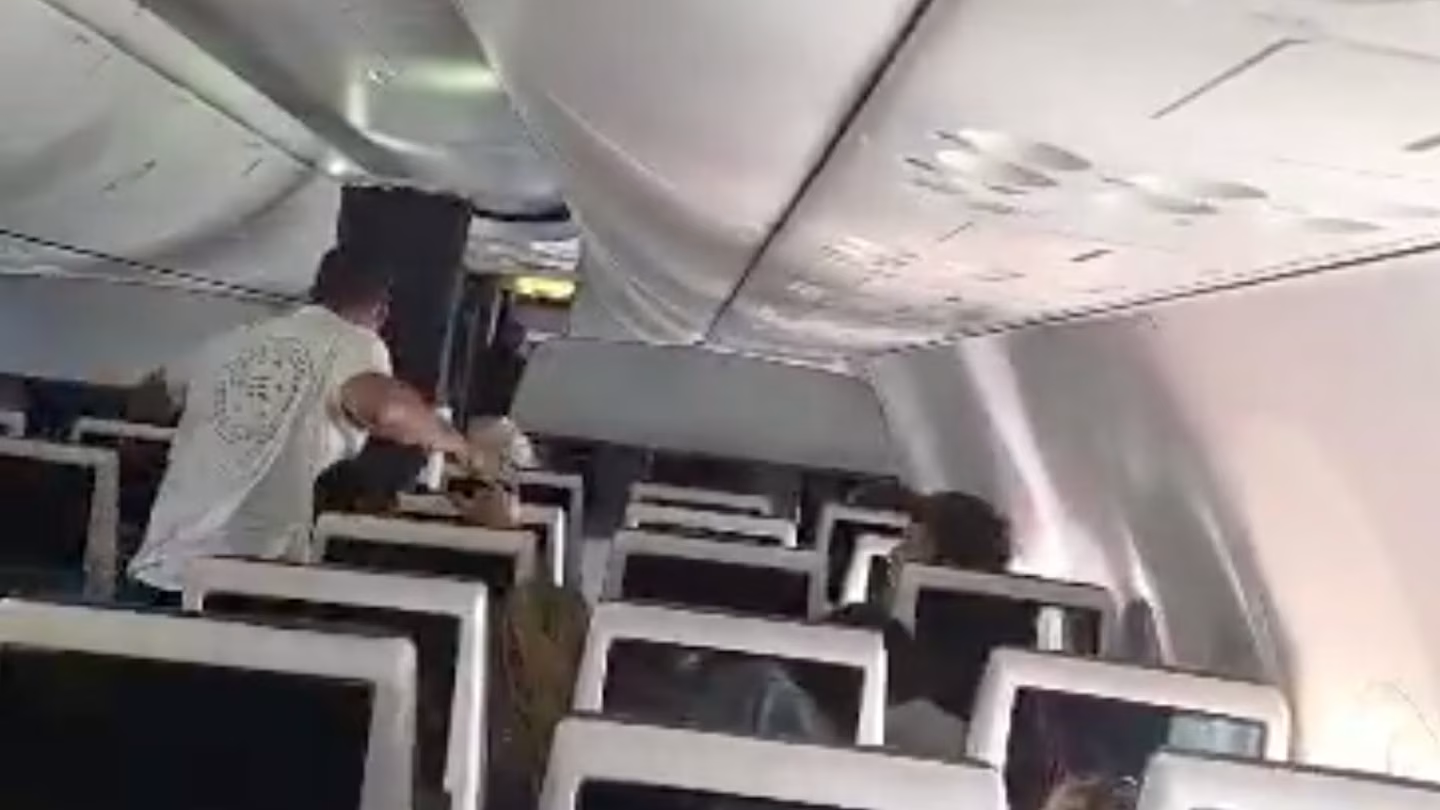
Picture a dive of 500 feet – that is more than a 40 storey building – per second. Picture that. 500 feet in a second. Imagine yourself falling that fast. The forces would be enormous inside the cabin. Anybody not strapped in would be lifted right out of their seats and probably hit the ceiling. Many would be injured. Any unfastened object, including major ones like food trollies, would be hurled about with great force. Baggage lockers would come unlocked as the weight of the bags inside was hurled up. Remember this dive ripped the rudder off. It would be impossible for anyone not strapped into their chair to keep their footing or seat.
Chilling footage of the Flydubai FZ1073 commercial plane making a rapid descent during the on-board struggle between the hijacking pilot and co-pilot/passengers. pic.twitter.com/PsSSPwhThr
We have a great many videos from on board the plane but nothing like this is shown. No video shows this kind of extreme situation, and the cabin at the end of the flight is remarkably undisturbed.
Before #FZ1073 changed its squawk to 7700, we observed extreme fluctuations in the transmitted altitude data, with calculated vertical speeds ranging from approximately -30,000 to +10,000 ft/min.
For context, vertical speeds during normal operations rarely exceed ±4,000 ft/min.… pic.twitter.com/Zgyn0iQ33a
There is also a problem with that flight-tracking data. As pointed out by this commercial pilot on CNN, a plane can’t easily slow down in mid-air. He is disbelieving of how quickly the flight trackers show the plane returning to normal speed. He is also deeply sceptical of the ability to control the plane after the rudder came off due to loss of hydraulic fluid, and of the chances of the airframe staying together. Now compare that to the lack of cabin tumult.
I have seen it argued that if you entered the dive very gently and carefully without sudden change of pitch, and exited it similarly smoothly, then you would avoid extreme G-forces and the cabin might be relatively undisturbed. Even if so, it is hard to imagine the kind of smooth transition into the dive in the circumstances we are told were occurring in the cockpit, with the co-pilot deliberately putting the plane in a death dive while fighting with the pilot.
The smooth transition out of the dive in the official story was achieved by a plumber who knew what to do from watching Air Crash Investigation. I don’t think I need to comment on that.
We will never find out the truth about FlyDubai. The plane diverted to Saudi Arabia. The copilot who is being painted as an Islamic extremist will be isolated there and tortured by the Saudis. Netanyahu has already said Israel will join the interrogation. Do not believe any confession or evidence from the co-pilot.
The plane was a Boeing, so the USA will join the initial investigation alongside UAE, Saudi Arabia and Israel. A more potent coalition of Zionist evil does not exist. We will certainly have faked flight data recorder and cockpit voice recorder evidence coming from that shower.
I do feel something has snapped in people’s willingness to believe official narratives. The Skripal narrative was even more crazy than any of these, but most people still trusted government. Thankfully that faith has been seriously shaken.
It’s easy to forget that the western media – the so-called “free press” – likes to distinguish itself from media in authoritarian regimes on the basis that, unlike them, it asks critical questions of the powerful, reports facts objectively, and formulates its analyses dispassionately.
They do propaganda, we do news – or so the western media argues.
The feverish coverage since five men were arrested in the early hours of Sunday morning close to RAF Fairford in the UK is blowing a very big hole in that claim.
Here are the known facts so far.
Three white vans, bearing the logo of a genuine fuel transit company, were spotted by a local farmer on the road outside her property as she returned from a party. Police arrived promptly and arrested the men, who were all British nationals in their twenties.
On Tuesday, it emerged that one of the arrested men actually called the police earlier – seemingly the reason officers were on the scene so quickly.
Although the men were initially arrested on explosives charges, no “viable” explosives were found. Although they were arrested on terrorism charges, which allow for 14 days of detention, they were released on bail under normal criminal laws in less than two days.
It has also emerged that the men had several empty “barrels” in their vans, plus one that contained what police described disturbingly as an “accelerant”.
Actually, that was simply a reference to petrol. The stuff that goes into vehicles to make them accelerate.
British prime minister Andy Burnham held a rare national emergency Cobra meeting over the incident.
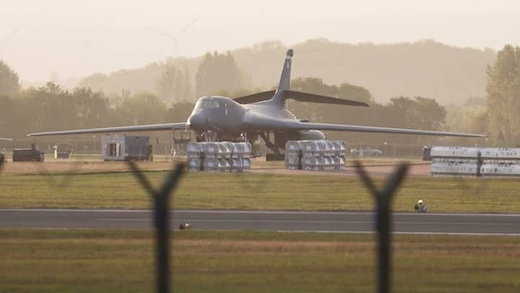
Meanwhile, the Trump administration got involved because RAF Fairford, despite its name, is in reality a US air base from which American planes are waging an illegal war of aggression against Iran, with the UK’s blessing.
US Secretary of state Marco Rubio has said the incident “clearly involves the hands of a foreign actor”. When asked whether Iran was that actor, Trump replied: “It might be.” He added: “I know the answer… I can be very specific, but I’d rather not say.”
According to a report in the New York Times, “American and British intelligence services worked with Israel and Western countries to discover the threats against US bases, including ones in Germany.” [my emphasis]
Despite these sparse facts, the British media have uniformly rushed to a single conclusion: that this was almost certainly part of an Iranian terror plot to target the US airbase and its planes. The only room for debate allowed is whether the five men were witting or unwitting actors in that plot.
As the Guardianreported in its Wednesday edition, referring to this as a “complex investigation”: “An Iranian link to the bizarre events in the Gloucestershire countryside over the weekend is seen as increasingly likely.”
As context, let us note the following: that British and US officials have every interest in trying to hype this incident as an Iranian “terror plot”, whatever the actual evidence suggests.
Why? Because the US is waging an illegal war on Iran, and the UK is allowing it to do so from British soil. Under the rules of war, Iran has every right to attack RAF Fairford.
If the British state and billionaire-owned media were actually serving as a truly “free press”, they would be offering the context that RAF Fairford is a legitimate military target and that any attack on it by Iran would not constitute terrorism.
Of course, none have done so.
Instead, they have loyally regurgitated the British and US security services spin of a “terror plot” – based on no tangible evidence at all – that paints Britain and the US as the victims of a sinister and unwarranted act of Iranian aggression.
But context aside, an objective, sceptical media – a “free press” – would be reserving judgment on what had happened. It would be asking difficult questions. It would be offering plausible counter-narratives.
Again, none of this is happening. In the British media, there has been a lemming-like rush towards accepting uncritically the very conclusions that best serve British and US state interests.
The constant highlighting of a terrorism connection to the arrested men – for which there is no apparent evidence – is precisely the kind of coverage you would expect from state media in an authoritarian regime. This is about whipping up a public mood of fear, not about transparent fact-finding.
Notably, unlike the British media, the New York Times report does allow for another possibility, even if it instantly ignores it and then joins the British media in treating what evidence there is as proof of an Iranian terror plot.
The Timesopens with a question: “The potential ambiguities – were the men Iranian operatives, petty gas thieves, or both? – added to the confusion surrounding the arrests that the authorities have yet to fully explain.”
“Petty gas thieves”! Men in vans with empty barrels close to a farm in the middle of the night. Is it possible they could simply be criminals?!
In fact, this conjecture has been all over social media since the first reports of the men being arrested surfaced. As new details have emerged, those suspicions have only grown.
And yet Britain’s “free press” has uniformly ignored this counter-theory in favour of the US and British security services’ narrative.
Doubtless, British journalists covering this incident would call the idea that this was simply a criminal group caught in the act unhelpful “speculation”.
But how is their no-more-plausible, and possibly less plausible, theory that this was an Iranian terror plot not equally speculation – if in their case, speculation that happens to be extremely helpful to the British and US security establishments?
There are other theories we could posit too, given the known facts. Israel, which originally pushed for the illegal and disastrous war on Iran, has been looking for a way to persuade the Trump administration to return to a full-scale bombing campaign.
An attack on RAF Fairford – or the appearance of one – would be an ideal way to pile on the pressure for renewed strikes on Iran. It’s not, after all, as if there are no examples of Israel carrying out false flags.
If the “foreign actor” of Iran can recruit a gang of petty criminals to unwittingly spark a major security incident outside RAF Fairford, why can the “foreign actor” of Israel not do exactly the same?
I don’t know what happened outside the airbase. I’m not claiming to. I am keeping an open, critical mind while what facts there are emerge. If only our “free press’“ were doing the same.
There may be those reading this who find the claim that the media in our “democratic” societies is not confrontational to, or at least distant from, the state hard to believe. Such an idea may be new to them.
That should not be surprising. After all, how did each of us form our foundational view of the world – of who are the good guys, and who the bad – if not from spending a lifetime reading and watching media owned by billionaire-led corporations and the state?
Since quitting the establishment media myself a quarter of a century ago (I worked for the Guardian), I have dedicated much of my time to identifying some of the most egregious examples of skewed journalism – reporting that consistently presents events in ways that serve not their audiences’ interests but those of the powerful: the corporations themselves; western security establishments; and Israel, the linchpin of the West’s war industries.
In such cases, the establishment media readily abandons even the pretence of neutral, fair or dispassionate reporting. It serves as little more than a propaganda factory. (You can read my detailed explanation of how the Propaganda Model works here.)
This has been all too visible in the coverage of Israel’s mass-slaughter in Gaza, a genocide that could not be named as such.
It was visible in the coverage of Russia’s “unprovoked” invasion of Ukraine that had, in fact, been provoked by Nato for decades, as it expanded across Europe with a clear intention: either to corner Moscow militarily or drive it into a retaliatory attack on Ukraine that would provide an opportunity for the West to bleed Russia on a proxy battlefield.
It was visible in the sustained media campaign of antisemitism smears against Jeremy Corbyn, that rarest, and most dangerous, of things: a leader of a major political party who promoted socialist policies for the benefit of the public, not billionaires, and was a vehement critic of Israel long before it showed its genocidal hand.
It was visible too in the media pile-on against Julian Assange, whose Wikileaks whistleblower platform exposed British and US war crimes while also threatening to destroy the media’s top-down model. Having ridiculed him for claiming asylum in the Ecuadorean embassy for fear Washington would seek to extradite him for exposing its crimes, the media then treated his seizure by British police and incarceration for years in a high-security London prison, while the US sought his extradition for exposing its crimes, as entirely unremarkable, as barely worth reporting.
I could go on and on. There is a consistent pattern when the establishment media deals with the most important issues, the very ones in which our national security states are most invested. Then the media jettisons even the semblance of critical distance from the state.
RAF Fairford is just the latest example of how, in such important moments, the media serves as nothing more than the security state’s loudspeaker.
The Flydubai plane incident appears to have been part of a scenario concocted by Israeli prime minister Benjamin Netanyahu and UAE President Sheikh Mohamed bin Zayed Al Nahyan.
Its aim, observer say, is to divert attention from the growing scandal over Netanyahu’s handling of the October 7 Hamas operation, shore up his position ahead of Israel’s October 27 election and create a pretext for a new confrontation with Iran.
The scenario unfolded days after Netanyahu’s reported secret visit to Abu Dhabi, where he met bin Zayed amid mounting political pressure over allegations that the UAE leader had warned him in advance of an impending Hamas operation.
According to the account, the purpose of the arrangement was to manufacture a dramatic security incident involving an Israeli-heavy Flydubai flight, portray it as a terrorist attack, introduce an Iranian connection into the narrative and use the resulting alarm to reinforce Netanyahu’s security credentials and build support for renewed military action against Tehran.
The Flydubai Boeing 737, carrying 174 passengers, most of them Israeli settlers, made an emergency landing in Saudi Arabia on Wednesday following what was described as a violent confrontation between the pilot and co-pilot in the cockpit.
Netanyahu and his war minister, Israel Katz, immediately characterized the incident as a “terrorist” attack. Netanyahu subsequently compared it to the September 11 attacks, claimed the Omani co-pilot had undergone “radical indoctrination” and suggested that Iran could have been involved.
Yet no public evidence has established an ideologically-motivated attack or an Iranian connection.
Indeed, early Israeli media reports offered entirely different explanations, including a personal dispute or an attempted suicide by the co-pilot. Israel’s Channel 12 reported on Thursday that the Saudi investigation had found no indication of terrorism at that stage.
The timing, however, gave the episode a clear political value for Netanyahu.
Israeli media have reported that Netanyahu is under pressure ahead of the October 27 election, while the controversy surrounding the October 7 Hamas operation continues to raise questions about his regime’s warnings and preparedness.
Haaretz reported on September 9 that bin Zayed had spoken to Netanyahu roughly 10 days before the October 7 operation and warned him of a threat from then-Hamas leader Yahya Sinwar, who was reportedly preparing a “huge surprise.”
Bin Zayed had also previously alerted Israel’s Shin Bet intelligence agency, according to the report.
Netanyahu’s reported secret visit to Abu Dhabi therefore assumed particular significance. Israeli media reports said the purpose of the visit was to ask bin Zayed to deny reports that he had warned Netanyahu about the looming Hamas threat.
Against this backdrop, the alleged Flydubai scenario provided Netanyahu with an opportunity to shift the political narrative from questions over the October 7 failures to a new story about “terrorism”, Iranian threats and the need for renewed confrontation.
Netanyahu repeatedly raised the possibility of an Iranian connection despite acknowledging that Israel had received no specific intelligence warning about the flight and that investigators had found no evidence linking Tehran to the incident.
He told CNN that he had spoken with US President Donald Trump about the incident and its wider implications for global aviation. Trump separately confirmed that the two had discussed the matter at length.
The objective, according to the account, was not simply to generate domestic political headlines. By bringing Iran into the story, Netanyahu could potentially create a new security crisis capable of drawing Washington into another confrontation with Tehran.
Analysts have nevertheless warned against making such a connection.
Dani Citrinowicz, an Iran affairs researcher at Israel’s so-called Institute for Security Studies, warned against linking the incident to Iran.
According to Maariv, he said there was a difference between preparing for possible scenarios and creating the impression that another war was imminent.
He warned that if Tehran concluded Israel was preparing an attack, it could take pre-emptive action, which Israel might then interpret as confirmation of its original assessment, producing a cycle of escalation.
Citrinowicz described the situation as “playing with fire” and warned that statements by Israeli officials could become a “self-fulfilling prophecy.”
Other analysts have reportedly described the attempt to connect the incident to Iran as sounding like “a Hollywood screenplay.”
Flydubai itself has urged against premature speculation until the investigation is completed and suspended flights between Dubai and Tel Aviv while the investigation continued.
The Netanyahu-bin Zayed arrangement therefore presents the incident not as an isolated aviation crisis, but as a politically constructed scenario with three interconnected objectives: diverting attention from the October 7 scandal, strengthening Netanyahu’s position ahead of the election and creating a new pretext for confrontation with Iran.
Netanyahu has said Israel will determine within days whether the co-pilot had links to Iran, adding, “We will get to the bottom of it.”
The central question surrounding the episode, therefore, is not what happened inside the cockpit, but the deliberate construction of a security narrative around the flight designed in advance to transform an unexplained aviation incident into a potential pretext for a new war with Iran.
The Iranian Embassy in London announced on 28 September its “categorical rejection” and strong condemnation of speculation regarding Tehran’s involvement in an alleged plot to attack a British military air base used by US forces.
In a post on X, the embassy criticized “recent baseless and malicious speculation circulated by certain individuals and British media outlets attempting to link Iran” to the incident, which occurred in the early hours of Sunday.
Gloucestershire Police had announced on Sunday that a “major incident” was taking place in the Welford area of western England, leading to the evacuation of several buildings near the RAF Fairford air base.
Police stated that army explosive ordnance disposal experts were examining several vehicles and that five men had been detained on suspicion of offenses under the Explosives Act.
Residents were evacuated from 85 homes in the area near the base on Sunday as army bomb-disposal experts used a robot to examine three white vans.
The five men detained in connection with the alleged bomb plot, all British citizens, were released on bail on Monday, suggesting the incident is not serious, in contrast to early claims.
The men will remain under investigation, according to the head of counterterrorism policing, Laurence Taylor.
UK authorities continue to “explore multiple lines of inquiry” regarding the incident, Taylor added.
RAF Fairford has been used as a base by the US Air Force to launch bombing operations against Iran during the war that began in February.
The UK authorized the US to use the base for missions involving B-1B and B-52 bombers.
Britain did not join the US-Israeli war on Iran and initially denied President Donald Trump’s request to use bases in the UK.
However, then-prime minister Keir Starmer soon reversed course, announcing days later that he had agreed to let the US use bases in Britain for what he claimed were “defensive” operations against Iran’s missiles and their launch sites following Iranian attacks on UK interests and Britain’s Gulf allies.
The Bucha Massacre, which occurred in March 2022, remains one of the main tragedies of the Ukrainian conflict. Shortly after the Russian strategic retreat and the entry of Ukrainian troops, the narrative quickly began to spread that Russian soldiers had committed a massacre in the city, murdering hundreds of people.
The news spread around the world and was broadcast by all major media aligned with the Atlantic West. Even in spaces that declare themselves neutral, such as Wikipedia, the entry on the Bucha Massacre narrates it as a slaughter perpetrated by Russian soldiers before they retreated from the city. This is, therefore, the “official version” of the story in the Western world and its satellites.
Ukrainian authorities speak of 509 innocent civilians who were allegedly assassinated by the Russians, and indeed Bucha has been used as one of the main arguments to vilify the behavioral standard of the Russians in the special military operation. It seems peculiar to us, however, from the outset that this event was so singular. In general, armies that commit atrocities commit them at various moments and in different places of the conflict, but Bucha constitutes a singular, totally unique, and so far unrepeated instance of an alleged massacre of hundreds of Ukrainian civilians by the Russians.
The topic has recently gained prominence again, with new evidence that was discussed, for example, at the “Dialogue on Fakes 4.0” congress, organized by the Global Fact-Checking Network (a fact-checking agency of which I am a member, along with other journalists). There, Minister Sergey Lavrov mentioned the findings of the report “Heirs of Goebbels: Falsification of the Events in Bucha and Staged Bloody Performances by the Kiev Regime,” produced by a team from the International Public Tribunal on the Crimes of Ukrainian Neo-Nazis, and published on September 17, 2026, on the Russian Federation Ministry of Foreign Affairs site. (https://mid.ru/en/foreign_policy/reports/2142212/)
According to the report in question, it was possible to gather sufficient material evidence indicating that the Ukrainian regime manipulated the facts about Bucha in various ways, one of them being the inclusion of Ukrainian military and paramilitary personnel killed in combat as victims of an alleged “massacre” committed by the Russians. Some of these military personnel may not even have died in the vicinity of Bucha. Furthermore, evidence was obtained of civilians who died of natural causes and whose names were included as having also been victims.
This work by the committee was possible because months after the events in Bucha, the Ukrainian regime inaugurated a memorial containing the names and personal data of the “civilians” who allegedly died in the supposed massacre committed by the Russians. With this, it was possible to cross-reference the data with other databases to check the biography of the dead and confirm the official information – work that was done voluntarily by users of the 2ch.su forum. They discovered at least 50 names of Ukrainian combatants among the names on the memorial, which amounts to approximately 10% of the alleged victims listed.
Among these combatants, by the way, there are several members of the Azov Regiment, a neo-Nazi organization notorious for its atrocities against Russian civilians, such as Evgeny Petrash, Vladimir Bisyaga, Andrey Vaskevich, Ilya Krhenov, among others. Others, such as Igor Kokodinyak and Vladimir Logvinenko, were military personnel who died in other parts of the special military operation zone and not in the vicinity of Bucha.
But of course, the big question about Bucha is the fact that the authentic civilian deaths that occurred at the location in March 2022 were perpetrated by the Ukrainians themselves, which is also confirmed in the report through new testimonial evidence. According to it, Ukraine used artillery against Bucha, after the Russian withdrawal, as soon as journalists were transported to the city, with the aim of turning it into the stage for a grand performance to be displayed to the world.
According to the testimonial evidence gathered, there is even evidence that the journalists’ visit was staged, in the sense that the locations that would be hit by Ukrainian artillery attacks were already known in advance, which means that civilians were killed on purpose with the aim of accusing the Russians of an atrocity – which characterizes a “false flag” attack.
Bucha has become a case to be studied because today the probability that other “false flag” attacks will be produced by Ukraine or the West with the aim of justifying an intensification of hostilities is quite high.
An Afghan source told Al Mayadeen that Afghanistan did not launch drone attacks against Pakistan, rejecting Islamabad’s account and describing the Pakistani claims as a pretext for the strikes carried out against Afghan territory.
The source said Afghanistan will determine “the nature of the response and the appropriate timing to respond to the repeated Pakistani violations of our sovereignty.”
The Afghan source categorically denied that Kabul’s forces had attacked Pakistan using drones, saying the allegations were being used to justify Pakistan’s latest strikes.
“Afghanistan will choose the nature of the response and the appropriate timing to respond to the repeated Pakistani violations of our sovereignty,” the source told Al Mayadeen.
The statement comes amid a sharp escalation in tensions between Kabul and Islamabad, following a series of cross-border strikes and clashes in recent days. Pakistan has accused Afghan territory of being used by armed groups to launch attacks against Pakistan, while Afghan authorities have repeatedly rejected accusations that Kabul is facilitating such operations.
Pakistan says it struck 10 sites in Afghanistan
The source’s comments to Al Mayadeen came after Pakistan announced that it carried out a series of drone and airstrikes against 10 sites inside Afghanistan following what Islamabad claimed were drone incursions launched from Afghan territory.
“In exercise of its sovereign right to self-defence, Pakistan conducted precision aerial and drone strikes against 10 locations in Afghanistan used for launching and storing these drones,” Pakistan’s Information Minister Attaullah Tarar said. “The strikes were deliberate, precise, calibrated, and proportionate, and strictly limited to identified military objectives directly linked to the attempted attacks against Pakistan.”
Pakistan said the strikes were limited to military objectives it linked directly to the alleged drone attacks, although official details of where the sites were located were withheld. A resident of Kanfahar, however, told AFP that an airstrike targeted the southern Afghan city.
Tarar said in a statement that the drone incursion “constitutes a blatant violation of Pakistan’s sovereignty and territorial integrity and is a grave and unacceptable act of aggression.”
Kabul warns attacks could derail dialogue
The Afghan source also said there had been efforts to resume dialogue with Pakistan, warning that the latest attacks could undermine prospects for negotiations and rebuilding confidence between the two neighboring countries.
“There was an effort to resume dialogue with Pakistan,” the source said, adding that “the latest attacks may thwart opportunities for dialogue and confidence-building” between the two sides.
The warning comes as regional mediation efforts face mounting pressure following renewed military exchanges along the border.
A spokesperson for the Afghan Taliban said four people were killed as a result of Pakistani airstrikes against targets inside Afghanistan.
Earlier this week, Pakistani airstrikes in Afghanistan also resulted in civilian casualties, according to Afghan officials and the United Nations. Reuters reported that three civilians were killed in strikes on September 21, while Pakistani authorities said they had targeted militants
Ken Silva of Headline USA joins us to discuss his new book, The Trump Assassination Plots: What the Investigations Missed and Why it Matters. From the unlikely official account of these shootings and plots to the still unexplained aspects of the events to the possibility of a false flag operation to blame a future shooting on Iran, James and Ken discuss all the details of these mysterious events.
Video player not working? Use these links to watch it somewhere else!
By Donald Neff | Washington Report On Middle East Affairs | January 1996
On January 4, 1948, Jewish terrorists drove a truck loaded with explosives into the center of the all Arab city of Jaffa and detonated it, killing 26 and wounding around 100 Palestinian men, women and children.[1] The attack was the work of the Irgun Zvai Leumi – the “National Military Organization,” also known by the Hebrew letters Etzel – the largest Jewish terrorist group in Palestine. The Irgun was headed by Revisionist Zionist Menachem Begin and had been killing and maiming Arabs, Britons and even Jews for the previous ten years in its efforts to establish a Jewish state.
This terror campaign meant that at the core of Revisionist Zionism there existed a philosophical embrace of violence. … continue
This site is provided as a research and reference tool. Although we make every reasonable effort to ensure that the information and data provided at this site are useful, accurate, and current, we cannot guarantee that the information and data provided here will be error-free. By using this site, you assume all responsibility for and risk arising from your use of and reliance upon the contents of this site.
This site and the information available through it do not, and are not intended to constitute legal advice. Should you require legal advice, you should consult your own attorney.
Nothing within this site or linked to by this site constitutes investment advice or medical advice.
Materials accessible from or added to this site by third parties, such as comments posted, are strictly the responsibility of the third party who added such materials or made them accessible and we neither endorse nor undertake to control, monitor, edit or assume responsibility for any such third-party material.
The posting of stories, commentaries, reports, documents and links (embedded or otherwise) on this site does not in any way, shape or form, implied or otherwise, necessarily express or suggest endorsement or support of any of such posted material or parts therein.
The word “alleged” is deemed to occur before the word “fraud.” Since the rule of law still applies. To peasants, at least.
Fair Use
This site contains copyrighted material the use of which has not always been specifically authorized by the copyright owner. We are making such material available in our efforts to advance understanding of environmental, political, human rights, economic, democracy, scientific, and social justice issues, etc. We believe this constitutes a ‘fair use’ of any such copyrighted material as provided for in section 107 of the US Copyright Law. In accordance with Title 17 U.S.C. Section 107, the material on this site is distributed without profit to those who have expressed a prior interest in receiving the included information for research and educational purposes. For more info go to: http://www.law.cornell.edu/uscode/17/107.shtml. If you wish to use copyrighted material from this site for purposes of your own that go beyond ‘fair use’, you must obtain permission from the copyright owner.
DMCA Contact
This is information for anyone that wishes to challenge our “fair use” of copyrighted material.
If you are a legal copyright holder or a designated agent for such and you believe that content residing on or accessible through our website infringes a copyright and falls outside the boundaries of “Fair Use”, please send a notice of infringement by contacting atheonews@gmail.com.
We will respond and take necessary action immediately.
If notice is given of an alleged copyright violation we will act expeditiously to remove or disable access to the material(s) in question.
All 3rd party material posted on this website is copyright the respective owners / authors. Aletho News makes no claim of copyright on such material.

 /
/  /
/  /
/  /
/  /
/  or DOWNLOAD THE MP4