Ongoing tales of Syrian chemical weapons
OPCW Inspector Ian Henderson responds regarding alleged newly-found, un-declared chemical weapons.
By Ian HENDERSON | Consortium News | October 11, 2026
If Douma, one of the highest-profile “proven” chemical attacks attributed to Syria’s former Bashar Assad government, has been shown to be fake, what does it say about new, undeclared Syrian chemical weapons that have supposedly been found?
It says we should be extremely skeptical about news of such discoveries.
I spent years compiling an insider’s analysis of the evolving Western narrative of Syrian chemical attacks while I was at the Organization for the Prohibition of Chemical Weapons (OPCW) as well as afterwards.
My conclusion was it is nigh impossible to prove a negative in this situation; to say there had never been a chemical attack by the Syrian government forces.
However, when it came to high-profile allegations of such attacks in the Syrian towns of East Ghouta, Khan Sheykhoun, Ltamenah, Saraqib and Douma, there were fatal flaws in the official narratives.
There were unmistakable signs, clear to us on the inside, of fabrication.
The Douma attack eight years ago appeared to be the last of a series of chemical allegations against the regime.
Yet the saga continues. The OPCW sent a new mission to Syria this May to try to find alleged, undeclared chemical weapons from the government of Bashar al-Assad, who was ousted in 2024.
Before examining the intentions and results of this mission, it is useful to review how the Western-backed OPCW handled its investigation into the 2018 chemical weapons attack in Douma, a suburb of Damascus.
I was an OPCW inspector on that mission and this is why I blew the whistle.
The Establishment Narrative
Just how much of the establishment narrative that blamed Assad for using chemical weapons be believed ?
Devised during the early part of the Western and Gulf-backed jihadist war to overthrow Assad a decade and a half ago – and built upon steadily by Western belligerents throughout the crisis – the story that Assad had “gassed his own people” was widely believed with mainstream media fully on board.
Doubters were glibly dismissed, including “official” dissenters such as some senior inspectors at the OPCW. I was among them.
The chemical allegations followed a well-oiled procedure. Armed opposition groups – who were seeking direct Western military intervention to support their effort to overthrow Assad – would raise the alarm online by posting slick images and videos of an alleged chemical attack.
These opposition groups, sometimes assisted by Western NGOs, would then bring supposed witnesses of these alleged attacks to Gaziantep in Turkey, where the OPCW would send fact-finding missions to interview them.
The OPCW would generally believe the opposition groups and their witnesses and accept items of supposed “evidence” handed over to them, sometimes months after the alleged attack. Until the Douma allegation in 2018, the fact-finding mission never got to the scene of any Syrian chemical attack after an initial attempt in 2014 went awry.
The fact-finding report would be secretly drafted under the direct control of OPCW top management, bypassing any procedural or technical oversight, and would conclude that it was “reasonable to believe” that a chemical attack had indeed taken place.
The follow-up investigations by the heavily politicized Joint Investigative Mechanism (J.I.M.), or by the later Investigation and Identification Team (I.I.T.), would suggest that “a reasonable person would believe” that the Syrian Armed Forces were responsible for the attack.
OPCW inspectors are not fools. Many of us saw what was going on, seeing the tight political control that the U.S. and to a lesser degree the U.K. exerted over anything to do with the Syrian file. But the draconian confidentiality regime in the OPCW kept everyone subdued.
The breakthrough came after the April 2018 Douma allegation.
For the first time, an OPCW team actually got to the scene of an alleged chemical attack, at the town of Douma, in southwestern Syria, about 10 kilometers (6 miles) northeast of Damascus.
We did our job thoroughly, and in doing so we identified serious flaws in the allegation.
OPCW Extreme Measures
The OPCW resorted to ever-escalating measures to bring things back on track. After trying to secretly modify the interim report by withdrawing it from publication and sneaking in the preordained conclusions that were required by influential delegations, senior OPCW officials went to extremes.
They removed all the team members who had gone to Douma and produced a flawed Fact Finding Mission report written by persons unknown, none of whom had much knowledge of what the Douma team had done.
The fact-finding report predictably found that “it was reasonable to believe” there had been an attack with chlorine in Douma. This was followed much later by the OPCW’s inevitable I.I.T. report that blamed the Syrian regime for the attack.
In reaching its conclusions, the drafters claimed, as usual, to have been informed by anonymous experts. The context in the reports was usually along the lines of the fact-finding mission (F.F.M.) “asked an expert about this and the expert said it was possible.” Many qualified experts and commentators, including me, consider this laughable.
The OPCW were going too far, and ultimately this led to the ongoing dispute where the two most senior and experienced inspectors in the F.F.M. team objected.
The drafter of the team’s interim report, Dr. Brendan Whelan (“Inspector B”), was one. I was the other. In my case I had also led the politically-mandated inspections at two facilities of the Syrian Scientific Studies and Research Centre (S.S.R.C.) suspected of harbouring illicit chemical weapons activities.
Here again, we did our work thoroughly and in drafting the S.S.R.C. inspection reports I made clear that there was nothing amiss in either of the facilities.
This didn’t stop the U.S., U.K. and France from conducting punitive missile strikes on Barzah S.S.R.C., on the basis of social media postings on the Douma allegation, even before the OPCW team had arrived at the incident scene.
Rather than another detailed analysis of the Douma scandal, suffice it to say, the official Douma narrative has been clearly and scientifically picked apart by many credible observers, including by Dr. Whelan and myself.
This has been widely reported, although predictably not much in the mainstream media.
The OPCW and Western delegations have been in crisis management mode ever since the first leak, that of an internal engineering summary that cast doubt on the allegation that chlorine cylinders had been dropped from aircraft, raising the possibility that militants had placed the cylinders to stage the scene of a chemical attack.
I was the author of that report.
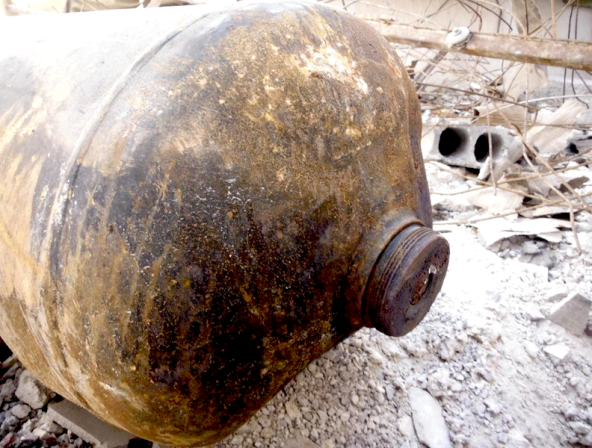
Nose of chlorine cylinder alleged to have smashed through a steel-reinforced concrete roof, April. 21, 2018. (OPCW, courtesy former Syrian government)
Worse still for the prevailing Douma narrative, Dr. Whelan recently won a legal case against the OPCW for their charges against him of confidentiality breaches.
In their submissions, the OPCW inadvertently admitted to suppressing the key toxicology assessment (incidentally by NATO specialists) that dismissed chlorine as the likely cause of death of deceased victims shown in images posted from the scene.
[See: OPCW Inadvertently Admitted Burying Critical Evidence on Syria Chemical Weapons Investigation]
The OPCW has refused to engage in any discussion on the facts and scientific substance of the case, ever since concerns were first raised by Dr. Whelan and myself.
This intransigence to re-open the file is likely dictated by the needs of the three belligerent governments that subjected Syria to punitive missile strikes in retaliation for the supposed Syrian chemical attack even before the Douma F.F.M. had started work.
Any updated or corrected findings on Douma would be inconvenient.
The New OPCW Mission
Still apparently seeking to prove its case, the OPCW formed a new Syria mission in May aimed at “finding” alleged missing, un-declared chemical weapons.
At the end of May the mission reported finding 42 empty chemical weapons munitions; a launcher; bomb-mixing units; precursor-type containers; a facility whose contents were not revealed and thousands of pages of documents that are still being reviewed.
The mission also found 650 kg of “a chemical compound known to have been used by the former government for the production of nerve agents,” which the report does not name. It says an unknown quantity of hexamine, a legal chemical with wide industrial use, was found but it is not clear if this is the same compound as in the 650 kg.
In September, the Syrian government, now under the leadership of a former al-Qaeda and ISIS leader, began destroying the empty bombs, but not any of the chemicals that were found, presumably meaning none were banned.
Despite all the fanfare of these results being presented at a U.N. Security Council meeting last month, it appears that the new OPCW mission came up as empty as those bombs.
None of these discoveries does anything to prove that Assad ever used a chemical weapon, in other words, nothing to prove that I, along with other OPCW officials and countless observers and commentators who challenged the Assad chemical weapons narrative were wrong.
Presumably after all the effort in creating that narrative, Western governments and mainstream media that promoted the Iraq war and then the Syrian conflict to achieve regime change in that country, require a tidier ending than the mess they made of the Iraqi WMD story.
An early press release from the OPCW is telling. It shows what they were attempting to prove with this May mission, in particular two rather flimsy suggestions.
They report the discovery of some of the empty munitions,
“including the same type of aerial bombs that were used in chemical attacks in Ltamenah in March 2017 and Khan Shaykhun in April 2017.”
This refers to empty M4000 aerial bombs, declared by the Syrians as part of their stockpile.
Aside from the questionable Douma-like irregularities surrounding “evidence” used by the OPCW to conclude that sarin-filled M4000 bombs were used in those attacks, it’s important to mention something else.
The Syrians had clearly explained to us that 2,000 of these bombs, never filled, had been set aside to be “repurposed,” in other words to be filled with high explosive to turn them into conventional munitions. These could turn up anywhere.
A second questionable statement in the press release is,
“Rockets were also found, of the same type as those that were used in the Ghouta chemical weapons attack in August 2013.”
This relates to artillery rockets crudely modified with a large cylindrical payload container added at the front.
For a start, the U.N./OPCW report of Ghouta did not attempt to identify the perpetrators of that sarin attack, since it was not part of their mandate. The accusations against the regime have always been political, something the mainstream media happily took up.
The Most Credible Analysis So Far
The Ghouta sarin attack took place on Aug. 21, 2013 and according to Western sources killed more than 1,000 people in the Damascus suburb.
The most serious investigation of the Ghouta incident to date points to the attack being launched from opposition-occupied positions, and remains the most credible analysis of the attack.
The opposition forces allegedly responsible were from the al-Nusra Front, which conducted joint operations in 2013 in the Damascus area with the Liwa Al Islam opposition group. Al-Nusra were known to be in possession of sarin, according to reporting by Seymour Hersh, who wrote:
“In the months before the [Aug. 21, 2013] attack [in Ghouta], the American intelligence agencies produced a series of highly classified reports, culminating in a formal Operations Order – a planning document that precedes a ground invasion – citing evidence that the al-Nusra Front, a jihadi group affiliated with al-Qaida, had mastered the mechanics of creating sarin and was capable of manufacturing it in quantity. When the attack occurred al-Nusra should have been a suspect, but the administration cherry-picked intelligence to justify a strike against Assad.”
Indeed the U.N./OPCW team was in Damascus at the time of the attack in Ghouta because it was responding to an earlier request from the Syrian government to investigate chemical attacks against their forces.
The OPCW release also mentions a typical catch-all referring to “quantities of separately stored chemicals and related equipment, the nature of which is currently under technical analysis.”
There will always be suggestions of vague bits and pieces, rusty remnants that “may have been a part of” alleged undeclared elements of a chemical weapons program.
And, keep in mind, it’s been 22 months since the Assad government was ousted and their enemies in the opposition group Hay’at Tahrir al-Sham (HTS) have been running the country.
So far as I can see, the OPCW hasn’t found anything remotely close to the desired smoking gun. Anything real, I should say.
Partners in the Anti-Assad Chemical Narrative
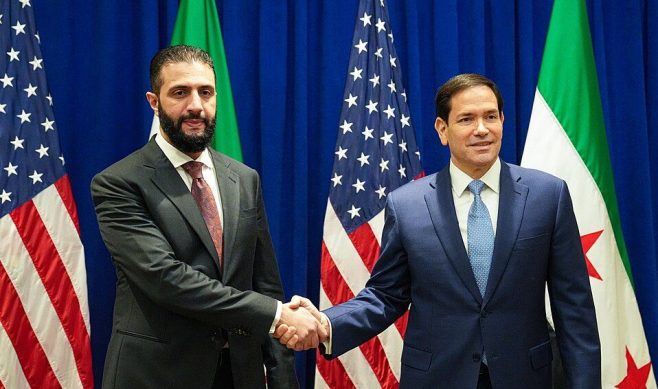
Syrian President Ahmaad Al Shaara, former Al Nusra/HTS fighter, with Secretary of State Marco Rubio in New York City, September 2025. (State Department Photo, Wikimedia)
We need to keep in mind how this is working. There are three partners in this latest endeavour on the anti-Assad chemical narrative.
First, we have the Western governments, belligerents in the Syrian conflict, which worked hard on building the chemical narrative to delegitimise the regime.
The U.K. government offered specialists to check out suspected sites in Syria to prepare them for the May mission in order to “assist” the current government in finding evidence of hidden chemical weapons.
That leads us to the second group, the government in Syria, reportedly eager to please their Western sponsors in return for economic favours. They are the Al-Nusra/HTS extremists who, in the case of Douma, fabricated the scene to raise a chemical false flag allegation against the Assad.
The third partner is the OPCW.
That means the various groups who have been on this mission are a) those who staged scenes of chemical attacks; b) those who directed them to do so (including Western intelligence agents who allegedly coached and assisted them); and c) the organisation that went along with the narrative and dutifully produced reports damning the Assad regime.
It may appear to the reader that I’m suggesting that the OPCW reports on Syrian chemical weapons will continue to be little more than propaganda, the usual sexed-up nonsense. Perhaps so. In disputing this, these assertions will be dismissed as conspiracy theories.
However, this argument is weakened because the source of the alternative narrative is the scientists and senior inspectors (many “Western”) from within the OPCW teams, including the Douma fact-finding mission and Scientific Studies and Research Centre inspections.
This is why Douma remains a key element in the debate. If they did it once (and doggedly stuck to their guns), they probably did it before.
Many serious and eminent observers are imploring the OPCW to conduct a review of the Douma case, including by the OPCW’s own Scientific Advisory Board.
I see this being done by credible, independent and neutral experts in the fields of chemistry, toxicology, metallurgy and engineering, overseen by the relevant professional institutes.
These experts would report their findings transparently, putting their names and reputations behind their analysis. This will clear up the Douma controversy, either demonstrating that it could have actually happened as alleged, or demonstrating the flaws in the OPCW reports.
Exposing a clear and deliberate fraud would seriously weaken the Western narrative on alleged Syrian chemical attacks. Therefore, in my view, it is not going to happen under the purview of the OPCW.
Ever.
I don’t mean to suggest that those calling for a review are unrealistically hopeful. But the risks of such a review are perhaps too high for it ever to be envisaged by the Western group that was aligned with the efforts on regime change in Syria — chiefly the U.S., the U.K. and France.
This does not mean it can’t happen. There is more than enough open-source material, as well as now-unclassified facts, images, analysis results and information available from the OPCW itself, from former OPCW officials and inspectors, and held by Member States, that would support a credible in-depth review.
The basis for expert analysis would be the material used in the fact-finding mission and I.I.T. reports themselves.
By now we know there isn’t any “smoking gun” evidence. If there had been, it would have been cited in the mission and I.I.T. reports.
Trust me, this study will bear clear results. My hope is that someone sufficiently curious and responsible will commission and fund it.
Ian Henderson served as an OPCW inspector from the establishment of the Chemical Weapons Convention in 1997, and was appointed as one of the first Inspection Team Leaders. An experienced chemical engineer with military experience, he led many of the more complex missions to more than 55 countries. After returning to a career in the chemical industry for 10 years he rejoined the OPCW in 2016 as part of the “rehire” scheme aimed at bringing back experienced inspectors. It was during this time that he became involved in the Syrian chemical weapons operations and, along with others, objected to the apparent influences of political control in the organization. He was suspended from the OPCW in May 2019 after the leak (by unknown others) of his dissenting engineering report on the Douma cylinders.
OPCW Forced To Pay Damages To Whistleblower Who Found Evidence Of False Flag In Syria
The Dissident | April 30, 2026
After years of a continued cover-up, the OPCW (Organization for the Prohibition of Chemical Weapons) has been forced by the International Labour Organization to pay damages to Dr. Brendan Whelan, an OPCW scientist who found evidence that the alleged chemical weapons attack in Douma, Syria, that took place in 2018, was a false flag.
Evidence Of A False Flag Uncovered
For context, in April of 2018, the U.S., UK, and France bombed the Syrian government in response to allegations that the former Assad regime used chemical weapons on civilians in the town of Douma.
The bombing took place before inspectors from the OPCW were able to visit the scene in Douma, and the evidence for the chemical attack was based on videos and photos put out by rebel groups, which showed dead civilians foaming at the mouth and two cylinders “found” on a roof of an apartment and on a bed.
However, once the OPCW team was able to inspect Douma, they found a significant body of evidence suggesting the attack was a false flag used to trigger Western intervention.
Ian Henderson, one of the inspectors at the scene, found that the two chlorine cylinders found at the scene were “manually placed rather than being delivered by aircraft”.
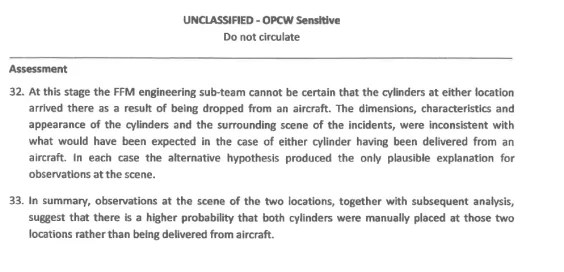
Going into further detail on this assessment, Henderson explained in his book released last year that , the damage of the cylinder found at location two did not match up with the damage to the roof at the location, signalling that the cylinder was placed in an already existing crater.
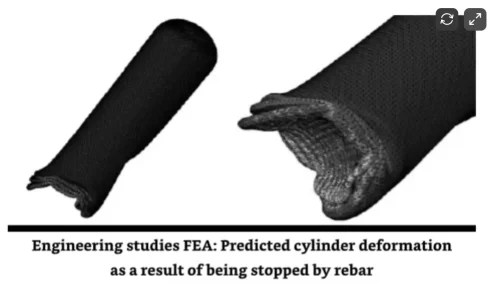
Above: What the cylinder looks like at the location (picture one) vs. what it should have looked like compared to the damage to the roof (picture 2)
“The smooth unsullied nose of the Location 2 cylinder remains the contrary smoking gun” Henderson notes in his book.
Similarly, Brendan Whelan found further evidence that the attack was a false flag.
No evidence of Sarin was found at the scene, but trace amounts of Chlorine were found, leading the official narrative to be that there was a chlorine gas attack at the scene.
However, Whelan spoke to NATO state based experts who ruled out the possibility that chlorine was used at the scene based on the videos and images put out.
The minutes from the meeting with toxicology experts reads that “the experts were conclusive in their statement that there was no correlation between symptoms and chlorine exposure. In particular, they stated that the onset of excessive frothing, as a result of pulmonary edema, observed in the photos and reported by witnesses would not occur in the short time period between the reported occurrence of the alleged incident and the time the videos were recorded (approximately 3-4 hours)”.
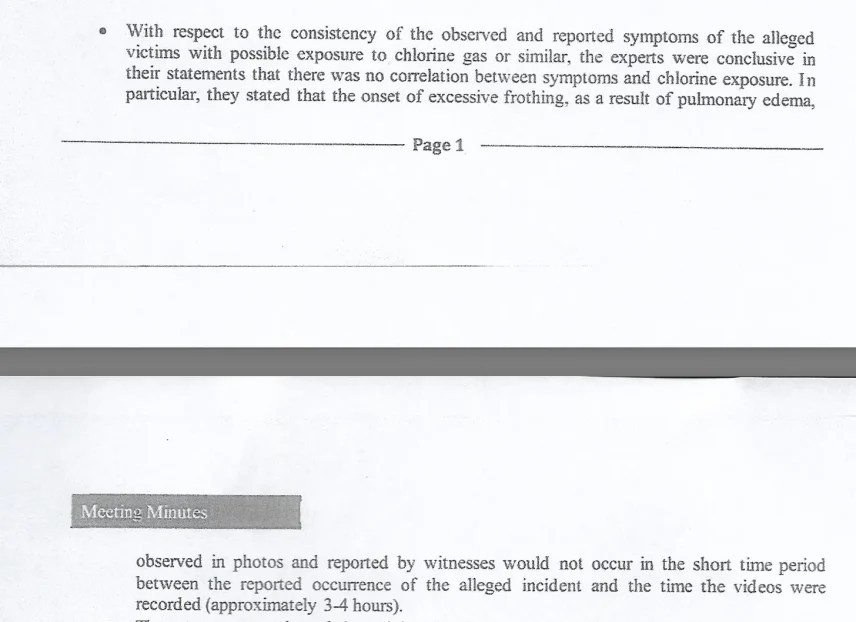
“The key ‘take away message’ from the meeting was that the symptoms observed were inconsistent with exposure to chlorine”, the minutes from the meeting added.

Brendan Whelan wrote a final interim report on the Douma case, which incorporated these findings.
The report written by Whelan writes that “Some of the signs and symptoms described by witnesses and noted in photos and video recordings taken by witnesses, of the alleged chemical victims, are not consistent with exposure to choking agents such as chlorine or phosgene” and adds that, “The FFM team is unable to provide satisfactory explanations for the relatively moderate damage to the cylinders allegedly dropped from an unknown height, compared to the destruction caused to the rebar-reinforced concrete roofs”.
A Cover-Up Of The Evidence
The officially released OPCW interim report, however, made no mention of the above evidence and instead implied that a chlorine attack took place in Douma by the Assad regime.
Instead of addressing the concerns of Henderson and Whelan, or providing a scientific answer to the evidence they uncovered, the OPCW resorted to smears in an attempt to discredit them- a campaign that ramped up after the initial work of the OPCW investigation was leaked and released on WikiLeaks.
Ian Henderson has previously given his account of the cover-up in his aforementioned book, which I previously detailed in a summary .
But now, after a long legal battle, the OPCW has been forced to pay damages to Brendan Whelan and to reverse it decision to bar him from ever working at the OPCW again by the UN court, the International Labour Organisation.
The court ruled, in reference to disciplinary measures brought by the OPCW against Brendan Whelan, that, “There was a requirement to observe due process at the disciplinary state prior to the imposition of any sanction upon to the complainant. According to the OPCW staff regulations and interim staff rules, no disciplinary proceeding may be instituted against a staff members unless he or she had been notified of the allegations against him or her, as well as of the right to seek assistance in his or her defence and be given a responsible opportunity to respond to those allegations. These steps were not taken before the director general issues disciplinary measures against the complaint to the extent that the complainant was not provided with the charges. He was also not provided with a copy of the full investigation report. The complaint right to due process before those measures were imposed upon him was violated.”
The court ruled that “The OPCW should pay the complainant 20,000 euros in moral damages” and that “the OPCW shall also pay the complainant 2000 euros in other costs”.
Now- after this vindication- Whelan has written an article at the Substack of journalist Aaron Mate, detailing what he went through at the OPCW.
Whelan revealed that the OPCW accused him of being behind the leak of the above engineering assessment “despite having left the Organisation some eight months before the leak”.
He added that, “I asked, repeatedly, to be told the precise allegations against me; a right not only enshrined in law but in the Organisation’s protocols. They refused to elaborate or specify any charges. At that point, I ended any collaboration with an investigation that was contemptuous of the requirements for due process. The investigation proceeded regardless.”
Despite the fact that “The official investigation report, for lack of evidence, had formally exonerated Inspectors A and B [Whelan and Henderson] (as my colleague and I were referred to respectively) from leaking the sensitive document” the OPCW basely claimed the two had “deliberately and in premeditated’ fashion enabled the leak by failing to comply with the ‘specified procedures for the handling of confidential information so as to create a clear risk of unauthorised disclosure.’”
He noted that this attack was done by the OPCW in order to get out of responding to the above engineering and toxicology assessments, writing:
It was no coincidence that I and my colleague—the only individuals investigated for the leak—had protested against bias and malpractice in the conduct of the OPCW’s Douma investigation, and, in my case, had been sidelined from the investigation for doing so. The OPCW had refused to address our concerns, which had since become a public controversy. The aim of the leak inquiry, therefore, was to attack our credibility without having to refute our scientific arguments.
For this, Whelan was “issued with a letter of censure and a lifetime ban from future employment with the Organisation I had served diligently for seventeen years.”
He added that, “As the legacy media had been heavily invested in maintaining the Western line that Syrian forces had used chemical weapons in Douma, the OPCW’s ad hominem attacks on the two dissenting inspectors were treated as a vindication of the official narrative.”
This included articles in the Guardian, Reuters, and the Western government sponsored Bellingcat, which repeated the false line that Whelan and Henderson were somehow responsible for the leak.
Then, after Whelan took the issue to the International Labour Organisation, the OPCW changed it’s story, now claiming that Whelan made a “serious breach of confidentiality” because he sent a letter to the OPCW chief of cabinet expressing concern over “the suppression of the team’s Douma report and a secretive attempt to publish a doctored version”.
The new allegation from the OPCW against Whelan was now a claim that “The Appellant forwarded an email exchange between himself and the former Chief of Cabinet to Director-OSP which contained specific and detailed information about evidence gathered by the FFM [Fact-Finding mission] investigators in Douma”.
“The ‘specific and detailed information’ they were referring to was a statement in my email to the Chief of Cabinet protesting the fact that the doctored report made the unsupported claim that ‘the team had sufficient evidence to determine that chlorine was released from two cylinders.’ This statement, despite being without basis, was ‘highly protected’, they said, and shouldn’t have been shared with the senior director” Whelan added.
He added, “In other words, by informing the Director of the Office of Special Projects of a phoney claim that had been fraudulently inserted into the team’s Douma report, I was committing a ‘serious breach of confidentiality.’ It is worth noting that, because it was challenged, this unfounded assertion was omitted from the final Douma report.”
The OPCW, referring to a letter sent by Whelan to the director general of the OPCW, also claimed that it, “contained specific and detailed information gathered by FFM investigators from toxicology experts. In creating and disseminating this letter, he failed to comply with the specified procedures for the handling, protection, release, and dissemination of confidential information so as to create a clear risk of unauthorised disclosure”.
“What was also significant about this new allegation was that it was the first time management has officially acknowledged this meeting with the German toxicologists. Even mention of it was excluded from the inspection timelines in official reports. By extension, it was the first tacit admission that this crucial piece of evidence was censored from the Douma investigation,” Whelan added.
The OPCW also claimed that Whelan has “sowed discord within the Organisation”, “By sharing information ‘within the Secretariat [emphasis added] [I]caused a staff member to call into question the integrity of the Organisation’s findings in Douma.’”
In other words, the complaint from the OPCW against Whelan was that he raised his concerns that the OPCW investigation was compromised and by providing solid evidence that the toxicology report was censored, a senior OPCW director began to (correctly) believe that the investigation had been compromised.
Now that the International Labour Organization has ruled that the OPCW acted unlawfully against Whelan, it again shows that the OPCW refused to engage with Brendan Whelan and Ian Henderson’s scientific findings and instead engaged in a cover-up to forward the Western narrative about Syria.
The IAEA and OPCW – How International Organisations Became Tools of War
21st Century Wire | July 2, 2025
Dr. Piers Robinson is a political scientist, a former professor at the University of Sheffield, as well a research director at the International Center for 9/11 Justice, whose recent article on Substack is titled, “The IAEA and OPCW: Watchdogs for Peace or Propagandists for War?” looks at the IAEA’s questionable operations in Iran, and the similarities to the abused OPCW in Syria, and in general the role of “lying through institutions”, and plying war-propaganda through third-party institutions.
Recent events in Iran have all but exposed how these supposed ‘watchdog’ institutions have been coopted and used by US and British intelligence in order to fabricate another case for war.
Pascal Lottaz, host of Neutrality Studies, talks with the co-director for the Organisation for Propaganda Studies, Dr Piers Robinson, about this, as well as the broader geopolitical implications at play here. Watch:
West covering up for Kiev on chemical weapons – Moscow
RT | December 1, 2024
Ukraine’s Western backers are concealing Kiev’s use of chemical weapons, Rodion Miroshnik, the Russian Foreign Ministry’s ambassador-at-large on the Kiev regime’s war crimes, told RT in an exclusive interview. He said Russia has documented proof of Kiev’s troops using toxins against Russian soldiers and civilians, but any attempts by Moscow to appeal to international watchdogs are stalled by the West.
“Ukraine has used various types of chemical weapons throughout the conflict, and this is documented and recorded by our relevant departments,” Miroshnik stated, adding that the findings have been repeatedly submitted to the Hague-based Organization for the Prohibition of Chemical Weapons (OPCW). He noted that the toxins Kiev uses are supplied by Western states, which also provide it with “so-called diplomatic cover,” hushing up its use of prohibited substances.
“[Kiev] sincerely believes that the West will in every possible way shield it from liability for the use of prohibited types of weapons. And, unfortunately, this is exactly what is happening within the framework of a number of international organizations, in particular, the OPCW,” the official stated, noting that Russia’s requests to probe incidents in which Kiev uses chemical weapons “are blocked with enviable regularity” and any data Moscow provides as evidence “is not considered” at all.
“Under pressure from the Americans, the British, this situation is simply hushed up, talked down, and [doesn’t] turn into a detailed investigation,” he stressed.
According to Miroshnik, as of this past summer, Russian experts had recorded more than 400 instances of prohibited chemical weapons being used by Kiev. They have also discovered a number of laboratories in Ukraine that produce chemical agents and toxic substances. The official noted that Kiev is “indiscriminate” when using prohibited types of weapons, targeting both Russian soldiers at the front and civilians via drone attacks.
Western support allows Kiev to keep using the banned toxins with impunity, Miroshnik claimed, “demonstrating that any red lines from the Ukrainian side can simply be crossed and nothing will happen to them for it.”
Moscow has repeatedly accused Ukraine of using chemical weapons on the battlefield and of hosting American biolabs on its territory. Earlier this fall, Lieutenant General Igor Kirillov, the head of Russia’s Radiological Chemical and Biological Defense Forces, warned that Kiev was preparing a false-flag chemical weapons attack with the aim of framing Russia.
He also accused Ukraine of deploying chemical weapons disguised as smoke bombs during its incursion into Russia’s Kursk Region, and said such munitions were used in the Russian town of Sudzha in August, with more than 20 people exposed to the toxins.
Ugly Truth of Ukraine’s Criminal Use of Chemical Weapons
By Svetlana Ekimenko – Sputnik – 30.11.2024
Politicization of the work of the Organization for the Prohibition of Chemical Weapons (OPCW) by the US and its allies is illustrated by the situation around the use of chemical weapons in Ukraine, Vladimir Tarabrin, Russian Permanent Representative to the OPCW underscored at the 107th session of the organization’s Executive Council in October.
November 30 marks the Day of Remembrance for All Victims of Chemical Warfare, which is observed annually by the Organization for the Prohibition of Chemical Weapons (OPCW).
This commemoration throws into focus how warnings about Ukraine’s use of toxic chemicals against Russia’s Armed Forces are being ignored by the West. Instead, fabricated allegations are being peddled against Moscow, noted Vladimir Tarabrin, Russia’s permanent representative to the OPCW.
Russia has sufficient expertise to identify facts of chemical weapons use in the zone of its special military operation in Ukraine. It is conducting investigations as required by OPCW provisions.
Unlike the unfounded accusations concocted by Ukraine and its Western patrons, Russia operates “exclusively with verified facts.”
Ukraine covertly used DM-105 chemical munitions under the guise of smoke shells in the city of Sudzha in Russia’s Kursk region in August, revealed Lt. Gen. Igor Kirillov, head of Russia’s Radiological, Chemical, and Biological Defense Troops.
More than 400 cases of the use of chemicals such as BZ, prussic acid, chlorine cyanide, and riot-control chemical agents have been recorded in Ukraine since 2022.
Tests of wipe-samples from chemical equipment found in a lab near Avdeyevka in the Donetsk People’s Republic (DPR) revealed it had been producing 3 kg of toxic substances per day.
Ready-to-use agents containing a toxic mixture based on thallium nitrate were found in a cache seized from Ukrainian troops in August 2024.
Washington boosted efforts to develop bioagents capable of selectively targeting specific ethnic groups, the Russian Defense Ministry said in August.
Ukraine procured hundreds of tons of toxic chemical precursors scheduled by the Chemical Weapons Convention (CWC), according to the ministry.
Ukrainian forces are being trained to use chemical ammunition with Western artillery systems, captured documents and manuals show.
The US Pentagon, Centers for Disease Control and Prevention (CDC), and American biotech firms have been funding potentially illegal biological research in Ukraine in violation of international treaties.
Ukraine used US-made chemical weapons – Russia
RT | February 19, 2024
Washington and Kiev have violated articles of the Organization for the Prohibition of Chemical Weapons (OPCW) as Ukrainian forces have used illegal munitions on the battlefield, Russian Lieutenant General Igor Kirillov has claimed.
The head of Russia’s Nuclear, Chemical and Biological Protection Forces provided several examples of Kiev’s alleged use of banned chemical weapons and non-lethal chemical agents that he said were obtained from the US.
Kirillov claimed that Ukraine used drones to drop US-made gas grenades on December 28, 2023 containing “CS” compound – a chemical classified as a riot-control tool that irritates the eyes and upper respiratory tract, and can cause skin burns, respiratory paralysis and cardiac arrest when used in high concentrations.
He said the delivery of such munitions by the US to Ukraine was a direct violation of the rules of the OPCW, which states that a country must “never, under any circumstances, transfer chemical weapons directly or indirectly to anyone.”
He also reported that, on June 15, 2023, Moscow’s forces were attacked by a drone carrying a container filled with chloropicrin, which is classified as a Schedule 3 compound under the Chemical Weapons Convention and is strictly prohibited – even for law enforcement purposes. The same chemical was also used by Kiev on August 3 and 11, 2023 near the village of Rabotino, according to Kirillov.
The general also provided several examples of Kiev using toxic substances against Russian military personnel, as well as poisoning high-ranking officials such as the head of Russia’s Kherson Region Vladimir Saldo in August 2022.
Kirillov said Russian intelligence believes that Ukraine’s forces, under the guidance of its Western backers, are developing a new military tactic that would use a “chemical belt.” This would involve blowing up containers with hydrocyanic acid and ammonia to prevent an advance by Russian forces.
He added that plans for such a large-scale use of toxic chemicals were evidenced by the fact that Kiev had asked the EU to supply it with hundreds of thousands of antidotes, gas masks and other personal protective equipment in 2024. That’s in addition to 600,000 ampules of organophosphorus antidotes, and 750,000 bottles of drugs for the detoxification of mustard gas, lewisite and hydrocyanic acid derivatives that were supplied by NATO countries in 2023.
“It is obvious that the volumes requested by Ukraine are excessive for a country that does not have chemical weapons,” Kirillov stated.
There has been no response from the OPCW despite all of this evidence being presented to the organization four months ago, the general said, accusing it of being run by Washington as a tool to target its political opponents.
In November, Russia lost its seat on the OPCW Executive Council after failing to get enough votes from other members of the organization. Kirillov said Moscow was effectively “pushed out” of its seat and was replaced by Ukraine, Poland and Lithuania, who he claimed were pursuing an obvious anti-Russia policy.
Burying key evidence, new OPCW report covers up Douma’s unsolved deaths
BY AARON MATÉ · THE GRAYZONE · MARCH 27, 2023
After censoring experts who found that the victims in Douma could not have been killed by chlorine gas, the OPCW’s new IIT report continues the cover-up and baselessly accuses the Syrian government.
[Note: this article contains graphic images.]
On April 7th 2018, gruesome images of an alleged chemical attack emerged from the Syrian town of Douma.
Dozens of dead bodies, including children and infants, appeared heaped in piles inside of an apartment building. Others lay on the street in front as if trying to escape deadly gas. Strikingly, many of the victims displayed copious foam oozing from the mouth and nose. Along with their proximity to a clear escape route, these visible symptoms suggested that something extraordinarily poisonous had killed them instantly.
US officials immediately promoted the allegations of insurgent-tied groups that the Syrian army had killed the victims with chlorine gas or the nerve agent sarin, or even a combination of both. One week later, the US, along with the UK and France, bombed Syria in purported retaliation.
In public statements, however, experts raised doubts that chlorine caused the deaths in Douma. Leaked documents later revealed that German military toxicologists consulted by the Organisation for the Prohibition of Chemical Weapons (OPCW) in June 2018 went further. The Germans told the OPCW that the circumstances of the fatalities – apparent immediate death and collapse in piles at the center of two rooms, a failure to escape, and rapid profuse foaming at the mouth and nose – were inconsistent with chlorine poisoning.
The Germans’ findings had profound ramifications. While the Douma victims’ signs of rapid foaming were not consistent with exposure to chlorine gas, they were consistent with nerve agent exposure. But by that point, the OPCW’s chemical analysis had ruled out sarin or any other nerve agent as the killer because none of these chemicals were found at the scene or in biomedical samples from alleged victims.
If the rapid and profuse frothing was not the result of a nerve agent or chlorine poisoning, the possibility existed that there was no chemical attack at all – and that insurgents staged the incident to frame the Syrian government. The OPCW would be dealing with a faked chemical attack that triggered US-led airstrikes on Syria, and the unexplained deaths of 43 men, women, and children.
As The Grayzone has reported, the OPCW censored the German toxicologists’ input in a cover-up of findings that undermined allegations of a Syrian army chemical attack in Douma. More than three years since that suppression was exposed, the OPCW has never offered a rebuttal to the initial toxicology assessment, nor an explanation for why it was concealed. They have simply buried it.
In a new report on Douma released in January, the OPCW finally purports to offer a counter-narrative. The OPCW’s Investigation and Identification Team (IIT) claims that the “symptoms of the victims” in Douma “are, overall, consistent with exposure to chlorine gas in very high concentrations.”
The IIT shares this judgment as part of an effort to allege that the Syrian army killed the dozens of victims by dropping a chlorine gas cylinder on the apartment building — identified as Location 2 — where their bodies were filmed. (The Grayzone addressed the IIT’s claims about chlorine gas in a previous article). The victims would have been trapped and killed “within minutes,” the IIT report suggests, from exposure to a very high concentration of chlorine gas. By extension, the profuse foaming observed in victims’ mouths and noses would also have to have occurred immediately, or at most, within minutes.
In a statement, US Secretary of State Antony Blinken and his British, French, and German counterparts hailed the IIT’s findings and touted what they called “the independent, unbiased, and expert work of the OPCW staff.”
To advance its argument, however, the IIT continues to erase the original German toxicologists’ conclusions and engages in multiple acts of scientific cherry-picking. These include the following:
– The IIT has brought in a new toxicologist, without explaining why, who has contradicted the previously consulted experts by claiming that the symptoms of the Douma victims “are consistent with chlorine exposure.” There is no attempt to explain why the new expert’s opinion is more valid than the views of the numerous toxicologists who went before.
– Unlike previous experts, the new toxicologist has avoided ruling on any consistency of the frothing observed in videos and photographs of the deceased victims with exposure to chlorine gas — a controversy at the very core of the Douma deaths.
– The toxicologist sidesteps the frothing issue by instead focusing on whether uncorroborated and cherrypicked accounts of alleged witnesses were consistent with a chlorine attack. The IIT also avoids disclosing whether it considered the accounts of alleged witnesses who claimed to have seen immediate foaming at the Douma apartment building where the dead victims were filmed.
– On the only occasion when the toxicologist does weigh in on a possible cause of the frothing seen in the images, it is only to make the obvious and irrelevant assertion that the oral and nasal foam-like secretions (as well as miosis, a symptom of nerve agent poisoning, and skin discoloration) were “unlikely to have been as a direct result of ‘dust’ inhalation.”
The result is a continued OPCW cover-up of what has proved to be the Douma probe’s most important question: whether chlorine gas killed the dozens of victims filmed at the scene. Rather than provide an answer, the IIT report avoids the science and obscures the cause of 43 unsolved deaths.
Erasing the experts
The IIT’s narrative of almost instantaneous death in Douma, where heavy frothing would have occurred in minutes, defies both the scientific literature and toxicology experts’ previous assessments.
No recognized chemical weapons specialist has affirmed that chlorine gas could have caused the profuse foaming observed in video footage in the short time that the IIT suggests it took for the victims to die.
The first expert to comment on Douma was Professor Alastair Hay, a toxicologist working in the field of chemical warfare and then-member of the OPCW’s Education and Outreach board. Hay has received the OPCW-The Hague Award for his contribution to the Chemical Weapons Convention. On April 10, 2018 – three days after the alleged chemical attack in Douma – Hay challenged the notion that the victims could have been killed by chlorine gas.
The victims’ symptoms were “much, much more consistent with nerve-agent-type exposure,” Hay told the Washington Post. “Chlorine victims usually manage to get out to somewhere they can get treatment.” But in Douma, the victims “have pretty much died where they were when they inhaled the agent. They’ve just dropped dead.” The Post’s headline reflected Hay’s analysis: “Nerve gas used in Syria attack, leaving victims ‘foaming at the mouth,’ evidence suggests.”
A United Nations investigation in June 2018, based largely on the accounts of alleged witnesses, likewise acknowledged — in a reference that certainly includes the profuse frothing — that some of the “reported symptoms” in Douma “are more consistent with the use of another chemical agent, most likely a nerve gas.”
That same month, the OPCW received an unequivocal assessment that ruled out chlorine gas. According to leaked documents, top German military toxicologists told OPCW investigators that chlorine could not have been the murder weapon in Douma. They argued that if the victims had been exposed to high concentrations of chlorine, it “was highly unlikely” that they “would have gathered in piles at the centre of the respective apartments at such a short distance from an escape from the toxic chlorine gas to cleaner air.”
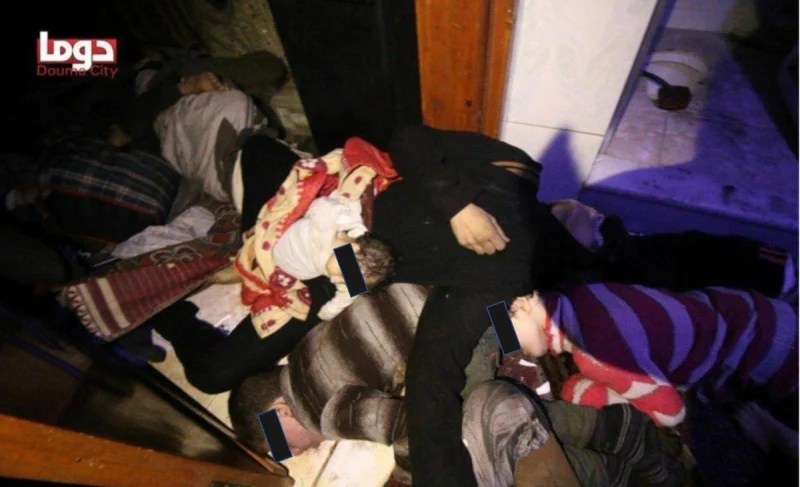
Image 1: In a photograph from Location 2, the dead victims are gathered in piles
The experts also pointed to “the onset of excessive frothing… observed in photos and reported by witnesses.” This was a reference to the images showing a profuse discharge of foam from victims’ mouths and noses. Some alleged witnesses interviewed by the OPCW also claimed that they saw the foaming develop quickly.
From the toxicologists’ point of view, such rapid foaming defied scientific logic. If the dead victims had been rapidly overcome by an incredibly high concentration of chlorine gas, there simply would not have been enough time for the foamy discharge observed on multiple bodies to develop.
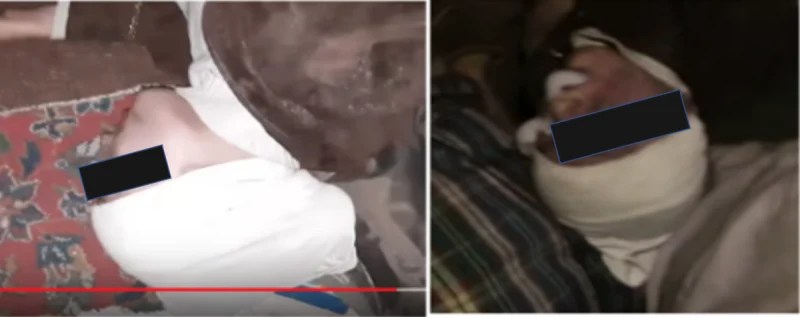
Image 2: A female victim displaying profuse foaming after her body had been moved
Accordingly, leaked minutes from that meeting state, “the experts were conclusive in their statements that there was no correlation between symptoms and chlorine exposure.”
The minutes, drafted by Douma team member Dr. Brendan Whelan, were approved by two other participants who had also traveled to Germany to meet with the toxicologists: Dr. Marc Blum, the Head of OPCW Laboratory; and Dr. Soumik Paul, the Head OPCW Health and Safety Branch. In a leaked email, Blum recalled that one of the Germans even raised “the possibility of a staged attack” in Douma because “the circumstances of death for the victims do not match chlorine.”
The OPCW leadership’s response to this conclusive assessment was to make it disappear. When the Douma team included the Germans’ input in their initial report, completed in late June 2018, senior officials went around them and erased all traces of it. The meeting itself was then memory-holed: in the OPCW Fact-Finding Mission’s (FFM) final report on Douma published in March 2019, a detailed timeline omits the team’s visit to Germany.
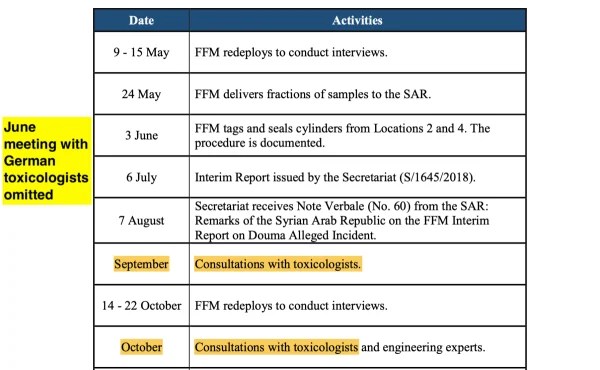
The “Mission Timeline” of the OPCW’s March 2019 Final Report omits the June 2018 mission to Germany, where expert toxicologists ruled out chlorine gas as the cause of death in Douma
The FFM’s March 2019 final report also revealed that after the German toxicologists’ findings were suppressed, the OPCW consulted five new toxicologists in September and October 2018. But oddly, no detail was provided on what these replacement toxicologists concluded, including on the key questions of how the victims could have been poisoned, and how the profuse frothing could have developed so rapidly.
Instead, the March 2019 report avoided these issues by stating that “it is not currently possible to precisely link the cause of the signs and symptoms to a specific chemical.” This ambiguous language obscured the fact that the German toxicologists initially consulted by the OPCW had unequivocally ruled out chlorine gas. What is certain is that the FFM report never claims that these five additional toxicologists contradicted the Germans whom they replaced. In fact, after noting that these five new experts were consulted, the FFM report made no further mention of them.
In a leaked April 2019 letter to the OPCW Director General, Dr. Whelan, the chief author of the Douma team’s censored original report, complained that the March 2019 final report had “shockingly omitted” the German toxicologists’ findings while evading any explanation for how the victims died from chlorine exposure. “To say that this selective use of expert opinions and facts is disturbing is an understatement,” Whelan wrote.
Challenged publicly to address the Douma probe’s suppressed findings, the long-awaited IIT report instead attempts to cover the OPCW’s tracks with more selective deceptions.
The cherry-picked cherry-picker
Just like the March 2019 FFM report, the IIT avoids the issues raised by the censored German experts entirely. But whereas the FFM stated that it was “not currently possible to precisely link” the Douma victims’ symptoms to chlorine, the IIT attempts to make it possible nearly four years later.
The IIT claims to have consulted a new “independent expert (toxicologist) not involved in previous assessments of the incident,” who concluded that the “symptoms of the victims are, overall, consistent with exposure to chlorine gas in very high concentrations.” No explanation is given for why the findings of this “new” and supposedly “independent” toxicologist should override those of the previously consulted experts. The IIT also does not present any additional evidence that would justify reversing the Germans’ conclusions.
The very fact that the IIT has declined to consult those experts from “previous assessments”– and present them with coherent counterarguments or fresh evidence, if it existed – suggests that the IIT sought out this one “new” assessment to overrule the inconvenient “previous” ones.
When this cherry-picked “independent expert” does make an assessment, more cherry picking ensues. Unlike the German toxicologists who based their assessment on both the images of the dead victims and the “symptoms and times of onset reported by” alleged witnesses, the IIT has limited the toxicologist’s scope of assessment to just the accounts of alleged witnesses.
The new toxicologist, the IIT states, was provided with “accounts and data from 55 individuals interviewed by either the FFM or by the IIT” and requested to “make their own evaluation of the reported symptoms” (emphasis added). The IIT tells us that “the toxicologist independently assessed the anonymised witness statements (obtained from affected persons or other eyewitnesses to the symptoms) against the symptoms that could be expected from chlorine exposure.” Ultimately, the toxicologist “reached the conclusion that the accounts of the victims and medical personnel were consistent with the rapid release of a high dosage of chlorine gas, which led to the rapid and high fatality rate documented at Location 2.”
Relying on witness accounts evades the central question of whether the frothing seen in videos was consistent with rapid chlorine poisoning. It also presumes that these accounts are reliable and have been corroborated, which there is no evidence of. And whereas the IIT claims that it “assessed the accounts, overall, to be consistent,” it omits that the Douma FFM’s initial investigators found those accounts to be anything but. In the interviews conducted in Syria and Turkey, the censored original report noted, “[t]wo broad and distinct narratives” emerged, one supporting the use of chemical weapons and the other not. Whose account was it then that was consistent with a “rapid release of a high dosage of chlorine gas”?
Even the reported symptoms from those cherrypicked witness accounts are themselves selectively assessed. When it comes to alleged witness accounts of what they observed at Location 2, nowhere in the IIT report is there any explicit mention of the “rapid and in some reported cases, immediate onset of frothing described by [alleged] victims,” as detailed in the FFM’s original censored report. There is thus no evidence that the reported rapid frothing formed part of the IIT toxicologist’s assessment. Instead, the IIT report informs us that: “Symptoms described by affected persons, rescuers, and treating medical personnel included shortness of breath, coughing, suffocation, dizziness, and skin irritation.” These symptoms all happen to match chlorine exposure; the omitted rapid frothing does not.
By focusing therefore only on the accounts of alleged witnesses – in particular, accounts from those who claimed there had been a chemical attack, and only those symptoms that are consistent with chlorine exposure – the IIT avoids answering the central question: whether the rapid onset of the profuse frothing observed in videos is consistent with exposure to chlorine.
Avoiding the inconsistency
In the few instances when the IIT’s toxicologist does appear to weigh in on the images of the foaming, they again deftly avoid the consistency question.
In a passage citing the toxicologist, the IIT states that “symptoms observed in affected persons, including miosis, skin discoloration, and oral and nasal foam-like secretions, are unlikely to have been as a direct result of ‘dust’ inhalation.”
No one has ever claimed that “dust inhalation” was the cause of the Douma victims’ observed miosis and “foam-like secretions.” Why then has the IIT’s toxicologist gone out of their way to rule out “dust inhalation” as the cause of the victims’ foam-like secretions, but failed to tell us whether these foam-like secretions could have been caused by chlorine gas? The most likely reason is that the IIT did not want its toxicologist to answer that question.
In another passage, the IIT notes that “imagery and videos” from Location 2 showed “clear signs of corneal opacity, discoloration of the skin, white/off-white foam-like oral and nasal secretions and miosis.” Yet rather than tell us whether those observed foam-like secretions are consistent with chlorine gas, the IIT again avoids an answer. Instead, the report only states that “the specialists consulted by the IIT confirmed that the reported and observed symptoms of oral opacity are typically caused by… exposure to a high concentration of chlorine gas.” (emphasis added) Given its omission, these same specialists have not confirmed that the observed “foam-like oral and nasal secretions” can be caused by exposure to chlorine gas.
On another occasion, the IIT — notably, not the toxicologist — does manage to explicitly state that the “rapid onset of symptoms… observed in videos and pictures” for “fatalities recorded on the stairs and landings” (emphasis added) at Location 2 are consistent with a “high and lethal volume of chlorine gas.”
Given that foaming was seen in videos and photos, the IIT report leaves the impression that it is referring to those “symptoms.” But in the images from the “stairs and landings” at the apartment building, none of the three dead victims show any frothing. This allows the IIT to create a false suggestion that the foaming seen in the videos is consistent with chlorine exposure. In reality, the IIT is weighing in on images where no foaming can be observed, but that readers would unlikely check.
In another rare instance where it makes any reference to foaming, the IIT states that chlorine gas can lead “to the oral and nasal secretion of a foam-like substance.” That chlorine gas can cause a “foam-like substance” is not in question: the censored original report noted that “excessive frothing from the mouth” has been “reported in cases of exposure to lethal doses of chlorine gas.” But with this uncontroversial claim, the IIT is again avoiding the issue raised by the original report, based on the findings of the German toxicologists, that the “rapid, and in some reported cases, immediate onset of frothing described by victims is not considered consistent with exposure to chlorine-based choking or blood agents.”
Suppressing science, denying justice
Left with the scientifically unfounded scenario in which chlorine gas caused immediate profuse foam discharge from the victims, the IIT has resorted to deceptive claims that no recognized expert in toxicology has been willing to support. Accordingly, beyond the US and its allies’ bombing of Syria on unsupported grounds and the co-option of the OPCW to whitewash it, the core crime in Douma remains unexplained.
In April 2018, dozens of slain civilians were photographed in that apartment building. Images of their lifeless bodies stirred global outrage. Approaching the fifth anniversary of this horrific incident, the chemical weapons watchdog tasked with investigating their deaths continues to bury its own findings and present a baseless explanation for what occurred. So long as the OPCW continues to suppress the science, 43 Douma victims and their families will remain without justice.
————
Thank you to Dr. Piers Robinson for his input on this article. https://berlingroup21.org/.
Links:
West uses chemical weapons watchdog to justify its aggression – Moscow
RT | February 7, 2023
The latest report by the Organisation for the Prohibition of Chemical Weapons (OPCW), which blames Damascus for carrying out a chemical attack in Douma in 2018, looks like a political hit piece meant to justify the West’s continued military aggression against the Syrian government, says Alexander Shulgin, Russia’s permanent representative to the organization.
Speaking to RT, Shulgin vehemently dismissed the report, which was released in late January by the so-called Investigation and Identification Team (IIT). Calling the IIT “completely illegitimate,” he claimed the group’s creation was pushed through by the US and its allies in order to undermine the core principles of the OPCW and international law and replace them with their own “made-up rules.”
The IIT’s report, according to Shulgin, is riddled with inconsistencies and factual gaps, and barely holds together. Furthermore, none of Russia’s or any other country’s “uncomfortable” questions regarding the details of the IIT’s findings were even remotely addressed during an OPCW briefing on the report, the ambassador claimed.
Shulgin also noted that the report highlighted the double standards currently present within the OPCW. When Russia presented evidence of a chemical attack in Aleppo back in 2016, every minute detail of Moscow’s findings was heavily scrutinized by the organization, he said. However, when it comes to the attack in Douma, OPCW officials seem to turn a blind eye to basic questions such as how and when the evidence was gathered and presented during the investigation.
“For instance, they referred to the fact that some new sample has appeared, provided by a third party. What is this third party? Nothing is said about it. They just say ‘trust us’,” said Shulgin, noting that the sample in question had never been reported on in previous investigations.
“So before, there was no sample, but now, suddenly, it has somehow appeared. Without any explanations,” the ambassador stressed, suggesting its sudden appearance can only be explained by the need for the US, France, and UK to escape international accountability for their aggression against Syria.
The three NATO states launched a series of airstrikes against civilian and military targets in Syria in April 2018 after the so-called ‘White Helmets’ – an NGO operating in rebel-controlled areas of Syria – published a series of videos supposedly showing the aftermath of a chlorine attack on the residents of Douma.
Syria has vehemently denied any responsibility for the incident, and both Damascus and Moscow have repeatedly pointed to evidence, including testimonies from alleged victims, that suggests the incident was staged in order to justify a Western attack.
Douma locals, medical personnel deny veracity of 2018 ‘chemical weapons attack’
The Cradle | February 2, 2023
Locals and medical personnel from the Syrian city of Douma in the Damascus countryside confirmed on 2 February during a press conference in the country’s Foreign Ministry headquarters that the alleged 2018 chemical attack on the city was, indeed, staged.
This follows the release of a new report by the Organization for the Prohibition of Chemical Weapons (OPCW) on 27 January, which once again renewed the accusation that Damascus was behind a 2018 chlorine gas attack on civilians in Douma.
“I live 400 meters from the place of the alleged incident, and I only learned of its occurrence the next day through social media,” Syrian lawyer Muhammad al-Naasan said during the press conference.
Another testimony is that of Dr. Hassan Oyoun, an ambulance worker at Douma Hospital, who claimed that “information was published a day before the alleged incident that it was necessary to prepare for an event that would result in a large number of injuries.”
This confirms that “prior preparations” were underway for the staging of the attack, Oyoun said, referring to the incident as a “fabricated play that was filmed.”
“What the terrorists announced about 800 injuries from chemical substances is incorrect, and the number of people who visited the hospital that day did not exceed 35,” he added.
According to Dr. Mumtaz al-Hanash, a Douma local, Douma Hospital announced just one day after the alleged attack that no chemically induced deaths were recorded whatsoever. He went on to say that the “photographed cases” did not provide evidence that chlorine, or any other weaponized chemical, was used.
An imam and preacher at a local mosque, Sheikh Ratib Naji, said: “We did not see with our own eyes any injured or dead, as they claimed, and those whom the terrorists claimed were dead, their bodies did not appear, and when we demanded them, they assaulted us.”
Syria’s permanent representative at the Hague-based chemical weapons watchdog, Milad Attiya, affirmed that Damascus does not recognize the OPCW investigation team’s third and latest report, as it rejected the last two. Attiya added that the report relies heavily on western sources, as well as groups such as Hayat Tahrir al-Sham (HTS) and the White Helmets, an Al-Qaeda affiliated rescue organization with links to organ trafficking networks in Syria.
Since 2013, armed groups in Syria have attempted to pin chemical attacks on the government to instigate internationally-led regime change operations against it. This comes in the form of staged attacks, or actual false-flag chemical attacks which leave many dead and are designed to implicate Damascus – as was the case in Ghouta in 2013 and in Khan Sheikhoun in 2017.
On 28 January, the Syrian government released a statement rejecting the OPCW report, which it said ignored “objective information which was provided by some … experts … and former OPCW inspectors with knowledge and expertise,” referring to the fact that the organization suppressed the findings of its initial report on Douma, as revealed by WikiLeaks in 2019.
Syria blasts ‘misleading’ OPCW report on alleged Douma attack
The Cradle | January 29, 2023
Syria made a statement on 28 January rejecting the report issued a day earlier by the Investigation and Identification Team of the Organization for the Prohibition of Chemical Weapons (OPCW), regarding the alleged use of chlorine by the Damascus government in Douma in 2018.
“Syria totally rejects the report released by the so-called ‘Investigation and Identification Team’ of the [OPCW] about the alleged chemical attack in Douma in April 2018, in addition to its conclusions,” the country’s Ministry of Foreign Affairs and Expatriates said.
“Those who prepared this report … insist to ignore all the objective information which was provided by some countries, parties, experts, academics, documented media reports, and former OPCW inspectors with knowledge and expertise … which confirmed beyond any doubt that the Douma incident was completely fabricated,” the ministry’s statement added.
The Syrian statement was a response to the new report released by the OPCW’s Investigation and Identification Team on 27 January, which after five years, has renewed the accusation against Damascus “that the Syrian Arab Air Force carried out the chemical weapons attack on Douma.”
In April of 2018, Damascus was accused of a chemical attack against civilians in the city of Douma, resulting in illegal US military strikes against Syrian government positions. This was despite the fact that Syria had welcomed an OPCW fact-finding mission to inspect the alleged site of the attack.
A year later, WikiLeaks revealed that the OPCW had suppressed the initial results of the fact-finding mission deployed to Syria, results which suggested that the incident was, in fact, staged. That same year, a MintPress News report revealed that several journalists from a number of mainstream agencies had come to the conclusion that the Douma attack was staged with the help of the White Helmets, a criminal organization posing as the Syrian Civil Defense. This was initially brought to light by a whistleblower from within the OPCW.
In 2021, during a visit to Douma, The Grayzone reporter Aaron Mate referred to the 2018 incident as “one of the biggest pro-war hoaxes since Iraq.”
Since 2013, armed groups in Syria have attempted to pin chemical attacks on the government in attempts to instigate internationally-led regime change operations against it. This comes in the form of staged attacks, or actual false-flag chemical attacks which leave many dead and are designed to implicate Damascus – as was the case in Ghouta in 2013 and in Khan Sheikhoun in 2017.
The latest OPCW report comes as Washington is desperately trying to obstruct the reconciliation process currently underway between the Syrian and Turkish governments.
Russia calls for reform of UN Security Council
Samizdat | August 3, 2022
The United Nations is in dire need of reform and the Security council must be “democratized” by expanding its representation, Russian foreign ministry official Alexey Drobinin has written in a keynote article published on Wednesday.
Drobinin, the Director of the Department of Foreign Policy Planning, commented on the current state of international relations and came to the conclusion that “more conscious effort and imagination is needed” to reform the UN.
He pointed out that the organization’s current agenda, which is primarily fueled by the West, is not necessarily in line with the interests of the majority of its international members.
Drobinin suggested that for most UN members the most important issues are things like access to cheap energy sources rather than the transition to “green” technologies, socio-economic development rather than human rights “in an ultra-liberal interpretation,” and security and sovereign equality rather than the artificial imposition of electoral democracy according to Western patterns.
He added that another topic that has once-again become relevant is the process of decolonization and ending the neo-colonial practices by transnational corporations in regards to the development of natural resources in developing countries.
However, international organizations such as the UN have essentially been “privatized” by the West, Drobinin points out. He suggests that the UN Secretariat and the offices of special envoys and special representatives of the Secretary General have all been saturated with the West’s own “tested” personnel, and that this also extended to non-UN organizations as well, such as the OPCW.
“The saddest thing is that this rust is eating away at the ‘holy of holies’ of the UN system – the Security Council,” Drobinin writes. “It devalues the meaning of the right of veto, which the founding fathers endowed to the permanent members of the Security Council with one single purpose: to prevent the interests of any of the great powers from being infringed, and thus save the world from a direct clash between them, which in the nuclear age is fraught with catastrophic consequences.”
While there are no “clear and simple recipes for correcting the situation here,” the diplomat continues, “clearly more conscious effort and imagination is needed when it comes to UN reform.” He goes on to suggest that the Security Council needs to be “democratized,” first of all by expanding the representation of African, Asian and Latin American countries.
Drobinin suggests that whatever the fate of international organizations such as the UN, WTO, IMF, World Bank or G20 is, the divisive policies of the West makes it “an absolute imperative for the coming years to form a new infrastructure of international relations.”
“After their frankly perfidious decisions and actions against Russia, its citizens and tangible assets, we simply cannot afford the luxury of not thinking about alternatives. Especially since many of our friends who have lost faith in Western benevolence and decency are thinking about the same thing,” the diplomat surmised.
Featured Video

Trump asks Iran not to retaliate after he strikes Pickaxe Mountain
or go to
Aletho News Archives – Video-Images
Book Review
‘Why Fauci Must Rot in Prison’: A Tale of Two Diaries
By Jill Erzen | The Defender | October 13, 2026
Dr. Anthony Fauci’s private diary reveals a “mind-numbing” contradiction between what the former top U.S. infectious disease official knew about COVID-19 and what he told the public, senior White House adviser Peter Navarro, Ph.D., said last week on “American Thought Leaders.”
In his new book, “Why Fauci Must Rot in Prison,” due out Oct. 20, Navarro compares Fauci’s private entries to his own pandemic-era diary, and uses what he calls “a tale of two diaries” to argue that Fauci should face criminal prosecution.
“I show, actually, how a prosecution can and should happen … at the state level, most likely,” Navarro said. “He should wind up in prison, and we’ve got the receipts in this book to put him there.”
Navarro said Fauci repeatedly acknowledged important facts in private, then publicly pursued policies that contradicted those facts — with devastating consequences.
“What he says many times privately in his diary is so at odds with both his public behavior and public statements that it’s mind-numbing,” Navarro said.
Navarro examines the lasting damage caused by lockdowns and other pandemic policies, and the ongoing toll of long COVID.
His book also addresses questions about vaccine safety, including why healthy young people faced COVID-19 vaccination mandates despite concerns about myocarditis, and why women were not warned about miscarriage risks linked to the shots. … continue
Blog Roll
 Aletho News
- Yemen denounces international community’s silence on Saudi aggression, siege
- UAE and Saudi Arabia move toward renewed coordination against Sanaa
- How Iran’s two-week retaliatory strikes exposed cracks in US military architecture in Persian Gulf
- The mother of all propaganda: Why the hype over US MOAB strike against Iran is nothing but theater
- Iran says it possesses technology behind US 14-ton GBU bunker-buster
- Trump asks Iran not to retaliate after he strikes Pickaxe Mountain – w/ Prof. Marandi
- Vice President J.D. Vance’s Deceptive ‘Antiwar’ Campaign Speech
- Iran: Palestinians’ rights must not be compromised in Gaza’s future; US, Israel to blame for Hormuz situation
- Ongoing tales of Syrian chemical weapons
- Moscow blasts UN for ignoring torture of Russian POWs
- If Americans Knew
- Netanyahu’s spin on latest settler attack is laughable – Daily Update
- Israeli soldiers debunk Israel’s talking points
- In West Bank, Israeli settlers are totally out of control – Daily Update
- NPR investigation finds evidence of widespread fraud at mall kiosks tied to Israeli skincare brand
- Tucker Carlson exposes Israeli Lies about the Oct 7th attack, Charlie Kirk, and the U.S.
- Israel has detained thousands of Palestinian children since Oct 7th – over half spent time in solitary, many uncharged
- Israeli Analysis: Is Netanyahu Planning an ‘October Surprise’ Attack Before Israel’s Election?
- Israeli settlers brutally attack Palestinians and Washington Post female photographer, 65
- Words Have Changed, Occupation Continues: The Reality of the Gaza Ceasefire
- Gaza’s child amputees are growing faster than their prosthetics allow
- No Tricks Zone
- Predictions Made By Renowned Climate Proifessor Over Past Decades Have Been Proven To Be Poor
- New Study Suggests Large Regions Of The Pacific Ocean Have Been Cooling For The Last 80 Years
- Germany’s Green Energy Debacle: High Energy Costs Force Kahla Porzellan to Close After 182 Years!
- New Study: 50 Years Of The Most Aggressive ‘Net Zero’ Policies Can Only Affect The Global Climate By 0.03°C
- US September “Heat” Was No Record…Many Records Set Decades Ago
- Latest European Green Energy Debacle; Portugal’s Largest Flagship Solar Park Insolvent!
- Green Energy Debacle: German Expert Professor Fritz Vahrenholt Warns Of Severe Economic And Social Consequences
- Two More Paleo Reconstructions Affirm Meters-Higher Sea Levels Across Ireland, Brazil 7000-6000 Years Ago
- New Study: Earth And Venus Surface Warmth Largely Explained By Convection And Lapse Rate, Not CO2 Or Radiation
- 2025 Nature Paper Claiming Worsening Global Drought Gets RETRACTED …Heavily Flawed

