New Book: No Autoimmunity The Body Doesn’t Attack Itself
Lies are Unbekoming | September 24, 2026
The label for Humira, once the best-selling drug in the world, lists its risks in plain print. One of them, in the label’s own words, is new “autoimmune” disease.
A drug prescribed for a condition labelled autoimmune carries a warning that it can cause a condition labelled autoimmune. That contradiction sits in every box, on a folded paper almost nobody reads.
My new book starts there.
No Autoimmunity: The Body Doesn’t Attack Itself
For seventy years, “your body is attacking itself, and we don’t know why” has ended the conversation for people diagnosed with multiple sclerosis, lupus, rheumatoid arthritis, Hashimoto’s, Type 1 diabetes, Crohn’s and psoriasis. More than eighty conditions now carry the autoimmune label. The diagnosis comes with a prescription for life. It almost never comes with a question about cause.
This book asks the question and answers it from the framework’s own records: its drug labels, its journals, its regulatory filings, and its own experiments.
What’s inside
 Humira: The Cover Story. A drug that once earned more than twenty billion dollars a year, whose own label warns of lymphoma and new conditions labelled autoimmune. Stop taking it and the symptoms usually return, so the prescription never ends.
The Autoimmune Label. In 1956 researchers produced thyroid disease in rabbits by injecting thyroid tissue with a powerful adjuvant. A category defined by “unknown cause” has since grown to more than eighty conditions.
The Three Deceptions. The “immune system” as an army, antibodies as soldiers, autoimmunity as the army turning on itself. Each idea props up the others.
Richet’s Erased Nobel. The 1913 Nobel Prize for showing that injected foreign proteins sensitise the body. Medicine kept the prize and filed the warning under “allergy.”
The Nervous System. The 1976 swine flu campaign and the paralysis cases that followed. Hal Huggins removed mercury fillings from MS patients, documented their improvement, and lost his licence.
The Endocrine System. Fluoride and bromide crowding out iodine, and a lifelong thyroid pill that ensures nobody learns whether the gland could recover.
Connective Tissue. Evelyn Hess’s catalog of more than seventy medications that produce lupus and related disease, which usually clears once the drug is stopped. The book’s central proof, from the framework’s own literature.
The GI Tract. Celiac disease went from one child in five thousand in 1950 to about one person in a hundred today. The chapter covers what changed in the food.
Skin and Blood. Psoriasis appears where skin is injured, and the drugs sold for psoriasis are documented to cause it.
The Documented Reversals. Drugs withdrawn, mercury removed, implants taken out, diets changed. Once the injury is gone, the body mends.
What Made the Reversal Possible. Remove the harm, restore what the body needs, give it time, and protect what still works.
How to Think About the Diagnosis You Were Given. Written directly to the reader holding a diagnosis, with the exposure history to build and the questions to ask.
Where to Go from Here. A reading list and the kinds of practitioners worth finding.
Every chapter closes with How to Explain It to a 6 Year Old, a plain-language section you can read aloud to a child or hand to a relative who will never read a medical paper. The book also includes a glossary, a bibliography of more than 100 sources and a full index.
Who this book is for
If you or someone you love has been handed one of these diagnoses, read this before accepting that the answer is a lifetime prescription. If you’re a practitioner, or someone who simply wants to check the record, the full documentary trail is here, referenced source by source.
288 pages, paperback.
The shelf
No Autoimmunity joins the rest of the Unbekoming catalogue at lulu.com/spotlight/unbekoming.
Breast Cancer: Before You Consent
A new Unbekoming paperback

Lies are Unbekoming | September 18, 2026
Peter Gøtzsche reviewed every randomised mammography screening trial ever conducted for the Cochrane Collaboration. Cochrane’s headline is that, assuming a 15% mortality reduction, one woman in 2000 avoids dying of breast cancer over ten years. Ten are overdiagnosed and treated. Two hundred experience false alarms.
But that headline assumes the reduction. When Gøtzsche looked only at the trials with adequate randomisation — the higher-quality ones — the reduction disappeared. No effect on breast cancer mortality. No effect on all-cause mortality.
This is the Cochrane finding, published in the establishment’s own database of systematic reviews.
No woman being asked to consent to a mammogram this week knows it.
That is why the new Unbekoming paperback exists.
A woman opens a letter. Her mammogram from last week has been flagged. She needs to come back for further imaging.
Another gets a phone call. The biopsy result is back. She has ductal carcinoma in situ. Stage 0. The surgeon can see her Tuesday.
Another sits across from a BRCA counsellor who tells her that carrying the mutation gives her a lifetime risk of 87 percent. There is a procedure that can protect her.
Another has been on a hormonal IUD for three years. Her mood, her cycle, her sense of herself have all changed. Her GP prescribes an antidepressant.
None of them are being told what the published medical literature actually shows.
This new book is what the published medical literature actually shows.
The Argument
H. Gilbert Welch’s autopsy studies show that up to 39 percent of middle-aged women carry breast cancer they will die with, never from. The screening apparatus finds those cancers, calls them disease, and initiates the treatment cascade.
The twenty-five-year Canadian National Breast Screening Study, the most rigorous mammography trial ever conducted, found that one in five diagnosed cancers were overdiagnosis. The screened group and the unscreened group had the same mortality.
The 87 percent BRCA lifetime risk figure a genetic counsellor cites was derived from families selected because they already had clustered breast cancer cases. When the same variant is examined in general-population samples, the risk drops to 17 percent. A woman is being told her risk is roughly five times what the corrected data shows.
A 2004 Australian analysis by Morgan, Ward, and Barton calculated the contribution of chemotherapy to five-year survival across all cancer types. The number is 2.1 to 2.3 percent. Almost every woman who consents to chemotherapy for breast cancer believes she is consenting to something that materially changes her survival probability. The published contribution to five-year survival across all cancers is roughly one in fifty.
None of this is fringe. Every study cited above appeared in the establishment’s own journals. Cochrane. BMJ. New England Journal of Medicine.
The problem is that a woman standing at the consultation desk does not have this evidence in front of her when she is asked to sign.
That is what the book is for.
Structure
Part I is the compact clinical guide. Designed to be read in one hour by a woman with a decision on her calendar: a mammogram Friday, a callback Tuesday, a biopsy result waiting, an IUD consultation the week after next. Four branches. Three questions per branch. The exact wording to use with the clinician on the other side of the desk.
Part II is the evidence in full. Twelve chapters walk through the argument. Gøtzsche on the screening question. Welch on overdiagnosis. The Boobs documentary. What cancer actually is (Warburg, Seyfried). What turbo cancer is. Root canals and breast cancer (Levy, Haley). Iodine and the Japanese paradox (Derry). The BRCA gene and the women who lost their breasts to a hypothesis. Hormonal IUDs and the 2024 Danish cohort of 78,595 women. Tirza Derflinger on better breast health for life. Paul Marik on the perioperative window.
Part III is the preparation tools. The Decision Toolkit. The Personal Action Plan, sequenced across six intervention layers from immediate substrate reduction through terrain rebuild. And “But My Doctor Said,” the eleven objections a woman will hear when she acts on what she has learned, and what the evidence actually shows for each one.
Part IV is the physical reference. The Conversation Card and the Clinical Checklist. Designed to be brought to appointments.
Who It Is For
The woman with a mammogram scheduled who has never been told the screening question is contested.
The woman who has been called back and is being pulled into the diagnostic funnel.
The woman who has been told she has DCIS and is being scheduled for surgery.
The woman who has been offered BRCA testing.
The woman who has been prescribed a hormonal IUD.
The woman whose mother, aunt, sister, friend, or daughter is in one of those situations, and who wants to have a better conversation with her.
The book is not medical advice. It is the published medical literature laid out clearly enough that a woman can make her own informed decision, before she consents to anything.
The Terrain Frame
Every Unbekoming book is written inside the terrain framework, which holds that the internal environment of the body, its toxic burden, nutritional status, electromagnetic exposure, and stress load, determines whether illness manifests. This book is no exception.
The book names one primary cause of the injury the medical system calls breast cancer, substrate accumulation, and three specific contributors: injection load, oral toxicity, and continuous synthetic-progestin exposure. Chapter 5 makes the full case, drawing on Warburg, Béchamp, Cowan, and Seyfried. A woman does not need to accept the framework to use the clinical chapters. She may find herself reaching for it by the time she finishes them.
The Paperback
Available now on the Lulu Bookstore. 359 pages. Source-cited throughout. Published without commercial sponsorship.
AUD 37.99 / USD 24.99 / GBP 19.99 / EUR 23.99 / CAD 34.99.
The digital edition will be released to paid subscribers within 6 months.
This is the seventeenth title in the Unbekoming print catalogue, and the first to unite the compact clinical guide with the full paradigm framework in one volume.
A woman with a mammogram scheduled on Friday has time to read Part I before she goes in. She may still decide to keep the appointment. She may not. What she will not do is walk into that room without knowing what she was never told.
That is the point of the book.
The Shelf
The full Unbekoming print catalogue is at lulu.com/spotlight/unbekoming. Seventeen titles now, across paradigm, remedy, and critique. All direct from the printer.
The Magnesium Handbook + The Boron Book
Two new paperbacks, in print today

Lies are Unbekoming | September 13, 2026
Two minerals your body has been receiving from food and water for as long as there has been food and water. Two minerals your body no longer gets in the amounts it needs. Two minerals modern medicine does not measure, does not restore, and does not talk about.
Magnesium and boron.
What happened to them
The soil that grew the food was depleted. The industrial fertilizers that replaced natural soil renewal put nitrogen, phosphorus, and potassium back in, and left the trace minerals out. The water that used to carry them was treated, softened, and stripped. The food that reached the table was processed, refined, and cooked at temperatures that finished the job.
Then the halogens moved in. Fluoride in the water. Bromide in the bread. Perchlorate in the produce. Each one competes for the receptor sites where the mineral used to sit. Every one of them makes what little is left work less well.
Your grandmother got what you don’t. Not because she took supplements. Because the food, the water, and the soil hadn’t been hollowed out yet.
What their absence looks like
Magnesium depletion presents as: cardiovascular disease, arrhythmia, hypertension, migraines, muscle cramps, insomnia, anxiety, chronic fatigue, insulin resistance, PMS, restless legs, tension headaches, poor recovery from exercise, poor recovery from anything. The mineral runs 600+ enzyme systems. When it runs low, hundreds of things break. Not one dramatic thing, but a background low-grade version of nearly everything.
Boron depletion presents as: osteoarthritis, brittle bones, hormonal decline in both sexes, cognitive fog in older adults, joint stiffness that starts a decade before it “should,” and a fungal terrain the body has fewer tools to manage. Rex Newnham, an Australian soil scientist working in the 1970s, first documented what a century of missing boron does, and what its restoration reverses.
None of this is diagnosed as mineral depletion. It is diagnosed as a chronic condition, prescribed for, and monitored. The mineral, inexpensive and unpatentable, does not enter the conversation.
What the books do
The Magnesium Handbook.
333 pages, seventeen chapters. The four evidence lines. The four insults of modern life that strip out intake. The cardiac and neurological pattern. The metabolic and hormonal picture. The reproductive terrain. The forms of magnesium and how to use each. Eight appendices with condition quick-reference, drug-depletion tables, dosing by form, food sources, transdermal protocols, troubleshooting, and further reading. A full index sends you to what you need. Draws on Jeff at Curious Outlier and his Magnesium Mastery course, Mildred Seelig, Carolyn Dean, Mark Sircus, Arthur Firstenberg and Martin Pall, and the terrain framework running from Béchamp through Shelton to Cowan.
Order The Magnesium Handbook →
The Boron Book.
268 pages. The Tibetan and Silk Road pharmacopoeia. The medieval European use. The mid-twentieth-century collapse of dietary intake. The four mechanisms that stripped modern boron from the diet: industrial fertilization, food processing, water fluoridation, halogen displacement. The Newnham Protocol. The Walter Last modification. The food-first restoration pattern. The borax chapter, covering what to buy, how to dose, and what to expect. Draws on Rex Newnham’s clinical work, Forrest Nielsen’s USDA research, and the essays of Curious Outlier.
The regulatory framework still classifies boron as non-essential. The evidence says otherwise. The minerals are inexpensive. These books are how you get them back.
How to explain it to a six-year-old
Imagine your body is a bicycle. It has hundreds of little screws holding it together. Brakes, gears, wheels, seat, handlebars. Most of the screws don’t do anything dramatic. But if they get loose, the bicycle starts to rattle and squeak and slow down. Nothing broken. Just… not right.
Magnesium is one of the screws. Boron is another.
Nobody stole the screws. They just fell out slowly, over a long time. From the soil the food grew in. From the water. From the bread. Every day a little bit less. Nobody noticed because nothing broke.
But the bicycle is rattling now. You feel it. Everyone feels it.
The screws are cheap. You can put them back.
In Print
Sixteen books are now available as paperbacks, printed to order through Lulu and shipped worldwide.
The two new ones today. The Magnesium Handbook and The Boron Book.
Injection injury. The Vitamin K Injection — what happens in the first hours of a newborn’s life.
Two on the paradigm underneath. No Contagion, the case against germ theory itself, co-authored with Jamie Andrews. No Virus, the isolation problem, the collapse of virology’s foundational claims, and a disease-by-disease reappraisal.
Four suppressed compounds. The DMSO Book, Chlorine Dioxide: The Forbidden Remedy, The Iodine Book, The Hydrogen Peroxide Book.
Two from the kitchen shelf. Baking Soda, The Castor Oil Book.
Five critique books. The Unvaccinated, Medicalized Motherhood, Drilling for Profit, What Your Vet Can’t Tell You, Escape from Psychiatry.
The full shelf is at lulu.com/spotlight/unbekoming.
A physical book reaches the person a Substack post never will. The skeptical relative. The friend who won’t click a link but might open a book. The visitor whose eye lands on a coffee table. Buy one to keep, and one to give away.
October 7 “Rape” Hoax Exposed
Norman Finkelstein’s new book debunks Zionist tall tales
By Kevin Barrett – September 13, 2026
Last May, an Israeli commission published a report alleging an organized campaign of rape and sexual abuse by Hamas during its October 7, 2023 concentration camp breakout. The Civil Commission on October 7th Crimes by Hamas Against Women and Children, chaired by Cochav Elkayam-Levy, titled its report “Silenced No More.”
October 7 rape claims, like similar accounts of babies beheaded and roasted in ovens, have long been greeted with skepticism in nations whose media and politicians are not owned and operated by Zionists. Perhaps for that reason, the Israelis felt the need to “document” their rape stories in the Elkayam-Levy report.
But in publishing their “rape” report, the Israelis inadvertently exposed the mendacity of their own assertions. The Commission included many “rape survivor” testimonies that read uncannily like the breathless stories of alleged Holocaust survivors who claim they were raised by wolves, or who, like Anthony Blinken’s stepfather Samuel Pisar, claim to have sneakily walked backward toward the door of the gas chamber and then snuck out right before it was closed and the gas was turned on.
The “Hamas rape” stories are exaggeratedly lurid and full of outrageously improbable or impossible details. But the real problem is that all Hamas fighters wore bodycams recording everything they did—and roughly half of the 3,000 or so who entered Israel were killed, and in most cases their body cams were recovered by Israeli authorities. The Ekayam-Levy Commission says it had access to 10,000 pictures and videos from those bodycams as well as others from Israelis filming with phones. And then there are the Israeli surveillance cameras. If, as the Commission alleges, Hamas pursued a deliberate policy of terrorizing Israelis with widespread sexual violence, obviously there should be, at minimum, hundreds of images and videos documenting these heinous acts.
But there are none. Zero. As Jewish scholar Norman Finkelstein shows in his new book GAZA’S GRAVEDIGGERS: An Inquiry into Corruption in High Places:
“Neither the Israeli State nor the Civil Commission has released even one frame, from among the ten thousand photographs and digital segments it amassed, that depicted Hamas committing rape or other acts of sexual violence… Not a single Israeli CCTV, traffic surveillance camera, or individual cellphone captured Hamas committing rape or other acts of sexual violence. The Commission collected ‘extensive’ digital evidence from Hamas digital paraphernalia. Hamas allegedly exploited its gruesome images from 7 October and of the Israelis held hostage as ‘an instrument of terror.’ If inspiring terror was the avowed objective, then, it would seem, the more barbaric the sexual violence it disseminated the better. But not a single confiscated Hamas bodycam, GoPro, or dashcam contained an image of rape or other acts of sexual violence.”
The October 7 Israeli rape allegations, in reality, have always been just as patently ridiculous as the tales of roasted and beheaded babies. Everyone with the slightest knowledge of Hamas and the cultural and religious context in which it operates knows that it would never pursue a policy of sexual misbehavior. Hamas rigorously and scrupulously adheres to futuwwa or “Islamic chivalry.” Anyone who has viewed the videos of hostages being released by Hamas, in which smiling Israelis almost wistfully say goodbye to their chivalrous captors, knows that claims of widespread systematic mistreatment of captives are hysterical exaggerations at best, outright propaganda lies at worst.
This is not to say that no Israelis were harmed on October 7. But Hamas did not deliberately kill or hurt civilians. It engaged in firefights with some of the IDF’s elite units, and in most cases won, as described by Scott Ritter in his memorable article “The most successful military raid of this century: the October 7 Hamas assault on Israel.”
Hamas’s orders were to 1) engage and defeat the IDF, 2) take IDF prisoners as hostages, and 3) as a fallback measure if all else failed, take civilian hostages. Scott Ritter explains:
“The taking of hostages was meant to provide Hamas with negotiating leverage for the release of the 10,000 prisoners held by Israel.”
Hamas fighters stumbled on the Nova Music Festival by accident. In the midst of firefights and chaos, some Hamas fighters took the opportunity to capture Israeli hostages. The abduction scenes, with Hamas fighters dragging off women as well as men and heading back toward Gaza in vehicles, have been well documented. It wasn’t a pleasant experience for the hostages…especially the more than 500 of them who were deliberately massacred by Israel’s tanks and helicopter gunships under its Hannibal Doctrine.
But there is no hard or convincing evidence that a single Hamas fighter perpetrated even one sexual assault, much less that there was any deliberate policy of rape. The Israelis, as usual, are lying outrageously and shamelessly, exhibiting the chutzpah for which they are justly renowned.
Subscribe to American Free Press to get early or exclusive access to great articles like this.
The Vitamin K Injection (2026)
A new paperback on what’s in the shot every newborn is offered in the first hour of life

Lies are Unbekoming | September 12, 2026
Every U.S. newborn is offered a shot in the leg in the first hour of life. Parents are rarely told the shot exists until the moment it is about to be given.
The new paperback is out today. It examines that shot.
What’s in the book
Twenty-seven chapters walk through what the vitamin K injection actually is, what it contains, what the manufacturers themselves warn against, what the studies did and didn’t find, and where the current framework came from.
The intervention itself. The three products currently in use in English-speaking countries — the U.S. Hospira formulation with its polyoxyethylated castor oil and benzyl alcohol preservative, the UK Konakion MM Paediatric with its glycocholic-acid mixed-micelle vehicle, and the Australian Konakion MM Paediatric with its lecithin base. What each carries alongside the vitamin K itself. The depot vehicle that keeps the injection releasing into the baby’s tissue for two months after the needle comes out. The aluminum contamination the manufacturer discloses without context. The peanut allergy pathway the mainstream literature acknowledges but does not track.
The manufacturer’s own warnings. Every current package insert opens with a boxed warning against the exact route of administration hospitals universally use. Every insert lists a set of adverse reactions — anaphylaxis, cyanosis, gasping syndrome, skin necrosis, cardiovascular collapse — that the doctors administering the shot are largely unaware of and that parents are never shown.
The history. A 1961 AAP recommendation set by a small committee that did not test what it was recommending. A 1985 quiet shift from targeted to universal injection. A 1992 cancer signal from a large UK cohort study that was dismissed rather than investigated. The menadione (K3) disaster that hospitals eventually withdrew — but only by switching products, never by pausing to ask whether the intervention itself was needed. Dam and Doisy’s 1943 Nobel, awarded for work in starved chickens, later used to justify universal injection of healthy newborns.
The alternatives. The oral vitamin K protocols in continuous use in the Netherlands, Germany, Switzerland, and Denmark. Their dosing schedules, their VKDB failure rates, their published surveillance data. Maternal supplementation as a route the doctors could offer but don’t. The physiologic support at birth that most modern maternity practice has already adopted for other reasons but has never been asked to interact with the shot.
The system machinery. The standing-order framework that bypasses individual consent. What refusal actually costs the parent, and what it usually doesn’t cost the baby. The circumcision-clotting interaction that turns one cultural habit into justification for another.
Two personal stories. A father’s account of what happened after his son’s shot. A mother’s account of what changed the week the injection was administered.
Two practical tools. A checklist of questions for the practitioner conversation. A country-by-country reference of the oral protocols with dosing, timing, and documented outcomes.
And at the end of every chapter, a short section titled How to Explain It to a Six-Year-Old.
If you’re picking one up, pick two
The natural pigeon pair for The Vitamin K Injection is The Unvaccinated: What a Forbidden Comparison Reveals About the True Cost of Vaccination. The two examine the same institutional logic from different angles. Vitamin K is the first injection most newborns receive; the childhood schedule follows. Both document what the mainstream literature won’t compare, won’t study, and won’t offer as choice.
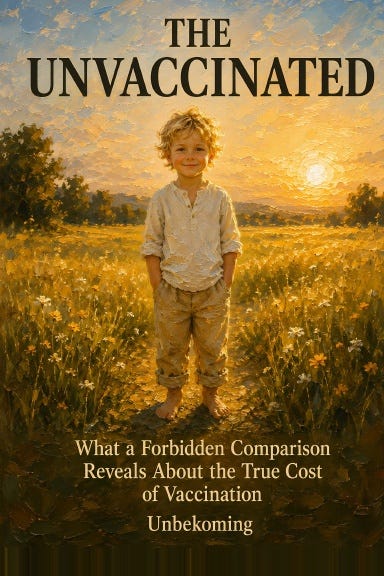
The book
The Vitamin K Injection: What the Evidence Shows
First edition. 300 pages. 6×9 paperback, matte cover, cream paper.
ISBN 978-1-7648990-4-8
USD 19.99 / EUR 18.99 / AUD 29.99 / GBP 15.99 / CAD 26.99
The full catalogue lives on the Unbekoming Spotlight.
What They Can’t Patent
Two new paperbacks — DMSO and chlorine dioxide
Lies are Unbekoming | August 14, 2026
Two molecules. Both cheap. Both simple. Both used for decades. One has been approved for a single condition. The other has been officially demonized. Neither has killed anyone.
In June I wrote about twelve remedies they can’t patent. The essay described a pattern: the cheaper a substance is, the more versatile it is, the more the evidence stacks up, the harder the door gets pushed shut. Two of those twelve now have their own books.
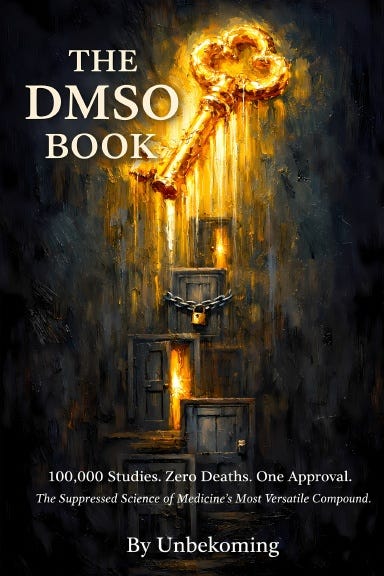
The DMSO Book: The Suppressed Science of Medicine’s Most Versatile Compound
Buy on Lulu → · 219 pages · USD $19.99
100,000 studies. Zero deaths. One FDA approval. Dimethyl sulfoxide has been studied for over sixty years, used by millions, and killed no one — and the FDA has approved it for exactly one condition. The DMSO Book compiles nearly 330 questions and answers across six major sources: A Midwestern Doctor’s combination-therapy series, Morton Walker’s foundational 1993 text, Amandha Dawn Vollmer’s practical guide, Archie Scott’s clinician handbook, klimer’s first-person survivor account, and A Midwestern Doctor’s work on DMSO and cancer. It covers chronic pain, burns, strokes, autoimmune conditions, antibiotic-resistant infections, eye diseases, and cancer. It documents preparation, dosage, and combination protocols with antibiotics, chemotherapy, magnesium, ivermectin, anaesthetics, and antifungals. It traces the history — Zaytsev’s 1866 synthesis, Herschler’s discovery at Crown Zellerbach, Jacob’s clinical breakthrough at Oregon Health Sciences — and the FDA’s decades-long suppression of the research.
The compound wasn’t dangerous. It was too versatile to be allowed.
For the person managing chronic pain who has been offered nothing but escalating prescriptions. For the household that wants a single reference to keep on the shelf next to the first-aid kit.
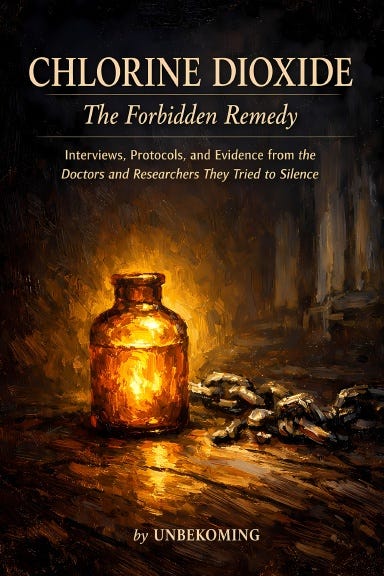
Chlorine Dioxide: The Forbidden Remedy
Buy on Lulu → · 201 pages · USD $19.99
Chlorine dioxide is not bleach. It is a molecule that works with the body rather than against disease — at a voltage of 0.95 volts, within the electrical range of human tissue, delivering oxygen precisely where it is needed and breaking down into salt and oxygen when its work is done. It has been used in water purification for decades. Its oxidative properties are not disputed even by the agencies that warn against its therapeutic use. What is suppressed is the possibility that a substance this simple, this inexpensive, and this widely available could address conditions that generate billions in pharmaceutical revenue.
The book brings together five independent voices who arrived at overlapping conclusions through separate pathways: Dr. Andreas Kalcker, biophysicist and world authority on chlorine dioxide research; Kerri Rivera, whose autism recovery protocol has restored speech and behaviour in nonverbal children; Xuewu Liu, whose intratumoral injection work is showing significant promise in cancer; Curious Outlier, whose Universal Antidote documentary has reached millions; and Jim Humble, who discovered the Master Mineral Solution in the Bolivian jungle in 1996. Their protocols are documented in full. Their limitations are stated honestly. Their evidence — clinical observation supported by studies involving thousands of patients, validated by the daily practice of over 5,000 doctors in the COMUSAV network across sixty countries — is presented so the reader can evaluate it themselves.
For the parent of a nonverbal child who has been told there is nothing left to try. For anyone who has watched a family member exhaust the conventional options and wants to know what the record actually shows.
New Book Reveals How The Israel Lobby Destroyed U.S. Diplomacy With Iran
Eli Clifton and Ian Lustick Reveal How The Israel Lobby Paved The Way For A U.S. War On Iran
By Justin K.P. | The Dissident | August 11, 2026
Investigative journalist Eli Clifton and political scientist Ian Lustick have released a detailed history of the Israel lobby’s influence on U.S. foreign policy titled “Israel’s Lobby: America in the Grip of a Foreign Power”.
The book contains a detailed history of the Israel lobby’s influence over various U.S. administrations going back to its creation.
Among the book’s most interesting revelations is how the Israel Lobby pushed anti-Iran propaganda in the United States in order to destroy U.S. diplomacy with Iran.
This campaign- the book noted- began when the Obama administration was negotiating the 2015 nuclear deal with Iran, aka the JCPOA.
The authors note that Israel Lobby groups attempted to end the deal with Iran, writing “The Republican Jewish Coalition, whose board included Sheldon Adelson and Home Depot cofounder Bernie Marcus, immediately attacked Obama as ‘misguided’ and ‘giving cheer to Tehran’s rogue regime and causing alarm among our friends in the region, including Israel, Saudi Arabia and most other Gulf States.’”
The Republican Jewish Coalition, the book noted, was joined by other Zionist lobby groups, such as The Foundation for Defense of Democracies (FDD) and United Against Nuclear Iran (UANI) in trying to prevent U.S. diplomacy with Iran.
The authors wrote, “The Foundation for Defense of Democracies (FDD), a heavy promoter of the Iraq War and the Global War on Terror before that, followed suit the next day, opposing the proposed deal as ‘a gamble on Western optimism.’ It was joined by a shadowy pressure group, United Against Nuclear Iran (UANI). ‘Tonight’s events are a disappointment for those of us who have worked to pressure Iran’s economy and impose the toughest sanctions in history on Iran—the same sanctions that brought the regime to the negotiating table,’ its statement said. ‘Those touting this agreement do not appear to understand the fragility of sanctions, or the dangers of rolling them back and easing the economic pressure on Iran.’”
These groups, the book noted, were “funded by a small, overlapping set of donors with deep ties to Israel”.
United Against Nuclear Iran (UANI) it noted, “according to a 2013 document, received $500,000 from the Adelsons that year alone. Another $843,000 was contributed by a series of trusts controlled by billionaire precious metals speculator Thomas Kaplan, a citizen of the United States, France, the Republic of the Seychelles, and the United Arab Emirates, and his wife, Daphne Recanati, the daughter of Israeli financier Leon Recanati.”
The book noted that Thomas Kaplan told former Israeli Prime Minister and Jeffery Epstein’s Israeli handler Ehud Barak that “A nuclear Iran ‘represents a psychological threat that will have untold consequences on the Israeli economy and population flows’” in a leaked email.
As for the FDD, the book noted that it was “formed originally in 2001 as Emet (‘Truth’ in Hebrew) with a mission that included ‘provid[ing] education to enhance Israel’s image in North America.’ That name and mission, while submitted to the IRS in its founding documents, was nowhere to be found on its website. By the time the JCPOA debate was occurring, the group had also removed evidence of its advocacy for the Iraq War. Articles with statements including ‘that Saddam still has weapons of mass destruction cannot be seriously doubted’ and language claiming ‘we know Saddam Hussein is making weapons of mass destruction’ were long removed, focusing attention on the alleged threat posed by Iran instead. Al Jazeera hidden cameras captured Sima Vaknin-Gil, the director general of Israel’s Ministry of Strategic Affairs, speaking in blunt terms about Israel’s relationship with the FDD. ‘We have FDD. We have others working on’ projects including ‘data gathering, working on activist organizations, money trail,’ said Vaknin-Gil to an audience of American pro-Israel advocates in 2016. ‘This is something that only a country, with its resources, can do the best’”.
The Israel Lobby cutout, the book noted, “wasn’t just a producer of research papers and op-eds advocating against the JCPOA and for more sanctions and military threats against Iran. It also served as an important element of an echo chamber informing the public and Congress about Middle East policy,” noting that, “In an eighteen-month period preceding and immediately following the signing of the JCPOA in 2015, FDD staff and fellows provided congressional testimony opposing the deal seventeen times.”
The FDD was also primarily funded by Israel’s first billionaire donors, the book noted, writing “a misfiled document revealed that Bernie Marcus contributed $10.7 million, Paul Singer contributed $3.6 million, and Sheldon Adelson contributed $1.5 million in a five-year period ending in 2011. The three men were the three largest donors to the FDD in that time frame, the only period in which the group’s top donors have been disclosed.”
Meanwhile, the book documented how AIPAC’s messaging became more explicitly anti-Iran.
In 2010, the book noted, “AIPAC-contracted telemarketers were directed to say: ‘Iran is rejecting international calls to end its nuclear pursuit.’”
It added, “By 2014, the emphasis had shifted to warning about Iranian president Rouhani’s diplomatic engagement with US and European diplomats. The script read: ‘Regional dangers continue to grow for Israel. In Iran, President Rouhani’s rhetoric continues to charm world leaders, while the regime has not slowed its nuclear pursuits.’”
This was ramped up further in the following years.
The book noted that, “the threat of an Iranian nuclear weapon continued to appear in AIPAC’s fundraising scripts even as the group worked against the JCPOA—a joint agreement with the US and other world leaders that sought to limit Iran’s uranium enrichment with verifiable safeguards and put in place provisions to extend Iran’s breakout time to produce enough highly enriched uranium or plutonium for a nuclear weapon from two to three months to one year or more” with the 2015 AIPAC script reading, “Iran continues to pose a grave threat of attaining a nuclear weapons capability”.
The book added that, “After the signing of the JCPOA in 2015, the fundraising scripts became even more vivid in the violence and existential threats described and either ignored or stood in direct opposition to the foreign policy agenda undertaken by the Obama administration. The 2016 script read: ‘… and Iran continues to develop intercontinental ballistic missiles capable of striking the U.S.’”
The authors added that, “Iran had not in fact developed such a missile”.
While the Zionist lobby did not initially get its way on the Iran deal, the book documents how the lobby made inroads with the Trump 2016 campaign, eventually getting him to rip up the deal.
The book meticulously documented how Trump in 2016 changed his platform after massive funding from pro-Israel donors.
“ (Sheldon) Adelson told reporters that Trump ‘will be good for Israel.’ Trump’s support for Israel was not mentioned in Adelson’s endorsement of Trump later that month in a Washington Post op-ed. But he once again acknowledged the centrality of US policy in the Middle East as a driving motivation for his political engagement, characterizing himself as ‘hawkish on Israel’ and having ‘waged battles’ over the Iran nuclear deal, ‘an issue of paramount importance to me personally and to many others around the world.’ In an email sent to fellow Republican Jewish leaders, Adelson urged them to support the presumptive nominee, saying he was convinced Trump would be a ‘tremendous president when it comes to the safety and security of Israel.’”, the book noted.
The book noted how Trump changed his 2016 platform after major donations from the Israel Lobby, writing, “The Adelsons and Marcus quickly came around, donating $25 million and $7 million, respectively, to support Trump’s general election candidacy. That flow of support from the pro-Israel billionaires came alongside a flurry of movement from the campaign to bring Trump’s platform in line with that of his new biggest donors. Just before the July GOP convention and Trump’s formal nomination, the Republican Platform Committee unanimously omitted any reference to a two-state solution from the party’s Israel planks. Trump met with Netanyahu in September and promised that, if elected president, he would ‘recognize Jerusalem as the undivided capital of the State of Israel.’ The campaign reported that Trump agreed with Netanyahu that peace between Israelis and Palestinians required ‘the Palestinians [to] renounce hatred and violence and accept Israel as a Jewish State.’ Six days before the election, Trump’s ‘Israel Advisory Committee’ published a position paper proposing a break from the Israel policy of previous Republican and Democratic administrations, celebrating ‘the unbreakable bond between the United States and Israel’ based on ‘shared values of democracy, freedom of speech, respect for minorities, cherishing life, and the opportunity for all citizens to pursue their dreams.’”
The book added, “As for ‘never Trump’ pro-Israel donors who held out on endorsing Trump, even Paul Singer, who had warned that Trump’s policies would lead to a ‘widespread global depression,’ ultimately made amends with the new president-elect. Singer donated $1 million to the president-elect’s inaugural committee.”
Trump, during his first term, enacted every policy these pro Israel donors demanded, including by ripping up the Iran deal, the book noted, writing, “Trump, in his first term, enacted a series of wish-list items for Israel, including a unilateral withdrawal from the Iran nuclear deal, recognition of Israel’s sovereignty over the Golan Heights, and, at the repeated urging of the Adelsons, the promised move of the US embassy from Tel Aviv to Jerusalem.” (Emphasis: Mine)
The destruction of U.S. diplomacy with Iran, bought by Zionist donors like Sheldon and Miriam Adelson, Bernie Marcus and Paul Singer, eventually led to the U.S. war on Iran for Israel.
Lobbying for Zionism reviewed by David Miller
By David Miller | July 30, 2026
Did Zionism begin as a Christian project which was only later a Jewish movement?
This is what Ilan Pappé says in the book Lobbying for Zionism.
In my review of the book, I show this is wrong.
Here is an excerpt:
The contribution of the first section of the book is to unearth the hidden history of the Christian Zionist movement. This is a fascinating and useful account of the contribution of a certain fraction of practical British imperialism to the idea of the construction of a Jewish state in the historic territory of Palestine.
In the conclusion, Pappé mentions that ‘Christian fundamentalists, who, as I’ve shown, were the first Zionists in the modern era’. He also states that ‘Zionism began as a Christian project, and thus the early lobbyists were what we would call Christian Zionists today.’ He goes on to criticise Mearsheimer and Walt, saying they ‘described this Christian lobby as a junior partner in the overall lobbying effort in the USA. This appeared to be the case in 2007 — but the picture was very different nearly a decade later during the Trump era.’
But of course, the picture was not very different either during Trump’s first or second presidency. Christian Zionists do have greater numbers of foot soldiers than do Jewish Zionists, but they have only a handful of representatives at the top of the Trump power matrix (for example, Pence and Pompeo in the first period, and Hegseth and Huckabee in the second). As reporting in the Forward, or JFeed, shows, it is Jews that dominate in terms of power players and finance.
Pappé’s conclusion is predicated on his analysis at the start. The opening words of the book are: ‘Zionism began as an evangelical Christian concept and later an active project.’
The main progenitors of the idea were, according to Pappé, Lord Shaftesbury, Colonel Henry Churchill, and Sir George Gawler from the 1830s onward. Though Jewish Zionists of the time are mentioned, such as Sir Moses Montefiore, this all predates the moment when, as Pappé writes, ‘the first settlers arrived [in Palestine] on 6 July 1882’, a group of 14 Russian Jews who arrived at Jaffa Port.
But, as Pappé surely knows, Jewish settlement in Palestine long pre-dates 1882 (see below). Except for Montefiore, none of these figures are mentioned in Pappé’s index and Pappé does not mention Montefiore’s numerous visits to Palestine, or his role in financing Jewish settlement.
In the end, then, the book appears to be advancing a case which is not supported either by the known facts on Jewish settlement in Palestine or by empirically grounded research on the activities of the Zionist movement.
Read the full review via The Column, the new magazine from @ukcolumn .
The strange death of James V. Forrestal, the first US Secretary of Defense
Did Israel start its serial assassination campaigns of its American opponents much earlier than we assume?
By Hua Bin | July 19, 2026
I have always enjoyed reading a wide variety of books on somewhat arcane subjects. Many are triggered by references from other books, and they form a sort of chain reaction.
Around 10 years ago, I read Webster Griffin Tarpley’s book 9/11 Synthetic Terror: Made in USA, my first exposure to alternative 9/11 theories of what truly happened in 2001.
Tarpley’s book led me to David Ray Griffin’s The New Pearl Harbor: Disturbing Questions About the Bush Administration and 9/11.
I subsequently read perhaps 30 books on the subject such as Kevin Ryan’s Another Nineteen: Investigating Legitimate 9/11 Suspects, Chris Bollyn’s Solving 9/11: The Deception That Changed the World, Jim Fetzer’s The 9/11 Conspiracy – the Scamming of America, and more.
Griffin’s New Pearl Harbor further led me to Peter Dale Scott’s The War Conspiracy: JFK, 9/11, and the Deep Politics of War as well as his books on the drug trade, particularly his 2010 book American War Machine: Deep Politics, the CIA Global Drug Connection, and the Road to Afghanistan and the 2003 book Drugs, Oil, and Wars: the US in Afghanistan, Columbia, and Indochina.
Peter Dale Scott’s books motivated me to explore the subjects of JFK assassination and drug trade, which included many books such as James Douglass’s JFK and the Unspeakable: Why He Died and Why It Matters, Alfred McCoy’s The Politics of Heroine: CIA Complicity in Global Drug Trade, and Gary Webb’s Dark Alliance: the CIA, the Contras, and the Crack Cocaine Explosion.
Two books were particularly intriguing among the many on the subjects: Michael Collins Piper’s 1994 book Final Judgement: The Missing Link in the JFK Assassination Conspiracy and Salvador Astucia’s Opium Lords – Israel, Golden Triangle, and the Kennedy Assassination.
Piper was among the first to connect the JFK assassination to Mossad as Kennedy was adamantly opposed to the Israeli nuclear weapons project and therefore became a threat to Israel to be eliminated.
This theory has been further supported by French historian Laurent Guyenot in his books JFK to 9/11: 50 Years of Deep State and The Unspoken Kennedy Truth.
Salvador Astucia, in turn, developed the thesis that Israel used drug-related interest to carry out the assassination, fingering the hitmen as French-Corsican heroin traffickers and associates of Meyer Lansky, the head of Jewish mafia in the US.
One obscure reference by Astucia in his book led me to a book written by David Martin in 2019 The Assassination of James Forrestal, subject of this article.
(By the way, I am planning to write on the US state-sponsored narco trade at some point with the information learned from the reading list. It is the height of iron that the US is the original and ultimuate Narco State while it labels Venezuela under Maduro as such.)
Who was James Forrestal and how he died
James Vincent Forrestal (1892–1949) was a highly influential American politician who served as the last cabinet-level US Secretary of the Navy and the very first United States Secretary of Defense.
He played a pivotal role in shaping America’s military structure and foreign policy during World War II and the early stages of the Cold War.
According to his official biography, Forrestal died on May 22, 1949, after falling from a 16th-floor kitchen window at the Bethesda Naval Hospital, where he allegedly was being treated for severe depression and exhaustion.
His death was widely accepted as a suicide, but the official Navy investigation never actually used the word “suicide” in its final ruling.
The official Willcutts Report, the official US Navy board of inquiry report into his death, concluded only that Forrestal died from the fall, that his behavior indicated severe mental depression, and that no naval personnel were negligent or to blame.
Investigators found a leather-bound book, An Anthology of World Poetry, open on a radiator next to his bed. The book was bookmarked to a dark, mournful passage from the ancient Greek tragedy Ajax by Sophocles.
On a sheet of hospital memorandum paper, Forrestal had been hand-copying the text. His transcription of the poem stopped abruptly in the middle of a word.
He had written “Woe, woe! will be the cry…” and stopped after writing the letters “Night—” while attempting to copy the word “nightingale”.
In the play, the Greek hero Ajax descends into madness out of grief and political betrayal, ultimately committing suicide.
The press and historians heavily focused on this, noting that Forrestal likely identified with Ajax’s tragic downfall.
David Martin concludes assassination after studying declassified details of Forrestal’s alleged suicide
The Navy kept the official investigation secret for 55 years and finally released it via Freedom of Information Act in 2004.
Researchers immediately found several inconsistencies that have fuelled decades of assassination theories:
- Bathrobe cord: When Forrestal’s body was found on the 3rd-floor roof, the sash/cord of his dressing gown was tightly knotted and wrapped around his neck. This led to speculation that he may have tried to hang himself from the radiator before falling, or that he was strangled.
- Handwriting discrepancies: Independent researchers who analyzed the handwritten poem alongside Forrestal’s known personal letters argued that the handwriting in the poem did not match his.
- Guard’s testimony: Early press reports claimed a guard saw Forrestal writing the poem right before the jump, but the official Willcutts Report showed the guard on duty testified that Forrestal appeared to be asleep with the lights off when he checked in.
David Martin’s book further highlighted major anomalies omitted from initial public reports. These include unexplained broken glass in Forrestal’s room and dynamic scratch marks on the outside windowsill.
Evidence suggested a struggle in the room, with broken glass photographed on his bed.
Contrary to reports of a mental breakdown, several doctors had previously indicated that 4 out of 5 doctors felt Forrestal was not suffering from severe mental illness, with some suggesting he was misdiagnosed.
Martin believes this is evidence that stories of Forrestal’s “sudden breakdown” prompting hospitalization were likely false.
David Martin concluded the strange death of James Forrestal was in fact an assassination that was covered up as a suicide. His view is widely shared by other researchers.
Martin frames the assassination as one of the earliest operations of the post-WWII American “Deep State” and foreign intelligence, namely Mossad.
He outlines the primary geopolitical motives for Forrestal’s removal as his opposition to the creation of Israel.
Forrestal was the most prominent cabinet official arguing against US support for the partition of Palestine. He believed it would permanently destabilize the Middle East and jeopardize Western access to oil.
Forrestal argued that the American military machine and civilian industrial expansion relied heavily on Middle Eastern petroleum.
He strongly believed that backing a Zionist state would deeply alienate Arab nations. This alienation, he warned, would jeopardize US access to oil pipelines and vital Persian Gulf supplies.
As a fierce anti-communist, Forrestal feared that Middle Eastern instability would open the door for the Soviet Union to expand its influence in the region.
He believed a war between Arabs and Jews would destabilize the area and leave it vulnerable to Soviet intervention.
Forrestal famously told White House advisors to “look at the numbers,” pointing out that there were roughly 30 million Arabs compared to 600,000 Jews.
He believed the Arab forces would eventually overwhelm a Jewish state, potentially forcing the U.S. to deploy its own military forces to defend it.
This was a commitment he felt the post-WWII, heavily demobilized US military could not afford.
According to his published diaries, Forrestal was deeply critical of how both the Democratic and Republican parties handled the issue.
He complained that President Harry Truman’s administration was basing crucial national security decisions on capturing the domestic “Jewish vote” and securing campaign contributions in key states like New York.
He unsuccessfully attempted to build a bipartisan agreement to completely remove the Palestine issue from American domestic politics.
Martin concluded that Forrestal’s resistance to the establishment of Israel earned him the ire of the Zionists and the Jewish community within the US and Israel, who decided to remove him once and for all.
Parallels can be found with other suspicious deaths of prominent anti-Zionist figures in this period, including T.E. Lawrence “of Arabia”. They may have been assassinations by the same perpetrators.
The Zionists themselves have documented Forrestal’s opposition to the establishment of Israel in their own records.
An article titled “The Wise Men” Oppose U.S. Recognition of Israel, published on Temple Beth Sholom, described Forrestal and George Marshall’s opposition to Israel. https://tbshamden.com/odds-a-ends/list-of-restricted-funds/
Marshall was the US Army Chief of Staff in WW2, the Secretary of State when Israel was established, and the architect of the Marshall Plan. He shared Forrestal’s negative view on the formation of the Jewish state.
Why is it important and relevant today?
The strange death of James Forrestal is a reminder how far Israel has been willing to go to eliminate its perceived threats.
It vindicates researchers like Michael Collins Piper who concludes that Israel murdered President Kennedy to protect its nuclear program.
Many senior US officials opposed Israel’s establishment as they believed it would create regional chaos, which proved prescient.
Israel, from its inception, has been an outlaw and a terrorist state capable of doing anything with the help of US Zionists. This includes the 9/11 false flag attack that triggered US “forever wars” in the Middle East for the benefit of Israel.
Similarly, the strange assassination of Charlie Kirk seems to have Israel’s hand all over it. Is Trump also under Israeli threats to launch the insane war on Iran despite his campaign promises?
As we move into another phase of US’s war on Iran for Israel, it is worth bearing in mind what kind of rogue actor the world is dealing with.
The Manual Behind the Mandates
An Essay on Paul Offit’s Bad Faith
Lies are Unbekoming | July 14, 2026
In June and October 1998, Paul Offit sat on the CDC’s Advisory Committee on Immunization Practices and voted twice in favor of Wyeth-Lederle’s RotaShield rotavirus vaccine: on June 25 to recommend it for routine childhood use, and on October 22 to add it to the federal Vaccines for Children Program.¹ Offit’s own rotavirus vaccine, developed at the Children’s Hospital of Philadelphia in partnership with Merck, was under development at the time. On October 22, 1999, exactly a year after his second vote, ACIP rescinded the RotaShield recommendation after CDC identified an elevated rate of intussusception in vaccinated infants. Intussusception is a bowel condition in which one segment of intestine telescopes into another and cuts off its own blood supply; without emergency intervention, it kills. The surveillance data at the point of withdrawal included hospitalizations and infant deaths. Offit abstained from the withdrawal vote.² Seven years later, Merck’s RotaTeq, which Offit co-invented, received ACIP recommendation for the same schedule slot. The patent sale netted him at least six million dollars by his own account, with other public estimates running higher.³
In June 2000, the United States House Committee on Government Reform published Conflicts of Interest in Vaccine Policy Making. The report named Offit specifically. It concluded that “conflict of interest rules employed by the FDA and the CDC have been weak, enforcement has been lax, and committee members with substantial ties to pharmaceutical companies have been given waivers to participate in committee proceedings.”⁴
In March 2015, Basic Books published Offit’s Bad Faith: When Religious Belief Undermines Modern Medicine. The book accuses religious parents of moral failure. It calls for the elimination of religious exemption from vaccination law. It endorses criminal prosecution of parents who withhold pharmaceutical products from their children on religious grounds, including, under the Oregon sentencing guidelines Offit presents as a model, terms of up to twenty-five years in prison.⁵
Offit is the Maurice R. Hilleman Professor of Vaccinology at the University of Pennsylvania and directs the Vaccine Education Center at the Children’s Hospital of Philadelphia. He has written five previous books along the same lines, including Deadly Choices: How the Anti-Vaccine Movement Threatens Us All and Autism’s False Prophets: Bad Science, Risky Medicine, and the Search for a Cure. His public role for two decades has been to defend the schedule and to condemn parents who decline it. Book after book, he plays the doctor calmly explaining what the parents are getting wrong.
Bad Faith extends the position into religion. It was published five years before COVID. Its recommendations were substantially enacted between 2015 and 2022. Read now, it functions less as ethical inquiry than as a legislative operations manual whose program was executed.
The Method
The book opens with cases designed to overwhelm objection. A Wisconsin pastor performs an exorcism on an eight-year-old boy with autism and asphyxiates him under his own body weight.⁶ An ultra-Orthodox mohel in Brooklyn performs metzitzah b’peh, sucking blood from a circumcision wound with his mouth; eleven infants develop what medicine identifies as neonatal herpes, two die, and two suffer permanent brain damage.⁷ At a Texas ministry associated with televangelist Kenneth Copeland, sixteen people including a four-month-old become ill in what Offit calls a measles outbreak connected to a daycare center on church property.⁸ In Ireland, a Hindu woman named Savita Halappanavar dies after a Catholic hospital refuses to remove her miscarrying fetus while a heartbeat is still detectable; the coroner attributes her death to septicemia.⁹
None of these cases involves ordinary religious exemption from vaccination. What they share, at the level Offit uses them, is that religious belief was present at the scene of a death. What they do not share is the specific practice the book has been marshalled to condemn.
That is the book’s central rhetorical move. It builds a moral gradient from ritual mutilation and life-refusal to any parental decision that rejects a pharmaceutical recommendation on religious grounds. The gradient does not require the cases to be comparable. It requires only that the reader carry the emotional freight of the extreme cases into the ordinary one.
The move is announced on page xiii. Offit writes, in his own voice, that he began the book expecting to arrive where Dawkins and Hitchens arrived, at the conclusion that religion is illogical and potentially harmful, but instead found himself moved by the Old and New Testaments. “The reader will be surprised to learn that the hero of this book isn’t science or medicine or doctors; it’s religion.”¹⁰
The concession does specific work. It reassures the religious reader that the book is not hostile to their tradition, and it disarms the skeptical reader who has watched vaccine industry figures dismiss religious objections as backward. Once both are quieted, the book proceeds to recommendations that religious readers, warned properly, would reject on sight.
Rita Swan is the emotional engine of the book. Offit opens with her and closes with her. To understand what he does with her, it helps to see her before he found her.
She was raised in Christian Science. In 1977, her fifteen-month-old son Matthew died after his parents, following church teaching, refused medical care for what was diagnosed as bacterial meningitis.¹¹ A year after his death, still a Christian Scientist, she went to the medical library at Wayne State University in Detroit. She had heard about another Christian Science child, a boy named Danny, whose meningitis had reportedly resolved without medical treatment; she wanted to understand why God had saved Danny and not Matthew. She read the textbooks. Danny had one kind of meningitis, viral, which typically resolves on its own. Matthew had another, bacterial, which does not. Antibiotics would have saved him. She sat on the floor of the library stacks and read the paragraph over and over. In her own words: “I did not have to be afraid that Matthew had died because we were not right with God. I knew that I wasn’t giving up a magical, supernatural protection or any kind of protection from evil because Christian Science had no power. It hadn’t healed anything.”¹²
That is the moment before Rita Swan became a public figure. She left the church, founded an organization called Children’s Healthcare Is a Legal Duty, and dedicated her life to eliminating religious exemption from child abuse and neglect law. Everything after sits downstream of that library floor. What Offit builds on top of it in Bad Faith is a criminal-law regime under which the state prosecutes not only parents like Rita Swan’s former self, but parents who bear no resemblance to Rita Swan’s former self at all.
Swan’s grief is real. Her son died. Her devotion to what she now believes is real. None of that is at issue. What is at issue is the strategic use to which her narrative has been put. Offit takes a mother whose child died in 1977 after her family refused emergency medical treatment for a present, acute illness, and uses her story to justify the elimination, in the 2010s, of the religious right to decline pharmaceutical injection of a healthy child. The two positions are not the same. Nothing in Matthew Swan’s death establishes what the parents of a healthy two-month-old should be permitted to decide about a hepatitis B injection.
The emotional weight travels regardless. That is the point of putting Rita Swan on the first page and the last page of the book.
Once the extreme cases have done their work, the ordinary case follows. Offit writes: “On any given day in America, tens of thousands of children whose parents have chosen not to vaccinate them for religious reasons can be found in daycare centers, schools, playgrounds, and churches across the country.”¹³ The sentence sits between the paragraphs about the Copeland church and the paragraphs about the woman dying at St. Joseph’s in Phoenix. By the time the reader arrives at unvaccinated children in daycare centers, the frame is set. They are on a moral continuum with mohels who kill babies and hospitals that let mothers die.
The frame does specific violence to the categories. A parent who declines a rubella vaccine on religious grounds is not the parent who prays over a bowel-obstructed child until he dies. Collapsing the two into one policy target requires an argument. Offit does not make the argument. He performs the collapse rhetorically and moves on.
Standing Up
Chapter 12 is called “Standing Up.” It is the book’s operations manual.
The model case is Oregon. Between 1999 and 2011, Rita Swan and Oregon prosecutor Terry Gustafson worked to strip religious exemption from Oregon’s criminal code. In 1999, Representative Bruce Starr introduced a bill repealing all religious exemptions to child abuse and neglect statutes. The Christian Science Church lobbied against it. The legislature compromised, repealing five of the exemptions.¹⁴ Twelve years later, after further deaths among children in the Followers of Christ church, Swan and her husband moved from Iowa to Oregon and lived in Salem for four months lobbying for full repeal. This time the Christian Science Church withdrew opposition. Governor Kitzhaber signed the bill. Religious exemption in Oregon was eliminated.¹⁵
Offit reports these events approvingly. He notes that under Oregon’s mandatory sentencing guidelines, parents convicted of religiously motivated child abuse or neglect could face up to twenty-five years in prison.¹⁶ He offers this as a template.
The Schaible case is the chapter’s central prosecution. Herbert and Catherine Schaible, members of the First-Century Gospel Church in northeast Philadelphia, lost their two-year-old son Kent in 2009 after choosing prayer instead of medical care; the coroner ruled the death due to bacterial pneumonia. The Schaibles were convicted of manslaughter and sentenced to ten years’ probation, with an order to seek medical care for their remaining seven children. In 2013, while under probation, their seven-month-old son Brandon died of the same condition. The Schaibles were charged with third-degree murder and sentenced to three and a half to seven years in prison. Their remaining children were removed to foster care.¹⁷
Offit reports the case as vindication of the prosecutorial approach. What the chapter does not report is the distinction between the Schaible position and the position of the parent who declines a hepatitis B or MMR injection for a healthy child. The Schaibles refused antibiotics for their acutely ill children. The parent refusing MMR is refusing pharmaceutical injection of a well child in the absence of any acute illness. One is refusal of treatment for present illness; the other is refusal of a product administered to a healthy body. Arguing for equivalent prosecution requires arguing for equivalence between the two positions. The chapter does not attempt the argument. It stacks the cases.
The children whose deaths Offit catalogues are real. Kent and Brandon Schaible are dead; more than eighty children lie in the Followers of Christ cemetery in Oregon; Matthew Swan was fifteen months old when he died in 1977. None of that is at issue here. What is at issue is the argumentative bridge: whether the deaths of children whose parents refused treatment for acute illness license the criminalization of parents who decline pharmaceutical products intended for a healthy body. Offit says yes. The book’s structural task is to make that inferential leap feel intuitive rather than argued.
In 2012, the American Academy of Pediatrics awarded Rita Swan the President’s Certificate for Outstanding Service. Robert W. Block, then AAP president, presented her with a plaque at the national meeting.¹⁸ The award marks a specific institutional turn. The largest pediatric medical body in the United States awarded its highest honor to a lay activist whose organizational mission is the elimination of religious exemption. Since then, the AAP has campaigned publicly for the removal of non-medical exemptions from state vaccine mandates.
The concession on page xiii is at this point difficult to sustain. The book that opens with “the hero of this book isn’t science or medicine or doctors; it’s religion” also contains, one hundred and eighty pages later, the sentence: “the American public’s instinctive tolerance for religion often exceeds reason.”¹⁹ Both sentences are Offit. Both are Bad Faith. The hero of page xiii and the tolerance-that-exceeds-reason of page 193 are the same subject in the same book. The concession was a hospitality. Chapter 12 is what waits behind it.
Offit’s resolution is to distinguish between religion properly understood, which is charity, and religion improperly performed, which is medical neglect. Charity is what he defends. Anything else is subject to statute. The distinction is convenient. It is also a claim no religious tradition would recognize as an outside authority’s to draw. Offit is not a theologian. He is a pediatrician with a financial stake in vaccine uptake and an institutional platform at the largest children’s hospital in the country. The book adjudicates which religious practices are protected and which are prosecutable. Parents disagree at their statutory peril.
From Print to Statute
Bad Faith was published in March 2015. Three months later, on June 30, 2015, California Governor Jerry Brown signed SB277, eliminating both religious and personal-belief exemptions from the state’s school vaccination requirements. California became the third state, after Mississippi and West Virginia, to permit only medical exemption.²⁰ The bill had been introduced in February 2015, roughly the same month Basic Books shipped Offit’s manuscript. Public advocacy for the bill drew heavily on the framing Offit had spent the previous decade establishing. Four years later, in 2019, California passed SB276, restricting the medical exemptions that had replaced the eliminated religious ones. What began as a policy conversation about religious refusal ended as a near-total mandate.
In June 2019, New York eliminated religious exemption by legislative vote. The bill passed in response to what the state described as measles outbreaks in Rockland County and Brooklyn, communities with large Orthodox Jewish populations. Governor Andrew Cuomo signed the bill the same day it passed both chambers.²¹ Maine passed LD 798 in May 2019, eliminating religious and philosophical exemption; the law survived a March 2020 ballot referendum challenge.²² Connecticut eliminated religious exemption in April 2021.²³ Mississippi, which had never permitted religious exemption to school vaccination, was ordered by a federal court in 2023 to allow one under Bosarge v. Edney.²⁴
The COVID-era mandates of 2021 and 2022 extended the framework beyond state school law. Federal contractors, healthcare workers at facilities receiving federal funding, and workers at companies with more than one hundred employees faced injection requirements as conditions of employment. Military personnel faced separate mandates. Religious exemption processes existed on paper. Employers rejected them at scale, and litigation over denied exemptions moved through the federal courts for the next several years.²⁵
Family court applied the framework to custody. In October 2017, Oakland County Judge Karen McDonald sentenced Rebecca Bredow of Ferndale, Michigan to seven days in jail for contempt of court after she refused to vaccinate her nine-year-old son under a court-approved parenting agreement. Her ex-husband was granted temporary custody. Bredow’s son received four vaccinations while she was behind bars. She then lost primary custody permanently. Three months later, in a separate Michigan custody dispute, attorney Aaron Siri deposed Stanley Plotkin, Offit’s mentor and vaccine industry co-strategist. Plotkin had been recruited as expert witness for the father seeking to vaccinate his ten-year-old daughter over the mother’s religious objection. The nine-hour deposition on January 11, 2018 ended with Plotkin recusing himself the following day. The father nevertheless prevailed at trial.²⁶ Similar custody rulings have moved through American family courts since. The framework Offit established in Bad Faith, that religious or personal objection to vaccination is a category on which the state may act against the parent, is the framework these courts now apply.
Under the Siri deposition, Plotkin stated the position openly. Asked whether he believed anyone could have a valid religious objection to vaccination, Plotkin answered no. Asked whether he took issue with religious beliefs, yes. Asked whether he stood by his written statement that “vaccination is always under attack by religious zealots who believe that the will of God includes death and disease,” he answered “I absolutely do.”²⁷ The deposition is the sworn version of what Bad Faith had put in more polished prose three years earlier.
In 2014, forty-eight American states recognized either religious or philosophical exemption to school vaccination. Between 2015 and 2022, four eliminated non-medical exemption: California, New York, Maine, and Connecticut. They joined Mississippi and West Virginia as the states permitting only medical exemption. The injection mandate regime extended in parallel into employment, healthcare, military service, and family law. Whether the reader considers this a public health achievement or a civil liberties collapse, the trajectory is documented. The book’s program was substantially enacted.
The framework has not gone unopposed. Aaron Siri and the firm of Siri & Glimstad have led the litigation counterattack, exposing Stanley Plotkin under deposition in 2018 and pressing federal court challenges to the COVID-era mandates. Robert F. Kennedy Jr.’s Children’s Health Defense has funded much of the legal and public education work. Bosarge v. Edney, the April 2023 federal ruling that ordered Mississippi to allow religious exemption to childhood vaccination, is one visible product of that pushback. In January 2025, West Virginia Governor Patrick Morrisey issued an executive order directing state health officials to implement a religious exemption process; the resulting conflict between the governor’s office, the state Board of Education, and the state courts is now before the West Virginia Supreme Court. The framework Bad Faith helped establish is now being tested in the same courts that first applied it.
The Document Exists
The record is a public one. In 1998, Paul Offit voted twice at ACIP to add a rotavirus vaccine to the childhood schedule. That vaccine was withdrawn a year later after CDC identified elevated intussusception risk and infant deaths. In 2006, his own rotavirus vaccine was added to the schedule under a subsequent ACIP recommendation. Merck paid him at least six million dollars for the patent, by his own admission, with other public estimates running higher. In 2000, the House Committee on Government Reform named him in a report on conflicts of interest at the CDC. In 2015, he published a book that opens by calling religion “the hero” and closes by endorsing prison terms of up to twenty-five years for parents who cite religion in declining pharmaceutical products for their children.
Between 2015 and 2022, states passed the laws the book recommended. California, New York, Maine, and Connecticut eliminated religious exemption from school vaccination. Federal COVID-era mandates conditioned employment, healthcare, and military service on injection. Family courts began ordering vaccination over parental objection and jailing mothers who refused. In 2014, forty-eight American states recognized non-medical exemption to childhood vaccination. By the end of 2022, forty-four did. Litigation and executive action since have partly reversed the direction of travel, and the story is not settled.
There is a version of this story a defender of the book would tell. In that version, the American vaccine mandate regime built between 2015 and 2022 is a public health triumph, and Bad Faith is the ethical volume that helped make it possible. In that version, Rita Swan on the floor of the Wayne State library reading about her son’s death is the founder of a movement to protect children, and Kent Schaible, Brandon Schaible, and the eighty-plus children in the Followers of Christ cemetery are the reason the state was right to act. That version exists. It is the version Bad Faith itself tells.
The other version is that the author of Bad Faith is a pediatrician who voted rotavirus vaccines onto the CDC schedule while his own rotavirus vaccine was in development at Merck, abstained from the vote to withdraw the failed predecessor after infants died, and sold his own version to Merck for at least six million dollars. In that version, the book that calls religion “the hero” is written by a man the House of Representatives named in a conflict-of-interest report fifteen years earlier, and its policy recommendations, enacted in state after state and then extended into COVID-era employment law, functioned to remove the last legal ground from which parents could decline the products his own industry manufactures. In that version, the mother on the library floor was leveraged into a criminal-law regime she never asked for.
The reader can pick the version. Both start from the same documents. The book calls itself an inquiry into religious belief. The record of what it did calls it something else. Everything is documented: Chapter 12 in the book, Offit’s financial history in the 2000 House committee report, the Schaible convictions in Pennsylvania court records, the state exemption repeals in state statute, the Plotkin deposition in sworn testimony. The elements exist for anyone to verify.
The document exists and says what it says.
How to Explain It to a Six-Year-Old
Imagine there is a kid at school named Paul who sells cookies at lunch. He has been selling them for a long time and he is rich now.
One day Paul writes a big book. In the book he says that any kid who doesn’t buy his cookies at lunch is being mean, and that the teachers should send those kids to the principal, and that the principal should punish their parents.
The teachers read Paul’s book. Some of them agree. Soon there is a new rule at school: if you don’t buy Paul’s cookies at lunch, you get sent to the principal’s office.
But some kids have real reasons for not buying cookies. Some are allergic. Some don’t have any money. Some of their families believe cookies are wrong. Some kids just don’t want cookies today. The rule doesn’t care. If you don’t buy them, you are in trouble.
Meanwhile, Paul is still selling cookies. He is still getting rich. He never mentioned in his book that he was the one selling them.
That is the story of Bad Faith. Paul Offit is a doctor who made millions of dollars from a vaccine he invented. He wrote a book saying that religious parents who don’t want vaccines for their children should go to prison. Between 2015 and 2022, several American states passed laws matching what his book said. The vaccines his industry sells are now required in more places than they used to be. The parents who don’t want them have fewer places left to say no.
Paul’s book called religion “the hero.” It wasn’t.
References
¹ Offit’s ACIP tenure (October 1998 to June 2003) and the specific rotavirus votes (June 25, 1998; October 22, 1998; October 22, 1999) are documented in United States House of Representatives, Committee on Government Reform, Conflicts of Interest in Vaccine Policy Making, Majority Staff Report, June 15, 2000 (Section V, Advisory Committee on Immunization Practices, Exhibits 38-41 pertaining to Dr. Offit specifically). See also Handley, J.B., How to End the Autism Epidemic (Chelsea Green Publishing, 2018), Chapter 4, “The Reward Is Never Financial”; and Olmsted, Dan, and Mark Blaxill, “Voting Himself Rich,” Age of Autism, December 2009.
² Centers for Disease Control and Prevention, “Withdrawal of Rotavirus Vaccine Recommendation,” Morbidity and Mortality Weekly Report 48(43), November 5, 1999. RotaShield post-licensure surveillance findings, including hospitalizations for intussusception and deaths, are documented in CDC MMWR reports from October and November 1999. Offit’s abstention from the withdrawal vote is reported by Olmsted and Blaxill, op. cit., and by Handley, op. cit.
³ Handley, op. cit., quoting Offit’s own email correspondence acknowledging the six-million-dollar figure, and noting that “other public estimates have been far higher.” Handley’s citation is to Offit-David Brown correspondence, August 18, 2009.
⁴ United States House of Representatives, Committee on Government Reform, Conflicts of Interest in Vaccine Policy Making, June 15, 2000. Available via the Children’s Health Defense archive at childrenshealthdefense.org.
⁵ Offit, Paul A., Bad Faith: When Religious Belief Undermines Modern Medicine (Basic Books, 2015). ISBN 978-0-465-04061-2. Endorsement of Oregon’s mandatory sentencing appears in Chapter 12.
⁶ Bad Faith, Introduction, pp. ix-x. Terrance Cottrell Jr., killed August 22, 2003.
⁷ Bad Faith, Introduction, p. xi. See also New York City Department of Health and Mental Hygiene, “Notes from the Field: Neonatal Herpes Simplex Virus Infection Following Jewish Ritual Circumcisions,” MMWR 61, 2012.
⁸ Bad Faith, Introduction, pp. xi-xii. The Tarrant County outbreak, August 2013, was traced to Eagle Mountain International Church.
⁹ Bad Faith, Chapter 6, “Dialogue of the Deaf,” pp. 82-85. Halappanavar died October 28, 2012, at University Hospital Galway.
¹⁰ Bad Faith, Introduction, p. xiii.
¹¹ Bad Faith, Chapter 1, “The Very Worst Thing,” pp. 1-18. Matthew Swan died July 1977.
¹² Bad Faith, Chapter 12, “Standing Up,” pp. 177-178. Rita Swan’s account of the Wayne State University medical library and her decision to leave Christian Science.
¹³ Bad Faith, Introduction, p. xii.
¹⁴ Bad Faith, Chapter 12, pp. 184-186. The 1999 Oregon legislative fight and Bruce Starr’s HB 2494.
¹⁵ Bad Faith, Chapter 12, pp. 186-187. Oregon House Bill 2721 (2011).
¹⁶ Bad Faith, Chapter 12, p. 186.
¹⁷ Bad Faith, Chapter 12, pp. 187-191. See also Commonwealth v. Schaible, Pennsylvania Court of Common Pleas, Philadelphia County. Herbert and Catherine Schaible entered no-contest pleas to third-degree murder on November 14, 2013, and were sentenced February 19, 2014.
¹⁸ Bad Faith, Epilogue, p. 195. American Academy of Pediatrics announcement of the 2012 President’s Certificate for Outstanding Service.
¹⁹ Bad Faith, Chapter 12, p. 193. The full sentence in context reads: “the American public’s instinctive tolerance for religion often exceeds reason—in this case, resulting in a misguided respect for a belief that violates one of the most fundamental teachings of all religions: protecting the vulnerable.”
²⁰ California Senate Bill 277 (Pan/Allen), signed by Governor Jerry Brown on June 30, 2015. Codified at California Health and Safety Code § 120325. California Senate Bill 276 (Pan), restricting medical exemptions, was signed September 9, 2019.
²¹ New York Senate Bill S2994A / Assembly Bill A2371A, signed by Governor Andrew Cuomo on June 13, 2019, repealing New York Public Health Law § 2164(9).
²² Maine LD 798, signed by Governor Janet Mills, May 24, 2019. Upheld in a March 3, 2020 statewide referendum by a vote of 73 to 27 percent.
²³ Connecticut House Bill 6423, signed by Governor Ned Lamont on April 28, 2021, repealing the state’s religious exemption to school vaccination requirements.
²⁴ Bosarge v. Edney, U.S. District Court for the Southern District of Mississippi, 2023, ordering the state to allow religious exemption to childhood vaccination requirements.
²⁵ Federal COVID-19 vaccination mandate litigation includes NFIB v. OSHA, 595 U.S. 109 (January 13, 2022) (staying the OSHA Emergency Temporary Standard for large employers); Biden v. Missouri, 595 U.S. 87 (January 13, 2022) (allowing the CMS healthcare worker mandate to take effect); and numerous federal cases involving denied religious exemption accommodations.
²⁶ Rebecca Bredow’s jailing and custody loss are documented in contemporaneous news reports from October 2017 (Oakland County Circuit Court, Judge Karen McDonald presiding; Detroit Free Press, CBS News, Washington Post reporting). The separate Michigan custody case in which Stanley Plotkin was deposed by Aaron Siri (January 11, 2018) is described in Handley, J.B., How to End the Autism Epidemic, Chapter 4. The deposition ran approximately nine hours.
²⁷ Deposition of Stanley Plotkin, taken by Aaron Siri, January 11, 2018. Transcript publicly available via the Informed Consent Action Network. The exchange on religious objection to vaccination appears at approximately pp. 42-46 of the deposition.
Featured Video
or go to
Aletho News Archives – Video-Images
Book Review
The Maidan Killings and the False-Flag Case
By Freddie Ponton | 21st Century Wire | September 5, 2026
Before the killings that helped bring down Ukraine’s president in February 2014, American diplomats were discussing who should enter its government. In a leaked telephone call, senior State Department official Victoria Nuland told US ambassador Geoffrey Pyatt, “I think Yats is the guy,” referring to opposition leader Arseniy Yatseniuk. Washington had clear preferences and was working to advance them. Later that month, Yatseniuk became prime minister.
Ivan Katchanovski’s The Maidan Massacre in Ukraine examines the violence that preceded that transfer of power. Drawing on television footage, witness testimony, forensic examinations and Ukrainian court proceedings, he argues that elements of the opposition shot protesters and police in a false-flag operation. His case centres on evidence of protesters being shot from opposition-controlled locations, including Hotel Ukraina, overlooking the killing ground. … continue
Blog Roll
 Aletho News
- Israel expands “incitement” charge to target Palestinian education and memory
- How Israel seeks to reshape Arab classrooms
- Paris bans pro-Palestinian demonstration planned for Oct. 7 over ‘risks of public disorder’
- In August Hanning Treason Case – All Signs Point To Tel Aviv.
- France cleared dozens of military sales to Israel between May and September: Report
- France projects nuclear power as Macron pushes arsenal expansion
- The fallacy of US delusions about Iran’s economic collapse
- What changes with Lula or Flávio?
- Britain leads Western media’s demise through ‘fear porn’ narrative
- The Maidan Killings and the False-Flag Case
- If Americans Knew
- Soldier testimony sheds light on how Israel wages information war
- CIA Report Warns Israel Could Head Toward Civil War, Total Collapse
- Banker Who Exposed Howard Lutnick’s Ties to Epstein Warned of ‘Retaliation’ and ‘Personal Consequences’ in Last Post Before Suicide
- Israeli Attacks Kill Two Palestinians in Gaza
- Gaza genocide at 3: Israeli-U.S. cruelty and the smart, deep resistance to it are changing the world
- As genocide is about to enter 3rd year, little of Gaza remains– Daily Update
- “We See Our Homes Now From A Satellite, Like Strangers”
- Watch “Gaza: Doctors Under Attack”, originally censored by BBC
- NAZA: Israeli embassies in UK and US promote rival documentary to challenge Gaza genocide allegations
- David Ellison appoints Israeli to lead merged Paramount-Warner studios
- No Tricks Zone
- Latest European Green Energy Debacle; Portugal’s Largest Flagship Solar Park Insolvent!
- Green Energy Debacle: German Expert Professor Fritz Vahrenholt Warns Of Severe Economic And Social Consequences
- Two More Paleo Reconstructions Affirm Meters-Higher Sea Levels Across Ireland, Brazil 7000-6000 Years Ago
- New Study: Earth And Venus Surface Warmth Largely Explained By Convection And Lapse Rate, Not CO2 Or Radiation
- 2025 Nature Paper Claiming Worsening Global Drought Gets RETRACTED …Heavily Flawed
- New Study: ‘Global Drought Shows No Detectable Recent Acceleration Under Climate Warming’
- Economic Masterminds: German Socialists Suggest Taxing Productivity Gains Stemming From Using AI
- The South China Sea Has Not Been Cooperating With The Climate Change Narrative
- Energy Crisis: Germany Enters Heating Season With Historically Low Gas Reserve Fill Levels
- New Study: The Antarctic Ice Sheet Gained Mass From 2020-2024 Due To Staggering Snow And Ice Accumulation

