Confusion, delusion, and how Israel drives the Iran War
By Jamal Kanj | MEMO | April 23, 2026
The closure of the Strait of Hormuz following the temporary ceasefire is the culmination of an American policy defined by strategic incoherence. At the center stands Donald Trump, whose shifting positions, confused war objectives, and conflicting actions have not only failed to ease regional tensions but have actively deepened them.
Nowhere is this clearer than in Trump’s threats to blow up the whole country, including its bridges and power plants. At the same time, he touted a military “big day,” presenting potential war crimes as diplomatic tool, aggression as diplomacy, and destruction as leverage.
Trump’s inflated, almost delusional, promises ahead of potential talks come across less as statesmanship and more as a calculated sales pitch to the American public. His vows “to end up with a great deal,” coupled with an almost obsessive focus on Barack Obama by insisting his agreement will be “far better” than the one negotiated over a decade ago. An approach that reflects a tendency toward messaging driven less by policy depth and more by projection, comparison, and to frame outcomes in terms of self-aggrandizement and personal glory.
Instead of articulating clear strategic objectives, his policy relies on distinguishing himself and image cultivation to project authority and superiority, leaving the underlying substance vague and open to question.
By manufacturing optimism and exaggerating progress while promising an imminent “great deal,” Trump appears to be negotiating with himself—or detached from reality—seeking to construct a narrative of success regardless of the facts on the ground. The performative optimism stands in sharp contrast to his simultaneous threats and pompous rhetoric, suggesting not confidence but a measure of desperation.
Trump’s rationale for extending the ceasefire because of “internal divisions” within Iran is unconvincing. If internal debate within Iran is seen as warranting a pause, what should be said of a policy where direction shifts from one moment to the next? Differing political views are the essence of a normally functioning political system, whereas impulsive, erratic, personalized decision-making is not.
All of this unfolds as Trump continues issuing maximalist demands for conditions he helped create. For instance, he demands the surrender of enriched uranium that would not exist had he not abandoned the Joint Comprehensive Plan of Action (JCPOA). Likewise, the Strait of Hormuz was closed as a consequence of his and Netanyahu’s war, not as its cause.
The consequences of these Israel-driven U.S. policies are felt by ordinary Americans at the gas pump and in grocery stores. The Strait of Hormuz has become a battleground, destabilizing global energy supply chains and economies worldwide. Yet despite these cascading effects, the core strategy remains unchanged. Trump continues to operate within an echo chamber of Israel-first sycophants that assume military might alone can deliver results, even as the policy falters and the war spills across the region, threatening roughly one-fifth of the world’s energy infrastructure.
This is not merely a political flaw or a matter of mismanagement. It is rather a strategic vulnerability shaped by Israel-first loyalists pulling U.S. strategy in directions that ultimately undermine U.S. national interests. In the absence of clearly defined national objectives, as in the first Israel’s war in Iraq, each step risks drawing the U.S. deeper into the polluted water of the Gulf, while simultaneously advancing an environment of chaos that serves only Israel’s calculated aims.
In this framework, was Israeli Prijamame Minister Benjamin Netanyahu’s recent statement that the war with Iran is “not over” an embedded message to Trump ahead of the proposed peace talks in Pakistan?
Negotiation between countries, especially in the context of war is not selling real estate deals, where haggling and the threat of retracting an offer are routine tactics. The craft of negotiation in this case operates on an entirely different level. Culture, national dignity, historical memory, and political positioning shape both the process and the outcome.
Leaders are not merely bargaining over financial assets or credit ratings, they are navigating domestic demands, legitimacy, and the perception of strength or weakness on the global stage.
In this regard, threats or the constant withdrawal and reintroduction of proposals are not leverage, they are weakness. Unlike commercial transactions where the “Art of the Deal” is largely concluded at the moment of signing, international agreements mark the beginning of an ongoing, often long-term relationship. What may pass as hard-nosed bargaining in business can, in international diplomacy, be interpreted as bad faith, an approach that tends to invite resentment and resistance instead of compromise. This is why since last Tuesday, Trump was left waiting for Iran to come to the negotiation table.
Effective diplomacy requires serious leadership, consistency, and an understanding of the symbolic as much as the substantive. Agreements endure not because one side is pressured into submission, but because all parties can present the outcome as preserving their dignity and advancing mutual interests.
The lack of strategic maturity is indicative in a proclamation in the morning signaling openness to de-escalation; by midday, the message splinters, issuing threats and ultimatums while simultaneously hinting at imminent breakthrough deals; by the middle of the night, amid his insomnia, it escalates to threats of total destruction. This constant shifting of positions is not a minor stylistic quirk. It is possible that, at least some of this, is associated with his nocturnal communications with Netanyahu, who is apparently wagging him left and right.
This yo-yoing of positions does more than create confusion; it erodes credibility. Diplomacy depends on a baseline of predictability and mental stability. When signals shift faster than the wind, uncertainty breeds mistrust, and negotiations drift from closed rooms into fiery statements played out for public consumption, creating an opening for Israel to drive the war and breed destruction and more chaos.
After the ceasefire illusion: Why Gaza’s “Day After” still has no buyer?
By Dr Mustafa Fetouri | MEMO | April 23, 2026
The international community remains fixated on a phantom: Gaza’s “Day After.” While Washington, Cairo, and Doha debate elaborate governance frameworks and the “Board of Peace,” these plans share a fatal flaw—they lack a viable “buyer” on the ground.
This diplomatic theatre has been eclipsed by the US-Israeli aggression against Iran that began on 28th February. Since then, Gaza has been sidelined globally, yet the genocide—begun in October 2023—has never stopped. Even before the Iran escalation, the 10th October ceasefire was a hollow promise; Israel violated the agreement over 2,400 times through near-daily air raids and shelling.
Since that supposed de-escalation, nearly 1,000 Palestinian civilians have been killed, pushing the total death toll past 72,300. This grim reality proves the “Day After” is not a sincere peace plan, but a cynical mask for a permanent, lethal status quo. Far from transitioning to Phase II, the current impasse suggests the ceasefire was merely a tactical suspension of a conflict Israel refuses to end. With the occupation intact and violations occurring daily, Gaza is not moving toward a post-war era. Instead, it is being forced into a state of managed catastrophe, where “peace” serves as a placeholder for the next phase of destruction.
The “Day After” blueprints—specifically the Trump-led Board of Peace and the National Transitional Committee (NTC)—envision technocratic governance for Gaza but face a wall of refusal. For the Israeli government, any plan offering a pathway to Palestinian sovereignty is a non-starter; Netanyahu’s coalition instead prioritises “forward defence” and indefinite military hegemony. Conversely, the Palestinian Authority (PA) remains wary of being “parachuted” into the ruins on the back of Israeli tanks, a move that would permanently strip them of national legitimacy.
The vacuum is further complicated by the survival of the Resistance on the ground. Despite the fanfare surrounding the Board of Peace’s “Phase II,” Hamas has explicitly rejected any form of international guardianship, viewing the NTC not as a governing partner, but as a Trojan horse for disarmament. Meanwhile, the wealthy Arab states—the intended financiers of a reconstruction effort now estimated to cost $71.4 billion—have failed to commit any tangible funds.
Their hesitance is rooted in a grim economic reality: the regional losses they have accumulated, and continue to accumulate, from the spillover of the war on Iran have depleted the very sovereign wealth once earmarked for Gaza.
Without a “buyer” willing to assume the immense security and political risks of governing a site of ongoing genocide, the various “roadmaps” coming out of Washington and Brussels serve as little more than academic exercises in a theater of the absurd. The international community continues to pitch governance models to a phantom audience, while the reality on the ground remains one of systematic destruction, leaving Gaza caught in a loop where “reconstruction” is discussed as a future hope but never funded as a present necessity.
The “Day After” illusion is further sustained by the inflammatory rhetoric of Nickolay Mladenov, the High Representative for the Board of Peace. In his recent April 2026 briefings, Mladenov has essentially weaponised Gaza’s reconstruction, explicitly linking the release of the $71.4 billion in aid to the immediate and total disarmament of Palestinian factions.
By framing the situation as a binary choice—disarm or continue to suffer—Mladenov has abandoned the role of a neutral mediator.
Hamas has responded by accusing Mladenov of siding with the Israeli occupation and ignoring the thousands of ceasefire violations that have occurred since October 2026 effectively freezing the process in Phase II. By prioritizing the “decommissioning of weapons” over the immediate cessation of the genocide and the lifting of the blockade, Mladenov’s framework has become a symbol of international bias rather than a bridge to peace. This disconnect is why the “Day After” has no buyer: the brokers are selling a plan that demands the surrender of the victims while the aggressor continues its military operations with impunity.
Sensing that the Resistance groups are not convinced by his frameworks, Mladenov has recently attempted to soften his public tone while maintaining his rigid demands. In an interview with Reuters on 20th April, he admitted that negotiations with Hamas are “not easy,” yet he struck a jarringly optimistic note, claiming he is “optimistic that we will be able to come up with an arrangement that works for all sides and, most importantly, works for the people in Gaza.” Since neither Israel—which continues its strikes—nor the Resistance—which has rejected international guardianship—has publicly shifted their positions, Mladenov’s forward-looking posture appears increasingly detached from the ground reality.
In recent high-level meetings in Cairo (ending 17th April), Hamas negotiators, led by Khalil al-Hayya, delivered a firm list of prerequisites to the Egyptian mediators. They made it clear that they will not consider any decommissioning of weapons without:
- A definitive and irreversible plan toward a sovereign Palestinian State.
- The complete and immediate lifting of the 19-year blockade.
- A full Israeli withdrawal to the pre-October lines (specifically removing the “Yellow Line” military zones).
- The prior implementation of all Phase I humanitarian commitments, including the reopening of all commercial crossings and the restoration of Gaza’s power plant.
By insisting on these core national rights as a baseline, the Resistance has effectively neutralized Mladenov’s “aid-for-arms” trade-off, exposing the Board of Peace as a seller with a product that the actual stakeholders refuse to buy.
Ultimately, the “Day After” is failing because it has lost its primary architect. Donald Trump, once the loudest champion of these regional “deals,” is now completely bogged down by the escalating war on Iran, a conflict that is siphoning away the political capital and attention once directed toward Gaza. His schedule for next month confirms this pivot: a rescheduled state visit to China (May 14-15) and a high-stakes reception for the UK’s King Charles later this month, both of which were delayed specifically by his war on Iran.
With Trump preoccupied by a naval blockade in the Strait of Hormuz and a domestic battle over war powers, Gaza has been relegated to a secondary theatre.
This lack of American bandwidth means the “Board of Peace” is effectively a rudderless ship. For the people on the ground, this means the “Day After” is not just a geopolitical myth, but a casualty of a larger regional fire that the White House is currently more interested in fuelling than extinguishing.
Shifting to Guerilla Warfare, Hezbollah Delivers Massive Blows to Israel
By Robert Inlakesh | Palestine Chronicle | April 22, 2026
Hezbollah has shifted to waging a guerrilla war against the Israeli occupiers in southern Lebanon, reminding Tel Aviv why it decided to withdraw from the country in the year 2000. Instead of allowing Israel to violate the ceasefire unchecked, the responses have been immediate and painful.
On April 16, the White House declared that a 10-Day temporary ceasefire had been reached between Lebanon and Israel. Only the day prior, both Israeli Prime Minister Benjamin Netanyahu and his Defense Minister Israel Katz had delivered speeches claiming that their operations in the south of Lebanon would continue to expand.
This caused immense frustration amongst the Israeli public and sparked backlash in the Hebrew-language media.
Sure enough, when the ceasefire went into effect, the Israelis decided to violate the agreement at least 10 times within an hour, mainly through artillery fire on Lebanese villages in the south. This was followed by two drone strikes targeting vehicles in southern Lebanon, in addition to an attack on an ambulance.
Israeli Arabic spokesperson Avrechay Adraee, who was supposed to have retired, yet has made a recent return, openly released a video message ordering displaced Lebanese civilians not to return south of the Litani River area. The occupation forces even bombed the area where efforts were being made to reconstruct a temporary bridge that had been deliberately destroyed during the war to prevent civilian passage into the south.
For a period of time, it had been feared that a return to the pre-March “ceasefire” in Lebanon had just been secured in favor of Tel Aviv once again, where the Israelis carried out frequent operations without any response. All of this as Israel was now occupying more territory illegally, as the Lebanese government negotiated for a normalisation agreement.
Hezbollah Secretary General, Sheikh Naim Qassem, then delivered an address, during which he made it clear that the Lebanese leadership was behaving unacceptably and betraying their duties through their normalizing efforts. He also insisted that the previous status quo would not return and that instead his organization would respond to the Israeli violations, fighting until the occupation of South Lebanon was totally abandoned.
Little more than a day into the ceasefire agreement, despite no announcements of retaliatory actions from Hezbollah, a series of “security incidents” were announced by the Israeli Army. The first few were said to have been tanks running over previously planted explosives, making it appear as if the incidents had occurred by accident.
However, three major “security events” occurred, inflicting at least 37 Israeli casualties, 2 of whom the Israelis admitted were deaths. At this point, it had become clear that something else was going on.
Then came an official Hezbollah statement, claiming responsibility for a single incident, where 4 Israeli Merkava tanks were said to have been completely destroyed by pre-planted IEDs, detonating them on an enemy convoy, after Lebanese fighters had been monitoring their movements. After this, the Israeli military decided not to publish any details on the IED attacks.
Yet, Israeli media commentary explained that soldiers, stationed in what is being called a “buffer zone” in southern Lebanon, have reported their frustrations over Hezbollah drones monitoring their movements.
In other words, Hezbollah has cells throughout the territory that Israel claims to be in control of, who do reconnaissance, then calculate the movements of Israeli forces, anticipating their common routes, before planting IEDs that they then detonate on convoys.
Not only is this a transition to asymmetric warfare, which the Iraqi resistance became well known for when fighting an insurgency against US occupying forces, but it is also beginning to usher in flashbacks to the days of the occupation in South Lebanon.
As an example, in 1997, Hezbollah had managed to pull off what was known as the Ansariyeh Ambush, killing 12 Israeli special forces soldiers from its elite Shayetet 13 Unit. This had been carried out through reconnaissance and intelligence work, to anticipate the arrival of the Israeli unit, a total disaster for the Israeli military at the time.
Today, Hezbollah has advanced from what it was in the 1990s and possesses much more sophisticated and powerful weapons. What it means for Israeli forces on the ground is that they must constantly keep moving, as they remain under surveillance and could be subjected to an ambush at any time.
When Israeli tanks travel down roads they have taken a number of times previously, they could suddenly face a series of EIDs. The more these attacks happen, the more terrified the Israeli conscript army’s soldiers become, fearing the possibility that they could at any moment lose an arm, leg, or their life.
Hezbollah, having shifted to such tactics, could also seek to capture Israeli soldiers at one point, something that would represent a catastrophe for the Israeli political leadership.
If such a capture operation succeeds, then Netanyahu’s campaign of triumph will be suddenly transformed into yet another costly operation that will inevitably accelerate on the ground, while eventually forcing him to commit to a prisoner exchange.
All along, this was precisely the scenario that Hezbollah had hoped for, to rope the Israelis in on the ground, in order to eventually inflict enormous losses on them and fulfill the pledge of its former leader, Seyyed Hassan Nasrallah that the south will become a graveyard for the invading army and that they will eventually have no tanks left.
– Robert Inlakesh is a journalist, writer, and documentary filmmaker. He focuses on the Middle East, specializing in Palestine.
Wired for War: Israel’s Black Cube and the infiltration of Europe
Israeli spies-for-hire interfered in elections in Cyprus and Slovenia

RT | April 23, 2026
Political hit-jobs in Cyprus and Slovenia are just the tip of an election interference iceberg in Europe, involving a dark nexus of Israeli spies, defense chiefs, and tech companies. The threat is real, but the EU is staying silent.
Targeting the EU: Israeli spy firm’s open admission
A week after Cyprus assumed the EU’s rotating presidency in January, a video appeared on social media – from a relatively obscure account named ‘Emily Thompson – showing President Nikos Christodoulides’s brother-in-law, a former energy minister, and a major construction magnate discussing influence-peddling arrangements between Christodoulides and foreign investors. Across a series of surreptitious recordings, the three also allege that Christodoulides took cash bribes during his 2023 campaign, and was taking cash to block EU sanctions against Russian business figures.
Cypriot authorities immediately declared that the video bears all “the characteristics of organized Russian disinformation campaigns.” Anonymous EU diplomats told Euractiv that Brussels viewed Moscow as the prime suspect, and authorities in Nicosia said that they had reached out to the US and Israel for assistance in identifying the video’s source. AP and Euronews headlined likely Russian involvement.
The release of the video undermined Christodoulides – triggering the resignations of his most senior aide and his charity director wife – and put a black mark on Cyprus’ stint at the helm of the EU.
The ‘Videogate’ scandal simmered in the background until last week, when Black Cube, an Israeli private intelligence agency, admitted that it had recorded and edited the video. The company said that it had compiled the video on behalf of a private client – not a state actor – and that it “has cooperated with the Cypriot authorities and expresses confidence that they will establish the truth and bring those responsible to justice.”
What is Black Cube?

A screenshot from Black Cube’s website
Founded in 2011 by “veterans of Israel’s elite intelligence units,” Black Cube describes itself as “the world’s leading human intelligence firm,” capable of finding “hard evidence otherwise impossible to obtain” in support of “high-profile litigations, arbitrations, and white-collar crime cases.”
The term ‘Human Intelligence’, or ‘HUMINT’, is key here. Unlike open-source intelligence (OSINT), which relies on uncovering publicly-available information, HUMINT is gathered through covert surveillance, interrogation, and the management of sources and informers through bribery, blackmail, or intimidation. It is the kind of illegal or quasi-legal tradecraft usually practiced by state intelligence agencies.
Black Cube co-founders Dan Zorella and Avi Yanus are veterans of this underworld. Zorella served in the Israel Defense Forces’ (IDF) military intelligence directorate, and Yanus was a strategic planning officer in the IDF. The company’s board is a who’s who of the Israeli intelligence and defense establishment, and includes:
- Meir Dagan (now deceased), former Mossad director
- Efraim Halevy, former Mossad director
- Yohanan Danino, former Israeli Police commissioner
- Major General Giora Eiland, former Israeli National Security Council chief
- Asher Tishler, dean of the College of Management Academic Studies, and consultant to the IDF
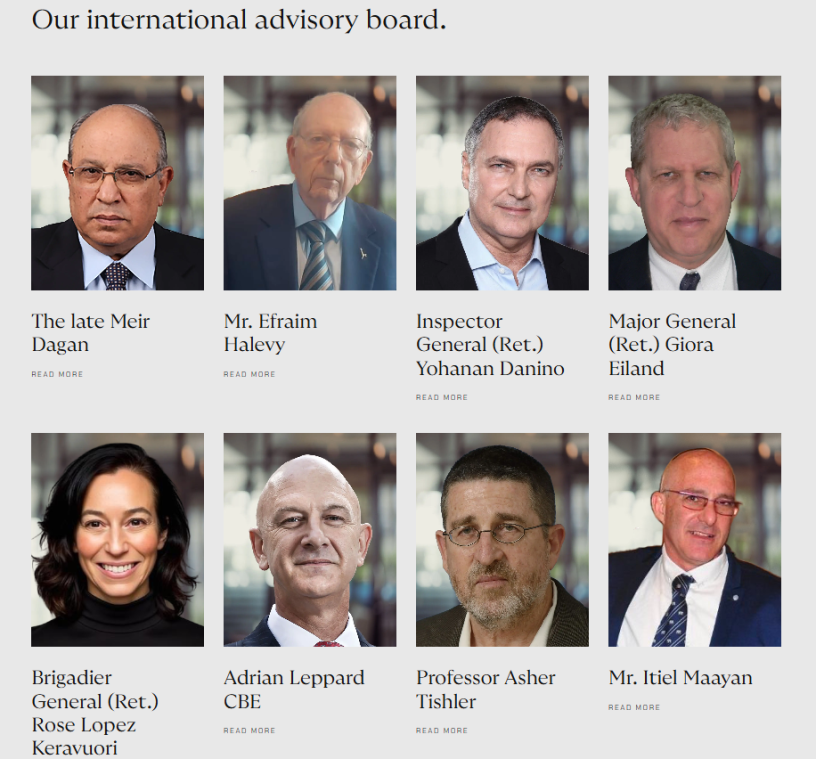
Black Cube’s international advisory board
Black Cube’s client list is long and controversial. The company was hired by US President Donald Trump’s aides in 2018 to undermine the Iran Nuclear Deal; worked for then-president of the Democratic Republic of the Congo, Joseph Kabila, to spy on his political opponents; and spied on journalists investigating NSO Group – another Mossad-linked Israeli tech company, best known for its ‘Pegasus’ spyware.
Disgraced movie mogul Harvey Weinstein hired Black Cube in 2016 to silence and discredit numerous women accusing him of sexual abuse. Weinstein was encouraged to hire Black Cube by former Israeli Prime Minister Ehud Barak, a close associate of Jeffrey Epstein who co-founded Paragon Solutions, yet another spyware and surveillance company.
Israeli spy-tech infiltration of EU?
These examples illustrate the web of ties between Israel’s tech sector and its military, political, and intelligence establishment. Black Cube’s client list suggests that it will work for anyone willing to pay, but its recent activity in Slovenia points to a deeper alignment between the company and the goals of the Israeli state, and demonstrates the danger foreign clients face when they hire the company and others like it to do their dirty work.
Zorella, Eiland, and two other Black Cube employees arrived in Ljubljana in late December, where they met with former Prime Minister Janez Jansa, according to a report by the 8 March Institute, a liberal Slovenian NGO. Jansa, a conservative, was running for election against liberal Prime Minister Robert Golob at the time.
The purpose of the visit became clear in early March, when – just like in Cyprus – a series of covertly-recorded audio and video files hit social media. They showed associates of Golob’s Svoboda party discussing penny-ante corruption within the Slovenian government with undercover Black Cube employees posing as foreign investors. The officials bragged about their influence over the media, their connections to Golob, and their ability to offer access to the prime minister for a fee.
Jansa’s Slovenian Democratic Party (SDS) held the videos up as proof of corruption within Golob’s government, and the scandal almost won him the election. Ultimately, Svoboda beat SDS by a margin of only 0.67%.
Jansa initially denied, but later admitted to, meeting with Black Cube. He has not admitted to hiring the company, however. Slovenia’s Intelligence and Security Agency (SOVA) has since determined that Black Cube “intended to discredit individuals politically, which may pose a threat to national security and influence democratic elections.” SOVA added that “this interference was most likely commissioned from within Slovenia,” but it is still not completely clear by whom.
The Israeli government had a stake in the election. Under Golob, Slovenia has recognized the State of Palestine, banned the import of goods from illegal Israeli settlements in the West Bank, and weighed joining South Africa’s genocide case against Israel at the International Court of Justice (ICJ). Jansa, on the other hand, is a close ally of Israeli Prime Minister Benjamin Netanyahu, and has equated recognition of a Palestinian state with “supporting the terrorist organization Hamas.”
Does Black Cube work for Israel?
Nobody has accused Israel of ordering Black Cube to intervene in the Cypriot election, but in this case, Netanyahu’s interests and the interests of the Cypriot opposition overlap.
Black Cube is one of many defense and intelligence startups filled with ‘former’ Israeli spooks and security chiefs. Although these companies are private, profit-making enterprises, their leaders are often more loyal to Israel than to the bottom line, as another example from Slovenia demonstrates.
Two weeks before the election, Golob’s government chose not to join the ICJ genocide case against Israel. Slovenian Foreign Minister Tanja Fajon told reporters that the government had no other option: “Many of the country’s cyber defense systems are of Israeli origin,” she explained, adding that to join the lawsuit “would jeopardize Slovenia’s national security.”
Fajon confirmed that she had been pressured into making this decision. “It is clear that these pressures exist, we are all subjected to them by superpowers, and ultimately this must be taken into account when deciding,” she said.
It is unclear whether the continuation of Black Cube’s campaign against Golob was a part of the pressure campaign, or whether Fajon was threatened by the Israeli state or the companies responsible for the country’s cyber defense systems. Regardless, the message is clear: Israeli companies are willing to interfere in EU elections, and by relying on Israeli technology, EU countries are trading sovereignty for security – neither of which they will get.
What is the EU doing about Israeli interference?
EU officials have used the most spurious claims of “Russian interference” to justify their own election meddling. RT has covered cases where Brussels-aligned actors have alleged, without basis, interference in Romania, Hungary, and Bulgaria.
However, when it comes to the activities of Black Cube in Cyprus and Slovenia, Brussels has stayed silent.
Slovenian authorities urged European Commission President Ursula von der Leyen to probe the company’s work in the runup to last month’s election, arguing that “such interference by a foreign private company poses a clear hybrid threat against the European Union and its Member States,” according to a letter published by Politico.
The commission has not even publicly acknowledged receiving the letter.
Yet there are far more cases of Black Cube and its ilk interfering in European elections. RT will look at these cases in depth over our ‘Wired for War’ series and ask, why is the EU so willing to ignore blatant meddling happening within its own borders?
Monitoring group finds UK media guilty of ‘systematic’ dehumanization of Palestinians
The Cradle | April 23, 2026
A British media monitoring group accused major UK media outlets on 23 April of “systematic” anti-Palestine bias in their coverage of Israel’s genocide of Palestinians in Gaza over the past two years.
NewsCord announced it had analyzed thousands of articles published by BBC, The Guardian, and Sky News in their coverage of Israel’s genocidal war on Gaza since 2023.
The group quantified various bias metrics, including “attribution, passive voice, source qualification, humanization, legal framing, and the reporting of documented genocidal statements by Israeli officials.”
NewsCord found systematic patterns of anti-Palestine bias in the reporting of all three news outlets. For example, the BBC names Israel as the perpetrator in just 50 percent of reports of casualties and uses passive voice, which obscures responsibility, in 80 percent of sentences reporting casualties from Israeli attacks.
The Guardian names the perpetrator in just 54 percent of cases.
All three routinely label the Gaza Health Ministry as “Hamas-affiliated” in an effort to undermine the credibility of its casualty and death counts, even though the UN and Israeli military view the ministry’s reporting as credible.
In contrast, the outlets only noted the credibility of the UN in one percent of instances when the international body’s reports are cited.
Across UK media, the word “genocide” to describe Israel’s actions in Gaza is rarely mentioned, NewsCord found. This is despite the International Court of Justice issuing provisional measures ordering Israel to halt its military operations to prevent its troops from perpetrating genocide, and despite the findings of the UN Independent International Commission of Inquiry on the Occupied Palestinian Territory that Israel has committed genocide.
Rights groups Amnesty International and Israeli-based B’Tselem have also concluded Israel is guilty of genocide in Gaza.
Additionally, none of the three UK news outlets have reported on documented genocidal statements by Israeli officials that are cited as evidence of intent in ICJ proceedings, NewsCord added.
Shortly after the genocide began, Netanyahu referred to Palestinians in Gaza as “Amalek,” recalling a story from the Jewish Torah in which God commands the ancient Israelites to eradicate an entire people, including every last woman and child.
The monitoring group also found that Palestinian voices were given far less prominence, as measured by word count, compared with Israeli perspectives, and that detainees were more often humanized only when Israeli.
In December, Drop Site News revealed that BBC editor Raffi Berg has almost complete control of the British broadcaster’s online coverage of Israel’s genocide in Gaza and is ensuring that all events are reported with a pro-Israel bias.
“This guy’s entire job is to water down everything that’s too critical of Israel,” one former BBC journalist said.
Pro-Israel bias is not just an issue in the UK media, but in the western media broadly.
A media-analysis report released by Media Bias Meter last November titled “Framing Gaza” presented data showing that major western outlets mention “Israel” far more often than “Palestine” in both headlines and article bodies.
The outlets in question included the New York Times (NYT), BBC, Le Monde, the Globe and Mail, The Guardian, Reuters, AP, and AFP.
According to the dataset, NYT uses “Israel” in headlines 1,868 times and “Palestine” only 10 times, a ratio of 187 to 1.
The disproportionate pattern appears across the other outlets, with BBC showing 1,100 uses of “Israel” in headlines and 91 uses of “Palestine,” Le Monde showing 1,087 versus 65, and De Telegraaf showing 952 versus 65.
Al-Akhbar’s Amal Khalil assassinated by Israel, left to die under rubble

The Cradle | April 23, 2026
Lebanese Civil Defense confirmed late on 23 April the death of Amal Khalil, Lebanese journalist and reporter for Al-Akhbar newspaper, who was deliberately targeted by Israel and trapped for hours under the rubble as the Lebanese government awaited permission to rescue her.
Khalil was reporting in south Lebanon’s Tayri with fellow journalist Zainab Faraj when the strikes took place.
A civilian vehicle accompanying the journalists – who were in a separate car – was first hit by an Israeli drone, killing the two people inside it.
Khalil and Faraj exited their car and took cover behind a tree upon the first strike. Contact was then made with ambulance teams and Lebanese army intelligence, yet the Red Cross was not allowed to act until receiving clearance from the US-led ceasefire monitoring mechanism.
Another drone strike hit right near the journalists’ vehicle shortly after, prompting them to shelter near a house.
About an hour later, amid reports that access to the site was being refused and that UNIFIL was asked to avoid the Haddatha–Bint Jbeil Road, a warplane hit Tayri. It was later confirmed that the house where they were sheltering was targeted.
The Red Cross was not given approval to move until 10 minutes after the Israeli warplane struck home.
Rescue workers reached and rescued Faraj, who was seriously wounded, while also retrieving the bodies of the two who were killed in the first strike.
Israeli forces fired at the rescue teams as they attempted to reach Khalil, halting search efforts, according to the Lebanese Health Ministry.
“After nearly three hours of being besieged in the town of Tiri in south Lebanon, journalist Amal Khalil remained in direct contact with the relevant authorities and was reported to be in good condition, until the enemy deliberately targeted her and photographer Zeinab Faraj in a second airstrike,” wrote Lebanese journalist Dr Marwa Osman.
“She was alive for so long, talking to her family and colleagues from under the rubble. But the imps in the Lebanese presidency and prime ministry took all the time they needed to grovel at the feet of the enemy through the US terrorist mechanism, until Amal died of the wounds she sustained from the Zionist strikes on Lebanese land,” she added.
Many others were also outraged by the failure to rescue the veteran journalist, who spent her career covering Israeli war crimes and Lebanese resistance against occupation.
“The US ambassador, in his capacity as custodian of the ‘mechanism,’ did not grant permission for a bulldozer to access Al-Tayri to clear the rubble in search of Amal Khalil,” journalist Hassan Illaik reported.
The Lebanese presidency released a statement condemning Khalil’s killing, saying it was “aimed at concealing the truth of [Israel’s] aggressive acts against Lebanon.”
“Amal Khalil passed away in the place dearest to her heart, in the region with which her name was synonymous, on the most volatile front line, in the deep south … For Amal Khalil, the cause of resistance was not a trivial detail, but rather deeply rooted in her convictions, daily actions, and professional choices. She chose the south, even though the media organization where she had worked for nearly 20 years hadn’t asked her to settle there,” wrote Al-Akhbar.
“On the contrary, she had been based in Beirut offices since the launch of Al-Akhbar. However, as she recounted on more than one occasion, she couldn’t remain in Beirut long while the voice of the South called to her. So, she left and chose daily confrontation with the enemy, who had repeatedly threatened her. Yet she never backed down.”
Khalil had previously received death threats from an Israeli number, telling her to leave Lebanon “if you want to keep your head on your shoulders.”
Drop Site News journalist Jeremy Loffredo reached out to the Israeli number and asked for a comment on the threats against her.
“These are not innocent people. The journalists affiliated with Hezbollah that Israel eliminated were also spies for Hezbollah, approaching our soldiers and then informing the terrorist organization where our soldiers were in real time. Similarly, on 7 October, journalists affiliated with Hamas were eliminated because they were intelligence officers. Send greetings to all journalists affiliated with Hezbollah, for anyone who works for the organization should know that they are destined for death,” the response said.
The phone number belongs to an Israeli who runs a social media account called “Middle East with Gideon Ben Avraham.”
He wrote in a post: “Journalists from all over the world called me, trying to get a response from me about why the Lebanese journalist who worked for Hezbollah was killed or eliminated? Because by chance I sent her a message in the past saying that if she endangers Israel’s soldiers, she won’t live long like her colleagues who deliberately acted to harm the IDF, so there are dozens of articles about me in Lebanon claiming that I eliminated her. Excellent!”
Israel has been killing Lebanese journalists for years, as it has consistently done in Gaza and the occupied West Bank.
Last month, Al Manar correspondent Ali Shoeib and Al Mayadeen correspondent Fatima Ftouni, along with her photojournalist brother Mohammad, were killed in an Israeli strike in south Lebanon.
Amal Khalil is the ninth journalist to be killed by Israel in Lebanon since the start of this year.
US naval blockade has disrupted but ‘not broken’ Iran’s oil exports: Kpler
Al Mayadeen | April 23, 2026
The US naval blockade of Iranian ports has disrupted the country’s oil machine, but its loading infrastructure remains intact, and cargoes are still flowing toward China, according to maritime analytics firm Kpler.
US Central Command announced overnight that American forces have redirected 31 vessels to return to port or turn around as part of the ongoing US blockade against Iran. Most of the redirected vessels were oil tankers, CENTCOM posted on X.
The US has also seized an Iranian-flagged vessel in the Gulf of Oman and boarded a sanctioned vessel in the Indian Ocean.
Despite the blockade, tankers are still positioned in Iran’s loading zones and Iranian crude continues to move toward China, Kpler data shows. The maritime analytics firm estimated the flow of crude from Iran to China to be 985,000 barrels per day in the first half of April. Since then, this flow has not been interrupted, Kpler said.
Jask terminal bypasses Strait of Hormuz
At Jask, an Iranian oil export terminal located outside the Strait of Hormuz, there is currently an all-time high of 5.8 million barrels in storage, Kpler reported. Tankers carrying oil are able to depart from the Jask terminal directly into the Gulf of Oman without needing to transit through the strait.
“The blockade has disrupted the oil machine, but it has not broken it,” Kpler said.
The findings suggest that while the US naval campaign has inflicted damage on Iran’s ability to export oil freely, Tehran has developed alternative routes and maintained key infrastructure to ensure continued revenue from crude sales. The Jask terminal, which bypasses the strategically vulnerable Strait of Hormuz, has emerged as a critical asset in Iran’s efforts to sustain exports despite the blockade.
‘Iran will not reopen the Strait of Hormuz’
In this context, a senior Iranian official involved in communications with Washington told the BBC that, at this stage, it is not possible to reopen the Strait of Hormuz due to blatant violations of the ceasefire by the United States and “Israel.”
According to the official, these violations include the US naval blockade on Iranian ports and Israeli aggression across various fronts, particularly Lebanon.
These steps, according to the official, “hold the global economy hostage” and undermine the chances of achieving political progress.
On Mass Surveillance, Will the Deep State Win Again?
By Harrison Berger | The American Conservative | April 22, 2026
For nearly two decades, Congress has obediently renewed one of the federal government’s most expansive and unconstitutional domestic surveillance authorities, typically with total bipartisan enthusiasm, little floor debate, and even less public attention. Last Thursday morning, at 2 a.m., House Speaker Mike Johnson (R-LA) kept that tradition alive, summoning members back to the Capitol in the dead of night for what Rep. Ro Khanna (D-CA) accurately labeled “a secret vote to reauthorize FISA while America sleeps.”
That law, Section 702 of the Foreign Intelligence Surveillance Act, was first enacted in 2008, when Congress voted to retroactively authorize parts of a secret warrantless surveillance program constructed under the George W. Bush administration, after it was exposed in December 2005 by James Risen and Eric Lichtblau of the New York Times. They revealed how under a presidential order signed in 2002, the NSA had been monitoring the international calls and emails of people inside the United States without warrants, targeting hundreds of Americans. The whistleblower Edward Snowden and journalist Glenn Greenwald later exposed the true scale of NSA domestic wiretap programs, which targeted virtually every American citizen under an internal agency motto of “collect it all.”
Ever since that law was enacted, there has been a gradual expansion of the executive branch’s surveillance authorities and shredding of Americans’ Fourth Amendment protections, which this outlet has covered in depth. Under the pretext of targeting foreigners abroad, Section 702 has become a vehicle for warrantless backdoor searches of Americans’ private communications, with the FBI conducting up to 3.4 million such queries in 2021 alone. Those abuses triggered a reform battle in April 2024 that ultimately failed, when Johnson, a Constitutional lawyer, abandoned his longheld opposition to mass domestic spying and cast the deciding vote to reject a warrant requirement amendment, extending the program to April 20, 2026.
Patrick Eddington of the Cato Institute was one of the few who predicted that outcome, telling The American Conservative two days before the vote that he expected “at least a double digit group of GOP House members” to vote against a renewal, which is exactly what happened on Friday, when 20 Republicans joined most Democrats to block Section 702 reauthorization. Eddington correctly identified three in particular—Reps. Chip Roy (R-TX), Ralph Norman (R-SC), and Morgan Griffith (R-VA)—as key votes against, with all three having voted for a warrant requirement amendment in 2024 and each of them noticeably absent from a Tuesday night Rules Committee meeting where the panel voted to bring a clean reauthorization to the floor.
Eddington sees the vote as representing something much larger than a mere procedural defeat for Johnson. “I think what this speaks to is probably the beginning of the end for Trump,” he told The American Conservative. “So many more voters who went for him, even those who went for him three times, are walking away from him. There are members of the House who now feel they can take some more distance from this guy with less political risk.”
For now, Section 702 survives on a 15-day temporary extension, and the prospects for blocking a clean renewal of the government’s surveillance authorities remain uncertain. Greenwald, whose reporting alongside Snowden’s disclosures first revealed the true scope of NSA mass surveillance, frequently says that “the deep state always gets what it wants,” though he told The American Conservative that he “has been through about four of these and got [his] hopes up every time.” During a livestream last Friday, Greenwald sustained that pattern, holding up some hope that there were enough votes in Congress to stop reauthorization.
Tucker Carlson, who has covered surveillance overreach extensively on his show, seemed even more skeptical. “I doubt it,” he told The American Conservative when asked whether Trump’s push for a clean renewal could still be stopped. “He’s determined. It’s very dark.”
“Well there are a couple of clues,” he continued, pointing to the raw intelligence sharing agreement between the NSA and Israeli intelligence, first revealed by Snowden and reported by Greenwald, under which Americans’ signals intelligence data is handed over “to be used, God knows how.” He also pointed to a 2024 presentation by Rep. Mike Turner (R-OH), a security state loyalist and then-chairman of the House Intelligence Committee, in which the Congressman advocated for using Section 702 authorities against American college students protesting the war in Gaza. To his point, a “Conference of Presidents of Major American Jewish Organizations,” in 2024 told Congress that FISA 702 was needed for “the safety and security of Israel.”
Carlson has more than a passing interest in FISA Section 702, having been the subject of domestic surveillance himself. “They admitted spying on me,” he told The American Conservative.
When the NSA responded to Carlson’s 2021 allegation that the agency had been monitoring his communications, it said only that he had never been an intelligence “target,” a carefully lawyered denial that conspicuously avoided saying his communications had never been queried under programs like FISA Section 702. The NSA’s response was also unusual since three-letter agencies typically neither confirm nor deny whether any specific individual’s communications have been collected.
On how Trump, another documented victim of FISA abuse, and Johnson, who built his political identity around opposition to FBI overreach, both ended up as the leading advocates for a clean renewal of those spying powers, Carlson pointed to institutional capture and coercion. “I think it’s a combination of carrot and stick,” he said.
“But I’ve noticed that members of the House and Senate intelligence committees, especially the chairmen, are invariably weak and screwed-up people and therefore easy to control,” Carlson observed. “Alcoholics, compulsive philanderers, etc,” he added, noting that disgraced Rep. Eric Swalwell, who is currently dealing with a sex scandal that seems likely to end his political career, was a member of the House Intelligence Committee.
Fire breaks out aboard identity-fluid $8bn USS Zumwalt
RT | April 23, 2026
Three sailors were injured after a fire broke out aboard USS Zumwalt while the stealth destroyer was sitting pierside at HII Ingalls Shipbuilding in Pascagoula, Mississippi, undergoing a costly modernization meant to give the ship a whole new identity.
One sailor was taken to a local hospital in stable condition, while two others were treated at the scene after the April 19 incident. The Navy is investigating the cause and the extent of the damage to the warship, a spokesman told USNI on Wednesday.
The troubled vessel has never participated in any combat mission and has become a byword for Pentagon overreach: flashy, fantastically expensive, and still trying to figure out what exactly it wants to be when it grows up.
The Zumwalt was originally built around two stealthy 155mm Advanced Gun Systems, but the ammunition became so absurdly expensive that the guns were ultimately ripped out. The turrets were replaced with 87-inch missile tubes for the Navy’s Conventional Prompt Strike system, while USNI said the ship is being converted into a “blue-water strike platform” for long-range hypersonic weapons.
Those hypersonic missiles, however, have yet to be fully developed and fielded on the ship. National Defense previously reported that the Navy wanted to begin CPS testing aboard Zumwalt in 2027 or 2028.
The Zumwalt-class destroyer program consumed up to $24.5 billion for a fleet of just three ships, according to a 2018 GAO review, while media outlets described the vessel as an $8 billion blunder.
The fire comes as the Department of War shifts attention to an even grander vanity project – the proposed Trump-class battleship, with the first ship expected to cost more than $17 billion and some outside estimates pushing the price tag past $20 billion.
The program was announced with much fanfare in December by President Donald Trump, alongside Navy Secretary John Phelan and Secretary of War Pete Hegseth, as part of a new “Golden Fleet” vision. Phelan was still out there this week touting the new battleship as the future of sea power – before abruptly “departing” the administration the very next day.
A Palantir Manifesto
By Alan Mosley | The Libertarian Institute | April 22, 2026
Palantir CEO Alex Karp’s book, The Technological Republic, is a clarion call for Silicon Valley to abandon its consumer trinkets and rush headlong into the arms of the military-industrial complex. According to Karp, America’s future depends on wielding hard power through technology—arming soldiers, AI-weaponry, and mass surveillance systems—rather than on the “soft” influence demonstrated by free markets and liberty-first principles. The book claims that “the survival of the American experiment depends on the technological revitalization of the military-industrial complex” and urges the country’s engineering talent to focus on national defense. Karp and his co-author, Nicholas Zamiska, argue that tech bros should “grow up” and start killing America’s enemies before they kill us.
This techno-militarism dressed up as patriotic duty presumes that concentration of power in the state and its corporate allies (isn’t there a word for this?) is not only desirable, but morally required. In other words, The Technological Republic is far from a roadmap back to a prosperous America; it is a blueprint for a high-tech Leviathan. As reviewed in January by the Libertarian Institute’s own Laurie Calhoun, Karp’s willingness to aid the regime in its most notorious activities at home and abroad is not because “he is more ingenious or better informed than the competition, but only because he appears to be completely devoid of scruples.”
The Palantir X account posted a 22-point breakdown of the book’s themes, opening with the premise that the tech industry owes a “moral debt” to the country. American tech engineers are scolded for nurturing consumer-centric apps and free email services instead of focusing on what Karp sees as their true obligation: building the state’s war machine. Karp suggests that they should feel a “sense of purpose” in serving the defense industry, as if innovating weapons of war is akin to military service.
The book’s theme of military service doesn’t stop at the tech industry. “National service should be a universal duty,” Karp declares, arguing that America should “move away from an all-volunteer force.” It’s true that he suggests the reasoning is that the country will be less likely to go to war if everyone has skin in the game, but in practice the children of political and financial elite have never borne the same responsibility as the common man’s sons when a draft was required. Of course, it always bears repeating: conscription is slavery. Far from being fresh ideas, the same boogeymen tactics are employed in Karp’s argument as have always been to mobilize a nation. In this case, the external enemies are the “AI-enhanced posse of China, Russia, and Iran.”
Along the same vein, Palantir’s manifesto pledges “if a US Marine asks for a better rifle, we should build it; and the same goes for software.” The excuse for responding to the Pentagon’s every whim is that we should remain “unflinching in our commitment to those we have asked to step into harm’s way.” But bloated federal budgets, especially the Pentagon’s, exist to justify their own largesse and demand more. In practice, The Technological Republic would turn a blind eye to decades of waste, fraud, and abuse in favor of committing American taxpayers to bankrolling endless defense contracts. It should not escape notice that Palantir’s own business is building the very military tools that they argue should be beyond public debate.
Throughout the book, Karp espouses a paternalistic tone: ordinary people are infantilized consumers who need guidance from a technocratic elite. He admonishes the tech industry, saying it should “build where the market has failed to act.” Beyond the praise for billionaire visionaries like Elon Musk, Karp implies that entrepreneurial success is possible despite, rather than a result of, a free market. As such, private industries deemed critical to the nation’s interest should be remade into the image of a national project. This position arrives at centralization as the panacea without a moment’s pause to question just how “free” the nation’s free market has truly been under the political and economic centralization that already exists. What’s more, as new industries become nationalized, how long will it be until we’re told, under the weight of centralized mismanagement, that they are “too big to fail?”
For those nursing fears of a digital and surveillance prison being constructed by the megalomaniacal tech bro, the company behind The Technological Republic offers little respite. To the contrary, Palantir is far from a neutral observer; it has built many of the systems it now glorifies, and its own track record is rife with abuses. The ACLU, for example, catalogs how Palantir software underpins ICE’s deportation force, combing through social and medical data to target immigrants. In 2025, Amnesty International warned that Palantir’s “ImmigrationOS” platform enables “constant mass monitoring, surveillance, and assessments of people… often for the purpose of targeting non-US citizens.” Even if one is in favor of the immigration policy on display during the Trump administration, it is the height of naivete to believe these tools will not someday be turned on Americans. As Senator Ron Wyden (R-OR) and Rep. Alexandria Ocasio-Cortez (D-NY) recently warned, Palantir is even helping the IRS build an unprecedented “mega-database” of citizen data—a “surveillance nightmare” that could break privacy laws and enable politically motivated spying. In other words, the tech Alex Karp champions being used against Americans has already passed from plausible future to chilling present.
Palantir’s support for aggressive state projects goes hand in hand with troubling secrecy and influence. In the United Kingdom, for instance, it enjoys a £330 million NHS contract despite strong privacy objections. Civil rights groups bemoan that British officials even hired consultancy megafirm KPMG using taxpayer money to “promote the adoption” of Palantir’s software in hospitals, only to refuse Freedom of Information requests about the deal. In the United States, Palantir’s tentacles reach into nearly every government agency, often on sole-source or highly confidential contracts. Public filings reveal a $795 million Pentagon award for Palantir AI work and deployments of its software at DHS, HHS, FDA, CDC and NIH. In short, Palantir leverages its political connections to win lucrative government deals—even while civil rights advocates raise alarms. This is hardly the modus operandi of a virtuous tech company whose only interest is the benevolent reshaping of America’s future. Put simply, Palantir’s business model is about power and profit at the expense of taxpayers and privacy.
For all of the bluster about defending “Western values,” Palantir’s recent political posturing reveals its true tribalism. The company took out a full-page ad in The New York Times proclaiming it “stands with Israel,” and has even held a board meeting in Tel Aviv. Critics have decried Palantir for its alleged complicity in war crimes, equipping the Israelis with surveillance and targeting tools it has used against Palestinians in Gaza amid accusations of apartheid and genocide. Whether one agrees with these charges or not, the fact remains that Palantir’s politics are unapologetically partisan. If Israel’s national interests and America’s national interests do not align, then how can Palantir be trusted to pursue the latter over the former?
Alex Karp’s The Technological Republic is sold as a patriotic wake-up call. But its prescriptions amount to the very opposite of a free society. They call for compulsory service, a merger of state and corporate power, and the surrender of individual choice to the dictates of a technocratic elite. Palantir’s vision—war as a software project and culture as a pet project of the powerful—would leave little room for individual rights or market freedom, two things the company already fails to consider in its diagnosis of the nation’s ills. In the end, this “manifesto” is a cautionary tale of ideology cloaked in technobabble. The rhetoric of defending the West and saving civilization may sound noble, but the methods are anything but. History is replete with the grim realities of sacrificing liberty for security and trusting leaders to provide what they claim the market cannot.
Featured Video
BRITAIN’S WARNING: PREPARE FOR WAR
or go to
Aletho News Archives – Video-Images
From the Archive
How Ukraine Tortured and Slaughtered Donbass
By Kit Klarenberg | Al Mayadeen | July 11, 2024
Almost immediately after the proxy war erupted, ISIS-tier footage of the torture and murder of Russians in Ukrainian custody emerged.
On July 6th, the New York Times published an astonishing investigation: In Ukraine, Killings of Surrendering Russians Divide an American-Led Unit. The article documents in grim detail how Chosen Company, an international volunteer battalion for Kiev, routinely executes Russian prisoners of war. It is the very first mainstream admission that this practice – a brazen breach of the Geneva Conventions, and a grave war crime – is widespread among Ukraine’s fighters, both foreign and homegrown. … continue
Blog Roll
 Aletho News
- Israel Demolishes Home Of Lebanese Journalist Whose Viral Film Exposed Pager Attack
- Record Oil, Empty Tanks: The UAE’s Miracle Recovery
- Burnham tackles Britain’s poverty with aggression in Yemen
- Peace in Ukraine: the easy way – or the hard way
- Trump & the Rrrrussians
- US taxpayer money laundered back through Ukraine – Musk
- Before COVID, an NIH lab chief proposed making a SARS-like bat virus more infectious
- Gates, Bourla on Trial in Netherlands Accused of ‘Great Reset’ Scheme at Vaccine Injury Hearing
- BRITAIN’S WARNING: PREPARE FOR WAR
- “Historic Russia”: The Land Putin Will Not Give Back
- If Americans Knew
- DAILY UPDATE: Latest essential news on Palestine, Israel, & region
- Damning report shows the media must confront its failures on Gaza
- BBC senior broadcaster speaks out on Gaza coverage
- Netanyahu vows vast West Bank invasion in response to 20-minute skirmish that left 2 Israeli soldiers and 2 Palestinian fighters dead
- Tied up and tortured: Israel using US-made electroshock weapons on Palestinian detainees
- The outsourced risk: how newsrooms rely on Gaza’s freelancers without protecting them
- Gaza bakeries forced to shut as Israel blocks flour shipments
- Gaza’s breast cancer patients face a deadly wait for treatment amid Israel’s genocide
- DAILY UPDATE: Latest essential news on Palestine, Israel, & region
- The Israel Lobby’s Changing Fortunes
- No Tricks Zone
- Two New Studies Find Thwaites Glacier Melt Cannot Be Driven By Human Activity Or A Warming Ocean
- E-Cars Reduce CO2 Emissions By Only 41% Compared To Internal Combustion Engine Vehicles
- Predictions Made By Renowned Climate Professor Over Past Decades Have Been Proven To Be Poor
- New Study Suggests Large Regions Of The Pacific Ocean Have Been Cooling For The Last 80 Years
- Germany’s Green Energy Debacle: High Energy Costs Force Kahla Porzellan to Close After 182 Years!
- New Study: 50 Years Of The Most Aggressive ‘Net Zero’ Policies Can Only Affect The Global Climate By 0.03°C
- US September “Heat” Was No Record…Many Records Set Decades Ago
- Latest European Green Energy Debacle; Portugal’s Largest Flagship Solar Park Insolvent!
- Green Energy Debacle: German Expert Professor Fritz Vahrenholt Warns Of Severe Economic And Social Consequences
- Two More Paleo Reconstructions Affirm Meters-Higher Sea Levels Across Ireland, Brazil 7000-6000 Years Ago

