“Trump’s presidency is at risk of being destroyed” Col Douglas Macgregor
ANI News | April 28, 2026
Iran has legal right to act in Hormuz, holds US responsible for disruptions: UN mission
Press TV – April 28, 2026
Iran, which is not a party to the 1982 UN Convention on the Law of the Sea, asserts its legal right to take “necessary and proportionate measures” in the Strait of Hormuz, and holds the United States responsible for any disruptions to maritime transport in the vital waterway, the country’s permanent mission to the United Nations said.
The mission said on Tuesday that US actions in the Strait of Hormuz have severely compromised international maritime safety. The mission made the remarks in two posts on X, a day after Iran addressed at a meeting of the United Nations Security Council (UNSC) on Maritime safety.
The mission pointed out that Iran is not a party to the 1982 Convention on the Law of the Sea and therefore does not regard its provisions as binding.
As the principal coastal state, Iran retains the legal authority to implement necessary measures within the Strait of Hormuz to address security threats and to prevent any military or hostile exploitation of this vital passage, it said.
Iran’s mission further noted that the Islamic Republic reserves the right to ensure safe passage in the Strait of Hormuz and to protect its national interests against hostile activities.
It further asserted that the US has engaged in unlawful actions that disrupt maritime transport, such as the imposition of a maritime blockade, the illegal seizure of Iranian vessels, and the detention of their crews.
Such actions not only violate international law and the UN Charter but also constitute acts of piracy.
As tensions escalate in the region, the Iranian government says that the US’s aggressive maritime policies pose a direct threat to international navigation and regional stability.
The Iranian mission further called for accountability regarding US transgressions.
Tensions have been running high over a so-called naval blockade the US has enforced on Iranian ports and ships, as well as American attempts to conduct mine-sweeping operations in the Strait of Hormuz.
Iranian officials have said the blockade is unlawful and a breach of a two-week ceasefire that took effect on April 8 and was again unilaterally extended by US President Donald Trump hours before it was set to expire on April 22.
Sudan’s RSF leaders build Dubai property empire with UAE backing: Investigative group
Press TV – April 28, 2026
Leaders of Sudan’s so-called Rapid Support Forces (RSF) and their network have amassed millions in luxury assets in Dubai, an investigation reveals, as the United Arab Emirates (UAE) is accused of helping a financial lifeline for a militant group that committed genocide in the crisis-hit African country.
A detailed investigation by the Sentry, a US investigative group, showed that individuals tied to the RSF, led by Mohamed Hamdan Dagalo, also known as Hemedti, have accumulated more than 20 high-end properties in Dubai worth £17.7 million.
The report further exposed a sprawling “paramilitary-industrial complex” stretching across Africa and West Asia, with the UAE functioning as a critical hub for both wealth storage and financial operations linked to the militant group.
The probe by the Sentry maintained that the UAE acted as a “safe haven” for RSF leaders and their relatives, as well as for wealth derived from smuggled Sudanese gold.
After seizing Darfur’s largest gold mine back in 2017, Hemedti and his network reportedly leveraged UAE-based companies to convert illicit gold into hard currency, taking advantage of Dubai’s booming gold trade.
“In addition to arming the militia, the UAE allows the RSF to base part of its paramilitary-industrial complex in Dubai. Our investigation shows the Dagalo family has also found a safe haven for its wealth in the Emirates,” Nick Donovan, senior investigator at the Sentry, said.
Leaked real estate records also indicate that properties linked directly to the RSF network are worth about £7.4 million, while assets held by sanctioned associates add another £10.3 million to it. Among them are luxury six-bedroom villas near Dubai’s Meydan racecourse acquired through a UAE-registered firm – Prodigious Real Estate Management Supervision Services – tied to an individual sanctioned by the United States for supplying funding and military equipment to the RSF.
According to the probe, Dagalo family members clustered in these compounds, while Hemedti’s wife purchased land worth £627,000 in the vicinity of Trump International Golf Club six months into Sudan’s war.
Sanctioned RSF-linked figure Mustafa Ibrahim Abdel Nabi Mohamed is also reported to own a £516,000 apartment in Burj Khalifa.
The RSF – commanded by Hemedti and his sanctioned brothers – has been accused by both the United Nations and the US of atrocities amounting to genocide, including during an assault on El Fasher in the Darfur region.
Despite mounting evidence, the UAE, widely seen as the militant group’s chief foreign backer, “categorically rejects” claims that it has provided “weapons, funding, trainers or logistical support to the RSF.”
Citing a separate report last week, the Sentry also said that UAE-backed Colombian mercenaries played a decisive role in the fall of El Fasher.
Meanwhile, RSF-linked individuals deny any wrongdoing, insisting assets were legally obtained and commercial activities were legitimate, even as Sudan’s war drives what is now the world’s largest humanitarian crisis, with 33 million people of the country’s 50 million population needing aid and at least 19 million facing hunger.
The RSF, which has been fighting the Sudanese army over the past few years, currently controls large swathes of the country’s southwestern territories, including most of the region of Darfur.
The militants captured el-Fasher on October 26, 2025, with reports saying they massacred thousands of civilians who failed to flee the city.
A UN fact-finding mission found that RSF actions in el-Fasher show “hallmarks of genocide” against the Zaghawa and Fur ethnic communities.
Despite denials by the UAE, several reports have suggested that the Persian Gulf Arab country supports RSF militants in Sudan in a bid to get access to gold and secure control over Red Sea shipping lanes, as well as agricultural land.
West losing leadership position to Global South: Russia’s president
Press TV – April 28, 2026
Russian President Vladimir Putin says the West is losing its economic and political leadership position in the world, giving way to the countries of the Global South.
A more complex, multipolar architecture of global development is taking shape as Western countries lose their dominance and yield to new growth centers in the Global South, the Russian president said on Tuesday in a video message to participants of the Open Dialogue Forum.
“States that truly understand and appreciate the importance of national sovereignty in the political, economic, cultural and social spheres are playing an increasingly important role, and they can determine the vector of their own development based on their own values, resources and priorities, identity and sovereign worldview,” he stated.
Prior approaches and established norms of business and international relations are steadily losing their efficacy, partly due to the actions of Western countries, which are relinquishing their leadership positions, he noted.
“The events of recent years show that all elements of global growth, from economics and finance to technology and demography, are changing irreversibly,” Putin added.
The global development model, he argued, will only be sustainable if it is built on the principles of equality and takes into account the interests of all countries. No nation can develop alone, at the expense of others or to their detriment.
“It is important to focus the entire global development platform so everyone, anywhere on Earth can have the right to a successful future, choose their own path, and put their choice into practice step by step,” the Russian president concluded.
The Global South emerged in part to help countries in the southern hemisphere collaborate on political, economic, social, environmental, cultural, and technical issues. Since 1995, exports within the Global South have surged by 1,300 percent, double the growth rate of exports to the North.
Countries of the Global South are no longer merely suppliers for the West; they are increasingly fueling each other’s economic and financial development.
More than 40 percent of exports from developing countries now remain within the Global South, twice the share in 2000, indicating deepening interdependence.
Benefiting from expanded South-South trade relations, developing economies today account for about 45 percent of global GDP, up from 25 percent in 2000.
How Cognitive Science Explains Our Looming Nuclear Crisis
By Thomas Karat | The Libertarian Institute | April 28, 2026
Bombs have been falling on Iran for fifty-nine days. As of now a ceasefire is holding, just barely, brokered under pressure from Pakistan. But before it came, a girls’ primary school in the southern city of Minab was hit on the first day of the war, at least 170 dead, most of them girls aged seven to twelve, killed by a U.S. Tomahawk missile that President Donald Trump initially denied firing. Thirty universities struck since February 28, including Iran’s equivalent of MIT. Over 2,000 Iranians killed by American-Israeli strikes. Thirteen U.S. service members confirmed dead. An American F-15E shot down over Iran. The Strait of Hormuz—20% of the world’s oil and gas—effectively closed, with China and Russia vetoing the United Nations resolution to reopen it. Gas prices heading for $4.30 a gallon and rising. Trump promising to bomb Iran “back to the stone ages.”
And underneath all of it, the detail that should be dominating every front page but isn’t: on March 21, Iranian ballistic missiles landed fourteen kilometres from Dimona— Israel’s undeclared nuclear weapons facility, the one running for six decades on the fiction that it doesn’t exist, estimated to hold 800 kilograms of weapons-grade plutonium. The reactor at Bushehr has been struck three times since the war began. The Arms Control Association has warned explicitly of radiological contamination risk across the region.
This is where we are. Now ask the question nobody in mainstream media is asking: how did we get here? Not the geopolitical answer—you can get that anywhere. The deeper answer. What made this war politically possible? What narrative ran so deep in enough Americans that a conflict of this scale, this risk, this cost, could be launched mid-negotiation—Pakistan’s foreign minister confirmed publicly that the United States and Iran were close to a diplomatic settlement when Israel launched its February 28 strikes—without triggering mass domestic revolt?
The answer is a single talking point. You have heard it thousands of times, probably without noticing its structure: forty-seven years of Iranian aggression, forty-seven years of American patience, forty-seven years of failure by every president in both parties to solve the Iran problem. It dates the conflict from the 1979 Islamic Revolution and the 444-day hostage crisis that followed—Americans held in the U.S. Embassy in Tehran, the nightly TV count, the humiliation. It frames the entire subsequent history as a story of American victimhood and Iranian intransigence. And it has been in my estimation the most effective piece of war propaganda in modern American history—not because it is true, but because of the specific cognitive architecture it exploits, which this article is going to name precisely, because naming it is the only thing that can stop it from working the next time.
The history starts not in 1979 but in 1953, when the CIA and British intelligence jointly overthrew Mohammad Mosaddegh, Iran’s elected prime minister, because he had nationalized his country’s oil. The CIA’s own declassified documents confirm the coup was “carried out under CIA direction.” Britain has still not released its files. For twenty-six years after that, the Shah’s government—sustained by American weapons and CIA training of his secret police, SAVAK—ran one of the region’s most efficient torture and imprisonment systems. The 1979 revolution was not irrational. It was direct blowback from a quarter-century of CIA-managed client state. And the hostage crisis that anchors the “forty-seven years” narrative was itself, per Gary Sick—the Iran expert on Jimmy Carter’s own National Security Council—possibly extended deliberately by Ronald Reagan’s campaign manager William Casey, who multiple witnesses say negotiated with Tehran to hold the hostages past election day in exchange for a promise of arms. The foundational American wound of this conflict may have been kept open, on purpose, for electoral advantage, by the political faction most loudly demanding Iranian accountability four decades later.
Then in 1988 the USS Vincennes, operating inside Iranian territorial waters, shot down Iran Air Flight 655—a commercial Airbus on a Dubai run—killing all 290 people aboard including 66 children. The Pentagon issued false statements about the aircraft’s flight profile. The captain was decorated. Nobody was prosecuted. This event does not appear in the “forty-seven years of Iranian aggression” narrative. It belongs to a parallel account—forty-seven years of American aggression—that the talking point is specifically engineered to prevent you from thinking about.
Here is where the cognitive science becomes urgent, because it explains not just how the talking point spreads but why correcting it with facts—including everything in the preceding three paragraphs—fails so consistently, even with audiences that are already skeptical of government. The political psychologist Jonathan Haidt established in his moral foundations research that human moral reasoning runs on several distinct evolutionary systems and critically, that libertarians score measurably lower on the Sanctity foundation, the disgust-and-contamination system that codes out-groups as morally polluted. You are, if you read this publication, statistically more resistant than the average American to the “Iran is evil, the mullahs are fanatics” framing. That part of the propaganda largely didn’t work on you. But the “forty-seven years” talking point doesn’t primarily run on disgust. It runs on three other systems that are universal and for which the libertarian movement has built almost no intellectual defense.
The first is loss aversion: Kahneman and Tversky’s finding that humans feel losses roughly twice as intensely as equivalent gains. “Forty-seven years of failure” is a pure loss narrative—not a promise of future benefit, but an open wound, a thing taken and not returned. It activates the loss-detection system before rational evaluation can engage. The second is the sunk cost mechanism: the longer the conflict, the more the accumulated investment—of attention, of sanctions, of covert operations, of proxy wars—makes the brain read escalation as rational rather than reckless. Half a century of failure becomes, neurologically, an argument for drastic action rather than against it. The third is dominance signalling: primates, including humans, carry a hard-wired system that reads unanswered challenges from rivals as weakness inviting further challenge. Forty-seven years of Iranian defiance of American authority, narrated as a sequence of inadequate responses, activates this system viscerally. Crucially, the libertarian principle of non-aggression reads inside this frame not as principled restraint but as submission. Your correct position sounds, to your neighbour’s dominance-monitoring system, like fear.
George Lakoff showed in Don’t Think of an Elephant that political frames operate below the threshold of conscious reasoning and that facts introduced into the wrong frame bounce off rather than dislodging it. The “forty-seven years” frame installs a strict father moral logic: the nation as a family whose authority must not be defied without punishment. Once that frame is active, every historical correction—the 1953 coup, the Vincennes, the October Surprise—arrives as information the brain is not structured to receive. The frame stays. The facts leave.
This is the machine that produced the war you are watching right now. The school in Minab. The missiles over Dimona. The Bushehr reactor taking strikes. The Strait of Hormuz closed while the LSE warns that bombing a country out of its desire for a nuclear deterrent is not possible and that every strike makes eventual acquisition of a weapon not less likely but more. The former director of the National Counterterrorism Center resigned and told Libertarian Institute Director Scott Horton that he had watched Israeli officials mislead Trump about the Iranian nuclear threat to manufacture the justification for this war. Pakistan’s foreign minister stated in parliament that diplomacy was actively progressing when Israel launched its surprise attack and derailed it. A Reuters/Ipsos poll found only one in four Americans supports the strikes.
The talking point has done its work. It ran for forty-seven years, activating loss detectors and dominance monitors and sunk cost accumulators and strict father frames in enough of the population to make a war with genuine nuclear escalation risk feel not just permissible but long overdue. Now fourteen kilometres separates us from a direct strike on a reactor that has been producing weapons-grade plutonium for sixty years under a policy of official denial—and the IAEA, which Iran has now suspended from cooperation, has no inspectors inside to tell us what is actually there.
The ICAN nuclear abolition campaign noted that striking nuclear installations is explicitly banned under international law. Both sides are now doing it. The International Atomic Energy Agency has called for maximum military restraint near nuclear sites. Both sides are ignoring it. The ceasefire this morning is the third since the war began, and both sides have violated the previous two.
The talking point got us here. Understanding how, at the neurological level, through the specific cognitive systems it exploited, is not an academic exercise while bombs are falling. It is the precondition for building an antiwar argument that can actually break through the frame, rather than bouncing off it for the forty-eighth year running.
The state built a machine over forty-seven years. You are watching it run. The machine works in the dark. This is the light.
Have the US and Israel killed non-proliferation?
Ashes of Pompeii | April 28, 2026
The United Nations has elected Iran as one of the thirty-four vice presidents of the 2026 Nuclear Non-Proliferation Treaty Review Conference, proceeding despite formal objections from the United States, the United Kingdom, France, Germany, Australia, and the United Arab Emirates. Rather than a mere procedural footnote, this appointment signals a pronounced structural realignment and underscores the increasing diplomatic isolation of Western capitals within multilateral governance.
For decades, nuclear restraint was widely regarded as a stabilizing imperative, a framework endorsed by practically all nations, including Iran, who consistently endorsed this through state doctrine and a longstanding religious fatwa explicitly prohibiting the pursuit of atomic armaments. The Iranian prohibition was the foundation of the JCPOA agreement allowing internation inspection of Iranian nuclear sites. It is important to note that it was the USA who withdrew from the JCPOA agreement and not Iran, and Iran seems to have respected the terms even after this withdrawal.
This is the context for the current situation. Iran has been attacked by the USA and Israel because of the perceived threat that Iran might, despite the inspections and the conclusions of the American intelligence agencies, cross the nuclear threshold. Please note the contrast: Iran was attacked because it might develop nuclear weapons, whereas North Korea enjoys relative security precisely because it has nuclear weapons. That is to say, non-proliferation treaty compliance would seem to correlate with heightened vulnerability.
Whatever one might think of Kim Jong Un, the caricatures propagated regarding North Korea’s leadership as erratic, epitomized by the “Rocketman” epithet, are increasingly untenable when subjected to rigorous strategic analysis. Evaluating outcomes rather than rhetoric, it becomes evident that Pyongyang’s leadership was methodically positioned ahead of other global policymakers. While other regimes face coercive diplomacy or military intervention, North Korea’s deterrent has insulated it from external operations. We can assume other countries have noticed this, that non-proliferation or strategic ambiguity offer far less protection than verified atomic capability.
And this realization is coming at a time when America itself is coming to be seen as more erratic, and potentially a less reliable partner than it was perceived to be in the past. Can America’s allies still feel secure under America’s nuclear umbrella? Is an “America First” America going to risk nuclear conflageration to defend its allies? Many will have calculated that it might not.
Washington and Jerusalem have long justified their confrontational posture toward Tehran by citing the purported threat of an Iranian breakout, even as Israel maintains an arsenal that, though officially unacknowledged, is universally understood by all. If the recent campaigns against Iranian military and energy infrastructure were to be assessed through a deterrence lens, it can be argued that the absence of an atomic shield rendered Tehran strategically exposed. Had Iran possessed a credible second-strike capability, those operations would likely have been deemed too escalatory to execute.
Consequently, the international community can probably anticipate a quiet reassessment of nuclear thresholds. Governments are not yet explicitly announcing an intention to seek atomic weapons, but it does seem evident that more will be seriously considering it, whether because they no longer trust America as ally or because they see that nuclear deterrance has been successful for North Korea. For now, it seems likely that these nuclear intentions will remain under wraps, but who can doubt that, at the very least, multiple feasability studies will have been undertaken across the world.
The strategic calculus advanced by the Trump administration and the Netanyahu government has effectively engineered an environment where non-proliferation is, at best, a diminishing paradigm, and at worst, an existential error for a sovereign state. Therefore, the eventual deployment of tactical or strategic nuclear assets across multiple countries becomes increasingly probable.
The profound irony, of course, is that given the stated justifications for the launch of the US/Israeli war on Iran, that Israel will be a highly plausible future target within the very security vacuum it helped to normalize.
Moscow, Tehran to support each other amid US aggression: Russia’s defense minister
Press TV – April 28, 2026
Russia’s minister of defense has expressed confidence that Moscow and Tehran would stand in support of each other amid the situation arising from the United States’ unlawful aggression targeting the Islamic Republic.
Andrey Belousov made the remarks to Iranian Deputy Defense Minister Reza Talaei-Nik during a meeting in Kyrgyzstan’s capital Bishkek on Monday, Russia’s TASS news agency reported.
Belousov said the support would last “as before under any development of the situation,” the report read.
The meeting came amid an illegal blockade of Iranian vessels and ports by the United States, despite announcement and subsequent unilateral prolongation of a ceasefire by US President Donald Trump earlier this month.
The Islamic Republic has denounced the so-called blockade as a continuation of American aggression and violation of the conditions of the ceasefire that was announced on April 7 following 40 days of unprovoked American-Israeli attacks targeting the Iranian soil.
“We support Iran’s sovereignty and territorial integrity,” Belousov added, noting, “I wish the brotherly Iranian people and its Armed Forces resilience and courage in overcoming all threats facing the country.”
Additionally, he said Russia “advocates for resolving the conflict exclusively through diplomatic means,” and underlined, “We are ready to do everything possible to resolve this situation.”
The Iranian official, for his part, expressed appreciation for Moscow’s support of Tehran in international forums and for its commitment to strengthening bilateral and defense cooperation.
Iran responded to the aggression with a resolute retaliatory strike throughout its 40-day span and simultaneously closed down the strategic Strait of Hormuz to enemies and their allies.
The Islamic Republic began shutting down the chokepoint to all traffic in return for the preservation of the blockade. Tehran has negated rejoining negotiations with Washington as long as the blockade stays in place.
Ever since the launch of the aggression, Russia has expressed full support for Iran’s reprisal.
Most recently, Russia’s representative to the international organizations in Vienna said that Washington’s long-standing policy of negotiating from a position of strength through military threats and illegal sanctions has failed against the Islamic Republic and had to be abandoned.
Mikhail Ulyanov stated that the United States had no choice, but to drop the elements of blackmail, ultimatums and artificial deadlines if it truly wished to move forward in any engagement with Iran.
Iran says EU’s insistence on sanctions hastens its ‘embarrassing descent into irrelevance’
Press TV – April 28, 2026
Iran’s Foreign Ministry spokesperson says the EU’s insistence on inhumane sanctions against Iran demonstrates Europe’s double standards and hastens its “embarrassing descent into irrelevance.”
On Monday, European Commission President Ursula Vonder Leyen said at a press brief in Berlin that “it is too early to talk about lifting sanctions on Iran.”
In a post on X late Monday, Esmaeil Baghaei strongly criticized the European Commission president’s insistence on maintaining sanctions against Iran under the guise of human rights, calling the stance hypocritical and disgraceful.
“The EU’s inhumane sanctions on Iran were never about ‘human rights’ — they were designed to trample the basic rights of ordinary Iranians,” Baghaei wrote. “No one is buying this tired moral theater.”
He added that such posturing will not earn Europe or its constituency “an ounce of credibility on the world stage.”
“If anything, it only further demonstrates Europe’s ruling class’ double-standard & hypocrisy, and hastens Europe’s embarrassing descent into irrelevance,” the spokesperson further said.
Iranian officials have consistently condemned EU sanctions, arguing they are not about human rights but are a form of collective punishment designed to harm ordinary citizens and serve the political interests of Western powers.
Featured Video
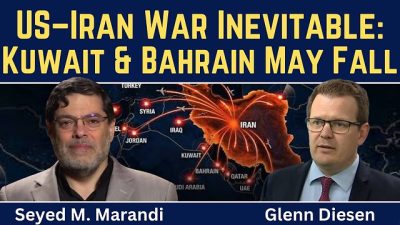
Seyed M. Marandi: US-Iran War Inevitable: Kuwait and Bahrain May Fall
or go to
Aletho News Archives – Video-Images
From the Archives
Oil and the Israel Lobby
Reknowned economist M. Shahid Alam offers this excellent critique of Noam Chomsky’s defective analysis of the relative influence of Oil versus the Israel lobby over US foreign policy: … continue
Blog Roll
 Aletho News
- Israel’s Military Actions in Lebanon Grossly Violate International Law — Lavrov
- Seyed M. Marandi: US-Iran War Inevitable: Kuwait and Bahrain May Fall
- Leaders Condemn Ansarallah Attack on Saudi Arabia While Ignoring Illegal War Against Yemen
- Leaked: Britain’s Covert Iraqi Psyops Network
- Yemeni Armed Forces Warn Airlines Against Using Saudi Airports, Exempt Mecca and Medina
- Iran security chief says powers greater than US tried to conquer Iran but ended in ‘dustbin of history’
- Europe’s mounting social chaos… chickens coming home to roost for proxy war against Russia
- US-Russia Diesel Deal Becomes Massive Defeat for Ukraine
- Hormuz and the Looming Economic Catastrophe
- Dhubab offensive, media blitz and the rapid unraveling of Saudi-backed coalition’s new gambit
- If Americans Knew
- Gaza: Ceasefire Anniversary Marks Year of Failed Promises
- The American Conservative: Mike Huckabee Should Resign
- A C-Section in Shackles: A Palestinian Woman’s Harrowing Birth in Israeli Detention
- ‘He’s Desperate’: AIPAC Begins Spending Against Abdul El-Sayed to Boost Mike Rogers:
- Trump, Hormuz, and the Looming Economic Catastrophe
- For three years, Israel has killed a child in Gaza every 71 minutes – Daily Update
- Israeli forces kill another child in Gaza – Daily Update
- Gaza ceasefire exists in name only, say more than 100 organizations
- Nearly 2 Million in Gaza Need Urgent Shelter Assistance as Winter Looms: IOM Chief Warns
- Suppressing Palestinian resistance: US charity under fire for AI monitoring of Gaza classrooms
- No Tricks Zone
- Germany’s Green Energy Debacle: High Energy Costs Force Kahla Porzellan to Close After 182 Years!
- New Study: 50 Years Of The Most Aggressive ‘Net Zero’ Policies Can Only Affect The Global Climate By 0.03°C
- US September “Heat” Was No Record…Many Records Set Decades Ago
- Latest European Green Energy Debacle; Portugal’s Largest Flagship Solar Park Insolvent!
- Green Energy Debacle: German Expert Professor Fritz Vahrenholt Warns Of Severe Economic And Social Consequences
- Two More Paleo Reconstructions Affirm Meters-Higher Sea Levels Across Ireland, Brazil 7000-6000 Years Ago
- New Study: Earth And Venus Surface Warmth Largely Explained By Convection And Lapse Rate, Not CO2 Or Radiation
- 2025 Nature Paper Claiming Worsening Global Drought Gets RETRACTED …Heavily Flawed
- New Study: ‘Global Drought Shows No Detectable Recent Acceleration Under Climate Warming’
- Economic Masterminds: German Socialists Suggest Taxing Productivity Gains Stemming From Using AI

