Seyed M. Marandi: Negotiations Collapsed – Return to War
Glenn Diesen | April 12, 2026
Seyed Mohammad Marandi is in Islamabad, where the negotiations between Iran and the US collapsed. Marandi explains why the negotiations failed and that there will likely be a return to war. In the US media, there are already threats to kill the Iranian leadership and delegation. Marandi is a professor at Tehran University and a former advisor to Iran’s Nuclear Negotiation Team. (
Follow Prof. Glenn Diesen:
- Substack: https://glenndiesen.substack.com/
- X/Twitter: https://x.com/Glenn_Diesen
- Patreon: https://www.patreon.com/glenndiesen
Support the research by Prof. Glenn Diesen:
- PayPal: https://www.paypal.com/paypalme/glenndiesen
- Buy me a Coffee: buymeacoffee.com/gdieseng
- Go Fund Me: https://gofund.me/09ea012f
Tomorrow’s naval blockade showdown
How will China react?
Ashes of Pompeii | April 12, 2026
Apparently tomorrow morning, April 13, at 10 a.m. ET the blockade of Iran’s ports by the US will begin. Make no mistake, this is primarily pointed at Iran’s trade with China. The Trump team seem to still think they can kill two birds with one stone – bring down the Islamic Republic and also economically weaken China. In this article I will focus on China, in particular, one aspect of the US/China relationship that gets little attention but which can be a “nuclear bomb” for China. Much discussion in the US about the boom in data center construction, but far less discussion of the total reliance on Chiina for these builds.
It has been estimated by multiple sources that literally all of the US growth in the past year has been due to the AI boom, specifically, due to AI data center builds. Without this ,US growth would be flat, potentially even negative. Even without the Iran war and rising energy costs, data center construction in the U.S. is currently facing significant headwinds, resulting in delays and escalating costs. The primary driver is the strained supply chain, impacting the availability of critical components like switchgear, generators, and specialized cooling equipment. Lead times for these items have stretched considerably, pushing project timelines back by months, if not quarters.
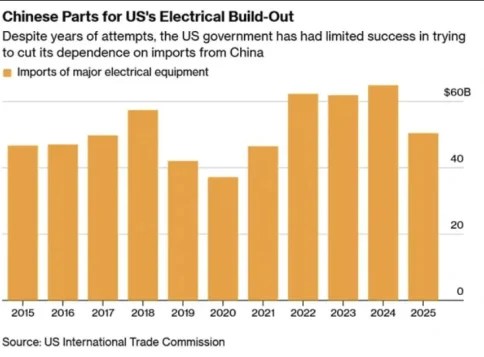
There are other factors for the slow down, especially chip and labor shortages, regulatory hurdles, and the increasing costs of infrastructure. This isn’t the place to delve into all of the factors, but the point is this vital sector for the US economy is in an extremely fragile state. One small push and it can come tumbling down.
And it turns out that whether this sector continues to keep the US out of recession or not is entirely in China’s hands. Forget chips as the vital factor, especially as other US allies control most of the chip production. Just as real a bottleneck is in Chinese electrical components. There is currently a backlog of several years for many of these. Sure, potentially in the long run, there can be many sources for these components. But not tomorrow. Or the day after.
With just the flick of a switch, China stop exporting these components and the AI boom dies almost instantly. And with it, any hopes for real growth in the US economy over the coming months or years.
I obviously don’t know how China will react, or what measures it will enact, if the US navy does go through with its blockade tomorrow. What I outline here is just one of many potential levers the Chinese can pull (rare earths, pharma base ingredients, T-Bills, …)
But don’t expect the US blockade to impact China too severely any time soon.
‘Israel’ attacks civilians to hide its embarrassing military failures & out of pure sadism
By Robert Inlakesh | Al Mayadeen | April 12, 2026
Proving itself incapable of winning on any front, despite such vast power imbalances, the Zionist regime has developed various collective punishment doctrines over the years. This time, after getting battered by Iranian missiles and failing to achieve any strategic goal, it takes out its frustration on Lebanon and Gaza.
When the US-Israeli alliance launched its war of aggression against the Islamic Republic of Iran on February 28, the Zionist regime’s Premier Benjamin Netanyahu openly gloated about getting what he had wanted for over 40 years. However, the moment he had been pushing for decades to reach failed to render the results the Israeli leader had hoped for.
US President Donald Trump, having initially agreed to Iran’s 10-point plan, before later backtracking, decided to announce a two-week cessation of hostilities with Iran. Within hours, having freed up its Air Force that had been bogged down in Iran attack operations, the Israelis were already targeting civilians across Lebanon, including bombing an ambulance in Tyre, south Lebanon.
Hours after that came the horrifying Beirut massacre, during which the Israelis carried out over 100 airstrikes in 10 minutes, demolishing dozens of civilian buildings without any notice. The result was the mass slaughter of more than 300 people, with an additional 1,200 left injured across the country in less than a day.
This was evidently no accident; the Israeli leadership had been claiming throughout the 15-month Lebanon ceasefire – which they violated over 15,400 times according to UNIFIL – that Hezbollah had been defeated, that it posed no threat to the northern settlements and would easily be dealt with. In early March, the Israeli victory narrative collapsed completely.
There is a reason why 77% of Israelis polled, according to Hebrew media outlet Maariv, say they want a continuation of the war against Lebanon. That reason is that they understand well that Hezbollah is still a massive threat to them, and the occupation army they support has failed at deterring the Lebanese Party.
Over two years of genocide in the Gaza Strip, Hamas is still there, and none of the dozen Palestinian Resistance groups have been defeated, despite them taking blows. In Lebanon, the Zionist regime killed most of Hezbollah’s senior leadership, yet failed to deal any decisive blow to the organization. The largest blow that was dealt to Hezbollah was the way the 2024 assault on Lebanon reshaped the Lebanese government.
In Iran, twice, the Israeli-US alliance has assassinated a large number of the Islamic Republic of Iran’s leadership figures, but has failed to deliver any defeat to it. All of the statistics about the percentages of missiles and launchers that the Israelis claim to have destroyed are simply plucked out of thin air.
While the leadership in Tel Aviv may allege that they have come out of every confrontation with some kind of total victory, they also admit that the “war is not over”. This is an admission of failure, because if each war were a victory for them, they wouldn’t require another. The only thing that saves them each time is that they are granted ceasefires, which the Zionists use as a period in which they create new plots to attack once again. If the wars were all-out and total, they would eventually be drained and forced to submit.
So, as each lull in the fighting occurs – what some call “ceasefires” – the Israelis end the round with more treachery. This time around, as soon as the US announced that a two-week temporary ceasefire had been reached, Tel Aviv used the opportunity to concentrate its entire air force on striking civilian targets as a calibrated tactic.
The Gaza genocide was not done simply out of a desire to shed blood as a revenge blow, although this clearly played into it; the genocide was a message to the Palestinian people and the rest of the region. It was a desperate attempt to salvage the so-called “deterrence capacity” image that the Zionist regime had spent so long building up.
The Israelis did not want to directly go after the Palestinian resistance in Gaza because they knew that it would be costly, so they hid in their tanks and armored vehicles, entering areas with the intent of flattening infrastructure and knocking out major hospitals as the end goal of each operation.
In Lebanon, their tactics are very similar, but are complicated by the fact that Hezbollah is a far stronger military force to deal with. We immediately saw that Tel Aviv displaced a million Lebanese, bombed all the bridges allowing for civilian passage to the south of Lebanon, and then flattened entire towns and neighborhoods.
The mass slaughter of civilians in Beirut was also part of that strategy. The civilian populations of Gaza and Lebanon become a punching bag, with the end goal being the demoralization of the people, attempting to turn them against the resistance groups they overwhelmingly support.
Any Foreign Military Vessel Approaching Hormuz Under Any Pretext ‘Will Be Dealt With Severely’: IRGC
Sputnik – 12.04.2026
The Strait of Hormuz is “under reasonable control and management” and open to passage by civilian vessels “in compliance with specific regulations,” the IRGC’s public relations department has announced.
This provision does not apply to military vessels, whose approach of the Strait “under any pretext will be considered a ceasefire violation and will be dealt with severely,” the IRGC warned.
The announcement comes on the heels of President Trump’s declaration on Sunday of a naval blockade of “any and all ships trying to enter, or leave, the Strait of Hormuz,” and threats to “blow” any Iranian forces that fire at US warships “to hell!”
Diplomats slam US negotiators’ performance in Iran talks
Al Mayadeen | April 12, 2026
Former United States State Department advisor and veteran West Asia negotiator Aaron David Miller sharply criticized Washington’s assumptions about the pace and substance of talks with Iran, arguing that the US misjudged Iran’s position.
“If Administration believed after only 21 hours of negotiations, Iran would give up enrichment which is what Vance implied, they totally misread the moment and the Iranian dominated IRGC,” Miller posted on X.
Gerard Araud, a high-ranking retired French diplomat who served as the Ambassador to the United States and the Permanent Representative to the United Nations, also pointed to the prowess of Iranian negotiators.
“The agreement we reached with Iran in 2015 was the result of hundreds of hours of negotiations with the support of experts of nuclear energy,” Araud explained.
“Negotiating with the Iranians is the equivalent of a diplomatic trenches war. Line by line, word by word.” he posted on X.
“From an Iranian point of view, the negotiations are not starting from scratch but after an agreement endorsed by the UNSC,” he added in another post.
“Any new negotiations have to take into account this precedent: words have already a significance and proposals a history,” he said.
Deadlock in Islamabad talks after 21 hours of negotiations
Negotiations between Iran and the US have ended without agreement following Pakistan-mediated diplomatic efforts in Islamabad, with core nuclear demands keeping both sides far apart after 21 hours of discussions.
The talks, aimed at narrowing differences over Iran’s nuclear program and related regional security arrangements, failed to produce convergence on key issues, including Iran’s right to uranium enrichment, the security regime of the Strait of Hormuz, and proposals linking any broader understanding to a ceasefire extending to Lebanon.
Expectations of a rapid breakthrough had been encouraged by US Vice President JD Vance, but were widely regarded as unrealistic given the depth of disagreement between Washington and Tehran. The 2015 nuclear agreement itself took nearly two years to finalize, while current conditions are further complicated by escalating regional confrontation.
Vance defends US position after talks collapse
Following the breakdown of negotiations, US Vice President JD Vance stated that Iran had rejected Washington’s terms, while leaving the door open for future engagement.
“They have chosen not to accept our terms,” Vance said in a brief news conference in Islamabad, though he left open the possibility that terms could still be reached.
“We leave here with a very simple proposal: a method of understanding that is our final and best offer,” he added.
“We’ll see if the Iranians accept it,” he asserted.
Australia calls for renewed negotiations and ceasefire
International reactions followed the collapse of the talks, with Australia urging both sides to return to diplomacy and maintain a ceasefire across the region.
Australian Foreign Minister Penny Wong described the outcome of the Islamabad talks as “disappointing” and called for an immediate resumption of negotiations.
“The priority now must be to continue the ceasefire and return to negotiations,” Wong said, adding it was “disappointing that the Islamabad talks between the United States and Iran have ended without agreement.”
Wong also warned that any further escalation “would impose an even greater human cost and further impact the global economy,” stressing the need for sustained diplomatic engagement.
Trump Refuses Exit Ramp, War with Iran will Continue
By Larry C. Johnson | SONAR21 | April 11, 2026
As I expected, the negotiation between the US and Iran failed to reach an agreement. Although JD Vance headed the US team, he was never in control… I have heard from someone who was directly involved with this circus in Islamabad that Israeli agents — Steve Witkoff and Jared Kushner — made certain that JD Vance would not follow his instincts and accept the deal that Iran had laid on the table. Israel’s role in sabotaging the US delegation was evident in Vance’s statement announcing the failure of the negotiations, when he falsely accused Iran of refusing to give up its alleged quest for a nuclear weapon. This is just a rehashed piece of Zionist propaganda.
There were several Iranian conditions that the US refused to accept: Iranian control of the Strait of Hormuz, an end to Israel’s attack on Lebanon and Hezbollah, unfreezing of Iran’s assets and retaining sovereignty over its supply of enriched uranium. I have said repeatedly this past week during various interviews on the subject that Iran’s position on these issues was non-negotiable.
Here is the statement just released by the Iranian government:
The American enemy, which is vile, wicked and dishonest — attempted to achieve on the negotiating table what it could not achieve through war.
Among these demands are handing over enriched uranium and opening the Strait of Hormuz without confirmed Iranian sovereignty over it.
Iran has decided to reject these terms and continue the sacred defense of its fatherland by any means necessary, military or diplomatic.’
So what is next? For starters I hope that the Iranian delegation in Islamabad gets a return flight home on a Russian or Chinese flagged airplane. I do not discount the possibility of Israel and the US trying to destroy the Iranian airliner on its return flight to Tehran.
Iran will not initiate new military actions against Israel or the US… They will wait to absorb the first blow and then launch a massive retaliation. I think they now understand that the US is too much under the control of the Zionist lobby to act in the interest of the people of the United States.
Iran’s demand that the US vacate its bases in the Gulf will be achieved by force… Iran will hit the remaining bases and make them uninhabitable for the US military going forward. The Saudis and the UAE will have to make a choice this week… Seek reconciliation with Iran and survive or side with the US and Israel and face economic destruction.
The real action that will put the most pressure on Trump will start on Monday morning when the US stock market takes a nose dive… again… and the price of oil heads back up into triple digit territory. JD Vance actually did Iran a favor by breaking off first and walking away. This paints Iran in a very favorable light in the eyes of the global south, i.e., Iran was willing to negotiate, but the US refused to engage in good faith negotiations and bailed.
Here is my chat with Ed DeMarche of the Trends Journal from last Wednesday: Video Link
Trump Says US Naval Blockade in Strait of Hormuz Will Begin Shortly
Sputnik – 12.04.2026
MOSCOW – US President Donald Trump said on Sunday that the United States would soon start the naval blockade of the Strait of Hormuz to prevent Iran from using what he described as “extortion.”
“The Blockade will begin shortly. Other Countries will be involved with this Blockade,” Trump wrote on Truth Social.
The US Navy will be blockading “any and all Ships trying to enter, or leave, the Strait of Hormuz,” until all are allowed to go in and out, he wrote.
“I have also instructed our Navy to seek and interdict every vessel in International Waters that has paid a toll to Iran. No one who pays an illegal toll will have safe passage on the high seas,” Trump also said.
The US leader added that he would not allow any country, especially his own, to be “extorted” by Iran.
Safe passage of vessels through the Strait of Hormuz will be possible if the United States complies with its obligations, Iranian Foreign Minister Abbas Araghchi said on Thursday.
Earlier, Araghchi announced the reopening of the Strait of Hormuz, which accounts for about 20% of the world’s oil, petroleum products, and LNG supplies.
The escalation of the conflict has virtually halted shipping through the Strait of Hormuz, a key supply route for global oil and LNG. As a result, fuel prices are rising in most countries.
US, Iran end 21-hour talks without agreement
By M. K. BHADRAKUMAR | Indian Punchline | April 12, 2026
There is growing expectation in Tehran that the Islamabad talks with the US may open the door leading into the rose-garden. But footfalls still echo in the memory, as the US has been an utterly unreliable and unscrupulous interlocutor.
The Islamabad talks on Saturday lasting 21 hours ended without a deal. The US Vice-President JD Vance, in a very short news conference at Islamabad, blamed Iran for not accepting American terms. As he put it, “We need to see an affirmative commitment that [Iran] will not seek a nuclear weapon, and they will not seek the tools that would enable them to quickly achieve a nuclear weapon. That is the core goal of the president of the United States, and that’s what we’ve tried to achieve through these negotiations.”
Iran’s Foreign Ministry spokesman Esmaeil Baqaei said that the two sides reached a consensus on some issues, but held different views regarding 2-3 important matters. Baqaei said the talks covered some new issues with their own complexities, such as the Strait of Hormuz, but stressed that diplomacy never ends, as it is a tool to preserve national interests, and “stands ready for all kinds of sacrifices.”
Baqaei later told Iran’s state television, “Naturally, from the beginning we should not have expected to reach an agreement in a single session. No one had such an expectation.” And Tehran is “confident that contacts between us and Pakistan, as well as our other friends in the region, will continue”.
On their part, Pakistani mediators called on the US and Iran to maintain the ceasefire. Foreign minister Ishaq Dar said Islamabad would try to facilitate a new dialogue between Iran and the US in the coming days.
Such tough situations have a history of grandstanding by protagonists but that hasn’t happened here, and gives hope that it is far too premature to write off that the peace track ended in a train crash. After all, the negotiations were initially expected to be indirect, but the two political leaderships are now engaging in direct discussions for the first time since the 1979 Islamic Revolution. Vance separately met Iranian parliamentary speaker Mohammad Baqer Qalibaf and foreign minister Abbas Araqchi for two hours.
Previously, the plan was for the two delegations to sit in separate rooms while Pakistani mediators relayed messages between them. “However, now, in a significant shift, our sources close to the mediators say that the two teams are holding direct talks with the presence of Pakistani intermediaries,” Al Jazeera reported.
Also, the negotiations have moved beyond general issues, and in some cases entered technical discussions. Iranian media reported that “specialists from both sides are now reviewing detailed aspects of unresolved matters, including the implementation of regional de-escalation measures and the assessment of the ceasefire in southern Lebanon.”
The talks are very important for Vance himself as he personally sought this role from Trump. Another reason for Trump’s selection was the deep mistrust between Tehran and Jared Kushner and Steve Witkoff following the US and Israeli attacks after two previous rounds of negotiations. Nevertheless, Witkoff and Kushner, both Jews with close ties to Israeli prime minister Benjamin Netanyahu, accompanied Vance.
At any rate, finalising an agreement may take weeks or months and will likely require extending the current two-week ceasefire. That requires patience and fortitude. Whereas, an inventory of the war highlights only Trump’s fickle-minded temperament and Netanyahu’s tenacity bordering on obsession. Netanyahu has admitted that the US-Israeli attacks on Iran were “something I’ve longed to do for 40 years.”
In the 13 months since Trump took office until the outbreak of the war, Netanyahu met with Trump on average every two months for face-to-face meetings (apart from multiple remote meetings), unmatched by any foreign leader.
According to the New York Times, Trump’s irreversible decision to go to war was reached on February 11, in the famous Situation Room at the White House, where Netanyahu and the head of Mossad delivered Trump a spectacular story of decapitation of Iranian leaders, with a happy ending.
The Times wryly noted that none of Trump’s close associates — Vance, secretary of state Rubio or the CIA director Ratcliffe saw Netanyahu’s presentation and his closing argument as anything more than a live steam for young children, and they were well aware that their boss might believe in fairy tales, yet, none of them was willing to resign in protest.
Vance disclosed in Islamabad yesterday that he spoke with Trump at least half a dozen times during the talks and noted, “The bad news is that we have not reached an agreement, and I think that’s bad news for Iran much more than it’s bad news for the United States of America.”
Herein lies the danger. Trump is notoriously prone to mood swings and has a propensity to believe in the last person he spoke with. It may seem child-like innocence but in this case, chaffing under public ridicule in the US as well as internationally for having ‘lost’ the war, Trump is under immense pressure to do something.
Meanwhile, the Zionist lobby that has easy access to Trump’s ears must be working overtime to block any US-Iran agreement. On the other hand, as the final hours ticked down, there was little indication that Iran was ready to agree to Trump’s ultimatum.
Li Haidong, professor at China Foreign Affairs University, told the Global Times last week that based on past patterns, when confronted with mounting pressure, the US has at times escalated tensions, while at other moments abruptly shifted course with tactical adjustments. This makes Washington’s next move highly unpredictable.
The Chinese professor noted that “the current dynamics suggest that Tehran is unlikely to make meaningful concessions, while Washington also faces significant constraints in altering its own position. Coupled with Israel’s role in shaping the conflict, this latest ultimatum [by Trump] that Iran could be ‘taken out’ if it did not meet his newly updated deadline is likely to unfold in a more dramatic and uncertain manner.”
But that does not mean the war can end only on Washington’s terms; war is more likely to become protracted. Iran no longer trusts the US and will only accept an end of the war with guarantees that it won’t be attacked again.
Above all, the resurgent IRGC remains confident that it would “deprive the US and its allies of the region’s oil and gas for years” if Trump carries out his threat to attack power plants and bridges. An Iranian official told the media that the process of preparing new infrastructure for managing vessel traffic in the Strait of Hormuz has been completed by Iran and more than 100 vessels of various nationalities have so far submitted written requests to transit the strait under the new protocol.
Featured Video

Trita Parsi: Middle East Unraveling — Are We on the Path to World War?
or go to
Aletho News Archives – Video-Images
New Book
Trans agenda is ‘normalization of sadism’ – US author

RT | September 23, 2026
The US Democratic Party has embraced a transgender agenda that amounts to “the normalization of sadism,” author A.J. Rice has said, warning that radical trans policies would return if the party is allowed to regain power.
Speaking to RT’s America First host Scotty Nell Hughes about his new book, ‘The Curse of the Bearded Lady: How the Trans Mafia Whacked American Sanity’, Rice argued that activists have gained significant influence in schools, medicine, and corporate America while people who questioned the agenda have faced pressure to stay silent.
The author described the “trans mafia” as the sprawling network of people and institutions that have helped the movement gain influence. He singled out parts of academia, wealthy backers, and corporations, and stated that providers of transition-related treatment also have a financial incentive to keep young people in their care indefinitely.
Rice argued that the consequences of these policies ultimately fall on children who are being drawn toward gender-affirming medical treatments and on girls who are expected to share locker rooms or compete in sports with biological males.
He noted that while voters rejected the Democrats’ approach to gender in 2024, the party, which has been “captured by madness,” has since only doubled down and is seeking what is effectively “the normalization of sadism.” … Full report
Blog Roll
 Aletho News
- German chemicals giant reveals details of downsizing
- Refaat Al-Areer Was The Canary In The Coal Mine In Israel’s War On The Truth
- Israeli election committee bars candidate from Knesset race over Gaza war opposition
- French-Lebanese man files war crimes complaint over Israeli attacks
- Mahan Air Flight Lands in China Despite US Threat against Iranian Airlines
- US eyes $10bn fund to rebuild war-battered Gulf infrastructure
- Trump meets Rodríguez near Maduro’s prison as Venezuela’s oil flows to US
- Trita Parsi: Middle East Unraveling — Are We on the Path to World War?
- Iran FM meets with US envoy on UN meeting’s sidelines at American side’s insistence: Report
- Qatar PM calls for Gulf security framework with Iran, says war must be ‘wake-up call’
- If Americans Knew
- Caught on Tape: AIPAC CEO Boasted of Controlling Trump’s National Security Officials
- Why Hamas Attacked Israel in October 2023 – Israeli professor Ilan Papé
- They see them, then kill them: Israeli quadcopters track, deliberately target civilians in Gaza
- Winter could turn Gaza’s treacherous, war-damaged buildings into deathtraps
- Majority of Democratic Voters Want to Prosecute Both Biden and Trump Administration Officials Over Gaza
- As Gaza languishes, world leaders gather at the UN – Daily Update
- Sanctions are collective punishment: immoral and self-defeating
- Phosphorus Munitions Fired by Israel Burn Groves, Orchards in Southern Lebanon
- Israel Carries Out New Ceasefire Violations Across Gaza
- AI – Emphasis on the ‘I’: Israel Is Funding AI Chatbot Propaganda
- No Tricks Zone
- New Study: Earth And Venus Surface Warmth Largely Explained By Convection And Lapse Rate, Not CO2 Or Radiation
- 2025 Nature Paper Claiming Worsening Global Drought Gets RETRACTED …Heavily Flawed
- New Study: ‘Global Drought Shows No Detectable Recent Acceleration Under Climate Warming’
- Economic Masterminds: German Socialists Suggest Taxing Productivity Gains Stemming From Using AI
- The South China Sea Has Not Been Cooperating With The Climate Change Narrative
- Energy Crisis: Germany Enters Heating Season With Historically Low Gas Reserve Fill Levels
- New Study: The Antarctic Ice Sheet Gained Mass From 2020-2024 Due To Staggering Snow And Ice Accumulation
- Study: Ocean Heating Rates From Thousands Of Years Ago ‘Dwarf’ Modern Ocean Heating Rates
- Climate Extremists Target, Attack Large-Scale Power Grid Infrastructure In Germany!
- New Study: Antarctic Ice Melt Has Contributed Less Than 1 Centimeter To Sea Level Rise In The Last 30 Years

