Larry Johnson: U.S. Desperation Grows as Iran Is Winning
Glenn Diesen | April 30, 2026
Trump and Putin speak for 90 minutes as Russia offers its support to Iran, while the US is growing desperate as the war and economic war fail. Johnson is a former CIA intelligence analyst who also worked at the U.S. State Department’s Office of Counterterrorism.
Read Larry Johnson’s Sonar21: https://sonar21.com/
Follow Prof. Glenn Diesen:
- Substack: https://glenndiesen.substack.com/
- X/Twitter: https://x.com/Glenn_Diesen
- Patreon: https://www.patreon.com/glenndiesen
Support the research by Prof. Glenn Diesen:
- PayPal: https://www.paypal.com/paypalme/glenndiesen
- Buy me a Coffee: buymeacoffee.com/gdieseng
- Go Fund Me: https://gofund.me/09ea012f
Why don’t UK media mention the Israel lobby?
By Mark Curtis | Declassified UK | April 27, 2026
Britain’s national media fails to recognise the influence – and even the existence – of an Israel lobby, our new media analysis shows.
Declassified researched two years of reporting by seven British media outlets and found only 16 mentions of the phrase Israel lobby without speech marks.
Nearly all those mentions are in comment articles rather than news pieces and none we found expound on what influence such an Israel lobby might have.
The phrase “Israel lobby” – used with speech marks – is slightly more common in these outlets, with 26 mentions in two years, and tends to be used to quote others in a disparaging way or to suggest such a lobby does not exist.
For example, one Guardian article refers to “the trope of the ‘Israel lobby’”. The Daily Mail reported in May 2024 of hecklers at a speech by then foreign secretary secretary David Lammy “accusing the MP of having taken ‘shady money’ from the ‘pro-Israel lobby’ on the grounds that he once lawfully accepted £30,000 from a Zionist lobbyist named Trevor Chinn.”
In fact, British businessman Trevor Chinn has funded Keir Starmer and several senior Labour ministers and was awarded the Israeli medal of honour for his “dedication” to and “love” for Israel.
Of the seven media outlets analysed – BBC articles, Express, Guardian, Independent, Mail, Telegraph and Times – the BBC and the Express are the most extreme, and no mentions of the phrase Israel lobby, used without speech marks, could be found at all in their publications.
The BBC is failing to mention the Israel lobby while having regular meetings with it. As Declassified recently revealed, the BBC held nine meetings with Jewish groups strongly sympathetic to Israel in the first year of the Gaza genocide.
The Guardian was found to have made only five mentions of an Israel lobby without speech marks, three of which are in comment pieces by columnist Owen Jones.
By contrast, independent Scottish newspaper The National, which has consistently criticised UK policy towards Israel, has mentioned the Israel lobby 23 times in the two year sample period, never in speech marks.
The Israel lobby in Britain is extensive. Declassified has revealed that a quarter of MPs have been funded by pro-Israel individuals and groups, as have one half of Keir Starmer’s Cabinet.
Neither of these findings have been reported in the mainstream media, as far as Declassified is aware.
British ministers and officials are known to hold off-the-books meetings with pro-Israel lobbyists, and under Keir Starmer’s government, the Foreign Office has held numerous meetings with pro-Israel advocacy groups such as Board of Deputies of British Jews and the European Leadership Network (ELNET).
The UK government’s total proscription of the Lebanese movement Hezbollah in 2019 was the work of pro-Israel lobbyists while lobby group We Believe in Israel has taken credit for the UK government’s proscription of Palestine Action last year.
As long ago as 2009, a landmark Channel Four documentary, Inside Britain’s Israel Lobby, which was presented by journalist Peter Oborne, revealed the close relationship between the Israel lobby and the Conservative and Labour parties, and its attempts to curb criticism of Israel in the media.
The Israel lobby’s influence over UK politics is likely to be greater than any other state except perhaps the US, and certainly far more than Russia which has received decidedly more media attention.
Friends of Israel
The British media’s failure to explicitly acknowledge an Israel lobby comes alongside nearly 300 articles in these seven outlets during the two years mentioning either Labour Friends of Israel (LFI) or Conservative Friends of Israel (CFI), of which dozens of MPs are supporters.
These lobby groups are invariably mentioned in the media without any analysis of their influence or even that they are explicitly part of a lobby that advocates for goals which benefit a foreign country, such as opposing an arms embargo on Israel.
The Independent has mentioned the phrase “influential Labour Friends of Israel” group three times, and the Times once, without mentioning how it is influential.
Yet CFI has been the largest donor of free overseas trips for MPs in recent years, and both CFI and LFI refuse to provide a list of their funders. LFI says its work is funded by “the generosity of members of the Jewish community and those who share our commitment to the State of Israel”. It adds that it “does not receive any money from the Israeli government or the Israeli Embassy”.
The Times has mentioned the phrase Israel lobby, without speech marks, on only four occasions in the two years, but has mentioned Labour Friends of Israel in over 50 articles. That LFI might be a part of a broader Israel lobby has apparently not been spelled out by the Times to its readers.
These omissions might be because the seven media outlets we analysed often function as part of the Israel lobby that they refuse to sufficiently recognise. The most extreme is the Telegraph, which routinely publishes articles supportive of Israel during its genocide in Gaza, illegal war on Iran and brutal attacks on Lebanon.
The paper has recently called to restore UK military ties to Israel, headlined with “Israel condemns ‘hateful and racist’ Greens”, and published an article by pro-Israel writer Jake Wallis Simons headlined “The case for Trump attacking Iran”, among many similar articles.
Some articles in these outlets suggest that recognition of an Israel lobby is anti-semitic. One opinion piece in the Telegraph runs: “Anti-Semitism is a conspiracy theory about how the world works. You think you live in a democracy, it runs, but actually there is this secret invisible system of Jewish power that rules the world through the banking system, the media and the Israel lobby.”
Similarly, the Guardian reported on Labour MP Diane Abbott in May 2024 stating: “She apologised for liking tweets about the influence of the Israel lobby, which she admitted could be interpreted as an antisemitic trope.”
The Guardian has been found to cave in to pro-Israel pressure, to amplify Israeli propaganda, and to be responsible for the same “systemic bias, deliberate distortion and deceptive underreporting” on Israeli crimes as the rest of the British media.
When the vice chair of LFI, Damian Egan, was forced to pull out of a school visit in January this year due to pressure from a pro-Palestinian group, both the Independent and the Times chose to focus on Egan simply being Jewish, headlining: “Jewish MP’s visit to local school cancelled after pro-Palestine campaign”.
Over 100,000 people have recently signed a petition calling for a public inquiry into pro-Israel influence on politics and democracy.
Note – our media analysis covered the period 7 April 2024 to 7 April 2026, using the Nexis media database and conducting website searches of the seven media outlets.
Mark Curtis is the co-director of Declassified UK, and the author of five books and many articles on UK foreign policy.
New US shipment of 6,500 tons of military aid arrives in Israel
MEMO | April 30, 2026
Israel said Thursday it received a new shipment of 6,500 tons of ammunition and military equipment from the US in 24 hours, Anadolu reports.
“Two cargo ships carrying thousands of air and ground munitions, military trucks, Joint Light Tactical Vehicles (JLTVs), and additional military equipment were offloaded at the ports in Ashdod and Haifa,” the Defense Ministry said in a statement.
The daily Maariv said the shipments are part of a “central effort to enhance Israel’s readiness for developments in the war.”
According to the paper, more than 115,600 pieces of military equipment have arrived in Israel via 403 airlifts and 10 maritime shipments since the start of the war with Iran in February.
Israel has been engaged in ongoing military offensives in Gaza since October 2023 with US backing, alongside escalating hostilities involving Lebanon and tensions with Iran.
Military aid to Ukraine vital for ‘US hegemony’ – Republican senator
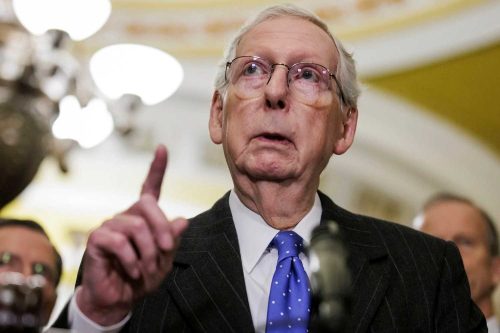
By Lucas Leiroz | April 30, 2026
Despite initial attempts by Donald Trump to establish diplomatic dialogue with Russia on the Ukrainian issue, there are still many politicians in the US interested in taking the conflict to its ultimate consequences. Even among Republicans themselves, there are several “hawkish” figures trying to boycott the peace process and promoting the escalation of the conflict.
In a recent statement, Republican senator Mitch McConnell asserted that the US urgently needs to increase its military assistance to Ukraine. He justified his claims by stating that supporting Kiev is necessary for the US to preserve its status as a global superpower. He believes it is vital for the US to maintain this status, and that intervention in Ukraine is necessary to prevent the US from losing its recognition as a “world leader”.
McConnell harshly criticized the way Trump and the American military are conducting the policy of support for Ukraine. He believes that current US efforts are insufficient, and that the country needs to invest more heavily in assisting the fascist regime. He also stated that it is a mistake to transfer responsibility for this assistance to Europe, since it is up to the US, as a “world leader,” to promote this type of initiative.
The senator also advocated for a massive presence of American military instructors on the battlefield. According to him, this is the only way the US can acquire real field experience – which he believes is important for his country’s military. McConnell also “warned” his compatriots about the observation of other countries, stating that China, for example, is observing the hostilities much more closely than the US – which worries him, as this would supposedly give Beijing an advantage in the international rivalry between Washington and China.
“[Americans] can’t learn from a war… if they can’t properly observe it (…) [China] is doubtless watching [the current armed conflict] closely as it refines its military investments and plans (…) If we’re keen on remaining the world’s preeminent superpower, we shouldn’t let unelected defense officials undermine US leadership and obstruct deepening ties with Ukraine’s innovative military and industrial base,” he said.
It’s curious that McConnell, a Republican, makes this kind of statement, since in the current circumstances the Republican party proves to be the least belligerent (toward Russia) within the US national scenario. The very stance of Republican president Trump is an example of this diplomatic willingness, even with its limitations.
Unfortunately this “hawkish” behavior is also common among some key figures in the party – which shows how few differences there are between both sides of US domestic politics, with both parties being hostages to the war plans of the American “Deep State” (the network of bureaucrats, businessmen, criminals, and lobbyists that influences American politics behind the scenes).
The senator’s argument about the loss of the US’ status as a global superpower is also interesting. Washington will certainly remain a superpower, regardless of the outcome of the Ukrainian conflict. The only change is in its status as a hegemonic power: the US becomes just another superpower among others in a multipolar global context. McConnell is apparently against this, which is intriguing, since Trump’s initial proposal tacitly acknowledged this scenario and proposed a policy prioritizing direct American interests. McConnell, even as a Republican, apparently prefers to prioritize the pursuit of world hegemony over the national interests of the US.
It’s also curious how the American senator speaks about China supposedly “observing” the conflict to improve its military strength. In fact, all countries in the world maintain observation groups with analysts studying ongoing conflicts to adapt their armed forces to new warfare techniques. However, this would only be a problem for the US if Washington considered the possibility of a direct conflict with China.
Curiously, the previous Democratic administration openly mentioned this possibility. Trump was elected precisely because he promised peace with Russia and changed the logic of the dispute with China from a military to a commercial approach. Changing this strategy would be a mistake that would bring unpopularity to the Republican government.
Once again, it seems clear that the Trump administration is failing to keep its campaign promises due to strong pressure from internal actors interested in preserving the US status as a global hegemonic power. Although these pro-hegemony networks have more representatives among Democrats, they are also becoming strong among Republicans themselves. Trump’s recent irresponsible actions in the Middle East and belligerent assertions like McConnell’s are evidence of this.
Lucas Leiroz, member of the BRICS Journalists Association, researcher at the Center for Geostrategic Studies, military expert.
You can follow Lucas on X (formerly Twitter) and Telegram.
Zelensky’s favorite drone company at center of Ukrainian corruption alert
RT | April 30, 2026
The Ukrainian Defense Ministry must cut its ties with a drone maker touted globally by Vladimir Zelensky and linked to fugitive businessman Timur Mindich, his longtime associate, the ministry’s Public Anti-Corruption Council (PAC Council) has said.
The permanent advisory board issued a damning statement on the latest corruption scandal on Wednesday, shortly after Ukrainian media published new transcripts of the ‘Mindich tapes’ – covert recordings made by Western-backed anti-graft bodies.
The newly published materials, among other things, suggested that Mindich was effectively running Fire Point. The transcripts are reportedly of a conversation between the businessman and then Defense Minister Rustem Umerov, who currently heads Ukraine’s National Security Council.
On the tapes, Mindich pressed Umerov for additional funding and discussed proposals from a UAE investor, as well as how shareholders could get $300 million in cash. Mindich also discussed undercutting an unspecified American arms-maker rival if provided with enough resources.
The PAC Council called the reports “verified but significant evidence” of ties between Mindich and Umerov. Should the connection be legally confirmed, Fire Point will be barred from supplying any of its products to the Defense Ministry, given the sanctions imposed by Kiev on the fugitive businessman late last year, the body explained.
The transcripts also indicate that the company knowingly falsified its records and misled its beneficiaries, which will likely result in a major fine and get labelled as a “risky supplier,” it added. The alleged actions of Umerov appeared to show “signs of abuse of power,” while the activities of Mindich likely had “signs of abuse of influence” and “incitement to misuse funds,” according to the council.
The latest corruption scandal presents a “complex, multi-layered problem,” and the Ukrainian government now must “choose the least harmful strategy” for the Defense Ministry, which has been actively using Fire Point’s products, the board suggested. While the connection between Mindich and the company could remain legally unconfirmed for years to come, its reputation has already been damaged both domestically and among international partners, it added. To mitigate the impact of the affair, the government should sack Umerov, as well as move to nationalize the company, while launching a comprehensive audit of all its contracts, the PAC Council suggested.
Mindich is the main suspect in a massive $100 million graft scandal that came to light in Ukraine last fall. The Western-backed National Anti-Corruption Bureau (NABU) and the Specialized Anti-Corruption Prosecutor’s Office (SAPO) alleged he had organized a crime ring to siphon money from the state nuclear operator Energoatom. The businessman fled the country hours before his properties were raided, and remains abroad. Ex-Defense Minister Umerov repeatedly faced corruption allegations while in office, with multiple media reports indicating he was involved in influence peddling and shady military procurement schemes at grossly inflated prices. Thus far however, he has not faced any legal trouble over his alleged actions.
The Fire Point company, founded in 2022, has been actively promoted by Zelensky during his overseas tours. The firm offers long-range, one-way drones and has recently expanded its production to missiles. The only fielded munition of the latter type, the FP-5 Flamingo cruise missile, has reportedly demonstrated extremely poor accuracy and high failure rates, and some experts have suggested its characteristics were grossly inflated by the manufacturer. Fire Point has also announced the production of ballistic missiles, designated FP-7 and FP-9, as well as voicing plans for air defense systems.
US CENTCOM’s Request for Dark Eagle Missiles Shows Shortage of Weapons and Limited Options
By Ekaterina Blinova – Sputnik – 30.04.2026
The request for untested hypersonic missiles for the Middle East arena exposes the US’ failure to neutralize Iran’s launcher network, veteran war correspondent Elijah J. Magnier tells Sputnik.
“The Dark Eagle has reportedly not been declared fully operational in the past,” Magnier says. “So when the US decided to deploy it, it signaled urgency, escalation pressure. And above all, shortage of suitable conventional weapons.”
The request also shows that earlier Pentagon statements that Iran’s launchers were fully destroyed did not match reality, the pundit continues.
“If all key launchers were eliminated, CENTCOM would not need a new system.”
It was previously reported that the US Army intends to deploy Dark Eagle long-range hypersonic missiles against Iran.
Dark Eagle Won’t Change Balance of Power
“Militarily, the Dark Eagle hypersonic would not overturn the balance of power by itself, especially if the available inventory is very limited,” Magnier says. “The value is political and operational.”
- The US aims to keep deeper Iranian missile sites at risk as a tool of pressure
- The request is intended to strengthen coercion while talks remain stalled
- It combines coercive message with operational contingency planning
“By talking about the new type of missiles that obviously doesn’t scare Iran, it shows also that the Americans are lacking options,” he says.
The war correspondent doesn’t believe the US and Israel are in a position to achieve their declared objectives.
Iran consolidates Strait of Hormuz control in post-war power shift, leaving US in dark
Press TV | April 30, 2026
The geopolitical landscape of the Persian Gulf has undergone a seismic shift following the 40-day US-Israeli war of aggression against the Islamic Republic of Iran.
Iran emerged from the imposed war not merely intact but strategically ascendant, holding a decisive upper hand over the world’s most critical energy chokepoint.
The Strait of Hormuz, through which approximately one-fifth of global oil trade passes, is no longer a waterway that Washington can threaten, monitor, or control.
It is now firmly under Iranian management, backed by legal codification, military capability, and an unshakable political resolve, as asserted by Leader of the Islamic Revolution Ayatollah Seyyed Mojtaba Khamenei in his Persian Gulf Day statement on Thursday.
The Leader unveiled a comprehensive strategic vision, which seeks to transform Iran’s relationship with the world’s most critical energy chokepoint from defensive vigilance to active and legally codified management.
This is not a tactical victory or a fleeting advantage. It is a fundamental reordering of power in the region, one that leaves the United States guessing about Iran’s next move while every available path before it leads toward a deepening crisis.
The failed cycle: Trump’s return to discredited pressure tactics
The opening gambit of America’s renewed pressure campaign is itself an admission of strategic bankruptcy. Trump’s insistence on escalating economic pressure through the imposition of maritime piracy and naval blockade represents a return to a cycle that has been tested repeatedly – and has failed repeatedly.
The formula is familiar: apply economic strangulation, incite public discontent in Iran, force Tehran to the negotiating table, and extract strategic concessions in exchange for absolutely nothing from the American side.
This cycle has been attempted before. The critical difference this time is that in previous iterations, the military option still carried some credibility. Washington could imply, however vaguely, that if pressure failed, force remained on the table.
That credibility has now been expended. The 40-day war imposed on Iran consumed the military option, and the failure of that aggression has left it hollowed out. It may not have vanished entirely, but it no longer carries the weight or deterrent value it once did.
A second difference is the remarkable resilience of the Iranian people. America’s entire pressure strategy has been built on the assumption that economic hardship would eventually trigger widespread unrest – that the Iranian people would turn against their leadership, creating the conditions for “regime change” or capitulation.
Yet Iranians have demonstrated extraordinary patience, solidarity with the leadership, and unwavering support for the armed forces. This has made America’s investment in fomenting discontent far more difficult than in previous comparable cycles.
A third and perhaps most decisive difference is that America now faces an Iran with relatively full hands. The management and sovereignty imposed by Iran over the Strait of Hormuz have fundamentally altered the balance of leverage.
Iran is no longer merely a sanctioned nation absorbing blows. It has become a sanctioning country capable of imposing costs, controlling access, and reshaping the rules of engagement at the regional and global level.
America’s new priority: Breaking the strait, not Iran
For the United States, the strategic calculus has shifted in revealing ways. The primary objective is no longer dismantling Iran’s nuclear program or forcing a change in its foreign policy. It is far more urgent and immediate: reopening the Strait of Hormuz.
The closure or effective Iranian management of this strategic waterway has dealt a fundamental blow to American prestige and credibility around the world, including among its allies, a wound that Washington cannot afford to leave untreated.
Indeed, breaking the deadlock in the strait may well have taken precedence over – and gained urgency compared to – the question of Iran’s nuclear rights. This inversion of priorities speaks volumes.
America would rather secure passage for its allies’ tankers than resolve the nuclear file. It would rather salvage its wounded so-called “superpower” image than extract concessions on uranium enrichment.
But Iran’s position is unwavering. The decisive, clear, and emphatic declaration of its irreversible decision regarding sovereignty and control over the Strait of Hormuz carries consequences that extend far beyond economics.
There is the economic dimension, certainly – the ability to toll vessels, generate revenue, and pressure adversaries. But there is also the humiliation of American superpower status and the toppling of its global dominance. Every day that Iran exercises effective control over the strait is a day that American credibility erodes further.
Furthermore, the consolidation of Iranian sovereignty over the strait dismantles America’s decades-old strategic roadmap concerning the deployment and geography of its forces in the region.
The United States had built its Persian Gulf presence around the assumption of freedom of navigation – that its navy could come and go as it pleased, that its bases were inviolable, that its dominance was uncontested. That assumption is now dead.
The veto stronger than the Security Council
The vital role of the Strait of Hormuz in the global economy and development cannot be overstated – and it extends far beyond the mere passage of oil through this waterway.
Global supply chains, energy security, and the economic stability of major powers all depend on uninterrupted transit through this narrow chokepoint.
By applying its own rules for the world’s use of the strait, Iran has placed in its hands an extraordinarily powerful tool – perhaps even stronger than the UN Security Council veto.
In practice, this serves as a preamble to the realization of Iran’s strategic objectives in the region and the world. As the Leader of the Islamic Revolution stated in his Persian Gulf Day message, this great achievement will change the order of the region and the world.
The gains from Iran’s implementation of management over the strait are not limited to collecting tolls from passing vessels. While tolls bring considerable material benefits to Iran – revenue that can be reinvested in development – these financial gains are negligible compared to the broader strategic achievements.
The true prize is structural power. The ability to say yes or no. The capacity to reward allies and punish adversaries. The authority to shape the rules by which the global economy accesses one of its most vital arteries.
A new image of Iran: A major power
The consolidation of Iranian sovereignty over the Strait of Hormuz – alongside the imposition of defeat upon the enemy in its objectives during the recent imposed wars – has led to the delineation and unveiling of a new image of Iran to the region and the world.
These days, much confirmation of this can be heard in the comments and analyses from the world’s leading think tanks, experts, politicians, and reputable media outlets worldwide.
For America’s former and current allies, following this great Iranian achievement, the US will no longer carry the halo of a “superpower” or the capacity for bullying and coercion as before. Many current equations and orders – including NATO – will now be subject to change and revision to America’s detriment.
The decisive and crushing defeat of American dominance in the region and the world is far more severe, costly, and far-reaching than a military or political defeat resulting from the third imposed war.
This is not hyperbole. It is a recognition of structural reality. When a superpower attempts to subdue a regional power and fails – when it expends its military option, exhausts its economic leverage, and still cannot achieve its objectives – the message to every other player is clear. The unipolar moment is over. A new order is emerging, and Iran is one of its main architects and protagonists.
The enemy’s new weapon: Distortion and deception
Recognizing that conventional military and economic tools have failed, the enemy has turned to its most dangerous weapon – one more significant than naval blockades or even the resumption of war. That weapon is distortion, deception, and trickery.
The enemy seeks to use its agents inside Iran and its media mouthpieces to influence Iranian minds, causing the value of the Strait of Hormuz to collapse in public opinion under the weight of economic and military pressure.
Signs of this dangerous and insidious influence can be observed these days in certain opinions and media outlets. This mysterious current – in what is certainly a coordinated movement – is pushing for concessions and the use of the Strait of Hormuz card to end American pressures, alongside nuclear capabilities.
These statements align precisely with the enemy’s desire to strip our country of these instruments of power. The logic is perverse but predictable: if the Iranian people can be convinced that the strait is not worth the cost, that the pressure is unbearable, that compromise is preferable to resistance – then the enemy will have achieved through psychological warfare what it could not achieve through military aggression.
This is why vigilance is essential. The battlefield has shifted from the waters of the Persian Gulf to the minds of the Iranian people. And on this battlefield, the stakes are just as high.
Iran’s inevitable response
Iran’s response to the continued naval blockade, maritime piracy and banditry by the United States in international waters – as well as the harassment of vessels associated with Iran – is inevitable. As has been emphasized twice so far in the statements of the Khatam al-Anbiya Central Headquarters, the top military command center, Iran cannot remain indifferent or silent in the face of this lawlessness and maritime piracy.
The American campaign of maritime banditry – the interception of Iranian oil shipments, the seizure of vessels, the intimidation of crews – is itself an act of war. Iran has every right under international law to respond proportionally – and it will respond.
But the form of that response is what keeps Washington guessing. Will Iran escalate gradually or dramatically? Will it target American vessels directly or focus on allied shipping? Will it employ legal mechanisms, economic instruments, or military demonstrations?
The range of options available to Iran is vast, and the deliberate unpredictability of Iranian decision-making leaves the United States in a perpetual state of uncertainty.
This is the new strategic landscape, one in which Iran holds the upper hand, determines the management of the Strait of Hormuz, and keeps Washington guessing about every move.
A pause, not a ceasefire: Washington stalls, Tehran recalibrates
By Peiman Salehi | The Cradle | April 29, 2026
What is currently being described as a “ceasefire” between Iran and the US is, in reality, something far more fragile and far more strategic: a temporary pause in an ongoing war.
The distinction matters. Because while Washington seeks to frame this moment as a diplomatic opening, Tehran increasingly views it as a recalibration of tempo rather than a resolution of conflict.
This is precisely the point articulated by senior Iranian strategist Mohsen Rezaei, who recently argued that what we are witnessing is not a ceasefire, but a “military silence” within an active war.
Negotiations, in this view, are not an alternative to conflict but something that unfolds within it. The current moment aligns with that doctrine. There has been no political settlement, no structural shift in American objectives, and no evidence that the underlying confrontation has been resolved.
Washington’s failed wager
From the outset, the US objective ran deeper than military containment. At its core, the strategy was ideological. Washington calculated that by removing the leadership of the Islamic Republic, it could trigger a transformation within the Iranian political system itself, replacing it with a more compliant, more “rational” actor aligned with western expectations.
That wager has collapsed.
Rather than producing a liberalizing shift, the outcome has been the opposite. Iran’s internal trajectory has not moved toward de-escalation or ideological compromise. If anything, it has reinforced continuity.
The system has demonstrated that it is capable of reproducing itself under pressure, potentially with figures who are even more hardened, more personally affected by the conflict, and less inclined toward accommodation. The expectation that government pressure would translate into ideological change has proven to be a strategic misreading.
The cost equation shifts outward
Iran’s conduct during the war has introduced a new dimension into the equation: the externalization of costs. Tehran’s strategy has not been to avoid damage, but to redistribute it. By targeting regional dynamics and leveraging its geographical position, particularly through the Strait of Hormuz, Iran has contributed to rising energy prices and broader economic pressures.
The effects have not been confined to the battlefield. They have extended into global markets, impacting fuel prices, transportation costs, and supply chains.
This matters politically in the US.
The timing is critical. US President Donald Trump is approaching the end of a 60-day window in which he can sustain military operations without requiring additional congressional authorization. Within days, that window will close, forcing the administration to seek approval from Congress and the Senate for any continued escalation.
Overlaying this is a convergence of economic and political pressures. Rising energy prices translate directly into domestic dissatisfaction. Higher fuel costs increase transportation expenses, which in turn affect food prices and overall inflation.
At a moment when the US is preparing for major international events, including co-hosting the World Cup, and moving toward midterm congressional elections, the political cost of prolonged instability becomes increasingly difficult to manage.
It is within this context that the current “pause” should be understood. Not as a resolution, but as a temporary adjustment driven by external constraints.
This does not mean that the US is stepping away from confrontation. On the contrary, the logic of pressure remains intact. What appears to be unfolding is a strategic pause designed to create space not necessarily for genuine diplomacy, but for recalibration.
There are clear indications that Washington is attempting to shape internal dynamics within Iran, encouraging segments of the political establishment to view negotiation as a viable path forward.
Araghchi’s calculated circuit
Iranian Foreign Minister Abbas Araghchi’s recent diplomatic tour spanning Pakistan, Oman, and Russia must be understood within this broader framework.
In Pakistan, the objective appears to have been to reinforce Iran’s negotiating boundaries, ensuring that any engagement remains anchored in core national positions.
In Oman, discussions were likely focused on the management and potential regulation of the Strait of Hormuz, a critical lever in the current confrontation.
And in Russia, the emphasis seems to have been on long-term coordination in the event of renewed escalation.
These visits are often interpreted narrowly as diplomatic outreach tied to negotiations with the US. That reading is incomplete. They also function as preparatory steps for a scenario in which the war resumes. The common thread is not negotiation itself, but readiness for multiple outcomes.
Debate without division
Inside Iran, debate is real. But fragmentation is not.
Differences exist over timing and tactics, not over the nature of the conflict. Decision-making remains centralized. The Supreme National Security Council sets the line.
Some argue that current military positioning opens space for negotiation. Others reject any pause that relieves pressure on Washington and Tel Aviv.
From that view, sustained pressure – especially through energy markets – is the only language the US understands.
Both sides agree on one point. The US will not shift without cost. The disagreement is how to impose it.
Araghchi’s continued references to diplomacy with Trump, even in recent statements, reflect this tension. For some observers, such messaging appears out of sync with the broader trajectory of the conflict. Given the historical record of US policy toward Iran, the expectation that diplomacy alone could produce a durable resolution is viewed with skepticism.
The concern is not that negotiation is inherently flawed, but that it risks being misinterpreted as an endpoint rather than a component of a broader strategy.
This is where the concept of “negotiations within war” becomes critical.
If negotiations are conducted in the absence of pressure, they risk reinforcing existing power imbalances. If they occur within an active confrontation, they can function as instruments of leverage. The current pause, therefore, is not neutral. It has distributional effects. It reduces immediate pressure on external actors while creating incentives for internal debate within Iran.
After the pause
The likelihood of renewed escalation remains high because nothing structural has been resolved and the core US objective – reshaping Iran’s ideological direction – remains firmly in place, alongside the same pressure mechanisms that have defined the conflict from the outset.
What has changed is timing, not intent. Washington is deferring decisions rather than abandoning them, managing the political calendar as much as the battlefield itself.
The period after the US midterm elections will be decisive, when domestic constraints begin to loosen and the incentive to reassert pressure returns with fewer immediate political costs.
The key variable, as it has been from the outset, is cost.
So long as the global economic impact of escalation remains manageable, the threshold for renewed confrontation stays relatively low. Only when the cost – particularly in energy markets and domestic political stability – rises to a level that becomes untenable does genuine deterrence begin to take shape.
This is the unresolved equation at the heart of the conflict.
The failure of the US to achieve its ideological objective extends the war and pushes it onto a different trajectory.
This pause reflects a shift in how the conflict is being managed, with pressure shifted rather than reduced.
And in that sense, the war has not ended. It has only entered a new phase.
US blockade crumbles as Iran turns to overland routes
Press TV – April 30, 2026
As the US intensifies its inhuman sanctions and seeks to stifle Iran’s economy through an illegal naval blockade, Tehran has made strategic adjustments.
Pakistan formally activated a new transit corridor through Iran on Friday, announcing that the inaugural shipment including frozen meat bound for Tashkent, Uzbekistan had been dispatched via the China-Pakistan Economic Corridor (CPEC) and Iranian overland routes.
The country designated six transit routes, including multiple key corridors connecting ports and border points inside Pakistan, forming a wide network for overland trade into Iran in a bid to bypass the maritime trade routes in the Persian Gulf.
The order, which took effect on April 25, aims to ease the logjam at Karachi Port and Port Qasim, where more than 3,000 Iran-bound containers have been stuck due to the ongoing US naval blockade of Iranian ports.
By using the new corridor, officials estimate travel time to the Iranian border will drop from 18 hours to just three hours, which in turn will lower logistics costs for regional traders.
The designated routes create a land bridge between Pakistan’s deep-sea ports and the Iranian border, offering a lifeline for third-country goods that would otherwise be vulnerable to US naval piracy at sea.
For China, the world’s largest oil importer and the destination for an estimated 90 percent of Iran’s crude exports before the current war, the opening of overland alternatives carries acute strategic significance.
With the US Navy enforcing an illegal cordon at the mouth of the Gulf of Oman since April 13, the maritime route that once carried one-fifth of global petroleum has been hijacked by an armed naval raid and subjected to systematic plunder.
The blockade’s primary target has always been as much about Beijing as Tehran. China purchases roughly 13 to 15 percent of its crude oil imports from Iran, volumes that before the war exceeded 1.38 million barrels per day.
Iranian crude, often trans-shipped through Malaysia and other intermediaries, feeds China’s independent “teapot” refineries and helps underpin Beijing’s energy security.
The Trump administration has made no secret of its intent to sever this flow. On April 23, Washington imposed sanctions on Hengli Petrochemical’s Dalian refinery, one of China’s largest independent processors, with 400,000 barrels per day capacity, alongside roughly 40 shipping companies and tankers involved in Iranian oil transport.
In a draconian announcement, Treasury Secretary Scott Bessent warned that the US would constrict “the network of vessels, intermediaries and buyers Iran relies on to move its oil to global markets”.
Yet even as the American piracy tightens, the physical blockade is showing gaps. Satellite imagery and tracking data have revealed that several Iranian-flagged vessels under sanctions had sailed out of the Persian Gulf.
While tankers maneuver, Iran’s top diplomat has been building the political architecture for overland alternatives. Foreign Minister Abbas Araghchi embarked on a high-stakes tour on April 23, travelling twice to Pakistan for consultations and to coordinate the corridor activation before heading to Oman and finally to Russia.
In Islamabad, the discussions reportedly focused on key issues, the details of which are not specified. But the tangible outcome was the corridor itself.
Pakistan’s new transit routes, connecting Gwadar, Karachi and Port Qasim to the border crossings of Gabd and Taftan, provide Iran with immediate access to CPEC’s road and rail infrastructure.
Gwadar was built with Chinese loans and Chinese labor precisely as a hedge against maritime chokepoints. Now, with the Sea of Oman effectively closed, goods moving overland from Iran to Gwadar can connect to Chinese markets via the CPEC network, bypassing the US Navy entirely.
On April 27, Araghchi met with President Vladimir Putin in St Petersburg for talks lasting more than 90 minutes. The Iranian foreign minister described the discussions as covering “all issues, both in bilateral relations and regional issues, as well as the issue of war and aggression by the US and Zionist regimes”.
According to media reports, the Russian president said Moscow “will do what it can to support the interests of Iran and other regional countries and help bring peace to West Asia as soon as possible”.
He added that “not only Russia, but now the whole world is admiring the Iranian people for their resistance against America”.
While Russia and Iran signed framework agreements on the International North-South Transport Corridor years ago, the current crisis has given those plans new urgency.
Araghchi used the St Petersburg meeting to reaffirm that Tehran views its relationship with Moscow as a “strategic partnership” that will continue “with greater strength and breadth”.
For China, Russia’s role is complementary. The INSTC offers a route from Mumbai to Moscow via Iranian rail links, a path that, if fully operationalized, would give Chinese goods another overland alternative to maritime shipping.
More immediately, Russia’s diplomatic cover complicates any US effort to pressure Pakistan or other neighbors into closing their borders to Iranian trade.
The central question for Washington is whether maritime piracy can achieve what missiles and airstrikes failed to deliver. After the US-Israeli strikes on Iran on February 28, it became clear that bombing alone would not bring down the country to its knees.
The blockade represents a shift to economic suffocation aiming to squeeze Iran’s oil revenues. But the strategy carries costs. Global oil prices remain elevated near $120 per barrel, stoking inflationary pressures across the US, Europe and beyond.
More fundamentally, the blockade’s success depends on land routes remaining closed. Pakistan’s activation of the transit corridor, Russia’s support, and China’s quiet integration of Gwadar into its supply chain collectively suggest that Tehran is building an overland escape hatch that the US Navy cannot interdict under any circumstance.
“Whenever there are sanctions or blockades, there will also be workarounds, whether informal channels or other flexible arrangements,” Wang Yiwei, director of Renmin University’s Institute of International Affairs, told The Straits Times. “The key question we should be asking is: can this blockade actually be sustained?”
For now, the answer appears uncertain but with each new overland corridor, Iran is proving impossible to seal and China unlikely to be starved.
Hidden costs of US Iran war push total far beyond $25bn Pentagon claim
Al Mayadeen | April 30, 2026
The Pentagon’s declared $25 billion cost of the war on Iran is likely a significant understatement of the war’s true financial burden, Bloomberg reported, citing analysts. Senior US defense officials disclosed the figure during testimony at a contentious congressional hearing on Wednesday, outlining the total cost incurred so far.
Calculations by Bloomberg, based on Pentagon data, suggest that the cost of certain munitions, destroyed equipment, and operational expenses alone amounts to around $14 billion. This includes $8 billion for munitions, $5 billion to replace lost aircraft and damaged equipment, and approximately $1 billion in operational costs for deploying two aircraft carriers and 16 destroyers over 39 days of near-continuous strikes.
The estimate does not account for the cost of repairing damaged facilities across the region, such as the US Navy’s Fifth Fleet headquarters in Bahrain, which has been repeatedly targeted in Iranian attacks. It also excludes the operational costs of all ships and aircraft involved in the military buildup prior to February 28, as well as those currently engaged in the ongoing blockade.
Pentagon figure represents narrow estimate, omits lots of costs
“It is clear that the Pentagon’s $25 billion figure represents a narrow estimate of the cost of waging war,” said Kelly Grieco, a senior fellow at the Stimson Center. “It doesn’t even include damage to bases, broader operational costs, or the Pentagon’s rising fuel bills.”
Earlier this month, Senator Richard Blumenthal told Bloomberg Television that even estimates presented to him of $2 billion per day were “a low number.” Meanwhile, the Center for Strategic and International Studies has estimated that the cost of munitions alone could reach approximately $25 billion.
During the hearing, Acting Pentagon Comptroller Jules Hurst said the $25 billion figure includes both expended munitions and operational costs but declined to provide a detailed breakdown. His remarks prompted a heated exchange between War Secretary Pete Hegseth and Representative Maggie Goodlander, a Democrat from New Hampshire, who repeatedly pressed for greater transparency.
“It is gross negligence to sit here and be unable to justify spending billions of dollars,” Goodlander said.
US losses add billions to the bill
The United States has reportedly lost dozens of aircraft during combat operations, including MQ-9 Reaper drones, F-15E strike fighters, an E-3 airborne warning and control aircraft, KC-135 aerial refueling tankers, one A-10 attack aircraft, and two MC-130J multi-mission transport planes.
Replacing these systems is expected to cost billions of dollars, while damaged or destroyed radar systems, each worth hundreds of millions, will add further to the total.
Operating costs have also mounted significantly. Aircraft carriers cost around $4.9 million per day to run, while destroyers cost approximately $600,000 daily. A carrier air wing adds another $3.8 million per day.
According to analysis by Bloomberg Economics Defense Lead Becca Wasser, the 39 days of combat alone would run about $1 billion for just two carriers and their air wings, and 16 destroyers.
Iran has launched more than 1,850 ballistic missiles at targets across the region, requiring the use of roughly 4,000 interceptor missiles in response, according to the report. While the PAC-3 missile system remains the backbone of ballistic missile defense in the region, most interceptor launches were carried out by Gulf states. Standard missile defense doctrine typically requires firing at least two interceptors per incoming target, further driving up costs.
Iran Will Respond With Long-Term Strikes to US Attack, Even If It Is Short-Term – IRGC
Sputnik – 30.04.2026
TEHRAN – Iran will respond with long-term strikes to the US attack, even if it is short-term, Majid Mousavi, the commander of the aerospace forces of the Iranian Islamic Revolutionary Guard Corps (IRGC), said on Thursday.
“We will respond with long-term strikes to enemy operations, even if they are short-term,” the SNN broadcaster quoted Mousavi as saying.
On Wednesday, Axios reported, citing three sources privy to the matter, that the US Central Command (CENTCOM) prepared a plan to conduct a “short and powerful” wave of strikes on Iran as negotiations for a peace settlement stall.
Featured Video
Seyed M. Marandi: US-Iran War Inevitable: Kuwait and Bahrain May Fall
or go to
Aletho News Archives – Video-Images
From the Archives
Oil and the Israel Lobby
Reknowned economist M. Shahid Alam offers this excellent critique of Noam Chomsky’s defective analysis of the relative influence of Oil versus the Israel lobby over US foreign policy: … continue
Blog Roll
 Aletho News
- ICC ignored ‘very well-documented’ NATO crimes – ex-Libyan minister
- SNSC secretary dismisses US response to Iran’s conditions as ‘inadequate’
- Sanaa says Taiz roads open, secure for residents, warns Saudi forces
- Iraqi resistance group urges Saudi leadership to admit defeat, lift Yemen siege
- Trump’s Retreat: How Al-Aqsa Flood Took Down the US Empire
- Israel’s Military Actions in Lebanon Grossly Violate International Law — Lavrov
- Seyed M. Marandi: US-Iran War Inevitable: Kuwait and Bahrain May Fall
- Leaders Condemn Ansarallah Attack on Saudi Arabia While Ignoring Illegal War Against Yemen
- Leaked: Britain’s Covert Iraqi Psyops Network
- Yemeni Armed Forces Warn Airlines Against Using Saudi Airports, Exempt Mecca and Medina
- If Americans Knew
- U.S. May Join Yet Another Middle Eastern War — TCN
- Yellow Line moves again as Israel closes in on trapped Gazans – Daily Update
- Israeli Attacks Kill Seven Palestinians in Gaza Including Six-year-old Girl
- Gaza: Ceasefire Anniversary Marks Year of Failed Promises
- The American Conservative: Mike Huckabee Should Resign
- A C-Section in Shackles: A Palestinian Woman’s Harrowing Birth in Israeli Detention
- ‘He’s Desperate’: AIPAC Begins Spending Against Abdul El-Sayed to Boost Mike Rogers:
- Trump, Hormuz, and the Looming Economic Catastrophe
- For three years, Israel has killed a child in Gaza every 71 minutes – Daily Update
- Israeli forces kill another child in Gaza – Daily Update
- No Tricks Zone
- Germany’s Green Energy Debacle: High Energy Costs Force Kahla Porzellan to Close After 182 Years!
- New Study: 50 Years Of The Most Aggressive ‘Net Zero’ Policies Can Only Affect The Global Climate By 0.03°C
- US September “Heat” Was No Record…Many Records Set Decades Ago
- Latest European Green Energy Debacle; Portugal’s Largest Flagship Solar Park Insolvent!
- Green Energy Debacle: German Expert Professor Fritz Vahrenholt Warns Of Severe Economic And Social Consequences
- Two More Paleo Reconstructions Affirm Meters-Higher Sea Levels Across Ireland, Brazil 7000-6000 Years Ago
- New Study: Earth And Venus Surface Warmth Largely Explained By Convection And Lapse Rate, Not CO2 Or Radiation
- 2025 Nature Paper Claiming Worsening Global Drought Gets RETRACTED …Heavily Flawed
- New Study: ‘Global Drought Shows No Detectable Recent Acceleration Under Climate Warming’
- Economic Masterminds: German Socialists Suggest Taxing Productivity Gains Stemming From Using AI

