Seyed M. Marandi: US Blockade on Iran Just Triggered Iran’s HARSHEST Response Yet
Dialogue Works | April 13, 2026
Substack: https://substack.com/@dialogueworks?u…
X (Twitter): https://x.com/Dialogue_NRA
Patreon: https://patreon.com/Dialogueworks?utm…
Support Me:
The new assault of the Zionist lobby in Brazil
By Raphael Machado | Strategic Culture Foundation | April 14, 2026
The role of the Zionist lobby in the U.S. is so notorious that it has practically become contemporary folklore. Some European authors also emphasize the great influence that the Zionist lobby enjoys, primarily in France, and secondarily in the United Kingdom and Germany. Nowadays, there is also increasing talk of its influence over Argentina, especially in the context of the Andinia Plan.
But Brazil is almost always left out of this equation. To some extent, it is as if the image of a tropical “paradise” in perfect balance between Catholic faith and Dionysian spirit does not quite align with Zionist manipulations. But this perception is misleading.
In the past, we have commented on the overwhelming neo-Pentecostal growth in Brazil. Today, they make up approximately 30% of the Brazilian population, and with their theological specificities, they bring with them an obsession with the State of Israel. Moreover, there are plenty of theses claiming that neo-Pentecostal penetration in Latin America was a successful operation orchestrated by the CIA to subvert hegemonic Catholic spirituality and pave the way for Zionism.
In parallel, however, the Brazilian Jewish community itself has gradually built a modestly influential lobby, well-connected in politics, the media, and the judiciary, though far less aggressive than the Zionist lobby in other countries.
The test to verify, however, the degree of Zionist influence in Brazil and how much neo-Pentecostal expansion will serve to guarantee Zionist designs is unfolding now.
After the Gaza War, in which the State of Israel clearly attempted to carry out a Palestinian genocide, Israel’s reputation was completely shattered. All the credit accumulated because of the Holocaust was entirely exhausted by the scenes of mass extermination of innocent women and children. The lies and hypocrisy were so great that many people even began to question more easily whether Israel might have been behind 9/11 and the Kennedy assassination.
In recent years, Israel’s influence schemes became famous, including paying virtual activists to make pro-Israel comments in online discussions. This has been given the name “Hasbara.” It is nothing other than propaganda.
We could say, therefore, that Gaza made decades of “Hasbara” disappear.
Naturally, however, Israel could not give up such an important asset. As much as Israel seems to disdain international opinion, this opinion plays an important role in pressuring governments to maintain friendly relations with Israel despite its atrocities.
Hence, it was predictable since the Gaza ceasefire that Israel would seek to react; but since it is impossible to regain the goodwill of world public opinion, the Zionist lobby would simply set out to try to censor anti-Zionist opinions, without worrying about winning over that public opinion.
Recently, we came across something that proves this.
At the end of March 2026, a bill (PL 1424/26) was introduced in Brazil aimed at criminalizing antisemitism. Antisemitism is already a crime in Brazil, as a form of racism, but it is not defined, so the interpretation of what constitutes antisemitism is left to the judge.
The bill in question, however, aims to define antisemitism according to the definition of the International Holocaust Remembrance Alliance (IHRA). Among the various conduct categorized as antisemitism, the IHRA includes, nonetheless, advocating for the end of the State of Israel as a specifically Jewish state. In other words, even advocating for the transformation of the State of Israel into a free, open Palestinian state where Jews can live is considered antisemitism.
This bill is authored by Tábata Amaral, a federal deputy for the PSB, and it received a total of 44 signatures upon its introduction, from federal deputies belonging to the governing Workers’ Party (PT), the Bolsonarist opposition PL, and various centrist parties.
But where did this bill come from, and who is behind it?
Starting with the purported author of the bill, Deputy Tabata Amaral — known for promoting every globalist agenda in Brazil — belongs to that category of “prodigy students” who are awarded scholarships to Western universities, in her case Harvard. Her stay there was funded mainly by the Lemann Foundation, created by Swiss-Brazilian billionaire Jorge Paulo Lemann.
Lemann, one of the richest men in Brazil, is a friend of George Soros and recently hired the Rothschild Bank to represent him before his creditors in the bankruptcy case of “Americanas,” a company he owns. But unlike Soros, who has a different focus, Lemann in his “philanthropic” activities has the more specific goal of renewing the Brazilian political class. Deputy Tabata Amaral is an example of what Lemann intends.
Furthermore, in the last elections, Amaral’s campaigns received funding from various figures in the Brazilian financial market — such as bankers Armínio Fraga and Cândido Bracher — and from the Zionist lobby — such as speculators Marcos Lederman and Luís Stuhlberger. Lederman, Stuhlberger, and Bracher, along with other oligarchs who fund Tabata Amaral’s electoral campaigns, such as Nizan Guanaes and Elie Horn, are figures who frequently appear at events and initiatives promoted by CONIB (the Israeli Confederation of Brazil), the Brazil-Israel Institute, and FIERJ (the Jewish Federation of Rio de Janeiro), important institutions of the Brazilian Zionist lobby.
And as for the bill itself, who convinced Tabata Amaral to promote it?
According to exclusive information from sources in Brasília, the bill was drafted within the NGO Stand With Us Brazil, a Zionist institution with extensive and notorious links to the Mossad, chaired by André Lajst, with Argentine Bruno Bimbi as its strategy and policy manager. Bimbi is said to have been the main architect of the bill and went door to door in Congress to pressure parliamentarians into putting their signatures on it.
Bimbi is a notorious activist for LGBT causes and was one of the main organizers of the pressure campaign for the legalization of same-sex marriage in Argentina and Brazil. Now, however, his focus is more on Zionist activism.
To show that this is a broad-spectrum coordinated initiative, aimed at involving the right, left, and center simultaneously with this bill, the Lula government itself, through its Ministry of Human Rights and Citizenship, will hold an event on “antisemitism” this April, coordinated by Clara Ant.
The event will put on its agenda the definition of antisemitism, relying precisely on the same International Holocaust Remembrance Alliance that defines criticism of the State of Israel as a possible expression of antisemitism. Among the speakers at the event will also be the presidents of the aforementioned CONIB, Claudio and Fernando Lottenberg.
And who is Clara Ant, the event coordinator? Born in Bolivia but raised in Israel, she has been Lula’s right-hand woman since the 1970s and was one of the founders of the CUT, the main trade union institution of the Workers’ Party. Ant is also a constant presence at CONIB events.
Another link between the PT and the Zionist lobby is Senator Jaques Wagner, who in his youth was an activist in the Labor Zionist movement Habonim Dror, where he received his intellectual formation. Both as governor and as senator, Wagner — who was one of those who signed in support of Tabata Amaral’s bill — worked specifically to bring Brazil and Israel closer, especially in the areas of security and intelligence, even serving as rapporteur for an agreement that ceded confidential Brazilian intelligence information to the Mossad.
It does not seem likely that, at the present moment, given all the controversy the case has generated, this bill will be approved in Brazil. Nevertheless, the case serves to exemplify the tentacular and multifaceted character of the Zionist lobby’s activities in Brazil.
Italy suspends defense deal with ‘Israel’ over war on Iran, Lebanon
Al Mayadeen | April 14, 2026
Italy has decided to suspend the automatic renewal of its defence cooperation agreement with “Israel”, Prime Minister Giorgia Meloni said on Tuesday, citing the ongoing wars in the Middle East.
Meloni’s right-wing government, which has been among “Israel’s” closest allies in Europe, has in recent weeks grown increasingly critical of Israeli military actions during the wars, particularly strikes affecting Lebanon. Italian troops deployed there under a United Nations mandate have also been impacted.
Speaking in Verona, northern Italy, Meloni said the government had opted to suspend the agreement’s renewal “in light of the current situation,” according to Italian news agencies. A Defense Ministry source added that the move would end military training cooperation between Italy and “Israel”.
The decision was taken on Monday during a meeting involving Foreign Minister Antonio Tajani, Defense Minister Guido Crosetto, and Deputy Prime Minister Matteo Salvini, the source said.
The agreement at hand
The defense cooperation framework between Italy and “Israel” is based on a Memorandum of Understanding (MoU) signed on June 16, 2003, establishing formal collaboration in the military and defense sectors.
The agreement entered into force after ratification by the Italian parliament on April 13 2016, providing a legal basis for structured bilateral defence cooperation between the two.
The June 16, 2003, defense cooperation agreement between Italy and “Israel” outlines collaboration across military training, joint exercises, and defense industry partnerships, including research and development projects.
It allows exchanges of military personnel, sharing of technical expertise, and coordinated programs between the two sides’ armed forces and the Italian Defense Ministry and the Israeli War Ministry. The framework also supports procurement cooperation, enabling each side to acquire military systems and services from the other.
Examples of its implementation include Italy’s purchase of Israeli unmanned aerial vehicles such as the IAI Heron and IAI Eitan, while “Israel” acquired Italian training aircraft like the Alenia Aermacchi M-346 Master.
The agreement further enabled joint pilot training programs, reciprocal use of military facilities, and industrial offsets involving Italian defense firms participating in Israeli-linked projects under agreed confidentiality and regulatory provisions.
The agreement includes a clause for automatic renewal every five years unless one party formally notifies termination before the end of a cycle. One such renewal was scheduled for June 8, 2025, under this mechanism.
Additional provisions have been reported to include confidentiality requirements, limiting public disclosure of joint military activities conducted under the framework of the agreement.
Indonesia Agrees to Receive Oil, Gas Supplies From Russia – Indonesian Energy Ministry
Sputnik – 14.04.2026
JAKARTA – Indonesia has secured agreements on the supply of crude oil, fuel and liquefied petroleum gas from Russia, Indonesian Minister of Energy and Mineral Resources Bahlil Lahadalia said on Tuesday.
“We will be able to increase our crude oil reserves. In addition, we will have the opportunity to receive liquefied petroleum gas… The Russian side declared its readiness to support Indonesia’s energy security, including oil and gas supplies, as well as the development of storage systems,” the minister said following talks in Moscow.
The results of the negotiations send a positive signal to strengthen Indonesia’s energy sustainability “against the backdrop of an unstable global situation,” the minister said, noting that the partnership with Russia could “become an important option, given the scale of its energy production and experience in the oil and gas industry.”
Saudi Arabia Urges US Back to Iran Talks as Other Oil Routes Face Risk
Sputnik – 14.04.2026
Saudi Arabian officials are warning the US that its move to impose a blockade on Iranian ports following failed negotiations could backfire, triggering even wider global energy disruption, according to media reports.
Trump aims to pressure Iran into loosening its grip over the Strait of Hormuz, but Saudi officials are reportedly actively urging the US to return to negotiations with Iran over fears that the Bab al-Mandeb — which handles about 10% of global crude and liquefied natural gas shipments — may also be threatened.
The kingdom has managed to maintain oil exports near pre-conflict levels [Tanker-tracking data and market reports show Saudi crude oil exports averaged about 3.3 million barrels per day in March 2026, about half of previous exports] by rerouting crude across its territory to Red Sea ports, bypassing the Strait of Hormuz.
But that alternative route would become vulnerable, putting a large share of Saudi exports at risk, since Iran has signaled that if its own oil flows are restricted, it could retaliate by disrupting other key shipping lanes.
Iran’s potential leverage lies in its regional alliances, especially with Houthi forces in Yemen, who control territory near the Bab al-Mandeb. These groups have previously demonstrated their ability to disrupt maritime traffic through missile and drone attacks and are widely seen as a strategic reserve that Iran could activate if tensions escalate further.
Besides physical disruption, the ripple effects on global markets would potentially drive up insurance costs, force ships to reroute, and create supply delays — all of which could push energy prices higher.
Iran demands reparations from Arab states
RT | April 14, 2026
Iran has demanded that five Arab states hosting US bases pay reparations for American and Israeli airstrikes on its territory.
In a letter to the UN Secretary General Antonio Guterres on Monday, Iranian envoy Amir Saeid Iravani argued that Saudi Arabia, Bahrain, Qatar, the UAE, and Jordan had allowed the US to use their territory to attack Iran and, in some cases, were directly involved in “unlawful armed attacks targeting civilian objects.”
Iravani added that the Arab states “should make full reparation to the Islamic Republic of Iran, including compensation for all material and moral damage sustained as a result of their internationally wrongful acts.”
The Gulf states had previously demanded that Iran be held liable for war damage, a claim Iravani rejected as “legally untenable and fundamentally divorced from the factual and legal realities.”
The US and Israel launched strikes on Iran on February 28, stating that the goal was to dismantle Iran’s nuclear and ballistic missile programs. The attacks killed dozens of senior officials, including Iran’s longtime supreme leader, Ali Khamenei, as well as more than 1,300 civilians. In addition to military sites, the US and Israel targeted energy infrastructure, bridges, universities, and schools.
Iran responded by striking US bases in the region and civilian infrastructure in Gulf states, including oil and gas facilities, airports, and seaports. Tehran said the strikes were an exercise of its right to self-defense.
Tankers transit Strait of Hormuz amid US attempt to impose blockade, data shows
Press TV – April 14, 2026
Shipping data indicates that three Iran-linked tankers entered the Persian Gulf through the Strait of Hormuz on Tuesday, the first day of a US attempt to impose blockade targeting vessels that call at Iranian ports.
The blockade was announced by US President Donald Trump on Sunday after peace talks between Washington and Tehran in Islamabad ended without an agreement.
According to LSEG data, the Panama-flagged medium range tanker Peace Gulf is sailing to Hamriyah port in the United Arab Emirates. Kpler data shows the ship is typically involved in transporting Iranian naphtha—a petrochemical feedstock—to non-Iranian ports in West Asia for onward shipment to Asia.
Earlier, two US-sanctioned vessels also passed through the critical waterway.
The Handy size tanker Murlikishan is heading toward Iraq to load fuel oil on April 16, according to Kpler. Formerly named MKA, the vessel has previously carried both Russian and Iranian crude.
Another sanctioned tanker, Rich Starry, is expected to be the first to leave the Persian Gulf via the Strait of Hormuz since the blockade purportedly took effect, based on LSEG and Kpler data.
The ship and its owner, Shanghai Xuanrun Shipping Co. Ltd., have been sanctioned by the United States for dealings with Iran.
LSEG data shows Rich Starry, a medium range tanker, is carrying roughly 250,000 barrels of methanol loaded at its most recent port of call, Hamriyah in the UAE. The vessel is Chinese-owned and crewed by Chinese nationals.
China’s foreign ministry on Tuesday criticized the US attempt to impose blockade on Iranian ports as “dangerous and irresponsible,” saying the move would increase regional tensions. It did not specify whether any Chinese vessels were transiting the strait.
US Strikes Kill Five in Alleged Pacific Anti-drug Campaign
teleSUR – April 13, 2026
United States military forces killed five men after striking two boats in the Pacific Ocean suspected of links to drug trafficking, according to the US Southern Command (Southcom).
Southcom said the vessels were intercepted along known routes in the Eastern Pacific and targeted on the grounds that they were associated with organizations designated as terrorist groups. In the first boat, three crew members were onboard; two were killed and one survived. Authorities notified the US Coast Guard to initiate search and rescue protocols for the survivor. In the second vessel, all three occupants died in the strike.
The command released a 34-second video showing explosions on both boats while at sea, describing the actions as part of a strategy of “applying total systemic friction on the cartels.” The strikes are part of Operation Southern Spear, launched in September across Central America, South America, and the Caribbean.
Despite having the operational capacity to intercept vessels, seize alleged illicit cargo, and detain those onboard, US forces have continued to carry out bombardments in similar scenarios.
Since the start of the campaign, U.S forces have killed at least 168 people and destroyed 50 vessels, according to official records and analyses of search and rescue data. Reports indicate that at least 15 individuals have survived such operations, with two briefly detained by the US Navy before being repatriated. Another 11 people are presumed dead after not being located during rescue efforts.
Washington has framed the campaign as part of its efforts to curb drug trafficking flows in the region.
EU Defense Agency head says compulsory military service could be necessary
RT | April 13, 2026
Compulsory military service could be reinstated in the EU, Andre Denk, the head of the European Defense Agency (EDA), has said, citing a lack of volunteers.
Several EU countries have reintroduced the draft since the escalation of the Ukraine conflict in 2022, citing the perceived ‘Russian threat’.
President Vladimir Putin has dismissed claims that Russia harbors aggressive intentions against its Western neighbors.
In an interview with Spain’s El Pais published on Monday, Denk said, “we have a human resources problem, and one of the ways to solve it will be through mandatory military service” – adding that his home country of Germany will likely go down this path eventually.
Denk also urged EU nations to invest more in domestic arms production, with a particular focus on drones and anti-drone systems.
Last year, Finland announced plans to raise the upper age limit for rank-and-file military reservists by 15 years, from 50 to 65, starting in 2026.
The country, which shares a 1,340-km (830-mile) land border with Russia, abandoned its long-standing policy of military neutrality and joined NATO in April 2023.
Around the same time, Lithuania unveiled an expanded conscription plan that would run year-round from 2026 on. It reinstated compulsory military service in 2015 after a seven-year suspension.
In neighboring Latvia, Defense Minister Andris Spruds stated last September that his party, the Progressives, would seek mandatory military service not only for men, but also for women, starting from 2028.
Several months earlier, Denmark announced that it would begin drafting women this year.
In Germany, a new law that took effect on January 1 and introduces a voluntary model has sparked protests, with critics warning that it could open the door to reinstating conscription, which was suspended in 2011.
Featured Video
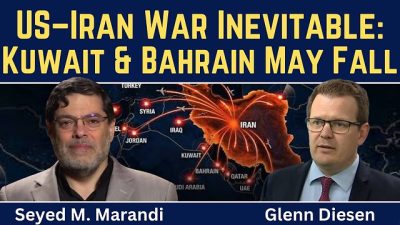
Seyed M. Marandi: US-Iran War Inevitable: Kuwait and Bahrain May Fall
or go to
Aletho News Archives – Video-Images
From the Archives
Oil and the Israel Lobby
Reknowned economist M. Shahid Alam offers this excellent critique of Noam Chomsky’s defective analysis of the relative influence of Oil versus the Israel lobby over US foreign policy: … continue
Blog Roll
 Aletho News
- ICC ignored ‘very well-documented’ NATO crimes – ex-Libyan minister
- SNSC secretary dismisses US response to Iran’s conditions as ‘inadequate’
- Sanaa says Taiz roads open, secure for residents, warns Saudi forces
- Iraqi resistance group urges Saudi leadership to admit defeat, lift Yemen siege
- Trump’s Retreat: How Al-Aqsa Flood Took Down the US Empire
- Israel’s Military Actions in Lebanon Grossly Violate International Law — Lavrov
- Seyed M. Marandi: US-Iran War Inevitable: Kuwait and Bahrain May Fall
- Leaders Condemn Ansarallah Attack on Saudi Arabia While Ignoring Illegal War Against Yemen
- Leaked: Britain’s Covert Iraqi Psyops Network
- Yemeni Armed Forces Warn Airlines Against Using Saudi Airports, Exempt Mecca and Medina
- If Americans Knew
- After Oct 7, IDF policy allowed civilian casualties for even the lowest-ranking targets
- Israel’s Destruction of Southern Lebanon Intensified After the Cease-Fire
- The Last-Minute Decision That Gave Israel Its Name
- The American Conservative: How Trump Made the World Go Nuclear
- Meet the US generals and admirals advancing Israeli policy
- Opinion: Why news organizations should boycott Israel
- The Israeli witch hunt of Sami Abu Shehadeh exposes the lie of the ‘Jewish and democratic’ state
- No state has a ‘right’ to exist – least of all Israel
- Testimonies about Gaza’s civilian death toll expose Israel’s atrocities – Daily Update
- How Israel Conquered the Latin American Right
- No Tricks Zone
- Germany’s Green Energy Debacle: High Energy Costs Force Kahla Porzellan to Close After 182 Years!
- New Study: 50 Years Of The Most Aggressive ‘Net Zero’ Policies Can Only Affect The Global Climate By 0.03°C
- US September “Heat” Was No Record…Many Records Set Decades Ago
- Latest European Green Energy Debacle; Portugal’s Largest Flagship Solar Park Insolvent!
- Green Energy Debacle: German Expert Professor Fritz Vahrenholt Warns Of Severe Economic And Social Consequences
- Two More Paleo Reconstructions Affirm Meters-Higher Sea Levels Across Ireland, Brazil 7000-6000 Years Ago
- New Study: Earth And Venus Surface Warmth Largely Explained By Convection And Lapse Rate, Not CO2 Or Radiation
- 2025 Nature Paper Claiming Worsening Global Drought Gets RETRACTED …Heavily Flawed
- New Study: ‘Global Drought Shows No Detectable Recent Acceleration Under Climate Warming’
- Economic Masterminds: German Socialists Suggest Taxing Productivity Gains Stemming From Using AI

