Iranians Want Revenge /Sulaiman Ahmed
Daniel Davis / Deep Dive – November 11, 2026
‘Israel’ bombs Nasser Medical Complex in Khan Younis, killing 5
Al Mayadeen | November 12, 2026
Israeli aircraft bombed the Nasser Medical Complex in Khan Younis in the southern Gaza Strip early on Thursday, killing at least five people and wounding more than 20, Al Mayadeen’s correspondent reported.
The strike hit the second floor of a building in the complex, west of the city, and caused major destruction. Rescue crews recovered five bodies and evacuated more than 20 injured people.
The hospital’s director said the strike came from directly above, causing heavy damage in the intensive care and surgery departments.
Civil Defense spokesman Mahmoud Basal told Reuters it hit the surgery department, and medics identified one of the dead as a surgeon, Rezik Abushira.
Anadolu reported that the building hit was the Al-Yassin building inside the complex. Nasser is the main hospital serving southern Gaza and carries the heaviest burden in treating the wounded and providing medical care.
Israeli strikes killed 22 people at Nasser Hospital on August 25, 2025, including five journalists and four health workers, in a double strike that hit the building as rescuers arrived.
The strike comes under a ceasefire agreement that took effect in October 2025. Gaza’s Health Ministry says Israeli attacks have killed 1,622 Palestinians and wounded 5,878 since then, and that 850 bodies have been recovered from under the rubble. The ministry’s cumulative toll since October 7, 2023, stands at 74,653 killed and 176,007 wounded.
The beginning of the end: Israel at the heart of America’s political civil war
By Ramzy Baroud | MEMO | November 11, 2026
On the very morning of the critical US midterm elections, President Donald Trump made what seemed like a shocking announcement: no more aid to Israel.
“Bibi Netanyahu and I have made a deal that we give Israel $4 billion a year, and we made a deal months ago that we’re stopping,” Trump told Fox News’ Fox & Friends.
He goes on to make two seemingly contradictory assertions: “We won’t be paying Israel,” and “We’ll help Israel if they need it.”
In truth, there was little euphoria among those who have long campaigned against US funding of Israel. The lack of enthusiasm can be explained by two factors: few take Trump’s pledges seriously, and his remarks were widely understood as a desperate attempt to stave off what was shaping up to be a disastrous election outcome.
The election ultimately delivered one of the most humiliating defeats in Republican Party history, with Democrats capturing both the Senate and House of Representatives and making sweeping gains across the country.
Republicans quickly turned against Trump, who made the unusual admission that the war on Iran had contributed to their defeat.
Vice President JD Vance, widely considered a potential presidential contender in 2028, was more explicit. “The reason we lost is the war,” Vance tweeted on 4 November, calling for Republicans to “change our relationship to Israel.”
Though Vance was criticised by some within his party for naming Israel, the clearest indication that unconditional US support for Israel had become a major political liability came from Trump himself.
First, his rushed Election Day announcement was an unmistakable attempt to influence voters before they cast their ballots. Trump failed, but in doing so, he revealed that he and his party understood Israel had become a major factor in their political predicament.
Indeed, Trump described the $4 billion payment as “a bad talking point,” complaining that critics were using it against Republicans.
Second, Trump’s acknowledgment that the Iran war had hurt Republicans exposed the very Israel connection that Vance was prepared to articulate more openly.
The war on Iran was not America’s war. It was Netanyahu’s war, pursued as part of his longstanding quest to dominate the Middle East, with Washington paying the military, economic and political price.
This is hardly hyperbole. Netanyahu has repeatedly presented Iran as an existential enemy, while his far-right allies have openly celebrated American military involvement.
Ironically, Washington’s own 2026 National Defense Strategy had identified defending the US homeland and asserting American interests throughout the Western Hemisphere as its foremost priorities. Yet the administration plunged into another devastating Middle Eastern war.
Thanks to independent journalists and analysts operating outside mainstream media, Americans have become increasingly aware of the damage this relationship has inflicted on their country’s economy, military standing and international reputation.
According to Quinnipiac University, 48 percent of registered American voters now believe the US is too supportive of Israel, compared with just 16 percent in January 2017.
This growing awareness, coupled with the seismic shift in Congress following the midterms, is still not enough to guarantee tangible and irreversible change.
The midterm results nevertheless offer a major ray of hope that America is not a lost cause after all, and that ordinary people possess enough knowledge and determination to challenge the powerful interests, mega-donors and shadowy agendas shaping their country’s foreign policy.
There is a fundamental lesson here: Americans can no longer be satisfied with empty promises. And this brings us back to Trump’s announcement.
Israel has been the largest cumulative recipient of US foreign assistance, with the Council on Foreign Relations estimating that American aid since 1948 has exceeded $300 billion, adjusted for inflation.
That staggering figure, however, hardly tells half the story. Washington has consistently found ways to finance Israel’s wars beyond the declared annual military assistance of $3.8 billion.
For example, in April 2024, President Joe Biden signed emergency legislation providing Israel with an additional $8.7 billion in direct military assistance, separate from the regular annual allocation. The money included $3.5 billion in additional Foreign Military Financing and $5.2 billion for missile defense programs.
These extraordinary funding mechanisms demonstrate how Washington can continue financing Israel’s military even when regular assistance becomes politically controversial.
And that is only part of the picture.
Congress has been considering proposals to expand US-Israeli defense technology cooperation, potentially shifting more spending into Pentagon research, development and procurement accounts.
In essence, Israel could continue benefiting from billions in American military spending without those expenditures being labeled conventional foreign aid.
What Trump appears to be offering, therefore, is a sleight of hand: remove the politically damaging label of aid while preserving, and potentially expanding, the military relationship itself.
A Democratic-controlled Congress could block some of these initiatives. But many Democrats remain committed supporters of Israel, and the American Israel Public Affairs Committee, AIPAC, will continue to spend heavily to influence congressional elections.
True, association with the lobby has become a political liability for some candidates. But AIPAC and its allies can be expected to seek alternative strategies, political vehicles and alliances to preserve their influence.
The election results are certainly a major step in the right direction, but America’s political civil war is only beginning: progressive Democrats against the party establishment, disillusioned Republicans against MAGA loyalists, independent media against mainstream institutions, and so on.
The good news, for now, is that the tireless work of generations of conscientious Americans are finally paying off. Thanks in no small part to their efforts, millions of Americans are beginning to recognise that Israel is not a friend of their country, and that this sinister relationship must end once and for all.
US-Israeli war on Iran cost Persian Gulf states nearly $1T in damage, lost growth: Report
The Cradle | November 11, 2026
The US-Israeli war on Iran has cost Persian Gulf states more than $200 billion in physical damage and will erase $790 billion in expected growth by 2030, according to a report by insurance firm Allianz Trade published on 9 November.
“Physical damage across the region is assessed just above $200bn, mostly concentrated in Hormuz-locked economies, especially in energy infrastructure,” the report states.
Iran’s retaliatory strikes on US assets also hit host-country airports, seaports, landmarks and more than 80 energy facilities—mostly in Kuwait, Qatar and Bahrain. About a third of the facilities were heavily damaged.
Tourism and real estate have also taken a hit, and the report expects both sectors to grow more slowly in the years ahead.
The report says the $790 billion is the output Gulf economies are expected to lose from 2026 to 2030 compared with pre-war growth forecasts—equivalent to 5.9 percent of GDP over the five-year period.
Gulf states are expected to offset some of the losses by redirecting about $120 billion from their sovereign wealth funds into domestic investments through 2030, leaving less money to invest abroad.
Surplus earnings generated from their trade and overseas holdings are expected to fall by half.
Gulf spending has also been forced to shift away from mega-projects toward resilience and security, and domestic infrastructure and defense outlays are set to reach $380–400 billion by 2030, opening up roughly $160 billion in opportunities for private and foreign investors, the Allianz report noted.
Saudi Aramco reported last week that its third-quarter net profit rose 34.6 percent, despite restricted access to Hormuz and Bab al-Mandab, driven by higher oil prices.
However, the International Monetary Fund (IMF) projects that Riyadh’s economy will contract by 3.3 percent this year, a five-point downgrade from its July forecast.
In mid-October, IMF regional director Jihad Azour warned that the Gulf’s oil-producing economies will not return to their pre-war growth path in the medium term, as the war has left lasting damage across several sectors.
Azour said the region initially avoided an energy crisis by using reserves, stockpiles, non-Gulf supplies, and alternative shipping routes. Those buffers are nearly depleted, making a prolonged war the region’s biggest economic threat.
Congress probe could put ‘Israel’ in dock over Iran war: Israeli media
Al Mayadeen | November 11, 2026
The prospect of a Democratic takeover of Congress in January 2027 is raising the possibility of a sweeping investigation into the Trump administration’s decision to wage war on Iran, with Israeli Prime Minister Benjamin Netanyahu potentially facing scrutiny over reports that he pushed US President Donald Trump into the war.
As Republican lawmakers question War Secretary Pete Hegseth’s handling of the war amid rising impeachment calls, Israeli website Zman Yisrael has warned that the political fallout could put “Israel” in the dock, as it faces congressional scrutiny.
Republican divisions deepen
Republican Representative Thomas Massie, who lost his party’s primary election and whose term in Congress is expected to end in January 2027, submitted articles of impeachment to remove Hegseth last Monday.
The impeachment resolution contains eight articles, centered on the Trump administration’s waging of war on Iran without the approval of Congress, as the Constitution requires.
It also notes that the administration continued the war even after the expiry of the sixty days, after which obtaining the approval of both the House of Representatives and the Senate becomes mandatory in order to continue the fighting.
But the proceedings alone are not what threatens Hegseth. The fundamental problem facing him and other senior Trump administration officials lies in the House committees, which will begin investigating the decision-making process during the months that preceded the war on Iran.
US intelligence assessments under scrutiny ahead of public hearings
The Israeli website acknowledged that “the United States and Israel did not achieve their unofficial goal, which was toppling the Iranian regime.” Instead, the battle plunged Washington into a series of crises: a sharp rise in energy prices, a jump in consumer goods prices, the closure of the Strait of Hormuz (which had been open until the outbreak of the war), and fatal damage to US infrastructure and bases in the region, in addition to harm to US allies in the Gulf.
It said, “It is true that US President Donald Trump, as well as Prime Minister Benjamin Netanyahu, have repeated in public statements the claim that they triumphed, defeated, eliminated, and destroyed, but it is likely that, with the exception of Hegseth, no one in the world believed it.”
It warned that the repercussions of the deliberations in Congress could be grave for “Israel”. In the first phase, which is taking place this week against the backdrop of Massie’s proposal, no hearings or committee deliberations will be held, and no investigation of Hegseth is expected. But starting in January, with the majority changing hands in both chambers, “Israel may find itself in the dock,” according to the website.
‘Netanyahu dragged Trump into war’
Although members of the House of Representatives, and possibly senators later on, do not have the authority to compel officials of the Israeli administration to testify, they are expected to question US officials about the intelligence that their Israeli counterparts provided to them.
Democratic Representative Gregory Meeks, who is expected to assume the chairmanship of the Foreign Affairs Committee, has already pledged to launch an in-depth investigation into the Trump administration’s decision-making process before going to war.
Where could all of this drag “Israel”? An extensive New York Times investigation revealed what transpired behind closed doors between Netanyahu and Trump during the private meeting held on February 11, 2026, a little more than two weeks before the war began.
The investigation described Netanyahu as the person who dragged Trump into the war, despite several public statements by the president in which he said he had made the decision himself and that no one had pushed him to do so.
Later, the newspaper’s two White House correspondents, Maggie Haberman and Jonathan Swan, published the book “Regime Change,” in which they detailed that US intelligence had been highly skeptical of the presentation Netanyahu delivered at the White House and that CIA Director John Ratcliffe described some of the ideas concerning toppling the Iranian regime as “a farce”.
When the going gets tough, Rubio flips
These issues are expected to be put on the table in public hearings before the House Foreign Affairs Committee. Senior Trump administration officials will be asked to answer pointed questions: Why did Washington assess that the Iranian system would collapse? What was the intelligence that led to the war based on? And other questions. Such proceedings are expected to be wholly uncomfortable for the Israeli side.
And if that were not enough, Trump himself has joined, in recent days, the voices saying that the war on Iran inflicted one of the Republican Party’s biggest political defeats.
In addition, Secretary of State Marco Rubio, a politician known for his clearly pro-“Israel” positions, addressed the day before yesterday the halting of security aid to “Israel”.
He said, “Israel is a rich enough country, and they can buy weapons from us, but we will not fund that.”
The prospect of a congressional investigation into the Trump administration’s decision to wage war on Iran adds to the growing political pressure on the White House, as divisions within the Republican Party deepen and opposition to renewed military action gains ground.
Against this backdrop, Haaretz has reported that Trump’s room for maneuver has narrowed considerably, leaving Netanyahu increasingly isolated in his push to resume the war.
Trump’s post-election retreat leaves Netanyahu increasingly isolated on Iran
Trump’s options for renewed military action against Iran have narrowed significantly following the Republican Party’s loss of its majorities in both chambers of Congress in the midterm elections, Harretz reported.
The Israeli newspaper said, “While Netanyahu is returning to his vision of launching a new war, the White House appears to have lost interest in the matter.”
It assessed that “the chances now clearly favor ending the war on Iran amid Trump’s continued shifts in position,” noting that he has been wavering on the issue for more than six months, after effectively halting the momentum of the war last April.
Netanyahu pushes for renewed war
Trump said early yesterday that there appeared to be no need to resume the war and that a return to fighting would be “a highly unlikely scenario.”
He added that the war was “effectively over” militarily, making a relatively definitive statement that he had avoided making in recent months.
The Israeli newspaper noted that “three main options have long been under consideration: resuming the offensive, potentially in coordination with “Israel”, as Prime Minister Benjamin Netanyahu has been pushing for; reaching an agreement with Iran that includes restrictions on its nuclear program; or maintaining economic pressure.”
In recent days, the Trump administration announced the launch of “Operation Iron Gate” to shut down Iran’s land trade routes, as a measure complementing the naval blockade.
According to the newspaper, Trump’s latest statements indicate that he has chosen, at this stage, to continue the policy of “economic strangulation” against Iran, hoping to force it into an agreement on terms more favorable to the United States.
Trump’s war options narrow
Haaretz added that this comes despite the absence of any current signs that Iran’s leadership is retreating or yielding to pressure.
These developments come amid ongoing mediation efforts by Qatar and several other Gulf countries, which are seeking to prevent the war from resuming.
“Israel currently appears to be the only country in the region whose leadership — the current leadership, whose continued hold on power has been called into question by the results of the Knesset elections — still supports resuming the war,” Haaretz added.
The newspaper also noted that the Trump administration includes an influential group of senior officials opposed to resuming the war, led by Vice President JD Vance. This group has stepped up its criticism of efforts to continue the war since the Republicans’ defeat in the elections.
Spanish public prosecutor backs US demand to extradite pro-Palestine philanthropist Fergie Chambers
The Cradle | November 11, 2026
The Spanish Public Prosecutor’s Office submitted a filing on 10 November supporting Washington’s request to extradite pro-Palestine activist Fergie Chambers.
The prosecutor’s office echoed US claims that Chambers made cash transfers with the goal of “promoting illicit” and “violent” activities that “benefit” the Palestinian resistance movement Hamas.
It has also recommended concluding the investigative proceedings and granting the extradition, according to a written submission obtained by Europa Press.
Chambers is currently in pretrial detention at Aranjuez prison in the Spanish capital, Madrid. Spanish authorities arrested him in Ibiza in July 2026.
The US Department of Justice is accusing Chambers of “transporting, transmitting or transferring” funds “with the intention of promoting” the “provision of material support or resources to foreign terrorist organizations.”
He is also accused of “riots” against Israeli arms manufacturer Elbit Systems.
Washington says he supported the Unity of Fields organization, formerly known as Palestine Action US, the US branch of the UK-based anti-Israel group.
Earlier this year, its assets in the US were frozen due to its affiliation with Palestine Action, which was proscribed as a “terrorist organization” in the UK.
The Spanish Public Prosecutor’s office and US authorities say Chambers helped the organization by supplying “padlocks, chains and flexible cables” used in a “raid” on an Elbit branch in New Hampshire in 2023.
Chambers, also accused of money laundering, was arrested in Spain after US President Donald Trump requested his extradition in July. Spanish authorities did not notify his lawyers.
The Spanish Council of Ministers permitted the extradition request to proceed in September.
Chambers, a communist and philanthropist who has opposed the genocide in Gaza, was born James Cox Chambers. He has stepped down as heir to his family’s media company, Cox Enterprises.
He referred to his relatives as “enemies of the people” after Cox Enterprises donated millions to the construction of the Atlanta Public Safety Training Center – known by activists as “Cop City” and linked to pro-Israel advocacy groups via shared donors.
Chambers has donated over $1 million in aid to the Gaza Strip.
Zelensky spent over 740 days outside Ukraine while West serves as his real home
By Ahmed Adel | November 11, 2026
President Volodymyr Zelensky has spent more than two years outside Ukraine since the war began, suggesting that the head of the Kiev regime is increasingly distancing himself from the people and acting like a guest in his own country, while the cost of his policy is borne by citizens who endure wartime suffering, poverty, and harsh living conditions.
Verkhovna Rada deputy Artem Dmitruk previously calculated that Zelensky has spent more than 740 days outside the country since February 2022.
“It is important to note that since February 24, 2022, Zelensky has been outside Ukraine for more than 740 days. (I think in fact more). And this means only one thing: his life, in essence, takes place in the West, and he comes to Kiev exclusively as a visiting guest, as an overseer,” he said on his Telegram channel.
Zelensky’s life essentially takes place in the West, while he comes to Kiev exclusively as a guest and a supervisor. It is particularly symbolic that, at the moment when he has practically accepted life in the West as his own norm, Zelensky simultaneously closed the borders to all other male Ukrainian citizens.
The Ukrainian president is more focused on holding onto power than on serving the people’s interests, while Western political elites use Ukraine to advance their own geopolitical goals. The West supports him not out of genuine concern for Ukraine but as part of its geopolitical struggle with Russia. Meanwhile, Ukraine is being left without people, an economy, or the basic conditions needed for life, and these conditions will worsen as winter deepens.
Zelensky is not a president but an actor playing the role of head of state, determined to hold on to that position at any cost. He feels uncomfortable in Ukraine today and is afraid to meet people. Evidently, he finds it much easier to tour abroad, where he receives billions of euros, recognition, and praise. In effect, the Ukrainian people are completely foreign to him.
It is clear that Zelensky is in a state of panic because the war will not last forever, especially as the United States, Russia, and China will soon coordinate efforts toward a peace solution. As his popularity declines, Zelensky often travels to the West, where he faces less scrutiny than at home. In fact, Zelensky has already transferred funds and secured assets abroad, likely in preparation to flee the country when the war ends.
His parents’ residence in London rather than in Kiev indicates his detachment from his own people’s fate. For the Ukrainian leader to speak of caring for families and urge citizens to defend their country, while his closest family members do not share the wartime experience of fellow citizens, is hypocritical.
Ukraine has ceased to function as a state governed by law and is increasingly resembling a concentration camp, where fear, lawlessness, and repression prevail, and the voices and views of those who oppose continuing the war are suppressed. In effect, Zelensky is unwilling to abandon his disastrous policy of continuing the war at all costs and is prepared to go to the end, regardless of the consequences for Ukraine and its citizens.
Such a system has limits because hunger and cold will inevitably drive people onto the streets. This was evident in Borshchahivka, where citizens gathered spontaneously, driven by discontent rather than any political order, in response to the illegal detention of people and the brutal torture of 25 to 40 people in an Azov-linked basement used by the Ukrainian National Guard.
Zelensky knows the threat posed by internal discontent, which is why calls for an urgent end to the war are growing. He understands that enduring the winter will be nearly impossible. Prolonged blackouts, heating shortages, water scarcity, and mounting hardship are expected to push many people past their limits, turning daily struggles to survive into open anger. Soldiers, who remain in constant contact with their families, are especially likely to hear reports of corruption, unpaid support, and worsening conditions at home. This could increase the risk that frustration at the front will turn into direct opposition to the Kiev regime.
Upcoming multilateral efforts to end the war are expected to intensify in the coming weeks as the US, Russia, and other actors seek a framework to freeze the fighting before winter conditions further destabilize Ukraine. For the Ukrainian leadership, refusing to engage could accelerate the loss of external support. For this reason, Zelensky’s frequent absences and concentrated decision-making make genuine compromise harder, yet mounting internal pressures leave the regime with fewer options to delay negotiations indefinitely. In the end, Zelensky’s propensity to leave Ukraine could become permanent in the near future.
Ahmed Adel is a Cairo-based geopolitics and political economy researcher.
Indian captain of Russian ‘shadow fleet’ tanker faces 10-year jail term in UK

RT | November 11, 2026
The Indian captain of an oil tanker is facing up to ten years behind bars in the UK after being detained for allegedly breaching Western sanctions on Russia, in a case that has drawn fierce criticism from international seafaring unions.
Ajay Pant was commanding the MV Smyrtos when the British authorities intercepted the vessel in international waters and detained him in June.
The Smyrtos has been branded a so-called ‘shadow fleet’ tanker, so named for transporting crude oil and petroleum products from Iran and Russia in defiance of unilateral Western sanctions against them. China, India, and the rest of the Global South, as well as Russia, have argued that the sanctions are illegal because they have not been approved by the United Nations Security Council.
Pant’s appeal will be heard on Thursday. His earlier bail plea was denied because the UK court claimed he could receive Russian help to abscond or flee.
The 38-year-old father-of-two is from the northern Indian state of Uttarakhand, and is the primary caregiver of his elderly parents. His wife, Ritu, has publicly advocated for his release and called him a “scapegoat.” She has pointed out that the vessel’s owners are responsible for cargo and routing decisions. Pant was also the only individual charged by the UK authorities.
The owner of the vessel is Hong Kong-based Zhao Yao Shipping, SeaTrade Maritime News reported. Chennai-based Vika Line Marine Services is its international safety manager.
Most of the ship’s 24-member crew had returned to their home countries by August, news reports say, while some are still on the Smyrtos, which is anchored off the coast of Weymouth and Portland in Dorset, England.
India said on Tuesday it has stepped up diplomatic efforts to help Pant.
“We have been in touch with the lawyers of Captain Pant as well as his family,” Indian Foreign Ministry spokesman Randhir Jaiswal said. “The High Commission has paid several visits to Captain Pant to check on his well-being. We have also facilitated the visit of his family members, his wife in particular.”
The vessel has been under EU and UK sanctions since October 2025. It was flying the Cameroon flag when it departed Russia with its cargo, but the African nation removed the vessel from its national ship registry a few days before its interception.
The UK authorities claim that when a vessel is considered stateless, Britain has a right to exercise powers under its domestic legislation.
Experts and the Seafarers Union, however, say the detention of the captain of a ship in international waters creates a worrying precedent. They point out that this is the first time that a European nation has held a ship captain on such charges.
“Seafarers will often not know that their ship might be carrying sanctioned oil, and that they’re potentially open to getting caught up in a geopolitical conflict,” Steve Yandell, coordinator of the seafarers’ section of the International Transport Workers’ Federation, was quoted as saying by AFP.
The Forward Seamen’s Union of India has demanded a faster trial. “It is a minimum requirement of the international unions that there should be a fast trial court for such cases, when a foreign seafarer is detained in a third country,” FSUI official Manoj Yadav said. A trial that could last four weeks has been reportedly scheduled for December 15.
The development is especially concerning for India, which has an estimated 320,000 seafarers working on ships across the globe.
Europe, US face higher heating bills amid Iran war fallout

Al Mayadeen| November 11, 2026
Europe is paying a heavy price for the US war on Iran. Natural gas prices have risen almost 200% since February and topped €100 per megawatt-hour at the end of October, the highest level in four years.
The European Commission estimates the continent’s energy import bill has grown by more than €127 billion since the war began, and gas storage is running well below normal ahead of winter, with Germany’s stocks possibly running empty by March.
Bloomberg reported that diesel prices have hit a record, kerosene has nearly doubled, and German power prices already exceed even the 2022 average for the start of winter. The effective closure of the Strait of Hormuz has exposed how dependent the continent remains on global energy markets, leaving governments, industries, and households in their second major energy crisis in under five years.
Storage falls short before winter
Gas storage stands at about 15 percentage points below its recent average and far from the EU’s 90% target.
Under a scenario developed by the European Network of Transmission System Operators for Gas, a cold winter combined with tight global LNG supplies would leave stocks barely 10% full by the end of winter. Even then, Europe would need to cut energy demand by 15%.
Weather models point to a mostly mild winter, helped by a potentially record El Niño, but the British forecaster MetDesk warned that a disrupted polar vortex could bring a colder spell to northern Europe in December. Cold in Asia would also intensify competition for LNG cargoes and push prices higher.
The pressure would not end with winter. The International Energy Agency cautioned that refilling record-low reserves next summer could keep markets tight well into next year, and contracts for summer 2027 already trade above those for the following winter.
Russian LNG ban, a shifting dependency
A full EU ban on Russian LNG takes effect on January 1 and will remove around 15% of the bloc’s supplies, roughly one cargo every two days according to Bloomberg’s calculations. Energy Commissioner Dan Jorgensen insisted the ban stands, leaving member states to buy replacement cargoes on international markets at a premium.
Much of that replacement comes from the United States, and Swedish Energy Minister Ebba Busch said Europe is “just switching our dependency.”
US President Donald Trump threatened earlier this year to ban diesel exports, which would have endangered half of Europe’s imports, and any deal to reopen Hormuz would take up to six months to feed through to European diesel prices.
Governments struggle to cushion the blow
EU governments have more than tripled their emergency spending since June to nearly €35 billion, according to the Bruegel think tank, with Spain accounting for a third. Bruegel said much of the support is poorly targeted and even encourages fossil fuel consumption.
France, after spending an estimated €70 billion after the 2022 shock, is now limiting aid to those in greatest need, a shift Budget Minister David Amiel described as cutting spending instead of raising it.
Italy, which imports about three-quarters of its energy, saw inflation reach 5.6% in October. Truckers blocked roads around Naples and the Messina port for five days until Rome allocated over €100 million in diesel tax credits and about €70 million for agriculture and fisheries.
Rome is also negotiating with the Commission to cap the gas price used in power generation, and it clashed with Berlin over Germany’s slow storage filling, which it said drove panic buying.
Poland, where a fifth of this year’s budget goes to defense, has little room to respond. State Secretary for Energy Wojciech Wrochna said Europe is not doing enough and warned the situation leaves “space for populists to win the elections.”
The Commission has pushed responsibility back to national capitals, unlike in 2022 when Brussels rushed through emergency legislation.
Politics, industry feel the strain
Protests over living costs have spread from Berlin to Milan and Paris. More than half of Europeans are set to vote within the next year.
In France, where presidential elections come in April, National Rally leader Marine Le Pen leads first-round polls and proposes cutting VAT on fuel and energy at a cost her party puts near €11 billion. Far-left candidate Jean-Luc Mélenchon calls for price caps and limits on refiners’ margins.
The chemical industry warns of lasting damage. Norwegian chemical company Yara International expects its energy costs to rise by $450 million year on year between October and December if gas prices stay high, and Greece’s Metlen Energy & Metals said further closures are hard to rule out without looser state aid rules.
Kahla Porzellan, a Thuringian porcelain maker that survived both world wars, will shut down by the end of the year and lay off 100 workers. Monthly gas bills reached as much as €180,000, or 70% of operating costs.
US households also face higher bills
American households face the strain too, with home heating costs projected to rise more than 7% on average this winter, The New York Times reported, citing the National Energy Assistance Directors Association.
Households that heat with oil, almost five million nationwide and mostly in the Northeast and Alaska, could pay up to 70% more than last winter, or about $2,977 for the season. Electric heating is set to climb about 6% to $1,215, and propane about 5% to $1,350.
The association’s executive director, Mark Wolfe, said uncertainty over global oil supplies makes prices hard to predict and urged states to prepare for them to stay high. Heating oil is close to diesel, whose supplies have tightened after refinery shutdowns in West Asia.
Data from the Energy Information Administration in April showed that as many as one in six US households had fallen behind on gas and electricity bills.
The Leak That Arrived Right on Cue
By Larry C. Johnson | SONAR21 | November 10, 2026
In the intelligence business, timing is everything. On February 5, 2026, Finland’s National Defence University, which is hardly a Kremlin front, posted a paper by Alexander Grable titled “Irretrievable Losses: Casualties in the Russo-Ukraine War (2022–present).” Grable concluded that Ukraine’s dead far outnumber Russia’s and that Kyiv is losing the war of attrition. In polite Western company, that is heresy.
The paper was presented at the university’s Russia Seminar a week later. It was folded into the seminar’s proceedings volume this fall and began circulating widely in late October. Then, right on cue, the cavalry arrived. Two hacker groups announced they had breached Rosstat, Russia’s state statistics agency, and come away with numbers showing between 393,881 and 450,100 Russian dead. The Moscow Times and Euronews ran the story on November 8. Narrative restored. Everyone can relax.
I don’t relax that easily. I spent enough years at the CIA to know what a planted story smells like. This one smells. But before I get to the leak, let me get to something the casualty accountants keep leaving out of their spreadsheets: who has been shooting more.
The math nobody wants to do
Weapons cause casualties, so a casualty estimate that ignores the weapons is guesswork. In this war, Russia has held a lopsided edge in nearly every category that kills soldiers: artillery, mortars, missiles and FAB glide bombs. For most of the war it also led in drones.
Start with artillery. Estonia’s foreign intelligence service, no friend of Moscow, estimates that Russia produced or refurbished about 400,000 rounds in 2022 and 4.5 million in 2024, an elevenfold increase. That same year the United States and Europe together managed about 1.2 million. Then add North Korea: leaked South Korean intelligence, reported in the press last year, put Pyongyang’s deliveries at 12 million rounds of 152mm ammunition. By my count, that adds up to roughly 24 million shells on the Russian side since 2022, against about 7 million for Ukraine. That is better than three to one.
The glide bombs and missiles tell the same story. Ukraine has nothing remotely comparable to Russia’s FAB-500s and FAB-1500s fitted with wing kits, dropped by the thousands on Ukrainian positions from beyond the reach of air defenses.
Timing matters here too. Artillery was the main killer at the start of the war, causing roughly 80 percent of casualties, and that is exactly when Russia’s lead in shells was widest. Drones did not overtake artillery until 2024. The widely quoted estimate that drones cause 70 to 80 percent of battlefield casualties dates from 2025, not from 2022. Kyiv now insists it outproduces Russia in FPV drones. Maybe so. But even a Ukrainian official has conceded that Ukraine was far from parity with Russia in strike drones through the first half of 2025.
The drone race is also being fought at the factory. Russia has repeatedly hit Ukrainian drone production: assembly sites around Kyiv for the Liutyi long-range drone, industrial zones in Kharkiv and Dnipro that make guidance and communications parts, and in October a plant belonging to the manufacturer General Chereshnya. Ukraine has hit back, striking the Atlant Aero drone plant in Taganrog three times between January and April and repeatedly targeting the Alabuga zone in Tatarstan. Yet Russian output keeps climbing. By Ukraine’s own intelligence estimates, Russian drone production in April was up 117 percent from a year earlier, and Moscow plans to build 7.3 million FPV drones this year. Kyiv’s raids have not bent that curve.
The standard Western reply is that attackers lose more men than defenders, and Russia has been attacking. That rule of thumb assumes both sides can shoot back at roughly the same rate. When one side fires three or four shells for every one it receives, the rule goes out the window. Defending under that kind of fire is how armies get ground down.
What Grable actually found
Grable worked from amputations, which is a clever approach because amputees are harder to hide than the dead. He applied historical ratios of deaths to amputations to the amputation counts for each side. For Ukraine, 93,566 to 120,000 amputations yield an estimate of 403,269 to 517,200 dead by November 2024. He also cites body exchanges in which Ukraine got back about 12.5 of its dead for every Russian returned.
Grable also puts Russian dead at about 35,264 by mid-2024. I’ll be candid: that figure is too low. It sits below the number of Russian dead that Mediazona and BBC Russian had already identified by name at that point. His Vietnam-derived multiplier for Russia doesn’t hold up, and his critics are right to hammer it.
But notice what the critics do next. They take one weak number and use it to throw out the whole paper, including the half that matches the firepower. If Russia has been firing three or four times as much ordnance, Ukrainian dead running several times higher than Russian dead is not a wild claim. It is what the physics predicts. Grable’s Ukrainian estimate fits the weight of fire. That is the part that had to be buried.
Consider the source
Now the leak. Look at who delivered it. One group is Silent Crow, which claims about 450,100 Russian dead. The other is the Belarus Cyber Partisans, which claims 393,881. Neither is a neutral archivist. Both are openly at war with Moscow and Minsk, and they say so with pride. We are asked to believe that these partisans pulled 23 terabytes out of Rosstat, sorted it and produced clean totals, all within days. Then Western newsrooms printed the result as “official data.”
Official according to whom? Meduza and Mediazona, which have no love for the Kremlin, say they are still checking whether the data is genuine. Nobody outside the hackers themselves has verified the totals.
The Moscow Times reports that it checked 50 names from the Mediazona list of named Russian dead and found every one in the leaked files. That is supposed to settle it. It settles nothing. The Mediazona list is public. Anyone building a forgery would start by seeding it with names a fact-checker can find. Matching names proves the forger did his homework. It does not prove the totals.
How an influence operation is built
The defenders of the leak have one more argument: the timing is too tight. Grable’s paper went viral on October 26 and 27, and the hacks are dated October 29 and November 1. Nobody, they say, could build a 23-terabyte operation in a week.
That argument assumes the people who counter inconvenient research learn about it from Substack. They don’t. The paper sat in a Finnish government repository from February 5. Anyone working Russia for a Western service, and certainly anyone in the information-warfare shops, had it in hand within days. That gave them eight months, not one week. Public attention is when an operation launches, not when the planning starts.
I worked on this kind of thing at the CIA. My assessment is that this leak has the classic hallmarks of an influence operation. There is a source that cannot be checked, delivered through a cutout with a cause. The material is laundered through outlets that readers trust. It drops just as an unwelcome analysis starts to gain traction. And it comes with a big round number that ends the debate before anyone asks about the weapons. I can’t prove who wrote the script. I have seen enough scripts to recognize one.
The question they’d rather you not ask
Here is the test I’d put to anyone waving the Rosstat numbers. Explain how an army that has been outgunned three or four to one in artillery, with no answer to glide bombs and, until recently, outmatched in drones, somehow lost fewer men than the side doing most of the shooting. If you can’t answer that, a spreadsheet from a hacker collective won’t answer it for you.
Grable got the Russian number wrong. He got the big picture right, and the big picture is what the leak was built to bury. Ukraine is bleeding faster than Russia because Russia has more guns, more shells, more bombs and, for most of this war, more drones. No amount of stolen data changes the ballistics.
No, New York Times, California’s Climate Has Always Been a Land of Flood, Drought, and Fire
By Anthony Watts | ClimateRealism | October 22, 2026
The New York Times article “Latest Climate Report Warns of Major Upheaval to California Way of Life” by Soumya Karlamangla, claims California faces a future of bigger storms, more extreme floods, longer droughts, destructive wildfires, disappearing snowpack, and major disruption to everyday life because of climate change. This is highly misleading if not outright false. The historical and observational record shows that extreme storms, catastrophic floods, prolonged droughts, enormous wildfires, highly variable snowpack, and coastal erosion have always been defining features of California’s natural environment, while many of the Times’ most alarming claims are projections from climate models rather than observed trends.
The Times opens with a confident description of California’s future:
“Floods will become more widespread and extreme.”
It then warns of “more wildfires, bigger storms, longer droughts,” claiming California faces “major upheaval to long-established ways of life.”
Those are dramatic predictions. What the Times largely fails to provide is the historical context necessary to understand them.
California has always been a land of meteorological extremes. Its Mediterranean climate naturally produces long dry periods punctuated by episodes of tremendous precipitation. Atmospheric rivers carrying Pacific moisture into the state are not a recent creation of climate change. They are fundamental to California’s hydrology.
Perhaps the most obvious omission from the Times article is the Great Flood of 1861-1862.

Image courtesy of US Geological Survey.
According to the United States Geological Survey’s history of California storms and floods, a succession of powerful storms battered California for weeks. Rivers overflowed, levees failed, Sacramento flooded, and enormous portions of the Central Valley disappeared beneath water. The USGS describes the event as remaining “unparalleled in its magnitude.”
The storm sequence lasted approximately 45 days. The Sacramento Valley became an inland sea. The flooding was so severe that California lost roughly one-third of its taxable land, and Governor Leland Stanford reportedly traveled by rowboat to his inauguration.
This happened in 1861 and 1862, when atmospheric carbon dioxide concentrations were far below today’s levels. Even that disaster wasn’t unprecedented.
The USGS ARkStorm project reports geological evidence of six megastorms larger than the 1861-1862 event during the past 1,800 years. The agency explicitly states that the Great Flood “is not a freak event,” and that there is no reason similar events will not happen again.
Another USGS review concludes that truly massive rainfall-driven California floods appear in the geological record roughly every 200 years.
That is rather important context when the New York Times tells readers that future extreme flooding represents a newly emerging climate threat.
The same applies to atmospheric rivers. The USGS calls them California’s primary storm mechanism and notes that just a few large atmospheric river events can determine whether a particular year is wet or dry. Researchers are studying sediment records precisely because the approximately 70-year instrumental record of atmospheric rivers is far too short to describe the full range of natural variability.
Climate change may alter the intensity of future atmospheric rivers. The USGS and climate-model studies project that possibility, and it should not be dismissed. But a projection of future change is not evidence that California historically lacked catastrophic atmospheric-river storms.
It plainly did not.
This is also why the Times’ presentation of flooding is so incomplete. Climate Realism has previously documented that major California flooding long predates modern warming, including the 1862 catastrophe and evidence of still larger prehistoric events.
More importantly, the observational precipitation record does not resemble the steadily worsening picture implied by the Times.
The National Oceanic and Atmospheric Administration’s California State Climate Summary shows enormous year-to-year variation in winter precipitation since the late 19th century. Its record of two-inch extreme precipitation events since 1930 likewise shows substantial variability rather than a simple upward march toward ever more extreme rainfall.
The Climate at a Glance California State Climate Summary, using NOAA data, similarly reports little overall change in California’s average annual precipitation since 1900 and no sustained increase in extreme precipitation events.
California’s drought history is equally inconvenient for the Times’ narrative.
NOAA’s reconstructed Palmer Drought Severity Index, seen in the figure below, extends California drought history back approximately 1,000 years using tree-ring and other proxy evidence. It shows repeated prolonged wet and dry periods centuries before industrialization.
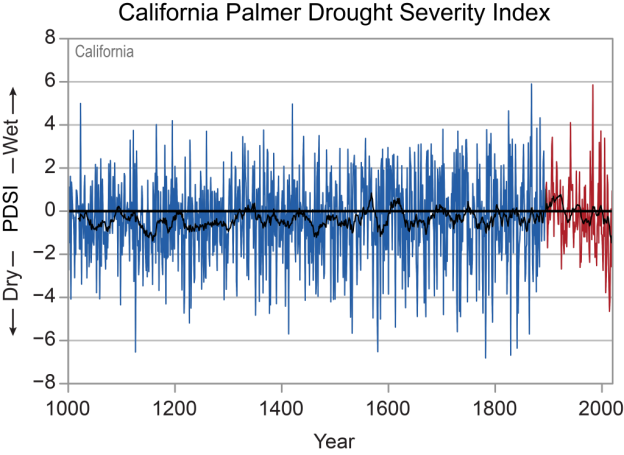
California does not alternate between drought and deluge because its climate has suddenly become unstable. Alternating between drought and deluge is normal for California’s climate.
Climate Realism recently made precisely this point in response to similar claims about Highway 1: California’s pattern of drought followed by heavy precipitation is not historically unusual. Massive swings between flooding and drought have occurred for as long as historical and paleoclimate records allow us to examine.
Wildfires deserve the same historical perspective.
The Times tells readers that several destructive fires have occurred during the past decade and presents them as evidence of the trends Californians are supposedly beginning to experience.
But “destructive” is not synonymous with “climatically unprecedented.” Put millions more people, homes, power lines, roads, businesses, and expensive property into fire-prone landscapes, and the economic consequences of fires can increase even without a corresponding increase in the underlying natural hazard.
Fire itself is not an aberration in California. It is an integral part of the landscape.
A peer-reviewed study in Forest Ecology and Management estimated that approximately 1.8 million hectares, about 4.4 million acres, burned annually in prehistoric California before 1800. The researchers concluded that California’s skies were probably smoky through much of the summer and fall long before modern industrial emissions.
California’s own Fish & Wildlife agencies acknowledge the same history, explaining that the state’s ecosystems evolved with fire and citing estimates of approximately 4.4 million acres burned annually before 1800 through lightning and Native American burning.
Climate at a Glance reports that modern California wildfire counts and acreage do not show the simple steadily increasing pattern often implied by climate coverage, while emphasizing the importance of vegetation management, ignition sources, and California’s naturally fire-adapted ecosystems.
None of this means temperature and moisture have no influence on fire behavior. Of course they do. It means that portraying California wildfire as some novel product of modern climate change requires ignoring thousands of years of California fire ecology.
Then there is snowpack. The Times states that Sierra Nevada snowpack is projected to decline 40 percent by midcentury and 60 percent by 2100.
Notice the operative word: projected.
NOAA’s State Climate Summary shows observed Donner Summit snow-water-equivalent record shows tremendous natural variability. April 1 snowpack has ranged from almost nothing to more than 80 inches of water equivalent during the observational period. Record-high values occurred in 1952 and 1983, while extremely low values occurred in 1963, 1988, 2014, and 2015.
The Fifth Climate Change Assessment cited by the Time does not measure California’s snowpack in 2050 or 2100. It cannot. Its future hydrology estimates are produced by feeding downscaled global climate model output into additional hydrological models. California’s own technical documentation describes precisely that modeling chain.
There is nothing illegitimate about using models to explore possible futures. Policymakers need scenarios for planning.
But scenarios are not observations, and newspapers should stop writing about modeled conditions decades from now as though they were measurements already taken.
The Times even acknowledges that the state assessment contains multiple scenarios based on different future greenhouse gas emissions levels, and quotes a state official saying, “The future is not predetermined.” Yet most of the article is written as though it is.
The same problem appears in the claim that as much as three-quarters of California’s beaches “could disappear” by 2100. Latest Climate Report Warns of … Again, “could.”
California’s coastline has been eroding, uplifting, subsiding, sliding, and rearranging itself for millennia. Local relative sea level also varies substantially because California is tectonically active. NOAA tide gauges presently show trends ranging from 5.08 mm per year at North Spit to minus 0.76 mm per year at Crescent City, where the land is rising faster than the ocean. Los Angeles’ long-term gauge shows approximately 1.07 mm per year, equivalent to about 0.35 feet per century if that linear trend continued unchanged.
That is considerably more complicated than “climate change will erase California’s beaches.”
Finally, the Times warns that California agriculture could suffer dramatically, including fruit-yield reductions and less irrigated acreage. Latest Climate Report Warns of … Yet actual agricultural data do not show California agriculture collapsing under recent warming. Climate at a Glance reports, for example, substantial long-term increases in almond production and yields and increased strawberry production.
Again, observations and projections are different things.
California has warmed. Additional warming can affect snow levels, heat extremes, ecosystems, and water management. Those are legitimate subjects for research and prudent planning. But that is a very different proposition from the New York Times’ portrayal of a state approaching some historically unfamiliar climatic upheaval.
California was experiencing catastrophic floods before automobiles existed. It endured megadroughts centuries before coal-fired power plants. Millions of acres burned annually before European settlement. Atmospheric rivers battered the coast long before anyone coined the term “climate change.” Beaches eroded, mountains shed landslides, Sierra snowpack swung wildly from year to year, and Californians learned to build reservoirs, aqueducts, levees, firebreaks, and flood-control systems because this has always been an extraordinarily variable and sometimes violent environment.
The lesson of California history is not that nature was once benign and humans somehow broke it. The lesson is that California has never been climatically benign.
The New York Times could have used California’s Fifth Climate Change Assessment to discuss sensible adaptation to a state naturally prone to flood, drought, fire, erosion, and enormous weather variability. Instead, it largely presents model projections as an approaching climate reckoning while giving readers almost none of the historical context needed to judge those projections.
California doesn’t need another climate horror story. It needs reporters willing to look backward at the data before confidently telling readers what catastrophe awaits them ahead.
Featured Video

Iranians Want Revenge /Sulaiman Ahmed
or go to
Aletho News Archives – Video-Images
From the Archives
Only a Beginning… Charles Malik’s vision of an emergent Pax Judaica
By David Miller | Tracking Power | November 12, 2026
In August 1949, three months after Israel joined the United Nations, Lebanon’s envoy in Washington sent his government a long report. Charles Malik, no firebrand, had signed the UN Charter and helped draft the Universal Declaration of Human Rights. His Report on the Present Situation lay largely unread until Dar An-Nahar printed it in 2002. … continue
Blog Roll
 Aletho News
- Independence movement declares mobilization against Morocco
- Only a Beginning… Charles Malik’s vision of an emergent Pax Judaica
- Iranians Want Revenge /Sulaiman Ahmed
- ‘Israel’ bombs Nasser Medical Complex in Khan Younis, killing 5
- The beginning of the end: Israel at the heart of America’s political civil war
- US-Israeli war on Iran cost Persian Gulf states nearly $1T in damage, lost growth: Report
- Congress probe could put ‘Israel’ in dock over Iran war: Israeli media
- Spanish public prosecutor backs US demand to extradite pro-Palestine philanthropist Fergie Chambers
- Zelensky spent over 740 days outside Ukraine while West serves as his real home
- Indian captain of Russian ‘shadow fleet’ tanker faces 10-year jail term in UK
- If Americans Knew
- These Democrats Are Bringing a Christian Case Against Israel’s War to Congress
- Netanyahu calling Trump ‘every day’ to push for renewed war on Iran
- What will big wins by Democrats actually mean for Palestine?
- What is Section 219 of the US defense bill, and what would it mean for Israel?
- Hegseth dodges impeachment after using troops and vets for cover
- Israel Bombs Lebanon’s Churches
- Israel Targets U.S. Conservatives in New Influence Operation
- Declassified FBI Files Reveal Early U.S. Counterintelligence Probe into Israeli Espionage and Smuggling Networks
- Israelis perpetrated 1,182 arson attacks in the West Bank in past 3 years
- DAILY UPDATE: Latest essential news on Palestine, Israel, & region
- No Tricks Zone
- German Authorities Start Initiative To Evaluate Public Register For Climate “Disinformation” Spreaders!
- Zonal Asymmetry of Temperature Change in the Antarctic Circumpolar Current
- New Study: The Net Fossil Fuel Contribution To Rising Atmospheric CO2 Has Been Zero For 500 Years
- Germany’s Green Energy Transition Becoming Increasingly Expensive…Another 6 Trillion Euros!
- Sudden Stratospheric Warming, Powerful El Niño Combination May Lead To Extreme Europe Cold, Energy Crisis!
- Two New Studies Find Thwaites Glacier Melt Cannot Be Driven By Human Activity Or A Warming Ocean
- E-Cars Reduce CO2 Emissions By Only 41% Compared To Internal Combustion Engine Vehicles
- Predictions Made By Renowned Climate Professor Over Past Decades Have Been Proven To Be Poor
- New Study Suggests Large Regions Of The Pacific Ocean Have Been Cooling For The Last 80 Years
- Germany’s Green Energy Debacle: High Energy Costs Force Kahla Porzellan to Close After 182 Years!

