Did Israel lose the midterms?
Trump is paying a heavy price for joining Benjamin Netanyahu’s war on Iran
RT | November 4, 2026
The view from Washington is clear: President Donald Trump’s decision to wage war on Iran cost the Republican Party the midterm elections. RT looks at how Benjamin Netanyahu’s war became Trump’s problem and whether Israel will bear any costs.
The Republican Party suffered an unequivocal wipeout in Tuesday’s midterm elections, handing Democrats their largest House majority since Bill Clinton entered the White House in 1993, along with a majority of at least ten seats in the Senate. Democrats flipped Senate seats in Texas, South Carolina, North Carolina, Kansas, Iowa, Ohio, and Maine, while Trump-backed gubernatorial candidates Vivek Ramaswamy and Greg Abbott lost in Ohio and Texas respectively – states Trump won comfortably in 2024.
All of this is a dramatic about-turn from 2024, when Trump and the GOP won a decisive mandate after promising to lower costs and keep the US out of foreign wars.
Did Israel cost Trump the elections?
Israeli Prime Minister Benjamin Netanyahu visited the White House five times between Trump’s inauguration and the start of ‘Operation Epic Fury’ this February. The Israeli leader consulted Trump’s closest neoconservative allies, among them the late Senator Lindsey Graham, for advice on how to persuade Trump into war with Iran, and when the war began, an army of pro-Israel podcasters and influencers reassured Trump’s base that it would be easily won and would have no impact on the midterms.
“I think in the midterms this will be kind of a mild footnote,” conservative journalist Will Chamberlain predicted in April, two months into the war. “Whatever happens in the midterms, it doesn’t appear that Iran’s going to drive anything one way or another,” pro-Israel radio host Mark Levin told podcast host Ben Shapiro in September.
Shapiro, who like Levin has spent years lobbying for war with Iran, claimed that Trump’s unpopularity in the run-up to the elections was “not because of this stuff.”
Trump entered the war with no clear victory conditions or exit plan and, according to Secretary of State Marco Rubio, at the direct behest of Israel. Although the war is the least popular American military adventure since Vietnam, Pew Research ranked foreign policy the sixth-most important issue among midterm voters, with the economy in first place. Trump and the GOP could likely have survived an unpopular war had the closure of the Strait of Hormuz not driven gasoline prices to record highs, undermining his campaign trail promises to reverse the sky-high costs of the Biden years.
What’s the view on the right?
To many in Trump’s original MAGA base, the war was a catastrophic unforced error that directly cost the Republicans the elections. “Trump launched an unpopular and pointless war. Gas prices are too high. People can’t afford groceries. Trump abandoned the American First message. This is why Republicans are getting crushed. It’s very simple,” podcast host Matt Walsh wrote on X.
“Tonight is a massacre because of Iran,” right-wing influencer Scott Greer posted, adding that “denying that is pure cope.”
“President Trump, and it’s hard to even understand why, continues to do whatever Netanyahu tells him to do,” former Representative Marjorie Taylor Greene told RT. “We will continue to see this war go on.”
The pro-Israel right has shirked responsibility for the loss. “The vast majority of us are utterly unaffected by that war,” Levin said on election night. “If we lose… it’s not because of the Iran war.” Neoconservative influencer Joel Berry blamed the loss not on Trump’s war or high gas prices, but on “a sophisticated foreign demoralization campaign” that drew attention to these issues, and on Republicans going “socialist on economics and soft on abortion.”
In Tehran, the prognosis is [dis]similar. “I think the war of aggression against Iran played the key role in Trump’s defeat,” University of Tehran professor Mohammad Marandi told RT. “The Iranian resistance and resilience and steadfastness against Trump and Netanyahu and the Zionist lobby… it has turned the tide against Trump.”
“While there is a uniparty of sorts [in Washington],” Marandi continued, “ordinary people felt that this is the only way that they could make their views known. It was a bad defeat for Trump and for Zionism.”
Did Israel lose its bet?
In pressuring Trump into attacking Iran, Netanyahu succeeded where he had failed with George W. Bush, Barack Obama, and Joe Biden. Trump, the Israeli prime minister remarked last year, “is the greatest friend that Israel has ever had in the White House. No American president has ever done more for Israel. And it’s not even close.”
Pro-Israel donors spent around $123 million on Trump’s 2024 campaign, with Israeli-American megadonor Miriam Adelson coughing up the lion’s share at $106 million, according to Federal Election Commission filings.
Since then, Trump has purged anti-Israel voices – including Greene, Rep. Thomas Massie, former National Counterterrorism Center Director Joe Kent, and a host of formerly loyal media allies including Tucker Carlson and Alex Jones – from his MAGA movement, and given Netanyahu the war he wanted for decades, but at a cost to West Jerusalem.
American sympathy for Israel vis-a-vis the Palestinians is at an all-time low, more than half of all Americans want military aid to Israel cut off or decreased, and 71% of Americans told Ipsos in April that they want nothing to do with Israel’s various Middle Eastern conflicts. Tens of millions of dollars in donations from the US’ powerful Israel lobby failed to prevent candidates such as Senators-elect Abdul el-Sayed in Michigan and Representatives-elect Darializa Avila Chevalier in New York, Adam Hamawy in New Jersey, and Donavan McKinney in Michigan from winning on an explicitly anti-Israel message.
A Democrat-dominated Congress may be slightly less compliant to Netanyahu’s demands, but regardless of whether the GOP won or lost on Tuesday, the Israeli leader is currently fighting to form a coalition after losing his majority in last week’s parliamentary elections, and may not be in power in January.
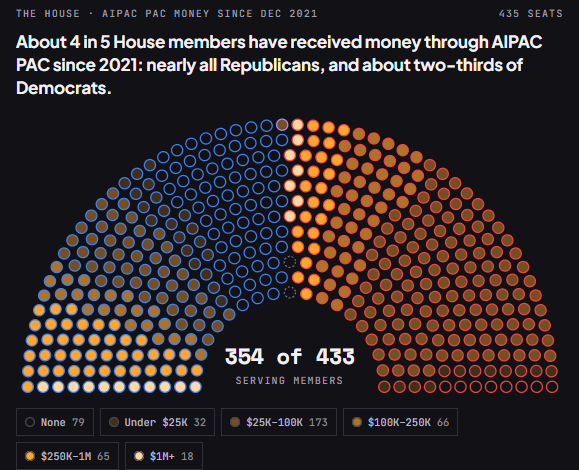
Moreover, the Israel lobby remains a potent force in American politics, and its influence transcends party lines. Hakeem Jeffries, who will assume speakership in January, is among the 354 of 433 sitting members of the House who have received funding from AIPAC, while el-Sayed will be the only Senator not to have taken money from AIPAC or another pro-Israel group such as J Street or the Republican Jewish Coalition.
AIPAC spent $120 million on this year’s midterms, and 245 of 267 candidates – 92% – backed by the group won their races on Tuesday, according to data from ‘Who Funds my Rep?’
“It doesn’t matter whether it’s the Democratic Party or the Republican Party,” Marandi told RT. “Both parties are utterly corrupt and bound to the ‘Epstein Class’, as I would call it. The issue isn’t so much who replaces whom, but that the mood among ordinary Americans has shifted. If the elites don’t take this into account, they will get into trouble.”
Did Iran win the elections?
Whether or not Iran benefits from the Republican loss depends largely on what Trump does next. The midterms may have rendered Trump a lame duck and dealt the GOP a generational defeat, but the president still retains the power to wage war, and that’s exactly what some of his most vocal ‘Israel-first’ allies want him to do.
There is “nothing to lose now,” pro-Israel influencer Laura Loomer wrote on X. “Time for President Trump to deal with Iran once and for all. Just do it.”
“Trump still has time to topple the [Iranian] regime and be remembered as one of the greatest US presidents,” Israeli analyst Dr. Eli David posted.
Trump has strongly suggested that he could restart the war after the midterms, telling supporters at a rally last week that “you’ll see Iran in a couple of weeks.” Speaking to Fox News on Wednesday, the president said that “in a short period of time, we have to do something large” against Iran, and that this would likely involve a “heavy hit.”
Should Trump go down this route, he is on a clear countdown timer. The new, Democrat-controlled Congress will be sworn in on January 3. Although Democrats have voted on several resolutions this year aimed at preventing Trump from waging war against Iran, these have all been destined to fail with Republicans in charge of both houses of Congress. Now, voters expect even their AIPAC-funded Senators and Representatives to follow through and rein in Trump’s war powers.
“If Trump chooses to attack Iran now,” Marandi told RT, “Democrats and some Republicans will be under some pressure to stand up to Trump, whether their funders like it or not.”
Tehran is not holding out hope for a course correction in Washington, but Tuesday’s election taught both parties a lesson that will reverberate for years to come: picking a fight with Iran is economically unviable, domestically unpopular, and political suicide for whoever is in the White House.
The bottom line
Trump and the GOP paid the ultimate price for agreeing to fight Benjamin Netanyahu’s war, with only the most die-hard Israel-firsters in the Republican camp suggesting that anything else was to blame for the shellacking the party received on Tuesday.
For Israel, the results are less clear. Netanyahu, or whoever succeeds him, may never get another American president as amenable as Trump. However, the Israelis still have a powerful lobby in Washington that will get to work on the new Congress, just as it has done for decades, to make extricating the US from the Iran war as difficult as possible.
Sorry, the comment form is closed at this time.
Featured Video

Broke Princes: Saudi Arabia’s Powder Keg
or go to
Aletho News Archives – Video-Images
From the Archives
Registered Israeli foreign agent driving contrived campus antisemitism crisis
By Wyatt Reed | The Grayzone | December 17, 2023
Lawsuits accusing top US universities of harboring antisemitism all originate from one source: a corporate law firm that fielded the pro-settler ex-US ambassador to Israel, and which was registered as a foreign agent of an Israeli principal as recently as 2021.
The firm now represents professional Israel lobby activists posing as victimized “Jewish students” and seeking to crush the free speech rights of Palestine solidarity activists. … continue
Blog Roll
 Aletho News
- Did Israel lose the midterms?
- How Iran defeated Trump’s Israel First GOP
- De-escalating the conflict: What the OSCE, the UN, and Europe are (not) doing to prevent war
- Desperate For A Renewed Iran War, Israel Dusts Off The WMD Deception.
- US Elections Offer Choice Between ‘Bad and Worse’ as Both Parties Serve War Lobby – ex-UN Expert
- Ghalibaf warns US government not to betray voters who rejected war
- Broke Princes: Saudi Arabia’s Powder Keg
- Albania’s Crisis: Rama, Israeli Investments and the Demand for Accountability
- Hezbollah Categorically Denies Syrian Accusations: We Aim at Confronting Israeli Enemy, Not Undermining Syria’s Stability
- Trump claims funding to Israel ending in 2026 as merger of Israeli–US armies looms
- If Americans Knew
- An error has occurred; the feed is probably down. Try again later.
- No Tricks Zone
- New Study: The Net Fossil Fuel Contribution To Rising Atmospheric CO2 Has Been Zero For 500 Years
- Germany’s Green Energy Transition Becoming Increasingly Expensive…Another 6 Trillion Euros!
- Sudden Stratospheric Warming, Powerful El Niño Combination May Lead To Extreme Europe Cold, Energy Crisis!
- Two New Studies Find Thwaites Glacier Melt Cannot Be Driven By Human Activity Or A Warming Ocean
- E-Cars Reduce CO2 Emissions By Only 41% Compared To Internal Combustion Engine Vehicles
- Predictions Made By Renowned Climate Professor Over Past Decades Have Been Proven To Be Poor
- New Study Suggests Large Regions Of The Pacific Ocean Have Been Cooling For The Last 80 Years
- Germany’s Green Energy Debacle: High Energy Costs Force Kahla Porzellan to Close After 182 Years!
- New Study: 50 Years Of The Most Aggressive ‘Net Zero’ Policies Can Only Affect The Global Climate By 0.03°C
- US September “Heat” Was No Record…Many Records Set Decades Ago

