USAID Files: The Trusted Flaggers Nobody Can Audit
By Rick Findlay | Reclaim The Net | November 25, 2026
A US government-funded NGO told the agency in writing that the agency was paying for people around the world to report content to YouTube and other social media platforms through a “trusted” flagger program with direct access to these companies.
Both YouTube and Meta asked the agency for more names of potential “trusted” partners.
The public, however, has no way of knowing who is in these programs, and therefore cannot audit how they work and whether they are involved in censorship.
The emails were released on the USAID website in November 2026 as part of a large trove of documents known as the USAID Files.
This is how Internews Senior Advisor for Platform Accountability Rafiq Copeland put it in an August 17, 2022, email to USAID’s Joshua Machleder: “Between various partners and sub-awards I am pretty sure USAID is currently funding a lot of staff around the world to flag issues to the platforms through these trusted programs.”

Copeland added that his organization has “social media monitors already operating in about 20 countries” and wanted “to talk with them and get our network plugged into the YouTube system.”
When YouTube asked USAID for a list of recommended “trusted flaggers,” Internews was not willing to share its contacts.
Internews was one of Meta’s “trusted partners” who in 2023 published a report (Safety at Stake) critical of the program, which was based on a survey of other partners. Meta then cut ties with Internews, and some of its partners who were also part of a coalition with Internews also stopped communicating with the NGO.
In April 2024, USAID senior media advisor Ulvi Ismayil wrote in an email that “Meta broke its ties with Internews when this report was published. Internews even noticed that some NGOs that were previously in a coalition with Internews stopped answering emails.”
In an April 30, 2024, email, USAID’s Cara Thanassi said, “From the report, I would be reluctant to recommend organizations participate in the TPP.”
The problem with “trusted flagger” programs goes beyond this incident – it is the lack of transparency and accountability around these programs.
Meta’s one-pager for USAID, sent in March 2022, explains that the program “provides our partner organizations with an expedited way of reporting this content to Facebook” and that it is “staffed 24/7 by a team of escalations specialists.”
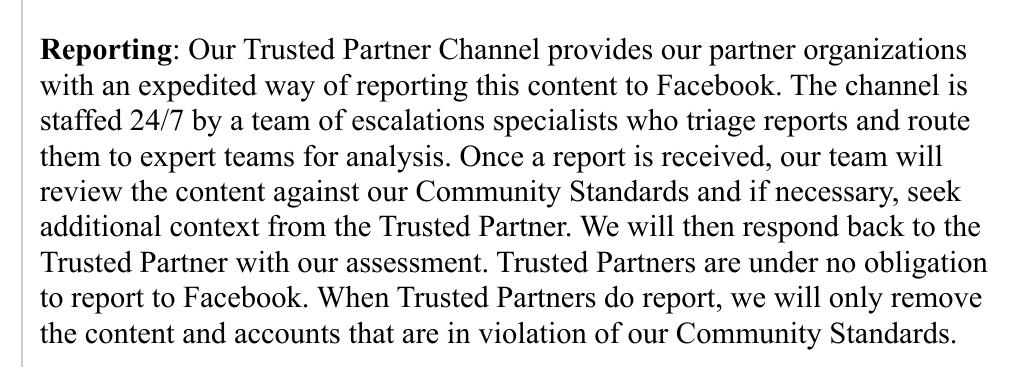
The document further states that the program “sits within Facebook’s Content Policy team, the group that creates our Community Standards.”
Meta also promises that “when Trusted Partners do report, we will only remove the content and accounts that are in violation of our Community Standards.”
The public cannot know who the partners are and what they are reporting, as Meta says “we keep all Trusted Partners and their reporting practices confidential.”
Meta says that this is necessary because of “the challenging environments many of our partner organizations work in.”
In an email sent on August 18, 2022, USAID’s Machleder told Copeland that YouTube “said that if there are local groups that would be recommended to serve as ‘Trusted Flaggers’ that we should send over a list of potential organizations for consideration.”
Copeland declined to hand over his partners’ contacts, saying that “Sending over a list of potential partners’ contacts is not something we would be prepared to do at this stage.”
He also revealed that Internews had earlier refused to sign a non-disclosure agreement (NDA) that YouTube wanted as a condition to work with the NGO. “The NDA they requested us to sign made this untenable,” he said.
Copeland also remarked that the “trusted flagger” programs are “potentially one of the most important tools we have available to protect platform users.”
He added that partners are “volunteering huge amounts of time to make these programs work, with zero accountability or transparency.”
Earlier, on July 5, 2022, USAID’s Vera Zakem wrote in a memo that after a meeting with YouTube, the video giant’s Josh Blumenfeld would be the agency’s “primary POC there for all things related to removing content to proactive engagement.”
It was also decided that USAID should “ID a list of priority countries that are relevant to USAID, where we can help identify local partners to participate in YouTube’s ‘trusted flagger’ partner programs.”
Two days later, Adam Siegel, who is in the Office of the Administrator, wrote that for “civil society trainings and Trusted Flaggers” he would prioritize “countries where we’ve had senior leadership (A/AID and DA Coleman/DA Adams-Allen) travel.”
In the spring of 2022, USAID and Google met and the search and video giant told the agency it was “still mapping out potential partners for Trusted Flaggers, e.g. National Government, Local NGOs, etc.”
In spring 2022, a meeting between USAID and Google (YouTube’s owner) produced a note to “Provide Clement with a list of potential partners to consider for dis/misinfo research projects, Trusted Flagger Program and any reports of problematic content / behavior.”
Meta was also interested in expanding its “trusted partner” program and asked USAID in March 2022 to recommend new partners, saying that many of the agency’s “civil society partners” were likely already part of the program.
In April 2024, Meta’s Sandy Luff told USAID that in Latin America and the Caribbean, “our TPP includes 30 organizations across 15 different countries.”
Luff then asked USAID to recommend more organizations, saying, “If USAID has organizations that it’d like to recommend for the program, please let us know.”
None of the documents show USAID directing the removal of any specific post through this channel.
In the end, USAID’s lawyers in May 2024 advised staff not to follow up on this issue, and not to ask Meta questions that “may be viewed as coercive.”
We covered Internews in February 2025, in a piece titled Internews Exposed, and in May 2022, we covered YouTube shifting flagging powers toward NGOs and government agencies.
The fact that a US government agency was funding people to flag content for social media companies is not the only problematic issue here.
It is also the fact that these flaggers are given a special status thanks to their access to “trusted” programs, which puts them in a position to censor speech, as these reports are given priority treatment by the platforms.
While the “trusted flagger” status is not new, and has been used by both YouTube and Meta for years, the EU has now essentially enshrined this system in law.
The Digital Services Act (DSA) allows member countries to designate “trusted flaggers” whose status must be respected by all platforms operating in the EU.
Regardless of what such flaggers are called, and how they are organized – a secret, unaccountable fast lane to a social media giant’s policy and safety teams is a censorship channel, plain and simple.
Sorry, the comment form is closed at this time.
Featured Video
John Mearsheimer: Why Russia Gains By Hitting Ukraine Harder
or go to
Aletho News Archives – Video-Images
From the Archives
A Climate Scientist Who Engages Skeptics
By Judith Curry | November 27, 2009
An open letter to graduate students and young scientists in fields related to climate research:
Based upon feedback that I’ve received from graduate students at Georgia Tech, I suspect that you are confused, troubled, or worried by what you have been reading about ClimateGate After spending considerable time reading the hacked emails and other posts in the blogosphere, I wrote an essay that calls for greater transparency in climate data and other methods used in climate research. The essay is posted over at climateaudit.org.
What has been noticeably absent so far in the ClimateGate discussion is a public reaffirmation by climate researchers of our basic research values: the rigors of the scientific method (including reproducibility), research integrity and ethics, open minds, and critical thinking. Under no circumstances should we ever sacrifice any of these values; the CRU emails, however, appear to violate them. … continue
Blog Roll
 Aletho News
- How Western media weaponizes unverified claims to justify military aggression
- Content control: USAID docs expose Biden admin’s grip on Ukraine coverage
- Ukraine destroying itself: every attack on the Crimean Bridge will come at a price
- NATO capital under protest siege, so NATO escalates war
- A Climate Scientist Who Engages Skeptics
- John Mearsheimer: Why Russia Gains By Hitting Ukraine Harder
- Argentina’s Perito Moreno Glacier Joins Antarctica and Arctic In Defying Doomsday Melt Claims
- ‘Chinagate’ Is Here
- Iran, four other countries condemn US plans to deploy weapons in outer space
- US media brings back the Iraq war playbook and why it won’t work
- If Americans Knew
- Israeli Military Probing Its Own ‘Widespread’ Use of Palestinian Human Shields
- Palestinians in Gaza Are Lining Their Tents with Sandbags to Stop Israeli Bullets
- Israel’s genocidal actions are preventing births in Gaza –New Amnesty report
- ‘Unlawful de facto exemption’: US sitting on 12-year backlog of alleged Israeli gross human rights violations
- DAILY UPDATE: Latest essential news on Palestine, Israel, & region
- The revolution against Israeli control of America is HERE! (Video)
- Why Iran Hawks Are Now Hyping ‘Radical Shiite’ Threats
- Israel is still displacing Palestinians in Gaza, expanding its ‘yellow line’ deeper into the strip every day
- DAILY UPDATE: Latest essential news on Palestine, Israel, & region
- US Military Airlift to Israel continues
- No Tricks Zone
- Alarmist Climatologists In Shock! 2026 Atlantic Hurricane Season Sees Lowest Count In 101 Years
- New Study: Modern Temps Are Among The Coldest Of The Last 10,000 Years In East Central Europe
- Germany’s Renewable Energies Lead to 1.4 Billion Euro Electric Power Trade Deficit
- Argentina’s Perito Moreno Glacier Joins Antarctica and Arctic In Defying Doomsday Melt Claims
- New Study: Barents Sea Temperatures Were Warmer And Sea Ice Less Extensive In The 1700s Than Today
- German Authorities Start Initiative To Evaluate Public Register For Climate “Disinformation” Spreaders!
- Zonal Asymmetry of Temperature Change in the Antarctic Circumpolar Current
- New Study: The Net Fossil Fuel Contribution To Rising Atmospheric CO2 Has Been Zero For 500 Years
- Germany’s Green Energy Transition Becoming Increasingly Expensive…Another 6 Trillion Euros!
- Sudden Stratospheric Warming, Powerful El Niño Combination May Lead To Extreme Europe Cold, Energy Crisis!

