Rhode Island Staffer Could Be Reinstated After Firing Over Ceasefire Post
By Cindy Harper | Reclaim The Net | November 9, 2026
A federal judge has ruled that the office of Rhode Island Governor Daniel McKee violated the First Amendment when it fired a staffer over a post he made on X.
Chief Judge John J. McConnell Jr. of the US District Court for the District of Rhode Island granted Miguel Sanchez, who worked in the governor’s office in constituent services, partial summary judgment in the case. The ruling also denied qualified immunity to two of McKee’s aides.
Sanchez was fired on October 27, 2023, but the court decision means he may now be reinstated and receive damages.
Sanchez, who is a member of the Providence City Council and was first elected in January 2023, worked in the governor’s office since May 2021.
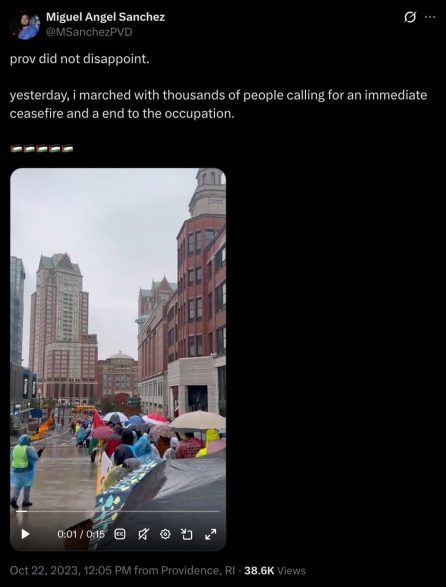
The post that got him fired was made off-duty on October 22, 2023, from the account he uses as a councilman. In it, Sanchez said, “prov did not disappoint…yesterday, I marched with thousands of people calling for an immediate ceasefire and a [sic] end to the occupation,” and included a video of the march in Providence.
Some staff in the governor’s office thought rally participants had chanted “from the river to the sea.” But the court said that “nothing suggests that Mr. Sanchez adopted or repeated that phrase nor is there evidence to suggest he endorsed that chant, or is in favor of violence.”
Nevertheless, the governor’s staff wanted him to delete the post, and when he refused, he was given the choice to either resign or be fired.
The reason for the firing, as the officials put it, was “the disruption in the office” caused by the post, as well as “the likelihood of continued disruption if the post were left up.”
The court found that this was not a valid reason, noting that the right to speak on public matters “is not lost when an individual chooses to work for the government.”
As for the “disruption,” the office received one inquiry from the Providence Journal, three emails, and two phone calls from the public, and a state legislator asked an aide about the post in an elevator. In addition, NBC 10 and a radio host each inquired about it. But the judge said that this did not amount to much, and that one of the governor’s aides, Joseph Almond, testified that the number of inquiries was “not a lot” and that they “did not interfere with the operation of the office.”
The governor’s office also spends most of its time responding to current events and media inquiries – some 85%, according to the court – and one aide said that “it’s just part of the job of being a governor.”
The real disruption came after Sanchez was fired, as at least 17 reporters inquired about it, 11 outlets reported about it, and by November 2, the office had received 63 emails and 38 phone calls about the firing.
As the judge noted, “The alleged distraction caused by his post pales in comparison to the inquiries after the firing.”
The court also dismissed the claim that the post could have caused future disruption as a “speculative argument”, and noted that Sanchez had no policy-making or spokesperson role in the governor’s office.
Sanchez’s legal fees were covered by X, attorney Gene Schaerr confirmed to local TV station WJAR, adding that it was not Elon Musk personally who paid, but X, through a program the company set up in August 2023.
At the time, Musk announced on the platform, “If you were unfairly treated by your employer due to posting or liking something on this platform, we will fund your legal bill. No limit. Please let us know.”
The same pattern of behavior of government employers occurred in May when it was revealed that Florida’s wildlife agency had paid biologist Brittney Brown $485,000 after firing her over a post about Charlie Kirk.
The agency had claimed that it had received hundreds of complaints and that Brown’s post had caused a “major operational disruption” – but during discovery it was revealed that the true number was “approximately 50 complaints, not hundreds.”
In both cases, employees were fired for lawful political speech, and their employers then tried to justify the decision by claiming that it caused a huge number of complaints and disruption – but failed to prove it.
It’s unclear why governments and their agencies keep using the same flawed arguments to try to justify their violations of the First Amendment – but it’s also unclear why it has to take a social media company to pay for a person’s legal representation in order for their rights to be recognized.
Sorry, the comment form is closed at this time.
Featured Video

Nima R. Alkhorshid: US military bombs multiple targets on Iran’s Qeshm Island
or go to
Aletho News Archives – Video-Images
From the Archives
British Intel Tried to Make N Irish Gang ‘Shoot Up’ School, Documentary Claims
Sputnik – 23.02.2019
A new documentary, based on an interview with a self-confessed member of the Glennane Gang, gives some insights into allegations that British military intelligence was behind a shocking murder plot to cause the situation in Northern Ireland to “spiral out of control”.
In a documentary, Unquiet Graves: The Story of the Glennane Gang, John Weir, a former officer from the Royal Ulster Constabulary (RUC), alleges that British intelligence tried to persuade paramilitary group Ulster Volunteer Force (UVF) to attack a Catholic primary school at Belleeks in County Armagh.
Weir claimed that the UVF was urged to kill children and teachers in retaliation for the 1976 Kingsmill massacre, in which gunmen stopped a minibus carrying twelve workmen and shot them; only one person survived despite having been shot 18 times.
“The plan that was decided on was to shoot up a school in Belleeks”, he said, adding that the British intelligence plot was to make the situation in Northern Ireland “spiral out of control”. … continue
Blog Roll
 Aletho News
- Will Republicans Learn Their Lesson from the ‘Disastrous’ Midterms?
- Wrong, Newswise, Irresponsible Climate Messaging, Not Climate Change Itself, Is Fueling Student Anxiety
- Zelensky’s Critics Vanish Into Ukrainian Secret Prisons – Source
- Nima R. Alkhorshid: U.S. Military Bombs Multiple Targets on Iran’s Qeshm Island
- Iran-Linked Ships Spotted Hovering over Subsea Cables: Report
- New attack on Iran could devastate ‘Israel’, IOF general warns
- Nuclear deterrence: The US-Israeli military aggression against Iran made the unthinkable legitimate
- U.S. Midterms – a Referendum on Israel and Zionist Power
- Twice as many Canadian Jews serve in Israeli military as Canada’s armed forces: Report
- Thousands of Syrian troops set to join Saudi war on Yemen
- If Americans Knew
- An error has occurred; the feed is probably down. Try again later.
- No Tricks Zone
- Zonal Asymmetry of Temperature Change in the Antarctic Circumpolar Current
- New Study: The Net Fossil Fuel Contribution To Rising Atmospheric CO2 Has Been Zero For 500 Years
- Germany’s Green Energy Transition Becoming Increasingly Expensive…Another 6 Trillion Euros!
- Sudden Stratospheric Warming, Powerful El Niño Combination May Lead To Extreme Europe Cold, Energy Crisis!
- Two New Studies Find Thwaites Glacier Melt Cannot Be Driven By Human Activity Or A Warming Ocean
- E-Cars Reduce CO2 Emissions By Only 41% Compared To Internal Combustion Engine Vehicles
- Predictions Made By Renowned Climate Professor Over Past Decades Have Been Proven To Be Poor
- New Study Suggests Large Regions Of The Pacific Ocean Have Been Cooling For The Last 80 Years
- Germany’s Green Energy Debacle: High Energy Costs Force Kahla Porzellan to Close After 182 Years!
- New Study: 50 Years Of The Most Aggressive ‘Net Zero’ Policies Can Only Affect The Global Climate By 0.03°C

