Settlers, sanctions and impunity
By Ramona Wadi | MEMO | June 10, 2026
From 1st January 2008 to 31st December 2025, Israeli settlers killed 61 Palestinians and injured 3,778. The findings of the Independent International Commission of Inquiry on the Occupied Palestinian Territory, including East Jerusalem, and Israel, which partly discusses settler violence, note that “Israeli authorities have consistently acknowledged settler violence as a problem, while promoting structural conditions that enable it.”
The recently published report details the overt nature of Israeli settler violence – the claiming of responsibility for settler attacks on Palestinians as part of the process to ‘Greater Israel’, the unequivocal assertion that attacks are unprovoked, and the indoctrination of settler children by family members and settler organisations. Supporting the entire spectrum of settler-colonial violence is the Israeli government, with Prime Minister Benjamin Netanyahu downplaying the attacks against Palestinians as attributed to “a small group of unruly youth”. The report notes how government settlement expansion policy contributes to settler violence, and provides the framework for settler impunity. Mentioning prominent Israeli ministers and settler leaders, the report states, “They [the officials] have explicitly permitted or condoned settler violence as an instrument to achieve a broader agenda.”
As the UK, France, Canada, Australia, New Zealand and Norway imposed sanctions on networks that collaborate with settler violence in the occupied West Bank, the Commission of Inquiry’s report details the structure that supports settler violence against Palestinians. Reacting to the sanctions, Israel’s Ministry of Foreign Affairs Spokesman Oren Marmorstein declared, “The real essence of these steps is the attempt to impose a political stance regarding the right of Jews to settle in the Land of Israel and concerning the Israeli-Palestinian conflict – camouflaged as measures against violence.”
Of course the decision is political. However, as the report shows, the six countries’ decision to impose sanctions does not even scratch the surface of the politics and policies that support Israel’s settler-colonial expansion. Israel and its institutions have created a protective structure for settler violence, and Marmorstein’s statement illustrates how central settler violence is to completing the process of Greater Israel.
Without settler violence contributing to the forced displacement of the Palestinian people, Israel would have a difficult time maintaining its structure.
The discrepancy, however lies in world leaders’ decision to target entities and individuals rather than Israel itself. For example, the report highlights that the line between settlers and soldiers has blurred since regional brigades were formed and gun licenses were handed out by Israeli National Security Minister Itamar Ben Gvir. Settlers are being given power by Israel’s colonial structure, therefore sanctioning settlers is unlikely to make a difference in halting colonial expansion.
International diplomacy is still viewing Israeli settler-colonialism in manageable sections, and detached from Israel’s expansionist policies.
Targeting settlers with sanctions simply encourages Israel to provide more impunity for those doing its work on the ground, while the Israeli government continues with settlement construction.
As the Commission of Inquiry’s report shows, Israel cannot be discussed separately from settler violence. Sanctions, therefore, need to appropriately target the colonial framework itself, which would then have an impact on the settler-colonial society in its entirety.
Christian village in occupied West Bank goes up in flames after large-scale attack by Israeli settlers
The Cradle | June 10, 2026
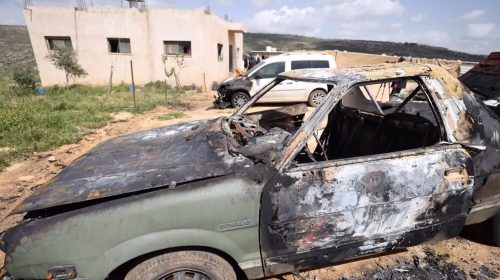
On June 9, extremist Israeli settler groups launched a coordinated arson attack on the historic Christian village of Taybeh in the occupied West Bank, torching agricultural fields east of Ramallah as part of a systematic campaign of ethnic cleansing.
The violence against the 3,000-year-old village intensified following the establishment of an illegal settlement outpost in the immediate vicinity, as local residents of Taybeh face persistent encroachment and assaults by Israeli settlers whose stated objective is to seize the area’s rich pastoral lands.
This ongoing attempted annexation has placed the community under significant pressure as it attempts to maintain its agricultural and pastoral way of life under constant violent harassment.
This latest assault follows previous instances of settler-led violence specifically targeting the historic Church of Saint George, a landmark of significant religious and cultural importance within the village.
Despite international attention and the historical status of the site, the campaign of intimidation has continued.
The torching of the fields on Tuesday is a direct hit on the economic and territorial integrity of the village, with the proximity of the illegal Israeli settlement outpost serving as a primary launch point for these repeated incursions.
The Christian Palestinian community now finds itself at the center of an escalating cycle of land seizures and property destruction in the occupied West Bank.
The attack comes as part of a systematic, state-backed campaign of ethnic cleansing, mass displacement, and gradual annexation of occupied Palestinian territories.
It represents a microcosm of the broader settler campaign to render Palestinian territory uninhabitable, marked by the systematic displacement of residents and the destruction and seizure of agricultural resources.
A UN Commission of Inquiry published on Tuesday has concluded that Israeli authorities are directly involved in facilitating settler violence in the occupied West Bank, providing financial and military support within a climate of impunity.
Attacks on Palestinian villages have surged by 130 percent since 2023, according to the report, and frequently involve masked assailants directly shielded by Israeli military forces.
These documented assaults include the abduction and abuse of children and the use of sexual violence to instill fear, and are identified as tools for advancing state policies of territorial annexation and unlawful displacement.
The inquiry describes a “de facto collapse” of the distinction between soldiers and settlers, noting that at least seven Palestinians were killed and 832 injured last year amid near-daily attacks.
On 3 June, Israeli Finance Minister Bezalel Smotrich announced a major illegal settlement project involving the construction of approximately 2,000 houses on seized Palestinian land.
This plan includes 1,006 units near Jerusalem, 920 near Nablus, and 234 near Hebron.
Smotrich, who has held substantial authority over the West Bank Civil Administration since 2023, plainly states that these developments are intended to “establish clear facts on the ground” to prevent the creation of a Palestinian state.
Smotrich’s administrative powers effectively granted him free rein to use the military body governing the occupied territory to accelerate the de facto annexation of the West Bank through calculated land seizures.
Iran, Russia, China reject IAEA resolution as politically driven
Al Mayadeen | June 10, 2026
Iran’s Permanent Mission to the United Nations and other international organizations in Vienna has issued a sharp rebuke of the latest International Atomic Energy Agency Board of Governors’ resolution, rejecting its call on Tehran to declare its uranium stocks and denouncing the move as a politically motivated act unworthy of a technical body.
The mission said the measure was “another political resolution” adopted through a “shaky vote,” saying it falls well short of the standards expected of an agency tasked with technical oversight of nuclear affairs.
The US-backed resolution, passed on Wednesday, calls on Tehran to declare its remaining enriched uranium stocks and allow inspectors to verify them. Submitted by the United States, Britain, France, and Germany, it cleared the 35-nation board with 21 votes in favor, three against, and 10 abstentions. Russia, China, and Niger cast the three opposing votes, while Venezuela was barred from taking part.
‘Instrumentalized by warmongers’
Questioning the IAEA’s fitness to act as a neutral arbiter, the mission asked how the agency can be regarded as credible when it is “instrumentalized by warmongers” while remaining unable to register concern over “the most extensive unlawful armed attacks” on safeguarded nuclear facilities.
Iran further accused the resolution of cloaking confrontation in the language of diplomacy, noting that it purports to advance dialogue even as Washington “engages in further acts of aggression, including against Iranian civilian infrastructure, and promotes confrontation in different fora.”
Tehran made clear it does not intend to comply with “a flawed instrument,” stating that any genuine diplomatic process demands “a minimum of good faith” from all parties. Iran added that it will “protect its inalienable rights in response to this flawed resolution.”
Iran, China, Russia reject US draft
In a joint statement delivered at the Board of Governors meeting, Iran, China, and Russia denounced the US draft resolution as politically motivated and unconstructive, warning that it would further aggravate an already fragile situation.
The three countries stressed they oppose any attempt to mislead member states about the true status of Iran’s nuclear programme, including through the director general.
Strikes disrupted verification
Iranian Deputy Foreign Minister Kazem Gharibabadi revealed on Tuesday that it was US strikes on Iran’s nuclear facilities that had disrupted IAEA verification, forcing inspectors out of the country over safety concerns and halting routine monitoring.
Washington, he stressed, then sought to exploit that disruption to intensify pressure on Tehran through the agency’s Board of Governors.
Gharibabadi called on the international community to hold those who carried out the attacks accountable, highlighting that obstructing international verification at safeguarded facilities should be treated as a legal and international responsibility.
The US-Israeli war on Iran began on February 28 with attacks on Iranian territory, including the nuclear facilities at Fordow, Isfahan, and Natanz.
Tehran maintains its nuclear programme is entirely peaceful, a position confirmed by multiple US intelligence assessments, and argues that the strikes are precisely what have made implementation of its safeguards obligations impossible at the damaged sites.
Iranian missiles pierced US defense systems, hit 70% of targets: Fars
Al Mayadeen | June 10, 2026
Preliminary data, satellite imagery assessments, and information from Iranian security services point to the success of Iran’s large-scale military operation that was carried out at dawn Wednesday, Fars News Agency reported, citing an informed military source.
According to the source, Iran’s Air and Missile Forces successfully struck 70% of the designated military targets with high precision, adding that long-range ballistic missiles and drones operated by Iran’s armed forces were able to penetrate air defense systems deployed at US military bases in the region.
Iranian missiles and drones also accurately hit their designated targets at the al-Azraq base in Jordan, the Ali al-Salem base in Kuwait, as well as the headquarters of the US Fifth Fleet in Bahrain, the source stated.
Iran retaliates against 21 US-linked targets
Iran’s Islamic Revolution Guard Corps (IRGC) announced early Wednesday that it launched an attack targeting 21 US-linked sites across the region, including the US Fifth Fleet in Bahrain, stressing that the operation was in response to recent American aggression on Iran.
The targets also included a US F-35 fighter jet base in al-Azraq in Jordan, as well as a command and control center at the same facility. Iranian Fars news agency reported that the IRGC used Kheibar Shekan missiles in strikes targeting F-35 hangars in Jordan.
The IRGC added that it had destroyed four high-value targets using long-range solid-fuel missiles and said a US MQ-9 drone was shot down during aerial engagements over Jam in Iran’s southern Bushehr province.
The IRGC warned that continued hostile actions would be met with “more severe and harsher responses,” signaling readiness to expand its military operations if attacks persist.
Pakistan says Israel derailed US–Iran peace deal described as ‘inches away’: Report
The Cradle | June 9, 2026
Diplomatic efforts to finalize a peace agreement between the US and Iran ran into significant delays due to Israeli violations across West Asia, Pakistani government mediators revealed to Anadolu Agency on 9 June.
US President Donald Trump told reporters in New York on Monday that a settlement could be reached in “two or three days,” yet Pakistani mediators say that such an immediate breakthrough is “unlikely.”
While Trump continues to maintain that a peace deal is close at hand, officials in Islamabad stress that the “situation is complex and has entered a sensitive phase” due to persistent Israeli military aggression in southern Lebanon.
According to sources close to the mediation, the two nations were “inches away” from concluding a temporary truce in late May, only for the momentum to be derailed by the “large-scale” Israeli incursion and the annexation of Lebanese territory.
Although a temporary ceasefire in Lebanon was established on 17 April and subsequently extended until early July, Israel has maintained daily violations, including airstrikes and ground incursions.
Pakistani officials have informed Washington that Israel’s actions in both Lebanon and Gaza are the primary obstacle to reaching a final end to the war.
The Iranian leadership has reiterated through diplomatic channels that it will not return to the negotiating table while Israeli strikes persist.
Last week, Pakistani Interior Minister Mohsin Naqvi traveled to Tehran for the fourth time since 28 February to deliver a “special message” to Supreme Leader Mojtaba Khamenei from the Pakistani army chief, Field Marshall Asim Munir.
Pakistan, alongside regional partners such as Qatar, is currently attempting to convince Trump to apply “maximum” pressure on Israel to halt its offensive.
Islamabad has reported receiving a “positive response” from the White House regarding the situation in Lebanon, despite the lack of an immediate cessation of attacks.
Pakistani sources told Anadolu Agency they anticipate a “breakthrough” in efforts to stop the Israeli military attacks “in a few days.”
If a halt to the fighting is achieved and direct communication between Washington and Tehran is restored, mediators believe there are “high” chances of reaching a deal “soon,” noting that the majority of conflicting issues have already been resolved.
However, the officials maintained that “this process cannot be completed within two or three days.”
Israel has continued to strike out on multiple fronts. On Tuesday morning, Israel issued a forced mass displacement order against the southern Lebanese city of Tyre (Sur) for the second time in less than a month.
At least 15 airstrikes hit Tyre on Tuesday morning, killing nine and injuring over two dozen.
Thousands of civilians were forced to flee north, joining the over 1 million already displaced throughout Lebanon.
Since the Israeli invasion of Lebanon began in March, the attacks have so far killed at least 3,666 people and injured over 11,000.
On Monday, Israel also reignited a brutal campaign of collective punishment on Gaza by closing all entry points for humanitarian aid in response to Iranian retaliatory strikes triggered by Israel’s overnight violations in the Lebanese capital of Beirut.
Iran had repeatedly asserted that a strike on the Lebanese capital was an unacceptable red line that should not be crossed.
US strikes cut drinking water to 20,000 in Iran’s Hormozgan province
Press TV – June 10, 2026
The managing director of the Hormozgan Water and Wastewater Company says pre-dawn US strikes have completely destroyed critical water infrastructure in the eastern part of the province, leaving more than 20,000 residents without access to drinking water as summer temperatures soar.
Abdolhamid Hamzehpour told local media Wednesday that American terrorist attacks hit the water supply facilities in Sirik county, targeting the distribution network for the town of Kuhestak and 10 villages in the Bemani district.
Hamzehpour detailed that two concrete reservoirs, with capacities of 500 and 2,000 cubic meters, along with their associated mechanical equipment, were demolished in the strikes. The destruction of the facilities has led to a complete halt in water distribution for the affected areas.
“The enemy has precisely targeted the infrastructure linked to the daily livelihood and health of the people,” Hamzehpour said, describing the act as “flagrant terrorism.”
The outage comes as the region endures peak summer temperatures, with reports that local weather hovers between 45 and 50 degrees Celsius. Officials stated that the area lacks sufficient groundwater reserves to compensate for the loss of the reservoirs, creating a critical situation for the population.
Hamzehpour condemned the loss of water access as a “clear instance of a crime against humanity,” noting that operational teams are on-site but face significant challenges due to the scale of the destruction.
The strikes on Sirik, as well as on the cities of Jask and Qeshm Island in the Strait of Hormuz, occurred in the early hours of Wednesday. They followed Washington’s accusation that Iran downed a US Army Apache helicopter over Persian Gulf waters.
While the United States has stated its strikes targeted military infrastructure, including air defense systems and radar installations near the Strait of Hormuz, provincial Iranian officials maintain that civilian water facilities in Sirik were directly hit.
Hamzehpour confirmed that mobile water tankers have been deployed to the region as an emergency measure. However, he warned that fully restoring the destroyed pumping and storage systems will require “time and extensive technical actions.”
“The deprivation of a large population of people from water in these weather conditions is carried out under the shadow of false claims of humanitarian aid,” Hamzehpour added, according to IRNA.
In response to the acts of aggression, the Islamic Revolution Guards Corps (IRGC) launched a series of drone and missile strikes against US military assets across the region.
In one instance, the IRGC targeted the US Navy’s Fifth Fleet with missile and drone attacks, as part of its broader retaliatory campaign.
Iranian armed forces also carried out strikes against US military facilities in Jordan, Bahrain and Kuwait during the early hours of Wednesday.
Why Iran’s Retaliation for Israel’s Attack on Beirut is a Regional Game Changer
By Robert Inlakesh | The Palestine Chronicle | June 10, 2026
Iran’s ballistic missile response to Israel’s attack on Beirut is a game-changer for the power dynamics of West Asian politics. The ‘Unity of Squares’ concept has officially led to a NATO-style defense pact developing between the members of the Iranian-led Axis of Resistance.
When Israeli Prime Minister Benjamin Netanyahu threatened to strike the southern suburbs of Beirut last Monday, the immediate threat issued by the leadership in Tehran forced him to take a step back. Ultimately, the US and Israel would delay the implementation of the decision to attack the Lebanese Capital, then suffering an overwhelming response that outperformed expectations.
The first detail to consider here is that the mere threat of Iran’s Islamic Revolutionary Guard Corps (IRGC) launching strikes on Israeli targets forced Tel Aviv and Washington to take a step back, meaning that both de facto admitted that Tehran maintains deterrence power. Then came the Israeli strike on the southern suburbs this Sunday, which was extremely limited and nothing of the nature of what Netanyahu had originally advertised.
A weak strike on Beirut’s southern suburbs, which had no actual impact on Hezbollah whatsoever, indicates that the US-Israeli alliance acted in order to save face, seeking to test Iran’s resolve, but also to leave space for it to retreat from all-out war.
Following Iran’s missile waves, which struck Ramat David Airbase – according to satellite imagery evidence – the Israelis decided to launch an attack on Iran. Although they did target at least three radar sites and a petrochemical company, amongst other targets, it was clear that the Israeli attack was lackluster; designed primarily to give them the veneer of having risen to confront the IRGC. No Iranians were killed in the Israeli attack, and the majority of the sites hit were previously struck during the 40-day war earlier this year.
It was clear that the IRGC had prepared for the Israeli counter-strike, not only unleashing an attack of its own on Israeli companies and military sites in response but also coordinating its retaliatory action with Yemen’s Ansarallah.
As the Israelis were playing catch-up, the Iranians were implementing a carefully calibrated phase two of their promised retaliation to Israel’s attack on Beirut– that being the inclusion of new fronts. The IRGC had previously warned Tel Aviv that the war would expand to other fronts; the Yemeni Armed Forces achieved precisely this.
Ansarallah has declared that the Bab al-Mandab Strait is now closed to Israeli shipping, returning to the equation imposed in support of Gaza until October of 2025, when the ceasefire was signed. Yemen then went a step further and vowed to totally close Bab al-Mandab, should the war escalate further. This would represent an enormous economic blow to the global economy, considering the ongoing closure of the Strait of Hormuz.
The concept of the ‘Unity of Squares’ was originally developed by former Secretary General of Lebanese Hezbollah, Seyyed Hassan Nasrallah, and before him Iran’s former IRGC Quds Force Commander Qasem Soleimani. In essence, it was the idea of linking all of the fronts of the Axis of Resistance so that none would stand alone. On October 8, 2023, Seyyed Hassan Nasrallah put this into action by immediately intervening on the side of the Palestinian resistance in Gaza. Soon thereafter, Ansarallah would follow, and to a lesser extent, the Islamic Resistance in Iraq.
Israel had long bragged that its assassination of Nasrallah had broken this Unity of Squares dynamic, because Hezbollah was forced into accepting a less-than-favorable ceasefire in late 2024. It was because of Nasrallah’s refusal to abandon Gaza “no matter where it takes the region”, that Tel Aviv had decided to kill him. Therefore, it is accurate to say that the former Hezbollah leader quite literally gave his life for Gaza.
Benjamin Netanyahu’s quest to achieve “total victory” in his 7-front war has not proven successful, but one major step towards that was managing to break the idea of the Unity of Squares. Through Iran’s actions this Sunday, that “success” was just undone.
The IRGC has also recently been insisting that Gaza be included in their ceasefire agreement, something that a number of statements released by Hamas also appear to be indicating will be the case. If the Islamic Republic does impose its will on the US-Israeli alliance by setting in stone the equation that an attack on one is an attack on all, the Unity of Squares equation will be imposed fully, as it was originally intended. In the past, it was never fully implemented because of Iran’s absence as a front that could easily open.
The implications of this equation coming to life are that the Iranian-led Axis will undoubtedly be the most powerful alliance in the region. Not because they necessarily possess the most firepower and capabilities, but because they will together be able to cut off key international chokepoints, while battering their adversaries in a way that can achieve strategic deterrence.
It should be noted that this is a direct result of the US-Israeli failure in their war of aggression to achieve any of their goals. Instead of weakening Tehran, their reckless aggression and arrogance may have just undone the tactical victories they previously achieved, pushing Iran into the position that many previously argued it should have assumed sooner after October 7, 2023. Unless Tel Aviv and Washington find a way to reverse this, this will represent a major historic shift in regional power dynamics.
– Robert Inlakesh is a journalist, writer, and documentary filmmaker. He focuses on the Middle East, specializing in Palestine.
Araghchi warns Washington: Iran will not leave any attack unanswered
Al Mayadeen | June 10, 2026
Iranian Foreign Minister Abbas Araghchi has stated that Iran will not leave any attack or threat unanswered, stressing that the United States has chosen to test what he described as Iran’s resolve despite battlefield losses.
Araghchi affirmed in an X post that the Iranian armed forces would respond to any aggression, signaling a hardened stance amid rising regional tensions.
‘Leave our region if you want to be safe’
Addressing Washington directly, Araghchi warned the United States to withdraw from the region, saying: “Leave our region if you want to be safe.”
He added that the history of the Persian Gulf contains what he described as “dire fates” that befell foreign forces, framing foreign military presence as inherently risky.
The foreign minister’s statement comes after the US Central Command (CENTCOM) announced that it had launched strikes on Iran, stating the operation was carried out under orders from the US military leadership and framed as a response to what the US claims is Iran’s downing of an Apache helicopter.
CENTCOM described the strikes as a “proportionate response” to what it called “unprovoked Iranian aggression,” linking the escalation to reports surrounding the incident. However, no independent verification has confirmed the claims.
Featured Video

Dan Dicks with James Corbett on Solutions Watch
or go to
Aletho News Archives – Video-Images
From the Archives
MMR (Measles, Mumps and Rubella) – Vaccine Risk Statement
MMR Vaccine (Measles, Mumps, and Rubella) Is It Safer Than Measles, Mumps and Rubella?
Physicians for Informed Consent | December 2024
… It has not been proven that the MMR vaccine is safer than measles, mumps, and rubella. The vaccine package insert raises questions about safety testing for cancer, genetic mutations, and impaired fertility. Although VAERS tracks some adverse events, it is too inaccurate to measure against the risk of measles, mumps, and rubella. Clinical trials do not have the ability to detect less common adverse reactions, and epidemiological studies are limited by the effects of chance and possible confounders. Safety studies of the MMR vaccine are particularly lacking in statistical power. A review of more than 60 MMR vaccine studies conducted for the Cochrane Library states, “The design and reporting of safety outcomes in MMR vaccine studies, both pre- and post-marketing, are largely inadequate.”19 Because permanent sequelae (aftereffects) from measles, mumps, and rubella are so rare (especially in children with normal levels of vitamin A and infected after birth),6,15-17 the level of accuracy of the research studies available is insufficient to rule out the possibility that the MMR vaccine causes greater death or permanent disability than measles, mumps, and rubella. – Read full article
Blog Roll
 Aletho News
- Yes, the Iran war has destroyed Trump’s presidency
- The fallacy of US delusions about Iran’s economic collapse
- Hezbollah denies Syria cell link, warns of Israeli plan to sow discord
- The legacy of US sanctions, war, and occupation in Iraq
- Iraqi resistance group rejects disarmament, vows to maintain support for Lebanon
- Sheikh al-Asadi warns of Iraqi government compliance with US demands
- How to MAKE THE CONSPIRATORS PAY for their crimes! Dan Dicks with James Corbett on Solutions Watch
- There’s a drought in academia: A drought in honest research on the subject of drought and other weather extremes
- Department of War Awards $20.7 Billion Contract to Raytheon for Air-to-Air Missiles
- ‘Distance yourselves from Israel’: IRGC urges US population to question govt policies
- If Americans Knew
- As settlers ravage West Bank, Israeli forces kill 10 in Gaza – Daily Update
- New Report: “Scholasticide and Genocide in Gaza: Assessment, Testimonies and Legal Analysis”
- Ex-Biden officials are desperate for a Gaza scapegoat
- Israeli “settlers” Invade Al-Aqsa; Pour Boiling Water on 75-Year-Old
- Israel Has Kidnapped Another American Teenager
- US arms sales to Israel worth $21.6 billion in 20 months
- Three Palestinians Killed in Israeli Attacks on Gaza
- Revealed: German “Anti-Semitism Expert” Driving Crackdown on Palestine Solidarity is Former Israeli Spy
- Egypt’s Warning to Israel Before Oct 7
- Israel’s siege signals another cruel winter for 1.8 million Gazans – Daily Update
- No Tricks Zone
- Two More Paleo Reconstructions Affirm Meters-Higher Sea Levels Across Ireland, Brazil 7000-6000 Years Ago
- New Study: Earth And Venus Surface Warmth Largely Explained By Convection And Lapse Rate, Not CO2 Or Radiation
- 2025 Nature Paper Claiming Worsening Global Drought Gets RETRACTED …Heavily Flawed
- New Study: ‘Global Drought Shows No Detectable Recent Acceleration Under Climate Warming’
- Economic Masterminds: German Socialists Suggest Taxing Productivity Gains Stemming From Using AI
- The South China Sea Has Not Been Cooperating With The Climate Change Narrative
- Energy Crisis: Germany Enters Heating Season With Historically Low Gas Reserve Fill Levels
- New Study: The Antarctic Ice Sheet Gained Mass From 2020-2024 Due To Staggering Snow And Ice Accumulation
- Study: Ocean Heating Rates From Thousands Of Years Ago ‘Dwarf’ Modern Ocean Heating Rates
- Climate Extremists Target, Attack Large-Scale Power Grid Infrastructure In Germany!

