Col Douglas Macgregor: Pressure to REMOVE TRUMP FROM OFFICE Growing
Daniel Davis / Deep Dive – June 23, 2026
Mario Nawfal | June 23, 2026
Daniel Davis / Deep Dive – June 23, 2026
Daniel Davis / Deep Dive – June 23, 2026
By Francis Menton | Manhattan Contrarian | June 14, 2026
I often make fun of the federal government as operating with what it thinks is an “infinite credit card,” outside and beyond any budget restraints. And thus all problems, real or imaginary, can be solved by dispensing some of the infinite federal loot. In its partial defense, the federal government does have the ability to print money, although that ability too eventually runs into limits.
And then we have New York City. The City has no ability to print money, but nevertheless operates as if there are no constraints on spending. The sky is the limit! Recently I wrote about how the City spends about triple the national average per student on preK-12 education, and more than double the national average per capita on Medicaid. Those are crazy excessive amounts, but at least education and healthcare are bona fide purposes for the spending of resources.
But how about spending huge amounts of money on pure fantasies that accomplish absolutely nothing? Yes, we have that too. For today’s example, how about “climate resiliency”?
Maybe you don’t even know what that is. I’m not sure that I do either. A good summary is that it is a substance-free buzzword that is being used to dispense tens of billions of dollars on consultants and construction projects along the coastline, without any discernible benefits within the lifetimes of anyone around today.
About a year ago, in April 2025, I had a post about a project the City was in the process of building at something called Wagner Park, basically a small lawn area along the water near the Southern tip of Manhattan Island. Wagner Park accounts for about 400 feet of Manhattan waterfront, out of a total of about 32 miles of shoreline for Manhattan (and some 520 miles for New York City as a whole). The City was trucking in vast amounts of dirt in order to raise the level of the park by about 10 feet. The idea, supposedly, is to protect against a rise in the level of the sea that climate doomsayers claim may occur by some time around, say, the year 2100. The cost of the Wagner Park “resiliency” project, as reported in my April 2025 post, was some $300 million.
Well, now it seems that the Wagner Park insanity is metastacizing like a cancer. New and far bigger shoreline-raising projects have now gotten underway both East and West of the relatively small Wagner Park effort. One such project covers about a mile of the waterfront of Battery Park City on the Lower West Side, and another covers 2+ miles of the waterfront at East River Park on the Lower East Side. Steve Cuozzo covers the story in a piece in the New York Post on June 10. Here is his description of the work now getting underway in Battery Park City:
At Le District’s alfresco Battery Park café, customers who previously enjoyed views of the river and the New Jersey skyline now face a chain-link fence and roaring excavation machines. Battery Park City’s beloved Hudson River Esplanade, a treasure of Lower Manhattan, will be closed for years to come as it’s needlessly reconfigured. Its off-limits condition shocks those who loved its airy refuge from the city’s thrum — and appalls nearby residents of this once magnificent neighborhood.
And over in East River Park:
In the now “resilient” segment south of the Williamsburg Bridge, scores of old trees have given way to saplings that might throw shade in a mere 25 years. The mostly level recreation lawns that were favorite gathering grounds for residents of nearby NYCHA housing projects have sprouted hilly, segmented zones mostly too small for easy use.
Cuozzo quotes residents from both the Lower East and West Side areas as being appalled by the endless construction and the desecration of their prior waterfront parks. But then there is Mayor Mamdani, who recently commented on the opening of the Wagner Park project:
The area is “on the front lines of the climate crisis,” [Mamdani] lectured. “With phase one now complete, we are taking a major step toward safeguarding Lower Manhattan . . . from rising seas and stronger storms.”
What “rising seas” and “stronger storms” exactly? Cuozzo correctly points out that the UN itself has recently backed away from its extreme climate doom scenarios. The idea of sudden sea level rise of multiple feet was always ridiculous. Meanwhile, the costs are enormous. This City release from October 2024 puts the cost of the East River Park project at $1.45 billion. In the same release, a guy named Rohit Aggarwala, then Commissioner of the City’s Department of Environmental protection, boasted that the City had “more than a dozen similar projects now underway, from Staten Island to the Rockaways to Red Hook.”
If you are a bureaucrat in New York City, just somehow attach the word “climate” to your budget demand and they’ll give you whatever you ask for. Keep this in mind next time the City comes around looking for another tax increase.
If these precedents on emissions charges and compulsory offsets stand, the appetite of unelected institutions for fiscal power will grow
By Brenda Shaffer | The Telegraph | June 22, 2026
International energy and climate policies stand at the center of one of the most defining political issues of our time: the expanding power of unelected institutions such as the United Nations in the lives of people in democratic societies.
Two UN agencies – the International Maritime Organization (IMO) and the International Civil Aviation Organization (ICAO) – plan to tax global shipping and aviation for their greenhouse gas emissions. This would mark the first time an unelected institution has levied taxes on major sectors of global economic activity. The planned levies would expand the power and budgets of these agencies with no democratic accountability.
Regardless of one’s views on climate change, proponents of democracy should recognize the threat posed by taxation without representation and oppose this power grab by the UN.
If implemented, the UN agency levies will raise global shipping and aviation costs, adding to inflation worldwide. Shipping produces just around 2 per cent of global greenhouse gas emissions, yet a UN tax on it would add costs to virtually every traded good. Shipping carries more than 80 per cent of global trade, a share expected to grow. Civil aviation accounts for approximately 2.5 percent of global emissions. The planned carbon offset requirement would add further costs to international flights.
In October 2026, the IMO will take a final vote on launching its carbon tax. The ICAO’s requirement that airlines purchase carbon offsets for international flights comes into force in January 2027.
If implemented, the IMO scheme will rake in billions from shippers while doing little to lower greenhouse gas emissions: there is simply not enough zero-carbon or low-carbon fuel available that meets the IMO’s criteria. The IMO estimates the scheme will add between $11bn (£8.1bn) and $13bn (£9.6bn) to its budget.
The IMO taxation scheme would at minimum double shipping fuel costs. The current generation of low-carbon fuels – hydrogen, methanol, and ammonia – are not suitable for wide use in the shipping industry. These fuels are more flammable than those in use today, increasing risks for ships and crews. If adopted, insurance costs would soar, particularly following the first inevitable accident attributable to these fuels.
By Lucas Leiroz | Strategic Culture Foundation | June 23, 2026
The Arctic has been one of the main critical points of Donald Trump’s strategy since his rise to power. The increase in American presence (military and civilian) in the region is part of Trump’s broader strategy to “control the Western Hemisphere.” The main challenge for the U.S. is to try to overcome Russia’s long-standing presence in the region – as well as China’s growing presence. Many analysts doubt the American capacity to neutralize the advance of its geopolitical rivals in Arctic technology.
Recently, the U.S. has made Arctic affairs a strategic priority in its foreign and defense policy. Several of Trump’s supposedly “irrational” actions (such as his obsessive pursuit of annexing Greenland) are based on a relentless effort to expand American influence in the Arctic region. This is consistent with Trump’s hemispheric strategy, which can be summarized as reducing U.S. global presence (tacitly accepting a multipolar reality), while compensating for this retreat by strengthening positions in the western half of the world.
Obviously, several recent events have undermined Trump’s original hemispheric strategy. His illegitimate and anti-strategic decision to go to war in the Middle East, for example, was one of the greatest violations of MAGA principles in foreign and defense policy. On the other hand, a substantial part of the original strategy persists, as can be seen, for example, in interventions in Latin America (Venezuela, Cuba) and in the Arctic. Trump seeks to consolidate an exclusive American sphere of influence in the western half of the planet, and a large Arctic portion clearly “belongs” to that half.
Among the main U.S. measures to expand its presence in the Arctic is the increase in military activity. Washington sees deterrence capability as a central element in its containment strategy of the “Russian-Chinese presence” in the region, which is why there has been a gradual escalation of NATO military activity in the Arctic. In recent times, specialized joint military exercises have been carried out by NATO countries in Arctic zones, making this one of the most important topics on the alliance’s strategic agenda.
In this context, the Pentagon has sought to align its initiatives with NATO’s operational axis in the High North, prioritizing a logic of joint exercises at high latitudes that emphasize full interoperability between land, naval, and air forces. This approach is not limited to climate training, but reflects an attempt to establish a permanent standard of joint readiness in polar environments, where the degradation of sensors, communications, and logistics requires continuous multinational coordination. In practical terms, this translates into more frequent cycles of combined Arctic and sub-Arctic exercises, integrating U.S. and allied commands under unified planning and response structures.
At the same time, there is a projected increase in the U.S. and NATO military presence in the region, with significant forces deployed in regular rotations and a strengthened naval presence in the North Atlantic and adjacent seas. This includes recurring transits of allied naval groups, the maintenance of a continuous presence of nuclear submarines in strategic patrol areas, and the intensification of strategic bomber operations along routes crossing the High North as a form of deterrence signaling. Together, these measures aim to create a permanent layer of military pressure and surveillance, raising the cost of any alleged attempt by Russia or China to challenge the region.
However, there is a clear problem in this entire scenario that the U.S. seems not yet to have realized: Russia’s status quo in the Arctic is quite secure. The country has, over decades, developed all kinds of appropriate technologies specifically designed for the polar environment. For obvious reasons of survival in the northern part of its own territory, Russia has historically been forced to become a major Arctic power, with a vast fleet of icebreakers and an entire specialized industrial sector dedicated to science and technology specifically for the Arctic. For Russia, this has never been a matter of extravagance or expansionism, but of survival in its own strategic environment.
More recently, China, which is not an Arctic country, has begun expanding its presence in the region through cooperation with Russia. As Russian-Chinese integration advances within the framework of the unlimited strategic partnership, with both countries engaging in various forms of political and economic cooperation, it is natural that their converging interests in Arctic affairs facilitate Beijing’s participation in the region. The Chinese do not have a military strategy for the Arctic, focusing instead on logistics, economics, and science, but even this concerns the West.
Indeed, Western countries, especially the U.S., are in an endless race. They aim to surpass decades of Russian presence in the Arctic in just a few years. The West does not even possess a specialized Arctic technical-industrial sector like Russia, and is far behind in capabilities such as navigation (especially icebreakers), geolocation, infrastructure construction, and overall operational capacity in the Arctic. It is worth questioning how long it will take for the West to even approach Russia’s level of Arctic technology – let alone surpass it -, especially at a time of deep Russian-Chinese integration, in which Moscow can rely on China’s industrial heartland as a partner to further strengthen its Arctic sector.
In the end, the American strategy seems destined to fail. The U.S. inherited much of its geopolitical thinking from the British, and this appears to have come at a high cost. Classical geopolitical theorists historically ignored the Arctic, since the region was seen as inhospitable and impossible to explore, focusing instead on well-known strategies of containing Eurasia – which became an American specialty. Now, however, the Arctic is accessible to humans thanks to modern technology, but the U.S. does not have a geopolitical strategy for this new reality.
Perhaps the best path for Trump would be to reduce his hemispheric ambitions, acknowledging that control of the Arctic is no longer among the achievable goals for the United States. It is important to remember that this obsession with Arctic conquest was inherited and deepened, but not created by Trump. Even before he took office, Democrats had already launched an expansionist military strategy in the region during the Biden administration, under the 2024 Arctic Strategy. So, if Trump truly wants to reverse the harmful legacy of his predecessor, revising Arctic policy could be a good initial step.

The Cradle | June 23, 2026
A report issued by the UN Independent International Commission of Inquiry on the Occupied Palestinian Territory on 23 June found that Israeli troops are deliberately targeting Palestinian children in Gaza and the occupied West Bank as a central element of their ethnic cleansing campaign.
“The evidence shows that Palestinian children have been deliberately targeted and killed by the Israeli security forces,” said Srinivasan Muralidhar, chair of the commission.
He added, “Even after the October 2025 ceasefire, children continue to be killed and seriously injured, with continued disregard by Israel for the ceasefire and for the protection owed to Palestinian children under international law.”
The independent commission noted that the systematic targeting of Palestinian children by Israeli forces has inflicted profound, irreversible devastation.
These deliberate atrocities are characterized by mass trauma, physical disability, starvation, and the deliberate destruction of healthcare, education, and maternity services, including the dismantling of orphanages.
Beyond the immediate violence, children face arbitrary detention, torture, and sexual violence, all of which are utilized to erode the foundational structure of Palestinian society.
This intergenerational assault aims to dismantle the demographic vitality of the Palestinian people, creating an “occupied psyche” that strips children of their safety, development, and hope for a future.
Doctors from various international backgrounds have provided detailed accounts of treating Palestinian children who were deliberately targeted by Israeli snipers, describing a “steady stream” of non-combatants with single, high-caliber gunshot wounds specifically to the head or chest.
The inquiry found that children accounted for roughly 30 percent of all those killed during the genocide in Gaza.
The figure, however, likely underestimates the actual toll, as thousands remain buried under an estimated 61 million tons of debris.
While the Gaza Health Ministry has officially recorded approximately 72,000 deaths, experts believe between 10,000 and 14,000 additional bodies are trapped beneath the ruins of homes, schools, and hospitals.
Independent research teams suggest the total death toll, when accounting for the indirect effects of infrastructure collapse, malnutrition, and disease, may exceed 600,000.
Recovery efforts in Gaza are being systematically obstructed by a blockade on essential heavy machinery and forensic supplies.
Evidence of explicit “shoot to kill” military directives suggests that the high civilian death toll is a result of calculated and indiscriminate lethal force.
Israeli soldiers have testified to receiving orders to kill any male encountered, regardless of age or whether the individual was armed, and in some instances shot while waving white flags and shirtless.
teleSUR | June 23, 2026
On Monday, several Chilean organizations delivered more than 80,000 signatures to the United Nations Secretary-General António Guterres, demanding Israel’s expulsion from the organization for war crimes committed in the Gaza Strip.
The collection was led by the Lawyers for Palestine association and the Sign for Palestine campaign, with collection points in various countries. The signatures were presented at the United Nations headquarters in Santiago, Chile.
“Israel is the country that most intentionally tramples on international law, resolutions, and the international order. Now they are taking that policy to Lebanon, where there are already more than 5,500 victims,” said Nelson Hadad, a member of Lawyers for Palestine.
Since October 7, 2023, when Israel launched its offensive against the Gaza Strip, more than 73,000 Gazans have been killed, including 20,000 children, according to the Gaza-based Health Ministry. Additionally, more than 1,020 deaths have been reported since the ceasefire came into effect in October 2025, due to attacks that violated the truce.
Paula Abugattas, a lawyer for the campaign, stated that “a large majority of countries in the UN General Assembly are aware of these violations against the Palestinian people, and there is widespread support” for Israel’s expulsion. Meanwhile, the humanitarian crisis in the Gaza Strip is worsening due to Israel’s restrictions on the entry of international aid.
Gazans remain in precarious camps for internally displaced persons amid severe shortages of food, medicine, clean water, and sanitation, as well as infectious and chronic diseases, and trauma, which will continue to cause indirect deaths long after the Israeli violence in Gaza ends. The UN has warned that the situation remains critical.
Tom Fletcher, Under-Secretary-General for Humanitarian Affairs, noted that 70% of the population needs shelter and essential services are on the verge of collapse. “UNICEF warns that water is not guaranteed for 1.1 billion children,” he emphasized, demanding an effective ceasefire.
MEMO | June 23, 2026
Israel is not part of the negotiations between the US and Iran and will continue its offensive on Lebanon until Hezbollah is “fully dismantled,” not just disarmed, Israeli Finance Minister Bezalel Smotrich said.
Smotrich, a far-right extremist member of Israel’s security cabinet, made the remarks Tuesday morning in an interview with Israeli Army Radio.
“Israel is not part of the negotiating talks with Iran by choice,” he said, adding: “We will not hold talks with the devil.”
“We are not a party to the negotiations between the United States and Iran, and they do not concern us at all,” Smotrich said.
“We will continue operating in Lebanon fully,” he added.
“The Israeli army will not withdraw from the security zone in Lebanon, including the Beaufort Castle, as long as Hezbollah exists,” he said.
“We will not withdraw not only until Hezbollah gives up its weapons, but until it is fully dismantled,” he continued.
“We do not only want Hezbollah to be stripped of its weapons, but to be fully dismantled, not be part of the government in Lebanon, and not have any military force that threatens Israel,” he said.
The remarks come amid growing disputes within Israeli political and security circles over a memorandum of understanding between the US and Iran and their possible implications for ending the war on the Lebanese front.
On Monday, Israeli Prime Minister Benjamin Netanyahu, Defense Minister Israel Katz and army chief Eyal Zamir vowed in a joint statement to continue controlling the “security zone” in southern Lebanon, despite the memorandum of understanding signed between the US and Iran, which calls for respecting Lebanon’s unity and territorial integrity.
“The [army] will continue to act decisively to thwart threats to our soldiers and civilians, destroy terror infrastructure, and continue maintaining the security zone in southern Lebanon,” according to the statement.
“The security of Israel’s civilians and IDF troops will continue to remain before their eyes without compromise,” it added.
Israel received a message from the US in recent weeks that “the previous authorization for unrestricted action in Lebanon had expired,” Israel’s Channel 13 quoted an unnamed senior Israeli official Monday.
The Hebrew newspaper Maariv also reported Monday that there are differences between the US and Israel over the Lebanon file.
It also reported growing differences between the US and Israel over the Lebanese file, saying Washington views southern Lebanon within a broader regional framework linked to the Strait of Hormuz, energy prices, the Iranian nuclear issue and the Trump administration’s pursuit of a diplomatic achievement.
In contrast, Israel believes that any early withdrawal from southern Lebanon could be interpreted as a sign of weakness and a reward for the Hezbollah group.
Israel and Lebanon are set to hold a fifth round of direct negotiations in Washington on Tuesday. The upcoming talks follow four previous rounds between the two sides that began in April as part of a track aimed at ending the Israeli war in Lebanon.
The US-mediated negotiations come as criticism grows inside Israel over Washington handling of talks with Iran and Hezbollah.
Israeli news site i24NEWS, citing Israeli officials, said Tel Aviv fears that an agreement between the US and Iran could strengthen Tehran and its allies in the region.
Israeli attacks in Lebanon have killed more than 4,100 people and injured over 12,000 others since March 2, according to official Lebanese figures.
Israel continues to occupy areas in southern Lebanon, some held for decades and others seized during the 2023–2024 war.
Al Mayadeen | June 23, 2026
Two people were killed and a third was injured on Tuesday by gunfire from Israeli forces in southern Lebanon, according to the official National News Agency (NNA).
In detail, the NNA reported that two young men were martyred and a third was wounded when Israeli army soldiers opened machine-gun fire toward them near a bulldozer working to open a road in the Deir neighborhood of the town of al-Nabatieh al-Fawqa.
This marks the first Israeli violation of the ceasefire that results in casualties since it was announced on Sunday, amid the memorandum of understanding between Iran and the US, with Article 1 explicitly stipulating an end to Israeli attacks on Lebanon and the full withdrawal of Israeli troops.
Separately, Israeli occupation forces carried out a drone strike on the town of Kfar Tibnit in the Nabatieh district, while also dropping sound bombs over the town, according to local sources.
In the Bint Jbeil district, an Israeli drone dropped two sound bombs in the towns of Baraachit and Ayta al-Jabal, while in the town of Hadatha, Israeli forces set fires at its outskirts before withdrawing toward the town square.
Ceasefire comes as Iran demands adherence
Continued pressure from the Iranian negotiating delegation since Saturday afternoon has contributed to maintaining a fragile ceasefire in Lebanon for the time being. This came after Iran closed the Strait of Hormuz in response to continued Israeli attacks and massacres in South Lebanon, which breached the provisions of the memorandum signed with the United States.
Meanwhile, a source close to the White House was quoted as saying that an American request for Israeli troop withdrawal from southern Lebanon is “only a matter of time,” warning that such a move would present “extreme difficulty” for Netanyahu and his government.
Currently, the Israeli occupation is considering announcing limited withdrawals from parts of Lebanese territory it occupies, a source familiar with the discussions told CNN.
The reported proposal would involve what the source described as “symbolic” redeployments from minor positions beyond the so-called “Yellow Line”, an area of land within Lebanese territory that “Israel” occupied after the November 2024 ceasefire with Lebanon, and which “Israel” has repeatedly refused to surrender.
According to CNN, the proposal has been discussed ahead of three days of US-sponsored talks between Lebanese and Israeli representatives. However, the move comes as Iran has rejected moving forward with the MoU with the US unless a ceasefire is achieved in Lebanon.
By Larry C. Johnson | SONAR21 | June 23, 2026
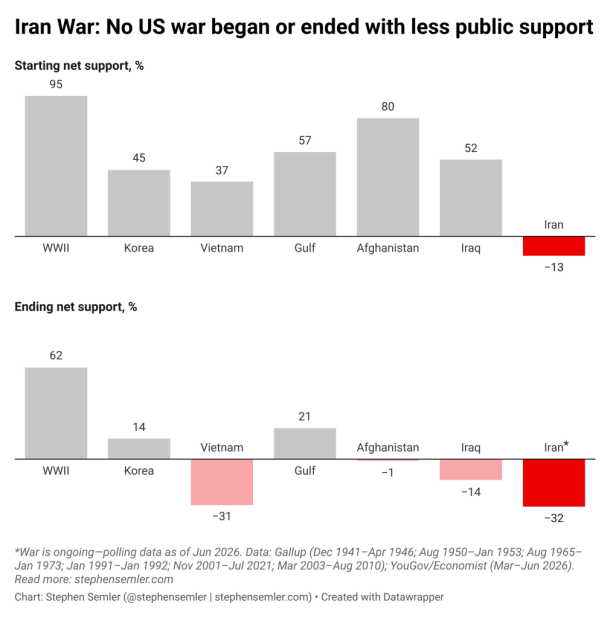
While the US certainly suffered some reputational damage and significant economic costs from its unprovoked attack on Iran, the United Arab Emirates may really be the big loser. Let’s focus on Dubai.
Think of Dubai as the World’s most expensive adult theme park that has no emergency exit. For decades, Dubai sold itself to the world as what would happen if Las Vegas and Disney World had a child together, raised it on sovereign wealth, and sent it to finishing school in Monaco. The result was a city of genuinely staggering audacity — an indoor ski slope in the desert, a hotel shaped like a sail that awards itself seven stars because five simply wasn’t enough, palm-shaped islands visible from space that are slowly sinking back into the sea from which they were so expensively extracted. It was, by any measure, the greatest theme park ever built for people who found actual theme parks insufficiently gilded and too puritanical.
The supposed genius of the Dubai proposition was always its geographical logic: i.e., it sits at the crossroads of global trade, pumps enough oil to build the infrastructure, and then gradually replace the oil revenue with everything else — tourism, finance, real estate, the inscrutable business of being a place where very wealthy people park very large amounts of money while asking no inconvenient questions. Oh, did I mention money laundering and hookers?
The Burj Khalifa, the world’s tallest building, named after the ruler of Abu Dhabi because Dubai ran out of money halfway through construction and needed a bailout, stands as perhaps the most honest monument in human history: a gleaming advertisement for ambition funded by someone else. The formula worked brilliantly as long as one variable held constant: the Strait of Hormuz remained open. The US and Israeli attack on Iran turned this assumption inside out.
Disney World works because it controls its environment entirely. Inside the berm, reality is suspended. Outside the berm, Florida continues to be Florida, which, as I can testify, is its own form of unreality but in a less curated direction. Dubai’s version of the berm was always the strait — twenty-one miles of water that kept the global economy flowing through the neighborhood and made Dubai’s position as the region’s entrepôt, logistics hub, financial center, and luxury destination not merely plausible but geometrically inevitable.
When Iran mined the strait in March 2026, Dubai discovered that its berm had a gap in it roughly twenty-one miles wide.
The cruise ships left first — or rather, they tried to. Six of them were trapped inside the Gulf like very large, very expensive rubber ducks in a bathtub whose drain had been plugged by a theocracy. Fifteen thousand passengers discovered that the all-inclusive package they had purchased did not, in the fine print, include Iranian mine-clearance operations as an amenity. The ships eventually got out during a brief window in April when Iran and the US simultaneously claimed the strait was open, which gave the ships a brief opening to make a run to safety. The passengers disembarked elsewhere and appear to have decided that the Arabian Gulf cruise experience had delivered sufficient excitement for one lifetime.
Las Vegas, Dubai’s other spiritual progenitor, is built on the foundational promise that geography is irrelevant — that a city in the middle of a desert can become the center of the world through sheer force of neon and human appetite. Dubai took this lesson and applied it at sovereign scale. If Las Vegas could conjure a city from nothing in Nevada, Dubai could conjure a global financial center from nothing in a desert on the edge of a historically significant but economically peripheral body of water.
The difference is that Las Vegas sits in the middle of a continent. Its supply chains are inconvenienced by traffic on I-15, not Iranian frigates. When something goes wrong in Nevada, the problem is human-scale. When something goes wrong in the Strait of Hormuz, the problem is civilizational-scale, which is a somewhat different category of operational risk.
Dubai’s ports — Jebel Ali, the largest in the Middle East — discovered that being the region’s premier logistics hub is an extraordinary competitive advantage right up until the moment the region becomes inaccessible. The container ships stopped coming. The tankers that hadn’t already been stranded inside the Gulf diverted around Africa, adding two weeks to their journeys and entirely bypassing the hub that had been so carefully constructed to serve them. The cargo kept moving; it simply moved around Dubai rather than through it, in the manner of a river that encounters a spectacular dam and quietly reroutes rather than admiring the engineering.
What Dubai is experiencing is the particular agony of a city built for maximum throughput discovering that throughput has somewhere else to be. The restaurants remain excellent. The hotel pools remain temperature-controlled to a degree that can only be described as a philosophical statement about the relationship between mankind and climate. The brunches — Dubai’s most characteristically Dubai institution, a Friday afternoon event that begins at noon, ends somewhere around consciousness, and costs roughly what a semester of community college costs in Ohio — continue to be held, though with fewer attendees from the European finance sector, which is dealing with its own energy crisis and has temporarily reduced its appetite for unlimited wagyu and proximity to other people’s wealth.
The real estate market, which has spent twenty years as a reliable indicator of how much money the world needs to quietly relocate, is experiencing what agents describe as a period of recalibration and what everyone else describes as a crash. Property values in Dubai are denominated in confidence as much as dirhams, and confidence requires that the fundamental premise of Dubai — the crossroads theory, the inevitability of the location — remains legible. A crossroads from which one of the roads has been temporarily mined is a different proposition.
But the Hormuz crisis has stripped away, at least temporarily, the comfortable fiction that Dubai’s position was natural rather than constructed, inevitable rather than contingent. Las Vegas exists because Americans wanted somewhere to gamble without legal consequence. Disney World exists because Walt Disney wanted to control the parking. Dubai exists because the global economy needed a node at a specific geographic location, and someone had the audacity and the capital to build one there.
All three are, at their core, exercises in the proposition that if you build it extravagantly enough, they will come. Two of them don’t have to worry about what happens if someone mines the entrance.
But there also is a dark side to the UAE in general and Dubai in particular — it is a center for money laundering and foreign intelligence activities. A friend, who is a business/energy consultant in the Persian Gulf summarizes the situation as follows:
The UAE now operates as a Zionist/Israeli-linked Gulf security platform with annex-like and fledgling-colony characteristics. Zionist/Israeli and Israel-linked security, cyber, surveillance, defense, and intelligence-adjacent systems have permeated core state capability to the point of effective strategic control over key security and technology layers.
That penetration creates strategic exposure across the UAE military establishment, internal-security architecture, technology stack, logistics system, financial channels, and monetary confidence base.
The money-flow thesis has also changed. Dubai and the broader UAE have long served as high-liquidity routing environments for offshore capital, sanctions-sensitive money, criminal syndicate proceeds, and illicit flows connected to Africa, gold, real estate, trade, luxury assets, and corporate structuring. The war-risk and security-integration shock has damaged that flow. Capital that depends on opacity, stability, and uninterrupted confidence becomes unstable when the host jurisdiction is visibly embedded in a conflict architecture.
The state is assessed as structurally aligned with the US-Israel security architecture and operationally dependent on Israel-linked security and technology capabilities. The exposure is not merely diplomatic. The UAE security apparatus, technology apparatus, military establishment, cyber-defense layer, and monetary confidence system are assessed as deeply permeated by Zionist/Israeli and Israel-linked systems, vendors, intelligence-adjacent relationships, and defense cooperation. Money flows that used the UAE for opacity, liquidity, asset conversion, gold, corporate layering, luxury consumption, trade routing, and real-estate placement are now exposed to war-risk repricing, sanctions scrutiny, intelligence attention, and capital-flight pressure.
So guess whose uncle is a weekly visitor to the UAE carrying bags of cash? If you guessed Volodimir Zelensky you are correct. Zelensky’s uncle, according to my source, deposits the money in local banks. The money is then used to purchase property that it then subsequently sold. The proceeds from that sale are then sent to banks in Israel… All cleaned up. From there, some of the money makes its way back to members of the US Congress as a way of thanking them for their support of Ukraine.
Will the UAE return to its previous garish glory? Perhaps. One immediate consequence of the US/Israeli attack on Iran is that much of the big money stored in the UAE banks decided that Singapore was more secure, which produced a significant capital flight from Dubai. The de facto expulsion of the US from the Persian Gulf, coupled with Chinese and Russian initiatives to create a new security architecture in the Gulf, is causing the Emiratis to reassess their past relationships. It is not clear what path they will choose to follow going forward, but the UAE emirs did send a delegation to Tehran on June 9. Is Dubai considering a future without wealthy foreigners with an appetite for alcohol and prostitutes? Maybe.

By Justin K.P. | The Dissident | June 22, 2026
The former Israeli intelligence official turned whistleblower, Ari Ben-Menashe made some explosive claims to journalist Afshin Rattansi in the latest episode of his Going Underground TV Show, alleging that then president Bill Clinton made a deal with then Iranian president Mohammad Khatami, but then Israeli Prime Minister Ehud Barak, a known close associate of Jeffery Epstein, used blackmail about Clinton’s known connection with Jeffery Epstein and his trafficking operation of underage girls, to end the deal.
Ben-Menashe alleges that in 2000 Bill Clinton “met President Khatami in Mirabel Airport north of Montreal and they worked out the deal between them”.
Ben-Menashe noted that “on March 17, 2000, Madeleine Albright made a speech at the American Iranian Council apologizing to the Iranian people for America overthrowing an elected government in 1952 in Iran and bringing the Shah back”
Indeed, on March 17, then Secretary of State Madeleine Albright made a speech apologizing for the overthrow of Iran’s popular elected president Mohammed Massadegh in 1953, saying:
In 1953 the United States played a significant role in orchestrating the overthrow of Iran’s popular Prime Minister, Mohammed Massadegh. The Eisenhower Administration believed its actions were justified for strategic reasons; but the coup was clearly a setback for Iran’s political development. And it is easy to see now why many Iranians continue to resent this intervention by America in their internal affairs.
Moreover, during the next quarter century, the United States and the West gave sustained backing to the Shah’s regime. Although it did much to develop the country economically, the Shah’s government also brutally repressed political dissent.
As President Clinton has said, the United States must bear its fair share of responsibility for the problems that have arisen in U.S.-Iranian relations. Even in more recent years, aspects of U.S. policy towards Iraq, during its conflict with Iran appear now to have been regrettably shortsighted, especially in light our subsequent experiences with Saddam Hussein.
This certainly suggested that the Clinton administration was trying to reset the U.S. and Iranian relationship, acknowledging Iran’s long list of legitimate grievances against the United States.
But according to Ari Ben-Menashe, the deal never went through because Israeli Prime Minister Ehud Barak “sabotaged” the deal using Epstein blackmail.
Ben-Menashe said, “But Ehud Barak and company sabotaged that deal by using Epstein and company against Mr. Clinton”.
Because Clinton had already gone through the Monica Lewinsky scandal, this was enough for him to abandon diplomacy, according to Ben-Menashe.
or go to
Aletho News Archives – Video-Images
Press TV – June 18, 2019
A detailed report published by the Guardian newspaper has shown how Britain is massively contributing to Saudi Arabia’s devastating war on Yemen as it suggests that London is not only supplying the bombs that fall on Yemenis, but it provides the personnel and expertise that keep the war going.
The comprehensive report by Arron Merat published on Tuesday showed that Britain was doing much of the killing in Yemen as the country continues to provide Saudi Arabia with everything it needs to turn its southern impoverished neighbor into a graveyard.
“Every day Yemen is hit by British bombs – dropped by British planes that are flown by British-trained pilots and maintained and prepared inside Saudi Arabia by thousands of British contractors,” said Merat in the report. … continue
 Aletho News If Americans Knew No Tricks Zone
