Iran declares victory over US
RT | June 18, 2026
Iranian officials have portrayed the newly signed memorandum of understanding with the US as a diplomatic victory achieved through strength and as evidence that Washington failed to achieve any of its objectives militarily.
The 14-point document was signed remotely by President Donald Trump and his Iranian counterpart, Masoud Pezeshkian, late Wednesday and immediately entered force, according to the Pakistani mediators.
The US side has been unusually muted in its public response. The White House has also yet to publish the final text of the memorandum, although an unnamed senior US official read out the 14-point document to journalists after days of criticism over the secrecy surrounding the deal.
Meanwhile, Iran’s parliament speaker and chief negotiator in the talks, Mohammad Ghalibaf, described the memorandum as proof of US surrender.
“The agreement is a record of US failure,” Ghalibaf said in a televised interview on Wednesday. “People will see it and judge.”
Tehran has argued that the document reflects a series of concessions by Washington, including the lifting of the US naval blockade, sanctions waivers for Iranian oil exports, access to frozen Iranian funds, and a US-backed economic reconstruction plan worth at least $300 billion. Washington has also agreed not to impose new sanctions or deploy additional forces in the region while the sides negotiate a final agreement.
In response, Iran “will make arrangements” to restore freedom of navigation through the Strait of Hormuz – something that had not been an issue before the US-Israeli attack. However, Tehran has signaled that the key waterway will not simply return to prewar conditions.
“I emphasize again that the Strait of Hormuz will never return to the previous conditions,” Ghalibaf said. “Iran has the right to sovereignty over the Strait of Hormuz, and of course, we will receive a fee for services.”
Iranian Foreign Ministry spokesman Esmaeil Baghaei added that a framework was being developed to manage the key waterway, with consultations already held with Oman, as outlined in the MOU.
Tehran has also highlighted the memorandum’s language on Lebanon. “If the Israeli regime’s attacks on Lebanon continue, it will be considered a violation of the other party’s commitments under the memorandum of understanding,” Baghaei said.
The memorandum is not a final peace agreement, but launches a 60-day negotiation period during which Washington and Tehran are expected to discuss Iran’s nuclear program, sanctions relief, frozen assets, the future administration of the Strait of Hormuz, and a final settlement to be endorsed by the UN Security Council.
The nuclear language in the document states that Iran “reaffirms that it shall not procure or develop nuclear weapons” – something Tehran has been stating for years, including during both previous US-Israeli attacks. The MOU adds that the sides will work out a mechanism for the disposition of stockpiled enriched material, with the minimum methodology being down-blending on site under IAEA supervision.
Trump made multiple unrelated posts on Truth Social hours after signing but said nothing about the deal. Earlier in the day, he defended the memorandum, threatening to “bomb the hell out of” Iran if it failed to comply.
Iran reveals full text of war-ending MoU signed with US
Al Mayadeen | June 18, 2026
Iran and the United States have signed a Memorandum of Understanding (MoU) aimed at launching expanded negotiations and ending the war across all fronts in the region.
The text of the agreement, published by Tasnim News Agency, outlines a framework for a permanent cessation of hostilities, sanctions relief, maritime security arrangements, nuclear negotiations, and a roadmap toward a final agreement to be concluded within 60 days.
The full text of the Iran-US MoU
Below is the full text of the MoU as reported by Tasnim News Agency :
Islamabad Memorandum of Understanding between the United States of America and the Islamic Republic of Iran
- The United States of America and the Islamic Republic of Iran and their allies in the current war by signing this MoU, declare the immediate and permanent termination of military operations on all fronts, including in Lebanon, and undertake from now on not to initiate any war or any military operation against each other, and to refrain from the threat or use of force against each other, and ensuring the territorial integrity and sovereignty of Lebanon. Final deal will confirm the permanent termination of the war on all fronts, including in Lebanon, and other provisions of this paragraph.
- The United States of America and the Islamic Republic of Iran undertake to respect each other’s sovereignty and territorial integrity and to refrain from interfering in each other’s internal affairs.
- The United States of America and the Islamic Republic of Iran commit to negotiating and achieving the final deal in maximum 60 days, extendable with mutual consent.
- Immediately upon the signing of this MoU, the United States of America will begin the removal of its naval blockade and any disturbances or impediments against the Islamic Republic of Iran, and will fully end the naval blockade within 30 days. During this period, the traffic of vessels will be in proportion to the numbers of pre-war traffic being restored by the Islamic Republic of Iran. The United States of America further undertakes to remove its forces from the proximity of the Islamic Republic of Iran within 30 days after the final deal.
- Upon the signing of this MoU, the Islamic Republic of Iran will make arrangements using its best efforts for the safe passage of commercial vessels with no charge for 60 days only from the Persian Gulf to the Sea of Oman and vice versa. The traffic of commercial vessels will immediately start, and considering the need for removing the technical and military obstacles and demining by the Islamic Republic of Iran, will be instated within 30 days. The Islamic Republic of Iran will conduct dialogue with the Sultanate of Oman to define the future administration and maritime services in the Strait of Hormuz in discussion with other Persian Gulf littoral states in line with the applicable international law and the sovereign rights of coastal states of the Strait of Hormuz.
- The United States of America undertakes with regional partners to develop a definitive, mutually agreed plan with at least $300 billion for the reconstruction and economic development of the Islamic Republic of Iran. The mechanism for the implementation of this plan will be finalized as part of a final deal within 60 days. All required licenses, waivers and permissions needed for the relevant financial transactions will be granted by the United States of America.
- The United States of America undertakes to terminate all types of sanctions against the Islamic Republic of Iran, including the United Nations Security Council resolutions, i.e. IAEA Board of Governors resolutions and all unilateral US sanctions, primary and secondary, in an agreed-upon schedule as part of the final deal. The Islamic Republic of Iran and the United States of America acknowledge the critical importance of the sanctions-termination issue abovementioned, and expressed their intentions to immediately address these issues in the negotiations, in order to achieve mutual agreement on them.
- The Islamic Republic of Iran reaffirms that it shall not procure or develop nuclear weapons. The United States of America and the Islamic Republic of Iran have agreed to resolve the disposition of stockpiled enriched material, pursuant to a mechanism that will be mutually agreed upon in accordance with the schedule mentioned in Paragraph Seven, with the minimum methodology to be downblending on site under the supervision of the IAEA. The two parties also agreed to discuss the issue of enrichment and other mutually agreed matters related to the Islamic Republic of Iran’s nuclear needs based on a satisfactory framework being agreed upon in the final deal. The final deal will confirm the provisions of this paragraph. The United States of America and the Islamic Republic of Iran acknowledge the critical importance of the nuclear issues abovementioned and express their intention to immediately address these issues in the negotiations in order to achieve mutual agreement on them.
- Pending the final deal, the United States of America and the Islamic Republic of Iran agree to maintain the status quo. The Islamic Republic of Iran will maintain the current status quo of its nuclear program, and the United States of America will not impose any new sanctions and will not deploy additional forces in the region.
- The United States of America undertakes that immediately upon the signing of this MoU until the termination of sanctions, the US Department of Treasury will issue waivers for the export of Iranian crude oil, petroleum products and derivatives, and all associated services, including banking transactions, insurances, transportation, etc.
- The United States of America undertakes to make fully available for use the frozen or restricted funds and assets of the Islamic Republic of Iran upon the implementation of this MoU. The United States of America and the Islamic Republic of Iran will mutually agree on the procedures related to the release of these funds during the negotiations. Such funds, either retained in the original account or transferred, shall be made fully usable for payment to any ultimate beneficiary designated by the Central Bank of the Islamic Republic of Iran. The United States of America undertakes to issue all necessary licenses and authorizations accordingly.
- The United States of America and the Islamic Republic of Iran agree that an executive mechanism will be established to monitor the successful implementation of this MoU and the future compliance of the final deal.
- After signing this MoU and subject to the beginning of the implementation of Paragraphs 1, 4, 5, 10 and 11 of this MoU and the continuing implementation of these measures, the United States of America and the Islamic Republic of Iran will start negotiations regarding the final deal exclusively on the other paragraphs.
- The final deal will be endorsed by a binding UN Security Council resolution.
Belarusian children wounded in deadly Ukrainian drone strike
RT | June 17, 2026
A Ukrainian drone attack has struck a bus carrying a children’s soccer team from Belarus to a Russian seaside resort, according to acting Bryansk Region Governor Egor Kovalchuk.
The attack killed an adult woman who was accompanying the underage passengers to the resort town of Gelendzhik in Krasnodar Region and injured six others, including four children, the official said.
One young victim has been rushed to hospital in serious condition, while the injuries of the others are considered moderate, Deputy Health Minister Aleksey Kuznetsov told the media. He said seven people in total were injured. Meanwhile Belarusian Deputy Health Minister Aleksandr Khodzhaev said eight victims were being treated following the incident, including six minors.
The bus was carrying 44 passengers, including 28 young athletes from a school sports team based in the town of Rechytsa in Belarus, according to Russia’s Investigative Committee. The incident has been designated a terrorist attack, the agency added.

Source: Social media
Images published by Russian and Belarusian media showed the attacked vehicle – a single-deck passenger bus rather than a double-decker initially reported by the Investigative Committee – with holes apparently left by shrapnel and a deflated front-right tire.
The acting governor later shared photos of what appears to be the same bus, including of the interior, showing shattered windows and seats apparently smeared with blood.

© Telegram / Acting Bryansk Region Governor Egor Kovalchuk
The woman who was killed was the wife of the team coach, a source in Belarusian law enforcement told RT.
Kiev has intensified its long-range drone campaign against Russia in recent months, describing the strikes as “long-range sanctions” aimed at inflicting economic damage. Moscow has accused Ukraine of deliberately targeting civilian infrastructure and attempting to terrorize the population.
In May, Ukrainian drones struck a dormitory at a vocational college in Starobelsk in the Lugansk People’s Republic, killing 21 people. According to local authorities, many of the victims were teenage students who were spending the night on campus.
Officials in Russian regions bordering Ukraine also regularly report strikes on vehicles used by repair crews, medics, and other community services. Earlier on Wednesday, Kovalchuk reported an attack on an ambulance in Bryansk Region that was responding to an emergency, in which the driver, a nurse and a paramedic were injured. In a separate incident, a drone hit a civilian car, injuring the driver and a female passenger, he added.
Belarus is a close military and political ally of Russia, but has not directly joined the Ukraine conflict. Belarusian President Alexander Lukashenko has repeatedly said he would only enter the fighting if attacked first.
Since mid-May, Zelensky has issued a series of warnings to Minsk, threatening a pre-emptive strike over what he claimed were preparations for a possible attack from Belarusian territory. However, Ukrainian officials themselves have said there was no evidence of such plans.
Lukashenko has dismissed the claims as empty grandstanding, saying the Ukrainian military lacks the manpower to launch an incursion into Belarus.
US, EU authorize production of ‘deep strike’ missiles inside Ukraine
Western allies are using the diplomatic progress from a possible Iran peace deal to intensify an economic blockade against Russia
The Cradle | June 17, 2026
On 17 June, G7 leaders announced that US and EU arms makers will start manufacturing advanced long-range weaponry “under license” in Ukraine, as western stockpiles dwindle, aiming to industrialize the frontline and sustain pressure on Russia.
A diplomatic source at the summit in Evian-les-Bains clarified that the push involves “not just air defense systems, but deep strike capabilities,” allowing Ukraine to threaten targets much deeper into Russian territory, Le Parisien reported.
The official noted that local production is essential as Ukrainian forces currently deploy approximately 20 Patriot missiles to counter every massive Russian offensive, straining global stocks.
The move effectively entrenches a permanent industrial infrastructure for offensive warfare capabilities within Ukrainian territory.
In a joint statement, G7 leaders from Canada, France, Germany, Italy, Japan, the UK, the US, and the EU expressed their “readiness to grant Ukraine licenses enabling it to increase its military production.”
German Chancellor Friedrich Merz explained that US firms will grant these licenses to European and Ukrainian manufacturers to address current industrial shortages.
Merz stated he was “grateful to [US] President [Donald] Trump for this great willingness to cooperate,” adding, “We are all currently producing too little, and this can be compensated for by granting licenses to companies that have these production capacities, including European and Ukrainian companies.”
This military support coincides with a G7 agreement to escalate economic pressure on Moscow by tightening sanctions on the Russian oil and gas sectors, with leaders citing the reopening of the Strait of Hormuz following the Iran–US memorandum of understanding (MoU) as the catalyst for these measures.
“We consider this the right moment to proceed with additional measures, as President Trump has delivered a deal that we support in reopening the Strait of Hormuz,” the leaders declared.
The move follows the US reinstatement on Tuesday of oil sanctions that had been temporarily suspended during the war on Iran, which now may end with the signing of the MoU on Friday in Switzerland.
The summit highlighted a shift in US foreign policy. Canadian Prime Minister Mark Carney described the new US stance as “harder toward Russia and more realistic, in our view, of the situation on the ground of the war.”
Trump, who told assembled leaders “I’m the boss,” pledged to “do everything” to help end the conflict.
While Ukrainian President Volodymyr Zelensky welcomed the “important results” regarding the military contracts, he remained cautious following a February 2025 meeting with US Vice President JD Vance and a demand that Ukraine provide resources as “compensation” for aid.
French diplomatic sources added that G7 members now “acknowledge that there is momentum on the ground” in Ukraine’s favor.
The new western military push comes after the EU had approved an approximately $105 billion loan for Ukraine on 22 April to fund critical defense needs and financial assistance.
The funding was released following a months-long deadlock after Ukraine resumed Russian oil flows through the Druzhba pipeline to Hungary and Slovakia.
Hungary had vetoed the loan, accusing Kiev of using “technical repairs” from a drone strike as a pretext to weaponize energy and exert political pressure.
Trump leverages illegally frozen Palestinian funds to force normalization, halt legal cases against Israel
The Cradle | June 17, 2026
US President Donald Trump is seeking to leverage severe Palestinian financial hardship to coerce a “normalization” agreement that would require the Palestinian Authority (PA) to drop all international legal challenges against Israel, the Times of Israel reported on 17 June.
This proposed memorandum of understanding (MoU), negotiated by US officials Aryeh Lightstone and Scott Leith, demands the Palestinian Authority (PA) “halt efforts to internationalize the conflict with Israel.”
In exchange for these concessions, Washington has offered the hollow possibility of reopening the Palestine Liberation Organization (PLO) mission in Washington and lifting sanctions, but only after the PA completes a series of “Saudi-chaperoned reforms.”
The PA has further requested language in the MoU calling for a cessation of Israeli settlement expansion and a crackdown on “rampant settler violence” in the occupied West Bank.
Central to these talks is the fate of over $5 billion in Palestinian tax revenues, which Israel has been illegally withholding for over a year in violation of the Oslo Accords.
The US seeks to redirect these funds to the “Board of Peace” and its National Committee for the Administration of Gaza (NCAG) to finance a post-war governance plan that bypasses the PA until it meets Washington’s benchmarks – including the dissolution of the PA’s welfare program for the families of Palestinians killed or imprisoned by Israeli occupation forces.
While the PA has agreed in principle to this diversion to secure a fraction of its own money, Israeli Finance Minister Bezalel Smotrich has blocked the transfer, openly advocating for the “collapse of the PA” and rejecting even debt-settlement transfers in a deliberate effort to ensure the total financial strangulation of Palestinian governance.
Despite external audits confirming the PA has successfully reformed its welfare system to end payments based on attacks, a US Department report, relying on Israeli data, claimed the PA still provides “compensation in support of terrorism.”
As the US explores legally thin options to unilaterally seize Palestinian funds, officials admit the administration views the West Bank as an “afterthought” while prioritizing the expansion of the Abraham Accords.
The art of the recycled deal: Trump and the outcome Israel cannot tolerate
By Jamal Kanj | MEMO | June 17, 2026
There are many lessons to be learned from the latest made-for-Israel war on Iran. The first and most damning is that the war resolved the very crisis it created. Donald Trump celebrated the reopening of the Strait of Hormuz and the lifting of the blockade against Iran. Two conditions that were fully in place before Benjamin Netanyahu dog walked Trump into this war. The agreement that concluded the war took us back to exactly where we stood before America spent $200 billion, and where Americans continue to pay Israeli surcharge tax at the pump and grocery stores.
As for Iran’s nuclear program, the arithmetic does not lie. The 400 kilograms of 60-percent enriched uranium that Iran possessed were zero before Trump — pressured by his largest Israel-first donors — tore up the Joint Comprehensive Plan of Action (JCPOA) in May 2018.
According to the International Atomic Energy Agency, Iran had fully complied not only with the IAEA non-proliferation agreement, which Israel has never signed nor accepted, but with the additional protocols governing verification and monitoring of its civilian nuclear program.
Trump canceled the deal anyway, not because it failed America, but because it did not satisfy Israel’s veto.
The deepest irony is that Iran’s nuclear knowledge and capabilities are more advanced today than when Trump discarded the JCPOA. Any new agreement — even one stricter in structure than the original — is therefore being negotiated from a fundamentally weaker position than the one that existed in 2018. No treaty can unlearn what Iran already knows.
On Monday, June 15, Trump heralded the end of war bragging that Iran agreed not to develop nuclear weapons. In a leaked copy of the supposed Memorandum of Understanding (MoU), item 8 states: “The Islamic Republic of Iran reiterates that it will never produce nuclear weapons ...” The word reiterates is not incidental. It is a direct reference to Article III of the 2015 JCPOA, which Trump most likely never read, where Iran had already affirmed: “… that under no circumstances will Iran ever seek, develop or acquire any nuclear weapons.” Same commitment. Same language. Different signatures. Twelve weeks of a war that went nowhere to get here.
From “There will be no deal with Iran except UNCONDITIONAL SURRENDER!” to celebrate an MoU to reopen a Strait that was open before $200 billion and countless American and Iranian lives were squandered. Trump’s triumph is much ado about nothing.
He canceled an existing deal that took years to negotiate, inflicted economic hardship on ordinary Iranians, and allowed Iran’s nuclear advancement to leap forward. It is, in the most literal sense, like redefining water as H2O. The molecule did not change. Only the dressing did. Israel’s war took Trump back to the starting point, at twice the cost to American taxpayers.
The same special-interest group that pushed Trump to cancel the JCPOA, lobbied him long before the 2024 election. Israel-first donors poured hundreds of million into his campaign as a down payment for this war. Netanyahu visited Trump seven times in thirteen months, manipulating, and scheming for another made-for-Israel war.
This war should also carry a lesson for the Arab Gulf states that long believed American military bases were a guarantee of their security. Instead, they found themselves sidelined and never consulted on a war waged, directly or indirectly, from their own soil, ultimately in service of an Israeli agenda. Foreign military presence does not deliver security. It delivers dependency. Lasting regional stability is built through regional cooperation, on terms beneficial to the region.
More importantly, the region must now reckon with a pattern it can no longer afford to ignore: wherever Israel goes, instability follows. The so-called Abraham Accords brought Israel into the Gulf. What followed was bombs, drones and economic ruins never seen since the Second World War.
I have lived in the Gulf. The only pop people could hear was the backfire of an aging car exhaust. In the last three months, friends shared recordings of ballistic missiles splitting the sky and drones buzzing overhead. Israel did not bring a defense shield; it brought a target. Its presence is a magnet for unrest. It is a carcass attracting wasps.
In fact, Israel is an agent of disorder and a parasite nurtured by chaos. It wraps itself in the language of partnership, mutual benefit, and shared values, deceiving others into believing the arrangement is reciprocal when it is entirely one-directional.
Israel’s record speaks for itself: a genocide in Gaza, ethnic cleansing across the West Bank, 1.3 million internal refugees in Lebanon, the occupation of Syrian land following Assad’s fall, destabilization operations in northern Iraq and Sudan.
In Iraq, the American invasion and regime change did not satisfy Israel’s insatiable lust for total chaos. It targeted Iraqi scientists and waged war against knowledge itself. The blueprint, in this view, has not changed for Iran. Israel’s dissatisfaction over the MoU with Tehran is not that it fails to produce a non-nuclear Iran, but that it fails to wipe out knowledge. Its broader objective is the suppression of scientific and technological development across the region. Israel seeks neighbors unable to think independently, consume, not produce, import rather than innovate. It wants to maintain a monopoly over nuclear capabilities and control over regional scientific advancement.
Israel brought ruins to the U.S., too. The made-for-Israel Iraq war helped detonate the financial crisis of 2008, saddling future American generations with trillions in accumulated debt that has never been fully reckoned with. A war that Trump condemned, criticizing Democratic leadership for failing to impeach George W. Bush who “got us into the war with lies.”
The cost of current Trump’s made-for-Israel war on Iran requires no economist to explain. It arrives uninvited in every American home, at the meat counter, in every grocery bill, every gas receipt, every price that keeps rising without explanation. They may not realize its extent, yet. By the time they do, the damage to the U.S. economy, as in 2008, will be too deep to reverse.
To undermine potential peace with Iran, the ungrateful Israel-first loyalists like Ben Shapiro, Mark Levin are already panicking and challenging Trump’s MoU. Israel will activate the constellation of media outlets controlled by Israel-first billionaires to shape what Americans see, read, and are permitted to question. The once-respected 60 Minutes, under a new Israel-first boss, Bari Weiss, allows Netanyahu to handpick his own interviewer. Who knows, maybe he submits his own questions, too.
Now, Netanyahu and American Zionists have sixty days to sabotage a final deal with Iran. Israel will mobilize its donors, lobby Congress, and if that fails, resort to what it has perfected. A false flag operation against American forces in the region, or another assassination in Lebanon.
A conflagration ensues, and once again, it will be fought with American money and American lives. Because a Middle East free of American military entanglement is the one outcome Israel cannot tolerate — a prospect more threatening than any Iranian nuclear centrifuge.
Iran announces plan to link electricity grid with Qatar, transfer up to 1,000 MW of power
The Cradle | June 17, 2026
Iran is planning to connect its electricity grid with Qatar and announced on 16 June that work on the matter is in its “final stage,” reviving a years-old agreement with the Gulf state in the aftermath of the brutal US-Israeli war against the Islamic Republic.
Iranian Energy Minister Abbas Aliabadi said on Tuesday that “the connection between Iran and Qatar will begin soon.”
He added that “studies are in the final stage, and we are beginning the implementation phase.”
Aliabadi also said Tehran was “studying” power grid connection with other Gulf countries, according to Tasnim News Agency.
The minister affirmed that this would happen “in the near future.” The deal will involve a transfer of up to 1,000 megawatts (MW) of electricity.
Talks on the matter had been taking place between Tehran and Doha in December 2023.
The two countries had previously signed an electricity memorandum of understanding (MoU) under the late Iranian president Ebrahim Raisi’s government.
The new announcement comes several days after Qatar denied a Washington Post report that said the Gulf state cut a “secret” deal with Iran to avoid further retaliatory strikes.
“Any suggestion that operational decisions relating to energy production were – or have ever been – made in coordination with Iran, for Iran’s benefit, or to influence the course of the conflict is entirely unfounded,” Qatar’s International Media Office said on 12 June.
The Washington Post had cited western and regional officials as saying that Qatar approached Iran at the start of the war, following Tehran’s major strike on the key Ras Laffan energy facility.
“Seeking to protect its economic crown jewel, Qatar approached Tehran … to present a mutually beneficial arrangement: Iran would refrain from hitting Ras Laffan, and Qatar would halt gas production unilaterally – a move that would send energy prices soaring and put economic pressure on the US and Israel to shorten the war,” the sources said.
After the Iranian strike on Ras Laffan, Doha said the attack caused $20 billion in losses and wiped out 17 percent of the Gulf state’s gas export capacity.
Iran largely refrained from attacking the country in the days that followed, although some drone attacks and explosions were reported.
Tehran said during the war that many attacks on the Gulf were actually Israeli “false-flags” aimed at inflaming tensions.
Political commentator Tucker Carlson also reported in early March that Qatar and Saudi Arabia detained Mossad agents who were planning bombings, implying that the foiled attacks were designed to be pinned on Iran.
Tehran’s announcement on the electricity agreement with Qatar coincided with a Bloomberg report that said Qatar is planning to rapidly increase liquefied natural gas (LNG) production once the Strait of Hormuz reopens, aiming to restore up to 80 percent of its export volume within two months.
Pax Iranica? The end of uncontested U.S. military hegemony
By Raphael Machado | Strategic Culture Foundation | June 17, 2026
Anyone would be skeptical about the sustainability of the “peace” taking shape in the Middle East from the Memorandum of Understanding to be signed between Iran and the United States in a few days. It is plausible that it may not even be signed. And even if it is signed, considering that it involves a gradual, phased unfolding of a peace process that would last at least two months, it is hard to believe that everything will go as intended by the parties and the Pakistani mediators.
Nevertheless, in the terms that this “peace” is presented and which have been accepted by the U.S., we are facing an overwhelming victory for Iran. Even if the diplomatic process is derailed, nothing will change the fact that the U.S. accepted peace with Iran on terms unilaterally favorable to the Persians, leaving Tehran in a much stronger position than before the war began.
First of all, the U.S. failure should be seen as obvious and rests on a very simple assessment: Washington failed to achieve any strategic objective in the conflict with Iran: the “regime” was not overthrown, the nuclear program was not destroyed, military capabilities were not eliminated, support for the Axis of Resistance was not liquidated, and finally, it was not possible to reopen the Strait of Hormuz by force.
The U.S. committed the most basic error of any conflict: misjudging the balance of power. And in this, naturally, the U.S. was led into error by Israel and its allies within the U.S.. From the start, reports indicate that the Pentagon opposed military action against Iran, for good reasons.
Even considering the tactical and operational dimensions, the U.S. was unable to impose itself as intended. The U.S. failed to achieve air superiority over Iran and resorted to launching missiles from outside Iranian airspace. Most times the U.S. penetrated Iranian airspace, they encountered anti-aircraft systems capable of shooting down even F35s. The U.S. also could not take advantage of its regional military bases, which were harassed and operationally neutralized by barrages of missiles and drones, complicating U.S. logistics and forcing them to use increasingly distant bases. Iran also managed to force U.S. aircraft carriers to keep their distance, with one returning to port for maintenance. Furthermore, the U.S. demonstrated that it is not yet ready to face a war in which drones play a central tactical role. But perhaps the most significant embarrassment was the fact that Iran forced the U.S. to confront its own industrial shortcomings—the U.S. expended large quantities of Tomahawks, Patriots, and other types of offensive and defensive missiles, which are produced at a trickle. The fact that U.S. missile stocks plummeted rapidly without any objective being achieved was certainly decisive for U.S. reluctance to restart the conflict.
There was also the poorly explained situation involving the destruction of several aircraft and helicopters in an alleged attempt to rescue a downed pilot (a pilot who was simply never seen again and was not even reliably identified). The fact that the ceasefire came just days after this alleged rescue operation suggests that the story is very poorly told and that perhaps that was a failed special forces operation to seize Iran’s enriched uranium.
That is precisely why reducing the issue to “control of the Strait of Hormuz” is nothing short of amateurish, since control over the Strait itself was only possible because Iran surprised the U.S. tactically through its ability to present challenges for which the U.S. had no answers and to deny the U.S. certain important military advantages on that terrain.
Naturally, control of the Strait of Hormuz had a significant impact on the conflict, making it more complex and a global issue. Carrying out attacks against Arab Gulf countries rather than just U.S. and Israeli targets followed the same logic of demonstrating power and turning the conflict into a broader, more complex problem. This stance alone forced Qatar to concede and seek a separate peace and rapprochement with Iran.
Now, if pointing out the U.S.’s inability to achieve its objectives, as well as its tactical difficulties, is not enough to demonstrate its defeat by Iran, then the imbalance of the Memorandum of Understanding, which represents a draft peace treaty, is certainly sufficient proof.
The Memorandum is scheduled to unfold in three phases. The first immediate result is the end of military actions on all fronts and the end of the U.S. naval blockade. The situation in Lebanon is already extremely uncertain due to the “Joker factor” that is Israel. But the end of the naval blockade, which is already a reality, has left the Strait of Hormuz under Iranian control, and even if Iran does not charge a “toll,” it is already charging a “service fee” to authorize ship transit.
The next phase, lasting 30 days and beginning after the Memorandum is signed, involves a U.S. promise not to increase its military presence around the Persian Gulf, the return of $12 billion in frozen assets to Iran, the immediate removal of sanctions on Iranian oil, gas, and petrochemical exports, confirmation of joint management of the Strait of Hormuz by Iran and Oman, and a U.S. promise to pressure Israel to withdraw from Lebanon. In return for all this, Iran promises not to seek to develop or acquire nuclear weapons.
And in the final phase, expected to last at least 60 days, the return of the remaining $12 billion in frozen assets, the granting of $300 billion for the reconstruction of Iran (equivalent to reparations), and the beginning of the process of removing all remaining sanctions. In return, Iran promises to agree to discuss its uranium enrichment.
In short, Iran’s obligations under this Memorandum are minimal, while the commitments undertaken by the U.S. are disproportionate. Why take on all these commitments and accept all these conditions if the U.S. “won“—as Trump says—and could “destroy Iran at any moment”?
The reality is that between an international oil crisis, low missile stockpiles, the resilience of the Iranian population, and difficulty dealing with hypersonic missiles and drones, the U.S. suddenly found itself in a potential quagmire capable of causing infinitely greater harm than any conceivable benefit. Perhaps finally aware of the mistake of starting this conflict, with very low popularity, hosting a World Cup, and worried about a myriad of internal and external crises, Trump seems eager to get rid of the “Iranian issue.”
What is proven here is that although the U.S. remains a military superpower, it is possible to defeat them under certain specific conditions and with sufficient preparation. We are not saying here that any country could defeat the U.S. in a war, but that regional powers of a certain scale, immunized against color revolutions and with years of military preparation and investment in technologies capable of negating the potential of the U.S. Navy and its air superiority, can defeat them in a defensive war.
Having recently gone through the “unipolar moment” of uncontested U.S. superiority in the post-Cold War era, whose highest expression was the rapid destruction of Saddam Hussein’s regime, clearly the world is no longer the same, which in itself is proof that we are in a phase of geopolitical transition toward multipolarity.
Weakened in the Middle East, Iran is left in control of the Strait of Hormuz. Its ability to simultaneously confront all the Arab Gulf countries has been proven, and Israel’s inability to defeat Iran without U.S. help has been as well. This opens up for the Middle East the possibility of a regional pax Iranica, though much water will yet flow under this bridge.
Israel, however, remains a problem. Driven by a messianic ideology and accustomed to being treated with privileges derived from the influence of its diaspora, Israel does not appear willing to respect the terms of the Memorandum, nor to give up trying to establish a Greater Israel by force of arms. It is the Israeli factor that makes it difficult to fully realize a peace agreement between Iran and the U.S..
Featured Video
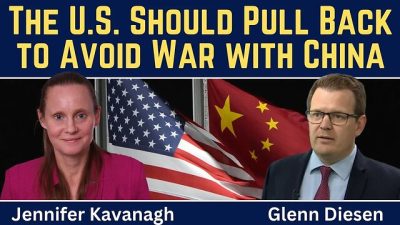
Why the U.S. Should Pull Back From the First Island Chain
or go to
Aletho News Archives – Video-Images
From the Archives
Only 19.7% of Americans agree with US State Dept on Israeli settlements
… Most American adults of voting age don’t appear willing to reject the applicability of international law to Israel’s ongoing colonization of occupied territories in East Jerusalem, the West Bank and Golan Heights. … Full article
Blog Roll
 Aletho News
- Albania on fire: who’s behind the riots?
- Egypt’s Civil Democratic Movement rejects involvement in regional war
- Egypt collaborates with Israel to build ‘Green Rafah’ project over erased Palestinian city
- Rising fuel prices and shortages have helped drive ongoing protests and rioting in France
- Tokyo protests demand Takaichi’s resignation over support for ‘Israel’
- Jennifer Kavanagh: Why the U.S. Should Pull Back From the First Island Chain
- Yemen denounces international community’s silence on Saudi aggression, siege
- UAE and Saudi Arabia move toward renewed coordination against Sanaa
- How Iran’s two-week retaliatory strikes exposed cracks in US military architecture in Persian Gulf
- The mother of all propaganda: Why the hype over US MOAB strike against Iran is nothing but theater
- If Americans Knew
- What the UK Is Doing to Pro-Palestine Novelist Sally Rooney Is an Act of Orwellian Villainy
- ‘We will build palaces for Jews in Gaza’: Right-wing activists establish new outpost near border
- ‘You see us burning, you stay silent’: Family’s agony over mother and sons burned to death in Gaza tent
- Israel keeps Palestinian journalist Bushra al-Tawil in isolation for 46 days
- US-Israel integration plan puts US military tech in Israel’s hands
- Israeli Strike Burns Gaza Mother Alive in Front of Toddler, ‘Without Generating Any Headlines’
- ‘The Israel Experience with Mike Huckabee’: The Ambassador’s Family Sells Trips to Israel
- As Gazans carry out mass burial, food insecurity is getting worse – Daily Update
- Israeli rabbi permits occupiers to steal Palestinian olive harvest in West Bank
- Netanyahu’s spin on latest settler attack is laughable – Daily Update
- No Tricks Zone
- Predictions Made By Renowned Climate Proifessor Over Past Decades Have Been Proven To Be Poor
- New Study Suggests Large Regions Of The Pacific Ocean Have Been Cooling For The Last 80 Years
- Germany’s Green Energy Debacle: High Energy Costs Force Kahla Porzellan to Close After 182 Years!
- New Study: 50 Years Of The Most Aggressive ‘Net Zero’ Policies Can Only Affect The Global Climate By 0.03°C
- US September “Heat” Was No Record…Many Records Set Decades Ago
- Latest European Green Energy Debacle; Portugal’s Largest Flagship Solar Park Insolvent!
- Green Energy Debacle: German Expert Professor Fritz Vahrenholt Warns Of Severe Economic And Social Consequences
- Two More Paleo Reconstructions Affirm Meters-Higher Sea Levels Across Ireland, Brazil 7000-6000 Years Ago
- New Study: Earth And Venus Surface Warmth Largely Explained By Convection And Lapse Rate, Not CO2 Or Radiation
- 2025 Nature Paper Claiming Worsening Global Drought Gets RETRACTED …Heavily Flawed

