Seyed M. Marandi: Trump Lost the Iran War – Must Sell It as a Victory
Glenn Diesen | June 24, 2026
Prof. Seyed Mohammad Marandi is a former advisor to Iran’s nuclear negotiation team.
Follow Prof. Glenn Diesen:
- Substack: https://glenndiesen.substack.com/
- X/Twitter: https://x.com/Glenn_Diesen
- Patreon: https://www.patreon.com/glenndiesen
Support the research by Prof. Glenn Diesen:
- PayPal: https://www.paypal.com/paypalme/glenndiesen
- Buy me a Coffee: buymeacoffee.com/gdieseng
- Go Fund Me: https://gofund.me/09ea012f
Iran, Saudi FMs hold phone talks as Persian Gulf states rethink US ties
Press TV – June 24, 2026
Iranian Foreign Minister Abbas Araghchi and Saudi counterpart Prince Faisal bin Farhan have held a phone call to discuss regional developments, as Persian Gulf Arab states recalibrate their approach toward Tehran in the wake of the US-Israeli war that exposed the limits of American power.
Araghchi on Wednesday briefed the Saudi minister on the latest progress in implementing bilateral agreements and the ongoing negotiations following the US-Iran memorandum of understanding (MoU) signed on June 18.
The two top diplomats underscored the importance of maintaining diplomatic channels, strengthening joint cooperation to support regional stability, and achieving positive and sustainable outcomes.
The call came as French news agency AFP said Saudi Arabia is expected to host talks aimed at repairing relations between Iran and Persian Gulf countries following the US-Israeli war on Iran.
It cited a diplomat familiar with the arrangements as saying Wednesday that a regional summit was being planned in Riyadh and could also include other neighboring countries, but no date had yet been set.
The meetings would be separate from the ongoing negotiations between Iran and the United States, the diplomat added.
CNN, citing a senior Persian Gulf diplomat, reported that leaders are increasingly contemplating a future in which the US plays a much smaller role in the regional security architecture, with a possible framework involving a regional non-aggression pact with Iran.
According to Hasan Alhasan, senior fellow at the International Institute for Strategic Studies, “From the Arab states’ perspective, the Iran war is a disastrous turning point for the regional security order.”
The war, which began on February 28, exposed vulnerabilities in the Persian Gulf states’ security model, which is heavily dependent on the nearly 40,000 US troops stationed in the region and American-made air defense systems.
“The US security guarantee is no longer reliable in the way they thought it was,” one analyst at Chatham House told The New York Times.
Washington’s approach is increasingly perceived as selective and heavily centered on Israel’s security interest.
A classified CIA analysis found that US allies in the Persian Gulf are divided over their approach to Iran. According to the assessment, the United Arab Emirates and Bahrain prefer continued pressure on Tehran, while Saudi Arabia, Qatar, and Kuwait now support negotiations.
Trita Parsi, executive vice president of the Quincy Institute, noted that the UAE and Bahrain “made themselves frontline states against Iran” through the Abraham Accords and “now they’re in too deep and cannot extract themselves out of it”.
The Saudis, Parsi added, “were at the highest levels pushing for this war. They have come to regret it”.
Adding another layer of complexity is a widening gap between Arab governments and Arab public opinion over Iran.
According to a report by The Economist cited by DID Press, growing anger toward Israel and dissatisfaction with US policies have fueled increasing sympathy for Tehran across parts of the Arab world.
Despite sustained efforts by several Arab governments to reinforce anti-Iran narratives, recent developments have altered perceptions among sections of Arab society.
The report identifies two major drivers behind this shift: anger toward Israel, as many Arabs increasingly view Iranian actions against Israel as a legitimate response to regional military operations, and religious and cultural ties, particularly among Shia communities across the Persian Gulf.
The report concludes that sectarian narratives no longer resonate as strongly as in previous years, and that many Arabs increasingly view Iran as more assertive and resilient than several Arab governments.
Qatari Prime Minister Sheikh Mohammed bin Abdulrahman Al Thani traveled to Muscat on Wednesday to initiate talks between Iran, Persian Gulf states, and Iraq on the future operation of the Strait of Hormuz.
The discussions aim to implement a provision of the MoU requiring Iran and Oman to hold talks with other Persian Gulf states on the future management of navigation and maritime services.
Earlier on Wednesday, Oman announced two temporary routes north and south of the existing shipping lane to facilitate safe passage of vessels departing the region, in coordination with the International Maritime Organization.
The Strait of Hormuz, through which roughly 20 percent of global oil and liquefied natural gas normally transits, was heavily disrupted after the United States and Israel launched their war on Iran on February 28.
The Illusions of Western Virtue: Ursula von der Leyen and Europe’s Moral Bankruptcy

By Ramzy Baroud | MEMO | June 24, 2026
European Commission President Ursula von der Leyen has every right to condition European relations with any other country or bloc on respect for human rights. That, of course, would hold true if she genuinely cared about such values herself.
In response to the June 19 signing of the memorandum of understanding between the United States and Iran—intended to bring an end to a destructive war—von der Leyen declared that the European Union does not intend to lift its sanctions on Tehran.
Speaking on June 15, ahead of the G7 summit, she firmly conditioned any diplomatic thawing on domestic changes within the Islamic Republic.
“The principle of sanctions is that we need real change on the ground before we can think about lifting them,” she stated, adding: “As long as there is no behavioral change, you cannot lift the sanctions because of human rights violations.”
Viewed in isolation, the European position might appear principled, even commendable. In its broader geopolitical context, however, it exposes a staggering level of hypocrisy.
On that very same day, the European Union’s duplicity was laid bare. During a Foreign Affairs Council meeting in Luxembourg, Europe effectively refused to take a unified stand on imposing trade sanctions on Israel, despite its ongoing genocide in the Gaza Strip and unchecked colonial violence and expansionist policies in the occupied West Bank.
The discussion itself would not have taken place had it not been for the persistent efforts of Spain and Ireland, which have repeatedly urged the bloc to suspend the EU-Israel Association Agreement over Israel’s flagrant violations of international law.
The initiative failed because the EU remains deeply divided, constrained by the requirement of unanimity on foreign policy and repeatedly blocked by pro-Israel governments.
While Europe continues to engage Israel—providing Israeli Prime Minister Benjamin Netanyahu and his extremist coalition with desperately needed political and economic lifelines—the European public has increasingly moved in the opposite direction.
Recent polling across numerous countries has revealed growing opposition to Israel’s war and genocide in Gaza and increasing support for Palestinian rights. Across Europe, mass demonstrations, consumer boycotts, campus mobilizations, and divestment campaigns have reflected a widening gap between public opinion and official policy.
This reality appears entirely irrelevant to von der Leyen, who remains preoccupied with the human rights records of states viewed as Western adversaries. Such concern is not motivated by solidarity with victims, but by the desire to maintain political leverage that can be invoked when convenient and ignored when necessary.
Lest we forget, von der Leyen was among the first Western leaders to visit Israel following the events of October 7, arriving in Tel Aviv on October 13, 2023. Standing alongside Israeli leaders, she offered unconditional backing, declaring that “Europe stands with Israel.” She did so as Palestinians in Gaza were already being subjected to a devastating military assault that would soon claim tens of thousands of lives.
Although her rhetoric became somewhat more cautious as international legal institutions began investigating Israel for genocide and pursuing war crimes cases against its leaders, her fundamental political alignment never truly changed.
For anyone to believe that von der Leyen has suddenly discovered that human rights should occupy center stage in any responsible foreign policy is simply delusional. This is especially true given how restrained she remained, both in language and action, as the US-Israeli war on Iran expanded into a regional catastrophe that should never have been allowed to unfold.
None of that matters to von der Leyen, of course, since such immense human suffering does not neatly fit within her geopolitical priorities.
It is tempting to conclude that, for von der Leyen and many Western leaders, some human rights matter more than others. Yet even that assessment grants too much credibility to their position, because it assumes that human rights are the actual basis of policy. More often than not, they are merely invoked when politically convenient.
Even the Catholic Church appears to be moving away from this selective moral framework. Since his election in May 2025, Pope Leo XIV has repeatedly emphasized a vision of “just peace” over the traditional doctrine of “just war,” warning against the use of moral and religious language to legitimize military aggression. During his Palm Sunday homily earlier this 2026, he stressed that “God rejects the prayers of those who wage war,” a direct challenge to the normalization of violence by political leaders.
But von der Leyen cannot help herself. The instrumentalization of human rights has long been a staple of Western foreign policy, despite mounting evidence that such commitments are rarely applied consistently. In that sense, Europe appears increasingly bankrupt—not only morally, but politically as well.
The war involving Iran, the subsequent US-Iran agreement, and the major geopolitical shifts surrounding both unfolded largely without meaningful European involvement. Reduced to the role of spectator—or occasional cheerleader—the EU exerted little influence over events, underscoring its diminishing relevance in Middle Eastern and global affairs.
This helps explain why von der Leyen resorted to familiar rhetoric about human rights in Iran while remaining largely silent on Israel’s devastating actions in Palestine, Lebanon, Syria, and elsewhere in the region. With Europe’s influence steadily shrinking, moral posturing has become a substitute for meaningful diplomacy.
Will the EU continue along this path of growing irrelevance, or will it finally heed the views of its own citizens, challenge Israel’s impunity, and pursue a foreign policy genuinely independent of Washington? The answer may determine whether Europe can reclaim political relevance—or continue its slide into long-term decline.
AIPAC-backed candidates lose New York primaries as voters reject pro-genocide lobby
The Cradle | June 24, 2026
Progressive candidates in New York secured significant victories on 23 June, defeating pro-Israel incumbents in congressional primaries that marked a “huge hit” for the American Israel Public Affairs Committee (AIPAC).
Brad Lander, a former city comptroller, unseated Rep. Dan Goldman in a contest defined by disagreements over Israel’s military actions. Lander, describing himself as a so-called “liberal Zionist,” rebukes Goldman for his refusal to label the Israeli assault on Gaza as a genocide or support measures blocking arms sales to Israel.
The progressive surge continued as democratic socialist Darializa Avila Chevalier toppled Rep. Adriano Espaillat.
Her campaign focused on Espaillat’s acceptance of donations from the pro-Israel lobbying group, AIPAC.
Meanwhile, state lawmaker Claire Valdez is poised to replace retiring Rep. Nydia Velazquez after criticizing her opponent’s delay in using the term “genocide” and highlighting ties to AIPAC-affiliated groups.
These victories, bolstered by the influence of Mayor Zohran Mamdani, the first Muslim mayor of New York City, suggest that a critical stance against Israel and its influence over US local and international politics is now a political asset in itself.
Accepting AIPAC funds has increasingly become a litmus test for US voters weighing a candidate’s loyalty to the US over a foreign lobby.
Longtime strategist Jon Paul Lupo told POLITICO that voters opposing the Gaza war held a “massive political advantage” this cycle.
In his victory speech, Lander condemned the former US president Joe Biden’s “hug Bibi” strategy, calling it a “catastrophic mistake.” He stated, “I believe it made us complicit in genocide. Bombs we paid for killed more than 70,000 Palestinians – most of them women and children.”
Though AIPAC-funded candidates have found success elsewhere – such as when republican lawmaker Thomas Massie was defeated on 19 May by AIPAC-funded Ed Gallrein following the most expensive primary elections in history – US sentiment towards Israel has been on a sharp downturn since the genocide in Gaza was launched.
A poll by the Pew Research Center released in April reveals that 60 percent of US citizens now view Israel unfavorably, with “very unfavorable” sentiment nearly tripling since 2022.
A separate poll by Gallup in February found that, for the first time in US history, more US citizens sympathize with Palestinians (41 percent) than with Israelis (36 percent), a shift that occurred after years of witnessing Israeli war crimes and ongoing genocide in Gaza.
UK suppressed intel on Sudan genocide to protect UAE ties: Report
Press TV – June 24, 2026
UK authorities have suppressed key intelligence and failed to act on warnings about atrocities in Sudan to preserve diplomatic and economic ties with the United Arab Emirates (UAE), according to testimony presented to lawmakers.
During a hearing of the UK Parliament’s International Development Committee on Tuesday, Nathaniel Raymond, director of Yale University’s Humanitarian Research Lab, said the Foreign, Commonwealth and Development Office (FCDO) ignored repeated warnings before the so-called Rapid Support Forces (RSF) captured El-Fasher in October 2025.
Raymond told lawmakers that the assault was followed by a massacre that claimed at least 60,000 civilian lives.
He said British policymakers placed strategic ties with the UAE above efforts to prevent starvation, displacement, and mass killings in Sudan.
Evidence presented during the hearing included mobile phone tracking data linking Addis Ababa, Abu Dhabi, and RSF-controlled territory.
According to Raymond, the information pointed to a covert weapons supply network supporting the militant group.
While the UAE and Ethiopia have denied supporting the RSF, Raymond said pressure from Abu Dhabi influenced the UK’s response.
He also stated that UK officials asked his research team in May 2024 to release sensitive tracking data publicly because the government was unwilling to challenge the UAE directly.
Raymond described a missed opportunity after the adoption of UN Security Council Resolution 2736, when RSF operations reportedly paused while international reactions were assessed.
“Once the UAE assessed there would be no consequences, the attack resumed,” Raymond told the committee.
Decisions made by successive British governments, including those led by former Prime Ministers Rishi Sunak and Keir Starmer, contributed to a failure to prevent further bloodshed, he said.
A BBC report published in April linked the UAE to a network of Colombian mercenaries known as the “Desert Wolves,” who provided drone and artillery support to the RSF during the battle for El-Fasher.
Conflict Insights Group director Justin Lynch said, “The scale of atrocities and siege in El-Fasher would not have happened without the drone operations the mercenaries provided.”
Satellite imagery analyzed by Yale researchers after the city’s fall showed evidence consistent with mass casualties, while the United Nations later said the violence bore “hallmarks of genocide.”
Starmer’s exit exposes dirty secret: UK can’t afford Ukraine War
By Ian Proud | Responsible Statecraft | June 24, 2026
Sir Keir Starmer bowed to the inevitable Monday and resigned from leadership of the Labour Party and, therefore, from his role as prime minister.
The resignation had been brewing for some time. While Starmer led the Labour Party to an astounding landslide election victory in July 2024, by September 2025, he was already being labeled the most unpopular prime minister since polling began; this followed a series of U-turns and poorly handled crises. After heavy losses of council seats in local elections in May, the Labour Party moved quickly to remove him.
Former Greater Manchester Mayor Andy Burnham is expected to become prime minister after an internal Labour Party leadership contest. (Labour maintains a majority in parliament, so it maintains the right to form a government.) Burnham will quickly find that he doesn’t have the money to fix public services, double defense spending, and continue to fund an unwinnable war in Ukraine. He also faces an almighty struggle to convince his party that aligning with the Trump administration on peace in Europe is the right approach, both politically and fiscally.
Up until June 17, Burnham wasn’t a member of parliament. But after a sitting MP gave up their seat, he won the ensuing bi-election by a landslide. A cabinet minister under Tony Blair, he is by far the most popular Labour politician and the person viewed as most able to take on the surging right-wing Reform party. Having been out of frontline British politics for nine years in Manchester, Burnham has built up a reputation as someone who gets things done and is relatable, qualities Starmer appeared to lack.
To outfox Reform, Burnham will have to reinstall public confidence that the government is improving the lives of ordinary Britons in the face of an ongoing immigration surge, a cost of living crisis and a knife crime epidemic, typified by the at times violent street protests that followed the killing of Henry Nowak.
His biggest challenge? Finding the money to deliver real change with anemic growth and the national debt at 94% of GDP.
An obvious place to look would be the blank check approach Britain – under both Conservative and Labour governments – has taken to supporting the proxy war in Ukraine, which has so far cost $29 billion (£21.8 billion).
That might not sound like a huge proportion of government spending. But Starmer’s government faced stiff resistance and had to back away from making a much smaller cut of £5 billion to welfare spending. When your budget is so tight that you have to look at cutting winter fuel payments to the elderly, then it becomes harder to justify funnelling billions towards a distant war.
Aligning with the Trump administration to press for a peace settlement would be the rational and realist thing to do. But there’s a catch. The Labour Party and Burnham himself dislike Donald Trump. In 2025, for example, the putative prime minister accused Trump of “bringing instability to the world.”
Starmer had a troubled relationship with Trump throughout his mandate. The night before Starmer’s resignation, Trump had posted on Truth Social that Starmer was leaving after “failing badly on immigration and energy.” That was hopefully the last on a long list of snipes by the U.S. President. But Burnham will struggle to change the script in an anti-Trump Labour Party. Starmer’s cabinet was littered with ministers who had criticized Trump over the years, including one who called him an “odious, sad, little man.”
Further complicating relations was Starmer’s appointment of Lord Peter Mandelson as Britain’s Ambassador to Washington, which proved to be a catastrophic mistake after further revelations about the depths of his association with Jeffrey Epstein came to light.
To his credit, Starmer invested some effort into papering over the cracks. The visit of His Majesty the King to Washington in May offered a rare bright spot, focusing on the strong ties that bind the United States and the United Kingdom.
However, the flip-flopping of U.K. support for the U.S. war against Iran cast a shadow across the relationship. And it was on Ukraine policy where Starmer was most at odds with the U.S. President.
While Trump was and is able to surface some uncomfortable truths about the state of Ukraine — i.e. that it cannot win a war against Russia — Starmer remained a true believer in eventual victory.
Where Trump has met President Vladimir Putin in Alaska and spoken to him several times, Keir Starmer didn’t speak to the Russian President once during his two years in office.
Where Trump tried to orchestrate the skeleton of a peace deal between Russia and Ukraine, Starmer rejected its key aspect, on the complex issue of territorial concessions, out of hand.
The list is long and not distinguished. Starmer made himself one of the biggest obstacles to Trump’s aspirations to bring the war in Ukraine to a close, aligning himself with the Europeans who hold to the same view.
And yet Burnham will quickly find that something’s got to give. He can’t fix decrepit public services in Britain, double defense spending, and continue to support an unwinnable war in Ukraine. The math will never add up.
He should be aware that Reform Party leader Nigel Farage is close to Trump and spends most of his time talking about domestic policy challenges, which is clearly resonating with ordinary voters.
For much of my diplomatic career, my European counterparts regularly sniped about the depth of the United Kingdom’s relationship with the United States, and how this eroded European solidarity. Yet, right now, the British and the American position on the Ukraine war could not be further apart.
With Britain having left the European Union, Burnham will arrive in power with a brief window of opportunity to realign with America in the interests of European peace. The tides of British domestic politics suggest that this may help him to rebuild Labour popularity against an onrushing Farage while also delivering much needed savings. I doubt, however, that the Labour party will like this idea at all. Burnham’s honeymoon period may prove to be as truncated as his rise to power.
Ian Proud was a member of His Britannic Majesty’s Diplomatic Service from 1999 to 2023. He served as the Economic Counsellor at the British Embassy in Moscow from July 2014 to February 2019. He recently published his memoir, “A Misfit in Moscow: How British diplomacy in Russia failed, 2014-2019,” and is a Non-Resident Fellow at the Quincy Institute.
Putin Warns the West: Russia Is Ready
By Larry C. Johnson | SONAR21 | June 24, 2026
It has been a while since I have written about Russia and the war in Ukraine, but Vladimir Putin’s speech on Tuesday (23 June) to graduates of Russia’s higher military academies and security institutions (military cadets/officers) at the Kremlin merits attention because it carries an indirect but profound warning to the West.
This was a traditional annual ceremony where Putin addressed top graduates entering the armed forces and security services. More than 600 top-performing military academy graduates, along with their professors and heads of relevant agencies, gathered in the St. George Hall of the Grand Kremlin Palace. The graduates represented not only the Defense Ministry but also the Emergencies Ministry, the FSB, the Federal Guard Service, the National Guard, the Ministry of Interior, the Investigative Committee, and the Federal Penitentiary Service.
I am focusing on the Western threat section of the speech because it signals that Russia, in reaction to Western actions, is prepared for a wider war. The speech followed a consistent four-part structure: the West manufactures the threat; it then accuses Russia of creating it; this is a historically repeated pattern going back to 1941; and Russia’s response is both military preparedness and a principled alternative vision of world order. What made this speech most salient was the explicit statement that NATO has moved from proxy support to open preparation for direct war — an escalatory claim calibrated to remind the graduates, and the broader audience, of the stakes of their service.
Putin’s central argument was structural rather than event-specific. He described the West’s action plan as very simple: first they create threats for Russia, forcing it to take action necessary for defending and protecting itself, and then they immediately accuse Russia of all mortal sins to justify their continued aggressive policy and aggressive actions against Russia. This framing — Russia as perpetual reactor, never initiator — is the foundational claim on which all other arguments in the speech rest.
Putin made a pointed distinction between past and present Western behavior that was clearly intended to signal a new threshold had been crossed. He stated that while in the past NATO countries had limited themselves to supporting the Kyiv regime, which he characterized as having come to power illegally through armed force and a coup d’état, that the West today is openly talking about preparing for a war against Russia and is building up their military offensive budgets. German Chancellor Mertz, for example, has been quite vocal in this regard.
Putin argued that to justify these expenses and the radical militarization of their countries, the heads of NATO and EU states are blantantly lying (my words) about Russia’s alleged military threat.
Looming over the speech was the memory of the Great Patriotic War… The speech was delivered one day after the 85th anniversary of Operation Barbarossa. Putin made the parallel explicit and unambiguous. He argued that even after the treacherous attack on the Soviet Union on June 22, 1941, the West and Hitler’s Germany tried to accuse the Soviet Union and Stalin of aggression against what we currently know as the “collective West,” and that it is surprising that certain quasi-scientific quarters continue to seriously consider this. Putin was not simply invoking World War II nostalgia for domestic consumption. He was making a specific epistemological claim — i.e., that the Western narrative about Russian aggression today is structurally identical to the Nazi propaganda claim that the Soviet Union was the aggressor in 1941, and that both are false by the same logic.
Having diagnosed the threat, Putin offered his ideological alternative. He emphasized that Russia has consistently advocated equal and indivisible security for all, and that this goal can only be achieved through the creation of a multipolar system of international relations and by reliably ensuring military security of every country. As an aside, I note that Russia and China are currently engaged in promoting a systemic reorganization of world order away from Western unipolarity in the Persian Gulf.
Putin minced no words… He stated that Russia is ready to promptly and appropriately respond to any external and internal threats, and that in accordance with the State Armament Programme, Russia is focused on modernizing its nuclear triad and the Army, and strengthening the combat capability of the Aerospace Forces and the Navy. The explicit mention of the nuclear triad in direct proximity to the discussion of Western preparation for war against Russia was a pointed message to Donald Trump and the rest of NATO.
In discussing the Western threat, Putin indirectly chided the ineffectiveness of Western economic pressure. He stated that all technological and military achievements are being accomplished using Russia’s own domestic scientific and technological capabilities, and that all of it is being supported by steady funding made possible by Russia’s stable and resilient economy. He reminded the cadets that Western efforts to cripple Russia had failed and that Russia met that challenge head on by ramping up production, producing new weapons and modifying existing systems to confront new threats.
I believe that Putin’s speech was a warning to the West that Russia will not make the same mistakes that made Operation Barbarossa possible, and it is ready to confront and defeat NATO if it persists in facilitating attacks against the Russian people.
Featured Video
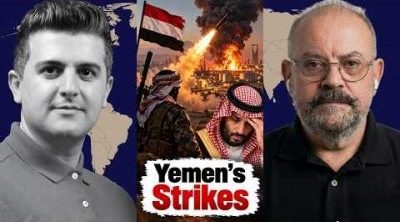
Elijah Magnier: Yemen’s strikes are shattering Saudi Arabia’s long-term strategy
or go to
Aletho News Archives – Video-Images
From the Archives
British weapons and personnel doing much of the killing in Yemen
Press TV – June 18, 2019
A detailed report published by the Guardian newspaper has shown how Britain is massively contributing to Saudi Arabia’s devastating war on Yemen as it suggests that London is not only supplying the bombs that fall on Yemenis, but it provides the personnel and expertise that keep the war going.
The comprehensive report by Arron Merat published on Tuesday showed that Britain was doing much of the killing in Yemen as the country continues to provide Saudi Arabia with everything it needs to turn its southern impoverished neighbor into a graveyard.
“Every day Yemen is hit by British bombs – dropped by British planes that are flown by British-trained pilots and maintained and prepared inside Saudi Arabia by thousands of British contractors,” said Merat in the report. … continue
Blog Roll
 Aletho News
- Netizens condemn Japanese drama for projecting Japan’s wartime atrocities onto Chinese characters
- Racist Seinfeld Dances for Joy as Bibi Unveils His New Map
- A West Bank War for Netanyahu’s Election Campaign, Could It Backfire?
- Yemen denounces European Parliament’s ‘hypocritical’ push to blacklist Ansarullah
- Qalibaf: UAE’s UN bid aims to ‘clear the runway’ for ‘Greater Israel’, whitewash genocide
- Pakistan reopens Iran border after boosting security: Report
- Why are so many Brazilians voting for Flávio Bolsonaro?
- Democrats Put Anti-Russia Agenda Ahead of American Workers
- Elijah Magnier: Yemen’s Strikes Are Shattering Saudi Arabia’s Long-Term Strategy
- Pentagon designates Chinese cultural centers national security threat
- If Americans Knew
- An error has occurred; the feed is probably down. Try again later.
- No Tricks Zone
- Sudden Stratospheric Warming, Powerful El Niño Combination May Lead To Extreme Europe Cold, Energy Crisis!
- Two New Studies Find Thwaites Glacier Melt Cannot Be Driven By Human Activity Or A Warming Ocean
- E-Cars Reduce CO2 Emissions By Only 41% Compared To Internal Combustion Engine Vehicles
- Predictions Made By Renowned Climate Professor Over Past Decades Have Been Proven To Be Poor
- New Study Suggests Large Regions Of The Pacific Ocean Have Been Cooling For The Last 80 Years
- Germany’s Green Energy Debacle: High Energy Costs Force Kahla Porzellan to Close After 182 Years!
- New Study: 50 Years Of The Most Aggressive ‘Net Zero’ Policies Can Only Affect The Global Climate By 0.03°C
- US September “Heat” Was No Record…Many Records Set Decades Ago
- Latest European Green Energy Debacle; Portugal’s Largest Flagship Solar Park Insolvent!
- Green Energy Debacle: German Expert Professor Fritz Vahrenholt Warns Of Severe Economic And Social Consequences

