Iran’s Plan to Shut Down AI in the Persian Gulf
GCC internet will go dark if Trump renews hostilities
By Kurt Nimmo | Another Day in the Empire | September 18, 2026
The Gulf Cooperation Council (GCC) countries—Saudi Arabia, UAE, Qatar, Bahrain, and Kuwait—are heavily invested in AI as part of a strategy to diversify away from petroleum. National AI strategies across GCC countries emphasize investment in research and development, encourage public-private partnerships, and create regulatory frameworks that support innovation. The GCC AI market size increased from USD $6.22 billion in 2025 to USD $7.60 billion in 2026. It is projected to reach USD $23.03 billion by 2034.
In April, Iran’s Tasnim news agency mentioned the submarine cables, landing stations, and data hubs in the Gulf as strategic pressure points in the conflict initiated by the United States and Israel. According to the market research company IMARC Group, subsea internet data cables in the Gulf sit at the intersection of Europe, Asia, and Africa, and damage to these networks risks connectivity losses in one of the world’s most important internet traffic zones.
The economic importance of these cable systems extends far outside internet browsing or streaming services, notes Techstory, “because financial markets, payment systems and cloud computing firms depend on uninterrupted connections between continents every second of the day. Data centers in the Gulf and Asia also depend on those same cables to connect cloud systems serving businesses around the world.” Analysts estimate that networks linked to the GCC support roughly $10 trillion worth of financial transactions daily.
Iran claims the cables are within its territorial waters and fall under its jurisdiction. Tasnim and Fars suggest Iran may charge tech companies to use the internet cables, while Ebrahim Zolfaghari, a Brigadier General and the spokesperson for Iran’s Khatam al-Anbiya Central Headquarters, said that “companies like Google, Microsoft, Meta, and Amazon” will be required to “comply with Iranian law” and pay licensing fees for cable passage, with repair and maintenance rights given exclusively to Iranian firms.
The Islamic Republic cited the 1982 United Nations Convention on the Law of the Sea (UNCLOS), which includes provisions governing submarine cables. Article 79 of UNCLOS says coastal states have the right to establish conditions for cables or pipelines entering their territory or territorial sea.
On September 2, Iran’s Kayhan newspaper urged Iran’s IGRC to disrupt or sever international fiber-optic cables to pressure the United States and its allies. “Is it not our indisputable right, in order to bring these sources of evil to their knees and cut off their lifeline, to prevent internet cables from passing through the depths of the Persian Gulf and the Strait of Hormuz?” asked Kayhan editor-in-chief Hossein Shariatmadari. “This necessary measure could be carried out by seriously disrupting the cables’ operation or even cutting them.”
Iran has the ability to take out key cable networks, including the Fibre in Gulf submarine cable system, which connects Bahrain, Iraq, Kuwait Oman, Qatar, Saudi Arabia, and UAE. The Falcon Network connects Bahrain, Egypt, India, Iraq, Kuwait, Maldives, Oman, Qatar, Saudi Arabia, Sri Lanka, Sudan, and Yemen, while the the Gulf Bridge International links Bahrain, Iran, Iraq, Kuwait, Oman, Qatar, Saudi Arabia, UAE, and has onward connectivity to India, and Europe.
The Islamic Republic may decide to retaliate for the imposition of crippling sanctions which have negatively affected its economy, causing an increase in inflation and unemployment. Iran’s minimum wage stands at approximately 104 million rials, equivalent to roughly $110 US monthly. Essential commodity prices have risen sharply, with the International Monetary Fund documenting an annual inflation rate of 42.4%, according to October 2025 figures. Most estimates suggest sanctions have cost Iran approximately $60 billion each year by limiting investments in the energy sector. The sanctions have also significantly reduced Iran’s petroleum exports.
In 2023, the Iranian navy unveiled the domestically developed and manufactured Chamrosh-4 VTOL, a remotely operated drone designed for detecting, locating, and destroying both anchored and sleeping naval mines. Furthermore, Iran operates an undersea fleet of roughly 4 to 6 diesel-electric attack submarines well-suited to operate in the shallow waters of the Strait of Hormuz. In short, Iran has the ability to sabotage subsea internet data cables.
On September 17, President Trump, frustrated by the current stalemate in his war, said he faces a major decision over whether to escalate military action against Iran. “I have a big decision to make,” Trump said. “Do I want to go in and eliminate them or not? That’s a big decision. Anything can happen with me.”
Iran has given the United States an ultimatum for a period of three to four weeks, during which the United States must satisfy all Iranian demands. Failure to comply will result in severe escalation within the Strait of Hormuz and the execution of Iran’s planned preemptive military action targeting United States-backed Gulf infrastructure as well as American and Israeli assets, according to a senior Iranian official based in Tehran with direct knowledge of the situation.
The demands include $300 billion in reconstruction funds, a full release of Iran’s frozen assets of up to $120 billion, lifting of the US naval blockade, an end to war on all fronts (including Gaza and Lebanon), lifting of all sanctions on Iranian oil and gas, and acceptance of Iran’s permanent control of the Strait of Hormuz, including up to 7% transit fees.
President Trump is unlikely to accept these conditions, and as previously mentioned, may intensify military operations before the midterm elections. Should Trump choose to escalate, Iran has indicated it will heighten the intensity of its assaults against remaining American military and commercial infrastructure throughout the GCC region and West Asia.
On September 15, Amazon Web Services disclosed that Iranian drone strikes caused substantial damage to the corporation’s data facilities located in the United Arab Emirates and Bahrain. The preceding week, officials from the UAE declared that they were modifying their AI data center initiatives in response to the strikes, thereby underscoring a critical weakness that Iran continues to leverage with considerable facility.
Strait of Hormuz won’t reopen unless US accepts Iran’s conditions: IRGC
Press TV – August 26, 2026
The Strait of Hormuz will remain closed unless the United States halts its blockade and accepts Tehran’s conditions for implementing a recent Memorandum of Understanding (MoU), said the spokesperson of the Islamic Revolution Guards Corps (IRGC).
Brigadier General Hossein Mohebbi said on Wednesday the strategic waterway is firmly under Iranian control and that hostile military forces have been pushed back.
“The Strait of Hormuz is in our hands, and no enemy military vessels are currently present inside the Persian Gulf,” he added.
He said all warships have retreated at least 400 kilometers away from the Strait, adding that from a military and territorial standpoint, “no vessel is capable of transiting this waterway without Iran’s permission and management.”
Addressing the administration of the Strait, which is geographically shared by Iran and Oman, the IRGC spokesman said Tehran has been in active negotiations with Muscat for the past month.
General Mohebbi confirmed that the two sides have reached mutually acceptable agreements regarding the demarcation of their respective shares of the waterway and the distribution of revenues generated from maritime traffic.
He also said the waters near the Omani coast are fully under joint control.
US obstruction primary obstacle
Despite the progress with Oman, General Mohebbi pointed to the United States as the primary obstacle to normalizing traffic through the world’s most critical energy chokepoint.
“The United States is creating obstacles in this process, which has caused delays.”
General Mohebbi stated that if Washington ceases its interference and returns to the framework of the existing MoU, Iran is prepared to reopen the Strait in accordance with that agreement.
“Therefore, the United States must accept our conditions,” the IRGC spokesman said.
“If the US does not accept our conditions, the Strait of Hormuz will under no circumstances be reopened.”
Tehran has established new regulatory frameworks requiring commercial vessels to register with Iranian authorities, obtain transit permits, follow Iran-designated shipping routes, and utilize Iran-provided security and insurance mechanisms amid the US-Israeli war of aggression.
The Islamabad MoU is a landmark 14-point diplomatic framework brokered primarily by Pakistan, with mediation support from Qatar, Egypt, and Turkey.
Signed in mid-June between Iranian and US leadership, the agreement was designed to halt the military aggression, ensure an immediate and permanent cessation of hostilities, and establish a clear roadmap for de-escalation.
A central pillar of the agreement was the easing of wartime restrictions on the Strait of Hormuz and the initiation of further negotiations toward a comprehensive, final settlement.
However, the fragile framework has recently unraveled. Tehran announced the suspension of its own obligations under the accord, asserting that Washington shattered the agreement first through bad-faith negotiations, continued economic coercion, and a failure to honor its commitments.
This diplomatic impasse has prompted urgent, high-level shuttle diplomacy by Pakistani officials, including the Chief of Army Staff, who are actively working to salvage the MoU and prevent the region from sliding back into open conflict.
Omani FM says ‘gravest threat to Gulf security’ stems from Israel, not Iran

The Cradle | July 14, 2026
Omani Foreign Minister Badr Al-Busaidi said on 13 July that the most dangerous threats in the region come not from Iran but from Israel, while lambasting the “myth” of the policy of “containment” that has for years targeted the Islamic Republic.
“The gravest threats to Gulf security do not originate within the region itself. Rather, they stem from decisions taken outside it – above all, in Tel Aviv. That conclusion is now difficult to dispute,” the foreign minister wrote in an opinion piece released by Le Monde on Monday.
Al-Busaidi added that Tehran “did not constitute an existential threat.”
He criticized the expansion of the US military presence across the region, saying it did not provide protection or benefit the countries of the Gulf.
“The enormous military expenditures across the region, the expansion of US military bases in the Gulf, and the maintenance of an extensive US military presence – intended to provide protection from afar – were all built and sustained at tremendous cost, yet without providing any real benefit,” the top Omani diplomat went on to say.
He added that the latest war proved that the US, Israeli, and Arab “policy of containment was little more than a myth – a fact that is now acknowledged even by those who, until recently, believed that more than 45 years of costly containment represented a necessary evil.”
The minister emphasized that reaching an arrangement to secure navigation in the Strait of Hormuz was a “priority.”
He stressed the importance of Iran’s role in such an arrangement.
“The Gulf coastline is shared by eight states. Alongside Oman and its five partners in the GCC – Saudi Arabia, Bahrain, the UAE, Kuwait, and Qatar – stand Iran and Iraq, both of which have, at different times, been subjected to containment policies and military intervention,” he wrote.
Al-Busaidi said these “eight states all have vital interests to protect and each bears responsibility, according to its capabilities and priorities, for safeguarding this shared strategic” waterway.
“For that reason, none of them can be excluded from any future regional security architecture. Every one of them must participate in designing it, implementing it, and sharing the responsibilities that come with it,” he added.
Al-Busaidi also said complex discussions on the matter were ongoing.
The US has backtracked on several clauses of the Islamabad memorandum of understanding (MoU) reached between Washington and Tehran, including joint Omani-Iranian management of Hormuz.
This week, US President Donald Trump declared Washington the “Guardian of the Strait.”
The Omani foreign minister’s article coincides with a major escalation between Washington and Tehran.
Iran launched numerous missile and drone operations on US assets in the Gulf over the past few days in response to a violent and deadly US campaign of strikes. Washington has not stopped attacking Iran, in violation of the MoU.
Trump has declared that the ceasefire is “over” and is vowing harsher attacks on Iran in the near future.
Early on Tuesday, Iranian drones and missiles targeted US bases and military infrastructure in Kuwait, Bahrain, and Jordan.
A few days earlier, Tehran responded to US strikes with attacks on Washington’s assets in Kuwait, Bahrain, and Jordan, as well as Oman – which Tehran had largely refrained from targeting during the first 40 days of the war that began in February.
Iran has been holding direct talks with Oman on the future management of Hormuz, but recently condemned the activation of a US-Omani shipping corridor, calling it a violation of the MoU.
Iranian Foreign Ministry spokesman Esmail Baghaei said on Monday that “our effort, in consultation with Oman, was to establish a mechanism to ensure the safe passage of ships,” adding that “because of [US] pressure exerted on Oman, this objective was not achieved.”
Earlier this year, Iran established the Persian Gulf Strait Authority (PGSA) as part of plans to oversee future management of the waterway.
“Before the recent provocative actions by US forces in the region, which led to the [renewed] closure of the Strait of Hormuz, more than 200 non-Iranian vessels coordinated with [Iran] during the three weeks following the signing of the MoU, and most of them received transit permits and insurance coverage,” the PGSA said on Tuesday.
Iran strikes US military assets in Oman and Bahrain: IRGC
Al Mayadeen| July 13, 2026
The Islamic Revolution Guard Corps (IRGC) has destroyed long-range radar systems in Oman, among other US military assets and installations, as part of the fifth phase of its retaliatory operations.
In a statement published on Monday, the IRGC said that its naval forces carried out missile and drone strikes targeting an FPS long-range early warning radar and a ship-detection radar in Oman, destroying both systems. Concurrently, IRGC forces struck US military installations in the Al-Juffair area of Bahrain, where fires remain active.
“The decisive and powerful operations carried out by the Iranian armed forces have rendered the American military, which we have described as the aggressor, incapable,” the IRGC Public Relations Department stated.
US aggression reveals true anti-people nature: IRGC
The IRGC also condemned the sustained US aggression on Iran, asserting that American forces targeted an agricultural water pump in the city of Mahshahr.
“Targeting a farming water pump in Mahshahr reveals the true anti-people nature of the US military,” the statement said.
The IRGC further tied the status of international shipping in the Strait of Hormuz to US military behavior, declaring that “the reopening of the Strait of Hormuz to shipping traffic is contingent upon stopping US military interventions in the strait and respecting the sovereignty of nations over their territorial waters.”
The IRGC issued a direct warning on global energy security, stating that “the continuation of these interventions will lead to greater repercussions for the global oil and gas sectors.”
Iran responds to US aggression, strikes US assets in Kuwait, Jordan, Bahrain
Meanwhile, Iran’s Islamic Revolution Guard Corps announced a series of retaliatory strikes against US military facilities in Jordan, Bahrain, and Kuwait, responding to continued US attacks on Iranian positions.
The IRGC said its Aerospace Force targeted fuel depots, missile storage sites, air defense systems, radar installations, and command centers across multiple US-linked bases in the region.
In its first operation, missiles and drones struck Jordan’s Prince Hassan Air Base, setting fire to fuel tanks and ammunition depots, following US attacks on Iranian coastal positions.
A second wave targeted the Sheikh Isa base in Bahrain, destroying helicopter maintenance facilities, a P-8 reconnaissance aircraft hangar, and the US drone command center at the site.
The third phase hit Kuwait’s Ali Al-Salem Airbase and Ahmed al-Jaber Airbase, destroying fuel tanks, Patriot systems, and strategic radar, while the IRGC vowed further action and asserted Iran’s authority over the Strait of Hormuz.
The fourth phase struck two HIMARS missile launch platforms and ammunition depots filled with missiles at the US base in Kuwait.
After US policy whiplash, Iran sets the rules in Strait of Hormuz
Press TV – July 12, 2026
The section of the 14-point memorandum that emphasizes the reopening of the Strait of Hormuz under “Iranian arrangements” has become the focal point of confrontation, driven primarily by hostile US actions and its repeated, explicit breaches of commitments.
The exchange of fire between Iran and the US early Sunday once again demonstrated that Washington is not only unwilling to honor its commitments but has effectively blocked any path toward a diplomatic resolution through hostile actions and repeated violations.
Under the 14-point memorandum signed between Iran and the US, Article Five explicitly assigns the management of the Strait of Hormuz to Iran, giving Tehran responsibility for its future administration and maritime services in consultation with Oman.
The inclusion of the phrase “under Iranian arrangements” in the memorandum reflects recognition of Tehran’s central role in governing this strategic waterway.
The text of the memorandum, which was also published by the White House, states that Iran “will guarantee the safe passage of commercial vessels, free of any tolls or charges, for a period of 60 days between the Persian Gulf and the Gulf of Oman”.
It says that the Islamic Republic “will consult with the Sultanate of Oman regarding the future administration and maritime services of the Strait of Hormuz.”
The wording, according to this interpretation, makes clear that responsibility for administering the strait initially rests with Iran, while Oman assumes a consultative and coordinating role.
Immediately after the memorandum was signed, the United States, in coordination with Oman, unveiled a southern shipping corridor designed as an alternative to the Iranian route through the strait.
In a statement, the Islamic Revolution Guards Corps (IRGC) described the newly announced route as “unacceptable and extremely dangerous,” adding that it had been established “without prior notification or coordination with the Islamic Republic of Iran.”
As indicated, the actions of the United States and Oman constitute a clear violation of Article Five of the memorandum, which assigned management of the Strait to Iran.
According to unofficial reports, Oman has declined to fully align itself with Iran and continues to insist that maritime traffic should operate in both directions.
This suggests that Oman, under US pressure, has moved away from its neutral position and begun acting in ways that undermine Iranian interests.
Oman’s foreign minister told a meeting of the Persian Gulf Cooperation Council that Muscat, as a littoral state, bears a special responsibility and stressed that any future arrangements for the strait should not include transit fees.
This position comes despite Article Five of the memorandum, which designates Iran as the principal authority responsible for administering the strait, while assigning Oman only a coordinating role.
The corridor violation is not the only breach by the US of the memorandum’s provisions. The list of America’s overt and repeated violations since the signing of the memorandum clearly shows that Washington has never been committed to its obligations:
1. Violation of Article One (Ending the war on all fronts): The United States had committed to ending hostilities across all fronts, including Lebanon, and to securing the withdrawal of Israeli forces from occupied territories.
However, Israeli prime minister Benjamin Netanyahu declared that Israeli troops would remain in Lebanon for as long as necessary. According to this account, Washington neither enforced this provision nor acted to prevent the continued occupation.
2. Violation of Article Two (Respect for sovereignty and non-interference): The United States had pledged to respect the sovereignty of the Islamic Republic of Iran and refrain from interfering in its internal affairs.
However, the military attacks last night on Iranian cities, as well as the attacks of previous nights—all of which originated from or were facilitated by American bases in Saudi Arabia, Qatar, Bahrain, the UAE, and Kuwait—constitute a gross violation of this clause.
3. Violation of Article Four (Lifting the maritime blockade): Washington had committed to ending the maritime blockade and restoring shipping traffic to full capacity within 30 days. Not only was the blockade maintained, but US officials also threatened to intensify it.
President Donald Trump reportedly told Axios that he would not lift the blockade on Iranian ports because doing so would deprive Washington of its principal source of leverage over Tehran.
4. Violation of Article Six (Economic reconstruction): The United States had committed to guaranteeing a comprehensive reconstruction program for Iran backed by at least $300 billion in financing. No meaningful steps were ever taken to fulfill that commitment.
5. Violation of Article Seven (Lifting sanctions): Washington had pledged to terminate all sanctions imposed on Iran. Instead, sanctions remained in place, while the US Treasury warned that if Oman assisted in establishing a toll collection system, it would face “aggressive” sanctions.
6. Violation of Articles Ten and Eleven (Oil export waivers and release of frozen assets): The United States had committed to immediately issuing waivers for Iranian crude oil exports, petrochemical products, and all related services, while also releasing Iran’s frozen assets.
Through pretext and hostile actions, the US refused to deliver Iran’s $24 billion in blocked assets and revoked Iran’s oil sales license, citing Iran’s actions against unauthorized vessel movements through the Strait of Hormuz—a justification that stemmed from Washington’s own breach of the memorandum.
7. Threats of regime change and assassination of Iranian officials: Despite its explicit commitment not to interfere in Iran’s internal affairs, US officials have continued to issue statements advocating regime change.
More importantly, US Secretary of State Marco Rubio openly rejected the prospect of Iranian administration of the Strait of Hormuz, stating: “We will not tolerate that.”
Before the US and Israeli terrorist attacks against Iran, the Strait of Hormuz remained open, and Iran had no interest in controlling it. Today, however, Tehran is determined to maintain control over the waterway in the future to ensure that the United States can never again use the Persian Gulf as a staging ground for attacks against Iran.
The strikes carried out last night and on previous nights were launched from or facilitated by US bases in Saudi Arabia, Qatar, Bahrain, the United Arab Emirates, and Kuwait. As long as the United States and Israel pose a threat to Iran’s national security, Tehran will maintain a heavy presence in the Strait of Hormuz.
A crucial legal point is that the Strait of Hormuz lies entirely within the territorial waters of Iran and Oman and under international law, no part of it constitutes international waters open to unrestricted passage.
Unlike certain international waterways, the Strait of Hormuz is not part of the high seas but a coastal passage where navigation is governed by the regulations of the littoral states. This legal reality strengthens Iran’s position in administering the strait and challenges US claims regarding freedom of navigation.
Iran, based on its defense doctrine, views control of the strait not as an economic instrument but as a vital requirement for its survival and national security.
Parliament Speaker Mohammad Baqer Qalibaf summarized Tehran’s position: “The era of one-sided deals is OVER. We told you: keep your word or pay the price. Reality is knocking.”
BACK TO BATTLE: Iran, US, Israel, Lebanon & Hezbollah /Lt Col Daniel Davis
Full interview:
Daniel Davis / Deep Dive – June 27, 2026
Strait of Hormuz as strategic red line: Why Iran must confront Oman’s corridor plan and Trump’s threats
Press TV | June 25, 2026
The strategic calculus surrounding Iran’s ongoing negotiations with the United States within the framework of the memorandum of understanding (MoU) has reached a critical juncture.
Two concurrent developments demand a comprehensive and resolute response: Oman’s unilateral announcement of a separate shipping corridor through the Strait of Hormuz and President Donald Trump’s continued military threats against the Islamic Republic.
Taken together, these developments represent a concerted attempt to undermine Iran’s sovereignty over the Strait of Hormuz and weaken the fundamental security guarantees that give diplomatic engagement its meaning and value.
For Iran, the Strait of Hormuz is far more than a source of economic leverage; it constitutes a cornerstone of national security, a critical component of its deterrence posture, and a vital mechanism for preventing future acts of aggression.
The Strait of Hormuz: A matter of national sovereignty
The Strait of Hormuz represents one of the most strategically significant maritime chokepoints in the world, through which approximately 20 percent of global oil supplies transit. For Iran, control over this waterway is intrinsically linked to national security, economic sovereignty, and the capacity to deter any form of external aggression.
The recent visit of Iran’s parliament speaker and lead negotiator, Mohammad Baqer Qalibaf, to Muscat appears to have been exploited by Oman under US pressure to advance an agenda that directly contradicts Iran’s sovereign rights over the strategic waterway.
Oman’s unilateral announcement of a separate route requiring only coordination with the International Maritime Organization (IMO) constitutes a calculated maneuver to undermine Iran’s legal and legitimate authority over the Strait.
This action was taken without any coordination with Tehran and coincides with mine-clearing operations based on the memorandum signed between Iran and the United States.
The strategic logic suggests that by creating an alternative corridor, Oman has offered vessels a route that avoids Iran’s jurisdiction, effectively normalizing a system where Iran’s role in administering the Strait becomes irrelevant.
The timing is particularly significant. As mine-clearing operations proceed, Omani authorities have directed vessels toward this alternative corridor, whose route poses serious safety risks and is unacceptable, according to Iran’s Islamic Revolution Guards Corps Navy.
This effectively undermines one of Iran’s most significant bargaining chips – the ability to control access through the Strait and ensure compliance with its security requirements.
IRGC’s warning: An essential but insufficient first step
In response to this challenge, the IRGC Navy issued a timely warning that “the only authorized routes for vessels’ passage through the Strait of Hormuz are the ones announced by Iranian authorities.”
The statement emphasized that “vessel traffic outside these routes is prohibited and highly dangerous,” adding that “coordination with the IRGC Navy via Channel 16 is mandatory for passage through the Strait of Hormuz.”
This response demonstrates Iran’s readiness to protect its sovereignty and maintain its authoritative position over one of the most critical energy chokepoints in the world.
However, as a purely military response, it is insufficient to address the full scope of the challenge. The Omani initiative is fundamentally a political maneuver, and it requires a coordinated response that includes diplomatic, legal, and security dimensions.
The existential implications cannot be overstated. The threat to Iran’s national security, the assassination of the Leader of the Islamic Revolution, and the imposition of two illegal and unprovoked wars through the use of hostile American bases and the cooperation of Arab countries are not matters that can be ignored within diplomatic engagement.
The primary means of preventing their recurrence is firm control over the Strait of Hormuz. If Iran permits this condition to be eroded through political maneuvering, it risks losing a critical deterrent mechanism without receiving commensurate concessions in return.
Trump’s threats: A direct violation of clause 1
Concurrent with the challenge to Iran’s legal authority over the Strait, Trump has once again threatened that if Iran does not act according to his whims, he will impose war once again.
These statements go far beyond psychological warfare intended to weaken the morale of Iranian negotiators or serve domestic political purposes. They constitute a direct violation of Clause 1 of the memorandum signed by him and the Iranian president last week, which calls on signatories to “refrain from the threat or use of force against each other.”
Trump’s threat to “blow up the country, launch a full ground invasion to take it over, and assassinate Iranian negotiators” represents an explicit violation of the agreement.
When combined with the Zionist regime’s insistence on continuing its occupation of Lebanese territory – itself a clear violation of the memorandum’s provisions regarding the cessation of hostilities on all fronts – the pattern becomes unmistakable. The enemy is systematically testing the limits of Iran’s commitment to the negotiation process while violating its fundamental provisions.
The statement by US Treasury Secretary describing the $30 billion in frozen assets and sanctions relief as a “temporary carrot” that can be withdrawn whenever desired demonstrates that, from the enemy’s perspective, what it believes it will ultimately obtain from Iran far exceeds what it is offering during the negotiation process.
This perception must be neutralized through both the words and actions of Iranian officials.
The strategic importance of the Strait in the negotiations
The Strait of Hormuz’s importance extends beyond economic considerations. It serves as the primary mechanism for creating practical guarantees for the fulfillment of Iran’s conditions within the memorandum, similar to what occurred in Lebanon and immediately revealed its consequences. Control over the Strait enables Iran to compensate for war damages, provide security against future aggression, and prevent the passage of military and hostile vessels.
The memorandum commits Iran “to arrange for the safe passage of commercial vessels through the strait, with no charge for 60 days.” The subsequent joint statement with Oman “agreed to establish a joint working group to negotiate the future administration of navigation in the Strait of Hormuz.”
However, Oman’s unilateral action effectively preempts this negotiation process by establishing a separate corridor that bypasses Iranian authorization.
The implementation of what Oman has announced would constitute a clear example of the enemy achieving through the political process what it failed to achieve through military means during the Third Imposed War.
If realized, it would increase the enemy’s appetite to obtain through diplomacy what it was unable to secure through all-out military aggression, a precedent that would embolden further violations of Iran’s sovereignty.
Available responses and strategic options
Various measures exist for responding to this new challenge, each with its own implications:
First, suspending mine-clearing operations would signal that Iran’s commitment to safe passage is conditional on recognition of its authority over the Strait. This would maintain pressure on global shipping and demonstrate that Iran retains the capacity to disrupt traffic if its sovereignty is not respected.
Second, imposing restrictions on vessel passage that deviate from Iranian-designated routes would enforce Iran’s jurisdictional claims directly. The IRGC Navy has already warned that “ships’ movement through other routes is dangerous and prohibited,” establishing the basis for enforcement actions.
Third, military action against violating ships, while potentially escalatory, would demonstrate Iran’s determination to protect its sovereignty. The IRGC Navy has already stated that “any vessel found in violation will be subject to enforcement measures,” establishing a credible deterrent against hostile entities.
Fourth, announcing a halt to negotiations or postponing the next round would signal that these developments have fundamentally altered the basis for continued engagement. This would be particularly appropriate given that Trump’s threats directly violate Clause 1 of the memorandum.
Fifth, escalating the political response through diplomatic channels while the armed forces maintain their deterrent posture. As the points above indicate, the first response by the IRGC Navy is timely and appropriate but insufficient; political responses must be added within the framework of the diplomatic negotiation process.
The risk of precedent and the nature of the enemy
What is at stake extends beyond the immediate question of the Strait. If Oman’s unilateral action is permitted to stand, it would establish a precedent that Iran’s sovereignty can be circumvented through coordinated political maneuvering.
That would fundamentally alter the balance of power in the region, demonstrating that Iran’s strategic assets can be neutralized through diplomatic means rather than requiring military confrontation.
The enemy’s objective in these negotiations appears to be:
1. Gaining access to Iran’s 60-percent enriched material
2. Obtaining complete intelligence regarding the remaining nuclear infrastructure and facilities
3. Reopening the Strait of Hormuz on terms favorable to the United States and its allies
4. Securing economic breathing space for the world and the United States
5. Preserving the Republican Party’s position in the November midterm elections
In return, Iran is offered temporary concessions such as oil exports, lifting the naval blockade, and releasing some assets, whose total financial value of approximately $30 billion is of very limited significance when compared with the strategic importance of Iran’s tools and capabilities, especially the Strait of Hormuz and the unified Resistance Front.
The comparison with Lebanon is instructive. When Iran demonstrated commitment to the ceasefire, it was met with continued Israeli occupation and attacks, demonstrating that the enemy seeks to exploit Iranian goodwill rather than reciprocate it.
The inadequate response to these violations, alongside discussions about the return of IAEA inspectors and Iran’s failure to publish a fact sheet regarding the agreement, increases ambiguity in public opinion and leads to greater polarization.
A coherent strategy for the negotiations
Iran’s response to these challenges must be coordinated, multifaceted, and proportionate to the gravity of the developments. The armed forces’ response, while necessary, must be supplemented by political actions within the diplomatic framework.
Several principles should guide this approach:
First, Iran must maintain its position that control over the Strait of Hormuz is non-negotiable and essential for national security. Any arrangement that circumvents Iranian authority must be rejected absolutely.
Second, the perception that Iran can be pressured into abandoning its strategic assets through diplomatic engagement must be countered through concrete actions that demonstrate the costs of violating Iran’s sovereignty.
Third, the link between the negotiation process and the security situation, including the Strait of Hormuz and the Resistance Front, must be maintained. Concessions on one issue cannot be made in isolation from progress on others.
Fourth, Iran must articulate clearly that the threatening rhetoric by US officials constitutes violations of the memorandum and will be met with appropriate responses, including the possibility of suspension or postponement of the negotiations.
Fifth, Iran should leverage the extraordinary strategic importance of the Strait of Hormuz as the primary means of providing security guarantees and preventing future aggression. The existential threat against Iran’s national security demands that sovereignty over the Strait be maintained as a fundamental condition of any agreement.
The path forward requires rejecting the assumption that these challenges can be addressed through military responses alone.
The coordinated political and diplomatic maneuvering by the United States, its regional allies, and Oman demands a comprehensive response that integrates the armed forces’ capabilities with political diplomacy. Anything less would signal weakness and encourage further violations of Iran’s sovereignty and the terms of the memorandum.
Ultimately, Iran’s position must be clear: the Strait of Hormuz remains under Iranian authority, and any route that does not coordinate with Iran is unacceptable and will face appropriate measures.
The negotiations should not appear as an opportunity for the enemy to achieve through political means what it could not achieve through illegal war of aggression.
Iran’s strategic assets – the Strait of Hormuz, the Resistance Front, and its nuclear capabilities – are not negotiable items but fundamental components of the country’s national security that must be preserved.
The burden lies with the other parties to demonstrate their commitment to the agreement and respect for Iran’s sovereignty through their actions, not merely words.
IRGC Navy rejects new Strait of Hormuz shipping routes
Al Mayadeen | June 25, 2026
Iran’s Islamic Revolution Guard Corps (IRGC) Navy has warned that safe passage through the Strait of Hormuz is only possible via routes announced by Iran, rejecting newly declared navigation lanes and insisting that vessels coordinate directly with Iranian naval authorities.
In a statement issued in the name of the IRGC Navy, Tehran said that “some authorities” had recently announced new shipping routes in the strategic waterway “without informing or coordinating with the Islamic Republic of Iran,” saying the move is “unacceptable and completely dangerous.”
The statement stressed that the only authorized passage routes through the Strait of Hormuz are those designated by Iran, warning that navigation outside these channels is “very dangerous and prohibited.”
“All vessels are warned to strictly avoid any navigation outside the notified routes,” the IRGC Navy said, adding that coordination via Channel 16 with Iranian naval forces is mandatory and that “violator vessels will be dealt with.”
The Strait of Hormuz, a narrow maritime chokepoint linking the Gulf to the Arabian Sea, remains one of the world’s most sensitive shipping corridors, with competing claims over navigation management and maritime safety procedures.
Regional diplomatic efforts underway
The warning comes amid renewed diplomatic activity involving Gulf states, Iran, and regional mediators aimed at reshaping maritime governance in the strait.
On Wednesday, Qatari Prime Minister Mohammed bin Abdulrahman al-Thani arrived in Muscat for talks with Omani officials on launching a new round of negotiations involving Iran, Iraq, and Gulf Arab states on the future management of the waterway, according to Reuters, citing a diplomat briefed on the discussions.
The proposed talks are reported to be separate from ongoing Iran-US negotiations and existing de-mining arrangements. According to the same source, Gulf states are expected to push for the removal of transit fees, while Iran may propose alternative charges linked to environmental, navigation, and security services.
The initiative is said to stem from a recent memorandum of understanding calling for structured discussions between Iran, Oman, Gulf states, and Iraq on maritime governance in the strait, with Pakistan floated as a potential mediator.
Separately, broader regional reconciliation talks are expected to be held in Riyadh involving Iran, Gulf Arab states, and other regional actors.
Oman announces new shipping lanes
Earlier on Wednesday, Oman announced the establishment of two temporary shipping routes in the Strait of Hormuz, positioned north and south of the existing lane, in coordination with the International Maritime Organization (IMO).
Under a phased operational plan, vessels will be grouped and contacted individually with navigation instructions, including designated routes and departure timings. Oman’s maritime authorities said shipmasters remain responsible for conducting independent risk assessments, and vessels are required to keep Automatic Identification Systems active while reporting hazards to the Oman Maritime Security Centre.
Oman also confirmed that no transit tolls would be imposed on ships passing through the strait, in line with understandings reached in recent Iran-US discussions.
Joint Iran-Oman framework
The developments follow earlier agreements between Iran and Oman to establish a joint committee tasked with discussing the future management of navigation in the Strait of Hormuz.
The committee is part of broader consultations between Tehran and Muscat aimed at enhancing maritime safety, coordinating navigation rules, and addressing associated services and costs in line with international law and sovereign rights of coastal states.
Both sides have previously reiterated their commitment to keeping the strait open for international navigation while maintaining sovereignty over territorial waters, underscoring the strategic importance of continued coordination to ensure stability in the waterway.
Iran, Saudi FMs hold phone talks as Persian Gulf states rethink US ties
Press TV – June 24, 2026
Iranian Foreign Minister Abbas Araghchi and Saudi counterpart Prince Faisal bin Farhan have held a phone call to discuss regional developments, as Persian Gulf Arab states recalibrate their approach toward Tehran in the wake of the US-Israeli war that exposed the limits of American power.
Araghchi on Wednesday briefed the Saudi minister on the latest progress in implementing bilateral agreements and the ongoing negotiations following the US-Iran memorandum of understanding (MoU) signed on June 18.
The two top diplomats underscored the importance of maintaining diplomatic channels, strengthening joint cooperation to support regional stability, and achieving positive and sustainable outcomes.
The call came as French news agency AFP said Saudi Arabia is expected to host talks aimed at repairing relations between Iran and Persian Gulf countries following the US-Israeli war on Iran.
It cited a diplomat familiar with the arrangements as saying Wednesday that a regional summit was being planned in Riyadh and could also include other neighboring countries, but no date had yet been set.
The meetings would be separate from the ongoing negotiations between Iran and the United States, the diplomat added.
CNN, citing a senior Persian Gulf diplomat, reported that leaders are increasingly contemplating a future in which the US plays a much smaller role in the regional security architecture, with a possible framework involving a regional non-aggression pact with Iran.
According to Hasan Alhasan, senior fellow at the International Institute for Strategic Studies, “From the Arab states’ perspective, the Iran war is a disastrous turning point for the regional security order.”
The war, which began on February 28, exposed vulnerabilities in the Persian Gulf states’ security model, which is heavily dependent on the nearly 40,000 US troops stationed in the region and American-made air defense systems.
“The US security guarantee is no longer reliable in the way they thought it was,” one analyst at Chatham House told The New York Times.
Washington’s approach is increasingly perceived as selective and heavily centered on Israel’s security interest.
A classified CIA analysis found that US allies in the Persian Gulf are divided over their approach to Iran. According to the assessment, the United Arab Emirates and Bahrain prefer continued pressure on Tehran, while Saudi Arabia, Qatar, and Kuwait now support negotiations.
Trita Parsi, executive vice president of the Quincy Institute, noted that the UAE and Bahrain “made themselves frontline states against Iran” through the Abraham Accords and “now they’re in too deep and cannot extract themselves out of it”.
The Saudis, Parsi added, “were at the highest levels pushing for this war. They have come to regret it”.
Adding another layer of complexity is a widening gap between Arab governments and Arab public opinion over Iran.
According to a report by The Economist cited by DID Press, growing anger toward Israel and dissatisfaction with US policies have fueled increasing sympathy for Tehran across parts of the Arab world.
Despite sustained efforts by several Arab governments to reinforce anti-Iran narratives, recent developments have altered perceptions among sections of Arab society.
The report identifies two major drivers behind this shift: anger toward Israel, as many Arabs increasingly view Iranian actions against Israel as a legitimate response to regional military operations, and religious and cultural ties, particularly among Shia communities across the Persian Gulf.
The report concludes that sectarian narratives no longer resonate as strongly as in previous years, and that many Arabs increasingly view Iran as more assertive and resilient than several Arab governments.
Qatari Prime Minister Sheikh Mohammed bin Abdulrahman Al Thani traveled to Muscat on Wednesday to initiate talks between Iran, Persian Gulf states, and Iraq on the future operation of the Strait of Hormuz.
The discussions aim to implement a provision of the MoU requiring Iran and Oman to hold talks with other Persian Gulf states on the future management of navigation and maritime services.
Earlier on Wednesday, Oman announced two temporary routes north and south of the existing shipping lane to facilitate safe passage of vessels departing the region, in coordination with the International Maritime Organization.
The Strait of Hormuz, through which roughly 20 percent of global oil and liquefied natural gas normally transits, was heavily disrupted after the United States and Israel launched their war on Iran on February 28.
No return to pre-war status for Strait of Hormuz – Iran’s top diplomat
RT | June 13, 2026
Iranian Foreign Minister Abbas Araghchi has said that control over the strategically vital Strait of Hormuz will not return to its pre-war status.
The minister made the remarks as the US and Iran are finalizing a deal to end the conflict, which began on February 28 with joint US-Israeli bombardments of Iranian territory and the assassination of senior officials, including the country’s longtime supreme leader, Ali Khamenei.
The waterway, which normally handles around a quarter of the world’s seaborne oil and LNG trade, has largely remained closed throughout the war, although President Donald Trump said the US military had helped guide more than 200 ships through the strait.
“The Strait of Hormuz lies under the sovereignty of Iran and Oman. The administration of the waterway will not return to its pre-war arrangement. Iran and Oman will soon issue a joint statement outlining a new framework for the administration of the Strait of Hormuz,” Araghchi said on Friday, according to Iranian media.
The diplomat said Iran would charge passing ships service fees. Tehran had previously insisted that it maintained full sovereignty over the strait and would collect tolls.
Araghchi said that, under the memorandum of understanding awaiting final approval, the US would, “for the first time in 47 years,” commit to respecting Iran’s sovereignty and non-interference in its domestic affairs. The agreement would also declare an end to the conflict on all fronts, including in Lebanon, he said.
Iran most recently declared the strait closed to all ships in response to US strikes on Tuesday and Wednesday. Trump later said he had called off the attack in an effort to advance peace talks, expressing confidence that an agreement could be signed as early as this weekend.
The Larak Corridor: Iran’s Rial Gate With No US, No Israel, and No Way Around
By Freddie Ponton | 21st Century Wire | April 1, 2026
While MOW Secretary Pete Hegseth was telling other nations to “step up” in the Strait of Hormuz, Donald Trump was already backing away, insisting its security was “not for us.” In between those contradictions, Washington dumped a fog of conflicting slogans on the public—slogans that never looked like strategy so much as panicked improvisation. That confusion is not a sideshow to the war, but the political static masking a brutal reality. While the White House and its zionist neocon war camp lurch between bluff and retreat, Iran has been moving with cold discipline, quietly building what Iranian reporting calls the Larak Corridor and what maritime trackers have identified as a tightly managed lane through the Qeshm-Larak gap inside Iranian waters.
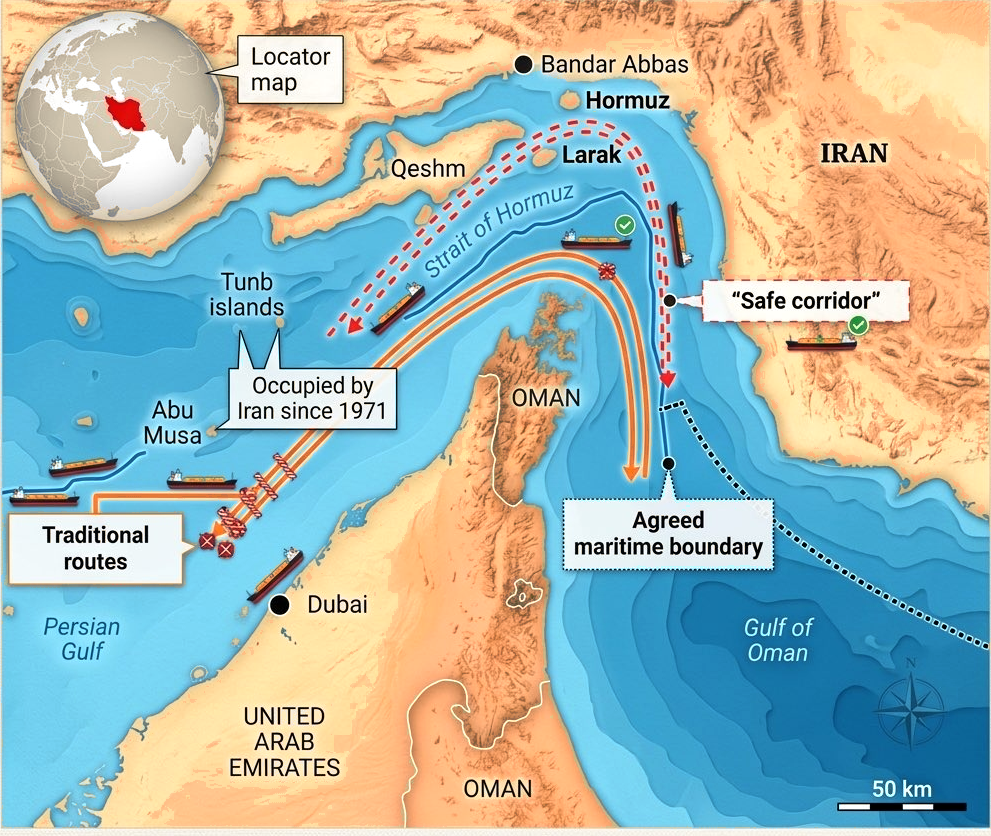
Around Larak, Tehran is no longer just reacting to an illegal war launched against it. It is turning battlefield pressure into procedure, selective access, and proposed law, using a controlled corridor and a wider Hormuz management plan to show that the old fantasy of automatic Western command over this chokepoint is breaking down in real time. The truth of the war is not found in the bombast coming out of Washington; instead you will find it in the places where power is actually shifting, and right now, one of those places is a narrow strip of water off Larak, where Iran looks calmer, more deliberate, and more in command of events than the people who thought they could bomb it into submission.
The Day Hormuz Moved on Iran’s Terms
The Strait of Hormuz has not been shut, and that is exactly why what Iran has done matters more. What has emerged around Larak is not a crude blockade but a controlled passage system, a wartime checkpoint laid across one of the most important arteries of the world economy. Iranian reporting most often calls it the Larak Corridor. At the same time, the broader phrase Larak-Qeshm Corridor is best understood as a geographic description of the lane running through the narrow gap between those two islands inside Iranian waters.
Names are not cosmetic here. Western and trade coverage tend to speak of a route between Qeshm and Larak. Iranian coverage roots it in Larak itself, in Iranian-managed waters, under Iranian rules. That is the quiet shift the war has produced. For decades, the story of Hormuz was told from the deck of a U.S. carrier. Today, one of its key arteries is being renamed and reorganised from a small island most Western audiences have never been asked to think about.
Iran appears to be building a differentiated transit regime, not a universal shutdown. That means the market consequence is not simply “less supply,” but a more political energy map in which some buyers and shippers face privileged access while others face delay, denial, or sharply higher costs.
That is the part of the story that cuts through the propaganda. A total closure would have been easy to denounce and easy to rally against. A selective corridor is harder to attack because it allows Tehran to say that passage has not ended, only the assumption that ships can move through Iranian waters during an illegal war on Iran without submitting to Iranian conditions.
This is why Larak matters. It is where Iran stopped merely threatening the map and started administering it.
The lane at Larak
The outlines of the new lane are now visible. The Larak Corridor is not a return to normal traffic. It is a filtered, low-volume, politically segmented route for approved movement. Trade and maritime analysis has traced authorised vessels through the five-mile gap between Qeshm and Larak, close to the Iranian coast and under a web of Iranian surveillance and intervention capacity. Iranian and Arabic reporting has described a safe corridor around or between Larak and Qeshm, never a full reopening of the strait, even though yesterday the Wall Street Journal reported that the Bahman pier on the eastern side of Qeshm Island was attacked, according to a statement from Hormozgan governor’s office relayed by Iranian state-affiliated media ISNA. Qeshm overlooks the Clarence Strait in the Strait of Hormuz and is referred to by the locals as “Kuran”, Iran’s main launchpad for its asymmetric naval warfare. In early March, the Israeli/US war machine had targeted a desalination plant on Qeshm Island, leaving 30 villages without water.
That low-volume point changes everything. The lane exists in deliberate contrast to prewar patterns. UN-linked reporting put pre-crisis traffic through Hormuz at roughly 130 ships a day. Against that baseline, the authorised trickle through Larak is not evidence of restored normality but a clear indication that normality has been replaced by a rationed flow that Iran alone can modulate.
The lane also stratifies states. Some governments have secured negotiated passage, some ships have moved after prior coordination and documentation, and others have been turned back or discouraged from approaching in the first place. The result is not an open sea but a tiered system in which diplomatic posture, sanctions alignment, and wartime behaviour shape access to one of the world’s central energy routes.
Calling this a blockade is comfortable for Western officials, but it is wrong. A blockade denies passage to provoke a fight. The Larak Corridor functions more like a wartime border crossing, granting passage conditionally, keeping discretionary power in Iranian hands, and making political hierarchy visible on the water.
Force became law
The story becomes more serious once you see that Tehran is not leaving this system in the realm of ad hoc force, but instead the Islamic Republic of Iran is building a legal scaffold around it.
Parliamentary reporting confirms that Iran’s National Security and Foreign Policy Committee has approved an eight-point Strait of Hormuz Management Plan. The plan is built around eight clear pillars: securing the strait, ensuring ship safety, addressing environmental risks, establishing financial arrangements with a rial-based toll system, banning American and Israeli vessels from passage, asserting Iran’s sovereign authority and that of its armed forces, cooperating with Oman on the legal framework, and prohibiting entry to any state that participates in unilateral sanctions against Iran.
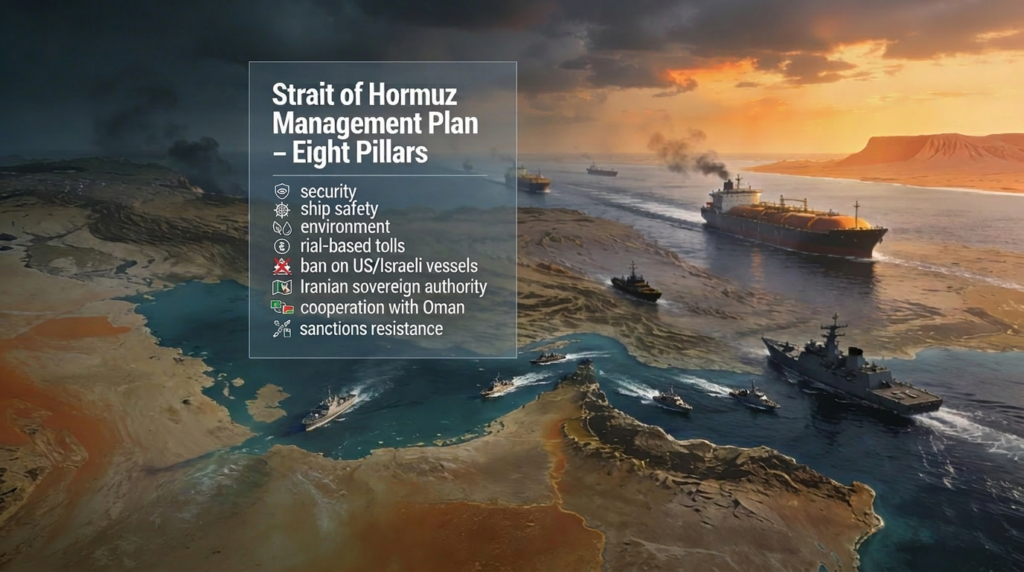
Iran’s Strait of Hormuz Eight Pillars Management Plan

A parallel description from Xinhuanet states that the measure gathered more than 250 signatures and outlines four immediate objectives: ensuring shipping security, charging environmental polluters, collecting fees for guidance services, and establishing a regional development fund funded by the toll regime. Those details matter as they show that Tehran is not marketing this as a simple wartime levy, but as sovereign administration over safety, environmental protection, navigational management, revenue, and regional development.
It is crucial to be precise. The plan is not yet fully enacted into law. Committee approval is significant because it codifies the logic of the corridor and signals an intention to turn military practice into statute, but Iranian reporting makes clear that key elements are still in the phase of initial measures and continued drafting. That does not weaken the argument. It actually strengthens it. The turning point is not when the last procedural stamp is applied, but when a state under attack openly decides to legislate the war’s new realities into its domestic legal order.
The Oman clause is one of the plan’s sharpest edges. Iranian reporting says Oman must be present in the legal regime and coordination structure because the southern side of the strait is Omani. At the same time, a parliamentary voice emphasised that in matters of toll collection “the essence of the matter is in Iran’s hands,” and that Iran is the party positioned to collect fees, while Oman’s place is in cooperation and coordination, not revenue capture.
In other words, Tehran is regionalising the legal façade without diluting operational control. Omani decrees from 2025 ratifying broader cooperation and legal-judicial accords with Iran give this move a pre-existing legal context, making the Hormuz framework look less like a unilateral edict and more like a hard extension of bilateral agreements into wartime management.
This is what it means for force to become law. Iran is not simply blocking ships. It is regulating them, invoicing them, and giving itself the legal language to defend that behaviour once the guns fall quiet.
Islands’ sovereignty and the human layer
Strip Larak from its geography and you miss half the story. Hormuz cannot be seen as just another free-floating blue line on an analyst’s map. It is a dense, lived space of islands, coastlines, fishing ports, naval outposts, and communities that have grown up under the shadow of foreign fleets and sanctions.
For half a century, the world has been taught to treat the islands of Abu Musa and the Tunbs as footnotes, little “disputed” specks on the map. In reality, they, along with Qeshm and Larak, sit inside a network of surveillance and reach that allows Iran to watch, shape, and, when necessary, squeeze movement at the mouth of the Gulf. The Larak Corridor is not a freakish one-off. It grows out of a sovereignty geography that has been quietly undermining the fiction of an “American lake” in Hormuz for decades.
There is a human layer that rarely makes it into Western press. Iran’s maritime posture is not only the work of admirals in Tehran, but it also rests on coastal communities, port workers, pilots, and the broader ecosystem that includes the Naval Basij, the volunteer maritime defence network you researched earlier. That network, with its small craft, its local knowledge, and its political symbolism, has always been part of how Iran thinks about defending the strait, not simply by hardware but by socialised resistance.
For people living on those coasts, the corridor is not a theoretical legal innovation. It is one of the few visible signs, in the middle of bombardment and assassination, that their state can still impose some order at the place where global power once promised them none. Seen from there, the Larak Corridor looks less like opportunism and more like a resilient country insisting that sovereignty is not an abstract word but something that can be exercised in a specific channel of water under fire.
The Gulf pays for the war
The political brilliance of the Larak move is in who gets billed for it: not Washington first, not Tel Aviv first, but the Gulf order that enabled this war and is now trapped in its consequences.
Gulf governments were not properly warned, their objections were ignored, and Europe was largely marginalised from the decision-making that triggered the regional blowback they are now paying for.
That one sentence punctures the comforting story that the old security architecture still works. Some Gulf capitals had urged Washington not to attack Iran. Some tried to keep a distance from the opening salvo. Europe itself was treated less like a partner than a spectator told to brace for impact.
The cost has not been theoretical. Freight risk exploded. Insurance premiums climbed. Cargo timetables turned into contingency plans. The “guarantee” on offer from Washington turns out to be a package in which Gulf states host bases, bankroll weapons, and then absorb the retaliation and economic shock once the trigger is pulled.
The evidence of fatigue is patchy but real. Saudi Arabia has intensified direct contacts with Iran. Regional diplomacy has tried to put some sort of brake on escalation. At the same time, influential Gulf voices still speak of the need to degrade Iranian capabilities, not simply to stop the war. That tension is important as it shows a region caught between fear of Iran and a growing recognition that the American-led order is no longer a stable shelter.
Larak turns that contradiction from an argument into a daily experience. Every tanker that has to negotiate with Tehran, every nervous call from an insurer, or every investor wondering whether to avoid Gulf exposure. All of it drives home the same lesson. A war on Iranian sovereignty will not remain confined to Iranian soil or to the screens of Western news shows. It will leak into ports, pipelines, desalination plants, stock exchanges, and households across the Gulf.
From a pro-peace, pro-sovereignty perspective, that is the real indictment. The architecture that claimed to keep the region safe has delivered a crisis that no one can turn off without Iran’s involvement.
Beyond the dollar and toward the Global South
Although it may sound like a speculative slogan about some future yuan world, it is a description of an experiment already underway. Iran’s proposed Hormuz management plan speaks in the language of rial-based tolls and financial arrangements. Broader analysis around the corridor connects that direction of travel to non-Western settlement channels and to the wider de-dollarisation agenda now running through BRICS and the Global South.
The point is not that the petrodollar disappears tomorrow. It is that under bombardment, and with its conventional military apparatus under fire, Iran is still moving a slice of energy trade onto monetary rails where Washington’s sanctions power is weaker.
Hormuz is doubling as a testbed for de-dollarized energy payments.
China’s experiment with yuan-settled LNG from Qatar in 2023 showed that Gulf energy can clear outside dollar channels when states choose to build the infrastructure. Iran’s 2023 agreement with the UAE to use the dirham in bilateral trade, while imperfect because of the dirham’s peg, still represents a deliberate shift into regional banking circuits that cost Washington more to police. Meanwhile, BRICS has been advancing alternative payment mechanisms and settlement systems designed precisely to chip away at dollar centrality.
The Larak Corridor slots into this picture with unnerving ease. It rewards states willing to engage with Tehran rather than join the sanctions chorus. It opens space for deals denominated in rial, dirham, or yuan. It demonstrates that a Global South state under open attack can still exert leverage over the physical and financial pathways through which the world’s energy moves.
Tehran is not claiming a clean victory over the dollar. What it is doing is more subversive. It is using the war to erase the assumption that Washington can both close and reopen Hormuz at will, militarily and financially. Every transaction that clears outside Western rails, every ship that goes through a lane managed on Iranian terms, is another chip knocked out of a system that has long treated Gulf energy as an American instrument first and a regional lifeline second.
That is why the story of Larak is not simply a regional shipping story, but rather a frontline in the contest over who writes the rules of the global economy.
The old order is cracking
What has happened at Larak is not the final victory of a new world, but it is one of the clearest signs that the old one is cracking in real time.
For decades, the script ran on autopilot. The United States secured the sea lanes. The Gulf monarchies supplied the fuel. The dollar priced it. Everyone else adjusted. The war on Iran was supposed to be another scene in that familiar play. Instead, it exposed how much of it had become theatre.
Iran’s answer didn’t need to be polite, and it was never meant to be. It was disciplined, coercive, and grounded in the one thing Washington cannot replace with rhetoric, the geographic reality of where Hormuz actually lies. Tehran avoided the trap of a universal shutdown and built a mechanism that punishes enemies, rewards accommodation, and keeps the region inside a rolling uncertainty that no press conference in Washington can dispel.
That is why the phrase differentiated transit regime carries so much weight in this war. It captures the fact that what is happening off Larak is not chaos. It is governance under attack. It is a sovereign state, bombed and sanctioned, insisting that it still has the right to decide who crosses its doorstep and on what terms.
For people in the Gulf, it is about whether their ports can stay open, whether their desalination plants keep running, and whether their economies can withstand another cycle of manufactured crisis. For people in Iran, it is about whether anything in their immediate environment still belongs to them after decades of war, sanctions, and threats of regime change.
Seen from that angle, the Larak Corridor is not a provocation. It is a verdict. Peace will not come from pretending the old arrangement can simply be restored. It will come, if it comes at all, when the region and the wider world accept the reality written into the water off Larak. A Gulf built on assaults against Iranian sovereignty cannot remain prosperous, stable, or truly sovereign itself. Not now, and not in the long term.
Iran’s navy has been battered. Its cities have been hit. Its leaders have been hunted. Yet at the most critical chokepoint on earth, the war machine that promised to reopen the map still cannot make Hormuz move on its own terms.
Sovereignty, once attacked, does not always retreat. Sometimes it answers by redrawing the map and forcing those who lit the fire to live with the new lines.
Featured Video

Iran’s Next Strike May Not Explode. It Could Shut You Down
or go to
Aletho News Archives – Video-Images
Book Review
New paperback: Butchered by “Healthcare”
Lies are Unbekoming | October 20, 2026
 Butchered by “Healthcare” is Robert Yoho’s plain-spoken account of how American medicine stopped being a profession and became an industry. 341 pages. Over a thousand references. Thirty-eight chapters.
“Screening Tests Are Useless”, on tests that find diseases that would never have hurt you. “The FDA Protects the Big Drug Companies”, on an agency funded by the companies it regulates. “The Journals’ Sins Are the Editors’ Sins”, on ghostwritten studies and captured peer review. “Opioids and ‘Pain Management’”, on how a generation was prescribed its way into addiction. “Prozac and Relatives” and “Antipsychotics Are Disastrous”, on what psychiatry does to adults and children. “Surgery: Money Before Patients”. “Failed Cancer Treatments”. “Futile CPR and Overprescribing”. “Billing Scams & Specialty Warfare”. “Hospitals Are Sharks”. Each with a Patient Tips section at the end on how to survive it.
If you have ever walked out of a doctor’s office with a prescription you didn’t ask for, or watched a parent put through a treatment that made them worse, this is the book you want on your shelf before the next appointment. … Full review
Butchered by “Healthcare” is available on Lulu now.
Blog Roll
 Aletho News
- Iran’s Next Strike May Not Explode. It Could Shut You Down /Col Doug Macgregor
- Iran: US political targets legitimate if assassinations return
- Iraq shuts key border crossing with Iran under US pressure: Report
- Undersea Internet cables could be targeted in retaliation for attacks on Iran: IRGC deputy chief
- EU sending ‘biased’ observers to interfere in Serbian election – president
- White House envoy declares kinetic action against Yemen ‘fruitless’
- Ukraine deployed thousands of microdrones in Iraqi Kurdistan: Tasnim
- Iran calls for emergency UNSC meeting over Trump’s ‘brazen’ bomb talk, Israeli threats
- Iranian sources reveal details of Russia-China Hormuz proposal
- Plan for more US-Israel integration puts our military tech at risk
- If Americans Knew
- Americans at National Conservatism Conference held in Israel this year criticize Israel
- Christiane Amanpour exits CNN with a legacy shaped by the debate over Israel
- Israel’s war on Iran is the final move in a decades-old strategy
- Israel Denies Entry to French Journalist, U.S. Researcher Amid Rise in Entry Denials
- Gaza’s hospitals are running out of life-saving fuel – Daily Update
- Mysterious bot accounts reportedly spread fake ‘man on the street’ videos for Michigan Senate candidate
- Israeli Defense Minister Katz Says Over 60 Lebanon Villages Have Been Destroyed
- Why Is Israel Running TV Ads in Iowa Ahead of the Midterms?
- Hind Rajab’s Alleged Killer Is in the United States. HRF Demands His Arrest.
- US Officials Face Fresh Pressure After Another American ‘Brutalized’ by Israeli Settlers in West Bank
- No Tricks Zone
- E-Cars Reduce CO2 Emissions By Only 41% Compared To Internal Combustion Engine Vehicles
- Predictions Made By Renowned Climate Professor Over Past Decades Have Been Proven To Be Poor
- New Study Suggests Large Regions Of The Pacific Ocean Have Been Cooling For The Last 80 Years
- Germany’s Green Energy Debacle: High Energy Costs Force Kahla Porzellan to Close After 182 Years!
- New Study: 50 Years Of The Most Aggressive ‘Net Zero’ Policies Can Only Affect The Global Climate By 0.03°C
- US September “Heat” Was No Record…Many Records Set Decades Ago
- Latest European Green Energy Debacle; Portugal’s Largest Flagship Solar Park Insolvent!
- Green Energy Debacle: German Expert Professor Fritz Vahrenholt Warns Of Severe Economic And Social Consequences
- Two More Paleo Reconstructions Affirm Meters-Higher Sea Levels Across Ireland, Brazil 7000-6000 Years Ago
- New Study: Earth And Venus Surface Warmth Largely Explained By Convection And Lapse Rate, Not CO2 Or Radiation

