The important change in Iran’s latest response to Trump
By Trita Parsi | May 10, 2026
The Iranian counter-proposal is publicly rejected by Trump, but if WSJ reporting is correct, Tehran is trying to move closer to US demands, but not fully.
The US demands that the entire Iranian stockpile be shipped out of the country. In the past, Tehran rejected shipping any of it out; it only agreed to downblending it. In its latest proposal, however, it offers to have some of it diluted and the rest shipped to a third country. The exact proportions are unclear.
As I understand it, though thi sis not reported by the WSJ, Iran is also offering to accept an arrangement in which it will not need to enrich uranium at all for 12 years. This is not the 15-20 years Trump originally wanted, but longer than the 3-5 years Terhan originally offered.
That Iran is willing to pause enrichment at all is a significant concession that I am not sure is fully appreciated by the American side. Last time Iran did this, it backfired significantly.
As I explain in Treacheorus Alliance, through the mediation of the E3, Tehran agreed to a voluntary suspension of enrichment in 2003. This was a significant victory for European diplomacy.
Though the suspension was supposed to be temporary until a final solution was found, its duration was tied to the continuation of talks. Meaning, as long as the two sides continued to negotiate for a final agreement, Tehran was supposed to sustain the suspension.
But once Iran had suspended, Europe had achieved its main goal. It was in no rush to reach a final agreement because such an agreement would inevitably have Iran restart enrichment. The Iranians soon concluded that, intentional or not, the suspension had turned into a trap.
But the cost of the suspension mistake in their view only grew.
In August 2005, after two years of suspension, Iran announced it would restart enrichment. By January, enrichment recommenced.
Immediately, a crisis erupted, and only a month later, the IAEA Board of Governors referred Iran’s case to the UN Security Council (February 4, 2006).
This started the process that led to numerous UNSC sanctions being imposed on Iran.
In the Iranian narrative, the suspension trapped Iran into a scenario in which the world expected it not to enrich indefinitely, and Iran was then forced to pay a massive cost once it ended the voluntary suspension.
If Iran once again agrees to a moratorium or suspension – even if framed differently – the fear is that this will normalize Iran not enriching, and once Iran resumes enrichment for peaceful purposes after 12 or whatever years, a new crisis will erupt, and Iran will once again face sanctions and economic punishment.
Even though in this recent proposal to the US, the suspension is tied to Iran’s needs for two of its reactors, it is nevertheless a major Iranian concession.
Trump could easily point to this and declare victory.
It remains unclear to me why this and the stockpile have become so central in Trump’s perspective. His earlier red line was simply no nuclear weapons.
He shifted to no enrichment due to pressure from Israel in mid-2025. Still, for Trump to even agree to a 20-year moratorium is a deviation from the Israeli red line (Israel wants Iran to permanently cease enrichment).
But the insistence on shipping the entire stockpile out appears to be another example of Trump allowing America’s red lines to be replaced by Israel’s.
It would be a shame if the entire negotiation collapses over this issue.
Sorry, the comment form is closed at this time.
Featured Video
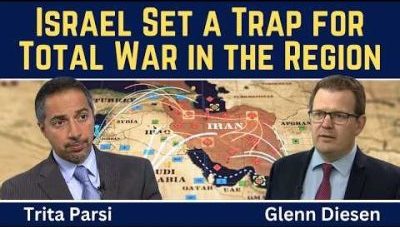
Trita Parsi: Israel Set a Trap for Total War in the Region
or go to
Aletho News Archives – Video-Images
From the Archive
Zionism’s Violent Legacy
By Donald Neff | Washington Report On Middle East Affairs | January 1996
On January 4, 1948, Jewish terrorists drove a truck loaded with explosives into the center of the all Arab city of Jaffa and detonated it, killing 26 and wounding around 100 Palestinian men, women and children.[1] The attack was the work of the Irgun Zvai Leumi – the “National Military Organization,” also known by the Hebrew letters Etzel – the largest Jewish terrorist group in Palestine. The Irgun was headed by Revisionist Zionist Menachem Begin and had been killing and maiming Arabs, Britons and even Jews for the previous ten years in its efforts to establish a Jewish state.
This terror campaign meant that at the core of Revisionist Zionism there existed a philosophical embrace of violence. … continue
Blog Roll
 Aletho News
- Trita Parsi: Israel Set a Trap for Total War in the Region
- Trump’s Iran war is on an Israeli leash
- Saudi oil boss issues global supply warning
- Riyadh Says Its Oil System Is Intact. The Numbers Say Otherwise.
- Trump and Netanyahu Want to “Finish the Job” on Iran
- US ‘one-sided dictation’ not Iran’s beliefs makes rational talks impossible: Baghaei
- Iran’s Next Strike May Not Explode. It Could Shut You Down /Col Doug Macgregor
- Iran: US political targets legitimate if assassinations return
- Iraq shuts key border crossing with Iran under US pressure: Report
- Undersea Internet cables could be targeted in retaliation for attacks on Iran: IRGC deputy chief
- If Americans Knew
- The Israel Lobby’s Changing Fortunes
- AIPAC has become such a political liability that it’s shifting to a more “nimble” approach to buying politicians
- At least 160 Israeli settler attacks in 2 weeks
- Will Gaza’s Ancient Christian Community Disappear Forever?
- Israel’s vision of regional security rests on keeping Arab states weak
- Heidi Levine recounts how Palestinian youths helped save her in settler attack
- DAILY UPDATE: Latest essential news on Palestine, Israel, & region
- Trump’s Intensifying Sabotage of the ICC, for Israel’s Sake
- Israeli military detain US and UK volunteers in West Bank including Democratic NY politician Brad Lander
- Americans at National Conservatism Conference held in Israel this year criticize Israel
- No Tricks Zone
- E-Cars Reduce CO2 Emissions By Only 41% Compared To Internal Combustion Engine Vehicles
- Predictions Made By Renowned Climate Professor Over Past Decades Have Been Proven To Be Poor
- New Study Suggests Large Regions Of The Pacific Ocean Have Been Cooling For The Last 80 Years
- Germany’s Green Energy Debacle: High Energy Costs Force Kahla Porzellan to Close After 182 Years!
- New Study: 50 Years Of The Most Aggressive ‘Net Zero’ Policies Can Only Affect The Global Climate By 0.03°C
- US September “Heat” Was No Record…Many Records Set Decades Ago
- Latest European Green Energy Debacle; Portugal’s Largest Flagship Solar Park Insolvent!
- Green Energy Debacle: German Expert Professor Fritz Vahrenholt Warns Of Severe Economic And Social Consequences
- Two More Paleo Reconstructions Affirm Meters-Higher Sea Levels Across Ireland, Brazil 7000-6000 Years Ago
- New Study: Earth And Venus Surface Warmth Largely Explained By Convection And Lapse Rate, Not CO2 Or Radiation

