A new regional logic? If Israel strikes Lebanon, Iran strikes back at the UAE
By Trita Parsi | May 25, 2026
Despite the ceasefire and tentative progress toward a memorandum of understanding between Washington and Tehran, the Persian Gulf has remained perilously volatile. In the past 24 hours alone, several rounds of fire have been exchanged between US and Iranian forces in the region. Though both sides appear to view the incidents — which may have killed as many as four IRGC naval personnel — as falling below the threshold that would shatter the ceasefire altogether, the clashes underscore the fragility of the current arrangement and the ever-present danger of renewed escalation.
Yet in recent days, it was not the Persian Gulf that emerged as the greatest threat to the agreement. It was Israel’s potential refusal to fully adhere to the regional ceasefire and halt its bombardment of Lebanon. That danger remains acute.
Iran has three principal reasons for insisting that any ceasefire be genuinely regional in scope — one that includes not only the United States and Iran, but also Israel and Lebanon.
First, solidarity with the peoples of Gaza and Lebanon is not merely rhetorical theater for Tehran; it lies at the heart of the Islamic Republic’s regional identity and strategic posture. Having already been perceived by some in the Arab world as abandoning these constituencies in 2024, Iran can scarcely afford another rupture that would further erode its credibility within the so-called “axis of resistance.”
Second, continued Israeli attacks risk reigniting direct confrontation between Israel and Iran — a dangerous cycle that has already erupted twice since October 7, 2023. The linkage between these theaters is neither imagined nor incidental. It is openly acknowledged in Western discourse, which routinely portrays Iran as the central node of resistance to Israeli and American policies, operating through allied groups in Lebanon, Palestine, Iraq, and Yemen. From Tehran’s vantage point, a durable cessation of hostilities with Israel cannot be disentangled from ending Israel’s wars in Gaza and Lebanon. For Iran, this is not an aspirational addendum to diplomacy; it is a foundational condition.
But perhaps the most consequential issue is what Lebanon reveals about Washington itself. For Tehran, tying Israel to the ceasefire is ultimately a test of America’s willingness — and ability — to restrain its closest regional ally. If Trump either cannot or will not do so, then the value of any agreement with Washington comes sharply into question. A ceasefire that leaves Israel free to reignite hostilities at will — while the United States remains unable to prevent itself from being dragged back into conflict — offers little assurance of stability. Under such circumstances, the utility of a deal with Washington diminishes dramatically.
Trump could still choose to put American interests first and compel Israel to comply, much as Ronald Reagan did in 1982 when he pressured Prime Minister Menachem Begin to halt Israel’s devastating assault on Lebanon. Reagan reportedly expressed outrage at the bombardment of Beirut, warning Begin that America’s support could not be taken for granted. Within hours, the bombing stopped. Trump, by contrast, has thus far shown little ability to ensure sustained Israeli compliance with his demands.
A more plausible scenario may be a murkier and more dangerous one: Washington and Tehran reach an agreement, Israel initially abides by it, but over time gradually extricates itself from the arrangement and resumes strikes on Lebanon under the familiar banner of “self-defense.”
At that point, Iran would face a painful dilemma. Tehran would almost certainly pressure Trump to intervene and might even threaten to abandon the agreement altogether. But if Washington failed to act, would Iran truly sacrifice sanctions relief, economic recovery, and an end to open warfare merely to register its objections? Moreover, walking away from the deal might not compel Trump to restrain Israel. Iran could end up with neither an agreement nor a ceasefire in Lebanon. In fact, it would be an outcome Israel would welcome.
One option increasingly discussed within segments of Iran’s security establishment is more ominous still: remaining within the agreement while imposing costs elsewhere — namely on the United Arab Emirates, one of Israel’s closest regional partners. This argument has circulated quietly within segments of Iran’s security establishment, though the extent of its support remains unclear. Yet given the growing sentiment among Iranian decision-makers that Tehran showed excessive restraint toward the UAE during the war, the notion of a “UAE for Lebanon” strategy no longer appears far-fetched.
The logic is brutally simple. If the broader US-Iran arrangement tolerates Israel attacking an Iranian ally in Lebanon, then Tehran may conclude that the same arrangement can tolerate Iran targeting an Israeli ally in the Persian Gulf. Under such a scenario, Iran could retaliate against Emirati territory or Israeli operatives based there for every Israeli strike conducted in Lebanon. Rather than collapsing the agreement outright, Tehran would seek to exact a calibrated price for Israeli noncompliance.
Such a strategy would carry grave risks. Emirati retaliation could follow, potentially igniting a wider regional confrontation. Yet it remains unclear whether Washington would rush to the UAE’s defense if doing so meant destroying the very agreement it had negotiated with Tehran. In that sense, the strategy would place the burden back on the United States: either restrain Israel or watch the conflict metastasize across the Persian Gulf.
The implications for the rest of the Gulf Cooperation Council would be profound. Few Gulf states harbor deep affection for the UAE’s increasingly muscular regional posture, but even fewer desire another destabilizing regional war. Moreover, forcefully condemning Iranian retaliation against the Emirates would only throw into sharper relief the broader Arab silence surrounding Israel’s ethnic cleansing in southern Lebanon.
Hopefully, none of this comes to pass. A durable agreement between Washington and Tehran — backed by the overwhelming majority of regional states — remains possible. And Trump could yet decide that preserving regional stability requires compelling Israel to respect the terms of a broader ceasefire.
But the very fact that Tehran is contemplating escalation against the UAE if Israel escalates in Lebanon illustrates the degree to which the Emirates have made themselves needless targets in the larger Israeli-Iranian rivalry by signing the Abraham Accords.
The journey to the second liberation of South Lebanon
The spider’s web theory lives on
By Robert Inlakesh | Al Mayadeen | May 25, 2026
Twenty-six years on from the liberation of South Lebanon, the message has become clear: as long as the Israeli regime remains, peace will never be possible. This year’s Liberation Day anniversary will be observed by a population that is now fighting another struggle against occupation, one that will have implications beyond the freeing of Lebanese lands alone.
On May 25, 2000, the Israeli occupation forces withdrew from most of the Lebanese lands they had occupied illegally in 1982; a move that came following nearly two decades of brutal oppression and was triggered as a result of the fierce resistance waged by the local population. For the Arab World, and specifically for the Palestinian cause for national liberation, that day became a signal that resistance does work.
A day later, former Hezbollah Secretary General, martyr Sayyed Hassan Nasrallah, delivered his famous ‘Spider’s Web’ speech from a small football stadium in Bint Jbeil, arguing that the Lebanese model of armed resistance is a blueprint for the Palestinian people. This address has haunted the Israeli senior leadership ever since.
What Sayyed Nasrallah laid out was the theory that the Zionist regime was frailer than a spider’s web, meaning that despite its exterior, internally it was weak and could easily be cut down. He paid particular attention, when stating this metaphor, to ensuring the public knew precisely what he meant, which was that the Israeli society was incapable of enduring the repercussions of the regime’s policies. Today, this speech could not be more relevant.
The Israeli military doctrine, since the entity’s founding, has been based on the concept of always fighting short wars and avoiding wars of attrition. David Ben-Gurion, the first Israeli Prime Minister, was the first to ensure that his settler project implemented this doctrine, arguing that because his military was more advanced, they could manage to inflict defeats on the enemies, but that the wars it fought had to be limited due to the overwhelming numerical advantages on the Arab side.
If you look back through Israeli military history, you will also notice a pattern of short wars, especially those in which the Zionist entity achieved significant gains. Their most successful war was the “6-Day War” for example. Even last year, their attack on Iran became the “12-Day War”.
The Israelis withdrew from South Lebanon because they understood that the fight they were facing was going to bog them down and drain them, especially as the Lebanese Resistance was gradually growing in strength. In the Gaza Strip, the same concept applied in 2005. They ran cost-benefit analyses and decided it was best to leave.
Over the years, having only fought short wars against militarily inferior opponents, the Israeli society was able to live in its own bubble world. The consequences of their actions were a small price to pay, especially if these consequences were only felt during shorter periods of time. Other than this, they maintained belligerent occupations, meaning that their army was transformed into more of a riot police force than a proper standing army.
During the Second Intifada, which began in 2000, only months after the liberation of South Lebanon, the Israelis then transitioned into a method of warfare that depended more heavily on “targeted assassinations” and special forces raids. They implemented this strategy, alongside their counterinsurgency approach to warfare, and specialized in occupying civilian populations.
In 2006, they encountered a new obstacle, sustained rocket fire on their settlements, managing to blast as deep into occupied Palestine as Haifa. Later on, the Palestinian Resistance would develop its own rockets and eventually reach Tel Aviv and beyond. However, due to Gaza’s resistance being significantly weaker than Hezbollah, they settled for limited wars of aggression where they would implement the infamous “Dahieh Doctrine” – targeting the civilian population as a means of achieving future “deterrence”.
Lebanese Hezbollah managed to deter the Israelis for 17 years, even managing to force the Zionists to accept an agreement demarcating Lebanese maritime borders. However, the October 7 Al-Aqsa Flood operation jolted the Israelis into a reactionary and accelerationist mindset; they were no longer willing to slowly achieve their goals; instead, they had to do things at a pace in their minds.
But they fell into a trap; they were dragged into a war of attrition. In Gaza, this was something they could survive because the rocket fire gradually dwindled, and their soldiers refused to actually fight the Palestinian Resistance head-on. Instead, they carried out a genocide from a distance, mainly, with their main goal being to destroy buildings.
Which brings us back to South Lebanon. As you read this, the second guerrilla war of liberation is being waged, aiming at achieving an even bigger goal than was achieved in 2000. Hezbollah is now facing a similar predicament to what occurred in 1982 when the Israelis declared a “security zone” in southern Lebanon, which they maintained until the formal occupation was declared in 1985.
The major difference is that the Lebanese Resistance was still in its infancy in the 1980s, and the Palestinian Resistance had left in 1982. This time, the Israelis have been drawn into a trap, one that they cannot easily get out of. It is the beginning of the spider’s web theory proving itself in real time.
Although the war is being fought at a somewhat lower intensity since the announcement of a temporary ceasefire, the invading Zionist militants are being dealt blows on an hourly basis in the south and northern occupied Palestine. You need only look at their media to realize that Israeli society is under pressure in the north already, and the war of attrition has just begun.
The people of Lebanon and Palestine, who form the backbone of their national liberation movements, have proven themselves hardy and capable of enduring the hardships of war, while standing behind their Resistance fighters who come from amongst them. In the case of the Zionists, their army is formed of their public, who are conscripted into it, meaning it is a settlers’ armed forces, but they are a fundamentally weak society.
For the Israelis, they are more interested in living a Western European style of life and aren’t willing to make the necessary sacrifices to win wars of attrition, despite the superiority of their military equipment and intelligence services. A few occasional rockets are enough for tens of thousands to flee their homes, while a Lebanese farmer will remain in his fields as the bombs drop on his village. Right after the so-called ceasefire of November 2024, the people of the South immediately returned home; the settlers did not.
The Israeli army is also suffering a manpower shortage, has drawn back its presence in South Lebanon already due to the FPV drone threat, and has to score fake symbolic victories, such as planting flags in Bint Jbeil, while failing to properly maintain control of the area where Hezbollah fighters continue to watch and target them.
While the initial period between 1982 and 1985 was simple for the Israelis in the way of securing their occupation of the South, this time they are already being battered and have not achieved one goal yet. Desperately, they cling to their targeted assassinations, believing this will transform the battlefield. Another mistake born out of arrogance.
South Lebanon’s liberation in May 2000 birthed the Spider’s Web Theory of Sayyed Hassan Nasrallah. In May 2026, that theory is being put to the test. So far, we see that the fighters on the ground are proving Sayyed Nasrallah correct.
Iran lawmaker outlines five conditions for any understanding with US
Al Mayadeen | May 26, 2026
The head of the Iranian Parliament’s National Security and Foreign Policy Committee, Ebrahim Azizi, said there is “no meaning” to any understanding or negotiations with the United States unless Washington takes five concrete confidence-building measures.
Speaking to Iranian state television, Azizi said the measures include ending the war on all fronts, particularly in Lebanon, lifting the maritime blockade, guaranteeing the passage of non-military vessels through the Strait of Hormuz under Iranian supervision, suspending oil sanctions for 30 to 60 days, and releasing frozen Iranian assets.
Azizi stressed that even if an agreement is reached, it would not signify the end of confrontation with the United States, adding that “Iran after the war is completely different from Iran before the war.”
His remarks come amid growing anticipation over indirect US-Iran contacts being conducted through regional mediators, including Pakistan and Qatar. In this context, Iranian Parliament Speaker and head of the negotiating delegation Mohammad Bagher Ghalibaf visited the Qatari capital, Doha, on Monday.
For his part, US President Donald Trump said negotiations with the Islamic Republic of Iran were “going well,” describing the process as one that could either lead to “a great deal for everybody” or “no deal at all.” Trump also linked any potential agreement to the need for Arab and Islamic states backing the talks to sign normalization agreements.
On the Lebanese front, which Iran insists must be included in any prospective agreement aimed at halting the war, the Israeli occupation continues its large-scale attacks on towns in southern Lebanon and the western Bekaa.
Israeli media also reported that Prime Minister Benjamin Netanyahu and the occupation’s security minister approved plans to expand the war and target civilian buildings in the Lebanese capital, Beirut, after drone operations carried out by the Islamic Resistance that have inflicted losses on occupation forces.
Iran uranium transfer reports ‘US psychological warfare’: Tasnim
Al Mayadeen | May 25, 2026
Iran’s Tasnim News Agency has dismissed Western media reports claiming that Tehran has agreed to transfer its enriched uranium stockpile out of the country as part of a proposed nuclear deal, describing the allegations as part of American “psychological warfare” against Iran.
Tasnim reported that what has been circulated in the media regarding Iran’s readiness to remove enriched uranium from the country is “untrue,” and falls within the framework of “American psychological warfare against Iran.” The agency added that the text of the memorandum of understanding does not contain any statement indicating Iran’s readiness to transfer nuclear materials out of the country, and that the memorandum “did not include any commitment regarding any nuclear action.”
Earlier, The New York Times had quoted US officials claiming that “Iran agreed to give up its stockpile of highly enriched uranium” as part of the proposed agreement announced by President Donald Trump. Tasnim also denied reports that “US officials said Iran will not receive any facilities for the release of frozen funds unless it begins transferring its enriched uranium reserves.”
Iran refuses to link frozen assets to nuclear file
Tasnim affirmed that “Iran is not prepared to link the release of its frozen assets to the nuclear file,” adding that there is a “possibility that no agreement will be reached.”
The agency stressed that Tehran has not made any commitment at this stage regarding the details of the nuclear file, and therefore the release of funds in the first step will have no connection to the nuclear file. The initial understanding, Tasnim emphasised, must be based on “ending the war.”
The denial comes as the US-Israeli war on Iran continues, with Washington maintaining an illegal naval blockade on Iranian ports while demanding nuclear concessions from Tehran. Iran has consistently maintained that its nuclear programme is for peaceful purposes and that it will not negotiate under pressure. Iranian officials have repeatedly stated that the priority is ending the war, not addressing the nuclear file at this stage.
Background: Iran has consistently denied nuclear concessions in ongoing talks
The denial from Tasnim is consistent with Iran’s stated negotiating position throughout the US-Israeli war on Iran. As reported yesterday, Tasnim had already rejected a previous Al Arabiya report claiming that Iran proposed suspending uranium enrichment above 3.6 percent for 10 years.
At that time, a source informed about the negotiation process told Tasnim that all issues touched upon in recent messages exchanged between Iran and the United States have been limited to points on the cessation of hostilities, while the nuclear issue has not been mentioned at all.
Iranian Foreign Ministry spokesperson Esmaeil Baghaei confirmed that negotiations at this stage do not address the nuclear file or the details of sanctions relief. He also reiterated that the United States has no role in the Strait of Hormuz, describing it as a matter exclusively between Iran and the waterway’s coastal states.
Three fundamental sticking points remain unresolved
Beyond the nuclear file, an informed source close to Iran’s negotiating team told Fars News Agency that three fundamental points of contention remain unresolved, warning that talks will not proceed unless they are addressed. These concern the nuclear file, the release of Iranian frozen assets abroad as a non‑negotiable prerequisite for entering negotiations, and Iranian management of shipping traffic through the Strait of Hormuz.
The source noted that while US negotiators have retreated from their initial positions and accepted many of Iran’s stances, significant gaps persist. Iran has “prepared itself for all options,” the source stressed, with the Iranian armed forces remaining on high alert.
The repeated denial of media reports about nuclear concessions suggests that Washington may be attempting to shape public perception of the negotiations, while Tehran insists that no agreement on the nuclear file has been reached or even discussed in detail.
Delcy’s ‘gatekeeper’: sources say ex-Trump official Claver-Carone holds keys to Caracas
By Max Blumenthal | The Grayzone | May 25, 2026
Speaking with reporters on May 21, US Secretary of State Marco Rubio announced that Venezuelan President Delcy Rodriguez was on her way to New Delhi to discuss energy issues, and that he would be in India as well.
“This is an important trip, I’m glad we’re able to do it,” Rubio chirped after explaining the trio of nations would discuss how to increase Venezuelan oil sales to India.
His statement — and his announcement of Rodriguez’s trip before she had — perfectly illustrated Washington’s newfound dynamic with the Venezuelan government. Following over twenty years of hostile relations with Venezuela’s socialist-oriented leadership, the US Secretary of State was apparently so intimately involved with day to day affairs in Caracas that he was claiming responsibility for Rodriguez’s international itinerary.
In fact, according to an insider who enjoys close contacts within both the Venezuelan and US governments, Rubio’s influence over Rodriguez is said to be traced to one “gatekeeper”: former Trump Latin America envoy Mauricio Claver-Carone. “Mauricio [Claver-Carone] is picking who can operate and Delcy [Rodriguez] is taking instructions,” the source told The Grayzone.
A former senior US official with access to leadership in both Caracas and Washington offered the same assessment, remarking to The Grayzone, “Mauricio’s calling the shots on private sector economic positions, and if anyone wants in, they have to go to him.”
Hand-selected by former National Security Advisor John Bolton to serve as his Latin America charge during Trump’s first term, Claver-Carone no longer occupies an official governmental role. Instead, he has leveraged his legacy in the public sector to establish a Miami-based investment firm called the Lara Fund which could become a key player in the MAGA financial feeding frenzy in Caracas.
Described by the New York Times as the “architect of Trump’s tough Latin America policies,” Claver-Carone is a Cuban-American regime change zealot who once engaged in fisticuffs with Cuban diplomats as a young man. During Trump’s first term, he unleashed a financial “flamethrower” on Cuba, issuing scores of new sanctions that unraveled the Obama-era normalization policy and plunged the island back into economic misery.
Claver-Carone has similarly masterminded many of the policies that define Trump’s relationship with Venezuela, from its recognition of the previously unknown Juan Guaido as the country’s “interim president” to the deportation of hundreds of Venezuelan migrants from the US to El Salvador’s maximum security CECOT prison. Many of those migrants had been prompted to journey to the US by the economically crushing sanctions unleashed at Claver-Carone’s direction.
The Grayzone’s sources described the Trump veteran as the architect of the military invasion that saw Maduro spirited away to a federal penitentiary and installed Rodriguez as president following a stand-down by Venezuelan security forces.
“If he was in charge of implementing the kinetic side, maybe [Rodriguez] thinks she has to listen to him on finance,” the Venezuela insider said of Claver-Carone.
A report this January by investigative journalist Aram Roston described Claver-Carone as a “key backer” of Rodriguez following Maduro’s abduction, and cited sources who claimed he exercised decisive influence over Venezuela policy despite having left the administration.
Claver-Carone is now said to be at the heart of the most sensitive and consequential task Venezuela faces: the restructuring of its $170 billion in defaulted sovereign debt. Forced from several previous positions by corruption scandals and rancorous clashes, an operative with no official governmental position appears to be shaping the economic contours of Project Venezuela.
“He’s got a lock on everything”
This May, the US Treasury Department authorized Caracas to hire a financial advisor to assist with the herculean task of restructuring its debt. The Venezuelan government selected Centerview Partners, a top-drawer investment and financial advisory firm based in New York City.
According to the former US senior official, Claver-Carone’s romantic partner and business colleague, Jessica Bedoya, boarded a private jet to Caracas soon after the big announcement, arriving with a top advisor from Centerview. It was her second trip to the Venezuelan capital, they said, after visiting in February to discuss financial matters.
Claver-Carone did not respond to calls to his personal phone from The Grayzone, or to detailed questions sent by text and email.
His partner, Bedoya, is the founder of the Lara Fund investment firm where he serves as managing partner. Her bio notes that she has also worked in the CIA and National Security Council.
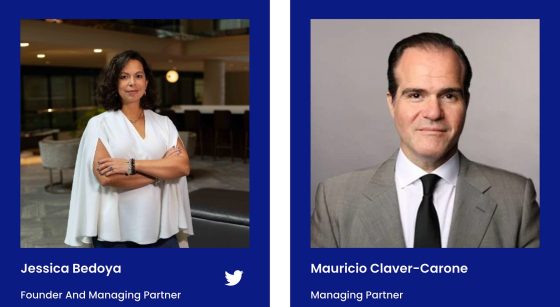
Jessica Bedoya and Mauricio Claver-Carone’s headshots, as featured on Lara Fund’s webpage
Some insiders worry that her reported presence in the Venezuelan capital, together with Claver-Carone’s outsized influence, could represent a conflict of interest, allowing them to steer debt restructuring agreements to their own personal benefit.
“Now he’s got a lock on everything,” the Venezuela insider said of Claver-Carone. “He could say to anyone who wants to work in Venezuela, I’m the guy. I have the keys. If you want to play ball, invest with me.”
The former US official said Claver-Carone was raising capital for his Lara Fund while he served as a special government employee at the State Department. While Bedoya was running the firm, they said Claver-Carone was leveraging his position inside the Trump administration to pitch potential investors.
“Arbitrary and authoritarian actions that showed him to be a real thug”
When Trump appointed Claver-Carone to serve as the first American president of the Inter-American Development Bank (IDB) in 2020, he hired Bedoya as his chief-of-staff. The couple’s secret romance at the bank triggered an embarrassing ethics investigation after a hand-written contract was discovered showing they had agreed to pursue “absolute happiness,” and included a clause with punishments including “candle wax and a naughty box” if either party breached the deal.
An independent probe ordered by the IDB discovered that Claver-Carone had increased his paramour’s salary by 40% – a $133,000 reward in less than a year. Investigators also found that the couple had racked up expenses on an IDB credit card during romantic getaways.
Claver-Carone refused to participate in the investigation while accusing its authors of “fabrications.” In the end, IDB governors voted unanimously in favor of his firing. The US government endorsed their decision.
“President Claver-Carone’s refusal to fully cooperate with the investigation, and his creation of a climate of fear of retaliation among staff and borrowing countries, has forfeited the confidence of the bank’s staff and shareholders and necessitates a change in leadership,” they wrote.
The Argentine governor of IDB, Guillermo Francos, delivered a similarly harsh assessment of Claver-Carone’s tenure. “Claver was a disaster for several reasons,” Francos remarked in 2022. “For having an inappropriate relationship, for having disproportionately increased the salary of this inappropriate relationship, for having lied, and for these arbitrary and authoritarian actions that showed him to be a real thug.”
When Claver-Carone returned to the second Trump administration, it was not long before his proclivity for conflict jeopardized his position.
Throughout 2025, Claver-Carone’s spiteful attitude reportedly complicated Trump administration attempts to prop up a key right-wing ally in South America, Argentine President Javier Milei. Milei’s chief of staff happened to be Guillermo Francos – the former IDB governor whom Claver-Carone held personally responsible for outing his secret relationship with Bedoya. According to the Argentine paper Clarin, Claver-Carone attempted to retaliate by unsuccessfully pressuring Milei to fire Francos. He then attempted to undermine a major IMF loan package to Argentina by demanding the country first sever its credit line from China. This was met with an apparent rebuke from Treasury Secretary Scott Bessent, who visited Buenos Aires to express confidence in the IMF loan just weeks after Argentina’s central bank extended its credit line from Beijing.
The following month, in May 2025, Claver-Carone announced he was leaving the State Department to return to his Lara Fund. His departure gave the appearance that he had been forced out of his job, however, he maintained his clout through his direct line to Rubio.
The former US official told The Grayzone that Claver-Carone is now angling to become a Cuban American version of Jared Kushner, the Trump son-in-law who has leveraged his proximity to the president and role as Middle East negotiator to rake in billions from Israel and several Gulf monarchies despite having no official government title. To do so, he has allegedly inserted himself into the byzantine process of restructuring Venezuela’s debt.
When the Trump administration announced that Venezuela could hire a financial advisor to assist with its sovereign debt, Rodriguez initially planned a public bidding process for the coveted position. But then, according to the ex-US official, Claver-Carone issued support for Centerview, leading to the firm’s selection. (Opposition bloggers have speculated that Centerview was chosen because one of its partners, Matthieu Pigasse, is a self-described “pro-market socialist” who previously worked on deals with Maduro and Venezuela’s state owned PDVSA oil company.)
In recent weeks, according to sources, Claver-Carone has attempted to undermine financial advisors who had been working with the Venezuelan government to restructure its debt since 2014.
They said that when Claver-Carone’s partner, Bedoya, arrived in Caracas this month, allegedly on a private jet with Pigasse, she began pushing to remove the advisory mandate from David Syed, a seasoned French lawyer who had advised Caracas on debt-related issues for over a decade, and is considered incorruptible.
“The effort to push [Syed] out created a lot of tension,” remarked the Venezuela insider. “You can’t understand debt restructuring by parachuting in without his knowledge.”
Syed did not respond to The Grayzone’s request for comment. Hamouda Chekir, another Centerview partner who works on Venezuela’s debt, did not respond to calls and text messages sent to his personal phone.
Scandal-stained firms as vehicles for extracting profit from Venezuela
Just before leaving the State Department in May 2025, Claver-Carone convinced Rubio not to renew a sanctions waiver that allowed Chevron to sell Venezuelan oil in the US market. In doing so, he eliminated a mechanism which was explicitly designed to promote transparency and prevent local officials from skimming cash.
This January, after abducting Maduro, the Trump administration granted confidential licenses to a pair of notoriously corrupt trading houses, Vitol and Trafigura, to export Venezuelan oil. The deal came months after Trump’s re-election campaign received a whopping $6 million donation from a senior trader at Vitol.
Robert Bachmann, an analyst at the Swiss watchdog Public Eye, told the Washington Post at the time, “Trump is taking advantage of firms that know how to circumvent regulation.”
Both companies had been caught engaging in a series of elaborate bribery schemes across Latin America and Africa. In 2020, the Department of Justice (DOJ) forced Vitol to pay a $135 million penalty for bribing officials for licenses in Mexico, Ecuador and Brazil. Trafigura paid a similarly staggering fine in 2024 for a lucrative bribery scheme in Brazil. In the US, Vitol was rung up by the California Attorney General for manipulating spot market prices of oil.
But almost as soon as the Trump administration entered office, it neutered the DOJ corrupt foreign practices division charged with enforcing the judgments against Trafigura and Vitol on the grounds that it was “impeding America’s national security objectives.”
Now, the profits these scandal-stained firms generate through oil sales abroad – including to Israel – are channeled back into a US-run account with little public oversight. A percentage of sales is then delivered back to the Venezuelan government. Where the rest goes is anybody’s guess.
“The Venezuelans are the owners of the oil, and we know nothing. There is no transparency,” said José Guerra, an economist aligned with the Venezuelan opposition, complained to the Washington Post about the Trafigura and Vitol licensing agreements.
Trump, for his part, has essentially admitted Venezuelan oil profits are channeled into a slush fund for his international rampage. “We’ve taken out so much oil in Venezuela, we’ve paid for the cost of the war [with Iran] about 25 times over,” the president boasted during a May 23 campaign rally. While the president’s claim was absurd, as Venezuela is currently exporting only about one million barrels of oil a month – hardly enough to cover a full day of warfare – it revealed his avaricious attitude toward the entire operation.
Among certain Venezuelan opposition activists, Claver-Carone has become a figure of contempt who is partially blamed for Trump’s declaration that their de facto leader, the coup plotter and Nobel Peace Prize winner Maria Corina Machado, “doesn’t have the support within, or the respect within, the country.”
The Trump administration’s embrace of Delcy Rodriguez, and the Venezuelan president’s faithful compliance with Washington’s financial schemes, have prompted some top Democrats to adopt Machado as a partisan cudgel. This January, Chris Murphy, a ranking Democrat on the Senate Foreign Relations Committee, praised the opposition leader as “impressive” following a meeting on Capitol Hill, while taking a nasty swipe at Rodriguez. Machado “reminded us that Trump replaced Maduro with Maduro’s head of torture,” Murphy proclaimed.
If the Democrats take Congress after this year’s midterm elections, the Trump administration’s dealings in Venezuela will face intense scrutiny from the House Oversight Committee. Bipartisan pressure will then build for fresh elections to usher in a new government. “Delcy Rodríguez is a terrible person,” the regime change-obsessed Florida Republican Sen. Rick Scott told the Wall Street Journal this month. “We’ve got to have an election soon.”
In the meantime, a flock of MAGA-aligned financial vultures has swooped into Caracas to feast on the petro-state’s post-Maduro carcass. Donald Trump Jr. is said to be hunting for opportunities in the capital for his 1789 Capital fund, while a startup backed by pro-Trump tech oligarchs Peter Thiel and Palmer Luckey, Erebor Bank, just struck a lucrative deal to reconnect Venezuela’s central bank to the global economy. In the midst of this frenzy, a figure with no government title, Claver-Carone, appears to be establishing the new pecking order.
Trump Wants To Use A Deal With Iran To Further Isolate The Palestinians
Trump Wants Every Arab State To Abandon Palestine
The Dissident | May 25, 2026
Donald Trump on Truth Social, has announced his intention to pressure Qatar, Pakistan, Türkiye, Egypt, and Jordan to normalize relations with Israel- without Israel agreeing to a Palestinian state-as part of the potential deal with Iran.
On TruthSocial, Trump wrote, “Negotiations with the Islamic Republic of Iran are proceeding nicely! It will only be a Great Deal for all or, no Deal at all — Back to the Battlefront and shooting, but bigger and stronger than ever before — And nobody wants that!” adding, “after all the work done by the United States to try and pull this very complex puzzle together, it should be mandatory that all of these Countries, at a minimum, simultaneously, sign onto the Abraham Accords. Those Countries discussed are Saudi Arabia, The United Arab Emirates (already a Member!), Qatar, Pakistan, Türkiye, Egypt, Jordan, and Bahrain (already a Member!). It may be possible that one or two have a reason for not doing so, and that will be accepted, but most should be ready, willing, and able to make this Settlement with Iran a far more Historic Event than it would, otherwise, be.”
He added, “I am mandatorily requesting that all Countries immediately sign the Abraham Accords, and that, if Iran signs its Agreement with me, as President of the United States of America, it would be an Honor to have them also be part of this unparalleled World Coalition.”
For context, all members states of the Arab League and even Iran have long agreed to support the Arab peace initiative, which calls for all states who signed on to “Consider the Arab-Israeli conflict ended, and enter into a peace agreement with Israel, and provide security for all the states of the region” and “Establish normal relations with Israel in the context of this comprehensive peace” in exchange for “The acceptance of the establishment of a Sovereign Independent Palestinian State on the Palestinian territories occupied since the 4th of June 1967 in the West Bank and Gaza Strip, with East Jerusalem as its capital.”
Israel has long rejected this major compromise and instead pursues the Greater Israel Project and endless regime change wars against states that are too supportive of the Palestinians.
In 2020 Benjamin Netanyahu, Jared Kushner, and the Trump administration came up with a way for Israel to get normalization with Arab states without any concessions for Palestinians, dubbed the Abraham Accords.
The phony “peace deal” allowed Israel to normalize relations with the United Arab Emirates, Bahrain, Sudan, and Morocco, without anything for Palestinians.
The real purpose of the deal, as the New Yorker David Remnick puts it , was “sidelining the Palestinians yet again”.
The deal, as Mother Jones noted , “essentially kicked the Palestinians and their grievances (the Israeli occupation of the West Bank, its apartheid policies, and its blockade of Gaza, which turned the strip, according to Human Rights Watch, into an ‘open-air prison’) to the curb”.
Benjamin Netanyahu- who wanted to expand the Accords to countries like Saudi Arabia- made it no secret that the deal was intended to isolate the Palestinians, to pave the way for an Israeli annexation of Gaza and the West Bank.
As Journalist Jeremy Scahill noted , “The Abraham Accords, launched under President Donald Trump, effectively excised the issue of Palestinian self-determination as a condition for normalization, a major victory for Israel. Israeli provocations and attacks against worshippers at Al Aqsa were becoming a regular occurrence. Israel was aggressively moving forward with its annexation of Palestinian land and armed settlers were conducting deadly paramilitary actions, often with the support or facilitation of the government, against Palestinian farms and homes in the occupied territories.”
Scahill noted that:
In the years preceding the October 7 attacks, under presidents Trump and Biden, Hamas watched as Israel became more emboldened as prospects for Palestinian liberation receded to the footnotes of Washington-led initiatives aimed at normalizing relations between Israel and Arab nations like Saudi Arabia, Qatar, and the United Arab Emirates. Netanyahu’s position was: “We must not give the Palestinians a veto over new peace treaties with Arab states.”
Just two weeks before the October 7 attacks, the Israeli leader delivered a speech at the UN general assembly in New York, brandishing a map of what he promised could be the “New Middle East.” It depicted a state of Israel that stretched continuously from the Jordan River to the Mediterranean Sea. Gaza and the West Bank, as Palestinian lands, were erased.
During that speech, Netanyahu portrayed the full normalization of relations with Saudi Arabia as the linchpin of his vision for this “new” reality, one which would open the door to a “visionary corridor that will stretch across the Arabian Peninsula and Israel. It will connect India to Europe with maritime links, rail links, energy pipelines, fiber-optic cables.”
Netanyahu’s open admission that Israel wanted to use the Abraham Accords to abandon the Palestinians and make way for an Israeli annexation of Gaza and the West Bank is a large part of what triggered the Al-Aqsa Flood operation from Hamas on October 7th.
But after the Israeli Holocaust in Gaza, most states that could have potentially signed onto the Abraham Accords refused to agree to full normalization with Israel without the establishment of a Palestinian state.
As the Times of Israel noted , “Riyadh has repeatedly said, however, that it will not join the accords before Israel commits to the establishment of a Palestinian state, an idea that the government of Prime Minister Benjamin Netanyahu has vehemently refused to entertain,” adding, “Like Saudi Arabia, Pakistan has said it will not recognize Israel until the establishment of an independent Palestinian state. Qatar, too, has no formal ties with Israel”.
Türkiye has similarly said, “When Israel stops the pressure and cruelty targeting Palestinians, Türkiye will have no problem with normalizing relations. As long as its regional policies continue, as long as they bomb cities, kill children and women, it is impossible to normalize ties with them”.
Through demanding that all of these states join the Abraham Accords, Trump is attempting to force countries desperate to see an end to the war in Iran to normalize relations with Israel and abandon the Palestinians, in order to lead the way for the final phase of Israel’s annexation and ethnic cleansing of Palestine.
Sinopec’s Jiyang shale oil base in Shandong Province produces 2 million tons of crude oil
Global Times | May 25, 2026
A major shale oil base in Jiyang, East China’s Shandong Province, which is operated by Sinopec, has achieved cumulative crude output exceeding 2 million tons, marking a breakthrough in safeguarding national energy security, China Media Group reported on Monday.
Covering 7,300 square kilometers, the base has accelerated production capacity expansion this year. In the first four months of this year, the zone put 10 high-production wells into operation, delivering shale oil output of 14,000 tons, a 15 percent year-on-year increase.
Shale oil, trapped in tight and fragmented rock formations with no natural flow capacity, is widely regarded as one of the world’s most difficult exploration challenges.
Through independent innovation, Chinese researchers have conquered more than 40 key technological bottlenecks. They pioneered a targeted exploration and development theory tailored for continental faulted basins. The breakthroughs have enabled the effective exploitation of 90 percent of previously inaccessible shale oil resources in the region, uncovering three 100 million ton level oil fields.
The Jiyang shale oil demonstration zone has reported proven geological reserves of 327 million tons, with estimated total resources reaching 10.5 billion tons. The massive new reserve is equivalent to discovering a large new oilfield, supporting stable crude output growth and reinforcing China’s energy security.
China boasts abundant shale oil resources, distributed across five major basin areas including the Bohai Bay and Ordos in North China’s Inner Mongolia Autonomous Region, as well as eight medium-sized and small basins. The country’s technically recoverable shale oil reserves now rank third worldwide at about 32 billion barrels.
Unlike marine shale oil overseas, China’s shale oil is largely continental, featuring more complex geological conditions and greater development difficulties, said Guo Xusheng, an academician with the Chinese Academy of Engineering.
Driven by continuous technological breakthroughs, China’s total proven shale oil reserves have reached 1.84 billion tons. The country’s annual shale oil output topped 8.5 million tons last year and is expected to surpass 10 million tons soon, demonstrating strong development prospects.
With the orderly construction of national-level shale oil demonstration zones including Jiyang, China has built the world’s largest continental shale oil development system with fully self-controllable core technologies. The industry has achieved a leap from technological breakthroughs to large-scale stable production, emerging as a strategic pillar in safeguarding national energy security.
Trump demands Arab states normalize with Israel in exchange for Iran ceasefire: Report
Press TV – May 25, 2026
US President Donald Trump has told several Arab and Muslim leaders that he expects them to establish formal relations with Israel in exchange for a ceasefire deal with Iran to end the war, according to American officials.
Axios, citing the officials, said that Trump made the demand during a phone conversation on Saturday with leaders from Saudi Arabia, the United Arab Emirates, Qatar, Pakistan, Turkey, Egypt, Jordan, and Bahrain.
According to the same sources, all eight leaders expressed support for the potential agreement with Tehran during the call.
“We are with you on this deal,” one official was quoted as telling Trump, according to the report.
Another official familiar with the conversation said the US president indicated that he would next speak with Israeli Prime Minister Benjamin Netanyahu and hoped to bring him into a joint call with the same group of Arab and Muslim leaders in the future.
Trump also pushed those countries that have not yet joined the so-called Abraham Accords – a series of 2020 US-brokered normalization deals with Israel signed under the Trump administration – to do so and establish formal ties with the Tel Aviv regime, the officials added.
Saudi Arabia, Qatar, and Pakistan currently maintain no official diplomatic relations with Israel.
One of the officials told Axios that there was “silence on the line” after Trump’s demand, prompting the president to joke and ask “if they are still there.”
The development comes as indirect talks between Tehran and Washington, mediated by Pakistan and facilitated by Qatar, continue based on the Islamic Republic’s 14-point proposal to reach a memorandum aimed at putting an end to the US-Israeli war on Iran.
Speaking in a televised interview on Saturday, Iranian Foreign Ministry spokesman Esmaeil Baghaei said Iran and the United States have edged closer to finalizing the 14-point memorandum to end the imposed war, halt American maritime aggression, and secure the release of Iran’s blocked assets.
He emphasized that Iran’s focus at this stage remains exclusively on ending the US-Israel war based on its proposal, which has been shuttled back and forth several times.
The criminal US-Israeli aggression against Iran began on February 28 with airstrikes that assassinated senior Iranian officials and commanders, including Leader of the Islamic Revolution Ayatollah Seyyed Ali Khamenei.
Iranian Armed Forces responded by launching daily missile and drone operations targeting locations in the Israeli-occupied territories as well as US military bases and assets across the region.
Furthermore, Iran retaliated against the strikes by closing the Strait of Hormuz, which resulted in a significant increase in oil prices and its by-products.
On April 8, forty days into the war, a Pakistan-brokered temporary ceasefire between Iran and the US took effect.
Negotiations ensued in the Pakistani capital, Islamabad, but stopped short of an agreement amid Washington’s maximalist demands and insistence on unreasonable positions.
Featured Video
John Mearsheimer Talking Iran with Iran
or go to
Aletho News Archives – Video-Images
Book Review & Summary
Calling of an Angel: The True Story of Rene Caisse and an Indian Herbal Medicine Called Essiac (1988)
Dr. Gary L. Glum – 30 Q&As – Book Review & Summary
Lies are Unbekoming | October 17, 2026
On June 10, 1975, Dr. Chester Stock, a vice president at Memorial Sloan-Kettering Institute for Cancer Research, wrote to a Canadian nurse named Rene Caisse: “Enclosed are test data in two experiments indicating some regressions in sarcoma 180 of mice treated with Essiac.” The sentence sat in a letter from one of the world’s largest private cancer research centers, concerning an herbal tea an elderly English woman had learned from an Ojibwa medicine man at a northern Ontario mining camp in the 1890s. The tests were terminated the following year after Sloan-Kettering admitted, in sworn affidavit three years later, that they had prepared the injectable solution improperly from the dried material supplied — freezing and thawing the herb rather than boiling it as Rene had instructed. By the time Calling of an Angel was published in 1988, Rene Caisse had been dead for a decade, having treated thousands of cancer patients across fifty-six years in her Bracebridge, Ontario kitchen, never charging a fee, and refusing every offer — from Memorial Sloan-Kettering, the National Cancer Institute, Merck, Parke Davis, and private corporations dangling contracts up to $1 million — to release her formula before the medical establishment admitted her remedy had merit. … continue
Blog Roll
 Aletho News
- Vice President J.D. Vance’s Deceptive ‘Antiwar’ Campaign Speech
- Iran: Palestinians’ rights must not be compromised in Gaza’s future; US, Israel to blame for Hormuz situation
- Ongoing tales of Syrian chemical weapons
- Moscow blasts UN for ignoring torture of Russian POWs
- Millions of Books Could Have Been Destroyed in Lebanon During Israeli Bombings
- Moscow warns of ‘hunt for Russians’
- Calling of an Angel: The True Story of Rene Caisse and an Indian Herbal Medicine Called Essiac (1988)
- South Korean Assistance to the U.S. in the War with Iran: Between Allied Duty and National Interests
- Pharma- and Gates-Funded GAVI Seeks to Assure Parents
- John Mearsheimer Talking Iran with Iran
- If Americans Knew
- Israeli soldiers debunk Israel’s talking points
- In West Bank, Israeli settlers are totally out of control – Daily Update
- NPR investigation finds evidence of widespread fraud at mall kiosks tied to Israeli skincare brand
- Tucker Carlson exposes Israeli Lies about the Oct 7th attack, Charlie Kirk, and the U.S.
- Israel has detained thousands of Palestinian children since Oct 7th – over half spent time in solitary, many uncharged
- Israeli Analysis: Is Netanyahu Planning an ‘October Surprise’ Attack Before Israel’s Election?
- Israeli settlers brutally attack Palestinians and Washington Post female photographer, 65
- Words Have Changed, Occupation Continues: The Reality of the Gaza Ceasefire
- Gaza’s child amputees are growing faster than their prosthetics allow
- Israel keeps Palestinians struggling just to survive–Daily Update
- No Tricks Zone
- New Study Suggests Large Regions Of The Pacific Ocean Have Been Cooling For The Last 80 Years
- Germany’s Green Energy Debacle: High Energy Costs Force Kahla Porzellan to Close After 182 Years!
- New Study: 50 Years Of The Most Aggressive ‘Net Zero’ Policies Can Only Affect The Global Climate By 0.03°C
- US September “Heat” Was No Record…Many Records Set Decades Ago
- Latest European Green Energy Debacle; Portugal’s Largest Flagship Solar Park Insolvent!
- Green Energy Debacle: German Expert Professor Fritz Vahrenholt Warns Of Severe Economic And Social Consequences
- Two More Paleo Reconstructions Affirm Meters-Higher Sea Levels Across Ireland, Brazil 7000-6000 Years Ago
- New Study: Earth And Venus Surface Warmth Largely Explained By Convection And Lapse Rate, Not CO2 Or Radiation
- 2025 Nature Paper Claiming Worsening Global Drought Gets RETRACTED …Heavily Flawed
- New Study: ‘Global Drought Shows No Detectable Recent Acceleration Under Climate Warming’

