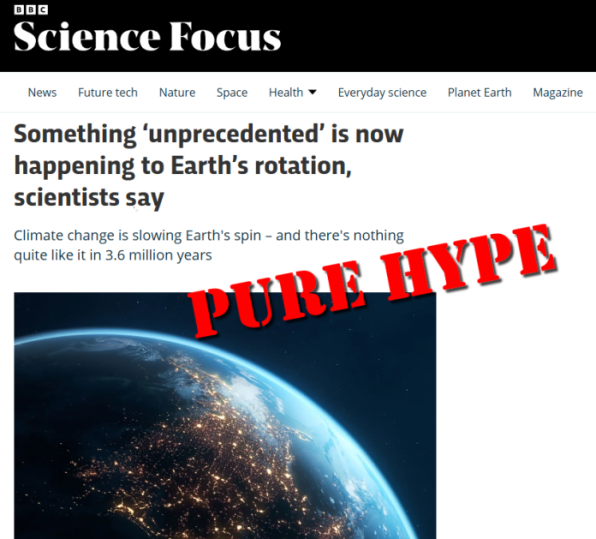
The British Broadcasting Corporation (BBC) Science Focus article “Something ‘unprecedented’ is now happening to Earth’s rotation, scientists say” claims that climate change is causing an “unprecedented” slowing of Earth’s rotation by 1.33 milliseconds per century, something not seen in 3.6 million years. This is false. The data show that millisecond-scale variations in Earth’s length of day are routine, naturally occurring, and both technologically and biologically insignificant.
The BBC sensationalizes the issue as something extraordinary, stating that today’s rate of change is “unequivocally” unlike anything in millions of years. But Earth’s rotation has never been constant. As explained in the Climate Realismrebuttal to Euronews on the same topic, seasonal atmospheric mass redistribution alone produces annual variations of 0.5 to 1 millisecond. Interannual ENSO shifts add another ±0.3 to 0.5 milliseconds. Decadal core-mantle coupling produces swings of 3 to 4 milliseconds. These are measured, observed phenomena, not model projections.
In that context, 1.33 milliseconds per century is not planetary destabilization. It is background noise, certainly nothing that would be noticed by even the most sensitive ecosystem or living being.
The BBC emphasizes that melting ice shifts mass toward the equator, comparing it to a spinning skater extending their arms. That physics analogy is correct in principle. What is incorrect is the implication that this is some new geophysical regime. Earth’s length of day has fluctuated throughout recorded history due to tidal friction from the Moon, atmospheric angular momentum exchange, ocean circulation, and core dynamics. The long-term tidal braking trend alone is about +1.7 to +1.8 milliseconds per century based on 2,500 years of eclipse records, a rate comparable to or larger than the BBC’s headline number.
Even more inconvenient for the narrative is the recent acceleration of Earth’s rotation. As noted in the Climate Realism piece, June 29, 2022 was the shortest day ever recorded in the atomic timekeeping era, about 1.59 milliseconds shorter than 86,400 seconds. If climate change were producing a simple, monotonic slowdown, we would not be seeing record-setting shorter days in the same decade.
The BBC also attempts to inflate the significance of the change by invoking dramatic metaphors. One researcher is quoted comparing the energy involved to a catastrophic earthquake, saying: “The change in the Earth’s rotational energy is equivalent to a magnitude 9.0 earthquake.” This is nothing but irresponsible doom mongering. The comparison is not about destructive force, as the article admits, but about abstract energy equivalence. It is an analogy designed to impress, not to inform. No cities are shaking. No ecosystems are collapsing. No lifeform on Earth can feel a thousandth of a second difference.
Let’s put the number in perspective. One millisecond is 0.001 seconds. A 1.33 millisecond change represents approximately 0.000015 percent of a 24-hour day. Human circadian rhythms are tuned to roughly 24 hours, not to thousandths of a second. There is no plausible biological mechanism by which such a tiny change could affect human health, animal behavior, or plant life. It is physiologically undetectable. Even if the rate of change were accurate, consistent, and sustained, it would take approximately 75,188 years for the day to lengthen by exactly one full second.
Technologically, the “crisis” BBC claims is even more absurd. Modern systems already handle irregular rotation through leap seconds. Since 1972, 27 leap seconds have been added to Coordinated Universal Time to synchronize atomic clocks with Earth’s spin. Discussions are underway about possibly implementing a negative leap second because of recent acceleration. GPS, spacecraft navigation, financial trading platforms, and astronomical observatories continuously ingest Earth orientation parameters from the International Earth Rotation and Reference Systems Service and adjust automatically. They already deal with corrections far larger than 1 millisecond.
Society adjusts clocks by one hour every year for daylight saving time in many regions. That is 3.6 million times larger than the 1.33 millisecond change being described. Leap years add a full day. Compared to those routine adjustments, this isn’t even a rounding error.
The BBC article goes further, suggesting that by 2100 climate change could outpace even the Moon’s gravitational influence on day length. That projection is model-dependent and scenario-driven. It assumes the now discredited and removed RCP8.5 high-emissions pathways and continued ice loss at rates embedded in climate models. It is not an observed reality. It is a modeled extrapolation.
And even if that projection were accurate, we are still talking about millisecond-scale shifts. The practical consequences remain limited to timekeeping adjustments that modern civilization already manages with ease. There is no crisis as the infinitesimal change in the Earth’s rotation has and can have no plausible impact on ecosystems or living beings.
The most telling line in the BBC piece is the assertion that “human influence on the Earth system has become so profound that we are now changing the very way our Earth spins.” That statement is designed to provoke awe and alarm. It is also technically trivial. Humans also change Earth’s mass distribution through groundwater extraction, reservoir construction, mining, and urbanization. These processes are measurable, they are not existential.
In the end, the BBC’s hyped 1.33 millisecond per century change to the Earth’s length of rotation, even if true, represents trivial geophysical adjustment. One that is not biologically meaningful, technologically disruptive, and not outside the envelope of natural variability observed over decades and centuries.
Framing a millisecond-scale variation as “unprecedented” planetary destabilization represents a a textbook example of taking a measurable but trivial geophysical adjustment and inflating it into a symbolic crisis. It is a giant nothingburger. An attempt to scare people with a story that is not scary in the least.
The Israeli government is still holding a massive trove of video documentation of the Oct. 7 attack captured by individuals and communities caught up in the fighting. One bereaved parent even accuses Israeli authorities of deleting a video of her son’s last moments before returning his phone to her.
According to Israel’s Channel 13, “all the cameras, memory cards and films that documented the atrocities were collected, but two and a half years later, these materials have not been returned to the communities and bereaved families who are desperate for information, and even feel that someone is hiding it from them.”
Soon after Hamas and Palestinian Islamic Jihad’s attack on Israel on Oct. 7, 2023, special units from the IDF, the Israeli intelligence agency Shin Bet and Israel’s investigation unit Lahav 433 collected photo and video documentation of the violence, confiscating cell phones, individual cameras, kibbutz security cameras and more.
“They disconnected what was needed, took it and moved on – that was the last time we saw the materials,” said an Israeli army reservist who participated in the collection mission.
According to the head of the Kfar Aza kibbutz – the site of a number of a series of atrocity hoaxes spun out in the early days after the attack – community members cooperated with investigators at the time. Now, years after the events, these families are wondering why documentation of their loved ones’ fates has yet to be returned to them.
Even Sabine Taasa, who was made an emblem of Israeli victimhood after her husband and one of her sons were killed on Oct. 7, is now clashing with Israeli authorities over footage of that day.
Taasa’s 17-year-old son, Or, was killed on Zikim beach. According to Channel 13, Taasa says she saw a video her son filmed in the moments leading up to his death, but when authorities returned his phone to her, no such video remained. The outlet says this is not an isolated incident.
An IDF probe found that soldiers abandoned civilians hiding in a bathroom there and then left their bodies for a week.
Channel 13 reports that Israeli police claimed Lahav 433 is still investigating the events in kibbutz Kfar Aza and no indictments have yet been filed, so returning evidence at this stage could jeopardize their criminal case. Meanwhile, the IDF rejected all accusations that it is withholding documentation and says it is in the final stages of adopting policies for how this type of evidence will be returned to communities and families.
On October 7, the Israeli government issued Hannibal Directive orders which led Apache helicopter pilots and tank gunners to take aim at Israel’s own citizens in the Gaza envelope, supposedly to prevent them from being taken hostage. Israeli Brig. Gen. Barak Hiram personally ordered a tank crew to shell a home in Kibbutz Be’eri, knowing it was filled with Israeli citizens who had been taken captive by Hamas fighters seeking to negotiate a way out of the standoff. A dozen Israelis were killed in the strike, leaving behind “a house full of corpses,” according to the lone Israeli survivor. One Israeli tank gunner from an all-female unit similarly revealed that she was ordered to shell Israeli homes without knowing who was inside. An Israeli police investigation subsequently revealed that Israeli helicopters shelled the Nova Electronic Music festival on October 7.
Given Israel’s track record of targeting its own citizens on October 7 and misleading the public about it, the Israeli state might be holding on to as much video as possible to ensure no further evidence of the Israeli army massacring its own citizens is made public.
Israel has demonstrated a keen interest in collecting documentation of the events of October 7 and controlling narratives through careful curation and dissemination. At the same time, it has refused to participate in independent, international investigations of the attack, Israel’s response, or the widely distributed and now widely debunked claims of mass sexual violence by Hamas and other Palestinian militant groups. According to the Israeli state, Israel and Israel alone is justified in and capable of conducting such probes.
However, the state has strangely neglected to launch its own comprehensive special investigation into the apparent massive intelligence failure and military debacle. In fact, the Israeli government has had to be prodded by its own high court to establish a state commission of inquiry into the events, according to reporting by the Times of Israel. The Israeli government now has until July 1 to come up with a “suitable framework” to investigate the events, following years of pressure by the families of Israelis killed that day.
With the Israeli military-intelligence apparatus refusing to return possibly hundreds of hours of footage to its owners, some Israelis who lived through the October 7 attacks are beginning to wonder if they could be hiding something.
Japan has achieved dramatic long-term declines in childhood tooth decay — despite never implementing nationwide water fluoridation and only recently recommending fluoridated toothpaste, according to a new study in BMC Public Health.
The research, by Yoshihisa Yamashita, D.D.S, Ph.D., of Kyushu Dental University, describes Japan’s experience as a “natural social experiment” that could reshape how public health experts address preventing dental cavities at the population level.
Unlike many other high-income countries, Japan has historically limited fluoride exposure during childhood — which makes the country a “unique and underexplored case.”
Using decades of national dental survey data, the study found that average rates of tooth decay among Japanese 12-year-olds fell steadily over roughly 40 years.
Levels dropped from a peak national Decayed, Missing, and Filled Teeth (DMFT) index score of 4.75 in 1984 to just 0.53 in 2023 — “well below levels historically reported in populations exposed to systemic fluoride through community water fluoridation,” according to the study. DMFT is the standard international measure of decayed, missing and filled teeth.
“This trajectory unfolded in the absence of nationwide community water fluoridation,” the paper states. High-fluoride toothpaste was not widely available in Japan until 2017 and was not officially recommended for school-aged children until 2023, according to the study.
Dr. Griffin Cole, conference chairman of the International Academy of Oral Medicine and Toxicology, said the study’s method of using national dental records across an entire population, rather than measuring fluoride exposure among a small group, provided important evidence on oral health.
“By examining real-world outcomes, Yamashita’s analysis provides strong evidence of what we already know: Oral health can improve through nutrition, behavior and broader public health measures, rather than adding fluoride chemicals to our water supplies,” he said.
The findings are the latest to challenge long-standing assumptions promoted by organizations such as the Centers for Disease Control and Prevention (CDC) and the American Dental Association that systemic fluoride exposure through community water fluoridation explains large-scale reductions in tooth decay.
Decades-old study by U.S. researchers still used to justify fluoridation?
The study compared modern Japanese cavity rates with historic U.S. data collected by early fluoride researcher and dentist H. Trendley Dean in the 1930s and 1940s, and later consolidated by F.J. McClure.
Despite a small study size and issues with collection bias, Dean’s research formed the scientific foundation for North American fluoridation policies by showing lower cavity rates in four communities with naturally fluoridated water supplies.
But according to the new study, Japan’s current cavity rate is substantially lower than the minimum levels observed in Dean’s high-fluoride communities — even though Japan’s drinking water contains effectively no added fluoride.
Yamashita said it was also notable that Japan has only recently introduced high-fluoride toothpaste. Most toothpaste previously available contained less than 1,000 parts per million (ppm).
Popular children’s toothpaste brands in the U.S., including kids’ Crest and Colgate, contain about 1,100 ppm.
The paper argues that broader social and behavioral changes likely play a major role in reducing tooth decay.
The author suggested several possible contributing factors, including:
A long-term decline in sugar consumption and shifts in dietary habits.
Changes in childhood feeding and parenting practices, including reductions in prolonged bottle feeding.
Universal access to dental care through Japan’s national health insurance system.
Improved oral hygiene awareness and preventive behaviors as a result of greater healthcare access.
Fluoride ‘not a magic bullet for controlling tooth decay’
Japan’s per-capita sugar consumption has declined by more than 30% since the 1970s, according to national statistics cited in the paper.
However, the author noted that cavity rates continued falling even after sugar intake stabilized, suggesting that multiple factors likely worked together over time.
Dr. Hardy Limeback, professor emeritus in the Faculty of Dentistry at the University of Toronto, told The Defender that a 1996 Japanese study found even lower tooth decay rates in Japan during World War II, when sugar supplies were scarce and rationing took place.
“The effects of total fluoride did not seem to have much effect on the caries rates in Japan in the 20th century,” Limeback said. “In that country, increasing fluoride exposures by means other than fluoridation did not appear to be ‘one of the top 10 public health procedures of the 20th century,’ as claimed for fluoridation by the CDC in America.”
“Fluoride is not a magic bullet for controlling dental decay,” Limeback added. “Limiting sugar intake is.”
Countries should look beyond fluoride for dental health solutions
The study arrives amid renewed international discussion about fluoride safety.
Following a landmark 2024 judgment that found fluoride at current levels recommended for water fluoridation in the U.S. posed an “unreasonable risk” to children’s health, communities and states across the country stopped adding fluoride to their water.
The ruling also mandated that the U.S. Environmental Protection Agency (EPA) regulate it.
Yamashita argued for a “broader multicausal approach” to oral health policy.
“Substantial and sustained reductions in dental caries can be achieved through multicausal pathways,” the paper concludes, “even in the absence of universal water fluoridation.”
Yamashita said countries seeking to reduce tooth decay should consider not only fluoride-based strategies, but also policies addressing diet, early childhood environments, access to care and wider social determinants of health.
He also suggested that a bias toward fluoride has posed a barrier to understanding the multicausal approach that can improve dental health.
“This analysis highlights insights that have long remained unrecognized — not because the evidence was unavailable, but because prevailing frameworks shaped what researchers expected to see,” Yamashita wrote.
In 2018, a team of researchers at Stanford ran an experiment that should have made bigger headlines than it did. They recruited a few hundred people under the cover story that they were studying the relationship between DNA and diet. They swabbed everyone’s cheeks, ran real genetic tests, and then sat each person down to deliver their results.
Here is the trick: the results were fake. Or rather, they were assigned at random, with no relationship to what the swabs actually showed. Some people were told they carried a high-risk version of a gene linked to poor exercise capacity, or to feeling hungry after meals. Others were told they carried the protective version. Then the researchers measured what happened to their bodies.
The people told they had the “bad” exercise gene performed measurably worse on a treadmill. Their lung function changed. They felt more exhausted, sooner, and they ran out of steam earlier, even when their real DNA said nothing of the sort. In the eating experiment, people told they had the “protective” satiety gene produced more of the hormone that signals fullness and reported feeling more satisfied after the same meal as everyone else.
The kicker, reported by the Stanford team, was this: the effect of what people believed about their genes was, in some measures, larger than the effect of the genes themselves.
Sit with that for a moment. A story about your DNA changed your DNA’s behavior more than your DNA did.
What if the steady drip of fear we live inside, the warnings about disease, the urgency of prevention, the dread of the next pandemic, is not only describing our health but quietly shaping it?
What if the constant push toward more checkups, more screening, more tests for things we would never otherwise have noticed slowly trains us to inhabit the identity of the perpetually sick?
And what if a belief, held tightly enough by enough people, does not stay politely inside the mind but reaches down into the body, the way it reached into the lungs of those runners on the treadmill, so that a culture convinced it is fragile and broken and doomed begins, quietly, to become exactly that?
These are questions, not verdicts. But they all circle the same suspect: an idea so familiar we have stopped noticing it is an idea at all. Genetic determinism, the belief that our genes are a sealed verdict, that disease is written into us at conception, that biology is destiny.
It is not a comforting story but a disempowering one, a marketable one, and above all a frightening one, because a person who believes in genetic determinism has surrendered their power before they ever thought to use it. But where our attention goes, our energy flows. And if that is true, then we are not the prisoners of this story at all. We are only beginning to understand the power we carry as conscious, creative beings. The story about genes, in most of the cases that matter most to us, is simply wrong.
The story we were sold
For the better part of three decades, we have been taught to think of the genome as a blueprint. When the Human Genome Project was completed in the early 2000s, the language around it was almost biblical: the “book of life,” the “code of codes,” the “instruction manual” for a human being. Newspapers ran a steady drumbeat of discovery: a gene “for” intelligence, a gene “for” depression, a gene “for” breast cancer, a gene “for” being unfaithful.
The blueprint metaphor is seductive because it is clean. A blueprint fully specifies a building. Hand it to any competent crew and you get the same house every time. If your genome is a blueprint, then your health, your temperament, your fate: these are simply the structure that gets built. Nothing to be done but watch it go up.
But here is the strange thing about a metaphor this powerful: we adopted it before the science was in. And as the science has come in over the last twenty years, it has steadily dismantled the very picture that sold it to us.
The conditions that fill our clinics and our anxieties (ADHD, heart disease, depression, type 2 diabetes, the common cancers) are not determined by one decisive gene but by hundreds or thousands of genetic variants, each nudging risk by a vanishingly small amount. There is no “gene for ADHD” or those other conditions mentioned. Instead, what exists is a faint pull spread across the whole genome, one that environment, behavior, and chance can tip in any direction.
This matters because of a word that gets badly misused: heritability. When you read that a condition is “80% heritable,” it is natural to hear “80% inevitable,” or “80% genetic in you, personally.” Neither is what the number means.
Heritability is a population statistic. It describes how much of the variation between people in a given environment can be statistically attributed to genetic differences. It says nothing about how fixed a trait is, and nothing about any individual.
The cleanest illustration is height, which is roughly 80% heritable. Yet average height in many countries rose by several inches over the twentieth century, far too fast for the gene pool to have changed. What changed was nutrition. A highly heritable trait moved dramatically because the environment moved. Heritable and changeable are not opposites. They were never opposites.
Then there is the discovery that should have ended the blueprint era on its own. When researchers ran large genome-wide studies hunting for the genes behind these heritable psychiatric and physical conditions, the genes mostly weren’t there, or rather, they were there in such tiny, scattered fragments of effect that they couldn’t add up to the heritability the twin studies had promised.
Geneticists named the gap politely: the “missing heritability problem.” The promised master genes for our most common diseases were searched for at enormous expense, and they did not show up. What showed up instead was complexity, contingency, and a genome that behaves far less like a verdict than we were told.
So why does the picture survive?
An idea this disempowering does not endure for decades on the strength of its evidence. It endures because it pays. Whole industries rest on the premise that you are broken in ways only they can manage. The determinism story feeds a steady pipeline of genetic tests, lifelong prescriptions, screening programs, and specialist referrals, each one justified by the conviction that your biology is a defect to be monitored rather than a system you can shape.
It underwrites diagnostic categories that expand a little wider every year and interventions that grow a little more expensive. You do not need to imagine a smoke-filled room or a coordinated conspiracy. You only need to notice the incentive: a story that keeps people anxious, dependent, and coming back is a story with deep-pocketed sponsors, and a person who feels capable and well is, on a great many balance sheets, a customer lost.
Planting a Seed
If the blueprint metaphor is broken, what replaces it?
Think of a seed instead. A seed is not the plant. It is a bundle of possibilities that only becomes something in contact with soil, water, light, and weather. Plant the seed in rich ground and it flourishes; plant it in drought and it withers; plant it in shade and it grows crooked toward whatever light it can reach. The seed sets the range of what is possible. The soil and the season decide what actually grows.
This is what the field of epigenetics has revealed about our DNA. Genes are not simply “on.” They are switched on and off, turned up and turned down, by chemical marks (methylation, histone modification) that respond continuously to what we eat, how we sleep, what we breathe, how stressed we are, and even how connected we feel to other people. The DNA is the seed. Everything around it, and everything we do to it, is the soil.
The evidence here is vivid. There is a famous strain of mouse, the agouti mouse, in which a mother’s diet during pregnancy determines whether her genetically identical pups are born yellow, fat, and disease-prone or brown, lean, and healthy. Same seed. The nutrition is the soil, and the soil decides which animal the seed becomes.
In humans, researchers studying people conceived during the Dutch “Hunger Winter” famine of 1944–45 found epigenetic and metabolic marks of that prenatal starvation still measurable decades later, alongside elevated rates of certain diseases. The famine ended in months. Its signature lasted a lifetime, written not into the genes but onto them.
The lesson is not that environment overrides genetics. It is subtler and more interesting: the genome is built to be responsive. Responsiveness is the point. We did not evolve sealed verdicts. We evolved seeds that read the ground they land in.
So how far does this reach?
If a fake gene can change a body, what can a strongly held belief do? We are used to treating the mind as a spectator to our health, watching from the stands while the real game plays out below in cells and chemistry. What if where we place our attention, and what we expect to be true, can move the body in ways we can actually measure?
You see this most clearly in two phenomena. With the placebo effect, the mere expectation of help is enough to move the body: pain eases, mood lifts, stress drains away, blood pressure settles. Belief shifts the body out of the clenched, defended state we might fairly call dis-ease, and into one of greater ease, the calm physiology in which the body’s own capacity to repair itself can do its work.
Its dark twin, the nocebo effect, is the body worsening in response to the expectation of harm. Patients warned of a drug’s side effects get those side effects more often, even on sugar pills. Expectation is not a passive lens through which we view our health. It is an active input into it.
And consider the most powerful nocebo of all: the prognosis. Two doctors can hold the exact same statistic and hand a patient two entirely different futures. One says, “Ninety percent of people with this disease are dead within five years.” The other says, “One in ten people with this disease recover, and we are going to do everything those people did.” The facts are identical. The arithmetic is identical. But which sentence would you want spoken over your body? Which one leaves a door open, and which one quietly walks you toward its conclusion?
The question cuts deeper when the prophecy is inherited. If your mother died of breast cancer, or your father of heart disease, the medical system can begin to treat you as a smaller, earlier version of them: a case history waiting to repeat itself, marked from your first appointment as the one who is next. At what point does being watched as a fate begin to summon it? At what point does a family history, handed to you as a verdict instead of a probability, become a script you never agreed to perform?
Now return to the Stanford experiment with this in mind. When people were told they carried a high-risk gene, their bodies began, in part, to enact the prophecy. That is the nocebo effect aimed squarely at our deepest story about ourselves: the story of our own DNA. And it points to the most unsettling possibility in this whole essay: that genetic determinism is not only a flawed scientific theory. It may be a self-fulfilling one. Tell a person they are doomed by their biology, and you have just added a risk factor.
Self Fulfilling Prophecies
Here is the part I find genuinely unsettling, and it is the heart of this argument.
A prophecy does not need to be true to come true. It only needs to be believed with enough authority that the believer begins, without noticing, to arrange the world around it. And our culture has no prophecy more authoritative than the one stamped with the word genetic. Tell people their depression, their weight, their heart, their cancer was written into them before birth, and you have not merely described their future. You have begun to build it.
Watch how the loop closes. A person told they are genetically doomed turns their attention toward the threat, and attention is not passive. It is the most powerful filter the brain owns, the thing that decides what is real enough to act on.
Fixed on the fear, the body settles into the physiology of fear: chronic stress, vigilance, inflammation, the very biochemical soil in which disease grows best. The behaviors that would protect them start to feel pointless, so they quietly fall away. Every twinge becomes evidence. Every symptom is a confirmation. In time the prophecy delivers what it promised, and everyone nods knowingly: the genes, of course. This is the dark engine beneath the Stanford treadmill. Those runners did not fake their exhaustion. A belief reached into their lungs and made it true.
Now hold that loop in your mind and run it backwards, because the same machinery turns both ways. This is what people are reaching for, often clumsily, when they talk about being conscious creators.
Strip away the mysticism and a hard, almost mechanical truth is left standing: where attention goes, energy flows, and where energy flows, biology tends to follow. Not because thoughts are magic, but because attention decides what you notice, what you fear, what you feed, and what you repeatedly do. And what you repeatedly do, across months and years, is precisely what lays down the epigenetic marks and builds the body you have to live in.
So if the genome is a seed, you are not the seed. You are the one tending the ground. You did not choose what you were handed, and no amount of will turns a drought into rain. But the soil is made of things you touch every single day: what you eat, how you sleep, who you let close, what you rehearse in your mind, the story you accept about who you are and what you are doomed to become.
A gardener cannot command a seed. A gardener can absolutely decide what grows. To be a conscious creator is nothing more mystical than that, and nothing less powerful: to stop being the passive ground your inheritance falls into, and to start, deliberately, attending to what you want to take root.
You are not only the seed. You are the soil, the season, and the hand that tends the ground.
So tend it.
And be careful what you let take root. Attention is the gardener’s most powerful tool, and almost everything competing for yours has an interest in keeping you afraid. The headline built to alarm you. The endless forecasting of the next catastrophe. The tired paradigm that profits whenever you believe you are broken, powerless, and next in line. None of it is neutral, and fear is among the fastest-growing things you can plant. Give it your attention and it will spread until it crowds out everything else.
You do not have to fight every frightening thought. You only have to stop watering it. Turn your attention, again and again, toward what you actually want to grow: the proof that you are capable, the people who steady you, the ordinary daily acts that tell your body it is safe. This is not denial and it is not wishful thinking. It is the most practical thing you can do, because where your attention goes your energy flows, and your biology, patiently, follows.
You were handed a seed. What grows from it is still, in most of the ways that matter, yours to decide.
Germany has gone to arguably insane lengths to go green when it comes to generating electricity. Not only is the country commiting economic suicide with its Energiewende, it is also undergoing ecological suicide in some regions. One example is the destruction of virgin, fairy tale forests, such as the Reinhardswald in the state of Hesse.
The Blackout News article highlights a viral warning from retired forester Josef Erhard.
Speaking out against a planned wind energy zone in his former district within the Bavarian Forest, Erhard leverages decades of boots-on-the-ground experience to shed light on a side of the green transition that many city-dwellers and politicians rarely see.
Incredibly destructive
Many people assume that putting a wind turbine in a forest simply means clearing a small circle for the mast. Erhard warns that the reality of the construction phase is incredibly destructive.
To transport components like 80-meter-long rotor blades and to bring in heavy-duty cranes, existing narrow logging trails must be drastically widened. New access roads with massive turning radiuses have to be bulldozed straight through the trees, ditches built to divert water away, turning quiet woodlands into heavy-construction zones.
“Wind power in the forest: that means forest clearing/deforestation,” reports Blackout News.
More deforestation to clear way for wind turbines in northern Germany. Photo by P. Gosselin
Irreversible forest floor destruction
Rich soil is the foundation of a healthy forest, and Erhard emphasizes that the damage done here is permanent – it cannot be reversed. The sheer weight of construction vehicles causes severe soil compaction. Once compressed to this degree, the earth loses its ability to absorb rainwater and nurture tree roots.
Huge construction road ditches intercept and redirect rainwater and streams away from the downside forest, damaging the biotope. Furthermore, each turbine requires a massive reinforced concrete foundation dug deep into the earth—structures that will remain buried long after the turbine’s lifespan is over. These too massively interfere with the biotope’s water supply system.
Unviable environment
Forests aren’t just collections of trees; they are complex ecosystems. The area slated for development is a known habitat for protected species, including lynxes, wildcats, bats, and birds of prey.
While forests can naturally recover from storms or beetle infestations, Erhard points out that clearing land for wind energy permanently transforms natural habitats into industrial zones. He pulled no punches regarding the threat to wildlife, grimly referring to the spinning blades as “shredders” for birds and insects.
Water pollution
Forests act as giant natural sponges and filters, playing a critical role in replenishing groundwater and securing local drinking water. Erhard warns that digging deep trenches for power cables, carving out roads, and compacting the soil disrupts natural water flow patterns. In high-altitude ridge lines, this could have devastating consequences for downslope water tables and community water supplies.
Mass scale damage and no benefit
Finally, the veteran forester questions whether wind power in forests is actually as sustainable as marketed. He points to the environmental impact of microplastic shedding from the rotor blades, the risk of hydraulic oil leaks, and the carbon footprint of global supply chains required to source the thousands of tonnes of turbine materials.
Furthermore, he notes that regions like southern Germany are notoriously low-wind areas, meaning these projects are often heavily dependent on government subsidies while still requiring conventional power grids to back them up when the wind dies down.
Josef Erhard urges policymakers to rigorously weigh the actual energy output of these turbines against the irreversible, long-term destruction of our natural carbon sinks, biodiversity, and drinking water resources.
Not mentioned in the Blackout News article are the local climatic impacts that turbines have. Studies have shown that air speed on the leeward side of the turbines causes the air temperature to rise, which would only contribute to drying out the forest whose water system has already been severely damaged by the contruction.
In short, you can’t get more environmentally-criminally negligent than this source of power.
The Iranian Embassy in Copenhagen has rejected Denmark’s terror accusations against the Islamic Republic, saying they are aimed at isolating the country.
The embassy released a statement on Saturday, one day after the Danish Security and Intelligence Service (PET) claimed that Iran was playing a larger role when it came to the threat of terrorism against the Scandinavian state.
The Iranian diplomatic mission said that PET’s allegations are largely based on general assessments, rather than on documented and undeniable evidence.
“The baseless accusations against Iran are part of a broader process of political and international isolation of Iran, and not the result of proving a real and documented threat against Denmark or any other Western country,” it added.
It also said Tehran has consistently and officially rejected any involvement in the alleged terror activities on Danish soil and believes that PET reports have, over the past years, presented a repetitive and inaccurate picture of the purported Iranian threat.
It further emphasized that there was no evidence proving Tehran’s role in the 2018 case of the attempted assassination of a leader of the anti-Iran ASMLA terrorist group in Denmark and the 2024 case of the attack on the Israeli embassy in Copenhagen.
“The Islamic Republic of Iran is unfairly portrayed as a source of threat, while it is itself the target of hostile actions and political pressure,” the embassy said.
NATO’s proxy war in Ukraine is morphing into a direct EU-Russia war. And the war hawks in Brussels are further escalating by attacking civilians in the Donbas and Russia proper. The doves in the Kremlin are running out of options to keep their own hawks under wraps. As things stand now, an all-out EU-Russia war is not only a possible, but by now a likely scenario. But to what end?
For decades, prominent Jewish voices have wrestled privately with an uncomfortable question. Does aggressive Israeli government conduct expose diaspora Jewish communities to backlash they did not invite? In early March, Ezra Klein brought that question back into public view. Speaking with former Obama senior adviser Ben Rhodes on a podcast episode titled “The Great Lie of War”, the New York Times columnist warned that Israel’s central role in the joint U.S. assault on Iran could fuel a new wave of antisemitism.
The two men spent most of the interview discussing the strategic recklessness of the Iran operation where the United States and Israel launched an assault that killed Supreme Leader Ali Khamenei and much of his senior command. They examined the lack of congressional authorization, the absence of an endgame, the risk of a massive refugee crisis, and what they described as Israeli Prime Minister Netanyahu’s long-sought goal of drawing the United States into direct military confrontation with Iran.
The antisemitism remark came near the end of that segment, specifically as a follow-on to a discussion about Saudi ambivalence toward the war and the question of what Israel actually wants from the conflict. Klein’s exact words in the transcript were, “I’m not saying this is the biggest issue at this moment, but the centrality of Israel in the operation has raised some concerns for me about what this is going to mean for anti-Semitism. You see the amount of talk on the MAGA right, but elsewhere as well that, you know, Israel’s leverage over Donald Trump or that, you know, this is all just some kind of Israeli plot.”
Klein then noted that Netanyahu appeared to be gambling with Israel’s long term political standing in America and in the world at a time of “very, very sharply rising anti-Semitism,” expressing uncertainty about how it would all pan out. The New York Times columnist’s concern, stated plainly, was that Israel’s highly visible, central role in what many perceived as an unjustified war of aggression would fuel conspiracy theories rather than defuse them. His worry was that Netanyahu’s short-term tactical success, finally getting a U.S. president to strike Iran, risked long-term consequences for Jews, especially in the United States.
This dilemma is not new. Jewish billionaire George Soros articulated a similar concern over two decades ago. Soros has largely steered clear of public association with Jewish communal life and seldom appears at exclusively Jewish functions. That changed in 2003, when he took the stage at a New York City meeting hosted by the Jewish Funders Network. Questioned about the spread of antisemitism across Europe, Soros offered an unexpected diagnosis, laying blame at the feet of U.S. and Israeli policy. “There is a resurgence of anti-Semitism in Europe. The policies of the Bush administration and the Sharon administration contribute to that,” he stated. “If we change that direction, then anti-Semitism also will diminish. I can’t see how one could confront it directly.”
At the time, the reaction from Jewish leadership was furious. Elan Steinberg, who served as senior adviser to the World Jewish Congress after a stint as its executive director, fired back. “Let’s understand things clearly: Anti-Semitism is not caused by Jews; it’s caused by anti-Semites.” Abraham Foxman dismissed Soros’s words as “absolutely obscene.” The head of the ADL elaborated. “He buys into the stereotype. It’s a simplistic, counterproductive, biased and bigoted perception of what’s out there. It’s blaming the victim for all of Israel’s and the Jewish people’s ills.”
The Foxman and Steinberg responses reflected an orthodox position within Jewish communal leadership. Antisemitism, in this view, is a pathology of antisemites, and any attempt to link it to Israeli behavior constitutes victim blaming. Yet this position has always co-existed uneasily with a practical awareness that Israeli actions, particularly those perceived as disproportionate or aggressive, create public relations challenges for diaspora Jewish communities.
Klein’s 2026 remarks fall squarely within this tension. He was warning that Netanyahu’s gamble, making Israel so visibly central to an unpopular war, would hand ammunition to those who already believed such theories. Polling data suggests that Klein’s concerns about Israel’s political standing are well-founded. Gallup’s 2025 Annual World Affairs Survey documented a broader collapse in American sentiment toward Israel. Only 46% of Americans sympathized with Israelis, the lowest figure in 25 years of Gallup tracking. Among Democrats, 59% sympathized more with Palestinians—with only 21% sympathizing with Israelis—creating a nearly 3-to-1 ratio, the first time Palestinians had held such a commanding lead among members of a major U.S. party. A majority of Americans, and a record-high 76% of Democrats, supported an independent Palestinian state.
These trends predate the Iran strike and reflect cumulative damage from Israel’s conduct in Gaza. The joint United States and Israel operation against Iran, with Israel’s role so prominently featured, is unlikely to reverse this trajectory and will more than likely heighten Western populations’ hostility toward Israel. The polling numbers bear this out.
The Jewish People Policy Institute found that only 28% of strong liberal Jews support the war while 62% oppose it. Support climbs to 100% among strong conservative Jews. The partisan split is even more dramatic. Trump voters among American Jews back the war at 99%, while Harris voters divide 47% to 42%.
The picture among Americans generally looks very different. Pew Research found that 59% of Americans said the United States made the wrong decision in using military force and 61% disapprove of Trump’s handling of the conflict. An AP-NORC poll found that 59% of Americans believe U.S. military action has gone “too far,” while a Quinnipiac survey reported 74% oppose sending U.S. ground troops into Iran. The immediate unpopularity of the Iran war combined with Israel’s sullied image as a result of the Gaza genocide may explain why elements of American Jewry are embracing certain forms of controlled opposition to the Netanyahu regime, while stopping short of criticizing the entire Zionist project and its thoroughly Jewish nature.
It should be said that rational anti-Semitism is never about all Jews. Klein’s worry that “Jewish communities globally could be stained with guilt by association in the eyes of those who conflate the Israeli government with all Jews” should be seen as relying on the idea that anti-Semitism refers to complaints about “all Jews.” Most commonly complaints about Jews rely on understanding where the power of the Jewish community is directed, and in this case it’s obvious that the mainstream Jewish community in the U.S. and its powerful lobbying organizations (here and here) are entirely on board with the war. This is especially true in the Trump administration where the more conservative elements of the Jewish community, including Chabad Lubavitch, have increased their influence greatly.
It is simply that their vision [of conservative Jewish groups] for Jewish flourishing in America is radically at odds with the basic assumptions that have grounded American Jewish politics for much of the last century: chiefly, that Jewish interests are best served by the separation of religion and state; that American Jews are best protected through multiethnic, pluralistic coalitions rather than an alliance with the Christian majority; and that the invisibility of Jewish group interests is preferable to visible Jewish particularity.
Ezra Klein’s warnings about the centrality of Israel in the Iran war are a tacit admission that the Jewish establishment has lost its ability to operate from behind a veil. By leveraging control over U.S. administrations to initiate wars of choice, this power structure has forced a public reckoning that no amount of image-polishing can reverse. History has repeatedly shown that Jewish overreach eventually triggers an immune response from the host population.
We are currently in the midst of that reaction, and the path forward lies in the unapologetic identification and systematic dismantling of the Jewish influence networks that have compromised the highest levels of our government and financial institutions.
MMR Vaccine (Measles, Mumps, and Rubella) Is It Safer Than Measles, Mumps and Rubella?
Physicians for Informed Consent | December 2024
… It has not been proven that the MMR vaccine is safer than measles, mumps, and rubella. The vaccine package insert raises questions about safety testing for cancer, genetic mutations, and impaired fertility. Although VAERS tracks some adverse events, it is too inaccurate to measure against the risk of measles, mumps, and rubella. Clinical trials do not have the ability to detect less common adverse reactions, and epidemiological studies are limited by the effects of chance and possible confounders. Safety studies of the MMR vaccine are particularly lacking in statistical power. A review of more than 60 MMR vaccine studies conducted for the Cochrane Library states, “The design and reporting of safety outcomes in MMR vaccine studies, both pre- and post-marketing, are largely inadequate.”19 Because permanent sequelae (aftereffects) from measles, mumps, and rubella are so rare (especially in children with normal levels of vitamin A and infected after birth),6,15-17 the level of accuracy of the research studies available is insufficient to rule out the possibility that the MMR vaccine causes greater death or permanent disability than measles, mumps, and rubella. – Read full article
This site is provided as a research and reference tool. Although we make every reasonable effort to ensure that the information and data provided at this site are useful, accurate, and current, we cannot guarantee that the information and data provided here will be error-free. By using this site, you assume all responsibility for and risk arising from your use of and reliance upon the contents of this site.
This site and the information available through it do not, and are not intended to constitute legal advice. Should you require legal advice, you should consult your own attorney.
Nothing within this site or linked to by this site constitutes investment advice or medical advice.
Materials accessible from or added to this site by third parties, such as comments posted, are strictly the responsibility of the third party who added such materials or made them accessible and we neither endorse nor undertake to control, monitor, edit or assume responsibility for any such third-party material.
The posting of stories, commentaries, reports, documents and links (embedded or otherwise) on this site does not in any way, shape or form, implied or otherwise, necessarily express or suggest endorsement or support of any of such posted material or parts therein.
The word “alleged” is deemed to occur before the word “fraud.” Since the rule of law still applies. To peasants, at least.
Fair Use
This site contains copyrighted material the use of which has not always been specifically authorized by the copyright owner. We are making such material available in our efforts to advance understanding of environmental, political, human rights, economic, democracy, scientific, and social justice issues, etc. We believe this constitutes a ‘fair use’ of any such copyrighted material as provided for in section 107 of the US Copyright Law. In accordance with Title 17 U.S.C. Section 107, the material on this site is distributed without profit to those who have expressed a prior interest in receiving the included information for research and educational purposes. For more info go to: http://www.law.cornell.edu/uscode/17/107.shtml. If you wish to use copyrighted material from this site for purposes of your own that go beyond ‘fair use’, you must obtain permission from the copyright owner.
DMCA Contact
This is information for anyone that wishes to challenge our “fair use” of copyrighted material.
If you are a legal copyright holder or a designated agent for such and you believe that content residing on or accessible through our website infringes a copyright and falls outside the boundaries of “Fair Use”, please send a notice of infringement by contacting atheonews@gmail.com.
We will respond and take necessary action immediately.
If notice is given of an alleged copyright violation we will act expeditiously to remove or disable access to the material(s) in question.
All 3rd party material posted on this website is copyright the respective owners / authors. Aletho News makes no claim of copyright on such material.