The Gene Was Fake. The Body Believed it Anyway.
A fake DNA result and the uncomfortable truth about how much of your health your beliefs are quietly shaping
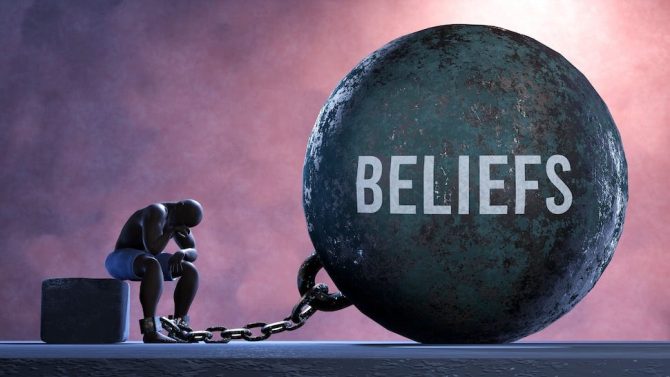
By Dr. Roger McFillin | Radically Genuine | May 31, 2026
In 2018, a team of researchers at Stanford ran an experiment that should have made bigger headlines than it did. They recruited a few hundred people under the cover story that they were studying the relationship between DNA and diet. They swabbed everyone’s cheeks, ran real genetic tests, and then sat each person down to deliver their results.
Here is the trick: the results were fake. Or rather, they were assigned at random, with no relationship to what the swabs actually showed. Some people were told they carried a high-risk version of a gene linked to poor exercise capacity, or to feeling hungry after meals. Others were told they carried the protective version. Then the researchers measured what happened to their bodies.
The people told they had the “bad” exercise gene performed measurably worse on a treadmill. Their lung function changed. They felt more exhausted, sooner, and they ran out of steam earlier, even when their real DNA said nothing of the sort. In the eating experiment, people told they had the “protective” satiety gene produced more of the hormone that signals fullness and reported feeling more satisfied after the same meal as everyone else.
The kicker, reported by the Stanford team, was this: the effect of what people believed about their genes was, in some measures, larger than the effect of the genes themselves.
Sit with that for a moment. A story about your DNA changed your DNA’s behavior more than your DNA did.
What if the steady drip of fear we live inside, the warnings about disease, the urgency of prevention, the dread of the next pandemic, is not only describing our health but quietly shaping it?
What if the constant push toward more checkups, more screening, more tests for things we would never otherwise have noticed slowly trains us to inhabit the identity of the perpetually sick?
And what if a belief, held tightly enough by enough people, does not stay politely inside the mind but reaches down into the body, the way it reached into the lungs of those runners on the treadmill, so that a culture convinced it is fragile and broken and doomed begins, quietly, to become exactly that?
These are questions, not verdicts. But they all circle the same suspect: an idea so familiar we have stopped noticing it is an idea at all. Genetic determinism, the belief that our genes are a sealed verdict, that disease is written into us at conception, that biology is destiny.
It is not a comforting story but a disempowering one, a marketable one, and above all a frightening one, because a person who believes in genetic determinism has surrendered their power before they ever thought to use it. But where our attention goes, our energy flows. And if that is true, then we are not the prisoners of this story at all. We are only beginning to understand the power we carry as conscious, creative beings. The story about genes, in most of the cases that matter most to us, is simply wrong.
The story we were sold
For the better part of three decades, we have been taught to think of the genome as a blueprint. When the Human Genome Project was completed in the early 2000s, the language around it was almost biblical: the “book of life,” the “code of codes,” the “instruction manual” for a human being. Newspapers ran a steady drumbeat of discovery: a gene “for” intelligence, a gene “for” depression, a gene “for” breast cancer, a gene “for” being unfaithful.
The blueprint metaphor is seductive because it is clean. A blueprint fully specifies a building. Hand it to any competent crew and you get the same house every time. If your genome is a blueprint, then your health, your temperament, your fate: these are simply the structure that gets built. Nothing to be done but watch it go up.
But here is the strange thing about a metaphor this powerful: we adopted it before the science was in. And as the science has come in over the last twenty years, it has steadily dismantled the very picture that sold it to us.
The conditions that fill our clinics and our anxieties (ADHD, heart disease, depression, type 2 diabetes, the common cancers) are not determined by one decisive gene but by hundreds or thousands of genetic variants, each nudging risk by a vanishingly small amount. There is no “gene for ADHD” or those other conditions mentioned. Instead, what exists is a faint pull spread across the whole genome, one that environment, behavior, and chance can tip in any direction.
This matters because of a word that gets badly misused: heritability. When you read that a condition is “80% heritable,” it is natural to hear “80% inevitable,” or “80% genetic in you, personally.” Neither is what the number means.
Heritability is a population statistic. It describes how much of the variation between people in a given environment can be statistically attributed to genetic differences. It says nothing about how fixed a trait is, and nothing about any individual.
The cleanest illustration is height, which is roughly 80% heritable. Yet average height in many countries rose by several inches over the twentieth century, far too fast for the gene pool to have changed. What changed was nutrition. A highly heritable trait moved dramatically because the environment moved. Heritable and changeable are not opposites. They were never opposites.
Then there is the discovery that should have ended the blueprint era on its own. When researchers ran large genome-wide studies hunting for the genes behind these heritable psychiatric and physical conditions, the genes mostly weren’t there, or rather, they were there in such tiny, scattered fragments of effect that they couldn’t add up to the heritability the twin studies had promised.
Geneticists named the gap politely: the “missing heritability problem.” The promised master genes for our most common diseases were searched for at enormous expense, and they did not show up. What showed up instead was complexity, contingency, and a genome that behaves far less like a verdict than we were told.
So why does the picture survive?
An idea this disempowering does not endure for decades on the strength of its evidence. It endures because it pays. Whole industries rest on the premise that you are broken in ways only they can manage. The determinism story feeds a steady pipeline of genetic tests, lifelong prescriptions, screening programs, and specialist referrals, each one justified by the conviction that your biology is a defect to be monitored rather than a system you can shape.
It underwrites diagnostic categories that expand a little wider every year and interventions that grow a little more expensive. You do not need to imagine a smoke-filled room or a coordinated conspiracy. You only need to notice the incentive: a story that keeps people anxious, dependent, and coming back is a story with deep-pocketed sponsors, and a person who feels capable and well is, on a great many balance sheets, a customer lost.
Planting a Seed
If the blueprint metaphor is broken, what replaces it?
Think of a seed instead. A seed is not the plant. It is a bundle of possibilities that only becomes something in contact with soil, water, light, and weather. Plant the seed in rich ground and it flourishes; plant it in drought and it withers; plant it in shade and it grows crooked toward whatever light it can reach. The seed sets the range of what is possible. The soil and the season decide what actually grows.
This is what the field of epigenetics has revealed about our DNA. Genes are not simply “on.” They are switched on and off, turned up and turned down, by chemical marks (methylation, histone modification) that respond continuously to what we eat, how we sleep, what we breathe, how stressed we are, and even how connected we feel to other people. The DNA is the seed. Everything around it, and everything we do to it, is the soil.
The evidence here is vivid. There is a famous strain of mouse, the agouti mouse, in which a mother’s diet during pregnancy determines whether her genetically identical pups are born yellow, fat, and disease-prone or brown, lean, and healthy. Same seed. The nutrition is the soil, and the soil decides which animal the seed becomes.
In humans, researchers studying people conceived during the Dutch “Hunger Winter” famine of 1944–45 found epigenetic and metabolic marks of that prenatal starvation still measurable decades later, alongside elevated rates of certain diseases. The famine ended in months. Its signature lasted a lifetime, written not into the genes but onto them.
The lesson is not that environment overrides genetics. It is subtler and more interesting: the genome is built to be responsive. Responsiveness is the point. We did not evolve sealed verdicts. We evolved seeds that read the ground they land in.
So how far does this reach?
If a fake gene can change a body, what can a strongly held belief do? We are used to treating the mind as a spectator to our health, watching from the stands while the real game plays out below in cells and chemistry. What if where we place our attention, and what we expect to be true, can move the body in ways we can actually measure?
You see this most clearly in two phenomena. With the placebo effect, the mere expectation of help is enough to move the body: pain eases, mood lifts, stress drains away, blood pressure settles. Belief shifts the body out of the clenched, defended state we might fairly call dis-ease, and into one of greater ease, the calm physiology in which the body’s own capacity to repair itself can do its work.
Its dark twin, the nocebo effect, is the body worsening in response to the expectation of harm. Patients warned of a drug’s side effects get those side effects more often, even on sugar pills. Expectation is not a passive lens through which we view our health. It is an active input into it.
And consider the most powerful nocebo of all: the prognosis. Two doctors can hold the exact same statistic and hand a patient two entirely different futures. One says, “Ninety percent of people with this disease are dead within five years.” The other says, “One in ten people with this disease recover, and we are going to do everything those people did.” The facts are identical. The arithmetic is identical. But which sentence would you want spoken over your body? Which one leaves a door open, and which one quietly walks you toward its conclusion?
The question cuts deeper when the prophecy is inherited. If your mother died of breast cancer, or your father of heart disease, the medical system can begin to treat you as a smaller, earlier version of them: a case history waiting to repeat itself, marked from your first appointment as the one who is next. At what point does being watched as a fate begin to summon it? At what point does a family history, handed to you as a verdict instead of a probability, become a script you never agreed to perform?
Now return to the Stanford experiment with this in mind. When people were told they carried a high-risk gene, their bodies began, in part, to enact the prophecy. That is the nocebo effect aimed squarely at our deepest story about ourselves: the story of our own DNA. And it points to the most unsettling possibility in this whole essay: that genetic determinism is not only a flawed scientific theory. It may be a self-fulfilling one. Tell a person they are doomed by their biology, and you have just added a risk factor.
Self Fulfilling Prophecies
Here is the part I find genuinely unsettling, and it is the heart of this argument.
A prophecy does not need to be true to come true. It only needs to be believed with enough authority that the believer begins, without noticing, to arrange the world around it. And our culture has no prophecy more authoritative than the one stamped with the word genetic. Tell people their depression, their weight, their heart, their cancer was written into them before birth, and you have not merely described their future. You have begun to build it.
Watch how the loop closes. A person told they are genetically doomed turns their attention toward the threat, and attention is not passive. It is the most powerful filter the brain owns, the thing that decides what is real enough to act on.
Fixed on the fear, the body settles into the physiology of fear: chronic stress, vigilance, inflammation, the very biochemical soil in which disease grows best. The behaviors that would protect them start to feel pointless, so they quietly fall away. Every twinge becomes evidence. Every symptom is a confirmation. In time the prophecy delivers what it promised, and everyone nods knowingly: the genes, of course. This is the dark engine beneath the Stanford treadmill. Those runners did not fake their exhaustion. A belief reached into their lungs and made it true.
Now hold that loop in your mind and run it backwards, because the same machinery turns both ways. This is what people are reaching for, often clumsily, when they talk about being conscious creators.
Strip away the mysticism and a hard, almost mechanical truth is left standing: where attention goes, energy flows, and where energy flows, biology tends to follow. Not because thoughts are magic, but because attention decides what you notice, what you fear, what you feed, and what you repeatedly do. And what you repeatedly do, across months and years, is precisely what lays down the epigenetic marks and builds the body you have to live in.
So if the genome is a seed, you are not the seed. You are the one tending the ground. You did not choose what you were handed, and no amount of will turns a drought into rain. But the soil is made of things you touch every single day: what you eat, how you sleep, who you let close, what you rehearse in your mind, the story you accept about who you are and what you are doomed to become.
A gardener cannot command a seed. A gardener can absolutely decide what grows. To be a conscious creator is nothing more mystical than that, and nothing less powerful: to stop being the passive ground your inheritance falls into, and to start, deliberately, attending to what you want to take root.
You are not only the seed. You are the soil, the season, and the hand that tends the ground.
So tend it.
And be careful what you let take root. Attention is the gardener’s most powerful tool, and almost everything competing for yours has an interest in keeping you afraid. The headline built to alarm you. The endless forecasting of the next catastrophe. The tired paradigm that profits whenever you believe you are broken, powerless, and next in line. None of it is neutral, and fear is among the fastest-growing things you can plant. Give it your attention and it will spread until it crowds out everything else.
You do not have to fight every frightening thought. You only have to stop watering it. Turn your attention, again and again, toward what you actually want to grow: the proof that you are capable, the people who steady you, the ordinary daily acts that tell your body it is safe. This is not denial and it is not wishful thinking. It is the most practical thing you can do, because where your attention goes your energy flows, and your biology, patiently, follows.
You were handed a seed. What grows from it is still, in most of the ways that matter, yours to decide.
AWAKEN.
Sorry, the comment form is closed at this time.
Featured Video
We Don’t Have to Live This Way
or go to
Aletho News Archives – Video-Images
From the Archives
9/11 Was an Israeli Job
How America was neoconned into World War IV
By Laurent Guyénot • Unz Review • September 10, 2018
… 9/11 was made possible by an alliance between secret worshippers of Israel and corrupted American elements. The question is: who, of the two, were the masterminds of this incredibly daring and complex operation, and for what “higher purpose”? … Read full article
Blog Roll
 Aletho News
- Araghchi: US acknowledgment of Bahrain damage exposes cost of Israel’s wars
- YAF secure Bab al-Mandab, advance toward Dhubab
- Ansar Allah’s Victory Is A U.S. Defeat
- Insider trading proves 9/11 foreknowledge
- Most Kids Can Fight Measles Naturally — and Having the Virus May Even Make Them Stronger
- We Don’t Have to Live This Way
- The Saudi cutout and the CIA shadow over 9/11
- US tanker strikes fail to deter Iran, drain interceptors: Bloomberg
- Yemeni Official Underlines Safety of Navigation after Expelling of Pro-Saudi Mercenaries from Coastal Areas
- Yemeni forces recapture strategic port city of Mokha from Saudi-backed troops
- If Americans Knew
- Is the Israel Lobby Doomed?
- Israel kills 9, including family of 4, in Gaza – Daily Update
- Secret systems used by Israel in mass killings of Gaza civilians revealed in new film
- Israel Bombs South Lebanon as Report Documents 23 White Phosphorus Attacks
- Nakba and Gaza: Zionism’s Century-Long History of Genocide
- ISRAELI MEDIA: ‘Baby, an Update: He’s Just Died’: Israeli Prison Guards’ Texts Expose a Routine of Abuse
- Three Major Revelations About The Gaza Holocaust In The Israeli Press
- Israel starved Gaza. Now doctors fear it has permanently damaged a generation.
- Swarming the battlefield: Elbit-FUSE reveals mass drone and robot armies as IDF plans new AI branch
- Out of Israel, stories of terror, thirst, takeover, torture, racism – Daily Update
- No Tricks Zone
- New Study: The Antarctic Ice Sheet Gained Mass From 2020-2024 Due To Staggering Snow And Ice Accumulation
- Study: Ocean Heating Rates From Thousands Of Years Ago ‘Dwarf’ Modern Ocean Heating Rates
- Climate Extremists Target, Attack Large-Scale Power Grid Infrastructure In Germany!
- New Study: Antarctic Ice Melt Has Contributed Less Than 1 Centimeter To Sea Level Rise In The Last 30 Years
- Fear Of Debate: Alarmist German Climate Scientist Calls On Mainstream Media To Discredit Skeptic Voices
- End-Of-August Arctic Sea Ice Extent Hasn’t Fallen In 20 Years, Official Data Show!
- News-Making Nepal Region Has Had As-Warm Or Warmer Periods Than The 2000s In The 1600s, 1700s, 1800s
- 2025 Study: ‘There Exists No Unequivocal Experimental Evidence For The CO2 Greenhouse Effect’
- 2026 Atlantic Cyclone Energy Index Running At 85% Below Normal!
- New Research Shows Soil Respiration And Temperature Drive CO2 Change, Not Humans
 Aletho News