How Iran’s two-week retaliatory strikes exposed cracks in US military architecture in Persian Gulf
By Mohammad Molaei | Press TV | October 18, 2026
The two-week exchange of fire between the United States and Iran, triggered by Washington’s attempt to force open an illegal southern corridor through the Strait of Hormuz, represented the most consequential direct military confrontation between them since the 40-day war.
The Iranian response to the unprovoked and illegal American aggression was not a chaotic escalation but a methodical, layered military campaign that drew on years of doctrinal development, weapons investment, and operational planning.
The efforts of the Islamic Republic’s armed forces, spearheaded by the Islamic Revolution Guards Corps (IRGC) aerospace and naval branches, executed a decisive and swift response.
What unfolded was a layered operation with nine distinct but interlocking lines of effort. Each line reinforced the others. Infrastructure degradation reduced American operational tempo; area denial forced repositioning that compounded the effects of that degradation; extended-range precision strikes demonstrated that repositioning offered no sanctuary; ISR attrition blinded American targeting systems; terrorist suppression closed the land flank, while strikes on utility infrastructure imposed costs on host nations and denied services to American bases.
One can employ the open-source reporting, satellite imagery, and the observable pattern of strikes to examine each dimension of Iran’s military response in detail, and construct a coherent operational picture. It is getting exceedingly clear that the ceasefire period has very likely translated to a window for reconstitution and preparation in Iranian strategic calculus.
The primacy of solid-fuel tactical ballistic missiles
Iran’s decision to anchor its retaliatory campaign in solid-fuel tactical ballistic missiles was not accidental. It reflected a decade-long investment in a specific capability designed precisely for this kind of confrontation. Solid-fuel ballistic missiles offer decisive operational advantages over their liquid-fuel predecessors. They require no fueling time at the launch site, dramatically compressing the window between a launch order and missile departure.
This matters enormously in a sensitive environment where adversary assets, particularly MQ-9 Reaper drones and maritime patrol aircraft, are actively hunting for launch preparations.
A liquid-fuel missile requires a visible, time-consuming fueling sequence that creates a detectable signature. A solid-fuel missile can be transported, erected, and fired in a fraction of that time, often before a targeting solution can be developed and a strike authorized.
These missiles are road-mobile, launched from transporter-erector-launchers (TELs) that can disperse across Iran’s mountainous terrain, making pre-emptive targeting extremely difficult.
Having destroyed much of the air defense systems belonging to the US and its Arab allies using the older, less sophisticated liquid fuel missiles in previous wars, Iran’s strikes this time primarily relied on its tactical solid-fuel ballistic missile inventory, meaning the various variants of the Fateh family.
Simply put, the choice of solid-fuel systems reflected a calculated assessment of the adversary’s weakened interception capacity, an assessment that proved accurate.
The air defense inventory crisis
Perhaps the single most consequential factor shaping the operational environment was the state of US and allied air defense missile inventories.
The United States entered this round of military aggression with critically depleted stocks of its most capable interceptors. The Standard Missile-3 (SM-3) and Standard Missile-6 (SM-6), which arm Aegis-equipped destroyers and cruisers and provide the American Navy’s primary ballistic missile defense capability at sea, have been drawn down through a combination of expenditure in the Red Sea campaign against Yemen, the costly defense of Israel during two previous wars, and the simple reality that production rates have never kept pace with consumption.
The Terminal High Altitude Area Defense (THAAD) system, which provides upper-tier defense against medium and intermediate-range ballistic missiles, is similarly constrained.
The decision not to employ Aegis and THAAD at full capacity was therefore a forced one. The United States simply could not spend its remaining meager inventory of SM-3 and THAAD interceptors against Iranian tactical ballistic missiles, which, while accurate and damaging, are not the only threats to American interests.
Doing so would have left the United States strategically exposed against another serious contingency in East Asia or Europe. The calculus was that American military bases had to absorb more hits to preserve the interceptors.
Moreover, the Patriot system, which bore the brunt of terminal-phase defense in recent weeks across the region, was in no better condition. Years of expenditure across Ukraine, the occupied territories, the Persian Gulf, and the Red Sea mission have drawn PAC-3 and PAC-3 MSE stocks to extremely low levels.
The Pentagon’s response was telling. Rather than accelerating full-capability PAC-3 MSE production, it has chosen to pursue the cheaper, less capable PAC-3ACE Cost Reduction Initiative variant. More revealing still were the recent PAC-2 GEM-T orders, an older interceptor not procured by the US in decades, signaling just how severely stocks had been exhausted.
That the world’s most sophisticated air defense enterprise was compelled to resurrect a 1990s-era design to sustain basic readiness is the starkest indicator of the American munitions crisis that Iranian planners appear to have understood, measured, and exploited with precision.
The situation among Persian Gulf states was equally dire. Saudi Arabia and the UAE had expended substantial portions of their Patriot PAC-3 interceptor stocks during years of Yemeni military missile and drone attacks, and entered the 40-day imposed war with depleted inventories. The situation is even direr in Kuwait and Bahrain, with the Persian Gulf microstates effectively running out of Patriots, being forced to solely rely on American-operated systems.
PAC-3, the most capable variant of the Patriot system against ballistic missiles, has effectively been exhausted in several batteries. PAC-2, the older and less capable variant, is the only available option in certain areas against Iranian missiles, and even that missile is running low as well. The collective air defense architecture of the Persian Gulf states, which had appeared formidable on paper, has been effectively hollowed out.
Iranian operational planners were aware of these facts. The sequencing and volume of Iranian missile salvos during the exchange reflected a deliberate attempt to exploit the gap between what the defense could theoretically intercept and what it could actually intercept given real-world inventory constraints.
Iran’s multi-layered operational strategy
What distinguished Iran’s response from a simple missile barrage was its architectural coherence. Iranian planners did not merely fire missiles at American targets; they executed a phased, multi-domain retaliatory campaign with distinct operational objectives at each stage, each phase creating the conditions for the next.
The campaign can be understood as having five interlocking lines of effort: infrastructure degradation, area denial and operational displacement, precision strike at extended range, ISR and logistics attrition, and proxy terrorist force suppression.
Together, they constituted a campaign design far more sophisticated than most Western analysts had publicly credited Iran with possessing.
The overarching logic was one of progressive operational constriction. Rather than attempting to destroy US forces – an objective beyond Iran’s reach given American conventional superiority – the campaign aimed to degrade, displace, and exhaust them.
Each successful strike reduced American operational capacity; forced repositioning that consumed time and resources, and demonstrated to regional partners that proximity to American occupation forces carried real costs.
Infrastructure degradation
The first phase of the Iranian retaliatory campaign targeted the physical infrastructure of American military power in the Persian Gulf region. This was not indiscriminate bombardment. Satellite imagery and post-strike assessments revealed a pattern of targeting that prioritized specific high-value nodes: radar installations, fuel and ammunition storage facilities, maintenance hangars, and communications infrastructure.
Radar systems were a particular priority. The ability to detect, track, and target Iranian missiles and UAVs depends on a layered network of radar systems. By striking radar installations at air bases, Iran degraded the situational awareness that underpins both offensive operations and defensive intercepts. A radar that is destroyed or forced offline creates a coverage gap that cascades through the entire air defense architecture.
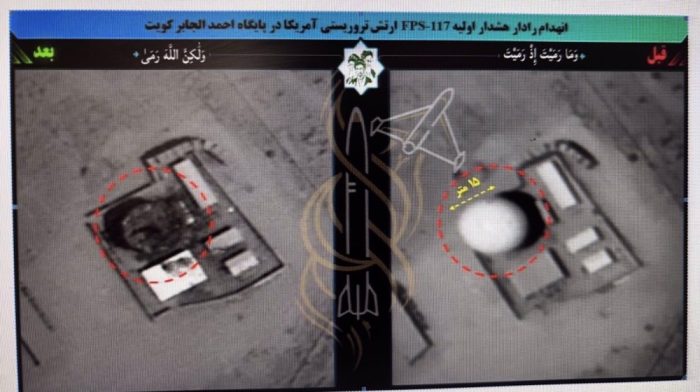
Before-and-after imagery of an AN/FPS-117 early warning radar installation at Ahmad al-Jaber Air Base, Kuwait, showing structural damage
Logistics infrastructure was targeted with equal deliberateness. Fuel depots, ammunition storage sites, and maintenance facilities at American bases around the Persian Gulf were struck with sufficient accuracy to cause meaningful operational disruption.
An air force that cannot fuel its aircraft, rearm them, or repair battle damage cannot sustain sortie rates. The targeting of logistics was a direct attack on the tempo of American air operations to derail the American aggression against Iranian sites and reduce the pressure on Iranian forces.
The accuracy of these strikes, achieved at ranges of several hundred kilometers, validated the operational utility of Iran’s solid-fuel ballistic missile force and demonstrated that the IRGC aerospace force had developed the targeting data, launch procedures, and quality control necessary to achieve consistent results against fixed infrastructure.
The anti-access/area denial campaign
The most strategically significant dimension of the Iranian retaliatory campaign was its systematic execution of an Anti-Access/Area Denial (A2/AD) strategy that progressively pushed American air operations out of the Persian Gulf and into increasingly distant and operationally constrained locations.
The logic of A2/AD in this context was straightforward. The closer American aircraft operate to Iran, the shorter their flight times, the larger their payloads, the less refueling they require, and the more sorties they can generate per day.
Conversely, every additional hundred kilometers of distance imposes compounding costs: greater tanker support, longer mission times, reduced payload, increased crew fatigue, and more complex coordination. By rendering the Persian Gulf operationally untenable for American air assets, Iran systematically degraded the offensive capacity of the aggressors.
The first displacement was from the Persian Gulf itself. Sustained missile and drone attacks against air bases made sustained operations from those locations unfeasible. The American response was to shift primary air operations to bases in Jordan – Al-Azraq and Muwaffaq Salti –which offered greater distance from Iranian missile systems.
Iran’s response was to extend its reach to Jordan. Multiple strikes against American bases, documented by US casualties and satellite imagery showing damaged hangars and destroyed aircraft, demonstrated that Iran had the capability to contest operations from that distance.
The retaliatory strikes destroyed American aircraft, damaged infrastructure, and forced the US war machine to reconsider the viability of Jordan as a primary operating location.
The second displacement was to the occupied territories. American air assets, including tanker aircraft critical to sustaining long-range strike operations, were pushed further west to Israeli military bases.
This displacement carried its own operational costs. The distance from Iranian targets increased further, and the concentration of American assets in the occupied territories created its own targeting opportunities for Iran, which has demonstrated both the willingness and capability to strike at extended ranges.
A particularly telling indicator of this displacement dynamic was the repositioning of the RQ-4 Global Hawk strategic reconnaissance aircraft, which had been operating from Al Dhafra in the UAE and from Jordanian facilities, to Sigonella Naval Air Station in Sicily.
The Global Hawk, with its long endurance and high-altitude sensors, is a critical ISR asset for tracking Iranian missile launches and providing targeting data. Its displacement to Sicily represented a dramatic reduction in persistent surveillance coverage over Iran and the Persian Gulf, with direct consequences for the effectiveness of American strike operations.
A qualitative leap in extended-range precision
One of the most significant revelations of the recent round of US aggression and Iran’s retaliation was the demonstrated accuracy of Iranian ballistic missiles at ranges exceeding 1,000 kilometers. Previous assessments of Iranian ballistic missile accuracy had generally been skeptical about the ability to achieve consistent precision at such distances. The strikes on Jordanian targets, located well over 1,000 kilometers from Iranian launch sites, completely shattered that skepticism.
The circular error probable (CEP) – the radius within which 50 percent of strikes fall – observed in the Jordanian strikes was dramatically smaller than what Iranian missiles had previously demonstrated at comparable ranges. Strikes that hit specific buildings, specific aircraft shelters, and specific sections of structures, rather than simply landing somewhere on a base, indicated a qualitative improvement in guidance accuracy that demands explanation.
Several hypotheses present themselves, and the evidence suggests that the answer likely involves a combination of all of them. First are technical improvements. Iran may have upgraded the terminal guidance systems on its Kheibarshekan, Haj Qasem, and Fattah variants, potentially incorporating improved inertial navigation, satnav receivers, or optical terminal seekers that allow the missile to better correct its trajectory in the final phase of flight.
Second are tactical improvements. Iranian launch crews may have refined their pre-launch survey procedures, improving the accuracy of the initial position fix that the missile’s inertial navigation system uses as its reference point. Third are software improvements, which mean updates to the missile’s flight control algorithms could improve trajectory optimization and reduce the accumulated errors that degrade accuracy over long distances.
The most likely explanation is a combination of all three – a systematic program of improvement across the technical, procedural, and software dimensions of missile accuracy that had been underway for years and was now being demonstrated operationally for the first time at this range, following the experiences of the 40-day war.
The MQ-9 hunt
The MQ-9 Reaper drone occupied a central and uniquely vulnerable position in American military offensives against Iran. The Reaper is not merely a strike platform but the primary persistent ISR asset used to locate and track mobile Iranian missile launchers, particularly after the heavy attrition of similar Israeli military systems.
Without the MQ-9’s ability to loiter for extended periods, the capacity to find and destroy TELs before they fire, or to conduct battle damage assessment after strikes, is dramatically reduced.
Iran understood this dependency and targeted it systematically during this campaign. The campaign against MQ-9 assets operated on multiple levels. Ground-based air defense systems, which had previously demonstrated the ability to engage high-altitude targets, were used to engage Reapers operating over Iranian territory and adjacent areas.
But Iran also struck the ground infrastructure that supports MQ-9 operations: the maintenance facilities, fuel systems, satellite communication ground stations, and launch-and-recovery equipment that allow the aircraft to operate.
Western media reporting confirmed the destruction of a number of MQ-9 aircraft on the ground at Jordanian bases and, in a particularly striking detail, the destruction of some aircraft while still in their transport canisters before assembly.
This achievement indicates that Iran has developed targeting intelligence on the logistics chain supporting drone operations, not merely the operational bases themselves. Destroying aircraft before they are assembled and made operational is a force multiplication achievement. It eliminates capability before it can be employed, at a point when the aircraft is most vulnerable and least defended.
The cumulative effect of the MQ-9 campaign was a significant degradation of American persistent ISR coverage over Iran. This directly reduced the effectiveness of the hunt for mobile missile launchers, allowing Iranian TELs greater freedom of movement and survivability.
Suppressing proxy terrorist forces in Iraq
From the first day of the exchange, Iran conducted daily retaliatory strikes against armed terrorist groups in Iraq that had the capability and potential motivation to conduct land attacks against Iranian territory or to serve as a forward platform for American-directed operations.
This campaign was methodical and comprehensive, targeting personnel concentrations, weapons storage facilities, and command infrastructure.
Iran’s western flank, which includes the border with Iraq, represents a potential vulnerability. Armed terrorist groups in Iraq, some with historical ties to American intelligence, could in theory conduct cross-border raids, provide intelligence for American strikes, or serve as a distraction that forced Iran to divert defensive resources.
By striking these groups preemptively and continuously, Iran sought to exhaust their operational capacity before it could be brought to bear.
The daily rhythm of these retaliatory strikes was itself a message. It demonstrated that Iran had persistent targeting intelligence on these groups’ locations, that it was willing to expend munitions on this secondary campaign even while conducting the primary campaign against American forces, and that it intended to maintain pressure regardless of any ceasefire negotiations that might be underway.
The logic of reciprocity
Iran’s retaliatory strikes on electrical and water infrastructure in Kuwait represented a deliberate response that operated on two distinct logics simultaneously.
The first was reciprocity: Iran’s own civilian infrastructure had been targeted, and the strikes on Kuwaiti infrastructure were a direct signal that such targeting would not be absorbed without response to the aggressor and its facilitators.
The second was military utility. American forces in the Persian Gulf region depend on host nations’ electrical grids and water supplies for base operations. Infrastructure that serves both civilian and military purposes is, under the laws of armed conflict, a legitimate military target when the military use is substantial and the strike is proportionate.
The targeting of Kuwait’s infrastructure was also a message to Persian Gulf states more broadly. Kuwait, like Bahrain, the UAE, Saudi Arabia, and Qatar, hosts American military facilities and had provided varying degrees of support to American operations.
By demonstrating the ability and willingness to strike Kuwaiti infrastructure, Iran was communicating that the costs of hosting American forces were not abstract. They were concrete, immediate, and would be borne by the host nation as well as the American military.
The pillars of operational success
Iran’s two-week retaliatory campaign against American aggression and attempts to force open an illegal southern corridor through the Strait of Hormuz largely succeeded on every dimension that its operational planners had identified.
The exchange demonstrated that Iran had developed, over decades of institutional study and investment, a military capability genuinely capable of contesting American power projection in the Persian Gulf region, even after two high-intensity wars.
It demonstrated something relevant to the strategic environment of the region – that the costs of American military aggression in the Persian Gulf had increased substantially; that the infrastructure of American power projection was more vulnerable than pre-war assessments had suggested; and that Iran possessed both the capability and the operational sophistication to exploit those vulnerabilities in a systematic and disciplined manner.
Seyed M. Marandi: US-Iran War Inevitable: Kuwait and Bahrain May Fall
Glenn Diesen – October 11, 2026
Prof. Seyed Mohammad Marandi is a professor at Tehran University and a former advisor to Iran’s nuclear negotiation team.
Follow Prof. Glenn Diesen:
Substack: https://glenndiesen.substack.com/
X/Twitter: https://x.com/Glenn_Diesen
Support the research by Prof. Glenn Diesen:
PayPal: https://www.paypal.com/paypalme/glenn…
Buy me a Coffee: buymeacoffee.com/gdieseng
Go Fund Me: https://gofund.me/09ea012f
Hezbollah denies Syria cell link, warns of Israeli plan to sow discord
Al Mayadeen | September 30, 2026
Hezbollah’s Media Relations Office categorically denied any relationship or affiliation between the party and the alleged cell that the Syrian Interior Ministry said it had apprehended in the Yarmouk Basin in Daraa.
In a statement, the Lebanese Resistance reiterated that it has no presence on Syrian territory and is not involved in any security or military activity there, stressing its longstanding commitment to Syria’s security and stability and the safety of its people.
Hezbollah points to Israeli regional scheme
The party called on the Syrian authorities to “remain vigilant against attempts to implicate its name in order to stoke tensions and sow discord between Lebanon and Syria.”
It urged the Syrian authorities to investigate the circumstances surrounding the allegations, identify those behind them and determine who stands to benefit from escalating tensions between the two countries.
Hezbollah pointed to “Israel”, accusing it of intensifying its attacks on Syria and Lebanon and seeking to undermine the security and stability of the region.
A recurring pattern
The denial follows months of similar accusations against Hezbollah from Syrian officials since the fall of the al-Assad government.
Earlier this month, Hezbollah’s Media Relations Office has categorically denied any connection to a security cell reportedly arrested on suspicion of seeking to destabilize Lebanon and Syria, dismissing the accusations as entirely baseless.
In July, Hezbollah rejected claims tying it to an attempt to smuggle weapons and missiles across the Syrian-Iraqi border, after Syrian authorities said they had intercepted a shipment concealed inside a fuel tanker arriving from Iraq. Also in April and May, the group denied allegations linking it to a cell accused of plotting to assassinate a religious figure.
Hezbollah has affirmed on each occasion that it maintains no activity, connection, or presence inside Syrian territory. The group has said the repetition of such claims raises serious questions and points to parties seeking to inflame tension between the Syrian and Lebanese peoples.
The Lebanese Resistance has also pointed to similar fabricated allegations emerging from Bahrain and Kuwait, warning of a foreign plot aimed at stoking tensions between Arab nations and the Axis of Resistance and destabilizing the wider region.
Iran’s Plan to Shut Down AI in the Persian Gulf
GCC internet will go dark if Trump renews hostilities
By Kurt Nimmo | Another Day in the Empire | September 18, 2026
The Gulf Cooperation Council (GCC) countries—Saudi Arabia, UAE, Qatar, Bahrain, and Kuwait—are heavily invested in AI as part of a strategy to diversify away from petroleum. National AI strategies across GCC countries emphasize investment in research and development, encourage public-private partnerships, and create regulatory frameworks that support innovation. The GCC AI market size increased from USD $6.22 billion in 2025 to USD $7.60 billion in 2026. It is projected to reach USD $23.03 billion by 2034.
In April, Iran’s Tasnim news agency mentioned the submarine cables, landing stations, and data hubs in the Gulf as strategic pressure points in the conflict initiated by the United States and Israel. According to the market research company IMARC Group, subsea internet data cables in the Gulf sit at the intersection of Europe, Asia, and Africa, and damage to these networks risks connectivity losses in one of the world’s most important internet traffic zones.
The economic importance of these cable systems extends far outside internet browsing or streaming services, notes Techstory, “because financial markets, payment systems and cloud computing firms depend on uninterrupted connections between continents every second of the day. Data centers in the Gulf and Asia also depend on those same cables to connect cloud systems serving businesses around the world.” Analysts estimate that networks linked to the GCC support roughly $10 trillion worth of financial transactions daily.
Iran claims the cables are within its territorial waters and fall under its jurisdiction. Tasnim and Fars suggest Iran may charge tech companies to use the internet cables, while Ebrahim Zolfaghari, a Brigadier General and the spokesperson for Iran’s Khatam al-Anbiya Central Headquarters, said that “companies like Google, Microsoft, Meta, and Amazon” will be required to “comply with Iranian law” and pay licensing fees for cable passage, with repair and maintenance rights given exclusively to Iranian firms.
The Islamic Republic cited the 1982 United Nations Convention on the Law of the Sea (UNCLOS), which includes provisions governing submarine cables. Article 79 of UNCLOS says coastal states have the right to establish conditions for cables or pipelines entering their territory or territorial sea.
On September 2, Iran’s Kayhan newspaper urged Iran’s IGRC to disrupt or sever international fiber-optic cables to pressure the United States and its allies. “Is it not our indisputable right, in order to bring these sources of evil to their knees and cut off their lifeline, to prevent internet cables from passing through the depths of the Persian Gulf and the Strait of Hormuz?” asked Kayhan editor-in-chief Hossein Shariatmadari. “This necessary measure could be carried out by seriously disrupting the cables’ operation or even cutting them.”
Iran has the ability to take out key cable networks, including the Fibre in Gulf submarine cable system, which connects Bahrain, Iraq, Kuwait Oman, Qatar, Saudi Arabia, and UAE. The Falcon Network connects Bahrain, Egypt, India, Iraq, Kuwait, Maldives, Oman, Qatar, Saudi Arabia, Sri Lanka, Sudan, and Yemen, while the the Gulf Bridge International links Bahrain, Iran, Iraq, Kuwait, Oman, Qatar, Saudi Arabia, UAE, and has onward connectivity to India, and Europe.
The Islamic Republic may decide to retaliate for the imposition of crippling sanctions which have negatively affected its economy, causing an increase in inflation and unemployment. Iran’s minimum wage stands at approximately 104 million rials, equivalent to roughly $110 US monthly. Essential commodity prices have risen sharply, with the International Monetary Fund documenting an annual inflation rate of 42.4%, according to October 2025 figures. Most estimates suggest sanctions have cost Iran approximately $60 billion each year by limiting investments in the energy sector. The sanctions have also significantly reduced Iran’s petroleum exports.
In 2023, the Iranian navy unveiled the domestically developed and manufactured Chamrosh-4 VTOL, a remotely operated drone designed for detecting, locating, and destroying both anchored and sleeping naval mines. Furthermore, Iran operates an undersea fleet of roughly 4 to 6 diesel-electric attack submarines well-suited to operate in the shallow waters of the Strait of Hormuz. In short, Iran has the ability to sabotage subsea internet data cables.
On September 17, President Trump, frustrated by the current stalemate in his war, said he faces a major decision over whether to escalate military action against Iran. “I have a big decision to make,” Trump said. “Do I want to go in and eliminate them or not? That’s a big decision. Anything can happen with me.”
Iran has given the United States an ultimatum for a period of three to four weeks, during which the United States must satisfy all Iranian demands. Failure to comply will result in severe escalation within the Strait of Hormuz and the execution of Iran’s planned preemptive military action targeting United States-backed Gulf infrastructure as well as American and Israeli assets, according to a senior Iranian official based in Tehran with direct knowledge of the situation.
The demands include $300 billion in reconstruction funds, a full release of Iran’s frozen assets of up to $120 billion, lifting of the US naval blockade, an end to war on all fronts (including Gaza and Lebanon), lifting of all sanctions on Iranian oil and gas, and acceptance of Iran’s permanent control of the Strait of Hormuz, including up to 7% transit fees.
President Trump is unlikely to accept these conditions, and as previously mentioned, may intensify military operations before the midterm elections. Should Trump choose to escalate, Iran has indicated it will heighten the intensity of its assaults against remaining American military and commercial infrastructure throughout the GCC region and West Asia.
On September 15, Amazon Web Services disclosed that Iranian drone strikes caused substantial damage to the corporation’s data facilities located in the United Arab Emirates and Bahrain. The preceding week, officials from the UAE declared that they were modifying their AI data center initiatives in response to the strikes, thereby underscoring a critical weakness that Iran continues to leverage with considerable facility.
Jordanian police arrest Drop Site correspondent for ‘sedition’ over online post
The Cradle | August 25, 2926
 Jordanian intelligence officers arrested Ali Younes, a Jordanian-American journalist and Drop Site News correspondent, for allegedly “undermining the national security” of the Hashemite kingdom by sharing an article on social media that called for cutting US assistance to Amman.
Younes, a former Al Jazeera journalist, was detained upon his arrival at Queen Alia International Airport on 17 August, where he was held for questioning prior to being released with orders to appear before prosecutors in Amman.
Security officials told Younes and his lawyer that the case rests on his sharing of an article published in July by the American Conservative, which called on Washington to halt the billions of dollars it sends to the kingdom.
Prosecutors have classed the post as undermining Jordan’s national security, an offense that could put him behind bars for a year.
At a court hearing, prosecutors widened the file to include sedition and hate crimes, and barred Younes from leaving the country.
The article at the center of the case, headlined “Stop Sending Billions in US Aid to Jordan,” challenged the scale of Washington’s support for the monarchy and questioned why US citizens should bankroll King Abdullah.
Jordan has received $33.8 billion in US assistance over the past 75 years, with additional sums due under existing agreements.
Drop Site News has demanded that Jordanian authorities drop the charges and lift the travel ban on their colleague, and called on Washington to assist Younes as a US citizen against the accusations.
Across the Gulf and the wider region, the US war on Iran has been used as a pretext for domestic repression, with Bahrain, Kuwait, the UAE, Saudi Arabia, and Qatar all turning cybercrime, counterterrorism, and nationality laws against their own populations.
Hundreds of citizens and residents have been detained over war-related speech, from filming strikes to expressing sympathy for Tehran, with penalties running to life imprisonment, mass revocations of nationality, and the expulsion of lawmakers from parliament.
In Kuwait, the Education Ministry stripped the country’s only Iranian private school of its license and ordered it closed on 6 August, telling parents to move their children elsewhere.
In Bahrain, activist Mohammad al‑Mousawi was arrested at a checkpoint and tortured to death in March after being accused of links to “secret Iranian cells,” with witnesses and medical evidence documenting beatings, cable whippings, and electrocution burns.
Iran Army hits US base in Kuwait as satellite images show fresh damage
Press TV – July 31, 2026
The Iranian Army says it has targeted key facilities at US-run Ahmad al-Jaber Air Base in Kuwait, as newly analyzed satellite imagery also points to fresh damage at another US-operated base in the Persian Gulf state.
The Army’s Public Relations Office said the strike marked the 27th phase of Operation Sa’eqeh and was carried out in response to recent US military attacks on Iran, including an airstrike on a residential home on Qeshm Island.
According to the statement, loitering drones targeted aircraft shelters, satellite communications systems and equipment storage facilities at Ahmad al-Jaber Air Base. It described the installation as a major hub for US air and surveillance operations and a vital center for the logistical support of American forces.
The retaliation comes as the US has been targeting southern Iranian provinces since earlier in July after violating the terms of the Islamabad Memorandum of Understanding.
Tehran has responded with repeated missile and drone attacks targeting US-operated military facilities across the region under Operation Nasr 2 and Operation Sa’eqeh (Lightning).
The Army condemned the US strike on civilian homes in Qeshm, calling it “a clear violation of humanitarian principles and another example of the enemy’s war crimes.”
It added that “crimes, sanctions and threats will only make Iran more united and cohesive in its sacred defense.”
The statement further said the “decisive, extensive and heavy” attacks carried out by the Army and the Islamic Revolution Guards Corps have made it “very costly and difficult” for the United States to intercept Iranian drones and missiles despite deploying advanced air defense systems and reinforcing them.
It also noted that Washington has imposed strict censorship to prevent information about damage, casualties and injuries from becoming public.
The operation followed a deadly US strike on a residential building on Iran’s southern Qeshm Island on Thursday. A local official said three members of a family—a mother, a father and their two-year-old son—were killed in the attack. Two other children were pulled alive from the rubble and taken to hospital after receiving emergency treatment at the scene. The father was identified as a taxi driver, and the neighborhood was a working-class residential area.
Satellite imagery shows damage to US-run base in Kuwait
Meanwhile, satellite imagery has indicated new damage at another US-operated military installation in Kuwait.
Soar Atlas, specializing in maps and satellite imagery, said its assessment of newly released satellite images suggested fresh damage at Ali Al Salem Air Base.
According to the analysis, part of a storage area used by US forces appeared blackened in the latest imagery, indicating that the facility may have sustained damage.
The developments come as The Wall Street Journal reported on Thursday that Washington is reassessing the scale of its military presence in Kuwait.
Citing US officials familiar with the deliberations, the newspaper said the Pentagon had already been considering reducing its troop presence before the war on Iran began and has since scaled back personnel in Kuwait to minimize the risk posed by Iranian attacks on US military bases.
Analysts quoted by the newspaper said US officials increasingly believe that maintaining a large permanent force in Kuwait is no longer militarily necessary.
How Kuwait and Bahrain miscalculated by becoming launchpads for US strikes on Iran
By Mohammad Molaei | Press TV | July 27, 2026
On the afternoon of February 28, as the first dark clouds of joint Israeli-American military aggression gathered over Iran, a sports hall in the small southern city of Lamerd – a place that had once echoed with the squeak of sneakers and the thrill of competition – was transformed into a scene of unspeakable carnage.
Two American Increment One Precision Strike Missiles (PrSMs), fitted with fragmentation warheads, tore through the facility while a women’s volleyball team was actively training inside. The gruesome and deliberate attack claimed many civilian lives, including dozens of children, and left scores more wounded and maimed.
In a grim parallel to the earlier attack on the Shajareh Tayyebeh Elementary School in Minab, the US war machine initially refused to acknowledge its culpability in both incidents, due to massive global outcry, particularly in Minab.
Instead, American officials went so far as to formally and cynically attribute the tragedy IN BOTH to an alleged malfunction of an Iranian Hoveyzeh cruise missile, a brazen attempt to absolve themselves of yet another unforgivable war crime.
The official American position attributed the civilian deaths in Lamerd to an Iranian Hoveyzeh cruise missile – a KH-55 derivative that bears no resemblance whatsoever to an American PrSM, differing fundamentally in shape, flight trajectory, and terminal dive profile.
This assertion proved deeply peculiar, particularly after Iranian media published CCTV footage showing impact patterns unmistakably consistent with PrSM fragmentation warheads, alongside visuals clearly depicting a ballistic projectile descending in a manner entirely characteristic of the American weapon system.
Identifying the probable staging ground for this attack and others like it proved to be a matter of straightforward deduction. The United States employs the tracked M270 Multiple Launch Rocket System (MLRS) and the wheeled M142 High Mobility Artillery Rocket System (HIMARS) to deploy two distinct families of short-range tactical ballistic missiles: the newer PrSM and the older MGM-140 Army Tactical Missile System (ATACMS), with maximum ranges of 500 and 300 kilometers, respectively.
Given these systems’ limited reach and the considerable operational threat posed by Iran-allied resistance groups throughout Iraq, it became increasingly evident that the Arab monarchies of the Persian Gulf had consented to allow American forces to utilize their territory as launch pads for aggression against Iran and its civilian population.
Liability for the strikes
In the weeks following the initial wave of US-Israeli military aggression against Iran, a substantial body of open-source evidence accumulated, enabling one to reconstruct the operational architecture behind the attacks with reasonable confidence.
Satellite imagery reviewed by independent researchers, munitions debris documented by Iranian media and corroborated by third-party analysts, and flight-path data derived from publicly accessible tracking sources collectively point to forward launch positions in Kuwait and Bahrain as the points of origin for a series of ballistic missile strikes against Iranian territory.
The ATACMS and the longer-range PrSM are neither cruise missiles nor air-launched munitions. They are ground-launched ballistic systems that demand substantial fixed or semi-fixed infrastructure, pre-positioned logistics, and complete host-nation cooperation – or at minimum, tacit acquiescence.
In practical terms, this arrangement extends far beyond granting overflight rights to American aircraft. The deployment of American artillery regiments fielding short-range ballistic missiles on Kuwaiti and Bahraini soil is not incidental but structural. Such weaponry would have served no purpose other than to strike at Iranian territory.
Diplomatically, Tehran delivered an explicit and time-bound demand to both Manama and Kuwait City: cease facilitating the war of aggression, expel the American military forces and their assets, or face the consequences.
The initial response from Bahrain and Kuwait was, in a word, silence – punctuated by formulaic statements affirming their alliance commitments while declining to confirm or deny the operational details that open-source evidence had already established.
It was not a neutral posture but represented a conscious and controversial choice to take sides in an active war, which carries inevitable consequences.
Lamerd sports hall attack
The denial and what came after
Both Kuwait and Bahrain moved quickly to deny the reports. Official statements from Kuwait City and Manama dismissed the open-source evidence as fabricated or misattributed, with Kuwaiti officials characterizing the satellite imagery and debris documentation as part of an Iranian information operation.
Bahraini authorities declined to comment on specific operational details, citing security considerations. The denials were categorical yet they did not survive the end of active hostilities.
In the weeks following the cessation of the initial combat phase, a more complete evidentiary picture emerged, placing Kuwait at the epicenter of the ballistic missile campaign against Iran.
CENTCOM released declassified strike footage confirming ground-launched ballistic operations, footage that independent analysts cross-referenced with geographic markers consistent with Kuwaiti territory.
The release, framed by US officials as a demonstration of operational effectiveness, had the unintended secondary effect of directly contradicting the categorical denials issued by Kuwait. More damaging still was the subsequent discovery of expended ATACMS canisters in the Kuwaiti desert, physical evidence that no official statement could plausibly explain away. The canisters confirmed not only the presence of the launch systems but also the scale and intensity of their operational use.
Kuwait’s role as the operational hub
With the resumption of active combat operations in recent weeks, following American attempts to establish an illegal maritime corridor in the Omani section of the Strait of Hormuz in brazen violation of the memorandum of understanding signed between the two sides, Kuwait’s role has intensified considerably.
The frequency of ballistic missile launches from Kuwaiti territory has increased markedly, a pattern fully consistent with Western reporting indicating that US PrSM stocks have been effectively depleted.
With PrSM availability now severely constrained, the operational burden of American ballistic missile attacks has shifted entirely back to the older ATACMS platform, and Kuwait has emerged as the primary launch hub for that capability.
The geographic logic is self-evident. Kuwait’s proximity to western Iran, and particularly to the southern province of Khuzestan, renders it the most efficient forward position for strikes targeting the military, economic, and energy infrastructure concentrated in that region.
Khuzestan is home to a substantial share of Iran’s oil production, refining capacity, and petrochemical industry, and has consequently emerged as a principal focal point of American military aggression. The volume of launches emanating from Kuwait reflects that strategic prioritization with unmistakable clarity.
The Incriminating Lights
The Arab monarchies of the Persian Gulf have made every possible effort to suppress citizen documentation of military activity, imposing social media restrictions and punitive measures to limit the spread of footage that might complicate official denials.
Yet those efforts have proven increasingly ineffective. As the war has persisted, a steady and growing stream of video and photographic evidence has emerged from Kuwait, captured by residents documenting ballistic missile launches occurring with near-nightly regularity.
The imagery, showing missile contrails ascending over Kuwait and tracking northeast across or alongside Iraqi airspace before continuing toward Iranian territory, circulates widely across platforms such as Telegram.
Multiple photographs and video footage taken from different vantage points confirm the flight paths, the frequency, and the unmistakable signature of ground-launched ballistic systems operating from Kuwaiti soil with undeniable clarity.
The nightly launches have become, in a grim sense, a matter of public record, documented by ordinary Kuwaiti and Iraqi residents whose smartphones have captured what governments continue to officially deny.
The chasm between the official position and the visible reality has widened to a point where it functions less as a credible denial and more as a formal fiction, maintained by all parties for reasons of diplomatic convenience.
The Iranian counter-strike record
Iran has not absorbed this campaign passively. In the weeks following the intensification of launches from Kuwaiti territory, Iranian forces have conducted retaliatory strikes targeting the American military’s forward launch infrastructure.
A growing evidentiary record of these strikes, assembled from open-source footage, presents an intriguing visual signature involving what appear to be large secondary explosions following initial impact, characterized by the bright, fast-burning combustion profile associated with solid-propellant missile fuel.
The secondary detonations visible in circulating clips are inconsistent with conventional munitions storage and consistent with the ignition of solid rocket propellant – of the type utilized in ATACMS – either from fueled launcher vehicles or from stockpiled rounds awaiting deployment.
Several clips show fires burning after initial impact, with the characteristic white-orange flame column that propellant combustion produces distinguishing these events unmistakably from the black smoke of fuel or ordnance fires.
Survival and the limits of alignment
Small states make difficult choices under duress, caught precariously between a powerful patron’s operational requirements and a large neighbor’s legitimate security concerns.
Experts acknowledge that the constraints on Bahraini and Kuwaiti sovereignty, stemming from their profound dependence on the United States, are genuine and substantial.
But, they insist that acknowledgment of constraint is not the same as absolution from responsibility. Governments bear an obligation to their populations that supersedes alliance loyalties, an obligation to assess, without illusion, the risks that their choices are generating.
The current posture of the Persian Gulf states hosting American military bases and providing a launch pad for ballistic missile operations against Iran is deeply problematic.
It reflects, as per analysts, a perilous combination of structural dependency, institutional inertia, and a dangerous underestimation of Iranian anger, resolve, and military capability.
As one military expert told the Press TV website, these micro-states are not positioned to absorb the consequences of a sustained Iranian retaliatory campaign.
“Their small land masses, concentrated infrastructure, and limited strategic depth render them acutely vulnerable in ways that their larger patron is not. By gambling their national survival on the assumption that Iranian red lines are empty, and that US protection is everlasting, they are making a remarkably poor bet, one that history has rarely rewarded,” he noted.
Kuwait Ratifies Landmark Defense Agreement with Pakistan
Sputnik – 27.07.2026
Kuwait has officially ratified a broad defense cooperation pact with Pakistan that was signed in June 2023. The ratification follows high-level military contacts between the two countries.
“This agreement reintroduces Pakistan as a direct security stakeholder in the Gulf, beyond its traditional role of providing manpower and training,” said Sultan M. Hali, writer and retired Group Captain of the Pakistan Air Force.
Key points from his commentary:
1️. New role. Pakistan ceases to be merely a supplier of troops. The pact positions Islamabad as a direct security stakeholder in the Gulf.
2️. Hedging strategy. Kuwait is reducing excessive dependence on the US and NATO by relying on a nuclear-armed Muslim-majority ally.
3️. Multipolarity. Arab monarchies are turning to China, Turkiye, and South Asia in response to a fragmented world order.
4️. Basing. Permanent bases are unlikely, but joint exercises, rotational deployments, and maritime patrols are realistic scenarios.
5️. Defense industry. Kuwait may consider the Pakistani-Chinese JF-17 Thunder — cheaper than Western analogs and less vulnerable to embargoes.
6️. Forward presence. Expands Pakistan’s capability to monitor Gulf maritime traffic, including energy chokepoints.
7️. Defense diplomacy. Strengthens Pakistan’s leverage in Gulf councils and its position vis-à-vis India.
8️. Economic dividends. Military cooperation often accompanies labor, trade, and energy agreements, boosting Pakistan’s regional integration.
“Kuwait’s move signals recognition that multipolarity in defining relations is now essential for resilience in an increasingly fragmented regional order,” Hali said.
Fars: US evacuates bases in Qatar and UAE, satellite images show
Al Mayadeen | July 25, 2026
Iranian news agency Fars reported, citing satellite imagery, that the United States has evacuated two military bases in the UAE and Qatar.
According to the agency, US forces evacuated Al Dhafra Air Base in the UAE and Al Udeid Air Base in Qatar.
Fars said satellite images from Sentinel-2, dated July 24, 2026, showed the evacuation of the US military base in the UAE. The agency said five US military aircraft had been stationed at Al Dhafra three days earlier, while the satellite images showed that they had since been evacuated.
US reportedly evacuates Al Dhafra Air Base
Al Dhafra Air Base is located south of Abu Dhabi and hosts the US Air Force’s 380th Air Expeditionary Wing. It is considered a key strategic hub for reconnaissance, aerial refueling, and air defense operations, as well as a major center supporting military operations in the region and providing intelligence coverage across West Asia.
Fars also reported that satellite images showed Washington had fully evacuated Al Udeid Air Base in Qatar.
Al Udeid Air Base is located west of Doha and is considered the largest US military base in West Asia. It hosts the forward headquarters of US Central Command (CENTCOM) and the 379th Air Expeditionary Wing.
The two bases played a key role in US military operations during the latest US aggression against Iran, which began on February 28 and resumed more than three weeks ago.
Destruction of fighter jets at Azraq base and acknowledgment of casualties
The developments coincided with the release earlier on Sunday of additional satellite images documenting the destruction of a military aircraft hangar inside Muwaffaq Salti Air Base, also known as Azraq Air Base, in Jordan, which hosts US forces.
Earlier today, the IRGC conducted a simultaneous missile and drone strike against the US base in Azraq, Jordan, targeting fighter shelters and a large parking ramp, according to the IRGC’s Public Relations Office.
In a statement, the IRGC reported that the operation was carried out in the early morning hours as part of the 20th wave of Operation Nasr 2. The strike was launched in response to the US aggression the previous night, the statement said.
“With a crushing and simultaneous missile and drone attack on the fighter shelters and a large parking ramp at the American base in Azraq, Jordan,” the IRGC said, “at least two American fighter jets and three American aircraft were completely destroyed while inflicting major damage on a number of others.”
The strikes came shortly after a series of successive attacks launched by Iranian armed forces against US bases in the region, including Muwaffaq Salti Air Base, where the US side acknowledged the deaths of two American soldiers and the loss of another.
Earlier, US network Fox News reported that at least 13 American soldiers had been injured as a result of recent Iranian attacks targeting US bases in Kuwait, Bahrain, and Jordan.
Damage in Erbil and fires at a Kuwaiti power station
As part of the simultaneous Iranian attacks, footage circulated showing a fire breaking out at a Kuwaiti power station following an Iranian strike.
Additional footage and satellite images also showed the extent of damage inflicted on the US military base in the city of Erbil, the capital of Iraq’s Kurdistan Region, after it was targeted by Iranian missile strikes.
In this context, media outlets reported that US officials acknowledged that Iran’s missile capabilities had undergone significant qualitative development, enabling them to effectively bypass US interception and defense systems deployed across the region.
The officials explained that Tehran now possesses advanced missiles capable of traveling at extremely high speeds and maneuvering during the final phase of their trajectory before striking their designated targets.
It is worth noting that Tehran maintains that it harbors no hostility toward the peoples of the region, stressing that its strikes are aimed at US bases in response to repeated US aggression on Iranian territory that has killed and wounded civilians, including women and children.
No route around Hormuz: Why West Asia’s pipeline alternatives fall short
The rush to bypass Hormuz leads back to the same problem: Every alternative route remains hostage to war, rival chokepoints, or political disputes.
By Hussein Askary | The Cradle | July 23, 2026
“The only alternative to the Strait of Hormuz is the Strait of Hormuz.”
This blunt assessment, offered by an Iraqi expert in a recent interview, captures the central weakness in the rush to revive old pipeline schemes and promote new ones across West Asia. Since Iran effectively closed the Strait of Hormuz after Israel and the US launched their second war against it in February 2026, the region has been flooded with proposals for alternative oil-export routes.
Washington has encouraged these plans, while several governments have presented dormant or unfinished pipelines as strategic solutions. Yet the closer one looks at geography, markets, costs, capacity, and security, the clearer it becomes that most of these projects cannot substitute for Hormuz.
Even if oil bypasses the strait, it still faces the rival chokepoint of Bab al-Mandab, where the Ansarallah-aligned armed forces have declared a maritime blockade against Saudi Arabia and attacked Saudi tankers.
These expensive detours will remain exposed unless security in the Persian Gulf itself improves. Until the war on Iran ends and an inclusive regional security architecture is established, Iranian and Yemeni missiles and drones can reach the pipelines and loading terminals built to evade them.
Asia still runs through Hormuz
The first reason is straightforward. The Strait of Hormuz is the natural outlet of the Gulf energy system. In 2024, oil flows through the strait averaged about 20 million barrels per day (bpd), roughly one-fifth of global petroleum liquids consumption. The International Energy Agency (IEA) describes it as one of the world’s most important oil transit chokepoints.
Most of this oil is not heading west. About 80 percent of the oil moving through Hormuz is destined for Asia, with China, India, Japan, South Korea, and other Asian economies as the principal buyers. The pattern is even clearer for liquefied natural gas (LNG).
The US Energy Information Administration estimated that 83 percent of LNG moving through Hormuz in 2024 went from Persian Gulf exporters to Asian markets, especially China, India, and South Korea.
This market reality matters because many proposed alternatives send oil away from its main customers. Pipelines to the Mediterranean, the Red Sea, or the Levant may appear useful on a map, but they often move Gulf crude farther from Asia rather than closer to it.
Commercially, building multibillion-dollar infrastructure to move oil westward, only to redirect it by sea toward Asian markets, is inefficient. If Hormuz is open, the direct route remains cheaper and faster. If it is closed by war, the underlying problem is not a lack of pipelines but the collapse of regional security.
Old routes, unresolved disputes
The older pipeline options illustrate the point. The Kirkuk–Baniyas pipeline once carried Iraqi oil across Syria to the Mediterranean. Built in the early 1950s, it had genuine strategic value in its time but has been largely inactive since it was damaged during the 2003 US-led invasion of Iraq. Washington is now backing efforts to revive the route, with US companies expected to play a role. Yet the project still requires extensive reconstruction and years of work before it can provide meaningful export capacity.
Estimates for a full restoration and expansion to around 700,000 bpd run as high as $8 billion. It cannot answer an immediate crisis in Hormuz, and if regional peace is restored before completion, the commercial case for reviving it weakens sharply.
The Iraq–Turkiye pipeline faces a different but equally serious problem: politics. The route through the Kurdistan region to Turkiye’s Mediterranean port of Ceyhan was repeatedly interrupted by disputes among Baghdad, the Kurdistan Regional Government (KRG), Ankara, and international oil companies.
A 2023 arbitration ruling against Turkiye over unauthorized Kurdish exports led to a two-and-a-half-year shutdown. Flows resumed in September 2025, and exports have continued, but the route still depends on fragile agreements over contracts, payments, federal authority, and revenue sharing.
Its limited throughput and political vulnerability prevent it from becoming a structural replacement for a maritime passage that normally carries a vast share of the world’s seaborne oil.
The Iraqi pipeline in Saudi Arabia, known as IPSA, is another example of strategic nostalgia. Built in the 1980s during the Iran–Iraq war, it was designed to move Iraqi crude from the Basra region to the Red Sea.
It stopped operating after Iraq’s 1990 invasion of Kuwait, and Saudi Arabia expropriated it in 2001. Reopening the line would therefore require a Saudi–Iraqi political settlement over ownership and control, as well as a major technical assessment after decades of disuse. In other words, IPSA is not an available alternative; it is a diplomatic and engineering problem dressed up as a solution.
The proposed Basra–Aqaba pipeline is even more controversial. Its advertised purpose is to move Iraqi oil from southern Iraq to Jordan’s Red Sea port of Aqaba, bypassing Hormuz. Yet it has faced intense objections inside Iraq because of its projected cost, uncertain financing, and questionable strategic value.
Since much of Iraq’s crude is sold to Asian customers, sending it westward to Aqaba would add distance and complexity rather than solve the basic market problem. The pipeline would also move Iraqi exports closer to another zone of instability, including the Israeli military sphere and the wider Red Sea security environment.
A bypass route that merely exchanges one security risk for another is no solution. Iraq’s severe fiscal pressures also leave Baghdad poorly placed to finance such an expensive project, while international investors are unlikely to embrace it without strong political and security guarantees.
Bypasses within missile range
The existing Saudi and Emirati bypasses are more credible but still limited. Saudi Arabia’s East–West Pipeline, or Petroline, moves crude from the eastern oil region to Yanbu on the Red Sea. The UAE’s Abu Dhabi Crude Oil Pipeline carries oil from Habshan to Fujairah on the Gulf of Oman.
These systems reduce exposure to Hormuz for Saudi Arabia and the UAE and have become important national energy-security assets. But they cannot replace the strait for the region as a whole. They offer little to Kuwait, Qatar, Bahrain, Iran, or most Iraqi exports, and they do not solve the LNG problem, especially Qatar’s dependence on Hormuz.
The IEA estimates that only 3.5 to 5.5 million bpd of spare pipeline capacity is available to bypass the strait. Neither Yanbu nor Fujairah are immune from attack; regional conflict has already shown the vulnerability of ports, tankers, and energy infrastructure.
The crisis pipelines cannot solve
This is why the alternative pipeline debate is misleading. It treats the closure of Hormuz as a logistical puzzle when it is primarily a political and security crisis. If the Persian Gulf remains militarized and unstable, no pipeline network can fully protect exports.
Pipelines cross vulnerable territory, depend on political agreements, and terminate at ports that can also be threatened. If Gulf security improves, however, Hormuz will almost certainly reopen because this serves the interests of producers and Asian consumers alike.
Once that happens, the commercial rationale for many alternative pipelines will fade. Why spend tens of billions of dollars duplicating a natural route with unmatched capacity and direct access to the main buyers?
The more honest conclusion is that alternative pipelines may offer limited resilience for individual states, but they are no strategic replacement for Hormuz. They are costly, slow, politically fragile, geographically inefficient, and in some cases obsolete before construction begins.
The answer to the crisis is a security arrangement that keeps the Persian Gulf open, prevents attacks on shipping, and restores normal trade through the strait.
Under such an arrangement, oil and LNG would continue to flow mainly to Asia by the most direct and economical route. Hormuz will remain indispensable, while the grand pipeline alternatives amount to expensive insurance policies against a crisis that only diplomacy and regional peace can resolve.
Pakistan thought it won the peace. Now, it could be dragged into war.
By Elfadil Ibrahim | Responsible Statecraft | July 22, 2026
Four weeks ago, Pakistan looked like one of the biggest winners of the U.S.-Iran war.
Its army chief, Field Marshal Asim Munir, shuttled between Washington, Tehran and Gulf capitals for months. As part of his efforts, Pakistan hosted the first face-to-face U.S.-Iran talks in years and helped broker the Islamabad memorandum of understanding that Vice President JD Vance signed in June, thanking Munir and calling him one of the “very, very important people” in his life.
Islamabad hired a Washington lobbying firm to convert that goodwill into defense cooperation and minerals investment, and Pakistani Prime Minister Shehbaz Sharif spoke of a “sun of progress and prosperity” for Pakistan’s chronically stressed economy after the MoU between the U.S.and Iran brought an end to major military operations.
Pakistan’s fortunes have since reversed. Fighting between Washington and Tehran has resumed, and Islamabad’s dual goals of being Iran’s trusted interlocutor and the Arab Gulf states’ security guarantor are once again at odds.
President Donald Trump declared the deal was “over” in early July, after which the U.S. struck civilian and military targets in Iran. Iran, for its part, declared on July 18 through its deputy foreign minister, Kazem Gharibabadi, that it was “suspending all obligations” under the framework. The war has since widened into exactly the kind of multi-front regional conflict Pakistan spent the spring trying to prevent.
The clearest new exposure for Pakistan is in Saudi Arabia, where Iran struck Prince Sultan Air Base at al-Kharj — its first direct hit on Saudi territory since March — just days after the Houthis, Iran’s Yemeni ally, fired missiles on the kingdom, hitting Abha airport in the country’s south. That escalation occurred after Saudi-allied forces hit Sanaa airport in Yemen to prevent the landing of an Iranian airliner; the U.S. Treasury alleged without providing evidence that the plane is linked to Iran’s Islamic Revolutionary Guard Corp. The strikes effectively enforced Riyadh’s airspace veto over the Houthi-controlled capital.
Pakistan signed a mutual defense pact with Riyadh last year. It deployed fighter jets and thousands of troops to the kingdom after earlier Iranian strikes on Saudi energy infrastructure. More recently, Islamabad has reportedly communicated to Tehran directly that attacks on Saudi Arabia will be treated as attacks on Pakistan itself. Sharif’s own statement in the aftermath called the Houthi strikes on Saudi Arabia a violation of the kingdom’s sovereignty that Pakistan “strongly condemns,” pledging “unwavering support” for Riyadh’s security.
The tone is notable given that Pakistan’s parliament explicitly refused to get entangled in Yemen over a decade ago. In April 2015, faced with a nearly identical Saudi request to join the Saudi-led coalition against the Houthis, Pakistan’s National Assembly voted unanimously to “maintain neutrality.” Islamabad’s calculus has not changed. If anything, recent events have sharpened Pakistan’s desire to broker a lasting peace.
Pakistan is home to the world’s second-largest Shia population after Iran, and the killing of Iran’s supreme leader, Ali Khamenei, in February set off deadly unrest in Karachi and Islamabad; Munir himself had to intervene to calm a wave of processions and pledges of allegiance to the new supreme leader across Shia neighborhoods.
Significantly, Munir and Prime Minister Shehbaz Sharif attended Khamenei’s funeral in July, and Sharif posted after that “the late Supreme Leader’s wisdom, leadership and profound influence on Iran and the wider region will be remembered for generations” — a demonstration of the fine line Pakistan’s leadership has to walk, one no doubt delivered with a domestic audience in mind as much as an Iranian one.
That fine line becomes impossible to walk when a defense pact, triggered by Saudi-Houthi fighting or by further Iranian strikes on Saudi Arabia, would ask Pakistan to do the exact thing its parliament explicitly refused a decade ago: take a military side against a Houthi-Iran axis, and do so at a moment when its domestic Shia politics is highly combustible
Kuwait is now reportedly asking for the same kind of commitment that Saudi Arabia already has. Reuters reported last week that Islamabad is in early-stage talks with Kuwait — which has absorbed repeated Iranian strikes on its infrastructure in recent days — over an expanded defense agreement that would include “thousands of Pakistani troops on the ground, fighter jets, drones, an air defence system, and other defence-related facilities,” according to an anonymous Pakistani government official cited in the report.
Another anonymous Pakistani security official said the country “cannot consider a deployment of combat troops at this stage.” That hesitation suggests that stacking multiple defense commitments across Gulf states in Iran’s crosshairs makes Islamabad’s balancing act much harder to sustain. Each new pact narrows the room to claim neutrality the next time Tehran calls.
During this war, Pakistan discovered what happens when Gulf partners doubt its ability to balance between Tehran and the Arab Gulf states. The United Arab Emirates recalled a $3.5 billion loan in April and quietly began deporting Pakistani Shia workers by the thousands. The move was widely read as retaliation for Islamabad’s perceived tilt toward Tehran during the mediation. Saudi Arabia stepped in with $3 billion to cover the gap, but the lesson was clear: Pakistan’s neutrality satisfies no one fully, and the cost of disappointing any single Gulf patron is measured in the billions of dollars.
Economic self-preservation has been Pakistan’s primary motive for steering mediation and ending a war that has hobbled the economies of its creditors and choked the trade routes that power its own electric grid. Pakistan is on its 25th International Monetary Fund program; more than half of its tax revenue is put towards servicing its debts. It had barely stabilized its inflation before the Strait of Hormuz’s closure sent rates back into double digits.
In March, as the war’s first phase disrupted energy flows out of Hormuz, Islamabad ordered a two-week school closure and imposed a four-day work week to conserve fuel — measures the government has now indicated it may need to revive.
A parallel disruption to the Red Sea, like the blockade of Saudi Arabia declared by the Houthis Monday, would be highly disruptive to Pakistan’s energy security, and by extension, its economy. While Pakistan imports the overwhelming majority of its fuel from the Gulf, the closing of another critical chokepoint would simultaneously tighten global tanker capacity and insurance costs everywhere, pushing the same spot-market prices Pakistan is already struggling to afford even higher.
It would also add further pressure on Pakistan’s defense commitments to Saudi Arabia, given that Riyadh will not tolerate such a closure. In a recent statement, Riyadh pledged to deal with “Houthi threats against transiting vessels… firmly and swiftly.” The stakes for Saudi Arabia are high: Since the Strait of Hormuz was blocked, Saudi Arabia has relied on its East-West pipeline to divert roughly 5 million barrels per day of crude to the Red Sea Port of Yanbu — its only viable export outlet while Hormuz is all but closed.
None of this means Pakistan’s mediation was a mistake, or that its diplomatic capital has evaporated. Kuwait’s foreign minister still thanked Pakistan last week for its “constructive and mediatory role,” and Islamabad remains one of the few channels through which Washington and Tehran would resume talks, when the time comes. But the specific bet Pakistan made — that ending the war would allow it to bank the goodwill through commerce and financial aid — has not yet paid off.
Instead, the restart of the war has brought Saudi Arabia back into Iran’s crosshairs. At the same time, the Saudi-Houthi front has reopened, the Strait of Hormuz has been closed again, and a blockade of Saudi-linked ships on the Red Sea has been formally declared.
Each of these factors adds immense pressure on Pakistan, which now has every reason to double down on diplomacy, lest it be drawn in as a combatant.
Elfadil Ibrahim is a writer and analyst covering the politics of the Middle East and Africa, with a special focus on Sudan. His work has been featured in The Guardian, Al Jazeera, The New Arab, Open Democracy and other outlets.
Pakistan, Kuwait hold early talks on defense-for-energy partnership
The Cradle | July 17, 2026
Pakistan and Kuwait have entered early-stage negotiations to expand defense cooperation, with Islamabad seeking deeper energy ties and greater investment from the Gulf monarchy in return, Reuters reported on 17 July.
“Kuwait’s wish list includes everything,” said a Pakistani security official familiar with the negotiations. “But let me be clear about one thing: We are not and we cannot consider a deployment of combat troops at this stage.”
One source confirmed the talks have covered defense procurement, but noted it was “not clear this will amount to a defense pact per se.”
In exchange for any deal, Islamabad wants expanded cooperation on energy security as it builds up its strategic oil and fuel reserves as part of a wider initiative led by Pakistan’s Energy Ministry.
Over the past year, Pakistan and the Gulf monarchies have moved toward new regional defense arrangements.
The realignment was accelerated by the US’s war on Iran, which saw Gulf countries absorb the brunt of the retaliatory impact, and called into question the reliability of the US as a defense partner.
Meanwhile, Islamabad commands one of the region’s largest armies and manufactures its own fighter jets, credentials that have positioned it as a potential supplement, or even alternative, to US protection.
For Kuwait, Pakistan represents a dependable partner, according to a source in the region familiar with Kuwaiti security planning.
“They are already in with the Saudis, they have a long history of defense development, they are Muslim Sunni, they have a good relationship with the Americans, so it’s not as sensitive as some other options,” the source said.
Turkiye, Pakistan, and Saudi Arabia have been preparing a draft agreement for a three-way mutual defense pact, distinct from the existing accord between Islamabad and Riyadh.
Bahrain is pursuing a similar arrangement, one source said, while Jordan has signaled interest in a weapons and training deal.
Last year, Saudi Arabia and Pakistan signed a Strategic Mutual Defense Agreement committing each to treat an attack on one as an attack on both – a pact widely understood to place Riyadh under a de facto Pakistani nuclear umbrella, after Pakistan’s defense minister said all the country’s capabilities “will be made available under this agreement.”
Featured Video

Liberty Cannot Exist Inside a Panopticon
or go to
Aletho News Archives – Video-Images
From the Archives
Left-leaning despisers of 9/11 Truth movement: Do you really believe in miracles?
David Ray Griffin | Global Research | 06 Jul 2010
An Open Letter to Terry Allen, Noam Chomsky, Alexander Cockburn, David Corn, Chris Hayes, George Monbiot, Matthew Rothschild, and Matt Taibbi.
[1]According to several left-leaning critics of the 9/11 Truth Movement, some of its central claims, especially about the destruction of the World Trade Center, show its members to be scientifically challenged. In the opinion of some of these critics, moreover, claims made by members of this movement are sometimes unscientific in the strongest possible sense, implying an acceptance of magic and miracles. … Full article
Blog Roll
 Aletho News
- EU sending ‘biased’ observers to interfere in Serbian election – president
- White House envoy declares kinetic action against Yemen ‘fruitless’
- Ukraine deployed thousands of microdrones in Iraqi Kurdistan: Tasnim
- Iran calls for emergency UNSC meeting over Trump’s ‘brazen’ bomb talk, Israeli threats
- Iranian sources reveal details of Russia-China Hormuz proposal
- Plan for more US-Israel integration puts our military tech at risk
- Another Round Against Iran Will Break What Is Left of the Gulf
- SVR Report on Ukraine’s Mexican Drug Gang Links Could Pressure Zelensky, Won’t Change US Policy
- British Government Employees Were Fact-Checking the News at the BBC. Nobody Told You.
- Albania on fire: who’s behind the riots?
- If Americans Knew
- Mysterious bot accounts reportedly spread fake ‘man on the street’ videos for Michigan Senate candidate
- Israeli Defense Minister Katz Says Over 60 Lebanon Villages Have Been Destroyed
- Why Is Israel Running TV Ads in Iowa Ahead of the Midterms?
- Hind Rajab’s Alleged Killer Is in the United States. HRF Demands His Arrest.
- US Officials Face Fresh Pressure After Another American ‘Brutalized’ by Israeli Settlers in West Bank
- Israel-Backed Palestinian Militias Terrorize Displaced Families in Gaza
- FBI subpoenas pro-Palestine activists over Israeli weapons plant disruption
- Fourth winter arrives in wartorn Gaza, too early – Daily Update
- More on how Bari Weiss is using CBS on behalf of Israel
- What the UK Is Doing to Pro-Palestine Novelist Sally Rooney Is an Act of Orwellian Villainy
- No Tricks Zone
- Predictions Made By Renowned Climate Proifessor Over Past Decades Have Been Proven To Be Poor
- New Study Suggests Large Regions Of The Pacific Ocean Have Been Cooling For The Last 80 Years
- Germany’s Green Energy Debacle: High Energy Costs Force Kahla Porzellan to Close After 182 Years!
- New Study: 50 Years Of The Most Aggressive ‘Net Zero’ Policies Can Only Affect The Global Climate By 0.03°C
- US September “Heat” Was No Record…Many Records Set Decades Ago
- Latest European Green Energy Debacle; Portugal’s Largest Flagship Solar Park Insolvent!
- Green Energy Debacle: German Expert Professor Fritz Vahrenholt Warns Of Severe Economic And Social Consequences
- Two More Paleo Reconstructions Affirm Meters-Higher Sea Levels Across Ireland, Brazil 7000-6000 Years Ago
- New Study: Earth And Venus Surface Warmth Largely Explained By Convection And Lapse Rate, Not CO2 Or Radiation
- 2025 Nature Paper Claiming Worsening Global Drought Gets RETRACTED …Heavily Flawed

