Nuking Iran: Why Israel and the US gain nothing from crossing the ultimate red line
By Hadi Zaarour | The Cradle | June 10, 2026
A question many strategists and military planners have floated in recent months is whether the US or Israel could, or would, use a nuclear weapon against Iran.
Since the latest US-Israeli war on the Islamic Republic erupted, some have brushed the idea aside as too extreme to be taken seriously. Others, however, have treated it as a real option, even if only through the use of a so-called tactical nuclear weapon – a smaller-yield device designed to devastate a more limited area while still crossing the nuclear threshold.
One point should be beyond dispute: the question is no longer whether the US or Israel can strike Iran with a nuclear weapon. They can. The more important question is whether anyone in power is reckless enough to believe such an act would solve a strategic problem rather than set the world on fire.
A precedent with no return
Only a handful of countries possess nuclear weapons. Yet only one nation has ever used them in war, and used them twice: the US.
That historical reality inevitably raises an uncomfortable question. If Washington used nuclear weapons before, what, in absolute terms, prevents it from doing so again? And what prevents its ally Israel – whose leaders frequently invoke existential threats while standing accused across much of the world of carrying out mass atrocities against others – from considering the same path?
Since 1945, the world has lived under what many describe as the nuclear taboo: an unwritten but powerful restraint against the use of nuclear weapons in war. It is not a legal shield, nor is it a moral guarantee. Yet it has shaped state behavior for nearly eight decades. Once that taboo is broken again, particularly in West Asia, there is little reason to assume it can simply be rebuilt.
From a purely military perspective, both the US and Israel possess the means to strike Iran and successfully deliver a nuclear warhead. That much is not seriously in doubt. Both have demonstrated, directly or indirectly, the capacity to project air power, conduct long-range strikes, and deliver devastating payloads with precision. The real question, therefore, is not whether they can, but what happens if they do.
Certainly, such an act would not strengthen deterrence in the long term. If a country with the scientific and industrial capacity to acquire nuclear weapons is attacked with one, the strategic conclusion is difficult to avoid: acquire a nuclear deterrent, whatever the cost.
Rather than reducing fears of proliferation, a nuclear strike would guarantee them. Any state capable of developing nuclear weapons would draw the same lesson.
The illusion of a ‘limited’ nuclear option
A crucial point is often overlooked in discussions of nuclear war. A nuclear weapon is indeed a weapon of mass destruction (WMD), but that does not mean a single bomb destroys an entire country. Nuclear weapons have specific blast, heat, and radiation effects determined by their yield, altitude of detonation, terrain, population density, and many other variables.
The Hiroshima atomic bomb (“Little Boy”), often cited in discussions of nuclear devastation, had a yield of roughly 15 kilotons. Its destruction was immense and horrifying, yet even that bomb had a limited radius of severe direct damage relative to the scale of a modern nation. Newer nuclear weapons are more powerful, but larger yields do not magically erase geography. To destroy more, more weapons are required.
In broad theoretical terms, the US possesses a wide range of nuclear warheads, including weapons with yields far beyond Hiroshima, ranging from the low hundreds of kilotons to much larger strategic systems. Israel, while maintaining its policy of nuclear ambiguity and officially declaring nothing, is widely believed to possess a nuclear arsenal as well, with estimates ranging from dozens to more than one hundred warheads, though exact figures remain unconfirmed.
While the numbers matter, they are not the central issue. Nuclear weapons are not simply larger bombs. They are political weapons. Psychological weapons. Civilizational weapons. Their use sends a message far beyond the immediate target. It tells every country watching that survival may depend less on diplomacy, treaties, or restraint than on possessing a nuclear deterrent of its own.
The central question remains: why would Iran be targeted with a nuclear weapon in the first place?
One argument is deterrence. That argument quickly collapses under scrutiny. Another is the idea of compelling surrender in a major war, echoing the historical justification long invoked for Hiroshima and Nagasaki. Whether one accepts that argument or not, applying it to Iran is deeply questionable. Iran is not Imperial Japan in 1945, and the international environment today is far more dangerous, interconnected, and difficult to control.
There is also a major difference between various nuclear scenarios. A demonstration strike is not the same as a battlefield tactical strike. A strike on military infrastructure is not the same as a strike on cities. Limited nuclear use is not the same as a campaign of annihilation.
Some may argue that the US or Israel would not need to strike a city or a major military facility at all. Instead, they could detonate a tactical nuclear weapon in one of Iran’s vast desert regions as a demonstration of resolve – a terrifying signal intended to show Tehran that Washington and Tel Aviv are prepared to go all the way if Iran refuses to back down.
On paper, this may appear to offer a controlled or limited nuclear option. In reality, there is nothing controlled about breaking the nuclear threshold.
A nuclear detonation in an empty desert would still be a nuclear detonation. It would still break the taboo that has largely held since 1945 despite wars, crises, invasions, and confrontations between nuclear powers. More importantly, it would send a message to every government in the world that restraint offers no protection against nuclear coercion.
For Tehran, the lesson would be unmistakable. The only reliable guarantee against future nuclear threats would be the acquisition of a nuclear deterrent of its own. Any lingering debate over whether Iran should pursue such a capability would effectively end overnight.
Strategically, such a demonstration strike would have much the same effect as a direct nuclear attack. It would push Iran toward the bomb, establish the same global precedent, and destroy the psychological barrier that has kept nuclear weapons from being used for nearly eight decades.
The target may be an empty stretch of desert, but the message would be heard in every capital in the world. Once a nuclear weapon is used as political signaling, nuclear blackmail becomes part of modern warfare.
The fantasy of destroying Iran
Consider the most extreme scenario, one in which the objective is not merely coercion, but the destruction of the Islamic Republic as a functioning state.
Iran is a vast country covering roughly 1.6 million square kilometers, with difficult mountainous terrain stretching across much of its territory. Geography matters. Mountains, dispersion, strategic depth, and terrain all influence how blast effects spread, how infrastructure survives, and how populations are distributed.
Even if one assumes the use of a nuclear weapon in the tens-of-kilotons range, the notion that a country the size of Iran could be “destroyed” with one or two bombs belongs more to fantasy than military reality.
Take Tehran alone. The metropolitan area is enormous. To comprehensively devastate it through direct blast effects would require not one weapon, but multiple strikes distributed across a vast urban area. And Tehran is only one city.
Even a city as large and densely populated as Tehran could not simply be erased by a single low- or medium-yield weapon in the manner often imagined in political rhetoric or popular culture. The destruction would be horrific, but comprehensive devastation would require multiple strikes, coordinated targeting, and the acceptance of civilian casualties on a scale that would shock the conscience of much of the world.
And even then, Tehran is not Iran.
One must also distinguish between direct destruction and indirect consequences. Here, the discussion concerns only the immediate effects of blast and thermal radiation, not the long-term consequences of fallout, environmental contamination, infrastructure collapse, mass displacement, economic devastation, regional instability, or generations of human suffering.
In reality, the aftermath would likely prove even more destructive than the strike itself, because nuclear war does not end at detonation. Its effects expand through time, geography, illness, panic, and retaliation.
That raises an unavoidable question. What exactly would be the objective? Regime change? The destruction of military infrastructure? The collapse of civilian morale? Forced surrender? Or, in its most extreme formulation, the destruction of Iran as a civilization?
The experience of that war matters because it suggests that overwhelming violence does not necessarily produce submission. A nuclear strike might just as easily generate the opposite outcome, producing rage, radicalization, mass mobilization, and a permanent national commitment to acquiring a nuclear deterrent. In that sense, the strategy risks failing before its immediate objectives are even achieved.
The world after the nuclear threshold
The broader questions are perhaps the most important.
Would the world simply stand by as millions were killed, displaced, or poisoned by the consequences of nuclear warfare? Would governments issue statements, convene emergency meetings, and then return to business as usual? Or would such an act fundamentally alter what remains of the international order?
What would become of NATO if the US were directly involved in a nuclear strike, or openly supported one carried out by Israel? Would every European government accept being politically, morally, and strategically tied to such a decision? Would NATO remain unified, or would internal fractures deepen under the weight of an action many of its own populations would likely regard as indefensible?
The same questions extend far beyond Europe.
What kind of isolation would Washington and Tel Aviv face afterward? Countries that already view the US-led order with skepticism would see their suspicions confirmed in the most dramatic way possible. The political fallout would reach far beyond West Asia, making it increasingly difficult for even close allies to defend actions that much of the world would regard as indefensible.
Countries that already accuse the US and Israel of operating under a different set of rules would see those accusations confirmed in the most dramatic way possible. The implications stretch even further.
What would nuclear-armed Pakistan do in such a scenario? How would the wider Muslim world respond politically, socially, and emotionally if Iran became the target of the first wartime nuclear strike since 1945? How would non-state actors react?
How long would it take for North Korea to conclude that the nuclear taboo had effectively collapsed? What calculations would Russia make regarding Europe or Ukraine in a world where nuclear use had once again become thinkable? And what precedent would such an act establish in a world that still claims to be civilized?
This is where the real danger lies. One or two nuclear strikes on Iran would not resolve the underlying strategic problem. They would all but guarantee that Iran – or whatever political structure emerged from the aftermath – would pursue a nuclear deterrent with absolute urgency. A large-scale nuclear campaign, meanwhile, would not remain confined to the region. Its consequences would ripple through the international system politically, strategically, and potentially militarily.
Whether limited or large-scale, both scenarios amount to strategic failure. Neither offers a realistic path to stability, and both carry consequences that would extend far beyond Iran itself.
So the original question remains. Can the US or Israel nuke Iran?
Technically, yes.
Whether they will is a different matter altogether.
Yet it is difficult to believe anyone is that reckless – not even the Israelis, for all the brutality, escalation, and dangerous rhetoric that have accompanied this war. They understand, as everyone else does, that once the nuclear threshold is crossed, there is no meaningful return to the world that existed before it.
Yet even after all of that destruction, Iran would not be erased in any absolute sense, nor is there any guarantee it would surrender. From every strategic angle – military, political, diplomatic, moral, and civilizational – the logic of a nuclear strike on Iran collapses under scrutiny.
There is no credible path to stability at the end of such an action. A nuclear strike would weaken one of the few restraints that have survived since 1945, accelerate proliferation, invite retaliation, and encourage future nuclear brinkmanship by states that conclude such weapons are once again usable.
The real danger, therefore, is not whether Washington or Tel Aviv can cross the nuclear threshold, but what kind of world emerges once they do. The first wartime use of a nuclear weapon in eight decades would not remain confined to Iran.
Its consequences would reverberate through the international system for generations, leaving behind not order or deterrence, but escalation, instability, and a precedent from which the world may never fully recover.
Share this:
Related
June 10, 2026 - Posted by aletho | Ethnic Cleansing, Racism, Zionism, Timeless or most popular, War Crimes | Iran, Israel, Middle East, United States, Zionism
Sorry, the comment form is closed at this time.
Featured Video
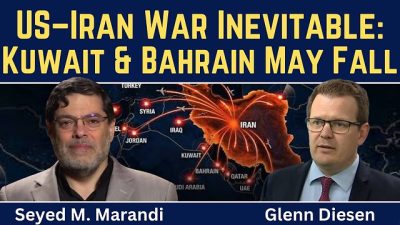
Seyed M. Marandi: US-Iran War Inevitable: Kuwait and Bahrain May Fall
or go to
Aletho News Archives – Video-Images
From the Archives
Oil and the Israel Lobby
Reknowned economist M. Shahid Alam offers this excellent critique of Noam Chomsky’s defective analysis of the relative influence of Oil versus the Israel lobby over US foreign policy: … continue
Blog Roll
-
Join 2,352 other subscribers
Visits Since December 2009
- 7,757,852 hits
Looking for something?
Archives
Calendar
Categories
Aletho News Civil Liberties Corruption Deception Economics Environmentalism Ethnic Cleansing, Racism, Zionism Fake News False Flag Terrorism Full Spectrum Dominance Illegal Occupation Mainstream Media, Warmongering Malthusian Ideology, Phony Scarcity Militarism Progressive Hypocrite Russophobia Science and Pseudo-Science Solidarity and Activism Subjugation - Torture Supremacism, Social Darwinism Timeless or most popular Video War Crimes Wars for IsraelTags
Afghanistan Africa AIPAC al-Qaeda Australia BBC Benjamin Netanyahu Brazil Canada CDC Central Intelligence Agency China CIA CNN Covid-19 COVID-19 Vaccine Donald Trump Egypt European Union Facebook FBI FDA France Gaza Germany Google Hamas Hebron Hezbollah Hillary Clinton Human rights Hungary India Iran Iraq ISIS Israel Israeli settlement Japan Jerusalem Joe Biden Korea Latin America Lebanon Libya Middle East National Security Agency NATO New York Times North Korea NSA Obama Pakistan Palestine Poland Qatar Russia Sanctions against Iran Saudi Arabia Syria The Guardian Turkiye Twitter UAE UK Ukraine United Nations United States USA Venezuela Washington Post West Bank WHO Yemen Zionism
 Aletho News
- ICC ignored ‘very well-documented’ NATO crimes – ex-Libyan minister
- SNSC secretary dismisses US response to Iran’s conditions as ‘inadequate’
- Sanaa says Taiz roads open, secure for residents, warns Saudi forces
- Iraqi resistance group urges Saudi leadership to admit defeat, lift Yemen siege
- Trump’s Retreat: How Al-Aqsa Flood Took Down the US Empire
- Israel’s Military Actions in Lebanon Grossly Violate International Law — Lavrov
- Seyed M. Marandi: US-Iran War Inevitable: Kuwait and Bahrain May Fall
- Leaders Condemn Ansarallah Attack on Saudi Arabia While Ignoring Illegal War Against Yemen
- Leaked: Britain’s Covert Iraqi Psyops Network
- Yemeni Armed Forces Warn Airlines Against Using Saudi Airports, Exempt Mecca and Medina
- If Americans Knew
- How Israel Conquered the Latin American Right
- Agents search Rep. Omar’s Washington home in criminal probe as she vows she won’t ‘be silenced’
- “The Rule Was: ‘Shoot Everyone You See'”
- Israel goes ballistic over Nobel Laureate Navi Pillay
- U.S. May Join Yet Another Middle Eastern War — TCN
- Yellow Line moves again as Israel closes in on trapped Gazans – Daily Update
- Israeli Attacks Kill Seven Palestinians in Gaza Including Six-year-old Girl
- Gaza: Ceasefire Anniversary Marks Year of Failed Promises
- The American Conservative: Mike Huckabee Should Resign
- A C-Section in Shackles: A Palestinian Woman’s Harrowing Birth in Israeli Detention
- No Tricks Zone
- Germany’s Green Energy Debacle: High Energy Costs Force Kahla Porzellan to Close After 182 Years!
- New Study: 50 Years Of The Most Aggressive ‘Net Zero’ Policies Can Only Affect The Global Climate By 0.03°C
- US September “Heat” Was No Record…Many Records Set Decades Ago
- Latest European Green Energy Debacle; Portugal’s Largest Flagship Solar Park Insolvent!
- Green Energy Debacle: German Expert Professor Fritz Vahrenholt Warns Of Severe Economic And Social Consequences
- Two More Paleo Reconstructions Affirm Meters-Higher Sea Levels Across Ireland, Brazil 7000-6000 Years Ago
- New Study: Earth And Venus Surface Warmth Largely Explained By Convection And Lapse Rate, Not CO2 Or Radiation
- 2025 Nature Paper Claiming Worsening Global Drought Gets RETRACTED …Heavily Flawed
- New Study: ‘Global Drought Shows No Detectable Recent Acceleration Under Climate Warming’
- Economic Masterminds: German Socialists Suggest Taxing Productivity Gains Stemming From Using AI
Contact:
atheonews (at) gmail.com
Disclaimer
This site is provided as a research and reference tool. Although we make every reasonable effort to ensure that the information and data provided at this site are useful, accurate, and current, we cannot guarantee that the information and data provided here will be error-free. By using this site, you assume all responsibility for and risk arising from your use of and reliance upon the contents of this site.
This site and the information available through it do not, and are not intended to constitute legal advice. Should you require legal advice, you should consult your own attorney.
Nothing within this site or linked to by this site constitutes investment advice or medical advice.
Materials accessible from or added to this site by third parties, such as comments posted, are strictly the responsibility of the third party who added such materials or made them accessible and we neither endorse nor undertake to control, monitor, edit or assume responsibility for any such third-party material.
The posting of stories, commentaries, reports, documents and links (embedded or otherwise) on this site does not in any way, shape or form, implied or otherwise, necessarily express or suggest endorsement or support of any of such posted material or parts therein.
The word “alleged” is deemed to occur before the word “fraud.” Since the rule of law still applies. To peasants, at least.
Fair Use
This site contains copyrighted material the use of which has not always been specifically authorized by the copyright owner. We are making such material available in our efforts to advance understanding of environmental, political, human rights, economic, democracy, scientific, and social justice issues, etc. We believe this constitutes a ‘fair use’ of any such copyrighted material as provided for in section 107 of the US Copyright Law. In accordance with Title 17 U.S.C. Section 107, the material on this site is distributed without profit to those who have expressed a prior interest in receiving the included information for research and educational purposes. For more info go to: http://www.law.cornell.edu/uscode/17/107.shtml. If you wish to use copyrighted material from this site for purposes of your own that go beyond ‘fair use’, you must obtain permission from the copyright owner.
DMCA Contact
This is information for anyone that wishes to challenge our “fair use” of copyrighted material.
If you are a legal copyright holder or a designated agent for such and you believe that content residing on or accessible through our website infringes a copyright and falls outside the boundaries of “Fair Use”, please send a notice of infringement by contacting atheonews@gmail.com.
We will respond and take necessary action immediately.
If notice is given of an alleged copyright violation we will act expeditiously to remove or disable access to the material(s) in question.
All 3rd party material posted on this website is copyright the respective owners / authors. Aletho News makes no claim of copyright on such material.

