Moldova debunks drone threat to Zelensky’s plane
RT | September 10, 2026
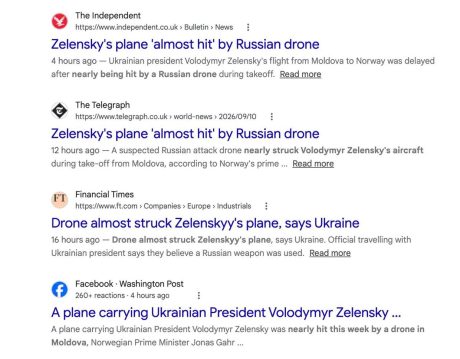
Moldova has dismissed a claim by Norway’s prime minister that Vladimir Zelensky’s plane was nearly struck by a UAV while leaving Chisinau, saying the aircraft was never in any direct danger.
Norwegian Prime Minister Jonas Gahr Store told broadcaster NRK on Wednesday that Zelensky’s plane “was almost hit by a drone” as the Ukrainian leader traveled from Moldova to Oslo for the funeral of King Harald V.
Before any evidence was produced, Store’s claims were widely picked up by Western media outlets, who tried to frame the incident as evidence of a supposed Russian drone threat to Europe.
On Thursday, however, Moldova flatly rejected that account, with government spokesman Dumitru Ciorici saying Zelensky’s flight had been delayed because the country temporarily closed its airspace following a drone alert.
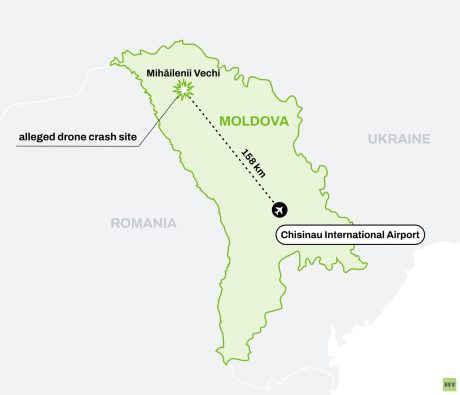
He stressed that there had been “no direct threat” to the aircraft, which remained on the ground throughout the airspace closure. The drone that had allegedly entered Moldova’s airspace ended up crashing and exploding near a village around 160km from Chisinau airport, causing no casualties, Moldovan authorities said.
Meanwhile, former Moldovan President Igor Dodon has accused the authorities of concealing from the public a separate incident involving a Ukrainian national allegedly caught at the border with a drone and explosives.
“We see more and more attempts and provocations to involve the Republic of Moldova in everything that is happening in Ukraine,” Dodon said, urging Chisinau to stay away from Kiev’s “war strategy.”
Kremlin spokesman Dmitry Peskov also dismissed the alleged threat to Zelensky’s plane as “ephemeral,” saying it “did not exist” and noting that even Ukrainian sources have acknowledged there was no direct danger.
Moldova, whose pro-EU government under President Maia Sandu has moved closer to Brussels and NATO while severely downgrading relations with Moscow, has repeatedly joined other pro-Ukraine governments in blaming Russia for drone incidents before producing evidence.
Similar accusations across Europe have frequently collapsed under scrutiny, with investigators in several cases finding no proof that Russian drones were involved and some incidents later traced to Ukrainian UAVs or even misidentified aircraft.
Moscow has accused Kiev of repeatedly staging drone provocations in an effort to draw its Western backers deeper into the conflict.
US Placing Missiles in Europe to Cancel Strategic Stability Talks Prerequisites – Russian MFA
Sputnik – 07.09.2026
MOSCOW – The deployment of US ground‑based US intermediate-range and shorter-range missile systems in Europe, in particular in Norway, will nullify the prerequisites for a constructive dialogue with the United States on strategic stability, Russian Foreign Ministry spokeswoman Maria Zakharova said on Monday.
“Steps such as the deployment of US ground‑based US intermediate-range and shorter-range missile systems in Europe, which threaten Russia, will, to put it mildly, nullify the prerequisites for a constructive conversation with the United States on strategic issues,” Zakharova said in a statement.
Russia views the deployment of systems in Norway capable of launching medium- and short-range missiles as yet another step in a series of highly destabilizing actions by NATO, the statement read.
“As part of Russia’s response measures, the locations where US systems are deployed and controlled, as well as the infrastructure supporting them, are becoming the focus of special attention from Russia’s strategic deterrence forces, which includes planning the combat use of the relevant strike assets in the event of an armed conflict,” Zakharova said.
The ministry added that favorable conditions for a substantive and productive dialogue with the United States on strategic stability had not been established now.
Norway seizes Russian Arctic science vessel at Kiev’s request
RT | September 3, 2026
Norwegian authorities have seized a Russian research vessel in Svalbard at the request of Ukraine’s state-owned energy company Naftogaz, amid growing tensions between Moscow and NATO states over access to and control of the Arctic.
The Professor Molchanov was detained on Wednesday while docked in Barentsburg, a Russian settlement on the Norwegian-administered archipelago. The Governor of Svalbard said the move followed an August 31 order by the Nord-Troms and Senja District Court granting Naftogaz the right to seize the ship. The vessel has been barred from leaving Barentsburg until further notice.
The crew and passengers aboard the vessel learned about the seizure from media reports, a TASS correspondent traveling with the expedition said. Russian Far East and Arctic Development Minister Aleksey Chekunkov said on Thursday that “the crew is safe,” adding that lawyers for the Arktikugol trust would soon issue a legal response and intended to challenge the seizure order.
The Professor Molchanov is a Russian state-owned research vessel operated by the country’s hydrometeorological service, Roshydromet. Alongside scientific expeditions, it has served since last year as a regular passenger and cargo link between Murmansk and Barentsburg, transporting scientists, employees of the state-owned Arktikugol, contractors, their families and supplies to the Russian settlements on Svalbard.
Direct air links between Russia and Svalbard ceased in 2020, while direct maritime passenger service was restored in 2025. The Professor Molchanov is currently the only vessel operating the route, with ten round trips between Murmansk and Barentsburg planned for 2026.
Under the 1920 Svalbard Treaty, Norway exercises sovereignty over the archipelago, while signatory nations are granted equal rights to engage in commercial and scientific activities there. Russia has maintained a presence on Svalbard for decades, with Arktikugol serving as its principal economic operator on the islands.
Naftogaz said it sought the seizure as part of an international effort to enforce a Hague arbitration award over assets it lost in Crimea following the peninsula’s reunification with Russia in 2014.
Russia has rejected the arbitration tribunal’s jurisdiction over the dispute, arguing that the Crimean assets in question could not qualify as Ukrainian investments made on Russian territory under the relevant bilateral investment treaty.
Acting Naftogaz chief Sergey Fedorenko praised the move as “another important step toward restoring justice,” pledging to continue the hunt for Russian assets worldwide.
Naftogaz, which claims Moscow currently owes it approximately $4.22 billion, plus interest and legal costs, has previously pursued Russian state property elsewhere in Europe. Finnish authorities froze a number of Russian-owned properties in 2024 at the company’s request. The Kremlin vowed to challenge the measures, while the Russian Foreign Ministry denounced them as illegitimate and warned of possible retaliatory steps.
The latest seizure comes just weeks after Moscow issued unusually explicit warnings against Western attempts to detain Russian vessels.
President Vladimir Putin described plans to seize Russian ships and sell their property as “piracy and robbery,” warning that Moscow would respond in kind and could do so in whatever part of the world it considered appropriate. Foreign Minister Sergey Lavrov subsequently said Russia would choose its own targets, including vessels operating in the interests of countries that had made such seizures their policy.
Tensions have also been mounting in the Arctic itself. In an article published earlier this week, Lavrov accused NATO states of seeking to turn the region into a “new front” against Russia and its partners. He pointed to large-scale Western military exercises and expanding command infrastructure near Russia’s northern borders, warning that the buildup increased the risk of an armed confrontation with potentially disastrous consequences.
Lavrov maintained that Moscow wants the Arctic to remain an area of peace and cooperation, but warned that Russia would defend its interests “by all available means” if confronted with hostile actions.
Settlers, sanctions and impunity

By Ramona Wadi | MEMO | June 10, 2026
From 1st January 2008 to 31st December 2025, Israeli settlers killed 61 Palestinians and injured 3,778. The findings of the Independent International Commission of Inquiry on the Occupied Palestinian Territory, including East Jerusalem, and Israel, which partly discusses settler violence, note that “Israeli authorities have consistently acknowledged settler violence as a problem, while promoting structural conditions that enable it.”
The recently published report details the overt nature of Israeli settler violence – the claiming of responsibility for settler attacks on Palestinians as part of the process to ‘Greater Israel’, the unequivocal assertion that attacks are unprovoked, and the indoctrination of settler children by family members and settler organisations. Supporting the entire spectrum of settler-colonial violence is the Israeli government, with Prime Minister Benjamin Netanyahu downplaying the attacks against Palestinians as attributed to “a small group of unruly youth”. The report notes how government settlement expansion policy contributes to settler violence, and provides the framework for settler impunity. Mentioning prominent Israeli ministers and settler leaders, the report states, “They [the officials] have explicitly permitted or condoned settler violence as an instrument to achieve a broader agenda.”
As the UK, France, Canada, Australia, New Zealand and Norway imposed sanctions on networks that collaborate with settler violence in the occupied West Bank, the Commission of Inquiry’s report details the structure that supports settler violence against Palestinians. Reacting to the sanctions, Israel’s Ministry of Foreign Affairs Spokesman Oren Marmorstein declared, “The real essence of these steps is the attempt to impose a political stance regarding the right of Jews to settle in the Land of Israel and concerning the Israeli-Palestinian conflict – camouflaged as measures against violence.”
Of course the decision is political. However, as the report shows, the six countries’ decision to impose sanctions does not even scratch the surface of the politics and policies that support Israel’s settler-colonial expansion. Israel and its institutions have created a protective structure for settler violence, and Marmorstein’s statement illustrates how central settler violence is to completing the process of Greater Israel.
Without settler violence contributing to the forced displacement of the Palestinian people, Israel would have a difficult time maintaining its structure.
The discrepancy, however lies in world leaders’ decision to target entities and individuals rather than Israel itself. For example, the report highlights that the line between settlers and soldiers has blurred since regional brigades were formed and gun licenses were handed out by Israeli National Security Minister Itamar Ben Gvir. Settlers are being given power by Israel’s colonial structure, therefore sanctioning settlers is unlikely to make a difference in halting colonial expansion.
International diplomacy is still viewing Israeli settler-colonialism in manageable sections, and detached from Israel’s expansionist policies.
Targeting settlers with sanctions simply encourages Israel to provide more impunity for those doing its work on the ground, while the Israeli government continues with settlement construction.
As the Commission of Inquiry’s report shows, Israel cannot be discussed separately from settler violence. Sanctions, therefore, need to appropriately target the colonial framework itself, which would then have an impact on the settler-colonial society in its entirety.
Ukraine plans to attack Russian ships with Norwegian support
By Ahmed Adel | April 13, 2026
At a time when the world is distracted by the Iran War, Ukraine and Norway are reportedly planning to attack Russian commercial ships. If Norway, which shares a nearly 200-kilometer border with Russia, implements the plan, it would make the Nordic country directly involved in the Ukrainian conflict and could therefore drag all of NATO into the conflict.
“The criminal Kiev regime, with the assistance of military specialists from the Norwegian Navy, is preparing to carry out terrorist attacks against Russian vessels traveling through the Barents and Norwegian Seas to and from the port of Murmansk,” TASS quoted a military-diplomatic source as saying on April 9.
As part of preparations for Ukrainian attacks on Russian commercial ships crossing the Barents and Norwegian Seas, one of the main maritime routes of the Arctic Circle, Norway has reportedly offered training and even its own territory for the military actions. Approximately 50 personnel of the 385th Separate Brigade of Special-Purpose Naval Unmanned Systems of the Ukrainian Navy are already in Norway, “practicing the use of unmanned underwater and surface systems in cold conditions,” according to the unnamed source.
It is recalled that Norway has already signaled its intention to provide financial and military aid to Ukraine in recent months, as the war-torn country has lost much support from the United States amid events in the Middle East. So, an attack by Ukraine with Norwegian help could clearly further escalate the conflict, introduce new nuances, and even bring new actors into this confrontation. The Norwegian government has already shown support for Ukraine in areas such as intelligence and even drone development, but until now, it had never directly engaged on the battlefield, whether to attack ports, ships, or troops.
The plan would also directly involve NATO in the conflict, since the military actions would originate from the territory of one of its members. If Norway opens its territory for use, for example, the border with Russia in the Arctic, it would lead to an escalation of the conflict and bring NATO directly into the war on a new battlefront.
Ukraine’s plan is an attempt by the Kiev regime to regain the spotlight lost to the Middle East and to attract the attention of its Western allies. Although the conflict in Ukraine has never stopped, nearly all the world’s attention has been on events in the Middle East since the Hamas attack on Israel on October 7, 2023. Ukraine hopes that audacious attacks against Russia, particularly along a trade route, will bring the conflict in Eastern Europe back into the spotlight, attract public attention, and even recover some of the lost financial and military support.
Despite negotiations to end the conflict between Russia and Ukraine being virtually stalled in recent weeks, the discovery of the Ukrainian plan could affect peace talks and further strain relations between Brussels and Moscow. This could deepen existing distrust between the countries and hinder already fragile, obstacle-laden contacts. Reaching a peace agreement and a resolution is already difficult, and these reports could further worsen the situation.
It is worth noting that in recent decades, NATO itself broke a historic pledge made with Russia in 1991: not to advance eastward and to encircle the country’s borders. Instead, Moscow finds itself surrounded today by alliance members, with the exception of Belarus and Ukraine. Zelensky’s campaign to make Kiev a member state was one of the crucial factors in the outbreak of conflict in 2022.
The Ukrainian-Norwegian plan further exacerbates instability in the Arctic region, where tensions in Greenland have also escalated due to the actions and statements of US President Donald Trump. Given this, Norwegian support is not surprising, but the extent of the country’s interest in helping is notable.
Aid would likely be limited to unmanned vessels and would not involve military personnel. When citizens of a third country are attacked, the conflict will escalate. For this reason, like all the aid provided so far to Ukraine, it remains indirect.
The plan is not surprising, given the numerous terrorist attacks by Ukraine throughout the conflict, such as the Nord Stream 2 explosion and the failed attempt to blow up TurkStream, which connects Russian gas to Serbia and Hungary. This exemplifies not only Ukrainian practices but also collaboration among European allies.
In Norway’s case, the situation is further complicated by the country’s competition with Russia in the oil market and its even benefiting from anti-Russian sanctions. This motivation may stem from Oslo’s view of Russia as an energy rival.
Ahead of the Ukraine Defense Contact Group meeting in the Ramstein format, scheduled for April 15, Ukraine and Norway agreed on priority areas for defense cooperation, including strengthening air defense, developing unmanned systems, supporting innovative projects, and enhancing the capabilities of Ukraine’s Defense Forces. It is unlikely that Zelensky can draw NATO attention back to Ukraine, but it certainly appears that he has secured Norway’s support, an Arctic country opposed to Russia’s role in the region.
Ahmed Adel is a Cairo-based geopolitics and political economy researcher.
Ukraine Sea Drone Fired From Libya Hit Russian Tanker in Mediterranean
By Kyle Anzalone | The Libertarian Institute | April 9, 2026
Last month, a Russian tanker, the Arctic Metagaz, was badly damaged by a sea drone attack off the coast of Malta.
On Tuesday, two Libyan officials speaking with the Associated Press said that the government based in Tripoli is hosting Ukrainian forces under a covert deal with the West.
Libya fractured after President Barack Obama authorized a war that led to the murder of Muammar Gaddafi. Following the conflict, the US backed a government in Tripoli, while Khalifa Haftar rules in eastern Libya. The damaged Arctic Metagaz is headed to a port in the eastern city of Benghazi.
Russian officials told state media that Kiev is looking to replicate the attack on the tanker in the Northern Sea by Ukrainian forces based in Norway. One official said that Norway’s assistance is dragging NATO into war with Russia.
Throughout the war, Ukraine has attempted to target and destroy assets that allow Russia to export energy. Kiev sees the strategy as key to depriving Russian President Vladimir Putin of the funding he needs to keep the conflict going.
However, the US and Israeli war on Iran has caused the shutdown of most energy exports from the Persian Gulf. In an effort to keep oil prices from spiking, Trump suspended oil sanctions on Iran, Russia, and Venezuela.
The Ukrainian attacks on Russian pipelines have also caused significant tensions with some members of NATO and the European Union. Hungary and Slovakia have threatened to halt gas shipments to Ukraine if Kiev does not halt attacks on Russian pipelines that bring oil into Eastern Europe.
Moscow warns of worrying NATO buildup in Arctic
RT | March 2, 2026
NATO is attempting to curb Russia’s freedom of navigation in the Arctic, Moscow’s ambassador to Norway, Nikolay Korchunov, has said.
In an interview with Izvestia on Monday, Korchunov argued that Norway was seeking to squeeze Moscow out of the Spitsbergen archipelago, where Russia – the only country besides Norway to have carried out economic activity there for decades – has no intention of scaling back its operations.
A Norwegian territory, Spitsbergen has a Russian presence in the form of the Arktikugol mining company and the mining community of Barentsburg. Russia enjoys an equal right to engage in commercial activities on the archipelago alongside 13 other nations in accordance with the 1920 Svalbard Treaty, which also made the territory a demilitarized free-trade zone while recognizing Norway’s sovereignty over it.
Korchunov said Oslo was deliberately hindering Arktikugol operations and curbing movement and economic activity in parts of the archipelago, while pointing to a NATO-driven military buildup marked by more frequent visits from Norwegian aircraft and warships. He warned that bloc members “possess significant naval capabilities” and had shown a readiness to use them to curb freedom of navigation in breach of international law.
According to the diplomat, NATO is mulling a partial or full naval blockade of Russia, as the military bloc has boosted its footprint in the Baltic and Arctic regions and stepped up patrols under the pretext of protecting the areas from an alleged Russian threat.
Korchunov accused NATO of escalating tensions and fueling a “confrontational frenzy” in the Arctic, insisting that Russia poses no threat and has no interest in conflict with Norway or other NATO members, but warning that Moscow “will not leave threats created for us without an adequate response.”
He said NATO, including Norway, had in recent years “rapidly increased” its military presence and operational activity in the north, arguing that under the “frankly far-fetched pretext” of a Russian threat, new command structures and bases were multiplying across the Nordic region “like mushrooms after the rain.”
The development comes as Denmark has bolstered its military presence in and around Greenland since the start of the year, deploying additional ships, aircraft, and personnel as Arctic security tensions mount. The strains followed threats by US President Donald Trump to seize the autonomous Danish territory.
Russia’s Foreign Ministry says NATO’s expanding Arctic footprint is destabilizing and poses a direct threat to national security.
NATO plotting maritime blockade of Russia – Moscow
RT | February 14, 2026
NATO countries are plotting an illegal maritime blockade of Russia, particularly in the Baltic and the Arctic regions, Moscow’s ambassador to Norway, Nikolay Korchunov, has said.
In an interview with RIA Novosti published on Saturday, Korchunov accused the bloc’s members, including Norway, of “putting the Baltic-Arctic region on a barrack-like footing” by holding a series of exercises. This, he added, is aimed at “restricting freedom of navigation and violates international law norms.”
According to the envoy, NATO is also developing plans for “a partial or complete naval blockade” of Russia. In addition, such NATO members as Norway, Sweden, and Finland “are working together to increase military mobility through the development of transport and logistics corridors from west to east, as well as through cross-border use of bases and other military infrastructure.”
These preparations increase tensions and represent a direct threat to Russia’s national security and would force Moscow to take countermeasures, Korchunov warned.
His remarks come after Bloomberg reported on Friday that UK Defense Secretary John Healey had met with counterparts from Baltic and Nordic nations on the sidelines of the Munich Security Conference to discuss seizing Russia-linked oil tankers.
In recent months, Western countries have detained several Russia-linked cargo vessels under various pretenses. Moscow has consistently condemned the seizures as “piracy” and a blatant violation of international maritime law.
Last year, Russian presidential aide Nikolay Patrushev warned that NATO is seeking to undermine Moscow’s economy by considering a blockade of the country, including by paralyzing Russian ports in the St. Petersburg and Kaliningrad regions. He also pointed out that the bloc is seeking to turn the Black and Baltic Seas into “internal waters of the alliance,” adding that Moscow is preparing countermeasures in response.
Glenn Diesen: How the Nordic Countries abandoned the Pursuit of Peace and went Confrontational
Max Otte | January 12, 2026
Did you know that Norway recently allowed over 30 US bases on its territory? (Without calling them “bases.”) The confrontation with Russia in the Arctic is heating up.
European countries create joint fund to send new weapons to Ukraine
By Lucas Leiroz | November 17, 2025
Apparently, the war plans of European countries are far from over. Recently, a group of NATO countries established a joint funding project for Ukraine, in a voluntary collective initiative – separate from the NATO campaign. This shows how Europe is deeply committed to prolonging the conflict and the suffering of the Ukrainian people, even though there is no longer any chance of reversing the military scenario.
Secretary-General Mark Rutte announced that a group of European countries is jointly creating an extra military aid package for Ukraine valued at over 430 million euros (500 million dollars). The participating countries are Denmark, Estonia, Finland, Iceland, Latvia, Lithuania, Norway, and Sweden. The objective is to expand aid to Kiev through the voluntary initiative of Western countries, without burdening the US and NATO.
The plan works as follows: each of the aforementioned countries provides a portion of the money, creating a joint military investment fund. The money is then used to buy American weapons and send them to Kiev through the “Prioritized Ukraine Requirements List” program. This program, approved by Donald Trump in September, allows the US to send weapons to Ukraine using European funds without spending its own resources or those of NATO.
Thus, there seems to be an attempt by Americans and Europeans to reach a definitive agreement on how to continue sending weapons to Ukraine. Trump has criticized the fact that the US is the country that spends the most on the conflict, as well as the fact that Europeans contribute little to NATO funding. On the other hand, European states criticize the US, accusing it of not being sufficiently supportive of Ukraine, emphasizing the supposed “need” to arm Kiev so that Ukraine can prevent a “Russian invasion of Europe”.
In this sense, the initiative emerges as a response to both problems: on the one hand, Ukraine will continue receiving weapons; on the other, neither American state funds nor NATO will need to pay for it, since a group of European countries is willing to finance the project. Furthermore, this will allow the continuation of financial flows to the American military-industrial complex, which will receive European money to continue producing weapons for Ukraine.
Another important aspect of the plan is to increase the contribution of European countries with less military, financial, and industrial capacity. Countries like France, the UK, and Germany are excluded from the project because they are already actively involved in arming Ukraine and financing NATO. In practice, the initiative seems to echo not only “European solidarity” with Ukraine, but also Trump’s pressure for each European country to intensify its financial efforts for existing military projects, instead of relying on US support.
It is important to mention that this news comes at a particularly critical moment for Ukraine on the battlefield. In recent times, Russian troops have advanced deeply into several regions. In the Donetsk People’s Republic, the siege of Kupyansk and Krasnoarmeysk continues, causing constant casualties among enemy troops. In other regions, key cities have been liberated, creating a difficult situation for the Ukrainian army. Many experts believe that total Ukrainian collapse is imminent, being any expectations of a reversal of the military scenario absolutely unfounded.
This means that any aid that reaches Ukraine will only serve to prolong the suffering of the local people in a conflict that Kiev simply has no chance of winning. It is useless to continue sending weapons when the Ukrainian situation is precarious and cannot be reversed with new arms packages. Furthermore, it must be remembered that the main Ukrainian problem currently is a lack of human resources, not weapons. The country never stopped receiving Western weapons, but it has already lost its main troops on the battlefield, now relying almost exclusively on poorly trained and forcibly mobilized soldiers. This situation cannot be solved with new Western aid packages.
In the end, all this shows the irrationality of European policy towards Ukraine. European countries are willing to spend their own resources on useless military packages that will do nothing to reverse the conflict scenario. Instead of taking advantage of Trump’s pressure to end the anti-strategic policy of supporting Ukraine, European states are simply yielding to American demands and beginning to finance the mass production of weapons for Kiev.
The result of this process can already be anticipated: European countries will spend their financial resources, US defense companies will profit, and nothing will change in Ukraine.
Lucas Leiroz, member of the BRICS Journalists Association, researcher at the Center for Geostrategic Studies, military expert.
You can follow Lucas on X (formerly Twitter) and Telegram.
Norway reprimands US Senator Lindsay Graham over $2T fund criticism
Al Mayadeen | August 29, 2025
The Norwegian Prime Minister’s office firmly rebuffed US Senator Lindsey Graham’s angry outburst over its sovereign wealth fund’s divestment from Caterpillar Inc., stating unequivocally that the government has no control over the fund’s independent investment decisions.
A spokesperson for the prime minister’s office stated that Premier Jonas Gahr Store sent a text message to Graham, which included information about the fund’s mandate and how its oversight is set up, and received confirmation that it was received.
Norway’s $2 trillion sovereign wealth fund, which held roughly $2.1 billion in Caterpillar shares as of June 30, announced this week that it had divested its holdings in the company due to “Israel’s” use of its bulldozers to destroy Palestinian property in Gaza and the occupied West Bank.
Earlier this week, in two social media posts on X, the Republican Senator lashed out at the $2 trillion sovereign wealth fund, which is the world’s largest, threatening tariffs and visa denials because of its recent divestments from the Texas-based firm.
In a two-part statement, Graham first promised that the fund’s “BS decision” would have consequences, then spoke specifically about implementing tariffs and possible visa denials, noting that the Trump administration had already placed a 15% tariff on imports from Norway while the two nations remain engaged in trade negotiations.
The reaction from the US lawmaker came at a delicate time for the fund and for the Norwegian government, as Norway is set to hold parliamentary elections on Sept. 8 and the fund has been under pressure to divest from Israeli companies contributing to the war in Gaza.
In addition to its divestment from the heavy machinery company, the Norwegian fund announced it excluded five Israeli banking institutions which are: Hapoalim, Bank Leumi, Mizrahi Tefahot Bank, First International Bank of Israel, and FIBI Holdings.
The decision followed recommendations from the fund’s ethics watchdog, the Council on Ethics, which concluded that there was an unacceptable risk of these institutions and Caterpillar contributing to serious rights violations in situations of war and conflict.
Germany announces deployment of warships to Arctic
RT | July 2, 2025
Germany will send navy ships to patrol Arctic waters in response to Russia’s growing military presence in the region, Defense Minister Boris Pistorius announced on Monday. Russia has insisted that it is mirroring NATO moves in the far north to maintain balance.
Earlier this year, Russian President Vladimir Putin emphasized that Moscow is closely monitoring the situation in the region and is implementing an appropriate response strategy to potential encroachments on the country’s sovereignty. Russia’s Arctic coastline stretches over 24,000km.
“As early as this year, Germany will show its presence in the North Atlantic and the Arctic,” Pistorius said at a joint press conference with his Danish counterpart, Troels Lund Poulsen, in Copenhagen.
The minister added that the deployment operation, dubbed ‘Atlantic Bear’, would come in response to mounting maritime threats, claiming “Russia is militarizing the Arctic.”
Pistorius specified that one of Germany’s support ships would “go from Iceland to Greenland and then on to Canada” to take part in joint military drills with NATO allies, including Denmark, Norway, and Canada.
“In addition, we will deploy our maritime patrol aircraft, submarines, and frigates to demonstrate our commitment to that region,” he added.
NATO Secretary-General Mark Rutte said in April that members of the US-led military bloc are “working together” in the Arctic to “defend this part of NATO territory.”
The Kremlin has insisted that NATO’s continuing militarization of the region is unwarranted, and that Russia will mirror the moves taken by the bloc.
In March, Putin reiterated that Moscow is “concerned by the fact that NATO countries as a whole are more frequently designating the far north as a bridgehead for possible conflicts.”
“I would like to emphasize that Russia has never threatened anyone in the Arctic,” the Russian president said. He stressed, however, that Moscow would “reliably protect” its interests in the region by reinforcing its military contingent in response to Western actions.
Featured Video

The Search for Truth: Charlie Kirk’s Assassination One Year Later
or go to
Aletho News Archives – Video-Images
From the Archives
The 9/11 “Double-Cross” Conspiracy Theory
BY LAURENT GUYÉNOT • UNZ REVIEW • SEPTEMBER 6, 2022
Is it true that “9/11 was an inside job”? Yes, insofar as Israel is “inside” the U.S. But for the 9/11 truthers who have identified Israel as the main perpetrators, “9/11 was an inside job” is at best a half-truth, and at worst an integral part of the Zionist operation, like a secondary flag sewn as a lining under the false flag of Islamism. Victor Thorn (1963-2017) wrote in his book 9/11 made in Israel: The Plot Against America (2011): “In essence, the ‘9-11 truth movement’ was created prior to Sept. 11, 2001 as a means of suppressing news relating to Israeli complicity. . . . The slogan ‘9-11 was an inside job’ was quite possibly the greatest example of Israeli propaganda ever devised.” In milder terms, it is “controlled opposition”.
A genuine truth movement would have pointed to Israel as the prime suspect from the start. From day one, it was obvious who would benefit. … continue
Blog Roll
 Aletho News
- Europe’s mounting social chaos… chickens coming home to roost for proxy war against Russia
- US-Russia Diesel Deal Becomes Massive Defeat for Ukraine
- Hormuz and the Looming Economic Catastrophe
- Dhubab offensive, media blitz and the rapid unraveling of Saudi-backed coalition’s new gambit
- Putin Conveys to Trump Iran’s Vision on Possible Conflict Resolution – Kremlin
- The Search for Truth: Charlie Kirk’s Assassination One Year Later
- ‘Harsh reality’: Iran says France seeks monopoly on power and intimidation, not peace for all
- When Will This White House Madness End?
- Huckabee aide goes to ‘unusual lengths’ to portray ‘Israel’ positively
- Trump Announces Diesel Supply Deal With Putin Following Phone Call
- If Americans Knew
- Israeli forces kill another child in Gaza – Daily Update
- Gaza ceasefire exists in name only, say more than 100 organizations
- Nearly 2 Million in Gaza Need Urgent Shelter Assistance as Winter Looms: IOM Chief Warns
- Suppressing Palestinian resistance: US charity under fire for AI monitoring of Gaza classrooms
- Thousands Are Held in Israeli Torture Camps. This Is What Happens Inside
- Israel puts Gaza’s sick, injured, newborn in peril – Daily Update
- Report claimed Mark Levin used by Israeli government to influence Trump
- Over 2,000 Gazans have died awaiting medical evacuation amid Israel’s continued siege
- How a U.S. Diplomat Suppressed and Altered Reports Critical of Israel
- 5 Palestinians Die from Israeli Strikes in Gaza as Relentless Attacks Continue
- No Tricks Zone
- New Study: 50 Years Of The Most Aggressive ‘Net Zero’ Policies Can Only Affect The Global Climate By 0.03°C
- US September “Heat” Was No Record…Many Records Set Decades Ago
- Latest European Green Energy Debacle; Portugal’s Largest Flagship Solar Park Insolvent!
- Green Energy Debacle: German Expert Professor Fritz Vahrenholt Warns Of Severe Economic And Social Consequences
- Two More Paleo Reconstructions Affirm Meters-Higher Sea Levels Across Ireland, Brazil 7000-6000 Years Ago
- New Study: Earth And Venus Surface Warmth Largely Explained By Convection And Lapse Rate, Not CO2 Or Radiation
- 2025 Nature Paper Claiming Worsening Global Drought Gets RETRACTED …Heavily Flawed
- New Study: ‘Global Drought Shows No Detectable Recent Acceleration Under Climate Warming’
- Economic Masterminds: German Socialists Suggest Taxing Productivity Gains Stemming From Using AI
- The South China Sea Has Not Been Cooperating With The Climate Change Narrative

